EP4403371A1 - Polymerschichtverbund für sicherheits- und wertdokumente, herstellungsverfahren, zubereitung und verwendung - Google Patents
Polymerschichtverbund für sicherheits- und wertdokumente, herstellungsverfahren, zubereitung und verwendung Download PDFInfo
- Publication number
- EP4403371A1 EP4403371A1 EP24151372.0A EP24151372A EP4403371A1 EP 4403371 A1 EP4403371 A1 EP 4403371A1 EP 24151372 A EP24151372 A EP 24151372A EP 4403371 A1 EP4403371 A1 EP 4403371A1
- Authority
- EP
- European Patent Office
- Prior art keywords
- weight
- layers
- polycarbonate
- composite
- preparation
- Prior art date
- Legal status (The legal status is an assumption and is not a legal conclusion. Google has not performed a legal analysis and makes no representation as to the accuracy of the status listed.)
- Pending
Links
Images
Classifications
-
- B—PERFORMING OPERATIONS; TRANSPORTING
- B41—PRINTING; LINING MACHINES; TYPEWRITERS; STAMPS
- B41M—PRINTING, DUPLICATING, MARKING, OR COPYING PROCESSES; COLOUR PRINTING
- B41M5/00—Duplicating or marking methods; Sheet materials for use therein
- B41M5/26—Thermography ; Marking by high energetic means, e.g. laser otherwise than by burning, and characterised by the material used
- B41M5/30—Thermography ; Marking by high energetic means, e.g. laser otherwise than by burning, and characterised by the material used using chemical colour formers
- B41M5/323—Organic colour formers, e.g. leuco dyes
-
- B—PERFORMING OPERATIONS; TRANSPORTING
- B41—PRINTING; LINING MACHINES; TYPEWRITERS; STAMPS
- B41M—PRINTING, DUPLICATING, MARKING, OR COPYING PROCESSES; COLOUR PRINTING
- B41M5/00—Duplicating or marking methods; Sheet materials for use therein
- B41M5/26—Thermography ; Marking by high energetic means, e.g. laser otherwise than by burning, and characterised by the material used
- B41M5/30—Thermography ; Marking by high energetic means, e.g. laser otherwise than by burning, and characterised by the material used using chemical colour formers
- B41M5/337—Additives; Binders
- B41M5/3372—Macromolecular compounds
-
- C—CHEMISTRY; METALLURGY
- C09—DYES; PAINTS; POLISHES; NATURAL RESINS; ADHESIVES; COMPOSITIONS NOT OTHERWISE PROVIDED FOR; APPLICATIONS OF MATERIALS NOT OTHERWISE PROVIDED FOR
- C09D—COATING COMPOSITIONS, e.g. PAINTS, VARNISHES OR LACQUERS; FILLING PASTES; CHEMICAL PAINT OR INK REMOVERS; INKS; CORRECTING FLUIDS; WOODSTAINS; PASTES OR SOLIDS FOR COLOURING OR PRINTING; USE OF MATERIALS THEREFOR
- C09D11/00—Inks
- C09D11/02—Printing inks
- C09D11/10—Printing inks based on artificial resins
- C09D11/102—Printing inks based on artificial resins containing macromolecular compounds obtained by reactions other than those only involving unsaturated carbon-to-carbon bonds
-
- C—CHEMISTRY; METALLURGY
- C09—DYES; PAINTS; POLISHES; NATURAL RESINS; ADHESIVES; COMPOSITIONS NOT OTHERWISE PROVIDED FOR; APPLICATIONS OF MATERIALS NOT OTHERWISE PROVIDED FOR
- C09D—COATING COMPOSITIONS, e.g. PAINTS, VARNISHES OR LACQUERS; FILLING PASTES; CHEMICAL PAINT OR INK REMOVERS; INKS; CORRECTING FLUIDS; WOODSTAINS; PASTES OR SOLIDS FOR COLOURING OR PRINTING; USE OF MATERIALS THEREFOR
- C09D11/00—Inks
- C09D11/30—Inkjet printing inks
- C09D11/36—Inkjet printing inks based on non-aqueous solvents
-
- C—CHEMISTRY; METALLURGY
- C09—DYES; PAINTS; POLISHES; NATURAL RESINS; ADHESIVES; COMPOSITIONS NOT OTHERWISE PROVIDED FOR; APPLICATIONS OF MATERIALS NOT OTHERWISE PROVIDED FOR
- C09D—COATING COMPOSITIONS, e.g. PAINTS, VARNISHES OR LACQUERS; FILLING PASTES; CHEMICAL PAINT OR INK REMOVERS; INKS; CORRECTING FLUIDS; WOODSTAINS; PASTES OR SOLIDS FOR COLOURING OR PRINTING; USE OF MATERIALS THEREFOR
- C09D11/00—Inks
- C09D11/30—Inkjet printing inks
- C09D11/38—Inkjet printing inks characterised by non-macromolecular additives other than solvents, pigments or dyes
-
- B—PERFORMING OPERATIONS; TRANSPORTING
- B41—PRINTING; LINING MACHINES; TYPEWRITERS; STAMPS
- B41M—PRINTING, DUPLICATING, MARKING, OR COPYING PROCESSES; COLOUR PRINTING
- B41M2205/00—Printing methods or features related to printing methods; Location or type of the layers
- B41M2205/04—Direct thermal recording [DTR]
-
- B—PERFORMING OPERATIONS; TRANSPORTING
- B41—PRINTING; LINING MACHINES; TYPEWRITERS; STAMPS
- B41M—PRINTING, DUPLICATING, MARKING, OR COPYING PROCESSES; COLOUR PRINTING
- B41M5/00—Duplicating or marking methods; Sheet materials for use therein
- B41M5/26—Thermography ; Marking by high energetic means, e.g. laser otherwise than by burning, and characterised by the material used
- B41M5/30—Thermography ; Marking by high energetic means, e.g. laser otherwise than by burning, and characterised by the material used using chemical colour formers
- B41M5/333—Colour developing components therefor, e.g. acidic compounds
- B41M5/3333—Non-macromolecular compounds
- B41M5/3335—Compounds containing phenolic or carboxylic acid groups or metal salts thereof
-
- B—PERFORMING OPERATIONS; TRANSPORTING
- B41—PRINTING; LINING MACHINES; TYPEWRITERS; STAMPS
- B41M—PRINTING, DUPLICATING, MARKING, OR COPYING PROCESSES; COLOUR PRINTING
- B41M5/00—Duplicating or marking methods; Sheet materials for use therein
- B41M5/26—Thermography ; Marking by high energetic means, e.g. laser otherwise than by burning, and characterised by the material used
- B41M5/30—Thermography ; Marking by high energetic means, e.g. laser otherwise than by burning, and characterised by the material used using chemical colour formers
- B41M5/337—Additives; Binders
- B41M5/3375—Non-macromolecular compounds
-
- B—PERFORMING OPERATIONS; TRANSPORTING
- B41—PRINTING; LINING MACHINES; TYPEWRITERS; STAMPS
- B41M—PRINTING, DUPLICATING, MARKING, OR COPYING PROCESSES; COLOUR PRINTING
- B41M5/00—Duplicating or marking methods; Sheet materials for use therein
- B41M5/26—Thermography ; Marking by high energetic means, e.g. laser otherwise than by burning, and characterised by the material used
- B41M5/30—Thermography ; Marking by high energetic means, e.g. laser otherwise than by burning, and characterised by the material used using chemical colour formers
- B41M5/337—Additives; Binders
- B41M5/3377—Inorganic compounds, e.g. metal salts of organic acids
-
- B—PERFORMING OPERATIONS; TRANSPORTING
- B41—PRINTING; LINING MACHINES; TYPEWRITERS; STAMPS
- B41M—PRINTING, DUPLICATING, MARKING, OR COPYING PROCESSES; COLOUR PRINTING
- B41M5/00—Duplicating or marking methods; Sheet materials for use therein
- B41M5/26—Thermography ; Marking by high energetic means, e.g. laser otherwise than by burning, and characterised by the material used
- B41M5/34—Multicolour thermography
-
- C—CHEMISTRY; METALLURGY
- C09—DYES; PAINTS; POLISHES; NATURAL RESINS; ADHESIVES; COMPOSITIONS NOT OTHERWISE PROVIDED FOR; APPLICATIONS OF MATERIALS NOT OTHERWISE PROVIDED FOR
- C09D—COATING COMPOSITIONS, e.g. PAINTS, VARNISHES OR LACQUERS; FILLING PASTES; CHEMICAL PAINT OR INK REMOVERS; INKS; CORRECTING FLUIDS; WOODSTAINS; PASTES OR SOLIDS FOR COLOURING OR PRINTING; USE OF MATERIALS THEREFOR
- C09D11/00—Inks
- C09D11/30—Inkjet printing inks
- C09D11/32—Inkjet printing inks characterised by colouring agents
- C09D11/328—Inkjet printing inks characterised by colouring agents characterised by dyes
-
- C—CHEMISTRY; METALLURGY
- C09—DYES; PAINTS; POLISHES; NATURAL RESINS; ADHESIVES; COMPOSITIONS NOT OTHERWISE PROVIDED FOR; APPLICATIONS OF MATERIALS NOT OTHERWISE PROVIDED FOR
- C09D—COATING COMPOSITIONS, e.g. PAINTS, VARNISHES OR LACQUERS; FILLING PASTES; CHEMICAL PAINT OR INK REMOVERS; INKS; CORRECTING FLUIDS; WOODSTAINS; PASTES OR SOLIDS FOR COLOURING OR PRINTING; USE OF MATERIALS THEREFOR
- C09D11/00—Inks
- C09D11/50—Sympathetic, colour changing or similar inks
Definitions
- the present invention relates to a composite of polymer layers based on polycarbonate polymers for security or valuable documents, a process for producing the composite, a preparation for coating the polymer layers, the use of the preparation and security and valuable documents.
- Security or valuable documents such as the federal identity card are usually made of polycarbonate (PC) and then personalized if necessary using a laser engraving process.
- PC polycarbonate
- Optical/thermal interactions between a material of the security or valuable document and the laser radiation generate locally high-resolution pyrolysis processes, so that local blackening occurs as a result of carbon formation.
- the disadvantage of this process is that it is limited to black and white and, at best, grayscale representations.
- So-called colored laser personalization in which a laser-sensitive material is first integrated into a PC card body and later a colored image is made possible depending on the process parameters and the laser(s) used, is the subject of current development efforts.
- the EP 3 928 996 A relates to a method for marking articles having a first and a second color-forming layer on at least a portion of a carrier, each color-forming layer forming a first and a second color after marking.
- thermosensitive recording medium a thermosensitive recording medium, a booklet and a card.
- the US 2015/0306887 A1 relates to a composite comprising polymer layers for security documents.
- the invention is based on the object of providing a polymer layer composite for security or value documents which is suitable for colour laser personalisation, is easy to produce and does not delaminate.
- the invention is also based on the object of specifying a manufacturing method for such a layer composite and providing the means required for production and the security and value documents comprising the layer composite.
- the composite of polymer layers according to the invention comprises polymer layers made of polycarbonate and at least one polymer layer which is coated and in particular printed with a preparation which comprises a leuco dye, an NIR activator, a polycarbonate, solvent and optionally a developer.
- a polycarbonate based on bisphenol A is preferably selected, and particularly preferably a polycarbonate based on geminal disubstituted dihydroxydiphenylcycloalkanes.
- the polycarbonate-based polymer layers can be printed directly with a preparation containing leuco dyes, NIR activators and, if necessary, developers, if the preparation contains solvents and polycarbonate preferably based on bisphenol A and particularly preferably based on geminal disubstituted dihydroxydiphenylcycloalkanes.
- thermochromic leuco dyes are highly compatible with the polymer layers or film layers made of polycarbonate, which are also made in particular of polycarbonate based on bisphenol A and particularly preferably a polycarbonate based on geminal disubstituted dihydroxydiphenylcycloalkanes, such as Makrofol ® films.
- the polycarbonates in the preparation and in the layer are stable at high temperatures and show no discoloration and can be used at lamination temperatures of up to 200 °C and more.
- the printing layer does not act as a separating layer, but rather promotes the formation of a monolithic bond during lamination.
- Printing can be done anywhere on the polymer layer.
- Printing can be done using inkjet printing.
- the preparation can be used directly as ink.
- a layered composite i.e. a card body made of polycarbonate, can be produced, which is a highly secure document blank that can be personalized in color at a later date.
- the leuco dye LF1 contained in a preparation reacts with the developer E1 also contained in the preparation when heated to a dye F1, preferably one of the colors cyan, magenta or yellow.
- a dye F1 preferably one of the colors cyan, magenta or yellow.
- each preparation in particular ink, has a specific NIR activator, which is also referred to as a photothermal conversion agent (CPA).
- the respective NIR activator absorbs the NIR radiation when irradiated with a specific wavelength ⁇ 1 , and the resulting heating causes the leuco dye LF1 to react with the developer E1 to form the dye F1.
- the absorption wavelengths ⁇ n of the different NIR activators corresponding to the leuco dyes should be sufficiently different from each other so that when the layer composite is irradiated with the wavelength ⁇ 1, only the color reaction of the leuco dye LF1 to dye F1 occurs, and not also of the leuco dye LF2 or LF3 to dye F2 or F3.
- cyan, magenta and yellow there is a specific leuco dye including developer and a wavelength-sensitive NIR absorber.
- thermochromic layers are advantageously provided between the thermochromic layers.
- the composite layer can additionally contain UV filter layers and oxygen barrier layers and a hard, durable top layer.
- the printed thermochromic layers should be inner layers in the stack.
- the composite according to the invention preferably comprises at least two and particularly preferably at least three polymer layers coated with preparations that differ in the leuco dye, the NIR activator and/or the developer.
- the various polymer layers are provided, at least one polymer layer made of polycarbonate is coated and in particular printed with a preparation comprising a leuco dye, an NIR activator, a polycarbonate, solvent and optionally a developer, the printed layer is optionally dried, the polymer layers are optionally combined with other layers to form a stack and laminated under pressure, preferably at a temperature of 140 °C to 230 °C.
- heat insulation layers are provided between the thermochromic layers.
- the composite should preferably have UV filter and/or oxygen barrier layers and hard cover layers. Depending on the use of, for example, oxygen-insensitive leuco activator NIR absorber formulations, these layers can be dispensed with.
- thermochromic inkjet printing layer can be applied over the entire surface of the polymer layer.
- the optional drying of the applied preparation on the polymer layer can be carried out at a temperature in the range 20 °C to 120 °C, in particular 20 °C to 80 °C, preferably 20 °C to 60 °C, for a duration of at least 1 second, preferably 5 seconds to 600 seconds.
- the pressure during lamination is typically in the range from 1 bar to 200 bar, in particular in the range from 15 bar to 95 bar.
- the lamination temperature is preferably in the range from 140 °C to 200 °C, in particular in the range from 150 °C to 180 °C.
- the lamination time can range from 0.5 seconds to 300 seconds, in particular 5 seconds to 60 seconds.
- the polymer layers of the composite are preferably polycarbonate layers with a glass transition temperature T g of more than 145 °C, in particular more than 147 °C, the polycarbonates generally have an average molecular weight (weight average) of at least 10,000, preferably from 20,000 to 300,000.
- the thickness of a polycarbonate layer can be in the range from 10 to 1000 ⁇ m, in particular from 20 to 200 ⁇ m.
- the thickness of the inkjet printing layer applied to a polycarbonate layer can, measured in directions orthogonal to the main surface of the polycarbonate layer, before or after drying, be in the range of 0.01 to 10 ⁇ m, in particular 0.05 to 5 ⁇ m, preferably 0.02 to 1 ⁇ m.
- the total layer thickness of such a layer composite with the thermochromic, thermal insulation, filter, protective and barrier layers is approximately 20 - 150, preferably 30 micrometers.
- the preparation can be used as ink for inkjet printing.
- the preparation preferably contains between a) 0.1% by weight and 2% by weight and particularly preferably 0.5% by weight to 1% by weight of leuco dye, b) 0.1% by weight to 2.0% by weight and particularly preferably 0.5% by weight to 1% by weight of developer, c) 0.1% by weight to 2.0% by weight and particularly preferably 0.5% by weight to 1% by weight of NIR activator, d) 0.1% by weight to 10% by weight, in particular 0.5% by weight to 5% by weight of polycarbonate based on geminal disubstituted dihydroxydiphenylcycloalkanes, e) 40 to 99.9% by weight, in particular 45 to 99.5% by weight, of an organic solvent or solvent mixture, f) 0.001 to 6% by weight, in particular 0.1 to 4% by weight, additives, auxiliaries or mixtures thereof.
- the leuco dyes are compounds with electron donor properties and can be used alone or in combination with 2 or more species.
- the leuco dyes themselves are colorless or weakly colored dye precursors, for example from the group of triphenylmethanephthalide, triarylmethane, fluoran, phenothiazine, thiofluoran, xanthene, indophthalyl, spiropyran, azaphthalide, chlormenopirazole, methyne, rhodamine anilinolactum, rhodamine lactum, quinazoline, diazaxanthene and bislactone compounds.
- the leuco dyes are preferably from the group of 2-anilino-3-methyl-6-diethylaminofluoran, 2-anilino-3-methyl-6-(di-n-butylamino) fluoran, 2-anilino-3-methyl-6-( di-n-pentylamino)fluoran, 2-anilino-3-methyl-6-(Nn-propyl-N-methylamino)fluoran, 2-anilino-3-methyl-6-(N-isopropyl-N-methylamino)fluoran, 2-Anilino-3-methyl-6-(N-Isobutyl-N-methylamino)fluoran, 2-Anilino-3-methyl-6-(Nn-Amyl-N-methylamino)fluoran, 2-Anilino-3-methyl- 6-(N-sec-butyl-N-ethylamino)fluoran, 2-Ani-lino-3-methyl-6-(N
- the leuco dye After the application of heat, the leuco dye reacts with the developer to form a dye.
- the dye reaction should be irreversible to prevent attempts at manipulation.
- electron-accepting materials are preferably used which react with the aforementioned leuco dyes at the time of heating to develop colors.
- these are phenol compounds, organic or inorganic acidic compounds and esters or salts thereof.
- the following compounds are suitable as developers: Bisphenol A, Tetrabromobisphenol A, Gallic acid, Salicylic acid, 3-Isopropyl salicylate, 3-cyclohexyl salicylate, 3-5-di-tert-butyl salicylate, 3,5-di- ⁇ -methylbenzyl salicylate, 4,4'-Isopropylidenediphenol, 1,1'-Isopropylidenebis(2-chlorophenol), 4,4'-Isopropylidenebis(2,6-dibromophenol), 4,4'-Isopropylidenebis(2,6-dichlorophenol), 4,4'-Isopropylidenebis(2-methylphenol), 4,4'-Isopropylidenebis(2-methyl
- the developers can be used alone or in combination.
- the NIR activators which form components c) in the present formulation, should have high light stability, a steep absorption edge, no secondary absorption maxima in the visual range and high extension coefficients.
- both inorganic substances can be used as IR absorbers, for example metal oxides (tungsten bronze), coordination compounds, rare earths or compounds, in particular from the group dysprosium, thulium, ytterbium, or organic compounds such as p-benzoquinone diimonium salts, nickel dithiolene complexes or quaterrylenes.
- the preparation contains as component d) polycarbonates based on bisphenol A and particularly preferably based on geminal disubstituted dihydroxydiphenylcycloalkanes, in particular of the following formula (I) wherein R1 and R2 independently of one another are hydrogen, halogen, preferably chlorine or bromine, C1-C8-alkyl, C5-C6-cycloalkyl, C6-C10-aryl, preferably phenyl, and C7-C12-aralkyl, preferably phenyl-C1-C4-alkyl, in particular benzyl; m is an integer from 4 to 7, preferably 4 or 5; R3 and R4 can be selected individually for each X, independently of one another are hydrogen or C1-C6-alkyl; X is carbon and n is an integer greater than 20, with the proviso that on at least one atom X, R3 and R4 simultaneously represent alkyl.
- R1 and R2 independently of one another are hydrogen, hal
- R3 and R4 are simultaneously alkyl on one or two X atoms, in particular only on one X atom.
- R3 and R4 can in particular be methyl.
- the X atoms in the alpha position to the diphenyl-substituted C atom (C1) cannot be dialkyl-substituted.
- the X atoms in the beta position to C1 can be disubstituted with alkyl.
- m 4 or 5.
- the polycarbonate is preferably a polycarbonate based on monomers such as 4,4'-(3,3,5-trimethylcyclohexane-1,1-diyl)diphenol, 4,4'-(3,3-dimethylcyclohexane-1,1-diyl)diphenol, or 4,4'-(2,4,4-trimethylcyclopentane-1,1-diyl)diphenol.
- the solvent according to component e) can in principle be essentially organic or aqueous.
- Essentially aqueous means that up to 20% by weight of component e) can be organic solvents.
- Essentially organic means that up to 5% by weight of water can be present in component e).
- component e) contains or consists of a liquid aliphatic, cycloaliphatic and/or aromatic hydrocarbon, a liquid organic ester, and/or a mixture of such substances.
- the organic solvents used are preferably halogen-free organic solvents.
- aliphatic, cycloaliphatic, aromatic hydrocarbons such as mesitylene, 1,2,4-trimethylbenzene, cumene and solvent naphtha, toluene, xylene; (organic) esters such as methyl acetate, ethyl acetate, butyl acetate, methoxypropyl acetate, ethyl 3-ethoxypropionate.
- Ethyl 3-ethoxypropionate Particularly preferred are: mesitylene (1,3,5-trimethylbenzene), 1,2,4-trimethylbenzene, cumene (2-phenylpropane), solvent naphtha and ethyl 3-ethoxypropionate.
- a suitable solvent mixture comprises, for example, L1) 0 to 10 wt. %, preferably 1 to 5 wt. %, in particular 2 to 3 wt. %, mesitylene, L2) 10 to 50 wt. %, preferably 25 to 50 wt. %, in particular 30 to 40 wt. %, 1-methoxy-2-propanol acetate, L3) 0 to 20 wt. %, preferably 1 to 20 wt. %, in particular 7 to 15 wt. %, 1,2,4-trimethylbenzene, L4) 10 to 50 wt. %, preferably 25 to 50 wt. %, in particular 30 to 40 wt.
- % ethyl 3-ethoxypropionate, L5) 0 to 10 wt. %, preferably 0.01 to 2 wt. %, in particular 0.05 to 0.5 wt. %, cumene, and L6) 0 to 80 wt. %, preferably 1 to 40 wt. %, in particular 15 to 25% by weight of solvent naphtha, the sum of components L1 to L6 in relation to the solvent mixture always being 100% by weight.
- the preparation according to component f) can comprise antifoam agents, wetting agents, surfactants, flow agents, catalysts, preservatives, surfactants, organic polymers for viscosity adjustment, etc. All commercially available surfactants that are used for inks can be used as surfactants. Amphoteric or non-ionic surfactants are preferred. Of course, the use of special anionic or cationic surfactants that do not change the properties of the dye is also possible. Examples of suitable surfactants are betaines, ethoxylated diols, etc. Examples are the Surfynol ® and Tergitol ® product ranges.
- the amount of surfactants is chosen, for example, with the proviso that the surface tension of the ink is in the range of 10 to 60 mN/m, preferably 25 to 35 mN/m, measured at 25 °C.
- the proportion of surfactant, based on the total amount of ink can be in the range from 0 to 0.2% by weight.
- the proportion of extenders, based on the total amount of ink can be 0 to 1% by weight, preferably 0.1 to 0.5% by weight.
- the invention relates to a security and/or value document containing a composite according to the invention.
- the composite which can be integrated into a security or valuable document, is irradiated with one or more NIR lasers, thus creating the desired color image.
- security and/or valuable documents include: driving licenses, identity cards, passports, ID cards, access control cards, visas, tax stamps, tickets, driving licenses, vehicle documents, banknotes, checks, postage stamps, credit cards, any chip cards and adhesive labels (e.g. for product security).
- a security and/or valuable document comprises a composite according to the invention within the overall layer composite.
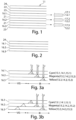
- FIG. 1 shows a layer composite 11 according to the invention.
- the layer composite comprises several thermochromic layers 16.1 ... 16.3, a cover layer 24, heat insulation layers 21, UV barrier layers 22 and oxygen barrier layers 23.
- the thermochromic layers 16.1 ... 16.3 are located within the stack.
- Each thermochromic layer 16.1 ... 16.3 comprises a polymer layer 12.1 ... 12.3 which is printed with a printing layer with an ink 17.1 ... 17.3 with a specific leuco dye 13.1 ... 13.3, a specific developer 15.1 ... 15.3 and a specific NIR activator 14.1 ... 14.3 in order to provide thermochromic layers for producing a cyan printing layer, magenta printing layer and a yellow printing layer, cf. Figure 3 .
- thermochromic layers are printed directly on top of each other.
- thermochromic layer 16.1 comprises, for example, the preparation 17.1 with the special leuco dye 13.1, the developer 15.1 and the corresponding NIR activator 14.1 for producing a cyan dye, the second layer 16.2 the corresponding components for producing the magenta dye (13.2, 14.2, 15.2), etc.
- thermochromic layer 21 is located between the thermochromic layers 16.1, 16.2, 16.3.
- the two outer thermochromic layers are covered with an oxygen barrier layer 23 and a UV protection layer 22.
- the composite is additionally protected on its visible side by a hard cover layer 24.
- the composite can also have a hard cover layer 24 on the underside or can be glued to a carrier material.
- thermochromic layers 16.1, 16.2 and 16.3 (without the heat insulation layer 21) are shown schematically.
- the cyan leuco dye 13.1 can be converted into the cyan dye by irradiation with the wavelength ⁇ 1 (and absorption of the corresponding NIR activator 14.1 for the wavelength ⁇ 1 )
- the magenta leuco dye 13.2 can be converted into the magenta dye by irradiation with the wavelength ⁇ 2
- the yellow leuco dye 13.3 can be converted into the yellow dye by irradiation with the wavelength ⁇ 3 .
- FIG 3b shows the result after irradiation of the layer composite with the wavelengths ⁇ 2 and ⁇ 3.
- the respective dye namely magenta and yellow
- the first layer 16.1 is colorless at the irradiation site
- the second layer 16.2 is magenta
- the third layer 16.3 is yellow.
- High-resolution "hot spots" can be generated by irradiation with an NIR laser, since the color reaction of the leuco dye is only resolved in the immediate vicinity. In this example, magenta and yellow are excited and the resulting leuco dyes become visible and produce the color "red” through the superposition of magenta and yellow.
- Quantity range (wt. %) function Polycarbonate copolymer of bisphenol-A and a bisphenol-cyclohexane derivative 1 - 10
- Polymer binder Mesitylen 1 - 5 Solvents 1-Methoxy-2-propanol acetate 10 - 50 Solvents 1,2,4-Trimethylbenzo 2 - 20 Solvents Ethyl 3-ethoxypropionate 10 - 50 Solvents Cumene 0.1 - 2 Solvents Solvent naphtha 10 - 30 Solvents Butyl glycol acetate 10 - 50 Solvents 2-anilino-3-methyl-6-diethyl aminofluoran 0.01 - 2 Leuco dye Bisphenol-A or Bisphenol-S 0.01-2 Developer Leuco dye Quaterrylene (QDI) 0.01 - 2 NIR_Activator (absorption 780 nm) Non-ionic surfactants 0.01 - 2 Dispersion aids
- the preparation according to the invention can be used as ink for inkjet printing. It can be printed directly onto the polycarbonate layer based on bisphenol A, then optionally dried, combined with the other layers to form the film stack and then laminated.
Landscapes
- Chemical & Material Sciences (AREA)
- Life Sciences & Earth Sciences (AREA)
- Engineering & Computer Science (AREA)
- Materials Engineering (AREA)
- Wood Science & Technology (AREA)
- Organic Chemistry (AREA)
- Chemical Kinetics & Catalysis (AREA)
- General Chemical & Material Sciences (AREA)
- Physics & Mathematics (AREA)
- Optics & Photonics (AREA)
- Heat Sensitive Colour Forming Recording (AREA)
Abstract
Die Erfindung betrifft einen Verbund (11) umfassend Polymerschichten (12) auf Basis von Polycarbonat für Sicherheitsdokumente, wobei wenigstens eine Polymerschicht (12) zur Bereitstellung einer thermochromen Schicht (16) mit einer Zubereitung (17) umfassend einen Leukofarbstoff (13), einen NIR-Aktivator (14), Polycarbonat, Lösemittel und optional einen Entwickler (15) beschichtet und insbesondere bedruckt ist.
Description
- Die vorliegende Erfindung betrifft einen Verbund von Polymerschichten auf der Basis von Polycarbonatpolymeren für Sicherheits- oder Wertdokumente, ein Verfahren zur Herstellung des Verbunds, eine Zubereitung zur Beschichtung der Polymerschichten, die Verwendung der Zubereitung und Sicherheits- und Wertdokumente.
- Sicherheits- oder Wertdokumente wie zum Beispiel der Bundespersonalausweis werden in der Regel aus Polycarbonat (PC) gefertigt und dann bei Bedarf mittels Laser-Engraving-Verfahren personalisiert. Hierbei werden über optisch/thermische Wechselwirkungen eines Werkstoffes des Sicherheits- oder Wertdokuments mit der Laserstrahlung örtlich hoch aufgelöste Pyrolysevorgänge erzeugt, so dass lokale Schwärzungen infolge von Kohlenstoffbildung auftreten. Nachteil dieses Verfahrens ist die Beschränkung auf Schwarz-Weiß- und bestenfalls Graustufendarstellungen.
- Eine sogenannte farbige Laserpersonalisierung, bei der ein lasersensitives Material zunächst in einen PC-Kartenkörper integriert ist und später dann je nach Prozessparametern und eingesetztem/n Laser(n) ein farbiges Abbild ermöglicht wird, ist Gegenstand der aktuellen Entwicklungsbestrebungen.
- Aus der
EP 2 205 686 B1 ist eine Druckfarbe für Tintenstrahldrucker umfassend Bindemittel mit Polycarbonat und Lösemittel sowie ein Verfahren zur Herstellung eines laminierten Schichtverbundes umfassend eine bedruckte Polymerschicht aus Polycarbonat bekannt. - Die
EP 3 928 996 A betrifft ein Verfahren zur Markierung von Artikeln, die eine erste und eine zweite farbbildende Schicht auf wenigstens einem Teil eines Trägers aufweisen, wobei jede farbbildende Schicht nach der Markierung eine erste und eine zweite Farbe bildet. - Die
WO 2023/281842 lehrt ein thermosensitives Aufzeichnungsmedium, ein Booklet und ein Karte. - Die
US 2015/0306887 A1 betrifft einen Verbund umfassend Polymerschichten für Sicherheitsdokumente. - Eine Tintenformulierung zur Lasermarkierung ist aus der
EP 3 401 372 A1 bekannt. - Der Erfindung liegt die Aufgabe zugrunde, einen Polymerschichtverbund für Sicherheits- oder Wertdokumente bereitzustellen, der zur farbigen Laserpersonalisierung geeignet, einfach herstellbar ist und nicht delaminiert.
- Der Erfindung liegt auch die Aufgabe zugrunde, ein Herstellungsverfahren für solch einen Schichtverbund anzugeben und die zur Herstellung erforderlichen Mittel und die den Schichtverbund umfassenden Sicherheits- und Wertdokumente bereitzustellen.
- Diese Aufgabe wird durch die Merkmale des Anspruchs 1, 5, 6 und 14 gelöst.
- Der erfindungsgemäße Verbund von Polymerschichten umfasst Polymerschichten aus Polycarbonat und wenigstens eine Polymerschicht, die mit einer Zubereitung, die einen Leukofarbstoff, einen NIR-Aktivator, ein Polycarbonat, Lösemittel und ggf. einen Entwickler umfasst, beschichtet und insbesondere bedruckt ist.
- Als Polycarbonat der Zubereitung wird vorzugsweise ein Polycarbonat auf der Basis von Bisphenol A und besonders bevorzugt ein Polycarbonat auf Basis von geminal disubstituierten Dihydroxydiphenylcycloalkanen ausgewählt.
- Die Polymerschichten auf Polycarbonatbasis sind direkt mit einer Leukofarbstoffe, NIR-Aktivatoren und ggf. Entwickler umfassenden Zubereitung bedruckbar, wenn die Zubereitung Lösemittel und Polycarbonat vorzugsweise auf Basis von Bisphenol A und besonders bevorzugt auf der Basis von geminal disubstituierten Dihydroxydiphenylcycloalkanen umfasst.
- Solche thermochrome Leukofarbstoffe umfassende Zubereitungen sind hochkompatibel mit den Polymerschichten bzw. Folienlagen aus Polycarbonat, die ebenfalls insbesondere aus Polycarbonat auf Basis Bisphenol A und besonders bevorzugt ein Polycarbonat auf Basis von geminal disubstituierten Dihydroxydiphenylcycloalkanen, wie beispielsweise Makrofol® Folien sind.
- Nach dem Laminieren des Schichtverbunds ist eine Schichtgrenze optisch nicht mehr zu detektieren, vielmehr wird quasi ein monolithischer Verbund erhalten. Die Polycarbonate in der Zubereitung und in der Schicht sind hochtemperaturstabil und zeigen keinerlei Verfärbungen und können bei Laminationstemperaturen bis zu
200 °C und mehr eingesetzt werden. - Die Druckschicht wirkt nicht als Trennschicht, sondern fördert vielmehr sogar die Bildung eines monolithischen Verbunds im Zuge des Laminierens.
- Der Druck kann an jedem beliebigen Ort auf der Polymerschicht erfolgen.
- Das Drucken kann mittels Tintenstrahldruck erfolgen. Vorteilhafterweise kann die Zubereitung direkt als Tinte eingesetzt werden.
- Dadurch, dass sich die Leukofarbstoffe in den Tinten auf Polycarbonatbasis direkt auf den Polycarbonatschichten/-folien verdrucken lassen, kann ein Schichtverbund, d.h. ein Kartenkörper aus Polycarbonat hergestellt werden, der ein hochsicherer Dokumentenrohling ist, der zu einem späteren Zeitpunkt farbig personalisiert werden kann.
- Der in einer Zubereitung enthaltene Leukofarbstoff LF1 regiert mit dem in der Zubereitung ebenfalls enthaltenen Entwickler E1 bei Erwärmung zu einem Farbstoff F1, vorzugsweise einem der Farben Cyan, Magenta oder Yellow. Hierfür weist jede Zubereitung, insbesondere Tinte, einen spezifischen NIR-Aktivator, der auch als Photothermal Conversion Agent (CPA) bezeichnet wird, auf. Der jeweilige NIR-Aktivator absorbiert bei Bestrahlung mit einer bestimmten Wellenlänge λ1 die NIR-Strahlung, und durch die dadurch bewirkte Erwärmung erfolgt die Reaktion des Leukofarbstoffs LF1 mit dem Entwickler E1 zu dem Farbstoff F1.
- Um zu gewährleisten, dass die Reaktionen der verschiedenen Leukofarbstoffe unabhängig voneinander erfolgen, sollten die Absorptionswellenlängen λn der verschiedenen mit den Leukofarbstoffen korrespondierenden NIR-Aktivatoren hinreichend voneinander verschieden sein, damit bei Bestrahlung des Schichtverbunds mit der Wellenlänge λ1 nur die Farbreaktion des Leukofarbstoffs LF1 zu Farbstoff F1, und nicht auch noch des Leukofarbstoffs LF2 oder LF3 zu Farbstoff F2 oder F3 erfolgt.
- Für jede der Skalenfarben Cyan, Magenta und Yellow existiert ein spezifischer Leukofarbstoff inklusive Entwickler sowie ein wellenlängensensitiver NIR Absorber.
- Um zu verhindern, dass die in einer Schicht durch Laserbestrahlung und NIR-Absorption erzeugte Wärme auf eine angrenzende thermochrome Schicht überspringt, sind vorteilhafterweise zwischen den thermochromen Schichten Wärmeisolationsschichten vorgesehen.
- Zur Verhinderung von chemischen oder photochemischen Reaktionen und zur Verbesserung der Haltbarkeit kann der Schichtverbund zusätzlich UV-Filterschichten und Sauerstoffsperrschichten und eine harte, haltbare Deckschicht aufweisen.
- Die bedruckten thermochromen Schichten sollten innenliegende Schichten in dem Stapel sein.
- Zur Bereitstellung mehrfarbiger laserpersonalisierbarer Bilder umfasst der erfindungsgemäße Verbund vorzugsweise wenigstens zwei und besonders bevorzugt wenigstens drei Polymerschichten, die mit Zubereitungen beschichtet sind, die sich in dem Leukofarbstoff, dem NIR-Aktivator und/oder dem Entwickler unterscheiden.
- Zur Herstellung des Verbundes werden die verschiedenen Polymerschichten bereitgestellt, wenigstens eine Polymerschicht aus Polycarbonat mit einer Zubereitung umfassend einen Leukofarbstoff, einen NIR-Aktivator, ein Polycarbonat, Lösemittel und optional einen Entwickler beschichtet und insbesondere bedruckt, die Druckschicht optional getrocknet, die Polymerschichten ggf. mit weiteren Schichten zu einem Stapel zusammengefügt und unter Druck, vorzugsweise bei einer Temperatur von 140 °C bis 230 °C, laminiert. Vorzugsweise werden zwischen den thermochromen Schichten Wärmeisolationsschichten vorgesehen. Zudem sollte der Verbund vorzugsweise UV- Filter- und/oder Sauerstoff-Sperrschichten und harte Deckschichten aufweisen. Je nach Verwendung von z.B. sauerstoffunempfindlichen Leuko-Aktivator-NIR-Absorber-Formulierungen kann auf diese Schichten verzichtet werden.
- Die thermochrome Tintenstrahldruckschicht kann vollflächig auf die Polymerschicht aufgebracht werden.
- Die optionale Trocknung der aufgebrachten Zubereitung auf der Polymerschicht kann bei einer Temperatur im Bereich 20 °C bis 120 °C, insbesondere 20 °C bis 80 °C, vorzugsweise 20 °C bis 60 °C, für eine Dauer von zumindest 1 Sekunde, vorzugsweise 5 Sekunden bis 600 Sekunden, erfolgen.
- Der Druck bei der Lamination liegt typischerweise im Bereich von 1 bar bis 200 bar, insbesondere im Bereich von 15 bar bis 95 bar. Die Laminationstemperatur liegt vorzugsweise im Bereich von 140 °C bis 200 °C, insbesondere im Bereich von 150 °C bis 180 °C. Die Laminationsdauer kann im Bereich von 0,5 Sekunden bis 300 Sekunden, insbesondere 5 Sekunden bis 60 Sekunden, liegen.
- Die Polymerschichten des Verbunds sind vorzugsweise Polycarbonatschichten mit einer Glastemperatur Tg von mehr als 145 °C, insbesondere mehr als 147 °C, die Polycarbonate weisen im allgemeinen ein mittleres Molekulargewicht (Gewichtsmittel) von mindestens 10.000, vorzugsweise von 20.000 bis 300.000 auf. Die Dicke einer Polycarbonatschicht kann im Bereich von 10 bis 1000 µm, insbesondere von 20 bis 200 µm, liegen.
- Die Dicke der auf eine Polycarbonatschicht aufgebrachten Tintenstrahldruckschicht kann, gemessen in Richtungen orthogonal zu der Hauptfläche der Polycarbonatschicht, vor oder nach dem Trocknen, im Bereich von 0,01 bis 10 µm, insbesondere 0,05 bis 5 µm, vorzugsweise 0,02 bis 1 µm, liegen.
- Die Gesamtschichtdicke eines solchen Schichtverbunds mit den thermochromen, Wärmeisolations-, Filter-, Schutz- und Sperrschichten liegt bei ca. 20 - 150, bevorzugt 30 Mikrometer.
- Die erfindungsgemäße Zubereitung, umfasst
- a) 0,01 Gew. % bis 5 Gew. % Leukofarbstoff (13),
- b) 0 Gew. % bis 5 Gew. % Entwickler (15),
- c) 0,01 bis 2 Gew. % NIR-Aktivator (14),
- d) 0,1 Gew. % bis 20 Gew. % Polycarbonat vorzugsweise auf Basis von Bisphenol A und insbesondere von geminal disubstituierten Dihydroxydiphenylcycloalkanen,
- e) 30 Gew. % bis 99,9 Gew. % eines Lösemittels oder Lösemittelgemischs,
- f) 0 bis 30 Gew. % Additive oder Hilfsstoffe,
- Die Zubereitung kann als Tinte zum Tintenstrahldrucken verwendet werden.
- Vorzugsweise enthält die Zubereitung zwischen a) 0,1 Gew.% und 2 Gew.% und besonders bevorzugt 0,5 Gew,% bis 1 Gew.% Leukofarbstoff, b) 0,1 Gew.% bis 2,0 Gew.% und besonders bevorzugt 0,5 Gew,% bis 1 Gew.% Entwickler, c) 0,1 Gew.% bis 2,0 Gew.% und besonders bevorzugt 0,5 Gew,% bis 1 Gew.% NIR-Aktivator, d) 0,1 Gew.% bis 10 Gew. %, insbesondere 0,5 Gew.% bis 5 Gew. % Polycarbonat auf Basis von geminal disubstituierten Dihydroxydiphenylcycloalkanen, e) 40 bis 99,9 Gew. %, insbesondere 45 bis 99,5 Gew.- %, eines organischen Lösungsmittels oder Lösungsmittelgemischs, f) 0,001 bis 6 Gew. %, insbesondere 0,1 bis 4 Gew. %, Additive, Hilfsstoffe oder deren Mischung.
- Die Leukofarbstoffe (Komponente a) sind Verbindungen mit Elektronendonoreigenschaften und können alleine oder in Kombination mit 2 oder mehr Spezies eingesetzt werden. Die Leukofarbstoffe selbst sind farblose oder schwachgefärbte Farbstoffprecursor beispielsweise aus der Gruppe der Triphenylmethanphthalid-, Triarylmethan-, Fluoran-, Phenothiazin-, Thiofluoran-, Xanthen-, Indophthalyl-, Spiropyran-, Azaphthalid-, Chlormenopirazol, Methyn-, Rhodamin-Anilinolactum-, Rhodamin-Lactum-, Quinazolin-, Diazaxanthen- und Bislacton-Verbindungen.
- Vorzugsweise werden die Leukofarbstoffe aus der Gruppe der 2-Anilino-3-methyl-6-diethylaminofluoran, 2-Anilino-3-methyl-6-(di-n-butylamino) fluoran, 2-Anilino-3-methyl-6-(di-n-pentylamino)fluoran, 2-Anilino-3-methyl-6-(N-n-propyl-N-methylamino)fluoran, 2-Anilino-3-methyl-6-(N-isopropyl-N-methylamino)fluoran, 2-Anilino-3-methyl-6-(N-Isobutyl-N-methylamino)fluoran, 2-Anilino-3-methyl-6-(N-n-Amyl-N-methylamino) fluoran, 2-Anilino-3-methyl-6-(N-sec-butyl-N-ethylamino) fluoran, 2-Ani-lino-3-methyl-6-(N-n-amyl-N-ethylamino) fluoran, 2-Anilino-3-methyl-6-(N-iso-amyl-N-ethyl amino) fluoran, 2-Anilino-3-methyl-6-(N-cyclohexyl-N-methylamino) fluoran, 2-Anilino-3-methyl-6-(N-ethyl-p-toluidino) fluoran, 2-Anilino-3-methyl-6-(N-methyl-p-toluidino) fluoran, 2-(m-Trichlor-methylanilin)-3-methyl-6-diethylaminofluoran, 2-(m-Trifluormethylanilin)-3-methyl-6-diethylamino Fluoran, 2-(m-Trifluormethylanilino)-3-methyl-6-(N-Cyclohexyl-N-methylamino) Fluoran, 2-(2,4-Dimethylanilino)-3-methyl-6-diethylaminofluoran, 2-(N-Ethyl-p-toluidino)-3-methyl-6-(N-ethylanilino)fluoran, 2-(N-Methyl-p-toluidino)-3-methyl-6-(N-propyl-p-toluidino)fluoran, 2-anilino-6-(N-n-hexyl-N-ethylamino)fluoran, 2-(o-chloranilino)-6-diethylamino Fluoran, 2-(o-Bromanilino)-6-diethylaminofluoran, 2-(o-Chloranilino)-6-dibutylaminofluoran, 2-(o-Fluoranilino)-6-dibutylaminofluoran,2-(m-Trifluormethylanilino)-6-diethylaminofluoran,2-(p-Acetylanilino)-6-(N-n-Amyl-N-n-butylamino) Fluoran,2-Benzyla-mino-6-(N-Ethyl-p-toluidino)fluoran, 2-Benzylamino-6-(N-Methyl-2,4-di-methylanilino)fluoran, 2-Benzyl-amino-6-(N-ethyl-2,4-dimethylani-lino)fluoran, 2-Dibenzylamino-6-(N-methyl-p-toluidino)fluoran, 2-Di-benzylamino-6-(N-Ethyl-p-toluidino)fluoran, 2-(Di-p-methylbenzyla-mino)-6-(N-ethyl-p-toluidino)fluoran, 2-(a-Phenylethylamino)-6-(N-Ethyl-p-toluidino)-fluoran, 2-Methylamino-6-(N-methylanilino)-fluoran, 2-Methylamino-6-(N-ethylanilino)-fluoran, 2-Methylamino-6-(N-propyla-nilino)fluoran, 2-Ethylamino-6-(N-methyl-p-toluidino)fluoran, 2-Methyla-mino-6-(N-methyl-2,4-Dimethylanilino)fluoran, 2-Ethylamino-6-(N-methyl-2,4-dimethylanilino)fluoran, 2-Dimethylamino-6-(N-methylani-lino)fluoran, 2-Dimethylamino-6-(N-Ethylanilino)fluoran, 2-Diethyla-mino-6-(N-Methyl-p-toluidino)fluoran, Benzo-leuco-Methylenblau, 2-[3,6-Bis(diethylamino)]-6-(o-chloranilino) xanthylbenzoesäurelactum, 2-[3,6-Bis(diethylamino)]-9-(o-Chloranilino)xanthylbenzoesäurelactum, 3,3-Bis(p-dimethylaminophenyl)phthalid, 3,3-Bis(p-dimethylaminophenyl)-6-Dimethylaminophthalid, 3,3-Bis(p-dimethylamino-phenyl)-6-diet-hylaminophthalid, 3,3-Bis(p-dimethylamino-phenyl)-6-chlorphthalid, 3,3-Bis(p-dibutylamino-phenyl)phthalid, 3-(2-Methoxy-4-dimethylaminophenyl)-3-(2-hydroxy-4,5-Dichlorphenyl)phthalid, 3-(2-Hydroxy-4-dimethylaminophenyl)-3-(2-methoxy-5-chlorphenyl)phthalid, 3-(2-Hydroxy-4-dimethoxyaminophenyl)-3-(2-methoxy-5-chlorphenyl)phthalid, 3-(2-Hydroxy-4-dimethoxyaminophenyl)-3-(2-Methoxy-5-nitrophenyl)phthalid, 3-(2-Hydroxy-4-diethylamino-phenyl)-3-(2-methoxy-5-methyl-phenyl)phthalid, 3,6-Bis(dimethylamino)fluorenespiro(9,3')-6'-dime-thylaminophthalid,6'-Chlor-8'-methoxy-benzoindolinospiropyran und 6'-Brom-2'-methoxy-Benzoindolino-Spiropyran ausgewählt. Die vorgenannten Leukofarbstoffe können allein oder in Kombination verwendet werden.
- Der Leukofarbstoff reagiert nach Anwendung von Wärme mit dem Entwickler zu einem Farbstoff.
- Die Farbstoffreaktion sollte irreversibel sein, um Manipulationsversuche zu verhindern.
- Als Entwickler b) werden vorzugsweisen elektronenakzeptierende Materialien verwendet, die mit den vorgenannten Leukofarbstoffen zum Zeitpunkt der Erhitzung reagieren, um Farben zu entwickeln. Beispiele hierfür sind Phenolverbindungen, organische oder anorganische säurehaltige Verbindungen und Ester oder Salze davon. Insbesondere sind folgende Verbindungen als Entwickler geeignet: Bisphenol A, Tetrabromobisphenol A, Gallussäure, Salicylsäure, 3-Isopropylsalicylat, 3-Cyclohexylsalicylat, 3-5-Di-tert-Butylsalicylat, 3,5-Di-α-methylbenzylsalicylat, 4,4'-Isopropylidendiphenol, 1,1'-Isopropylidenbis (2-Chlorphenol), 4,4'-Isopropylidenbis (2,6-Dibromphenol), 4,4'-Isopropylidenbis (2,6-Dichlorphenol), 4,4'-Isopropylidenbis (2-Methylphenol), 4,4'-Isopropyliden-bis (2,6-Dimethylphenol), 4,4'-Isopropyliden-bis (2-tert-Butylphenol), 4,4'-sec-Butylidene Diphenol, 4,4'-Cyclohexyliden-Bisphenol, 4,4'-Cyclohexyliden-bis-(2-Methylphenol), 4-tert-Butylphenol, 4-Phenyl-Phenol, 4-Hydroxy-Diphenoxid, o-Naphthol, β-Naphthol, 3,5-Xylenol, Thymol, Methyl-4-hydroxybenzoat, 4-Hydroxyacetophenon, Novolak-Phenolharze, 2,2'-Thio-bis-(4,6-Dichlorphenol), Catechin, Resorcin, Hydrochinon, Pyrogallol, Fluorglycin, Fluorglycincarboxylat, 4-tert-Octylcatechin, 2,2'-Methylen-bis-(4-chlorphenol), 2,2'-Methylen-bis(4-Methyl-6-tert.-butylphenol), 2,2'-Dihydroxydiphenyl, Ethyl-p-hydroxybenzoat, Propyl-p-hydroxybenzoat, Butyl-p-Hydroxybenzoat, Benzyl-p-hydroxybenzoat, p-Hydroxybenzoat-p-chlorbenzyl, p-Hydroxybenzoat-o-chlorbenzyl, p-Hydroxybenzoat-p-methylbenzyl, p-Hydroxybenzoat-n-octyl, Benzoesäure, Zinksalicylat, 1-Hydroxy-2-naphthoesäure, 2-Hydroxy-6-naphthoesäure, 2-Hydroxy-6-zinknaphthoat, 4-Hydroxydiphenylsulfon, 4-Hydroxy-4'-chlorodiphe-nylsulfon, Bis(4-hydroxyphenyl)sulfid, 2-Hydroxy-p-toluylsäure, 3,5-Di-tert.-Zinkbutylsalicylat, 3,5-Di-tert.-Zinnbutylsalicylat, Salicylat, Weinsäure, Oxalsäure, Maleinsäure, Zitronensäure, Bernsteinsäure, Stearinsäure, 4-Hydroxyphthalsäure, Borsäure , Thioharnstoffderivate, 4-Hydroxythiophenolderivate, Bis(4-hydroxyphenyl)acetat, Bis(4-hydroxyphenyl)ethylacetat, Bis(4-hydroxyphenyl)ethylacetat, Bis(4-hydroxyphenyl)acetat-n-propyl, Bis(4-hydroxyphenyl)acetat-n-butyl, Bis(4-hydroxyphenyl)phenylacetat, Bis(4-hydroxyphenyl)benzylacetat, Bis(4-hydroxyphenyl)phenethylacetat, Bis(3-methyl-4-hydroxyphenyl)acetat, Bis-(3-methyl-4-hydroxyphenyl)-methylacetat, Bis-(3-methyl-4-hydroxyphenyl)-acetat-n-propyl, 1,7-Bis-(4-hydroxyphenylthio) 3,5-dioxaheptan, 1,5-Bis(4-hydroxyphenylthio) 3-oxaheptan, 4-Hydroxyphthalatdimethyl, 4 Hydroxy-4'-methoxy-diphenylsulfon, 4-Hydroxy-4'-ethoxy-diphenylsulfon, 4-Hydroxy-4'-isopropoxy-diphenylsulfon, 4-Hydroxy-4'-propoxy-diphenylsulfon, 4-Hydroxy-4'-butoxy-diphenylsulfon, 4-Hydroxy-4'-isopropoxy-diphenylsulfon, 4-Hydroxy-4'-sec-butoxy-diphenylsulfon, 4-Hydroxy-4'-tert-butoxy-diphenylsulfon, 4-Hydroxy-4'-benzyloxy-diphenylsulfon, 4-Hydroxy-4'-phenoxy-diphenylsulfon, 4-Hydroxy-4'-(m-methyl-benzoxy) diphenylsulfon, 4-Hydroxy-4'-(p-Methylbenzoxy)-diphenylsulfon, 4-Hydroxy-4'-(o-methylbenzoxy)-diphenylsulfon, 4-Hydroxy-4'-(p-chlorbenzoxy)Diphenylsulfon, 4-Hydroxy-4'-oxyaryl-diphenylsulfon, 4-Hydroxy-4-allyloxy-diphenylsulfon, N-(2-((Phenylcarbamoyl)amino)phenyl) benzolsulfonamid, 4,4'-Sulfonylbisphenol, Polymer mit 1,1'-Oxybis[2-chlorethan], 2-(4-Hydroxyphenylsulfonyl)phenol,(Bis(3-allyl-4-hydroxyphenyl)sulfon),2,2'-Diallyl-4,4'-sulfonyldiphenol.
- Die Entwickler können allein oder in Kombination verwendet werden.
- Die NIR-Aktivatoren, die in der vorliegenden Rezeptur die Komponenten c) bilden, sollten eine hohe Lichtstabilität, eine steile Absorptionskante, keine Nebenabsorptionsmaxima im visuellen Bereich und hohe Extensionskoeffizienten aufweisen. Grundsätzlich können als IR-Absorber sowohl anorganische Substanzen eingesetzt werden, beispielsweise Metalloxide (Wolframbronze), Koordinationsverbindungen, Seltene Erden oder -Verbindungen, insbesondere aus der Gruppe Dysprosium, Thulium, Ytterbium, oder der organischen Verbindungen wie der p-Benzochinondiimoniumsalze, Nickeldithiolenkomplexe oder Quaterrylene.
- Die Zubereitung enthält als Komponente d) Polycarbonate auf Basis von Bisphenol A und besonders bevorzugt auf Basis geminal disubstituierter Dihydroxydiphenylcycloalkane insbesondere der nachfolgenden Formel (I)

- Bevorzugt ist es, wenn an einem oder zwei Atomen X, insbesondere nur an einem Atom X, R3 und R4 gleichzeitig Alkyl sind. R3 und R4 können insbesondere Methyl sein. Die X-Atome in alpha-Stellung zu dem Diphenyl-substituierten C-Atom (C1) können nicht dialkylsubstituiert sein. Die X-Atome in beta-Stellung zu C1 können mit Alkyl disubstituiert sein. Bevorzugt ist m = 4 oder 5. Das Polycarbonat ist vorzugsweise ein Polycarbonat auf Basis von Monomeren wie 4,4'-(3,3,5-trimethylcyclohexan-1,1-diyl)diphenol, 4,4'-(3,3-dimethylcyclohexan-1,1-diyl)diphenol, oder 4,4'-(2,4,4- trimethylcyclopentan-1,1-diyl)diphenol.
- Das Lösemittel gemäß Komponente e) kann grundsätzlich im Wesentlichen organisch oder wässrig sein. Im Wesentlichen wässrig meint dabei, dass bis zu 20 Gew. % der Komponente e) organische Lösungsmittel sein können. Im Wesentlichen organisch meint, dass bis zu 5 Gew. % Wasser in der Komponente e) vorliegen können. Vorzugsweise enthält die Komponente e) einen bzw. besteht aus einem flüssigen aliphatischen, cycloaliphatischen und/oder aromatischen Kohlenwasserstoff, einem flüssigen organischen Ester, und/oder einer Mischung solcher Substanzen. Die eingesetzten organischen Lösungsmittel sind vorzugsweise halogenfreie organische Lösungsmittel. In Frage kommen insbesondere aliphatische, cycloaliphatische, aromatische Kohlenwasserstoffe, wie Mesitylen, 1,2,4- Trimethylbenzol, Cumol und Solvent Naphta, Toluol, Xylol; (organische) Ester, wie Methylacetat, Ethylacetat, Butylacetat, Methoxypropylacetat, Ethyl-3-ethoxypropionat. Bevorzugt sind Mesitylen, 1,2,4-Trimethylbenzol, Cumol und Solvent Naphta, Toluol, Xylol, Essigsäuremethylester, Essigsäureethylester, Methoxypropylacetat. Ethyl-3-ethoxypropionat. Ganz besonders bevorzugt sind: Mesitylen (1,3,5-Trimethylbenzol), 1,2,4-Trimethylbenzol, Cumol (2-Phenylpropan), Solvent Naphta und Ethyl-3-ethoxypropionat.
- Ein geeignetes Lösungsmittelgemisch umfasst beispielsweise L1) 0 bis 10 Gew. %, vorzugsweise 1 bis 5 Gew. %, insbesondere 2 bis 3 Gew. %, Mesitylen, L2) 10 bis 50 Gew. %, vorzugsweise 25 bis 50 Gew. %, insbesondere 30 bis 40 Gew. %, 1-Methoxy-2-propanolacetat, L3) 0 bis 20 Gew. %, vorzugsweise 1 bis 20 Gew. %, insbesondere 7 bis 15 Gew. %, 1,2,4-Trimethylbenzol, L4) 10 bis 50 Gew. %, vorzugsweise 25 bis 50 Gew. %, insbesondere 30 bis 40 Gew. %, Ethyl-3-ethoxypropionat, L5) 0 bis 10 Gew. %, vorzugsweise 0,01 bis 2 Gew. %, insbesondere 0,05 bis 0,5 Gew. %, Cumol, und L6) 0 bis 80 Gew. %, vorzugsweise 1 bis 40 Gew. %, insbesondere 15 bis 25 Gew. %, Solvent Naphta, wobei die Summe der Komponenten L1 bis L6 in Bezug auf das Lösemittelgemisch stets 100 Gew. % ergibt.
- Weiterhin kann die Zubereitung gemäß Komponente f) Antischaummittel, Netzmittel, Tenside, Fließmittel, Katalysatoren, Konservierungsmittel, Tenside, organische Polymere zur Viskositätseinstellung, etc. umfassen. Als Tenside kommen alle handelsüblichen Tenside, welche für Tinten verwendet werden, in Frage. Bevorzugt sind amphotere oder nichtionische Tenside. Selbstverständlich ist aber auch der Einsatz spezieller anionischer oder kationischer Tenside, welche die Eigenschaften des Farbstoffs nicht verändern, möglich. Beispiele für geeignete Tenside sind Betaine, ethoxilierte Diole usw. Beispiele sind die Produktreihen Surfynol® und Tergitol®.
- Die Menge an Tensiden wird beispielsweise mit der Maßgabe gewählt, dass die Oberflächenspannung der Tinte im Bereich von 10 bis 60 mN/m, vorzugsweise 25 bis 35 mN/m, gemessen bei 25 °C, liegt. Der Anteil an Tensid, bezogen auf die Gesamtmenge an Tinte, kann im Bereich von 0 bis 0,2 Gew. % liegen. Der Anteil an Stellmitteln kann, bezogen auf die Gesamtmenge an Tinte, 0 bis 1 Gew. %, vorzugsweise 0,1 bis 0,5 Gew. %, betragen.
- Schließlich betrifft die Erfindung ein Sicherheits- und/oder Wertdokument enthaltend einen erfindungsgemäßen Verbund.
- Zur farbigen Personalisierung wird der Verbund, der in ein Sicherheits- oder Wertdokument integriert sein kann, mit einem oder mehreren NIR-Lasern bestrahlt und so das gewünschte farbige Bild erzeugt.
- Als Sicherheits- und/oder Wertdokument seien beispielhaft genannt: Führerscheine, Personalausweise, Reisepässe, ID-Karten, Zugangskontrollausweise, Visa, Steuerzeichen, Tickets, Führerscheine, Kraftfahrzeugpapiere, Banknoten, Schecks, Postwertzeichen, Kreditkarten, beliebige Chipkarten und Haftetiketten (z.B. zur Produktsicherung). Ein solches Sicherheits- und/oder Wertdokument umfasst innerhalb des Gesamt-Schichtverbundes einen erfindungsgemäßen Verbund.
- Die Erfindung wird nachfolgend anhand von Ausführungsbeispielen näher beschrieben.
- Figur 1:
- zeigt einen ersten schematischen Aufbau eines erfindungsgemäßen Schichtverbundes.
- Figur 2:
- zeigt einen zweiten schematischen Aufbau eines erfindungsgemäßen Schichtverbundes.
- Figur 3:
- zeigt a) schematisch die Absorption der drei unterschiedlichen NIR-Aktivatoren in den drei thermochromen Schichten mit den Leukofarbstoffen zur Erzeugung der Cyan, Magenta und Yellow-Farbstoffe und b) die bei Bestrahlung mit der Wellenlänge λ2 und λ3 erzeugten Farbstoffe.
-
Figur 1 zeigt einen erfindungsgemäßen Schichtverbund 11. Der Schichtverbund umfasst mehrere thermochrome Schichten 16.1 ... 16.3, eine Deckschicht 24, Wärmeisolationsschichten 21, UV-Sperrschichten 22 und Sauerstoff-Sperrschichten 23. Die thermochromen Schichten 16.1 ... 16.3 liegen innerhalb des Stapels. Eine jede thermochrome Schicht 16.1 ... 16.3 umfasst eine Polymerschicht 12.1 ... 12.3, die mit einer Druckschicht mit einer Tinte 17.1 ... 17.3 mit einem spezifischen Leukofarbstoff 13.1 ... 13.3, einem spezifischen Entwickler 15.1 ... 15.3 und einem spezifischen NIR-Aktivator 14.1 ... 14.3 bedruckt ist, um thermochrome Schichten zur Herstellung einer cyanfarbenen Druckschicht, magentafarbenen Druckschicht und einer yellowfarbenen Druckschicht bereitzustellen, vgl.Figur 3 . - In
Figur 2 ist eine weitere vereinfachte Variante eines Aufbaus eines Schichtverbundes ohne Sperrschichten dargestellt, in dem die thermochromen Schichten direkt übereinander gedruckt sind. - In diesen Beispielen umfasst die thermochrome Schicht 16.1 beispielsweise die Zubereitung 17.1 mit dem speziellen Leukofarbstoffe 13.1, dem Entwickler 15.1 und dem damit korrespondierenden NIR-Aktivator 14,1 zur Herstellung eines cyanfarbenen Farbstoffs, die zweite Schicht 16.2 die entsprechenden Komponenten zur Herstellung des magentafarbenen Farbstoffs (13.2, 14.2, 15.2) etc.
- Zwischen den thermochromen Schichten 16.1, 16.2, 16.3 befindet sich jeweils eine Wärmeisolationsschicht 21. Die beiden äußeren thermochromen Schichten sind mit einer Sauerstoff-Barriereschicht 23 und einer UV-Schutzschicht 22 abgedeckt. Der Verbund ist an seiner Sichtseite zusätzlich durch eine harte Deckschicht 24 geschützt.
- Der Verbund kann an der Unterseite ebenfalls eine harte Deckschicht 24 aufweisen oder aber mit einem Trägermaterial verklebt sein.
- In
Figur 3a ) sind schematisch die drei thermochromen Schichten 16.1, 16.2 und 16.3 (ohne die Wärmeisolationsschicht 21) dargestellt. In der ersten thermochromen Schicht 16.1 kann der Cyan-Leukofarbstoff 13.1 durch Bestrahlung mit der Wellenlänge λ1 (und Absorption des entsprechenden NIR-Aktivators 14.1 für die Wellenlänge λ1) in den Cyan-Farbstoff umgewandelt werden, in der zweiten thermochromen Schicht 16.2 der magenta-Leukofarbstoff 13.2 durch Bestrahlung mit der Wellenlänge λ2 in den Magenta-Farbstoff und in der dritten thermochromen Farbschicht 16.3 der Yellow-Leukofarbstoff 13.3 durch Bestrahlen mit der Wellenlänge λ3 in den Yellow-Farbstoff. - In
Figur 3b ) ist das Ergebnis nach Bestrahlung des Schichtverbunds mit den Wellenlängen λ2 und λ3 dargestellt. In den thermochromen Schichten 16.2 und 16.3 wurde der jeweilige Farbstoff, nämlich Magenta und Yellow, erzeugt, (wie schematisch durch die auftretenden Absorptionsbanden im VIS dargestellt), in der ersten Schicht nicht. Die erste Schicht 16.1 ist am Bestrahlungsort farblos, die zweite Schicht 16.2 magentafarben und die dritte Schicht 16.3 yellow. Durch Bestrahlung mit einem NIR-Laser können hochaufgelöste "Hot-Spots" generiert werden, da nur in unmittelbarer Umgebung die Farbreaktion des Leukofarbstoffs aufgelöst wird. In diesem Beispiel werden Magenta und Gelb angeregt und die resultierenden Leukofarbstoff werden sichtbar und ergeben durch Überlagerung von Magenta und Yellow die Farbe "rot". -
Komponente Mengenbereich (Gew. %) Funktion Polycarbonatcopolymer aus Bisphenol-A und einem Bisphenol-Cyclohexan-Derivat 1 - 10 Polymerer Binder Mesitylen 1 - 5 Lösemittel 1-Methoxy-2-Propanolacetat 10 - 50 Lösemittel 1,2,4-Trimethylbenzo 2 - 20 Lösemittel Ethyl-3-Ethoxypropionat 10 - 50 Lösemittel Cumol 0,1 - 2 Lösemittel Solvent Naphta 10 - 30 Lösemittel Butyl-Glycol-Acetat 10 - 50 Lösemittel 2-anilino-3-methyl-6-diethyl aminofluoran 0,01 - 2 Leukofarbstoff Bisphenol-A oder Bisphenol-S 0,01-2 Entwickler Leukofa rbstoff Quaterrylen (QDI) 0,01 - 2 NIR_Aktivator (Absorption 780 nm) Nicht-ionische Tenside 0,01 - 2 Dispersionshilfsmittel - Die erfindungsgemäße Zubereitung kann als Tinte für den Tintenstrahldruck eingesetzt werden. Sie kann direkt auf die Polycarbonatschicht auf der Basis von Bisphenol-A aufgedruckt, anschließend optional getrocknet, zusammen mit den anderen Schichten zu dem Folienstapel zusammengefügt und anschließend laminiert werden.
-
- 11 Verbund
- 12, 12.1 ... 12.n Polymerschicht
- 13, 13.1 ... 13.n Leukofarbstoff
- 14, 14.1 ... 14.n NIR-Aktivator
- 15, 15.1 ... 15.n Entwickler
- 15, 16.1 ... 16.n thermochrome Schicht
- 17 Zubereitung
- 21 Wärmeisolationsschicht
- 22 UV-Filterschicht
- 23
- Sauerstoff-Sperrschicht
- 24 Deckschicht
- 30 Sicherheits- oder Wertdokument
Claims (14)
- Verbund (11) umfassend Polymerschichten (12) auf Basis von Polycarbonat für Sicherheitsdokumente, wobei wenigstens eine Polymerschicht (12) zur Bereitstellung einer thermochromen Schicht (16) mit einer Zubereitung (17) umfassend einen Leukofarbstoff (13), einen NIR-Aktivator (14), Polycarbonat, Lösemittel und optional einen Entwickler (15) beschichtet und insbesondere bedruckt ist.
- Verbund nach Anspruch 1, dadurch gekennzeichnet, dass der Verbund (11) mehrere Polymerschichten (12.1 ... 12.n) umfasst, wobei wenigstens zwei Polymerschichten (12.1, 12.2) mit Zubereitungen (17.1, 17.2) beschichtet sind, die sich in dem Leukofarbstoff (13.1, 13.2), dem NIR-Aktivator (14.1, 14.2) und/oder einem Entwickler (15.1, 15.2) unterscheiden.
- Verbund nach einem der Ansprüche 1 oder 2, dadurch gekennzeichnet, dass das Polycarbonat der Polymerschicht (12) und/oder der Zubereitung (17) ein Polycarbonat auf Basis von Bisphenol-A und insbesondere ein Polycarbonat auf Basis von geminal disubstituierten Dihydroxydiphenylcycloalkanen ist.
- Verbund nach einem der vorangegangenen Ansprüche, dadurch gekennzeichnet, dass die thermochromen Schichten (16) in dem Verbund (11) innenliegende Schichten sind und/oder zwischen den thermochromen Schichten (16) Wärmeisolationsschichten (21) vorgesehen sind und/oder der Verbund (11) UV-Filterschichten (22) und/oder Sauerstoff-Sperrschichten (23) und/oder wenigstens eine harte Deckschicht (24) aufweist.
- Verfahren zur Herstellung eines Verbunds (11) nach einem der Ansprüche 1 bis 4, dadurch gekennzeichnet, dass Polymerschichten (12) bereitgestellt werden, wenigstens eine Polymerschicht (12.1) aus Polycarbonat mit einer Zubereitung (17) umfassend einen Leukofarbstoff (13), einen NIR-Aktivator (14), Polycarbonat, Lösemittel und optional einen Entwickler (15) beschichtet und insbesondere bedruckt wird, die Druckschicht optional getrocknet, die Polymerschichten (12) ggs. mit weiteren Schichten wie Wärmeisolationsschichten (21), UV-Filterschichten(22), Sauerstoff-Sperrschichten (23) und/oder Deckschichten (24) zu einem Stapel zusammengefügt und anschließend laminiert werden.
- Zubereitung (17), insbesondere zur Verwendung in einem Verfahren nach Anspruch 5, umfassenda) 0,01 Gew. % bis 5 Gew. % Leukofarbstoff (13),b) 0 Gew. % bis 5 Gew. % Entwickler (15),c) 0,01 bis 2 Gew. % NIR-Aktivator (14),d) 0,1 Gew. % bis 20 Gew. % Polycarbonat, vorzugsweise auf Basis von Bisphenol A und insbesondere von geminal disubstituierten Dihydroxydiphenylcycloalkanen,e) 30 Gew. % bis 99,9 Gew. % eines Lösemittels oder Lösemittelgemischs,f) 0 Gew. % bis 30 Gew. % Additive oder Hilfsstoffe,wobei die Summe der Komponenten a) bis f) stets 100 Gew. % beträgt.
- Zubereitung nach Anspruch 6, umfassend zwischena) 0,1 Gew. % und 2 Gew. % und besonders bevorzugt 0,5 Gew % bis 1 Gew. % Leukofarbstoff (13),b) 0,1 Gew. % bis 2,0 Gew. % und besonders bevorzugt 0,5 Gew % bis 1 Gew. % Entwickler (15),c) 0,1 Gew. % bis 2,0 Gew. % und besonders bevorzugt 0,5 Gew % bis 1 Gew. % NIR-Aktivator (14),d) 0,1 Gew. % bis 10 Gew. %, insbesondere 0,5 Gew. % bis 5 Gew. % Polycarbonat, auf Basis von geminal disubstituierten Dihydroxydiphenylcycloalkanene) 40 Gew. % bis 99,9 Gew. %, insbesondere 45 Gew. % bis 99,5 Gew. %, eines organischen Lösungsmittels oder Lösungsmittelgemischs, f) 0,001 Gew. % bis 6 Gew. %, insbesondere 0,1 Gew. % bis 4 Gew. %, Additive, Hilfsstoffe oder deren Mischung.
- Zubereitung nach einem der Ansprüche 6 oder 7, dadurch gekennzeichnet, dass die Leukofarbstoffe (13) aus der Gruppe der Triphenylmethanphthalid-, Triarylmethan-, Fluoran-, Phenothiazin-, Thiofluoran-, Xanthen-, Indophthalyl-, Spiropyran-, Azaphthalid-, Chlormenopirazol, Methyn-, Rhodamin-Anilinolactum-, Rhodamin-Lactum-, Quinazolin-, Diazaxanthen- und Bislacton-Verbindungen ausgewählt werden.
- Zubereitung nach einem der Ansprüche 6 bis 8, dadurch gekennzeichnet, dass die Entwickler (15) aus der Gruppe der Phenolverbindungen, der organischen oder anorganischen säurehaltige Verbindungen, der Ester oder deren Salze ausgewählt wird.
- Zubereitung nach einem der Ansprüche 6 bis 9, dadurch gekennzeichnet, dass die NIR-Aktivatoren (14) aus der Gruppe der Metalloxide, Wolframbronze, Koordinationsverbindungen, Seltene Erden oder -Verbindungen, insbesondere aus der Gruppe Dysprosium, Thulium, Ytterbium, oder der organischen Verbindungen wie der p-Benzochinondiimoniumsalze, Nickeldithiolenkomplexe oder Quaterrylene ausgewählt werden.
- Zubereitung nach einem der Ansprüche 6 bis 10, dadurch gekennzeichnet, dass die Komponente e) (Lösemittel) flüssigen aliphatischen, cycloaliphatischen, und/oder aromatischen Kohlenwasserstoff, einen flüssigen organischen Ester und/oder eine Mischung solcher Substanzen umfasst.
- Zubereitung nach einem der Ansprüche 6 bis 11, dadurch gekennzeichnet, dass das Lösemittelgemisch umfassend L1) 0 bis 10 Gew. %, vorzugsweise 1 bis 5 Gew. %, insbesondere 2 bis 3 Gew. %, Mesitylen, L2) 10 bis 50 Gew. %, vorzugsweise 25 bis 50 Gew. %, insbesondere 30 bis 40 Gew. %, 1-Methoxy-2-propanolacetat, L3) 0 bis 20 Gew. %, vorzugsweise 1 bis 20 Gew. %, insbesondere 7 bis 15 Gew. %, 1,2,4-Trimethylbenzol, L4) 10 bis 50 Gew. %, vorzugsweise 25 bis 50 Gew. %, insbesondere 30 bis 40 Gew. %, Ethyl-3-ethoxypropionat, L5) 0 bis 10 Gew. %, vorzugsweise 0,01 bis 2 Gew. %, insbesondere 0,05 bis 0,5 Gew. %, Cumol, und L6) 0 bis 80 Gew. %, vorzugsweise 1 bis 40 Gew. %, insbesondere 15 bis 25 Gew. %, Solvent Naphta, wobei die Summe der Komponenten L1 bis L6 in Bezug auf das Lösemittelgemisch stets 100 Gew. % ergibt.
- Verwendung einer Zubereitung nach einem der Ansprüche 6 bis 12 als Tintenstrahldruckfarbe.
- Sicherheits- und Wertdokument umfassend einen Verbund von Polymerschichten nach einem der Ansprüche 1 bis 4.
Applications Claiming Priority (1)
| Application Number | Priority Date | Filing Date | Title |
|---|---|---|---|
| DE102023101175.8A DE102023101175A1 (de) | 2023-01-18 | 2023-01-18 | Polymerschichtverbund für Sicherheits- und Wertdokumente, Herstellungsverfahren, Zubereitung und Verwendung |
Publications (1)
| Publication Number | Publication Date |
|---|---|
| EP4403371A1 true EP4403371A1 (de) | 2024-07-24 |
Family
ID=91622763
Family Applications (1)
| Application Number | Title | Priority Date | Filing Date |
|---|---|---|---|
| EP24151372.0A Pending EP4403371A1 (de) | 2023-01-18 | 2024-01-11 | Polymerschichtverbund für sicherheits- und wertdokumente, herstellungsverfahren, zubereitung und verwendung |
Country Status (2)
| Country | Link |
|---|---|
| EP (1) | EP4403371A1 (de) |
| DE (1) | DE102023101175A1 (de) |
Citations (7)
| Publication number | Priority date | Publication date | Assignee | Title |
|---|---|---|---|---|
| EP2205686B1 (de) | 2007-10-31 | 2011-03-16 | Bundesdruckerei GmbH | Verfahren zur herstellung eines polycarbonat-schichtverbundes |
| US20130235145A1 (en) * | 2010-12-07 | 2013-09-12 | Agfa-Gevaert N.V. | Colour laser marking methods of security document precursors |
| US20150306887A1 (en) | 2012-11-12 | 2015-10-29 | Agfa-Gevaert | Colour imaging of security document precursors |
| EP3401372A1 (de) | 2013-07-30 | 2018-11-14 | Datalase Limited | Tinte für laserbildgebung |
| EP3928996A1 (de) | 2020-06-22 | 2021-12-29 | Agfa Nv | Markierung von gegenständen |
| WO2022138766A1 (ja) * | 2020-12-22 | 2022-06-30 | ソニーグループ株式会社 | 積層体、カードおよび筐体 |
| WO2023281842A1 (ja) | 2021-07-09 | 2023-01-12 | ソニーグループ株式会社 | 感熱記録媒体、冊子およびカード |
-
2023
- 2023-01-18 DE DE102023101175.8A patent/DE102023101175A1/de active Pending
-
2024
- 2024-01-11 EP EP24151372.0A patent/EP4403371A1/de active Pending
Patent Citations (8)
| Publication number | Priority date | Publication date | Assignee | Title |
|---|---|---|---|---|
| EP2205686B1 (de) | 2007-10-31 | 2011-03-16 | Bundesdruckerei GmbH | Verfahren zur herstellung eines polycarbonat-schichtverbundes |
| US20130235145A1 (en) * | 2010-12-07 | 2013-09-12 | Agfa-Gevaert N.V. | Colour laser marking methods of security document precursors |
| US20150306887A1 (en) | 2012-11-12 | 2015-10-29 | Agfa-Gevaert | Colour imaging of security document precursors |
| EP3401372A1 (de) | 2013-07-30 | 2018-11-14 | Datalase Limited | Tinte für laserbildgebung |
| EP3928996A1 (de) | 2020-06-22 | 2021-12-29 | Agfa Nv | Markierung von gegenständen |
| WO2022138766A1 (ja) * | 2020-12-22 | 2022-06-30 | ソニーグループ株式会社 | 積層体、カードおよび筐体 |
| EP4269095A1 (de) * | 2020-12-22 | 2023-11-01 | Sony Group Corporation | Laminierter körper, karte und gehäuse |
| WO2023281842A1 (ja) | 2021-07-09 | 2023-01-12 | ソニーグループ株式会社 | 感熱記録媒体、冊子およびカード |
Also Published As
| Publication number | Publication date |
|---|---|
| DE102023101175A1 (de) | 2024-07-18 |
Similar Documents
| Publication | Publication Date | Title |
|---|---|---|
| EP3297837B1 (de) | Lasermarkierbare zusammensetzungen, artikel und dokumente | |
| EP3297838B1 (de) | Lasermarkierbare materialien und dokumente | |
| DE69926092T2 (de) | Methode zur Herstellung eines Druckerzeugnisses | |
| DE60207009T2 (de) | Verfahren zur Fluoreszenzbildabbildung, dadurch hergestellter Druck und Thermotransferblatt davon | |
| DE112012001184B4 (de) | Thermisches Aufzeichnungsmaterial und Verfahren zur Herstellung desselben | |
| DE3526890A1 (de) | Waermeempfindliches zweifarben-aufzeichnungsetikett | |
| EP2463109B1 (de) | Farblasermarkierungsverfahren für Sicherheitsdokumentenvorläufer | |
| EP1439964B1 (de) | Mehrschichtenkörper mit einer ersten lasersensitiven schicht und einer zweiten lasersensitiven schicht sowie verfahren zur erzeugung eines mehrschichtenbildes in einem solchen mehrschichtenkörper | |
| EP3746308B1 (de) | Beschichtungszusammensetzung, wärmeempfindliche aufzeichnungsschicht, wärmeempfindliches aufzeichnungsmaterial sowie entsprechende verwendungen und verfahren | |
| DE60216089T2 (de) | Wärmeempfindliches aufzeichnungselement mit laseraufzeichnung | |
| EP3305538A1 (de) | Wärmeempfindliches aufzeichnungsmaterial | |
| DE3601645A1 (de) | Waermeempfindliches aufzeichnungsmaterial | |
| US10286707B2 (en) | Laser markable compositions, materials and documents | |
| EP0664292B1 (de) | Eine Phthalidverbindung und ein Absorber im nahen IR-Bereich und ein Aufzeichnungsmaterial | |
| DE69915962T2 (de) | Wärmeempfindliches Aufzeichnungsmedium | |
| DE10062638B4 (de) | Reversibles wärmeempfindliches Aufzeichnungsmaterial und dessen Verwendung | |
| DE60315695T2 (de) | Wärmeempfindliches aufzeichnungsmedium | |
| DE19522914B4 (de) | Thermoaufzeichnungsmaterial | |
| DE60217325T2 (de) | Verfahren zur herstellung von wärmeempfindlichem aufzeichnungsmaterial und wärmeempfindliches aufzeichnungsmaterial | |
| DE102023101175A1 (de) | Polymerschichtverbund für Sicherheits- und Wertdokumente, Herstellungsverfahren, Zubereitung und Verwendung | |
| DE3329070A1 (de) | Waermeempfindliches bilduebertragungsmaterial | |
| DE3520190C1 (de) | Gewebeschreibband | |
| DE602005003552T2 (de) | Wärmeempfindliches aufzeichungsmedium für laseraufzeichnungen | |
| EP0643062B1 (de) | Bislactone | |
| DE19742593B4 (de) | Neuer farbbildender Farbstoffvorläufer, Zusammensetzung, die denselben enthält und farbbildendes wärmeempfindliches Aufzeichnungsmaterial |
Legal Events
| Date | Code | Title | Description |
|---|---|---|---|
| PUAI | Public reference made under article 153(3) epc to a published international application that has entered the european phase |
Free format text: ORIGINAL CODE: 0009012 |
|
| STAA | Information on the status of an ep patent application or granted ep patent |
Free format text: STATUS: THE APPLICATION HAS BEEN PUBLISHED |
|
| AK | Designated contracting states |
Kind code of ref document: A1 Designated state(s): AL AT BE BG CH CY CZ DE DK EE ES FI FR GB GR HR HU IE IS IT LI LT LU LV MC ME MK MT NL NO PL PT RO RS SE SI SK SM TR |
|
| STAA | Information on the status of an ep patent application or granted ep patent |
Free format text: STATUS: REQUEST FOR EXAMINATION WAS MADE |
|
| 17P | Request for examination filed |
Effective date: 20250124 |
|
| RAP3 | Party data changed (applicant data changed or rights of an application transferred) |
Owner name: BUNDESDRUCKEREI GMBH |