EP4397682A2 - Zellkulturverfahren - Google Patents
Zellkulturverfahren Download PDFInfo
- Publication number
- EP4397682A2 EP4397682A2 EP24164969.8A EP24164969A EP4397682A2 EP 4397682 A2 EP4397682 A2 EP 4397682A2 EP 24164969 A EP24164969 A EP 24164969A EP 4397682 A2 EP4397682 A2 EP 4397682A2
- Authority
- EP
- European Patent Office
- Prior art keywords
- cysteine
- cystine
- recombinant protein
- tryptophan
- production phase
- Prior art date
- Legal status (The legal status is an assumption and is not a legal conclusion. Google has not performed a legal analysis and makes no representation as to the accuracy of the status listed.)
- Pending
Links
Images






Classifications
-
- A—HUMAN NECESSITIES
- A61—MEDICAL OR VETERINARY SCIENCE; HYGIENE
- A61K—PREPARATIONS FOR MEDICAL, DENTAL OR TOILETRY PURPOSES
- A61K47/00—Medicinal preparations characterised by the non-active ingredients used, e.g. carriers or inert additives; Targeting or modifying agents chemically bound to the active ingredient
- A61K47/06—Organic compounds, e.g. natural or synthetic hydrocarbons, polyolefins, mineral oil, petrolatum or ozokerite
- A61K47/16—Organic compounds, e.g. natural or synthetic hydrocarbons, polyolefins, mineral oil, petrolatum or ozokerite containing nitrogen, e.g. nitro-, nitroso-, azo-compounds, nitriles, cyanates
- A61K47/18—Amines; Amides; Ureas; Quaternary ammonium compounds; Amino acids; Oligopeptides having up to five amino acids
- A61K47/183—Amino acids, e.g. glycine, EDTA or aspartame
-
- A—HUMAN NECESSITIES
- A61—MEDICAL OR VETERINARY SCIENCE; HYGIENE
- A61K—PREPARATIONS FOR MEDICAL, DENTAL OR TOILETRY PURPOSES
- A61K47/00—Medicinal preparations characterised by the non-active ingredients used, e.g. carriers or inert additives; Targeting or modifying agents chemically bound to the active ingredient
- A61K47/06—Organic compounds, e.g. natural or synthetic hydrocarbons, polyolefins, mineral oil, petrolatum or ozokerite
- A61K47/22—Heterocyclic compounds, e.g. ascorbic acid, tocopherol or pyrrolidones
-
- A—HUMAN NECESSITIES
- A61—MEDICAL OR VETERINARY SCIENCE; HYGIENE
- A61K—PREPARATIONS FOR MEDICAL, DENTAL OR TOILETRY PURPOSES
- A61K47/00—Medicinal preparations characterised by the non-active ingredients used, e.g. carriers or inert additives; Targeting or modifying agents chemically bound to the active ingredient
- A61K47/06—Organic compounds, e.g. natural or synthetic hydrocarbons, polyolefins, mineral oil, petrolatum or ozokerite
- A61K47/26—Carbohydrates, e.g. sugar alcohols, amino sugars, nucleic acids, mono-, di- or oligo-saccharides; Derivatives thereof, e.g. polysorbates, sorbitan fatty acid esters or glycyrrhizin
-
- A—HUMAN NECESSITIES
- A61—MEDICAL OR VETERINARY SCIENCE; HYGIENE
- A61K—PREPARATIONS FOR MEDICAL, DENTAL OR TOILETRY PURPOSES
- A61K9/00—Medicinal preparations characterised by special physical form
- A61K9/08—Solutions
-
- C—CHEMISTRY; METALLURGY
- C07—ORGANIC CHEMISTRY
- C07K—PEPTIDES
- C07K1/00—General methods for the preparation of peptides, i.e. processes for the organic chemical preparation of peptides or proteins of any length
- C07K1/14—Extraction; Separation; Purification
- C07K1/16—Extraction; Separation; Purification by chromatography
-
- C—CHEMISTRY; METALLURGY
- C07—ORGANIC CHEMISTRY
- C07K—PEPTIDES
- C07K16/00—Immunoglobulins [IG], e.g. monoclonal or polyclonal antibodies
-
- C—CHEMISTRY; METALLURGY
- C12—BIOCHEMISTRY; BEER; SPIRITS; WINE; VINEGAR; MICROBIOLOGY; ENZYMOLOGY; MUTATION OR GENETIC ENGINEERING
- C12N—MICROORGANISMS OR ENZYMES; COMPOSITIONS THEREOF; PROPAGATING, PRESERVING, OR MAINTAINING MICROORGANISMS; MUTATION OR GENETIC ENGINEERING; CULTURE MEDIA
- C12N5/00—Undifferentiated human, animal or plant cells, e.g. cell lines; Tissues; Cultivation or maintenance thereof; Culture media therefor
- C12N5/0018—Culture media for cell or tissue culture
-
- C—CHEMISTRY; METALLURGY
- C12—BIOCHEMISTRY; BEER; SPIRITS; WINE; VINEGAR; MICROBIOLOGY; ENZYMOLOGY; MUTATION OR GENETIC ENGINEERING
- C12P—FERMENTATION OR ENZYME-USING PROCESSES TO SYNTHESISE A DESIRED CHEMICAL COMPOUND OR COMPOSITION OR TO SEPARATE OPTICAL ISOMERS FROM A RACEMIC MIXTURE
- C12P21/00—Preparation of peptides or proteins
- C12P21/02—Preparation of peptides or proteins having a known sequence of two or more amino acids, e.g. glutathione
-
- A—HUMAN NECESSITIES
- A61—MEDICAL OR VETERINARY SCIENCE; HYGIENE
- A61K—PREPARATIONS FOR MEDICAL, DENTAL OR TOILETRY PURPOSES
- A61K39/00—Medicinal preparations containing antigens or antibodies
- A61K2039/505—Medicinal preparations containing antigens or antibodies comprising antibodies
-
- C—CHEMISTRY; METALLURGY
- C07—ORGANIC CHEMISTRY
- C07K—PEPTIDES
- C07K2317/00—Immunoglobulins specific features
- C07K2317/10—Immunoglobulins specific features characterized by their source of isolation or production
- C07K2317/14—Specific host cells or culture conditions, e.g. components, pH or temperature
-
- C—CHEMISTRY; METALLURGY
- C07—ORGANIC CHEMISTRY
- C07K—PEPTIDES
- C07K2317/00—Immunoglobulins specific features
- C07K2317/50—Immunoglobulins specific features characterized by immunoglobulin fragments
- C07K2317/56—Immunoglobulins specific features characterized by immunoglobulin fragments variable (Fv) region, i.e. VH and/or VL
- C07K2317/565—Complementarity determining region [CDR]
-
- C—CHEMISTRY; METALLURGY
- C12—BIOCHEMISTRY; BEER; SPIRITS; WINE; VINEGAR; MICROBIOLOGY; ENZYMOLOGY; MUTATION OR GENETIC ENGINEERING
- C12N—MICROORGANISMS OR ENZYMES; COMPOSITIONS THEREOF; PROPAGATING, PRESERVING, OR MAINTAINING MICROORGANISMS; MUTATION OR GENETIC ENGINEERING; CULTURE MEDIA
- C12N2500/00—Specific components of cell culture medium
- C12N2500/30—Organic components
- C12N2500/32—Amino acids
-
- C—CHEMISTRY; METALLURGY
- C12—BIOCHEMISTRY; BEER; SPIRITS; WINE; VINEGAR; MICROBIOLOGY; ENZYMOLOGY; MUTATION OR GENETIC ENGINEERING
- C12N—MICROORGANISMS OR ENZYMES; COMPOSITIONS THEREOF; PROPAGATING, PRESERVING, OR MAINTAINING MICROORGANISMS; MUTATION OR GENETIC ENGINEERING; CULTURE MEDIA
- C12N2510/00—Genetically modified cells
- C12N2510/02—Cells for production
-
- C—CHEMISTRY; METALLURGY
- C12—BIOCHEMISTRY; BEER; SPIRITS; WINE; VINEGAR; MICROBIOLOGY; ENZYMOLOGY; MUTATION OR GENETIC ENGINEERING
- C12N—MICROORGANISMS OR ENZYMES; COMPOSITIONS THEREOF; PROPAGATING, PRESERVING, OR MAINTAINING MICROORGANISMS; MUTATION OR GENETIC ENGINEERING; CULTURE MEDIA
- C12N2511/00—Cells for large scale production
-
- C—CHEMISTRY; METALLURGY
- C12—BIOCHEMISTRY; BEER; SPIRITS; WINE; VINEGAR; MICROBIOLOGY; ENZYMOLOGY; MUTATION OR GENETIC ENGINEERING
- C12N—MICROORGANISMS OR ENZYMES; COMPOSITIONS THEREOF; PROPAGATING, PRESERVING, OR MAINTAINING MICROORGANISMS; MUTATION OR GENETIC ENGINEERING; CULTURE MEDIA
- C12N2523/00—Culture process characterised by temperature
Definitions
- the present invention belongs to the field of the manufacture of recombinant proteins, particularly antibodies. More specifically, it relates to cell culture methods for expressing proteins with reduced heterogeneity during commercial scale manufacturing.
- Mammalian cell cultures however, present significant challenges.
- the titer of recombinant protein produced is generally very low compared with other eukaryotic productions systems such as those based on yeast and insect cells.
- therapeutic proteins produced by mammalian cell culture exhibit varying levels of heterogeneity.
- heterogeneity includes, but is not limited to, different glycosylation patterns, differences resulting from deamidation or oxidation, different charge or size variants.
- Heterogeneity of recombinant proteins may also lead to differences in product colour, e.g. between different batches of the same protein manufactured by the same manufacturing process. Such heterogeneity and in particular, differences in colour of the recombinant protein of interest, becomes more apparent when the therapeutic proteins are formulated at high concentrations.
- Cell culture conditions such as the composition of the medium ( Kshirsagar R., et al. Biotechnology and Bioengineering, 109:10, 2523-2532 (2012 ); US 2013/0281355 ; WO 2013/158275 ) and the growing conditions, including pH and temperature ( US 8,765,413 ) have been shown to impact the quality attributes of therapeutic proteins. Yet, there remains the need to provide further improved cell culture methods for the production of therapeutic proteins, and, in particular, therapeutic antibodies with minimal heterogeneity.
- the invention relates to a process for producing a recombinant protein comprising:
- the total amount of cysteine or cystine and/or tryptophan in the cell culture medium is reached by adding cysteine or cystine and/or tryptophan to the cell culture medium:
- tryptophan is depleted in the cell culture medium before tryptophan is added on the next day.
- the tryptophan concentration in the cell culture does not exceed 0.6 g/L at any time point during the production phase, preferably wherein the tryptophan concentration in the cell culture does not exceed 0.3 g/L at any time point during the production phase.
- the recombinant protein is an antibody or an antigen-binding fragment thereof.
- the purification comprises Protein A chromatography.
- the process comprises a further the step of formulating the purified recombinant protein.
- the formulation comprises histidine and/or proline.
- the formulation comprises histidine in a concentration of 5 mM to 100 mM, e.g. a concentration of 10 mM to 50 mM, and/or proline in a concentration of 100 mM to 500 mM, at a pH between 5 and 7.4, such as between 5 and 6.5, e.g. between 5 and 6, such as between 5.5 and 6.
- the formulation comprises histidine in a concentration of 30 mM and proline in a concentration of 250 mM, at a pH between 5.2 and 6.0, such as about 5.6.
- the surfactant is polysorbate 80, preferably in a concentration of 0.001 % to 0.1% (w/v), e.g. 0.005% to 0.1%, such as 0.01% to 0.1%, e.g. 0.01% to 0.05%, such as 0.03%.
- the recombinant protein is an antibody and the antibody is formulated at a concentration of 10 mg/ml to 250 mg/ml, e.g. 20 mg/ml to 250 mg/ml, such as 50 mg/ml to 250 mg/ml, e.g. 120 mg/ml to 160 mg/ml, such as about 140 mg/ml.
- the process reduces the heterogeneity of the recombinant proteins produced, wherein said reduction of heterogeneity comprises reducing:
- the culture is supplemented with cysteine or cystine up to a total amount of from 12 wt% to 28 wt% of the expected total amount of recombinant protein produced, such as a total amount of from 12 wt% to 25 wt%, e.g. from 12 wt% to 20 wt% of the expected total amount of recombinant protein produced.
- the culture is supplemented with tryptophan up to a total amount of from 8 wt% to 30 wt% of the expected total amount of recombinant protein produced, such as a total amount of from 8 wt% to 25 wt%, e.g. from 8 wt% to 20 wt% of the expected total amount of recombinant protein produced.
- the total amount of cysteine or cystine provided during the process is from 2.9 to 12 g/(10 12 cells), such as from 2.9 to 7 g/(10 12 cells), e.g. from 5.6 to 7 g/(10 12 cells), wherein cells refers to the expected integral viable cell count at the end of the production phase.
- the total amount of tryptophan provided during the process is from 2.5 to 7 g/(10 12 cells), such as from 2.5 to 3.5 g/(10 12 cells/L), wherein cells refers to the expected integral viable cell count at the end of the production phase.
- the total amount of cysteine or cystine and/or tryptophan in the cell culture medium is reached by adding cysteine or cystine and/or tryptophan to the cell culture medium:
- the process is a batch process, such as a fed-batch process.
- cysteine or cystine and/or tryptophan are provided through daily addition during the production phase.
- the cysteine or cystine concentration in the cell culture medium does not exceed 0.9 g/L at any time point during the production phase, preferably wherein the cysteine or cystine concentration in the cell culture medium does not exceed 0.3 g/L at any time point during the production phase.
- the tryptophan concentration in the cell culture medium does not exceed 0.6 g/L at any time point during the production phase, preferably wherein the tryptophan concentration in the cell culture medium does not exceed 0.3 g/L at any time point during the production phase.
- the production phase is performed for at least 7 days, preferably at least 14 days.
- the host cells are mammalian cells, preferably CHO cells.
- the recombinant protein is an antibody or an antigen-binding fragment thereof.
- the production phase is carried out in a bioreactor, preferably with a volume of equal or more than 50 L, equal or more than 100 L, equal or more than 500 L, equal or more than 1000 L, equal or more than 2,000 L, equal or more than 5,000 L, equal or more than 10,000 L or equal or more than 20,000 L.
- the method comprises the step of recovering the recombinant protein from the cell culture medium and a further step of purifying the recombinant protein.
- the purification comprises Protein A chromatography.
- the recombinant protein is formulated in a liquid formulation comprising one or more amino acids and a surfactant.
- the formulation comprises histidine and/or proline.
- the formulation comprises histidine in a concentration of 5 mM to 100 mM, e.g. a concentration of 10 mM to 50 mM, and/or proline in a concentration of 100 mM to 500 mM, at a pH between 5 and 7.4, such as between 5 and 6.5, e.g. between 5 and 6, such as between 5.5 and 6.
- the surfactant is polysorbate 80, preferably in a concentration of 0.001% to 0.1% (w/v), e.g. 0.005% to 0.1%, such as 0.01% to 0.1%, e.g. 0.01% to 0.05%, such as 0.03%.
- the recombinant protein is an antibody and the antibody is formulated at a concentration of 10 mg/ml to 250 mg/ml, e.g. 20 mg/ml to 250 mg/ml, such as 50 mg/ml to 250 mg/ml, e.g. 120 mg/ml to 160 mg/ml, such as about 140 mg/ml.
- the recombinant proteins preferably the antibodies or antigen-binding fragments thereof in said preparation so obtained exhibit reduced heterogeneity with respect to the same recombinant proteins obtained with the same process but where the total amount of cysteine or cystine and/or tryptophan during the production phase is not limited as described in the present invention.
- the pharmaceutical composition comprises histidine in a concentration of 30 mM and proline in a concentration of 250 mM, at a pH between 5.2 and 6.0, such as about 5.6.
- the surfactant is polysorbate 80, preferably in a concentration of 0.001% to 0.1% (w/v), e.g. 0.005% to 0.1%, such as 0.01% to 0.1%, e.g. 0.01% to 0.05%, such as 0.03%.
- the production phase is carried out in a bioreactor or any other suspension culture container such as shake flask or spinner flask.
- the production phase is operated preferably in a fed-batch mode, but any other mode such as batch, perfusion or chemostat modes can be used as an alternative.
- any other mode such as batch, perfusion or chemostat modes can be used as an alternative.
- the ratios of the total amounts of cysteine or cysteine and/or tryptophan used are calculated according to the perfusion flow rate versus the rate of removal of recombinant protein produced from the production vessel.
- the formulation comprises histidine and/or proline.
- the formulation comprises histidine in a concentration of 30 mM and proline in a concentration of 250 mM, at a pH between 5.2 and 6.0, such as about 5.6.
- the recombinant protein is an antibody and the antibody is formulated at a concentration of 10 mg/ml to 250 mg/ml, e.g. 20 mg/ml to 250 mg/ml, such as 50 mg/ml to 250 mg/ml, e.g. 120 mg/ml to 160 mg/ml, such as about 140 mg/ml.
- the process of the invention can be used to produce any type of recombinant polypeptide or protein, including for example, peptides or larger proteins having significant tertiary structure as well as e.g. glycoproteins and multimeric proteins.
- the recombinant protein produced in the process according to the invention is an antibody or an antigen-binding fragment thereof.
- antibody or “antibodies” as used herein includes e.g. both monoclonal and polyclonal antibodies as well as both monospecific and multispecific, such as bispecific, antibodies.
- Antibody or “antibodies” include antibodies' of any species, in particular of mammalian species, typically having two heavy chains and two light chains, human antibodies of any isotype, including IgA 1 , IgA 2 , IgD, IgG 1 , IgG 2a , IgG 2b , IgG 3 , IgG 4 IgE, and IgM and modified variants thereof, non-human primate antibodies, e.g. from chimpanzee, baboon, rhesus or cynomolgus monkey, rodent antibodies, e.g. from mouse, rat or rabbit; goat or horse antibodies, and derivatives thereof, or of bird species such as chicken antibodies or of fish species such as shark antibodies.
- human antibodies of any isotype including IgA 1 , IgA 2 , IgD, IgG 1 , IgG 2a , IgG 2b , IgG 3 , IgG 4 IgE, and IgM and modified variant
- antibody fragment refers to an antibody fragment.
- a fragment of an antibody comprises at least one heavy or light chain immunoglobulin domain as known in the art and binds to one or more antigen(s).
- antibody fragments according to the invention include Fab, Fab', F(ab') 2 , and Fv and scFv fragments; as well as diabodies, triabodies, tetrabodies, minibodies, domain antibodies(dAbs), such as sdAbs, VHH or camelid antibodies (e.g.
- Product titer analysis was performed with a ForteBio Octet model analyser (ForteBio, Inc., Menlo Park, CA) or protein A high-pressure liquid chromatography (HPLC) with cell culture supernatant samples which were stored at -80°C prior to analysis.
- ForteBio Octet model analyser FormeBio, Inc., Menlo Park, CA
- HPLC protein A high-pressure liquid chromatography
- the second objective was to identify if the impact was due to high concentrations of cysteine or cystine and/or tryptophan reached throughout cell culturing and/or due to the total quantity added wt % of total mAb weight produced.
- Table 2a Bioreactor ID Cys max concentration Total amount Cys/mAb1 wt % (g/g) Trp max concentration Total amount Trp/mAb1 wt % (g/g) 1 0.05 g/L 17.51 0.20 g/L 11.79 2 0.05 g/L 13.35 0.20 g/L 10.34 3 0.30 g/L 15.72 0.30 g/L 10.58 4 0.05 g/L 18.94 0.20 g/L 11.27 5 0.12 g/L 16.18 0.20 g/L 9.87 6 0.05 g/L 13.30 0.20 g/L 8.96 7 0.05 g/L 20.79 0.20 g/L 12.37 8 0.05 g/L 20.840612 0.20 g/L 8.56843
- Figure 5 shows the impact of the total quantity of cysteine or cystine and tryptophan (added throughout 14 days cell culturing) wt % of total mAb1 weight produced on main peak group. As seen for the APG%, the impact of cysteine or cystine and tryptophan is cumulative with no interaction. Decreasing the total quantity of cysteine or cystine and tryptophan added throughout a production phase of 14 days wt % of total mAb1 weight produced increases the percentage of main peak on the recombinant mAb produced.
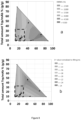
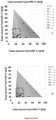
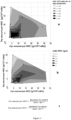
- contour plots shown in Figures 11a and 11b show the optimum ranges of total amount of cysteine or cystine and tryptophan added to the cell culture medium per IVCC*10 -12 at the end of the production phase which are between 2.9 and 12 g for Cys and between 2.5 and 7 g for Trp.
- compositions of the monoclonal antibody mAb1 were manufactured in fed-batch mode at large scale, i.e. in a 2000L stainless steel bioreactor, under standard operating conditions described in material and methods with various cysteine or cystine and tryptophan total quantity added as specified in Table 9.
- the buffer of the antibody sample was replaced with a diafiltration buffer (33mM His and 250mM Pro, pH 5.6) by at least 7 times (7 diavolumes) followed by ultrafiltration using a membrane having a Molecular Weight Cut Off (MWCO) of 30kDa.
- Polysorbate 80 at the required concentration (0.03% w/v based on the final concentration) was added once the concentration of the antibody (140mg/ml +/- 14 mg/ml) was achieved.
- the concentration of the antibody was measured using UV A280.
- Table 8 shows the appearance of charge variants of the formulated mAb1.
- Table 8 shows the appearance of charge variants of the formulated mAb1.
- the APG charge variant increase is correlated to an increase of total quantity of cysteine or cystine added wt % of total recombinant mAb1 produced.
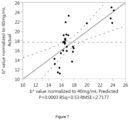
- a model to predict acidic peak group (APG) level was developed based on data (Tables 3) of a DG44 CHO cell line expressing mAb1 antibodies ( Figure 17 ).
- the APG is expressed as a function of the total quantity of cysteine or cystine and tryptophan added throughout the 14 days of production wt % of total recombinant mAb weight produced using Michealis Menten kinetic.
- each perfusion production day was defined as a new production batch. Therefore, the ratios of the total amounts of cysteine or cysteine and/or tryptophan used are calculated according to the perfusion flow rate versus the rate of removal of recombinant protein produced from the production vessel.
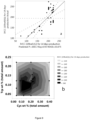
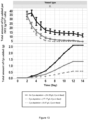
- a perfusion production was performed in 2L bioreactors using Alternating Tangential Flow (ATF) technology. As shown in Figure 18 , the APG charge variant prediction fits well with the experimental data.
- ATF Alternating Tangential Flow
Landscapes
- Health & Medical Sciences (AREA)
- Chemical & Material Sciences (AREA)
- Life Sciences & Earth Sciences (AREA)
- Organic Chemistry (AREA)
- Engineering & Computer Science (AREA)
- General Health & Medical Sciences (AREA)
- Genetics & Genomics (AREA)
- Zoology (AREA)
- Wood Science & Technology (AREA)
- Biotechnology (AREA)
- Biochemistry (AREA)
- Biomedical Technology (AREA)
- Bioinformatics & Cheminformatics (AREA)
- Molecular Biology (AREA)
- Proteomics, Peptides & Aminoacids (AREA)
- Medicinal Chemistry (AREA)
- Microbiology (AREA)
- General Engineering & Computer Science (AREA)
- General Chemical & Material Sciences (AREA)
- Chemical Kinetics & Catalysis (AREA)
- Biophysics (AREA)
- Veterinary Medicine (AREA)
- Pharmacology & Pharmacy (AREA)
- Epidemiology (AREA)
- Animal Behavior & Ethology (AREA)
- Public Health (AREA)
- Immunology (AREA)
- Cell Biology (AREA)
- Oil, Petroleum & Natural Gas (AREA)
- Analytical Chemistry (AREA)
- Preparation Of Compounds By Using Micro-Organisms (AREA)
- Micro-Organisms Or Cultivation Processes Thereof (AREA)
- Medicinal Preparation (AREA)
- Medicines Containing Antibodies Or Antigens For Use As Internal Diagnostic Agents (AREA)
- Peptides Or Proteins (AREA)
Applications Claiming Priority (3)
| Application Number | Priority Date | Filing Date | Title |
|---|---|---|---|
| GBGB1708655.4A GB201708655D0 (en) | 2017-05-31 | 2017-05-31 | Cell culture methods |
| PCT/EP2018/064102 WO2018219968A1 (en) | 2017-05-31 | 2018-05-29 | Cell culture methods |
| EP18743683.7A EP3630946B1 (de) | 2017-05-31 | 2018-05-29 | Zellkulturverfahren |
Related Parent Applications (1)
| Application Number | Title | Priority Date | Filing Date |
|---|---|---|---|
| EP18743683.7A Division EP3630946B1 (de) | 2017-05-31 | 2018-05-29 | Zellkulturverfahren |
Publications (2)
| Publication Number | Publication Date |
|---|---|
| EP4397682A2 true EP4397682A2 (de) | 2024-07-10 |
| EP4397682A3 EP4397682A3 (de) | 2024-08-21 |
Family
ID=59270991
Family Applications (2)
| Application Number | Title | Priority Date | Filing Date |
|---|---|---|---|
| EP18743683.7A Revoked EP3630946B1 (de) | 2017-05-31 | 2018-05-29 | Zellkulturverfahren |
| EP24164969.8A Pending EP4397682A3 (de) | 2017-05-31 | 2018-05-29 | Zellkulturverfahren |
Family Applications Before (1)
| Application Number | Title | Priority Date | Filing Date |
|---|---|---|---|
| EP18743683.7A Revoked EP3630946B1 (de) | 2017-05-31 | 2018-05-29 | Zellkulturverfahren |
Country Status (21)
| Country | Link |
|---|---|
| US (3) | US12077796B2 (de) |
| EP (2) | EP3630946B1 (de) |
| JP (3) | JP7460370B2 (de) |
| KR (3) | KR20200012972A (de) |
| CN (2) | CN119326882A (de) |
| AU (2) | AU2018276376C1 (de) |
| BR (1) | BR112019024390A2 (de) |
| CA (1) | CA3065661A1 (de) |
| CL (1) | CL2019003459A1 (de) |
| CO (1) | CO2019012871A2 (de) |
| EA (1) | EA201992828A1 (de) |
| ES (1) | ES2978394T3 (de) |
| GB (1) | GB201708655D0 (de) |
| HR (1) | HRP20240585T1 (de) |
| HU (1) | HUE066922T2 (de) |
| IL (2) | IL270880B2 (de) |
| MX (1) | MX2019014140A (de) |
| MY (1) | MY193535A (de) |
| PL (1) | PL3630946T3 (de) |
| RU (2) | RU2021128024A (de) |
| WO (1) | WO2018219968A1 (de) |
Families Citing this family (4)
| Publication number | Priority date | Publication date | Assignee | Title |
|---|---|---|---|---|
| GB201708655D0 (en) * | 2017-05-31 | 2017-07-12 | Ucb Biopharma Sprl | Cell culture methods |
| JP2023554489A (ja) * | 2020-12-22 | 2023-12-27 | ノバルティス アーゲー | 細胞培養中の分泌された組換え発現タンパク質中のシステイン残基の酸化レベルを低減するための方法 |
| GB202105424D0 (en) * | 2021-04-16 | 2021-06-02 | UCB Biopharma SRL | Cell culture processes |
| WO2025262319A1 (en) | 2024-06-21 | 2025-12-26 | Boehringer Ingelheim International Gmbh | Modifying blue color formation in bioprocesses |
Citations (4)
| Publication number | Priority date | Publication date | Assignee | Title |
|---|---|---|---|---|
| WO1998008934A1 (en) | 1996-08-30 | 1998-03-05 | Life Technologies, Inc. | Serum-free mammalian cell culture medium, and uses thereof |
| WO2013158275A1 (en) | 2012-04-20 | 2013-10-24 | Abbvie Inc. | Cell culture methods to reduce acidic species |
| US20130281355A1 (en) | 2012-04-24 | 2013-10-24 | Genentech, Inc. | Cell culture compositions and methods for polypeptide production |
| US8765413B2 (en) | 2010-04-26 | 2014-07-01 | Novartis Ag | Cell cultivation process |
Family Cites Families (26)
| Publication number | Priority date | Publication date | Assignee | Title |
|---|---|---|---|---|
| US5672502A (en) | 1985-06-28 | 1997-09-30 | Celltech Therapeutics Limited | Animal cell culture |
| US6048728A (en) | 1988-09-23 | 2000-04-11 | Chiron Corporation | Cell culture medium for enhanced cell growth, culture longevity, and product expression |
| IL161677A0 (en) | 2001-11-08 | 2004-09-27 | Protein Design Labs | Stable liquid pharmaceutical formulation of igg antibodies |
| EP1623019B2 (de) | 2003-05-15 | 2017-01-25 | Wyeth LLC | Kontrollierte glukosezufuhr für tierzellkultur |
| US7335491B2 (en) | 2004-08-27 | 2008-02-26 | Wyeth Research Ireland Limited | Production of anti-abeta |
| TWI364458B (en) | 2004-08-27 | 2012-05-21 | Wyeth Res Ireland Ltd | Production of tnfr-lg |
| TWI384069B (zh) | 2004-08-27 | 2013-02-01 | Pfizer Ireland Pharmaceuticals | 多胜肽之製法 |
| SI2078071T1 (sl) * | 2006-11-08 | 2015-05-29 | Wyeth Llc | Racionalno zasnovana gojišča za celično kulturo |
| US8030027B2 (en) * | 2008-04-29 | 2011-10-04 | St. Jude Children's Research Hospital | Method for enhancing recombinant antibody production |
| US8252557B2 (en) | 2008-10-28 | 2012-08-28 | Chugai Seiyaku Kabushiki Kaisha | Peptide-containing culture medium for culturing animal cell |
| US20110262965A1 (en) | 2010-04-23 | 2011-10-27 | Life Technologies Corporation | Cell culture medium comprising small peptides |
| RU2563353C2 (ru) | 2010-04-26 | 2015-09-20 | Новартис Аг | Улучшенная среда для культивирования клеток |
| CN102653729B (zh) | 2011-03-04 | 2014-07-16 | 上海赛金生物医药有限公司 | 一种用于中国仓鼠卵巢细胞的培养基 |
| WO2012145682A1 (en) * | 2011-04-21 | 2012-10-26 | Amgen Inc. | A method for culturing mammalian cells to improve recombinant protein production |
| EP4527855A3 (de) * | 2012-03-26 | 2025-06-11 | Sanofi | Stabile igg4-basierte bindemittelformulierungen |
| GB201208370D0 (en) | 2012-05-14 | 2012-06-27 | Ucb Pharma Sa | Antibodies |
| GB201208367D0 (en) | 2012-05-14 | 2012-06-27 | Ucb Pharma Sa | Biological product |
| JP2016513478A (ja) * | 2013-03-15 | 2016-05-16 | ジェネンテック, インコーポレイテッド | 細胞培養培地及び抗体を産生する方法 |
| CN106715707A (zh) | 2014-06-18 | 2017-05-24 | 免疫医疗公司 | 包含n‑乙酰半胱氨酸的细胞培养方法和培养基 |
| WO2016108765A1 (en) | 2014-12-29 | 2016-07-07 | Wirojpaisi Wanlop | Engine combustion system oxygen efficiency enhancing device with raised electrical voltage and improved installation method |
| GB201508180D0 (en) * | 2015-05-13 | 2015-06-24 | Ucb Biopharma Sprl | Antibodies |
| KR102425040B1 (ko) | 2016-04-28 | 2022-07-25 | 메르크 파텐트 게엠베하 | 단백질 내 트리술파이드 수준을 감소시키기 위한 방법 |
| GB201608323D0 (en) | 2016-05-12 | 2016-06-29 | Ucb Biopharma Sprl | Pharmaceutical compositions |
| WO2018018613A1 (zh) * | 2016-07-29 | 2018-02-01 | 广东东阳光药业有限公司 | 一种提高抗体纯度的细胞培养基和培养方法 |
| CN106222129A (zh) | 2016-07-29 | 2016-12-14 | 广东东阳光药业有限公司 | 一种提高抗体纯度的细胞培养基和培养方法 |
| GB201708655D0 (en) | 2017-05-31 | 2017-07-12 | Ucb Biopharma Sprl | Cell culture methods |
-
2017
- 2017-05-31 GB GBGB1708655.4A patent/GB201708655D0/en not_active Ceased
-
2018
- 2018-05-29 IL IL270880A patent/IL270880B2/en unknown
- 2018-05-29 US US16/615,419 patent/US12077796B2/en active Active
- 2018-05-29 EA EA201992828A patent/EA201992828A1/ru unknown
- 2018-05-29 KR KR1020197038895A patent/KR20200012972A/ko not_active Ceased
- 2018-05-29 IL IL317828A patent/IL317828A/en unknown
- 2018-05-29 RU RU2021128024A patent/RU2021128024A/ru unknown
- 2018-05-29 BR BR112019024390-9A patent/BR112019024390A2/pt unknown
- 2018-05-29 CN CN202411456463.9A patent/CN119326882A/zh active Pending
- 2018-05-29 HU HUE18743683A patent/HUE066922T2/hu unknown
- 2018-05-29 KR KR1020247019609A patent/KR20240096888A/ko active Pending
- 2018-05-29 CA CA3065661A patent/CA3065661A1/en active Pending
- 2018-05-29 MX MX2019014140A patent/MX2019014140A/es unknown
- 2018-05-29 EP EP18743683.7A patent/EP3630946B1/de not_active Revoked
- 2018-05-29 HR HRP20240585TT patent/HRP20240585T1/hr unknown
- 2018-05-29 PL PL18743683.7T patent/PL3630946T3/pl unknown
- 2018-05-29 JP JP2019566198A patent/JP7460370B2/ja active Active
- 2018-05-29 RU RU2019143742A patent/RU2758674C2/ru active
- 2018-05-29 ES ES18743683T patent/ES2978394T3/es active Active
- 2018-05-29 MY MYPI2019006875A patent/MY193535A/en unknown
- 2018-05-29 WO PCT/EP2018/064102 patent/WO2018219968A1/en not_active Ceased
- 2018-05-29 EP EP24164969.8A patent/EP4397682A3/de active Pending
- 2018-05-29 AU AU2018276376A patent/AU2018276376C1/en active Active
- 2018-05-29 CN CN201880035870.9A patent/CN110741077B/zh active Active
- 2018-05-29 KR KR1020257034169A patent/KR20250156183A/ko active Pending
-
2019
- 2019-11-18 CO CONC2019/0012871A patent/CO2019012871A2/es unknown
- 2019-11-26 CL CL2019003459A patent/CL2019003459A1/es unknown
-
2021
- 2021-08-31 JP JP2021141016A patent/JP7560420B2/ja active Active
-
2022
- 2022-07-06 JP JP2022109106A patent/JP7406593B2/ja active Active
-
2024
- 2024-08-23 US US18/813,117 patent/US20250051824A1/en active Pending
- 2024-11-11 AU AU2024259881A patent/AU2024259881B2/en active Active
- 2024-11-15 US US18/948,600 patent/US20250066832A1/en active Pending
Patent Citations (5)
| Publication number | Priority date | Publication date | Assignee | Title |
|---|---|---|---|---|
| WO1998008934A1 (en) | 1996-08-30 | 1998-03-05 | Life Technologies, Inc. | Serum-free mammalian cell culture medium, and uses thereof |
| US20060148074A1 (en) | 1996-08-30 | 2006-07-06 | Invitrogen Corporation | Serum-free mammalian cell culture medium, and uses thereof |
| US8765413B2 (en) | 2010-04-26 | 2014-07-01 | Novartis Ag | Cell cultivation process |
| WO2013158275A1 (en) | 2012-04-20 | 2013-10-24 | Abbvie Inc. | Cell culture methods to reduce acidic species |
| US20130281355A1 (en) | 2012-04-24 | 2013-10-24 | Genentech, Inc. | Cell culture compositions and methods for polypeptide production |
Non-Patent Citations (5)
| Title |
|---|
| BANKS D. D. ET AL., JOURNAL OF PHARMACEUTICAL SCIENCES, vol. 98, 2009, pages 4501 - 10 |
| HECKLAU C. ET AL., J BIOTECH, vol. 218, 2016, pages 53 - 63 |
| KSHIRSAGAR R. ET AL., BIOTECHNOLOGY AND BIOENGINEERING, vol. 109, no. 10, 2012, pages 2523 - 2532 |
| PURDIE J. ET AL., BIOTECHNOLOGY PROGRESS, vol. 32, 2016, pages 998 - 1008 |
| ZANG LI ET AL., ANAL. CHEM, vol. 83, 2011, pages 5422 - 5430 |
Also Published As
Similar Documents
| Publication | Publication Date | Title |
|---|---|---|
| US20250066832A1 (en) | Cell culture methods | |
| EP3717631B1 (de) | Zellkulturverfahren | |
| US20240425894A1 (en) | Cell culture processes | |
| HK40114294A (zh) | 细胞培养方法 | |
| EA044551B1 (ru) | Способы культивирования клеток | |
| BR122024024868A2 (pt) | Métodos de cultura celular | |
| KR20250022781A (ko) | 세포 배양 방법 |
Legal Events
| Date | Code | Title | Description |
|---|---|---|---|
| PUAI | Public reference made under article 153(3) epc to a published international application that has entered the european phase |
Free format text: ORIGINAL CODE: 0009012 |
|
| STAA | Information on the status of an ep patent application or granted ep patent |
Free format text: STATUS: THE APPLICATION HAS BEEN PUBLISHED |
|
| AC | Divisional application: reference to earlier application |
Ref document number: 3630946 Country of ref document: EP Kind code of ref document: P |
|
| AK | Designated contracting states |
Kind code of ref document: A2 Designated state(s): AL AT BE BG CH CY CZ DE DK EE ES FI FR GB GR HR HU IE IS IT LI LT LU LV MC MK MT NL NO PL PT RO RS SE SI SK SM TR |
|
| REG | Reference to a national code |
Ref country code: DE Ref legal event code: R079 Free format text: PREVIOUS MAIN CLASS: C07K0016000000 Ipc: C12N0005000000 |
|
| PUAL | Search report despatched |
Free format text: ORIGINAL CODE: 0009013 |
|
| AK | Designated contracting states |
Kind code of ref document: A3 Designated state(s): AL AT BE BG CH CY CZ DE DK EE ES FI FR GB GR HR HU IE IS IT LI LT LU LV MC MK MT NL NO PL PT RO RS SE SI SK SM TR |
|
| RIC1 | Information provided on ipc code assigned before grant |
Ipc: C07K 16/00 20060101ALI20240717BHEP Ipc: C12P 21/02 20060101ALI20240717BHEP Ipc: C12N 5/00 20060101AFI20240717BHEP |
|
| STAA | Information on the status of an ep patent application or granted ep patent |
Free format text: STATUS: REQUEST FOR EXAMINATION WAS MADE |
|
| 17P | Request for examination filed |
Effective date: 20250221 |