EP4391664A2 - Elektronische vorrichtung und verfahren zur steuerung der übertragungsleistung davon - Google Patents
Elektronische vorrichtung und verfahren zur steuerung der übertragungsleistung davon Download PDFInfo
- Publication number
- EP4391664A2 EP4391664A2 EP24175416.7A EP24175416A EP4391664A2 EP 4391664 A2 EP4391664 A2 EP 4391664A2 EP 24175416 A EP24175416 A EP 24175416A EP 4391664 A2 EP4391664 A2 EP 4391664A2
- Authority
- EP
- European Patent Office
- Prior art keywords
- electronic device
- type
- transmission power
- processor
- sensor
- Prior art date
- Legal status (The legal status is an assumption and is not a legal conclusion. Google has not performed a legal analysis and makes no representation as to the accuracy of the status listed.)
- Pending
Links
Images



Classifications
-
- H—ELECTRICITY
- H04—ELECTRIC COMMUNICATION TECHNIQUE
- H04W—WIRELESS COMMUNICATION NETWORKS
- H04W52/00—Power management, e.g. Transmission Power Control [TPC] or power classes
- H04W52/04—Transmission power control [TPC]
- H04W52/18—TPC being performed according to specific parameters
- H04W52/28—TPC being performed according to specific parameters using user profile, e.g. mobile speed, priority or network state, e.g. standby, idle or non-transmission
-
- G—PHYSICS
- G06—COMPUTING OR CALCULATING; COUNTING
- G06F—ELECTRIC DIGITAL DATA PROCESSING
- G06F1/00—Details not covered by groups G06F3/00 - G06F13/00 and G06F21/00
- G06F1/16—Constructional details or arrangements
- G06F1/1613—Constructional details or arrangements for portable computers
- G06F1/1615—Constructional details or arrangements for portable computers with several enclosures having relative motions, each enclosure supporting at least one I/O or computing function
- G06F1/1616—Constructional details or arrangements for portable computers with several enclosures having relative motions, each enclosure supporting at least one I/O or computing function with folding flat displays, e.g. laptop computers or notebooks having a clamshell configuration, with body parts pivoting to an open position around an axis parallel to the plane they define in closed position
-
- H—ELECTRICITY
- H04—ELECTRIC COMMUNICATION TECHNIQUE
- H04B—TRANSMISSION
- H04B1/00—Details of transmission systems, not covered by a single one of groups H04B3/00 - H04B13/00; Details of transmission systems not characterised by the medium used for transmission
- H04B1/02—Transmitters
- H04B1/04—Circuits
-
- H—ELECTRICITY
- H04—ELECTRIC COMMUNICATION TECHNIQUE
- H04B—TRANSMISSION
- H04B1/00—Details of transmission systems, not covered by a single one of groups H04B3/00 - H04B13/00; Details of transmission systems not characterised by the medium used for transmission
- H04B1/38—Transceivers, i.e. devices in which transmitter and receiver form a structural unit and in which at least one part is used for functions of transmitting and receiving
- H04B1/40—Circuits
-
- G—PHYSICS
- G06—COMPUTING OR CALCULATING; COUNTING
- G06F—ELECTRIC DIGITAL DATA PROCESSING
- G06F1/00—Details not covered by groups G06F3/00 - G06F13/00 and G06F21/00
- G06F1/16—Constructional details or arrangements
- G06F1/1613—Constructional details or arrangements for portable computers
- G06F1/1633—Constructional details or arrangements of portable computers not specific to the type of enclosures covered by groups G06F1/1615 - G06F1/1626
- G06F1/1637—Details related to the display arrangement, including those related to the mounting of the display in the housing
- G06F1/1652—Details related to the display arrangement, including those related to the mounting of the display in the housing the display being flexible, e.g. mimicking a sheet of paper, or rollable
-
- G—PHYSICS
- G06—COMPUTING OR CALCULATING; COUNTING
- G06F—ELECTRIC DIGITAL DATA PROCESSING
- G06F1/00—Details not covered by groups G06F3/00 - G06F13/00 and G06F21/00
- G06F1/16—Constructional details or arrangements
- G06F1/1613—Constructional details or arrangements for portable computers
- G06F1/1633—Constructional details or arrangements of portable computers not specific to the type of enclosures covered by groups G06F1/1615 - G06F1/1626
- G06F1/1675—Miscellaneous details related to the relative movement between the different enclosures or enclosure parts
- G06F1/1677—Miscellaneous details related to the relative movement between the different enclosures or enclosure parts for detecting open or closed state or particular intermediate positions assumed by movable parts of the enclosure, e.g. detection of display lid position with respect to main body in a laptop, detection of opening of the cover of battery compartment
-
- G—PHYSICS
- G06—COMPUTING OR CALCULATING; COUNTING
- G06F—ELECTRIC DIGITAL DATA PROCESSING
- G06F1/00—Details not covered by groups G06F3/00 - G06F13/00 and G06F21/00
- G06F1/16—Constructional details or arrangements
- G06F1/1613—Constructional details or arrangements for portable computers
- G06F1/1633—Constructional details or arrangements of portable computers not specific to the type of enclosures covered by groups G06F1/1615 - G06F1/1626
- G06F1/1684—Constructional details or arrangements related to integrated I/O peripherals not covered by groups G06F1/1635 - G06F1/1675
- G06F1/1698—Constructional details or arrangements related to integrated I/O peripherals not covered by groups G06F1/1635 - G06F1/1675 the I/O peripheral being a sending/receiving arrangement to establish a cordless communication link, e.g. radio or infrared link, integrated cellular phone
-
- H—ELECTRICITY
- H04—ELECTRIC COMMUNICATION TECHNIQUE
- H04B—TRANSMISSION
- H04B1/00—Details of transmission systems, not covered by a single one of groups H04B3/00 - H04B13/00; Details of transmission systems not characterised by the medium used for transmission
- H04B1/38—Transceivers, i.e. devices in which transmitter and receiver form a structural unit and in which at least one part is used for functions of transmitting and receiving
- H04B1/3827—Portable transceivers
- H04B1/3833—Hand-held transceivers
- H04B1/3838—Arrangements for reducing RF exposure to the user, e.g. by changing the shape of the transceiver while in use
-
- H—ELECTRICITY
- H04—ELECTRIC COMMUNICATION TECHNIQUE
- H04B—TRANSMISSION
- H04B17/00—Monitoring; Testing
- H04B17/10—Monitoring; Testing of transmitters
-
- H—ELECTRICITY
- H04—ELECTRIC COMMUNICATION TECHNIQUE
- H04M—TELEPHONIC COMMUNICATION
- H04M1/00—Substation equipment, e.g. for use by subscribers
- H04M1/02—Constructional features of telephone sets
- H04M1/0202—Portable telephone sets, e.g. cordless phones, mobile phones or bar type handsets
- H04M1/0206—Portable telephones comprising a plurality of mechanically joined movable body parts, e.g. hinged housings
- H04M1/0208—Portable telephones comprising a plurality of mechanically joined movable body parts, e.g. hinged housings characterized by the relative motions of the body parts
- H04M1/0214—Foldable telephones, i.e. with body parts pivoting to an open position around an axis parallel to the plane they define in closed position
-
- H—ELECTRICITY
- H04—ELECTRIC COMMUNICATION TECHNIQUE
- H04M—TELEPHONIC COMMUNICATION
- H04M1/00—Substation equipment, e.g. for use by subscribers
- H04M1/02—Constructional features of telephone sets
- H04M1/0202—Portable telephone sets, e.g. cordless phones, mobile phones or bar type handsets
- H04M1/0206—Portable telephones comprising a plurality of mechanically joined movable body parts, e.g. hinged housings
- H04M1/0208—Portable telephones comprising a plurality of mechanically joined movable body parts, e.g. hinged housings characterized by the relative motions of the body parts
- H04M1/0214—Foldable telephones, i.e. with body parts pivoting to an open position around an axis parallel to the plane they define in closed position
- H04M1/0216—Foldable in one direction, i.e. using a one degree of freedom hinge
-
- H—ELECTRICITY
- H04—ELECTRIC COMMUNICATION TECHNIQUE
- H04M—TELEPHONIC COMMUNICATION
- H04M1/00—Substation equipment, e.g. for use by subscribers
- H04M1/02—Constructional features of telephone sets
- H04M1/0202—Portable telephone sets, e.g. cordless phones, mobile phones or bar type handsets
- H04M1/0206—Portable telephones comprising a plurality of mechanically joined movable body parts, e.g. hinged housings
- H04M1/0241—Portable telephones comprising a plurality of mechanically joined movable body parts, e.g. hinged housings using relative motion of the body parts to change the operational status of the telephone set, e.g. switching on/off, answering incoming call
- H04M1/0243—Portable telephones comprising a plurality of mechanically joined movable body parts, e.g. hinged housings using relative motion of the body parts to change the operational status of the telephone set, e.g. switching on/off, answering incoming call using the relative angle between housings
-
- H—ELECTRICITY
- H04—ELECTRIC COMMUNICATION TECHNIQUE
- H04M—TELEPHONIC COMMUNICATION
- H04M1/00—Substation equipment, e.g. for use by subscribers
- H04M1/72—Mobile telephones; Cordless telephones, i.e. devices for establishing wireless links to base stations without route selection
- H04M1/724—User interfaces specially adapted for cordless or mobile telephones
- H04M1/72448—User interfaces specially adapted for cordless or mobile telephones with means for adapting the functionality of the device according to specific conditions
- H04M1/72454—User interfaces specially adapted for cordless or mobile telephones with means for adapting the functionality of the device according to specific conditions according to context-related or environment-related conditions
-
- H—ELECTRICITY
- H04—ELECTRIC COMMUNICATION TECHNIQUE
- H04W—WIRELESS COMMUNICATION NETWORKS
- H04W52/00—Power management, e.g. Transmission Power Control [TPC] or power classes
- H04W52/02—Power saving arrangements
- H04W52/0209—Power saving arrangements in terminal devices
- H04W52/0261—Power saving arrangements in terminal devices managing power supply demand, e.g. depending on battery level
- H04W52/0267—Power saving arrangements in terminal devices managing power supply demand, e.g. depending on battery level by controlling user interface components
- H04W52/027—Power saving arrangements in terminal devices managing power supply demand, e.g. depending on battery level by controlling user interface components by controlling a display operation or backlight unit
-
- H—ELECTRICITY
- H04—ELECTRIC COMMUNICATION TECHNIQUE
- H04W—WIRELESS COMMUNICATION NETWORKS
- H04W52/00—Power management, e.g. Transmission Power Control [TPC] or power classes
- H04W52/04—Transmission power control [TPC]
- H04W52/06—TPC algorithms
- H04W52/14—Separate analysis of uplink or downlink
-
- H—ELECTRICITY
- H04—ELECTRIC COMMUNICATION TECHNIQUE
- H04W—WIRELESS COMMUNICATION NETWORKS
- H04W52/00—Power management, e.g. Transmission Power Control [TPC] or power classes
- H04W52/04—Transmission power control [TPC]
- H04W52/18—TPC being performed according to specific parameters
- H04W52/28—TPC being performed according to specific parameters using user profile, e.g. mobile speed, priority or network state, e.g. standby, idle or non-transmission
- H04W52/283—Power depending on the position of the mobile
-
- H—ELECTRICITY
- H04—ELECTRIC COMMUNICATION TECHNIQUE
- H04W—WIRELESS COMMUNICATION NETWORKS
- H04W52/00—Power management, e.g. Transmission Power Control [TPC] or power classes
- H04W52/04—Transmission power control [TPC]
- H04W52/18—TPC being performed according to specific parameters
- H04W52/28—TPC being performed according to specific parameters using user profile, e.g. mobile speed, priority or network state, e.g. standby, idle or non-transmission
- H04W52/288—TPC being performed according to specific parameters using user profile, e.g. mobile speed, priority or network state, e.g. standby, idle or non-transmission taking into account the usage mode, e.g. hands-free, data transmission or telephone
-
- H—ELECTRICITY
- H04—ELECTRIC COMMUNICATION TECHNIQUE
- H04W—WIRELESS COMMUNICATION NETWORKS
- H04W52/00—Power management, e.g. Transmission Power Control [TPC] or power classes
- H04W52/04—Transmission power control [TPC]
- H04W52/30—Transmission power control [TPC] using constraints in the total amount of available transmission power
- H04W52/36—Transmission power control [TPC] using constraints in the total amount of available transmission power with a discrete range or set of values, e.g. step size, ramping or offsets
- H04W52/367—Power values between minimum and maximum limits, e.g. dynamic range
-
- H—ELECTRICITY
- H04—ELECTRIC COMMUNICATION TECHNIQUE
- H04B—TRANSMISSION
- H04B1/00—Details of transmission systems, not covered by a single one of groups H04B3/00 - H04B13/00; Details of transmission systems not characterised by the medium used for transmission
- H04B1/02—Transmitters
- H04B1/04—Circuits
- H04B2001/0408—Circuits with power amplifiers
- H04B2001/0416—Circuits with power amplifiers having gain or transmission power control
Definitions
- the disclosure relates to an electronic device and a method for controlling transmission power thereof.
- Electronic devices may provide wireless communication (e.g., Bluetooth, Wi-Fi, or near field communication (NFC)) functions using electric waves.
- wireless communication e.g., Bluetooth, Wi-Fi, or near field communication (NFC)
- NFC near field communication
- Electronic devices may generate electric waves that are harmful to human bodies during wireless communication. Accordingly, the electronic devices should satisfy the rules for electromagnetic waves on a specific absorption rate (SAR) for electromagnetic waves of a human body.
- the rules for electromagnetic waves may be different according to the types of the electronic devices.
- the rules of electromagnetic waves may be differently defined for an electronic device of a phone type, an electronic device of a phablet type, an electronic device of a tablet type, or an electronic device of a laptop type.
- the electronic devices may be generally classified into a phone, a phablet, a tablet, or a laptop according to the sizes of the displays.
- the disclosure provides an electronic device that can control transmission power of a wireless communication circuit such that an SAR rule (e.g., a specific absorption rate for electromagnetic waves of a human body) is satisfied in correspondence (response) to a change in the size or the form of a display.
- an SAR rule e.g., a specific absorption rate for electromagnetic waves of a human body
- the disclosure also provides an electronic device that can control transmission power of a wireless communication circuit such that an SAR rule according to an approach degree of an external object (e.g., a user) is satisfied.
- an electronic device may include: a foldable housing including: a hinge structure; a first housing structure connected to the hinge structure, and including a first surface facing a first direction and a second surface facing a second direction that is opposite to the first direction; and a second housing structure connected to the hinge structure, including a third surface facing a third direction and a fourth surface facing a fourth direction that is opposite to the third direction, and being folded with the first housing structure while the hinge structure is taken as an axis; a flexible display extending from the first surface to the third surface and defining the first surface and the third surface; a wireless communication circuit disposed inside the foldable housing; a grip sensor disposed in the foldable housing; at least one sensor disposed inside the foldable housing and configured to detect a folding state of the foldable housing; a processor disposed inside the first housing structure or the second housing structure and operatively connected to the flexible display, the wireless communication circuit, the grip sensor, and the at least one sensor; and a memory operatively connected to the processor
- an electronic device may include: a housing; a flexible display; a support structure configured to roll the flexible display; a wireless communication circuit disposed inside the housing; a grip sensor; at least one sensor configured to detect a unfolding degree of the flexible display; a processor disposed inside the housing, and operatively connected to the flexible display, the wireless communication circuit, the grip sensor, and the at least one sensor; and a memory operatively connected to the processor, wherein the memory stores instructions that, when executed, cause the processor to: determine the unfolding degree of the flexible display by using the at least one sensor; detect an approach distance of an external object from the electronic device by using the grip sensor; and control transmission power of the wireless communication circuit based at least in part on the unfolding degree and the approach distance.
- a method for controlling transmission power of an electronic device may include: determining an effective size of an exposed area of a flexible display; determining a type of the electronic device, at least on the basis of the determined effective size; detecting a distance between the electronic device and an external object; and controlling transmission power of the wireless communication circuit based at least in part on the determined type of the electronic device and the detected distance.
- various functions described below can be implemented or supported by one or more computer programs, each of which is formed from computer readable program code and embodied in a computer readable medium.
- application and “program” refer to one or more computer programs, software components, sets of instructions, procedures, functions, objects, classes, instances, related data, or a portion thereof adapted for implementation in a suitable computer readable program code.
- computer readable program code includes any type of computer code, including source code, object code, and executable code.
- computer readable medium includes any type of medium capable of being accessed by a computer, such as read only memory (ROM), random access memory (RAM), a hard disk drive, a compact disc (CD), a digital video disc (DVD), or any other type of memory.
- ROM read only memory
- RAM random access memory
- CD compact disc
- DVD digital video disc
- a "non-transitory” computer readable medium excludes wired, wireless, optical, or other communication links that transport transitory electrical or other signals.
- a non-transitory computer readable medium includes media where data can be permanently stored and media where data can be stored and later overwritten, such as a rewritable optical disc or an erasable memory device.
- FIGS. 1 through 6 discussed below, and the various embodiments used to describe the principles of the present disclosure in this patent document are by way of illustration only and should not be construed in any way to limit the scope of the disclosure. Those skilled in the art will understand that the principles of the present disclosure may be implemented in any suitably arranged system or device.
- FIG. 1 illustrates an electronic device 101 in a network environment 100 according to an embodiment of the disclosure.
- the electronic device 101 in the network environment 100 may communicate with an electronic device 102 via a first network 198 (e.g., a short-range wireless communication network), or an electronic device 104 or a server 108 via a second network 199 (e.g., a long-range wireless communication network).
- a first network 198 e.g., a short-range wireless communication network
- an electronic device 104 or a server 108 via a second network 199 (e.g., a long-range wireless communication network).
- the electronic device 101 may communicate with the electronic device 104 via the server 108.
- the electronic device 101 may include a processor 120, memory 130, an input device 150, a sound output device 155, a display device 160, an audio module 170, a sensor module 176, an interface 177, a haptic module 179, a camera module 180, a power management module 188, a battery 189, a communication module 190, a subscriber identification module (SIM) 196, or an antenna module 197.
- at least one (e.g., the display device 160 or the camera module 180) of the components may be omitted from the electronic device 101, or one or more other components may be added in the electronic device 101.
- some of the components may be implemented as single integrated circuitry.
- the sensor module 176 e.g., a fingerprint sensor, an iris sensor, or an illuminance sensor
- the display device 160 e.g., a display
- an haptic module 179 e.g., a camera module 180
- a power management module 188 e.g., the display
- the processor 120 may execute, for example, software (e.g., a program 140) to control at least one other component (e.g., a hardware or software component) of the electronic device 101 coupled with the processor 120, and may perform various data processing or computation. According to one embodiment, as at least part of the data processing or computation, the processor 120 may load a command or data received from another component (e.g., the sensor module 176 or the communication module 190) in volatile memory 132, process the command or the data stored in the volatile memory 132, and store resulting data in non-volatile memory 134.
- software e.g., a program 140
- the processor 120 may load a command or data received from another component (e.g., the sensor module 176 or the communication module 190) in volatile memory 132, process the command or the data stored in the volatile memory 132, and store resulting data in non-volatile memory 134.
- the processor 120 may include a main processor 121 (e.g., a central processing unit (CPU) or an application processor (AP)), and an auxiliary processor 123 (e.g., a graphics processing unit (GPU), an image signal processor (ISP), a sensor hub processor, or a communication processor (CP)) that is operable independently from, or in conjunction with, the main processor 121.
- auxiliary processor 123 may be adapted to consume less power than the main processor 121, or to be specific to a specified function.
- the auxiliary processor 123 may be implemented as separate from, or as part of the main processor 121.
- the auxiliary processor 123 may control at least some of functions or states related to at least one component (e.g., the display device 160, the sensor module 176, or the communication module 190) among the components of the electronic device 101, instead of the main processor 121 while the main processor 121 is in an inactive (e.g., sleep) state, or together with the main processor 121 while the main processor 121 is in an active state (e.g., executing an application).
- the auxiliary processor 123 e.g., an image signal processor or a communication processor
- the memory 130 may store various data used by at least one component (e.g., the processor 120 or the sensor module 176) of the electronic device 101.
- the various data may include, for example, software (e.g., the program 140) and input data or output data for a command related thereto.
- the memory 130 may include the volatile memory 132 or the non-volatile memory 134.
- the non-volatile memory 134 may include an internal memory 136 or may be used to access an external memory 138.
- the program 140 may be stored in the memory 130 as software, and may include, for example, an operating system (OS) 142, middleware 144, or an application 146.
- OS operating system
- middleware middleware
- application application
- the input device 150 may receive a command or data to be used by another component (e.g., the processor 120) of the electronic device 101, from the outside (e.g., a user) of the electronic device 101.
- the input device 150 may include, for example, a microphone, a mouse, a keyboard, or a digital pen (e.g., a stylus pen).
- the sound output device 155 may output sound signals to the outside of the electronic device 101.
- the sound output device 155 may include, for example, a speaker or a receiver.
- the speaker may be used for general purposes, such as playing multimedia or playing record, and the receiver may be used for an incoming call. According to an embodiment, the receiver may be implemented as separate from, or as part of the speaker.
- the display device 160 may visually provide information to the outside (e.g., a user) of the electronic device 101.
- the display device 160 may include, for example, a display, a hologram device, or a projector and control circuitry to control a corresponding one of the display, hologram device, and projector.
- the display device 160 may include touch circuitry adapted to detect a touch, or sensor circuitry (e.g., a pressure sensor) adapted to measure the intensity of force incurred by the touch.
- the audio module 170 may convert a sound into an electrical signal and vice versa. According to an embodiment, the audio module 170 may obtain the sound via the input device 150, or output the sound via the sound output device 155 or a headphone of an external electronic device (e.g., an electronic device 102) directly (e.g., wiredly) or wirelessly coupled with the electronic device 101.
- an external electronic device e.g., an electronic device 102
- directly e.g., wiredly
- wirelessly e.g., wirelessly
- the sensor module 176 may detect an operational state (e.g., power or temperature) of the electronic device 101 or an environmental state (e.g., a state of a user) external to the electronic device 101, and then generate an electrical signal or data value corresponding to the detected state.
- the sensor module 176 may include, for example, a gesture sensor, a gyro sensor, an atmospheric pressure sensor, a magnetic sensor, an acceleration sensor, a grip sensor, a proximity sensor, a color sensor, an infrared (IR) sensor, a biometric sensor, a temperature sensor, a humidity sensor, or an illuminance sensor.
- the interface 177 may support one or more specified protocols to be used for the electronic device 101 to be coupled with the external electronic device (e.g., the electronic device 102) directly (e.g., wiredly) or wirelessly.
- the interface 177 may include, for example, a high definition multimedia interface (HDMI), a universal serial bus (USB) interface, a secure digital (SD) card interface, or an audio interface.
- HDMI high definition multimedia interface
- USB universal serial bus
- SD secure digital
- a connecting terminal 178 may include a connector via which the electronic device 101 may be physically connected with the external electronic device (e.g., the electronic device 102).
- the connecting terminal 178 may include, for example, a HDMI connector, a USB connector, a SD card connector, or an audio connector (e.g., a headphone connector).
- the haptic module 179 may convert an electrical signal into a mechanical stimulus (e.g., a vibration or a movement) or electrical stimulus which may be recognized by a user via his tactile sensation or kinesthetic sensation.
- the haptic module 179 may include, for example, a motor, a piezoelectric element, or an electric stimulator.
- the camera module 180 may capture a still image or moving images.
- the camera module 180 may include one or more lenses, image sensors, image signal processors, or flashes.
- the power management module 188 may manage power supplied to the electronic device 101.
- the power management module 188 may be implemented as at least part of, for example, a power management integrated circuit (PMIC).
- PMIC power management integrated circuit
- the battery 189 may supply power to at least one component of the electronic device 101.
- the battery 189 may include, for example, a primary cell which is not rechargeable, a secondary cell which is rechargeable, or a fuel cell.
- the communication module 190 may support establishing a direct (e.g., wired) communication channel or a wireless communication channel between the electronic device 101 and the external electronic device (e.g., the electronic device 102, the electronic device 104, or the server 108) and performing communication via the established communication channel.
- the communication module 190 may include one or more communication processors that are operable independently from the processor 120 (e.g., the application processor (AP)) and supports a direct (e.g., wired) communication or a wireless communication.
- AP application processor
- the communication module 190 may include a wireless communication module 192 (e.g., a cellular communication module, a short-range wireless communication module, or a global navigation satellite system (GNSS) communication module) or a wired communication module 194 (e.g., a local area network (LAN) communication module or a power line communication (PLC) module).
- a wireless communication module 192 e.g., a cellular communication module, a short-range wireless communication module, or a global navigation satellite system (GNSS) communication module
- GNSS global navigation satellite system
- wired communication module 194 e.g., a local area network (LAN) communication module or a power line communication (PLC) module.
- LAN local area network
- PLC power line communication
- a corresponding one of these communication modules may communicate with the external electronic device via the first network 198 (e.g., a short-range communication network, such as Bluetooth TM , wireless-fidelity (Wi-Fi) direct, or infrared data association (IrDA)) or the second network 199 (e.g., a long-range communication network, such as a cellular network, the Internet, or a computer network (e.g., LAN or wide area network (WAN)).
- the first network 198 e.g., a short-range communication network, such as Bluetooth TM , wireless-fidelity (Wi-Fi) direct, or infrared data association (IrDA)
- the second network 199 e.g., a long-range communication network, such as a cellular network, the Internet, or a computer network (e.g., LAN or wide area network (WAN)
- These various types of communication modules may be implemented as a single component (e.g., a single chip), or may be implemented as multi
- the wireless communication module 192 may identify and authenticate the electronic device 101 in a communication network, such as the first network 198 or the second network 199, using subscriber information (e.g., international mobile subscriber identity (IMSI)) stored in the subscriber identification module (SIM) 196.
- subscriber information e.g., international mobile subscriber identity (IMSI)
- SIM subscriber identification module
- the antenna module 197 may transmit or receive a signal or power to or from the outside (e.g., the external electronic device) of the electronic device 101.
- the antenna module 197 may include an antenna including a radiating element composed of a conductive material or a conductive pattern formed in or on a substrate (e.g., PCB).
- the antenna module 197 may include a plurality of antennas. In such a case, at least one antenna appropriate for a communication scheme used in the communication network, such as the first network 198 or the second network 199, may be selected, for example, by the communication module 190 (e.g., the wireless communication module 192) from the plurality of antennas.
- the signal or the power may then be transmitted or received between the communication module 190 and the external electronic device via the selected at least one antenna.
- another component e.g., a radio frequency integrated circuit (RFIC)
- RFIC radio frequency integrated circuit
- At least some of the above-described components may be coupled mutually and communicate signals (e.g., commands or data) therebetween via an inter-peripheral communication scheme (e.g., a bus, general purpose input and output (GPIO), serial peripheral interface (SPI), or mobile industry processor interface (MIPI)).
- an inter-peripheral communication scheme e.g., a bus, general purpose input and output (GPIO), serial peripheral interface (SPI), or mobile industry processor interface (MIPI)
- commands or data may be transmitted or received between the electronic device 101 and the external electronic device 104 via the server 108 coupled with the second network 199.
- Each of the electronic devices 102 and 104 may be a device of a same type as, or a different type, from the electronic device 101.
- all or some of operations to be executed at the electronic device 101 may be executed at one or more of the external electronic devices 102, 104, or 108.
- the electronic device 101 may perform a function or a service automatically, or in response to a request from a user or another device, the electronic device 101, instead of, or in addition to, executing the function or the service, may request the one or more external electronic devices to perform at least part of the function or the service.
- the one or more external electronic devices receiving the request may perform the at least part of the function or the service requested, or an additional function or an additional service related to the request and transfer an outcome of the performing to the electronic device 101.
- the electronic device 101 may provide the outcome, with or without further processing of the outcome, as at least part of a reply to the request.
- a cloud computing, distributed computing, or client-server computing technology may be used, for example.
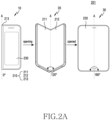
- FIG. 2A illustrates a foldable electronic device according to an embodiment of the disclosure.
- a foldable electronic device 201 (e.g., the electronic device 101) may include a foldable housing 210, a flexible (or foldable) display 220, and a sub-display 230.
- a surface, on which the flexible display 220 is disposed is defined as a first surface or a front surface of the foldable electronic device 201.
- An opposite surface of the front surface is defined as a second surface or a rear surface of the foldable electronic device 201.
- a surface that surrounds a space between the front surface and the rear surface is defined as a third surface or a side surface of the foldable electronic device 201.
- the foldable housing 210 may include a first housing structure 211, a second housing structure 212, and a hinge structure 213.
- the first housing structure 211 may be connected to the second housing structure 212 through the hinge structure 213, and include a first surface facing a first direction and a second surface facing a second direction that is opposite to the first direction.
- the sub-display 230 may be located on the second surface of the first housing structure 211.
- the second housing structure 212 may include a third surface connected to the first housing structure 211 through the hinge structure 213 and facing a third direction and a fourth surface facing a fourth direction that is opposite to the third direction.
- the third surface may refer to a front surface of the second housing structure 212
- the fourth surface may refer to a rear surface of the second housing structure 212.
- the hinge structure 213 may be connected to the first housing structure 211 and the second housing structure 212, and may maintain the first housing structure 211 and the second housing structure 212 disposed on opposite sides of a folding axis (axis A) in a folding state, a flat state, or an intermediate state.
- the intermediate state may be a state, in which the first housing structure 211 and the second housing structure 212 define a certain angle.
- the flexible display 220 may be disposed in a space defined by the foldable housing 210.
- the flexible display 220 may be seated (or accommodate) in a recess defined by the first housing structure 211 and the second housing structure 212.
- At least a partial area of the flexible display 220 may be deformed to a flat surface or a curved surface.
- the flexible display 220 may be folded with respect to the folding axis (axis A).
- the sub-display 230 may be viewed through at least a portion of the second surface of the first housing structure 211.
- the sub-display 230 may or may not provide various screens in the folding state of the foldable electronic device 201.
- the foldable electronic device 201 may include an illumination sensor, a camera, or an approach detecting interface (e.g., a grip sensor) that detects an approach of an external object, on the outside thereof.
- the foldable electronic device 201 may include a wireless communication circuit, a type detecting interface including at least one sensor (e.g., an angle sensor, a motion sensor, a Hall sensor, and a counter sensor) that detects a folding state of the foldable housing 210, a processor, a memory, and/or a battery, in the interior thereof.
- the above-described foldable electronic device 201 may control power transmission of the wireless communication circuit according to an international specific absorption rate (SAR) standard.
- the international SAR standard may have different rules according to the type of the electronic device. For example, as in Table 1, the international SAR standard classifies the electronic device into a phone type, a phablet type, a mini-tablet type, a tablet type, or a laptop type with reference to the size of the display, and applies different rules according to the types. Table 1.
- the international SAR standard may classify the electronic device into a phone type, a phablet type, a mini-tablet type, a tablet type, or a laptop type according to the size of the display.
- the electronic device may be classified as a phone when the length of the diagonal line of the display is less than a first reference value (e.g., 15 cm), may be classified as a phablet when the length of the diagonal line of the display is not less than the first reference value (e.g., 15 cm) and less than a second reference value (e.g., 20 cm), and a voice communication is possible, may be classified as a mini-tablet when the length of the diagonal line of the display is not less than the first reference value (e.g., 15 cm) and less than the second reference value (e.g., 20 cm) and a voice communication is impossible, may be classified as a tablet when the length of the diagonal line of the display is not less than the second reference value, and may be classified as a laptop when the
- the international SAR standard designates a maximum value of an SAR value measured in a state in which the electronic is spaced apart from a specific portion (e.g., an arm or the body) of a user by a specific spacing distance. For example, it can be seen that for the SAR value measured when a wireless signal is transmitted while the electronic body is spaced apart from the body of the user by 10 mm, when the electronic device is a phone type and supports Hotspot, an average value may be 1.6 W/Kg per 1 g of a human body.
- an average value may be 4.0 W/Kg per 10 g of a human body.
- a detailed description of another example may be omitted for convenience of description.
- the foldable electronic device 201 may be deformed into a folding state, an intermediate state, and an unfolding state, and the size of the display may vary according to the states.
- the foldable electronic device 201 may determine the type of the electronic device as the size of the display changes, and may control transmission power of the wireless communication circuit to satisfy the SAR rule corresponding to the determined type.
- the foldable electronic device 201 may measure an angle between the first surface and the third surface and/or an angle between the second surface and the fourth surface by using at least one sensor (e.g., an angle sensor or a motion sensor disposed in the foldable housing 210, and may determine the type of the electronic device, to which the SAR standard is to be applied, on the basis of the measured angle.
- the foldable electronic device 201 may measure the angle between the first surface and the third surface (or between the second surface and the fourth surface) through an angle sensor connected to the hinge structure 213.
- the foldable electronic device 201 may measure an angle between the first surface and the third surface (or between the second surface and the fourth surface) through a first motion sensor disposed in the first housing structure 211 and a second motion sensor disposed in the second housing structure 212.
- an electronic device 201 may measure the angle between the first surface and the third surface (or between the second surface and the fourth surface) through a counter sensor that detects a saw-tooth motion of the hinge structure (e.g., the hinge structure 213).
- the foldable electronic device 201 may measure an angle between the first surface of the first housing structure 211 and the second surface of the second housing structure 212 through at least one Hall sensor that detects a magnetic force.
- the foldable electronic device 201 may measure the angle between the first surface and the second surface on the basis of the magnetic force detected by the Hall sensor.
- the foldable electronic device 201 may be determined as a phone type when the measured angle is in a first range (e.g., the angle between the first surface and the third surface is from “0 degrees to 45 degrees” or the angle between the second surface and the fourth surface is from “315 degrees to 360 degrees") as denoted by reference numeral 10, may be determined as a phablet type when the measured angle is in a second range (e.g., the angle between the first surface and the third surface is from "45 degrees to 135 degrees” or the angle between the second surface and the fourth surface is from "225 degrees to 315 degrees") as denoted by reference numeral 20, and may be determined as a tablet type (or a mini-tablet type) when the measured angle is in a third range (e.g., the angle between the first surface and the third surface is from "135 degrees to 180 degrees” or the angle between the second surface and the fourth surface is from "180 degrees to 225 degrees”) as denoted by reference numeral 30.
- a first range e.g.
- the foldable electronic device 201 may be determined as a laptop type when the electronic device docked with a docking device including a keyboard and has a form that is similar to a notebook computer. Further, the foldable electronic device 201 may be determined as a laptop type when the electronic device is an intermediate state, in which the first housing structure 211 and the second housing structure 212 are folded to have a predetermined angle therebetween and a virtual keyboard is displayed in the first area or the second area of the display.
- the foldable electronic device 201 may detect a distance between the foldable housing 210 and an external object (e.g., a human body) by using at least one sensor (e.g., a grip sensor) disposed in the foldable housing 210.
- an external object e.g., a human body
- at least one sensor e.g., a grip sensor
- the foldable electronic device 201 may control transmission power of the wireless communication circuit at least partially on the basis of the determined type of the electronic device and the detected distance.
- the foldable electronic device 201 may store a lookup table including a plurality of parameters related to the type, the distance, and the transmission power of the electronic device, in a memory in advance.
- the foldable electronic device 201 may select at least one parameter from the lookup table, at least partially on the basis of the determined type and the detected distance, and may control the transmission power of the wireless communication circuit such that the transmission power corresponds to the selected parameter.
- the foldable electronic device 201 may control the transmission power of the wireless communication circuit at least partially on the basis of the measured angle and the detected distance.
- the foldable electronic device 201 may store a lookup table including a plurality of parameters related to an angle, a distance, and transmission power in a memory in advance, may select at least one parameter corresponding to the measured angle and the detected distance from the lookup table, and may control the transmission power of the wireless communication circuit such that the transmission power corresponds to the selected parameter.
- the foldable electronic device may be multi-folded with respect to a plurality of folding axes.
- the foldable electronic device may include a first folding axis for folding/unfolding the first housing structure and the second housing structure, and a second folding axis for folding/unfolding the second housing structure and the third housing structure.
- the foldable electronic device may control the transmission power of the wireless communication circuit at least partially on the basis of the effective size of the display according to a folding/unfolding state of at least one of the first to third housing structures.
- the effective sizes of the display may be different when the first housing structure and the second housing structure are unfolded and the third housing structure and the second housing structure are folded and when both of the first housing structure and the third housing structure are unfolded, and may control the transmission power of the wireless communication circuit on the basis of the effective size of the display.
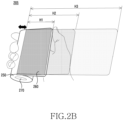
- FIG. 2B illustrates a rollable electronic device according to an embodiment of the disclosure.
- the rollable electronic device 205 may include a housing 250, a flexible display 260, and a support structure (or a rollable module) 270 configured to roll the flexible display 260.
- the housing 250 may have a cylindrical shape. This is because the flexible display 260 may be rolled to be round. However, the disclosure is not limited thereto, and the housing 250 may have a rectangular shape, and the flexible display 260 may be rolled to be round in the interior of the housing 250.
- the flexible display 260 may be deformed.
- the flexible display 260 may be located to be rolled in the interior of the housing 250, or may be exposed to the outside to be flat.
- the support structure 270 may roll the flexible display 260.
- the support structure 270 may be rotated counterclockwise such that the flexible display 260 is rolled in the interior of the housing 250. Further, the support structure 270 may be rotated clockwise such that the flexible display 260 is exposed to the outside.
- the support structure 270 may be rotated clockwise or counterclockwise by a force of a user or an actuator (e.g., a motor).
- the rollable electronic device 205 may include a button, a fingerprint sensor, an approach detecting module (e.g., a grip sensor) on the outside thereof.
- the rollable electronic device 205 may include a wireless communication circuit, a type detecting module including at least one sensor (e.g., an angle sensor, a motion sensor, a Hall sensor, and a counter sensor) that detects an unfolding degree of the flexible display 260, a processor, a memory, and/or a battery, in the interior thereof.
- the rollable electronic device 205 may determine the type of the electronic device according to an unfolding degree (e.g., a transverse length) of the flexible display 260. For example, the electronic device may check a degree of rotation of the support structure 270 through at least one sensor, and may calculate the unfolding degree according to the degree of rotation.
- an unfolding degree e.g., a transverse length
- the rollable electronic device 205 may determine the electronic device as a phone type when the unfolding degree H1 (e.g., the transverse length) of the flexible display 260 exposed to the outside is not more than (or less than) a first reference value (e.g., a transverse length when the diagonal length of the exposed flexible display 260 is 15 cm), may determine the electronic device as a phablet type when the unfolding degree H2 is more than (or not less than) the first reference value and is not more than (or less than) a second reference value (e.g., a transverse length when the diagonal length of the exposed flexible display 260 is 20 cm), and may determine the electronic device as a tablet type (or a mini-tablet type) when the unfolding degree H3 is more than (or not less than) the second reference value.
- a first reference value e.g., a transverse length when the diagonal length of the exposed flexible display 260 is 15 cm
- a second reference value e.g., a transverse length when the diagonal
- the rollable electronic device 205 may detect a distance between the housing 250 and an external object (e.g., a human body) by using at least one sensor (e.g., a grip sensor) disposed in the housing 250.
- an external object e.g., a human body
- at least one sensor e.g., a grip sensor
- the rollable electronic device 205 may control the transmission power of the wireless communication circuit such that the transmission power satisfies the SAR rule corresponding to the determined type and the distance.
- the rollable electronic device 205 may store a lookup table including a plurality of parameters related to the type, the distance, and the transmission power of the electronic device, in a memory.
- the rollable electronic device 205 may select at least one parameter from the lookup table, at least partially on the basis of the determined type and the detected distance, and may control the transmission power of the wireless communication circuit such that the transmission power corresponds to the selected parameter.
- the rollable electronic device 205 may control the transmission power of the wireless communication circuit at least partially on the basis of the unfolding degree and the detected distance.
- the rollable electronic device 205 may store a lookup table including a plurality of parameters related to an unfolding angle, a distance, and transmission power in a memory in advance, may select at least one parameter corresponding to the unfolding degree and the detected distance from the lookup table, and may control the transmission power of the wireless communication circuit such that the transmission power corresponds to the selected parameter.
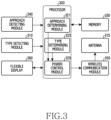
- FIG. 3 illustrates a configuration of an electronic device according to an embodiment of the disclosure.
- an electronic device e.g., the electronic device 101, the foldable electronic device 201, and the rollable electronic device (205) according to an embodiment of the disclosure may include a type detecting module 310, a processor 320, a memory 330, an approach detecting module 340, a wireless communication module 350, a flexible display 360, and an antenna 370.
- At least a partial area of the flexible display 360 may be deformed to a flat surface or a curved surface.
- the flexible display 360 may be folded with respect to a folding axis (e.g., axis A of FIG. 1 ) or may be rolled on the support structure (e.g., the support structure 270).
- the type detecting module 310 may detect a change in the size of the exposed area of the flexible display 360.
- the type detecting module 310 may measure a state and/or a folding angle of a foldable housing (e.g., the foldable housing 210) by using at least one of a Hall sensor that detects a magnetic force, an angle sensor, a motion sensor, or a counter sensor that detects a saw-tooth motion of a hinge structure (e.g., the hinge structure 213).
- the type detecting module 310 may measure the unfolding degree of the flexible display 360 by using a sensor that detects the degree of rotation of the support structure.
- the approach detecting module 340 may identify whether an external object (e.g., a human body) has approached the electronic device.
- the approach detecting module 340 may identify whether an external object approaches the electronic device or a distance from the external object by using at least one of a capacitive grip sensor, the capacity of which changes as a dielectric body approaches the grip sensor, an ultrasonic wave sensor, or an infrared ray sensor.
- the memory 330 may be located in the interior of the electronic device, and may be operatively (functionally) connected to the processor 320.
- the memory 330 may store various programs, and may store data generated while the various programs are executed or downloaded.
- the memory 330 may store various commands and/or instructions for operating the processor 320.
- the memory 330 may include at least one of an internal memory or an external memory.
- the memory 330 may store a program that causes the processor 320 to control transmission power according to the type of the electronic device and a distance from an external object (hereinafter, an approach distance).
- the memory 330 may store a lookup table used for controlling the transmission power of the wireless communication module 350 at least partially on the basis of the type of the electronic device and the approach distance of the external object.
- the lookup table is a table for controlling the transmission power of the wireless communication module 350 according to various situations (environments) such that the international SAR standard of Table 1 is satisfied, and may include a plurality of parameters (transmission power parameters) related to the type of the electronic device, the approach distance, and the transmission power.
- the lookup table may be stored as in Table 2. Table 2.
- the first condition may refer to a case in which the distance between an antenna and a human body is a specific threshold value or more
- the second condition may refer to a case in which the distance between the antenna and the human body is less than the specific threshold value.
- Table 2 is simply an example, and may be stored in conjunction with the angle of the foldable electronic device or the unfolding degree of the rollable electronic device and the approach distance and the transmission power parameter.
- the processor 320 may control an overall operation of the electronic device.
- the processor 320 may be operatively connected to elements (e.g., the flexible display 360, the wireless communication module 350, the approach detecting module 340, and the type detecting module 310) of the electronic device to control the elements of the electronic device.
- the processor 320 may perform various functions by receiving a command or instructions from the memory 330 and controlling the elements according to the received command or instructions.
- the processor 320 may include an approach determining module 321, a type determining module 323, and a power control module 325.
- the approach determining module 321 may determine whether an external object has approached the electronic device and/or an approach distance on the basis of information (e.g., a sensor value corresponding to whether the external object has approached the electronic device and/or the approach distance) received from the approach detecting module 340, and may deliver the determination result to the power control module 325.
- the type determining module 323 may determine the type of the electronic device on the basis of information (e.g., the sensor value corresponding to the angle or the unfolding degree) received from the type detecting module 310, and may deliver the determination result to the power control module 325.
- the power control module 325 may control the transmission power of the wireless communication module 350 on the basis of the information received from the approach determining module 321 and the type determining module 323. For example, the power control module 325 may select a parameter corresponding to the type and the distance from the lookup table, and may transmit the selected parameter to the wireless communication module 350.
- the wireless communication module 350 may transmit and/or receive a wireless signal through the antenna 370.
- the wireless communication module 350 may connect an external device and a communication channel.
- the wireless communication module 350 according to an embodiment of the disclosure may transmit a wireless signal through the antenna 370 with transmission power according to control of the processor 320 (e.g., the power control module 325).
- the antenna 370 may be connected to the wireless communication module 350 to transmit or receive a wireless signal.
- an electronic device may comprise: a foldable housing (e.g., the foldable housing 210) comprising a hinge structure (e.g., the hinge structure 213), a first housing structure (e.g., the first housing structure 211) connected to the hinge structure, and comprising a first surface facing a first direction and a second surface facing a second direction that is opposite to the first direction, and a second housing structure (e.g., the second housing structure 212) connected to the hinge structure, comprising a third surface facing a third direction and a fourth surface facing a fourth direction that is opposite to the third direction, and foldable with the first housing structure while the hinge structure is taken as an axis; a flexible display (e.g., the display device 160, the flexible display 220, the flexible display 360) extending from the first surface to the third surface and defining the first surface and the third surface; a wireless communication circuit (e.g., the wireless
- the instructions may cause the processor to: select at least one of a plurality of parameters used for controlling the transmission power based at least in part on the measured angle and the detected distance.
- the memory may store a lookup table comprising the plurality of parameters.
- the lookup table may comprise parameters related to the transmission power, a type of the electronic device according to the angle, and the distance.
- the type of the electronic device may comprise at least two of a phone type, a phablet type, a mini-tablet type, a tablet type, or a laptop type defined by an international specific absorption rate (SAR) standard.
- SAR international specific absorption rate
- the at least one sensor may comprise an angle sensor connected to the hinge structure to measure the angle between the first surface and the third surface.
- the at least one sensor may comprise a first motion sensor disposed inside the first housing structure, and a second motion sensor disposed inside the second housing structure.
- an electronic device may comprise: a housing (e.g., the housing 205); a flexible display (e.g., the display device 160, the flexible display 260, the flexible display 360); a support structure (e.g., the support structure 270) configured to roll the flexible display; a wireless communication circuit (e.g., the wireless communication module 192, the wireless communication module 350) disposed inside the housing; a grip sensor (e.g., the sensor module 176, the approach detecting module 340); at least one sensor (e.g., the sensor module 176, the type detecting module 310) configured to detect a unfolding degree of the flexible display; a processor (e.g., the processor 120, the processor 320) disposed inside the housing, and operatively connected to the flexible display, the wireless communication circuit, the grip sensor, and the at least one sensor; and a memory (e.g., the memory 130, the memory 330
- the instructions may cause the processor to: select at least one of a plurality of parameters used for controlling the transmission power based at least in part on the unfolding degree and the approach distance.
- the memory may store a lookup table comprising the plurality of parameters.
- the lookup table may comprise parameters related to the transmission power, a type of the electronic device according to the unfolding degree, and the distance.
- the type of the electronic device may comprise at least two of a phone type, a phablet type, a mini-tablet type, a tablet type, or a laptop type defined by an international specific absorption rate (SAR) standard.
- SAR international specific absorption rate
- FIG. 4 illustrates a flowchart of a method for controlling transmission power of an electronic device according to an embodiment of the disclosure.
- an electronic device e.g., the processor (e.g., the processor 120 and the processor 320) of the electronic device 101, the foldable electronic device 201, the rollable electronic device 205), in operation 401, may determine the effective size of an exposed area of the flexible display (e.g., the display device 160, the flexible display 220, the flexible display 260, and the flexible display 360).
- the processor may measure the angle of the foldable housing (e.g., the foldable housing 210) of the electronic device by using the Hall sensor, the counter sensor, the angle sensor, the first motion sensor disposed in the first housing structure, and the second motion sensor disposed in the second housing structure, and may determine the effective size on the basis of the measured angle.
- the angle may be an angle between the front surfaces (e.g., between the first surface and the third surface) or an angle between the rear surfaces (e.g., between the second surface and the fourth surface) of the first housing structure (e.g., the first housing structure 211) and the second housing structure (e.g., the second housing structure 212).
- the processor may measure (determine) the effective size according to the unfolding degree of the flexible display that may be rolled on the support structure (e.g., the support structure 270).
- the processor may determine the type of the electronic device on the basis of the effective size of the flexible display.
- the processor as described with reference to FIGS. 2A and 2B , may determine the type of the electronic device on the basis of the effective size.
- the type of the electronic device may include a phone type, a phablet type, a mini-tablet type, a tablet type, or a laptop type defined by the international SAR standard.
- the processor may detect a distance between the electronic device and an external object (e.g., a human body). For example, the processor may detect whether a human body has approached the electronic device and a distance from the human body by using the approach detecting module (e.g., the approach detecting module 340).
- the approach detecting module may include at least one of a grip sensor, an ultrasonic wave sensor, and an infrared ray sensor.
- the processor may control the transmission power of the wireless communication circuit (e.g., the wireless communication module 192 and the wireless communication module 350) at least partially on the basis of the determined type of the electronic device and the detected distance.
- the processor may select at least one of a plurality of parameters included in the lookup table stored in the memory (e.g., the memory 130 and the memory 330) at least partially on the basis of the determined type of the electronic device and the detected distance, and may control the wireless communication circuit such that a wireless signal is transmitted with the transmission power corresponding to the selected parameter.
- the lookup table may include parameters related to the type of the electronic device, the distance, and the transmission power.
- the processor in operation 409, may identify whether the change in the effective size of the flexible display is detected. When the change in the effective size is not detected in the identification result of operation 409, the processor may return to operation 405 and repeat the above-described operations. Meanwhile, when the change in the effective size is detected in the identification result of operation 409, the processor may return to operation 401 and repeat the above-described operations.
- operations 401 to 409 may be performed when a wireless communication is connected or a wireless communication function is enabled.
- the above-described method may further include a communication connecting operation before operation 401.
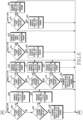
- FIG. 5 illustrates a flowchart of a method for controlling transmission power of an electronic device according to a gripping state according to an embodiment of the disclosure.
- the processor may identify whether a grip is detected. For example, the processor may identify whether an external object (e.g., a human body) contacts (or is located within a predetermined distance from) a partial area of the electronic device.
- the processor in operation 503, may control a wireless communication circuit such that a wireless signal is transmitted with a (1-1)-th transmission power.
- the (1-1)-th transmission power may be the same as or lower than the transmission power designated by the international SAR standard (specification) such that the electronic device of a phone type may transmit a signal while an external object does not contact the electronic device. Meanwhile, when a grip is detected in the identification result of operation 501, the processor, in operation 505, may control a wireless communication circuit such that a wireless signal is transmitted with a (1-2) transmission power.
- the (1-2)-th transmission power is electric power set to be transmitted when a human body approaches the electronic device, and may be the (1-1)-th transmission power or less.
- the processor in operation 511, may identify whether a grip is detected. For example, the processor may identify whether an external object (e.g., a human body) contacts (or is located within a predetermined distance from) a partial area of the electronic device.
- the processor in operation 513, may control a wireless communication circuit such that a wireless signal is transmitted with a (2-1)-th transmission power.
- the (2-1)-th transmission power may be the same as or lower than the transmission power designated by the international SAR standard (specification) such that the electronic device of a phablet type may transmit a signal while an external object does not contact the electronic device. Meanwhile, when a grip is detected in the identification result of operation 511, the processor, in operation 515, may control a wireless communication circuit such that a wireless signal is transmitted with a (2-2)-th transmission power.
- the (2-2)-th transmission power is electric power set to be transmitted when a human body approaches the electronic device, and may be the (2-1)-th transmission power or less.
- the processor in operation 531, may identify whether a grip is detected. For example, the processor may identify whether an external object (e.g., a human body) contacts (or is located within a predetermined distance from) a partial area of the electronic device.
- the processor in operation 533, may control a wireless communication circuit such that a wireless signal is transmitted with a (3-1)-th transmission power.
- the (3-1)-th transmission power may be the same as or lower than the transmission power designated by the international SAR standard (specification) such that the electronic device of a tablet type may transmit a signal while an external object does not contact the electronic device.
- the processor in operation 535, may control a wireless communication circuit such that a wireless signal is transmitted with a (3-2)-th transmission power.
- the (3-2)-th transmission power is electric power set to be transmitted when a human body approaches the electronic device, and may be the (3-1)-th transmission power or less.
- the processor in operation 551, may identify whether a grip is detected. For example, the processor may identify whether an external object (e.g., a human body) contacts (or is located within a predetermined distance from) a partial area of the electronic device.
- the processor in operation 553, may control a wireless communication circuit such that a wireless signal is transmitted with a (4-1)-th transmission power.
- the (4-1)-th transmission power may be the same as or lower than the transmission power designated by the international SAR standard (specification) such that the electronic device of a laptop type may transmit a signal while an external object does not contact the electronic device.
- the processor in operation 555, may control a wireless communication circuit such that a wireless signal is transmitted with a (4-2)-th transmission power.
- the (4-2)-th transmission power is electric power set to be transmitted when a human body approaches the electronic device, and may be the (4-1)-th transmission power or less.
- FIG. 6 illustrates a flowchart of a method for controlling transmission power of an electronic device according to an approach distance according to an embodiment of the disclosure.
- the processor e.g., the processor 120 and the processor 320
- the processor may identify whether the distance detected in operation 405 is more than (or not less than) a first threshold value (e.g., 15 mm).
- a first threshold value e.g. 15 mm.
- the processor in operation 603, may control a wireless communication circuit such that a wireless signal is transmitted with a (1-1)-th transmission power.
- the processor in operation 605, may identify whether the detected distance is more than (or not less than) a second threshold value (e.g., 10 mm).
- a second threshold value e.g. 10 mm.
- the processor in operation 607, may control a wireless communication circuit such that a wireless signal is transmitted with a (1-2)-th transmission power.
- the (1-2)-th transmission power may be not more than the (1-1)-th transmission power.
- the processor in operation 609, may control a wireless communication circuit such that a wireless signal is transmitted with a (1-3)-th transmission power.
- the (1-3)-th transmission power may be not more than the (1-2)-th transmission power.
- the processor in operation 611, may identify whether the detected distance is more than (or not less than) the first threshold value (e.g., 15 mm).
- the processor in operation 613, may control a wireless communication circuit such that a wireless signal is transmitted with a (2-1)-th transmission power.
- the processor in operation 615, may identify whether the detected distance is more than (or not less than) a second threshold value (e.g., 10 mm).
- a second threshold value e.g. 10 mm.
- the processor in operation 617, may control a wireless communication circuit such that a wireless signal is transmitted with a (2-2)-th transmission power.
- the (2-2)-th transmission power may be not more than the (2-1)-th transmission power.
- the processor in operation 619, may identify whether the detected distance is more than a third threshold value (e.g., 0 mm).
- a third threshold value e.g., 0 mm.
- the processor in operation 621, may control a wireless communication circuit such that a wireless signal is transmitted with a (2-3)-th transmission power.
- the (2-3)-th transmission power may be not more than the (2-2)-th transmission power.
- the processor in operation 623, may control a wireless communication circuit such that a wireless signal is transmitted with a (2-4)-th transmission power.
- the (2-4)-th transmission power may be not more than the (2-3)-th transmission power.
- the processor in operation 631, may identify whether the detected distance is more than the first threshold value (e.g., 0 mm).
- the processor in operation 633, may control a wireless communication circuit such that a wireless signal is transmitted with a (3-1) transmission power.
- the processor in operation 635, may control a wireless communication circuit such that a wireless signal is transmitted with a (3-2)-th transmission power.
- the (3-2)-th transmission power may be not more than the (3-1)-th transmission power.
- the processor in operation 651, may identify whether the detected distance is more than the first threshold value (e.g., 0 mm). When the distance is more than the first threshold value in the identification result of operation 651, the processor, in operation 653, may control a wireless communication circuit such that a wireless signal is transmitted with a (4-1) transmission power. Meanwhile, when the distance is not more than the first threshold value in the identification result of operation 651, the processor, in operation 655, may control a wireless communication circuit such that a wireless signal is transmitted with a (4-2)-th transmission power. The (4-2)-th transmission power may be not more than the (4-1)-th transmission power.
- the first threshold value e.g., 0 mm
- the processor in operation 653 may control a wireless communication circuit such that a wireless signal is transmitted with a (4-1) transmission power.
- the processor in operation 655, may control a wireless communication circuit such that a wireless signal is transmitted with a (4-2)-th transmission power.
- the (4-2)-th transmission power may be not more than
- a method for controlling transmission power of an electronic device may comprise: determining an effective size of an exposed area of a flexible display (e.g., the display device 160, the flexible display 260, the flexible display 360) of the electronic device; determining a type of the electronic device based at least in part on the determined effective size; detecting a distance between the electronic device and an external object; and controlling transmission power of a wireless communication circuit (e.g., the wireless communication module 192, the wireless communication module 350) of the electronic device based at least in part on the determined type of the electronic device and the detected distance.
- a wireless communication circuit e.g., the wireless communication module 192, the wireless communication module 350
- the determining of the effective size may comprise: measuring an angle of a foldable housing (e.g., the foldable housing 210) by using at least one sensor (e.g., the sensor module 176, the type detecting module 310); or identifying an unfolding degree of the flexible display by using the at least one sensor.
- a foldable housing e.g., the foldable housing 210
- at least one sensor e.g., the sensor module 176, the type detecting module 310
- identifying an unfolding degree of the flexible display by using the at least one sensor.
- the measuring of the angle of the foldable housing may comprise at least one of: measuring the angle of the foldable housing by using an angle sensor connected to a hinge structure (e.g., the hinge structure 213) that connects a first housing structure (e.g., the first housing structure 211) and a second housing structure (e.g., the second housing structure 212) of the foldable housing; or measuring the angle of the foldable housing by using a first motion sensor disposed inside the first housing structure and a second motion sensor disposed inside the second housing structure.
- a hinge structure e.g., the hinge structure 213
- a first housing structure e.g., the first housing structure 211
- a second housing structure e.g., the second housing structure 212
- the controlling of the transmission power of the wireless communication circuit may comprise: selecting at least one of a plurality of parameters stored for controlling the transmission power based at least in part on the determined type of the electronic device and the detected distance.
- the controlling of the transmission power of the wireless communication circuit may comprise: selecting a power parameter corresponding to the determined type of the electronic device and the detected distance from a lookup table that maps the transmission power with the type of the electronic device and the distance; and controlling the wireless communication circuit to transmit a wireless signal as the transmission power corresponding the selected power parameter.
- the determining of the type of the electronic device may comprise: determining any one of a phone type, a phablet type, a mini-tablet type, a tablet type, or a laptop type defined by an international specific absorption rate (SAR) standard as the type of the electronic device.
- SAR international specific absorption rate
- the detecting of the distance between the electronic device and an external object may comprise: identifying whether the distance between the electronic device and the external object is within at least one threshold value.
- the number of the at least one threshold value may be varied according to the type of the electronic device.
- transmission power can be adaptively controlled such that the electronic wave rule (e.g., the human body electromagnetic wave absorption rate rule) corresponding to a type (or a form-factor) of an electronic device according to a change in the size of a display can be controlled.
- the electromagnetic wave rule e.g., the human body electromagnetic wave absorption rate rule
- an approach distance between the electronic device and an external object e.g., the human body
- the electronic device may be one of various types of electronic devices.
- the electronic devices may include, for example, a portable communication device (e.g., a smartphone), a computer device, a portable multimedia device, a portable medical device, a camera, a wearable device, or a home appliance. According to an embodiment of the disclosure, the electronic devices are not limited to those described above.
- each of such phrases as “A or B,” “at least one of A and B,” “at least one of A or B,” “A, B, or C,” “at least one of A, B, and C,” and “at least one of A, B, or C,” may include any one of, or all possible combinations of the items enumerated together in a corresponding one of the phrases.
- such terms as “1st” and “2nd,” or “first” and “second” may be used to simply distinguish a corresponding component from another, and does not limit the components in other aspect (e.g., importance or order).
- an element e.g., a first element
- the element may be coupled with the other element directly (e.g., wiredly), wirelessly, or via a third element.
- module may include a unit implemented in hardware, software, or firmware, and may interchangeably be used with other terms, for example, “logic,” “logic block,” “part,” or “circuitry”.
- a module may be a single integral component, or a minimum unit or part thereof, adapted to perform one or more functions.
- the module may be implemented in a form of an application-specific integrated circuit (ASIC).
- ASIC application-specific integrated circuit
- Various embodiments as set forth herein may be implemented as software (e.g., the program 140) including one or more instructions that are stored in a storage medium (e.g., internal memory 136 or external memory 138) that is readable by a machine (e.g., the electronic devices 101).
- a processor e.g., the processor 120
- the machine e.g., the electronic devices 101
- the one or more instructions may include a code generated by a complier or a code executable by an interpreter.
- the machine-readable storage medium may be provided in the form of a non-transitory storage medium.
- non-transitory simply means that the storage medium is a tangible device, and does not include a signal (e.g., an electromagnetic wave), but this term does not differentiate between where data is semi-permanently stored in the storage medium and where the data is temporarily stored in the storage medium.
- a method may be included and provided in a computer program product.
- the computer program product may be traded as a product between a seller and a buyer.
- the computer program product may be distributed in the form of a machine-readable storage medium (e.g., compact disc read only memory (CD-ROM)), or be distributed (e.g., downloaded or uploaded) online via an application store (e.g., PlayStore TM ), or between two user devices (e.g., smart phones) directly. If distributed online, at least part of the computer program product may be temporarily generated or at least temporarily stored in the machine-readable storage medium, such as memory of the manufacturer's server, a server of the application store, or a relay server.
- CD-ROM compact disc read only memory
- an application store e.g., PlayStore TM
- two user devices e.g., smart phones
- each component e.g., a module or a program of the above-described components may include a single entity or multiple entities. According to various embodiments, one or more of the above-described components may be omitted, or one or more other components may be added. Alternatively or additionally, a plurality of components (e.g., modules or programs) may be integrated into a single component. In such a case, according to various embodiments, the integrated component may still perform one or more functions of each of the plurality of components in the same or similar manner as they are performed by a corresponding one of the plurality of components before the integration.
- operations performed by the module, the program, or another component may be carried out sequentially, in parallel, repeatedly, or heuristically, or one or more of the operations may be executed in a different order or omitted, or one or more other operations may be added.
Landscapes
- Engineering & Computer Science (AREA)
- Signal Processing (AREA)
- Computer Networks & Wireless Communication (AREA)
- Computer Hardware Design (AREA)
- Theoretical Computer Science (AREA)
- Physics & Mathematics (AREA)
- Human Computer Interaction (AREA)
- General Engineering & Computer Science (AREA)
- General Physics & Mathematics (AREA)
- Electromagnetism (AREA)
- Mathematical Physics (AREA)
- Environmental & Geological Engineering (AREA)
- Telephone Function (AREA)
- Telephone Set Structure (AREA)
- Transceivers (AREA)
Applications Claiming Priority (2)
| Application Number | Priority Date | Filing Date | Title |
|---|---|---|---|
| KR1020190042624A KR102596817B1 (ko) | 2019-04-11 | 2019-04-11 | 전자 장치 및 그의 송신 전력을 제어하는 방법 |
| EP20169052.6A EP3722924B1 (de) | 2019-04-11 | 2020-04-09 | Elektronische vorrichtung und verfahren zur steuerung der übertragungsleistung davon |
Related Parent Applications (1)
| Application Number | Title | Priority Date | Filing Date |
|---|---|---|---|
| EP20169052.6A Division EP3722924B1 (de) | 2019-04-11 | 2020-04-09 | Elektronische vorrichtung und verfahren zur steuerung der übertragungsleistung davon |
Publications (2)
| Publication Number | Publication Date |
|---|---|
| EP4391664A2 true EP4391664A2 (de) | 2024-06-26 |
| EP4391664A3 EP4391664A3 (de) | 2024-08-14 |
Family
ID=70285514
Family Applications (2)
| Application Number | Title | Priority Date | Filing Date |
|---|---|---|---|
| EP20169052.6A Active EP3722924B1 (de) | 2019-04-11 | 2020-04-09 | Elektronische vorrichtung und verfahren zur steuerung der übertragungsleistung davon |
| EP24175416.7A Pending EP4391664A3 (de) | 2019-04-11 | 2020-04-09 | Elektronische vorrichtung und verfahren zur steuerung der übertragungsleistung davon |
Family Applications Before (1)
| Application Number | Title | Priority Date | Filing Date |
|---|---|---|---|
| EP20169052.6A Active EP3722924B1 (de) | 2019-04-11 | 2020-04-09 | Elektronische vorrichtung und verfahren zur steuerung der übertragungsleistung davon |
Country Status (5)
| Country | Link |
|---|---|
| US (3) | US11147026B2 (de) |
| EP (2) | EP3722924B1 (de) |
| KR (1) | KR102596817B1 (de) |
| CN (1) | CN111817741A (de) |
| WO (1) | WO2020209640A1 (de) |
Families Citing this family (21)
| Publication number | Priority date | Publication date | Assignee | Title |
|---|---|---|---|---|
| KR102262165B1 (ko) * | 2018-08-08 | 2021-06-09 | 삼성전자주식회사 | 입력 장치와의 통신 연결을 제어하는 전자 장치 및 그 제어 방법 |
| KR102858588B1 (ko) * | 2020-11-04 | 2025-09-12 | 삼성전자주식회사 | 무선 전력 전송 장치 및 무선 전력 전송 장치의 제어 방법 |
| US11923697B2 (en) | 2020-11-04 | 2024-03-05 | Samsung Electronics Co., Ltd. | Wireless power transmitting apparatus and method for controlling wireless power transmitting apparatus |
| US11968630B2 (en) * | 2020-11-06 | 2024-04-23 | Samsung Electronics Co., Ltd. | Electronic device having slidable structure |
| KR102867141B1 (ko) * | 2020-11-13 | 2025-10-10 | 삼성전자주식회사 | 플렉서블 디스플레이를 포함하는 전자 장치 및 이의 제어 방법 |
| WO2022182200A1 (ko) * | 2021-02-26 | 2022-09-01 | 삼성전자 주식회사 | 무선 전력 송수신 가능한 전자 장치 및 그 동작 방법 |
| KR102886799B1 (ko) * | 2021-03-08 | 2025-11-18 | 삼성전자주식회사 | 전자 장치 및 형태 변경이 가능한 전자 장치에서 송신 신호의 전력을 제어하는 방법 |
| EP4270798A4 (de) | 2021-03-08 | 2024-05-29 | Samsung Electronics Co., Ltd. | Elektronische vorrichtung und verfahren zur steuerung der leistung eines übertragungssignals in einer umwandelbaren elektronischen vorrichtung |
| KR102845136B1 (ko) | 2021-04-22 | 2025-08-12 | 삼성전자주식회사 | 방사 성능 향상을 위한 안테나 구조 및 이를 포함하는 전자 장치 |
| CN115347345A (zh) * | 2021-05-13 | 2022-11-15 | 中兴通讯股份有限公司 | 柔性屏终端、天线调节方法及存储介质 |
| KR20220159785A (ko) * | 2021-05-26 | 2022-12-05 | 삼성전자주식회사 | 무선 충전 구조를 포함하는 전자 장치 |
| KR20230006349A (ko) | 2021-07-02 | 2023-01-10 | 삼성전자주식회사 | 무선 전력 수신 장치, 무선 전력 송신 장치, 및 그 동작 방법 |
| EP4351221A4 (de) | 2021-07-30 | 2024-10-02 | Samsung Electronics Co., Ltd. | Elektronische vorrichtung und kommunikationssteuerungsverfahren dafür |
| CN115915372A (zh) * | 2021-08-16 | 2023-04-04 | 荣耀终端有限公司 | 功率管理方法、终端及存储介质 |
| EP4332722A4 (de) * | 2021-09-16 | 2024-09-11 | Samsung Electronics Co., Ltd. | Elektronische vorrichtung mit flexibler anzeige und steuerungsverfahren dafür |
| KR20230044760A (ko) | 2021-09-27 | 2023-04-04 | 삼성전자주식회사 | 사용자 인터페이스를 제공하는 방법 및 그 전자 장치 |
| CN113905433A (zh) * | 2021-09-29 | 2022-01-07 | Oppo广东移动通信有限公司 | 天线模组控制方法及相关装置 |
| US12418866B2 (en) * | 2022-05-11 | 2025-09-16 | T-Mobile Innovations Llc | Uplink power management for extended range communication |
| WO2024043647A1 (ko) * | 2022-08-22 | 2024-02-29 | 삼성전자 주식회사 | 안테나를 포함하는 전자 장치 및 그 방법 |
| WO2024242327A1 (ko) * | 2023-05-24 | 2024-11-28 | 삼성전자 주식회사 | 전자 장치 및 이를 이용한 안테나 그룹의 송신 전력을 조정하는 방법 |
| WO2024259586A1 (en) * | 2023-06-20 | 2024-12-26 | Motorola Mobility Llc | Managing multiple energy storage devices in an electronic device based on environmental conditions |
Family Cites Families (28)
| Publication number | Priority date | Publication date | Assignee | Title |
|---|---|---|---|---|
| JP2001223514A (ja) * | 2000-02-09 | 2001-08-17 | Sony Corp | 携帯用通信装置及びアンテナの指向性制御方法並びにアンテナの送信電力制御方法 |
| JP4252954B2 (ja) * | 2004-12-02 | 2009-04-08 | インターナショナル・ビジネス・マシーンズ・コーポレーション | 情報処理装置、情報処理装置のパワーマネージメント方法、およびそのためのプログラム |
| KR101521219B1 (ko) | 2008-11-10 | 2015-05-18 | 엘지전자 주식회사 | 플렉서블 디스플레이를 이용하는 휴대 단말기 및 그 제어방법 |
| KR101722237B1 (ko) * | 2010-09-28 | 2017-03-31 | 삼성전자주식회사 | 휴대단말기의 통신 전력 제어장치 및 방법 |
| JP5168385B2 (ja) * | 2011-05-11 | 2013-03-21 | 株式会社Jvcケンウッド | 電子機器 |
| KR102009926B1 (ko) * | 2012-08-08 | 2019-10-21 | 삼성전자주식회사 | 전자 장치 및 그 제어 방법 |
| KR102078748B1 (ko) * | 2013-01-29 | 2020-02-19 | 삼성전자주식회사 | 플렉서블 디스플레이에서 문자를 입력하는 방법 및 그 전자 장치 |
| US9307505B2 (en) * | 2013-03-12 | 2016-04-05 | Blackberry Limited | System and method for adjusting a power transmission level for a communication device |
| KR102065709B1 (ko) | 2013-04-16 | 2020-01-13 | 삼성전자주식회사 | 모드에 따른 통신 출력 제어 방법 |
| US9871544B2 (en) * | 2013-05-29 | 2018-01-16 | Microsoft Technology Licensing, Llc | Specific absorption rate mitigation |
| US10013020B2 (en) * | 2014-01-29 | 2018-07-03 | Hewlett-Packard Development Company, L.P. | Electronic device with flexible display |
| KR102377785B1 (ko) * | 2014-02-10 | 2022-03-23 | 삼성전자주식회사 | 사용자 단말 장치 및 이의 디스플레이 방법 |
| KR102194839B1 (ko) * | 2014-04-10 | 2020-12-24 | 삼성전자주식회사 | 송신 전력 크기 조절 방법 및 전자 장치 |
| KR101632008B1 (ko) * | 2014-04-30 | 2016-07-01 | 엘지전자 주식회사 | 이동단말기 및 그 제어방법 |
| US9785174B2 (en) * | 2014-10-03 | 2017-10-10 | Microsoft Technology Licensing, Llc | Predictive transmission power control for back-off |
| KR102278141B1 (ko) * | 2015-04-09 | 2021-07-19 | 삼성전자주식회사 | 전자 장치의 센서 동작 방법 및 장치 |
| JP2017033116A (ja) | 2015-07-30 | 2017-02-09 | レノボ・シンガポール・プライベート・リミテッド | 複数の使用モードを備える電子機器、制御方法およびコンピュータ・プログラム |
| KR102537922B1 (ko) * | 2015-09-11 | 2023-05-30 | 삼성전자 주식회사 | 디스플레이 사이의 각도를 측정하는 방법 및 이를 사용하는 전자 장치 |
| US10013038B2 (en) * | 2016-01-05 | 2018-07-03 | Microsoft Technology Licensing, Llc | Dynamic antenna power control for multi-context device |
| WO2017155541A1 (en) * | 2016-03-11 | 2017-09-14 | Hewlett-Packard Development Company, L.P. | Kickstand for computing devices |
| US10269322B2 (en) * | 2016-06-15 | 2019-04-23 | Intel Corporation | Power conservation techniques for foldable displays |
| KR20180005421A (ko) * | 2016-07-06 | 2018-01-16 | 엘지이노텍 주식회사 | 폴더블 무선 전력 송신기 및 제어 방법 |
| KR102529686B1 (ko) * | 2016-09-01 | 2023-05-08 | 삼성전자 주식회사 | 전자 장치 및 이를 이용한 그립 상태를 인식하는 방법 |
| TWI609294B (zh) * | 2016-12-27 | 2017-12-21 | 財團法人工業技術研究院 | 摺疊式顯示裝置之使用者介面方法 |
| US10148304B2 (en) | 2017-04-28 | 2018-12-04 | Dell Products L.P. | Broadband intelligent antenna system (BIAS) |
| US10218403B2 (en) * | 2017-07-30 | 2019-02-26 | Dell Products, Lp | System and method for a modular dynamic wireless power control system in a convertible information handling system |
| JP2019190518A (ja) * | 2018-04-20 | 2019-10-31 | レノボ・シンガポール・プライベート・リミテッド | ヒンジ装置および電子機器 |
| KR102585017B1 (ko) | 2018-12-12 | 2023-10-05 | 삼성전자주식회사 | 안테나 및 이를 포함하는 전자 장치 |
-
2019
- 2019-04-11 KR KR1020190042624A patent/KR102596817B1/ko active Active
-
2020
- 2020-04-09 WO PCT/KR2020/004848 patent/WO2020209640A1/en not_active Ceased
- 2020-04-09 EP EP20169052.6A patent/EP3722924B1/de active Active
- 2020-04-09 EP EP24175416.7A patent/EP4391664A3/de active Pending
- 2020-04-10 CN CN202010278849.0A patent/CN111817741A/zh active Pending
- 2020-04-10 US US16/845,596 patent/US11147026B2/en active Active
-
2021
- 2021-10-08 US US17/497,722 patent/US12133177B2/en active Active
-
2024
- 2024-10-28 US US18/929,348 patent/US20250056423A1/en active Pending
Also Published As
| Publication number | Publication date |
|---|---|
| US11147026B2 (en) | 2021-10-12 |
| KR102596817B1 (ko) | 2023-11-01 |
| KR20200120134A (ko) | 2020-10-21 |
| WO2020209640A1 (en) | 2020-10-15 |
| US12133177B2 (en) | 2024-10-29 |
| CN111817741A (zh) | 2020-10-23 |
| US20220030524A1 (en) | 2022-01-27 |
| US20250056423A1 (en) | 2025-02-13 |
| EP3722924A1 (de) | 2020-10-14 |
| US20200329435A1 (en) | 2020-10-15 |
| EP4391664A3 (de) | 2024-08-14 |
| EP3722924B1 (de) | 2024-06-05 |
Similar Documents
| Publication | Publication Date | Title |
|---|---|---|
| US12133177B2 (en) | Electronic device and method for controlling transmission power thereof | |
| US11201635B2 (en) | Electronic device including foldable housing | |
| EP3726336B1 (de) | Faltbare elektronische vorrichtung | |
| US11425831B2 (en) | Foldable electronic device including hidden damper | |
| US11470190B2 (en) | Electronic device having grip sensor and method of controlling the electronic device having grip sensor | |
| US10809826B2 (en) | Electronic device and method for displaying affordance for providing charging of battery of external device through display | |
| EP3742254B1 (de) | Verfahren, elektronische vorrichtung und speichermedium zum ändern des betriebsmodus auf der grundlage von biegeinformation unter verwendung einer messschaltung | |
| US11082094B2 (en) | Electronic device including plurality of antennas and method of operating same | |
| US11310354B2 (en) | Foldable device and controlling method thereof | |
| US12079044B2 (en) | Electronic device having flexible display and method for providing control panel according to mode change thereof | |
| US20200218310A1 (en) | Method for controlling power back off using grip sensor and electronic device for supporting the same | |
| US20220303379A1 (en) | Electronic device including flexible display, and operating method thereof | |
| US20250217091A1 (en) | Electronic device and method for controlling screen displayed on flexible display | |
| US20230247130A1 (en) | Method for providing screen by using flexible display, and electronic device supporting same | |
| US11843400B2 (en) | Electronic device for controlling output of antenna by using APC of communication module, and method for operation of electronic device | |
| EP4400948A1 (de) | Elektronische vorrichtung zur zustandserkennung unter verwendung eines sensors | |
| US20210075259A1 (en) | Electronic device for providing wireless charging function and operation method thereof | |
| US12170447B2 (en) | Electronic device for wirelessly charging external electronic device | |
| US20250227178A1 (en) | Electronic device comprising flexible display, operating method thereof, and storage medium |
Legal Events
| Date | Code | Title | Description |
|---|---|---|---|
| PUAI | Public reference made under article 153(3) epc to a published international application that has entered the european phase |
Free format text: ORIGINAL CODE: 0009012 |
|
| STAA | Information on the status of an ep patent application or granted ep patent |
Free format text: STATUS: THE APPLICATION HAS BEEN PUBLISHED |
|
| AC | Divisional application: reference to earlier application |
Ref document number: 3722924 Country of ref document: EP Kind code of ref document: P |
|
| AK | Designated contracting states |
Kind code of ref document: A2 Designated state(s): AL AT BE BG CH CY CZ DE DK EE ES FI FR GB GR HR HU IE IS IT LI LT LU LV MC MK MT NL NO PL PT RO RS SE SI SK SM TR |
|
| REG | Reference to a national code |
Ref country code: DE Ref legal event code: R079 Free format text: PREVIOUS MAIN CLASS: H04W0052360000 Ipc: G06F0001160000 |
|
| PUAL | Search report despatched |
Free format text: ORIGINAL CODE: 0009013 |
|
| AK | Designated contracting states |
Kind code of ref document: A3 Designated state(s): AL AT BE BG CH CY CZ DE DK EE ES FI FR GB GR HR HU IE IS IT LI LT LU LV MC MK MT NL NO PL PT RO RS SE SI SK SM TR |
|
| RIC1 | Information provided on ipc code assigned before grant |
Ipc: H04W 52/36 20090101ALI20240709BHEP Ipc: H04W 52/28 20090101ALI20240709BHEP Ipc: H04B 1/3827 20150101ALI20240709BHEP Ipc: H04M 1/72454 20210101ALI20240709BHEP Ipc: H04M 1/02 20060101ALI20240709BHEP Ipc: H04W 52/04 20090101ALI20240709BHEP Ipc: G06F 1/16 20060101AFI20240709BHEP |
|
| STAA | Information on the status of an ep patent application or granted ep patent |
Free format text: STATUS: REQUEST FOR EXAMINATION WAS MADE |
|
| 17P | Request for examination filed |
Effective date: 20241106 |
|
| RBV | Designated contracting states (corrected) |
Designated state(s): AL AT BE BG CH CY CZ DE DK EE ES FI FR GB GR HR HU IE IS IT LI LT LU LV MC MK MT NL NO PL PT RO RS SE SI SK SM TR |
|
| STAA | Information on the status of an ep patent application or granted ep patent |
Free format text: STATUS: EXAMINATION IS IN PROGRESS |
|
| 17Q | First examination report despatched |
Effective date: 20250411 |