EP4389728A1 - Verfahren zur herstellung von pflanzlichem festem paraffin und pflanzliches festes paraffin - Google Patents
Verfahren zur herstellung von pflanzlichem festem paraffin und pflanzliches festes paraffin Download PDFInfo
- Publication number
- EP4389728A1 EP4389728A1 EP21954167.9A EP21954167A EP4389728A1 EP 4389728 A1 EP4389728 A1 EP 4389728A1 EP 21954167 A EP21954167 A EP 21954167A EP 4389728 A1 EP4389728 A1 EP 4389728A1
- Authority
- EP
- European Patent Office
- Prior art keywords
- plant
- solid paraffin
- fatty acid
- derived
- solid
- Prior art date
- Legal status (The legal status is an assumption and is not a legal conclusion. Google has not performed a legal analysis and makes no representation as to the accuracy of the status listed.)
- Pending
Links
Images
Classifications
-
- C—CHEMISTRY; METALLURGY
- C11—ANIMAL OR VEGETABLE OILS, FATS, FATTY SUBSTANCES OR WAXES; FATTY ACIDS THEREFROM; DETERGENTS; CANDLES
- C11C—FATTY ACIDS FROM FATS, OILS OR WAXES; CANDLES; FATS, OILS OR FATTY ACIDS BY CHEMICAL MODIFICATION OF FATS, OILS, OR FATTY ACIDS OBTAINED THEREFROM
- C11C3/00—Fats, oils, or fatty acids by chemical modification of fats, oils, or fatty acids obtained therefrom
- C11C3/003—Fats, oils, or fatty acids by chemical modification of fats, oils, or fatty acids obtained therefrom by esterification of fatty acids with alcohols
-
- C—CHEMISTRY; METALLURGY
- C07—ORGANIC CHEMISTRY
- C07C—ACYCLIC OR CARBOCYCLIC COMPOUNDS
- C07C1/00—Preparation of hydrocarbons from one or more compounds, none of them being a hydrocarbon
- C07C1/20—Preparation of hydrocarbons from one or more compounds, none of them being a hydrocarbon starting from organic compounds containing only oxygen atoms as heteroatoms
- C07C1/22—Preparation of hydrocarbons from one or more compounds, none of them being a hydrocarbon starting from organic compounds containing only oxygen atoms as heteroatoms by reduction
-
- C—CHEMISTRY; METALLURGY
- C07—ORGANIC CHEMISTRY
- C07C—ACYCLIC OR CARBOCYCLIC COMPOUNDS
- C07C67/00—Preparation of carboxylic acid esters
- C07C67/08—Preparation of carboxylic acid esters by reacting carboxylic acids or symmetrical anhydrides with the hydroxy or O-metal group of organic compounds
-
- C—CHEMISTRY; METALLURGY
- C11—ANIMAL OR VEGETABLE OILS, FATS, FATTY SUBSTANCES OR WAXES; FATTY ACIDS THEREFROM; DETERGENTS; CANDLES
- C11B—PRODUCING, e.g. BY PRESSING RAW MATERIALS OR BY EXTRACTION FROM WASTE MATERIALS, REFINING OR PRESERVING FATS, FATTY SUBSTANCES, e.g. LANOLIN, FATTY OILS OR WAXES; ESSENTIAL OILS; PERFUMES
- C11B11/00—Recovery or refining of other fatty substances, e.g. lanolin or waxes
-
- C—CHEMISTRY; METALLURGY
- C11—ANIMAL OR VEGETABLE OILS, FATS, FATTY SUBSTANCES OR WAXES; FATTY ACIDS THEREFROM; DETERGENTS; CANDLES
- C11C—FATTY ACIDS FROM FATS, OILS OR WAXES; CANDLES; FATS, OILS OR FATTY ACIDS BY CHEMICAL MODIFICATION OF FATS, OILS, OR FATTY ACIDS OBTAINED THEREFROM
- C11C5/00—Candles
- C11C5/002—Ingredients
-
- Y—GENERAL TAGGING OF NEW TECHNOLOGICAL DEVELOPMENTS; GENERAL TAGGING OF CROSS-SECTIONAL TECHNOLOGIES SPANNING OVER SEVERAL SECTIONS OF THE IPC; TECHNICAL SUBJECTS COVERED BY FORMER USPC CROSS-REFERENCE ART COLLECTIONS [XRACs] AND DIGESTS
- Y02—TECHNOLOGIES OR APPLICATIONS FOR MITIGATION OR ADAPTATION AGAINST CLIMATE CHANGE
- Y02W—CLIMATE CHANGE MITIGATION TECHNOLOGIES RELATED TO WASTEWATER TREATMENT OR WASTE MANAGEMENT
- Y02W30/00—Technologies for solid waste management
- Y02W30/50—Reuse, recycling or recovery technologies
- Y02W30/74—Recovery of fats, fatty oils, fatty acids or other fatty substances, e.g. lanolin or waxes
Definitions
- the present invention relates to a method for producing a plant-derived solid paraffin, and a plant-derived solid paraffin.
- Solid paraffins are mainly composed of saturated hydrocarbons represented by C n H 2n+2 , and have been widely used for daily life products, such as candles; crayon materials; electrical insulation materials; raw materials included in cosmetics and pharmaceuticals; moisture and water proofing agents; and surface coatings for wrapping paper, etc.
- the solid paraffins contained in these products are produced by separation and purification of distillate oils obtained by distillation of petroleum under reduced pressure.
- Solid paraffins are also found in deodorizer distillates obtained as by-products in the production process of soybean oils, and in rice bran. These solid paraffins are thought to be originally present in plant tissues, and to play roles in protecting the tissues from desiccation and insect damage.
- Conventional methods for obtaining such paraffins present in plants include those using saponification, concentration by distillation, solvent extraction, and separation by column chromatography.
- a deodorizer distillate of a soybean oil was subjected to distillation, saponification, and column chromatography to separate and identify hydrocarbons, tocopherols, and sterols, to detect linear saturated hydrocarbons ( n -paraffins) (see, for example, Non-Patent Literature 1).
- the n -paraffins detected by this method were found to account for 4.0 to 4.2% of the total hydrocarbons, and to have a melting point of 67.5°C.
- n -C 31 H 64 (65%), n -C 29 H 60 (27%), and n -C 30 H 62 (8%) as major components, and also n -C 27 H 56 , n -C 28 H 58 , and n -C 32 H 66 in minor amounts.
- Non-Patent Literature 2 There is also a case where a deodorizer distillate of a soybean oil was subjected to saponification, distillation, and column chromatography to separate and identify paraffins having melting points of 68.0 to 68.5°C and a molecular weight of 435 (see, for example, Non-Patent Literature 2).
- the paraffins identified by this method were found to contain n -C 32 H 66 (about 60%) and n -C 30 H 62 (about 30%) as major components, and also n -C 28 H 58 , n -C 29 H 60 , and n -C 31 H 64 in minor amounts.
- Non-Patent Literatures 1 to 3 have melting points equivalent to those of petroleum-derived solid paraffins.
- petroleum-derived solid paraffins have a wide range of numbers of carbon atoms including even and odd numbers
- these plant-derived solid paraffins have mainly odd numbers of carbon atoms, and hardly any even numbers of carbon atoms.
- Examples of a method for obtaining a solid or liquid paraffin from a vegetable oil, other than saponification, distillation, and column chromatography include a method in which hydrodeoxygenation treatment is carried out in the presence of a catalyst.
- a catalyst for example, there is a method in which a mixed fatty acid derived from a vegetable oil and an animal oil/fat was subjected to hydrodeoxygenation treatment in the presence of a sulfided NiMo/Al 2 O 3 -P catalyst, which is a sulfided catalyst, to produce an n -paraffin mixture of n -C 17 H 36 , n -C 18 H 38 , n -C 15 H 32 , and n -C 16 H 34 (see, for example, Non-Patent Literature 4).
- a method in which a C 12 -C 14 vegetable oil such as a palm kernel oil, an ouricuri oil, or a babassu oil is subjected to hydrogenation treatment using a sulfided NiMo or sulfided CoMo catalyst, which is a sulfided catalyst, to produce C 10 -C 13 n -paraffins has been developed (see, for example, Patent Literature 1).
- plant-derived waxes include rice bran wax, carnauba wax, candelilla wax, and soy wax. These are substances containing ester compounds (R-COO-R', where R and R' are hydrocarbon groups) as major components, and are physically and chemically different from the solid paraffins in the present description.
- Candelilla wax is extracted from the stem of the candelilla plant, not from a vegetable oil.
- candelilla wax contains 24 to 30% ester compounds and 40 to 50% hydrocarbons. These hydrocarbons contain 76 to 80% C 31 (see, for example, Non-Patent Literature 5), and have been used as a candelilla wax hydrocarbons.
- Candelilla is a plant protected by the Washington Convention.
- Patent Literature 1 US 8067657 B
- Non-Patent Literatures 1 to 3 utilize the saponification, concentration by distillation, solvent extraction, and separation by column chromatography. As a result, the processes are complex and production costs are high, which has been problematic.
- the methods of producing a plant-derived solid paraffin described in Non-Patent Literature 4 and Patent Literature 1 utilize hydrodeoxygenation reaction using a catalyst, the reaction must be conducted at high temperature and pressure, resulting in high production costs, which has been problematic. Thus, due to the high production costs, the conventional methods have not been used for the industrial production of plant-derived solid paraffins.
- the present invention has been made focusing on such problems, and an object of the present invention is to provide a method for producing a plant-derived solid paraffin and a plant-derived solid paraffin, which make it possible to reduce the production costs.
- an alcohol is added to a vegetable oil to obtain a fatty acid ester, and then a solid paraffin is obtained from the fatty acid ester.
- the conversion of the vegetable oil into the fatty acid ester lowers the melting point, so that solidification of the fatty acid contained in the vegetable oil at room temperature can be prevented. Therefore, the resulting fatty acid ester is a liquid form, and thus only hydrocarbons in the fatty acid ester can be easily precipitated. By separating the resulting solid from the liquid, a solid paraffin can be obtained.
- the method for producing a plant-derived solid paraffin according to the present invention makes the production process simpler than the conventional methods using saponification, distillation, and column chromatography. Furthermore, since the present method does not require high temperature and high pressure, the energy consumption and the production cost for the production can be greatly reduced.
- the production cost can be reduced to enable low-cost production of a plant-derived solid paraffin.
- This enables industrial production of plant-derived solid paraffins, which makes it possible to use the plant-derived solid paraffins in a wide range of applications, including both basic research and industrial use.
- plant-derived solid paraffins can be obtained industrially as alternatives to petroleum-derived solid paraffins.
- the solid paraffin obtained may be washed with a solvent as appropriate in order to increase its purity (quality).
- the fatty acid ester is preferably obtained in the presence of an acid catalyst or a base catalyst, especially in the presence of a solid acid catalyst or a solid base catalyst.
- the fatty acid ester can be obtained by an esterification reaction catalyzed by the acid catalyst, or by a transesterification reaction catalyzed by the base catalyst.
- the catalyst can be recovered together with a solid paraffin during the process of obtaining the solid paraffin from the fatty acid ester.
- the fatty acid ester obtained is preferably cooled to precipitate a solid, followed by separation of the solid to obtain the solid paraffin.
- the fatty acid ester obtained is preferably cooled to precipitate a solid, followed by separation of the solid to obtain the solid paraffin.
- hydrocarbons are precipitated simply by cooling the liquid fatty acid ester, so that a solid paraffin can be easily obtained.
- the cooling temperature for the fatty acid ester is preferably -10°C to 25°C. At a temperature lower than -10°C, solidification of the fatty acid ester also occurs, while at a temperature higher than 25°C, solidification of the paraffin does not occur. Therefore, the concentration of the solid paraffin contained in the precipitated solid can be increased by cooling from -10°C to 25°C.
- the cooling temperature is more preferably -5°C to 15°C, and even more preferably 0°C to 10°C. In these cases, the amount of the fatty acid ester that solidifies during cooling can be reduced, and in addition, the amount of the precipitated paraffin can be increased, so that the concentration of the solid paraffin can be further increased.
- the vegetable oil preferably contains at least one of a crude oil, a deodorizer distillate, and a fatty acid oil.
- the plant-derived solid paraffin can be efficiently produced because the crude oil, the deodorizer distillate, and the fatty acid oil contain a relatively large amount of paraffin.
- the vegetable oil may be one derived from any plant-related source such as a seed or pulp of palm, soybean, rapeseed, or the like; or rice bran.
- the alcohol is preferably added to the vegetable oil such that the amount of the alcohol is 0.5 to 10 molar equivalents relative to the fatty acid contained in the vegetable oil.
- the amount of the alcohol is less than 0.5 molar equivalent, the amount of the fatty acid ester obtained decreases, resulting in a decrease in the amount of paraffin precipitated.
- the amount of the solution increases, leading to difficulties in its handling, so that the production cost increases.
- the amount of the alcohol is more preferably 1 to 5 molar equivalents, even more preferably 3 to 5 molar equivalents. In these cases, the amount of paraffin precipitated can be increased while reducing the production cost.
- any alcohol may be used, and the alcohol is preferably a C 1 -C 8 alcohol, more preferably a linear Ci-Cs alcohol in terms of the carbon chain length.
- the hydrophobicity increases, resulting in a decrease in the amount of fatty acid ester obtained and thus a decrease in the amount of paraffin precipitated.
- the alcohol is a linear C 2 -C 4 alcohol. In this case, the melting point of the fatty acid ester decreases, so that the amount of the fatty acid ester solidifying on cooling can be reduced, resulting in an increased concentration of the solid paraffin.
- the plant-derived solid paraffin according to the present invention comprises a saturated hydrocarbon(s) having an odd number(s) of carbon atoms of C 21 to C 29 in a proportion of not less than 60%.
- the plant-derived solid paraffin according to the present invention preferably comprises a saturated hydrocarbon(s) having an odd number(s) of carbon atoms of C 21 to C 29 in a proportion of not less than 80%.
- the plant-derived solid paraffin according to the present invention comprises a saturated hydrocarbon(s) having an odd number(s) of carbon atoms as a main component(s), and hardly comprises saturated hydrocarbons having even numbers of carbon atoms. This is in sharp contrast to the fact that petroleum-derived solid paraffins contain a wide range of saturated hydrocarbons having both even and odd numbers of carbon atoms, showing a broad distribution of the number of carbon atoms.
- the plant-derived solid paraffin according to the present invention is preferably produced by the method for producing a plant-derived solid paraffin according to the present invention.
- the plant-derived solid paraffin can be produced at a low cost, and has almost the same physical properties (for example, melting point) as those of the conventional petroleum-derived solid paraffins. Therefore, the plant-derived solid paraffin can be used as an alternative to a petroleum-derived solid paraffin.
- a method for producing a plant-derived solid paraffin and a plant-derived solid paraffin which makes it possible to reduce the production costs; can be provided.
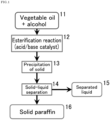
- Fig. 1 is a flowchart showing a method for producing a plant-derived solid paraffin of an embodiment of the present invention.
- Fig. 1 shows a method for producing a plant-derived solid paraffin of an embodiment of the present invention.
- an alcohol is added to a raw material vegetable oil (Step 11), and then an esterification reaction using an acid catalyst or a transesterification reaction using a base catalyst is carried out to obtain a fatty acid ester (Step 12).
- the raw material vegetable oil may be one derived from any plant-related source such as a seed or pulp of palm, soybean, rapeseed, or the like; or rice bran.
- the raw material vegetable oil preferably contains at least one of a crude oil, a deodorizer distillate, and a fatty acid oil containing a relatively large amount of paraffin.
- the alcohol may be any alcohol, and its amount relative to the fatty acid contained in the raw material vegetable oil is preferably 0.5 to 10 molar equivalents.
- the alcohol is preferably a C 1 -C 8 alcohol in terms of the carbon chain length. From the viewpoint of the recovery efficiency, the acid catalyst or base catalyst is preferably a solid.
- the method of contacting the raw material vegetable oil with the alcohol is not limited and may be, for example, a batch method (batch process) or a continuous method (flow process).
- the fatty acid ester is cooled to precipitate a solid (Step 13), and then the precipitated solid is separated from the liquid (Step 14).
- the cooling temperature is preferably -10°C to 25°C.
- the solid-liquid separation may be carried out by any method, and examples of the method include filtration, centrifugation, or sedimentation using an apparatus such as a press filter, a filter press, a vacuum filter, a rotary drum, a centrifuge (batch or continuous type), or a sedimentation tank.
- a plant-derived solid paraffin of an embodiment of the present invention can be obtained.
- the solid paraffin obtained comprises a saturated hydrocarbon(s) having an odd number(s) of carbon atoms of C 21 to C 29 in a proportion of not less than 60%, and hardly comprises saturated hydrocarbons having even numbers of carbon atoms. This is in sharp contrast to the fact that petroleum-derived solid paraffins contain a wide range of saturated hydrocarbons having both even and odd numbers of carbon atoms, showing a broad distribution of the number of carbon atoms.
- the solid paraffin obtained may be washed with a solvent to increase its purity (quality).
- the conversion of the vegetable oil to the fatty acid ester lowers the melting point, so that solidification of the fatty acid contained in the vegetable oil at room temperature can be prevented.
- the resulting fatty acid ester is in a liquid form, and thus only hydrocarbons in the fatty acid ester can be precipitated simply by cooling the fatty acid ester.
- a solid paraffin can be obtained.
- the method for producing a plant-derived solid paraffin according to the embodiment of the present invention can make the production process simpler than the conventional methods using saponification, distillation, and column chromatography. Furthermore, since the present method does not require high temperature and high pressure, the energy consumption and the production cost for the production can be greatly reduced.
- the production cost can be reduced to enable low-cost production of a plant-derived solid paraffin.
- This enables the industrial production of plant-derived solid paraffins and thus the use of the plant-derived solid paraffins for a wide range of applications, including both basic research and industrial use.
- plant-derived solid paraffins can be obtained industrially as alternatives to petroleum-derived solid paraffins.
- a solid paraffin was produced by the method for producing a plant-derived solid paraffin according to the embodiment of the present invention shown in Fig. 1 .
- a rice bran deodorizer distillate (Sample 1) and a rapeseed deodorizer distillate (Sample 2) were used to produce the solid paraffin.
- Ethanol was used as the alcohol.
- PK208LH A commercially available porous resin PK208LH was used as an acid catalyst as shown in Table 1.
- PK208LH is strongly acidic, has a copolymer of styrene and divinylbenzene as a backbone, and contains a sulfonate group as a functional group.
- PK208LH is in the form of a gel composed of particles whose inner portions are homogeneous, and has a porous structure in which physical holes (pores) are formed. Before using the acid catalyst PK208LH, it was swollen with the alcohol (ethanol).
- the reaction liquid and the washing liquid separated by filtration were then cooled at 6°C overnight.
- the solid precipitated by the cooling was filtered through No. 3 filter paper with a particle retention capacity of 5 ⁇ m, and then the filtered solid was washed twice using 0.35 kg of ethanol as a washing liquid, followed by natural drying of the solid.
- a solid paraffin was obtained from each vegetable oil.
- Each solid paraffin sample obtained was subjected to evaluation of melting point, purity, and composition.
- each sample was dissolved in hexane, and then analyzed by gas chromatography using a hydrogen flame ionization detector (FID; "GC-4000 Plus", manufactured by GL Sciences Inc.) and a gas chromatograph mass spectrometer (GC-MS; "Agilent 5975C Series GC/MSD", manufactured by Agilent Technologies, Inc.), to determine the purity and the composition of the paraffin.
- FID hydrogen flame ionization detector
- GC-MS gas chromatograph mass spectrometer
- the solid paraffins obtained from the vegetable oils have almost the same melting point as that of the petroleum-derived solid paraffin (Comparison Sample 1).
- the proportion of C 21 -C 37 saturated hydrocarbons having odd numbers of carbon atoms was found to be not less than 90%, and the proportion of C 21 -C 29 saturated hydrocarbons having odd numbers of carbon atoms was found to be not less than 85%, indicating that these solid paraffins hardly contain saturated hydrocarbons having even numbers of carbon atoms.
- the proportion of saturated hydrocarbons having odd numbers of carbon atoms is as high as 98%.
- the solid obtained was found to be a product of the dilution of the original rice bran deodorizer distillate in the ethanol, and not a product obtained by solidification of hydrocarbons.
- the content of paraffin in the solid obtained was below the detection limit of 0.1%. This result indicates that recovery of solid hydrocarbons was not possible in this Comparative Example due to solidification of fatty acid components.
- the plant-derived solid paraffin produced by the method for producing a plant-derived solid paraffin according to the present invention, and the plant-derived solid paraffin according to the present invention, are expected to be highly demanded for the purpose of application to cosmetics and food, which may be brought into contact with the skin or hair, or may be taken into the body.
- Specific examples of such applications may include cosmetics (creams, lipsticks, hairdressing products, eye shadows, blushers, and facial masks), food (natural coating materials), stationery (crayons, pastel crayons, pencils, and paraffin paper), candle materials, coating materials, and water-proofing materials.
Landscapes
- Chemical & Material Sciences (AREA)
- Organic Chemistry (AREA)
- Life Sciences & Earth Sciences (AREA)
- Engineering & Computer Science (AREA)
- Chemical Kinetics & Catalysis (AREA)
- Oil, Petroleum & Natural Gas (AREA)
- Wood Science & Technology (AREA)
- General Chemical & Material Sciences (AREA)
- Organic Low-Molecular-Weight Compounds And Preparation Thereof (AREA)
- Low-Molecular Organic Synthesis Reactions Using Catalysts (AREA)
- Fats And Perfumes (AREA)
Applications Claiming Priority (1)
| Application Number | Priority Date | Filing Date | Title |
|---|---|---|---|
| PCT/JP2021/030104 WO2023021593A1 (ja) | 2021-08-18 | 2021-08-18 | 植物由来の固形パラフィンの製造方法および植物由来の固形パラフィン |
Publications (2)
| Publication Number | Publication Date |
|---|---|
| EP4389728A1 true EP4389728A1 (de) | 2024-06-26 |
| EP4389728A4 EP4389728A4 (de) | 2024-10-09 |
Family
ID=83005019
Family Applications (1)
| Application Number | Title | Priority Date | Filing Date |
|---|---|---|---|
| EP21954167.9A Pending EP4389728A4 (de) | 2021-08-18 | 2021-08-18 | Verfahren zur herstellung von pflanzlichem festem paraffin und pflanzliches festes paraffin |
Country Status (5)
| Country | Link |
|---|---|
| US (1) | US20240360378A1 (de) |
| EP (1) | EP4389728A4 (de) |
| JP (1) | JP7125695B1 (de) |
| CA (1) | CA3229019A1 (de) |
| WO (1) | WO2023021593A1 (de) |
Family Cites Families (5)
| Publication number | Priority date | Publication date | Assignee | Title |
|---|---|---|---|---|
| JPS5615218A (en) * | 1979-07-17 | 1981-02-14 | Nippon Petrochem Co Ltd | Separation of normal paraffin |
| JPS6040197A (ja) * | 1983-08-15 | 1985-03-02 | Sumitomo Metal Ind Ltd | パラフインの抽出方法 |
| BRPI0601403B1 (pt) | 2006-04-17 | 2015-11-03 | Petroleo Brasileiro Sa | processo de obtenção de n-parafinas a partir de óleo vegetal |
| US9469583B2 (en) * | 2014-01-03 | 2016-10-18 | Neste Oyj | Composition comprising paraffin fractions obtained from biological raw materials and method of producing same |
| JP2021014408A (ja) * | 2017-11-15 | 2021-02-12 | Siエナジー株式会社 | 炭化水素系化合物の製造方法および製造装置 |
-
2021
- 2021-08-18 CA CA3229019A patent/CA3229019A1/en active Pending
- 2021-08-18 US US18/683,981 patent/US20240360378A1/en active Pending
- 2021-08-18 WO PCT/JP2021/030104 patent/WO2023021593A1/ja not_active Ceased
- 2021-08-18 EP EP21954167.9A patent/EP4389728A4/de active Pending
- 2021-08-18 JP JP2021576364A patent/JP7125695B1/ja active Active
Also Published As
| Publication number | Publication date |
|---|---|
| JP7125695B1 (ja) | 2022-08-25 |
| US20240360378A1 (en) | 2024-10-31 |
| EP4389728A4 (de) | 2024-10-09 |
| CA3229019A1 (en) | 2023-02-23 |
| JPWO2023021593A1 (de) | 2023-02-23 |
| WO2023021593A1 (ja) | 2023-02-23 |
Similar Documents
| Publication | Publication Date | Title |
|---|---|---|
| US9447334B2 (en) | Process for converting feeds derived from renewable sources with pre-treatment of feeds by hot dephosphatation | |
| JP6224896B2 (ja) | 天然油供給原料から燃料を精製および製造する方法 | |
| Contreras-Andrade et al. | Purification of glycerol from biodiesel production by sequential extraction monitored by 1H NMR | |
| JP2023116490A (ja) | バイオディーゼル、ディーゼルレンジ炭化水素を製造するための方法及び装置並びに生成物 | |
| AU2008224996B2 (en) | Production of biodiesel fuels which are low in glycerin and sulfur | |
| de Jesus et al. | Laboratory extraction of microalgal lipids using sugarcane bagasse derived green solvents | |
| Nasir et al. | Purification of crude glycerol from transesterification reaction of palm oil using direct method and multistep method | |
| WO2012092046A2 (en) | Pretreatment of fats and oils in the production of biofuels | |
| KR20250006085A (ko) | 글리세롤의 연료 범위 유기 화합물로의 전환 | |
| MX2008003068A (es) | Metodo para elaborar esteres de etilo de acidos grasos a partir de trigliceridos y alcoholes. | |
| US8624048B2 (en) | Method of producing alkyl esters from vegetable or animal oil and an aliphatic monoalcohol with fixed-bed hot purification | |
| CN102282245B (zh) | 从含油植物的种子获得富含官能化脂肪酸酯的级分的方法 | |
| US20150239820A1 (en) | System and Method for Separating Lipid Based Products from Biomass | |
| Niawanti et al. | Removal of bioactive compound (γ-oryzanol) from rice bran oil-based biodiesel using deep eutectic solvent | |
| US20240360378A1 (en) | Method for producing plant-derived solid paraffin and plant-derived solid paraffin | |
| EP2154232B1 (de) | Verfahren zur herstellung von fettsäureestern | |
| RO130351B1 (ro) | Procedeu de obţinere a biocombustibilului pentru aviaţie din biomasă microalgală | |
| Zhang et al. | The production of bio-jet fuel from Botryococcus braunii liquid over a Ru/CeO2 catalyst | |
| CN102660594B (zh) | 脂肪酶催化异Vc混合脂肪酸酯的制备方法 | |
| WO2013115634A1 (en) | A process for refining glyceride oil and purified triglyceride oil obtained such process | |
| JP5272073B2 (ja) | トコトリエノール組成物の製造方法 | |
| MX2010007010A (es) | Metodo de produccion de acidos carboxilicos y esteres de cadena corta a partir de biomasa y producto del mismo. | |
| Dibenedetto et al. | Tunable mixed oxides: efficient agents for the simultaneous trans-esterification of lipids and esterification of free fatty acids from bio-oils for the effective production of FAMEs | |
| Ferreira et al. | Lipid extraction from Scenedesmus Sp. Followed by purification using column chromatography | |
| US9234158B2 (en) | Process for pretreatment of vegetable oils by heterogeneous catalysis of the esterification of fatty acids |
Legal Events
| Date | Code | Title | Description |
|---|---|---|---|
| STAA | Information on the status of an ep patent application or granted ep patent |
Free format text: STATUS: THE INTERNATIONAL PUBLICATION HAS BEEN MADE |
|
| PUAI | Public reference made under article 153(3) epc to a published international application that has entered the european phase |
Free format text: ORIGINAL CODE: 0009012 |
|
| STAA | Information on the status of an ep patent application or granted ep patent |
Free format text: STATUS: REQUEST FOR EXAMINATION WAS MADE |
|
| 17P | Request for examination filed |
Effective date: 20240216 |
|
| AK | Designated contracting states |
Kind code of ref document: A1 Designated state(s): AL AT BE BG CH CY CZ DE DK EE ES FI FR GB GR HR HU IE IS IT LI LT LU LV MC MK MT NL NO PL PT RO RS SE SI SK SM TR |
|
| A4 | Supplementary search report drawn up and despatched |
Effective date: 20240909 |
|
| RIC1 | Information provided on ipc code assigned before grant |
Ipc: C11C 3/10 20060101ALI20240903BHEP Ipc: C07C 9/22 20060101ALI20240903BHEP Ipc: C07C 7/148 20060101AFI20240903BHEP |
|
| DAV | Request for validation of the european patent (deleted) | ||
| DAX | Request for extension of the european patent (deleted) |