EP4386901A1 - Schwefel-kohlenstoff-verbundstoff für lithium-schwefel-batterie und lithium-schwefel-batterie damit - Google Patents
Schwefel-kohlenstoff-verbundstoff für lithium-schwefel-batterie und lithium-schwefel-batterie damit Download PDFInfo
- Publication number
- EP4386901A1 EP4386901A1 EP23827565.5A EP23827565A EP4386901A1 EP 4386901 A1 EP4386901 A1 EP 4386901A1 EP 23827565 A EP23827565 A EP 23827565A EP 4386901 A1 EP4386901 A1 EP 4386901A1
- Authority
- EP
- European Patent Office
- Prior art keywords
- sulfur
- carbon composite
- positive electrode
- lithium
- porous carbonaceous
- Prior art date
- Legal status (The legal status is an assumption and is not a legal conclusion. Google has not performed a legal analysis and makes no representation as to the accuracy of the status listed.)
- Pending
Links
Images

Classifications
-
- H—ELECTRICITY
- H01—ELECTRIC ELEMENTS
- H01M—PROCESSES OR MEANS, e.g. BATTERIES, FOR THE DIRECT CONVERSION OF CHEMICAL ENERGY INTO ELECTRICAL ENERGY
- H01M4/00—Electrodes
- H01M4/02—Electrodes composed of, or comprising, active material
- H01M4/13—Electrodes for accumulators with non-aqueous electrolyte, e.g. for lithium-accumulators; Processes of manufacture thereof
-
- H—ELECTRICITY
- H01—ELECTRIC ELEMENTS
- H01M—PROCESSES OR MEANS, e.g. BATTERIES, FOR THE DIRECT CONVERSION OF CHEMICAL ENERGY INTO ELECTRICAL ENERGY
- H01M4/00—Electrodes
- H01M4/02—Electrodes composed of, or comprising, active material
- H01M4/36—Selection of substances as active materials, active masses, active liquids
- H01M4/58—Selection of substances as active materials, active masses, active liquids of inorganic compounds other than oxides or hydroxides, e.g. sulfides, selenides, tellurides, halogenides or LiCoFy; of polyanionic structures, e.g. phosphates, silicates or borates
- H01M4/581—Chalcogenides or intercalation compounds thereof
- H01M4/5815—Sulfides
-
- H—ELECTRICITY
- H01—ELECTRIC ELEMENTS
- H01M—PROCESSES OR MEANS, e.g. BATTERIES, FOR THE DIRECT CONVERSION OF CHEMICAL ENERGY INTO ELECTRICAL ENERGY
- H01M10/00—Secondary cells; Manufacture thereof
- H01M10/05—Accumulators with non-aqueous electrolyte
- H01M10/052—Li-accumulators
-
- H—ELECTRICITY
- H01—ELECTRIC ELEMENTS
- H01M—PROCESSES OR MEANS, e.g. BATTERIES, FOR THE DIRECT CONVERSION OF CHEMICAL ENERGY INTO ELECTRICAL ENERGY
- H01M4/00—Electrodes
- H01M4/02—Electrodes composed of, or comprising, active material
-
- H—ELECTRICITY
- H01—ELECTRIC ELEMENTS
- H01M—PROCESSES OR MEANS, e.g. BATTERIES, FOR THE DIRECT CONVERSION OF CHEMICAL ENERGY INTO ELECTRICAL ENERGY
- H01M4/00—Electrodes
- H01M4/02—Electrodes composed of, or comprising, active material
- H01M4/13—Electrodes for accumulators with non-aqueous electrolyte, e.g. for lithium-accumulators; Processes of manufacture thereof
- H01M4/136—Electrodes based on inorganic compounds other than oxides or hydroxides, e.g. sulfides, selenides, tellurides, halogenides or LiCoFy
-
- H—ELECTRICITY
- H01—ELECTRIC ELEMENTS
- H01M—PROCESSES OR MEANS, e.g. BATTERIES, FOR THE DIRECT CONVERSION OF CHEMICAL ENERGY INTO ELECTRICAL ENERGY
- H01M4/00—Electrodes
- H01M4/02—Electrodes composed of, or comprising, active material
- H01M4/36—Selection of substances as active materials, active masses, active liquids
-
- H—ELECTRICITY
- H01—ELECTRIC ELEMENTS
- H01M—PROCESSES OR MEANS, e.g. BATTERIES, FOR THE DIRECT CONVERSION OF CHEMICAL ENERGY INTO ELECTRICAL ENERGY
- H01M4/00—Electrodes
- H01M4/02—Electrodes composed of, or comprising, active material
- H01M4/36—Selection of substances as active materials, active masses, active liquids
- H01M4/38—Selection of substances as active materials, active masses, active liquids of elements or alloys
-
- H—ELECTRICITY
- H01—ELECTRIC ELEMENTS
- H01M—PROCESSES OR MEANS, e.g. BATTERIES, FOR THE DIRECT CONVERSION OF CHEMICAL ENERGY INTO ELECTRICAL ENERGY
- H01M4/00—Electrodes
- H01M4/02—Electrodes composed of, or comprising, active material
- H01M4/62—Selection of inactive substances as ingredients for active masses, e.g. binders, fillers
-
- H—ELECTRICITY
- H01—ELECTRIC ELEMENTS
- H01M—PROCESSES OR MEANS, e.g. BATTERIES, FOR THE DIRECT CONVERSION OF CHEMICAL ENERGY INTO ELECTRICAL ENERGY
- H01M4/00—Electrodes
- H01M4/02—Electrodes composed of, or comprising, active material
- H01M4/62—Selection of inactive substances as ingredients for active masses, e.g. binders, fillers
- H01M4/624—Electric conductive fillers
- H01M4/625—Carbon or graphite
-
- H—ELECTRICITY
- H01—ELECTRIC ELEMENTS
- H01M—PROCESSES OR MEANS, e.g. BATTERIES, FOR THE DIRECT CONVERSION OF CHEMICAL ENERGY INTO ELECTRICAL ENERGY
- H01M4/00—Electrodes
- H01M4/02—Electrodes composed of, or comprising, active material
- H01M2004/021—Physical characteristics, e.g. porosity, surface area
-
- H—ELECTRICITY
- H01—ELECTRIC ELEMENTS
- H01M—PROCESSES OR MEANS, e.g. BATTERIES, FOR THE DIRECT CONVERSION OF CHEMICAL ENERGY INTO ELECTRICAL ENERGY
- H01M4/00—Electrodes
- H01M4/02—Electrodes composed of, or comprising, active material
- H01M2004/026—Electrodes composed of, or comprising, active material characterised by the polarity
- H01M2004/028—Positive electrodes
-
- Y—GENERAL TAGGING OF NEW TECHNOLOGICAL DEVELOPMENTS; GENERAL TAGGING OF CROSS-SECTIONAL TECHNOLOGIES SPANNING OVER SEVERAL SECTIONS OF THE IPC; TECHNICAL SUBJECTS COVERED BY FORMER USPC CROSS-REFERENCE ART COLLECTIONS [XRACs] AND DIGESTS
- Y02—TECHNOLOGIES OR APPLICATIONS FOR MITIGATION OR ADAPTATION AGAINST CLIMATE CHANGE
- Y02E—REDUCTION OF GREENHOUSE GAS [GHG] EMISSIONS, RELATED TO ENERGY GENERATION, TRANSMISSION OR DISTRIBUTION
- Y02E60/00—Enabling technologies; Technologies with a potential or indirect contribution to GHG emissions mitigation
- Y02E60/10—Energy storage using batteries
Definitions
- the present disclosure relates to a sulfur-carbon composite for a lithium sulfur battery and a lithium sulfur battery including the same.
- a lithium sulfur battery is a battery system using a sulfur-based material having a sulfur-sulfur (S-S) bond as a positive electrode active material and lithium metal as a negative electrode active material.
- S-S sulfur-sulfur
- Sulfur as a main ingredient of the positive electrode active material is advantageous in that it is rich in resources all over the world, has no toxicity and shows a low atomic weight.
- a sulfur-based material as a positive electrode active material accepts the electron and is reduced.
- the S-S bond accepts two electrons through the reduction of the sulfur-based material and is converted into a sulfur anion form.
- the lithium cation produced by the oxidation of lithium is transferred to a positive electrode through an electrolyte, and is bound with the sulfur anion produced by the reduction of the sulfur-based compound to form a salt.
- sulfur before discharge has a cyclic S 8 structure, which is converted into lithium polysulfide (Li 2 S x ) through the reduction and is reduced completely to produce lithium sulfide (Li 2 S).
- sulfur used for the positive electrode active material is an insulator
- a porous carbonaceous material has been studied as a carrier of sulfur in order to improve the reactivity of sulfur.
- a sulfur-carbon composite including a positive electrode active material supported in a porous carbonaceous material as a positive electrode material.
- the sulfur-carbon composite used for a lithium sulfur secondary battery has a structure including a sulfur-containing compound supported in a porous carbonaceous material used as a matrix.
- a porous carbonaceous material having a large specific surface area in order to increase the loading amount of sulfur, it causes a decrease in tap density during the formation of an electrode, a drop in compressing ratio during the pressing and an electrode swelling phenomenon, which makes it difficult to manufacture and commercialize electrodes.
- the present disclosure is designed to solve the problems of the related art, and therefore the present disclosure is directed to providing a sulfur-carbon composite which shows enhanced dynamic activity of oxidation/reduction of sulfur by using a carrier having a large specific surface area and pore volume.
- the present disclosure is directed to providing a sulfur-carbon composite using a sheet-like carbonaceous material having excellent packing density as well as a large specific surface area and pore volume.
- the present disclosure is directed to providing an electrode for a lithium sulfur battery having low porosity and a high-performance lithium sulfur secondary battery.
- a sulfur-carbon composite including: a porous carbonaceous matrix as a sulfur carrier; and a sulfur-containing compound supported at least partially in the pores of the porous carbonaceous matrix and on the external surface thereof, wherein the porous carbonaceous matrix includes a sheet-like carbonaceous material and has a specific surface area of 1,000 m 2 /g or more and a pore volume of 6 cm 3 /g or more.
- the sulfur-carbon composite as defined in the first embodiment, wherein the sheet-like carbonaceous material includes graphene, graphene oxide, reduced graphene oxide (rGO), or a mixture of two or more of them.
- the sheet-like carbonaceous material includes graphene, graphene oxide, reduced graphene oxide (rGO), or a mixture of two or more of them.
- the sulfur-carbon composite as defined in the first or the second embodiment, wherein the porous carbonaceous matrix has a pore volume of 6-15 cm 3 /g.
- the sulfur-carbon composite as defined in any one of the first to the third embodiments, wherein the porous carbonaceous matrix includes mesopores having an average diameter (D 50 ) equal to or larger than 1 nm and less than 50 nm and macropores having an average diameter (D 50 ) of 50-200 nm.
- the sulfur-carbon composite as defined in any one of the first to the fourth embodiments, wherein the pores of the porous carbonaceous matrix have an average diameter (D 50 ) of 20-25 nm.
- the sulfur-carbon composite as defined in any one of the first to the fifth embodiments, wherein the sulfur-containing compound includes inorganic sulfur (Ss), lithium polysulfide (Li 2 S n , 1 ⁇ n ⁇ 8), carbon-sulfur polymer ((C 2 S x ) m , 2.5 ⁇ x ⁇ 50, 2 ⁇ m ), or a mixture thereof.
- the sulfur-containing compound includes inorganic sulfur (Ss), lithium polysulfide (Li 2 S n , 1 ⁇ n ⁇ 8), carbon-sulfur polymer ((C 2 S x ) m , 2.5 ⁇ x ⁇ 50, 2 ⁇ m ), or a mixture thereof.
- the sulfur-carbon composite as defined in any one of the first to the sixth embodiments, wherein the content of the sulfur-containing compound is 75 wt% or more based on the total weight of the sulfur-carbon composite.
- a positive electrode according to any one of the following embodiments.
- a positive electrode including the sulfur-carbon composite as defined in any one of the first to the seventh embodiments as a positive electrode active material.
- the positive electrode as defined in the eighth embodiment which has a porosity of 70 vol% or less.
- the positive electrode as defined in the eighth or the ninth embodiment which has a porosity of 30 vol% or less.
- a lithium sulfur battery including a positive electrode, a negative electrode, a separator interposed between the positive electrode and the negative electrode, and an electrolyte, wherein the positive electrode includes a positive electrode including the sulfur-carbon composite as defined in any one of the first to the seventh embodiments as a positive electrode active material.
- the sulfur-carbon composite according to an embodiment of the present disclosure provides excellent dynamic activity to the oxidation/reduction of sulfur.
- the sulfur-carbon composite is effective for enhancing the reactivity of sulfur by supporting sulfur in a porous carbonaceous matrix having enhanced active sites in which sulfur can participate in the reaction by virtue of a high specific surface area.
- the sulfur-carbon composite allows sulfur to be supported easily by virtue of a large pore volume of the porous carbonaceous matrix, and is favorable to ensuring an ion diffusion path.
- the sulfur-carbon composite shows a high content of sulfur supported therein and includes a sheet-like carbonaceous material having a large specific surface area, and thus an electrode using the sulfur-carbon composite as a positive electrode active material shows improved packing density in the sulfur-carbon composition, thereby realizing low porosity.
- ⁇ a part includes element' does not preclude the presence of any additional elements but means that the part may further include the other elements.
- ⁇ A and/or B' means ⁇ A, B or both of them'.
- a sulfur-carbon composite which can be used as a positive electrode material of a lithium sulfur secondary battery.
- the sulfur-carbon composite includes: a porous carbonaceous matrix as a sulfur carrier; and a sulfur-containing compound supported at least partially in the pores of the porous carbonaceous matrix and on the external surface thereof.
- the sulfur-carbon composite according to the present disclosure may be used as a positive electrode material in itself at a positive electrode, or may be incorporated as a catalyst for enhancing the activity of a positive electrode active material separately from the positive electrode active material, and the use of the sulfur-carbon composite is not limited thereto.
- the sulfur-carbon composite according to an embodiment of the present disclosure includes: a porous carbonaceous matrix as a sulfur carrier; and a sulfur-containing compound supported at least partially in the pores of the porous carbonaceous matrix and on the external surface thereof, wherein the porous carbonaceous matrix includes a sheet-like carbonaceous material and has a specific surface area of 1,000 m 2 /g or more and a pore volume of 6 cm 3 /g or more.
- the porous carbonaceous matrix is characterized in that it has a high specific surface area in order to enhance the active sites in which sulfur can participate oxidation/reduction.
- the porous carbonaceous matrix is characterized in that it has a large pore volume so that it allows sulfur to be supported easily and ensures an ion diffusion path advantageously.
- the sulfur-carbon composite includes a porous carbonaceous matrix as a carrier to support the sulfur-containing compound.
- the sulfur-carbon composite includes a sheet-like porous carbonaceous material as a porous carbonaceous matrix.
- the sheet-like porous carbonaceous material is significantly excellent in terms of packing density as compared to an amorphous porous carbonaceous material or a spherical porous carbonaceous material. Therefore, when using a sulfur-carbon composite including such a sheet-like porous carbonaceous material, it is possible to provide an advantageous effect in realizing a low-porosity electrode, but the mechanism of the present disclosure is not limited thereto.
- the sheet-like carbonaceous material may include graphene, graphene oxide, reduced graphene oxide (rGO), or a mixture of two or more of them.
- the sheet-like porous carbonaceous material may include reduced graphene oxide alone.
- the porous carbonaceous matrix has a specific surface area of 1,000 m 2 /g or more.
- the BET specific surface area of the porous carbonaceous matrix is not particularly limited in its upper limit.
- the porous carbonaceous matrix may have a BET specific surface area of 1,000 m 2 /g to 5,000 m 2 /g.
- the porous carbonaceous matrix may have a BET specific surface area of 1,000 m 2 /g to 3,000 m 2 /g, 1,000 m 2 /g to 2,000 m 2 /g, 1,000 m 2 /g to 1,500 m 2 /g, 1,000 m 2 /g to 1,200 m 2 /g, or 1,000 m 2 /g to 1,100 m 2 /g.
- the sulfur-carbon composite according to the present disclosure includes a plurality of fine pores on the external surface thereof and/or inside thereof, and thus has a significantly large specific surface area advantageously.
- the BET specific surface area is determined by the BET method, and may refer to a value determined by a known method for determining a BET specific surface area.
- the BET specific surface area may be a value calculated from the nitrogen gas adsorption under a liquid nitrogen temperature (77K) by using BELSORP-max available from BEL Japan Co.
- the porous carbonaceous matrix includes a plurality of pores having different sizes.
- the porous carbonaceous matrix has a total pore volume of 6 cm 3 /g or more.
- the pore volume of the porous carbonaceous matrix is not particularly limited in its upper limit, as long as it is 6 cm 3 /g or more.
- the porous carbonaceous matrix may have a pore volume of 6 cm 3 /g or more, or 6.5 cm 3 /g or more.
- the porous carbonaceous matrix may have a pore volume of 6 cm 3 /g to 15 cm 3 /g, 6.5 cm 3 /g to 15 cm 3 /g, 6 cm 3 /g to 12 cm 3 /g, 6 cm 3 /g to 10 cm 3 /g, or 6 cm 3 /g to 8 cm 3 /g.
- the pore volume may be a value calculated through the N 2 isotherm analysis based on the liquid nitrogen adsorption.
- the porous carbonaceous matrix has a large total pore volume and thus can provide an advantageous effect for manufacturing a high-sulfur loading electrode, but the mechanism of the present disclosure is not limited thereto.
- the porous carbonaceous matrix in the sulfur-carbon composite includes a plurality of fine pores in order to support the sulfur-containing compound.
- the porous carbonaceous matrix includes a plurality of fine pores on the external surface thereof and inside thereof, wherein the fine pores may include mesopores having a diameter equal to or larger than 1 nm and less than 50 nm, and macropores having a diameter of 50-200 nm.
- the porous carbonaceous matrix preferably includes mesopores and macropores developed homogeneously therein.
- the diameter of the fine pores may be determined by a method for determining the pore diameter of a porous material known to those skilled in the art with no particular limitation.
- the average diameter of the fine pores may be determined by scanning electron microscopy (SEM), field-emission electron microscopy or laser diffraction methods.
- the average diameter of the fine pores may be determined through the laser diffraction method using a commercially available laser diffraction particle size analyzer (e.g. Microtrac MT 3000).
- the total pores of the porous carbonaceous matrix may have an average diameter (D 50 ) of 25 nm or less. It is preferred that the fine pores contained in the porous carbonaceous matrix have a uniform size.
- the upper limit of the average diameter (D 50 ) of the fine pores of the porous carbonaceous matrix may be limited to 25 nm. More particularly, the average diameter (D 50 ) of the fine pores of the porous carbonaceous matrix may be 5-25 nm, 10-25 nm, 15-25 nm, 20-25 nm, or 23-25 nm, but is not limited thereto.
- the average diameter (D 50 ) of the pores refers to the diameter of the pores at a point of 50% in the pore volume cumulative distribution depending on diameter.
- the sulfur-containing compound is contained at least partially inside of the pores of the porous carbonaceous matrix having the above-described characteristics and on the external surface thereof.
- any sulfur-containing compound may be used with no particular limitation, as long as it may be used as a positive electrode active material in a lithium sulfur secondary battery.
- the sulfur-containing compound may include inorganic sulfur (Ss), lithium polysulfide (Li 2 S n , 1 ⁇ n ⁇ 8), carbon-sulfur polymer((C 2 S x ) m , 2.5 ⁇ x ⁇ 50, 2 ⁇ m), or a mixture thereof, but is not limited thereto.
- the sulfur-containing compound may be incorporated into the sulfur-carbon composite through the physical adsorption with the porous carbonaceous matrix, or chemical bonding, such as covalent bonding between a sulfur element and carbon in the porous carbonaceous matrix, Van der Waals bonding, or the like.
- the porous carbonaceous matrix and the sulfur-containing compound may be contained in the sulfur-carbon composite at a weight ratio of 1:9-9: 1, particularly 1:9-5:5, 1:9-4:6, 1:9-3:7, or 1:9-1.5:8.5.
- the sulfur-carbon composite includes the sulfur-containing compound at a high content, thereby increasing the dynamic activity of the sulfur-carbon composite while providing an advantageous effect in terms of improvement of the conductivity derived from the porous carbonaceous matrix.
- the scope of the present disclosure is not limited thereto.
- the content of the sulfur-containing compound in the sulfur-carbon composite may be 10 wt% or more, particularly 50 wt% or more, 60 wt% or more, 70 wt% or more, 75 wt% or more, 80 wt% or more, or 85 wt% or more, based on the total weight of the sulfur-carbon composite.
- the content of the sulfur-containing compound may be 50-95 wt%, particularly 60-90 wt%, 70-90 wt%, 75-90 wt%, 80-90 wt%, or 85-90 wt%, based on the total weight of the sulfur-carbon composite.
- the sulfur-carbon composite includes the sulfur-containing compound at a high content, thereby increasing the dynamic activity of the sulfur-carbon composite while providing an advantageous effect in terms of improvement of the conductivity derived from the porous carbonaceous matrix.
- the scope of the present disclosure is not limited thereto.
- the average particle diameter (D 50 ) of the sulfur-carbon composite may be 0.5-200 ⁇ m, 0.5-200 ⁇ m, 1-150 ⁇ m, or 10-150 ⁇ m.
- the particle diameter of the sulfur-carbon composite may be determined by scanning electron microscopy (SEM), field-emission electron microscopy or laser diffraction methods.
- the average particle diameter of the sulfur-carbon composite may be determined through the laser diffraction method using a commercially available laser diffraction particle size analyzer (e.g. Microtrac MT 3000).
- the average particle diameter (D 50 ) refers to the particle diameter at a point of 50% in the number cumulative distribution depending on particle size.
- the sulfur-carbon composite may have a Raman peak intensity ratio (I G /I D ratio) of 2 or less.
- the sulfur-carbon composite may have a Raman peak intensity of 1 or less.
- the I G /I D ratio is larger than 1, the surface of the sulfur-carbon composite shows high crystallinity to cause the problems of degradation of the composite formation with the sulfur-containing compound or the efficiency of the conversion of lithium polysulfide.
- the scope of the present disclosure is not limited thereto.
- the Raman peak intensity ratio may be determined through the I G and I D values obtained from the spectrum of the sulfur-carbon composite as analyzed by Raman spectroscopy.
- I G refers to the peak (G-peak, 1573/cm) of a crystalline segment
- I D refers to the peak (D-peak, 1309/cm) of an amorphous segment. Therefore, a smaller vale of I G /I D ratio suggests that the sulfur-carbon composite has lower crystallinity.
- the sulfur-carbon composite may be formed by mixing the porous carbonaceous matrix with the sulfur-containing compound and carrying out heat treatment, but the method for preparing the sulfur-carbon composite according to the present disclosure is not limited thereto.
- the sulfur-carbon composite according to the present disclosure includes a sheet-like carbonaceous material having a high specific surface area and large pore volume, and thus shows an enhanced sulfur loading amount and can provide a plurality of active sites for the oxidation/reduction of sulfur.
- the mechanism of the present disclosure is not limited thereto.
- a positive electrode including the above-described sulfur-carbon composite as a positive electrode active material.
- the positive electrode may include the sulfur-carbon composite using the porous carbonaceous matrix as a carrier in which the sulfur-containing compound is support, as a positive electrode active material.
- the positive electrode may further include a binder, a conductive material, an additive, or the like, if necessary.
- a binder any conventional type of binder, conductive material and additive may be used, and thus detailed description thereof will be omitted.
- the positive electrode may include a positive electrode current collector, and a positive electrode active material layer coated on one surface or both surfaces of the positive electrode current collector and including the positive electrode active material in combination with the binder.
- the structure of the positive electrode is not limited thereto.
- the positive electrode current collector is not particularly limited, as long as it has high conductivity, while not causing any chemical change in the corresponding battery.
- the positive electrode including the sulfur-carbon composite shows excellent effects in terms of sulfur loading amount and sulfur oxidation/reduction activity, but the effects of the present disclosure are not limited thereto.
- the positive electrode may have a sulfur (S) loading amount of 1.0 mg/cm 2 or more based on the area of the electrode.
- the sulfur loading amount in the positive electrode may be 1 mg/cm 2 or more, 1.5 mg/cm 2 or more, 2 mg/cm 2 or more, particularly 2-10 mg/cm 2 . Therefore, when the positive electrode is used in a lithium sulfur battery, it is possible to provide the battery with high-energy density.
- the positive electrode includes the sulfur-carbon composite in which the sulfur-containing compound is supported in the porous carbonaceous matrix having high specific surface area and large total pore volume, and thus it is possible to realize high tap density and low porosity upon the formation of the positive electrode. Therefore, the positive electrode can be used for a battery having high energy density.
- the positive electrode may have a porosity of 70 vol% or less, 50 vol% or less, or 30 vol% or less.
- porosity of the positive electrode falls within the above-defined range, it is possible to provide an excellent sulfur loading amount and packing density, and thus to show an advantageous effect of providing a battery having high energy density, but the scope of the present disclosure is not limited thereto.
- the porosity of the positive electrode is not limited in its lower limit, but the positive electrode may have a porosity of 1 vol% or more, 5 vol% or more, 7 vol% or more, or 10 vol% or more.
- the porosity of the positive electrode may be determined by the BET (Brunauer-Emmett-Teller) method using nitrogen gas or Hg porosimetry according to ASTM D-2873.
- the net density of the electrode may be calculated from the density (apparent density) of the electrode, the composition of the ingredients contained in the electrode and the density of each ingredient, and then the porosity of the electrode may be calculated from the difference between the apparent density and the net density.
- a lithium sulfur battery including a positive electrode, a negative electrode and a separator layer interposed between the positive electrode and the negative electrode, wherein the positive electrode includes the above-described positive electrode.
- the separator layer is a constitutional element configured to prevent the positive electrode and the negative electrode from being in contact with each other.
- the separator layer may include a separator, a solid electrolyte membrane or both.
- the negative electrode and the separator layer are not particularly limited, as long as they may be used for a lithium sulfur battery without detracting from the objects of the present disclosure. Therefore, detailed description of the negative electrode and the separator layer will be omitted herein.
- the negative electrode may include lithium metal.
- the lithium sulfur battery may include an electrode assembly including the positive electrode, the negative electrode and the separator layer, and a casing in which the electrode assembly is received together with an electrolyte.
- the electrolyte may include a lithium salt and a nonaqueous solvent, and may further include any additive, if necessary.
- the lithium salt is not particularly limited, as long as it may be used conventionally for an electrolyte of a lithium sulfur battery.
- the lithium salt may include, but are not limited to: LiCl, LiBr, LiI, LiClO 4 , LiBF 4 , LiB 10 Cl 10 , LiPF 6 , LiCF 3 SO 3 , LiCF 3 CO 2 , LiC 4 BO 8 , LiAsF 6 , LiSbF 6 , LiAlCl 4 , CH 3 SO 3 Li, CF 3 SO 3 Li, (CF 3 SO 2 ) 2 NLi, (C 2 F 5 SO 2 ) 2 NLi, (SO 2 F) 2 NLi, (CF 3 SO 2 ) 3 CLi, lithium chloroborate, lithium lower aliphatic carboxylate, lithium tetraphenylborate, lithium imide, or two or more of them.
- the nonaqueous solvent is not particularly limited, as long as it may be used conventionally for an electrolyte of a lithium sulfur battery.
- Particular examples of the nonaqueous solvent may include, but are not limited to: cyclic carbonate solvents, linear carbonate solvents, ester solvents, ketone solvents, or mixed solvents containing two or more of them.
- the separator is not particularly limited, as long as it may be used as a separator of a lithium sulfur battery.
- the separator may include a porous polyolefin substrate, and if necessary, may further include inorganic particles on at least one surface of the porous polyolefin substrate.
- the separator may further include a binder for binding the inorganic particles, if necessary.
- the solid electrolyte layer may be a film-shaped electrolyte membrane including a solid electrolyte, and if necessary, may further include a binder for binding the solid electrolyte.
- the solid electrolyte is not particularly limited, as long as it may be used conventionally for a lithium sulfur battery.
- Particular examples of the solid electrolyte may include a polymeric solid electrolyte, an inorganic solid electrolyte or a mixture thereof.
- the outer shape of the lithium sulfur battery may be selected from a coin-like shape, a cylindrical shape, a pouch-like shape or a prismatic shape with no particular limitation.
- the lithium sulfur battery may be used not only for a battery cell used as a power source of a compact device but also for a unit cell in a middle- or large-scale battery module including a plurality of battery cells, and the application thereof is not particularly limited.
- the lithium sulfur battery using the positive electrode including the above-described sulfur-carbon composite can realize an excellent effect in terms of the energy density of the battery, but the effect of the present disclosure is not limited thereto.
- the lithium sulfur battery can provide an effect of improving the energy density by increasing the sulfur loading amount in the electrode and reducing the amount of the electrolyte, but the effect of the present disclosure is not limited thereto.
- the lithium sulfur battery may have an electrolyte/sulfur (E/S) ratio of 10 ⁇ L/mg or less.
- E/S ratio of the lithium sulfur battery may be 10 ⁇ L/mg or less, 8 ⁇ L/mg or less, 6 ⁇ L/mg or less, 4 ⁇ L/mg or less, or 2 ⁇ L/mg or less.
- E/S ratio there is a limitation in reducing the E/S ratio due to the low activity of a positive electrode.
- the E/S ratio is reduced stably. Therefore, it is apparent to those skilled in the art that the E/S ratio of the lithium sulfur battery according to the present disclosure may have a value larger than the above-defined range, and the lower limit of the E/S ratio is not limited.
- the lithium sulfur battery may have an energy density (W G ) of 100 Wh/g or more.
- W G energy density
- the lithium sulfur battery may have an energy density of 100 Wh/g or more, 150 Wh/g or more, 200 Wh/g or more, 250 Wh/g or more, 300 Wh/g or more, or 350 Wh/g or more, but the scope of the present disclosure is not limited thereto.
- rGO reduced graphene oxide
- D 50 average pore diameter
- the specific surface area and pore volume of the porous carbonaceous matrix were determined through the BET (Brunauer-Emmett-Teller) 6-point method based on the nitrogen gas adsorption flowmetry using a porosimetry analyzer (Bell Japan Inc., Belsorp-II mini).
- the average pore diameter (D 50 ) was determined by the laser diffraction method.
- the resultant positive electrode slurry composition was applied onto an aluminum current collector having a thickness of 20 ⁇ m and dried at 50°C for 12 hours to obtain a positive electrode.
- the positive electrode prepared as described above and lithium metal (thickness 35 ⁇ m) as a negative electrode were positioned in such a manner that they might face each other, a separator (polyethylene, thickness 20 ⁇ m, porosity 45 vol%) was interposed between both electrodes, and 70 ⁇ L of an electrolyte was injected to obtain a lithium sulfur battery.
- a separator polyethylene, thickness 20 ⁇ m, porosity 45 vol%
- a lithium sulfur battery was obtained in the same manner as Comparative Example 1, except that rGO having a BET specific surface area of 494 m 2 /g, pore volume of 3.75 cm 3 /g and an average pore diameter (D 50 ) of 30.5 nm was used as a porous carbonaceous matrix for preparing a sulfur-carbon composite.
- Sheet-like graphene was obtained as a porous carbonaceous matrix through the thermal reduction as follows.
- graphene oxide SE2430, available from sixth element Co.
- TE-rGO thermally expanded reduced graphene oxide
- the resultant porous carbonaceous matrix had a BET specific surface area of 921 m 2 /g, pore volume of 5.13 cm 3 /g and an average pore diameter (D 50 ) of 22.28 nm.
- a lithium sulfur battery was obtained in the same manner as Comparative Example 1, except that 20 wt% of the porous carbonaceous matrix obtained as described above was mixed with 80 wt% of sulfur (S 8 ).
- a lithium sulfur battery was obtained in the same manner as Comparative Example 1, except that sheet-like rGO having a BET specific surface area of 1,023 m 2 /g, pore volume of 6.99 cm 3 /g and an average pore diameter (D 50 ) of 24.91 nm was obtained through the thermal reduction, and 10 wt% of rGO having the above-mentioned characteristics was used as a porous carbonaceous matrix and mixed with 90 wt% of sulfur (S 8 ).
- the porous carbonaceous matrix used for preparing the sulfur-carbon composite in manufacturing the lithium sulfur battery according to each of Example 1 and Comparative Examples 1-3 was determined in terms of BET specific surface area, pore volume and average pore diameter by using a BET analyzer (Belsorp-max). The results are shown in FIG. 1 .
- the porous carbonaceous matrix according to Example 1 has a specific surface area of 1,000 m 2 /g or more, while Comparative Examples 1-3 show a specific surface area of less than 1,000 m 2 /g, and particularly, Comparative Examples 1 and 2 show a significantly smaller specific surface area of 500 m 2 /g or less.
- the porous carbonaceous matrix according to Example 1 has a total pore volume of 6 cm 3 /g or more, while Comparative Examples 1-3 show a pore volume of less than 6 cm 3 /g, and particularly, Comparative Examples 1 and 2 show a significantly lower pore volume of 2.84 cm 3 /g (Comparative Example 1) and 3.75 cm 3 /g (Comparative Example 2).
- Example 1 and Comparative Examples 1-3 include mesopores having a pore diameter equal to or larger than 1 nm and less than 50 nm and macropores having a pore diameter of 50 nm or more, and are determined to have an average pore diameter (D 50 ) of 24.91 nm (Example 1), 26.58 nm (Comparative Example 1), 30.5 nm (Comparative Example 2) and 22.28 nm (Comparative Example 3).
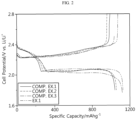
- the lithium sulfur battery according to each of Example 1 and Comparative Examples 1-3 was charged/discharged by using a charge/discharge tester (PNE solution Co.) at 25°C and at a charge/discharge rate of 0.1 C/0.1 C in a voltage range of 1.7-3.0 V (vs. Li/Li + ) to evaluate the capacity characteristics of the battery.
- the results of evaluation of the battery capacity characteristics are shown in FIG. 2 .
- each of Comparative Examples 1-3 has a higher content of porous carbonaceous matrix in the sulfur-carbon composite, it shows a lower discharge capacity as compared to Example 1 having a lower content of porous carbonaceous matrix.
- Comparative Examples 1 and 2 show a significantly low discharge capacity and provide poor high-rate operability.
- Example 1 shows a significantly improved discharge capacity and can provide a battery capable of high-rate operation.
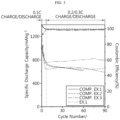
- Example 1 The lithium sulfur battery according to each of Example 1 and Comparative Examples 1-3 was charged/discharged six times repeatedly by using a charge/discharge tester (PNE solution Co.) at 25°C and at a current density of 0.1 C and charged/discharged repeatedly at 0.2 C/0.3 C for 60 cycles to evaluate the life characteristics.
- PNE solution Co. a charge/discharge tester
- the results of evaluation of the battery life characteristics are shown in FIG. 3 .
- Example 1 shows a higher capacity retention after repeating charge/discharge cycles, as compared to Comparative Examples 1-3, and thus provides significantly higher life characteristics.
- the pore volume is not sufficient, thereby making it difficult to ensure an ion diffusion path and causing generation of over-voltage, which results in a lithium sulfur battery problematic in terms of normal operation.
Landscapes
- Chemical & Material Sciences (AREA)
- Chemical Kinetics & Catalysis (AREA)
- Electrochemistry (AREA)
- General Chemical & Material Sciences (AREA)
- Engineering & Computer Science (AREA)
- Inorganic Chemistry (AREA)
- Materials Engineering (AREA)
- Manufacturing & Machinery (AREA)
- Battery Electrode And Active Subsutance (AREA)
- Carbon And Carbon Compounds (AREA)
Applications Claiming Priority (3)
| Application Number | Priority Date | Filing Date | Title |
|---|---|---|---|
| KR20220076854 | 2022-06-23 | ||
| KR1020230073152A KR20240000372A (ko) | 2022-06-23 | 2023-06-07 | 리튬황 전지용 황-탄소 복합체 이를 포함하는 리튬황 전지 |
| PCT/KR2023/008778 WO2023249457A1 (ko) | 2022-06-23 | 2023-06-23 | 리튬황 전지용 황-탄소 복합체 이를 포함하는 리튬황 전지 |
Publications (2)
| Publication Number | Publication Date |
|---|---|
| EP4386901A1 true EP4386901A1 (de) | 2024-06-19 |
| EP4386901A4 EP4386901A4 (de) | 2025-10-29 |
Family
ID=89380281
Family Applications (1)
| Application Number | Title | Priority Date | Filing Date |
|---|---|---|---|
| EP23827565.5A Pending EP4386901A4 (de) | 2022-06-23 | 2023-06-23 | Schwefel-kohlenstoff-verbundstoff für lithium-schwefel-batterie und lithium-schwefel-batterie damit |
Country Status (4)
| Country | Link |
|---|---|
| US (1) | US20250149574A1 (de) |
| EP (1) | EP4386901A4 (de) |
| JP (1) | JP2024540962A (de) |
| WO (1) | WO2023249457A1 (de) |
Family Cites Families (13)
| Publication number | Priority date | Publication date | Assignee | Title |
|---|---|---|---|---|
| JP6796254B2 (ja) * | 2014-11-13 | 2020-12-09 | 株式会社Gsユアサ | 硫黄−カーボン複合体、硫黄―カーボン複合体を含む電極を備えた非水電解質電池、及び硫黄−カーボン複合体の製造方法 |
| KR20180036868A (ko) * | 2016-09-30 | 2018-04-10 | 전자부품연구원 | 다공성 탄소재 양극 및 그를 포함하는 리튬-이산화황 이차 전지 |
| JP6860125B2 (ja) * | 2017-01-06 | 2021-04-14 | 学校法人早稲田大学 | 二次電池 |
| CN112673440A (zh) * | 2018-10-19 | 2021-04-16 | 帝伯爱尔株式会社 | 电容器及电容器用电极 |
| KR102690253B1 (ko) * | 2018-11-14 | 2024-07-30 | 주식회사 엘지에너지솔루션 | 열팽창된 환원 그래핀 옥사이드, 이의 제조방법, 이를 포함하는 황-탄소 복합체 및 리튬 이차전지 |
| KR102733694B1 (ko) * | 2018-11-14 | 2024-11-26 | 주식회사 엘지에너지솔루션 | 열팽창된 환원 그래핀 옥사이드, 이의 제조방법, 이를 포함하는 황-탄소 복합체 및 리튬 이차전지 |
| WO2020101276A1 (ko) * | 2018-11-14 | 2020-05-22 | 주식회사 엘지화학 | 열팽창된 환원 그래핀 옥사이드, 이의 제조방법, 이를 포함하는 황-탄소 복합체 및 리튬 이차전지 |
| KR102690260B1 (ko) * | 2019-05-16 | 2024-07-30 | 주식회사 엘지에너지솔루션 | 황-탄소 복합체 및 이를 포함하는 리튬-황 전지 |
| GB2588749A (en) * | 2019-10-15 | 2021-05-12 | Oxis Energy Ltd | Lithium sulfur cell |
| KR102781565B1 (ko) * | 2020-01-03 | 2025-03-17 | 주식회사 엘지에너지솔루션 | 리튬 이차전지용 양극 및 이를 포함하는 리튬 이차전지 |
| KR102799574B1 (ko) * | 2020-01-14 | 2025-04-22 | 주식회사 엘지에너지솔루션 | 리튬 이차전지용 양극 활물질, 이의 제조방법 및 이를 포함하는 리튬 이차전지 |
| KR102542677B1 (ko) | 2020-12-01 | 2023-06-14 | 김기홍 | 수목용 해충 포집기 |
| KR102531572B1 (ko) | 2023-02-10 | 2023-05-15 | 김재훈 | 사용자를 위한 영상 메이킹 플랫폼 생성 방법 |
-
2023
- 2023-06-23 EP EP23827565.5A patent/EP4386901A4/de active Pending
- 2023-06-23 WO PCT/KR2023/008778 patent/WO2023249457A1/ko not_active Ceased
- 2023-06-23 US US18/833,875 patent/US20250149574A1/en active Pending
- 2023-06-23 JP JP2024523765A patent/JP2024540962A/ja active Pending
Also Published As
| Publication number | Publication date |
|---|---|
| WO2023249457A1 (ko) | 2023-12-28 |
| EP4386901A4 (de) | 2025-10-29 |
| US20250149574A1 (en) | 2025-05-08 |
| JP2024540962A (ja) | 2024-11-06 |
Similar Documents
| Publication | Publication Date | Title |
|---|---|---|
| CN113169321B (zh) | 锂二次电池用负极活性物质、其制备方法,以及包括其的锂二次电池 | |
| EP2633575B1 (de) | Negativ-aktivmaterial, verfahren zur herstellung des negativ-aktivmaterials und lithiumionenbatterie damit | |
| EP4428943B1 (de) | Negativelektrode und sekundärbatterie damit | |
| EP2056380B1 (de) | Aktives material für eine negative elektrode für eine lithiumionen-sekundärbatterie, herstellungsverfahren dafür, sowie dieses verwendende negative elektrode für eine lithiumionen-sekundärbatterie und lithiumionen-sekundärbatterie | |
| EP3506402A1 (de) | Russ für batterien, leitfähige zusammensetzung für elektroden, elektrode für batterien und batterie | |
| US9147879B2 (en) | Composite nano porous electrode material, process for production thereof, and lithium ion secondary battery | |
| EP3179543B1 (de) | Kohlenstoffhaltiges material für negativelektrode einer sekundärbatterie mit wasserfreiem elektrolyt | |
| KR20210000983A (ko) | 복합 음극 및 이를 포함하는 리튬 이차전지 | |
| KR20220029521A (ko) | 양극 활물질, 상기 양극 활물질을 포함하는 양극, 및 상기 양극을 포함하는 이차 전지 | |
| JP2024500147A (ja) | リチウムイオン二次電池用金属系-炭素系複合負極材、その製造方法およびこれを含む二次電池 | |
| EP3067970B1 (de) | Negativelektrodenmaterial für eine sekundärbatterie und sekundärbatterie damit | |
| US6337159B1 (en) | Lithium anode with solid electrolyte interface | |
| KR20250061770A (ko) | 리튬 이온 전지용 음극 | |
| Wang et al. | Carbon-coated Si-Cu/graphite composite as anode material for lithium-ion batteries | |
| EP4386901A1 (de) | Schwefel-kohlenstoff-verbundstoff für lithium-schwefel-batterie und lithium-schwefel-batterie damit | |
| KR20230076274A (ko) | 흑연계 음극재 및 이의 제조 방법 | |
| EP4362131A2 (de) | Anodenaktivmaterial für lithiumsekundärbatterie und lithiumsekundärbatterie damit | |
| KR102825606B1 (ko) | 질소 도핑된 고흑연화 다공성 탄소 구조체, 이를 포함하는 리튬-황 전지 및 이의 제조방법 | |
| CN118077072B (zh) | 负极极片、二次电池、电池模块、电池包和用电装置 | |
| EP4181237B1 (de) | Negatives aktivmaterial sowie negativelektrode und sekundärbatterie damit | |
| CN110649213B (zh) | 一种用于锂硫二次电池的涂覆隔膜材料及其应用 | |
| CN121862725A (zh) | 负极极片、二次电池、电池模块、电池包和用电装置 | |
| KR20230103806A (ko) | 리튬-황 전지용 양극 및 그의 제조방법 및 그를 포함하는 리튬-황 전지 | |
| CN117916914A (zh) | 锂硫电池用硫-碳复合材料和包含其的锂硫电池 | |
| EP4181236A1 (de) | Negativelektrodenaktivmaterial und negativelektrode und sekundärbatterie damit |
Legal Events
| Date | Code | Title | Description |
|---|---|---|---|
| STAA | Information on the status of an ep patent application or granted ep patent |
Free format text: STATUS: THE INTERNATIONAL PUBLICATION HAS BEEN MADE |
|
| PUAI | Public reference made under article 153(3) epc to a published international application that has entered the european phase |
Free format text: ORIGINAL CODE: 0009012 |
|
| STAA | Information on the status of an ep patent application or granted ep patent |
Free format text: STATUS: REQUEST FOR EXAMINATION WAS MADE |
|
| 17P | Request for examination filed |
Effective date: 20240313 |
|
| AK | Designated contracting states |
Kind code of ref document: A1 Designated state(s): AL AT BE BG CH CY CZ DE DK EE ES FI FR GB GR HR HU IE IS IT LI LT LU LV MC ME MK MT NL NO PL PT RO RS SE SI SK SM TR |
|
| DAV | Request for validation of the european patent (deleted) | ||
| DAX | Request for extension of the european patent (deleted) | ||
| A4 | Supplementary search report drawn up and despatched |
Effective date: 20250929 |
|
| RIC1 | Information provided on ipc code assigned before grant |
Ipc: H01M 4/36 20060101AFI20250923BHEP Ipc: H01M 4/38 20060101ALI20250923BHEP Ipc: H01M 4/13 20100101ALI20250923BHEP Ipc: H01M 4/62 20060101ALI20250923BHEP Ipc: H01M 10/052 20100101ALI20250923BHEP Ipc: H01M 4/02 20060101ALI20250923BHEP Ipc: H01M 4/58 20100101ALI20250923BHEP Ipc: H01M 4/136 20100101ALI20250923BHEP |
|
| STAA | Information on the status of an ep patent application or granted ep patent |
Free format text: STATUS: EXAMINATION IS IN PROGRESS |