EP4376225B1 - Verbinder - Google Patents
Verbinder Download PDFInfo
- Publication number
- EP4376225B1 EP4376225B1 EP23202645.0A EP23202645A EP4376225B1 EP 4376225 B1 EP4376225 B1 EP 4376225B1 EP 23202645 A EP23202645 A EP 23202645A EP 4376225 B1 EP4376225 B1 EP 4376225B1
- Authority
- EP
- European Patent Office
- Prior art keywords
- contact
- contacting
- extending
- plug contact
- contacting portion
- Prior art date
- Legal status (The legal status is an assumption and is not a legal conclusion. Google has not performed a legal analysis and makes no representation as to the accuracy of the status listed.)
- Active
Links
Images





Classifications
-
- H—ELECTRICITY
- H01—ELECTRIC ELEMENTS
- H01R—ELECTRICALLY-CONDUCTIVE CONNECTIONS; STRUCTURAL ASSOCIATIONS OF A PLURALITY OF MUTUALLY-INSULATED ELECTRICAL CONNECTING ELEMENTS; COUPLING DEVICES; CURRENT COLLECTORS
- H01R12/00—Structural associations of a plurality of mutually-insulated electrical connecting elements, specially adapted for printed circuits, e.g. printed circuit boards [PCB], flat or ribbon cables, or like generally planar structures, e.g. terminal strips, terminal blocks; Coupling devices specially adapted for printed circuits, flat or ribbon cables, or like generally planar structures; Terminals specially adapted for contact with, or insertion into, printed circuits, flat or ribbon cables, or like generally planar structures
- H01R12/70—Coupling devices
- H01R12/77—Coupling devices for flexible printed circuits, flat or ribbon cables or like structures
- H01R12/771—Details
-
- H—ELECTRICITY
- H01—ELECTRIC ELEMENTS
- H01R—ELECTRICALLY-CONDUCTIVE CONNECTIONS; STRUCTURAL ASSOCIATIONS OF A PLURALITY OF MUTUALLY-INSULATED ELECTRICAL CONNECTING ELEMENTS; COUPLING DEVICES; CURRENT COLLECTORS
- H01R12/00—Structural associations of a plurality of mutually-insulated electrical connecting elements, specially adapted for printed circuits, e.g. printed circuit boards [PCB], flat or ribbon cables, or like generally planar structures, e.g. terminal strips, terminal blocks; Coupling devices specially adapted for printed circuits, flat or ribbon cables, or like generally planar structures; Terminals specially adapted for contact with, or insertion into, printed circuits, flat or ribbon cables, or like generally planar structures
- H01R12/50—Fixed connections
- H01R12/59—Fixed connections for flexible printed circuits, flat or ribbon cables or like structures
- H01R12/592—Fixed connections for flexible printed circuits, flat or ribbon cables or like structures connections to contact elements
-
- H—ELECTRICITY
- H01—ELECTRIC ELEMENTS
- H01R—ELECTRICALLY-CONDUCTIVE CONNECTIONS; STRUCTURAL ASSOCIATIONS OF A PLURALITY OF MUTUALLY-INSULATED ELECTRICAL CONNECTING ELEMENTS; COUPLING DEVICES; CURRENT COLLECTORS
- H01R13/00—Details of coupling devices of the kinds covered by groups H01R12/70 or H01R24/00 - H01R33/00
- H01R13/46—Bases; Cases
- H01R13/502—Bases; Cases composed of different pieces
- H01R13/506—Bases; Cases composed of different pieces assembled by snap action of the parts
-
- H—ELECTRICITY
- H01—ELECTRIC ELEMENTS
- H01R—ELECTRICALLY-CONDUCTIVE CONNECTIONS; STRUCTURAL ASSOCIATIONS OF A PLURALITY OF MUTUALLY-INSULATED ELECTRICAL CONNECTING ELEMENTS; COUPLING DEVICES; CURRENT COLLECTORS
- H01R12/00—Structural associations of a plurality of mutually-insulated electrical connecting elements, specially adapted for printed circuits, e.g. printed circuit boards [PCB], flat or ribbon cables, or like generally planar structures, e.g. terminal strips, terminal blocks; Coupling devices specially adapted for printed circuits, flat or ribbon cables, or like generally planar structures; Terminals specially adapted for contact with, or insertion into, printed circuits, flat or ribbon cables, or like generally planar structures
- H01R12/50—Fixed connections
- H01R12/59—Fixed connections for flexible printed circuits, flat or ribbon cables or like structures
- H01R12/65—Fixed connections for flexible printed circuits, flat or ribbon cables or like structures characterised by the terminal
- H01R12/69—Fixed connections for flexible printed circuits, flat or ribbon cables or like structures characterised by the terminal deformable terminals, e.g. crimping terminals
-
- H—ELECTRICITY
- H01—ELECTRIC ELEMENTS
- H01R—ELECTRICALLY-CONDUCTIVE CONNECTIONS; STRUCTURAL ASSOCIATIONS OF A PLURALITY OF MUTUALLY-INSULATED ELECTRICAL CONNECTING ELEMENTS; COUPLING DEVICES; CURRENT COLLECTORS
- H01R12/00—Structural associations of a plurality of mutually-insulated electrical connecting elements, specially adapted for printed circuits, e.g. printed circuit boards [PCB], flat or ribbon cables, or like generally planar structures, e.g. terminal strips, terminal blocks; Coupling devices specially adapted for printed circuits, flat or ribbon cables, or like generally planar structures; Terminals specially adapted for contact with, or insertion into, printed circuits, flat or ribbon cables, or like generally planar structures
- H01R12/70—Coupling devices
- H01R12/77—Coupling devices for flexible printed circuits, flat or ribbon cables or like structures
- H01R12/777—Coupling parts carrying pins, blades or analogous contacts
-
- H—ELECTRICITY
- H01—ELECTRIC ELEMENTS
- H01R—ELECTRICALLY-CONDUCTIVE CONNECTIONS; STRUCTURAL ASSOCIATIONS OF A PLURALITY OF MUTUALLY-INSULATED ELECTRICAL CONNECTING ELEMENTS; COUPLING DEVICES; CURRENT COLLECTORS
- H01R13/00—Details of coupling devices of the kinds covered by groups H01R12/70 or H01R24/00 - H01R33/00
- H01R13/02—Contact members
-
- H—ELECTRICITY
- H01—ELECTRIC ELEMENTS
- H01R—ELECTRICALLY-CONDUCTIVE CONNECTIONS; STRUCTURAL ASSOCIATIONS OF A PLURALITY OF MUTUALLY-INSULATED ELECTRICAL CONNECTING ELEMENTS; COUPLING DEVICES; CURRENT COLLECTORS
- H01R13/00—Details of coupling devices of the kinds covered by groups H01R12/70 or H01R24/00 - H01R33/00
- H01R13/02—Contact members
- H01R13/04—Pins or blades for co-operation with sockets
-
- H—ELECTRICITY
- H01—ELECTRIC ELEMENTS
- H01R—ELECTRICALLY-CONDUCTIVE CONNECTIONS; STRUCTURAL ASSOCIATIONS OF A PLURALITY OF MUTUALLY-INSULATED ELECTRICAL CONNECTING ELEMENTS; COUPLING DEVICES; CURRENT COLLECTORS
- H01R13/00—Details of coupling devices of the kinds covered by groups H01R12/70 or H01R24/00 - H01R33/00
- H01R13/40—Securing contact members in or to a base or case; Insulating of contact members
-
- H—ELECTRICITY
- H01—ELECTRIC ELEMENTS
- H01R—ELECTRICALLY-CONDUCTIVE CONNECTIONS; STRUCTURAL ASSOCIATIONS OF A PLURALITY OF MUTUALLY-INSULATED ELECTRICAL CONNECTING ELEMENTS; COUPLING DEVICES; CURRENT COLLECTORS
- H01R13/00—Details of coupling devices of the kinds covered by groups H01R12/70 or H01R24/00 - H01R33/00
- H01R13/46—Bases; Cases
- H01R13/502—Bases; Cases composed of different pieces
Definitions
- the present invention relates to a connector connected to a sheet type connection object having a conductor exposed on at least one surface of the connection object.
- smart clothes that can obtain user's biological data such as the heart rate and the body temperature only by being worn by the user.
- Such smart clothes have an electrode disposed at a measurement site, and when a wearable device serving as a measurement device is electrically connected to the electrode, biological data can be transmitted to the wearable device.
- the electrode and the wearable device can be interconnected by, for instance, use of a connector connected to a conductor drawn from the electrode.
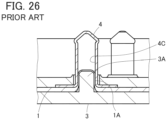
- JP 2018-129244 A discloses a connector as shown in FIG. 25 .
- This connector includes a housing 2 and a base member 3 that are separately disposed on opposite sides of a flexible substrate 1 to sandwich the flexible substrate 1.
- Tubular portions 4A of contacts 4 are passed through contact through-holes 2A of the housing 2, and flanges 4B of the contacts 4 are sandwiched between the housing 2 and conductors 1A exposed on the top surface of the flexible substrate 1.
- housing fixing posts 3B formed to project from the base member 3 are press-fitted into post accommodating portions 2B of the housing 2 as shown in FIG. 25 , so that the housing 2 and the base member 3 are fixed to each other.
- the wearable device When a wearable device is fitted with the connector disclosed in JP 2018-129244 A , the wearable device can be connected to an electrode formed of a conductor.
- DE 10 2012 003 865 A1 discloses a device with an arrangement for contacting between a flexible piece of material provided with at least one electrically conductive functional structure and a control unit operating the functional structure.
- the arrangement is alike a two-part male portion of a snap fastener, the flexible piece of material being squeezed between flanges of the two parts when the bottom part is riveted in the hollow of the top part.
- the present invention has been made to solve the foregoing problem and aims at providing a connector that enables to make an electrical connection of a contact to a conductor of a connection object regardless of whether the conductor is exposed on the top surface or the bottom surface of the connection object.
- a connector according to the present invention as defined in claim 1 comprises:
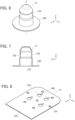
- FIG. 1 shows a connector 11 according to Embodiment 1.
- the connector 11 is, for instance, used as a garment-side connector for fitting a wearable device and has a housing 12 made of an insulating material.
- Four plug contacts 13 are retained in the housing 12, and a sheet type conductive member 15 is retained by the housing 12.
- the sheet type conductive member 15 constitutes a sheet type connection object to which the connector 11 is connected.
- the four plug contacts 13 are arranged in two rows parallel to each other and disposed to project perpendicularly to the sheet type conductive member 15.
- the sheet type conductive member 15 is defined as extending in an XY plane, the arrangement direction of the four plug contacts 13 is referred to as "Y direction,” and the direction in which the four plug contacts 13 project is referred to as "+Z direction.”
- the Z direction is a fitting direction in which the connector 11 is fitted to a counter connector.
- FIG. 2 shows an exploded perspective view of the connector 11.
- the connector 11 includes a top insulator 16 and a bottom insulator 17, and these top and bottom insulators 16 and 17 constitute the housing 12.
- the four plug contacts 13 are disposed on the -Z direction side of the top insulator 16, and the sheet type conductive member 15 is disposed on the -Z direction side of the four plug contacts 13. Further, four inner contacts 18 are disposed on the -Z direction side of the sheet type conductive member 15, and the bottom insulator 17 is disposed on the -Z direction side of the four inner contacts 18. The four inner contacts 18 separately correspond to the four plug contacts 13.
- the top insulator 16 includes a recessed portion 16A opening in the +Z direction, and four contact through-holes 16B formed within the recessed portion 16A.
- the recessed portion 16A constitutes a counter connector accommodating portion in which part of a counter connector (not shown) is to be accommodated, and the four contact through-holes 16B separately correspond to the four plug contacts 13.
- a plurality of bosses 16C are formed to project in the -Z direction.
- the bottom insulator 17 includes a flat plate portion 17A, and four contact arrangement regions 17B are defined on a top surface, facing in the +Z direction, of the flat plate portion 17A.
- the contact arrangement region 17B is a circular region for arranging the corresponding plug contact 13 via the sheet type conductive member 15.
- the four contact arrangement regions 17B are separately provided with four projections 17C projecting in the +Z direction from center parts of the contact arrangement regions 17B.
- the flat plate portion 17A is provided with a plurality of through-holes 17D separately corresponding to the plurality of bosses 16C of the top insulator 16.
- the projection 17C formed in the contact arrangement region 17B of the bottom insulator 17 has a substantially columnar shape extending in the Z direction along a fitting axis C of the plug contact 13 disposed to correspond to the contact arrangement region 17B, and an accommodating groove 17E for accommodating the corresponding inner contact 18 is formed at X-directional opposite lateral surfaces and a +Z directional end portion of the projection 17C.
- the accommodating groove 17E continuously extends in a top surface of the contact arrangement region 17B on the -X direction side of the projection 17C.
- the four plug contacts 13 are each made of a conductive material such as metal, and are to be connected to corresponding contacts of a counter connector (not shown) when part of the counter connector is accommodated in the recessed portion 16A of the top insulator 16.
- the plug contact 13 has a tubular portion 13A of cylindrical shape extending in the Z direction along the fitting axis C, and a flange 13B of flat plate shape extending from a -Z directional end portion of the tubular portion 13A along an XY plane.
- the tubular portion 13A constitutes an axially extending portion
- the flange 13B constitutes an orthogonally extending portion.
- the tubular portion 13A is provided in its interior with a recessed portion 13C opening in the -Z direction, and the recessed portion 13C is provided in its inside with a receiving portion 13D formed of a dent annularly extending in an XY plane along an inner surface of the recessed portion 13C.
- the fitting axis C is an axis passing the center of the tubular portion 13A and extending in the Z direction that is the fitting direction between the connector 11 and a counter connector.
- tubular portion 13A has a cylindrical shape
- the cross-sectional shape thereof is not limited to a circular shape
- the tubular portion 13A may have various cross-sectional shapes such as an elliptical shape and a polygonal shape as long as the tubular portion 13A is provided in its interior with the recessed portion 13C.
- All the four plug contacts 13 may be each used as a terminal for transmitting an electric signal.
- the sheet type conductive member 15 has a multilayer structure in which a plurality of wiring layers each formed from a conductor and a plurality of insulating layers are laminated.
- the sheet type conductive member 15 is provided with four circular opening portions 15A penetrating the sheet type conductive member 15 in the Z direction.
- the four opening portions 15A separately correspond to the four plug contacts 13.
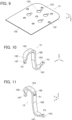
- a wiring layer 15B is exposed toward the +Z direction so as to be adjacent to the opening portions 15A on the -X direction side of the opening portions 15A, while an insulating layer 15C is exposed in a region other than the regions corresponding to the four opening portions 15A and the four parts of the wiring layer 15B adjacent to these opening portions 15A.
- the opening portions 15A penetrate the sheet type conductive member 15 in the Z direction, as shown in FIG. 9 , the four opening portions 15A can be seen also on a bottom surface, facing in the -Z direction, of the sheet type conductive member 15.
- a wiring layer 15D is exposed toward the -Z direction so as to be adjacent to the four opening portions 15A on the X direction side of the opening portions 15A, while an insulating layer 15E is exposed in a region other than the regions corresponding to the four opening portions 15A and the four parts of the wiring layer 15D adjacent to these opening portions 15A.
- a plurality of through-holes 15F separately corresponding to the plurality of bosses 16C of the top insulator 16 are formed at a peripheral portion of the sheet type conductive member 15.
- the inner contact 18 is formed of a single band type metal sheet having conductivity and being bent, and has a crossing portion 18A extending in the X direction.
- a first extending portion 18B extends in the -Z direction from a -X directional end portion of the crossing portion 18A
- an arm portion 18C extends in the -X direction from a -Z directional end portion of the first extending portion 18B
- a second extending portion 18D extends in the -Z direction from a +X directional end portion of the crossing portion 18A.
- the crossing portion 18A, the first extending portion 18B, and the second extending portion 18D are inserted into the recessed portion 13C of the corresponding plug contact 13 when the connector 11 is assembled.
- a hook portion 18E projecting in the -X direction is formed at a joint portion between the crossing portion 18A and the first extending portion 18B.
- the hook portion 18E projects in a right angle shape or a chevron shape toward the -X direction, and a first contacting portion P1 facing in the -Z direction is set at a -X directional end portion of the hook portion 18E.
- a curved portion 18F that is curved to protrude in the +X direction is formed at a -Z directional end portion of the second extending portion 18D, and a second contacting portion P2 facing in the +X direction is set on a +X directional surface of the curved portion 18F.
- a curved portion 18G that is curved to protrude toward the +Z direction is formed at a -X directional end portion of the arm portion 18C, and a third contacting portion P3 facing in the +Z direction is set on a +Z directional surface of the curved portion 18G.
- a distance L11 in the X direction from the first contacting portion P1 to the second contacting portion P2 is set to be larger than a distance L21 in the X direction from the receiving portion 13D of the plug contact 13 to a part of an inner surface of the recessed portion 13C which part faces the receiving portion 13D.
- a distance L12 in the Z direction from the first contacting portion P1 to the third contacting portion P3 is set to be smaller than a distance L22 in the Z direction from the receiving portion 13D of the plug contact 13 to the bottom surface of the sheet type conductive member 15 disposed on the -Z direction side of the flange 13B.
- the inner contact 18 elastically deforms as shown by a dashed line in FIG. 12 , the second contacting portion P2 makes contact with the inner surface of the recessed portion 13C of the plug contact 13, and the third contacting portion P3 makes contact with the bottom surface of the sheet type conductive member 15.
- the inner contact 18 configured as above can be easily produced by, for example, cutting out a metal sheet into a predetermined shape and then bending the cut metal sheet.
- the four contact through-holes 16B of the top insulator 16, the four plug contacts 13, the four opening portions 15A of the sheet type conductive member 15, the four inner contacts 18, and the four contact arrangement regions 17B of the bottom insulator 17 are arranged so as to align with each other in the Z direction.
- bosses 16C of the top insulator 16, the through-holes 15F of the sheet type conductive member 15, and the through-holes 17D of the bottom insulator 17 are arranged so as to align with each other in the Z direction.
- the four inner contacts 18 are separately accommodated in the accommodating grooves 17E of the four projections 17C of the bottom insulator 17.
- tubular portions 13A of the plug contacts 13 are inserted into the four contact through-holes 16B of the top insulator 16 correspondingly from the -Z direction, and the bottom insulator 17 is pressed toward the top insulator 16 in the +Z direction with the sheet type conductive member 15 being sandwiched therebetween.
- the inner contact 18 accommodated in the accommodating groove 17E of the projection 17C of the bottom insulator 17 is pushed up in the +Z direction, and the crossing portion 18A, the first extending portion 18B, and the second extending portion 18D of the inner contact 18 are inserted into the recessed portion 13C of the corresponding plug contact 13 through the opening portion 15B of the sheet type conductive member 15.
- the flange 13B of the plug contact 13 is situated around the corresponding opening portion 15B of the sheet type conductive member 15, and the sheet type conductive member 15 is sandwiched between the +Z directional surface of the curved portion 18G formed at the -X directional end portion of the arm portion 18C of the inner contact 18 and a bottom surface on the -Z direction side of the flange 13B of the plug contact 13.
- the bosses 16C of the top insulator 16 sequentially penetrate the through-holes 15F of the sheet type conductive member 15, and the through-holes 17D of the bottom insulator 17. Thereafter, as shown in FIG. 13 , the top insulator 16 and the bottom insulator 17 are fixed to each other through heat deformation of a tip of each of the plurality of bosses 16C projecting on the -Z direction side of the bottom insulator 17. Thus, the assembling operation of the connector 11 is completed.
- the inner contact 18 when the inner contact 18 is pushed up in the +Z direction by the projection 17C of the bottom insulator 17, the inner contact 18 elastically deforms, the crossing portion 18A, the first extending portion 18B, and the second extending portion 18D move in the +Z direction within the recessed portion 13C of the plug contact 13, and the hook portion 18E is received by the receiving portion 13D formed inside the recessed portion 13C of the plug contact 13.
- the distance L11 in the X direction from the first contacting portion P1 to the second contacting portion P2 is set to be larger than the distance L21 in the X direction from the receiving portion 13D of the plug contact 13 to a part of the inner surface of the recessed portion 13C which part faces the receiving portion 13D.
- first contacting portion P1 is pressed against the receiving portion 13D within the recessed portion 13C of the plug contact 13, while the second contacting portion P2 is pressed against the inner surface of the recessed portion 13C of the plug contact 13 on the opposite side from the first contacting portion P1 across the fitting axis C.
- first and second contacting portions P1 and P2 are pressed against and makes contact with the inner surface of the recessed portion 13C of the plug contact 13, whereby the inner contact 18 is electrically connected to the plug contact 13.
- the distance L12 in the Z direction from the first contacting portion P1 to the third contacting portion P3 is set to be smaller than the distance L22 in the Z direction from the receiving portion 13D of the plug contact 13 to the bottom surface of the sheet type conductive member 15 disposed on the -Z direction side of the flange 13B.
- the third contacting portion P3 is elastically displaced in the -Z direction and makes contact with the bottom surface of the sheet type conductive member 15 disposed on the -Z direction side of the flange 13B of the plug contact 13. Therefore, the top surface on the +Z direction side of the sheet type conductive member 15 is pressed against the bottom surface of the flange 13B of the plug contact 13, while the bottom surface on the -Z direction side of the sheet type conductive member 15 is pressed against the third contacting portion P3 of the inner contact 18.
- the wiring layer 15B is exposed so as to be adjacent to the opening portions 15A on the -X direction side of the opening portions 15A
- the wiring layer 15D is exposed so as to be adjacent to the opening portions 15A on the -X direction side of the opening portions 15A.
- the wiring layer 15B on the top surface of the sheet type conductive member 15 makes contact with the bottom surface of the flange 13B of the plug contact 13 with predetermined contact pressure, while the wiring layer 15D on the bottom surface of the sheet type conductive member 15 makes contact with the third contacting portion P3 of the inner contact 18 with predetermined contact pressure.
- the wiring layer 15B exposed on the top surface of the sheet type conductive member 15 is electrically connected to the plug contact 13 directly, and the wiring layer 15D exposed on the bottom surface of the sheet type conductive member 15 is electrically connected to the plug contact 13 via the inner contact 18. In other words, both the wiring layers 15B and 15D are connected to the plug contact 13.
- both the wiring layer 15B and the wiring layer 15D formed of the conductors disposed on the top surface side and the bottom surface side of the sheet type conductive member 15 can be electrically connected to a single plug contact 13 by use of the inner contact 18.
- the plug contact 13 can be electrically connected to the conductor on the top surface side of the sheet type conductive member.
- the plug contact 13 can be electrically connected to the conductor on the bottom surface side of the sheet type conductive member.
- the plug contact 13 can be electrically connected to both the conductors on the top surface side and the bottom surface side of the sheet type conductive member.
- a connection object is a sheet type conductive member having a multilayer structure in which conductors constituting shield layers are separately exposed on the top surface side and the bottom surface side and a conductor constituting a signal wiring layer is disposed between these shield layers so as to be insulated from both the shield layers
- a shield effect with respect to the signal wiring layer is exhibited when the plug contact 13 connected to the shield layers on the top surface side and the bottom surface side is connected to a ground potential, and it is possible to carry out highly accurate signal transmission with reduced influence of external disturbances caused by, for example, electromagnetic waves.
- each of the plug contacts 13 is sandwiched between the top insulator 16 and the bottom insulator 17, so that the plug contacts 13 are fixed to the top insulator 16 and the bottom insulator 17.
- the first contacting portion P1 and the second contacting portion P2 of the inner contact 18 are elastically displaced such that the gap therebetween in the X direction is narrowed, and make contact with the inner surface of the recessed portion 13C of the plug contact 13, and the third contacting portion P3 is elastically displaced in the -Z direction and makes contact with the bottom surface of the sheet type conductive member 15; therefore, as shown in FIG.
- the inner contact 18 is retained by the plug contact 13 in the state where: the first contacting portion P1 receives a force F1 acting in the +X direction and the +Z direction from the receiving portion 13D of the recessed portion 13C of the plug contact 13; the second contacting portion P2 receives a force F2 acting in the -X direction from the inner surface of the recessed portion 13C of the plug contact 13; and the third contacting portion P3 receives a force F3 acting in the -Z direction from the bottom surface of the sheet type conductive member 15.
- F1, F2, F3, F1X, and F1Z are all represented by absolute values.
- a tangential plane formed by the hook portion 18E and the receiving portion 13D contacting each other in the case where the receiving portion 13D of the plug contact 13 receives the hook portion 18E of the inner contact 18 is assumed to be T, and a normal line perpendicular to the tangential plane T is assumed to be N. If a frictional force exerted between the inner contact 18 and the plug contact 13 is ignored, the force F1 along the normal line N is applied from the receiving portion 13D of the plug contact 13 to the first contacting portion P1 set at the -X directional end portion of the hook portion 18E.
- a ratio of the Z directional component force F1Z to the X directional component force F1X of the force F1 is equal to an inclination S of the normal line N.
- the inner contact 18 is supported at three points by the plug contact 13 by means of the first contacting portion P1, the second contacting portion P2, and the third contacting portion P3 in the state where the forces F1, F2, and F3 applied to the inner contact 18 balance and the moments balance.
- the force F3 acting in the -Z direction to be applied to the third contacting portion P3 becomes small, and accordingly, the Z directional component force F1Z of the force F1 is also reduced.
- the ratio (F1Z/F1X) becomes smaller than the inclination S of the normal line N.
- the force F3 acting in the -Z direction to be applied to the third contacting portion P3 becomes large, and accordingly, the Z directional component force F1Z of the force F1 also increases.
- the ratio (F1Z/F1X) becomes larger than the inclination S of the normal line N.
- the force F1 along the normal line N is applied, as a perpendicular reaction force from the tangential plane T, to the first contacting portion P1, and a force acting in the -Z direction, which corresponds to the increase in the Z directional component force F1Z of the force F1 is applied to the first contacting portion P1.
- the inner contact 18 easily falls off the plug contact 13 in the -Z direction.
- the ratio LZ/LX of the distance LZ in the Z direction between the first contacting portion P1 and the second contacting portion P2 to the distance LX in the X direction between the first contacting portion P1 and the third contacting portion P3 is preferably not more than the inclination S with respect to the X direction of the normal line N perpendicular to the tangential plane T formed by the hook portion 18E and the receiving portion 13D contacting each other in the case where the receiving portion 13D receives the hook portion 18E.
- the inner contact 18 can be stably supported by the plug contact 13 by setting the ratio LZ/LX to be not more than the inclination S of the normal line N.
- the invention is not limited thereto, and a plug contact having no receiving portion 13D may be used by utilizing a static frictional force.
- FIG. 16 shows a plug contact 23 used in a connector 21 according to Embodiment 2.
- the plug contact 23 is made of a conductive material such as metal and has a tubular portion 23A of cylindrical shape and extending in the Z direction along the fitting axis C, and a flange 23B extending from a -Z directional end portion of the tubular portion 23A along an XY plane.
- the tubular portion 23A is provided in its interior with a recessed portion 23C opening in the -Z direction, but the receiving portion formed of the dent included in the plug contact 13 in Embodiment 1 is not formed inside the recessed portion 23C.
- FIG. 18 shows the connector 21 of Embodiment 2 connected to the sheet type conductive member 15.
- the connector 21 is configured to use the plug contact 23 in place of the plug contact 13 in the connector 11 of Embodiment 1 shown in FIG. 14 , and the other members are the same as those of the connector 11 of Embodiment 1.
- the crossing portion 18A, the first extending portion 18B, and the second extending portion 18D of the inner contact 18 are inserted into the recessed portion 23C of the plug contact 23
- the first contacting portion P1 and the second contacting portion P2 are elastically displaced such that the gap therebetween in the X direction is narrowed.
- a force F1 acting in the +X direction from an inner surface of the recessed portion 23C of the plug contact 23 is applied to the first contacting portion P1
- a force F2 acting in the -X direction from the inner surface of the recessed portion 23C of the plug contact 23 is applied to the second contacting portion P2.
- the third contacting portion P3 set at the tip of the arm portion 18C makes contact with the bottom surface of the sheet type conductive member 15 disposed on the -Z direction side of the flange 23B of the plug contact 23 and is elastically displaced in the -Z direction, and a force F3 acting in the -Z direction from the bottom surface of the sheet type conductive member 15 is applied to the third contacting portion P3.
- This force F3 is directed to -Z direction, so that falling off of the inner contact 18 from the plug contact 23 is promoted; however, since the first contacting portion P1 and the second contacting portion P2 make contact with the inner surface of the recessed portion 23C of the plug contact 23 and receive the forces F1 and F2 in the X direction, static frictional forces F1A and F2A acting in the +Z direction are exerted on the first contacting portion P1 and the second contacting portion P2, respectively.
- F1, F2, F3, F1A, and F2A are all represented by absolute values.
- the inner contact 18 can be stably supported at three points by the plug contact 23 without falling off the plug contact 23 in the -Z direction.
- the first contacting portion P1 and the second contacting portion P2 make contact with the inner surface of the recessed portion 23C of the plug contact 23, and the third contacting portion P3 makes contact with the bottom surface of the sheet type conductive member 15, so that both the wiring layer 15B and the wiring layer 15D respectively disposed on the top surface side and the bottom surface side of the sheet type conductive member 15 can be electrically connected to a single plug contact 23.
- plug contact 13, 23 has the tubular portion 13A, 23A of cylindrical shape in Embodiments 1 and 2 above, the invention is not limited thereto, and a plug contact having no tubular portion may also be used.
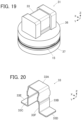
- FIG. 19 shows a partial perspective view of a connector 31 according to Embodiment 3.
- the connector 31 includes a top insulator 36 and a bottom insulator 37 separately disposed on opposite sides in the Z direction of the sheet type conductive member 15 with the sheet type conductive member 15 being sandwiched therebetween, and a plug contact 33 is retained by the top insulator 36.
- the plug contact 33 is formed of a bent plate-like member made of a conductive material such as metal and includes a top plate portion 33A of flat plate shape extending along an XY plane.
- Axially extending portions 33B and 33C extending in the -Z direction along a YZ plane are respectively joined to a -X directional end portion and a +X directional end portion of the top plate portion 33A, an orthogonally extending portion 33D extending in the -X direction along an XY plane is joined to a -Z directional end portion of the axially extending portion 33B, and an orthogonally extending portion 33E extending in the +X direction along an XY plane is joined to a -Z directional end portion of the axially extending portion 33C.
- the axially extending portions 33B and 33C face each other in the X direction, and a recessed portion 33F is formed between the axially extending portions 33B and 33C.
- This plug contact 33 may be retained by the top insulator 36 by, for example, press-fitting.
- the plug contact 33 retained by the top insulator 36 is disposed such that the recessed portion 33F opens in the -Z direction, and the inner contact 18 retained by the bottom insulator 37 is pushed in the +Z direction through the opening portion 15A of the sheet type conductive member 15 with the sheet type conductive member 15 being disposed between the top insulator 36 and the bottom insulator 37, whereby the crossing portion 18A, the first extending portion 18B, and the second extending portion 18D of the inner contact 18 are inserted into the recessed portion 33F of the plug contact 33.
- the inner contact 18 is the same as the inner contact 18 used in Embodiments 1 and 2 above.
- the first contacting portion P1 and the second contacting portion P2 of the inner contact 18 respectively make contact with the axially extending portions 33B and 33C of the plug contact 33, whereby the inner contact 18 is electrically connected to the plug contact 33, and the third contacting portion P3 is elastically displaced in the -Z direction and makes contact with the bottom surface of the sheet type conductive member 15 disposed on the -Z direction side of the orthogonally extending portion 33D of the plug contact 33.
- the wiring layer 15B exposed on the top surface of the sheet type conductive member 15 is electrically connected to the plug contact 33 directly, and the wiring layer 15D exposed on the bottom surface of the sheet type conductive member 15 is electrically connected to the plug contact 33 via the inner contact 18. That is, both the wiring layer 15B and the wiring layer 15D disposed on the top surface side and the bottom surface side of the sheet type conductive member 15 can be electrically connected to the single plug contact 33.
- first contacting portion P1 and the second contacting portion P2 of the inner contact 18 respectively make contact with the axially extending portions 33B and 33C of the plug contact 33
- third contacting portion P3 makes contact with the bottom surface of the sheet type conductive member 15, whereby the inner contact 18 is supported at three points by the plug contact 33 as with Embodiment 2 above.
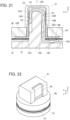
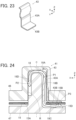
- FIG. 22 shows a partial perspective view of a connector 41 according to Embodiment 4.
- the connector 41 includes a top insulator 46 and a bottom insulator 47 separately disposed on opposite sides in the Z direction of the sheet type conductive member 15 with the sheet type conductive member 15 being sandwiched therebetween, and a plug contact 43 is retained by the top insulator 46.
- the plug contact 43 is formed of a bent plate-like member made of a conductive material such as metal and includes an axially extending portion 43A extending along a YZ plane, and an orthogonally extending portion 43B bent at a - Z directional end portion of the axially extending portion 43A and extending in the -Z direction along an XY plane.
- This plug contact 43 may be retained by the top insulator 46 by, for example, press-fitting.
- the top insulator 46 which retains the plug contact 43 has a dent facing a +X directional surface of the axially extending portion 43A of the plug contact 43, and the dent of the top insulator 46 and the axially extending portion 43A of the plug contact 43 form a recessed portion R opening in the -Z direction.
- the inner contact 18 retained by the bottom insulator 47 is pushed in the +Z direction through the opening portion 15A of the sheet type conductive member 15 with the sheet type conductive member 15 being disposed between the top insulator 46 and the bottom insulator 47, whereby the crossing portion 18A, the first extending portion 18B, and the second extending portion 18D of the inner contact 18 are inserted into the recessed portion R.
- the first contacting portion P1 of the inner contact 18 makes contact with the +X directional surface of the axially extending portion 43A of the plug contact 43, whereby the inner contact 18 is electrically connected to the plug contact 43, and the third contacting portion P3 is elastically displaced in the -Z direction and makes contact with the bottom surface of the sheet type conductive member 15 disposed on the -Z direction side of the orthogonally extending portion 43B of the plug contact 43.
- the wiring layer 15B exposed on the top surface of the sheet type conductive member 15 is electrically connected to the plug contact 43 directly, and the wiring layer 15D exposed on the bottom surface of the sheet type conductive member 15 is electrically connected to the plug contact 43 via the inner contact 18. That is, both the wiring layer 15B and the wiring layer 15D disposed on the top surface side and the bottom surface side of the sheet type conductive member 15 can be electrically connected to a single plug contact 43.
- first contacting portion P1 of the inner contact 18 makes contact with the axially extending portion 43A of the plug contact 43
- the second contacting portion P2 makes contact with the surface of the dent of the top insulator 46 which dent forms part of the recessed portion R
- the third contacting portion P3 makes contact with the bottom surface of the sheet type conductive member 15, whereby the inner contact 18 is supported with respect to the plug contact 43.
- the plug contact 33, 34 in Embodiments 3 and 4 above does not have any receiving portion formed of a dent, as with the plug contact 13 in Embodiment 1, the axially extending portion 33B of the plug contact 33 or the axially extending portion 43A of the plug contact 43 may be provided with a receiving portion formed of a dent so that the receiving portion receives the hook portion 18E of the inner contact 18.
- plug contact 13, 23, 33, 43 is connected to both the wiring layer 15B and the wiring layer 15D respectively exposed on the top surface side and the bottom surface side of the sheet type conductive member 15 in Embodiments 1 to 4 above, only the wiring layer 15D exposed on the bottom surface side of the sheet type conductive member 15 may be connected to the plug contact 13, 23, 33, 43, for instance.
- the sheet type conductive member 15 used in Embodiments 1 to 4 above has a multilayer structure, the invention is not limited thereto, and it suffices if the sheet type conductive member has a conductor exposed on at least one surface thereof.
- the two layers of the conductors i.e., the wiring layer 15B and the wiring layer 15D of a sheet type conductive member 15, are connected to a single plug contact 13, 23, 33, 43 in Embodiments 1 to 4 above, the invention is not limited thereto, and three or more layers of conductors may be connected to a single plug contact 13, 23, 33, 43.
- the connector 11 according to Embodiment 1 above has the four plug contacts 13, the invention is not limited to this number of the plug contacts 13, and it suffices if the connector includes at least a single plug contact 13 to be electrically connected to a conductor exposed on at least one surface of the sheet type conductive member 15.
- the connector 21, 31, 41 according to Embodiments 2 to 4 above may have four plug contacts 23, 33, 43.
Landscapes
- Coupling Device And Connection With Printed Circuit (AREA)
Claims (12)
- Verbinder, umfassend:einen Steckkontakt (13, 23, 33, 43), der Leitfähigkeit besitzt und einen sich axial erstreckenden Abschnitt (13A, 23A, 33B, 33C, 43A) aufweist, der mindestens einen Teil einer Innenfläche eines zurückgesetzten Abschnitts (13C, 23C, 33F, R) bildet, der sich entlang einer Montageachse (C) erstreckt, und einen sich orthogonal erstreckenden Abschnitt (13B, 23B, 33D, 33E, 43B) aufweist, der mit dem sich axial erstreckenden Abschnitt verbunden ist und sich von einem Basisende des zurückgesetzten Abschnitts in einer Richtung orthogonal zu der Montageachse erstreckt; undeinen inneren Kontakt (18), der Leitfähigkeit besitzt und elastisch verformbar ist und in einem Zustand gestützt ist, in dem er teilweise in den zurückgesetzten Abschnitt eingeführt ist,wobei der innere Kontakt aufweist: einen ersten Kontaktierungsabschnitt (P1), der mit der Innenfläche des zurückgesetzten Abschnitts, der von dem sich axial erstreckenden Abschnitt gebildet ist, Kontakt herstellt und elektrisch mit dem Steckkontakt verbunden ist; einen zweiten Kontaktierungsabschnitt (P2), der mit der Innenfläche des zurückgesetzten Abschnitts an einer dem ersten Kontaktierungsabschnitt gegenüberliegenden Seite quer zu der Montageachse an einer Position, die näher an dem Basisende des zurückgesetzten Abschnitts liegt als der erste Kontaktierungsabschnitt, Kontakt herstellt; und einen dritten Kontaktierungsabschnitt (P3), der sich in einer Richtung orthogonal zu der Montageachse erstreckt und dem sich orthogonal erstreckenden Abschnitt zugewandt ist,wobei ein Teil eines Verbindungsobjekts (15) von einer Flachmaterialform, der einen Leiter (15B, 15D) aufweist, der an mindestens einer Fläche des Verbindungsobjekts frei liegt, in einer Richtung entlang der Montageachse zwischen einer Unterseite des sich orthogonal erstreckenden Abschnitts des Steckkontakts und dem dritten Kontaktierungsabschnitt des inneren Kontakts sandwichartig aufgenommen ist, wobei die Unterseite des sich orthogonal erstreckenden Abschnitts mit einer Oberseite des Verbindungsobjekts Kontakt herstellt, und der dritte Kontaktierungsabschnitt mit einer Unterseite des Verbindungsobjekts Kontakt herstellt, wodurch der Steckkontakt (13, 23, 33, 43) direkt mit dem Leiter (15B) elektrisch verbunden ist, wenn der Leiter an der Oberseite des Verbindungsobjekts frei liegt, und der Steckkontakt (13, 23, 33, 43) über den inneren Kontakt (18) elektrisch mit dem Leiter (15D) verbunden ist, wenn der Leiter an der Unterseite des Verbindungsobjekts frei liegt.
- Verbinder nach Anspruch 1, wobei der innere Kontakt (18) aus einem einzelnen bandartigen Metallblech gebildet ist, das gebogen ist, der zweite Kontaktierungsabschnitt (P2) an einem Ende des bandartigen Metallblechs angeordnet ist, der dritte Kontaktierungsabschnitt (P3) an einem anderen Ende des bandartigen Metallblechs angeordnet ist und der erste Kontaktierungsabschnitt (P1) zwischen dem einen Ende und dem anderen Ende des bandartigen Metallblechs angeordnet ist.
- Verbinder nach Anspruch 2,
wobei der innere Kontakt (18) aufweist:einen Kreuzungsabschnitt (18A), der sich quer zu der Montageachse in einer Richtung orthogonal zu der Montageachse (C) erstreckt;einen ersten Erstreckungsabschnitt (18B), der sich entlang der Montageachse von einem Ende des Kreuzungsabschnitts in Richtung des Basisendes des zurückgesetzten Abschnitts erstreckt;einen Armabschnitt (18C), der sich von einer Spitze des ersten Erstreckungsabschnitts in einer Richtung orthogonal zu der Montageachse erstreckt; undeinen zweiten Erstreckungsabschnitt (18D), der sich entlang der Montageachse von einem anderen Ende des Kreuzungsabschnitts in Richtung des Basisendes des zurückgesetzten Abschnitts erstreckt,wobei der erste Kontaktierungsabschnitt (P1) an einem Verbindungsabschnitt zwischen dem Kreuzungsabschnitt und dem ersten Erstreckungsabschnitt angeordnet ist,wobei der zweite Kontaktierungsabschnitt (P2) an einer Spitze des zweiten Erstreckungsabschnitts angeordnet ist undwobei der dritte Kontaktierungsabschnitt (P3) an einer Spitze des Armabschnitts angeordnet ist. - Verbinder nach einem der Ansprüche 1 bis 3, wobei der innere Kontakt (18) an drei Punkten durch den Steckkontakt (13, 23, 33) mittels des ersten Kontaktierungsabschnitts (P1), des zweiten Kontaktierungsabschnitts (P2) und des dritten Kontaktierungsabschnitts (P3) gestützt ist.
- Verbinder nach einem der Ansprüche 1 bis 4,wobei der innere Kontakt (18) einen Hakenabschnitt (18E) aufweist, der in einer Richtung orthogonal zu der Montageachse vorsteht, wobei der erste Kontaktierungsabschnitt an einer Spitze des Hakenabschnitts angeordnet ist, undwobei der Steckkontakt (13) einen Aufnahmeabschnitt (13D) aufweist, der innerhalb des zurückgesetzten Abschnitts ausgebildet ist und den Hakenabschnitt aufnimmt.
- Verbinder nach Anspruch 5, wobei ein Verhältnis LZ/LX einer Distanz LZ in einer Richtung entlang der Montageachse zwischen dem ersten Kontaktierungsabschnitt (P1) und dem zweiten Kontaktierungsabschnitt (P2) zu einer Distanz LX in einer Richtung orthogonal zu der Montageachse zwischen dem ersten Kontaktierungsabschnitt (P1) und dem dritten Kontaktierungsabschnitt (P3) nicht größer ist als eine Neigung S einer Normalen in Bezug auf eine Richtung orthogonal zu der Montageachse, wobei die Normale senkrecht zu einer Tangentialebene verläuft, die von dem Hakenabschnitt (18E) und dem Aufnahmeabschnitt (13D) gebildet ist, die einander in einem Fall kontaktieren, in dem der Aufnahmeabschnitt den Hakenabschnitt aufnimmt.
- Verbinder nach einem der Ansprüche 1 bis 6, umfassend einen unteren Isolator (17, 37, 47), der einen Vorsprung (17C) aufweist, der in den zurückgesetzten Abschnitt (13C, 23C, 33F, R) eingeführt ist,
wobei der Vorsprung (17C) eine Aufnahmenut (17E) aufweist, um den inneren Kontakt (18) aufzunehmen. - Verbinder nach einem der Ansprüche 1 bis 7,wobei der Steckkontakt (13, 23) einen röhrenförmigen Abschnitt (13A, 23A) aufweist, der sich entlang der Montageachse erstreckt und in seinem Inneren mit dem zurückgesetzten Abschnitt versehen ist, und einen Flansch (13B, 23B) aufweist, der sich von einem Basisende des röhrenförmigen Abschnitts in einer Richtung orthogonal zu der Montageachse erstreckt,wobei der sich axial erstreckende Abschnitt von dem röhrenförmigen Abschnitt gebildet ist, und wobei der sich orthogonal erstreckende Abschnitt von dem Flansch gebildet ist.
- Verbinder nach Anspruch 8, umfassend einen oberen Isolator (16), der mit einem Kontaktdurchgangsloch (16B) versehen ist, in das der röhrenförmige Abschnitt (13A, 23A) des Steckkontakts eindringt und das kleiner als der Flansch (13B, 23B) ist.
- Verbinder nach einem der Ansprüche 1 bis 4, wobei der Steckkontakt (33, 43) aus einem plattenartigen Element, das gebogen ist, gebildet ist.
- Verbinder nach Anspruch 10,wobei der Steckkontakt (33) ein Paar der sich axial erstreckenden Abschnitte (33B, 33C) aufweist, die einander quer zu der Montageachse in einer Richtung orthogonal zu der Montageachse zugewandt sind,wobei der zurückgesetzte Abschnitt (33F) zwischen dem Paar der sich axial erstreckenden Abschnitte ausgebildet ist, wobei der erste Kontaktierungsabschnitt (P1) mit einem des Paares der sich axial erstreckenden Abschnitte Kontakt herstellt undwobei der zweite Kontaktierungsabschnitt (P2) mit einem anderen des Paares der sich axial erstreckenden Abschnitte Kontakt herstellt.
- Verbinder nach Anspruch 10, umfassend einen oberen Isolator (46), der den Steckkontakt (43) hält,wobei der zurückgesetzte Abschnitt (R) aus dem sich axial erstreckenden Abschnitt (43A) des Steckkontakts und dem oberen Isolator gebildet ist, undwobei der zweite Kontaktierungsabschnitt (P2) mit dem oberen Isolator (46), der einen Teil des zurückgesetzten Abschnitts bildet, Kontakt herstellt.
Applications Claiming Priority (1)
| Application Number | Priority Date | Filing Date | Title |
|---|---|---|---|
| JP2022187363A JP2024076024A (ja) | 2022-11-24 | 2022-11-24 | コネクタ |
Publications (2)
| Publication Number | Publication Date |
|---|---|
| EP4376225A1 EP4376225A1 (de) | 2024-05-29 |
| EP4376225B1 true EP4376225B1 (de) | 2025-01-22 |
Family
ID=88309164
Family Applications (1)
| Application Number | Title | Priority Date | Filing Date |
|---|---|---|---|
| EP23202645.0A Active EP4376225B1 (de) | 2022-11-24 | 2023-10-10 | Verbinder |
Country Status (4)
| Country | Link |
|---|---|
| US (1) | US12537336B2 (de) |
| EP (1) | EP4376225B1 (de) |
| JP (1) | JP2024076024A (de) |
| CN (1) | CN118073878A (de) |
Family Cites Families (6)
| Publication number | Priority date | Publication date | Assignee | Title |
|---|---|---|---|---|
| DE102012003865A1 (de) * | 2012-02-22 | 2013-08-22 | Technische Universität Dresden | Einrichtung mit Anordnung zur Kontaktierung zwischen einem mit zumindest einer elektrisch leitfähigen Funktionsstruktur versehenen biegeweichen Materialstück und einem die Funktionsstruktur betreibenden Steuergerät |
| US9577374B1 (en) * | 2015-10-23 | 2017-02-21 | Te Connectivity Corporation | Textile connector for an electronic textile having a snap fastener with contacts |
| JP6840559B2 (ja) | 2017-02-10 | 2021-03-10 | 日本航空電子工業株式会社 | コネクタ |
| JP7178956B2 (ja) * | 2019-05-17 | 2022-11-28 | 日本航空電子工業株式会社 | 接続方法、接続構造および接続端子組立体 |
| JP7313990B2 (ja) * | 2019-09-09 | 2023-07-25 | 日本航空電子工業株式会社 | コネクタおよび接続方法 |
| JP7348024B2 (ja) * | 2019-10-24 | 2023-09-20 | 日本航空電子工業株式会社 | コネクタおよび接続方法 |
-
2022
- 2022-11-24 JP JP2022187363A patent/JP2024076024A/ja active Pending
-
2023
- 2023-10-09 CN CN202311301211.4A patent/CN118073878A/zh active Pending
- 2023-10-10 EP EP23202645.0A patent/EP4376225B1/de active Active
- 2023-10-11 US US18/484,633 patent/US12537336B2/en active Active
Also Published As
| Publication number | Publication date |
|---|---|
| JP2024076024A (ja) | 2024-06-05 |
| US20240178604A1 (en) | 2024-05-30 |
| US12537336B2 (en) | 2026-01-27 |
| CN118073878A (zh) | 2024-05-24 |
| EP4376225A1 (de) | 2024-05-29 |
Similar Documents
| Publication | Publication Date | Title |
|---|---|---|
| EP3800739B1 (de) | Verbinder und verbindungsverfahren | |
| EP4346017B1 (de) | Verbinder | |
| US12424774B2 (en) | Connector | |
| CN117638541A (zh) | 连接器 | |
| EP4300713A1 (de) | Blattartiges leitfähiges element und verbinder | |
| EP4462605B1 (de) | Verbinder | |
| EP4376225B1 (de) | Verbinder | |
| EP4395079B1 (de) | Verbinder und verbindungsverfahren | |
| EP4318813A1 (de) | Verbinder | |
| EP4507128B1 (de) | Verbinder und verbinderanordnung | |
| CN117638542A (zh) | 连接器和连接器组装体 | |
| EP4611180A1 (de) | Verbinder | |
| EP4333216A1 (de) | Verbinder |
Legal Events
| Date | Code | Title | Description |
|---|---|---|---|
| PUAI | Public reference made under article 153(3) epc to a published international application that has entered the european phase |
Free format text: ORIGINAL CODE: 0009012 |
|
| STAA | Information on the status of an ep patent application or granted ep patent |
Free format text: STATUS: REQUEST FOR EXAMINATION WAS MADE |
|
| 17P | Request for examination filed |
Effective date: 20231010 |
|
| AK | Designated contracting states |
Kind code of ref document: A1 Designated state(s): AL AT BE BG CH CY CZ DE DK EE ES FI FR GB GR HR HU IE IS IT LI LT LU LV MC ME MK MT NL NO PL PT RO RS SE SI SK SM TR |
|
| RBV | Designated contracting states (corrected) |
Designated state(s): AL AT BE BG CH CY CZ DE DK EE ES FI FR GB GR HR HU IE IS IT LI LT LU LV MC ME MK MT NL NO PL PT RO RS SE SI SK SM TR |
|
| GRAP | Despatch of communication of intention to grant a patent |
Free format text: ORIGINAL CODE: EPIDOSNIGR1 |
|
| STAA | Information on the status of an ep patent application or granted ep patent |
Free format text: STATUS: GRANT OF PATENT IS INTENDED |
|
| RIC1 | Information provided on ipc code assigned before grant |
Ipc: H01R 12/77 20110101ALI20240913BHEP Ipc: H01R 12/69 20110101ALI20240913BHEP Ipc: H01R 12/59 20110101AFI20240913BHEP |
|
| INTG | Intention to grant announced |
Effective date: 20240927 |
|
| RAP3 | Party data changed (applicant data changed or rights of an application transferred) |
Owner name: JAPAN AVIATION ELECTRONICS INDUSTRY, LIMITED |
|
| GRAS | Grant fee paid |
Free format text: ORIGINAL CODE: EPIDOSNIGR3 |
|
| GRAA | (expected) grant |
Free format text: ORIGINAL CODE: 0009210 |
|
| STAA | Information on the status of an ep patent application or granted ep patent |
Free format text: STATUS: THE PATENT HAS BEEN GRANTED |
|
| AK | Designated contracting states |
Kind code of ref document: B1 Designated state(s): AL AT BE BG CH CY CZ DE DK EE ES FI FR GB GR HR HU IE IS IT LI LT LU LV MC ME MK MT NL NO PL PT RO RS SE SI SK SM TR |
|
| REG | Reference to a national code |
Ref country code: GB Ref legal event code: FG4D |
|
| REG | Reference to a national code |
Ref country code: CH Ref legal event code: EP |
|
| REG | Reference to a national code |
Ref country code: IE Ref legal event code: FG4D |
|
| REG | Reference to a national code |
Ref country code: DE Ref legal event code: R096 Ref document number: 602023001770 Country of ref document: DE |
|
| REG | Reference to a national code |
Ref country code: NL Ref legal event code: MP Effective date: 20250122 |
|
| PG25 | Lapsed in a contracting state [announced via postgrant information from national office to epo] |
Ref country code: NL Free format text: LAPSE BECAUSE OF FAILURE TO SUBMIT A TRANSLATION OF THE DESCRIPTION OR TO PAY THE FEE WITHIN THE PRESCRIBED TIME-LIMIT Effective date: 20250122 |
|
| PG25 | Lapsed in a contracting state [announced via postgrant information from national office to epo] |
Ref country code: RS Free format text: LAPSE BECAUSE OF FAILURE TO SUBMIT A TRANSLATION OF THE DESCRIPTION OR TO PAY THE FEE WITHIN THE PRESCRIBED TIME-LIMIT Effective date: 20250422 |
|
| PG25 | Lapsed in a contracting state [announced via postgrant information from national office to epo] |
Ref country code: FI Free format text: LAPSE BECAUSE OF FAILURE TO SUBMIT A TRANSLATION OF THE DESCRIPTION OR TO PAY THE FEE WITHIN THE PRESCRIBED TIME-LIMIT Effective date: 20250122 |
|
| PG25 | Lapsed in a contracting state [announced via postgrant information from national office to epo] |
Ref country code: PL Free format text: LAPSE BECAUSE OF FAILURE TO SUBMIT A TRANSLATION OF THE DESCRIPTION OR TO PAY THE FEE WITHIN THE PRESCRIBED TIME-LIMIT Effective date: 20250122 |
|
| PG25 | Lapsed in a contracting state [announced via postgrant information from national office to epo] |
Ref country code: ES Free format text: LAPSE BECAUSE OF FAILURE TO SUBMIT A TRANSLATION OF THE DESCRIPTION OR TO PAY THE FEE WITHIN THE PRESCRIBED TIME-LIMIT Effective date: 20250122 |
|
| REG | Reference to a national code |
Ref country code: LT Ref legal event code: MG9D |
|
| PG25 | Lapsed in a contracting state [announced via postgrant information from national office to epo] |
Ref country code: IS Free format text: LAPSE BECAUSE OF FAILURE TO SUBMIT A TRANSLATION OF THE DESCRIPTION OR TO PAY THE FEE WITHIN THE PRESCRIBED TIME-LIMIT Effective date: 20250522 Ref country code: NO Free format text: LAPSE BECAUSE OF FAILURE TO SUBMIT A TRANSLATION OF THE DESCRIPTION OR TO PAY THE FEE WITHIN THE PRESCRIBED TIME-LIMIT Effective date: 20250422 |
|
| REG | Reference to a national code |
Ref country code: AT Ref legal event code: MK05 Ref document number: 1762184 Country of ref document: AT Kind code of ref document: T Effective date: 20250122 |
|
| PG25 | Lapsed in a contracting state [announced via postgrant information from national office to epo] |
Ref country code: HR Free format text: LAPSE BECAUSE OF FAILURE TO SUBMIT A TRANSLATION OF THE DESCRIPTION OR TO PAY THE FEE WITHIN THE PRESCRIBED TIME-LIMIT Effective date: 20250122 |
|
| PG25 | Lapsed in a contracting state [announced via postgrant information from national office to epo] |
Ref country code: LV Free format text: LAPSE BECAUSE OF FAILURE TO SUBMIT A TRANSLATION OF THE DESCRIPTION OR TO PAY THE FEE WITHIN THE PRESCRIBED TIME-LIMIT Effective date: 20250122 Ref country code: PT Free format text: LAPSE BECAUSE OF FAILURE TO SUBMIT A TRANSLATION OF THE DESCRIPTION OR TO PAY THE FEE WITHIN THE PRESCRIBED TIME-LIMIT Effective date: 20250522 |
|
| PG25 | Lapsed in a contracting state [announced via postgrant information from national office to epo] |
Ref country code: GR Free format text: LAPSE BECAUSE OF FAILURE TO SUBMIT A TRANSLATION OF THE DESCRIPTION OR TO PAY THE FEE WITHIN THE PRESCRIBED TIME-LIMIT Effective date: 20250423 Ref country code: BG Free format text: LAPSE BECAUSE OF FAILURE TO SUBMIT A TRANSLATION OF THE DESCRIPTION OR TO PAY THE FEE WITHIN THE PRESCRIBED TIME-LIMIT Effective date: 20250122 |
|
| PG25 | Lapsed in a contracting state [announced via postgrant information from national office to epo] |
Ref country code: AT Free format text: LAPSE BECAUSE OF FAILURE TO SUBMIT A TRANSLATION OF THE DESCRIPTION OR TO PAY THE FEE WITHIN THE PRESCRIBED TIME-LIMIT Effective date: 20250122 |
|
| PG25 | Lapsed in a contracting state [announced via postgrant information from national office to epo] |
Ref country code: SE Free format text: LAPSE BECAUSE OF FAILURE TO SUBMIT A TRANSLATION OF THE DESCRIPTION OR TO PAY THE FEE WITHIN THE PRESCRIBED TIME-LIMIT Effective date: 20250122 |
|
| PG25 | Lapsed in a contracting state [announced via postgrant information from national office to epo] |
Ref country code: SM Free format text: LAPSE BECAUSE OF FAILURE TO SUBMIT A TRANSLATION OF THE DESCRIPTION OR TO PAY THE FEE WITHIN THE PRESCRIBED TIME-LIMIT Effective date: 20250122 |
|
| PG25 | Lapsed in a contracting state [announced via postgrant information from national office to epo] |
Ref country code: DK Free format text: LAPSE BECAUSE OF FAILURE TO SUBMIT A TRANSLATION OF THE DESCRIPTION OR TO PAY THE FEE WITHIN THE PRESCRIBED TIME-LIMIT Effective date: 20250122 |
|
| PG25 | Lapsed in a contracting state [announced via postgrant information from national office to epo] |
Ref country code: IT Free format text: LAPSE BECAUSE OF FAILURE TO SUBMIT A TRANSLATION OF THE DESCRIPTION OR TO PAY THE FEE WITHIN THE PRESCRIBED TIME-LIMIT Effective date: 20250122 |
|
| PGFP | Annual fee paid to national office [announced via postgrant information from national office to epo] |
Ref country code: FR Payment date: 20250908 Year of fee payment: 3 |
|
| PG25 | Lapsed in a contracting state [announced via postgrant information from national office to epo] |
Ref country code: EE Free format text: LAPSE BECAUSE OF FAILURE TO SUBMIT A TRANSLATION OF THE DESCRIPTION OR TO PAY THE FEE WITHIN THE PRESCRIBED TIME-LIMIT Effective date: 20250122 Ref country code: CZ Free format text: LAPSE BECAUSE OF FAILURE TO SUBMIT A TRANSLATION OF THE DESCRIPTION OR TO PAY THE FEE WITHIN THE PRESCRIBED TIME-LIMIT Effective date: 20250122 |
|
| REG | Reference to a national code |
Ref country code: DE Ref legal event code: R097 Ref document number: 602023001770 Country of ref document: DE |
|
| PG25 | Lapsed in a contracting state [announced via postgrant information from national office to epo] |
Ref country code: RO Free format text: LAPSE BECAUSE OF FAILURE TO SUBMIT A TRANSLATION OF THE DESCRIPTION OR TO PAY THE FEE WITHIN THE PRESCRIBED TIME-LIMIT Effective date: 20250122 |
|
| PG25 | Lapsed in a contracting state [announced via postgrant information from national office to epo] |
Ref country code: SK Free format text: LAPSE BECAUSE OF FAILURE TO SUBMIT A TRANSLATION OF THE DESCRIPTION OR TO PAY THE FEE WITHIN THE PRESCRIBED TIME-LIMIT Effective date: 20250122 |
|
| PLBE | No opposition filed within time limit |
Free format text: ORIGINAL CODE: 0009261 |
|
| STAA | Information on the status of an ep patent application or granted ep patent |
Free format text: STATUS: NO OPPOSITION FILED WITHIN TIME LIMIT |
|
| 26N | No opposition filed |
Effective date: 20251023 |
|
| PGFP | Annual fee paid to national office [announced via postgrant information from national office to epo] |
Ref country code: DE Payment date: 20250902 Year of fee payment: 3 |