EP4366998B1 - Verfahren zum bestimmen einer hands-off-zeit für ein automatisiertes kraftfahrzeug - Google Patents
Verfahren zum bestimmen einer hands-off-zeit für ein automatisiertes kraftfahrzeug Download PDFInfo
- Publication number
- EP4366998B1 EP4366998B1 EP22744687.9A EP22744687A EP4366998B1 EP 4366998 B1 EP4366998 B1 EP 4366998B1 EP 22744687 A EP22744687 A EP 22744687A EP 4366998 B1 EP4366998 B1 EP 4366998B1
- Authority
- EP
- European Patent Office
- Prior art keywords
- driver
- time
- attention
- level
- determined
- Prior art date
- Legal status (The legal status is an assumption and is not a legal conclusion. Google has not performed a legal analysis and makes no representation as to the accuracy of the status listed.)
- Active
Links
Images
Classifications
-
- B—PERFORMING OPERATIONS; TRANSPORTING
- B60—VEHICLES IN GENERAL
- B60W—CONJOINT CONTROL OF VEHICLE SUB-UNITS OF DIFFERENT TYPE OR DIFFERENT FUNCTION; CONTROL SYSTEMS SPECIALLY ADAPTED FOR HYBRID VEHICLES; ROAD VEHICLE DRIVE CONTROL SYSTEMS FOR PURPOSES NOT RELATED TO THE CONTROL OF A PARTICULAR SUB-UNIT
- B60W60/00—Drive control systems specially adapted for autonomous road vehicles
- B60W60/005—Handover processes
- B60W60/0057—Estimation of the time available or required for the handover
-
- B—PERFORMING OPERATIONS; TRANSPORTING
- B60—VEHICLES IN GENERAL
- B60W—CONJOINT CONTROL OF VEHICLE SUB-UNITS OF DIFFERENT TYPE OR DIFFERENT FUNCTION; CONTROL SYSTEMS SPECIALLY ADAPTED FOR HYBRID VEHICLES; ROAD VEHICLE DRIVE CONTROL SYSTEMS FOR PURPOSES NOT RELATED TO THE CONTROL OF A PARTICULAR SUB-UNIT
- B60W10/00—Conjoint control of vehicle sub-units of different type or different function
- B60W10/20—Conjoint control of vehicle sub-units of different type or different function including control of steering systems
-
- B—PERFORMING OPERATIONS; TRANSPORTING
- B60—VEHICLES IN GENERAL
- B60W—CONJOINT CONTROL OF VEHICLE SUB-UNITS OF DIFFERENT TYPE OR DIFFERENT FUNCTION; CONTROL SYSTEMS SPECIALLY ADAPTED FOR HYBRID VEHICLES; ROAD VEHICLE DRIVE CONTROL SYSTEMS FOR PURPOSES NOT RELATED TO THE CONTROL OF A PARTICULAR SUB-UNIT
- B60W30/00—Purposes of road vehicle drive control systems not related to the control of a particular sub-unit, e.g. of systems using conjoint control of vehicle sub-units
- B60W30/10—Path keeping
- B60W30/12—Lane keeping
-
- B—PERFORMING OPERATIONS; TRANSPORTING
- B60—VEHICLES IN GENERAL
- B60W—CONJOINT CONTROL OF VEHICLE SUB-UNITS OF DIFFERENT TYPE OR DIFFERENT FUNCTION; CONTROL SYSTEMS SPECIALLY ADAPTED FOR HYBRID VEHICLES; ROAD VEHICLE DRIVE CONTROL SYSTEMS FOR PURPOSES NOT RELATED TO THE CONTROL OF A PARTICULAR SUB-UNIT
- B60W30/00—Purposes of road vehicle drive control systems not related to the control of a particular sub-unit, e.g. of systems using conjoint control of vehicle sub-units
- B60W30/14—Adaptive cruise control
- B60W30/16—Control of distance between vehicles, e.g. keeping a distance to preceding vehicle
-
- B—PERFORMING OPERATIONS; TRANSPORTING
- B60—VEHICLES IN GENERAL
- B60W—CONJOINT CONTROL OF VEHICLE SUB-UNITS OF DIFFERENT TYPE OR DIFFERENT FUNCTION; CONTROL SYSTEMS SPECIALLY ADAPTED FOR HYBRID VEHICLES; ROAD VEHICLE DRIVE CONTROL SYSTEMS FOR PURPOSES NOT RELATED TO THE CONTROL OF A PARTICULAR SUB-UNIT
- B60W40/00—Estimation or calculation of non-directly measurable driving parameters for road vehicle drive control systems not related to the control of a particular sub unit, e.g. by using mathematical models
- B60W40/08—Estimation or calculation of non-directly measurable driving parameters for road vehicle drive control systems not related to the control of a particular sub unit, e.g. by using mathematical models related to drivers or passengers
- B60W40/09—Driving style or behaviour
-
- B—PERFORMING OPERATIONS; TRANSPORTING
- B60—VEHICLES IN GENERAL
- B60W—CONJOINT CONTROL OF VEHICLE SUB-UNITS OF DIFFERENT TYPE OR DIFFERENT FUNCTION; CONTROL SYSTEMS SPECIALLY ADAPTED FOR HYBRID VEHICLES; ROAD VEHICLE DRIVE CONTROL SYSTEMS FOR PURPOSES NOT RELATED TO THE CONTROL OF A PARTICULAR SUB-UNIT
- B60W50/00—Details of control systems for road vehicle drive control not related to the control of a particular sub-unit, e.g. process diagnostic or vehicle driver interfaces
- B60W50/08—Interaction between the driver and the control system
- B60W50/14—Means for informing the driver, warning the driver or prompting a driver intervention
-
- B—PERFORMING OPERATIONS; TRANSPORTING
- B60—VEHICLES IN GENERAL
- B60W—CONJOINT CONTROL OF VEHICLE SUB-UNITS OF DIFFERENT TYPE OR DIFFERENT FUNCTION; CONTROL SYSTEMS SPECIALLY ADAPTED FOR HYBRID VEHICLES; ROAD VEHICLE DRIVE CONTROL SYSTEMS FOR PURPOSES NOT RELATED TO THE CONTROL OF A PARTICULAR SUB-UNIT
- B60W40/00—Estimation or calculation of non-directly measurable driving parameters for road vehicle drive control systems not related to the control of a particular sub unit, e.g. by using mathematical models
- B60W40/08—Estimation or calculation of non-directly measurable driving parameters for road vehicle drive control systems not related to the control of a particular sub unit, e.g. by using mathematical models related to drivers or passengers
- B60W2040/0818—Inactivity or incapacity of driver
- B60W2040/0827—Inactivity or incapacity of driver due to sleepiness
-
- B—PERFORMING OPERATIONS; TRANSPORTING
- B60—VEHICLES IN GENERAL
- B60W—CONJOINT CONTROL OF VEHICLE SUB-UNITS OF DIFFERENT TYPE OR DIFFERENT FUNCTION; CONTROL SYSTEMS SPECIALLY ADAPTED FOR HYBRID VEHICLES; ROAD VEHICLE DRIVE CONTROL SYSTEMS FOR PURPOSES NOT RELATED TO THE CONTROL OF A PARTICULAR SUB-UNIT
- B60W50/00—Details of control systems for road vehicle drive control not related to the control of a particular sub-unit, e.g. process diagnostic or vehicle driver interfaces
- B60W2050/0001—Details of the control system
- B60W2050/0019—Control system elements or transfer functions
- B60W2050/0022—Gains, weighting coefficients or weighting functions
- B60W2050/0025—Transfer function weighting factor
-
- B—PERFORMING OPERATIONS; TRANSPORTING
- B60—VEHICLES IN GENERAL
- B60W—CONJOINT CONTROL OF VEHICLE SUB-UNITS OF DIFFERENT TYPE OR DIFFERENT FUNCTION; CONTROL SYSTEMS SPECIALLY ADAPTED FOR HYBRID VEHICLES; ROAD VEHICLE DRIVE CONTROL SYSTEMS FOR PURPOSES NOT RELATED TO THE CONTROL OF A PARTICULAR SUB-UNIT
- B60W2420/00—Indexing codes relating to the type of sensors based on the principle of their operation
- B60W2420/40—Photo, light or radio wave sensitive means, e.g. infrared sensors
- B60W2420/403—Image sensing, e.g. optical camera
-
- B—PERFORMING OPERATIONS; TRANSPORTING
- B60—VEHICLES IN GENERAL
- B60W—CONJOINT CONTROL OF VEHICLE SUB-UNITS OF DIFFERENT TYPE OR DIFFERENT FUNCTION; CONTROL SYSTEMS SPECIALLY ADAPTED FOR HYBRID VEHICLES; ROAD VEHICLE DRIVE CONTROL SYSTEMS FOR PURPOSES NOT RELATED TO THE CONTROL OF A PARTICULAR SUB-UNIT
- B60W2420/00—Indexing codes relating to the type of sensors based on the principle of their operation
- B60W2420/54—Audio sensitive means, e.g. ultrasound
-
- B—PERFORMING OPERATIONS; TRANSPORTING
- B60—VEHICLES IN GENERAL
- B60W—CONJOINT CONTROL OF VEHICLE SUB-UNITS OF DIFFERENT TYPE OR DIFFERENT FUNCTION; CONTROL SYSTEMS SPECIALLY ADAPTED FOR HYBRID VEHICLES; ROAD VEHICLE DRIVE CONTROL SYSTEMS FOR PURPOSES NOT RELATED TO THE CONTROL OF A PARTICULAR SUB-UNIT
- B60W2540/00—Input parameters relating to occupants
- B60W2540/221—Physiology, e.g. weight, heartbeat, health or special needs
-
- B—PERFORMING OPERATIONS; TRANSPORTING
- B60—VEHICLES IN GENERAL
- B60W—CONJOINT CONTROL OF VEHICLE SUB-UNITS OF DIFFERENT TYPE OR DIFFERENT FUNCTION; CONTROL SYSTEMS SPECIALLY ADAPTED FOR HYBRID VEHICLES; ROAD VEHICLE DRIVE CONTROL SYSTEMS FOR PURPOSES NOT RELATED TO THE CONTROL OF A PARTICULAR SUB-UNIT
- B60W2540/00—Input parameters relating to occupants
- B60W2540/225—Direction of gaze
-
- B—PERFORMING OPERATIONS; TRANSPORTING
- B60—VEHICLES IN GENERAL
- B60W—CONJOINT CONTROL OF VEHICLE SUB-UNITS OF DIFFERENT TYPE OR DIFFERENT FUNCTION; CONTROL SYSTEMS SPECIALLY ADAPTED FOR HYBRID VEHICLES; ROAD VEHICLE DRIVE CONTROL SYSTEMS FOR PURPOSES NOT RELATED TO THE CONTROL OF A PARTICULAR SUB-UNIT
- B60W2540/00—Input parameters relating to occupants
- B60W2540/229—Attention level, e.g. attentive to driving, reading or sleeping
-
- B—PERFORMING OPERATIONS; TRANSPORTING
- B60—VEHICLES IN GENERAL
- B60W—CONJOINT CONTROL OF VEHICLE SUB-UNITS OF DIFFERENT TYPE OR DIFFERENT FUNCTION; CONTROL SYSTEMS SPECIALLY ADAPTED FOR HYBRID VEHICLES; ROAD VEHICLE DRIVE CONTROL SYSTEMS FOR PURPOSES NOT RELATED TO THE CONTROL OF A PARTICULAR SUB-UNIT
- B60W2556/00—Input parameters relating to data
- B60W2556/10—Historical data
Definitions
- the present invention relates to a method for determining a hands-off time for an automated motor vehicle and a control unit configured to carry out the method.
- US 2021/0061300 A1 relates to a method and a device for preventing an unintentional lane change maneuver in a motor vehicle equipped with driver assistance systems.
- a sensor for detecting a driver intervention level, a memory for storing the driver intervention level, a user interface for providing a user alarm in response to an alarm signal, a selector for generating a request for a lane change operation, and a processor for receiving the request for the lane change operation, for comparing the driver intervention level with a threshold intervention level, and for generating the alarm signal in response to the driver intervention level being lower than the threshold intervention level.
- US 2021/0146943 A1 relates to a vehicle control system comprising a receiver configured to receive an operation of an occupant of a host vehicle, an information outputter configured to output information, an automated driving control unit configured to perform automated driving to cause the host vehicle to drive in an automated manner, a switching control unit configured to switch a driving mode of the host vehicle to any one of a plurality of driving modes, including at least an automated driving mode in which the automated driving control unit is caused to perform the automated driving and a manual driving mode in which the host vehicle is caused to drive in accordance with the operation with respect to the receiver, and an output controller configured to cause the information outputter to output predetermined information when the driving mode of the host vehicle is the automated driving mode and a predetermined condition is satisfied, wherein, when a predetermined operation has been received from the receiver, the switching controller determines a switching aspect of the driving mode depending on whether a time at which the predetermined operation was received is after an output start time of the predetermined information.
- a method for providing information regarding the required attention of a driver of a vehicle comprises selecting a required level of attention from a number of possible levels of attention, wherein the level of attention defines the driver's required attention to drive the vehicle, determining an associated period of time that describes how long the required level of attention is required, and providing a signal that describes the required level of attention and the associated period of time.
- a method for monitoring the attention level of a driver of a vehicle is known, wherein a time period is determined based on the speed of the vehicle. It is determined whether the driver's eyelid closure time and/or eyelid closing time exceeds the specified time period.
- a warning system for a motor vehicle comprising sensor means for detecting a driving situation, a warning device for issuing a warning to a driver of the motor vehicle, a device for detecting the driver's level of attention, which comprises operating elements of existing vehicle components, and a control device which, depending on data from the sensor means and the device for detecting the level of attention, activates the warning device.
- the device for detecting the level of attention concludes that the driver's level of attention is reduced if the total duration of a sequence of several operating actions related to the operating elements exceeds a minimum duration (e.g. seat adjustment).
- a reduced level of attention of the driver can be concluded when operating inputs known a priori to be cognitively demanding are triggered (e.g. telephone).
- the disadvantage of conventional systems and methods is that the driver's attention is determined or calculated at specific points, which leads to jumps in the level of attention.
- the steering and lane guidance assistant is designed to guide a vehicle essentially in the center of a lane by intervening in its lateral guidance.
- a camera system detects lane markings, along which the vehicle is aligned by intervening in the lateral guidance. If the driver takes their hands off the steering wheel (hands-off), a warning is issued after a predefined period of time, prompting the driver to return their hands to the steering wheel.
- the disadvantage of such conventional steering and lane guidance assistants is that the predefined time period is determined independently of the driver's level of attention and, in particular, it is an invariable period of time.
- the object of the present invention is to provide a device and a method which are each suitable for overcoming at least the above-mentioned disadvantages of the prior art.
- the object is achieved by a method for determining a hands-off time for an automated motor vehicle, wherein the hands-off time is determined based on a level of attention of a driver of the motor vehicle over time.
- the driver's level of attention is not only determined at a specific point in time, but rather a past level of attention of the driver is taken into account in order to determine the current level of attention and thus the level of attention that is decisive for the hands-off time.
- the (current) hands-off time is determined based on an attention level value, which in turn is determined based on the driver's current attention level and the driver's attention level determined before the current driver attention level was determined.
- Historical data is included.
- the hands-off time can be the period of time for which the driver can take his hands off the steering wheel without a warning being issued.
- the driver’s level of attention can be determined based on visual, auditory and/or haptic sensor data.
- an interior camera directed at the driver is provided to capture the visual sensor data.
- an interior microphone is provided to record the auditory sensor data, which records noises in the interior of the vehicle.
- a touch-sensitive sensor arrangement is arranged in the motor vehicle interior, in particular on a steering device and/or another arm or hand rest in the motor vehicle interior, in order to capture the haptic sensor data.
- the level of attention can be determined based on the driver’s behavior.
- a predefined positive behavior of the driver can be determined that leads to an increase in the level of attention, and a predefined negative behavior of the driver can be determined that leads to a decrease in the level of attention.
- the predefined positive behavior and/or the predefined negative behavior of the driver can be determined based on a driver's fatigue and/or a driver's gaze direction.
- the driver's fatigue is determined based on an eyelid blink analysis, in particular on an eyelid closure time and/or eyelid blink speed.
- the driver’s behavior can be determined discretely and/or continuously.
- a high level of driver attention can result in a longer hands-off time than a low level of driver attention.
- a steering and lane guidance assistant may be activated while the procedure is being carried out.
- the steering and lane guidance assistant can be a driver assistance system as described above, which intervenes in the lateral guidance of the vehicle and thereby keeps it in a lane and, if necessary, enables automated lane changing.
- an adaptive cruise control system is activated during the execution of the method.
- the adaptive cruise control system can be configured to assume longitudinal guidance of the motor vehicle at least temporarily and/or partially, in particular so that the motor vehicle follows a vehicle traveling ahead.
- the driver is continuously monitored via a camera in the interior of the vehicle and, based on the data recorded by the camera, a current score of the driver's attention is calculated, particularly at specific points.
- the driver's current attention or level of attention is determined based on this current score value and the previously calculated score values.
- Positive behavior allows for longer hands-off times and is rewarded. Negative behavior reduces hands-off time and is punished.
- control unit for a motor vehicle, wherein the control unit is designed to carry out the method described above.
- a motor vehicle comprising the control unit.
- the motor vehicle can be an automobile.
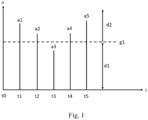
- Figure 1 A diagram is shown with time t on the horizontal axis and the level of attention a on the vertical axis.
- Examples include Figure 1 five attention level values a1 - a5 determined using the method according to the invention for determining the hands-off time for an automated motor vehicle, which were determined at the times t1 - t5, are plotted.
- the attention level a is therefore determined discretely over time and represented by the attention level values a1 - a5, whereby additionally or alternatively a continuous determination of the attention level a is also conceivable.
- a limit value g1 of the attention level a is shown, wherein the hands-off time is a first duration or time period d1 if the attention level a is below the limit value g1, and the hands-off time is a second duration or time period d2 if the attention level a is equal to the limit value g1 or above the limit value g1.
- the first time period d1 is shorter than the second time period d2, i.e. a high level of attention a of the driver leads to a longer hands-off time than a low level of attention a of the driver.
- the timeline t begins at time t0, at which a journey with the automated motor vehicle is started, whereby a steering and lane guidance assistant of the motor vehicle is activated at the time the method is executed.
- the method is carried out by a control unit installed in the motor vehicle, which is designed to issue a warning, in particular auditory, tactile and/or visual, to the driver when the first or second time period d1, d2, i.e. the specific hands-off time, is exceeded.
- the method is based on the idea that the hands-off time is determined based on the attention level a of the driver of the motor vehicle over time t, i.e. that to determine a current attention level value a1 - a5 at least the attention level value a1 - a5 of the previous determination is taken into account.
- a score value of the driver's attention is determined to determine the level of attention value a1 - a5 at the respective determination time t1 - t5.
- This score value is determined based on the driver's behavior at the respective time t1 - t5, whereby the driver's behavior is visually recorded using an interior camera.
- a movement of the driver in particular a head and/or eye movement to determine the driver's direction of gaze and/or an eyelid blink to determine the driver's fatigue, is analyzed using the image data from the camera.
- a driver's gaze directed away from the driving situation and/or fatigue exceeding a predetermined or predefined fatigue threshold value leads to a low attention score at the respective determination time t1 - t5 as predefined negative behavior
- a driver's gaze directed towards the driving situation and/or fatigue falling below a predetermined or predefined fatigue threshold value leads to a higher attention score at the respective determination time t1 - t5 as predefined positive behavior
- the attention score value a determined at the respective determination time t1-t5 does not alone result in the respective attention level value a1 - a5, which ultimately determines the duration d1, d2 of the hands-off time.
- the attention score value determined at time t1 is taken into account when determining the attention level value a2, which corresponds to the current attention level a at time t2.
- score values from further back are given less weight in determining the current score than recently determined score values, in this case the score value at time t2.
- the score values at times t4 and t5 are determined in the same way.
Landscapes
- Engineering & Computer Science (AREA)
- Transportation (AREA)
- Mechanical Engineering (AREA)
- Automation & Control Theory (AREA)
- Human Computer Interaction (AREA)
- Physics & Mathematics (AREA)
- Mathematical Physics (AREA)
- Chemical & Material Sciences (AREA)
- Combustion & Propulsion (AREA)
- Traffic Control Systems (AREA)
- Control Of Driving Devices And Active Controlling Of Vehicle (AREA)
Description
- Die vorliegende Erfindung betrifft ein Verfahren zum Bestimmen einer Hands-Off-Zeit für ein automatisiertes Kraftfahrzeug und ein Steuergerät, das ausgestaltet ist, das Verfahren auszuführen.
-
US 2021/0061300 A1 betrifft ein Verfahren und eine Vorrichtung zur Verhinderung eines unbeabsichtigten Spurwechselmanövers in einem mit Fahrassistenzsystemen ausgestatteten Kraftfahrzeug. Bereitgestellt wird dazu ein Sensor zum Erfassen eines Fahrereingriffsniveaus, ein Speicher zum Speichern des Fahrereingriffsniveaus, eine Benutzerschnittstelle zum Bereitstellen eines Benutzeralarms als Reaktion auf ein Alarmsignal, ein Selektor zum Erzeugen einer Anforderung für einen Spurwechselvorgang und ein Prozessor zum Empfangen der Anforderung für den Spurwechselvorgang, zum Vergleichen des Fahrereingriffsniveaus mit einem Schwelleneingriffsniveau und zum Erzeugen des Alarmsignals als Reaktion darauf, dass das Fahrereingriffsniveau niedriger als das Schwelleneingriffsniveau ist. -
US 2021/0146943 A1 betrifft ein Fahrzeugsteuersystem mit einem Empfänger, der so konfiguriert ist, dass er eine Betätigung eines Insassen eines Host-Fahrzeugs empfängt, einem Informationsausgeber, der so konfiguriert ist, dass er Informationen ausgibt, einer Steuereinheit für automatisiertes Fahren, die so konfiguriert ist, dass sie automatisiertes Fahren ausführt, um das Host-Fahrzeug zu veranlassen, automatisiert zu fahren, einer Schaltsteuereinheit, die so konfiguriert ist, dass sie einen Fahrmodus des Host-Fahrzeugs auf einen beliebigen aus einer Vielzahl von Fahrmodi umschaltet, einschließlich mindestens eines automatisierten Fahrmodus, in dem die Steuereinheit für automatisiertes Fahren veranlasst wird, das automatisierte Fahren auszuführen, und eines manuellen Fahrmodus, in dem das Host-Fahrzeug veranlasst wird, entsprechend der Betätigung in Bezug auf den Empfänger zu fahren, und eine Ausgabesteuerung, die so konfiguriert ist, dass sie den Informationsausgeber veranlasst, vorbestimmte Informationen auszugeben, wenn der Fahrmodus des Host-Fahrzeugs der automatisierte Fahrmodus ist und eine vorbestimmte Bedingung erfüllt ist, wobei, wenn eine vorbestimmte Operation von dem Empfänger empfangen wurde, die Schaltsteuerung einen Schaltaspekt des Fahrmodus in Abhängigkeit davon bestimmt, ob ein Zeitpunkt, zu dem die vorbestimmte Operation empfangen wurde, nach einem Ausgabestartzeitpunkt der vorbestimmten Informationen liegt. - Aus der
DE 10 2018 129 804 A1 ist ein Verfahren zum Bereitstellen einer Information bezüglich einer erforderlichen Aufmerksamkeit eines Fahrers eines Fahrzeuges bekannt. Dieses umfasst eine Auswahl eines erforderlichen Aufmerksamkeitsgrades aus einer Anzahl von möglichen Aufmerksamkeitsgraden, wobei der Aufmerksamkeitsgrad eine erforderliche Aufmerksamkeit des Fahrers zum Führen des Fahrzeuges definiert, ein Ermitteln eines zugehörigen Zeitraums, der beschreibt, wie lange der erforderliche Aufmerksamkeitsgrad erforderlich ist, und ein Bereitstellen eines Signals, welches den erforderlichen Aufmerksamkeitsgrad und den zugehörigen Zeitraum beschreibt. - Aus der
DE 10 2014 220 759 A1 ist ein Verfahren zum Überwachen eines Aufmerksamkeitsgrads eines Fahrers eines Fahrzeugs bekannt, wobei eine Zeitdauer basierend auf einer Geschwindigkeit des Fahrzeugs bestimmt wird. Es wird bestimmt, ob eine Lidschlusszeit und/oder eine Lidschließzeit des Fahrers die bestimmte Zeitdauer überschreitet. - Aus der
DE 10 2008 056 343 A1 ist ein Warnsystem für ein Kraftfahrzeug bekannt, umfassend Sensormittel zur Erfassung einer Fahrsituation, eine Warneinrichtung zur Ausgabe einer Warnung an einen Fahrer des Kraftfahrzeugs, eine Einrichtung zur Erfassung des Aufmerksamkeitszustands des Fahrers, welche Bedienelemente vorhandener Fahrzeugkomponenten umfasst, und eine Steuereinrichtung, die in Abhängigkeit von Daten der Sensormittel und der Einrichtung zur Erfassung des Aufmerksamkeitszustandes die Warneinrichtung ansteuert. Bei diesem Warnsystem schließt die Einrichtung zur Erfassung des Aufmerksamkeitszustands auf einen verringerten Aufmerksamkeitsgrad des Fahrers, wenn eine Gesamtzeitdauer einer Sequenz von mehreren auf die Bedienelemente bezogenen Bedienhandlungen eine Mindestzeitdauer überschreitet (z.B. Sitzeinstellung). Zusätzlich kann auf einen verringerten Aufmerksamkeitsgrad des Fahrers geschlossen werden, wenn a priori als kognitiv beanspruchend bekannte Bedieneingaben ausgelöst werden (z.B. Telefon). - Nachteil der herkömmlichen Systeme bzw. Verfahren ist, dass die Aufmerksamkeit des Fahrers punktuell bestimmt bzw. berechnet wird, was zu Sprüngen im Aufmerksamkeitsgrad führt.
- Weiterhin ist aus dem Stand der Technik ein sog. Lenk- und Spurführungsassistent bekannt. Der Lenk- und Spurführungsassistent ist ausgestaltet, um ein Fahrzeug durch Eingriffe in dessen Querführung im Wesentlichen mittig in einer Fahrspur zu führen. Dafür erfasst ein Kamerasystem eine Spurmarkierung der Fahrspur, an denen das Fahrzeug durch die Eingriffe in die Querführung des Fahrzeugs ausgerichtet wird. Nimmt der Fahrer die Hände vom Lenkrad (Hands-Off) erfolgt nach einer vordefinierten Zeitspanne eine Ausgabe einer Warnung, die den Fahrer auffordert, die Hände zurück an das Lenkrad zu begeben.
- Nachteil an solchen herkömmlichen Lenk- und Spurführungsassistenten ist, dass die vordefinierte Zeitspanne unabhängig von einem Aufmerksamkeitsgrad des Fahrers bestimmt wird und es sich insbesondere um eine invariable Zeitdauer handelt.
- Vor dem Hintergrund dieses Standes der Technik besteht die Aufgabe der vorliegenden Erfindung darin, eine Vorrichtung und ein Verfahren anzugeben, welche jeweils geeignet sind, zumindest die oben genannten Nachteile des Standes der Technik zu überwinden.
- Gelöst wird die Aufgabe durch die Merkmale des unabhängigen Anspruchs. Die Unteransprüche haben bevorzugte Weiterbildungen der Erfindung zum Inhalt.
- Danach wird die Aufgabe durch ein Verfahren zum Bestimmen einer Hands-Off-Zeit für ein automatisiertes Kraftfahrzeug gelöst, wobei die Hands-Off-Zeit basierend auf einem Aufmerksamkeitsgrad eines Fahrers des Kraftfahrzeugs über der Zeit bestimmt wird.
- Mit anderen Worten, zum Bestimmen eine Zeitspanne bzw. Dauer, während der der Fahrer seine Hände nicht am Lenkrad haben muss (sog. Hands-Off-Zeit), wird der Aufmerksamkeitsgrad des Fahrers nicht nur punktuell bestimmt, sondern vielmehr ein Aufmerksamkeitsgrad des Fahrers aus der Vergangenheit mitberücksichtigt, um so den aktuellen und damit den für die Hands-Off-Zeit ausschlaggebenden Aufmerksamkeitsgrad zu bestimmen.
- Das heißt, die (aktuelle) Hands-Off-Zeit wird basierend auf einem Aufmerksamkeitsgradwert bestimmt, der wiederum basierend auf einer aktuellen Aufmerksamkeit des Fahrers und einer Aufmerksamkeit des Fahrers, die vor der Bestimmung der aktuellen Aufmerksamkeit des Fahrers bestimmt wurde, bestimmt wird. Es werden als historische Daten mit einbezogen.
- Die Hands-Off-Zeit kann dabei die Zeitspanne sein, für die der Fahrer seine Hände vom Lenkrad nehmen kann, ohne dass eine Warnung ausgegeben wird.
- Der Aufmerksamkeitsgrad des Fahrers kann basierend auf visuellen, auditiven und/ oder haptischen Sensordaten bestimmt werden.
- Denkbar ist, dass zum Erfassen der visuellen Sensordaten ein auf den Fahrer gerichtete Innenraumkamera vorgesehen ist.
- Denkbar ist, dass zum Erfassen der auditiven Sensordaten ein Innenraummikrofon vorgesehen ist, dass Geräusche im Innenraum des Kraftfahrzeugs erfasst.
- Denkbar ist, dass zum Erfassen der haptischen Sensordaten eine berührungsempfindliche Sensoranordnung im Kraftfahrzeuginnenraum, insbesondere an einer Lenkvorrichtung und/oder einer weiteren Arm- bzw. Handablage im Kraftfahrzeuginnenraum, angeordnet ist.
- Der Aufmerksamkeitsgrad kann basierend auf einem Verhalten des Fahrers bestimmt werden.
- Zum Bestimmen des Verhaltens des Fahrers kann ein vordefiniertes positives Verhalten des Fahrers bestimmt werden, das zu einer Erhöhung des Aufmerksamkeitsgrads führt, und ein vordefiniertes negatives Verhalten des Fahrers bestimmt werden, das zu einer Verringerung des Aufmerksamkeitsgrads führt.
- Das vordefinierte positive Verhalten und/oder das vordefinierte negative Verhalten des Fahrers kann/können basierend auf einer Müdigkeit des Fahrers und/oder einer Blickrichtung des Fahrers bestimmt werden.
- Denkbar ist, dass die Müdigkeit des Fahrers basierend auf einer Lidschlaganalyse, insbesondere auf einer Lidschlusszeit und/oder einer Lidschlaggeschwindigkeit, bestimmt wird.
- Das Verhalten des Fahrers kann zeitdiskret und/oder kontinuierlich bestimmt werden.
- Ein hoher Aufmerksamkeitsgrad des Fahrers kann zu einer längeren Hands-Off-Zeit als ein niedriger Aufmerksamkeitsgrad des Fahrers führen.
- Während einem Ausführen des Verfahrens kann ein Lenk- und Spurführungsassistent aktiviert sein.
- Bei dem Lenk- und Spurführungsassistenten kann es sich um ein eingangs beschriebenes Fahrassistenzsystem handeln, welches Eingriffe in eine Querführung des Kraftfahrzeugs vornimmt und dieses dadurch in einer Fahrspur hält und ggf. ein automatisiertes Spurwechseln ermöglicht.
- Denkbar ist, dass zusätzlich oder alternativ zum Lenk- und Spurführungsassistent ein Abstandsregeltempomat während der Ausführung des Verfahrens aktiviert ist. Der Abstandsregeltempomat kann ausgestaltet sein, um eine Längsführung des Kraftfahrzeugs zumindest zweitweise und/oder teilweise zu übernehmen, insbesondere so, dass das Kraftfahrzeug einem vorausfahrenden Kraftfahrzeug folgt.
- Das oben Beschriebene kann in einer konkreten Ausführung und mit anderen Worten wie nachfolgend beschrieben zusammengefasst werden.
- Über eine Kamera im Innenraum des Kraftfahrzeugs wird der Fahrer kontinuierlich beobachtet und basierend auf den von der Kamera erfassten Daten insbesondere punktuell ein aktueller Score-Wert der Aufmerksamkeit des Fahrers berechnet.
- Die aktuelle Aufmerksamkeit bzw. der aktuelle Aufmerksamkeitsgrad des Fahrers wird basierend auf diesem aktuellen Score-Wert und den zuvor berechneten Score-Werten ermittelt.
- Dabei sind verschiedene Gewichtungen des aktuellen Score-Werts zu den zuvor berechneten Score-Werten denkbar. Insbesondere kann so ein Verlauf des Aufmerksamkeitsgrades über eine gesamte Fahrdauer errechnet werden und dieser erlaubt je nach seiner Höhe kürzere oder längere Hands-Off-Zeiten.
- Es wird also sowohl ein positives Verhalten des Fahrers, z.B. wenn eine Aufmerksamkeit des Fahrers dauerhaft vorhanden ist, als auch ein negatives Verhalten des Fahrers, z.B. wenn der Fahrer Systemgrenzen ausreizt und/oder Müdigkeit des Fahrers, erfasst.
- Das positive Verhalten ermöglicht längere Hands-off Zeiten und wird belohnt. Das negative Verhalten verringert die Hands-Off-Zeit und wird bestraft.
- Ferner wird ein Steuergerät für ein Kraftfahrzeug bereitgestellt, wobei das Steuergerät ausgestaltet ist, das oben beschriebene Verfahren auszuführen.
- Denkbar ist, zusätzlich oder alternativ, dass ein Kraftfahrzeug, aufweisend das Steuergerät bereitgestellt wird. Bei dem Kraftfahrzeug kann es sich um ein Automobil handeln.
- Das oben mit Bezug zum Verfahren Beschriebene gilt analog auch für das Steuergerät sowie das Kraftfahrzeug und umgekehrt.
- Nachfolgend wird eine Ausführungsform mit Bezug zu
Figur 1 beschrieben. - Fig. 1
- zeigt schematisch einen mit dem Verfahren zum Bestimmen einer Hands-Off-Zeit bestimmten Verlauf eines Aufmerksamkeitsgrad eines Fahrers des Kraftfahrzeugs über der Zeit.
- In
Figur 1 ist ein Diagramm dargestellt, auf dessen horizontaler Achse die Zeit t und auf der vertikalen Achse der Aufmerksamkeitsgrad a aufgetragen ist. - Beispielhaft sind in
Figur 1 fünf mit dem erfindungsgemäßen Verfahren zum Bestimmen der Hands-Off-Zeit für ein automatisiertes Kraftfahrzeug bestimmte Aufmerksamkeitsgradwerte a1 - a5, die zu den Zeitpunkten t1 - t5 bestimmt wurden, aufgetragen. - Der Aufmerksamkeitsgrad a wird demnach zeitdiskret bestimmt und durch die Aufmerksamkeitsgradwerte a1 - a5 repräsentiert, wobei zusätzlich oder alternativ auch eine kontinuierliche Bestimmung des Aufmerksamkeitsgrads a denkbar ist.
- Weiterhin ist in
Figur 1 ein Grenzwert g1 des Aufmerksamkeitsgrads a dargestellt, wobei die Hands-Off-Zeit eine erste Dauer bzw. Zeitspanne d1 beträgt, wenn der Aufmerksamkeitsgrad a unter dem Grenzwert g1 liegt, und die Hands-Off-Zeit eine zweite Dauer bzw. Zeitspanne d2 beträgt, wenn der Aufmerksamkeitsgrad a gleich dem Grenzwerts g1 ist oder über dem Grenzwert g1 liegt. - Die erste Zeitspanne d1 ist kürzer als die zweite Zeitspanne d2, d.h. ein hoher Aufmerksamkeitsgrad a des Fahrers führt zu einer längeren Hands-Off-Zeit als ein niedriger Aufmerksamkeitsgrad a des Fahrers.
- Die Zeitleiste t beginnt zum Zeitpunkt t0, bei dem eine Fahrt mit dem automatisierten Kraftfahrzeug begonnen wird, wobei zum Zeitpunkt der Ausführung des Verfahrens ein Lenk- und Spurführungsassistent des Kraftfahrzeugs aktiviert ist.
- Das Verfahren wird von einem im Kraftfahrzeug verbauten Steuergerät ausgeführt, das ausgestaltet ist, eine Warnung, insbesondere auditiv, taktil und/oder visuell, an den Fahrer auszugeben, wenn die erste bzw. die zweite Zeitspanne d1, d2, d.h. die bestimmte Hands-Off-Zeit, überschritten ist.
- Dem Verfahren liegt die Idee zugrunde, dass die Hands-Off-Zeit basierend auf dem Aufmerksamkeitsgrad a des Fahrers des Kraftfahrzeugs über der Zeit t bestimmt wird, d.h. dass zur Bestimmung eines aktuellen Aufmerksamkeitsgradwertes a1 - a5 zumindest der Aufmerksamkeitsgradwert a1 - a5 der vorherigen Bestimmung berücksichtigt wird.
- Vorliegend wird zur Bestimmung des Aufmerksamkeitsgradwertes a1 - a5 zum jeweiligen Bestimmungszeitpunkt t1 - t5 ein Score-Wert der Aufmerksamkeit des Fahrers bestimmt.
- Dieser Score-Wert wird basierend auf dem Verhalten des Fahrers zum jeweiligen Zeitpunkt t1 - t5 bestimmt, wobei dazu das Verhalten des Fahrers visuell mittels einer Innenraumkamera erfasst wird.
- Denkbar wäre auch, das Verhalten zusätzlich oder alternativ basierend auf auditiven und/ oder haptischen Sensordaten zu bestimmen.
- Dazu wird mittels der Bilddaten der Kamera eine Bewegung des Fahrers, insbesondere eine Kopf- und/oder Augenbewegung zum Bestimmen einer Blickrichtung des Fahrers und/oder ein Lidschlag zur Bestimmung einer Müdigkeit des Fahrers, analysiert.
- Dabei wird zwischen einem vordefinierten positiven Verhalten des Fahrers, das zu einer Erhöhung des Score-Werts der Aufmerksamkeit führt, und einem vordefinierten negativen Verhalten des Fahrers, das zu einer Verringerung des Score-Werts der Aufmerksamkeit a führt, unterschieden.
- Beispielsweise führt eine vom Fahrgeschehen abgewandte Blickrichtung des Fahrers und/oder eine einen vorbestimmten bzw. vordefinierten Müdigkeitsgrenzwert überschreitende Müdigkeit jeweils als vordefiniertes negatives Verhalten zu einem niedrigen Score-Wert der Aufmerksamkeit zum jeweiligen Bestimmungszeitpunkt t1 - t5, wohingegen eine zum Fahrgeschehen gewandte Blickrichtung des Fahrers und/oder eine einen vorbestimmten bzw. vordefinierten Müdigkeitsgrenzwert unterschreitende Müdigkeit jeweils als vordefiniertes positives Verhalten zu einem höheren Score-Wert der Aufmerksamkeit zum jeweiligen Bestimmungszeitpunkt t1 - t5 führt/führen.
- Der zum jeweiligen Bestimmungszeitpunkt t1-t5 bestimmte Score-Wert der Aufmerksamkeit a ergibt jedoch nicht alleine den jeweiligen Aufmerksamkeitsgradwert a1 - a5, der letztlich die Dauer d1, d2 der Hands-Off-Zeit festlegt.
- Vielmehr wird zum Zeitpunkt t2 der zum Zeitpunkt t1 ermittelte Score-Wert der Aufmerksamkeit bei der Bestimmung des Aufmerksamkeitsgradwertes a2, der dem aktuellen Aufmerksamkeitsgrad a zum Zeitpunkt t2 entspricht, berücksichtigt.
- Gleiches gilt für die Bestimmung des Aufmerksamkeitsgradwertes a3 zum Zeitpunkt t3, bei dem der zum Zeitpunkt t1 ermittelte Score-Wert der Aufmerksamkeit und/oder der zum Zeitpunkt t2 ermittelte Score-Wert der Aufmerksamkeit zur Bestimmung berücksichtigt werden.
- Denkbar ist, dass weiter zurückliegende Score-Werte, hier der Score-Wert zum Zeitpunkt t1, bei der Bestimmung des aktuellen Score-Wertes geringer gewichtet werden als kürzlich bestimmte Score-Werte, hier der Score-Wert zum Zeitpunkt t2. Die Score-Werte zu den Zeitpunkten t4 und t5 werden auf dieselbe Weise bestimmt.
- Dadurch können starke Sprünge in den Aufmerksamkeitsgradwerten a1 - a5 vermieden werden, wie
Figur1 zu entnehmen ist. Trotz abnehmendem Score-Wert vom Zeitpunkt t1 zum Zeitpunkt t2 fällt der Aufmerksamkeitsgrad a nicht direkt zum Zeitpunkt t2 unterhalb den Grenzwert g1, sondern erst zum Zeitpunkt t3 und erhöht sich dann wieder bis zum Zeitpunkt t5. - Damit kann ein positives Verhalten des Fahrers aus der Vergangenheit berücksichtigt und mit einer längeren Hands-Off-Zeit honoriert werden, selbst wenn der Score-Wert der Aufmerksamkeit bei einem Bestimmungszeitpunkt t1 - t5, beispielswiese zufällig, eine solche längere Hands-Off-Zeit nicht rechtfertigt und umgekehrt.
-
- a
- Aufmerksamkeitsgrad
- a1 - a5
- Aufmerksamkeitsgradwerte
- d1
- kürzere Dauer der Hands-Off-Zeit
- d2
- längere Dauer der Hands-Off-Zeit
- g1
- Grenzwert
- t
- Zeit
- t1 - t5
- Bestimmungszeitpunkte des Aufmerksamkeitsgrads
Claims (10)
- Verfahren zum Bestimmen einer Hands-Off-Zeit für ein automatisiertes Kraftfahrzeug, dadurch gekennzeichnet, dass die Hands-Off-Zeit basierend auf einem Aufmerksamkeitsgrad (a) eines Fahrers des Kraftfahrzeugs über der Zeit (t) bestimmt wird.
- Verfahren nach Anspruch 1, dadurch gekennzeichnet, dass der Aufmerksamkeitsgrad (a) des Fahrers basierend auf visuellen, auditiven und/oder haptischen Sensordaten bestimmt wird.
- Verfahren nach Anspruch 1 oder 2, dadurch gekennzeichnet, dass der Aufmerksamkeitsgrad (a) des Fahrers basierend auf einem Verhalten des Fahrers bestimmt wird.
- Verfahren nach Anspruch 3, dadurch gekennzeichnet, dass zum Bestimmen des Verhaltens des Fahrers ein vordefiniertes positives Verhalten des Fahrers bestimmt wird, das zu einer Erhöhung des Aufmerksamkeitsgrads (a) führt, und ein vordefiniertes negatives Verhalten des Fahrers bestimmt wird, das zu einer Verringerung des Aufmerksamkeitsgrads (a) führt.
- Verfahren nach Anspruch 4, dadurch gekennzeichnet, dass das vordefinierte positive Verhalten und/oder das vordefinierte negative Verhalten des Fahrers basierend auf einer Müdigkeit des Fahrers und/oder einer Blickrichtung des Fahrers bestimmt wird/werden.
- Verfahren nach Anspruch 5, dadurch gekennzeichnet, dass die Müdigkeit des Fahrers basierend auf einer Lidschlaganalyse bestimmt wird.
- Verfahren nach einem der Ansprüche 3 bis 6, dadurch gekennzeichnet, dass das Verhalten des Fahrers zeitdiskret und/oder kontinuierlich bestimmt wird.
- Verfahren nach einem der Ansprüche 1 bis 7, dadurch gekennzeichnet, dass ein hoher Aufmerksamkeitsgrad (a) des Fahrers zu einer längeren Hands-Off-Zeit als ein niedriger Aufmerksamkeitsgrad (a) des Fahrers führt.
- Verfahren nach einem der Ansprüche 1 bis 8, dadurch gekennzeichnet, dass während einem Ausführen des Verfahrens ein Lenk- und Spurführungsassistent aktiviert ist.
- Steuergerät für ein Kraftfahrzeug, dadurch gekennzeichnet, dass das Steuergerät ausgestaltet ist, das Verfahren nach einem der Ansprüche 1 bis 9 auszuführen.
Applications Claiming Priority (2)
| Application Number | Priority Date | Filing Date | Title |
|---|---|---|---|
| DE102021117350.7A DE102021117350A1 (de) | 2021-07-06 | 2021-07-06 | Verfahren zum bestimmen einer hands-off-zeit für ein automatisiertes kraftfahrzeug |
| PCT/EP2022/068541 WO2023280825A1 (de) | 2021-07-06 | 2022-07-05 | Verfahren zum bestimmen einer hands-off-zeit für ein automatisiertes kraftfahrzeug |
Publications (3)
| Publication Number | Publication Date |
|---|---|
| EP4366998A1 EP4366998A1 (de) | 2024-05-15 |
| EP4366998C0 EP4366998C0 (de) | 2025-04-23 |
| EP4366998B1 true EP4366998B1 (de) | 2025-04-23 |
Family
ID=82656557
Family Applications (1)
| Application Number | Title | Priority Date | Filing Date |
|---|---|---|---|
| EP22744687.9A Active EP4366998B1 (de) | 2021-07-06 | 2022-07-05 | Verfahren zum bestimmen einer hands-off-zeit für ein automatisiertes kraftfahrzeug |
Country Status (5)
| Country | Link |
|---|---|
| US (1) | US20250100588A1 (de) |
| EP (1) | EP4366998B1 (de) |
| CN (1) | CN117615951A (de) |
| DE (1) | DE102021117350A1 (de) |
| WO (1) | WO2023280825A1 (de) |
Families Citing this family (3)
| Publication number | Priority date | Publication date | Assignee | Title |
|---|---|---|---|---|
| DE102023116321A1 (de) * | 2023-06-21 | 2024-12-24 | Bayerische Motoren Werke Aktiengesellschaft | Assistenzsystem zum Unterstützen eines Fahrers eines Fahrzeugs bei einer Querführung des Fahrzeugs mit Berücksichtigung einer Blendung des Fahrers, Fahrzeug sowie Verfahren |
| DE102023117275A1 (de) * | 2023-06-30 | 2025-01-02 | Bayerische Motoren Werke Aktiengesellschaft | Assistenzsystem und Verfahren zum Warnen eines abgelenkten Fahrers in einem assistierten oder teilautomatisierten Fahrbetrieb und entsprechend eingerichtetes Kraftfahrzeug |
| CN116767235A (zh) * | 2023-07-26 | 2023-09-19 | 重庆长安汽车股份有限公司 | 一种脱眼驾驶辅助系统、方法、电子设备及存储介质 |
Family Cites Families (9)
| Publication number | Priority date | Publication date | Assignee | Title |
|---|---|---|---|---|
| DE102008056343B4 (de) | 2008-11-07 | 2024-07-25 | Bayerische Motoren Werke Aktiengesellschaft | Warnsystem für ein Kraftfahrzeug |
| DE102014220759B4 (de) | 2014-10-14 | 2019-06-19 | Audi Ag | Überwachung eines Aufmerksamkeitsgrads eines Fahrers eines Fahrzeugs |
| DE102015207025A1 (de) * | 2015-04-17 | 2016-10-20 | Bayerische Motoren Werke Aktiengesellschaft | Fahrerassistenzsystem in einem Kraftfahrzeug |
| CN110678371B (zh) * | 2017-06-02 | 2022-11-22 | 本田技研工业株式会社 | 车辆控制系统、车辆控制方法及存储介质 |
| DE102018129804A1 (de) | 2018-11-26 | 2020-05-28 | Bayerische Motoren Werke Aktiengesellschaft | Verfahren zum Bereitstellen einer Information bezüglich einer erforderlichen Aufmerksamkeit eines Fahrers eines Fahrzeuges |
| US11267483B2 (en) * | 2019-08-26 | 2022-03-08 | GM Global Technology Operations LLC | Method and apparatus for prevention of unintended lane change maneuver in an assisted driving system |
| KR102751290B1 (ko) * | 2019-10-01 | 2025-01-10 | 현대자동차주식회사 | 운전자 모니터링 장치, 그를 포함한 시스템 및 그 방법 |
| DE102020109701A1 (de) | 2020-04-07 | 2021-10-07 | Bayerische Motoren Werke Aktiengesellschaft | System und Verfahren zum automatisierten Fahren für ein Fahrzeug |
| CN112289003B (zh) | 2020-10-23 | 2022-06-17 | 江铃汽车股份有限公司 | 疲劳驾驶不端驾驶行为监测方法及主动安全驾驶监控系统 |
-
2021
- 2021-07-06 DE DE102021117350.7A patent/DE102021117350A1/de active Pending
-
2022
- 2022-07-05 CN CN202280046458.3A patent/CN117615951A/zh active Pending
- 2022-07-05 EP EP22744687.9A patent/EP4366998B1/de active Active
- 2022-07-05 US US18/576,800 patent/US20250100588A1/en active Pending
- 2022-07-05 WO PCT/EP2022/068541 patent/WO2023280825A1/de not_active Ceased
Also Published As
| Publication number | Publication date |
|---|---|
| EP4366998C0 (de) | 2025-04-23 |
| CN117615951A (zh) | 2024-02-27 |
| EP4366998A1 (de) | 2024-05-15 |
| WO2023280825A1 (de) | 2023-01-12 |
| DE102021117350A1 (de) | 2023-01-12 |
| US20250100588A1 (en) | 2025-03-27 |
Similar Documents
| Publication | Publication Date | Title |
|---|---|---|
| EP3752401B1 (de) | Verfahren zum auswählen eines fahrprofils eines kraftwagens, fahrassistenzsystem und kraftwagen | |
| EP4366998B1 (de) | Verfahren zum bestimmen einer hands-off-zeit für ein automatisiertes kraftfahrzeug | |
| EP3003767B1 (de) | Notfallassistenz zur fahrzeugführung | |
| DE102013222048B4 (de) | Verfahren und Vorrichtung zum Aktivieren oder Deaktivieren einer automatischen Fahrfunktion | |
| EP3468853B1 (de) | Proaktive steuerung eines assistenzsystems eines kraftfahrzeugs | |
| EP3479183B2 (de) | Verfahren zum betrieb eines kraftfahrzeugs in einer navigationsumgebung und kraftfahrzeug | |
| WO2015144410A1 (de) | Vorrichtung zur vorhersage von fahrzustandsübergängen | |
| EP4422943B1 (de) | Verfahren zum unterstützen eines nutzers eines fahrzeugs beim manövrieren des fahrzeugs auf einer mehrspurigen strasse unter berücksichtigung einer individuellen reaktionszeit des nutzers, fahrerassistenzsystem sowie fahrzeug | |
| WO2013127387A1 (de) | Verfahren zum betrieb eines fahrerassistenzsystems zur autonomen längs - und/oder querregelung eines fahrzeugs und fahrerassistenzsystem, das nach einem derartigen verfahren arbeitet | |
| DE102014118113A1 (de) | Fahrzeugsteuerung | |
| DE102017216800A1 (de) | Fahrerassistenzsystem, Verfahren und Computerprogrammprodukt für einen Spurwechselvorgang | |
| DE102017213207A1 (de) | Vorrichtung zum Verändern einer Querführung eines Fahrzeugs | |
| DE102014214777A1 (de) | Verfahren zur Interaktion eines Fahrassistenzsystems mit einem Fahrer eines Fahrzeugs | |
| DE102018207675A1 (de) | Verfahren zum Umschalten zwischen unterschiedlichen Automatisierungsstufen eines Fahrzeugs | |
| DE102011121484A1 (de) | Bedienungssystem für ein Fahrzeug und Verfahren zur Unterstützung eines Fahrers beim Bedienen eines Fahrzeugs | |
| WO2022079166A1 (de) | Verfahren, computerprogramm und vorrichtung zum anpassen einer route | |
| DE102021201062A1 (de) | Verfahren zum Betreiben eines Kraftfahrzeugs sowie Kraftfahrzeug | |
| WO2021058205A1 (de) | Verfahren zum betreiben eines fahrzeuges | |
| EP1874605B1 (de) | Fahrerassistenzsystem zur ausgabe zumindest einer information | |
| DE102017213205A1 (de) | Pedalsystem mit zumindest einer veränderbaren Bedeutung der Betätigung zumindest eines Pedals | |
| DE102022104785A1 (de) | Verbessertes Überholmanöver zum Überholen eines vorausfahrenden Drittfahrzeugs | |
| DE102019112453A1 (de) | Automatisches Auswählen einer Assistenzstufe für ein Fahrzeug | |
| DE102020120867A1 (de) | Verfahren zum Betreiben eines Fahrassistenzsystems eines Kraftfahrzeugs | |
| DE102010056248A1 (de) | Verfahren und Abstandsregelsystem zur Regelung eines Folgeabstands | |
| DE102019129904A1 (de) | Automatische Fahrkompetenzanalyse |
Legal Events
| Date | Code | Title | Description |
|---|---|---|---|
| STAA | Information on the status of an ep patent application or granted ep patent |
Free format text: STATUS: UNKNOWN |
|
| STAA | Information on the status of an ep patent application or granted ep patent |
Free format text: STATUS: THE INTERNATIONAL PUBLICATION HAS BEEN MADE |
|
| PUAI | Public reference made under article 153(3) epc to a published international application that has entered the european phase |
Free format text: ORIGINAL CODE: 0009012 |
|
| STAA | Information on the status of an ep patent application or granted ep patent |
Free format text: STATUS: REQUEST FOR EXAMINATION WAS MADE |
|
| 17P | Request for examination filed |
Effective date: 20240202 |
|
| AK | Designated contracting states |
Kind code of ref document: A1 Designated state(s): AL AT BE BG CH CY CZ DE DK EE ES FI FR GB GR HR HU IE IS IT LI LT LU LV MC MK MT NL NO PL PT RO RS SE SI SK SM TR |
|
| DAV | Request for validation of the european patent (deleted) | ||
| DAX | Request for extension of the european patent (deleted) | ||
| GRAP | Despatch of communication of intention to grant a patent |
Free format text: ORIGINAL CODE: EPIDOSNIGR1 |
|
| STAA | Information on the status of an ep patent application or granted ep patent |
Free format text: STATUS: GRANT OF PATENT IS INTENDED |
|
| INTG | Intention to grant announced |
Effective date: 20241119 |
|
| GRAS | Grant fee paid |
Free format text: ORIGINAL CODE: EPIDOSNIGR3 |
|
| GRAA | (expected) grant |
Free format text: ORIGINAL CODE: 0009210 |
|
| STAA | Information on the status of an ep patent application or granted ep patent |
Free format text: STATUS: THE PATENT HAS BEEN GRANTED |
|
| AK | Designated contracting states |
Kind code of ref document: B1 Designated state(s): AL AT BE BG CH CY CZ DE DK EE ES FI FR GB GR HR HU IE IS IT LI LT LU LV MC MK MT NL NO PL PT RO RS SE SI SK SM TR |
|
| REG | Reference to a national code |
Ref country code: GB Ref legal event code: FG4D Free format text: NOT ENGLISH |
|
| REG | Reference to a national code |
Ref country code: CH Ref legal event code: EP |
|
| REG | Reference to a national code |
Ref country code: DE Ref legal event code: R096 Ref document number: 502022003698 Country of ref document: DE |
|
| REG | Reference to a national code |
Ref country code: IE Ref legal event code: FG4D Free format text: LANGUAGE OF EP DOCUMENT: GERMAN |
|
| U01 | Request for unitary effect filed |
Effective date: 20250520 |
|
| U07 | Unitary effect registered |
Designated state(s): AT BE BG DE DK EE FI FR IT LT LU LV MT NL PT RO SE SI Effective date: 20250526 |
|
| U20 | Renewal fee for the european patent with unitary effect paid |
Year of fee payment: 4 Effective date: 20250716 |
|
| PG25 | Lapsed in a contracting state [announced via postgrant information from national office to epo] |
Ref country code: ES Free format text: LAPSE BECAUSE OF FAILURE TO SUBMIT A TRANSLATION OF THE DESCRIPTION OR TO PAY THE FEE WITHIN THE PRESCRIBED TIME-LIMIT Effective date: 20250423 |
|
| PG25 | Lapsed in a contracting state [announced via postgrant information from national office to epo] |
Ref country code: NO Free format text: LAPSE BECAUSE OF FAILURE TO SUBMIT A TRANSLATION OF THE DESCRIPTION OR TO PAY THE FEE WITHIN THE PRESCRIBED TIME-LIMIT Effective date: 20250723 Ref country code: GR Free format text: LAPSE BECAUSE OF FAILURE TO SUBMIT A TRANSLATION OF THE DESCRIPTION OR TO PAY THE FEE WITHIN THE PRESCRIBED TIME-LIMIT Effective date: 20250724 |
|
| PG25 | Lapsed in a contracting state [announced via postgrant information from national office to epo] |
Ref country code: PL Free format text: LAPSE BECAUSE OF FAILURE TO SUBMIT A TRANSLATION OF THE DESCRIPTION OR TO PAY THE FEE WITHIN THE PRESCRIBED TIME-LIMIT Effective date: 20250423 |
|
| PG25 | Lapsed in a contracting state [announced via postgrant information from national office to epo] |
Ref country code: HR Free format text: LAPSE BECAUSE OF FAILURE TO SUBMIT A TRANSLATION OF THE DESCRIPTION OR TO PAY THE FEE WITHIN THE PRESCRIBED TIME-LIMIT Effective date: 20250423 |
|
| PG25 | Lapsed in a contracting state [announced via postgrant information from national office to epo] |
Ref country code: RS Free format text: LAPSE BECAUSE OF FAILURE TO SUBMIT A TRANSLATION OF THE DESCRIPTION OR TO PAY THE FEE WITHIN THE PRESCRIBED TIME-LIMIT Effective date: 20250723 |
|
| PG25 | Lapsed in a contracting state [announced via postgrant information from national office to epo] |
Ref country code: IS Free format text: LAPSE BECAUSE OF FAILURE TO SUBMIT A TRANSLATION OF THE DESCRIPTION OR TO PAY THE FEE WITHIN THE PRESCRIBED TIME-LIMIT Effective date: 20250823 |