EP4359582B1 - Verfahren zum aufbringen einer schutzschicht auf eine metall- oder metalllegierungsoberfläche und artikel mit solch einer schutzschicht - Google Patents
Verfahren zum aufbringen einer schutzschicht auf eine metall- oder metalllegierungsoberfläche und artikel mit solch einer schutzschicht Download PDFInfo
- Publication number
- EP4359582B1 EP4359582B1 EP22761255.3A EP22761255A EP4359582B1 EP 4359582 B1 EP4359582 B1 EP 4359582B1 EP 22761255 A EP22761255 A EP 22761255A EP 4359582 B1 EP4359582 B1 EP 4359582B1
- Authority
- EP
- European Patent Office
- Prior art keywords
- protective layer
- metallic element
- nitride
- lithium
- substrate
- Prior art date
- Legal status (The legal status is an assumption and is not a legal conclusion. Google has not performed a legal analysis and makes no representation as to the accuracy of the status listed.)
- Active
Links
Images




Classifications
-
- C—CHEMISTRY; METALLURGY
- C23—COATING METALLIC MATERIAL; COATING MATERIAL WITH METALLIC MATERIAL; CHEMICAL SURFACE TREATMENT; DIFFUSION TREATMENT OF METALLIC MATERIAL; COATING BY VACUUM EVAPORATION, BY SPUTTERING, BY ION IMPLANTATION OR BY CHEMICAL VAPOUR DEPOSITION, IN GENERAL; INHIBITING CORROSION OF METALLIC MATERIAL OR INCRUSTATION IN GENERAL
- C23C—COATING METALLIC MATERIAL; COATING MATERIAL WITH METALLIC MATERIAL; SURFACE TREATMENT OF METALLIC MATERIAL BY DIFFUSION INTO THE SURFACE, BY CHEMICAL CONVERSION OR SUBSTITUTION; COATING BY VACUUM EVAPORATION, BY SPUTTERING, BY ION IMPLANTATION OR BY CHEMICAL VAPOUR DEPOSITION, IN GENERAL
- C23C8/00—Solid state diffusion of only non-metal elements into metallic material surfaces; Chemical surface treatment of metallic material by reaction of the surface with a reactive gas, leaving reaction products of surface material in the coating, e.g. conversion coatings, passivation of metals
- C23C8/06—Solid state diffusion of only non-metal elements into metallic material surfaces; Chemical surface treatment of metallic material by reaction of the surface with a reactive gas, leaving reaction products of surface material in the coating, e.g. conversion coatings, passivation of metals using gases
- C23C8/36—Solid state diffusion of only non-metal elements into metallic material surfaces; Chemical surface treatment of metallic material by reaction of the surface with a reactive gas, leaving reaction products of surface material in the coating, e.g. conversion coatings, passivation of metals using gases using ionised gases, e.g. ionitriding
-
- C—CHEMISTRY; METALLURGY
- C23—COATING METALLIC MATERIAL; COATING MATERIAL WITH METALLIC MATERIAL; CHEMICAL SURFACE TREATMENT; DIFFUSION TREATMENT OF METALLIC MATERIAL; COATING BY VACUUM EVAPORATION, BY SPUTTERING, BY ION IMPLANTATION OR BY CHEMICAL VAPOUR DEPOSITION, IN GENERAL; INHIBITING CORROSION OF METALLIC MATERIAL OR INCRUSTATION IN GENERAL
- C23C—COATING METALLIC MATERIAL; COATING MATERIAL WITH METALLIC MATERIAL; SURFACE TREATMENT OF METALLIC MATERIAL BY DIFFUSION INTO THE SURFACE, BY CHEMICAL CONVERSION OR SUBSTITUTION; COATING BY VACUUM EVAPORATION, BY SPUTTERING, BY ION IMPLANTATION OR BY CHEMICAL VAPOUR DEPOSITION, IN GENERAL
- C23C8/00—Solid state diffusion of only non-metal elements into metallic material surfaces; Chemical surface treatment of metallic material by reaction of the surface with a reactive gas, leaving reaction products of surface material in the coating, e.g. conversion coatings, passivation of metals
- C23C8/06—Solid state diffusion of only non-metal elements into metallic material surfaces; Chemical surface treatment of metallic material by reaction of the surface with a reactive gas, leaving reaction products of surface material in the coating, e.g. conversion coatings, passivation of metals using gases
- C23C8/08—Solid state diffusion of only non-metal elements into metallic material surfaces; Chemical surface treatment of metallic material by reaction of the surface with a reactive gas, leaving reaction products of surface material in the coating, e.g. conversion coatings, passivation of metals using gases only one element being applied
- C23C8/24—Nitriding
-
- H—ELECTRICITY
- H01—ELECTRIC ELEMENTS
- H01M—PROCESSES OR MEANS, e.g. BATTERIES, FOR THE DIRECT CONVERSION OF CHEMICAL ENERGY INTO ELECTRICAL ENERGY
- H01M10/00—Secondary cells; Manufacture thereof
- H01M10/05—Accumulators with non-aqueous electrolyte
- H01M10/052—Li-accumulators
-
- H—ELECTRICITY
- H01—ELECTRIC ELEMENTS
- H01M—PROCESSES OR MEANS, e.g. BATTERIES, FOR THE DIRECT CONVERSION OF CHEMICAL ENERGY INTO ELECTRICAL ENERGY
- H01M4/00—Electrodes
- H01M4/02—Electrodes composed of, or comprising, active material
- H01M4/13—Electrodes for accumulators with non-aqueous electrolyte, e.g. for lithium-accumulators; Processes of manufacture thereof
- H01M4/134—Electrodes based on metals, Si or alloys
-
- H—ELECTRICITY
- H01—ELECTRIC ELEMENTS
- H01M—PROCESSES OR MEANS, e.g. BATTERIES, FOR THE DIRECT CONVERSION OF CHEMICAL ENERGY INTO ELECTRICAL ENERGY
- H01M4/00—Electrodes
- H01M4/02—Electrodes composed of, or comprising, active material
- H01M4/13—Electrodes for accumulators with non-aqueous electrolyte, e.g. for lithium-accumulators; Processes of manufacture thereof
- H01M4/139—Processes of manufacture
- H01M4/1395—Processes of manufacture of electrodes based on metals, Si or alloys
-
- H—ELECTRICITY
- H01—ELECTRIC ELEMENTS
- H01M—PROCESSES OR MEANS, e.g. BATTERIES, FOR THE DIRECT CONVERSION OF CHEMICAL ENERGY INTO ELECTRICAL ENERGY
- H01M4/00—Electrodes
- H01M4/02—Electrodes composed of, or comprising, active material
- H01M4/36—Selection of substances as active materials, active masses, active liquids
- H01M4/362—Composites
- H01M4/366—Composites as layered products
-
- H—ELECTRICITY
- H01—ELECTRIC ELEMENTS
- H01M—PROCESSES OR MEANS, e.g. BATTERIES, FOR THE DIRECT CONVERSION OF CHEMICAL ENERGY INTO ELECTRICAL ENERGY
- H01M4/00—Electrodes
- H01M4/02—Electrodes composed of, or comprising, active material
- H01M4/36—Selection of substances as active materials, active masses, active liquids
- H01M4/38—Selection of substances as active materials, active masses, active liquids of elements or alloys
- H01M4/381—Alkaline or alkaline earth metals elements
-
- H—ELECTRICITY
- H01—ELECTRIC ELEMENTS
- H01M—PROCESSES OR MEANS, e.g. BATTERIES, FOR THE DIRECT CONVERSION OF CHEMICAL ENERGY INTO ELECTRICAL ENERGY
- H01M4/00—Electrodes
- H01M4/02—Electrodes composed of, or comprising, active material
- H01M4/36—Selection of substances as active materials, active masses, active liquids
- H01M4/38—Selection of substances as active materials, active masses, active liquids of elements or alloys
- H01M4/381—Alkaline or alkaline earth metals elements
- H01M4/382—Lithium
-
- H—ELECTRICITY
- H01—ELECTRIC ELEMENTS
- H01M—PROCESSES OR MEANS, e.g. BATTERIES, FOR THE DIRECT CONVERSION OF CHEMICAL ENERGY INTO ELECTRICAL ENERGY
- H01M4/00—Electrodes
- H01M4/02—Electrodes composed of, or comprising, active material
- H01M4/62—Selection of inactive substances as ingredients for active masses, e.g. binders, fillers
-
- H—ELECTRICITY
- H01—ELECTRIC ELEMENTS
- H01M—PROCESSES OR MEANS, e.g. BATTERIES, FOR THE DIRECT CONVERSION OF CHEMICAL ENERGY INTO ELECTRICAL ENERGY
- H01M4/00—Electrodes
- H01M4/02—Electrodes composed of, or comprising, active material
- H01M2004/026—Electrodes composed of, or comprising, active material characterised by the polarity
- H01M2004/027—Negative electrodes
-
- Y—GENERAL TAGGING OF NEW TECHNOLOGICAL DEVELOPMENTS; GENERAL TAGGING OF CROSS-SECTIONAL TECHNOLOGIES SPANNING OVER SEVERAL SECTIONS OF THE IPC; TECHNICAL SUBJECTS COVERED BY FORMER USPC CROSS-REFERENCE ART COLLECTIONS [XRACs] AND DIGESTS
- Y02—TECHNOLOGIES OR APPLICATIONS FOR MITIGATION OR ADAPTATION AGAINST CLIMATE CHANGE
- Y02E—REDUCTION OF GREENHOUSE GAS [GHG] EMISSIONS, RELATED TO ENERGY GENERATION, TRANSMISSION OR DISTRIBUTION
- Y02E60/00—Enabling technologies; Technologies with a potential or indirect contribution to GHG emissions mitigation
- Y02E60/10—Energy storage using batteries
Definitions
- the present invention relates to a method for applying a protective layer to a surface of a substrate, the surface comprising a metallic element or an alloy thereof, in particular wherein the metallic element is an alkali metal or an alkaline earth metal.
- the present invention is further related to an article comprising such a substrate and a protective layer arranged on or covering at least part of the substrate.
- the invention is further related to an electrode comprising the article, in particular an anode, and to a battery (cell) comprising the electrode.
- lithium (Li) but also sodium (Na) as alkali metal and magnesium (Mg) as alkaline earth metal have gained interest as electrode material for anodes, such as for Li-ion and lithium-sulphur (Li-S) batteries and battery cells.
- Li-S lithium-sulphur
- the interest in lithium is related to the fact that lithium has the lowest reduction potential of any element, allowing lithium-based batteries to have a very high cell potential.
- Lithium is the third lightest element and has one of the smallest ionic radii of any single charged ion.
- lithium-based batteries to have high gravimetric and volumetric capacity and power density in comparison to state of the art batteries, for example, batteries comprising intercalation-based anodes, such as carbon anodes or graphite anodes.
- Alkali metal anodes such as lithium metal anodes
- alkaline earth metal anodes such as magnesium metal anodes
- SEI solid electrolyte interphase
- the SEl-layer is typically conductive to metal ions composing the anode, while mitigating the reactions of the metal with the electrolyte and its components.
- the SEl-layer can also reduce the discharge voltage and the capacity of the cell, and a SEI-layer with reduced effectiveness or efficiency results often in corrosion of the metallic anode.
- the SEl-layer comprises, and substantially consists of, reduction products of the carbonate-based electrolyte.
- the materials moving from the cathode to the electrolyte mostly comprise electrochemical reduction products originating from the sulphur cathode in the form of polysulphides.
- the polysulphides are highly reactive, and render the SEI-layer in Li-S batteries and battery cells less effective, up to even ineffective, and thus unstable, which often results in corrosion of the lithium.
- the reaction of the polysulphides can lead to the so-called polysulphide shuttling and consumption of the electrolyte. This leads in most cases to a decrease of the Coulombic efficiency of the Li-S battery.
- non-uniform dissolution and deposition of the respective metal on the electrode surface, in particular the anode leads to the formation of needle-like deposits, i.e. (needle-like) dendrites.
- needle-like deposits i.e. (needle-like) dendrites.
- a protective layer on the surface of the electrode.
- suitable materials for use as a protective layer include inorganic materials, such as Li 3 PO 4 , carbon-based materials and Al 2 O 3 , and organic materials, in particular polymers, such as polyethylene oxide (PEO) and ionomers (polymers having ionic properties), for example sulfonated tetrafluoroethylene based fluoropolymer-copolymers, for example Nafion TM ( CAS 31175-20-9 ).
- PEO polyethylene oxide
- ionomers polymers having ionic properties
- sulfonated tetrafluoroethylene based fluoropolymer-copolymers for example Nafion TM (CAS 31175-20-9 .
- those materials can suppress lithium dendrite growth to some extent, they show several drawbacks, such as a complex preparation process, a low mechanical strength and/or a low Li-ion conductivity.
- organic materials are used, a higher
- alkali metal nitride or alkaline earth metal nitride such as lithium nitride (Li 3 N), sodium nitride (Na 3 N) and magnesium nitride (Mg 3 N 2 ) as solid-state lithium ionic conductor can provide a high ionic conductivity (6*10 -3 S/cm at room temperature) and a mechanical strength that is comparable to that of ceramic materials.
- WO2013/055573 discloses a lithium metal substrate comprising a ceramic protective layer on an exposed surface of the substrate.
- the protective layer is made of lithium nitride and is highly conductive to lithium ions and protects the lithium metal surface from reaction with components in the electrolyte.
- the lithium nitride layer is obtained by exposing the lithium metal substrate to a plasma comprising ions of a gas, such as nitrogen.
- the N 2 plasma was generated by introducing N 2 gas in a vacuum quartz tube and subjecting the gas to an electric field. Under these conditions, immediately a Li 3 N protective layer with a unique flower shape is formed, i.e. within 1 minute. The density of the flower-shaped layer increases with increasing exposure time to nitrogen plasma. Mainly ⁇ -phase Li 3 N crystals are observed, which are composed of hexagonal Li 2 N layers connected by Li ions. This structure provides open tunnels in a N-Li-N structure to ensure Li ion conductivity. Typical thicknesses of the Li 3 N layer are in the range of up to 100 ⁇ m (4 minutes treatment time). The Li 3 N layer has a high Young's modulus of 48 GPa, and is capable of mechanically blocking Li dendrites.
- the flower shaped Li 3 N morphology transforms into a hemispherical shape, thereby forming an interconnected interfacial protective layer.
- a drawback thereof is that Li ion transport is limited because of the high homogeneity of the Li metal surface coverage, which limits the battery capacity. Further drawbacks are that pits and defects present on the lithium metal surface act as nuclei for uneven lithium deposition and dendrite formation, which limits the maximum life time of the anode.
- EP 1 739 732 discloses a method for forming a nitride film of a high melting dielectric, in particular a metal nitride such as sintered ceramic, for example AIN, Si 3 N 4 and BN.
- the method comprises providing a solid dielectric on at least one of the opposed surfaces of a pair of electrodes opposed to each other under nearly atmospheric pressure, introducing a nitrogen gas into a space between the pair of opposed electrodes, applying an electric field to the nitrogen gas in a pulsed way, and contacting the resulting (pulsed) plasma gas with the object to be processed in a diffusion region outside the discharge space between the opposed electrodes, to form a nitride film on the objects surface.
- the plasma contains mainly neutral active N 2 species, so that damage due to the plasma is reduced. Under low pressure conditions, and when using N 2 in a mixture with He or another inert gas, less active nitrogen species and nitrogen ions N 2 + species are said to be generated.
- the solid dielectrics may be extended so as to form a plasma guide nozzle to blow and guide the plasma gas towards the silicon wafer placed outside the discharge space. In order to obtain a film with the desired composition, the distance between the blowing port of the discharge electrodes and the substrate is important.
- the present invention aims to overcome one or more of the above drawbacks. It is an aim of the invention to provide an improved method for passivating a surface comprising a metallic element or an alloy of the metallic element, in which the protective layer is more stable and/or provides improved electrode or battery performance. It is an aim to provide such methods, which, amongst other advantages, are less complex, have a shorter treatment time, and/or provide better process control.
- the invention further aims to provide an article, comprising a substrate having a surface comprising a metallic element or an alloy of the metallic element and a protective layer covering at least part of the surface, in which the protective layer is more stable and/or provides improved electrode or battery performance. It is an aim to provide such an article in which the protective layer, amongst other advantages, has a particular structure or morphology compared to the protective layers of the state of the art and/or has improved properties, in particular for use as an electrode.
- a method for applying a protective layer on a surface of a substrate as set out in the appended claims.
- a method as described herein provides a substrate comprising an exposed surface which comprises a metallic element and/or an alloy of the metallic element.
- the metallic element is an alkali metal or an alkaline earth metal.
- the method comprises the steps of (i) activating a gas by means of an atmospheric pressure plasma discharge to obtain an activated gas, wherein the gas comprises nitrogen (N 2 ), and (ii) contacting the exposed surface with the activated gas, wherein the protective layer is formed on at least part of the exposed surface.
- the protective layer advantageously comprises at least 60 mol% of a nitride of the metallic element, preferably at least 70 mol%, more preferably at least 80 mol%, and most preferably at least 90 mol% of the nitride of the metallic element.
- the mol% can be determined by XPS.
- the exposed surface is contacted with the activated gas in an afterglow resulting from the atmospheric pressure plasma discharge.
- An afterglow refers to an activated gas that egresses from the atmospheric pressure plasma discharge, i.e. egressing from a plasma discharge chamber. In other words, an afterglow is located remote from the plasma discharge chamber.
- the atmospheric pressure plasma discharge gives rise to the formation of reactive species in the activated gas. These reactive species have a limited lifetime, however, they are typically still present in the afterglow, possibly in a lesser concentration, with a lower activity, and/or in a relaxed state.
- An afterglow plasma treatment or in other words a plasma treatment at a position remote from the plasma discharge, is considered a 'milder' treatment compared to direct exposure to the atmospheric pressure plasma discharge.
- This allows to control the reaction depth of the substrate with the reactive species, which may be limited to a surface or surface region of the substrate and modification of the bulk of the substrate may be reduced to a minimum or even be avoided.
- a milder treatment also the risk of overheating and unwanted modification of the substrate surface prior to or in the course of its reaction with the reactive species of the plasma afterglow, may be better controlled.
- the exposed surface of the substrate and the plasma discharge chamber are moved with respect to each other, i.e. relative to one another, during contacting the exposed surface with the activated gas in the afterglow.
- the presence of localised spots of high concentrations of activated gas egressing from the plasma discharge (chamber) and contacting the substrate surface may be better controlled or be avoided where necessary. Additionally, the temperature of the substrate surface may be better controlled and the risk to unwanted overheating and/or melting at the substrate surface may be minimised. This is of particular importance when the substrate surface comprises a low melting material, as melting may locally alter the substrate properties. Also, between subsequent contact times with the activated gas relaxation of the substrate surface may advantageously take place.
- the surface of the substrate and the plasma discharge chamber, and thus the afterglow are moved with respect to each other (in a direction) along the exposed substrate surface, for example in a direction parallel to the exposed surface.
- the substrate is moved with respect to the plasma afterglow and the plasma discharge chamber.
- the plasma discharge chamber is moved relative to the substrate surface.
- This relative movement of the surface and the afterglow permits applying a protective layer to a desired part of the substrate surface, and permits subjecting different parts of the substrate surface to varying intensities of activated gas as a function of time.
- the substrate is moved towards and away from the plasma afterglow, for example in a direction perpendicular to the exposed surface.
- the surface is contacted with the activated (afterglow) gas in multiple passes.
- the inventors have surprisingly discovered that by contacting the surface of the substrate with the afterglow of the atmospheric pressure plasma discharge, hence without exposing the surface directly to the plasma discharge (i.e. the surface is arranged in the afterglow and hence remote from the plasma discharge), it is possible to obtain a nitride of the metallic element which is highly crystalline and has a particular morphology as will be described further below. This morphology is immediately formed and is maintained as treatment times increase. It has been surprisingly observed that such protective layer, when used in an electrode for a battery (cell), provides a more stable interface between the metal and the electrolyte and an optimal electrical field with a low activation barrier for metal ion diffusion.
- the gas that is activated by means of an atmospheric pressure plasma discharge can comprise a carrier gas.
- the gas that is activated by means of an atmospheric pressure plasma discharge can comprise a precursor, in particular one or more of a precursor gas, a vapour, an aerosol, or combinations thereof, which is introduced in an atmospheric pressure plasma discharge or in an afterglow resulting from the atmospheric pressure plasma discharge.
- the gas comprises nitrogen in an amount of at least 90 vol.%, such as at least 95 vol.%, preferably at least 98 vol.%, more preferably at least 99 vol.%, most preferably at least 99.5 vol.%, in particular at least 99.95 vol.%, in particular at least 99.95 vol.%.
- a concentration of an oxidizing gas, such as O 2 , in the gas is equal to or lower than 0.5 vol.%, such as equal to or lower than 0.25 vol.%, equal to or lower than 0.1 vol.%, equal to or lower than 0.075 vol.%, preferably equal to or lower than 0.05 vol.%, equal to or lower than 0.025 vol.%, equal to or lower than 0.01 vol.%, equal to or lower than 0.0075 vol.%, more preferably equal to or lower than 0.005 vol.%.
- a protective layer which mainly consists of the nitride of the metallic element and which is substantially free of impurities such as oxides, hydroxides or carbonates of the metallic element.
- impurities such as oxides, hydroxides or carbonates of the metallic element.
- the alkali metal is lithium (Li) or sodium (Na) and the corresponding alkali metal nitride is lithium nitride (Li 3 N) or sodium nitride (Na 3 N), respectively.
- an alloy of the alkali metal comprises at least 5 wt.% lithium or sodium, preferably at least 7.5 wt.%, more preferably at least 10 wt.% lithium or sodium based on the total weight of the alkali metal alloy.
- the alkaline earth metal is magnesium (Mg) and the corresponding alkaline earth metal nitride is magnesium nitride (Mg 3 N 2 ).
- an alloy of the alkaline earth metal comprises at least 5 wt.% magnesium, preferably at least 7.5 wt.%, more preferably at least 10 wt.% magnesium based on the total weight of the alkaline earth metal alloy.
- the exposed surface is contacted with the activated gas at a temperature equal to or lower than 700°C, preferably equal to or lower than 180°C, more preferably equal to or lower than 120°C, most preferably equal to or lower than 100°C, in particular equal to or lower than 75°C.
- contacting the exposed surface with the activated gas in the afterglow comprises alternating time periods of contacting the exposed surface with a higher concentration of reactive species and time periods of contacting the exposed surface with a lower concentration of reactive species.
- These time periods are advantageously low-frequency time periods, e.g. having a duration of at least 0.5 s, advantageously at least 1 s, and can be obtained by locally treating the surface with the plasma afterglow repetitively, in multiple passes, or by moving the exposed surface repetitively towards and away from the afterglow, or vice versa.
- An article as described herein comprises a substrate and a protective layer covering at least part of the substrate.
- the protective layer and the substrate share an interface.
- the interface comprises a metallic element and/or an alloy of the metallic element.
- the metallic element is an alkali metal or an alkaline earth metal.
- the protective layer is conductive to ions of the corresponding metallic element.
- the protective layer comprises a plurality of pillars projecting from the interface.
- the pillars are made of stacked layers of crystals of a nitride of the metallic element.
- the pillars are spaced apart along the substrate surface/interface.
- the stacked layers of crystals have substantially a polyhedron shape or structure.
- the plurality of pillars each have a cross section in a plane perpendicular to a direction of projection of the pillar, such as cross sections substantially parallel to a plane of the interface, the cross section having a polygonal shape.
- the polygonal shape can be a fern-shape, a kite-shape, a butterfly-shape or, in particular, a star-shape.
- the plurality of pillars each comprise a tip end forming a vertex or an edge of the polyhedron shape or structure.
- the metallic element is an alkali metal, more preferably the metallic element is lithium and the stacked layers of Li 3 N crystals comprise substantially hexagonal bipyramid structures.
- the pillars have a height between 5 nm and 500 ⁇ m, such as between 10 nm and 100 ⁇ m, preferably between 50 nm and 50 ⁇ m, for example between 250 nm and 25 ⁇ m, most preferably between 500 nm and 15 ⁇ m, in particular between 1 ⁇ m and 15 ⁇ m, such as between 5 ⁇ m and 15 ⁇ m.
- the height refers to a free height, e.g. a height protruding from the interface.
- an article comprising a substrate and a protective layer covering at least part of the substrate.
- the protective layer and the substrate share an interface.
- the interface comprises a metallic element and/or an alloy of the metallic element.
- the metallic element is an alkali metal or an alkaline earth metal.
- the protective layer comprises a nitride of the metallic element.
- the protective layer is made substantially of ⁇ -phase of the nitride of the metallic element and is substantially free from ⁇ -phase of the nitride of the metallic element.
- the protective layer is made of at least 90% (metals basis) of ⁇ -phase of the nitride of the metallic element, such as at least 95%.
- a high concentration of the ⁇ -phase of the nitride presents the advantage that Li ion conductivity may be maintained at a high level.
- the ⁇ -phase of the nitride is maintained upon repeated plating/stripping cycles of the article, in particular at least for 250 cycles at a current density of 1 mA/cm 2 , such as at least for 300 cycles, at least for 400 cycles, preferably at least for 500 cycles, more preferably at least for 600 cycles, most preferably at least for 700 cycles, such as at least for 750 cycles.
- the protective layer comprises at least 60 mol% of the nitride of the metallic element, preferably at least 70 mol%, at least 80 mol%, or at least 90 mol% of a nitride of the metallic element.
- the mol% can be determined by XPS.
- the articles of the second, third and fourth aspect of the invention are obtained by means of methods of the first aspect of the invention.
- an electrode comprising the article of the second, third or fourth aspect of the invention.
- the electrode can be an anode.
- a battery cell comprising the electrode according to the fifth aspect, in particular as an anode.
- Advantages of plasma-based (deposition) methods compared to nonplasma-based methods for applying the protective layer are that the parameters of the deposition process can be controlled more accurately, which allows a better control of the composition of the obtained protective layer and/or a reduction of the formation of any unwanted by-products, and/or that the process can be carried out at a low temperature.
- a further advantage is that plasma-based methods are more efficient in utilizing resources, such as energy.
- a protective layer is obtained with a particular morphology and/or a particular crystallinity, which are very stable and show unrivalled performance characteristics when used in electrode and battery applications, in particular upon repeated plating and stripping cycles or charging and discharging cycles.
- a method for applying a protective layer on an exposed surface of a substrate.
- the surface comprises or consists of a metallic element and/or an alloy of the metallic element.
- the surface can comprise two or more metallic elements and/or two or more alloys of a metallic element.
- the metallic element is an alkali metal or an alkaline earth metal.
- the obtained protective layer comprises or consists of a nitride of the metallic element.
- the alkali metal can be any element from Group 1 (la) of the periodic system of elements (PSE), i.e. lithium (Li), sodium (Na), potassium (K), rubidium (Rb), cesium (Cs) or francium (Fr).
- the alkali metal is lithium (Li), and the corresponding alkali metal nitride is lithium nitride (Li 3 N).
- the alkali metal can however also be sodium (Na), and then the corresponding alkali metal nitride is sodium nitride (Na 3 N).
- the surface can comprise an alloy of the alkali metal.
- the alkali metal alloy comprises lithium (Li), for example at least 5 wt.% lithium, preferably at least 10 wt.% lithium based on the total weight of the alkali metal alloy, and/or sodium (Na), for example at least 5 wt.% sodium, such as at least 10 wt.%, at least 15 wt.%, at least 20 wt.%, at least 25 wt.%, preferably at least 30 wt.% sodium based on the total weight of the alkali metal alloy.
- Li lithium
- Na sodium
- the alkali metal alloy can further comprise one or more other elements, such as elements from Group 2 of the PSE, for example magnesium (Mg), and/or elements from Group 3 of the PSE, for example aluminium (Al), and/or elements from Group 4 of the PSE, for example silicium (Si).
- elements from Group 2 of the PSE for example magnesium (Mg)
- elements from Group 3 of the PSE for example aluminium (Al)
- elements from Group 4 of the PSE for example silicium (Si).
- the alkaline earth metal can be any element from group 2 (IIa) of the periodic system of elements (PSE), in particular beryllium (Be), magnesium (Mg), calcium (Ca), strontium (Sr) and barium (Ba).
- PSE periodic system of elements
- Be beryllium
- Mg magnesium
- Ca calcium
- strontium Sr
- barium Ba
- the alkaline earth metal is magnesium (Mg)
- the corresponding alkaline earth metal nitride is magnesium nitride (Mg 2 N 3 ).
- the surface can comprise an alloy of the alkaline earth metal.
- the alkaline earth metal alloy comprises magnesium (Mg), for example at least 5 wt.% magnesium, such as at least 10 wt.%, at least 15 wt.%, at least 17 wt.%, at least 20 wt.%, at least 25 wt.%, at least 30 wt.%, preferably at least 34 wt.%, such as at least 35 wt.% magnesium based on the total weight of the alkaline earth metal alloy.
- the alkaline earth metal alloy can further comprise one or more other elements, such as elements from Group 1 of the PSE, for example lithium (Li) or sodium (Na), and/or elements from Group 3 of the PSE, for example aluminium (Al), and/or elements from Group 4 of the PSE, for example silicium (Si).
- elements from Group 1 of the PSE for example lithium (Li) or sodium (Na)
- elements from Group 3 of the PSE for example aluminium (Al)
- Si silicium
- the protective layer is applied on a surface of the substrate that is exposed to an afterglow of an atmospheric pressure plasma discharge.
- a gas is activated by means of an atmospheric pressure plasma discharge.
- the activated gas is made to egress from the plasma discharge chamber to form a so-called afterglow in which reactive species are present.
- the afterglow is located remote from the atmospheric plasma discharge, i.e. at a distance from the plasma discharge.
- the surface of the substrate is brought in contact with the afterglow.
- the reactive species react with the metallic element on the exposed surface and thereby produce the protective layer.
- An atmospheric pressure plasma discharge can be obtained by means of a direct current (DC) excitation (DC plasma discharge) or an alternating current (AC) excitation (AC plasma discharge), by inductively coupled plasma excitation, by excitation by means of radio waves or microwaves (radio frequency or microwave plasma discharge), or by other excitation means known in the field.
- DC excitation DC plasma discharge
- AC plasma discharge alternating current excitation
- an atmospheric pressure plasma discharge by means of DC excitation can be an electric arc discharge (arc plasma discharge).
- An atmospheric pressure plasma discharge by means of AC excitation can be, without being limited thereto, a corona discharge, a dielectric barrier discharge (DBD), a piezoelectric direct discharge, or a plasma jet.
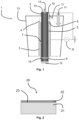
- an atmospheric pressure plasma jet apparatus (or plasma torch) 1 can be utilized for carrying out an exemplary embodiment of the method of the invention.
- the apparatus 1 allows to obtain an atmospheric pressure plasma discharge by a dielectric barrier discharge (DBD).
- the apparatus 1 advantageously comprises a first electrode 2 and a second electrode 3.
- the second electrode 3 can be arranged coaxial with the first electrode 2.
- the first electrode 2 is arranged centrally and the second electrode 3 can be arranged to surround the first electrode 2 and being coaxial with the first electrode 2.
- An electrical insulator 4 is coaxially disposed between the first, central electrode 2 and the second, outer electrode 3.
- a discharge lumen 5 in which a plasma discharge occurs is provided between the electrical insulator 4 and the first electrode 2.
- the second electrode 3 acts as a high voltage electrode, and the first electrode 2 can be grounded.
- the discharge lumen 5 is provided between the electrical insulator 4 and the second electrode, and the first electrode 2 can be the high voltage electrode.
- the high voltage (HV) electrode refers to the electrode connected to a radio frequency power supply 6 as known in the art. It will be appreciated that the first and second electrodes can alternatively have a planar configuration, or any other suitable configuration, such as elliptical, with the electrical insulator interposed between them and spaced apart from one of the electrodes to define the discharge lumen.
- the electrical insulator 4 may be a dielectric medium, such as Al 2 O 3 .
- a spacing between an outer surface of the first electrode 2 (or of the second electrode 3 as the case may be) and an inner surface of the electrical insulator 4 defining the discharge lumen 5 is between 0.1 mm and 10 mm, such as between 1 and 5 mm, preferably around 1.5 mm. The distance can be controlled by ceramic spacers 7.
- the discharge lumen 5 extends between a distal end 8 and a proximal end 9, forming an outlet.
- a supply opening disposed at the distal end 8 of the discharge lumen 5 allows for supplying a carrier gas 11 to the discharge lumen 5.
- the carrier gas is advantageously an inert gas, such as nitrogen, helium or argon, or a combination of two or more thereof.
- the carrier gas comprises nitrogen. More preferably, the carrier gas essentially consists of nitrogen.
- a precursor 13, in particular in gaseous, vapour or aerosol form, can be applied through a supply opening 14, either directly into the plasma discharge chamber (discharge lumen 5), or into the afterglow zone 12.
- the central, first electrode 2 is hollow having an internal lumen.
- the precursor 13 is introduced through the internal lumen of the grounded electrode 2 and egresses in the afterglow zone 12, where it can be activated by the plasma-excited carrier gas. Subsequently, the activated precursor reacts with the exposed surface of a substrate to be treated.
- a precursor is advantageously not introduced in the plasma discharge or afterglow.
- a slit opening 15 can optionally be provided between the proximal end 9 and the plasma afterglow zone 12.
- the slit opening 15 allows to control the supplied amount of precursor 13.
- the slit opening 15 can have a width of between 0.1 mm and 5 mm, such as between 0.2 mm and 2.5 mm, between 0.25 mm and 1 mm, preferably for the method of the invention around 0.5 mm.
- the substrate having a surface comprising a metallic element can be arranged in the afterglow zone 12 by means of a substrate holder, such as a plate or a grid or a tray, whereon or wherein the substrate is placed.
- the substrate holder can be moved relative to the plasma jet apparatus 1 to apply the plasma treatment to the entire surface.
- the substrate holder and plasma jet apparatus 1 can be moved with respect to each other, in particular the substrate holder and afterglow can be moved with respect to each other.
- the exposed surface is oriented towards the proximal end 9 of the discharge lumen 5 to ensure an optimal contact with the activated gas in the afterglow zone 12.
- the substrate holder can be moved with respect to the plasma jet afterglow in a direction which extends along the substrate surface, for example in a direction which is substantially parallel to the surface.
- the substrate holder can be moved towards and away from the plasma jet afterglow - i.e. the substrate surface can be moved towards and away from the plasma jet afterglow.
- the carrier gas advantageously comprises, or consists essentially of, nitrogen (N 2 ).
- the precursor gas if used, comprises, or consists essentially of, nitrogen.
- the carrier gas and/or precursor gas can substantially consist of or can comprise one or more further inert gases, for example helium (He) or argon (Ar), in addition to nitrogen.
- the carrier gas and/or precursor gas comprises N 2 in an amount of at least 90 vol.%, for example at least 92 vol.%, preferably at least 95 vol.%, such as at least 97.5 vol.%, more preferably at least 98 vol.%, most preferably at least 99 vol.%, such as at least 99.5 vol.%, at least 99.75 vol.%, at least 99.9 vol.%, or at least 99.95 vol.%.
- the inventors have observed that, even when use is made of N 2 gas of technical quality with a purity of about 90 vol.
- a protective layer which essentially consists of a nitride of the metallic element, in which impurities such as the corresponding metal oxide, metal hydroxide, metal carbonate or others are absent or present at such a level that cannot be detected with available analytical methods.
- the protective layer obtained by methods of the present disclosure comprises the nitride of the metallic element in an amount of at least 60 mol%, at least 70 mol%, at least 75 mol%, at least 80 mol%, at least 85 mol%, at least 90 mol%, or at least 95 mol% of the nitride of the metallic element.
- Mol% is expressed with respect to the composition of the protective layer, as determined by XPS.
- the concentration of an oxidizing gas, in particular O 2 , in the carrier gas and/or precursor gas is equal to or lower than 5 vol.%, such as equal to or lower than 1 vol.%, equal to or lower than 0.75 vol.%, preferably equal to or lower than 0.5 vol.%, for example equal to or lower than 0.25 vol.%, equal to or lower than 0.1 vol.%, equal to or lower than 0.075 vol.%, more preferably equal to or lower than 0.05 vol.%, such as equal to or lower than 0.025 vol.%, equal to or lower than 0.01 vol.%, equal to or lower than 0.0075 vol.%, most preferably equal to or lower than 0.005 vol.%.
- the power supply 6 is preferably arranged to provide an AC or DC voltage, between 0.5 kV and 50 kV, such as between 1 kV and 10 kV.
- the voltage may be applied to either one, or both of the first and second electrodes by the power source as a continuous wave, i.e. the plasma discharge may be a continuous wave discharge.
- the voltage may be applied to either one, or both of the first and second electrodes by the power supply as a pulsed wave, i.e. the plasma discharge may be a pulsed plasma discharge.
- the frequency of the voltage applied by the power supply may be from kHz to GHz, for example 18 kHz or 13.56 MHz.
- the exposed surface comprising the metallic element and/or an alloy thereof is contacted subsequent to activating the gas by the atmospheric pressure plasma discharge in a so-called indirect plasma treatment, remote plasma treatment, or afterglow plasma treatment.
- the surface to be treated is kept remote from the discharge lumen 5.
- the inventors have surprisingly discovered that by contacting the surface of the substrate with the afterglow of the atmospheric pressure plasma discharge, without exposing the surface directly to the plasma discharge, it is possible to obtain a nitride of the metallic element which is highly crystalline and has a particular morphology as will be described further below. This morphology is immediately formed within the first minute of contacting the exposed surface with the afterglow of the activated gas. Further, this morphology is maintained with increasing treatment times.
- the protective layer can comprise a plurality of pillars of the nitride of the metallic element and/or can substantially be monocrystalline.
- monocrystalline it is meant that the nitride is present in crystals which comprise substantially a single type of crystal lattice.
- the single type of crystal lattice is in particular substantially ⁇ -phase type of crystal lattice.
- the temperature of the exposed metal and/or metal alloy surface in step (ii) is advantageously maintained below the melting temperature of the metallic element and/or the alloy of the metallic element.
- This may be achieved by exposing the substrate surface to a plasma afterglow treatment, and by avoiding direct exposure to the plasma discharge (the plasma discharge chamber). Additionally, or alternatively, this may be achieved by moving the substrate surface relative to the plasma discharge chamber, and thus to the afterglow, as explained hereinbefore.
- the skilled person will be able to select the appropriate temperature taking into account the nature of the metal or metal alloy.
- ⁇ °C is equal to or lower than 700°C, preferably equal to or lower than 500°C, more preferably equal to or lower than 400°C, most preferably equal to or lower than 250°C, in particular equal to or lower than 200°C, more in particular equal to or lower than 180°C, preferably equal to or lower than 120°C, more preferably equal to or lower than 100°C, in particular equal to or lower than 75°C.
- the plasma jet apparatus 1 mounts the plasma jet apparatus 1 on an XY table and move the apparatus 1 over the exposed surface to be treated.
- the substrate can be placed on an XY table and moved underneath the plasma jet apparatus 1. By doing so, larger surfaces can be treated, and/or a treatment in multiple passes can be performed.
- step (ii) comprises contacting the surface of the substrate with the activated (afterglow) gas in multiple passes.
- This can be performed by moving the outlet (proximal end 9) of the discharge lumen and the surface of the substrate relative to one another in repeating passes.
- the number of passes can depend on a number of factors, such as the applied power, the distance between the surface and the outlet of the discharge lumen, and the metallic element, and is advantageously between 1 and 10, advantageously between 1 and 8, advantageously between 1 and 5.
- Each unit portion of the exposed surface is advantageously contacted with the activated gas in the afterglow for a total treatment time of between 0.1 seconds and 5 minutes, between 1 second and 4 minutes, such as between 2 seconds and 4.5 minutes, between 5 seconds and 4 minutes, between 10 seconds and 3.5 minutes, between 15 seconds and 3 minutes, preferably between 20 seconds and 2.5 minutes, for example between 25 seconds and 2 minutes, more preferably between 30 seconds and 90 seconds, such as around 60 seconds.
- the total treatment time can refer to the time in a single pass or a multi-pass treatment during which a unit surface area is contacted by the activated gas.
- the treatment time depends on, without being limited thereto, the thickness of the protective layer to be obtained, the composition of the gas, the gas flow, the configuration of the plasma discharge equipment (such as distance between electrodes, if electrodes are present), and the type of plasma discharge (AC or DC or other, pulsed wave or continuous wave, etc.), the plasma discharge power, or the temperature of the exposed surface comprising the metallic element or an alloy thereof.
- the treatment time is advantageously selected such that reaction with the activated species present in the plasma afterglow remains limited to the substrate surface in such a way that a protective layer of a desired thickness may be formed on the substrate surface and that reaction of the bulk of the substrate may be reduced to a minimum or may even be avoided.
- a pre-treatment can be performed to the substrate, in particular to the surface that will be exposed to the activated gas.
- the pre-treatment can comprise one or more of a reductive pre-treatment and a cleaning.
- the pre-treatment can be performed by means of a plasma discharge, or by means of another method, such as a method using one or more liquids. It will however be appreciated that methods as described herein do not require a pre-treatment of the exposed surface prior to applying the protective layer.
- a post-treatment can be performed to the protective layer, in particular a thermal post-treatment, such as a drying step.
- the plasma apparatus can be mounted in a closed environment (not shown), which is advantageously filled with an inert gas, such as nitrogen, helium or argon, or a mixture of two or more thereof.
- a closed environment is advantageously filled with an inert gas, such as nitrogen, helium or argon, or a mixture of two or more thereof.
- the closed environment is filled with N 2 .
- the closed environment allows to reduce the presence of unwanted impurities in the afterglow zone.
- an article comprising a substrate and a protective layer arranged on at least part of substrate.
- the protective layer is advantageously obtained by methods as described herein.
- the protective layer and the substrate share an interface.
- the interface comprises a metallic element and/or an alloy of the metallic element.
- the metallic element is an alkali metal or an alkaline earth metal.
- the metallic element and the substrate are as defined above in relation to the method of the invention.
- the protective coating advantageously comprises a nitride of the metallic element.
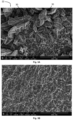
- an article 20 according to aspects as described herein comprises a substrate 21 and a protective layer 22 arranged thereon.
- the bulk substrate 21 and the protective layer 22 share an interface 23.
- the protective layer is advantageously directly arranged on the substrate 21 at the interface 23, without any other interposed layer between them.
- the protective layer is conductive to ions of the metallic element.
- the metallic element is lithium (Li)
- the protective layer advantageously is conductive to lithium ions.
- the protective layer is impermeable to electrons.
- the protective layer is passivated to reactions with the electrolyte.
- the protective layer advantageously minimizes reactions between the substrate and the electrolyte.
- the protective layer comprises a plurality of pillars projecting from the interface.
- projecting from the interface it is meant that the pillars are grown and thus present on the surface in a direction different from the plane of the interface.
- the pillars are spaced apart.
- the pillars can be branched, e.g. comprising side-branches. Alternatively, the pillars can be substantially straight.
- the pillars can comprise pyramid-shaped tips at the top of the pillar and/or at side-branches of the pillar.
- the plurality of pillars each comprise a cross section in a plane perpendicular to a direction of projection (i.e., a direction of extension) of the pillar, or of the branch, which has a polygonal shape.
- the polygonal shape can be a fern-shape, a kite-shape, a butterfly-shape or, in particular, a star-shape.
- the pillars can have a height between 10 nm and 100 ⁇ m, for example between 25 nm and 75 ⁇ m, preferably between 50 nm and 50 ⁇ m, such as between 75 nm and 45 ⁇ m, between 100 nm and 40 ⁇ m, between 150 nm and 35 ⁇ m, between 200 nm and 30 ⁇ m, more preferably between 250 nm and 25 ⁇ m, for example between 350 nm and 20 ⁇ m, most preferably between 500 nm and 15 ⁇ m, in particular between 1 ⁇ m and 15 ⁇ m or between 5 ⁇ m and 15 ⁇ m.
- the pillar height may increase by exposing the substrate to increasing contact times with the plasma afterglow.
- the thickness and height can be measured by means of scanning electron microscopy (SEM) of the cross-section of the article.
- SEM scanning electron microscopy
- a FEI NovaSEM 450 scanning electron microscope can be used.
- the cross-section can be made by slicing the article by means of a ceramic knife.
- the sliced samples can then be positioned on SEM sample holders placed in a transfer module (brand: Kammrath Weiss Gmbh) to avoid any contamination with moisture and oxygen from the atmosphere during transfer to the scanning electron microscope.
- the pillars are made of a plurality of stacked layers of crystals of the nitride of the metallic element.
- the stacked layers all have a same or identical crystalline structure.
- Each of these stacked layers can have the shape of a polyhedron.
- a polyhedron shape refers a three-dimensional shape with flat polygonal faces, straight edges and sharp corners or vertices. This shape is typically formed on the substrate surface upon contacting the substrate with the plasma afterglow; and it is maintained when the exposure time to the plasma afterglow is increased.
- adjacent layers of crystals within a pillar have substantially the same orientation.
- a first crystal of the nitride of the metallic element can function as a nucleus or seed for the growth of further crystals, thereby obtaining adjacent layers having substantially the same orientation.
- the orientation of a layer can be determined by the longest axis of the geometric figure.
- the layers of crystals further comprise a width and a length.
- the distance between adjacent pillars can be between 100 nm and 5 ⁇ m, such as between 200 nm and 4 ⁇ m, between 250 nm and 3 ⁇ m, preferably between 500 nm and 2 ⁇ m, in particular 1 ⁇ m.
- the distance between adjacent pillars may become smaller.
- reaction of the active species with the substrate surface may no longer be possible, and modification of the bulk of the substrate will start to take place. Usually this is unwanted as it will reduce the energy efficiency of an electrode containing such a material.
- the protective layer comprises a plurality of pillars
- diffusion channels for ions of the metallic element are provided between adjacent pillars.
- Such ion diffusion channels can contribute to an increase of the ionic conductivity.
- the interface surface comprises Li or a Li alloy
- the interface surface comprises Li or a Li alloy
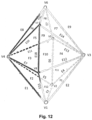
- the hexagonal bipyramid consists of twelve triangular faces, arranged in six pairs.
- the hexagonal bipyramid structure or morphology comprises an average angle between the edges at the basal vertices between 45° and 85°, preferably between 50° and 75°, such as between 50° and 60°, more preferably between 55° and 60°.
- the hexagonal bipyramid morphology comprises an average angle at the vertices at the apex between 40° and 75°, preferably between 45° and 70°, such as between 50° and 65°, more preferably between 55° and 60°.
- the longest dimension of a layer of Li 3 N crystals can be between 0.5 ⁇ m and 5 ⁇ m, preferably between 1 ⁇ m and 4 ⁇ m, more preferably between 1.5 ⁇ m and 2.5 ⁇ m.
- the shortest dimension of a layer of Li 3 N crystals can be between 0.5 ⁇ m and 5 ⁇ m, preferably between 1 ⁇ m and 4 ⁇ m, more preferably between 1.5 ⁇ m and 2.5 ⁇ m.
- the hexagonal bipyramid structure of the Li 3 N crystals can have an aspect ratio between 0.75 and 1.25, such as between 0.8 and 1.2, preferably between 0.9 and 1.1, for example 1, wherein the aspect ratio is the ratio of the width of a crystal to the height of the crystal.
- the aspect ratio is between 0.9 and 1.1, the crystals can be considered to have a substantially symmetrical morphology or structure.
- the protective layer is made substantially of ⁇ -phase of the nitride of the metallic element, in particular the concentration of ⁇ -phase of the nitride of the metallic element is at least 90%, such as at least 92.5%, at least 95%, at least 98%, or at least 99% on metals basis.
- the protective layer is substantially free from ⁇ -phase of the nitride of the metallic element. With 'substantially free' it is meant that the concentration of ⁇ -phase of the nitride of the metallic element is below the limit of detection of analysis methods, in particular X-ray diffraction (XRD).
- the protective layer mainly comprises crystalline ⁇ -Li 3 N (a-phase Li 3 N).
- the ⁇ -Li 3 N crystalline phase is arranged in pillars which protrude from the Li or Li alloy surface (interface) and are distanced from each other (at least over part of their height) to provide Li ion diffusion channels between them.
- the protective layer was observed to be free of ⁇ -Li 3 N ( ⁇ -phase Li 3 N), which means that it does not contain ⁇ -Li 3 N in an amount that is detectable with X-ray diffraction.
- the ⁇ -phase Li 3 N crystals have a hexagonal structure comprising edgesharing layers of planar lithium hexagons centred by nitrogen in the ab plane.
- Each of these hexagons is connected by a lithium ion above and another lithium ion below, both lithium ions along the c plane.
- each nitrogen atom is coordinated by a total of eight lithium atoms in hexagonal bipyramidal geometry.
- Protective layers as described herein were found to be mechanically stable, even when subjecting them to changing electrical fields in the form of repeated plating/stripping cycles, and, when used in an electrode of a battery, in the form of repeated charging/discharging cycles.
- the plurality of pillars and/or the crystalline morphology are maintained upon repeated plating/stripping cycles of the article, in particular at least for 250 cycles at a current density of 1 mA/cm 2 , such as at least for 300 cycles, at least for 400 cycles, preferably at least for 500 cycles, more preferably at least for 600 cycles, most preferably at least for 700 cycles, such as at least for 750 cycles.
- the ⁇ -phase of the nitride are maintained upon repeated charging/discharging cycles of the article, in particular at least for 250 cycles at a current density of 1 mA/cm 2 , such as at least for 300 cycles, at least for 400 cycles, preferably at least for 500 cycles, more preferably at least for 600 cycles, most preferably at least for 700 cycles, such as at least for 750 cycles.
- the protective layer of the invention comprises high conductivity pathways in which excellent metal ion transport can take place (high ionic conductivity).
- high conductivity pathways are advantageously provided by means of the pillar-morphology and/or the high concentration of ⁇ -crystals in the protective coating.
- the protective layer also provides an improved resistance to the substrate to volume changes upon charging and discharging of the battery compared to prior art protective layers having a different crystallinity and/or morphology, leading to a reduced damage of the protective layer over time.
- the protective layer comprises at least 60 mol %, for example at least 70 mol%, at least 75 mol%, at least 80 mol%, at least 90 mol% or at least 95 mol% of the nitride of the metallic element.
- the protective layer comprises at most 40 mol% of an oxide of the metallic element, such as at most 20 mol%, at most 15 mol%, preferably at most 10 mol%, more preferably at most 5 mol%, most preferably at most 3 mol% of an oxide of the metallic element.
- the protective layer as obtained as described herein has a Young's modulus equal to or lower than 45 GPa, indicating a certain degree of flexibility and providing resistance against cracking of the layer upon repeated stripping/plating of the article.
- the passivated substrate i.e. the substrate comprising a protective layer of the invention, is advantageously as malleable as the bare substrate.
- the article of the invention is advantageously used as (part of) an electrode.
- the electrode is advantageously an anode.
- the electrode can be used in a battery or a battery cell.
- the electrode is used in the battery cell as an anode.
- Particularly preferred is a lithium-ion, a solid-state lithium-ion, a Li-S (lithium-sulphur) or a lithium-air battery or battery cell comprising a lithium anode with a protective layer as described herein.
- Fig. 4 represents an exemplary embodiment of a battery cell 40.
- the battery cell 40 has a coin-cell configuration known in the art as a CR2032 type configuration.
- the battery cell 40 comprises an anode 41 and a cathode 42.
- the anode 41 is an electrode according to the present invention.
- the battery cell 40 further comprises a liquid electrolyte (not shown).
- the battery cell advantageously comprises a battery separator membrane 43 between the anode 41 and the cathode 42.
- the cathode can for example be a sulphur-based cathode, such as for a Li-S battery cell.
- the battery cell 40 further comprises a coin cell lid 44, a coin cell base 45, a spacer 46 and a spring 47. The spacer 46 and the spring 47 provide good contact between the other components 41, 42, 43, 44, 45 of the battery cell 40.
- the electrolyte may be a solid electrolyte.
- a solid electrolyte may be a solid polymer or a solid inorganic glass.
- the solid electrolyte may be poly(ethylene oxide) (PEO) with lithium salts dispersed in the polymer matrix of the PEO.
- the electrolyte may be a liquid electrolyte.
- the electrolyte may be an ionic liquid, optionally comprising an organic component, a salt-solvent mixture, preferably a super-saturated salt-solvent mixture.
- a liquid electrolyte may be an ionic liquid with lithium salt dissolved therein, or a mixture of an ionic liquid and an organic liquid with a dissolved lithium salt.
- liquids that may be used include polyethylene glycol dimethyl ether (PEG DME) or an organic solvent such as dioxolane mixed with dimethyl ether.
- the liquid electrolyte may comprise a compound of tetraethylene glycol dimethyl ether (PEGDME) and lithium bis(trifluoromethanesulfonyl)imide (LiTFSI).
- a useful ionic liquid is methyl-butyl pyridinium trifluorosulfonyl imide (PYR14TFSI).
- the electrolyte has a 1:1 ratio by weight of PYR14TFSI and PEGDME, with 1 mol/kg LiTFSI.
- the electrolyte comprises 1M lithium bis(trifluoromethanesulfonyl)imide (LiTFSI) in dimethoxyethane (DME):1,3-dioxolane (DOL) with a weight ratio of 2:1.
- LiTFSI lithium bis(trifluoromethanesulfonyl)imide
- DME dimethoxyethane
- DOL 1,3-dioxolane
- the electrolyte may be a gel electrolyte.
- a gel electrolyte may be a polymer-gelled organic medium.
- the gel electrolyte may be a mixture of poly(methyl methacrylate) (PMMA), a lithium salt and a small amount of liquid.
- the battery separator membrane can be a porous separator membrane.
- Polymeric battery separator membranes known in the field may be used, such as a porous polypropylene (PP) membrane or a porous polyethylene (PE) membrane.
- PP and PE are preferred materials because of their chemically inert character. However they are not easily wetted, while it is preferred that the porous separator may absorb the liquid electrolyte.
- the hydrophobic PP and PE may be treated with a surface treatment or a coating, such as a spray coating, a dip coating or a plasma coating - atmospheric pressure plasma or low pressure plasma.
- the battery separator membrane may be a ceramic material.
- a lithium metal substrate was treated with a method of the invention.
- the plasma jet apparatus of Fig. 1 was used, wherein the lithium metal substrate was mounted on a substrate holder and placed in the afterglow zone 12 of an atmospheric pressure dielectric barrier discharge.
- the substrate holder was moved by means of an XY translation table in a plane parallel to the outlet of the discharge lumen of the plasma jet apparatus so as to expose the entire surface to the afterglow zone.
- the plasma jet apparatus was mounted in a closed environment as described above. Nitrogen was added to the closed environment to limit the presence of unwanted impurities, in particular oxygen and water vapour.
- the gas used for the plasma discharge was N 2 as precursor and as carrier gas.
- the total nominal gas flow of N 2 carrier gas and precursor gas was 20 slm.
- the plasma power was 300 W and the frequency was 17 kHz.
- the duration of contacting the exposed surface with the activated N 2 gas was 1 minute (1 pass).
- the temperature of the exposed surface was around 80°C.
- the distance between the proximal end of the discharge lumen and the exposed lithium metal surface of the substrate was 3 mm.
- the closed environment comprised less than 50 ppm O 2 .
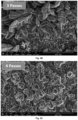
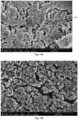
- Fig. 3A shows a SEM-image of the obtained lithium nitride layer after three passes. With three passes it is meant that the exposed surface of the substrate was contacted three times with the activated gas, wherein each one of the three passes was performed as described above.
- the protective layer clearly shows a morphology or structure comprising a plurality of pillars 30 projecting from the substrate.
- the pillars have a pyramid-shaped tip.
- the lithium nitride crystals are stacked in a direction away from the lithium metal surface of the substrate.
- such structure comprising pillars was not observed when the surface of a same substrate was exposed to a flow of nitrogen at room temperature for several hours without any plasma discharge being present, as shown in Fig. 3B .
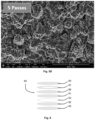
- Fig. 5A , 5B , 5C and 5D show the morphology of the obtained lithium nitride layer after 2, 3, 4 and 5 passes, respectively, wherein each one of the passes was performed as described above.
- the morphology of the protective layer after 2 and 3 passes (1 minute and 1.5 minutes total treatment time of each portion of the exposed surface) shows that the lithium nitride layer comprises a plurality of pillars, whereas after 4 and 5 passes this is less clear. This can be explained by the fact that with each pass, lithium nitride crystals can be obtained not only on the top of the pillars, but also at the sides, resulting in pillars having a less "straight" or "linear" structure or form.
- the inventors have discovered that for the optimal performance of the protective layer, a more "linear" or “straight" shape of the pillars is advantageously present. Hence, it can be beneficial to limit the number of passes or the total treatment time in order to obtain this particular and particularly beneficial morphology.
- Li-ion battery cells were made to evaluate the charge/discharge characteristics and the cycle life characteristics of the anode comprising a protective layer.
- the battery cells were produced in a glovebox filled with argon and with an oxygen and moisture level below 1 ppm to reduce the risk for contamination during production.
- Battery cells of the type represented by Fig. 4 were made, in which the anode was an electrode obtained through Example 1.
- a reference battery cell was made in which the anode was lithium metal without any protective layer.
- the cathode was prepared in-house by coating a slurry containing appropriate amounts of lithium cobalt oxide (LCO), carbon and a binder on an aluminium foil.
- LCO lithium cobalt oxide
- a polymeric separator was placed between the anode and the cathode.
- the battery cells were filled with 90 ⁇ L of an electrolytic solution comprising 1M lithium hexafluorophosphate (LiPF 6 ) in a mixture of ethylene carbonate and dimethyl carbonate (EC/DMC) with a weight ratio of 1:1.
- the battery cells were sealed with a pneumatic press.
- Li-S battery cells were made to evaluate the charge/discharge characteristics and the cycle life characteristics of the anode comprising a protective layer.
- the battery cells were produced in a glovebox filled with argon and with an oxygen and moisture level below 1 ppm to reduce the risk for contamination during production.
- Battery cells of the type represented by Fig. 4 were made, in which the anode was an electrode obtained through Example 1.
- a reference battery cell was made in which the anode was lithium metal without any protective layer.
- the cathode was prepared in-house by coating a slurry containing appropriate amounts of sulphur, carbon and a binder on an aluminium foil. A polymeric separator was placed between the anode and the cathode.
- the battery cells were filled with 90 ⁇ L of an electrolytic solution comprising 1M lithium bis(trifluoromethanesulfonyl)imide (LiTFSI) in dimethoxyethane (DME)/1,3-dioxolane (DOL) with a weight ratio of 2:1 and without LiNO 3 additive.
- LiTFSI lithium bis(trifluoromethanesulfonyl)imide
- DME dimethoxyethane
- DOL dimethoxyethane
- LiNO 3 additive LiNO 3 additive
- Li-S symmetric battery cells as represented in Fig. 6 , were made to evaluate how the internal resistance of the anode with and without the protective layer evolves as a function of time.
- the battery cells were produced in a glovebox filled with argon and with an oxygen and moisture level below 1 ppm to reduce the risk for any contamination during production.
- the Li-S symmetric battery cells 60 are similar to the battery cells 40 of Fig. 4 , with the difference that both electrodes 61, 62 are identical.
- the electrodes were lithium metal substrates without any protective layer.
- the electrodes 61, 62 were obtained through Example 1.
- a polymeric separator 63 was placed between the electrodes 61 and 62.
- the battery cells 60 were filled with 90 ⁇ L of an electrolytic solution comprising 1M lithium bis(trifluoromethanesulfonyl)imide (LiTFSI) in dimethoxyethane (DME)/1,3-dioxolane (DOL) with a weight ratio of 2:1 and without LiNO 3 additive.
- a coin cell lid 64 and a coin cell base 65 were provided, as well as a spacer 66 and a spring 67 to ensure good contact between the components of the cell 60.
- the battery cells 60 were sealed with a pneumatic press.
- Electrochemical impedance spectroscopy was performed on the reference symmetrical battery cell and symmetrical battery cell according to the invention. A 10 mV AC potential was applied to the cell during the frequency sweep. The frequency sweep was performed from 100 kHz to 0.01 Hz.
- Fig. 7A and Fig. 7B show the Nyquist plot of the impedance data for the reference symmetrical battery cell and the symmetrical battery cell according to the invention, respectively.
- the abscissa shows the real part of the impedance data
- the ordinate shows the imaginary part of the impedance data.
- Figs. 7A and 7B show the results at the start of the experiment (time 0) up to 120 hours of testing, represented in 6 hour intervals (results at time 0, after 6h, 12h, 18h, 24h, and so on up to 120 h).
- the impedance spectra of both the reference cell and the battery cell according to the invention consist of a semi-circle in the high-mid frequency region, which corresponds to the surface layer resistance.
- the symmetric battery cell configuration 60 of example 4 was used to evaluate the lithium plating/stripping behaviour of the electrode by monitoring the evolution of the overpotential over time when a constant current of 1 mA/cm 2 is applied.
- An Ametek PARSTAT PMC-200 multichannel potentiostat was used to perform these measurements.
- Fig. 8A shows the potential values measured for a duration of almost 500 hours for the reference battery cell (A, black) and for a duration of almost 1400 hours for the battery cell of the invention (B, grey).
- the potential values represent the deterioration of the lithium metal.
- the electrode comprising a lithium metal substrate without protective layer shows earlier (from 175 hours test duration on) and more deterioration than the electrode of the invention.
- the electrode of the invention shows no detectable signs of deterioration up to at least almost 1300 hours test duration (longer was not tested).
- Fig. 8B shows a close-up view of the plating/stripping overpotential of the electrode of the invention after a test duration around 1200 hours.
- the potential-time profile shows an excellent efficiency and stability of the protective layer and thus the passivated lithium metal.
- Fig. 9A shows the SEM image of one of the electrodes in the symmetrical battery cell according to the invention at the end of the plating/stripping testing (almost 1400 hours testing).
- a SEI layer 90 has formed on the electrode, and a portion of the protective layer 91 is visible.
- Fig. 9B and Fig. 9C show detailed views of the morphology of the protective layer 91. The morphology comprising a plurality of pillars is still clearly visible, as well as the pyramid-shaped top 92, indicating that the layer morphology has thus not significantly changed.
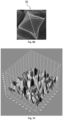
- Fig. 9D shows a geometrical outline of the morphological features of the pyramid-shaped top superimposed on an individual crystal layer.
- a 3D surface plot generated by ImageJ software from SEM images of a Li 3 N layer of the invention clearly shows the protective layer comprising a plurality of pillars ( Fig. 10 ), wherein the stacking of the layers of lithium nitride crystals extends substantially along a plane away from the lithium metal surface, the plane being substantially perpendicularly oriented in relation to the surface.
- the (measurable) average height of the pillars is 5 ⁇ m with a standard deviation of 0.9 ⁇ m.
- Such a stacking seems to lead to an anisotropic nature of the crystal lattice, which could impart beneficial properties such as low activation barrier for lithium ion migration along specific directions and consequently high ionic conductivity on the material.
- Fig. 11A shows lithium dendrite formation in the reference battery cell (no protective layer) for test durations of 175 hours and more, whereas the battery cell of the invention does not show any dendrite formation after 54 days (1300 hours) of testing ( Fig. 11B ).
- Such lithium dendrites eventually lead to short circuiting of the cell.
- Fig. 9A shows that the absolute overpotential values are higher and that the overpotential signal is less stable for the reference battery cell compared to the battery cell of the invention. Peak values are visible and become more frequent for test durations longer than 350 hours, indicating inhomogeneous plating/stripping of lithium due to the formation of heterogeneous surface film whose resistance increases over time.
- the protective layer thus provides clear protection against lithium dendrite formation by enabling a smooth and stable surface film with minimal increase in resistance.
- a lithium metal substrate was treated as described in example 1, except that the gas used for the plasma discharge was N 2 as precursor gas in Ar as carrier gas.
- the total nominal gas flow of Ar carrier gas and N 2 precursor gas was 20 slm.
- the plasma power was 300 W and the frequency was 17 kHz.
- the duration of contacting the exposed surface with the activated N 2 gas was 2 minutes (3 passes).
- the temperature of the exposed surface was around 80°C.
- the distance between the proximal end of the discharge lumen and the exposed lithium metal surface of the substrate was 3 mm.
- the closed environment comprised less than 50 ppm O 2 .
- Fig. 13A shows the SEM image of the obtained lithium nitride layer .
- the morphology of the protective layer after 3 passes is same as the morphology obtained when nitrogen is used as the precursor as well as the carrier gas, such as the protective layers of Example 1.
- Li-S symmetric battery cells as represented in Fig. 6 , were made to evaluate how the internal resistance of the anode with and without the protective layer of example 6 evolves as a function of time.
- the battery cells were produced as described above.
- the electrodes were lithium metal substrates without any protective layer.
- the electrodes 61, 62 were obtained through Example 6.
- the other components of the battery cell were as described in example 5.
- the symmetric battery cell configuration 60 was used to evaluate the lithium plating/stripping behaviour of the electrode by monitoring the evolution of the overpotential over time when a constant current of 1 mA/cm 2 is applied.
- An Ametek PARSTAT PMC-200 multichannel potentiostat was used to perform these measurements.
- Fig. 13B shows the potential values measured for a duration of almost 500 hours for the reference battery cell (C, black) and for a duration of almost 700 hours for the battery cell of the invention (D, grey).
- the potential values represent the deterioration of the lithium metal.
- the electrode comprising a lithium metal substrate without protective layer shows earlier (from 175 hours test duration on) and more deterioration than the electrode of the invention.
- the electrode of the invention shows no detectable signs of deterioration up to at least almost 700 hours test duration (longer was not tested).
- the stability of the battery cell of Example 7 is (surprisingly) even better than that of the battery cell having electrodes 61, 62 obtained through Example 4 (i.e. with only nitrogen gas being used as precursor and carrier gas), as shown by the lower overpotential (54 mV compared to 83 mV observed in Fig. 8A ) after 700 hours.
Landscapes
- Chemical & Material Sciences (AREA)
- Chemical Kinetics & Catalysis (AREA)
- Engineering & Computer Science (AREA)
- Electrochemistry (AREA)
- General Chemical & Material Sciences (AREA)
- Materials Engineering (AREA)
- Composite Materials (AREA)
- Manufacturing & Machinery (AREA)
- Mechanical Engineering (AREA)
- Metallurgy (AREA)
- Organic Chemistry (AREA)
- Battery Electrode And Active Subsutance (AREA)
- Chemical Vapour Deposition (AREA)
- Solid-Phase Diffusion Into Metallic Material Surfaces (AREA)
- Inorganic Chemistry (AREA)
- Other Surface Treatments For Metallic Materials (AREA)
Claims (18)
- Ein Verfahren zum Aufbringen einer Schutzschicht (22) auf mindestens einen Teil einer freiliegenden Oberfläche (23) eines Substrats (21), das Verfahren umfassend die folgenden Schritte:(i) Aktivieren eines Gases in einer Plasmaentladungskammer mittels einer Plasmaentladung bei atmosphärischem Druck, um ein aktiviertes Gas zu erlangen, wobei das Gas Stickstoff (N2) umfasst, und(ii) Inkontaktbringen der freiliegenden Oberfläche (23) mit einem Nachglühen des aus der Plasmaentladungskammer austretenden aktivierten Gases, um die Schutzschicht auf mindestens einem Teil der freiliegenden Oberfläche zu bilden,wobei die Oberfläche ein metallisches Element und/oder eine Legierung des metallischen Elements umfasst, wobei das metallische Element ein Alkalimetall oder ein Erdalkalimetall ist, und wobei die Schutzschicht ein Nitrid des metallischen Elements umfasst,dadurch gekennzeichnet, dass sich die Oberfläche und die Plasmaentladungskammer während des Kontakts der freiliegenden Oberfläche mit dem Nachglühen des aktivierten Gases in Bezug aufeinander bewegen.
- Das Verfahren nach Anspruch 1, wobei das Gas N2 in einer Menge von mindestens 90 Volumen-%, vorzugsweise mindestens 95 Volumen-%, bevorzugter mindestens 98 Volumen-%, am meisten bevorzugt mindestens 99 Volumen-%, insbesondere mindestens 99,5 Volumen-% umfasst.
- Das Verfahren nach Anspruch 1 oder 2, wobei die Konzentration eines oxidierenden Gases, wie beispielsweise O2, in dem Gas gleich wie oder niedriger als 0,5 Volumen-%, vorzugsweise gleich wie oder niedriger als 0,05 Volumen-%, bevorzugter gleich wie oder niedriger als 0,005 Volumen-% ist.
- Das Verfahren nach irgendeinem der vorherigen Ansprüche, wobei das metallische Element Natrium (Na), Lithium (Li) oder Magnesium (Mg) ist und das Nitrid Natriumnitrid (Na3N), Lithiumnitrid (Li3N) bzw. Magnesiumnitrid (Mg3N2) ist.
- Das Verfahren nach irgendeinem der vorherigen Ansprüche, wobei die freiliegende Oberfläche von der Plasmaentladung bei atmosphärischem Druck entfernt gehalten wird.
- Das Verfahren nach irgendeinem der vorherigen Ansprüche, wobei die freiliegende Oberfläche mit dem aktivierten Gas bei einer Temperatur gleich wie oder niedriger als 700 °C, vorzugsweise gleich wie oder niedriger als 180 °C, bevorzugter gleich wie oder niedriger als 120 °C, am meisten bevorzugt gleich wie oder niedriger als 100 °C, insbesondere gleich wie oder niedriger als 75 °C, in Kontakt gebracht wird.
- Das Verfahren nach irgendeinem der vorherigen Ansprüche, wobei das Inkontaktbringen der freiliegenden Oberfläche mit dem aktivierten Gas abwechselnd Zeiträume umfasst, in denen die freiliegende Oberfläche mit dem aktivierten Gas, das eine höhere Konzentration reaktiver Spezies umfasst, in Kontakt gebracht wird, und Zeiträume, in denen die freiliegende Oberfläche mit dem aktivierten Gas, das eine niedrigere Konzentration der reaktiven Spezies umfasst, in Kontakt gebracht wird.
- Das Verfahren nach irgendeinem der vorherigen Ansprüche, wobei die freiliegende Oberfläche in Bezug auf das Nachglühen des aus der Plasmaentladungskammer austretenden aktivierten Gases in einer Ebene parallel zu einem Auslass der Plasmaentladungskammer bewegt wird.
- Das Verfahren nach irgendeinem der vorherigen Ansprüche, wobei die Oberfläche in mehreren Durchgängen mit dem Nachglühen des aktivierten Gases in Kontakt gebracht wird.
- Ein Gegenstand (20), der durch das Verfahren nach irgendeinem der Ansprüche 1 bis 9 erlangbar ist, der Gegenstand umfassend ein Substrat (21) und eine Schutzschicht (22), die mindestens einen Teil des Substrats (21) bedeckt, wobei die Schutzschicht (22) und das Substrat (21) eine Grenzfläche (23) teilen, wobei die Grenzfläche (23) ein metallisches Element und/oder eine Legierung des metallischen Elements umfasst, wobei das metallische Element ein Alkalimetall oder ein Erdalkalimetall ist, dadurch gekennzeichnet, dass die Schutzschicht (22) eine Vielzahl von beabstandeten Säulen (30) umfasst, die von der Grenzfläche (23) hervorstehen, wobei die Säulen (30) aus gestapelten Schichten von Kristallen eines Nitrids des metallischen Elements gefertigt sind, und wobei die gestapelten Schichten von Kristallen eine Polyederform umfassen.
- Der Gegenstand nach Anspruch 10, wobei die Vielzahl von Säulen jeweils ein Spitzenende aufweisen, wobei das Spitzenende einen Scheitelpunkt oder eine Kante der Polyederform bildet.
- Der Gegenstand nach Anspruch 10 oder 11, wobei das metallische Element Lithium ist und die gestapelten Schichten aus Li3N-Kristallen hexagonale Bipyramidenstrukturen umfassen.
- Der Gegenstand nach irgendeinem der Ansprüche 10 bis 12, wobei die Säulen eine freie Höhe zwischen 10 nm und 100 µm, vorzugsweise zwischen 50 nm und 50 µm, bevorzugter zwischen 250 nm und 25 µm, am meisten bevorzugt zwischen 500 nm und 15 µm, insbesondere zwischen 1 µm und 15 µm, aufweisen.
- Der Gegenstand nach irgendeinem der Ansprüche 10 bis 13, wobei die Schutzschicht im Wesentlichen aus der α-Phase des Nitrids des metallischen Elements gefertigt ist und vorzugsweise im Wesentlichen frei von β-Phase des Nitrids ist, wobei die Schutzschicht vorzugsweise zu mindestens 90 % auf Metallbasis aus der α-Phase des Nitrids des metallischen Elements, vorzugsweise zu mindestens 95 % gefertigt is.
- Der Gegenstand nach Anspruch 14, wobei die α-Phase des Nitrids bei wiederholten Plattierungs-/Abstreifungszyklen des Gegenstands beibehalten wird, insbesondere über mindestens 250 Zyklen bei einer Stromdichte von 1 mA/cm2, vorzugsweise über mindestens 500 Zyklen, bevorzugter über mindestens 600 Zyklen, am meisten bevorzugt über mindestens 700 Zyklen.
- Der Gegenstand nach irgendeinem der Ansprüche 10 bis 15, wobei die Schutzschicht (22) mindestens 60 Mol-%, vorzugsweise mindestens 70 Mol-%, bevorzugter mindestens 80 Mol-% und am meisten bevorzugt mindestens 90 Mol-% des Nitrids des metallischen Elements umfasst.
- Eine Elektrode (41, 61, 62), vorzugsweise eine Anode, umfassend den Gegenstand (20) nach irgendeinem der Ansprüche 10 bis 16.
- Batteriezelle (40), umfassend die Elektrode (41) nach Anspruch 17 als Anode.
Applications Claiming Priority (2)
| Application Number | Priority Date | Filing Date | Title |
|---|---|---|---|
| EP21192479.0A EP4137604A1 (de) | 2021-08-20 | 2021-08-20 | Verfahren zum aufbringen einer schutzschicht auf eine metall- oder metalllegierungsoberfläche und artikel mit solch einer schutzschicht |
| PCT/EP2022/073362 WO2023021224A1 (en) | 2021-08-20 | 2022-08-22 | Method for applying a protective layer to a metal or metal alloy surface, and article comprising such protective layer |
Publications (3)
| Publication Number | Publication Date |
|---|---|
| EP4359582A1 EP4359582A1 (de) | 2024-05-01 |
| EP4359582B1 true EP4359582B1 (de) | 2025-03-12 |
| EP4359582C0 EP4359582C0 (de) | 2025-03-12 |
Family
ID=77447734
Family Applications (2)
| Application Number | Title | Priority Date | Filing Date |
|---|---|---|---|
| EP21192479.0A Withdrawn EP4137604A1 (de) | 2021-08-20 | 2021-08-20 | Verfahren zum aufbringen einer schutzschicht auf eine metall- oder metalllegierungsoberfläche und artikel mit solch einer schutzschicht |
| EP22761255.3A Active EP4359582B1 (de) | 2021-08-20 | 2022-08-22 | Verfahren zum aufbringen einer schutzschicht auf eine metall- oder metalllegierungsoberfläche und artikel mit solch einer schutzschicht |
Family Applications Before (1)
| Application Number | Title | Priority Date | Filing Date |
|---|---|---|---|
| EP21192479.0A Withdrawn EP4137604A1 (de) | 2021-08-20 | 2021-08-20 | Verfahren zum aufbringen einer schutzschicht auf eine metall- oder metalllegierungsoberfläche und artikel mit solch einer schutzschicht |
Country Status (9)
| Country | Link |
|---|---|
| US (1) | US20240376585A1 (de) |
| EP (2) | EP4137604A1 (de) |
| JP (1) | JP2024530258A (de) |
| KR (1) | KR20240044440A (de) |
| CN (1) | CN117813415A (de) |
| ES (1) | ES3024237T3 (de) |
| HU (1) | HUE070857T2 (de) |
| PL (1) | PL4359582T3 (de) |
| WO (1) | WO2023021224A1 (de) |
Families Citing this family (3)
| Publication number | Priority date | Publication date | Assignee | Title |
|---|---|---|---|---|
| KR20250103217A (ko) * | 2023-12-28 | 2025-07-07 | 에스케이온 주식회사 | 리튬 금속 음극 보호막, 리튬 금속 음극, 이의 제조방법 및 리튬 금속 전지 |
| KR20250146660A (ko) | 2024-04-02 | 2025-10-13 | 주식회사 엘지에너지솔루션 | 코팅 장치 |
| EP4711491A1 (de) * | 2024-09-13 | 2026-03-18 | Vito NV | Verfahren zum aufbringen einer schutzschicht auf eine metall- oder metalllegierungsoberfläche und artikel mit einer derartigen schutzschicht |
Family Cites Families (5)
| Publication number | Priority date | Publication date | Assignee | Title |
|---|---|---|---|---|
| JP4624991B2 (ja) * | 2004-03-26 | 2011-02-02 | 積水化学工業株式会社 | 酸窒化膜の形成方法、及び形成装置 |
| JP5263202B2 (ja) * | 2010-03-11 | 2013-08-14 | セイコーエプソン株式会社 | プラズマ処理装置 |
| CN103947027B (zh) * | 2011-10-13 | 2016-12-21 | 赛昂能源有限公司 | 电极结构及其制造方法 |
| JP2018203560A (ja) * | 2017-06-01 | 2018-12-27 | 国立大学法人東京工業大学 | 金属窒化物生成装置及び金属窒化物生成方法 |
| JP7035794B2 (ja) * | 2018-05-18 | 2022-03-15 | トヨタ自動車株式会社 | 燃料電池用セパレーターの製造方法及び製造装置 |
-
2021
- 2021-08-20 EP EP21192479.0A patent/EP4137604A1/de not_active Withdrawn
-
2022
- 2022-08-22 WO PCT/EP2022/073362 patent/WO2023021224A1/en not_active Ceased
- 2022-08-22 PL PL22761255.3T patent/PL4359582T3/pl unknown
- 2022-08-22 JP JP2024510362A patent/JP2024530258A/ja active Pending
- 2022-08-22 KR KR1020247005450A patent/KR20240044440A/ko active Pending
- 2022-08-22 EP EP22761255.3A patent/EP4359582B1/de active Active
- 2022-08-22 CN CN202280055389.2A patent/CN117813415A/zh active Pending
- 2022-08-22 US US18/683,074 patent/US20240376585A1/en active Pending
- 2022-08-22 HU HUE22761255A patent/HUE070857T2/hu unknown
- 2022-08-22 ES ES22761255T patent/ES3024237T3/es active Active
Also Published As
| Publication number | Publication date |
|---|---|
| KR20240044440A (ko) | 2024-04-04 |
| JP2024530258A (ja) | 2024-08-16 |
| CN117813415A (zh) | 2024-04-02 |
| EP4137604A1 (de) | 2023-02-22 |
| HUE070857T2 (hu) | 2025-07-28 |
| EP4359582A1 (de) | 2024-05-01 |
| US20240376585A1 (en) | 2024-11-14 |
| EP4359582C0 (de) | 2025-03-12 |
| ES3024237T3 (en) | 2025-06-04 |
| WO2023021224A1 (en) | 2023-02-23 |
| PL4359582T3 (pl) | 2025-05-26 |
Similar Documents
| Publication | Publication Date | Title |
|---|---|---|
| EP4268295B1 (de) | Verfahren zum aufbringen einer schutzschicht auf eine alkalimetall- oder alkalimetalllegierungsoberfläche und artikel mit solch einer schutzschicht | |
| EP4359582B1 (de) | Verfahren zum aufbringen einer schutzschicht auf eine metall- oder metalllegierungsoberfläche und artikel mit solch einer schutzschicht | |
| Chu et al. | Advanced characterizations of solid electrolyte interphases in lithium-ion batteries | |
| Zhao et al. | Toward a durable solid electrolyte film on the electrodes for Li-ion batteries with high performance | |
| Zhao et al. | Toward a stable solid-electrolyte-interfaces on nickel-rich cathodes: LiPO2F2 salt-type additive and its working mechanism for LiNi0. 5Mn0. 25Co0. 25O2 cathodes | |
| Xu et al. | Li+-solvation/desolvation dictates interphasial processes on graphitic anode in Li ion cells | |
| Yoshio et al. | Effect of carbon coating on electrochemical performance of treated natural graphite as lithium‐ion battery anode material | |
| Retoux et al. | High‐resolution electron microscopy investigation of capacity fade in SnO2 electrodes for lithium‐ion batteries | |
| Wang et al. | Atomic layer deposited coatings to significantly stabilize anodes for Li ion batteries: effects of coating thickness and the size of anode particles | |
| Spahr et al. | Exfoliation of graphite during electrochemical lithium insertion in ethylene carbonate-containing electrolytes | |
| US20170018760A1 (en) | Active Cathode Material for Secondary Lithium Cells and Batteries | |
| Liu et al. | Stable Li metal anode by crystallographically oriented plating through in-situ surface doping | |
| US20140106231A1 (en) | Silicon oxide-carbon composite and method of manufacturing the same | |
| GB2585621A (en) | Carbon materials | |
| Fathi-Hafshejani et al. | Laser-assisted growth of hierarchically architectured 2D MoS2 crystals on metal substrate for potential energy applications | |
| Koike et al. | Preparation and performances of highly porous layered LiCoO2 films for lithium batteries | |
| Sharova | Enhancing the performance of lithium batteries through the development of improved electrolyte formulation, formation protocol and graphite surface modification | |
| JP2017120710A (ja) | 二次電池用負極材料及びそれを用いた非水電解質二次電池 | |
| Hao et al. | Unraveling the mechanism of methyl acetate additive for reinforcing the solid electrolyte interface on graphite anodes | |
| EP4711491A1 (de) | Verfahren zum aufbringen einer schutzschicht auf eine metall- oder metalllegierungsoberfläche und artikel mit einer derartigen schutzschicht | |
| Neuhold et al. | Enhancement in cycle life of metallic lithium electrodes protected with Fp-silanes | |
| EP4106047A1 (de) | Anode für lithiumsekundärbatterie, herstellungsverfahren dafür und lithiumsekundärbatterie damit | |
| Rangasamy et al. | Star-shaped lithium nitride passivation layer obtained by atmospheric-pressure plasma treatment for rechargeable lithium metal batteries | |
| Bhatt et al. | Towards Li-air and Li-S batteries: understanding the morphological changes of lithium surfaces during cycling at a range of current densities in an ionic liquid electrolyte | |
| Xue et al. | Interfacial chemistry regulation of Na (Ni1/3Fe1/3Mn1/3) O2 cathodes via atomic layer deposition for high-performance sodium-ion batteries |
Legal Events
| Date | Code | Title | Description |
|---|---|---|---|
| STAA | Information on the status of an ep patent application or granted ep patent |
Free format text: STATUS: UNKNOWN |
|
| STAA | Information on the status of an ep patent application or granted ep patent |
Free format text: STATUS: THE INTERNATIONAL PUBLICATION HAS BEEN MADE |
|
| PUAI | Public reference made under article 153(3) epc to a published international application that has entered the european phase |
Free format text: ORIGINAL CODE: 0009012 |
|
| STAA | Information on the status of an ep patent application or granted ep patent |
Free format text: STATUS: REQUEST FOR EXAMINATION WAS MADE |
|
| 17P | Request for examination filed |
Effective date: 20240125 |
|
| AK | Designated contracting states |
Kind code of ref document: A1 Designated state(s): AL AT BE BG CH CY CZ DE DK EE ES FI FR GB GR HR HU IE IS IT LI LT LU LV MC MK MT NL NO PL PT RO RS SE SI SK SM TR |
|
| GRAP | Despatch of communication of intention to grant a patent |
Free format text: ORIGINAL CODE: EPIDOSNIGR1 |
|
| STAA | Information on the status of an ep patent application or granted ep patent |
Free format text: STATUS: GRANT OF PATENT IS INTENDED |
|
| DAV | Request for validation of the european patent (deleted) | ||
| DAX | Request for extension of the european patent (deleted) | ||
| INTG | Intention to grant announced |
Effective date: 20241023 |
|
| GRAS | Grant fee paid |
Free format text: ORIGINAL CODE: EPIDOSNIGR3 |
|
| GRAA | (expected) grant |
Free format text: ORIGINAL CODE: 0009210 |
|
| STAA | Information on the status of an ep patent application or granted ep patent |
Free format text: STATUS: THE PATENT HAS BEEN GRANTED |
|
| AK | Designated contracting states |
Kind code of ref document: B1 Designated state(s): AL AT BE BG CH CY CZ DE DK EE ES FI FR GB GR HR HU IE IS IT LI LT LU LV MC MK MT NL NO PL PT RO RS SE SI SK SM TR |
|
| REG | Reference to a national code |
Ref country code: GB Ref legal event code: FG4D |
|
| REG | Reference to a national code |
Ref country code: CH Ref legal event code: EP |
|
| REG | Reference to a national code |
Ref country code: DE Ref legal event code: R096 Ref document number: 602022011787 Country of ref document: DE |
|
| REG | Reference to a national code |
Ref country code: IE Ref legal event code: FG4D |
|
| U01 | Request for unitary effect filed |
Effective date: 20250403 |
|
| U07 | Unitary effect registered |
Designated state(s): AT BE BG DE DK EE FI FR IT LT LU LV MT NL PT RO SE SI Effective date: 20250410 |
|
| REG | Reference to a national code |
Ref country code: ES Ref legal event code: FG2A Ref document number: 3024237 Country of ref document: ES Kind code of ref document: T3 Effective date: 20250604 |
|
| PG25 | Lapsed in a contracting state [announced via postgrant information from national office to epo] |
Ref country code: RS Free format text: LAPSE BECAUSE OF FAILURE TO SUBMIT A TRANSLATION OF THE DESCRIPTION OR TO PAY THE FEE WITHIN THE PRESCRIBED TIME-LIMIT Effective date: 20250612 |
|
| PG25 | Lapsed in a contracting state [announced via postgrant information from national office to epo] |
Ref country code: NO Free format text: LAPSE BECAUSE OF FAILURE TO SUBMIT A TRANSLATION OF THE DESCRIPTION OR TO PAY THE FEE WITHIN THE PRESCRIBED TIME-LIMIT Effective date: 20250612 |
|
| PG25 | Lapsed in a contracting state [announced via postgrant information from national office to epo] |
Ref country code: HR Free format text: LAPSE BECAUSE OF FAILURE TO SUBMIT A TRANSLATION OF THE DESCRIPTION OR TO PAY THE FEE WITHIN THE PRESCRIBED TIME-LIMIT Effective date: 20250312 |
|
| PG25 | Lapsed in a contracting state [announced via postgrant information from national office to epo] |
Ref country code: GR Free format text: LAPSE BECAUSE OF FAILURE TO SUBMIT A TRANSLATION OF THE DESCRIPTION OR TO PAY THE FEE WITHIN THE PRESCRIBED TIME-LIMIT Effective date: 20250613 |
|
| REG | Reference to a national code |
Ref country code: HU Ref legal event code: AG4A Ref document number: E070857 Country of ref document: HU |
|
| U20 | Renewal fee for the european patent with unitary effect paid |
Year of fee payment: 4 Effective date: 20250723 |
|
| PGFP | Annual fee paid to national office [announced via postgrant information from national office to epo] |
Ref country code: HU Payment date: 20250815 Year of fee payment: 4 |
|
| PG25 | Lapsed in a contracting state [announced via postgrant information from national office to epo] |
Ref country code: SM Free format text: LAPSE BECAUSE OF FAILURE TO SUBMIT A TRANSLATION OF THE DESCRIPTION OR TO PAY THE FEE WITHIN THE PRESCRIBED TIME-LIMIT Effective date: 20250312 |
|
| PGFP | Annual fee paid to national office [announced via postgrant information from national office to epo] |
Ref country code: ES Payment date: 20250901 Year of fee payment: 4 |
|
| PGFP | Annual fee paid to national office [announced via postgrant information from national office to epo] |
Ref country code: PL Payment date: 20250724 Year of fee payment: 4 |
|
| PGFP | Annual fee paid to national office [announced via postgrant information from national office to epo] |
Ref country code: CH Payment date: 20250901 Year of fee payment: 4 |
|
| PG25 | Lapsed in a contracting state [announced via postgrant information from national office to epo] |
Ref country code: CZ Free format text: LAPSE BECAUSE OF FAILURE TO SUBMIT A TRANSLATION OF THE DESCRIPTION OR TO PAY THE FEE WITHIN THE PRESCRIBED TIME-LIMIT Effective date: 20250312 |
|
| PG25 | Lapsed in a contracting state [announced via postgrant information from national office to epo] |
Ref country code: SK Free format text: LAPSE BECAUSE OF FAILURE TO SUBMIT A TRANSLATION OF THE DESCRIPTION OR TO PAY THE FEE WITHIN THE PRESCRIBED TIME-LIMIT Effective date: 20250312 |
|
| PG25 | Lapsed in a contracting state [announced via postgrant information from national office to epo] |
Ref country code: IS Free format text: LAPSE BECAUSE OF FAILURE TO SUBMIT A TRANSLATION OF THE DESCRIPTION OR TO PAY THE FEE WITHIN THE PRESCRIBED TIME-LIMIT Effective date: 20250712 |
|
| PLBE | No opposition filed within time limit |
Free format text: ORIGINAL CODE: 0009261 |
|
| STAA | Information on the status of an ep patent application or granted ep patent |
Free format text: STATUS: NO OPPOSITION FILED WITHIN TIME LIMIT |
|
| REG | Reference to a national code |
Ref country code: CH Ref legal event code: L10 Free format text: ST27 STATUS EVENT CODE: U-0-0-L10-L00 (AS PROVIDED BY THE NATIONAL OFFICE) Effective date: 20260121 |
|
| 26N | No opposition filed |
Effective date: 20251215 |
|
| PG25 | Lapsed in a contracting state [announced via postgrant information from national office to epo] |
Ref country code: MC Free format text: LAPSE BECAUSE OF FAILURE TO SUBMIT A TRANSLATION OF THE DESCRIPTION OR TO PAY THE FEE WITHIN THE PRESCRIBED TIME-LIMIT Effective date: 20250312 |