EP4354516A1 - Photoelektrisches umwandlungselement, herstellungsverfahren für ein photoelektrisches umwandlungselement, solarbatteriemodul und paddel - Google Patents
Photoelektrisches umwandlungselement, herstellungsverfahren für ein photoelektrisches umwandlungselement, solarbatteriemodul und paddel Download PDFInfo
- Publication number
- EP4354516A1 EP4354516A1 EP22820319.6A EP22820319A EP4354516A1 EP 4354516 A1 EP4354516 A1 EP 4354516A1 EP 22820319 A EP22820319 A EP 22820319A EP 4354516 A1 EP4354516 A1 EP 4354516A1
- Authority
- EP
- European Patent Office
- Prior art keywords
- photoelectric conversion
- layer
- region
- electrode layer
- solar cell
- Prior art date
- Legal status (The legal status is an assumption and is not a legal conclusion. Google has not performed a legal analysis and makes no representation as to the accuracy of the status listed.)
- Pending
Links
Images




Classifications
-
- H—ELECTRICITY
- H10—SEMICONDUCTOR DEVICES; ELECTRIC SOLID-STATE DEVICES NOT OTHERWISE PROVIDED FOR
- H10F—INORGANIC SEMICONDUCTOR DEVICES SENSITIVE TO INFRARED RADIATION, LIGHT, ELECTROMAGNETIC RADIATION OF SHORTER WAVELENGTH OR CORPUSCULAR RADIATION
- H10F77/00—Constructional details of devices covered by this subclass
- H10F77/20—Electrodes
- H10F77/206—Electrodes for devices having potential barriers
- H10F77/211—Electrodes for devices having potential barriers for photovoltaic cells
-
- H—ELECTRICITY
- H10—SEMICONDUCTOR DEVICES; ELECTRIC SOLID-STATE DEVICES NOT OTHERWISE PROVIDED FOR
- H10F—INORGANIC SEMICONDUCTOR DEVICES SENSITIVE TO INFRARED RADIATION, LIGHT, ELECTROMAGNETIC RADIATION OF SHORTER WAVELENGTH OR CORPUSCULAR RADIATION
- H10F10/00—Individual photovoltaic cells, e.g. solar cells
- H10F10/10—Individual photovoltaic cells, e.g. solar cells having potential barriers
- H10F10/16—Photovoltaic cells having only PN heterojunction potential barriers
- H10F10/167—Photovoltaic cells having only PN heterojunction potential barriers comprising Group I-III-VI materials, e.g. CdS/CuInSe2 [CIS] heterojunction photovoltaic cells
-
- H—ELECTRICITY
- H10—SEMICONDUCTOR DEVICES; ELECTRIC SOLID-STATE DEVICES NOT OTHERWISE PROVIDED FOR
- H10F—INORGANIC SEMICONDUCTOR DEVICES SENSITIVE TO INFRARED RADIATION, LIGHT, ELECTROMAGNETIC RADIATION OF SHORTER WAVELENGTH OR CORPUSCULAR RADIATION
- H10F19/00—Integrated devices, or assemblies of multiple devices, comprising at least one photovoltaic cell covered by group H10F10/00, e.g. photovoltaic modules
- H10F19/90—Structures for connecting between photovoltaic cells, e.g. interconnections or insulating spacers
-
- H—ELECTRICITY
- H10—SEMICONDUCTOR DEVICES; ELECTRIC SOLID-STATE DEVICES NOT OTHERWISE PROVIDED FOR
- H10F—INORGANIC SEMICONDUCTOR DEVICES SENSITIVE TO INFRARED RADIATION, LIGHT, ELECTROMAGNETIC RADIATION OF SHORTER WAVELENGTH OR CORPUSCULAR RADIATION
- H10F71/00—Manufacture or treatment of devices covered by this subclass
- H10F71/138—Manufacture of transparent electrodes, e.g. transparent conductive oxides [TCO] or indium tin oxide [ITO] electrodes
- H10F71/1385—Etching transparent electrodes
-
- H—ELECTRICITY
- H10—SEMICONDUCTOR DEVICES; ELECTRIC SOLID-STATE DEVICES NOT OTHERWISE PROVIDED FOR
- H10F—INORGANIC SEMICONDUCTOR DEVICES SENSITIVE TO INFRARED RADIATION, LIGHT, ELECTROMAGNETIC RADIATION OF SHORTER WAVELENGTH OR CORPUSCULAR RADIATION
- H10F77/00—Constructional details of devices covered by this subclass
- H10F77/10—Semiconductor bodies
- H10F77/12—Active materials
- H10F77/126—Active materials comprising only Group I-III-VI chalcopyrite materials, e.g. CuInSe2, CuGaSe2 or CuInGaSe2 [CIGS]
-
- Y—GENERAL TAGGING OF NEW TECHNOLOGICAL DEVELOPMENTS; GENERAL TAGGING OF CROSS-SECTIONAL TECHNOLOGIES SPANNING OVER SEVERAL SECTIONS OF THE IPC; TECHNICAL SUBJECTS COVERED BY FORMER USPC CROSS-REFERENCE ART COLLECTIONS [XRACs] AND DIGESTS
- Y02—TECHNOLOGIES OR APPLICATIONS FOR MITIGATION OR ADAPTATION AGAINST CLIMATE CHANGE
- Y02E—REDUCTION OF GREENHOUSE GAS [GHG] EMISSIONS, RELATED TO ENERGY GENERATION, TRANSMISSION OR DISTRIBUTION
- Y02E10/00—Energy generation through renewable energy sources
- Y02E10/50—Photovoltaic [PV] energy
- Y02E10/541—CuInSe2 material PV cells
Definitions
- the present invention relates to a photoelectric conversion element, a method for manufacturing the photoelectric conversion element, a solar cell module, and a paddle.
- a CIS-based solar cell using a group I-III-VI 2 compound semiconductor having a chalcopyrite structure containing Cu, In, Ga, Se, and S as a photoelectric conversion layer has been proposed.
- a CIS-based solar cell is relatively inexpensive to manufacture, and further, has a large absorption coefficient in the visible to near-infrared wavelength range, and thus is expected to have high photoelectric conversion efficiency.
- the CIS-based solar cell is configured, for example, by forming a metal back electrode layer on a substrate, forming a photoelectric conversion layer of a chalcogen semiconductor containing a chalcogen element on the back electrode layer, and further forming a buffer layer and a window layer formed of a transparent conductive film in order.
- a wiring structure in which extraction wiring (interconnector) is attached onto a solar cell has been conventionally used (see, for example, Patent Literature 1).
- Patent Literature 1 JP H9-237911 A
- the adhesion strength of each interface is one of the constraint conditions.
- the adhesion strength at the interface between a photoelectric conversion layer and a back electrode layer is lower than the adhesion strength at other interfaces, it is difficult to join a solar cell and the interconnector with high adhesion strength.
- the present invention has been made in view of the above circumstances, and provides a photoelectric conversion element including a chalcogen semiconductor in the photoelectric conversion layer and capable of joining the interconnector with higher adhesion strength than before.
- a photoelectric conversion element includes: a back electrode layer formed on a substrate; a photoelectric conversion layer facing a light receiving surface side of the back electrode layer and containing a chalcogen semiconductor; and a current collector electrically connected to the light receiving surface side of the photoelectric conversion layer, in which a first region including an interface between the back electrode layer and the photoelectric conversion layer and a second region not including an interface between the back electrode layer and the photoelectric conversion layer are provided on the substrate, and a joined portion between the current collector and a wiring member is formed in the second region.
- a photoelectric conversion element including a chalcogen semiconductor in a photoelectric conversion layer and capable of joining an interconnector with higher adhesion strength than before.
- Fig. 1 is a plan view illustrating a configuration example of a solar cell of a first embodiment.
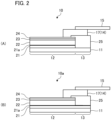
- Fig. 2(A) is a view illustrating an example of a cross-section in a thickness direction of the solar cell of the first embodiment.
- Fig. 2(A) corresponds to a cross-section of a portion surrounded by a broken line in Fig. 1 .
- a solar cell 10 has a first region 12 that performs photoelectric conversion and a second region 13 that does not contribute to photoelectric conversion and is used as a wiring arrangement region in a planar direction of a light receiving surface.
- the first region 12 and the second region 13 are formed on a substrate 11.
- a collector electrode 14 as an example of a collector
- the substrate 11 can be selected from a glass substrate, a resin substrate, a metal substrate, and the like, and may be a flexible substrate.
- the shape and dimension of the substrate 11 are appropriately determined according to the size or the like of the solar cell 10.
- the entire shape of the substrate 11 in the first embodiment is, for example, a rectangular flat plate shape, but is not limited thereto.
- the substrate 11 is formed of, for example, titanium (Ti), stainless steel (SUS), copper, aluminum, an alloy thereof, and the like.
- the substrate 11 may have a layered structure in which a plurality of metal substrates are stacked, and for example, a stainless foil, a titanium foil, or a molybdenum foil may be formed on the surface of the substrate.
- the solar cell 10 can be bent, and cracking of the substrate 11 due to bending can also be suppressed. Furthermore, in the above case, it is easy to reduce the weight and thickness of the solar cell 10 as compared with the glass substrate.
- the first region 12 has a layered structure in which a first electrode layer 21, a photoelectric conversion layer 22, a buffer layer 23, and a second electrode layer 24 are sequentially stacked on the substrate 11.
- the first electrode layer 21 is, for example, a metal electrode layer of molybdenum (Mo), and is formed on the substrate 11. Since the first electrode layer 21 faces not the light receiving surface side but the back side (substrate side) of the solar cell 10, it is also referred to as a back electrode. Although not particularly limited, the thickness of the first electrode layer 21 is, for example, 50 nm to 1000 nm.
- a group VI compound layer 21a made of Mo(Se, S) 2 is formed at an interface with the photoelectric conversion layer 22.
- Mo(Se, S) 2 of the group VI compound layer 21a is formed on the surface of the first electrode layer 21 when a precursor layer is chalcogenized to form the photoelectric conversion layer 22 as described later.
- Mo(Se, S) 2 in the group VI compound layer 21a is a substance having a graphite-like multilayer structure, and has a property of being easily peeled off by cleavage between layers.
- the photoelectric conversion layer 22 is formed on the first electrode layer 21.
- the photoelectric conversion layer 22 may have a double graded structure in which the band gap is large on each of the light receiving surface side (upper side in Fig. 2 ) and the substrate 11 side (lower side in Fig. 2 ) and the band gap is small on the inner side in the thickness direction of the photoelectric conversion layer 22.
- the thickness of the photoelectric conversion layer 22 is, for example, 1.0 um to 3.0 ⁇ m.
- the photoelectric conversion layer 22 is formed of a chalcogen semiconductor containing a chalcogen element, and functions as a polycrystalline or microcrystalline p-type compound semiconductor layer.
- the photoelectric conversion layer 22 is made of, for example, a group I-III-VI 2 compound semiconductor having a chalcopyrite structure containing a group I element, a group III element, and a group VI element (chalcogen element).
- the group I element can be selected from copper (Cu), silver (Ag), gold (Au), and the like.
- the group III element can be selected from indium (In), gallium (Ga), aluminum (Al), and the like.
- the photoelectric conversion layer 22 may contain tellurium (Te) or the like in addition to selenium (Se) and sulfur (S) as a group VI element.
- the photoelectric conversion layer 22 may contain an alkali metal such as Li, Na, K, Rb, or Cs.
- the photoelectric conversion layer 22 may be made of a group I 2 -(II-IV)-VI 4 compound semiconductor which is a CZTS-based chalcogen semiconductor containing Cu, Zn, Sn, S, or Se.
- Representative examples of the CZTS-based chalcogen semiconductor include those using a compound such as Cu 2 ZnSnSe 4 or Cu 2 ZnSn(S, Se) 4 .
- the buffer layer 23 is formed on the photoelectric conversion layer 22. Although not particularly limited, the thickness of the buffer layer 23 is, for example, 10 nm to 100 nm.
- the buffer layer 23 is, for example, an n-type or an i (intrinsic)-type high-resistance conductive layer.
- high-resistance means having a resistance value higher than the resistance value of the second electrode layer 24 described later.
- the buffer layer 23 can be selected from compounds containing zinc (Zn), cadmium (Cd), and indium (In).
- the compound containing zinc include ZnO, ZnS, Zn(OH) 2 , or Zn(O, S) and Zn(O, S, OH) which are mixed crystals thereof, and further include ZnMgO and ZnSnO.
- the compound containing cadmium include CdS, CdO, and Cd(O, S) and Cd(O, S, OH) which are mixed crystals of CdS and CdO.
- the compound containing indium examples include InS, InO, and In(O, S) and In(O, S, OH) which are mixed crystals of InS and InO, and In 2 O 3 , In 2 S 3 , In(OH) x , and the like can be used.
- the buffer layer 23 may have a layered structure of these compounds.
- the buffer layer 23 has an effect of improving characteristics such as photoelectric conversion efficiency, but this may be omitted.
- the second electrode layer 24 is formed on the photoelectric conversion layer 22.
- the second electrode layer 24 is formed on the buffer layer 23.
- the second electrode layer 24 is, for example, an n-type conductive layer.
- the thickness of the second electrode layer 24 is, for example, 0.5 um to 2.5 um.
- the second electrode layer 24 preferably includes, for example, a material having a large band gap and a sufficiently low resistance value.
- the second electrode layer 24 serves as a path of light such as sunlight, it is preferable that the second electrode layer 24 has a property of transmitting light having a wavelength that can be absorbed by the photoelectric conversion layer 22. From this point of view, the second electrode layer 24 is also referred to as a transparent electrode layer or a window layer.
- the second electrode layer 24 includes, for example, a metal oxide to which a group III element (B, Al, Ga, or In) is added as a dopant.
- the metal oxide include ZnO and SnO 2 .
- the second electrode layer 24 can be selected from, for example, indium tin oxide (In 2 O 3 : Sn), indium titanium oxide (In 2 O 3 : Ti), indium zinc oxide (In 2 O 3 : Zn), tin zinc doped indium oxide (In 2 O 3 : Sn, Zn), tungsten doped indium oxide (In 2 O 3 : W), hydrogen doped indium oxide (In 2 O 3 : H), indium gallium zinc oxide (InGaZnO 4 ), zinc tin oxide (ZnO: Sn), fluorine doped tin oxide (SnO 2 : F), gallium doped zinc oxide (ZnO: Ga), boron doped zinc oxide (ZnO: B), aluminum doped zinc oxide (ZnO: Al),
- the collector electrode 14 is electrically connected to the light receiving surface side of the second electrode layer 24. Since the collector electrode 14 blocks sunlight incident on the photoelectric conversion layer 22, it is preferable to reduce the area as much as possible from the viewpoint of improving power generation efficiency. Therefore, as illustrated in Fig. 1 , the collector electrode 14 is configured to have a comb-like overall shape by combining a bus bar electrode 17 and the plurality of finger electrodes 18.
- the finger electrodes 18 are long and narrow electrodes extending in the vertical direction in Fig. 1 , and are provided in parallel at intervals in the horizontal direction in Fig. 1 .
- Each of the finger electrodes 18 is disposed in the first region 12 of the solar cell 10 and has a function of guiding electricity generated in the photoelectric conversion layer 22 to the bus bar electrode 17.
- the bus bar electrode 17 is an electrode extending in the horizontal direction in Fig. 1 and substantially orthogonal to the finger electrodes 18, and is electrically connected to the finger electrodes 18.
- the bus bar electrode 17 has a function of extracting electricity collected by the finger electrodes 18 to the outside. As illustrated in Fig. 2(A) , the bus bar electrode 17 is disposed across the first region 12 to the second region 13.
- the bus bar electrode 17 When the bus bar electrode 17 is electrically connected to the second electrode layer 24 via the finger electrodes 18, the bus bar electrode 17 may be provided only on the second region 13. In this case, the bus bar electrode 17 has no optical loss (shadow loss) that blocks sunlight incident on the photoelectric conversion layer 22, which is preferable from the viewpoint of improving power generation efficiency. In addition, in this case, the finger electrodes 18 can be arranged across the first region 12 to the second region 13.
- the bus bar electrode 17 When the bus bar electrode 17 is disposed up to the boundary with the first region 12 in the second region 13, the area of the bus bar electrode 17 can be increased, so that resistance loss can be reduced. Therefore, there is no shadow loss due to the bus bar electrode 17, and resistance loss can be reduced.
- the bus bar electrode 17 when the bus bar electrode 17 is disposed up to the boundary with the first region 12 in the second region 13, the finger electrodes 18 are disposed up to the boundary with the second region 13 in the first region 12.
- the material of the collector electrode 14 can be selected from, indium tin oxide (In 2 O 3 : Sn), indium titanium oxide (In 2 O 3 : Ti), indium zinc oxide (In 2 O 3 : Zn), tin zinc doped indium oxide (In 2 O 3 : Sn, Zn), tungsten doped indium oxide (In 2 O 3 : W), hydrogen doped indium oxide (In 2 O 3 : H), indium gallium zinc oxide (InGaZnO 4 ), zinc tin oxide (ZnO: Sn), fluorine doped tin oxide (SnO 2 : F), aluminum doped zinc oxide (ZnO: Al), boron doped zinc oxide (ZnO: B), gallium doped zinc oxide (ZnO: Ga), Ni, Ti, Cr, Mo, Al, Ag,
- the collector electrode 14 may be a layered product of two or more kinds of metal films or transparent conductive films. Although not particularly limited, the thickness of the collector electrode 14 is, for example, 0.5 um to 50 ⁇ m.
- the first electrode layer 21, the photoelectric conversion layer 22, the buffer layer 23, and the second electrode layer 24 are not provided.
- an insulating layer 25 is formed instead of the first electrode layer 21, the photoelectric conversion layer 22, the buffer layer 23, and the second electrode layer 24.
- the insulating layer 25 is formed so as to cover each end surface in the planar direction of the first electrode layer 21, the photoelectric conversion layer 22, the buffer layer 23, and the second electrode layer 24, and partially cover the light receiving surface side of the second electrode layer 24 in the first region 12.
- the insulating layer 25 can use a known insulating material applicable to film formation in a semiconductor process, but is preferably formed of an oxide in order to electrically separate the back surface side and the cell end surface from the collector electrode 14.
- the material of the insulating layer 25 include Al 2 O 3 , Y 2 O 3 , ZrO 2 , MgO, HfO 2 , Bi 2 O 3 , TiO 2 , ZnO, In 2 O 3 , SnO 2 , Nb 2 O 5 , Ta 2 O 5 , SiO 2 , and Ca 3 (PO 4 ) 2 .
- the insulating layer 25 may be a layered product of a plurality of materials described above. Although not particularly limited, the thickness of the insulating layer 25 is, for example, 0.1 um to 50 ⁇ m.
- the bus bar electrode 17 of the collector electrode 14 is stacked on the light receiving surface side of the insulating layer 25. Then, the interconnector 15 is joined to the light receiving surface side of the bus bar electrode 17.
- the thickness of the collector electrode 14 at the joined portion with the interconnector 15 is preferably 1.0 um or more.
- the interconnector 15 is a wiring member on the negative electrode side of the solar cell 10, and three of the interconnectors 15 are connected in parallel to the upper end of the solar cell 10 in Fig. 1 .
- the interconnector 15 may be, for example, a ribbon wire of a conductive metal including Ag, Ni, Co, Fe, Cr, Mo, Mn, Cu, Al, Ti, or a combination thereof.
- the interconnector 15 may be made of an alloy containing some of the above-described conductive metals, such as an alloy Kovar or stainless steel (SUS).
- the dimensions of the interconnector 15 can be a strip shape having a thickness of about 30 um and a width of about 2.5 mm.
- the interconnector 15 may not have a strip shape, but may have a single piece configuration that continuously covers the bus bar 17.
- the description of the wiring on the positive electrode side of the solar cell 10 is omitted.
- the interconnectors 15 and the bus bar electrode 17 are joined by, for example, parallel gap resistance welding.
- the joined portion of the interconnectors 15 is at a position overlapping the second region 13 in the planar direction, and is shifted from the first region 12.
- a portion that is not a joined portion of the interconnector 15 may be provided on the first region 12.
- FIG. 3 is a view schematically illustrating a method for manufacturing the solar cell 10 of Fig. 2(A) .
- a solar cell in which the first electrode layer 21, the photoelectric conversion layer 22, the buffer layer 23, and the second electrode layer 24 are sequentially formed on a substrate is prepared by the following steps.
- the first electrode layer 21 is formed by forming a thin film of molybdenum (Mo) or the like on the surface of the substrate 11 by, for example, a sputtering method.
- the sputtering method may be a direct current (DC) sputtering method or a radio frequency (RF) sputtering method.
- the first electrode layer 21 may be formed using a chemical vapor deposition (CVD) method, an atomic layer deposition (ALD) method, or the like instead of the sputtering method.
- the photoelectric conversion layer 22 is formed by forming a thin film precursor layer on the first electrode layer 21 and chalcogenizing the precursor layer.
- Examples of the method for forming the precursor layer on the first electrode layer 21 include the sputtering method, the vapor deposition method, and the ink coating method.
- the vapor deposition method is a method of forming a film by heating a vapor deposition source and using an atom or the like that has become a gas phase.
- the ink coating method is a method in which a powdered precursor film material is dispersed in a solvent such as an organic solvent and applied onto the first electrode layer 21, and then the solvent is evaporated to form a precursor layer.
- the precursor layer contains the group I element and the group III element.
- the precursor layer may contain Ag as the group I element.
- the group I elements other than Ag included in the precursor layer can be selected from copper, gold, and the like.
- the group III element included in the precursor layer can be selected from indium, gallium, aluminum, and the like.
- the precursor layer may contain an alkali metal such as Li, Na, K, Rb, or Cs.
- the precursor layer may contain tellurium as the group VI element in addition to selenium and sulfur.
- the precursor layer containing the group I element and the group III element is subjected to a heat treatment in an atmosphere containing the group VI element to be chalcogenized, thereby forming the photoelectric conversion layer 22.
- selenization by a vapor phase selenization method is performed.
- the selenization is performed by heating the precursor layer in an atmosphere of a selenium source gas (for example, hydrogen selenide or selenium vapor) containing selenium as a group VI element source.
- a selenium source gas for example, hydrogen selenide or selenium vapor
- selenization is preferably performed, for example, at a temperature within a range of 300 °C or more and 600 °C or less in a heating furnace.
- the precursor layer is converted into a compound (photoelectric conversion layer 22) containing the group I element, the group III element, and selenium.
- the compound (photoelectric conversion layer 22) containing the group I element, the group III element, and selenium may be formed by a method other than the gas phase selenization method.
- such a compound can also be formed by a solid-phase selenization method, a vapor deposition method, an ink application method, an electrodeposition method, and the like.
- the photoelectric conversion layer 22 containing the group I element, the group III element, and selenium is sulfurized.
- the sulfurization is performed by heating the photoelectric conversion layer 22 in an atmosphere of a sulfur-containing sulfur source gas (for example, hydrogen sulfide or sulfur vapor).
- a sulfur-containing sulfur source gas for example, hydrogen sulfide or sulfur vapor.
- the photoelectric conversion layer 22 is converted into a compound containing the group I element, the group III element, and selenium and sulfur as the group VI element.
- the sulfur source gas plays a role of substituting selenium in a crystal containing the group I element, the group III element, and selenium, for example, a chalcopyrite crystal with sulfur.
- sulfurization is preferably performed, for example, at a temperature within a range of 450 °C or more and 650 °C or less in a heating furnace.
- the precursor layer is formed as a thin film of Cu-Zn-Sn or Cu-Zn-Sn-Se-S.
- the precursor layer containing Cu, Zn, and Sn is sulfurized and selenized in a hydrogen sulfide atmosphere and a hydrogen selenide atmosphere at 500 °C to 650 °C.
- the CZTS-based photoelectric conversion layer 22 having Cu 2 ZnSn(S, Se) 4 can be formed.
- the group VI compound layer 21a containing Mo (Se, S) 2 is formed at the interface between the first electrode layer 21 and the photoelectric conversion layer 22.
- the buffer layer 23 is formed by forming a thin film of Zn(O, S) or the like on the photoelectric conversion layer 22 by a method such as a chemical bath deposition (CBD) method, a sputtering method, a CVD method, or an ALD method. As described above, the formation of the buffer layer 23 may be omitted.
- CBD chemical bath deposition
- the second electrode layer 24 is formed on the buffer layer 23 by a method such as a sputtering method, a CVD method, or an ALD method.
- the second electrode layer 24 is, for example, a transparent electrode made of a thin film such as ZnO doped with B, Al, Ga, or In as a dopant.
- the photoelectric conversion layer 22, the buffer layer 23, and the second electrode layer 24 are removed in the second region 13 of the solar cell.
- the removal of these layers is carried out by mechanical scribing as an example.
- the first electrode layer 21 is exposed to the light receiving surface side.
- a portion removed from the solar cell is indicated by a broken line.
- the first electrode layer 21 is further removed in the second region 13 of the solar cell.
- the substrate 11 is exposed to the light receiving surface side.
- a portion removed from the solar cell is indicated by a broken line.
- the removal of the first electrode layer 21 is performed by laser irradiation (laser deletion) as an example.
- laser deletion for example, a pulsed laser in an infrared region having a wavelength of 1.06 um may be applied, the diameter of the laser beam may be set to about 100 um, and the energy density of the laser beam to be irradiated may be set to 1 W/cm 2 to 10 W/cm 2 .
- Fig. 3(B) illustrates an aspect in which the position of the end of the first electrode layer 21 is aligned with respect to each end of the photoelectric conversion layer 22, the buffer layer 23, and the second electrode layer 24 in the horizontal direction.
- the end of the first electrode layer 21 may not necessarily be aligned with the end of the photoelectric conversion layer 22 or the like.
- the first electrode layer 21 may slightly protrude toward the second region side from the end of the photoelectric conversion layer 22 or the like, and an edge space (not illustrated) where the photoelectric conversion layer 22 or the like is not stacked may be formed on the first electrode layer 21.
- the light receiving surface side of the second electrode layer 24 is covered with a mask M, and then the insulating layer 25 is formed in the second region 13 on the substrate 11.
- the insulating layer 25 is formed by applying a film forming process of a semiconductor thin film such as a sputtering method, a CVD method, a vapor deposition method, an optical Mod (Metal Organic Deposition) method, or an AD (Aerosol Deposition) method.
- the region covered with the mask M preferably does not include the boundary between the first region 12 and the second region 13.
- the insulating layer 25 is not formed on each end surface in the planar direction of the first electrode layer 21, the photoelectric conversion layer 22, the buffer layer 23, and the second electrode layer 24.
- the subsequent step of forming the collector electrode 14 there arises a problem in that the end surfaces in the planar direction of the first electrode layer 21, the photoelectric conversion layer 22, the buffer layer 23, and the second electrode layer 24 are covered with the collector electrode 14, and the second electrode layer 24 and the first electrode layer 21 are electrically connected (short-circuited).
- the collector electrode 14 can be formed, for example, by applying a printing process such as an inkjet method or a screen printing method in addition to a sputtering method, a CVD method, an ALD method, an AD method, and a vapor deposition method.
- a printing process such as an inkjet method or a screen printing method in addition to a sputtering method, a CVD method, an ALD method, an AD method, and a vapor deposition method.
- the end of the interconnector 15 made of a conductive metal is disposed on the light receiving surface side of the bus bar electrode 17, and then the interconnector 15 is joined to the solar cell.
- the joining of the interconnectors 15 is performed by, for example, a parallel gap welding method using a resistance welding machine whose control method is a transistor type. Specifically, a pair of electrodes (not illustrated) partitioned by a narrow gap is disposed above the second region 13, and the interconnector 15 is welded to the bus bar electrode 17 in the second region 13.
- the welding conditions are, for example, a welding current of 50 to 200 A and a welding time of 50 to 100 msec.
- the solar cell 30 of the comparative example of Fig. 4 corresponds to a configuration in which the joined portion of the interconnector 15 is provided in the first region.
- the joined portion of the interconnector 15 is disposed so as to overlap the first electrode layer 21 and the photoelectric conversion layer 22 in plan view. Therefore, when an external force acts on the joined portion of the interconnector 15, the photoelectric conversion layer 22 is peeled off from the substrate 11 side due to cleavage of the group VI compound layer 21a at the interface between the first electrode layer 21 and the photoelectric conversion layer 22, which may damage the joined portion of the interconnector 15.
- the joined portion of the interconnector 15 is formed on the substrate 11 and the insulating layer 25 in the second region 13. That is, in the first embodiment, since there is no interface between the first electrode layer 21 and the photoelectric conversion layer 22 under the joined portion of the interconnector 15, the joined portion is hardly peeled off from the substrate 11 side even if an external force acts on the joined portion of the interconnector 15. Therefore, according to the first embodiment, the interconnector 15 can be joined with higher adhesion strength than the comparative example.
- the method for manufacturing the solar cell 10 of the first embodiment is less likely to be damaged (shunt, dielectric breakdown) in the first region 12 where photoelectric conversion of the solar cell 30 is performed by energy during welding than the method for manufacturing the solar cell 30 of the comparative example.
- the insulating layer 25 is present between the joined portion of the interconnector 15 and the substrate at the end of the second region. Therefore, since the joined portion of the interconnector 15 is electrically separated from the element on the positive electrode side (for example, a conductive substrate) at the end of the second region 13, a loss related to the shunt resistor during the operation of the solar cell is suppressed.
- the bus bar electrode 17 is formed on the insulating layer 25 in the second region 13, the solar cell 10 is not short-circuited.
- Fig. 2(B) is a view illustrating an example of a cross-section in a thickness direction of a solar cell 10a according to a modification of the first embodiment.
- Fig. 2(B) is a view illustrating an example of a cross-section in a thickness direction of a solar cell 10a according to a modification of the first embodiment.
- the configuration of the solar cell 10a illustrated in Fig. 2(B) is different from the configuration of Fig. 2(A) in that the first electrode layer 21 is provided on the substrate 11 in the second region 13, and the insulating layer 25 is formed on the first electrode layer 21.
- the second region 13 of the solar cell 10a there is no photoelectric conversion layer 22, and therefore there is no interface between the first electrode layer 21 and the photoelectric conversion layer 22.
- a method for manufacturing a solar cell in the modification of the first embodiment is different from the first embodiment illustrated in Fig. 3 in the following points.
- the steps up to the step of removing the photoelectric conversion layer 22, the buffer layer 23, and the second electrode layer 24 are the same as those in the first embodiment.
- the insulating layer 25 is formed on the first electrode layer 21 without removing the first electrode layer 21 ( Fig. 3(B) ).
- the subsequent steps are the same as those in the first embodiment.
- the interconnector 15 can be joined with high adhesion strength as compared with the comparative example for the following two reasons.
- the first reason is that voids (not illustrated) are generated between the photoelectric conversion layer 22 and the group VI compound layer 21a in the manufacturing steps of the solar cell.
- the insulating layer 25 is formed again on the group VI compound layer 21a after the photoelectric conversion layer 22 is removed, voids are hardly formed between the group VI compound layer 21a and the insulating layer 25. Therefore, in the modification of the first embodiment, as compared with the adhesion strength between the group VI compound layer 21a and the photoelectric conversion layer 22, the adhesion strength between the group VI compound layer 21a and the insulating layer 25 is higher because there are fewer voids between the layers. As a result, in the modification of the first embodiment, the interconnector 15 can be joined with higher adhesion strength than the comparative example.
- the photoelectric conversion layer 22 is removed from the second region 13 before the insulating layer 25 is formed.
- the group VI compound layer 21a is peeled off to some extent from the surface of the first electrode layer 21. Therefore, in the modification of the first embodiment, since the thickness of the group VI compound layer 21a in the second region is thinner than that in the comparative example, the insulating layer 25 is less likely to be peeled off from the substrate 11 side. As a result, in the modification of the first embodiment, the interconnector 15 can be joined with higher adhesion strength than the comparative example.
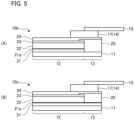
- Fig. 5(A) is a view illustrating an example of a cross-section in the thickness direction of a solar cell 10b of a second embodiment.
- the solar cell 10b of the second embodiment has a configuration in which the second electrode layer 24 is formed on the upper surface of the insulating layer 25 in the second region 13.
- the insulating layer 25 of the second embodiment illustrated in Fig. 5(A) is formed so as to cover each end surface in the planar direction of the first electrode layer 21, the photoelectric conversion layer 22, and the buffer layer 23, and partially cover the light receiving surface side of the buffer layer 23 in the first region 12. Then, the second electrode layer 24 is formed so as to cover the buffer layer 23 in the first region 12 and the insulating layer 25 in the second region 13, and the bus bar electrode 17 of the collector electrode 14 is stacked on the second electrode layer 24.
- the interconnector 15 is joined to the light receiving surface side of the bus bar electrode 17. Also in the second embodiment, the joined portion of the interconnector 15 is located on the substrate 11 and the insulating layer 25 in the second region 13 and is shifted from the first region 12. A portion that is not a joined portion of the interconnector 15 (for example, a portion not welded and joined) may be provided on the first region 12.
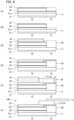
- Fig. 6 is a view schematically illustrating a method for manufacturing the solar cell 10b in Fig. 5(A) .
- a solar cell in which the first electrode layer 21, the photoelectric conversion layer 22, and the buffer layer 23 are sequentially formed on the substrate 11 is prepared.
- the steps of forming the first electrode layer 21, the photoelectric conversion layer 22, and the buffer layer 23 are the same as those in the first embodiment.
- the photoelectric conversion layer 22 and the buffer layer 23 are removed in the second region 13 of the solar cell.
- the removal of these layers is carried out by mechanical scribing as an example.
- the first electrode layer 21 is exposed to the light receiving surface side.
- a portion removed from the solar cell is indicated by a broken line.
- the first electrode layer 21 is further removed in the second region 13 of the solar cell.
- This step is the same as those in the above-described first embodiment.
- the substrate 11 is exposed to the light receiving surface side.
- a portion removed from the solar cell is indicated by a broken line.
- the light receiving surface side of the buffer layer 23 is covered with a mask M, and then the insulating layer 25 is formed in the second region 13 on the substrate 11.
- the method for forming the insulating layer 25 is the same as that in the first embodiment.
- the region covered with the mask M preferably does not include the boundary between the first region 12 and the second region 13.
- the insulating layer 25 is not formed on each end surface in the planar direction of the first electrode layer 21, the photoelectric conversion layer 22, and the buffer layer 23.
- the end surfaces of the first electrode layer 21, the photoelectric conversion layer 22, and the buffer layer 23 in the planar direction are covered with the second electrode layer 24, and there occurs a problem in that the second electrode layer 24 and the first electrode layer 21 are electrically connected (short-circuited).
- the mask M on the buffer layer 23 is removed, and the second electrode layer 24 is formed so as to cover the buffer layer 23 in the first region 12 and the insulating layer 25 in the second region 13.
- the method for forming the second electrode layer 24 is the same as that in the first embodiment.
- the collector electrode 14 (bus bar electrode 17) is formed on the light receiving surface of the second electrode layer 24.
- the method for forming the collector electrode 14 is the same as that in the first embodiment.
- the end of the interconnector 15 made of a conductive metal is disposed on the light receiving surface side of the bus bar electrode 17, and the interconnector 15 is joined to the bus bar electrode 17 by welding in the second region 13.
- the welding of the interconnector 15 is the same as that in the first embodiment.
- Fig. 5(B) is a view illustrating an example of a cross-section in a thickness direction of a solar cell 10c according to a modification of the second embodiment.
- the configuration of the solar cell 10c illustrated in Fig. 5(B) is different from the configuration of Fig. 5(A) in that the first electrode layer 21 is provided on the substrate 11 in a second region 13, and the insulating layer 25 is formed on the first electrode layer 21.
- a method for manufacturing a solar cell in the modification of the second embodiment is different from the second embodiment illustrated in Fig. 6 in the following points.
- the steps up to the step of removing the photoelectric conversion layer 22 and the buffer layer 23 are the same as those in the second embodiment.
- the insulating layer 25 is formed on the first electrode layer 21 without removing the first electrode layer 21 ( Fig. 6(B) ).
- the subsequent steps are the same as those in the second embodiment.
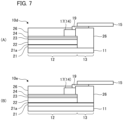
- Fig. 7(A) is a view illustrating an example of a cross-section in the thickness direction of a solar cell 10d of a third embodiment.
- the solar cell 10d of the third embodiment has a configuration in which the entire cell is covered with an insulating film 26 having optical transparency.
- the insulating film 26 is an example of the insulating layer.
- the first electrode layer 21, the photoelectric conversion layer 22, the buffer layer 23, and the second electrode layer 24 are sequentially stacked on the substrate 11.
- the collector electrode 14 (bus bar electrode 17) is provided on the second electrode layer 24.
- the first electrode layer 21, the photoelectric conversion layer 22, the buffer layer 23, and the second electrode layer 24 are not provided in the second region 13 of Fig. 7(A) .
- the insulating film 26 is stacked on both the second electrode layer 24 and the bus bar electrode 17 in the first region 12 and the substrate 11 in the second region 13.
- the insulating film 26 is formed so as to cover each end surface in the planar direction of the first electrode layer 21, the photoelectric conversion layer 22, the buffer layer 23, and the second electrode layer 24, and partially cover the light receiving surface side of the second electrode layer 24 in the first region 12.
- a thin-film conductive portion 19 electrically connected to the bus bar electrode 17 in the first region 12 is formed on the upper side of the insulating film 26 in the second region 13.
- the interconnector 15 is joined to the conductive portion 19 stacked on the insulating film 26.
- the conductive portion 19 is an example of a current collector.
- the material exemplified as the material of the collector electrode 14 can be applied as the material of the conductive portion 19.
- the material of the conductive portion 19 may be the same as or different from the material of the collector electrode 14.
- the conductive portion 19 may also be formed of a layered product of a plurality of materials.
- the joined portion of the interconnector 15 is formed on the substrate 11 and the insulating film 26 in the second region 13. Therefore, the same effects as those of the first embodiment can be obtained also in the third embodiment.
- a portion that is not a joined portion of the interconnector 15 may be provided on the first region 12.
- the insulating film 26 of the third embodiment has at least one function of, for example, a shielding layer that shields a proton beam or a heat radiation layer that increases infrared radiation efficiency.
- a case where a solar cell is operated in space is considered.
- a solar cell When a solar cell is operated in space, it is known that lattice defects are generated in a semiconductor by irradiation with a proton beam, and the output of the cell is reduced.
- the insulating film 26 is stacked on the photoelectric conversion layer 22, the shielding effect on the proton beam is improved, and deterioration of the cell due to the proton beam can be suppressed.
- the material of the insulating film 26 of the third embodiment it is preferable to use a material having a high insulating property and light transmittance and having a refractive index between the photoelectric conversion layer 22 and vacuum in order to suppress reflection of light.
- the material of the insulating film 26 of the third embodiment include Al 2 O 3 , Y 2 O 3 , ZrO 2 , MgO, HfO 2 , Bi 2 O 3 , TiO 2 , ZnO, In 2 O 3 , SnO 2 , Nb 2 O 5 , Ta 2 O 5 , and SiO 2 .
- SiO 2 and Al 2 O 3 have high emissivity, and thus are effective as materials of the heat radiation layer.
- the insulating film 26 may be a multilayer film in which layers of different materials selected from the above materials are stacked. From the viewpoint of increasing the infrared emissivity of the solar cell, it is preferable to stack materials having different refractive indexes and extinction coefficients for the insulating film 26.
- the thickness of the insulating film 26 is, for example, 0.1 um to 50 ⁇ m.
- Fig. 8 is a view schematically illustrating a method for manufacturing the solar cell 10d in Fig. 7(A) .
- a solar cell in which the first electrode layer 21, the photoelectric conversion layer 22, the buffer layer 23, the second electrode layer 24, and the collector electrode 14 are sequentially formed on the substrate 11 is prepared.
- the collector electrode 14 is formed on the first region 12.
- the steps of forming the first electrode layer 21, the photoelectric conversion layer 22, the buffer layer 23, the second electrode layer 24, and the collector electrode 14 are the same as those in the first embodiment.
- the photoelectric conversion layer 22, the buffer layer 23, and the second electrode layer 24 are removed in the second region 13 of the solar cell.
- the removal of these layers is carried out by mechanical scribing as an example.
- the first electrode layer 21 is exposed to the light receiving surface side.
- a portion removed from the solar cell 10 is indicated by a broken line.
- the first electrode layer 21 is further removed in the second region 13 of the solar cell.
- This step is the same as those in the above-described first embodiment.
- the substrate 11 is exposed to the light receiving surface side.
- a portion removed from the solar cell is indicated by a broken line.
- the insulating film 26 having optical transparency is formed over the first region 12 and the second region 13. As a result, the entire cell is covered with the insulating film 26.
- the method for forming the insulating film 26 is the same as that in the first embodiment.
- the mask M on the collector electrode 14 is removed, the first region 12 and the second region 13 are covered with the mask M except for the formation range of the conductive portion 19, and then the conductive portion 19 is formed.
- the formation range of the conductive portion 19 includes the portion masked in Fig. 8(C) .
- the conductive portion 19 electrically connected to the collector electrode 14 and exposed to the outside of the insulating film 26 is formed in the second region.
- a method of forming the conductive portion 19 a method applicable to the formation of the collector electrode 14 can be appropriately adopted.
- the end of the interconnector 15 made of a conductive metal is disposed on the conductive portion 19, and the interconnector 15 is joined to the conductive portion 19 by welding in the second region.
- the welding of the interconnector 15 is the same as that in the first embodiment.
- Fig. 7(B) is a view illustrating an example of a cross-section in a thickness direction of a solar cell 10e according to a modification of the third embodiment.
- the configuration of the solar cell 10e illustrated in Fig. 7(B) is different from the configuration of Fig. 7(A) in that the first electrode layer 21 is provided on the substrate 11 in the second region 13, and the insulating film 26 is formed on the first electrode layer 21.
- the entire cell is covered with the insulating film 26, so that the same effect as that of the third embodiment can be obtained.
- the modification of the third embodiment it is possible to obtain the same effect as that of the modification of the first embodiment illustrated in Fig. 2(B) with respect to the adhesion strength of the joined portion of the interconnector 15.
- a method for manufacturing a solar cell in the modification of the third embodiment is different from the third embodiment illustrated in Fig. 8 in the following points.
- the steps up to the step of removing the photoelectric conversion layer 22, the buffer layer 23, and the second electrode layer 24 are the same as those in the third embodiment.
- the insulating film 26 is formed on the first electrode layer 21 without removing the first electrode layer 21 ( Fig. 8(B) ).
- the subsequent steps are the same as those in the third embodiment.
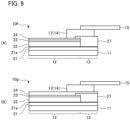
- Fig. 9(A) is a view illustrating an example of a cross-section in the thickness direction of a solar cell 10f of a fourth embodiment.
- the solar cell 10f is a configuration example in which a hydrophilic layer 27 is formed on the first electrode layer 21 in the second region 13.
- the photoelectric conversion layer 22, the buffer layer 23, and the second electrode layer 24 are not provided.
- the hydrophilic layer 27 is formed on the first electrode layer 21 in the second region 13.
- the hydrophilic layer 27 is formed so as to cover each end surface in the planar direction of the photoelectric conversion layer 22, the buffer layer 23, and the second electrode layer 24, and partially cover the light receiving surface side of the second electrode layer 24 in the first region 12.
- a material of the hydrophilic layer 27 for example, a Ca phosphate-based hydrophilic material can be used.
- the thickness of the hydrophilic layer 27 is, for example, 0.1 um to 50 ⁇ m.
- the bus bar electrode 17 of the collector electrode 14 is stacked on the light receiving surface side of the hydrophilic layer 27.
- the interconnector 15 is joined to the light receiving surface side of the bus bar electrode 17.
- the joined portion of the interconnectors 15 is at a position overlapping the second region 13 in the planar direction, and is shifted from the first region 12.
- a portion that is not a joined portion of the interconnector 15 may be provided on the first region 12.
- the hydrophilic layer 27 By forming the hydrophilic layer 27 having hydrophilicity on the first electrode layer 21, the hydrophilic layer 27 is less likely to be displaced in the planar direction with respect to the first electrode layer 21. Therefore, according to the configuration of the fourth embodiment, improvement of the adhesion strength of the joined portion of the interconnector 15 in the second region 13 can be expected.
- the material of the hydrophilic layer 27 is generally an insulator. Therefore, at the end of the second region 13, the joined portion of the interconnector 15 can be electrically separated from the element on the positive electrode side (for example, the conductive substrate) by the hydrophilic layer 27.
- an insulating film (not illustrated) may be further formed on the hydrophilic layer 27.
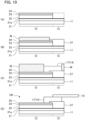
- Fig. 10 is a view schematically illustrating a method for manufacturing the solar cell 10f in Fig. 9(A) .
- a solar cell in which the first electrode layer 21, the photoelectric conversion layer 22, the buffer layer 23, and the second electrode layer 24 are sequentially formed on the substrate 11 is prepared.
- the steps of forming the first electrode layer 21, the photoelectric conversion layer 22, the buffer layer 23, and the second electrode layer 24 are the same as those in the first embodiment.
- the photoelectric conversion layer 22, the buffer layer 23, and the second electrode layer 24 are removed in the second region 13 of the solar cell.
- the removal of these layers is carried out by mechanical scribing as an example.
- the first electrode layer 21 is exposed to the light receiving surface side.
- a portion removed from the solar cell 10 is indicated by a broken line.
- the hydrophilic layer 27 is formed on the first electrode layer 21 in the second region 13.
- the hydrophilic layer 27 is formed by applying a film forming process of a semiconductor thin film such as a sputtering method, a CVD method, a vapor deposition method, an optical Mod method, or an AD method.
- the region covered with the mask M preferably does not include the boundary between the first region 12 and the second region 13.
- the hydrophilic layer 27 is not formed on each end surface in the planar direction of the photoelectric conversion layer 22, the buffer layer 23, and the second electrode layer 24.
- the subsequent step of forming the collector electrode 14 there arises a problem in that the end surfaces in the planar direction of the photoelectric conversion layer 22, the buffer layer 23, and the second electrode layer 24 are covered with the collector electrode 14, and the second electrode layer 24 and the first electrode layer 21 are electrically connected (short-circuited).
- the mask M of the second electrode layer 24 is once removed, and then a region other than the range in which the collector electrode 14 is formed in the first region 12 and the second region 13 is covered with the mask, and the collector electrode 14 (bus bar electrode 17) is formed on the light receiving surface.
- the method for forming the collector electrode 14 is the same as that in the first embodiment.
- the end of the interconnector 15 made of a conductive metal is disposed on the conductive portion 19, and the interconnector 15 is joined to the conductive portion 19 by welding in the second region.
- the welding of the interconnector 15 is the same as that in the first embodiment.
- Fig. 9(B) is a view illustrating an example of a cross-section in a thickness direction of a solar cell 10g according to a modification of the fourth embodiment.
- the solar cell 10g is different from the configuration of Fig. 9(A) in that the second electrode layer 24 is formed on the upper surface of the hydrophilic layer 27 of the second region 13. Also in the solar cell 10g, the same effects as those of the configuration of Fig. 9(A) can be obtained.
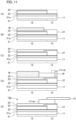
- Fig. 11 is a view schematically illustrating a method for manufacturing the solar cell 10g in Fig. 9(B) .
- a solar cell in which the first electrode layer 21, the photoelectric conversion layer 22, and the buffer layer 23 are sequentially formed on the substrate 11 is prepared.
- the steps of forming the first electrode layer 21, the photoelectric conversion layer 22, and the buffer layer 23 are the same as those in the first embodiment.
- the photoelectric conversion layer 22 and the buffer layer 23 are removed in the second region 13 of the solar cell.
- the removal of these layers is carried out by mechanical scribing as an example.
- the first electrode layer 21 is exposed to the light receiving surface side.
- a portion removed from the solar cell is indicated by a broken line.
- the hydrophilic layer 27 is formed on the first electrode layer 21 in the second region 13.
- the method for forming the hydrophilic layer 27 is the same as that in the fourth embodiment.
- the region covered with the mask M preferably does not include the boundary between the first region 12 and the second region 13.
- the hydrophilic layer 27 is not formed on each end surface in the planar direction of the photoelectric conversion layer 22, and the buffer layer 23.
- each end surface of the photoelectric conversion layer 22 and the buffer layer 23 in the planar direction are covered with the second electrode layer 24, and there occurs a problem in that the second electrode layer 24 and the first electrode layer 21 are electrically connected (short-circuited).
- the mask M on the buffer layer 23 is removed, and the second electrode layer 24 is formed so as to cover the buffer layer 23 in the first region 12 and the hydrophilic layer 27 in the second region 13.
- the method for forming the second electrode layer 24 is the same as that in the first embodiment.
- the collector electrode 14 (bus bar electrode 17) is formed on the light receiving surface of the second electrode layer 24.
- the method for forming the collector electrode 14 is the same as that in the first embodiment.
- the end of the interconnector 15 made of a conductive metal is disposed on the light receiving surface side of the bus bar electrode 17, and the interconnector 15 is joined to the bus bar electrode 17 by welding in the second region 13.
- the welding of the interconnector 15 is the same as that in the first embodiment.
- test pieces were used as a comparative example and Examples 1 to 3.
- the test piece of the comparative example has a configuration in which a first electrode layer of molybdenum, a CIS-based photoelectric conversion element, a second electrode layer, and a collector electrode are sequentially stacked on a substrate, and an interconnector of an Ag foil is joined to the collector electrode.
- the test piece of the comparative example corresponds to the configuration in which the joined portion of the interconnector is provided on the first region (comparative example of Fig. 4 ).
- the test piece of Example 1 has a configuration in which a first electrode layer of molybdenum, a CIS-based photoelectric conversion element, a second electrode layer, and a collector electrode are sequentially stacked on the substrate in the first region, an insulating layer and a collector electrode are sequentially stacked on the substrate in the second region, and an interconnector of an Ag foil is joined to the collector electrode in the second region.
- the insulating layer of the example is an Al 2 O 3 film having a thickness of 4 um.
- the test piece of Example 1 corresponds to the configuration (first embodiment) in which the joined portion of the interconnector is provided on the second region from which the first electrode layer is removed.
- the test piece of Example 2 has a configuration in which a first electrode layer of molybdenum, a CIS-based photoelectric conversion element, a second electrode, and a collector electrode are sequentially stacked on the substrate in the first region, the first electrode layer of molybdenum, an insulating layer, and the collector electrode are sequentially stacked on the substrate in the second region, and an interconnector of an Ag foil is joined to the collector electrode in the second region.
- the insulating layer of Example 2 is an Al 2 O 3 film having a thickness of 10 um.
- the test piece of Example 2 corresponds to a configuration in which the joined portion of the interconnector is provided on the second region where the first electrode layer is formed (modification of the first embodiment).
- the test piece of Example 3 has a configuration in which a first electrode layer of molybdenum, a CIS-based photoelectric conversion element, a second electrode layer, and a collector electrode are sequentially stacked on the substrate in the first region, the first electrode layer of molybdenum, an insulating layer, the second electrode layer, and the collector electrode are sequentially stacked on the substrate in the second region, and an interconnector of an Ag foil is joined to the collector electrode in the second region.
- the insulating layer of Example 3 is an Al 2 O 3 film having a thickness of 4 um.
- the test piece of Example 3 corresponds to a configuration in which the joined portion of the interconnector is provided on the second region where the first electrode layer is formed (modification of the second embodiment).
- the collector electrodes of the test pieces in the comparative example and Example 1 were formed by stacking a Ni film having a thickness of 10 nm, an Al film having a thickness of 1 ⁇ m, and an Ag film having a thickness of 2 um in this order from the substrate side.
- the collector electrode of the test piece in Example 2 was formed by stacking a Ni film having a thickness of 10 nm and an Al film having a thickness of 16 um.
- the collector electrode of the test piece in Example 3 was formed by stacking a Ni film having a thickness of 10 nm and an Al film having a thickness of 1 um.
- the presence or absence of the Ag film in the collector electrode does not affect the tensile strength of the interconnector.
- the maximum strength of the test piece of the comparative example was 1, whereas the maximum strengths of the test piece of Example 1 to 3 were 6, 34, and 9, respectively. That is, it was confirmed that the adhesion strength in the configuration of Example 1 to 3 was improved to 6 times or more the configuration of the comparative example. In addition, it can be seen that the maximum strength increases even when the thickness of the insulating layer or the thickness of the collector electrode changes.
- an artificial satellite including a solar cell and a paddle for an artificial satellite will be described.
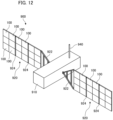
- FIG. 12 is a schematic perspective view illustrating an example of an artificial satellite including a solar cell module.
- An artificial satellite 900 may have a base 910 and a paddle 920.
- the base 910 may include a device (not illustrated) necessary for controlling the artificial satellite 900 or the like.
- An antenna 940 may be attached to the base 910.
- Fig. 12 illustrates an example in which one paddle 920 is disposed on each of both sides of the base 910 of the artificial satellite 900, and each paddle 920 is deployed.
- the paddle 920 may include a solar cell module 100.
- the paddle 920 including the solar cell module 100 can be used as a power source for operating various devices provided on the base 910. As described above, the solar cell module 100 can be applied to a paddle for an artificial satellite.
- One or a plurality of solar cells are sealed with, for example, a sealing material to constitute the solar cell module 100.
- the configuration of the solar cell of the solar cell module 100 is the same as that of any of the above embodiments.
- the solar cell module 100 includes a plurality of solar cells
- the plurality of solar cells may be arranged in at least one direction, and preferably may be arranged in a lattice pattern.
- the plurality of solar cells may be electrically connected to each other in series and/or in parallel.
- the solar cells may be electrically connected to each other by an interconnector.
- Fig. 12 illustrates an example in which a plurality of the solar cell modules 100 are arranged on each of the paddles 920.
- the paddle 920 may include a connecting portion 922 and a hinge portion 924.
- the connecting portion 922 corresponds to a portion connecting the paddle 920 to the base 910.
- the hinge portion 924 extends along one direction, and the paddle 920 can be bent with the hinge portion 924 as a rotation axis.
- Each of the paddles 920 may have at least one, preferably a plurality of the hinge portions 924.
- the paddle 920 including the solar cell modules 100 is configured to be small and foldable.
- the paddle 920 may be folded.
- the paddle 920 may be deployed when receiving sunlight to generate power.
- the paddle 920 may have a cylindrical shape formed by being wound. Accordingly, the paddle 920 can take a substantially flat developed state by the rotation of the wound portion. When the artificial satellite 900 is launched, the paddle 920 may maintain a generally cylindrical shape. The paddle 920 may be deployed in a substantially flat state when receiving sunlight to generate power.
- the configuration example of the CIS-based or CZTS-based solar cell has been described as an example of the photoelectric conversion element.
- the photoelectric conversion element of the present invention may be applied to, for example, a photodiode, an optical sensor, or the like as long as the photoelectric conversion layer contains a chalcogen semiconductor.
- the photoelectric conversion layer is removed by mechanical scribing, and the back electrode layer is removed by laser deletion.
- the method for removing the photoelectric conversion layer and the back electrode layer is not limited to the above.
- the photoelectric conversion layer may be removed by laser deletion, and then the back electrode may be removed by etching.
- the present invention can be similarly applied to the case of improving the adhesion strength of the joined portion between the collector electrode and the bypass diode.
- the configuration of the solar cell of the present invention is not limited to space applications, and can also be applied to, for example, when forming a joined portion that is less likely to break down even when receiving an external force due to strong wind, an earthquake, or the like in a solar cell installed on the ground.
Landscapes
- Photovoltaic Devices (AREA)
- Life Sciences & Earth Sciences (AREA)
- Engineering & Computer Science (AREA)
- Sustainable Development (AREA)
- Sustainable Energy (AREA)
Applications Claiming Priority (2)
| Application Number | Priority Date | Filing Date | Title |
|---|---|---|---|
| JP2021097294 | 2021-06-10 | ||
| PCT/JP2022/023338 WO2022260140A1 (ja) | 2021-06-10 | 2022-06-09 | 光電変換素子、光電変換素子の製造方法、太陽電池モジュールおよびパドル |
Publications (2)
| Publication Number | Publication Date |
|---|---|
| EP4354516A1 true EP4354516A1 (de) | 2024-04-17 |
| EP4354516A4 EP4354516A4 (de) | 2025-06-11 |
Family
ID=84424599
Family Applications (1)
| Application Number | Title | Priority Date | Filing Date |
|---|---|---|---|
| EP22820319.6A Pending EP4354516A4 (de) | 2021-06-10 | 2022-06-09 | Photoelektrisches umwandlungselement, herstellungsverfahren für ein photoelektrisches umwandlungselement, solarbatteriemodul und paddel |
Country Status (5)
| Country | Link |
|---|---|
| US (1) | US20240274730A1 (de) |
| EP (1) | EP4354516A4 (de) |
| JP (1) | JPWO2022260140A1 (de) |
| CN (1) | CN117461147A (de) |
| WO (1) | WO2022260140A1 (de) |
Cited By (1)
| Publication number | Priority date | Publication date | Assignee | Title |
|---|---|---|---|---|
| US20240162357A1 (en) * | 2021-03-30 | 2024-05-16 | Idemitsu Kosan Co.,Ltd. | Photoelectric conversion element and method for manufacturing photoelectric conversion element |
Families Citing this family (1)
| Publication number | Priority date | Publication date | Assignee | Title |
|---|---|---|---|---|
| CN120936106B (zh) * | 2025-10-09 | 2025-12-26 | 中能创光电科技(常州)有限公司 | 一种具有光生载流子收集功能的复合汇流条结构及其制备方法和应用 |
Family Cites Families (10)
| Publication number | Priority date | Publication date | Assignee | Title |
|---|---|---|---|---|
| JPH04276665A (ja) * | 1991-03-04 | 1992-10-01 | Canon Inc | 集積型太陽電池 |
| JPH09237911A (ja) | 1996-02-29 | 1997-09-09 | Iwasaki Electric Co Ltd | 太陽電池モジュール |
| US7825329B2 (en) * | 2007-01-03 | 2010-11-02 | Solopower, Inc. | Thin film solar cell manufacturing and integration |
| JP2010199173A (ja) * | 2009-02-24 | 2010-09-09 | Nec Toshiba Space Systems Ltd | 薄膜太陽電池パネルの縫合による結合構造 |
| JP2012134188A (ja) * | 2009-03-24 | 2012-07-12 | Fuji Electric Co Ltd | 光電変換装置、太陽電池モジュール、及び光電変換装置の製造方法 |
| JP5602700B2 (ja) * | 2010-11-02 | 2014-10-08 | 富士フイルム株式会社 | 光電変換素子およびその製造方法 |
| TW201318191A (zh) * | 2011-10-25 | 2013-05-01 | Axuntek Solar Energy | 可撓式太陽能電池模組及其製造方法 |
| CN105378947A (zh) * | 2013-06-05 | 2016-03-02 | 田永权 | 太阳能电池及其制造方法 |
| JP2017143105A (ja) * | 2016-02-08 | 2017-08-17 | 住友金属鉱山株式会社 | I−iii−vi型カルコパイライト系化合物半導体膜と薄膜太陽電池の製造方法 |
| JP7406082B2 (ja) | 2019-12-16 | 2023-12-27 | 日亜化学工業株式会社 | 遠隔操作型移動体、及び、遠隔操作型移動体に搭載された投影装置の冷却方法 |
-
2022
- 2022-06-09 EP EP22820319.6A patent/EP4354516A4/de active Pending
- 2022-06-09 WO PCT/JP2022/023338 patent/WO2022260140A1/ja not_active Ceased
- 2022-06-09 US US18/568,268 patent/US20240274730A1/en active Pending
- 2022-06-09 JP JP2023527929A patent/JPWO2022260140A1/ja active Pending
- 2022-06-09 CN CN202280040655.4A patent/CN117461147A/zh active Pending
Cited By (1)
| Publication number | Priority date | Publication date | Assignee | Title |
|---|---|---|---|---|
| US20240162357A1 (en) * | 2021-03-30 | 2024-05-16 | Idemitsu Kosan Co.,Ltd. | Photoelectric conversion element and method for manufacturing photoelectric conversion element |
Also Published As
| Publication number | Publication date |
|---|---|
| JPWO2022260140A1 (de) | 2022-12-15 |
| CN117461147A (zh) | 2024-01-26 |
| WO2022260140A1 (ja) | 2022-12-15 |
| EP4354516A4 (de) | 2025-06-11 |
| US20240274730A1 (en) | 2024-08-15 |
Similar Documents
| Publication | Publication Date | Title |
|---|---|---|
| KR101081294B1 (ko) | 태양전지 및 이의 제조방법 | |
| EP1492169A2 (de) | Solarzelle | |
| EP2475013B1 (de) | Vorrichtung zur solarstromerzeugung sowie verfahren zu ihrer herstellung | |
| KR101172132B1 (ko) | 태양전지 및 이의 제조방법 | |
| EP2680320B1 (de) | Dünnschicht-Solarzellenmodul und Verfahren zu dessen Herstellung | |
| EP4354516A1 (de) | Photoelektrisches umwandlungselement, herstellungsverfahren für ein photoelektrisches umwandlungselement, solarbatteriemodul und paddel | |
| WO2007043219A1 (ja) | 太陽電池およびその製造方法 | |
| JP5278418B2 (ja) | p型半導体及び光電素子 | |
| US20110201143A1 (en) | Method for manufacturing a thin film solar cell module | |
| EP4318603A1 (de) | Photoelektrisches umwandlungselement und verfahren zur herstellung eines photoelektrischen umwandlungselements | |
| JP5274432B2 (ja) | 光電変換装置 | |
| US20130299829A1 (en) | Photoelectric conversion device | |
| US12532550B2 (en) | Photoelectric conversion module, paddle, and method for manufacturing photoelectric conversion module | |
| JP2013026339A (ja) | 薄膜太陽電池およびその製造方法 | |
| US20240178338A1 (en) | Photoelectric conversion element and method for manufacturing photoelectric conversion element | |
| KR101034146B1 (ko) | 태양전지 및 이의 제조방법 | |
| US20250234656A1 (en) | Photoelectric conversion module, paddle, and method for manufacturing photoelectric conversion module | |
| JP5500059B2 (ja) | 光電素子 | |
| EP4693418A1 (de) | Photoelektrisches umwandlungselement, photovoltaisches modul, flugobjekt und verfahren zur herstellung eines photoelektrischen umwandlungselements | |
| EP4365959A1 (de) | Photoelektrisches umwandlungselement und verfahren zur herstellung eines photoelektrischen umwandlungselements | |
| EP4685853A1 (de) | Photoelektrisches umwandlungselement, photoelektrisches umwandlungsmodul und paddel | |
| EP4425577A1 (de) | Photoelektrisches umwandlungsmodul, paddel und verfahren zur herstellung des photoelektrischen umwandlungsmoduls | |
| JP6104579B2 (ja) | 薄膜太陽電池の製造方法 | |
| WO2019058604A1 (en) | PHOTOPILE, MULTIPURPOSE PHOTOPILE, PHOTOPILE MODULE, PHOTOVOLTAIC POWER GENERATION SYSTEM, AND PHOTOPOLY PRODUCTION METHOD | |
| EP2876692A1 (de) | Solarzelle und Verfahren zur Herstellung davon |
Legal Events
| Date | Code | Title | Description |
|---|---|---|---|
| STAA | Information on the status of an ep patent application or granted ep patent |
Free format text: STATUS: THE INTERNATIONAL PUBLICATION HAS BEEN MADE |
|
| PUAI | Public reference made under article 153(3) epc to a published international application that has entered the european phase |
Free format text: ORIGINAL CODE: 0009012 |
|
| STAA | Information on the status of an ep patent application or granted ep patent |
Free format text: STATUS: REQUEST FOR EXAMINATION WAS MADE |
|
| 17P | Request for examination filed |
Effective date: 20240108 |
|
| AK | Designated contracting states |
Kind code of ref document: A1 Designated state(s): AL AT BE BG CH CY CZ DE DK EE ES FI FR GB GR HR HU IE IS IT LI LT LU LV MC MK MT NL NO PL PT RO RS SE SI SK SM TR |
|
| DAV | Request for validation of the european patent (deleted) | ||
| DAX | Request for extension of the european patent (deleted) | ||
| REG | Reference to a national code |
Ref country code: DE Ref legal event code: R079 Free format text: PREVIOUS MAIN CLASS: H01L0031022400 Ipc: H10F0077200000 |
|
| A4 | Supplementary search report drawn up and despatched |
Effective date: 20250513 |
|
| RIC1 | Information provided on ipc code assigned before grant |
Ipc: H10F 10/167 20250101ALI20250507BHEP Ipc: H10F 19/90 20250101ALI20250507BHEP Ipc: H10F 77/20 20250101AFI20250507BHEP |