EP4353115B1 - Orthopädischer pur-schaumkunststoff-schuheinlegesohlenrohling - Google Patents
Orthopädischer pur-schaumkunststoff-schuheinlegesohlenrohling Download PDFInfo
- Publication number
- EP4353115B1 EP4353115B1 EP22200575.3A EP22200575A EP4353115B1 EP 4353115 B1 EP4353115 B1 EP 4353115B1 EP 22200575 A EP22200575 A EP 22200575A EP 4353115 B1 EP4353115 B1 EP 4353115B1
- Authority
- EP
- European Patent Office
- Prior art keywords
- shoe insole
- pur
- insole blank
- rim
- cushioning
- Prior art date
- Legal status (The legal status is an assumption and is not a legal conclusion. Google has not performed a legal analysis and makes no representation as to the accuracy of the status listed.)
- Active
Links
Images



Classifications
-
- A—HUMAN NECESSITIES
- A43—FOOTWEAR
- A43B—CHARACTERISTIC FEATURES OF FOOTWEAR; PARTS OF FOOTWEAR
- A43B17/00—Insoles for insertion, e.g. footbeds or inlays, for attachment to the shoe after the upper has been joined
- A43B17/003—Insoles for insertion, e.g. footbeds or inlays, for attachment to the shoe after the upper has been joined characterised by the material
- A43B17/006—Insoles for insertion, e.g. footbeds or inlays, for attachment to the shoe after the upper has been joined characterised by the material multilayered
-
- A—HUMAN NECESSITIES
- A43—FOOTWEAR
- A43B—CHARACTERISTIC FEATURES OF FOOTWEAR; PARTS OF FOOTWEAR
- A43B13/00—Soles; Sole-and-heel integral units
- A43B13/14—Soles; Sole-and-heel integral units characterised by the constructive form
- A43B13/18—Resilient soles
- A43B13/187—Resiliency achieved by the features of the material, e.g. foam, non liquid materials
-
- B—PERFORMING OPERATIONS; TRANSPORTING
- B29—WORKING OF PLASTICS; WORKING OF SUBSTANCES IN A PLASTIC STATE IN GENERAL
- B29D—PRODUCING PARTICULAR ARTICLES FROM PLASTICS OR FROM SUBSTANCES IN A PLASTIC STATE
- B29D35/00—Producing footwear
- B29D35/12—Producing parts thereof, e.g. soles, heels, uppers, by a moulding technique
- B29D35/14—Multilayered parts
- B29D35/142—Soles
Definitions
- the present invention relates to an orthopedic foam plastic shoe insole blank with a PUR support body formed three-dimensionally using the RIM process, on the upper side of which at least one cushioning body is arranged.
- An orthopedically effective footbed is also formed on the upper side of the PUR support body.
- the underside of the PUR support body faces the shoe sole.
- the present invention also relates to a method for producing such a shoe insole blank.
- Orthopedic PUR foam shoe insole blanks manufactured using the RIM process are known from the state of the art and have a PUR base body or support body.
- the task of the base or support body is to support or guide the foot in an anatomically and orthopedically effective manner.
- the base or support body is made of a flexible but relatively firm PUR foam plastic, which in addition to an orthopedic support effect must also have a biometric damping effect, for example when running, so that abrupt load changes are not transferred harshly to the foot skeleton.
- a cushioning body which is softer than the PUR support body and can therefore nestle better against the sole of the foot. The better the interaction between the support body and the cushioning body or insole cover material, the better orthopedic requirements can be implemented.
- PUR base bodies or support bodies are often formed in the form of a shoe insole by foaming a polyol with an isocyanate in a RIM foam mold.
- the two reactive starting components - the polyol and the isocyanate - are placed in an open, usually two-part mold, the cavity of which has a shoe sole shape.
- Such RIM foam molds are well known and are used in the production of orthopedic shoe insole blanks.
- a Such PUR base bodies or PUR support bodies produced using the RIM foaming process especially if they were manufactured with only one material hardness, do not have an optimal orthopaedic effect or optimal wearing comfort across all areas of the sole of the foot.
- the appearance of such a RIM blank is not always attractive, but this can be improved by covering the support body with a padding or covering material.
- orthopedic shoe insole blanks have different requirements in terms of support and cushioning properties, especially in the different areas of the sole of the foot, orthopedic shoe insole blanks generally cannot be made from just one material/material hardness. If, for example, different RIM foams are used, undefined, poorly predictable support and cushioning properties occur in the transition areas of the foams, depending on how the foams flow into one another during foaming. This and the formation of the material fronts are due to the foam production, which material fronts cannot be reproduced in a process-stable manner in such a way that precise sole of the foot area boundaries can be maintained.
- the PUR support bodies are therefore provided with padding bodies and other cover and covering materials or orthopedic components that improve the desired orthopedic support and cushioning properties.
- individual areas of the sole of the foot of a support body such as the forefoot area or the heel area, are often designed with recesses in order to insert cushioning materials into them, for example to provide the heel bone with cushioning and soft support in the vertical direction, but at the same time to keep the heel stable and guide it in the horizontal directions.
- reinforcements are inserted or applied to the longitudinal arch area in order to effectively reinforce the orthopedic shoe insole blanks in the respective areas.
- an attempt is made to optimize the desired comfort properties in these areas using a cover material.
- the conflicting objectives between stiffness and softness must be achieved without creating edges or stiffeners that reduce comfort or reduce the orthopedic effect.
- PUR support bodies are often provided with/covered with a padding body or cover material that has the desired properties in terms of cushioning, wearing comfort and appearance.
- the padding/covering materials used usually have a negative influence on the orthopedic effect of the PUR support body and vice versa. This is because the padding and cover materials conventionally used in the state of the art usually have a textile carrier layer or an adhesion-promoting carrier layer in order to make the padding and/or cover material connectable to the PUR foam plastic material of the support body and/or to keep the padding and/or cover material stable and abrasion-resistant.
- carrier layers or adhesion promoter layers influence the inherent properties of the individual components of a shoe insole, not only in the contact area between the support body and the padding material or cover material, but also distort the force transfer of the foot to the sole and change the desired cushioning effect. This is due to the interaction between the carrier and/or adhesion promoter layers of the padding body/cover material and the orthopedically effective support body made of PUR foam plastic.
- a textile carrier layer is disadvantageous in sole areas where good cushioning is to be achieved, since the inherent property of textiles to be tensile stiff in the longitudinal direction of the threads, i.e. in the textile plane, reduces the cushioning at least in this direction.
- the desired support and cushioning properties of an underlying PUR support body or padding body cannot fully develop, since the textile layer prevents the foot, e.g. the heel bone, from sinking into the cushioning layer.
- a similar situation applies to the area of the metatarsophalangeal joints, where good cushioning is usually required.
- the carrier or bonding layer is tensile or even rigid in one direction, the cushioning and/or cushioning properties of the cushioning material applied using the carrier or bonding layer are also reduced.
- Another challenge for the padding and cover materials is their ability to bond to the PUR material of the support body. Textile materials such as fleece or similar are penetrated by the not yet hardened PUR material during the foaming process and form a more or less hard intermediate layer after hardening. This impairs the flexibility as well as the elasticity and damping properties of the PUR foam plastic used for the support body and the padding or cover materials used in the boundary layer between the cover material and the PUR foam plastic, at least on the top of the PUR support body or on the bottom of the padding body.
- pressure loads or force transfer from the foot to the shoe insoles are only indirectly and distortedly transferred, to the point that selective damping, for example in the forefoot area, is made almost impossible, especially in the area of the metatarsophalangeal joints.
- the cushioning body should also be abrasion-resistant and have the necessary flexibility so that even point pressure loads can be reliably transmitted to the support body of the shoe insole blank.
- a shoe insole blank should be provided that is cost-effective to manufacture, whereby in particular the production of the PUR support body and the connection between the support body and the at least one cushioning body/cover material do not take place in separate process steps.
- the object according to the invention is achieved with an orthopedic PUR foam plastic shoe insole blank according to claim 1, wherein preferred embodiments are specified in the subsequent subclaims.
- the object according to the invention is further achieved with a method for producing an orthopedic PUR foam plastic shoe insole blank according to claim 12, wherein preferred embodiments of the method according to the invention are specified in the subsequent subclaims.
- the orthopedic PUR foam plastic shoe insole blank according to the invention has a PUR support body that is formed three-dimensionally using the RIM process and supports the foot.
- the PUR support body has a shoe-side underside and a foot-side upper side on which an anatomically shaped, orthopedically effective footbed is formed.
- At least one cushioning body is arranged on the foot-side upper side and/or underside of the PUR support body, which is foamed onto the support body during the reactive PUR foaming of the support body.
- the term cushioning body should also be understood to mean cover and covering materials, since these achieve a more or less strong cushioning effect depending on the material thickness, in addition to the optical improvement of the appearance of the shoe insole blank.
- the terms “PU” and “Ceiling material” should therefore be understood as synonymous and interchangeable, depending on the requirements for the upholstery, comfort and/or decorative properties of the PU surface material.
- the shoe insole blank according to the invention is also referred to in short as just shoe insert, which is because a shoe insole blank taken from the RIM foam mold can also be inserted directly into a shoe after suitable cutting and can replace a missing footbed, for example.
- the shoe insole blank according to the invention is intended to be further processed by an orthopedic specialist, such as a shoe orthopedist, in order to be adapted to the foot of the wearer of the shoe and also to the shoe itself, in particular to be individually adapted. Since the improvement in the state of the art achieved with the invention applies to both the shoe insole blank and the shoe insert, these terms are also used synonymously for the sake of simplicity.
- the material for the upholstery used according to the invention which can also be referred to as cover material or blanket material if its material thickness is rather low, is an essentially two-dimensional PU surface material that was produced without a carrier layer from a polyurethane starting material in a coagulation process, an extrusion process or from a dispersion mixture.
- the PU surface material used according to the invention has no carrier layer, in particular no textile serving as a carrier.
- the PU surface material used according to the invention is often referred to in specialist circles as textile-free synthetic leather based on polyurethane (PU).
- the PU surface material according to the invention is characterized in that the length and width dimensions are significantly larger than the thickness of the material. It is not absolutely necessary that the thickness of the material is constant across the width and/or length, even if this is the preferred embodiment in most cases.
- the term surface material is also intended to express that the upholstery body or the cover material or the ceiling material in Its surface dimensions do not have to correspond to the length and width dimensions of the shoe insole blank, but can be significantly larger or smaller in terms of its surface area.
- the PU surface material can be as thin as a film or, for example, a few millimeters or centimeters thick to fulfill its function as a cushioning body.
- the PU surface material is delivered and used as a sheet, strip, continuous or roll product by the manufacturer of the shoe insole blank according to the invention, and is only cut to length or trimmed to size before being inserted into a RIM foam mold, i.e. is prepared in a shoe insole blank-specific manner for insertion into a foam mold.
- a PU surface material produced in this way can be foamed and fixed in a RIM foaming process directly with the PUR foam plastic produced in the RIM foaming mold, since the two polyurethane materials bond together as the PUR foam plastic hardens, without a stiffened or hardened boundary layer forming.
- This is created when a carrier layer is arranged on the surface material, in particular a textile carrier layer, since this is penetrated by the still soft PUR foam plastic before the reactively produced PUR foam plastic hardens in the RIM foaming mold, thus creating a PUR foam plastic reinforced by the carrier layer in the boundary layer between the support body and the cushion body.
- both the support body and the cushion body still have (significantly) reduced elastic properties, which not only has a negative impact on the orthopedic effect of the shoe insole, but also on the comfort of wearing it. Due to the cross-linking/stiffening of the boundary layer, for example, point loads on the support body can no longer be supported at specific points, but are distributed over the surface, which leads to an overall harder, less soft support feeling or cushioning, although the hardness of the PUR foam plastic used remains unchanged.
- the load transfer and the support and cushioning function of the shoe insole are more uniform and easier to calculate and predict, whereby the shoe insole blank according to the invention and thus also the shoe insole made from it can be adjusted more precisely and better to the needs of the wearer of the shoe insole.
- orthopedic shoe insole blanks can be individually adapted to the foot or sole of the wearer of the shoe insole. This is usually achieved by the materials used - whether for the support body or for the cushion body - being at least sandable, if not millable. If a cushion body is milled and/or sanded according to the state of the art with a textile carrier layer for individual adjustment by an orthopedic shoemaker, it is inevitable that the sanded areas have a frayed appearance. Such an unsightly appearance of a ground shoe insole is avoided by the inventive use of a textile-free PU surface material, since no ground threads can protrude from the shoe insole. Thus, an (individually) adapted and processed shoe insole blank according to the invention also has a more attractive appearance than conventional shoe insole blanks known from the prior art.
- the cover material or the upholstery body consists of polyurethane (PU) surface material
- the inventor is not aware of any other suitable cover or upholstery materials that can be combined with reaction-foamed polyurethane (hereinafter PUR) without a carrier layer in such a way that no stiffened or hardened boundary layer is formed when the PUR is applied and foamed in the RIM foam mold or after the PUR foam plastic has hardened.
- PUR reaction-foamed polyurethane
- PVC polyvinyl chloride
- PU surface material when selected materials, it is important to ensure that only materials can be used that are classified as harmless to health by the health authorities in the individual countries and are therefore approved for use in the healthcare sector.
- PVC polyvinyl chloride
- the description of the invention is therefore based on PU artificial leather as the preferred material.
- the invention can also be applied to PVC artificial leather if PVC is one day approved for use in shoe insoles. If PVC is approved as a covering material for orthopedic shoe insoles in other countries outside Germany, the term PU surface material according to the invention should also be understood in these countries to mean PVC artificial leather without a carrier layer.
- a PU surface material without a carrier layer can be made thinner than a cover material with a (textile) carrier layer.
- This effect is particularly enhanced if a cushioning body that conforms to the foot is to be formed on the cover material, as a stiffening Carrier layer should be as far away from the sole of the foot as possible to ensure that the cushioning body fits snugly against the foot.
- a stiffened carrier layer is omitted, which makes it possible to make the cushioning body thinner.
- This effect is further increased by the flexibility of the PUR support body, as this no longer forms a rigid counter-bearing, such as a hardened boundary or intermediate layer.
- insoles for diabetics
- material hardness transitions can be cushioned with thinner cushioning bodies, meaning the insoles can be made thinner overall.
- thinner insoles are also preferred for street, sports, leisure and/or work shoes, particularly when the insoles of such shoes are not replaceable and the insole is additionally inserted into the shoes. This prevents, for example, the additional sole from causing the shoe to lose its heel support.
- cover materials or cushioning bodies without a carrier layer according to the invention is also preferred for shoe insoles whose support bodies are provided with recesses that are arranged, for example, in the heel area or in the forefoot area and into which soft damping materials are introduced.
- cover material without a carrier layer used according to the invention both the PUR foam plastic material of the support body and the damping material introduced into the recesses can fulfill their function over the entire material thickness and are not hindered by a hard boundary layer that is an orthopedic hindrance. Consequently, the support body with cushioning bodies accommodated in it can also be made thinner in the thickness direction of the insole, since a stiffening boundary layer is completely eliminated.
- the cushioning body or the covering material can cover the top and/or bottom of the shoe insole blank only partially or completely. Due to the easy connection of the two PU materials, large Freedom of design, particularly with regard to the arrangement of padding and support areas. According to the invention, the padding body can have a complete shoe sole shape, while at the same time the support body is only formed in orthopedically effective support areas. A person skilled in the art will also recognize the reverse design option, that is, padding bodies are only formed in the areas in which padding of the sole of the foot is required.
- cushion bodies and covering materials which either both consist of PU surface material according to the invention, whereby, for example, the cushion bodies protrude through recesses in the covering materials, or the cushion bodies are fixed to the support body by means of the covering materials.
- This can be done, for example, in the form of a sandwich construction, whereby the supporting body fixes the cushion body to the covering material and vice versa.
- the cushion bodies can thus be completely covered by the covering material or only partially, whereby both the cushion body and the support body can protrude through the recess in the covering material and/or be visible.
- the shoe insole blank is produced using the RIM foaming process.
- a RIM foaming mold is used, which is usually made up of two foam mold halves.
- the first foam mold half forms the upper side of the support body facing the foot with a three-dimensional footbed on the upper side.
- the second foam mold half forms the underside of the support body facing the shoe.
- the shaping surfaces of the two mold halves therefore each show a negative image of the upper side or the underside of the support body.
- the reagents - polyol and isocyanate - which form the PUR foam are introduced in liquid form into the lower foam mold half, usually referred to as the second foam mold half, through a mixing head.
- a RIM foam mold has a cavity in the closed state, which is formed by the first foam mold half, usually the upper The foam mold half is formed by placing it on the second foam mold half. After the two foam mold halves are put together, they are locked together so that the expanding PUR foam plastic cannot press the RIM foam mold open. The reagents introduced can expand in the cavity until they are used up. After a curing time, the foam plastic body produced in this way, here the support body, can be removed from the foam mold.
- the PU surface material of the cushioning body is inserted into the first foam mold half with the foam mold open and fixed there or attached thereto in such a way that the PU surface material at least partially covers the shaping surfaces of the first foam mold half and that the PU surface material at least adheres to the first foam mold half during the closing process of the foam mold and does not fall off.
- the starting components i.e. polyol and isocyanate
- the two reagents are introduced into the second foam mold half in liquid form using a so-called mixing head.
- the two reagents come into contact, they begin to react chemically with one another to form a PUR foam plastic and expand, as is well known in the art and described above. It is therefore necessary to close the foam mold as quickly as possible after the reagents have been introduced. This is usually done in a guided linear and/or folding movement.
- the closed mold is then locked or held shut. This locking or holding force can be used to finally hold the PU surface material inserted into the first foam mold half in place if it is so large that it protrudes beyond the shaping surfaces. This clamps and fixes the PU surface material, for example, in the parting plane between the two mold halves.
- the PU surface material in the closed foam mold is now also expanded by the expanding PUR foam plastic. foamed. This creates a material bond between the PU surface material and the PU foam plastic.
- the PU surface material is pressed against the shaping surfaces of the first foam mold half by the PU foam plastic that is being formed and deforms into a three-dimensional footbed, which is formed by the shaping surfaces of the first foam mold half.
- Such a cut shoe insole blank can also be inserted directly into a shoe, for example when replacing an insole, as described above.
- the protective film that adheres to the upholstery body and can be removed, with which the upholstery body/the PU surface material is inserted into the first foam mold half with the protective film facing the shaping surfaces.
- the protective film adheres at least lightly enough to the inside of the first foam mold half that it does not come loose from the first foam mold half when the foam mold is closed.
- the protective film with the PU surface material attached to it can then be clamped in the parting plane formed between the two foam mold halves and holds the upholstery body in its intended orthopedically effective position.
- the protective film can be easily removed from the shoe insole blank produced in this way, as it is attached to the cushion body in a removable manner. According to the invention, it does not matter when the protective film is removed. However, this should be done at a time before the wearer of the shoe insole starts using it.
- Another option is to cut the PU surface material so generously that the PU surface material is clamped directly in the mold parting line between the two foam mold halves when the foam mold is closed. This is particularly preferred if the PU surface material is relatively thin and a negative influence on the parting line can be avoided. At the same time, the PU surface material can seal the parting line so that no PUR foam plastic can escape from the cavity.
- the protective film described above can also be a cover material that remains on the shoe insole blank. This was, for example, previously glued to the PU surface material.
- a cover material or a protective film is inserted into the first foam mold half, to which the cushioning body adheres or is attached.
- the cushioning body does not need to cover the entire footbed, but can only be arranged in partial areas on the finished shoe insert.
- the cover material or the protective film is used only to position or fix the cushioning body or another orthopedically effective component in its orthopedically intended position.
- the cushioning body is held in its orthopedically predetermined position in the RIM foam mold by the cover material during the foaming process, i.e. during the expansion phase of the foam plastic.
- other orthopedically effective components such as pads, support wedges, heel wedges and similar orthopedic components known to the orthopedic specialist can be fixed to the predetermined position in the finished shoe insole by means of the cover material or the PU surface material.
- an injection-molded part is injection-molded onto the upholstery body before the upholstery body is placed in the foam mold.
- the PU surface material is first introduced into an injection mold or fixed there, for example by hanging it in such a way that the injection-molded part is injection-molded onto the PU surface material in an orthopedically desired and predetermined position and the injection-molded part can be transferred together with the PU surface material to the first foam mold half of the RIM foam mold, so that the injection-molded part is also held in the orthopedically predetermined position by the upholstery body, i.e. by the PU surface material, in the RIM foam mold.
- the injection molded part which is molded onto a cushioning body made of PU sheet material, is arranged on the underside of the shoe insole blank, since such injection molded parts are usually made of relatively hard materials so that they can exert a good supporting effect on the foot. So that the upper side of the shoe insole blank according to the invention still has a soft and elastic damping property, it is preferred to arrange the PUR support body above the injection molded part, i.e. on the upper side, so that the support body can be regarded as a type of cushioning body for the injection molded part.
- the injection molded part arranged on the cushion body or on the PU surface material is preferably placed in the second foam mold half, the shaping surfaces of which form the underside of the support body.
- the injection molded part can be arranged facing the shaping surfaces or facing away from the shaping surfaces in the second foam mold half, depending on whether the injection molded part is to be able to be processed on the molded shoe insole blank or not. If the injection molded part faces the cavity, it is at least partially covered by the PU surface material in the RIM-molded shoe insole blank, since the cushion body made of PU surface material holds the injection molded part in the desired predetermined position and faces the shaping surfaces of the second foam mold half during RIM foaming. Conversely, if the injection molded part faces the shaping surfaces of the second foam mold half, After the shoe insole blank has been removed, the injection-molded part is visible on the underside of the shoe insole blank and can be processed, for example, by an orthopedic specialist.
- the method according to the invention for producing a shoe insole blank was described above using only a single PUR foam plastic, which, as is known to the person skilled in the art, can also be done in an analogous manner with two or more PUR foam plastics, preferably with different material hardnesses.
- the starting materials for the two or more PUR foam plastics can be produced simultaneously in one and the same foam plastic foam mold.
- different mixtures or different amounts of polyol and isocyanate are introduced into the second foam mold at different points simultaneously through several mixing heads or through a mixing head in quick succession, which can then expand in the closed foam mold at the same time.
- the material fronts that are created in this way are, if no mechanical fleece boundaries are provided, dependent on the reaction speed of the individual PUR foam plastics that are created. It is therefore difficult to form a clear, reproducible material front, particularly because the PUR foam plastics run into one another and mix in some areas.
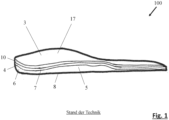
- FIG. 1 shows a shoe insert 100 known from the prior art schematically in a longitudinal section.
- the shoe insert 100 shows an upper footbed 3, which is formed on the upper side 7 of a support body 6 made of PUR foam plastic 5.
- the footbed is covered with a cushion body 10, with a carrier layer 4 as a connecting, adhesion-promoting layer holding the cushion body 10 on the support body 6.
- this adhesion-promoting layer 4 extends over the entire surface of the shoe insert 100.
- Figure 2 shows a shoe insole blank 1 according to the invention, also in a schematic longitudinal section.
- the shoe insole blank 1 according to the invention also shows a footbed 3, which is arranged on the upper side of a support body 6 formed from PUR foam plastic 5.
- the support body 6 of the shoe insole blank 1 according to the invention is also covered with a cushion body 10, which, however, is directly bonded to the material without any adhesive or connecting carrier layer. is connected to the support body 6.
- the adhesion-promoting layer 4 known from the prior art, as shown in the Figure 1 can be omitted according to the invention, since the material of the cushioning body 10 bonds firmly to the RIM foam plastic 5 during the RIM foaming of the support body 6.
- the shoe insole blank 1 according to the invention is two-layered in its simplest design, whereby currently known shoe insole blanks 100 must be designed with at least three layers due to the presence of a carrier layer 4.
- the advantages of a 2-layer design of a shoe insole blank have already been explained above in the general part of the description of the invention.
- FIG 3 a shoe insole blank according to the invention is shown in a second embodiment, in which the cushioning body 10 is arranged on the underside 8 of the support body 6, thus forming the underside 18 of the shoe insole blank 1.
- the upper side 7 of the support body 6 simultaneously forms the upper side 17 of the shoe insole blank 1.
- the upper side 7 of the support body 6 can, as a person skilled in the art will readily recognize, be provided with a further cover material 25, which can also be applied subsequently for individual adaptation of the shoe insole blank, for example by grinding or milling.
- the schematically illustrated shoe insole blank 1 also shows a support part 19 arranged in the heel area 13.
- the support part 19 is preferably injection-molded onto the cushion body 10 before the cushion body 10 is inserted into the foam mold half that forms the shoe-facing underside 18 of the shoe insole blank 1.
- the injection-molded part 19 is injected onto the PU surface material 15 of the cushion body 10 in such a way that it can be inserted and fixed together with these in the RIM foam mold in such a way that the injection-molded part 19 is held in the desired predetermined position by the cushion body 6 during RIM foaming.
- the cushion body 10 can be clamped in the parting plane of the two foam mold halves, for example when closing the RIM foam mold, so that neither the cushion body 10 nor the injection molded part 19 slips during the expansion of the PUR foam plastic in the RIM foam mold and the injection molded part 19 is held securely in the desired predetermined orthopedically effective position.
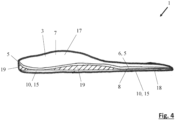
- Figure 4 shows a modification to the embodiment of the Figure 3 a third embodiment of a shoe insole blank 1 according to the invention with an internal injection molded part 19, which is arranged on the underside 8 of the support body 6.
- the PU surface material 15 of the cushion body 10 forms the underside 18 of the shoe insole blank 1 in this embodiment.
- the support body 6 is, as in the embodiment of the Figure 3 , arranged on the upper side 17 of the shoe insole blank 1 and can, as for example in the further embodiments of the Figures 5 and 6 shown, can be provided with a further cushion body 10 and/or a cover material 25.
- the injection molded part 19, which is molded onto the PU surface material 15 of the cushion body 10 was placed together with the cushion body 10 into the RIM foam mold in such a way that the injection molded part 19 faced the cavity during the RIM foaming.
- the cushion body 10 covered the shaping surfaces of the second RIM foam mold half, which form the shoe-facing underside 18 of the shoe insole blank 1.
- the exemplary embodiment according to Figure 4 an injection-molded part 19 completely covered by the PU surface material 15 of the cushion body 10, although this is not mandatory.
- the PU surface material has recesses 16 through which the injection-molded part 19 emerges to the surface and can be visibly processed there, for example by an orthopedic specialist.
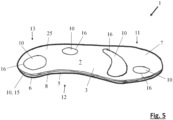
- FIG. 5 shows in perspective and by way of example a fourth embodiment of a shoe insole blank 1 according to the invention, in which, for example, a shoe insole blank 1 according to Figure 2 is covered with a further cover material 25.
- the cover material 25 which can also be a PU surface material, but does not have to be, one or more recesses 16 are arranged in the toe area 11, in the middle area 12 and in the heel area 13 of a sole of the foot. Through these recesses 16, the cushion body 10 comes into direct contact with the sole of the foot of the wearer of the shoe insole.
- the cushion bodies 10 can be connected to one another below the additional cover material 25 or can be separate cushion bodies 10 that are individually connected to the support body 6.
- the orthopedic The required cushioning and support requirements in the individual areas can be individually adapted.
- softer padding bodies 10 can be used than, for example, for the padding of the big toe.
- shoe insole blanks can be produced which have one or more cushioning bodies 10 both on the top side 17 of the shoe insole blank 1 and on its bottom side 18.
- the PU surface material 15 of the one or more cushioning bodies 10 or that of the cover materials 25, which are additionally applied to the top side 17 and/or bottom side 18 of the shoe insole blank 1 according to the invention, can have recesses 16 through which an injection-molded part 19 and/or the PU surface material 15 of the one or more cushioning bodies 10 are visible.
- the person skilled in the art will recognize a large number of possible combinations here, all of which are connected to one another by the inventive concept of using a carrier layer-free PU surface material 15 as the cushioning body 10.
Landscapes
- Engineering & Computer Science (AREA)
- Chemical & Material Sciences (AREA)
- Materials Engineering (AREA)
- Mechanical Engineering (AREA)
- Life Sciences & Earth Sciences (AREA)
- Wood Science & Technology (AREA)
- Footwear And Its Accessory, Manufacturing Method And Apparatuses (AREA)
Priority Applications (7)
| Application Number | Priority Date | Filing Date | Title |
|---|---|---|---|
| EP22200575.3A EP4353115B1 (de) | 2022-10-10 | 2022-10-10 | Orthopädischer pur-schaumkunststoff-schuheinlegesohlenrohling |
| HUE22200575A HUE069979T2 (hu) | 2022-10-10 | 2022-10-10 | Ortopéd PUR-mûanyaghab cipõ talpbetét nyersdarab |
| PL22200575.3T PL4353115T3 (pl) | 2022-10-10 | 2022-10-10 | Ortopedyczny półwyrób wkładki do obuwia z piankowego tworzywa sztucznego pur |
| ES22200575T ES3015087T3 (en) | 2022-10-10 | 2022-10-10 | Orthopaedic pur foam plastic shoe insole blank |
| PCT/EP2023/077868 WO2024079032A1 (de) | 2022-10-10 | 2023-10-09 | Orthopädischer pur-schaumkunststoff-schuheinlegesohlenrohling |
| CN202380042047.1A CN119317375B (zh) | 2022-10-10 | 2023-10-09 | 矫形的pur泡沫塑料的鞋内底坯料 |
| US18/994,415 US12593892B2 (en) | 2022-10-10 | 2023-10-09 | Orthopedic PUR foam plastic shoe insole blank |
Applications Claiming Priority (1)
| Application Number | Priority Date | Filing Date | Title |
|---|---|---|---|
| EP22200575.3A EP4353115B1 (de) | 2022-10-10 | 2022-10-10 | Orthopädischer pur-schaumkunststoff-schuheinlegesohlenrohling |
Publications (3)
| Publication Number | Publication Date |
|---|---|
| EP4353115A1 EP4353115A1 (de) | 2024-04-17 |
| EP4353115C0 EP4353115C0 (de) | 2024-11-06 |
| EP4353115B1 true EP4353115B1 (de) | 2024-11-06 |
Family
ID=83689558
Family Applications (1)
| Application Number | Title | Priority Date | Filing Date |
|---|---|---|---|
| EP22200575.3A Active EP4353115B1 (de) | 2022-10-10 | 2022-10-10 | Orthopädischer pur-schaumkunststoff-schuheinlegesohlenrohling |
Country Status (7)
| Country | Link |
|---|---|
| US (1) | US12593892B2 (pl) |
| EP (1) | EP4353115B1 (pl) |
| CN (1) | CN119317375B (pl) |
| ES (1) | ES3015087T3 (pl) |
| HU (1) | HUE069979T2 (pl) |
| PL (1) | PL4353115T3 (pl) |
| WO (1) | WO2024079032A1 (pl) |
Citations (5)
| Publication number | Priority date | Publication date | Assignee | Title |
|---|---|---|---|---|
| US20040025376A1 (en) | 2002-08-06 | 2004-02-12 | Schering Corporation | Insole with arch spring |
| EP1602294A1 (de) | 2004-06-02 | 2005-12-07 | Spannrit Schuhkomponenten GmbH | Polyurethan-Schaum-Einlegesohle und Verfahren zu ihrer Herstellung |
| DE202007018343U1 (de) | 2007-07-06 | 2008-05-15 | Spannrit Schuhkomponenten Gmbh | Schaumkunststoff-Schuheinlegesohle |
| DE102014115135A1 (de) | 2013-10-18 | 2015-04-23 | Willi Mander Gmbh | Verfahren und Aufschäumform zur Herstellung von Schuheinlagen |
| EP3981279A1 (de) | 2020-10-09 | 2022-04-13 | Spannrit GmbH | Orthopädischer schuheinlage-rohling und verfahren zu dessen herstellung |
Family Cites Families (9)
| Publication number | Priority date | Publication date | Assignee | Title |
|---|---|---|---|---|
| US4808469A (en) * | 1985-05-09 | 1989-02-28 | Maurice Hiles | Energy absorbing polyurethane composite article |
| RU1799257C (ru) | 1990-01-30 | 1993-02-28 | А.К.Белобородое | Стелька бак |
| DE102010015145B4 (de) | 2010-04-16 | 2017-02-09 | Spannrit Schuhkomponenten Gmbh | Thermoplastisch verformbare Schuheinlegesohle |
| PL2929792T3 (pl) | 2014-04-10 | 2017-05-31 | Spannrit Gmbh | Półfabrykat wkładki do obuwia z pianki z tworzywa sztucznego z pokryciem i sposobem jej nanoszenia |
| RU174557U1 (ru) | 2017-05-12 | 2017-10-19 | федеральное государственное бюджетное образовательное учреждение высшего образования "Казанский национальный исследовательский технологический университет" (ФГБОУ ВО "КНИТУ") | Вкладная стелька для обуви |
| ES2808142T3 (es) | 2018-01-23 | 2021-02-25 | Spannrit Gmbh | Plantilla ortopédica de plástico espumado para zapato |
| CN207949082U (zh) | 2018-02-24 | 2018-10-12 | 厦门吉康源科技有限公司 | 一种适配跑步鞋用的功能鞋垫 |
| DE102018206906B4 (de) * | 2018-05-04 | 2022-12-08 | Spannrit Gmbh | Einlegesohlen-Fräsblock und Verfahren zum Herstellen eines solchen Fräsblocks |
| PT3708018T (pt) * | 2019-03-11 | 2021-06-01 | Spannrit Gmbh | Sola de sapato em branco e método para personalizar a mesma |
-
2022
- 2022-10-10 ES ES22200575T patent/ES3015087T3/es active Active
- 2022-10-10 PL PL22200575.3T patent/PL4353115T3/pl unknown
- 2022-10-10 HU HUE22200575A patent/HUE069979T2/hu unknown
- 2022-10-10 EP EP22200575.3A patent/EP4353115B1/de active Active
-
2023
- 2023-10-09 WO PCT/EP2023/077868 patent/WO2024079032A1/de not_active Ceased
- 2023-10-09 US US18/994,415 patent/US12593892B2/en active Active
- 2023-10-09 CN CN202380042047.1A patent/CN119317375B/zh active Active
Patent Citations (5)
| Publication number | Priority date | Publication date | Assignee | Title |
|---|---|---|---|---|
| US20040025376A1 (en) | 2002-08-06 | 2004-02-12 | Schering Corporation | Insole with arch spring |
| EP1602294A1 (de) | 2004-06-02 | 2005-12-07 | Spannrit Schuhkomponenten GmbH | Polyurethan-Schaum-Einlegesohle und Verfahren zu ihrer Herstellung |
| DE202007018343U1 (de) | 2007-07-06 | 2008-05-15 | Spannrit Schuhkomponenten Gmbh | Schaumkunststoff-Schuheinlegesohle |
| DE102014115135A1 (de) | 2013-10-18 | 2015-04-23 | Willi Mander Gmbh | Verfahren und Aufschäumform zur Herstellung von Schuheinlagen |
| EP3981279A1 (de) | 2020-10-09 | 2022-04-13 | Spannrit GmbH | Orthopädischer schuheinlage-rohling und verfahren zu dessen herstellung |
Non-Patent Citations (12)
| Title |
|---|
| BEST WOLFGANG: "Digitaler Prozess und analoge Produktion kombiniert", MARKT & BETRIEB, 1 February 2022 (2022-02-01), pages 34 - 38, XP093305291 |
| D7A - PRODUKTIONSAUFTRAG "MANDER GO" |
| D7B - LIEFERSCHEIN "MANDER GO" |
| D7C - RECHNUNG "MANDER GO" |
| D7d - Eidesstattliche Versicherung Frau S.S. Stabel |
| D8A - PRODUKTIONSAUFTRAG "ELTEN DIALUTION" |
| D8B - LIEFERSCHEIN "ELTEN DIALUTION" |
| D8C - RECHNUNG "ELTEN DIALUTION" |
| D8d - Lieferschein vom 01.08.18 |
| D8E - RECHNUNG "COLORTEX - BEZUG" |
| D8f - Materialrechnung der Firma Colortex GmbH vom 13.09.2017 |
| D8G - DATENBLATT ZUM MATERIAL DER FIRMA COLORTEX VOM 03.05.2020 |
Also Published As
| Publication number | Publication date |
|---|---|
| EP4353115C0 (de) | 2024-11-06 |
| WO2024079032A1 (de) | 2024-04-18 |
| US12593892B2 (en) | 2026-04-07 |
| EP4353115A1 (de) | 2024-04-17 |
| PL4353115T3 (pl) | 2025-03-17 |
| ES3015087T3 (en) | 2025-04-29 |
| CN119317375A (zh) | 2025-01-14 |
| US20250261723A1 (en) | 2025-08-21 |
| HUE069979T2 (hu) | 2025-04-28 |
| CN119317375B (zh) | 2025-09-30 |
Similar Documents
| Publication | Publication Date | Title |
|---|---|---|
| DE102010052783B4 (de) | Verfahren zur Herstellung eines Schuhs und Schuh | |
| DE102010009127B4 (de) | Mehrdichtenpolsterung für einen Kraftfahrzeugsitz | |
| DE202014010460U1 (de) | Sohle für einen Schuh | |
| DE102012206094A1 (de) | Sohlen für Sportschuhe | |
| EP0048965A2 (de) | Polstersohle mit orthopädischen Eigenschaften | |
| EP1602294B1 (de) | Polyurethan-Schaum-Einlegesohle und Verfahren zu ihrer Herstellung | |
| EP1967086B1 (de) | Schaumkunststoff-Schuheinlegesohle | |
| EP2540178B1 (de) | Verfahren zur Herstellung eines Schalenteils eines Sportschuhs und ein gemäß diesem Verfahren hergestellter Schalenteil | |
| DE102016225335A1 (de) | Sohle für einen Schuh und Verfahren zu deren Herstellung | |
| DE202007018343U1 (de) | Schaumkunststoff-Schuheinlegesohle | |
| AT398157B (de) | Schuh mit einer mehrschichtigen brandsohle, brandsohle für einen solchen schuh und verfahren zur herstellung einer brandsohle | |
| EP3513675B1 (de) | Orthopädische schaumkunststoff-schuheinlage | |
| EP4353115A1 (de) | Orthopädischer pur-schaumkunststoff-schuheinlegesohlenrohling | |
| EP2342987B1 (de) | Integrales Dämpf- und Stützelement | |
| DE102010015145A1 (de) | Thermoplastisch verformbare Schuheinlegesohle | |
| EP2910677B1 (de) | Bedruckte schaumkunststoff-schuheinlegesohlen-rohlinge | |
| EP2929792A1 (de) | Schaumkunststoff-Schuheinlegesohlen-Rohling mit einer Decke und Verfahren zum aufbringen derselbigen | |
| EP0504788A2 (de) | Flexibles, sohlenartiges Stabilisierungselement für Schuhe | |
| EP3463974B1 (de) | Sitzlehnenverkleidung und verfahren zu deren herstellung | |
| EP4070681B1 (de) | Orthopädischer schuheinlegesohlenrohling | |
| EP2630884B1 (de) | Verfahren zum Herstellen eines anatomisch geformten Rohlings für eine Schuheinlage und Schuheinlage | |
| EP2823956B1 (de) | Schaumkunststoff-Schuheinlegesohle mit textiler Lage und Verfahren zu deren Herstellung | |
| DE102018206906A1 (de) | Einlegesohlen-Fräsblock und Verfahren zum Herstellen eines solchen Fräsblocks | |
| EP3838575A1 (de) | Verfahren zum herstellen einer laufsohle sowie spritz- oder giesswerkzeug | |
| DE102007019266A1 (de) | Einlegeteil für Prothesenfuß |
Legal Events
| Date | Code | Title | Description |
|---|---|---|---|
| PUAI | Public reference made under article 153(3) epc to a published international application that has entered the european phase |
Free format text: ORIGINAL CODE: 0009012 |
|
| STAA | Information on the status of an ep patent application or granted ep patent |
Free format text: STATUS: REQUEST FOR EXAMINATION WAS MADE |
|
| 17P | Request for examination filed |
Effective date: 20221010 |
|
| AK | Designated contracting states |
Kind code of ref document: A1 Designated state(s): AL AT BE BG CH CY CZ DE DK EE ES FI FR GB GR HR HU IE IS IT LI LT LU LV MC ME MK MT NL NO PL PT RO RS SE SI SK SM TR |
|
| GRAP | Despatch of communication of intention to grant a patent |
Free format text: ORIGINAL CODE: EPIDOSNIGR1 |
|
| STAA | Information on the status of an ep patent application or granted ep patent |
Free format text: STATUS: GRANT OF PATENT IS INTENDED |
|
| RIC1 | Information provided on ipc code assigned before grant |
Ipc: B29D 35/14 20100101ALI20240802BHEP Ipc: A43B 17/00 20060101AFI20240802BHEP |
|
| GRAS | Grant fee paid |
Free format text: ORIGINAL CODE: EPIDOSNIGR3 |
|
| INTG | Intention to grant announced |
Effective date: 20240902 |
|
| GRAA | (expected) grant |
Free format text: ORIGINAL CODE: 0009210 |
|
| STAA | Information on the status of an ep patent application or granted ep patent |
Free format text: STATUS: THE PATENT HAS BEEN GRANTED |
|
| AK | Designated contracting states |
Kind code of ref document: B1 Designated state(s): AL AT BE BG CH CY CZ DE DK EE ES FI FR GB GR HR HU IE IS IT LI LT LU LV MC ME MK MT NL NO PL PT RO RS SE SI SK SM TR |
|
| REG | Reference to a national code |
Ref country code: GB Ref legal event code: FG4D Free format text: NOT ENGLISH |
|
| REG | Reference to a national code |
Ref country code: CH Ref legal event code: EP |
|
| REG | Reference to a national code |
Ref country code: DE Ref legal event code: R096 Ref document number: 502022002070 Country of ref document: DE |
|
| REG | Reference to a national code |
Ref country code: IE Ref legal event code: FG4D Free format text: LANGUAGE OF EP DOCUMENT: GERMAN |
|
| U01 | Request for unitary effect filed |
Effective date: 20241119 |
|
| U07 | Unitary effect registered |
Designated state(s): AT BE BG DE DK EE FI FR IT LT LU LV MT NL PT RO SE SI Effective date: 20241122 |
|
| REG | Reference to a national code |
Ref country code: SK Ref legal event code: T3 Ref document number: E 45774 Country of ref document: SK |
|
| PG25 | Lapsed in a contracting state [announced via postgrant information from national office to epo] |
Ref country code: IS Free format text: LAPSE BECAUSE OF FAILURE TO SUBMIT A TRANSLATION OF THE DESCRIPTION OR TO PAY THE FEE WITHIN THE PRESCRIBED TIME-LIMIT Effective date: 20250306 Ref country code: HR Free format text: LAPSE BECAUSE OF FAILURE TO SUBMIT A TRANSLATION OF THE DESCRIPTION OR TO PAY THE FEE WITHIN THE PRESCRIBED TIME-LIMIT Effective date: 20241106 |
|
| PG25 | Lapsed in a contracting state [announced via postgrant information from national office to epo] |
Ref country code: NO Free format text: LAPSE BECAUSE OF FAILURE TO SUBMIT A TRANSLATION OF THE DESCRIPTION OR TO PAY THE FEE WITHIN THE PRESCRIBED TIME-LIMIT Effective date: 20250206 |
|
| PG25 | Lapsed in a contracting state [announced via postgrant information from national office to epo] |
Ref country code: GR Free format text: LAPSE BECAUSE OF FAILURE TO SUBMIT A TRANSLATION OF THE DESCRIPTION OR TO PAY THE FEE WITHIN THE PRESCRIBED TIME-LIMIT Effective date: 20250207 |
|
| REG | Reference to a national code |
Ref country code: HU Ref legal event code: AG4A Ref document number: E069979 Country of ref document: HU |
|
| PG25 | Lapsed in a contracting state [announced via postgrant information from national office to epo] |
Ref country code: RS Free format text: LAPSE BECAUSE OF FAILURE TO SUBMIT A TRANSLATION OF THE DESCRIPTION OR TO PAY THE FEE WITHIN THE PRESCRIBED TIME-LIMIT Effective date: 20250206 |
|
| REG | Reference to a national code |
Ref country code: ES Ref legal event code: FG2A Ref document number: 3015087 Country of ref document: ES Kind code of ref document: T3 Effective date: 20250429 |
|
| PG25 | Lapsed in a contracting state [announced via postgrant information from national office to epo] |
Ref country code: SM Free format text: LAPSE BECAUSE OF FAILURE TO SUBMIT A TRANSLATION OF THE DESCRIPTION OR TO PAY THE FEE WITHIN THE PRESCRIBED TIME-LIMIT Effective date: 20241106 |
|
| PLBI | Opposition filed |
Free format text: ORIGINAL CODE: 0009260 |
|
| PLAX | Notice of opposition and request to file observation + time limit sent |
Free format text: ORIGINAL CODE: EPIDOSNOBS2 |
|
| 26 | Opposition filed |
Opponent name: MANDER-MALMS GMBH Effective date: 20250805 |
|
| PGFP | Annual fee paid to national office [announced via postgrant information from national office to epo] |
Ref country code: PL Payment date: 20250827 Year of fee payment: 4 |
|
| U20 | Renewal fee for the european patent with unitary effect paid |
Year of fee payment: 4 Effective date: 20250917 |
|
| PGFP | Annual fee paid to national office [announced via postgrant information from national office to epo] |
Ref country code: SK Payment date: 20250905 Year of fee payment: 4 |
|
| PGFP | Annual fee paid to national office [announced via postgrant information from national office to epo] |
Ref country code: HU Payment date: 20250910 Year of fee payment: 4 |
|
| PGFP | Annual fee paid to national office [announced via postgrant information from national office to epo] |
Ref country code: CZ Payment date: 20251008 Year of fee payment: 4 |
|
| PLBB | Reply of patent proprietor to notice(s) of opposition received |
Free format text: ORIGINAL CODE: EPIDOSNOBS3 |
|
| PGFP | Annual fee paid to national office [announced via postgrant information from national office to epo] |
Ref country code: ES Payment date: 20251103 Year of fee payment: 4 |