EP4352283B1 - Use of quartz plates during growth of single crystal silicon ingots - Google Patents
Use of quartz plates during growth of single crystal silicon ingots Download PDFInfo
- Publication number
- EP4352283B1 EP4352283B1 EP22733347.3A EP22733347A EP4352283B1 EP 4352283 B1 EP4352283 B1 EP 4352283B1 EP 22733347 A EP22733347 A EP 22733347A EP 4352283 B1 EP4352283 B1 EP 4352283B1
- Authority
- EP
- European Patent Office
- Prior art keywords
- melt
- plates
- silicon
- weir
- ingot
- Prior art date
- Legal status (The legal status is an assumption and is not a legal conclusion. Google has not performed a legal analysis and makes no representation as to the accuracy of the status listed.)
- Active
Links
Images




Classifications
-
- C—CHEMISTRY; METALLURGY
- C30—CRYSTAL GROWTH
- C30B—SINGLE-CRYSTAL GROWTH; UNIDIRECTIONAL SOLIDIFICATION OF EUTECTIC MATERIAL OR UNIDIRECTIONAL DEMIXING OF EUTECTOID MATERIAL; REFINING BY ZONE-MELTING OF MATERIAL; PRODUCTION OF A HOMOGENEOUS POLYCRYSTALLINE MATERIAL WITH DEFINED STRUCTURE; SINGLE CRYSTALS OR HOMOGENEOUS POLYCRYSTALLINE MATERIAL WITH DEFINED STRUCTURE; AFTER-TREATMENT OF SINGLE CRYSTALS OR A HOMOGENEOUS POLYCRYSTALLINE MATERIAL WITH DEFINED STRUCTURE; APPARATUS THEREFOR
- C30B15/00—Single-crystal growth by pulling from a melt, e.g. Czochralski method
- C30B15/14—Heating of the melt or the crystallised materials
-
- C—CHEMISTRY; METALLURGY
- C30—CRYSTAL GROWTH
- C30B—SINGLE-CRYSTAL GROWTH; UNIDIRECTIONAL SOLIDIFICATION OF EUTECTIC MATERIAL OR UNIDIRECTIONAL DEMIXING OF EUTECTOID MATERIAL; REFINING BY ZONE-MELTING OF MATERIAL; PRODUCTION OF A HOMOGENEOUS POLYCRYSTALLINE MATERIAL WITH DEFINED STRUCTURE; SINGLE CRYSTALS OR HOMOGENEOUS POLYCRYSTALLINE MATERIAL WITH DEFINED STRUCTURE; AFTER-TREATMENT OF SINGLE CRYSTALS OR A HOMOGENEOUS POLYCRYSTALLINE MATERIAL WITH DEFINED STRUCTURE; APPARATUS THEREFOR
- C30B15/00—Single-crystal growth by pulling from a melt, e.g. Czochralski method
- C30B15/002—Continuous growth
-
- C—CHEMISTRY; METALLURGY
- C30—CRYSTAL GROWTH
- C30B—SINGLE-CRYSTAL GROWTH; UNIDIRECTIONAL SOLIDIFICATION OF EUTECTIC MATERIAL OR UNIDIRECTIONAL DEMIXING OF EUTECTOID MATERIAL; REFINING BY ZONE-MELTING OF MATERIAL; PRODUCTION OF A HOMOGENEOUS POLYCRYSTALLINE MATERIAL WITH DEFINED STRUCTURE; SINGLE CRYSTALS OR HOMOGENEOUS POLYCRYSTALLINE MATERIAL WITH DEFINED STRUCTURE; AFTER-TREATMENT OF SINGLE CRYSTALS OR A HOMOGENEOUS POLYCRYSTALLINE MATERIAL WITH DEFINED STRUCTURE; APPARATUS THEREFOR
- C30B15/00—Single-crystal growth by pulling from a melt, e.g. Czochralski method
- C30B15/02—Single-crystal growth by pulling from a melt, e.g. Czochralski method adding crystallising materials or reactants forming it in situ to the melt
-
- C—CHEMISTRY; METALLURGY
- C30—CRYSTAL GROWTH
- C30B—SINGLE-CRYSTAL GROWTH; UNIDIRECTIONAL SOLIDIFICATION OF EUTECTIC MATERIAL OR UNIDIRECTIONAL DEMIXING OF EUTECTOID MATERIAL; REFINING BY ZONE-MELTING OF MATERIAL; PRODUCTION OF A HOMOGENEOUS POLYCRYSTALLINE MATERIAL WITH DEFINED STRUCTURE; SINGLE CRYSTALS OR HOMOGENEOUS POLYCRYSTALLINE MATERIAL WITH DEFINED STRUCTURE; AFTER-TREATMENT OF SINGLE CRYSTALS OR A HOMOGENEOUS POLYCRYSTALLINE MATERIAL WITH DEFINED STRUCTURE; APPARATUS THEREFOR
- C30B15/00—Single-crystal growth by pulling from a melt, e.g. Czochralski method
- C30B15/10—Crucibles or containers for supporting the melt
-
- C—CHEMISTRY; METALLURGY
- C30—CRYSTAL GROWTH
- C30B—SINGLE-CRYSTAL GROWTH; UNIDIRECTIONAL SOLIDIFICATION OF EUTECTIC MATERIAL OR UNIDIRECTIONAL DEMIXING OF EUTECTOID MATERIAL; REFINING BY ZONE-MELTING OF MATERIAL; PRODUCTION OF A HOMOGENEOUS POLYCRYSTALLINE MATERIAL WITH DEFINED STRUCTURE; SINGLE CRYSTALS OR HOMOGENEOUS POLYCRYSTALLINE MATERIAL WITH DEFINED STRUCTURE; AFTER-TREATMENT OF SINGLE CRYSTALS OR A HOMOGENEOUS POLYCRYSTALLINE MATERIAL WITH DEFINED STRUCTURE; APPARATUS THEREFOR
- C30B15/00—Single-crystal growth by pulling from a melt, e.g. Czochralski method
- C30B15/10—Crucibles or containers for supporting the melt
- C30B15/12—Double crucible methods
-
- C—CHEMISTRY; METALLURGY
- C30—CRYSTAL GROWTH
- C30B—SINGLE-CRYSTAL GROWTH; UNIDIRECTIONAL SOLIDIFICATION OF EUTECTIC MATERIAL OR UNIDIRECTIONAL DEMIXING OF EUTECTOID MATERIAL; REFINING BY ZONE-MELTING OF MATERIAL; PRODUCTION OF A HOMOGENEOUS POLYCRYSTALLINE MATERIAL WITH DEFINED STRUCTURE; SINGLE CRYSTALS OR HOMOGENEOUS POLYCRYSTALLINE MATERIAL WITH DEFINED STRUCTURE; AFTER-TREATMENT OF SINGLE CRYSTALS OR A HOMOGENEOUS POLYCRYSTALLINE MATERIAL WITH DEFINED STRUCTURE; APPARATUS THEREFOR
- C30B29/00—Single crystals or homogeneous polycrystalline material with defined structure characterised by the material or by their shape
- C30B29/02—Elements
- C30B29/06—Silicon
Definitions
- the field of the invention relates to methods for producing single crystal silicon ingots by Continuous Czochralski (CCz) and, in particular, methods in which quartz plates are added to an outer melt zone of the crucible assembly.
- CCz Continuous Czochralski
- Continuous Czochralski is well suited to form 300 mm or 200 mm diameter single crystal silicon ingots such as ingots that are relative heavily doped with arsenic or phosphorous.
- Continuous Czochralski methods involve forming a single crystal silicon ingot from a melt of silicon while continuously or intermittently adding solid-state silicon to the melt to replenish the melt while the ingot is grown. The methods may involve forming multiple ingots from the same melt while the hot zone remains at temperature (i.e., with a melt continuously being present in the crucible assembly while the plurality of ingots is grown).
- Continuous Czochralski methods may involve a crucible assembly that includes at least two and often three melt zones that are separated by physical barriers - an outer melt zone into which solid polycrystalline silicon is fed, a middle melt zone in which the melt stabilizes, and an inner melt zone from which the silicon ingot is pulled. Addition of solid polycrystalline silicon to the melt causes inert gas bubbles (e.g., argon bubbles) to form in the melt which impacts the void count.
- inert gas bubbles e.g., argon bubbles
- buffer members such as quartz cullets have been added to the melt to reduce formation of inert gas bubbles.
- the quartz cullets cushion the polysilicon that falls into the melt.
- the cullets also promote dissipation of the inert gas bubbles.
- adding quartz cullets adds complexity to the crystal growth process. Cullets also dissolve relatively quickly. Gaps may form between groups of cullets which limits their effectiveness.
- the present invention is directed to a method for growing a single crystal silicon ingot in a continuous Czochralski process.
- a charge of polycrystalline silicon is added to a crucible assembly.
- the crucible assembly includes a weir and a sidewall that define an outer melt zone between the weir and the sidewall.
- One or more plates is added to the outer melt zone, the one or more plates each including one or more openings that extend through the plate to allow silicon to enter the melt.
- a melt of silicon is formed in the crucible assembly.
- a surface of the melt is contacted with a seed crystal.
- a single crystal silicon ingot is withdrawn from the melt.
- Solid polycrystalline silicon feedstock is added to the outer melt zone while withdrawing the single crystal silicon ingot to replenish the melt.
- the one or more plates at least partially cover the melt in the outer melt zone, wherein the polycrystalline silicon melts and falls through the one or more openings that extend through the one or more plates and enters the melt.
- the present invention relates to methods for growing a single crystal silicon ingot in a continuous Czochralski (CCz) process.
- One or more plates e.g., quartz plates
- solid-state silicon e.g., polycrystalline silicon
- the polycrystalline silicon falls onto the plates.
- the solid polycrystalline silicon melts and falls through openings formed in the plates and enters the silicon melt.
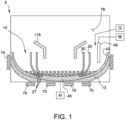
- the ingot puller apparatus 5 for producing an ingot 60 by a continuous Czochralski process is shown in Figures 1-6 .
- the ingot puller apparatus 5 includes a crucible assembly 10 that contains a melt 6 of semiconductor or solar grade silicon material.
- a susceptor 13 supports the crucible assembly 10.
- the crucible assembly 10 has a sidewall 40 and one or more fluid barriers 20, 30 or "weirs" that separate the melt into different melt zones.
- the crucible assembly 10 includes a first weir 20.
- the first weir 20 and sidewall 40 define an outer melt zone 42 of the silicon melt (and of the crucible assembly 10).
- the crucible assembly 10 includes a second weir 30 radially inward to the first weir 20 which defines an inner melt zone 22 of the silicon melt.
- the inner melt zone 22 is the growth region from which the single crystal silicon ingot 60 is grown.
- the first weir 20 and a second weir 30 define a middle melt zone 32 of the silicon melt in which the melt 6 may stabilize as it moves toward the inner melt zone 22.
- the first and second weirs 20, 30 each have at least one opening defined therein to permit molten silicon to flow radially inward towards the growth region of the inner melt zone 22.
- the first weir 20, second weir 30 and sidewall 40 each have a generally annular shape.
- the first weir 20, second weir 30 and sidewall 40 may be part of three nested crucibles which are joined at the bottom or floor 45 of the crucible assembly 10 (i.e., the first and second weirs 20, 30 are the sidewalls of two crucibles nested within a larger crucible).
- the crucible assembly configuration depicted in Figures 1-6 is exemplary. In other embodiments, the crucible assembly 10 has a single layer floor (i.e., does not have nested crucibles) with the weirs extending upward from the floor 45.
- the floor 45 may be flat rather than curved and/or the weirs 20, 30 and/or sidewall 40 may be straight-sided.
- the illustrated crucible assembly 10 is shown with two weirs, in other embodiments the crucible assembly may have a single weir or even no weirs.
- a feeding tube 46 feeds solid-state silicon which may be, for example, polysilicon chips, granular polysilicon, or chunk polysilicon, or a combination thereof, into the outer melt zone 42.
- Chuck polysilicon is generally larger in size than chip polysilicon which is larger in size than granular polysilicon.
- chuck polysilicon may generally have an average nominal size of at least 15 mm (e.g., ranging from 5 mm to 110 mm) while chip polysilicon may have an average nominal size from 1 to 15 mm.
- the solid-state silicon is added at a rate sufficient to maintain a substantially constant melt elevation level and volume during growth of the ingot 60.
- the melt 6 from which the ingot 60 is drawn is formed by loading polycrystalline silicon into a crucible to form an initial silicon charge 27 ( Figure 1 ).
- an initial charge is between about 10 kilograms and about 200 kilograms of polycrystalline silicon, which may be chip, chunk, granular, or a combination thereof.
- the mass of the initial charges depends on the desired crystal diameter and hot zone design. Initial charge does not reflect the length of the ingot crystal, because polycrystalline silicon is continuously fed during crystal growth.
- a variety of sources of polycrystalline silicon may be used including, for example, granular polycrystalline silicon produced by thermal decomposition of silane or a halosilane in a fluidized bed reactor or polycrystalline silicon produced in a Siemens reactor. While the solid-state silicon is typically polysilicon, an amount of single crystal silicon (e.g., portions discarded from a cropped ingot) may also be used.
- one or more plates 31 are added to the charge 27 in the outer melt zone 42.
- a plurality of plates 31 are added to the outer melt zone 42 (e.g., at least two, at least three, at least four, at least five, at least eight, at least ten or at least 12 plates or more) are added to the outer melt zone 42.
- a single plate 31 is added (e.g., a plate that circumscribes the entire circumference of the outer melt zone 42).
- the plates may be free-floating and not connected to each other. In other embodiments, the plates 31 may be connected. The plates 31 may be sized to minimize gaps between adjacent plates 31.
- the plates 31 may be made of quartz or other material that allows the plates 31 to operate as described herein.
- the plates 31 are generally less dense than the melt 6 of silicon such that the plates float within the melt 6 after formation of the melt 6.
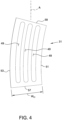
- each plate 31 has one or more openings or slots 49 that extend through the thickness of the plate 31.
- the openings 49 are slots having a major axis that is generally parallel to the longitudinal axis A of the plate 31 (i.e., the openings 49 are spaced radially)
- the openings 49 may have any shape that allows the plates 31 to operate as described herein.
- the openings 49 may be sized to be smaller than the size of the type of polysilicon introduced into the outer melt zone (e.g., chunk, chips or granular).
- the plates 31 have an inner edge 51 and an outer edge 53.
- the edges 51, 53 are rounded to match the contours of the outer melt zone 42 (i.e., the area bound by the first weir 20 and sidewall 40).
- the outer edge 53 is longer than the inner edge 51.
- First and second sides 57, 59 extend between the inner and outer edges 51, 53.
- Each plate 31 has a width W 31 .
- the width W 31 of each plate 31 is less than the width W 42 ( Figure 3 ) of the outer melt zone 42 to allow the plates 31 to be disposed within the outer melt zone 42 without contacting the first weir 20 or the sidewall 40 (e.g., during meltdown and/or during ingot growth).
- the charge 27 is heated to a temperature above the melting temperature of silicon (e.g., about 1412°C) to melt the charge, and thereby form a silicon melt 6 ( Figure 6 ) comprising molten silicon.
- the silicon melt 6 has an initial volume of molten silicon and has an initial melt elevation level, and these parameters are determined by the size of the initial charge 27.
- the crucible assembly 10 comprising the silicon melt 6 is heated to a temperature of at least about 1425°C, at least about 1450°C or even at least about 1500°C.
- the plates 31 float on the melt 6 in the outer melt zone 42.
- the ingot pulling apparatus 5 includes a pulling mechanism 114 ( Figure 6 ) for growing and pulling the ingot 60 from the melt 6 within the inner melt zone 22.
- the pulling mechanism 114 includes a pulling cable 118, a seed holder or chuck 120 coupled to one end of the pulling cable 118, and a seed crystal 122 coupled to the seed holder or chuck 120 for initiating crystal growth.
- One end of the pulling cable 118 is connected to a lifting mechanism (e.g., driven pulley or drum, or any other suitable type of lifting mechanism) and the other end is connected to the chuck 120 that holds the seed crystal 122.
- the seed crystal 122 is lowered to contact the melt 6 in the inner melt zone 22.
- the pulling mechanism 114 is operated to cause the seed crystal 122 to rise along pull axis A. This causes a single crystal ingot 60 to be pulled from the melt 6.
- the pulling mechanism 114 may rotate the seed crystal 122 and the ingot 60 connected thereto.
- a crucible drive unit 44 may rotate the susceptor 13 and crucible assembly 10.
- the silicon seed crystal 122 and the crucible assembly 10 are rotated in opposite directions, i.e., counter-rotation. Counter-rotation achieves convection in the silicon melt 6.
- Rotation of the seed crystal 122 is mainly used to provide a symmetric temperature profile, suppress angular variation of impurities and also to control crystal melt interface shape.
- an outwardly flaring seed-cone portion 54 (or “crown") adjacent the neck 52 is grown.
- the pull rate is decreased from the neck portion pull rate to a rate suitable for growing the outwardly flaring seed-cone portion 54.
- the many body 56 or "constant-diameter portion" of the ingot 60 is grown.
- the main body 56 of the ingot 60 has a diameter of about 150 mm, at least about 150 mm, about 200 mm, at least about 200 mm, about 300 mm, at least about 300 mm, about 450 mm, or even at least about 450 mm.
- solid polysilicon feedstock is added to the outer melt zone 42 through the tube 46 or other channel to replenish the melt 6 in the ingot growth apparatus 5.
- Solid polycrystalline silicon may be added from a polycrystalline silicon feed system 66 and may be continuously or intermittently added to the ingot puller apparatus 5 to maintain the melt level. Generally, polycrystalline silicon may be metered into the ingot puller apparatus 5 by any method available to those of skill in the art.
- the solid polysilicon added to the outer melt zone 42 may be silicon chips, chunk or granular.
- dopant is also added to the melt 6 during ingot growth.
- Dopant may be introduced from a dopant feed system 72.
- Dopant may be added as a gas or solid and may be added to the outer melt zone 42.
- the apparatus 5 may include a heat shield 116 disposed about the ingot 60 to permit the growing ingot 60 to radiate its latent heat of solidification and thermal flux from the melt 6.
- the heat shield 116 may be at least partially conical in shape and angles downwardly at an angle to create an annular opening in which the ingot 60 is disposed.
- a flow of an inert gas, such as argon, is typically provided along the length of the growing crystal.
- the ingot 60 is pulled through a growth chamber 78 that is sealed from the surrounding atmosphere.
- a plurality of independently controlled annular bottom heaters 70 may be disposed in a radial pattern beneath the crucible assembly 10. Annular bottom heaters 70 apply heat in a relatively controlled distribution across the entire base surface area of the crucible assembly 10.
- the annular bottom heaters 70 may be planar resistive heating elements that are individually controlled as described in U.S. Patent No. 7,635, 414 .
- the apparatus 5 may include one or more side heaters 74 disposed radially outward to the crucible assembly 10 to control the temperature distribution through melt 6.
- the ingot growth apparatus 5 shown in Figures 1-6 and described herein is exemplary and generally any system in which a crystal ingot is prepared by a continuous Czochralski method may be used unless stated otherwise.
- solid polycrystalline silicon feedstock is added to the crucible assembly 10 while withdrawing the single crystal silicon ingot 60 to replenish the melt 6.
- Solid-state silicon falls onto the plates 31 which at least partially cover the melt 6 in the outer melt zone 42.
- the heat of the melt 6 heats the solid polycrystalline silicon disposed on the plates 31 causing the silicon to melt and pass through openings 49 that extend through the plate 31 or fall over the edges 51, 53 and/or sides 57, 59 of the plates 31.
- more than one ingot is grown while the hot zone (i.e., lower portion of the apparatus 5 such as the crucible assembly 10 and the susceptor 13) remains heated with silicon melt 6 being continuously within the crucible assembly 10.
- a first ingot is grown to a target length and growth is terminated, the ingot is removed from the ingot puller, and a seed crystal is then lowered into the melt to initiate growth of a second single crystal silicon ingot (i.e., using the same melt from which the first ingot was withdrawn).
- the plates 31 remain in the melt 6 while the second and subsequent ingots are grown and while polycrystalline silicon is added to the outer melt zone 42 to replenish the melt.
- the thickness of the plates 31 may be selected such that the plates 31 do not fully dissolve and remain in the melt 6 after the first ingot is formed. In other embodiments, a new set of plates 31 is added before growth of each subsequent ingot.
- Subsequent ingots may be grown with the hot zone intact and at temperature with a continuous melt of silicon being within the crucible assembly 10 (e.g., until one or more components of the hot zone have degraded such as the crucible assembly requiring cool-down and replacement of the degraded component). For example, at least 1, 2, 3, 4, 5, 6, 10, or 20 or more ingots may be grown.
- the methods of the present invention have several advantages. Without being bound by any particular theory, it is believed that addition of polycrystalline silicon into the outer melt zone of the crucible assembly creates relatively small bubbles (e.g., less than 10 ⁇ m) of the inert gas (e.g., argon) that can be carried by the melt through the openings within each weir which allows bubbles to reach the solid-melt interface.
- the plates may act to prevent entrapment of the inert gas into the melt by preventing polycrystalline feedstock from being discharged directly into the melt.
- the first ingot (Batch A) grown during a continuous Czochralski process (200 mm) typically includes more microvoids (detected by laser light scattering with a size of at least than 0.12 ⁇ m) relative to subsequently grown ingots (Ingots B-G).
- Figure 8 shows the void count for the first grown ingots (Batch A) during a number of continuous Czochralski runs.
- the "Test" run (far right box plot) included plates on top of the initial charge of silicon ( Figure 2 ) and on the subsequent melt ( Figure 6 ) as polycrystalline silicon was added to the outer melt zone.
- the other runs included quartz cullets instead of quartz plates. As shown from Figure 8 , the run with plates did not increase void counts to unacceptable levels.
Landscapes
- Chemical & Material Sciences (AREA)
- Engineering & Computer Science (AREA)
- Crystallography & Structural Chemistry (AREA)
- Materials Engineering (AREA)
- Metallurgy (AREA)
- Organic Chemistry (AREA)
- Crystals, And After-Treatments Of Crystals (AREA)
Applications Claiming Priority (2)
| Application Number | Priority Date | Filing Date | Title |
|---|---|---|---|
| US202163197726P | 2021-06-07 | 2021-06-07 | |
| PCT/EP2022/065434 WO2022258634A1 (en) | 2021-06-07 | 2022-06-07 | Use of quartz plates during growth of single crystal silicon ingots |
Publications (2)
| Publication Number | Publication Date |
|---|---|
| EP4352283A1 EP4352283A1 (en) | 2024-04-17 |
| EP4352283B1 true EP4352283B1 (en) | 2025-03-12 |
Family
ID=82196672
Family Applications (1)
| Application Number | Title | Priority Date | Filing Date |
|---|---|---|---|
| EP22733347.3A Active EP4352283B1 (en) | 2021-06-07 | 2022-06-07 | Use of quartz plates during growth of single crystal silicon ingots |
Country Status (7)
| Country | Link |
|---|---|
| US (1) | US12146236B2 (https=) |
| EP (1) | EP4352283B1 (https=) |
| JP (1) | JP7825644B2 (https=) |
| KR (1) | KR20240018581A (https=) |
| CN (1) | CN117616160A (https=) |
| TW (1) | TWI912531B (https=) |
| WO (1) | WO2022258634A1 (https=) |
Families Citing this family (1)
| Publication number | Priority date | Publication date | Assignee | Title |
|---|---|---|---|---|
| US12410538B2 (en) | 2021-11-08 | 2025-09-09 | Globalwafers Co., Ltd. | Use of arrays of quartz particles during single crystal silicon ingot production |
Family Cites Families (16)
| Publication number | Priority date | Publication date | Assignee | Title |
|---|---|---|---|---|
| SU661966A1 (ru) * | 1976-11-23 | 1980-04-05 | Всесоюзный Научно-Исследовательский Институт Монокристаллов И Особо Чистых Химических Веществ "Вниимонокристалл" | Устройство дл выт гивани монокристаллов из расплава |
| JPS59141578U (ja) | 1983-03-09 | 1984-09-21 | 株式会社日立製作所 | 単結晶引上装置 |
| JPS61146788A (ja) * | 1984-12-20 | 1986-07-04 | Fujitsu Ltd | 単結晶成長法 |
| JPH0825833B2 (ja) * | 1990-04-27 | 1996-03-13 | 東芝セラミックス株式会社 | シリコン単結晶の製造方法 |
| JPH0724976U (ja) * | 1993-10-22 | 1995-05-12 | 川崎製鉄株式会社 | シリコン単結晶製造装置 |
| JP3769800B2 (ja) * | 1996-01-12 | 2006-04-26 | 株式会社Sumco | 単結晶引上装置 |
| US7635414B2 (en) | 2003-11-03 | 2009-12-22 | Solaicx, Inc. | System for continuous growing of monocrystalline silicon |
| WO2016179022A1 (en) * | 2015-05-01 | 2016-11-10 | Sunedison, Inc. | Methods for producing single crystal ingots doped with volatile dopants |
| US20180291524A1 (en) * | 2015-05-01 | 2018-10-11 | Corner Star Limited | Methods for producing single crystal ingots doped with volatile dopants |
| CN108350600A (zh) * | 2015-11-18 | 2018-07-31 | 各星有限公司 | 将从单晶锭切割的单晶段再循环的方法 |
| KR20170081499A (ko) * | 2016-01-04 | 2017-07-12 | 주식회사 엘지실트론 | 단결정 잉곳 성장장치 및 이에 적용된 진동 방지판 |
| US10221500B2 (en) | 2017-01-04 | 2019-03-05 | Corner Star Limited | System for forming an ingot including crucible and conditioning members |
| US10407797B2 (en) | 2017-05-04 | 2019-09-10 | Corner Start Limited | Crystal pulling system and method including crucible and barrier |
| WO2022103416A1 (en) | 2020-11-11 | 2022-05-19 | Globalwafers Co., Ltd. | Methods for forming a single crystal silicon ingot with reduced crucible erosion |
| US11499245B2 (en) | 2020-12-30 | 2022-11-15 | Globalwafers Co., Ltd. | Additive feed systems, ingot puller apparatus and methods for forming a single crystal silicon ingot with use of such additive feed systems |
| US11767610B2 (en) | 2020-12-31 | 2023-09-26 | Globalwafers Co., Ltd. | Use of buffer members during growth of single crystal silicon ingots |
-
2022
- 2022-06-02 US US17/831,271 patent/US12146236B2/en active Active
- 2022-06-07 CN CN202280047678.8A patent/CN117616160A/zh active Pending
- 2022-06-07 JP JP2023575484A patent/JP7825644B2/ja active Active
- 2022-06-07 WO PCT/EP2022/065434 patent/WO2022258634A1/en not_active Ceased
- 2022-06-07 TW TW111121105A patent/TWI912531B/zh active
- 2022-06-07 KR KR1020247000242A patent/KR20240018581A/ko active Pending
- 2022-06-07 EP EP22733347.3A patent/EP4352283B1/en active Active
Also Published As
| Publication number | Publication date |
|---|---|
| WO2022258634A1 (en) | 2022-12-15 |
| EP4352283A1 (en) | 2024-04-17 |
| JP2024520171A (ja) | 2024-05-21 |
| CN117616160A (zh) | 2024-02-27 |
| US12146236B2 (en) | 2024-11-19 |
| TWI912531B (zh) | 2026-01-21 |
| TW202248470A (zh) | 2022-12-16 |
| US20220389609A1 (en) | 2022-12-08 |
| JP7825644B2 (ja) | 2026-03-06 |
| KR20240018581A (ko) | 2024-02-13 |
Similar Documents
| Publication | Publication Date | Title |
|---|---|---|
| EP0170856B1 (en) | Process for growing monocrystals of semiconductor materials from shallow crucibles by czochralski technique | |
| JP4225688B2 (ja) | ポリシリコン装填物からシリコンメルトを製造する方法 | |
| EP4271862B1 (en) | Use of buffer members during growth of single crystal silicon ingots | |
| EP2705178B1 (en) | Growth of a uniformly doped silicon ingot by doping only the initial charge | |
| JP7748937B2 (ja) | 連続チョクラルスキー法を用いる窒素ドープ単結晶シリコンインゴットの成長方法およびこの方法により成長させた単結晶シリコンインゴット | |
| EP1820885A2 (en) | Intermittent feeding technique for increasing the melting rate of polycrystalline silicon | |
| EP4352283B1 (en) | Use of quartz plates during growth of single crystal silicon ingots | |
| WO2003021011A1 (en) | Process for eliminating neck dislocations during czochralski crystal growth | |
| CN116783333B (zh) | 用于以连续直拉法生长单晶硅锭的方法 | |
| TW202328509A (zh) | 用於涉及矽進料管之惰性氣體控制之單晶矽錠生長之方法 | |
| JP2011057460A (ja) | シリコン単結晶の育成方法 | |
| EP4430234B1 (en) | Use of arrays of quartz particles during single crystal silicon ingot production |
Legal Events
| Date | Code | Title | Description |
|---|---|---|---|
| STAA | Information on the status of an ep patent application or granted ep patent |
Free format text: STATUS: UNKNOWN |
|
| STAA | Information on the status of an ep patent application or granted ep patent |
Free format text: STATUS: THE INTERNATIONAL PUBLICATION HAS BEEN MADE |
|
| PUAI | Public reference made under article 153(3) epc to a published international application that has entered the european phase |
Free format text: ORIGINAL CODE: 0009012 |
|
| STAA | Information on the status of an ep patent application or granted ep patent |
Free format text: STATUS: REQUEST FOR EXAMINATION WAS MADE |
|
| 17P | Request for examination filed |
Effective date: 20231215 |
|
| AK | Designated contracting states |
Kind code of ref document: A1 Designated state(s): AL AT BE BG CH CY CZ DE DK EE ES FI FR GB GR HR HU IE IS IT LI LT LU LV MC MK MT NL NO PL PT RO RS SE SI SK SM TR |
|
| DAV | Request for validation of the european patent (deleted) | ||
| DAX | Request for extension of the european patent (deleted) | ||
| GRAP | Despatch of communication of intention to grant a patent |
Free format text: ORIGINAL CODE: EPIDOSNIGR1 |
|
| STAA | Information on the status of an ep patent application or granted ep patent |
Free format text: STATUS: GRANT OF PATENT IS INTENDED |
|
| INTG | Intention to grant announced |
Effective date: 20241018 |
|
| GRAS | Grant fee paid |
Free format text: ORIGINAL CODE: EPIDOSNIGR3 |
|
| GRAA | (expected) grant |
Free format text: ORIGINAL CODE: 0009210 |
|
| STAA | Information on the status of an ep patent application or granted ep patent |
Free format text: STATUS: THE PATENT HAS BEEN GRANTED |
|
| AK | Designated contracting states |
Kind code of ref document: B1 Designated state(s): AL AT BE BG CH CY CZ DE DK EE ES FI FR GB GR HR HU IE IS IT LI LT LU LV MC MK MT NL NO PL PT RO RS SE SI SK SM TR |
|
| REG | Reference to a national code |
Ref country code: GB Ref legal event code: FG4D |
|
| REG | Reference to a national code |
Ref country code: CH Ref legal event code: EP |
|
| REG | Reference to a national code |
Ref country code: DE Ref legal event code: R096 Ref document number: 602022011763 Country of ref document: DE |
|
| REG | Reference to a national code |
Ref country code: IE Ref legal event code: FG4D |
|
| PG25 | Lapsed in a contracting state [announced via postgrant information from national office to epo] |
Ref country code: RS Free format text: LAPSE BECAUSE OF FAILURE TO SUBMIT A TRANSLATION OF THE DESCRIPTION OR TO PAY THE FEE WITHIN THE PRESCRIBED TIME-LIMIT Effective date: 20250612 |
|
| PG25 | Lapsed in a contracting state [announced via postgrant information from national office to epo] |
Ref country code: FI Free format text: LAPSE BECAUSE OF FAILURE TO SUBMIT A TRANSLATION OF THE DESCRIPTION OR TO PAY THE FEE WITHIN THE PRESCRIBED TIME-LIMIT Effective date: 20250312 |
|
| PGFP | Annual fee paid to national office [announced via postgrant information from national office to epo] |
Ref country code: DE Payment date: 20250627 Year of fee payment: 4 |
|
| PG25 | Lapsed in a contracting state [announced via postgrant information from national office to epo] |
Ref country code: ES Free format text: LAPSE BECAUSE OF FAILURE TO SUBMIT A TRANSLATION OF THE DESCRIPTION OR TO PAY THE FEE WITHIN THE PRESCRIBED TIME-LIMIT Effective date: 20250312 |
|
| REG | Reference to a national code |
Ref country code: LT Ref legal event code: MG9D |
|
| PG25 | Lapsed in a contracting state [announced via postgrant information from national office to epo] |
Ref country code: NO Free format text: LAPSE BECAUSE OF FAILURE TO SUBMIT A TRANSLATION OF THE DESCRIPTION OR TO PAY THE FEE WITHIN THE PRESCRIBED TIME-LIMIT Effective date: 20250612 |
|
| PG25 | Lapsed in a contracting state [announced via postgrant information from national office to epo] |
Ref country code: HR Free format text: LAPSE BECAUSE OF FAILURE TO SUBMIT A TRANSLATION OF THE DESCRIPTION OR TO PAY THE FEE WITHIN THE PRESCRIBED TIME-LIMIT Effective date: 20250312 |
|
| REG | Reference to a national code |
Ref country code: NL Ref legal event code: MP Effective date: 20250312 |
|
| PG25 | Lapsed in a contracting state [announced via postgrant information from national office to epo] |
Ref country code: LV Free format text: LAPSE BECAUSE OF FAILURE TO SUBMIT A TRANSLATION OF THE DESCRIPTION OR TO PAY THE FEE WITHIN THE PRESCRIBED TIME-LIMIT Effective date: 20250312 |
|
| PGFP | Annual fee paid to national office [announced via postgrant information from national office to epo] |
Ref country code: FR Payment date: 20250625 Year of fee payment: 4 |
|
| PG25 | Lapsed in a contracting state [announced via postgrant information from national office to epo] |
Ref country code: BG Free format text: LAPSE BECAUSE OF FAILURE TO SUBMIT A TRANSLATION OF THE DESCRIPTION OR TO PAY THE FEE WITHIN THE PRESCRIBED TIME-LIMIT Effective date: 20250312 Ref country code: GR Free format text: LAPSE BECAUSE OF FAILURE TO SUBMIT A TRANSLATION OF THE DESCRIPTION OR TO PAY THE FEE WITHIN THE PRESCRIBED TIME-LIMIT Effective date: 20250613 |
|
| REG | Reference to a national code |
Ref country code: AT Ref legal event code: MK05 Ref document number: 1775069 Country of ref document: AT Kind code of ref document: T Effective date: 20250312 |
|
| PG25 | Lapsed in a contracting state [announced via postgrant information from national office to epo] |
Ref country code: NL Free format text: LAPSE BECAUSE OF FAILURE TO SUBMIT A TRANSLATION OF THE DESCRIPTION OR TO PAY THE FEE WITHIN THE PRESCRIBED TIME-LIMIT Effective date: 20250312 |
|
| PG25 | Lapsed in a contracting state [announced via postgrant information from national office to epo] |
Ref country code: SE Free format text: LAPSE BECAUSE OF FAILURE TO SUBMIT A TRANSLATION OF THE DESCRIPTION OR TO PAY THE FEE WITHIN THE PRESCRIBED TIME-LIMIT Effective date: 20250312 |
|
| PG25 | Lapsed in a contracting state [announced via postgrant information from national office to epo] |
Ref country code: SM Free format text: LAPSE BECAUSE OF FAILURE TO SUBMIT A TRANSLATION OF THE DESCRIPTION OR TO PAY THE FEE WITHIN THE PRESCRIBED TIME-LIMIT Effective date: 20250312 |
|
| PG25 | Lapsed in a contracting state [announced via postgrant information from national office to epo] |
Ref country code: PT Free format text: LAPSE BECAUSE OF FAILURE TO SUBMIT A TRANSLATION OF THE DESCRIPTION OR TO PAY THE FEE WITHIN THE PRESCRIBED TIME-LIMIT Effective date: 20250714 |
|
| PG25 | Lapsed in a contracting state [announced via postgrant information from national office to epo] |
Ref country code: IT Free format text: LAPSE BECAUSE OF FAILURE TO SUBMIT A TRANSLATION OF THE DESCRIPTION OR TO PAY THE FEE WITHIN THE PRESCRIBED TIME-LIMIT Effective date: 20250312 Ref country code: PL Free format text: LAPSE BECAUSE OF FAILURE TO SUBMIT A TRANSLATION OF THE DESCRIPTION OR TO PAY THE FEE WITHIN THE PRESCRIBED TIME-LIMIT Effective date: 20250312 |
|
| PG25 | Lapsed in a contracting state [announced via postgrant information from national office to epo] |
Ref country code: AT Free format text: LAPSE BECAUSE OF FAILURE TO SUBMIT A TRANSLATION OF THE DESCRIPTION OR TO PAY THE FEE WITHIN THE PRESCRIBED TIME-LIMIT Effective date: 20250312 |
|
| PG25 | Lapsed in a contracting state [announced via postgrant information from national office to epo] |
Ref country code: CZ Free format text: LAPSE BECAUSE OF FAILURE TO SUBMIT A TRANSLATION OF THE DESCRIPTION OR TO PAY THE FEE WITHIN THE PRESCRIBED TIME-LIMIT Effective date: 20250312 Ref country code: EE Free format text: LAPSE BECAUSE OF FAILURE TO SUBMIT A TRANSLATION OF THE DESCRIPTION OR TO PAY THE FEE WITHIN THE PRESCRIBED TIME-LIMIT Effective date: 20250312 |
|
| PG25 | Lapsed in a contracting state [announced via postgrant information from national office to epo] |
Ref country code: RO Free format text: LAPSE BECAUSE OF FAILURE TO SUBMIT A TRANSLATION OF THE DESCRIPTION OR TO PAY THE FEE WITHIN THE PRESCRIBED TIME-LIMIT Effective date: 20250312 |
|
| PG25 | Lapsed in a contracting state [announced via postgrant information from national office to epo] |
Ref country code: SK Free format text: LAPSE BECAUSE OF FAILURE TO SUBMIT A TRANSLATION OF THE DESCRIPTION OR TO PAY THE FEE WITHIN THE PRESCRIBED TIME-LIMIT Effective date: 20250312 |
|
| PG25 | Lapsed in a contracting state [announced via postgrant information from national office to epo] |
Ref country code: IS Free format text: LAPSE BECAUSE OF FAILURE TO SUBMIT A TRANSLATION OF THE DESCRIPTION OR TO PAY THE FEE WITHIN THE PRESCRIBED TIME-LIMIT Effective date: 20250712 |
|
| REG | Reference to a national code |
Ref country code: DE Ref legal event code: R097 Ref document number: 602022011763 Country of ref document: DE |
|
| PG25 | Lapsed in a contracting state [announced via postgrant information from national office to epo] |
Ref country code: DK Free format text: LAPSE BECAUSE OF FAILURE TO SUBMIT A TRANSLATION OF THE DESCRIPTION OR TO PAY THE FEE WITHIN THE PRESCRIBED TIME-LIMIT Effective date: 20250312 |
|
| PLBE | No opposition filed within time limit |
Free format text: ORIGINAL CODE: 0009261 |
|
| STAA | Information on the status of an ep patent application or granted ep patent |
Free format text: STATUS: NO OPPOSITION FILED WITHIN TIME LIMIT |
|
| REG | Reference to a national code |
Ref country code: CH Ref legal event code: L10 Free format text: ST27 STATUS EVENT CODE: U-0-0-L10-L00 (AS PROVIDED BY THE NATIONAL OFFICE) Effective date: 20260121 |
|
| REG | Reference to a national code |
Ref country code: CH Ref legal event code: H13 Free format text: ST27 STATUS EVENT CODE: U-0-0-H10-H13 (AS PROVIDED BY THE NATIONAL OFFICE) Effective date: 20260127 |
|
| PG25 | Lapsed in a contracting state [announced via postgrant information from national office to epo] |
Ref country code: MC Free format text: LAPSE BECAUSE OF FAILURE TO SUBMIT A TRANSLATION OF THE DESCRIPTION OR TO PAY THE FEE WITHIN THE PRESCRIBED TIME-LIMIT Effective date: 20250312 |
|
| PG25 | Lapsed in a contracting state [announced via postgrant information from national office to epo] |
Ref country code: LU Free format text: LAPSE BECAUSE OF NON-PAYMENT OF DUE FEES Effective date: 20250607 |
|
| 26N | No opposition filed |
Effective date: 20251215 |
|
| REG | Reference to a national code |
Ref country code: BE Ref legal event code: MM Effective date: 20250630 |
|
| PG25 | Lapsed in a contracting state [announced via postgrant information from national office to epo] |
Ref country code: IE Free format text: LAPSE BECAUSE OF NON-PAYMENT OF DUE FEES Effective date: 20250607 |
|
| PG25 | Lapsed in a contracting state [announced via postgrant information from national office to epo] |
Ref country code: BE Free format text: LAPSE BECAUSE OF NON-PAYMENT OF DUE FEES Effective date: 20250630 |
|
| PG25 | Lapsed in a contracting state [announced via postgrant information from national office to epo] |
Ref country code: CH Free format text: LAPSE BECAUSE OF NON-PAYMENT OF DUE FEES Effective date: 20250630 |