EP4350045A2 - Elektrode, membranelektrodenanordnung, elektrochemische zelle, stapel und elektrolyseur - Google Patents
Elektrode, membranelektrodenanordnung, elektrochemische zelle, stapel und elektrolyseur Download PDFInfo
- Publication number
- EP4350045A2 EP4350045A2 EP23195661.6A EP23195661A EP4350045A2 EP 4350045 A2 EP4350045 A2 EP 4350045A2 EP 23195661 A EP23195661 A EP 23195661A EP 4350045 A2 EP4350045 A2 EP 4350045A2
- Authority
- EP
- European Patent Office
- Prior art keywords
- less
- layer
- electrode
- catalyst layer
- noble metal
- Prior art date
- Legal status (The legal status is an assumption and is not a legal conclusion. Google has not performed a legal analysis and makes no representation as to the accuracy of the status listed.)
- Pending
Links
Images




Classifications
-
- C—CHEMISTRY; METALLURGY
- C25—ELECTROLYTIC OR ELECTROPHORETIC PROCESSES; APPARATUS THEREFOR
- C25B—ELECTROLYTIC OR ELECTROPHORETIC PROCESSES FOR THE PRODUCTION OF COMPOUNDS OR NON-METALS; APPARATUS THEREFOR
- C25B1/00—Electrolytic production of inorganic compounds or non-metals
- C25B1/01—Products
- C25B1/02—Hydrogen or oxygen
- C25B1/04—Hydrogen or oxygen by electrolysis of water
-
- H—ELECTRICITY
- H01—ELECTRIC ELEMENTS
- H01M—PROCESSES OR MEANS, e.g. BATTERIES, FOR THE DIRECT CONVERSION OF CHEMICAL ENERGY INTO ELECTRICAL ENERGY
- H01M8/00—Fuel cells; Manufacture thereof
- H01M8/10—Fuel cells with solid electrolytes
- H01M8/1004—Fuel cells with solid electrolytes characterised by membrane-electrode assemblies [MEA]
-
- C—CHEMISTRY; METALLURGY
- C25—ELECTROLYTIC OR ELECTROPHORETIC PROCESSES; APPARATUS THEREFOR
- C25B—ELECTROLYTIC OR ELECTROPHORETIC PROCESSES FOR THE PRODUCTION OF COMPOUNDS OR NON-METALS; APPARATUS THEREFOR
- C25B11/00—Electrodes; Manufacture thereof not otherwise provided for
- C25B11/04—Electrodes; Manufacture thereof not otherwise provided for characterised by the material
- C25B11/051—Electrodes formed of electrocatalysts on a substrate or carrier
- C25B11/052—Electrodes comprising one or more electrocatalytic coatings on a substrate
- C25B11/053—Electrodes comprising one or more electrocatalytic coatings on a substrate characterised by multilayer electrocatalytic coatings
-
- C—CHEMISTRY; METALLURGY
- C25—ELECTROLYTIC OR ELECTROPHORETIC PROCESSES; APPARATUS THEREFOR
- C25B—ELECTROLYTIC OR ELECTROPHORETIC PROCESSES FOR THE PRODUCTION OF COMPOUNDS OR NON-METALS; APPARATUS THEREFOR
- C25B11/00—Electrodes; Manufacture thereof not otherwise provided for
- C25B11/04—Electrodes; Manufacture thereof not otherwise provided for characterised by the material
- C25B11/051—Electrodes formed of electrocatalysts on a substrate or carrier
- C25B11/073—Electrodes formed of electrocatalysts on a substrate or carrier characterised by the electrocatalyst material
- C25B11/091—Electrodes formed of electrocatalysts on a substrate or carrier characterised by the electrocatalyst material consisting of at least one catalytic element and at least one catalytic compound; consisting of two or more catalytic elements or catalytic compounds
- C25B11/093—Electrodes formed of electrocatalysts on a substrate or carrier characterised by the electrocatalyst material consisting of at least one catalytic element and at least one catalytic compound; consisting of two or more catalytic elements or catalytic compounds at least one noble metal or noble metal oxide and at least one non-noble metal oxide
-
- C—CHEMISTRY; METALLURGY
- C25—ELECTROLYTIC OR ELECTROPHORETIC PROCESSES; APPARATUS THEREFOR
- C25B—ELECTROLYTIC OR ELECTROPHORETIC PROCESSES FOR THE PRODUCTION OF COMPOUNDS OR NON-METALS; APPARATUS THEREFOR
- C25B15/00—Operating or servicing cells
- C25B15/08—Supplying or removing reactants or electrolytes; Regeneration of electrolytes
-
- C—CHEMISTRY; METALLURGY
- C25—ELECTROLYTIC OR ELECTROPHORETIC PROCESSES; APPARATUS THEREFOR
- C25B—ELECTROLYTIC OR ELECTROPHORETIC PROCESSES FOR THE PRODUCTION OF COMPOUNDS OR NON-METALS; APPARATUS THEREFOR
- C25B1/00—Electrolytic production of inorganic compounds or non-metals
- C25B1/01—Products
- C25B1/02—Hydrogen or oxygen
-
- C—CHEMISTRY; METALLURGY
- C25—ELECTROLYTIC OR ELECTROPHORETIC PROCESSES; APPARATUS THEREFOR
- C25B—ELECTROLYTIC OR ELECTROPHORETIC PROCESSES FOR THE PRODUCTION OF COMPOUNDS OR NON-METALS; APPARATUS THEREFOR
- C25B1/00—Electrolytic production of inorganic compounds or non-metals
- C25B1/01—Products
- C25B1/27—Ammonia
-
- Y—GENERAL TAGGING OF NEW TECHNOLOGICAL DEVELOPMENTS; GENERAL TAGGING OF CROSS-SECTIONAL TECHNOLOGIES SPANNING OVER SEVERAL SECTIONS OF THE IPC; TECHNICAL SUBJECTS COVERED BY FORMER USPC CROSS-REFERENCE ART COLLECTIONS [XRACs] AND DIGESTS
- Y02—TECHNOLOGIES OR APPLICATIONS FOR MITIGATION OR ADAPTATION AGAINST CLIMATE CHANGE
- Y02E—REDUCTION OF GREENHOUSE GAS [GHG] EMISSIONS, RELATED TO ENERGY GENERATION, TRANSMISSION OR DISTRIBUTION
- Y02E60/00—Enabling technologies; Technologies with a potential or indirect contribution to GHG emissions mitigation
- Y02E60/30—Hydrogen technology
- Y02E60/50—Fuel cells
Definitions
- the present embodiments relate to an electrode, a membrane electrode assembly, an electrochemical cell, a stack, and an electrolyzer.
- electrochemical cells have been actively studied.
- a polymer electrolyte membrane electrolysis cell (PEMEC) is expected to be used for hydrogen generation in a large-scale energy storage system.
- PEMEC polymer electrolyte membrane electrolysis cell
- platinum (Pt) nanoparticle catalysts are generally used for PEMEC cathodes, and noble metal catalysts such as iridium (Ir) nanoparticle catalysts are used for positive electrodes.
- Ir iridium
- Other applications include anodes for an electrolyzer that decompose carbon dioxide electrolytically to produce methanol, ethylene, and other organics, or carbon monoxide.
- An electrode includes a support, and a catalyst layer including a sheet layer and a gap layer stacked, alternately on the support.
- the catalyst layer includes noble oxide and non-noble oxide. 4 [wt%] or more and 8 [wt%] or less of metal elements included in the catalyst layer is non-noble metal.
- An average thickness of the gap layer is 6 [nm] or more and 50 [nm] or less .
- each thickness of the members represents an average of distance in a stacking direction.
- FIG. 1 shows a schematic cross-sectional diagram of an electrode 100 of the embodiment.
- the electrode 100 has a support 1 and a catalyst layer 2.
- the catalyst layer 2 is used in the embodiment as a catalyst in the electrode reaction of water electrolysis.
- the catalyst layer 2 is also used as an anode catalyst in the electrolytic generation of ammonia.
- the electrode 100 of the first embodiment is used as an anode in water electrolysis.
- the electrode 100 of the embodiment is also used as the oxygen electrode of a fuel cell.
- the electrode 100 of the embodiment can also be used as an anode for electrolytic generation of ammonia.
- the electrode 100 of the embodiment can be used as an anode of an electrolyzer for ammonia synthesis.
- ultrapure water is supplied to the anode, water is decomposed to generate protons and oxygen at the anode, the generated protons pass through the electrolyte membrane, and nitrogen, protons, and electrons supplied to the cathode are bonded to produce ammonia.
- the electrode 100 of the embodiment can be used for the anode of a membrane electrode assembly used in electrolysis for ammonia synthesis.
- the electrode 100 of the embodiment can also be used as a cathode for generating hydrogen by electrolyzing ammonia.
- the electrode 100 according to embodiments can be used as a cathode for a hydrogen generation apparatus.
- an example of water electrolysis is described in the first embodiment and the other embodiments.
- the electrode 100 can be also used for other than water electrolysis, for example, as a cathode of a membrane electrode assembly for electrolysis of decomposing ammonia so that ammonia is supplied to a cathode, proton and nitrogen is generated in the cathode by decomposing ammonia, the generated proton passes through an electrolyte membrane, and hydrogen is synthesized by binging protons and electrons.
- the support 1 is a porous material through which gases and liquids pass. Since the electrode 100 is also used as an anode in a water electrolysis cell, for example, a porous support of valve metal is preferred.
- the porous support of the valve metal is a porous support including one or more metals selected from the group consisting of titanium, aluminum, tantalum, niobium, hafnium, zirconium, zinc, tungsten, bismuth, and antimony, or a porous support including one metal selected from the group consisting of titanium, aluminum, tantalum, niobium, hafnium, zirconium, zinc, tungsten, bismuth, and antimony.
- Ti is preferred as a durable valve metal for the support 1.
- Ti mesh, a cloth made of Ti fibers, or a Ti sintered body is used as the support 1.
- the porosity of the support 1 is preferably 20 [%] or more and 95 [%] or less, and more preferably 40 [%] or more and 90 [%] or less, considering the movement of materials.
- the support 1 is a metallic nonwoven fabric made of intertwined metallic fibers
- the fiber diameter is preferably 1 [um] or more and 500 [pm] or less, and more preferably 1 [um] or more and 100 [pm] or less, considering the reactivity and the power-feeding property.
- the support 1 is a particle sintered body
- the particle diameter is 1 [um] or more and 500 [pm] or less, and more preferably 1 [um] or more and 100 [um] or less in consideration of reactivity and power-feeding property.
- a coating layer can be added on the support 1.
- the dense coating layer having conductivity improves the durability of the electrode 100.
- the coating layer is not limited, but can be made of metallic materials, ceramic materials such as oxides and nitrides, and carbon. With respect to the coating layer, a multilayer or gradient structure composed of different materials can be formed to further enhance durability.
- the catalyst layer 2 includes noble metal oxides and non-noble metal oxides with Ir and Ru as main components.
- An intermediate layer, not shown, may be provided between the catalyst layer 2 and the support 1.
- the amount of noble metal in catalyst layer 2 is preferably 0.02 [mg/cm 2 ] or more and 1.0 [mg/cm 2 ] or less, and more preferably 0.05 [mg/cm 2 ] or more and 0.5 [mg/cm 2 ] or less.
- the sum of these masses can be measured by ICP-MS.
- the porosity of the catalyst layer 2 is preferably 10 [%] or more and 90 [%] or less, and more preferably 30 [%] or more and 70 [%] or less.
- the catalyst layer 2 has a structure of alternately stacked the sheet layer 2A and the gap layer 2B.
- the stacking structure of the catalyst layer 2 is shown in the schematic cross-sectional diagram of the catalyst layer 2 in FIG. 2 .
- the sheet layer 2A and gap layer 2B are stacked in parallel.
- the gap layer 2B is mostly hollow, but some of the sheet layer 2A protrudes and the sheet layers 2A are connected.
- the sheet layers 2A are connected by columnar member 2C present in the gap layer 2B, and the laminated structure is maintained.
- the sheet layer 2A is a sheet-like layer of agglomerated catalyst particles. There are some voids in the sheet layer 2A.
- the gap layer 2B is the area between the sheet layer 2A. Unlike the sheet layer 2A, the gap layer 2B does not have a regular structure of catalyst particles.
- the average thickness of one layer of the sheet layer 2A is preferably 6 [nm] or more and 50 [nm] or less.
- the average thickness of one layer of the gap layer 2B is preferably 6 [nm] or more and 50 [nm] or less.
- the average thickness of one layer of the sheet layer 2A is preferably thicker than the average thickness of one layer of the gap layer 2B. Some gap layers 2B may be thicker than some sheet layers 2A.
- the catalyst layer 2 preferably includes an oxide including Ir and/or Ru.
- the catalyst layer 2 preferably includes Ir oxide or/and Ir and Ru composite oxide as the noble metal oxide, and optionally includes Ru oxide as the noble metal oxide.
- the sum of the concentrations of Ir and Ru among the noble metals in catalyst layer 2 is preferably 90 [wt%] or more and 100 [wt%] or less.
- the catalyst layer 2 preferably includes an oxide including one or more non-noble metal elements selected from the group consisting of Ni, Co, and Mn as non-noble metal oxides.
- the non-noble metals included in catalyst layer 2 preferably include Ni and, optionally, Co or/and Mn.
- the total ratio of Ni, Co and Mn among the non-noble metals included in catalyst layer 2 is preferably 80 [wt%] or more and 100 [wt%] or less.
- the amount of all metal elements in the catalyst layer 2 is 100 [wt%]
- 4 [wt%] or more and 8 [wt%] or less of the metal elements in the catalyst layer 2 is preferably non-noble metals (the mass ratio of non-noble metal elements in the metal elements in the catalyst layer 2 is 4 [wt%] or more and 8 [wt%] or less).
- the amount of all metal elements in the catalyst layer 2 is 100 [wt%]
- the total concentration of one or more non-noble metals selected from the group consisting of Ni, Co, and Mn in the metal elements included in the catalyst layer 2 is preferably 4 [wt%] or more and 8 [wt%] or less.
- the ratio of Ni to the non-noble metal elements in the catalyst layer 2 is preferably 50 [wt%] or more and 100 [wt%] or less, more preferably 75 [wt%] or more and 100 [wt%] or less.
- Non-noble metal elements are also present in the catalyst layer 2 as oxides, acting as a co-catalyst for the noble metal oxides and structurally supporting the catalyst layer 2.
- the initial electrolytic voltage is high, but the voltage rise is preferably small when the MEA is allowed to run for a long time. Longer operation of MEAs is becoming possible, and the importance of small voltage rise is increasing in consideration of long operation time.
- the initial electrolytic voltage is kept low due to their catalyst effect.
- the electrolytic voltage tends to increase comparatively due to changes in the stacked structure of the catalyst layer 2 as a result of elution of non-noble metal oxides during electrolytic operation.
- the gap layer 2B becomes narrower because a lot of sheet layers 2A may touch each other.
- the gap layer 2B narrows, it becomes difficult for water and other substances to move within the catalyst layer 2.
- the co-catalyst effect is small and the cell voltage of water electrolysis is high from the initial stage.
- the gap layer 2B When the average thickness of the gap layer 2B is 5 [nm] or less, the gap layer 2B is easily collapsed and the initial voltage is easily increased, although the structure of the sheet layer 2A can be maintained when the ratio of non-noble metal is 4 [wt%] or more and 8 [wt%] or less.
- the initial voltage is high when the non-noble metal ratio is 4 [wt%] or more and 8 [wt%] or less, but the voltage increase is small even after long-term operation.
- the structure of the sheet layer 2A and the gap layer 2B is maintained after a long period of operation when the non-noble metal ratio is 4 [wt%] or more and 8 [wt%] or less, and the water electrolysis voltage is maintained low because the structure of the gap layer 2B is not easily collapsed from the beginning.
- the non-noble metal ratio is low and the average thickness of the gap layer 2B is thin, there are many areas where the gap layer 2B is collapsed due to thin or few columnar bodies 2C, i.e., when the cross section of the catalyst layer 2 is observed at the analyzed spots A1 to A9 in FIG. 3 , the areas where the gap layer 2B is less than 2 [nm] thick are occupies 20 [%] or more in the width and depth directions.
- Each spot is square-shaped and has an area of at least 1 mm 2 .
- the area centered at the nine intersection points of the virtual lines is designated as analysis spots A1 to A9.
- the cross-section observed by SEM is perpendicular to the plane of FIG. 3 and parallel to the width direction.
- the thickness of each gap layer 2B in the analyzed spots A1 to A9 is obtained at intervals of 50 [nm] in the width direction of the SEM image. Then, determine the ratio of the gap layer 2B having a thickness of less than 2 [nm].
- the average thicknesses of the gap layer 2B and sheet layer 2A are obtained in the same manner.
- the catalyst structure is well maintained initially both when the thickness of the gap layer 2B is 5 [nm] or less and when it is 6 [nm] or more.
- the catalyst structure is well maintained initially both when the thickness of the gap layer 2B is 5 [nm] or less and when it is 6 [nm] or more.
- the inventors' research revealed that a high ratio of non-noble metals is preferable regardless of the thickness of the gap layer 2B when considering the co-catalyst effect, and a low ratio of non-noble metals is preferable when considering the maintenance of the catalyst structure.
- an intermediate non-noble metal ratio is expected to be preferable regardless of the thickness of the gap layer 2B, but as explained above, the thickness of the gap layer 2B is also relevant to obtain the two effects.
- the thickness of the gap layer 2B is preferably 6 [nm] or more and 50 [nm] or less, and more preferably 6 [nm] or more and 10 [nm] or less when the non-noble metal ratio is 4 [wt%] or more and 8 [wt%] or less.
- the metal elements in the catalyst layer 2 is non-noble metal and that the thickness of the gap layer 2B is 6 [nm] or more and 50 [nm] or less.
- the total concentration of one or more non-noble metals selected from the group consisting of Ni, Co, and Mn included in the catalyst layer 2 to the metal elements included in the catalyst layer 2 is preferably 4 [wt%] or more and 6 [wt%] or less, and the thickness of the gap layer 2B is 6 [nm] or more and 50 [nm] or less.
- the ratio of Ni to the non-noble metal elements in the catalyst layer 2 is preferably 50 % or more and 100 % or less, and more preferably 75 % or more and 100 % or less.
- the metal elements in the catalyst layer 2 is non-noble metal and that the thickness of the gap layer 2B is 6 [nm] or more and 30 [nm] or less.
- the total concentration of one or more non-noble metals selected from the group consisting of Ni, Co, and Mn in the metal elements included in the catalyst layer 2 is preferably 4 [wt%] or more and 6 [wt%] or less.
- the ratio of Ni to the non-noble metal elements is preferably 50 [wt%] or more and 100 [wt%] or less, and more preferably 75 [wt%] or more and 100 [wt%] or less.
- the catalyst layer 2 is preferably formed on the support 1 by sputtering alternately a sheet layer precursor that is substantially a precursor of the sheet layer 2A and contains noble metal oxides and a gap layer precursor that is substantially a precursor of the gap layer 2B and mainly composed of non-noble metal oxides and dissolving the non-noble metal oxides by acid treatment.
- a sheet layer precursor that is substantially a precursor of the sheet layer 2A and contains noble metal oxides
- a gap layer precursor that is substantially a precursor of the gap layer 2B and mainly composed of non-noble metal oxides and dissolving the non-noble metal oxides by acid treatment.
- [target output] x [output time] of noble metals is preferably 5% or more and 30% or less of [target output power] x [output time] of non-noble metals.
- the gap layer precursor contains a large amount of noble metal oxides
- Ni in the gap layer tends to remain dissolved during acid treatment, and the Ni ratio in the gap layer tends to increase. Since much of the Ni remaining in the gap layer is eluted at the potential when electrochemically generating oxygen, the remained non-noble metal oxide may be deposited on the electrolyte membrane and performance deteriorates after long-term operation.
- too little iridium in the gap layer causes the structure to collapse and the thickness of the gap layer to become thin, resulting in a high initial voltage due to the lack of smooth mass transport in the gap layer.
- the concentration of each metal element in the catalyst layer 2 can be determined by ICP-MS (inductively coupled plasma mass spectrometry). The concentration of each metal element in the catalyst layer 2 is determined from after the electrode 100 is manufactured until after the MEA or electrochemical cell is manufactured using the manufactured electrode and before voltage is applied externally.
- the amount of non-noble metals (non-noble metal oxides) in the catalyst layer 2 can be adjusted by adjusting the time of acid treatment and other conditions.
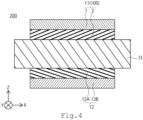
- FIG. 4 shows a schematic diagram of an embodiment of a membrane electrode assembly 200.
- the membrane electrode assembly 200 has a first electrode 11, a second electrode 12, and an electrolyte membrane 13.
- the first electrode 11 is preferably an anode electrode and the second electrode 12 is preferably a cathode electrode. It is preferred to use the electrode 100 of the first embodiment for the first electrode 11.
- the membrane electrode assembly 200 of the embodiment is preferably used in an electrochemical cell or stack for hydrogen generation or oxygen generation.
- electrode 100 of the first embodiment be used as the first electrode 11.
- the catalyst layer 2 of the electrode 100 used as the first electrode 11 is provided on the electrolyte membrane 13 side. It is preferable that the catalyst layer 2 is in direct contact with the electrolyte membrane 13.
- the second electrode 12 has a second support 12A and a second catalyst layer 12B.
- the second catalyst layer 12B is provided on the second support 12A.
- the second catalyst layer 12B is provided on the electrolyte membrane 13 side. It is preferable that the second catalyst layer 12B is in direct contact with the electrolyte membrane 13.
- the second support 12A is a porous material through which gases and liquids pass.
- the second support 12A is, for example, carbon paper or a metal mesh.
- a porous support of valve metal is preferable.
- the porous support of valve metal is a porous support material including one or more metals selected from the group consisting of titanium, aluminum, tantalum, niobium, hafnium, zirconium, zinc, tungsten, bismuth, and antimony, and a porous support material including one or more metals selected from the group consisting of titanium, aluminum, tantalum, niobium, hafnium, zirconium, zinc, tungsten, bismuth and antimony.
- the second support 12A has a carbon layer (MPL layer) containing carbon particles and a water repellent resin (fluororesin such as PTFE or Nafion). The carbon layer is provided, for example, between the carbon paper and the second catalyst layer 12B.
- the second catalyst layer 12B has a catalyst metal. It is preferable that the second catalyst layer 12B is particles of catalyst metal and that the catalyst metal is not supported on a carrier.
- the second catalyst layer 12B is preferably a porous catalyst layer.
- the catalyst metal is not limited, but includes, for example, one or more metal elements selected from the group consisting of Pt, Rh, Os, Ir, Pd, and Au. It is preferable that one or more metal elements selected from the group consisting of such catalytic materials be included.
- the catalyst metal is preferably metal, alloy, or metal oxide.
- the second catalyst layer 12B for example, preferably has a plurality of catalyst units consisting of alternately stacked catalyst layers in sheet form and gap layers.
- the amount of metal per area of the second catalyst layer 12B is preferably 0.02 [mg/cm 2 ] or more and 1.0 [mg/cm 2 ] or less, and more preferably 0.05 [mg/cm 2 ] or more and 0.5 [mg/cm 2 ] or less.
- the sum of these masses can be measured by ICP-MS.
- the porosity of the second catalyst layer 12B is preferably 10 [%] or more and 90 [%] or less, and more preferably 30 [%] or more and 70 [%] or less.
- the electrolyte membrane 13 is a proton-conducting membrane. Fluorinated polymers or aromatic hydrocarbon polymers having one or more selected from the group consisting of sulfonic acid groups, sulfonimide groups, and sulfate groups are preferred as the electrolyte membrane 13.
- the fluorinated polymers having sulfonic acid groups are preferred as electrolyte membranes 13.
- Nafion trademark DuPont
- Flemion trademark Asahi Kasei
- Selemion trademark Asahi Kasei
- Aquivion trademark Solvay Specialty Polymers
- Aciplex trademark Asahi Glass
- the thickness of the electrolyte membrane 13 can be determined appropriately in consideration of the membrane's permeability, durability, and other characteristics. From the viewpoint of strength, dissolution resistance, and output power characteristics of the MEA, the thickness of the electrolyte membrane 13 is preferably 20 [pm] or more and 500 [pm] or less, more preferably 50 [um] or more and 300 [pm] or less, and even more preferably 80 [pm] or more and 200 [pm] or less.
- the electrolyte membrane 13 preferably includes a noble metal region on the first electrode 11 side.
- the noble metal region includes noble metal particles.
- the noble metal region is preferably located on the surface of the electrolyte membrane 13.
- the noble metal region preferably consists of a single region, but may also consist of multiple separated regions.
- the noble metal particles are preferably particles of one or more noble metals selected from the group consisting of Pt, Re, Rh, Ir, Pd, and Ru.
- the noble metal particles may include particles of an alloy containing one or more selected from the group consisting of Pt, Re, Rh, Ir, Pd and Ru.
- the noble metal particles are preferably particles of one noble metal selected from the group consisting of Pt, Re, Rh, Ir, Pd, and Ru. Pt particles are preferred for the noble metal particles.
- Re particles are preferred for the noble metal particles.
- Rh particles are preferred for the noble metal particles.
- Ir particles are preferred for noble metal particles.
- Pd particles are preferred for noble metal particles.
- Ru particles are preferred for noble metal particles.
- the noble metal particles oxidize hydrogen that is generated on the cathode side and passes through the electrolyte membrane 13.
- the noble metal particles can reduce hydrogen leakage. Because the noble metal particles are present on the anode side, they are less likely to oxidize the hydrogen that is discharged from the cathode side.
- the area where noble metal particles are present may also be present in the electrolyte membrane 13 on the second electrode 12 (cathode) side.
- the average circumscribed circle diameter of the noble metal particles is preferably 0.5 [nm] or more and 50 [nm] or less, more preferably 1 [nm] or more and 10 [nm] or less, and even more preferably 1 [nm] or more and 5 [nm] or less.
- the membrane electrode assembly can be operated for a long time with high activity.
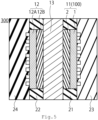
- FIG. 5 shows a cross-sectional diagram of the electrochemical cell 300 of the second embodiment.
- the electrochemical cell 300 is described below using water electrolysis as an example, but hydrogen can also be generated by decomposing ammonia and other substances in addition to water.
- the electrochemical cell 300 of the third embodiment has a first electrode (anode) 11, a second electrode (cathode) 12, an electrolyte membrane 13, a gasket 21, a gasket 22, a separator 23, and a separator 24.
- a gasket 21 the sealing member of the first electrode 11 may be used.
- the gasket 22 the seal member of the second electrode 12 may be used.
- the membrane electrode assembly 200 that the first electrode (anode) 11, the second electrode (cathode) 12, and the electrolyte membrane 13 are bonded together.
- the anode feeder may be provided separately from the separator 23.
- the cathode feeder may be provided separately from the separator 24.
- a power supply is connected to separators 23 and 24, and reactions occur at the anodes 11 and the cathodes 12.
- Water for example, is supplied to the anode 11, and at the anode 11, water is decomposed into protons, oxygen and electrons.
- the support and feeder of the electrode is a porous material, and this porous material acts as a passage plate. The produced and unreacted water is discharged, while the protons and electrons are used for cathodic reactions.
- protons and electrons react to produce hydrogen. Either or both of the hydrogen and oxygen produced are used, for example, as fuel for fuel cells.
- FIG. 6 is a schematic cross-sectional diagram of a stack 400 of the fourth embodiment.
- the stack 400 of the fourth embodiment shown in FIG. 6 includes a plurality of MEA 200 or electrochemical cells 300 connected in series, with tightening plates 31 and 32 attached to both ends of the MEA or electrochemical cells.
- the stack 400 consisting of multiple MEA 200 or multiple electrochemical cells 300 connected in series can produce a large amount of hydrogen.
- a fifth embodiment relates to an electrolyzer.
- FIG. 7 shows a conceptual diagram of the electrolyzer of the fifth embodiment.
- Electrolyzer 500 uses electrochemical cell 300 or stack 400.
- the electrolyzer of FIG. 7 is for water electrolysis.
- the electrolyzer for water electrolysis will be described.
- the electrodes of the embodiment can also be used in an electrolyzer that electrolyze carbon dioxide to produce organic substances such as methanol and ethylene, and carbon monoxide.
- single cells for water electrolysis are stacked in series to form a stack 400.
- the stack 400 is equipped with a power supply 41 and voltage is applied between the anode and cathode.
- a gas-liquid separator 42 that separates the generated gas and unreacted water, and a mixing tank 43 are connected.
- the water is circulated to the anodes.
- the oxygen produced at the anode passes through the gas-liquid separator 42 to obtain oxygen gas.
- a hydrogen purifier 49 is connected to the gas-liquid separator 48 to obtain high-purity hydrogen. Impurities are discharged through a path with a valve 50 connected to the hydrogen purifier 49.
- the stack and mixing tank can be heated to control stable operating temperatures, and the current density during pyrolysis can be controlled.
- a Ti non-woven fabric support with a size of 2 [cm] x 2 [cm] and a thickness of 200 [pm] is used as the support.
- Nickel and iridium are sputtered onto the titanium support to form the sheet layer precursor.
- only nickel is sputtered to form the gap layer precursor.
- This process of forming the sheet layer and gap layer is repeated 40 times to obtain a stacked structure with an Ir per area of 0.2 [mg/cm 2 ].
- the sputtering conditions for the sheet layer and gap layer are shown in Tables 1 and 2.
- the laminated catalyst is obtained with nickel partially dissolved by subsequent washing with sulfuric acid.
- the ratio of nickel in the laminated catalyst after acid treatment [wt%] to the metal elements in the catalyst metal is shown in Table 3.
- Example A the amount of residual nickel is controlled by varying the time of acid treatment. After acid treatment, the sheet layer precursor mostly becomes a sheet layer. After acid treatment, the gap layer precursor mostly becomes a gap layer.
- Sheet Layer Precursor Thickness [nm] Ir Ru Ni DC Output Power[W] Time [sec] DC Output Power[W] Time [sec] RF Output Power[W] Time [sec]
- the electrolyte membrane is 7[cm] x 7[cm] in size, Nafion115 manufactured by Chemours, and the electrolyte membrane is sandwiched between the anode and the cathode for hot pressing.
- the MEA is placed in a hot press apparatus and pressed at 130 [°C] and 20 [kg/cm 2 ] for 3 minutes, followed by press cooling at 25 [°C] and 20 [kg/cm 2 ] for 3 minutes.
- the resulting MEA and gasket are set between two separators with passage plate to create a PEEC single cell (electrochemical cell).
- a back pressure valve is attached to the outlet of the hydrogen side of the separator with flow paths to increase the internal pressure of hydrogen.
- Example A Comparative Example A
- Conditioning is performed on the single cell obtained for one day.
- the temperature is then maintained at 80 [°C] and ultrapure water is supplied to the anode at 0.01 [L/min].
- a current is applied between the anode and cathode at a current density of 2 [A/cm 2 ] using a power supply, and the cell voltage (VC) is measured after 48 hours of operation.
- the cell voltages (VC) are shown in Table 4.
- Durability is evaluated according to the following durability protocol.
- a single cell is maintained at 80 [°C] while ultrapure water is supplied to the anode at a flow rate of 0.01 [L/min].
- the cell voltage is held at 1.2 [V] for 3 seconds, and then held at 2.0 [V] for 3 seconds, making one cycle. This cycle is repeated for a total of 3,000 cycles.
- the cell voltage (V1) is then measured after 24 hours of operation with a current applied at a current density of 2 [A/cm 2 ] between the anode and the cathode using the power supply.
- the voltage rise rate (100 x (V1)/VC-100) is calculated by comparing the cell voltage (V1) with the cell voltage (VC) before durability evaluation.
- the voltage rise rate and cell voltage (V1) are shown in Table 2.
- Comparative Example A-2 with a low nickel content and a further collapsed gap layer, has a rather poor initial performance. On the other hand, the collapsed structure provides good durability, but the performance is inadequate because sufficient initial efficiency cannot be obtained with this structure. Comparative Example A-4, which has a large amount of nickel and wide gaps, has high initial performance, but the durability is not sufficient. This is considered to be because the structure has changed due to the dissolution of nickel during electrolysis. In Example A-2, a catalyst layer with relatively good initial performance and very high durability is obtained. The amount of nickel is 6.3%, and the gap layer is 8 [nm] wide, so the appropriate pore structure is maintained, and the initial performance and durability are considered to have been maintained.
- Example B includes examples in which nickel is also sputtered during the formation of the sheet layer precursor.
- Example B also includes examples in which iridium and/or ruthenium are also sputtered during the formation of the gap layer precursor. Except for the anode preparation conditions, Example B is the same as Example A-1, where single cells are prepared in the same way as in Example A-1. Table 7 also shows the amount of nickel after acid treatment.
- Example B-1 The prepared single cell is operated in the same manner as in Example A, and the cell voltage (VC) and cell voltage (V1) are obtained.
- the cell voltage (VC), the voltage rise rate, and cell voltage (V1) of Example B are shown in Table 8.
- Table 8 Cel Voltage [VC] Voltage Rise Rate [%] Cell Voltage [V1]
- Example B-1 1.73 1.16 1.75
- Example B-2 1.74 1.15 1.76
- Example B-3 1.75 1.14 1.77
- Example B-4 1.77 0.85 1.79 Comparative Example B-1 1.86 0.81 1.87 Comparative Example B-2 1.88 1.06 1.90 Comparative Example B-3 2.03 0.74 2.05 Comparative Example B-4 1.71 3.51 1.77
- Example B-2 which has a small amount of nickel and a collapsed gap layer, has a much worse initial performance. On the other hand, the structure is collapsed, so the durability is good, but this does not provide sufficient initial efficiency, so the performance is insufficient. Comparative Example B-4, which has a large amount of nickel and wide gaps, has high initial performance, but the durability is not sufficient. This is considered to be because the structure has changed due to the dissolution of nickel during electrolysis. In Example B-2, a catalyst layer with relatively good initial performance and very high durability is obtained. The amount of nickel is 6.2%, and the gap layer is wider (8 nm), so the appropriate pore structure is maintained, and the initial performance and durability are considered to have been maintained.
- Example C Anodes are prepared under the conditions shown in Tables 9 and 10.
- Example C one or more selected from the group consisting of nickel, cobalt, and manganese are sputtered during the formation of the gap layer precursor. Except for the anode preparation conditions, Example C is performed in the same manner as in Example A-1, where single cells are prepared in the same manner as in Example A-1. Table 11 also shows the amount of non-noble metals after acid treatment.
- the prepared single cell is operated in the same manner as in Example A, and the cell voltage (VC) and cell voltage (V1) are determined.
- the cell voltage (VC), the voltage rise rate, and cell voltage (V1) of Example C are shown in Table 12.
- the perforation effect is equivalent to that of Ni when not only Ni but also Co and Mn are added as perforating agents at the same time.
- the trends of initial performance and durability are the same as in Examples C-1 and C-2.
- Comparative Example C-2 in which the amount of perforating material is small and the gap layer is collapsed, shows considerably poor initial performance.
- the durability is good because the structure is collapsed, but the performance is insufficient because sufficient initial efficiency cannot be obtained in this case.
- Comparative Example C-4 which has a large amount of perforated material and a wide gap, has high initial performance, but the durability is not sufficient. This is thought to be due to structural changes caused by the dissolution of the porous material during electrolysis.
- Example C-2 a catalyst layer with relatively good initial performance and very high durability is obtained.
- the amount of porous material is 2.0% nickel, 2.5% Co, and 1.7% Mn, for a total of 6.2%, and the gap layer is 8 nm wide, which is thought to have maintained the appropriate pore structure, and thus the initial performance and durability are maintained.
- Example C-1 1.73 1.16 1.75
- Example C-2 1.74 1.15 1.76
- Example C-3 1.75 1.14 1.77
Landscapes
- Chemical & Material Sciences (AREA)
- Electrochemistry (AREA)
- Chemical Kinetics & Catalysis (AREA)
- Engineering & Computer Science (AREA)
- Organic Chemistry (AREA)
- Metallurgy (AREA)
- Materials Engineering (AREA)
- General Chemical & Material Sciences (AREA)
- Life Sciences & Earth Sciences (AREA)
- Sustainable Energy (AREA)
- Sustainable Development (AREA)
- Manufacturing & Machinery (AREA)
- Inorganic Chemistry (AREA)
- Electrolytic Production Of Non-Metals, Compounds, Apparatuses Therefor (AREA)
- Electrodes For Compound Or Non-Metal Manufacture (AREA)
- Catalysts (AREA)
- Composite Materials (AREA)
- Laminated Bodies (AREA)
Applications Claiming Priority (1)
| Application Number | Priority Date | Filing Date | Title |
|---|---|---|---|
| JP2022162625A JP2024055578A (ja) | 2022-10-07 | 2022-10-07 | 電極、膜電極接合体、電気化学セル、スタック、電解装置 |
Publications (2)
| Publication Number | Publication Date |
|---|---|
| EP4350045A2 true EP4350045A2 (de) | 2024-04-10 |
| EP4350045A3 EP4350045A3 (de) | 2024-10-30 |
Family
ID=87933833
Family Applications (1)
| Application Number | Title | Priority Date | Filing Date |
|---|---|---|---|
| EP23195661.6A Pending EP4350045A3 (de) | 2022-10-07 | 2023-09-06 | Elektrode, membranelektrodenanordnung, elektrochemische zelle, stapel und elektrolyseur |
Country Status (4)
| Country | Link |
|---|---|
| US (1) | US20240120499A1 (de) |
| EP (1) | EP4350045A3 (de) |
| JP (1) | JP2024055578A (de) |
| AU (1) | AU2023226691B2 (de) |
Family Cites Families (10)
| Publication number | Priority date | Publication date | Assignee | Title |
|---|---|---|---|---|
| JP4740179B2 (ja) * | 2007-03-20 | 2011-08-03 | 株式会社東芝 | 触媒層担持基板の製造方法、膜電極複合体の製造方法、および燃料電池の製造方法 |
| JP5342824B2 (ja) * | 2008-07-25 | 2013-11-13 | 株式会社東芝 | 触媒層担持基板の製造方法、触媒層担持基板、膜電極複合体、および燃料電池 |
| US10648092B2 (en) * | 2015-11-10 | 2020-05-12 | Kabushiki Kaisha Toshiba | Electrode, membrane electrode assembly, electrochemical cell, and stack |
| JP2017115232A (ja) * | 2015-12-25 | 2017-06-29 | 株式会社東芝 | 電極、膜電極複合体、電気化学セルおよびスタック |
| EP3453785A1 (de) * | 2017-09-07 | 2019-03-13 | Kabushiki Kaisha Toshiba | Membranelektrodenanordnung, elektrochemische zelle und elektrochemische vorrichtung |
| JP6971944B2 (ja) * | 2018-03-22 | 2021-11-24 | 株式会社東芝 | 触媒積層体、膜電極複合体、電気化学セル、スタック、水電解装置および水利用システム |
| US10777821B2 (en) * | 2018-03-22 | 2020-09-15 | Kabushiki Kaisha Toshiba | Catalyst, anode, membrane electrode assembly, water electrolysis cell, stack, water electrolyzer, and hydrogen utilizing system |
| JP7003016B2 (ja) * | 2018-03-22 | 2022-01-20 | 株式会社東芝 | 水電解の陽極に用いる酸素発生用触媒、陽極、膜電極複合体、水電解用セル、スタック及び水電解装置 |
| US11515552B2 (en) * | 2018-03-22 | 2022-11-29 | Kabushiki Kaisha Toshiba | Catalyst laminate, membrane electrode assembly, electrochemical cell, stack, water electrolyzer, and hydrogen utilizing system |
| JP7218263B2 (ja) * | 2019-09-18 | 2023-02-06 | 株式会社東芝 | 積層触媒、電極、膜電極複合体、電気化学セル、スタック、燃料電池及び水電解の可逆装置、車両及び飛翔体 |
-
2022
- 2022-10-07 JP JP2022162625A patent/JP2024055578A/ja active Pending
-
2023
- 2023-09-06 AU AU2023226691A patent/AU2023226691B2/en active Active
- 2023-09-06 EP EP23195661.6A patent/EP4350045A3/de active Pending
- 2023-09-06 US US18/461,693 patent/US20240120499A1/en active Pending
Also Published As
| Publication number | Publication date |
|---|---|
| AU2023226691A1 (en) | 2024-05-02 |
| AU2023226691B2 (en) | 2025-06-26 |
| JP2024055578A (ja) | 2024-04-18 |
| EP4350045A3 (de) | 2024-10-30 |
| US20240120499A1 (en) | 2024-04-11 |
Similar Documents
| Publication | Publication Date | Title |
|---|---|---|
| EP3378970A1 (de) | Laminierte elektrolytmembran, membranelektrodenanordnung, wasserelektrolysezelle, stapel und wasserelektrolysevorrichtung | |
| WO2018037774A1 (ja) | カソード、有機ハイドライド製造用電解セル及び有機ハイドライドの製造方法 | |
| US20240110300A1 (en) | Electrode, membrane electrode assembly, electrochemical cell, stack, and electrolyzer | |
| AU2023219977B2 (en) | Laminated catalyst, electrode, membrane electrode assembly, electrochemical cell, stack, and electrolyzer | |
| AU2023226658B2 (en) | Electrode, membrane electrode assembly, electrochemical cell, stack, and electrolyzer | |
| EP4350040A2 (de) | Membranelektrodenanordnung, elektrochemische zelle, stapel und elektrolyseur | |
| US20240229260A9 (en) | Electrode, membrane electrode assembly, electrochemical cell, stack, and electrolyzer | |
| US20240120499A1 (en) | Electrode, membrane electrode assembly, electrochemical cell, stack, and electrolyzer | |
| JP4868394B2 (ja) | ガス拡散電極とその製造方法、及び当該ガス拡散電極を用いる燃料電池及び食塩電解セル | |
| JP2024053540A (ja) | 基材、電極、膜電極接合体、電気化学セル、スタック、電解装置 | |
| AU2024204846B2 (en) | Electrode, membrane electrode assembly, electrochemical cell, stack, and electrolyzer | |
| EP4431641A1 (de) | Elektrode, membranelektrodenanordnung, elektrochemische zelle, stapel und elektrolyseur | |
| EP4707431A1 (de) | Elektrode | |
| EP4715090A1 (de) | Elektrode, membranelektrodenanordnung, elektrochemische zelle, stapel und elektrolyseur | |
| JP2026056493A (ja) | 基材、電極、膜電極接合体、電気化学セル、スタック、電解装置及び基材の製造方法 | |
| CN118668230A (zh) | 电极、膜电极接合体、电化学池、电堆、电解装置 |
Legal Events
| Date | Code | Title | Description |
|---|---|---|---|
| PUAI | Public reference made under article 153(3) epc to a published international application that has entered the european phase |
Free format text: ORIGINAL CODE: 0009012 |
|
| STAA | Information on the status of an ep patent application or granted ep patent |
Free format text: STATUS: REQUEST FOR EXAMINATION WAS MADE |
|
| 17P | Request for examination filed |
Effective date: 20230906 |
|
| AK | Designated contracting states |
Kind code of ref document: A2 Designated state(s): AL AT BE BG CH CY CZ DE DK EE ES FI FR GB GR HR HU IE IS IT LI LT LU LV MC ME MK MT NL NO PL PT RO RS SE SI SK SM TR |
|
| PUAL | Search report despatched |
Free format text: ORIGINAL CODE: 0009013 |
|
| AK | Designated contracting states |
Kind code of ref document: A3 Designated state(s): AL AT BE BG CH CY CZ DE DK EE ES FI FR GB GR HR HU IE IS IT LI LT LU LV MC ME MK MT NL NO PL PT RO RS SE SI SK SM TR |
|
| RIC1 | Information provided on ipc code assigned before grant |
Ipc: C25B 15/08 20060101ALI20240920BHEP Ipc: C25B 11/093 20210101ALI20240920BHEP Ipc: C25B 11/053 20210101ALI20240920BHEP Ipc: C25B 1/04 20210101AFI20240920BHEP |
|
| STAA | Information on the status of an ep patent application or granted ep patent |
Free format text: STATUS: EXAMINATION IS IN PROGRESS |
|
| 17Q | First examination report despatched |
Effective date: 20250814 |
|
| RIC1 | Information provided on ipc code assigned before grant |
Ipc: C25B 1/04 20210101AFI20260210BHEP Ipc: C25B 11/053 20210101ALI20260210BHEP Ipc: C25B 11/093 20210101ALI20260210BHEP Ipc: C25B 15/08 20060101ALI20260210BHEP Ipc: C25B 1/02 20060101ALN20260210BHEP Ipc: C25B 1/27 20210101ALN20260210BHEP |