EP4350043A2 - Wasserelektrolysevorrichtung und verfahren zur steuerung der wasserelektrolysevorrichtung - Google Patents
Wasserelektrolysevorrichtung und verfahren zur steuerung der wasserelektrolysevorrichtung Download PDFInfo
- Publication number
- EP4350043A2 EP4350043A2 EP23195654.1A EP23195654A EP4350043A2 EP 4350043 A2 EP4350043 A2 EP 4350043A2 EP 23195654 A EP23195654 A EP 23195654A EP 4350043 A2 EP4350043 A2 EP 4350043A2
- Authority
- EP
- European Patent Office
- Prior art keywords
- anode
- flow path
- valve
- metal
- metal ions
- Prior art date
- Legal status (The legal status is an assumption and is not a legal conclusion. Google has not performed a legal analysis and makes no representation as to the accuracy of the status listed.)
- Pending
Links
Images

Classifications
-
- C—CHEMISTRY; METALLURGY
- C25—ELECTROLYTIC OR ELECTROPHORETIC PROCESSES; APPARATUS THEREFOR
- C25B—ELECTROLYTIC OR ELECTROPHORETIC PROCESSES FOR THE PRODUCTION OF COMPOUNDS OR NON-METALS; APPARATUS THEREFOR
- C25B1/00—Electrolytic production of inorganic compounds or non-metals
- C25B1/01—Products
- C25B1/02—Hydrogen or oxygen
- C25B1/04—Hydrogen or oxygen by electrolysis of water
-
- C—CHEMISTRY; METALLURGY
- C25—ELECTROLYTIC OR ELECTROPHORETIC PROCESSES; APPARATUS THEREFOR
- C25B—ELECTROLYTIC OR ELECTROPHORETIC PROCESSES FOR THE PRODUCTION OF COMPOUNDS OR NON-METALS; APPARATUS THEREFOR
- C25B11/00—Electrodes; Manufacture thereof not otherwise provided for
- C25B11/04—Electrodes; Manufacture thereof not otherwise provided for characterised by the material
- C25B11/051—Electrodes formed of electrocatalysts on a substrate or carrier
- C25B11/052—Electrodes comprising one or more electrocatalytic coatings on a substrate
- C25B11/053—Electrodes comprising one or more electrocatalytic coatings on a substrate characterised by multilayer electrocatalytic coatings
-
- C—CHEMISTRY; METALLURGY
- C25—ELECTROLYTIC OR ELECTROPHORETIC PROCESSES; APPARATUS THEREFOR
- C25B—ELECTROLYTIC OR ELECTROPHORETIC PROCESSES FOR THE PRODUCTION OF COMPOUNDS OR NON-METALS; APPARATUS THEREFOR
- C25B11/00—Electrodes; Manufacture thereof not otherwise provided for
- C25B11/04—Electrodes; Manufacture thereof not otherwise provided for characterised by the material
- C25B11/051—Electrodes formed of electrocatalysts on a substrate or carrier
- C25B11/073—Electrodes formed of electrocatalysts on a substrate or carrier characterised by the electrocatalyst material
- C25B11/075—Electrodes formed of electrocatalysts on a substrate or carrier characterised by the electrocatalyst material consisting of a single catalytic element or catalytic compound
- C25B11/081—Electrodes formed of electrocatalysts on a substrate or carrier characterised by the electrocatalyst material consisting of a single catalytic element or catalytic compound the element being a noble metal
-
- C—CHEMISTRY; METALLURGY
- C25—ELECTROLYTIC OR ELECTROPHORETIC PROCESSES; APPARATUS THEREFOR
- C25B—ELECTROLYTIC OR ELECTROPHORETIC PROCESSES FOR THE PRODUCTION OF COMPOUNDS OR NON-METALS; APPARATUS THEREFOR
- C25B15/00—Operating or servicing cells
- C25B15/02—Process control or regulation
-
- C—CHEMISTRY; METALLURGY
- C25—ELECTROLYTIC OR ELECTROPHORETIC PROCESSES; APPARATUS THEREFOR
- C25B—ELECTROLYTIC OR ELECTROPHORETIC PROCESSES FOR THE PRODUCTION OF COMPOUNDS OR NON-METALS; APPARATUS THEREFOR
- C25B15/00—Operating or servicing cells
- C25B15/02—Process control or regulation
- C25B15/023—Measuring, analysing or testing during electrolytic production
- C25B15/025—Measuring, analysing or testing during electrolytic production of electrolyte parameters
- C25B15/029—Concentration
-
- C—CHEMISTRY; METALLURGY
- C25—ELECTROLYTIC OR ELECTROPHORETIC PROCESSES; APPARATUS THEREFOR
- C25B—ELECTROLYTIC OR ELECTROPHORETIC PROCESSES FOR THE PRODUCTION OF COMPOUNDS OR NON-METALS; APPARATUS THEREFOR
- C25B15/00—Operating or servicing cells
- C25B15/08—Supplying or removing reactants or electrolytes; Regeneration of electrolytes
-
- C—CHEMISTRY; METALLURGY
- C25—ELECTROLYTIC OR ELECTROPHORETIC PROCESSES; APPARATUS THEREFOR
- C25B—ELECTROLYTIC OR ELECTROPHORETIC PROCESSES FOR THE PRODUCTION OF COMPOUNDS OR NON-METALS; APPARATUS THEREFOR
- C25B15/00—Operating or servicing cells
- C25B15/08—Supplying or removing reactants or electrolytes; Regeneration of electrolytes
- C25B15/085—Removing impurities
-
- C—CHEMISTRY; METALLURGY
- C25—ELECTROLYTIC OR ELECTROPHORETIC PROCESSES; APPARATUS THEREFOR
- C25B—ELECTROLYTIC OR ELECTROPHORETIC PROCESSES FOR THE PRODUCTION OF COMPOUNDS OR NON-METALS; APPARATUS THEREFOR
- C25B9/00—Cells or assemblies of cells; Constructional parts of cells; Assemblies of constructional parts, e.g. electrode-diaphragm assemblies; Process-related cell features
- C25B9/17—Cells comprising dimensionally-stable non-movable electrodes; Assemblies of constructional parts thereof
- C25B9/19—Cells comprising dimensionally-stable non-movable electrodes; Assemblies of constructional parts thereof with diaphragms
- C25B9/21—Cells comprising dimensionally-stable non-movable electrodes; Assemblies of constructional parts thereof with diaphragms two or more diaphragms
-
- C—CHEMISTRY; METALLURGY
- C25—ELECTROLYTIC OR ELECTROPHORETIC PROCESSES; APPARATUS THEREFOR
- C25B—ELECTROLYTIC OR ELECTROPHORETIC PROCESSES FOR THE PRODUCTION OF COMPOUNDS OR NON-METALS; APPARATUS THEREFOR
- C25B9/00—Cells or assemblies of cells; Constructional parts of cells; Assemblies of constructional parts, e.g. electrode-diaphragm assemblies; Process-related cell features
- C25B9/17—Cells comprising dimensionally-stable non-movable electrodes; Assemblies of constructional parts thereof
- C25B9/19—Cells comprising dimensionally-stable non-movable electrodes; Assemblies of constructional parts thereof with diaphragms
- C25B9/23—Cells comprising dimensionally-stable non-movable electrodes; Assemblies of constructional parts thereof with diaphragms comprising ion-exchange membranes in or on which electrode material is embedded
-
- Y—GENERAL TAGGING OF NEW TECHNOLOGICAL DEVELOPMENTS; GENERAL TAGGING OF CROSS-SECTIONAL TECHNOLOGIES SPANNING OVER SEVERAL SECTIONS OF THE IPC; TECHNICAL SUBJECTS COVERED BY FORMER USPC CROSS-REFERENCE ART COLLECTIONS [XRACs] AND DIGESTS
- Y02—TECHNOLOGIES OR APPLICATIONS FOR MITIGATION OR ADAPTATION AGAINST CLIMATE CHANGE
- Y02E—REDUCTION OF GREENHOUSE GAS [GHG] EMISSIONS, RELATED TO ENERGY GENERATION, TRANSMISSION OR DISTRIBUTION
- Y02E60/00—Enabling technologies; Technologies with a potential or indirect contribution to GHG emissions mitigation
- Y02E60/30—Hydrogen technology
- Y02E60/36—Hydrogen production from non-carbon containing sources, e.g. by water electrolysis
Definitions
- Arrangements relate to a water electrolysis device and a method of controlling a water electrolysis device.
- the water electrolysis devices include, for example, a membrane electrode assembly (MEA) having an anode, a cathode, and an electrolyte membrane.
- MEA membrane electrode assembly
- the water electrolysis devices for example, oxidize water at the anode to produce a hydrogen ion and oxygen, and reduce the hydrogen ion at the cathode to produce hydrogen.
- a water electrolysis device in an arrangement includes: an anode configured to oxidize water to produce oxygen; a cathode configured to reduce a hydrogen ion to produce hydrogen; an anode flow path through which an anode solution containing water and a metal ion flows, the anode flow path facing on the anode and; a cathode flow path facing on the cathode; an electrolyte membrane provided between the anode and the cathode; an anode supply flow path connected to an inlet of the anode flow path; an anode discharge flow path connected to an outlet of the anode flow path; a first circulation flow path connecting the anode supply flow path and the anode discharge flow path; a second circulation flow path connected in parallel with the first circulation flow path; an ion filter provided in a middle of the second circulation flow path and configured to remove some of the metal ions in the anode solution; a metal supply source configured to supply the metal ions into the anode solution; a metal supply flow path connecting
- connecting includes not only directly connecting but also indirectly connecting, unless otherwise specified.
- FIG. 1 is a schematic view illustrating an example configuration of a water electrolysis device.
- a water electrolysis device 1 illustrated in FIG. 1 includes a membrane electrode assembly 100, an anode solution supply system 200, and a controller 300.
- the membrane electrode assembly 100 includes an electrode 10, an electrode 20, and an electrolyte membrane 30.
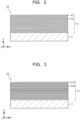
- FIG. 2 is a schematic cross-sectional view illustrating an example structure of the electrode 10.
- FIG. 2 illustrates an X-axis, a Y-axis orthogonal to the X-axis, and a Z-axis orthogonal to the X-axis and the Y-axis.
- FIG. 2 illustrates a part of the X-Z cross section of the electrode 10.
- the electrode 10 illustrated in FIG. 2 includes a substrate 11 and a stack 12.
- the electrode 10 has a function as an anode of the water electrolysis device.
- the substrate 11 for example, can be made using one or more of carbon materials such as carbon cloth and carbon paper, or one or more of metal materials such as titanium (Ti), nickel (Ni), and iron (Fe) and alloys containing at least one of these metals such as SUS.
- the substrate 11 may be a mesh substrate or porous substrate with these materials.
- the stack 12 is provided on the substrate 11.
- the stack 12 includes a catalyst layer 121 and a gap layer 122.
- FIG. 2 illustrates a plurality of the catalyst layers 121 and a plurality of the gap layers 122.
- Each catalyst layers 121 and each gap layers 122 are alternately stacked on the substrate 11.
- the catalyst layers 121 may be partially joined together at one or more ends of each of the catalyst layers 121 in at least one of the X-axis direction and the Y-axis direction. This can prevent deformation of the stack 12 caused by pressure in the stacking direction.
- the stack 12 may include at least one catalyst pillar connecting two or more of the catalyst layers 121. This can prevent peeling of the catalyst layer 121.
- the catalyst layer 121 includes an anode catalyst that promotes oxidation of an oxidizable material (a material to be oxidized).
- the number of the catalyst layers 121 is not particularly limited, and is, for example, 5 or more and 20 or less.
- the thickness of the catalyst layer 121 is, for example, 4 nm or more and 50 nm or less.
- the anode catalyst for example, contains at least one noble metal or oxide thereof.
- the at least one noble metal for example, includes at least one of platinum (Pt), palladium (Pd), iridium (Ir), ruthenium (Ru), rhodium (Rh), osmium (Os), gold (Au), and tantalum (Ta).
- the anode catalyst may contain a plurality of these catalyst materials.
- the anode catalyst is, for example, a material that promotes an oxidation reaction of water.
- the gap layer 122 is provided between two of the catalyst layers 121.
- the gap layer 122 forms a space.
- the average thickness of the gap layer 122 is, for example, 1 nm or more and 100 nm or less.
- the average thickness of the stack 12 is, for example, 10 nm or more and 900 nm or less.
- the thickness is less than 10 nm, the amount of catalyst is small and the reaction efficiency decreases.
- the thickness exceeds 900 nm, the diffusibility deteriorates, and the performance of supplying water to the catalyst layer 121 or the performance of discharging an oxygen gas deteriorates, resulting in a decrease in the performance.
- the dimensions and composition of the substrate 11, the catalyst layer 121, and the gap layer 122 can be measured using, for example, a scanning electron microscope (SEM), an X-ray fluorescence analysis (XRF), elemental mapping by a transmission electron microscope (TEM), TEM high-angle annular dark-field (HAADF), and an energy dispersive X-ray spectroscopy (EDS) line analysis.
- SEM scanning electron microscope
- XRF X-ray fluorescence analysis
- TEM transmission electron microscope
- HAADF TEM high-angle annular dark-field
- EDS energy dispersive X-ray spectroscopy
- FIG. 3 is a schematic cross-sectional view for explaining an example of a method of forming the stack 12.
- the stack 12 can be formed by alternately forming a precursor layer 121a of the catalyst layer 121 and a pore former layer (a pore-forming material layer) 122a using sputtering, and then removing the pore former layers 122a with the precursor layers 121a remaining.
- This method allows for control of the thicknesses of the catalyst layer 121 and the pore former layer 122a on the order of nanometers, and further facilitates control of the composition or the oxidation state, and therefore it is possible to improve the degree of freedom in the design of the catalyst layer 121.
- the precursor layer 121a contains an anode catalyst.
- a crystal structure may be oriented by performing a heat treatment.
- reactive sputtering is preferred in which an oxygen gas is added into a chamber of a sputtering apparatus.
- the pore former layer 122a contains a pore former.
- the pore former include at least one non-noble metal or oxide thereof.
- the non-noble metal include iron (Fe), cobalt (Co), nickel (Ni), manganese (Mn), aluminum (Al), zinc (Zn), tantalum (Ta), tungsten (W), hafnium (Hf), silicon (Si), molybdenum (Mo), titanium (Ti), zirconium (Zr), niobium (Nb), vanadium (V), chromium (Cr), tin (Sn), and strontium (Sr).
- the pore former layers 122a can be removed by selective etching using chemicals such as acid or alkali, for example, with the catalyst layers 121 remaining. A heat treatment may be performed to promote melting of the pore former layers 122a.
- the pore former may also be contained in the precursor layer 121a.
- the precursor layer 121a containing the pore former can be formed by performing sputtering using a mixed sputtering target containing a raw material of the precursor layer 121a and a raw material of the pore former. Thereby, the pore former in the precursor layer 121a is also removed by selective etching, to make the catalyst layer 121 porous. Therefore, the surface area of the catalyst layer 121 can be increased.
- the substrate 11 of the electrode 10 faces on an anode flow path 41 through which an anode solution flows.
- the stack 12 of the electrode 10 faces on the electrolyte membrane 30.
- the anode flow path 41 has grooves provided in the surface of an anode flow path plate 40.
- the anode flow path 41 has an inlet and an outlet, which are not illustrated.
- the inlet of the anode flow path 41 is connected to an anode supply flow path P1.
- the outlet of the anode flow path 41 is connected to an anode discharge flow path P2.
- the shape of the anode flow path 41 is not limited in particular, but may have a serpentine shape along the surface of the anode flow path plate 40, for example.
- the electrode 20 has a function as a cathode of the water electrolysis device.
- the electrode 20 includes a cathode catalyst that promotes reduction of a reducible material (a material to be reduced).
- the cathode catalyst include metals such as platinum (Pt), iron (Fe), calcium (Ca), iridium (Ir), and ruthenium (Ru), or oxides thereof.
- the cathode catalyst is formed as a cathode catalyst layer on a substrate, for example.
- the substrate can be formed using a material applicable to the substrate 11 of the electrode 10.
- a particulate cathode catalyst may be mixed with a binder made of a proton-conducting organic material to form the cathode catalyst layer.
- the binder include polyvinyl alcohol (PVA).
- the substrate of the electrode 20 faces on a cathode flow path 51.
- the cathode catalyst layer of the electrode 20 faces on the electrolyte membrane 30.
- the cathode flow path 51 has grooves provided on the surface of a cathode flow path plate 50.
- the cathode flow path 51 has an outlet, which is not illustrated.
- the outlet of the cathode flow path 51 is connected to a product collector, which is not illustrated.
- the shape of the cathode flow path 51 is not limited, and may have a serpentine shape along the surface of the cathode flow path 51, for example.
- the electrolyte membrane 30 is provided between the electrode 10 and the electrode 20.
- the electrolyte membrane 30 can be made of a membrane such as an ion exchange membrane that allows ions to move between the electrode 10 and the electrode 20, for example.
- the ion exchange membrane include a cation exchange membrane such as Nafion or Flemion.
- the electrolyte membrane 30 may be impregnated with part of the catalyst layers of the electrode 10 and the electrode 20. This impregnation can increase the adhesion between the electrode 10 and the electrolyte membrane 30 and the adhesion between the electrode 20 and the electrolyte membrane 30.
- the electrode 10 and the electrode 20 are electrically connected to an anode current collector 60 and a cathode current collector 70, respectively.
- Each of the anode current collector 60 and the cathode current collector 70 is electrically connected to a power supply 80 via a current introduction member such as a wiring.
- the power supply 80 is not limited to a power source such as a normal system power supply or a battery, and may have a power source that supplies power generated by renewable energy such as photovoltaics or wind power generation.
- the power supply 80 may include the power source and a power controller that adjusts the output of the power source to control the voltage between the electrode 10 and the electrode 20.
- the electrode 10, the electrode 20, the electrolyte membrane 30, the anode flow path plate 40, the cathode flow path plate 50, the anode current collector 60, and the cathode current collector 70 may be stacked to each other, This stack is also called an electrolysis cell.
- the stack may be provided between supporting plates, which are not illustrated, and may be tightened with bolts or the like.
- the anode solution supply system 200 includes an anode solution container 201, a flow rate controller 202, a concentration sensor 203, an ion filter 204, a valve 205, a valve 206, a metal supply source 207, a valve 208, a circulation flow path P3, and a metal supply flow path P4, and is configured so that the anode solution circulates through the anode supply flow path P1, the anode flow path 41, the anode discharge flow path P2, and the circulation flow path P3.
- the anode solution supply system 200 connects the anode supply flow path P1 and the anode discharge flow path P2 via the circulation flow path P3.
- the water electrolysis device 1 may have at least one selected from a valve or a pump in the middle of the anode supply flow path P1, in the middle of the anode discharge flow path P2, and/or in the middle of the circulation flow path P3 to control the pressure of each flow path or the flow rate of a fluid flowing through the corresponding flow path.
- the anode solution container 201 includes a tank that stores a fluid containing the anode solution to be discharged from the outlet of the anode flow path 41 through the anode discharge flow path P2 (also referred to as an anode discharge liquid).
- the flow rate controller 202 is provided in the middle of at least one of the anode supply flow path P1, the anode discharge flow path P2, and the circulation flow path P3, and controls the flow rate of the anode solution.
- the anode solution is introduced to the anode flow path 41 through the anode supply flow path P1.
- the water electrolysis device 1 may have a pressure controller provided in the middle of at least one of the anode supply flow path P1, the anode discharge flow path P2, and the circulation flow path P3 to control the pressure of the anode flow path 41.
- the anode solution container 201 may be connected to an anode solution supply source, which is not illustrated, and the anode solution container 201 may be replenished with the anode solution from the anode solution supply source.
- the anode solution is preferably a solution containing at least water (H 2 O).
- the anode solution may be, for example, ultrapure water.
- the anode solution in this arrangement further contains at least one metal ion.
- the at least one metal ion for example, includes at least one divalent ion selected from a nickel ion, an iron ion, a cobalt ion, and a manganese ion.
- the presence of the at least one metal ion in the anode solution can promote the oxidation of the anode solution. Further, the presence of the ions increases the conductive performance in the anode solution and reduces the cell resistance, thus lowering the cell voltage and improving the performance.
- the concentration of the at least one metal ions in the anode solution is preferably adjusted to 0.05 ⁇ mol/l or more and 0.5 ⁇ mol/l or less.
- concentration of the at least one metal ions is less than 0.05 ⁇ mol/l, the oxidizing effect of the anode solution is poor, so that the cell performance is not improved.
- concentration of the metal ions exceeds 0.5 ⁇ mol/l, the at least one metal ions adhere to the electrolyte membrane 30 and the performance of ion movement deteriorates, resulting in a decrease in the performance.
- the anode solution preferably has a lower concentration of any metal ions different from the nickel ions than the nickel ion concentration.
- the concentration sensor 203 is provided in the middle of the anode discharge flow path P2 or connected to the anode discharge flow path P2, for example.
- the concentration sensor 203 can detect the concentration of the at least one metal ions in the anode solution discharged from the anode flow path 41 and sends a detection signal having the detected concentration data to the controller 300.
- Examples of the concentration sensor 203 include a high-frequency inductively coupled plasma (ICP) emission spectroscopy sensor and ion chromatograph.
- ICP inductively coupled plasma
- the examples of the concentration sensor 203 is not limited to this examples, and the concentration sensor 203 may calculates the concentration from one or more results measured by an ion concentration meter, an absorbance sensor, or a conductivity meter.
- the water electrolysis device preferably inhibits mixture of other ions different from metal ions such as nickel ions from within the system as much as possible. Therefore, when the concentration sensor 203 is provided in-line in the device for measurement, the use of the conductivity meter for calculating the concentration can save the cost of the device.
- the circulation flow path P3 branches into a circulation flow path P31 and a circulation flow path P32.
- the circulation flow path P31 and the circulation flow path P32 are connected in parallel with each other.
- the circulation flow path P31 is connected to the anode supply flow path P1 without the ion filter 204 being provided therebetween.
- the circulation flow path P32 is connected to the anode supply flow path P1 via the ion filter 204.
- the ion filter 204 is provided in the middle of the circulation flow path P32.
- the ion filter 204 can remove some of the at least one metal ions in the anode solution.
- Examples of the ion filter 204 include filters using ion exchange resins, filters using reverse osmosis membranes (RO membranes), and filters made of combinations of activated carbon and ion exchange resins.
- the valve 205 is provided in the middle of the circulation flow path P31.
- the valve 206 is provided in the middle of the circulation flow path P32 and is provided to precede to the ion filter 204.
- the opening and closing of the valve 205 and the opening and closing of the valve 206 are controlled by control signals from the controller 300.
- the metal supply source 207 is connected to the anode supply flow path P1 via the metal supply flow path P4.
- the metal supply source 207 can supply the at least one metal ions to the anode solution.
- the metal supply source 207 may supply water containing the at least one metal ions to the anode supply flow path P1, the water containing the at least one metal ions having a concentration higher than the concentration of the at least one metal in the anode solution, the at least one metal being selected from nickel, iron, cobalt, and manganese.
- the metal supply source 207 may supply water containing the nickel ions to the anode supply flow path P1, the water containing the nickel ions having a concentration higher than the concentration of nickel.
- the valve 208 is provided in the middle of the metal supply flow path P4. The opening and closing of the valve 208 are controlled by a control signal from the controller 300.
- the controller 300 can send control signals to control the openings and closings of the valves 205, 206, and 208 respectively to the valves 205, 206, and 208 in response to detection signals from the concentration sensor 203. This can adjust the concentration of the at least one metal ions in the anode solution within a predetermined range.
- the controller 300 may be configured using hardware using a processor or the like, for example. Each operation may be stored as an operation program in a computer-readable recording medium such as a memory, and each operation may be executed by appropriately reading out the operation program stored in the recording medium by hardware.
- the valve 205 is opened and the valve 206 and the valve 208 are closed based on the control signals from the controller 300.
- the anode solution is supplied to the anode flow path 41 through the anode supply flow path P1
- the power supply 80 applies a voltage between the electrode 10 and the electrode 20 to supply current.
- the anode solution is supplied to the electrode 10.
- a current is applied between the electrode 10 and the electrode 20
- an oxidation reaction near the electrode 10 and a reduction reaction near the electrode 20 occur as described below.
- water is oxidized to produce a hydrogen ion and the hydrogen ion is reduced to produce hydrogen is explained here, but other side reactions may also occur.
- H + produced at the electrode 10 moves through the anode solution present in the electrode 10 and the electrolyte membrane 30 and reaches the vicinity of the electrode 20.
- the electron (e - ) based on the current supplied from the power supply 80 to the electrode 20 and H + that has moved to the vicinity of the electrode 20 cause a reduction reaction of the hydrogen ion. Specifically, as expressed in Expression (2) below, the hydrogen ion is reduced to produce hydrogen.
- the hydrogen produced at the electrode 20 is discharged from the outlet of the cathode flow path 51.
- the discharged hydrogen may be collected by a cathode product collector, which is not illustrated. 4H + + 4e - ⁇ 2H 2 ... (2)
- the valve 206 is closed based on the control signals from the controller 300 and the valve 205 and the valve 208 are opened based on the control signals from the controller 300, in a first operation.
- This operation enables the anode solution to flow through the circulation flow path P31, and at least one metal ions to be supplied to the anode solution from the metal supply source 207 through the metal supply flow path P4 until the measured concentration of the at least one metal ions discharged from the anode flow path 41 falls within a range of 0.05 ⁇ mol/l or more and 0.5 ⁇ mol/l or less.
- the application of the voltage may be stopped.
- the valve 205 and the valve 208 are closed based on the control signals from the controller 300 and the valve 206 is opened based on the control signals from the controller 300, in a second operation.
- This operation enables the anode solution to flow through the circulation flow path P32, and the at least one metal ions in the anode solution to be removed by the ion filter 204 until the measured concentration of the at least one metal ions discharged from the anode flow path 41 falls within a range of 0.05 ⁇ mol/l or more and 0.5 ⁇ mol/l or less.
- the application of the voltage may be stopped.
- the valve 206 and the valve 208 are closed based on the control signals from the controller 300, in a third operation and the valve 205 is opened based on the control signals from the controller 300, in a third operation.
- This operation enables the anode solution to flow through the circulation flow path P31 to be supplied to the anode flow path 41 through the anode supply flow path P1, and the electrolysis operation to be continued.
- the water electrolysis device in this arrangement can control the concentration of the at least one metal ions in the anode solution to fall within a predetermined range, to thus improve the performance of the water electrolysis device.
- the catalyst layer 121 may contain at least one metal selected from nickel, iron, cobalt, and manganese.
- the catalyst layer 121 can be formed by adding at least one metal to the precursor layer 121a of the catalyst layer 121 and dissolving the pore former layer 122a under the conditions that the at least one metal in the catalyst layer 121 remains by selective etching using agents such as acid or alkali, for example.
- the amount of the at least one metal remaining in the catalyst layer 121 can be adjusted to 0.072 or more and 0.293 or less by mass ratio with respect to a noble metal such as iridium, the at least one metal can be left without performing selective etching a plurality of times, resulting in that the formation process can be simplified.
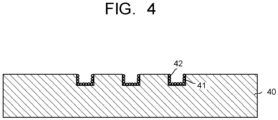
- FIG. 4 is a schematic cross-sectional view illustrating another example arrangement of the anode flow path plate 40.
- the anode flow path plate 40 illustrated in FIG. 4 includes a catalyst layer 42 containing at least one metal on the inner surface of grooves defining the anode flow path 41.
- the at least one metal is selected from nickel, iron, cobalt, and manganese.
- the catalyst layer 42 is formed, for example, by making particulate the at least one metal adhere to the inner surface of the grooves defining the anode flow path 41.
- the adhesion method include a method that includes spraying the at least one metal onto the flow path with a spray, and a method that includes mixing particulate the at least one metal with an organic adhesive for easy adhesion and spraying the mixture onto the inner surface.
- the adhesive include organics such as polyvinyl alcohol (PVA).
- the catalyst layer 42 may be preferably made using an ion-exchange resin such as Nafion in order to promote the movement of ions.
- Example methods of supporting the at least one metal only in the grooves include a method that includes introducing an ink containing the at least one metal and an ion-exchange resin to the anode flow path 41, and then drying and/or heating the object to form the catalyst layer 42 only on the inner surface of the grooves defining the anode flow path 41.
- the anode flow path 41 may have an uneven surface on the inner surface of the grooves defining the anode flow path 41 to facilitate adhesion of the at least one metal.
- the formation of the catalyst layer 42 enables the oxidation reaction similar to the oxidation reaction at the electrode 10 in also the anode flow path 41. This can inhibit the deterioration of the performance of the water electrolysis device.
- the continuation of electrolysis operation may cause the at least one metal of the catalyst layer 42 to be gradually peeled off from the anode flow path plate 40.
- This case enables the at least one metal to remain as at least one metal ions in the anode solution, and thus inhibit the decrease in the concentration of the at least one metal ions in the anode solution.
- the concentration of metal ions can be reduced by the method to adjust the concentration of the metal ions in the anode solution to 0.05 ⁇ mol/l or more and 0.5 ⁇ mol/l or less.
- a water electrolysis device having the electrolysis cell illustrated in FIG. 1 was manufactured.
- the catalyst layer 121 and the gap layer 122 were formed by alternately sputtering iridium and nickel on a titanium nonwoven fabric and etching the nickel with acid.
- the number of layers of the catalyst layer 121 was 3 to 20.
- the electrode 20 was formed by applying a carbon-supported platinum catalyst to a gas diffusion layer.
- the electrolyte membrane 30 was Nafion.
- the anode flow path plate 40 and the cathode flow path plate 50 were formed by cutting titanium.
- the anode current collector 60 and the cathode current collector 70 were formed by plating a titanium plate with gold. These members were stacked, sandwiched between support plates, which are not illustrated, and further tightened with bolts.
- the temperature of the electrolysis cell was set to 80°C, and an electrolysis operation was continuously performed at a current density of 2 A/cm 2 while supplying water having a nickel ion concentration of 0.05 ⁇ mol/l as an anode solution to the anode flow path 41.
- the voltage between the electrode 10 and the electrode 20 was measured 48 hours after the start of the electrolysis operation, and then the voltage was 1.840 V. Further, the conductivity of the anode solution was 0.05 ⁇ S/cm. The result is illustrated in Table 1.
- the water electrolysis device was used as in Example 1, and an electrolysis operation was performed under the same conditions as in Example 1, except that the concentration of the nickel ions in the anode solution was 0.1 ⁇ mol/l. Further, the voltage across the electrolysis cell was measured by the same method as in that of Example 1, and then the voltage was 1.830 V. Further, the conductivity of the anode solution was 0.05 ⁇ S/cm. The result is illustrated in Table 1.
- the water electrolysis device was used as in Example 1, and an electrolysis operation was performed under the same conditions as in Example 1, except that the concentration of the nickel ions in the anode solution was 0.5 ⁇ mol/l. Further, the voltage across the electrolysis cell was measured by the same method as in Example 1, and then the voltage was 1.825 V. Further, the conductivity of the anode solution was 0.06 ⁇ S/cm. The result is illustrated in Table 1.
- Example 3 variations in the nickel ion concentration, variations in the electrolysis cell voltage, and variations in the anode solution conductivity were each further evaluated with the passage of time in the electrolysis operation. The results are illustrated in Table 2.
- the water electrolysis device was used as in Example 1, and an electrolysis operation was performed under the same conditions as in Example 1, except that the concentration of the nickel ions in the anode solution was 0 ⁇ mol/l. Further, the voltage across the electrolysis cell was measured by the same method as in Example 1, and then the voltage was 1.845 V. Further, the conductivity of the anode solution was 0.03 ⁇ S/cm. The result is illustrated in Table 1.
- the water electrolysis device was used as in Example 1, and an electrolysis operation was performed under the same conditions as in Example 1, except that the concentration of the nickel ions in the anode solution was 0 ⁇ mol/l. Further, the voltage across the electrolysis cell was measured by the same method as in Example 1, and then the voltage was 1.845 V. Further, the conductivity of the anode solution was 0.03 ⁇ S/cm. The result is illustrated in Table 1.
- the water electrolysis device was used as in Example 1, and an electrolysis operation was performed under the same conditions as in Example 1, except that the concentration of the nickel ions in the anode solution was 1 ⁇ mol/l. Further, the voltage across the electrolysis cell was measured by the same method as in Example 1, and then the voltage was 1.85 V. Further, the conductivity of the anode solution was 0.1 ⁇ S/cm. The result is illustrated in Table 1. [Table 1] Exam. 1 Exam. 2 Exam. 3 Comp. Exam. 1 Comp. Exam.
- Examples 1 to 3 and Comparative examples 1 and 2 reveal that the control of the concentration of the nickel ions in the anode solution to 0.05 ⁇ mol/l or more and 0.5 ⁇ mol/l or less can inhibit the increase in cell voltage. This can inhibit the deterioration of the performance of the water electrolysis device.
- the voltage across the electrolysis cell is preferably, for example, 1.23 V or more and less than 1.85 V and more preferably 1.23 V or more and 1.84 V or less.
- the results in Table 2 reveal that as the operating time increases, the Ni ion concentration decreases and the voltage increases.
- the increase in voltage can be inhibited by measuring and adjusting the Ni ion concentration to 0.05 ⁇ mol/l or more and 0.5 ⁇ mol/l or less, as in the electrolysis device in the arrangement.
- the anode solution preferably has a conductivity of 0.05 ⁇ S/cm or more and 0.7 ⁇ S/cm or less.
Landscapes
- Chemical & Material Sciences (AREA)
- Engineering & Computer Science (AREA)
- Chemical Kinetics & Catalysis (AREA)
- Electrochemistry (AREA)
- Materials Engineering (AREA)
- Metallurgy (AREA)
- Organic Chemistry (AREA)
- Automation & Control Theory (AREA)
- Analytical Chemistry (AREA)
- Inorganic Chemistry (AREA)
- Electrolytic Production Of Non-Metals, Compounds, Apparatuses Therefor (AREA)
- Water Treatment By Electricity Or Magnetism (AREA)
Applications Claiming Priority (1)
| Application Number | Priority Date | Filing Date | Title |
|---|---|---|---|
| JP2022159382 | 2022-10-03 |
Publications (2)
| Publication Number | Publication Date |
|---|---|
| EP4350043A2 true EP4350043A2 (de) | 2024-04-10 |
| EP4350043A3 EP4350043A3 (de) | 2024-08-14 |
Family
ID=87934040
Family Applications (1)
| Application Number | Title | Priority Date | Filing Date |
|---|---|---|---|
| EP23195654.1A Pending EP4350043A3 (de) | 2022-10-03 | 2023-09-06 | Wasserelektrolysevorrichtung und verfahren zur steuerung der wasserelektrolysevorrichtung |
Country Status (4)
| Country | Link |
|---|---|
| US (1) | US12655527B2 (de) |
| EP (1) | EP4350043A3 (de) |
| JP (1) | JP2024053538A (de) |
| AU (1) | AU2023226686B2 (de) |
Families Citing this family (3)
| Publication number | Priority date | Publication date | Assignee | Title |
|---|---|---|---|---|
| JP7879561B2 (ja) * | 2024-11-19 | 2026-06-24 | 栗田工業株式会社 | 水の電解方法及び電解システム |
| KR102905546B1 (ko) * | 2025-06-05 | 2025-12-30 | 주식회사 큐에스에프 | Pcb 시스템 일체형 수전해 장치 |
| KR102890326B1 (ko) * | 2025-06-05 | 2025-11-24 | 주식회사 큐에스에프 | 유체흐름이 개선된 수전해 장치 |
Citations (3)
| Publication number | Priority date | Publication date | Assignee | Title |
|---|---|---|---|---|
| JP2017115232A (ja) | 2015-12-25 | 2017-06-29 | 株式会社東芝 | 電極、膜電極複合体、電気化学セルおよびスタック |
| JP2019167620A (ja) | 2018-03-22 | 2019-10-03 | 株式会社東芝 | 触媒積層体、膜電極複合体、電気化学セル、スタック、水電解装置および水利用システム |
| JP7125021B2 (ja) | 2017-09-07 | 2022-08-24 | 株式会社東芝 | 膜電極接合体、電気化学セル、および電気化学装置 |
Family Cites Families (8)
| Publication number | Priority date | Publication date | Assignee | Title |
|---|---|---|---|---|
| AU2358395A (en) * | 1994-04-26 | 1995-11-16 | Seh America, Inc. | Water purification system and method |
| JP2004058006A (ja) * | 2002-07-31 | 2004-02-26 | First Ocean Kk | 電解水製造方法 |
| JP5567375B2 (ja) * | 2010-04-14 | 2014-08-06 | 東洋炭素株式会社 | 気体発生装置および気体発生方法 |
| JP6672193B2 (ja) * | 2017-02-02 | 2020-03-25 | 株式会社東芝 | 二酸化炭素の電解セルと電解装置 |
| JP6823570B2 (ja) * | 2017-09-05 | 2021-02-03 | 千代田化工建設株式会社 | 合成ガス生成システム |
| US11578415B2 (en) * | 2018-11-28 | 2023-02-14 | Twelve Benefit Corporation | Electrolyzer and method of use |
| JP7247150B2 (ja) | 2020-09-02 | 2023-03-28 | 株式会社東芝 | 二酸化炭素電解装置および二酸化炭素電解方法 |
| EP4001463A1 (de) * | 2020-11-16 | 2022-05-25 | L'Air Liquide Société Anonyme pour l'Etude et l'Exploitation des Procédés Georges Claude | Elektrolyseanordnung und verfahren |
-
2023
- 2023-09-05 US US18/460,866 patent/US12655527B2/en active Active
- 2023-09-06 EP EP23195654.1A patent/EP4350043A3/de active Pending
- 2023-09-06 AU AU2023226686A patent/AU2023226686B2/en active Active
- 2023-09-13 JP JP2023148183A patent/JP2024053538A/ja active Pending
Patent Citations (3)
| Publication number | Priority date | Publication date | Assignee | Title |
|---|---|---|---|---|
| JP2017115232A (ja) | 2015-12-25 | 2017-06-29 | 株式会社東芝 | 電極、膜電極複合体、電気化学セルおよびスタック |
| JP7125021B2 (ja) | 2017-09-07 | 2022-08-24 | 株式会社東芝 | 膜電極接合体、電気化学セル、および電気化学装置 |
| JP2019167620A (ja) | 2018-03-22 | 2019-10-03 | 株式会社東芝 | 触媒積層体、膜電極複合体、電気化学セル、スタック、水電解装置および水利用システム |
Non-Patent Citations (1)
| Title |
|---|
| TOSHIBA REVIEW, vol. 77, no. 4, July 2022 (2022-07-01) |
Also Published As
| Publication number | Publication date |
|---|---|
| EP4350043A3 (de) | 2024-08-14 |
| AU2023226686A1 (en) | 2024-04-18 |
| AU2023226686B2 (en) | 2025-01-23 |
| US20240110290A1 (en) | 2024-04-04 |
| US12655527B2 (en) | 2026-06-16 |
| JP2024053538A (ja) | 2024-04-15 |
Similar Documents
| Publication | Publication Date | Title |
|---|---|---|
| Zhang et al. | Status and perspectives of key materials for PEM electrolyzer | |
| US20240110290A1 (en) | Water electrolysis device and method of controlling water electrolysis device | |
| JP5676334B2 (ja) | 層状触媒層、膜電極接合体、および電気化学セル | |
| Shintani et al. | Novel strategy to mitigate cathode catalyst degradation during air/air startup cycling via the atmospheric resistive switching mechanism of a hydrogen anode with a platinum catalyst supported on tantalum-doped titanium dioxide | |
| JP2002100373A (ja) | 燃料電池用触媒化多孔性炭素電極製造方法 | |
| Moore et al. | Novel methodology for ex situ characterization of iridium oxide catalysts in voltage reversal tolerant proton exchange membrane fuel cell anodes | |
| US9543591B2 (en) | Non-carbon mixed-metal oxide electrocatalysts | |
| US20240110297A1 (en) | Electrode for electrochemical reaction device, membrane electrode assembly, and electrochemical reaction device | |
| EP4350042A2 (de) | Elektrode für elektrochemische reaktionsvorrichtung, membranelektrodenanordnung und elektrochemische reaktionsvorrichtung | |
| EP4350047A2 (de) | Elektrode, membranelektrodenanordnung, elektrochemische zelle, stapel und elektrolyseur | |
| CN101120467A (zh) | 燃料电池催化剂 | |
| JP7793498B2 (ja) | 積層触媒、電極、膜電極複合体、電気化学セル、スタック、電解装置 | |
| JP7520758B2 (ja) | 電気化学装置 | |
| AU2023226658B2 (en) | Electrode, membrane electrode assembly, electrochemical cell, stack, and electrolyzer | |
| US20230250543A1 (en) | Catalyst layer, membrane electrode assembly | |
| JP5123565B2 (ja) | ガス拡散電極とその製造方法、及び当該ガス拡散電極を用いる燃料電池及び食塩電解セル | |
| JP2023162774A (ja) | 電気化学反応器用の電極及び電気化学反応器用の電極の製造方法 | |
| JP2009224151A (ja) | 燃料電池セパレータ | |
| CA3225562C (en) | Electrolytic cell for polymer electrolyte membrane electrolysis and method for production thereof | |
| JP7858459B2 (ja) | 電気化学反応装置及び電気化学反応方法 | |
| US20250075353A1 (en) | Electrode, membrane electrode assembly, electrochemical cell, stack, and electrolyzer | |
| EP4350045A2 (de) | Elektrode, membranelektrodenanordnung, elektrochemische zelle, stapel und elektrolyseur | |
| EP4431641A1 (de) | Elektrode, membranelektrodenanordnung, elektrochemische zelle, stapel und elektrolyseur | |
| US20240295035A1 (en) | Electrolytic cell for polymer electrolyte membrane electrolysis and method for production thereof | |
| JP6713896B2 (ja) | 燃料電池システム |
Legal Events
| Date | Code | Title | Description |
|---|---|---|---|
| PUAI | Public reference made under article 153(3) epc to a published international application that has entered the european phase |
Free format text: ORIGINAL CODE: 0009012 |
|
| STAA | Information on the status of an ep patent application or granted ep patent |
Free format text: STATUS: REQUEST FOR EXAMINATION WAS MADE |
|
| 17P | Request for examination filed |
Effective date: 20230906 |
|
| AK | Designated contracting states |
Kind code of ref document: A2 Designated state(s): AL AT BE BG CH CY CZ DE DK EE ES FI FR GB GR HR HU IE IS IT LI LT LU LV MC ME MK MT NL NO PL PT RO RS SE SI SK SM TR |
|
| PUAL | Search report despatched |
Free format text: ORIGINAL CODE: 0009013 |
|
| AK | Designated contracting states |
Kind code of ref document: A3 Designated state(s): AL AT BE BG CH CY CZ DE DK EE ES FI FR GB GR HR HU IE IS IT LI LT LU LV MC ME MK MT NL NO PL PT RO RS SE SI SK SM TR |
|
| RIC1 | Information provided on ipc code assigned before grant |
Ipc: C25B 9/73 20210101ALI20240705BHEP Ipc: C25B 15/02 20210101ALI20240705BHEP Ipc: C25B 9/23 20210101ALI20240705BHEP Ipc: C25B 15/08 20060101ALI20240705BHEP Ipc: C25B 15/029 20210101ALI20240705BHEP Ipc: C25B 11/053 20210101ALI20240705BHEP Ipc: C25B 1/04 20210101AFI20240705BHEP |