EP4339604B1 - Probenanalyseverfahren, kapillarelektroforeselösung und probenanalysekit - Google Patents
Probenanalyseverfahren, kapillarelektroforeselösung und probenanalysekit Download PDFInfo
- Publication number
- EP4339604B1 EP4339604B1 EP23196382.8A EP23196382A EP4339604B1 EP 4339604 B1 EP4339604 B1 EP 4339604B1 EP 23196382 A EP23196382 A EP 23196382A EP 4339604 B1 EP4339604 B1 EP 4339604B1
- Authority
- EP
- European Patent Office
- Prior art keywords
- sample
- sample analysis
- analysis method
- capillary electrophoresis
- alkaline solution
- Prior art date
- Legal status (The legal status is an assumption and is not a legal conclusion. Google has not performed a legal analysis and makes no representation as to the accuracy of the status listed.)
- Active
Links
Images

Classifications
-
- G—PHYSICS
- G01—MEASURING; TESTING
- G01N—INVESTIGATING OR ANALYSING MATERIALS BY DETERMINING THEIR CHEMICAL OR PHYSICAL PROPERTIES
- G01N27/00—Investigating or analysing materials by the use of electric, electrochemical, or magnetic means
- G01N27/26—Investigating or analysing materials by the use of electric, electrochemical, or magnetic means by investigating electrochemical variables; by using electrolysis or electrophoresis
- G01N27/416—Systems
- G01N27/447—Systems using electrophoresis
- G01N27/44704—Details; Accessories
-
- G—PHYSICS
- G01—MEASURING; TESTING
- G01N—INVESTIGATING OR ANALYSING MATERIALS BY DETERMINING THEIR CHEMICAL OR PHYSICAL PROPERTIES
- G01N27/00—Investigating or analysing materials by the use of electric, electrochemical, or magnetic means
- G01N27/26—Investigating or analysing materials by the use of electric, electrochemical, or magnetic means by investigating electrochemical variables; by using electrolysis or electrophoresis
- G01N27/416—Systems
- G01N27/447—Systems using electrophoresis
- G01N27/44756—Apparatus specially adapted therefor
- G01N27/44791—Microapparatus
-
- G—PHYSICS
- G01—MEASURING; TESTING
- G01N—INVESTIGATING OR ANALYSING MATERIALS BY DETERMINING THEIR CHEMICAL OR PHYSICAL PROPERTIES
- G01N27/00—Investigating or analysing materials by the use of electric, electrochemical, or magnetic means
- G01N27/26—Investigating or analysing materials by the use of electric, electrochemical, or magnetic means by investigating electrochemical variables; by using electrolysis or electrophoresis
- G01N27/416—Systems
- G01N27/447—Systems using electrophoresis
- G01N27/44704—Details; Accessories
- G01N27/44717—Arrangements for investigating the separated zones, e.g. localising zones
- G01N27/44721—Arrangements for investigating the separated zones, e.g. localising zones by optical means
-
- G—PHYSICS
- G01—MEASURING; TESTING
- G01N—INVESTIGATING OR ANALYSING MATERIALS BY DETERMINING THEIR CHEMICAL OR PHYSICAL PROPERTIES
- G01N27/00—Investigating or analysing materials by the use of electric, electrochemical, or magnetic means
- G01N27/26—Investigating or analysing materials by the use of electric, electrochemical, or magnetic means by investigating electrochemical variables; by using electrolysis or electrophoresis
- G01N27/416—Systems
- G01N27/447—Systems using electrophoresis
- G01N27/44704—Details; Accessories
- G01N27/44743—Introducing samples
-
- G—PHYSICS
- G01—MEASURING; TESTING
- G01N—INVESTIGATING OR ANALYSING MATERIALS BY DETERMINING THEIR CHEMICAL OR PHYSICAL PROPERTIES
- G01N27/00—Investigating or analysing materials by the use of electric, electrochemical, or magnetic means
- G01N27/26—Investigating or analysing materials by the use of electric, electrochemical, or magnetic means by investigating electrochemical variables; by using electrolysis or electrophoresis
- G01N27/416—Systems
- G01N27/447—Systems using electrophoresis
- G01N27/44704—Details; Accessories
- G01N27/44747—Composition of gel or of carrier mixture
-
- G—PHYSICS
- G01—MEASURING; TESTING
- G01N—INVESTIGATING OR ANALYSING MATERIALS BY DETERMINING THEIR CHEMICAL OR PHYSICAL PROPERTIES
- G01N27/00—Investigating or analysing materials by the use of electric, electrochemical, or magnetic means
- G01N27/26—Investigating or analysing materials by the use of electric, electrochemical, or magnetic means by investigating electrochemical variables; by using electrolysis or electrophoresis
- G01N27/416—Systems
- G01N27/447—Systems using electrophoresis
- G01N27/44756—Apparatus specially adapted therefor
-
- G—PHYSICS
- G01—MEASURING; TESTING
- G01N—INVESTIGATING OR ANALYSING MATERIALS BY DETERMINING THEIR CHEMICAL OR PHYSICAL PROPERTIES
- G01N27/00—Investigating or analysing materials by the use of electric, electrochemical, or magnetic means
- G01N27/26—Investigating or analysing materials by the use of electric, electrochemical, or magnetic means by investigating electrochemical variables; by using electrolysis or electrophoresis
- G01N27/416—Systems
- G01N27/447—Systems using electrophoresis
- G01N27/44756—Apparatus specially adapted therefor
- G01N27/44795—Isoelectric focusing
Definitions
- the present disclosure relates to a sample analysis method, a capillary electrophoresis solution, and a sample analysis kit.
- Hb hemoglobin
- HbA1c is well known as an analysis target for diagnosing diabetes and understanding the condition of diabetes.
- Mutant Hbs represented by HbS (sickle cell Hb), HbC, HbD, HbE, and the like are used as analysis targets for diagnosing abnormal Hb disease.
- HbA2 and HbF are widely used as analysis targets for diagnosing ⁇ -thalassemia.
- HPLC high performance liquid chromatography
- CE capillary electrophoresis
- JP-A Japanese Patent Application Laid-Open
- JP-A No. 2006-145537 discloses a method for analyzing Hb by a free solution capillary electrophoresis method (capillary zone electrophoresis, CZE).
- JP-A Japanese National-Phase Publication
- JP-A No. 2012-531609 discloses a method for analyzing Hb in which capillary electrophoresis is performed in the presence of a boronate compound.
- JP-A Japanese Patent Application Laid-Open
- JP-A No. 2009-109230 discloses a method for analyzing Hb by cation exchange electrokinetic chromatography using a solution containing an anionic polymer as a pseudo stationary phase.
- US 2016/209359 A1 discloses a sample analysis method including separating hemoglobin in a sample in an alkaline solution containing a cationic polymer by capillary electrophoresis.
- the inventor of the present invention has found that, since some types of Hb have similar structures, separation accuracy is not sufficient and there is room for improvement of conventional methods for analyzing Hb by capillary electrophoresis.
- An object of an embodiment of the disclosure is to provide a sample analysis method, a capillary electrophoresis solution, and a sample analysis kit, which enable separation of Hb.
- a sample analysis method includes a separation step of separating hemoglobin from a sample containing the hemoglobin, in an alkaline solution by capillary electrophoresis, wherein the alkaline solution contains a cationic polymer having a secondary amino group and a quaternary ammonium base.
- the upper limit value or the lower limit value of one numerical range may be replaced with the upper limit value or the lower limit value of another numerical range described step by step.
- the upper limit value or the lower limit value of the numerical ranges may be replaced with the values illustrated in the examples.
- Each component may contain a plurality of types of corresponding substances.
- the amount of each component in the composition means the total amount of the plurality of types of substances present in the composition unless otherwise specified.
- step includes not only an independent step but also a step that cannot be clearly distinguished from other steps as long as the intended purpose of the step is achieved.
- a sample analysis method includes a separation step of separating hemoglobin from a sample containing the hemoglobin, in an alkaline solution by capillary electrophoresis, wherein the alkaline solution (hereinafter also referred to as a "specific alkaline solution”) contains a cationic polymer having a secondary amino group and a quaternary ammonium base.
- Hb can be separated.
- the reason why the above effect is exhibited is not clear, but it is presumed as follows.
- the separation of Hb having similar structures such as HbA2 or HbE is performed in an alkaline solution containing a cationic polymer having a secondary amino group and a quaternary ammonium base according to the specific sample analysis method.
- HbA2 and HbE are charged negatively in the alkaline solution.
- the negatively charged HbA2 and HbE are moved to the positive electrode side by bringing the negative electrode into contact with the sample introduction side and applying a voltage.
- the cationic polymer has a quaternary ammonium base, and moves from the positive electrode side to the negative electrode side in a state of being bound to HbA2 and HbE by a secondary amino group.
- HbA2 and HbE there is a difference in the degree of negative charge of HbA2 and HbE. It is presumed that the difference in charge causes a difference in electrophoresis speed between HbA2 and HbE, and Hb having similar structures such as HbA2 or HbE is separated from a sample containing hemoglobin with excellent accuracy.
- the cationic polymer used in the specific sample analysis method has a secondary amino group and a quaternary ammonium base, and accordingly, a difference in ease of binding to Hb having similar structures such as HbA2 or HbE is caused. Accordingly, it is presumed to improve the accuracy of separation.
- sample analysis method according to an embodiment of the present disclosure can be analyzed by a small device as compared with a high performance liquid chromatography (HPLC) method.
- HPLC high performance liquid chromatography
- the specific sample analysis method includes a separation step of separating Hb in a sample, in an alkaline solution by capillary electrophoresis.
- HbA2 and HbE are preferably separated from the sample.
- HbA and HbG are preferably separated from the sample in the separation step.
- HbA2, HbA, and HbS are preferably separated from the sample in the separation step.
- one or more selected from the group consisting of HbF, HbC, and HbD are preferably separated from the sample.
- Separation of Hb in the sample, in the alkaline solution by capillary electrophoresis can be performed by introducing the sample into the capillary flow path filled with the alkaline solution, and applying a voltage to the whole or a part of the capillary flow path after introduction of the sample. By applying the voltage, Hb in the sample can be electrophoresed and separated from the sample.
- the voltage can be applied to the capillary flow path by bringing a negative electrode into contact with the sample introduction side of the capillary flow path and bringing a positive electrode into contact with the alkaline solution supply side.
- the cross-sectional shape of the capillary flow path is not particularly limited, and may be a circular shape, a rectangular shape, or other shapes.
- each of the flow path height and the flow path width of the capillary flow path is preferably from 1 to 1000 ⁇ m, more preferably from 10 to 200 ⁇ m, and still more preferably from 25 ⁇ m to 100 ⁇ m.
- the inner diameter of the capillary flow path is preferably 10 ⁇ m or more or 25 ⁇ m or more, and preferably from 100 ⁇ m or less or 75 ⁇ m or less.
- the flow path length of the capillary flow path is preferably from 10 mm to 150 mm, and more preferably from 20 mm to 60 mm.
- Examples of the material of the capillary flow path include glass, fused silica, and plastic.
- Examples of the plastic include polymethyl methacrylate (PMMA), polycarbonate, polystyrene, polytetrafluoroethylene (PTFE), and polyetheretherketone (PEEK).
- a capillary electrophoresis chip in which the above-described capillary flow path is made into a microchip may be used.
- the capillary electrophoresis chip can include a sample holding tank, an electrophoretic liquid holding tank, and a capillary flow path, in which the sample holding tank and the electrophoretic liquid holding tank are communicated with each other via the capillary flow path.
- the size of the capillary electrophoresis chip is not particularly limited, and is preferably appropriately adjusted.
- the size of the capillary electrophoresis chip can be, for example, from 10 mm to 200 mm in length, from 1 mm to 60 mm in width, and from 0.3 mm to 5 mm in thickness.
- the volumes of the sample holding tank and the electrophoretic liquid holding tank are appropriately determined according to the inner diameter and the length of the capillary flow path, and are each preferably from 1 mm 3 to 1000 mm 3 , and more preferably from 5 mm 3 to 100 mm 3 .
- the amount of the sample to be filled into the sample holding tank is not particularly limited, and may be from 1 ⁇ L to 30 ⁇ L.
- the amount of the alkaline solution to be filled into the electrophoretic liquid holding tank is not particularly limited, and may be from 1 ⁇ L to 30 ⁇ L.
- the voltage applied to both ends of the capillary flow path is preferably from 500 V to 10,000 V, and more preferably from 500 V to 5,000 V.
- the inner wall of the capillary flow path By coating the inner wall of the capillary flow path with the cationic substance, the inner wall of the capillary flow path can be positively charged. As a result, an electroosmotic flow from the negative electrode side toward the positive electrode side can be easily generated in the capillary flow path.
- the inner wall of the capillary flow path When the inner wall of the capillary flow path is coated with the anionic substance, the inner wall of the capillary flow path is negatively charged, but the cationic polymer contained in the alkaline solution is bound to the inner wall of the negatively charged capillary flow path. As a result, the inner wall of the capillary flow path is positively charged, and the electroosmotic flow from the negative electrode side toward the positive electrode side can be easily generated in the capillary flow path as described above.
- the cationic substance is not particularly limited, and a silane coupling agent having a cationic functional group and the like can be used. From the viewpoint of improving the separation accuracy, the cationic substance is preferably a polymer having a quaternary ammonium base.
- the anionic substance is not particularly limited, and polysaccharides having an anionic group, silane coupling agents having an anionic functional group, and the like can be used.
- polysaccharide having an anionic group examples include sulfated polysaccharides, carboxylated polysaccharides, sulfonated polysaccharides, and phosphorylated polysaccharides.
- Examples of the sulfated polysaccharide include chondroitin sulfate, heparin, heparan, fucoidan, and salts thereof.
- Examples of the carboxylated polysaccharide include alginic acid, hyaluronic acid, and salts thereof.
- Figs. 1A and 1B illustrate an embodiment of a capillary electrophoresis chip.
- Fig. 1A is a top view illustrating an embodiment of a capillary electrophoresis chip
- Fig. 1B is a cross-sectional view of the electrophoresis chip illustrated in Fig. 1A .
- the capillary electrophoresis chip illustrated in Figs. 1A and 1B includes a capillary flow path 10, a sample holding tank 11, and an electrophoretic liquid holding tank 12, and the sample holding tank 11 and the electrophoretic liquid holding tank 12 are communicated with each other via the capillary flow path 10.
- a detection unit 13 is formed in the capillary flow path 10.
- the sample holding tank 11 and the electrophoretic liquid holding tank 12 may each include an electrode for applying a voltage to both ends of the capillary flow path 10 (not illustrated).
- the sample holding tank 11 (sample introduction side) may include a negative electrode
- the electrophoretic liquid holding tank 12 (alkaline solution supply side) may include a positive electrode.
- the position of the detection unit 13, that is, the length required for the separation (distance from the sample holding tank 11 to the detection unit 13, x in Fig. 1A ) can be appropriately determined according to the length of the capillary flow path 10 or the like.
- the distance (x) from the sample holding tank 11 to the detection unit 13 is preferably from 5 mm to 140 mm, more preferably from 10 mm to 100 mm, and still more preferably from 15 mm to 50 mm.
- alkaline means that the pH is 7.0 or more.
- the pH of the specific alkaline solution is preferably higher than the isoelectric points of HbA2 and HbE, and is preferably from 7.5 to 12.0, more preferably from 8.5 to 11.0, and still more preferably from 9.5 to 10.5.
- the pH of the alkaline solution is the pH of the alkaline solution at 25°C, and is measured using a pH meter 30 minutes after the electrode is immersed.
- a pH meter F-72 manufactured by HORIBA, Ltd. or a device similar thereto can be used.
- the specific alkaline solution contains a cationic polymer having a secondary amino group and a quaternary ammonium base (hereinafter also referred to as a "specific cationic polymer").
- the "cationic polymer” means a polymer having a cationic group.
- the "cationic group” includes a cationic group and a group that is ionized to become a cationic group.
- the secondary amino group and the quaternary ammonium base correspond to a cationic group.
- the specific cationic polymer may have a cationic group other than the secondary amino group and the quaternary ammonium base (hereinafter also referred to as "other cationic group").
- Examples of other cationic groups include a primary amino group, a tertiary amino group, and an imino group.
- the content of the secondary amino group and the quaternary ammonium base with respect to the total mass of the secondary amino group, the quaternary ammonium base, and other cationic groups is preferably 50% by mass or more, more preferably 70% by mass or more, still more preferably 80% by mass or more, even more preferably 90% by mass or more, particularly preferably 95% by mass or more, and most preferably 100% by mass from the viewpoint of improving the separation accuracy.
- the specific cationic polymer preferably has a structure represented by Formula (1) and a structure represented by Formula (2).
- the nitrogen atom (N) in Formula (1) constitutes a quaternary ammonium base
- the nitrogen atom (N) in Formula (2) constitutes a secondary amino group.
- each of R 1 and R 2 independently represents an alkyl group having a substituent and having from 1 to 10 carbon atoms or an unsubstituted alkyl group having from 1 to 10 carbon atoms, and X represents a divalent linking group, and in Formula (2), Y represents a divalent linking group.
- each of R 1 and R 2 independently preferably represents an alkyl group having a substituent and having from 1 to 6 carbon atoms or an unsubstituted alkyl group having from 1 to 6 carbon atoms, more preferably represent an alkyl group having a substituent and having from 1 to 3 carbon atoms or an unsubstituted alkyl group having from 1 to 3 carbon atoms, further preferably represent an unsubstituted alkyl group having from 1 to 3 carbon atoms, particularly preferably represent a methyl group or an ethyl group, and most preferably represent a methyl group.
- substituents examples include a halogen atom, a hydroxy group, an amino group, a nitro group, a cyano group, and a sulfo group.
- each of X and Y independently preferably represents an alkylene group having a substituent and having from 1 to 10 carbon atoms or an unsubstituted alkylene group having from 1 to 10 carbon atoms, more preferably represent an alkylene group having a substituent and having from 1 to 6 carbon atoms or an unsubstituted alkylene group having from 1 to 6 carbon atoms, further preferably represent an alkylene group having a substituent and having from 1 to 6 carbon atoms, particularly preferably represent an alkylene group having a substituent and having from 3 to 6 carbon atoms, and an alkylene group having a substituent and having 3 carbon atoms.
- each of X and Y independently preferably represents an alkylene group having a hydroxy group and having from 1 to 6 carbon atoms, more preferably represent an alkylene group having a hydroxy group and having from 3 to 6 carbon atoms, further preferably represent an alkylene group having a hydroxy group and having from 3 carbon atoms, and particularly preferably represent a 2-hydroxypropylene group.
- the dimethylamine-ammonia-epichlorohydrin polycondensate can be represented by the following Formula (3).
- each of m and n is independently an integer from 1 to 1,000.
- the weight average molecular weight of the specific cationic polymer is preferably from 10,000 to 700,000, more preferably from 100,000 to 600,000, and still more preferably from 200,000 to 500,000.
- the weight average molecular weight of the cationic polymer refers to the catalogue value.
- the weight average molecular weight is a weight average molecular weight in terms of polyethylene glycol measured by a gel permeation chromatography (GPC) method.
- the content of the specific cationic polymer with respect to the total mass of the specific alkaline solution is preferably from 0.1% by mass to 5.0% by mass, more preferably from 0.7% by mass to 3.0% by mass, and still more preferably from 1.0% by mass to 2.0% by mass.
- a polymer synthesized by a conventionally known method may be used, or a commercially available polymer may be used.
- Examples of commercially available products of the specific cationic polymer include Unisense KHE 1000L manufactured by SENKA corporation.
- Examples of the method for synthesizing the specific cationic polymer include a method in which dimethylamine, ammonia, and epichlorohydrin are mixed and polycondensed.
- the specific alkaline solution may contain a cationic polymer other than the specific cationic polymer (hereinafter also referred to as "other cationic polymer”).
- other cationic polymers include polyallylamine, polyvinylamine, polylysine, polyarginine, polyhistidine, polyornithine, polydiallylamine, polymethyldiallylamine, polyethyleneimine, polyquaternium, and dimethylamine-epichlorohydrin polycondensate.
- polyquaternium refers to a cationic polymer containing a constituent unit derived from a monomer having a quaternary ammonium group.
- polyquaternium examples include polydiallyldimethylammonium salts such as polyquaternium-6 (poly(diallyldimethylammonium chloride)), polyquaternium-7 (copolymer of acrylamide and diallyldimethylammonium chloride), polyquaternium-4 (diallyldimethylammonium chloride-hydroxyethyl cellulose copolymer), and polyquaternium-22 (copolymer of acrylic acid and diallyldimethylammonium chloride); and polyquaternium-2 (poly[bis(2-chloroethyl)ether-alt-1,3-bis[3-(dimethylamino)propyl]urea]).
- polyquaternium-6 poly(diallyldimethylammonium chloride)
- polyquaternium-7 copolymer of acrylamide and diallyldimethylammonium chloride
- polyquaternium-4 diallyldimethylammonium chloride-hydroxyethyl cellulose copolymer
- the content of the other cationic polymer with respect to the total mass of the specific alkaline solution is preferably 5.0% by mass or less, more preferably 3.0% by mass or less, still more preferably 1.0% by mass or less, particularly preferably 0.01% by mass or less, and most preferably, no other cationic polymer is contained.
- the specific alkaline solution may contain water.
- the water include distilled water, ion-exchanged water, pure water, and ultrapure water.
- the content of water with respect to the total mass of the specific alkaline solution is not particularly limited, and may be from 10% by mass to 99.9% by mass.
- the specific alkaline solution may contain additives such as a non-surfactant type zwitterionic substance, a pH buffering substance, and a preservative for suppressing proliferation of microorganisms and the like.
- additives such as a non-surfactant type zwitterionic substance, a pH buffering substance, and a preservative for suppressing proliferation of microorganisms and the like.
- the preservative include sodium azide, ethylparaben, and ProClin.
- the sample preferably contains Hb and contains HbA2 and HbE.
- the content of Hb with respect to the total mass of the sample is not particularly limited, and may be from 0.001% by mass to 100% by mass.
- the contents of HbA2 and HbE with respect to the total mass of the sample are not particularly limited, and can be from 0.0001% by mass to 100% by mass, respectively.
- the contents of HbA2, HbA, and HbG with respect to the total mass of the sample are not particularly limited, and can be from 0.0001% by mass to 100% by mass, respectively.
- the content of HbA2, HbA, and HbS with respect to the total mass of the sample is not particularly limited, and can be from 0.0001% by mass to 100% by mass, respectively.
- sample raw material may be prepared, or may be the sample raw material itself.
- sample raw material examples include raw materials containing Hb, biological samples, and the like.
- Examples of the biological sample include blood and a blood derivative containing a red blood cell component or the like.
- Examples of the blood include blood collected from a living body, and include blood of mammals other than human, and blood of human.
- Examples of the blood derivative containing a red blood cell component include those separated or prepared from blood and containing a red blood cell component. Examples thereof include a blood cell fraction from which plasma is removed, a blood cell concentrate, a lyophilizate of blood or blood cells, a hemolysis sample obtained by hemolysis of whole blood, centrifuged blood, naturally precipitated blood, and washed blood cells.
- the sample preferably contains an alkaline solution containing a cationic polymer.
- the sample containing the alkaline solution can be obtained by diluting the sample raw material using the alkaline solution.
- the dilution rate is preferably from 1.2 times to 100 times, more preferably from 2 times to 60 times, and still more preferably from 3 times to 50 times on a mass basis.
- the material used for dilution is not particularly limited, and examples thereof include a pH adjusting agent (for example, hydrochloric acid), a surfactant (for example, EMULGEN LS-110 (manufactured by Kao Corporation)), an antiseptic agent (for example, sodium azide), an ionic strength adjusting agent (for example, sodium chloride), and a refractive index adjusting agent (for example, saccharides such as sucrose).
- a pH adjusting agent for example, hydrochloric acid
- a surfactant for example, EMULGEN LS-110 (manufactured by Kao Corporation)
- an antiseptic agent for example, sodium azide
- the cationic polymer may be a specific cationic polymer or need not be a specific cationic polymer.
- Examples of the cationic polymer that is not the specific cationic polymer include polyethyleneimine.
- the alkaline solution may be the same as or different from the specific alkaline solution filled into the capillary flow path.
- the specific sample analysis method can include a detection step of detecting Hb separated from the sample in the separation step.
- Detection of Hb can be performed by detecting Hb by an optical method.
- Examples of the detection by an optical method include measurement of absorbance.
- Hb can be detected by irradiating separated Hb with light having a wavelength from 415 to 420 nm to obtain an absorbance spectrum in which the vertical axis represents absorbance and the horizontal axis represents time.
- a capillary electrophoresis chip When a capillary electrophoresis chip is used for separating Hb, it is preferable to irradiate the detection unit with light having a wavelength from 415 to 420 nm.
- the absorbance spectrum can be obtained by using The Lab 001 manufactured by ARKRAY, Inc. or a device similar thereto.
- Hb may be detected using an electropherogram (differential waveform) obtained by differentiating the waveform of the absorbance spectrum with respect to time.
- the detection is performed by a method described in Japanese Patent Application Laid-Open ( JP-A) No. 2019-78599 .
- the electrophoretic liquid holding tank 12 of the capillary electrophoresis chip is filled with a specific alkaline solution containing a specific cationic polymer as an electrophoretic liquid, and the capillary flow path 10 is filled with the specific alkaline solution by capillary phenomenon.
- the sample to be added to the sample holding tank 11 can be prepared by diluting whole blood, which is a sample raw material, with the alkaline solution.
- a negative electrode is brought into contact with the sample holding tank 11, and a positive electrode is brought into contact with the electrophoretic liquid holding tank 12 (not illustrated), and a voltage is applied between both ends of the capillary flow path 10, that is, between the sample holding tank 11 and the electrophoretic liquid holding tank 12.
- a sample is introduced from the sample holding tank 11 into the capillary flow path 10, a sample containing Hb moves from the sample holding tank 11 toward the electrophoretic liquid holding tank 12, and separation of Hb is performed.
- the detection unit 13 emits light having a wavelength from 415 nm to 420 nm, and the absorbance measurement device measures the absorbance to detect Hb.
- the sample analysis method of the disclosure can be used for applications such as prevention, diagnosis, and treatment of abnormal Hb disease and ⁇ -thalassemia.
- a capillary electrophoresis solution according to the embodiment of the disclosure contains a cationic polymer having a secondary amino group and a quaternary ammonium base and is used for separation of Hb by capillary electrophoresis.
- the capillary electrophoresis solution according to the embodiment of the disclosure can be used for separation of HbA2 and HbE.
- the capillary electrophoresis solution according to the embodiment of the disclosure can be used for separation of HbA and HbG.
- the capillary electrophoresis solution according to the embodiment of the disclosure can be used for separation of HbA2, HbA, and HbS.
- a preferred aspect of the capillary electrophoresis solution is the same as the specific alkaline solution used in the specific sample analysis method, and thus the description thereof will be omitted here.
- a sample analysis kit includes: a container containing the capillary electrophoresis solution according to the description above; and an electrophoresis chip which includes a sample holding tank, an electrophoretic liquid holding tank, and a capillary flow path, in which the sample holding tank and the electrophoretic liquid holding tank are communicated with each other via the capillary flow path.
- capillary electrophoresis solution and the electrophoresis chip are the same as those of the specific alkaline solution and the electrophoresis chip used in the specific sample analysis method, and thus the description thereof will be omitted here.
- Examples of the material of the container containing the capillary electrophoresis solution include glass, fused silica, and plastic. Since the plastic has been described above, the description thereof will be omitted here.
- a resin-made chip (flow path width: 40 ⁇ m, flow path height: 40 ⁇ m, flow path length: 30 mm, distance (x) from sample holding tank 11 to detection unit 13: 20 mm) having the capillary flow path 10 having the structure illustrated in Fig. 1 was used.
- the capacity of the sample holding tank 11 and the electrophoretic liquid holding tank 12 was set to 10 ⁇ L.
- the inner wall of the capillary flow path was coated with polydiallyldimethylammonium chloride.
- an in-house electrophoresis device was used as the measurement device.
- Dimethylamine-ammonia-epichlorohydrin polycondensate (specific cationic polymer, Unisense KHE 1000L, manufactured by SENKA Corporation, weight average molecular weight from 100,000 to 500,000) 1.5% by mass - Sodium azide 0.02% by mass
- Human whole blood containing HbA2, HbE, HbA, and an anticoagulant (ethylenediaminetetraacetic acid) was diluted (dilution rate 41 times (mass basis)) with an alkaline solution (pH 8.8) having the following composition to obtain the sample A.
- an alkaline solution pH 8.8
- hydrochloric acid and water were added until the pH of the solution reached 8.8.
- the detection unit 13 was irradiated with light from 415 to 420 nm, and the absorbance was measured to obtain an absorbance spectrum.
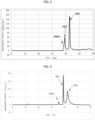
- An electropherogram was obtained by differentiating the waveform of the absorbance spectrum with respect to time. Electrophoresis was performed for 60 seconds. The obtained electropherogram is illustrated in Fig. 2 .
- the Lab 001 manufactured by ARKRAY, Inc. was used for light irradiation, measurement of absorbance, and acquisition of an electropherogram.
- Human whole blood containing HbA2, HbE, HbA, and an anticoagulant (ethylenediaminetetraacetic acid) was diluted (dilution rate 41 times (mass basis)) with an alkaline solution (pH 9.0) having the following composition to obtain the sample B.
- an alkaline solution pH 9.0
- hydrochloric acid and water were added until the pH of the solution reached 9.0.
- Electrophoresis and acquisition of electropherograms were performed in the same manner as in Example 1 except that the specific alkaline solution 1 was changed to the alkaline solution a and the sample A was changed to the sample B.
- the obtained electropherogram is illustrated in Fig. 3 .
- Electrophoresis and acquisition of electropherograms were performed in the same manner as in Example 1 except that the sample A was changed to the sample B prepared as described below.
- the obtained electropherogram is illustrated in Fig. 4 .
- Human whole blood containing HbA2, HbA, HbS, and an anticoagulant (ethylenediaminetetraacetic acid) was diluted (dilution rate 41 times (mass basis)) with the alkaline solution (pH 8.8) used in Example 1 to obtain the sample B.
- an anticoagulant ethylenediaminetetraacetic acid
- Electrophoresis and acquisition of electropherograms were performed in the same manner as in Example 1 except that the sample A was changed to the sample D prepared as described below.
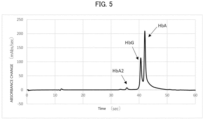
- the obtained electropherogram is illustrated in Fig. 5 .
- Human whole blood containing HbA2, HbA, HbG, and an anticoagulant (ethylenediaminetetraacetic acid) was diluted (dilution rate 41 times (mass basis)) with the alkaline solution (pH 8.8) used in Example 1 to obtain the sample D.
- an anticoagulant ethylenediaminetetraacetic acid
Landscapes
- Health & Medical Sciences (AREA)
- Life Sciences & Earth Sciences (AREA)
- Chemical & Material Sciences (AREA)
- Molecular Biology (AREA)
- Physics & Mathematics (AREA)
- Electrochemistry (AREA)
- Chemical Kinetics & Catalysis (AREA)
- Analytical Chemistry (AREA)
- Biochemistry (AREA)
- General Health & Medical Sciences (AREA)
- General Physics & Mathematics (AREA)
- Immunology (AREA)
- Pathology (AREA)
- Dispersion Chemistry (AREA)
- Investigating Or Analysing Biological Materials (AREA)
Claims (11)
- Probenanalyseverfahren, umfassend:einen Trennschritt zum Abtrennens von Hämoglobin aus einer Probe, die das Hämoglobin enthält, in einer alkalischen Lösung durch Kapillarelektrophorese,dadurch gekennzeichnet, dass die alkalische Lösung ein kationisches Polymer umfasst, das eine sekundäre Aminogruppe und eine quaternäre Ammoniumbase aufweist.
- Probenanalyseverfahren nach Anspruch 1, wobei das kationische Polymer eine Struktur aufweist, die durch die folgende Formel (1) dargestellt wird, und eine Struktur, die durch die folgende Formel (2) dargestellt wird:

 wobei in Formel (1) jedes von R1 und R2 unabhängig eine Alkylgruppe darstellt, die einen Substituenten aufweist und 1 bis 10 Kohlenstoffatome aufweist, oder eine unsubstituierte Alkylgruppe darstellt, die 1 bis 10 Kohlenstoffatome aufweist, und X eine zweiwertige Verbindungsgruppe darstellt, undwobei in Formel (2) Y eine zweiwertige Verbindungsgruppe darstellt.
 - Probenanalyseverfahren nach Anspruch 2, wobei jedes von X in Formel (1) und Y in Formel (2) unabhängig eine Alkylengruppe darstellt, die einen Substituenten aufweist und 1 bis 10 Kohlenstoffatome aufweist, oder eine unsubstituierte Alkylengruppe darstellen, die 1 bis 10 Kohlenstoffatome aufweist.
- Probenanalyseverfahren nach Anspruch 2, wobei jedes von X in Formel (1) und Y in Formel (2) unabhängig eine Alkylengruppe darstellt, die eine Hydroxygruppe und 1 bis 6 Kohlenstoffatome aufweist.
- Probenanalyseverfahren nach Anspruch 1 oder 2, wobei das kationische Polymer ein Dimethylamin-Ammoniak-Epichlorhydrin-Polykondensat ist.
- Probenanalyseverfahren nach Anspruch 1 oder 2, wobei ein gewichtsgemitteltes Molekulargewicht des kationischen Polymers 100.000 bis 500.000 beträgt.
- Probenanalyseverfahren nach Anspruch 1 oder 2, wobei die alkalische Lösung einen pH-Wert von 7,5 bis 12,0 aufweist.
- Probenanalyseverfahren nach Anspruch 1 oder 2, wobei im Trennschritt Hämoglobin A2 und Hämoglobin E aus der Probe getrennt werden.
- Probenanalyseverfahren nach Anspruch 1 oder 2, wobei im Trennschritt Hämoglobin A und Hämoglobin G aus der Probe getrennt werden.
- Kapillarelektrophoreselösung, wobei die Kapillarelektrophoreselösung zum Trennen von Hämoglobin durch Kapillarelektrophorese verwendet wird,
dadurch gekennzeichnet, dass die Kapillarelektrophoreselösung ein kationisches Polymer umfasst, das eine sekundäre Aminogruppe und eine quaternäre Ammoniumbase aufweist. - Probenanalysekit, umfassend:einen Behälter, der die Kapillarelektrophoreselösung nach Anspruch 10 umfasst; undeinen Elektrophorese-Chip, der einen Probenhaltetank, einen Haltetank für elektrophoretische Flüssigkeit und einen Kapillarströmungspfad umfasst, wobei der Probenhaltetank und der Haltetank für elektrophoretische Flüssigkeit über den Kapillarströmungspfad miteinander in Verbindung stehen.
Applications Claiming Priority (1)
| Application Number | Priority Date | Filing Date | Title |
|---|---|---|---|
| JP2022145645A JP2024040968A (ja) | 2022-09-13 | 2022-09-13 | 試料分析方法、キャピラリ電気泳動用溶液、及び試料分析用キット |
Publications (3)
| Publication Number | Publication Date |
|---|---|
| EP4339604A1 EP4339604A1 (de) | 2024-03-20 |
| EP4339604C0 EP4339604C0 (de) | 2025-05-14 |
| EP4339604B1 true EP4339604B1 (de) | 2025-05-14 |
Family
ID=88069040
Family Applications (1)
| Application Number | Title | Priority Date | Filing Date |
|---|---|---|---|
| EP23196382.8A Active EP4339604B1 (de) | 2022-09-13 | 2023-09-08 | Probenanalyseverfahren, kapillarelektroforeselösung und probenanalysekit |
Country Status (4)
| Country | Link |
|---|---|
| US (1) | US20240102961A1 (de) |
| EP (1) | EP4339604B1 (de) |
| JP (1) | JP2024040968A (de) |
| CN (1) | CN117705911A (de) |
Family Cites Families (7)
| Publication number | Priority date | Publication date | Assignee | Title |
|---|---|---|---|---|
| FR2878033B1 (fr) | 2004-11-18 | 2007-05-04 | Sebia Sa | Procede d'analyse de l'hemoglobine par electrophorese capillaire, trousse pour electrophorese capillaire et utilisation de ralentisseur de flux dans un tel procede |
| JP4854637B2 (ja) | 2007-10-26 | 2012-01-18 | 積水化学工業株式会社 | ヘモグロビン類の測定方法 |
| JP4854502B2 (ja) * | 2006-12-26 | 2012-01-18 | 積水化学工業株式会社 | ヘモグロビン類の測定方法 |
| FR2947632B1 (fr) | 2009-07-01 | 2011-11-11 | Sebia Sa | Analyse et dosage d'hemoglobines glyquees par electrophorese capillaire, compositions tampon et kits pour electrophorese capillaire |
| JP6052927B2 (ja) | 2015-01-15 | 2016-12-27 | アークレイ株式会社 | 試料の分析方法及びそれに用いる溶液 |
| US10545117B2 (en) * | 2015-01-15 | 2020-01-28 | Arkray, Inc. | Sample analysis method and solution therefor |
| JP6871129B2 (ja) | 2017-10-23 | 2021-05-12 | アークレイ株式会社 | 分析方法 |
-
2022
- 2022-09-13 JP JP2022145645A patent/JP2024040968A/ja active Pending
-
2023
- 2023-09-08 EP EP23196382.8A patent/EP4339604B1/de active Active
- 2023-09-11 US US18/464,771 patent/US20240102961A1/en active Pending
- 2023-09-12 CN CN202311168961.9A patent/CN117705911A/zh active Pending
Also Published As
| Publication number | Publication date |
|---|---|
| EP4339604C0 (de) | 2025-05-14 |
| EP4339604A1 (de) | 2024-03-20 |
| CN117705911A (zh) | 2024-03-15 |
| JP2024040968A (ja) | 2024-03-26 |
| US20240102961A1 (en) | 2024-03-28 |
Similar Documents
| Publication | Publication Date | Title |
|---|---|---|
| JP6052927B2 (ja) | 試料の分析方法及びそれに用いる溶液 | |
| EP3045903B1 (de) | Hemoglobinanalyseverfahren und lösung dafür | |
| EP2105735B1 (de) | VERFAHREN ZUR MESSUNG VON STABILEM HÄMOGLOBIN A1c UND ELEKTROPHORESEGERÄT | |
| EP2910306B1 (de) | Verfahren zur herstellung eines chips mit mikrokanal | |
| US20100258440A1 (en) | Analysis apparatus and analysis method for capillary electrophoresis | |
| EP2144055B1 (de) | Verfahren zur hämoglobinanalyse durch kapillarelektrophorese und darin zu verwendender zusatzstoff | |
| Laurent | An early look at macromolecular crowding | |
| EP4339604B1 (de) | Probenanalyseverfahren, kapillarelektroforeselösung und probenanalysekit | |
| JP2009145245A (ja) | ヘモグロビン類の測定システム | |
| US20240142402A1 (en) | Method for analyzing sample comprising hemoglobin a2 by capillary electrophoresis | |
| JP4854502B2 (ja) | ヘモグロビン類の測定方法 | |
| EP4361621A1 (de) | Probenanalyseverfahren, kapillarelektroforeselösung und probenanalysekit | |
| EP4481376A1 (de) | Probenanalyseverfahren und probenanalysevorrichtung | |
| JP2024065010A (ja) | キャピラリ電気泳動によるヘモグロビンa2を含む試料の分析方法 | |
| EP4361623A1 (de) | Probenanalyseverfahren, kapillarelektroforeselösung und probenanalysekit | |
| EP4361622A1 (de) | Probenanalyseverfahren, probenherstellungsverfahren, verdünnungsmittel zur verdünnung einer albumin- und gamma-globulinhaltigen probe und probenanalysekit | |
| CN118425280A (zh) | 基于毛细管电泳的包含血红蛋白a2的试样的分析方法 | |
| Tůma et al. | Determination of intact heparin by capillary electrophoresis with contactless conductivity detection in background electrolytes containing hydrophilic polymers | |
| JP4854577B2 (ja) | ヘモグロビン類の測定方法 | |
| JP4854651B2 (ja) | ヘモグロビン類の測定装置及びヘモグロビン類の測定方法 | |
| Pospichal et al. | Free mobility determination by electrophoresis in polyacrylamide containing agarose at a nonrestrictive concentration | |
| JP6925926B2 (ja) | マイクロチップ、分析システム及びマイクロチップの製造方法 |
Legal Events
| Date | Code | Title | Description |
|---|---|---|---|
| PUAI | Public reference made under article 153(3) epc to a published international application that has entered the european phase |
Free format text: ORIGINAL CODE: 0009012 |
|
| STAA | Information on the status of an ep patent application or granted ep patent |
Free format text: STATUS: THE APPLICATION HAS BEEN PUBLISHED |
|
| AK | Designated contracting states |
Kind code of ref document: A1 Designated state(s): AL AT BE BG CH CY CZ DE DK EE ES FI FR GB GR HR HU IE IS IT LI LT LU LV MC ME MK MT NL NO PL PT RO RS SE SI SK SM TR |
|
| STAA | Information on the status of an ep patent application or granted ep patent |
Free format text: STATUS: REQUEST FOR EXAMINATION WAS MADE |
|
| 17P | Request for examination filed |
Effective date: 20240823 |
|
| RBV | Designated contracting states (corrected) |
Designated state(s): AL AT BE BG CH CY CZ DE DK EE ES FI FR GB GR HR HU IE IS IT LI LT LU LV MC ME MK MT NL NO PL PT RO RS SE SI SK SM TR |
|
| GRAP | Despatch of communication of intention to grant a patent |
Free format text: ORIGINAL CODE: EPIDOSNIGR1 |
|
| STAA | Information on the status of an ep patent application or granted ep patent |
Free format text: STATUS: GRANT OF PATENT IS INTENDED |
|
| INTG | Intention to grant announced |
Effective date: 20250206 |
|
| GRAS | Grant fee paid |
Free format text: ORIGINAL CODE: EPIDOSNIGR3 |
|
| GRAA | (expected) grant |
Free format text: ORIGINAL CODE: 0009210 |
|
| STAA | Information on the status of an ep patent application or granted ep patent |
Free format text: STATUS: THE PATENT HAS BEEN GRANTED |
|
| AK | Designated contracting states |
Kind code of ref document: B1 Designated state(s): AL AT BE BG CH CY CZ DE DK EE ES FI FR GB GR HR HU IE IS IT LI LT LU LV MC ME MK MT NL NO PL PT RO RS SE SI SK SM TR |
|
| REG | Reference to a national code |
Ref country code: GB Ref legal event code: FG4D |
|
| REG | Reference to a national code |
Ref country code: CH Ref legal event code: EP |
|
| REG | Reference to a national code |
Ref country code: IE Ref legal event code: FG4D |
|
| U01 | Request for unitary effect filed |
Effective date: 20250516 |
|
| U07 | Unitary effect registered |
Designated state(s): AT BE BG DE DK EE FI FR IT LT LU LV MT NL PT RO SE SI Effective date: 20250522 |
|
| PG25 | Lapsed in a contracting state [announced via postgrant information from national office to epo] |
Ref country code: ES Free format text: LAPSE BECAUSE OF FAILURE TO SUBMIT A TRANSLATION OF THE DESCRIPTION OR TO PAY THE FEE WITHIN THE PRESCRIBED TIME-LIMIT Effective date: 20250514 |
|
| PG25 | Lapsed in a contracting state [announced via postgrant information from national office to epo] |
Ref country code: GR Free format text: LAPSE BECAUSE OF FAILURE TO SUBMIT A TRANSLATION OF THE DESCRIPTION OR TO PAY THE FEE WITHIN THE PRESCRIBED TIME-LIMIT Effective date: 20250815 Ref country code: NO Free format text: LAPSE BECAUSE OF FAILURE TO SUBMIT A TRANSLATION OF THE DESCRIPTION OR TO PAY THE FEE WITHIN THE PRESCRIBED TIME-LIMIT Effective date: 20250814 |
|
| PG25 | Lapsed in a contracting state [announced via postgrant information from national office to epo] |
Ref country code: PL Free format text: LAPSE BECAUSE OF FAILURE TO SUBMIT A TRANSLATION OF THE DESCRIPTION OR TO PAY THE FEE WITHIN THE PRESCRIBED TIME-LIMIT Effective date: 20250514 |
|
| PG25 | Lapsed in a contracting state [announced via postgrant information from national office to epo] |
Ref country code: HR Free format text: LAPSE BECAUSE OF FAILURE TO SUBMIT A TRANSLATION OF THE DESCRIPTION OR TO PAY THE FEE WITHIN THE PRESCRIBED TIME-LIMIT Effective date: 20250514 |
|
| PG25 | Lapsed in a contracting state [announced via postgrant information from national office to epo] |
Ref country code: RS Free format text: LAPSE BECAUSE OF FAILURE TO SUBMIT A TRANSLATION OF THE DESCRIPTION OR TO PAY THE FEE WITHIN THE PRESCRIBED TIME-LIMIT Effective date: 20250814 |
|
| PG25 | Lapsed in a contracting state [announced via postgrant information from national office to epo] |
Ref country code: IS Free format text: LAPSE BECAUSE OF FAILURE TO SUBMIT A TRANSLATION OF THE DESCRIPTION OR TO PAY THE FEE WITHIN THE PRESCRIBED TIME-LIMIT Effective date: 20250914 |
|
| U20 | Renewal fee for the european patent with unitary effect paid |
Year of fee payment: 3 Effective date: 20250924 |