EP4339060B1 - Kupplungskopf für eine scharfenbergkupplung - Google Patents
Kupplungskopf für eine scharfenbergkupplung Download PDFInfo
- Publication number
- EP4339060B1 EP4339060B1 EP23197197.9A EP23197197A EP4339060B1 EP 4339060 B1 EP4339060 B1 EP 4339060B1 EP 23197197 A EP23197197 A EP 23197197A EP 4339060 B1 EP4339060 B1 EP 4339060B1
- Authority
- EP
- European Patent Office
- Prior art keywords
- coupling
- triple
- shaft gear
- component
- output
- Prior art date
- Legal status (The legal status is an assumption and is not a legal conclusion. Google has not performed a legal analysis and makes no representation as to the accuracy of the status listed.)
- Active
Links
Images



Classifications
-
- B—PERFORMING OPERATIONS; TRANSPORTING
- B61—RAILWAYS
- B61G—COUPLINGS; DRAUGHT AND BUFFING APPLIANCES
- B61G3/00—Couplings comprising mating parts of similar shape or form which can be coupled without the use of any additional element or elements
- B61G3/16—Couplings comprising mating parts of similar shape or form which can be coupled without the use of any additional element or elements with coupling heads rigidly connected by rotatable hook plates or discs and balancing links, the coupling members forming a parallelogram, e.g. "Scharfenberg" type
- B61G3/20—Control devices, e.g. for uncoupling
Definitions
- the invention relates to a coupling head for an automatic coupling, in particular for a Scharfenberg coupling, wherein the coupling head has a coupling component which is mounted rotatably about a main axis of rotation and which is designed to cooperate with a coupling rod of another, in particular identical, coupling head, and wherein the coupling head has a coupling rod (3) which is pivotally connected to the coupling component and is designed to cooperate with a coupling component of the other coupling head.
- a central buffer coupling also known as a Scharfenberg coupling
- the Scharfenberg coupling is used to automatically couple two rail vehicles together. It consists of two identical coupling heads that can be automatically coupled by bringing them closer together until a stop is reached. Each of the two coupling heads contains a coupling component that is rotatably mounted about a main axis of rotation and is usually designed as a hook disc.
- the end of a coupling rod, in particular an eye rod is pivotally attached to the rotatably mounted coupling component by means of a swivel joint, with the swivel axis of the swivel joint being aligned parallel to the main axis of rotation of the coupling component.
- each of the eye rods can have a so-called eye cylinder at its free end, with each of the coupling components also having a hook mouth opposite the swivel joint with respect to the main axis of rotation for receiving the eye cylinder of the other eye rod.
- the coupling component is designed as a hook disc, the hook mouth is usually located on its peripheral edge.
- the two eye cylinders engage in the hook mouths, with the coupling components in a locked rotational position.
- the Rotatably mounted coupling components are each rotated around their main axis of rotation until a release rotation position is reached, until the eyelet cylinders can be removed from the hook mouths.
- the train coupling has a coupling head that includes a coupling head housing and a coupling lock with a locking mechanism.
- the coupling lock is designed as a rotary lock with a coupling eye and a frog, wherein the frog is rotatable about a main axis between a coupled position and an uncoupled position and wherein the coupling eye is connected to the frog with a first end that can be rotated about a coupling eye axis.
- the frog has a mouth that is arranged to receive a second end of a coupling eye of an oppositely identical coupling head.
- An electrically operated uncoupling device comprises an electric motor that is at least indirectly connected to the frog via a drive connection in order to rotate the frog from the coupled position into the uncoupled position.
- the electric motor has an output rotation axis that is arranged at least substantially radially to the main axis.
- an angular gear is provided, which consists of a drive pinion and a crown gear or bevel gear meshing with it, the axis of rotation of which is parallel to the main axis.
- a similar train coupling is made of DE 10 2021 132991 A1 known.
- a coupling head of the type mentioned at the outset which is characterized in that the coupling head comprises an actuator with an electric drive motor and with a electric drive motor has a three-shaft gearbox connected downstream of the drive motor, the output of which is coupled to the coupling component in order to release the coupling component from a coupling rotational position and/or to rotate it into a release rotational position by a motor as required, wherein the rotational axis of the rotor of the drive motor and/or the rotational axis of the three-shaft gearbox is/are aligned parallel or coaxially to the main rotational axis of the coupling component.
- the coupling component can, in particular, be designed as a hook disc. However, it is also possible for the coupling component to be designed differently.
- the coupling component can be a rotatably mounted component on which a coupling rod is articulated and which has a coupling element, in particular a receptacle for a counter-coupling element, for example, an eyelet cylinder, of the coupling rod of another coupling head.
- the output of the three-shaft gearbox can be A spur gear can be coupled to the coupling component.
- an output shaft of the three-shaft gear can have external gearing that meshes with external gearing of the coupling component.
- a circular spline or a dynamic spline of the stress wave gear can advantageously function as the output and have external gearing for coupling to the coupling component.
- the output of the three-shaft gearbox carries the coupling component.
- This design eliminates the need for a transmission gear connected between the output of the three-shaft gearbox and the coupling component.
- a rotary bearing of the output of the three-shaft gearbox functions as a pivot bearing for the coupling component.
- a three-shaft transmission is understood, in particular, to be a transmission having three shafts, each of which functions either as a drive shaft, an output shaft, or as a fixed shaft (for example, relative to a frame or a housing of the three-shaft transmission).
- the three-shaft transmission can be designed as a tension shaft transmission having a circular spline, a flex spline, and a shaft generator, wherein the tension shaft transmission can be operated, for example, in such a way that the shaft generator functions as the drive shaft, the flex spline as the output shaft, and the circular spline as the fixed shaft (for example, fixed to the housing or frame).
- the three-shaft transmission can alternatively be designed as a planetary transmission, in which, for example, the sun gear functions as the drive shaft and the ring gear as the output shaft, while the planet carrier functions as the fixed shaft (for example, fixed to the housing or frame).
- a three-shaft gearbox can also be operated as a summing gearbox, with two of the shafts acting as input shafts and one of the three shafts as the output shaft.
- a three-shaft gearbox can also be operated as a transfer case, with two of the shafts acting as output shafts and one of the three shafts acting as the input shaft.
- a two-shaft gearbox has one shaft acting as the input shaft and one as the output shaft, with no third shaft coupled to the other two shafts and acting as the input shaft, output shaft or fixed shaft.
- bevel gear gearboxes also called angle gearboxes
- the coupling head has a freewheel.
- the freewheel can advantageously be arranged such that it decouples the actuator from a rotation of the coupling component during a coupling process.
- the freewheel can be designed and arranged such that the gear is not driven back by a coupling process and/or that the rotor of the drive motor is not rotated by a coupling process.
- the actuator is decoupled from the hook disc by means of the freewheel, and the coupling component can be rotated unhindered (for example, driven by a spring device or by the coupling rod of the other coupling head inserting into the coupling head) into the locking rotational position when needed, in particular before or during a coupling process.
- the output of the three-shaft gearbox can be coupled to the coupling component via the freewheel.
- the freewheel can be connected between the output of the three-shaft gearbox and the coupling component to decouple the drive motor and the three-shaft gearbox.
- the output of the three-shaft gearbox can include the freewheel.
- the freewheel can also be arranged such that when the coupling component is transferred from the release rotational position to the coupling rotational position (for example, driven by a spring device or by the coupling rod of the other coupling head inserting into the coupling head), it decouples the electric drive motor, but not the three-shaft gearbox, from any rotational movement of the coupling component.
- the coupling component rotating into the coupling rotational position only drives back the three-shaft gearbox, but not the drive motor.
- the freewheel can be connected between the electric drive motor and the three-shaft gearbox.
- the drive motor is arranged coaxially with the three-shaft gearbox.
- the drive motor can have an output shaft that is rigidly connected to a drive shaft of the three-shaft gearbox.
- an output shaft of the drive motor and a drive shaft of the three-shaft gearbox are manufactured together in one piece from the same piece of raw material.
- the drive motor is arranged axially parallel to the three-shaft transmission.
- a traction drive in particular a belt drive, can be present, which transmits torque from an output component of the drive motor, for example, an output shaft, to a drive component of the three-shaft transmission.
- the coupling head preferably has a housing that encloses at least the coupling component.
- the housing also encloses the actuator at least partially, in particular completely. In this way, the actuator is particularly well protected against damage and contamination.
- the entire actuator or at least part of the actuator outside the housing.
- the drive motor can be arranged outside the housing, while the three-shaft gear is arranged inside the housing.
- Such a design has the particular advantage that the drive motor is easily accessible, for example for maintenance work, and that electrical cables for supplying the drive motor with energy and/or for controlling the drive motor do not have to be laid into the housing of the coupling head.
- At least one component of the actuator is connected to the housing in a rotationally fixed manner.
- at least one component of the actuator is fastened, in particular directly, to the housing in a rotationally fixed manner.
- the three-shaft gear unit can be constructed in such a way that one of the shafts of the three-shaft gear unit is rotatably mounted relative to another shaft of the three-shaft gear unit.
- the gear unit can, for example, be a stress wave gear unit in which a circular spline is rotatably mounted relative to a flex spline or relative to a drive shaft connected to a wave generator by means of the rolling element bearing.
- the stress wave gear unit can be designed as a ring gear unit.
- the circular spline can, for example, be rotatably mounted relative to a dynamic spline by means of the rolling element bearing.
- the rolling element bearing can, in particular, be an output bearing of the three-shaft gear unit.
- the three-shaft gearbox can advantageously have a hollow drive shaft. This allows, for example, an output shaft of the three-shaft gearbox to run through the drive shaft, thus achieving a compact design.
- the three-shaft gearbox can advantageously have an Oldham coupling.
- the drive motor can be coupled to the three-shaft gearbox via the Oldham coupling.
- the Oldham coupling can serve to compensate for an axial offset and/or to decouple the three-shaft gearbox and the drive motor from each other with regard to radial movements.
- the three-shaft gear can be a stress wave gear.
- the stress wave gear can be designed, in particular, as a pot gear or a hat gear.
- the stress wave transmission can be designed as a ring transmission.
- a circular spline or a dynamic spline of the stress wave transmission forms the output or is part of the output.
- a flex spline of the stress wave transmission can form the output or be part of the output.
- the gear unit may advantageously be a cycloidal gear unit or a planetary gear unit, for example.
- an automatic coupling in particular a Scharfenberg coupling, which has two, in particular identical, coupling heads according to the invention that can be coupled to one another.
- a coupling state of the coupling heads can be released remotely by means of the actuator.
- the coupling component of at least one of the coupling heads is rotated into the release rotational position to release the coupling connection. In this position, the coupling rods are released from the coupling components, so that the coupling heads can be spatially separated from one another.
- a vehicle in particular a rail vehicle, for example a wagon or a locomotive, which has at least one coupling head according to the invention, preferably two coupling heads according to the invention.
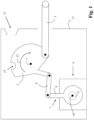
- Fig. 1 shows a first embodiment of a coupling head according to the invention.
- the coupling head has a coupling component 2 rotatably mounted about a main axis of rotation 1 (running perpendicular to the plane of the drawing), which coupling component is designed to interact with a coupling rod 3 of another, in particular identical, coupling head (not shown in this figure).
- the coupling head also has a coupling rod 3 pivotably connected to the coupling component 2, which coupling rod is designed to interact with a coupling component 2 of the other (not shown) coupling head.
- the coupling head has an actuator 4 with an electric drive motor 5 (not explicitly shown in this figure) and with a electric drive motor 5 has a three-shaft gearbox 6 (not explicitly shown in this figure) connected downstream of it.
- the three-shaft gear 6 has an output 7, which is designed as an output lever 8.
- the output lever 8 is coupled to the coupling component 2 by means of a transmission rod 9 in order to release the coupling component 2 from a coupling rotational position and/or to rotate it into a release rotational position by motor drive as needed.
- the transmission rod 9 is pivotally connected to the output lever 8 on the one hand and pivotally connected to the coupling component 2 on the other.
- the rotation axis 10 of the three-shaft gear 6 (running perpendicular to the plane of the drawing) is aligned parallel to the main rotation axis 1 of the coupling component 2.
- the coupling head has a housing 12 that encloses the coupling component 2.
- the housing 12 also encloses the actuator 4.
- the actuator 4 is connected to the housing 12 in a rotationally fixed manner.
- the housing 12 has an insertion opening 13 for the coupling rod 3 (not shown) of another coupling head.
- the free end of the coupling rod 3 of the other coupling head is designed and intended to engage in a hook mouth 14 of the coupling component 2.
- the coupling component 2 is rotated from the coupling rotational position into a release rotational position along the direction of rotation illustrated by arrow 15.
- the coupling head has a freewheel 11 below the output lever 8.
- the freewheel 11 is arranged such that it decouples the three-shaft gear 6 and the electric drive motor 5 from rotation of the coupling component 2 in the opposite direction of rotation (opposite the direction of rotation illustrated by the arrow 15).
- Figure 2 shows a cross-sectional view of a detail of a second embodiment of a coupling head according to the invention.
- the coupling head has an actuator 4 with an electric drive motor 5 and a three-shaft gear 6 connected downstream of the electric drive motor 5.
- the three-shaft gear 6 is designed as a strain wave gear in a pot design.
- the drive motor 5 is arranged axially parallel to the three-shaft gear. This means that the rotational axis 10 of the three-shaft gear 6 is arranged parallel to the rotational axis 16 of the drive motor 5. The rotational axis 10 of the three-shaft gear 6 and the rotational axis 16 of the drive motor 5 are also aligned parallel to the main rotational axis 1 (not shown in this figure) of the coupling component 2 (not shown in this figure).
- a traction drive 17 is provided, which transmits torque from an output component 18 of the drive motor 5, namely an output shaft, to a drive component 19 of the three-shaft transmission 6.
- the traction drive 17 has a belt 20 as a traction mechanism and a pulley 21, which is rotationally fixedly connected to the drive component 19.
- the three-shaft gear 6 has an output 7, which is connected in a rotationally fixed manner to an output lever 8.
- the output lever 8 can be coupled to the coupling component 2 (not shown) by means of a transmission rod 9 (not shown in this figure) in order to release the coupling component 2 from a coupling rotational position and/or to rotate it into a release rotational position by motor drive as needed.
- the transmission rod 9 can be pivotally connected to the output lever 8 on the one hand and pivotally connected to the coupling component 2 on the other. be.
- the three-shaft transmission 6 is designed as a stress wave transmission and has a wave generator 22.
- the wave generator 22 includes an elliptical deformation body 23, which is rotatably mounted within a cup-shaped flexspline 25 by means of a radially flexible wave generator bearing 24.
- the drive component 19 is manufactured in one piece with the deformation body 23.
- the cup-shaped flexspline 25 has an external toothing 26 that meshes with the internal toothing 27 of a circular spline 28 at at least two points.
- the output 7 is rotatably mounted relative to the circular spline 28 by means of a rolling bearing 29. In addition, the output 7 is rotatably mounted relative to the circular spline 28 by means of a further rolling bearing 30.
- Figure 3 shows a cross-sectional view of a detail of a third embodiment of a coupling head according to the invention.
- the coupling head has an actuator 4 with an electric drive motor 5 and a three-shaft gear 6 connected downstream of the electric drive motor 5.
- the three-shaft gear 6 is designed as a strain wave gear in a pot design.
- the drive motor 5 is arranged coaxially with the three-shaft gear. This means that the rotational axis 10 of the three-shaft gear 6 is arranged coaxially with the rotational axis 16 of the drive motor 5.
- the rotational axis 10 of the three-shaft gear 6 and the rotational axis 16 of the drive motor 5 are also aligned parallel to the main rotational axis 1 (not shown in this figure) of the coupling component 2 (not shown in this figure).
- the output component 18 of the drive motor 5 is manufactured in one piece with the drive component 19 of the three-shaft gear 6.
- the three-shaft gear 6 has an output 7, which is non-rotatably connected to an output lever 8.
- the output lever 8 can be coupled to the coupling component 2 (not shown) by means of a transmission rod 9 (not shown in this figure) in order to release the coupling component 2 from a coupling rotational position and/or rotate it into a release rotational position by motor drive as needed.
- the transmission rod 9 can be pivotally connected to the output lever 8 on the one hand and pivotally connected to the coupling component 2 on the other.
- the three-shaft transmission 6 is designed as a stress wave transmission and has a wave generator 22.
- the wave generator 22 includes an elliptical deformation body 23, which is rotatably mounted within a cup-shaped flexspline 25 by means of a radially flexible wave generator bearing 24.
- the drive component 19 is manufactured as a single piece with the deformation body 23, although a multi-part design is also possible, for example with a drive component 19 connected to the deformation body 23 by means of a screw connection or a welded connection.
- the cup-shaped flexspline 25 has external teeth 26 that mesh with the internal teeth 27 of a circular spline 28 at least two points.
- the output 7 is rotatably mounted relative to the circular spline 28 by means of a rolling bearing 29. In addition, the output 7 is rotatably mounted relative to the circular spline 28 by means of a further rolling bearing 30.
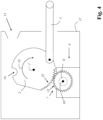
- Figure 4 shows a fourth embodiment of a coupling head according to the invention.
- the coupling head has a coupling component 2 which is rotatably mounted about a main axis of rotation 1 (running perpendicular to the plane of the drawing), which is designed to cooperate with a coupling rod 3 of another, in particular identical, coupling head (not shown in this figure).
- the coupling head also has a coupling rod 3 pivotally connected to the coupling component 2, which is designed to cooperate with a coupling component 2 of the other (not shown) coupling head.
- the coupling head has an actuator 4 with an electric drive motor 5 (not explicitly shown in this figure) and with a three-shaft gear 6 (not explicitly shown in this figure) connected downstream of the electric drive motor 5.
- the three-shaft gear 6 has an output 7 with a first spur gear toothing 31, which meshes with a second spur gear toothing 32 of the coupling component 2.
- the rotation axis 10 of the three-shaft gear 6 (running perpendicular to the plane of the drawing) is aligned parallel to the main rotation axis 1 of the coupling component 2.
- the coupling head has a housing 12 that houses the coupling component 2.
- the housing 12 also houses the actuator 4.
- the actuator 4 is connected to the housing 12 in a rotationally fixed manner.
- the housing 12 has an insertion opening 13 for the (not shown) coupling rod 3 of another coupling head.
- the free end of the coupling rod 3 of the other coupling head is designed and intended to engage in a hook mouth 14 of the coupling component 2.
- the coupling head has a freewheel 11.
- the freewheel 11 is arranged such that it separates the three-shaft gear 6 and the electric drive motor 5 from a rotation of the coupling component 2 with opposite direction of rotation (opposite to the direction of rotation illustrated by arrow 15).
- Figure 5 shows a fifth embodiment of a coupling head according to the invention.
- the coupling head has an actuator 4 with an electric drive motor 5 and a three-shaft gear 6 connected downstream of the electric drive motor 5.
- the three-shaft gear 6 is designed as a strain wave gear in a pot design.
- the drive motor 5 is arranged coaxially with the three-shaft gear. This means that the rotation axis 10 of the three-shaft gear 6 is arranged coaxially with the rotation axis 16 of the drive motor 5.
- the three-shaft gearbox 6 has an output 7 which carries the coupling component 2.
- the rotational axis 10 of the three-shaft gear 6 and the rotational axis 16 of the drive motor 5 are also aligned coaxially with the main rotational axis 1 of the coupling component 2.
- the output component 18 of the drive motor 5 is manufactured in one piece with the drive component 19 of the three-shaft gear 6.
- the three-shaft transmission 6 is designed as a stress wave transmission and has a wave generator 22.
- the wave generator 22 includes an elliptical deformation body 23, which is rotatably mounted within a cup-shaped flexspline 25 by means of a radially flexible wave generator bearing 24.
- the drive component 19 is manufactured in one piece with the deformation body 23.
- the cup-shaped flexspline 25 has an external toothing 26, which meshes with the internal toothing 27 of a Circular splines 28 mesh at least two points.
- the output 7 is rotatably mounted relative to the circular spline 28 by means of a rolling bearing 29. Furthermore, the output 7 is rotatably mounted relative to the circular spline 28 by means of a further rolling bearing 30.
- the rotational bearing of the output 7 realized by means of the rolling bearing 29 is simultaneously also the pivot bearing of the coupling component 2.
Landscapes
- Engineering & Computer Science (AREA)
- Mechanical Engineering (AREA)
- Connection Of Motors, Electrical Generators, Mechanical Devices, And The Like (AREA)
- Retarders (AREA)
Description
- Die Erfindung betrifft einen Kupplungskopf für eine automatische Kupplung, insbesondere für eine Scharfenbergkupplung, wobei der Kupplungskopf ein um eine Hauptdrehachse drehbar gelagertes Koppelbauteil aufweist, das dazu ausgebildet ist, mit einer Koppelstange eines anderen, insbesondere gleichen, Kupplungskopfs zusammenzuwirken, und wobei der Kupplungskopf eine schwenkbeweglich mit dem Koppelbauteil verbundene Koppelstange (3) aufweist, die dazu ausgebildet ist, mit einem Koppelbauteil des anderen Kupplungskopfs zusammenzuwirken.
- Aus
DE 149727 A ist eine Mittelpufferkupplung, die auch als Scharfenbergkupplung bezeichnet wird, bekannt. Die Scharfenbergkupplung dient dazu, zwei Schienenfahrzeuge automatisch aneinander zu kuppeln. Sie besteht aus zwei gleichen Kuppelköpfen, die automatisch miteinander verkoppelt werden können, indem sie bis zum Erreichen eines Anschlages einander angenähert werden. Jeder der beiden Kuppelköpfe beinhaltet einen um eine Hauptdrehachse drehbar gelagertes Koppelbauteil, das zumeist als eine Hakenscheibe ausgebildet ist. An dem drehbar gelagerten Koppelbauteil ist das Ende einer Koppelstange, insbesondere einer Ösenstange, mittels eines Drehgelenks schwenkbeweglich befestigt, wobei die Schwenkachse des Drehgelenks parallel zu der Hauptdrehachse des Koppelbauteils ausgerichtet ist. Beispielsweise kann jede der Ösenstangen an ihrem freien Ende einen sog. Ösenzylinder aufweisen, wobei jedes der Koppelbauteile außerdem bezogen auf die Hauptdrehachse dem Drehgelenk gegenüberliegend ein Hakenmaul zur Aufnahme des Ösenzylinders der jeweils anderen Ösenstange aufweist. Wenn das Koppelbauteil als Hakenscheibe ausgebildet ist, befindet sich das Hakenmaul zumeist an ihrem Umfangsrand. Im Koppelzustand greifen die beiden Ösenzylinder in die Hakenmäuler ein, wobei sich die Koppelbauteile in einer Verriegelungs-Drehstellung befinden. Zum Lösen des Kopplungszustandes müssen die drehbar gelagerten Koppelbauteile jeweils um ihre Hauptdrehachse bis zum Erreichen einer Freigabe-Drehstellung gedreht werden, bis die Ösenzylinder aus den Hakenmäulern gelangen können. - Aus
DE 102021133227 A1 ist eine automatische Zugkupplung bekannt. Die Zugkupplung weist einen Kupplungskopf, der ein Kupplungskopfgehäuse und einen Kuppelverschluss mit Arretierung umfasst, auf. Der Kuppelverschluss ist als Drehverschluss mit einer Kuppelöse und einem Herzstück ausgeführt, wobei das Herzstück um eine Hauptachse zwischen einer gekuppelten Stellung und einer entkuppelten Stellung verdrehbar ist und wobei die Kuppelöse mit einem ersten Ende verdrehbar um eine Kuppelösenachse am Herzstück angeschlossen ist. Das Herzstück weist ein Maul auf, das zur Aufnahme eines zweiten Endes einer Kuppelöse eines gegengleichen Kupplungskopfes angeordnet ist. Es ist eine elektrisch betätigte Entkuppeleinrichtung vorhanden, die einen Elektromotor umfasst, der über eine Triebverbindung zumindest mittelbar am Herzstück angeschlossen ist, um das Herzstück aus der gekuppelten Stellung in die entkuppelte Stellung zu verdrehen. Der Elektromotor weist eine Abtriebsdrehachse auf, die zumindest im Wesentlichen radial zur Hauptachse angeordnet ist. Zwischen dem Elektromotor und dem Herzstück ist ein Winkelgetriebe vorgesehen, das ein Antriebsritzel und ein mit diesem in verzahnten Eingriff stehendes Kronenrad oder Kegelrad gebildet ist, dessen Drehachse parallel zur Hauptachse ist. Eine ähnliche Zugkupplung ist ausDE 10 2021 132991 A1 bekannt. - Es ist die Aufgabe der vorliegenden Erfindung, einen Kupplungskopf anzugeben, der bei robustem und kompaktem Aufbau ein zuverlässiges Lösen eines Koppelzustandes zweier Kuppelköpfe ermöglicht.
- Die Aufgabe wird durch einen Kupplungskopf der eingangs genannten Art gelöst, der dadurch gekennzeichnet ist, dass der Kupplungskopf einen Aktuator mit einem elektrischen Antriebsmotor und mit einem dem elektrischen Antriebsmotor triebtechnisch nachgeschalteten Dreiwellengetriebe aufweist, dessen Abtrieb an das Koppelbauteil angekoppelt ist, um das Koppelbauteil bei Bedarf motorisch angetrieben aus einer Koppel-Drehstellung zu lösen und/oder in eine Freigabe-Drehstellung zu drehen, wobei die Rotationsachse des Rotors des Antriebsmotors und/oder die Rotationsachse des Dreiwellengetriebes parallel oder koaxial zu der Hauptdrehachse des Koppelbauteils ausgerichtet ist bzw. sind.
- Das Koppelbauteil kann insbesondere als Hakenscheibe ausgebildet sein. Es ist jedoch auch möglich, dass das Koppelbauteil anders ausgebildet ist. Ganz allgemein kann das Koppelbauteil ein drehbar gelagertes Bauteil sein, an dem eine Koppelstange gelenkig angeordnet ist und das ein Ankoppelelement, insbesondere eine Aufnahme für ein Gegenankoppelelement, beispielsweise einen Ösenzylinder, der Koppelstange eines anderen Kupplungskopfes aufweist.
- Bei einer besonderen Ausführung ist der Abtrieb des Dreiwellengetriebes über eine Hebelanordnung an das Koppelbauteil angekoppelt. Eine solche Ausführung hat den besonderen Vorteil, dass sie einfach und besonders robust ausgebildet werden kann. Beispielsweise kann die Hebelanordnung einen Übertragungsstab aufweisen, der einerseits schwenkbeweglich mit dem Abtrieb des Dreiwellengetriebes und andererseits schwenkbeweglich mit dem Koppelbauteil verbunden ist. Der Abtrieb des Dreiwellengetriebes kann einen Abtriebshebel aufweisen, insbesondere einen Abtriebshebel, der gelenkig mit dem Übertragungsstab verbunden ist. Beispielsweise wenn das Dreiwellengetriebe als Spannungswellengetriebe ausgebildet ist, kann beispielsweise ein Flexspline des Spannungswellengetriebes als Abtrieb fungieren und zur Ankopplung an das Koppelbauteil den Abtriebshebel aufweisen.
- Alternativ kann der Abtrieb des Dreiwellengetriebes beispielsweise über eine Stirnradverzahnung an das Koppelbauteil angekoppelt sein. Beispielsweise kann eine Abtriebswelle des Dreiwellengetriebes eine Außenverzahnung aufweisen, die mit einer Außenverzahnung des Koppelbauteils in Zahneingriff steht. Beispielsweise wenn das Dreiwellengetriebe als Spannungswellengetriebe ausgebildet ist, kann vorteilhaft ein Circularspline oder ein Dynamicspline des Spannungswellengetriebes als Abtrieb fungieren und zur Ankopplung an das Koppelbauteil die Außenverzahnung aufweisen.
- Bei einer ganz besonderen Ausführung trägt der Abtrieb des Dreiwellengetriebes das Koppelbauteil. Eine solche Ausführung kommt ohne ein Übertragungsgetriebe aus, das zwischen den Abtrieb des Dreiwellengetriebes und das Koppelbauteil geschaltet ist. Insbesondere hierbei kann vorteilhaft vorgesehen sein, dass eine Rotationslagerung des Abtriebs des Dreiwellengetriebes als Drehlagerung für das Koppelbauteil fungiert.
- Unter einem Dreiwellengetriebe wird insbesondere ein Getriebe verstanden, das drei Wellen aufweist, von denen jede entweder als eine Antriebswelle, eine Abtriebswelle oder als eine (beispielsweise relativ zu einem Gestell oder einem Gehäuse des Dreiwellengetriebes) festgehaltene Welle fungiert. Beispielsweise kann das Dreiwellengetriebe als ein Spannungswellengetriebe ausgebildet sein, das einen Circularspline, einen Flexspline und einen Wellengenerator aufweist, wobei das Spannungswellengetriebe beispielsweise in der Weise betrieben werden kann, dass der Wellengenerator als Antriebswelle, der Flexspline als Abtriebswelle und der Circularspline als (beispielsweise gehäuse- oder gestellfeste) festgehaltene Welle fungiert. Beispielsweise kann das Dreiwellengetriebe alternativ als Planetengetriebe ausgebildet sein, bei dem beispielsweise das Sonnenrad als Antriebswelle und das Hohlrad als Abtriebswelle fungiert, während der Planetenträger als (beispielsweise gehäuse- oder gestellfeste) festgehaltene Welle fungiert. Beispielsweise kann ein Dreiwellengetriebe auch als Summiergetriebe betrieben werden, wobei zwei der Wellen als Antriebswellen und eine der drei Wellen als Abtriebswelle fungiert. Beispielsweise kann ein Dreiwellengetriebe auch als Verteilergetriebe betrieben werden, wobei zwei der Wellen als Abtriebswellen und eine der drei Wellen als Antriebswelle fungiert. Ein Betrieb des Dreiwellengetriebes als Summiergetriebe oder als Verteilergetriebe spielt im Rahmen der vorliegenden Erfindung jedoch keine oder allenfalls eine untergeordnete Rolle. Im Gegensatz zu einem Dreiwellengetriebe hat ein Zweiwellengetriebe eine als Antriebswelle und eine als Abtriebswelle fungierende Welle, wobei es keine dritte Welle gibt, die mit den beiden anderen Wellen verkoppelt ist und die als Antriebswelle, Abtriebswelle oder festgehaltene Welle fungiert. Beispielsweise sind Kegelradgetriebe, auch Winkelgetriebe genannt, Zweiwellengetriebe mit einer einzigen Antriebswelle und einer einzigen Abtriebswelle, die zumeist um 90° zueinander versetzt sind.
- Bei einer ganz besonders vorteilhaften Ausführung weist der Kupplungskopf einen Freilauf auf. Der Freilauf kann vorteilhaft derart angeordnet sein, dass er den Aktuator bei einem Koppelvorgang von einer Drehung des Koppelbauteils entkoppelt. Insbesondere kann der Freilauf derart ausgebildet und angeordnet sein, dass das Getriebe durch einen Koppelvorgang nicht zurückgetrieben wird und/oder dass der Rotor des Antriebsmotors durch einen Koppelvorgang nicht gedreht wird. Eine solche Ausführung ist ganz besonders vorteilhaft, weil der Aktuator mittels des Freilaufs von der Hakenscheibe entkoppelt ist und das Koppelbauteil bei Bedarf, insbesondere vor oder während eines Kopplungsvorganges, ungehindert (beispielsweise angetrieben durch eine Federvorrichtung oder durch die in den Kupplungskopf eintauchende Koppelstange des anderen Kupplungskopfs) in die Verriegelungs-Drehstellung gedreht werden kann. Auf diese Weise wird vorteilhaft erreicht, dass der Aktuator für ein Überführen des Koppelbauteils in die Koppel-Drehstellung nicht zurückgetrieben werden muss. Dies schont den Aktuator und erleichtert den Koppelvorgang.
- Insbesondere kann der Abtrieb des Dreiwellengetriebes über den Freilauf an das Koppelbauteil angekoppelt sein. Der Freilauf kann zur Entkopplung des Antriebsmotors und des Dreiwellengetriebes triebtechnisch zwischen den Abtrieb des Dreiwellengetriebes und das Koppelbauteil geschaltet sein. Alternativ ist es beispielsweise auch möglich, dass der Abtrieb des Dreiwellengetriebes den Freilauf beinhaltet.
- Der Freilauf kann alternativ auch derart angeordnet sein, dass er bei einem Überführen des Koppelbauteils von der Freigabe-Drehstellung in die Koppel-Drehstellung (beispielsweise angetrieben durch eine Federvorrichtung oder durch die in den Kupplungskopf eintauchende Koppelstange des anderen Kupplungskopfs) den elektrischen Antriebsmotor jedoch nicht das Dreiwellengetriebe von einer Drehbewegung des Koppelbauteils entkoppelt. Bei einer solchen Ausführung wird durch das sich in die Koppel-Drehstellung drehende Koppelbauteil lediglich das Dreiwellengetriebe, jedoch nicht der Antriebsmotor zurückgetrieben. Für eine solche Entkopplung des Antriebsmotors kann der Freilauf triebtechnisch zwischen den elektrischen Antriebsmotor und das Dreiwellengetriebe geschaltet sein.
- Es ist jedoch durchaus auch möglich den Aktuator derart an das Koppelbauteil anzukoppeln, dass bei einem Koppelvorgang sowohl der Antriebsmotor aus auch das Dreiwellengetriebe zurückgetrieben werden. Eine solche Ausführung ist besonders einfach und kommt mit wenigen Bauteilen aus.
- Bei einer besonders kompakt ausführbaren Ausführung ist der Antriebsmotor koaxial zu dem Dreiwellengetriebe angeordnet. Insbesondere kann der Antriebsmotor eine Abtriebswelle aufweisen, die drehstarr mit einer Antriebswelle des Dreiwellengetriebes verbunden ist. Alternativ kann beispielsweise auch vorgesehen sein, dass eine Abtriebswelle des Antriebsmotors und eine Antriebswelle des Dreiwellengetriebes gemeinsam einstückig aus demselben Stück Rohmaterial hergestellt sind.
- Bei einer anderen Ausführung ist der Antriebsmotor achsparallel zu dem Dreiwellengetriebe angeordnet. Insbesondere kann hierbei ein Zugmitteltrieb, insbesondere ein Riementrieb, vorhanden sein, der ein Drehmoment von einem Abtriebsbauteil des Antriebsmotors, beispielsweise einer Abtriebswelle, zu einem Antriebsbauteil des Dreiwellengetriebes überträgt. Der Zugmitteltrieb kann ein von i = 1 verschiedenes Übersetzungsverhältnis aufweisen, so dass sich das Gesamtübersetzungsverhältnis aus der Reihenschaltung der Übersetzungsverhältnisse des Dreiwellengetriebes und des Zugmitteltriebs errechnet.
- Vorzugsweise weist der Kupplungskopf ein Gehäuse auf, das wenigstens das Koppelbauteil einhaust. Bei einer besonders robusten Ausführung haust das Gehäuse auch den Aktuator zumindest teilweise, insbesondere vollständig, ein. Auf diese Weise ist der Aktuator besonders gut gegen Beschädigung und Verschmutzung geschützt. Es ist allerdings durchaus auch möglich, den gesamten Aktuator oder wenigstens einen Teil des Aktuators außerhalb des Gehäuses anzuordnen. Beispielsweise kann der Antriebsmotor außerhalb des Gehäuses angeordnet sein, während das Dreiwellengetriebe innerhalb des Gehäuses angeordnet ist. Eine solche Ausführung hat den besonderen Vorteil, dass der Antriebsmotor, beispielsweise für Wartungsarbeiten, einfach zugänglich ist und dass elektrische Leitungen zum Versorgen des Antriebsmotors mit Energie und/oder zum Steuern des Antriebsmotors nicht in das Gehäuse des Kupplungskopfes hinein verlegt werden müssen.
- Bei einer vorteilhaften Ausführung ist wenigstens ein Bauteil des Aktuators drehfest mit dem Gehäuse verbunden. Insbesondere kann vorteilhaft vorgesehen sein, dass wenigstens ein Bauteil des Aktuators, insbesondere unmittelbar, drehfest an dem Gehäuse befestigt ist. Eine solche Ausführung hat den Vorteil, dass das von dem Aktuator erzeugte Drehmoment über das Gehäuse abgestützt wird.
- Hierbei kann das Dreiwellengetriebe in der Weise aufgebaut sein, dass eine der Wellen des Dreiwellengetriebes relativ zu einer anderen Welle des Dreiwellengetriebes rotierbar gelagert ist. Bei dem Getriebe kann es sich beispielsweise um ein Spannungswellengetriebe handeln, bei dem mittels des Wälzlagers ein Circularspline relativ zu einem Flexspline oder relativ zu einer mit einem Wellengenerator verbundenen Antriebswelle rotierbar gelagert ist. Beispielsweise kann das Spannungswellengetriebe als Ringgetriebe ausgebildet sein. Hierbei kann beispielsweise der Circularspline relativ zu einem Dynamicspline mittels des Wälzlagers rotierbar gelagert sein. Das Wälzlager kann insbesondere ein Abtriebslager des Dreiwellengetriebes sein.
- Das Dreiwellengetriebe kann vorteilhaft eine als Hohlwelle ausgebildete Antriebswelle aufweisen. Dies ermöglicht es im Hinblick auf eine kompakte Bauweise beispielsweise, dass eine Abtriebswelle des Dreiwellengetriebes durch die Antriebswelle hindurch verläuft.
- Das Dreiwellengetriebe kann vorteilhaft eine Oldhamkupplung aufweisen. Insbesondere kann der Antriebsmotor über die Oldhamkupplung triebtechnisch an das Dreiwellengetriebe angekoppelt sein. Die Oldhamkupplung kann dazu dienen, einen Achsversatz zu kompensieren und/oder das Dreiwellengetriebe und den Antriebsmotor hinsichtlich radialer Bewegungen voneinander zu entkoppeln.
- Das Dreiwellengetriebe kann, wie bereits erwähnt, ein Spannungswellengetriebe sein. Das Spannungswellengetriebe kann insbesondere als Topfgetriebe oder als Hutgetriebe ausgebildet sein.
- Alternativ kann das Spannungswellengetriebe als Ringgetriebe ausgebildet sein. Beispielsweise kann vorteilhaft vorgesehen sein, dass ein Circularspline oder ein Dynamicspline des Spannungswellengetriebes den Abtrieb bildet oder Teil des Abtriebs ist. Alternativ kann ein Flexspline des Spannungswellengetriebes den Abtrieb bilden oder Teil des Abtriebs sein.
- Bei dem Getriebe kann es sich alternativ in vorteilhafter Weise beispielsweise um ein Zykloidgetriebe oder ein Planetengetriebe handeln.
- Von ganz besonderem Vorteil ist eine automatische Kupplung, insbesondere Scharfenbergkupplung, die zwei, insbesondere gleiche, miteinander koppelbare, erfindungsgemäße Kuppelköpfe aufweist. Insbesondere kann vorteilhaft vorgesehen sein, dass ein Koppelzustand der Kuppelköpfe mittels des Aktuators ferngesteuert lösbar ist. Bei einer vorteilhaften Ausführung wird das Koppelbauteil wenigstens einer der Kuppelköpfe zum Lösen der Kuppelverbindung in die Freigabe-Drehstellung gedreht, in der die Koppelstangen von den Koppelbauteilen freigegeben sind, so dass die Kuppelköpfe räumlich voneinander getrennt werden können.
- Von ganz besonderem Vorteil ist ein Fahrzeug, insbesondere ein Schienenfahrzeug, beispielsweise ein Waggon oder eine Lokomotive, das wenigstens einen erfindungsgemäßen Kupplungskopf, vorzugsweise zwei erfindungsgemäße Kupplungsköpfe, aufweist.
- Von ganz besonderem Vorteil ist außerdem ein Zug von mehreren Fahrzeugen, insbesondere Schienenfahrzeugen, wobei unmittelbar benachbarte Fahrzeuge jeweils mittels einer erfindungsgemäßen automatischen Kupplung miteinander verkoppelt sind.
- In der Zeichnung ist der Erfindungsgegenstand beispielhaft und schematisch dargestellt und wird anhand der Figuren nachfolgend beschrieben, wobei gleiche oder gleich wirkende Elemente auch in unterschiedlichen Ausführungsbeispielen zumeist mit denselben Bezugszeichen versehen sind. Dabei zeigen:
- Fig. 1
- ein erstes Ausführungsbeispiel eines erfindungsgemäßen Kupplungskopfs,
- Fig. 2
- eine Querschnittsdarstellung eines Details eines zweiten Ausführungsbeispiels eines erfindungsgemäßen Kupplungskopfs,
- Fig. 3
- eine Querschnittsdarstellung eines Details eines dritten Ausführungsbeispiels eines erfindungsgemäßen Kupplungskopfs,
- Fig. 4
- ein viertes Ausführungsbeispiel eines erfindungsgemäßen Kupplungskopfs, und
- Fig. 5
- ein fünftes Ausführungsbeispiel eines erfindungsgemäßen Kupplungskopfs.
-
Fig. 1 zeigt ein erstes Ausführungsbeispiel eines erfindungsgemäßen Kupplungskopfs. Der Kupplungskopf weist ein um eine (senkrecht zur Zeichenebene verlaufende) Hauptdrehachse 1 drehbar gelagertes Koppelbauteil 2 auf, das dazu ausgebildet ist, mit einer Koppelstange 3 eines (in dieser Figur nicht dargestellten) anderen, insbesondere gleichen, Kupplungskopfs zusammenzuwirken. Der Kupplungskopf weist außerdem eine schwenkbeweglich mit dem Koppelbauteil 2 verbundene Koppelstange 3 auf, die dazu ausgebildet ist, mit einem Koppelbauteil 2 des anderen (nicht dargestellten) Kupplungskopfs zusammenzuwirken. - Der Kupplungskopf weist einen Aktuator 4 mit einem (in dieser Figur nicht explizit dargestellten) elektrischen Antriebsmotor 5 und mit einem dem elektrischen Antriebsmotor 5 triebtechnisch nachgeschalteten (in dieser Figur nicht explizit dargestellten) Dreiwellengetriebe 6 auf.
- Das Dreiwellengetriebe 6 weist einen Abtrieb 7 auf, der als Abtriebshebel 8 ausgebildet ist. Der Abtriebshebel 8 ist mittels eines Übertragungsstabes 9 an das Koppelbauteil 2 angekoppelt, um das Koppelbauteil 2 bei Bedarf motorisch angetrieben aus einer Koppel-Drehstellung zu lösen und/oder in eine Freigabe-Drehstellung zu drehen. Hierzu ist der Übertragungsstab 9 einerseits schwenkbeweglich mit dem Abtriebshebel 8 und andererseits schwenkbeweglich mit dem Koppelbauteil 2 verbunden.
- Die (senkrecht zur Zeichenebene verlaufende) Rotationsachse 10 des Dreiwellengetriebes 6 ist parallel zu der Hauptdrehachse 1 des Koppelbauteils 2 ausgerichtet.
- Der Kupplungskopf weist ein Gehäuse 12 auf, das das Koppelbauteil 2 einhaust. Das Gehäuse 12 haust auch den Aktuator 4 ein. Der Aktuator 4 ist drehfest mit dem Gehäuse 12 verbunden. Das Gehäuse 12 weist eine Einführöffnung 13 für die (nicht dargestellte) Koppelstange 3 eines anderen Kupplungskopfs auf. Das freie Ende der Koppelstange 3 des anderen Kupplungskopfs ist dazu ausgebildet und bestimmt, in ein Hakenmaul 14 des Koppelbauteils 2 einzugreifen. Zum Lösen eines Verriegelungszustandes wird das Koppelbauteil 2 entlang der durch den Pfeil 15 illustrierten Drehrichtung aus der Koppel-Drehstellung in eine Freigabe-Drehstellung gedreht.
- Der Kupplungskopf weist aus der Betrachtungsrichtung gesehen unterhalb des Abtriebshebels 8 einen Freilauf 11 auf. Der Freilauf 11 ist derart angeordnet, dass er das Dreiwellengetriebe 6 und den elektrischen Antriebsmotor 5 von einer Drehung des Koppelbauteils 2 mit entgegengesetzter Drehrichtung (entgegen der durch den Pfeil 15 illustrierten Drehrichtung) entkoppelt.
-
Figur 2 zeigt eine Querschnittsdarstellung eines Details eines zweiten Ausführungsbeispiels eines erfindungsgemäßen Kupplungskopfs. - Der Kupplungskopf weist einen Aktuator 4 mit einem elektrischen Antriebsmotor 5 und mit einem dem elektrischen Antriebsmotor 5 triebtechnisch nachgeschalteten Dreiwellengetriebe 6 auf. Das Dreiwellengetriebe 6 ist als Spannungswellengetriebe in Topfbauweise ausgebildet.
- Der Antriebsmotor 5 ist achsparallel zu dem Dreiwellengetriebe angeordnet. Dies bedeutet, dass die Rotationsachse 10 des Dreiwellengetriebes 6 parallel zu der Rotationsachse 16 des Antriebsmotors 5 angeordnet ist. Die Rotationsachse 10 des Dreiwellengetriebes 6 und die Rotationsachse 16 des Antriebsmotors 5 sind außerdem parallel zu der (in dieser Figur nicht eingezeichneten) Hauptdrehachse 1 des (in dieser Figur nicht eingezeichneten) Koppelbauteils 2 ausgerichtet.
- Es ist ein Zugmitteltrieb 17 vorhanden, der ein Drehmoment von einem Abtriebsbauteil 18 des Antriebsmotors 5, nämlich einer Abtriebswelle, zu einem Antriebsbauteil 19 des Dreiwellengetriebes 6 überträgt. Der Zugmitteltrieb 17 weist einen Riemen 20 als Zugmittel sowie eine Riemenscheibe 21 auf, die mit dem Antriebsbauteil 19 drehfest verbunden ist.
- Das Dreiwellengetriebe 6 weist einen Abtrieb 7 auf, der drehfest mit einem Abtriebshebel 8 verbunden ist. Der Abtriebshebel 8 kann mittels eines (in dieser Figur nicht dargestellten) Übertragungsstabes 9 an das (nicht dargestellte) Koppelbauteil 2 angekoppelt sein, um das Koppelbauteil 2 bei Bedarf motorisch angetrieben aus einer Koppel-Drehstellung zu lösen und/oder in eine Freigabe-Drehstellung zu drehen. Hierzu kann der Übertragungsstab 9 einerseits schwenkbeweglich mit dem Abtriebshebel 8 und andererseits schwenkbeweglich mit dem Koppelbauteil 2 verbunden sein.
- Das Dreiwellengetriebe 6 ist als Spannungswellengetriebe ausgebildet und weist einen Wellengenerator 22 auf. Der Wellengenerator 22 beinhaltet einen elliptischen Verformungskörper 23, der mittels eines radialflexiblen Wellengeneratorlagers 24 rotierbar innerhalb eines topfförmigen Flexsplines 25 gelagert ist. Das Antriebsbauteil 19 ist gemeinsam einstückig mit dem Verformungskörper 23 hergestellt. Der topfförmige Flexspline 25 weist eine Außenverzahnung 26 auf, die mit der Innenverzahnung 27 eines Circularsplines 28 an wenigstens zwei Stellen in Zahneingriff steht. Der Abtrieb 7 ist mittels eines Wälzlagers 29 relativ zu dem Circularspline 28 rotierbar gelagert. Außerdem ist der Abtrieb 7 mittels eines weiteren Wälzlagers 30 relativ zu dem Circularspline 28 rotierbar gelagert.
-
Figur 3 zeigt eine Querschnittsdarstellung eines Details eines dritten Ausführungsbeispiels eines erfindungsgemäßen Kupplungskopfs. - Der Kupplungskopf weist einen Aktuator 4 mit einem elektrischen Antriebsmotor 5 und mit einem dem elektrischen Antriebsmotor 5 triebtechnisch nachgeschalteten Dreiwellengetriebe 6 auf. Das Dreiwellengetriebe 6 ist als Spannungswellengetriebe in Topfbauweise ausgebildet.
- Der Antriebsmotor 5 ist koaxial zu dem Dreiwellengetriebe angeordnet. Dies bedeutet, dass die Rotationsachse 10 des Dreiwellengetriebes 6 koaxial zu der Rotationsachse 16 des Antriebsmotors 5 angeordnet ist. Die Rotationsachse 10 des Dreiwellengetriebes 6 und die Rotationsachse 16 des Antriebsmotors 5 sind außerdem parallel zu der (in dieser Figur nicht eingezeichneten) Hauptdrehachse 1 des (in dieser Figur nicht eingezeichneten) Koppelbauteils 2 ausgerichtet. Das Abtriebsbauteil 18 des Antriebsmotors 5 ist gemeinsam einstückig mit dem Antriebsbauteil 19 des Dreiwellengetriebes 6 hergestellt.
- Das Dreiwellengetriebe 6 weist einen Abtrieb 7 auf, der drehfest mit einem Abtriebshebel 8 verbunden ist. Der Abtriebshebel 8 kann mittels eines (in dieser Figur nicht dargestellten) Übertragungsstabes 9 an das (nicht dargestellte) Koppelbauteil 2 angekoppelt sein, um das Koppelbauteil 2 bei Bedarf motorisch angetrieben aus einer Koppel-Drehstellung zu lösen und/oder in eine Freigabe-Drehstellung zu drehen. Hierzu kann der Übertragungsstab 9 einerseits schwenkbeweglich mit dem Abtriebshebel 8 und andererseits schwenkbeweglich mit dem Koppelbauteil 2 verbunden sein.
- Das Dreiwellengetriebe 6 ist als Spannungswellengetriebe ausgebildet und weist einen Wellengenerator 22 auf. Der Wellengenerator 22 beinhaltet einen elliptischen Verformungskörper 23, der mittels eines radialflexiblen Wellengeneratorlagers 24 rotierbar innerhalb eines topfförmigen Flexsplines 25 gelagert ist. Das Antriebsbauteil 19 ist bei diesem Ausführungsbeispiel gemeinsam einstückig mit dem Verformungskörper 23 hergestellt, wobei jedoch auch eine mehrteilige Ausführung, beispielsweise mit einem Antriebsbauteil 19 das mittels einer Schraubverbindung oder einer Schweißverbindung mit dem Verformungskörper 23 verbunden ist, möglich ist. Der topfförmige Flexspline 25 weist eine Außenverzahnung 26 auf, die mit der Innenverzahnung 27 eines Circularsplines 28 an wenigstens zwei Stellen in Zahneingriff steht. Der Abtrieb 7 ist mittels eines Wälzlagers 29 relativ zu dem Circularspline 28 rotierbar gelagert. Außerdem ist der Abtrieb 7 mittels eines weiteren Wälzlagers 30 relativ zu dem Circularspline 28 rotierbar gelagert.
-
Figur 4 zeigt ein viertes Ausführungsbeispiel eines erfindungsgemäßen Kupplungskopfs. - Der Kupplungskopf weist ein um eine (senkrecht zur Zeichenebene verlaufende) Hauptdrehachse 1 drehbar gelagertes Koppelbauteil 2 auf, das dazu ausgebildet ist, mit einer Koppelstange 3 eines (in dieser Figur nicht dargestellten) anderen, insbesondere gleichen, Kupplungskopfs zusammenzuwirken. Der Kupplungskopf weist außerdem eine schwenkbeweglich mit dem Koppelbauteil 2 verbundene Koppelstange 3 auf, die dazu ausgebildet ist, mit einem Koppelbauteil 2 des anderen (nicht dargestellten) Kupplungskopfs zusammenzuwirken.
- Der Kupplungskopf weist einen Aktuator 4 mit einem (in dieser Figur nicht explizit dargestellten) elektrischen Antriebsmotor 5 und mit einem dem elektrischen Antriebsmotor 5 triebtechnisch nachgeschalteten (in dieser Figur nicht explizit dargestellten) Dreiwellengetriebe 6 auf.
- Das Dreiwellengetriebe 6 weist einen Abtrieb 7 mit einer ersten Stirnradverzahnung 31 auf, die mit einer zweiten Stirnradverzahnung 32 des Koppelbauteils 2 in Zahneingriff steht.
- Die (senkrecht zur Zeichenebene verlaufende) Rotationsachse 10 des Dreiwellengetriebes 6 ist parallel zu der Hauptdrehachse 1 des Koppelbauteils 2 ausgerichtet.
- Der Kupplungskopf weist ein Gehäuse 12 auf, das das Koppelbauteil 2 einhaust. Das Gehäuse 12 haust auch den Aktuator 4 ein. Der Aktuator 4 ist drehfest mit dem Gehäuse 12 verbunden. Das Gehäuse 12 weist eine Einführöffnung 13 für die (nicht dargestellte) Koppelstange 3 eines anderen Kupplungskopfs auf. Das freie Ende der Koppelstange 3 des anderen Kupplungskopfs ist dazu ausgebildet und bestimmt, in ein Hakenmaul 14 des Koppelbauteils 2 einzugreifen. Zum Lösen eines Verriegelungszustandes wird das Koppelbauteil 2 entlang der durch den Pfeil 15 illustrierten Drehrichtung aus der Koppel-Drehstellung in eine Freigabe-Drehstellung gedreht. Der Kupplungskopf weist einen Freilauf 11 auf. Der Freilauf 11 ist derart angeordnet, dass er das Dreiwellengetriebe 6 und den elektrischen Antriebsmotor 5 von einer Drehung des Koppelbauteils 2 mit entgegengesetzter Drehrichtung (entgegen der durch den Pfeil 15 illustrierten Drehrichtung) entkoppelt.
-
Figur 5 zeigt ein fünftes Ausführungsbeispiel eines erfindungsgemäßen Kupplungskopfs. - Der Kupplungskopf weist einen Aktuator 4 mit einem elektrischen Antriebsmotor 5 und mit einem dem elektrischen Antriebsmotor 5 triebtechnisch nachgeschalteten Dreiwellengetriebe 6 auf. Das Dreiwellengetriebe 6 ist als Spannungswellengetriebe in Topfbauweise ausgebildet.
- Der Antriebsmotor 5 ist koaxial zu dem Dreiwellengetriebe angeordnet. Dies bedeutet, dass die Rotationsachse 10 des Dreiwellengetriebes 6 koaxial zu der Rotationsachse 16 des Antriebsmotors 5 angeordnet ist.
- Das Dreiwellengetriebe 6 weist einen Abtrieb 7 auf, der das Koppelbauteil 2 trägt.
- Die Rotationsachse 10 des Dreiwellengetriebes 6 und die Rotationsachse 16 des Antriebsmotors 5 sind außerdem koaxial zu der Hauptdrehachse 1 des Koppelbauteils 2 ausgerichtet. Das Abtriebsbauteil 18 des Antriebsmotors 5 ist gemeinsam einstückig mit dem Antriebsbauteil 19 des Dreiwellengetriebes 6 hergestellt.
- Das Dreiwellengetriebe 6 ist als Spannungswellengetriebe ausgebildet und weist einen Wellengenerator 22 auf. Der Wellengenerator 22 beinhaltet einen elliptischen Verformungskörper 23, der mittels eines radialflexiblen Wellengeneratorlagers 24 rotierbar innerhalb eines topfförmigen Flexsplines 25 gelagert ist. Das Antriebsbauteil 19 ist gemeinsam einstückig mit dem Verformungskörper 23 hergestellt. Der topfförmige Flexspline 25 weist eine Außenverzahnung 26 auf, die mit der Innenverzahnung 27 eines Circularsplines 28 an wenigstens zwei Stellen in Zahneingriff steht. Der Abtrieb 7 ist mittels eines Wälzlagers 29 relativ zu dem Circularspline 28 rotierbar gelagert. Außerdem ist der Abtrieb 7 mittels eines weiteren Wälzlagers 30 relativ zu dem Circularspline 28 rotierbar gelagert. Die mittels des Wälzlagers 29 realisierte Rotationslagerung des Abtriebs 7 ist gleichzeitig auch die Drehlagerung des Koppelbauteils 2.
-
- 1
- Hauptdrehachse
- 2
- Koppelbauteil
- 3
- Koppelstange
- 4
- Aktuator
- 5
- Antriebsmotor
- 6
- Dreiwellengetriebe
- 7
- Abtrieb
- 8
- Abtriebshebel
- 9
- Übertragungsstab
- 10
- Rotationsachse
- 11
- Freilauf
- 12
- Gehäuse
- 13
- Einführöffnung
- 14
- Hakenmaul
- 15
- Pfeil
- 16
- Rotationsachse
- 17
- Zugmitteltrieb
- 18
- Abtriebsbauteil
- 19
- Antriebsbauteil
- 20
- Riemen
- 21
- Riemenscheibe
- 22
- Wellengenerator
- 23
- elliptischer Verformungskörper
- 24
- Wellengeneratorlager
- 25
- Flexspline
- 26
- Außenverzahnung
- 27
- Innenverzahnung
- 28
- Circularspline
- 29
- Wälzlager
- 30
- weiteres Wälzlager
- 31
- erste Stirnradverzahnung
- 32
- zweite Stirnradverzahnung
Claims (15)
- Kupplungskopf für eine automatische Kupplung, insbesondere für eine Scharfenbergkupplung, wobei der Kupplungskopf ein um eine Hauptdrehachse (1) drehbar gelagertes Koppelbauteil (2) aufweist, das dazu ausgebildet ist, mit einer Koppelstange (3) eines anderen, insbesondere gleichen, Kupplungskopfs zusammenzuwirken, und wobei der Kupplungskopf eine schwenkbeweglich mit dem Koppelbauteil (2) verbundene Koppelstange (3) aufweist, die dazu ausgebildet ist, mit einem Koppelbauteil (2) des anderen Kupplungskopfs zusammenzuwirken, wobei der Kupplungskopf einen Aktuator (4) mit einem elektrischen Antriebsmotor (5) aufweist, dadurch gekennzeichnet, dass der Aktuator mit einem dem elektrischen Antriebsmotor (5) triebtechnisch nachgeschalteten Dreiwellengetriebe (6) versehen ist, dessen Abtrieb an das Koppelbauteil (2) angekoppelt ist, um das Koppelbauteil (2) bei Bedarf motorisch angetrieben aus einer Koppel-Drehstellung zu lösen und/oder in eine Freigabe-Drehstellung zu drehen, wobei die Rotationsachse (16) des Rotors des Antriebsmotors (5) und/oder die Rotationsachse (10) des Dreiwellengetriebes (6) parallel oder koaxial zu der Hauptdrehachse (1) des Koppelbauteils (2) ausgerichtet ist bzw. sind.
- Kupplungskopf nach Anspruch 1, dadurch gekennzeichnet, dass das Koppelbauteil (2) als Hakenscheibe ausgebildet ist.
- Kupplungskopf nach Anspruch 1 oder 2, dadurch gekennzeichnet, dassa. der Abtrieb (7) des Dreiwellengetriebes (6) über eine Hebelanordnung an das Koppelbauteil (2) angekoppelt ist, oder dassb. der Abtrieb (7) des Dreiwellengetriebes (6) über eine Hebelanordnung an das Koppelbauteil (2) angekoppelt ist, wobei die Hebelanordnung einen Übertragungsstab (9) aufweist, der einerseits schwenkbeweglich mit dem Abtrieb (7) des Dreiwellengetriebes (6) und andererseits schwenkbeweglich mit dem Koppelbauteil (2) verbunden ist, oder dassc. der Abtrieb (7) des Dreiwellengetriebes (6) über eine Hebelanordnung an das Koppelbauteil (2) angekoppelt ist, wobei der Abtrieb (7) des Dreiwellengetriebes (6) einen Abtriebshebel (8) aufweist.
- Kupplungskopf nach Anspruch 1 oder 2, dadurch gekennzeichnet, dassa. der Abtrieb (7) des Dreiwellengetriebes (6) über eine Stirnradverzahnung an das Koppelbauteil (2) angekoppelt ist, oder dassb. der Abtrieb (7) des Dreiwellengetriebes (6) das Koppelbauteil (2) trägt, oder dassc. eine Rotationslagerung des Abtriebs (7) des Dreiwellengetriebes (6) als Drehlagerung für das Koppelbauteil (2) fungiert.
- Kupplungskopf nach einem der Ansprüche 1 bis 4, dadurch gekennzeichnet, dassa. der Kupplungskopf einen Freilauf (11) aufweist, oder dassb. der Kupplungskopf einen Freilauf (11) aufweist, der den Aktuator (4) oder wenigstens den elektrischen Antriebsmotor (5) bei einem Koppelvorgang von einer Drehung des Koppelbauteils (2) entkoppelt, oder dassc. der Kupplungskopf einen Freilauf (11) aufweist, wobei der Abtrieb (7) des Dreiwellengetriebes (6) über den Freilauf (11) an das Koppelbauteil (2) angekoppelt ist oder wobei der Abtrieb (7) des Dreiwellengetriebes (6) den Freilauf beinhaltet, oder dass d. der Kupplungskopf einen Freilauf (11) aufweist, der triebtechnisch zwischen den elektrischen Antriebsmotor (5) und das Dreiwellengetriebe (6) geschaltet ist.
- Kupplungskopf nach einem der Ansprüche 1 bis 5, dadurch gekennzeichnet, dass der Aktuator (4) derart an das Koppelbauteil (2) angekoppelt ist, dass er bei einem Koppelvorgang zurückgetrieben wird.
- Kupplungskopf nach einem der Ansprüche 1 bis 6, dadurch gekennzeichnet, dassa. der Antriebsmotor (5) koaxial zu dem Dreiwellengetriebe (6) angeordnet ist, oder dassb. der Antriebsmotor (5) achsparallel zu dem Dreiwellengetriebe (6) angeordnet ist, oder dassc. der Antriebsmotor (5) achsparallel zu dem Dreiwellengetriebe (6) angeordnet ist, wobei ein Zugmitteltrieb (17), insbesondere einen Riementrieb, ein Drehmoment von einem Motorabtriebsbauteil des Antriebsmotors (5) zu einem Antriebsbauteil des Dreiwellengetriebes (6) überträgt, oder dassd. der Antriebsmotor (5) achsparallel zu dem Dreiwellengetriebe (6) angeordnet ist, wobei ein Zugmitteltrieb (17), insbesondere einen Riementrieb, ein Drehmoment von einem Motorabtriebsbauteil des Antriebsmotors (5) zu einem Antriebsbauteil des Dreiwellengetriebes (6) überträgt und der Zugmitteltrieb (17) ein von i = 1 verschiedenes Übersetzungsverhältnis aufweist.
- Kupplungskopf nach einem der Ansprüche 1 bis 7, dadurch gekennzeichnet, dassa. der Kupplungskopf ein Gehäuse (12) aufweist, das wenigstens das Koppelbauteil (2) einhaust, oder dassb. der Kupplungskopf ein Gehäuse (12) aufweist, das wenigstens das Koppelbauteil (2) und den Aktuator (4) zumindest teilweise, insbesondere vollständig, einhaust, oder dassc. der Kupplungskopf ein Gehäuse (12) aufweist, das wenigstens das Koppelbauteil (2) und den Aktuator (4) zumindest teilweise, insbesondere vollständig, einhaust, wobei der Antriebsmotor (5) außerhalb des Gehäuses (12) angeordnet ist und das Dreiwellengetriebe (6) innerhalb des Gehäuses (12) angeordnet ist, oder dassd. der Kupplungskopf ein Gehäuse (12) aufweist, das wenigstens das Koppelbauteil (2) zumindest teilweise, insbesondere vollständig, einhaust, wobei der Aktuator (4) außerhalb des Gehäuses (12) angeordnet ist, oder dasse. der Kupplungskopf ein Gehäuse (12) aufweist, wobei wenigstens ein Bauteil des Aktuators (4) drehfest mit dem Gehäuse (12) verbunden ist und/oder wenigsten ein Bauteil des Aktuators (4), insbesondere unmittelbar, drehfest an dem Gehäuse (12) befestigt ist.
- Kupplungskopf nach einem der Ansprüche 1 bis 8, dadurch gekennzeichnet, dassa. mittels eines Wälzlagers (29, 30) eine der Wellen des Dreiwellengetriebes (6) relativ zu einer anderen Welle des Dreiwellengetriebes (6) rotierbar gelagert ist, oder dassb. mittels eines Wälzlagers (29, 30) eine der Wellen des Dreiwellengetriebes (6) relativ zu einer anderen Welle des Dreiwellengetriebes (6) rotierbar gelagert ist, wobei das Wälzlager (29) als Abtriebslager des Dreiwellengetriebes (6) fungiert.
- Kupplungskopf nach einem der Ansprüche 1 bis 9, dadurch gekennzeichnet, dassa. das Dreiwellengetriebe (6) eine als Hohlwelle ausgebildete Antriebswelle aufweist, und/oder dassb. das Dreiwellengetriebe (6) eine Oldhamkupplung aufweist, und/oder dassc. der Antriebsmotor (5) über die Oldhamkupplung triebtechnisch an das Dreiwellengetriebe (6) angekoppelt ist.
- Kupplungskopf nach einem der Ansprüche 1 bis 10, dadurch gekennzeichnet, dassa. das Dreiwellengetriebe (6) ein Spannungswellengetriebe ist, und/oder dassb. das Dreiwellengetriebe (6) ein Spannungswellengetriebe ist, das als Topfgetriebe oder als Hutgetriebe oder als Ringgetriebe ausgebildet ist, und/oder dassc. das Dreiwellengetriebe (6) ein Spannungswellengetriebe ist, wobei ein Circularspline (28) oder ein Dynamicspline des Spannungswellengetriebes den Abtrieb (7) bildet oder Teil des Abtriebs (7) ist oder wobei ein Flexspline (25) des Spannungswellengetriebes den Abtrieb (7) bildet oder Teil des Abtriebs (7) ist.
- Kupplungskopf nach einem der Ansprüche 1 bis 11, dadurch gekennzeichnet, dassa. das Dreiwellengetriebe (6) als Zykloidgetriebe ausgebildet ist, oder dassb. das Dreiwellengetriebe (6) als Planetengetriebe ausgebildet ist.
- Automatische Kupplung, insbesondere Scharfenbergkupplung, aufweisend zwei, insbesondere gleiche, miteinander koppelbare Kuppelköpfe nach einem der Ansprüche 1 bis 12, oder Automatische Kupplung, insbesondere Scharfenbergkupplung, aufweisend zwei, insbesondere gleiche, miteinander koppelbare Kuppelköpfe nach einem der Ansprüche 1 bis 12, wobei ein Koppelzustand der Kuppelköpfe mittels des Aktuators (4) ferngesteuert lösbar ist.
- Fahrzeug, insbesondere Schienenfahrzeug, mit wenigstens einem Kupplungskopf nach einem der Ansprüche 1 bis 12.
- Zug von mehreren Fahrzeugen, insbesondere Schienenfahrzeugen, wobei unmittelbar benachbarte Fahrzeuge jeweils mittels einer automatischen Kupplung nach Anspruch 13 miteinander verkoppelt sind.
Applications Claiming Priority (1)
| Application Number | Priority Date | Filing Date | Title |
|---|---|---|---|
| LU502810 | 2022-09-16 |
Publications (2)
| Publication Number | Publication Date |
|---|---|
| EP4339060A1 EP4339060A1 (de) | 2024-03-20 |
| EP4339060B1 true EP4339060B1 (de) | 2025-06-04 |
Family
ID=84332062
Family Applications (1)
| Application Number | Title | Priority Date | Filing Date |
|---|---|---|---|
| EP23197197.9A Active EP4339060B1 (de) | 2022-09-16 | 2023-09-13 | Kupplungskopf für eine scharfenbergkupplung |
Country Status (1)
| Country | Link |
|---|---|
| EP (1) | EP4339060B1 (de) |
Family Cites Families (3)
| Publication number | Priority date | Publication date | Assignee | Title |
|---|---|---|---|---|
| DE149727C (de) | ||||
| PL4263318T3 (pl) | 2020-12-15 | 2025-09-01 | Voith Patent Gmbh | Automatyczny sprzęg cięgłowy i sposób rozsprzęgania automatycznego sprzęgu cięgłowego |
| CN116601069B (zh) * | 2020-12-15 | 2025-11-25 | 福伊特专利有限公司 | 自动列车耦连装置 |
-
2023
- 2023-09-13 EP EP23197197.9A patent/EP4339060B1/de active Active
Also Published As
| Publication number | Publication date |
|---|---|
| EP4339060A1 (de) | 2024-03-20 |
Similar Documents
| Publication | Publication Date | Title |
|---|---|---|
| DE10207540B4 (de) | Motorvorrichtung zum Betätigen einer Fahrzeugtürbetätigungsvorrichtung | |
| EP3323718B1 (de) | Helikopterrotorgetriebe | |
| EP3487721B1 (de) | Getriebeanordnung für ein hybridfahrzeug, antriebssystem und hybridfahrzeug | |
| DE102012011686A1 (de) | Übersetzungs- und Ausgleichsgetriebe sowie Motor- und Getriebeeinheit | |
| DE102019201639B4 (de) | Getriebeeinrichtung für ein Kraftfahrzeug | |
| WO2022129159A2 (de) | Automatische zugkupplung | |
| DE3424309A1 (de) | Lenkkraft-uebertragungs-vorrichtung | |
| DE3444314A1 (de) | Hilfsaggregatantrieb bei einer turbine | |
| DE60111975T2 (de) | Verteilergetriebe für Fahrzeug mit Vierradantrieb | |
| DE102019202865A1 (de) | Gelenkwellenstruktur eines Roboters sowie Roboter | |
| WO2019038208A1 (de) | Getriebeeinrichtung für ein kraftfahrzeug | |
| AT413747B (de) | Winkelgetriebe mit integrierter drehspielkupplung | |
| DE3800767A1 (de) | Vorrichtung fuer die bewegung eines torblattes wahlweise mittels eines sicherheitsueberwachten motorantriebes oder eines antriebes von hand | |
| WO2015139913A1 (de) | Starrachsenanordnung mit in fahrzeugquerrichtung sich erstreckendem achskörper | |
| EP3892889A1 (de) | Spannungswellengetriebe | |
| DE102019201638B4 (de) | Getriebeeinrichtung für ein Kraftfahrzeug | |
| EP4339060A1 (de) | Kupplungskopf für eine scharfenbergkupplung | |
| DE2817106A1 (de) | Vorrichtung fuer den automatischen ausgleich von ausfluchtungsfehlern | |
| DE102022123772A1 (de) | Kupplungskopf für eine Scharfenbergkupplung | |
| DE102018005372A1 (de) | Antriebseinrichtung für ein Kraftfahrzeug, insbesondere für ein Hybrid- oder Elektrofahrzeug | |
| WO2013045076A1 (de) | Getriebe einer windenergieanlage mit hilfsantrieb, windenergieanlage und verfahren zum drehen einer rotorwelle einer windenergieanlage | |
| DE102018216251B3 (de) | Antriebsstranganordnung mit einer entkopplungseinheit zum entkoppeln einer antriebswelle von einer abtriebswelle | |
| DE69826926T3 (de) | Reduktionsgetriebe für eine Betonmischmaschine | |
| DE102017216159A1 (de) | Getriebeeinrichtung für ein Kraftfahrzeug sowie entsprechendes Kraftfahrzeug | |
| EP1679455B1 (de) | Wählhebelanordnung für ein Automatikgetriebe |
Legal Events
| Date | Code | Title | Description |
|---|---|---|---|
| PUAI | Public reference made under article 153(3) epc to a published international application that has entered the european phase |
Free format text: ORIGINAL CODE: 0009012 |
|
| STAA | Information on the status of an ep patent application or granted ep patent |
Free format text: STATUS: THE APPLICATION HAS BEEN PUBLISHED |
|
| AK | Designated contracting states |
Kind code of ref document: A1 Designated state(s): AL AT BE BG CH CY CZ DE DK EE ES FI FR GB GR HR HU IE IS IT LI LT LU LV MC ME MK MT NL NO PL PT RO RS SE SI SK SM TR |
|
| STAA | Information on the status of an ep patent application or granted ep patent |
Free format text: STATUS: REQUEST FOR EXAMINATION WAS MADE |
|
| 17P | Request for examination filed |
Effective date: 20240913 |
|
| RBV | Designated contracting states (corrected) |
Designated state(s): AL AT BE BG CH CY CZ DE DK EE ES FI FR GB GR HR HU IE IS IT LI LT LU LV MC ME MK MT NL NO PL PT RO RS SE SI SK SM TR |
|
| GRAP | Despatch of communication of intention to grant a patent |
Free format text: ORIGINAL CODE: EPIDOSNIGR1 |
|
| STAA | Information on the status of an ep patent application or granted ep patent |
Free format text: STATUS: GRANT OF PATENT IS INTENDED |
|
| INTG | Intention to grant announced |
Effective date: 20250102 |
|
| GRAS | Grant fee paid |
Free format text: ORIGINAL CODE: EPIDOSNIGR3 |
|
| GRAA | (expected) grant |
Free format text: ORIGINAL CODE: 0009210 |
|
| STAA | Information on the status of an ep patent application or granted ep patent |
Free format text: STATUS: THE PATENT HAS BEEN GRANTED |
|
| AK | Designated contracting states |
Kind code of ref document: B1 Designated state(s): AL AT BE BG CH CY CZ DE DK EE ES FI FR GB GR HR HU IE IS IT LI LT LU LV MC ME MK MT NL NO PL PT RO RS SE SI SK SM TR |
|
| REG | Reference to a national code |
Ref country code: GB Ref legal event code: FG4D Free format text: NOT ENGLISH |
|
| REG | Reference to a national code |
Ref country code: CH Ref legal event code: EP |
|
| REG | Reference to a national code |
Ref country code: DE Ref legal event code: R096 Ref document number: 502023001089 Country of ref document: DE |
|
| REG | Reference to a national code |
Ref country code: IE Ref legal event code: FG4D Free format text: LANGUAGE OF EP DOCUMENT: GERMAN |
|
| REG | Reference to a national code |
Ref country code: NL Ref legal event code: MP Effective date: 20250604 |
|
| PG25 | Lapsed in a contracting state [announced via postgrant information from national office to epo] |
Ref country code: ES Free format text: LAPSE BECAUSE OF FAILURE TO SUBMIT A TRANSLATION OF THE DESCRIPTION OR TO PAY THE FEE WITHIN THE PRESCRIBED TIME-LIMIT Effective date: 20250604 Ref country code: FI Free format text: LAPSE BECAUSE OF FAILURE TO SUBMIT A TRANSLATION OF THE DESCRIPTION OR TO PAY THE FEE WITHIN THE PRESCRIBED TIME-LIMIT Effective date: 20250604 |
|
| PGFP | Annual fee paid to national office [announced via postgrant information from national office to epo] |
Ref country code: DE Payment date: 20250918 Year of fee payment: 3 |
|
| REG | Reference to a national code |
Ref country code: LT Ref legal event code: MG9D |
|
| PG25 | Lapsed in a contracting state [announced via postgrant information from national office to epo] |
Ref country code: NO Free format text: LAPSE BECAUSE OF FAILURE TO SUBMIT A TRANSLATION OF THE DESCRIPTION OR TO PAY THE FEE WITHIN THE PRESCRIBED TIME-LIMIT Effective date: 20250904 |
|
| PG25 | Lapsed in a contracting state [announced via postgrant information from national office to epo] |
Ref country code: PL Free format text: LAPSE BECAUSE OF FAILURE TO SUBMIT A TRANSLATION OF THE DESCRIPTION OR TO PAY THE FEE WITHIN THE PRESCRIBED TIME-LIMIT Effective date: 20250604 |
|
| PG25 | Lapsed in a contracting state [announced via postgrant information from national office to epo] |
Ref country code: BG Free format text: LAPSE BECAUSE OF FAILURE TO SUBMIT A TRANSLATION OF THE DESCRIPTION OR TO PAY THE FEE WITHIN THE PRESCRIBED TIME-LIMIT Effective date: 20250604 |
|
| PG25 | Lapsed in a contracting state [announced via postgrant information from national office to epo] |
Ref country code: HR Free format text: LAPSE BECAUSE OF FAILURE TO SUBMIT A TRANSLATION OF THE DESCRIPTION OR TO PAY THE FEE WITHIN THE PRESCRIBED TIME-LIMIT Effective date: 20250604 |
|
| PGFP | Annual fee paid to national office [announced via postgrant information from national office to epo] |
Ref country code: AT Payment date: 20251020 Year of fee payment: 3 |
|
| PG25 | Lapsed in a contracting state [announced via postgrant information from national office to epo] |
Ref country code: RS Free format text: LAPSE BECAUSE OF FAILURE TO SUBMIT A TRANSLATION OF THE DESCRIPTION OR TO PAY THE FEE WITHIN THE PRESCRIBED TIME-LIMIT Effective date: 20250904 |
|
| PG25 | Lapsed in a contracting state [announced via postgrant information from national office to epo] |
Ref country code: LV Free format text: LAPSE BECAUSE OF FAILURE TO SUBMIT A TRANSLATION OF THE DESCRIPTION OR TO PAY THE FEE WITHIN THE PRESCRIBED TIME-LIMIT Effective date: 20250604 |
|
| PG25 | Lapsed in a contracting state [announced via postgrant information from national office to epo] |
Ref country code: NL Free format text: LAPSE BECAUSE OF FAILURE TO SUBMIT A TRANSLATION OF THE DESCRIPTION OR TO PAY THE FEE WITHIN THE PRESCRIBED TIME-LIMIT Effective date: 20250604 |
|
| PG25 | Lapsed in a contracting state [announced via postgrant information from national office to epo] |
Ref country code: PT Free format text: LAPSE BECAUSE OF FAILURE TO SUBMIT A TRANSLATION OF THE DESCRIPTION OR TO PAY THE FEE WITHIN THE PRESCRIBED TIME-LIMIT Effective date: 20251006 |
|
| PG25 | Lapsed in a contracting state [announced via postgrant information from national office to epo] |
Ref country code: IS Free format text: LAPSE BECAUSE OF FAILURE TO SUBMIT A TRANSLATION OF THE DESCRIPTION OR TO PAY THE FEE WITHIN THE PRESCRIBED TIME-LIMIT Effective date: 20251004 |
|
| PG25 | Lapsed in a contracting state [announced via postgrant information from national office to epo] |
Ref country code: SM Free format text: LAPSE BECAUSE OF FAILURE TO SUBMIT A TRANSLATION OF THE DESCRIPTION OR TO PAY THE FEE WITHIN THE PRESCRIBED TIME-LIMIT Effective date: 20250604 |
|
| PG25 | Lapsed in a contracting state [announced via postgrant information from national office to epo] |
Ref country code: CZ Free format text: LAPSE BECAUSE OF FAILURE TO SUBMIT A TRANSLATION OF THE DESCRIPTION OR TO PAY THE FEE WITHIN THE PRESCRIBED TIME-LIMIT Effective date: 20250604 |
|
| PG25 | Lapsed in a contracting state [announced via postgrant information from national office to epo] |
Ref country code: EE Free format text: LAPSE BECAUSE OF FAILURE TO SUBMIT A TRANSLATION OF THE DESCRIPTION OR TO PAY THE FEE WITHIN THE PRESCRIBED TIME-LIMIT Effective date: 20250604 |
|
| PG25 | Lapsed in a contracting state [announced via postgrant information from national office to epo] |
Ref country code: SK Free format text: LAPSE BECAUSE OF FAILURE TO SUBMIT A TRANSLATION OF THE DESCRIPTION OR TO PAY THE FEE WITHIN THE PRESCRIBED TIME-LIMIT Effective date: 20250604 |
|
| PG25 | Lapsed in a contracting state [announced via postgrant information from national office to epo] |
Ref country code: IT Free format text: LAPSE BECAUSE OF FAILURE TO SUBMIT A TRANSLATION OF THE DESCRIPTION OR TO PAY THE FEE WITHIN THE PRESCRIBED TIME-LIMIT Effective date: 20250604 |
|
| REG | Reference to a national code |
Ref country code: DE Ref legal event code: R097 Ref document number: 502023001089 Country of ref document: DE |
|
| PG25 | Lapsed in a contracting state [announced via postgrant information from national office to epo] |
Ref country code: RO Free format text: LAPSE BECAUSE OF FAILURE TO SUBMIT A TRANSLATION OF THE DESCRIPTION OR TO PAY THE FEE WITHIN THE PRESCRIBED TIME-LIMIT Effective date: 20250604 |
|
| PLBE | No opposition filed within time limit |
Free format text: ORIGINAL CODE: 0009261 |
|
| STAA | Information on the status of an ep patent application or granted ep patent |
Free format text: STATUS: NO OPPOSITION FILED WITHIN TIME LIMIT |
|
| PG25 | Lapsed in a contracting state [announced via postgrant information from national office to epo] |
Ref country code: DK Free format text: LAPSE BECAUSE OF FAILURE TO SUBMIT A TRANSLATION OF THE DESCRIPTION OR TO PAY THE FEE WITHIN THE PRESCRIBED TIME-LIMIT Effective date: 20250604 |
|
| REG | Reference to a national code |
Ref country code: CH Ref legal event code: L10 Free format text: ST27 STATUS EVENT CODE: U-0-0-L10-L00 (AS PROVIDED BY THE NATIONAL OFFICE) Effective date: 20260416 |
|
| 26N | No opposition filed |
Effective date: 20260305 |
|
| PG25 | Lapsed in a contracting state [announced via postgrant information from national office to epo] |
Ref country code: LU Free format text: LAPSE BECAUSE OF NON-PAYMENT OF DUE FEES Effective date: 20250913 |
|
| REG | Reference to a national code |
Ref country code: BE Ref legal event code: MM Effective date: 20250930 |
|
| PG25 | Lapsed in a contracting state [announced via postgrant information from national office to epo] |
Ref country code: LT Free format text: LAPSE BECAUSE OF FAILURE TO SUBMIT A TRANSLATION OF THE DESCRIPTION OR TO PAY THE FEE WITHIN THE PRESCRIBED TIME-LIMIT Effective date: 20250604 |
|
| PG25 | Lapsed in a contracting state [announced via postgrant information from national office to epo] |
Ref country code: MC Free format text: LAPSE BECAUSE OF FAILURE TO SUBMIT A TRANSLATION OF THE DESCRIPTION OR TO PAY THE FEE WITHIN THE PRESCRIBED TIME-LIMIT Effective date: 20250604 |
|
| PG25 | Lapsed in a contracting state [announced via postgrant information from national office to epo] |
Ref country code: IE Free format text: LAPSE BECAUSE OF NON-PAYMENT OF DUE FEES Effective date: 20250913 Ref country code: BE Free format text: LAPSE BECAUSE OF NON-PAYMENT OF DUE FEES Effective date: 20250930 |
|
| PG25 | Lapsed in a contracting state [announced via postgrant information from national office to epo] |
Ref country code: FR Free format text: LAPSE BECAUSE OF NON-PAYMENT OF DUE FEES Effective date: 20250930 |
|
| PG25 | Lapsed in a contracting state [announced via postgrant information from national office to epo] |
Ref country code: SE Free format text: LAPSE BECAUSE OF FAILURE TO SUBMIT A TRANSLATION OF THE DESCRIPTION OR TO PAY THE FEE WITHIN THE PRESCRIBED TIME-LIMIT Effective date: 20250604 |