EP4335898B1 - Polylactidharzzusammensetzung mit ausgezeichneter kristallinität und herstellungsverfahren dafür - Google Patents
Polylactidharzzusammensetzung mit ausgezeichneter kristallinität und herstellungsverfahren dafür Download PDFInfo
- Publication number
- EP4335898B1 EP4335898B1 EP23775184.7A EP23775184A EP4335898B1 EP 4335898 B1 EP4335898 B1 EP 4335898B1 EP 23775184 A EP23775184 A EP 23775184A EP 4335898 B1 EP4335898 B1 EP 4335898B1
- Authority
- EP
- European Patent Office
- Prior art keywords
- nucleating agent
- polylactide resin
- resin composition
- weight
- com
- Prior art date
- Legal status (The legal status is an assumption and is not a legal conclusion. Google has not performed a legal analysis and makes no representation as to the accuracy of the status listed.)
- Active
Links
Images



Classifications
-
- C—CHEMISTRY; METALLURGY
- C08—ORGANIC MACROMOLECULAR COMPOUNDS; THEIR PREPARATION OR CHEMICAL WORKING-UP; COMPOSITIONS BASED THEREON
- C08K—Use of inorganic or non-macromolecular organic substances as compounding ingredients
- C08K5/00—Use of organic ingredients
- C08K5/0008—Organic ingredients according to more than one of the "one dot" groups of C08K5/01 - C08K5/59
- C08K5/0083—Nucleating agents promoting the crystallisation of the polymer matrix
-
- C—CHEMISTRY; METALLURGY
- C08—ORGANIC MACROMOLECULAR COMPOUNDS; THEIR PREPARATION OR CHEMICAL WORKING-UP; COMPOSITIONS BASED THEREON
- C08K—Use of inorganic or non-macromolecular organic substances as compounding ingredients
- C08K5/00—Use of organic ingredients
- C08K5/04—Oxygen-containing compounds
- C08K5/10—Esters; Ether-esters
- C08K5/11—Esters; Ether-esters of acyclic polycarboxylic acids
-
- C—CHEMISTRY; METALLURGY
- C08—ORGANIC MACROMOLECULAR COMPOUNDS; THEIR PREPARATION OR CHEMICAL WORKING-UP; COMPOSITIONS BASED THEREON
- C08K—Use of inorganic or non-macromolecular organic substances as compounding ingredients
- C08K5/00—Use of organic ingredients
- C08K5/16—Nitrogen-containing compounds
- C08K5/34—Heterocyclic compounds having nitrogen in the ring
- C08K5/3412—Heterocyclic compounds having nitrogen in the ring having one nitrogen atom in the ring
- C08K5/3432—Six-membered rings
-
- C—CHEMISTRY; METALLURGY
- C08—ORGANIC MACROMOLECULAR COMPOUNDS; THEIR PREPARATION OR CHEMICAL WORKING-UP; COMPOSITIONS BASED THEREON
- C08K—Use of inorganic or non-macromolecular organic substances as compounding ingredients
- C08K5/00—Use of organic ingredients
- C08K5/16—Nitrogen-containing compounds
- C08K5/34—Heterocyclic compounds having nitrogen in the ring
- C08K5/3442—Heterocyclic compounds having nitrogen in the ring having two nitrogen atoms in the ring
- C08K5/3462—Six-membered rings
-
- C—CHEMISTRY; METALLURGY
- C08—ORGANIC MACROMOLECULAR COMPOUNDS; THEIR PREPARATION OR CHEMICAL WORKING-UP; COMPOSITIONS BASED THEREON
- C08L—COMPOSITIONS OF MACROMOLECULAR COMPOUNDS
- C08L67/00—Compositions of polyesters obtained by reactions forming a carboxylic ester link in the main chain; Compositions of derivatives of such polymers
- C08L67/04—Polyesters derived from hydroxycarboxylic acids, e.g. lactones
-
- C—CHEMISTRY; METALLURGY
- C08—ORGANIC MACROMOLECULAR COMPOUNDS; THEIR PREPARATION OR CHEMICAL WORKING-UP; COMPOSITIONS BASED THEREON
- C08L—COMPOSITIONS OF MACROMOLECULAR COMPOUNDS
- C08L2201/00—Properties
- C08L2201/06—Biodegradable
-
- C—CHEMISTRY; METALLURGY
- C08—ORGANIC MACROMOLECULAR COMPOUNDS; THEIR PREPARATION OR CHEMICAL WORKING-UP; COMPOSITIONS BASED THEREON
- C08L—COMPOSITIONS OF MACROMOLECULAR COMPOUNDS
- C08L2201/00—Properties
- C08L2201/10—Transparent films; Clear coatings; Transparent materials
-
- C—CHEMISTRY; METALLURGY
- C08—ORGANIC MACROMOLECULAR COMPOUNDS; THEIR PREPARATION OR CHEMICAL WORKING-UP; COMPOSITIONS BASED THEREON
- C08L—COMPOSITIONS OF MACROMOLECULAR COMPOUNDS
- C08L2205/00—Polymer mixtures characterised by other features
- C08L2205/02—Polymer mixtures characterised by other features containing two or more polymers of the same C08L -group
- C08L2205/025—Polymer mixtures characterised by other features containing two or more polymers of the same C08L -group containing two or more polymers of the same hierarchy C08L, and differing only in parameters such as density, comonomer content, molecular weight, structure
-
- C—CHEMISTRY; METALLURGY
- C08—ORGANIC MACROMOLECULAR COMPOUNDS; THEIR PREPARATION OR CHEMICAL WORKING-UP; COMPOSITIONS BASED THEREON
- C08L—COMPOSITIONS OF MACROMOLECULAR COMPOUNDS
- C08L2205/00—Polymer mixtures characterised by other features
- C08L2205/24—Crystallisation aids
Definitions
- the present invention relates to a polylactide resin composition excellent in crystallinity degree.
- Polylactide (or polylactic acid; PLA) resin is prepared based on biomass materials, and is an eco-friendly material which emits less global warming gas carbon dioxide during the production process, and is degraded by a specific temperature and composting facility. In recent years, it has also attracted attention as one of the materials that can replace existing crude oilbased resins as a measure for the upcycling of waste plastics and regulation on carbon emissions.
- the polylactide resin has the advantages of being inexpensive compared to other biodegradable polymers and having high tensile strength and modulus properties.
- the polylactide resin has a problem that a rigid polymer main chain is repeated in short units, the crystallization rate is slow due to slow chain mobility, and the molding cycle is long, thereby lowering the productivity. Therefore, in order to improve these problems, many studies are being conducted to introduce a material such as a nucleating agent to improve productivity and heat resistance.
- the materials used as the nucleating agents are mainly inorganic nucleating agents, and it has been reported that materials such as talc, mica, and nanoclay are used, and some of them are added during PLA molding, thereby capable of improving heat resistance and strength.
- organic nucleating agents such as LAK 301 (aromatic sulfonate derivative), sodium benzoate, N-aminophthalimide, phthalhydrazide, and cadmium phenylmalonate are used.
- LAK 301 aromatic sulfonate derivative
- sodium benzoate sodium benzoate
- N-aminophthalimide N-aminophthalimide
- phthalhydrazide cadmium phenylmalonate
- JP 2011080048 A discloses a polylactic acid resin composition comprising high molecular weight polylactic acid with 50 to 99% by weight and a low molecular weight polylactic acid containing a COOH group or ester residue of lactic acid as a nucleating agent.
- JP 4130695 B2 discloses a polylactic acid resin composition comprising a mixture of two nucleating agents.
- a polylactide resin composition comprising:
- polylactide resin is defined to comprehensively refer to a homopolymer or copolymer including a repeating unit represented by the following Chemical Formula.
- the polylactide resin can be prepared by a process including a step of forming the above repeating unit by the ring opening polymerization of the lactide monomer.
- the polymer obtained after the completion of such ring opening polymerization and the formation of the repeating unit can be referred to as the "polylactide resin".
- lactide monomer can be defined as follows.
- lactides can be classified into L-lactide consisting of L-lactic acid, D-lactide consisting of D-lactic acid, and meso-lactide consisting of an L-type and a D-type.
- meso-lactide consisting of an L-type and a D-type.
- a mixture of L-lactide and D-lactide in a ratio of 50:50 is referred to as D,L-lactide or rac-lactide.
- lactides the polymerization proceeding only with either of L-lactide and D-lactide that have a high level of optical purity is known to yield an L- or D-polylactide (PLLA or PDLA) with a high level of stereoregularity.
- L- or D-polylactide PLLA or PDLA
- Such polylactides have a faster crystallization rate and also a higher crystallinity degree than a polylactide having a low level of optical purity.
- the term "lactide monomer” is defined to include all types of lactides regardless of the characteristic differences of lactides depending on their types and the characteristic differences of the polylactide resins obtained therefrom.
- the polylactide resin composition according to the present disclosure has a weight average molecular weight of 70,000 to 400,000 as an example.
- the present disclosure is characterized in that the polylactide resin is used in combination of the first nucleating agent and the second nucleating agent to thereby improve the crystallinity degree of the polylactide resin.
- the first nucleating agent is uracil or orotic acid.
- the first nucleating agent is a bio-based organic material, and is added to the polylactide resin, acts as a nucleation site and induces the crystal nucleus generation at high temperature, thereby capable of improving the crystallization rate.
- the first nucleating agent is contained in an amount of 0.5 to 5% by weight based on the total weight of the polylactide resin composition. If the content is less than 0.1% by weight, the effect due to the use of the first nucleating agent is insignificant, and if the content exceeds 5% by weight, there is a risk of impairing physical properties inherent in the polylactide resin. More preferably, the first nucleating agent is contained in an amount of 4.5% by weight or less, 4.0% by weight or less, or 3.5% by weight or less.
- the second nucleating agent is a nucleating agent containing an oligomer structure of the lactide monomer. Due to the oligomer structure of the lactide monomer, it has high compatibility with the polylactide resin, and is added to the polylactide resin to play a role similar to that of a plasticizer. Thereby, a free volume can be formed in the polylactide resin to thereby enhance the chain mobility of the polylactide resin and increase the crystallinity degree.
- the second nucleating agent is a compound represented by the following Chemical Formula 1: wherein, in Chemical Formula 1, L is any one selected from the group consisting of: wherein,
- the weight average molecular weight of the second nucleating agent may be adjusted according to the number of each lactide repeating unit.
- the weight average molecular weight of the second nucleating agent is 1,000 to 50,000. More preferably, the weight average molecular weight of the second nucleating agent is 1,100 or more, 1,200 or more, 1,300 or more, 1,400 or more, or 1,500 or more; and 40,000 or less, 30,000 or less, 20,000 or less, 10,000 or less, 9,000 or less, or 8,000 or less.
- the second nucleating agent is contained in an amount of 3 to 25% by weight based on the total weight of the polylactide resin composition. If the content is less than 3% by weight, the effect due to the use of the second nucleating agent is insignificant, and if the content exceeds 25% by weight, there is a risk of impairing the physical properties inherent in the polylactide resin. More preferably, the second nucleating agent is contained in an amount of 3.5% by weight or more, 4.0% by weight or more, or 4.5% by weight or more; and 24% by weight or less, 23% by weight or less, 22% by weight or less, or 21% by weight or less.
- the method for preparing the above-mentioned polylactide resin composition is not particularly limited as long as it is a method of mixing the polylactide resin, the first nucleating agent, and the second nucleating agent.
- the polylactide resin composition can be prepared by a method of dissolving respective components in a CHCl 3 solvent, mixing them, and then removing the solvent.
- the above-mentioned polylactide resin composition according to the present disclosure is excellent in crystallinity degree and excellent in dispersibility between components and thus, also is excellent in transparency. Therefore, the polylactide resin composition according to the present disclosure can maintain the properties inherent in the polylactide resin according to the present disclosure while having excellent processability.
- An oligomer was prepared using PEG-400 (P4) as an initiator. Specifically, lactide and P4 were added in a 20 mL vial at a molar ratio of 4:1, 8:1, 12:1, and 16:1 so that the total was 4.5 g, and Sn(Oct) 2 catalyst was added in amount to be 0.1 to 0.2 wt.%, and then reacted at 130°C for 4 hours. After vacuum drying, the reaction mixture was cooled to room temperature to prepare a second nucleating agent, which was named P4-O-001, P4-O-002, P4-O-003, and P4-O-004, respectively, and the weight average molecular weight is shown in Tables 1 and 2 below.
- An oligomer was prepared using PEG-400 (P4) as an initiator. Specifically, lactide and P4 were added in a 20 mL vial at a molar ratio of 4:1, 8:1, 12:1, and 16:1 so that the total was 4.5 g, and Sn(Oct) 2 catalyst was added in amount to be 0.1 to 0.2 wt.%, and then reacted at 130°C for 4 hours. After adjusting the temperature to 120°C, acetic anhydride (4 equivalents relative to the terminal OH group) was added, and further reacted for 12 hours.
- P4 PEG-400
- acetic acid as a byproduct and residual acetic anhydride were removed by vacuum drying to prepare a second nucleating agent having a structure in which the terminal group was substituted with an acetyl group, which was named P4-A-001, P4-A-002, P4-A-003, and P4-A-004, respectively, and the weight average molecular weights are shown in Tables 1 and 2 below.
- An oligomer was prepared using PEG-1000 (P10) as an initiator. Specifically, lactide and P10 were added in a 20 mL vial at a molar ratio of 4:1, 8:1, 12:1, and 16:1 so that the total was 4.5 g, and Sn(Oct) 2 catalyst was added in amount to be 0.1 to 0.2 wt.%, and then reacted at 130°C for 4 hours. After vacuum drying, the reaction mixture was cooled to room temperature to prepare a second nucleating agent, which was named P10-O-001, P10-O-002, P10-O-003, and P10-O-004, respectively, and the weight average molecular weight is shown in Tables 1 and 2 below.
- An oligomer was prepared using PEG-1000 (P10) as an initiator. Specifically, lactide and P10 were added in a 20 mL vial at a molar ratio of 4:1, 8:1, 12:1, and 16:1 so that the total was 4.5 g, and Sn(Oct) 2 catalyst was added in an amount to be 0.1 to 0.2 wt.%, and then reacted at 130°C for 4 hours. After adjusting the temperature to 120°C, acetic anhydride (4 equivalents relative to the terminal OH group) was added, and further reacted for 12 hours.
- PEG-1000 P10
- acetic acid as a byproduct and residual acetic anhydride were removed by vacuum drying to prepare a second nucleating agent having a structure in which the terminal group was substituted with an acetyl group, which was named P10-A-001, P10-A-002, P10-A-003, P10-A-004, respectively, and the weight average molecular weights are shown in Tables 1 and 2 below.
- An oligomer was prepared using cyclohexanedimethanol (CD) as an initiator. Specifically, lactide and CD were added in a 20 mL vial at a molar ratio of 4:1, 8:1, 12:1, and 16:1 so that the total was 4.5 g, and Sn(Oct) 2 catalyst was added in amount to be 0.1 to 0.2 wt.%, and then reacted at 130°C for 4 hours. After vacuum drying, the reaction mixture was cooled to room temperature to prepare a second nucleating agent, which were named CD-O-001, CD-O-002, CD-O-003, and CD-O-004, respectively, and the weight average molecular weight is shown in Tables 1 and 2 below.
- CD-O-001, CD-O-002, CD-O-003, and CD-O-004 were named CD-O-001, CD-O-002, CD-O-003, and CD-O-004, respectively, and the weight average molecular weight is shown in Table
- An oligomer was prepared using 1,5-pentanediol (PD) as an initiator. Specifically, lactide and PD were added in a 20 mL vial at a molar ratio of 4:1, 8:1, 12:1, and 16:1 so that the total was 4.5 g, and Sn(Oct) 2 catalyst was added in amount to be 0.1 to 0.2 wt.%, and then reacted at 130°C for 4 hours. After vacuum drying, the reaction mixture was cooled to room temperature to prepare a second nucleating agent, which were named PD-O-001, PD-O-002, PD-O-003, and PD-O-004, respectively, and the weight average molecular weight is shown in Tables 1 and 2 below.
- An oligomer was prepared using diethylene glycol (DG) as an initiator. Specifically, lactide and DG were added in a 20 mL vial at a molar ratio of 4:1, 8:1, 12:1, and 16:1 so that the total was 4.5 g, and Sn(Oct) 2 catalyst was added in amount to be 0.1 to 0.2 wt.%, and then reacted at 130°C for 4 hours. After vacuum drying, the reaction mixture was cooled to room temperature to prepare a second nucleating agent, which were named DG-O-001, DG-O-002, DG-O-003, and DG-O-004, respectively, and the weight average molecular weight is shown in Tables 1 and 2 below.
- DG diethylene glycol
- An oligomer was prepared using glycerol (GL) as an initiator. Specifically, lactide and GL were added in a 20 mL vial at a molar ratio of 6:1, 12:1, and 18:1 so that the total was 4.5 g, and Sn(Oct) 2 catalyst was added in amount to be 0.1 to 0.2 wt.%, and then reacted at 130°C for 4 hours. After vacuum drying, the reaction mixture was cooled to room temperature to prepare a second nucleating agent, which was named GL-O-001, GL-O-002, and GL-O-003, respectively, and the weight average molecular weight is shown in Tables 1 and 2 below.
- An oligomer was prepared using pentaerythritol (PT) as an initiator. Specifically, lactide and PT were added in a 20 mL vial at a molar ratio of 8:1, 16:1, 24:1, and 32:1 so that the total was 4.5 g, and Sn(Oct) 2 catalyst was added in amount to be 0.1 to 0.2 wt.%, and then reacted at 130°C for 4 hours. After vacuum drying, the reaction mixture was cooled to room temperature to prepare a second nucleating agent, which were named PT-O-001, PT-O-002, PT-O-003, and PT-O-004, respectively, and the weight average molecular weight is shown in Tables 1 and 2 below.
- PT pentaerythritol
- An oligomer was prepared using sorbitol (SB) as an initiator. Specifically, lactide and SB were added in a 20 mL vial at a molar ratio of 12:1, 24:1, and 36:1 so that the total was 4.5 g, and Sn(Oct) 2 catalyst was added in amount to be 0.1 to 0.2 wt.%, and then reacted at 130°C for 4 hours. After vacuum drying, the mixture was cooled to room temperature to prepare a second nucleating agent, which were named SB-O-001, SB-O-002, and SB-O-003, respectively, and the weight average molecular weight is shown in Tables 1 and 2 below.
- SB sorbitol
- PLA pellet 4032D from NatureWorks; weight average molecular weight of about 200,000
- CHCl 3 12 mL of CHCl 3 was added and completely dissolved.
- the first nucleating agent and the second nucleating agent shown in Table 1 below were dissolved or evenly dispersed in 4 mL of CHCl 3 according to their contents to prepare a solution, and then mixed into the previously prepared PLA solution.
- the solution was mixed evenly by sonication for 1 hour and air-dried on an Al dish (diameter: 80 mm) to remove the solvent, and then dried in vacuum at 60°C for 5 hours to prepare PLA films (thickness: about 0.5 mm to 1.0 mm), respectively.
- the physical properties of the first nucleating agent, second nucleating agent, and PLA film prepared above were measured by the following methods.
- the number average molecular weight (Mn) and the weight average molecular weight (Mw) were calculated using a GPC (Gel Permeation Chromatography) device, and the oligomer molecular weight distribution (Mw/Mn) was measured, and specific measurement conditions are as follows.
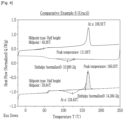
- the PLA film was made into a completely amorphous state, and heated up to 250°C, which is equal to or higher than the melting temperature of PLA, at a heating rate of 10°C/min to eliminate the thermal history, and then stabilized for 5 minutes to make into an amorphous molten state. After that, to analyze ⁇ Hc and crystallization behavior, a crystallization peak was observed while cooling up to -20°C at a cooling rate of 10°C/min. To observe the melting peak after stabilization, re-heating (2 nd Run) was performed up to 250°C at a rate of 10°C/min, and ⁇ Hm at the melting peak was confirmed.
Landscapes
- Chemical & Material Sciences (AREA)
- Health & Medical Sciences (AREA)
- Chemical Kinetics & Catalysis (AREA)
- Medicinal Chemistry (AREA)
- Polymers & Plastics (AREA)
- Organic Chemistry (AREA)
- Crystallography & Structural Chemistry (AREA)
- Compositions Of Macromolecular Compounds (AREA)
- Biological Depolymerization Polymers (AREA)
Claims (6)
- Polylactidharzzusammensetzung, umfassend:ein Polylactidharz; ein erstes Nukleierungsmittel; und ein zweites Nukleierungsmittel,wobei das erste Nukleierungsmittel Uracil oder Orotsäure ist und in einer Menge von 0,5 bis 5 Gew.-%, bezogen auf das Gesamtgewicht der Polylactidharzzusammensetzung, enthalten ist, undwobei das zweite Nukleierungsmittel eine Verbindung ist, die eine Lactidoligomerstruktur enthält, und in einer Menge von 3 bis 25 Gew.-%, bezogen auf das Gesamtgewicht der Polylactidharzzusammensetzung, enthalten ist.
- Polylactidharzzusammensetzung nach Anspruch 1, wobei:
ein gewichtsmittleres Molekulargewicht des Polylactidharzes 70.000 bis 400.000 beträgt, wobei das gewichtsmittlere Molekulargewicht wie in der Beschreibung offenbart gemessen wird. - Polylactidharzzusammensetzung nach Anspruch 1, wobei:
das erste Nukleierungsmittel in einer Menge von 0,5 bis 3,5 Gew.-%, bezogen auf das Gesamtgewicht der Polylactidharzzusammensetzung, enthalten ist. - Polylactidharzzusammensetzung nach Anspruch 1, wobei:
das zweite Nukleierungsmittel eine durch die folgende chemische Formel 1 dargestellte Verbindung ist:
L eines ist, ausgewählt aus der Gruppe, bestehend aus:
 n1 eine ganze Zahl von 1 bis 4 ist,n2 eine ganze Zahl von 1 bis 4 ist,n3 eine ganze Zahl von 1 bis 30 ist, undR ein durch die folgende chemische Formel 2 dargestellter Substituent ist,
 n die Anzahl der Wiederholungseinheiten darstellt, undR' Wasserstoff oder Acetyl ist.
 - Polylactidharzzusammensetzung nach Anspruch 1, wobei:
ein gewichtsmittleres Molekulargewicht des zweiten Nukleierungsmittels 1.000 bis 50.000 beträgt, wobei das gewichtsmittlere Molekulargewicht wie in der Beschreibung offenbart gemessen wird. - Polylactidharzzusammensetzung nach Anspruch 1, wobei:
das zweite Nukleierungsmittel in einer Menge von 4,5 bis 21 Gew.-%, bezogen auf das Gesamtgewicht der Polylactidharzzusammensetzung, enthalten ist.
Applications Claiming Priority (2)
| Application Number | Priority Date | Filing Date | Title |
|---|---|---|---|
| KR1020220035552A KR102949628B1 (ko) | 2022-03-22 | 2022-03-22 | 결정화도가 우수한 폴리락타이드 수지 조성물, 및 이의 제조 방법 |
| PCT/KR2023/002703 WO2023182686A1 (ko) | 2022-03-22 | 2023-02-27 | 결정화도가 우수한 폴리락타이드 수지 조성물, 및 이의 제조 방법 |
Publications (3)
| Publication Number | Publication Date |
|---|---|
| EP4335898A1 EP4335898A1 (de) | 2024-03-13 |
| EP4335898A4 EP4335898A4 (de) | 2024-09-18 |
| EP4335898B1 true EP4335898B1 (de) | 2025-06-04 |
Family
ID=88101348
Family Applications (1)
| Application Number | Title | Priority Date | Filing Date |
|---|---|---|---|
| EP23775184.7A Active EP4335898B1 (de) | 2022-03-22 | 2023-02-27 | Polylactidharzzusammensetzung mit ausgezeichneter kristallinität und herstellungsverfahren dafür |
Country Status (8)
| Country | Link |
|---|---|
| US (1) | US20240301200A1 (de) |
| EP (1) | EP4335898B1 (de) |
| JP (1) | JP7782916B2 (de) |
| KR (1) | KR102949628B1 (de) |
| CN (1) | CN117480208A (de) |
| AU (1) | AU2023238190A1 (de) |
| CA (1) | CA3221739A1 (de) |
| WO (1) | WO2023182686A1 (de) |
Family Cites Families (7)
| Publication number | Priority date | Publication date | Assignee | Title |
|---|---|---|---|---|
| JP4736523B2 (ja) | 2005-04-28 | 2011-07-27 | ソニー株式会社 | 樹脂組成物、及びこれより作製された成形物 |
| JP4130695B2 (ja) * | 2006-10-11 | 2008-08-06 | 花王株式会社 | 生分解性樹脂組成物 |
| JP5264314B2 (ja) | 2008-06-19 | 2013-08-14 | 花王株式会社 | ポリ乳酸樹脂組成物 |
| JP5794498B2 (ja) * | 2009-09-10 | 2015-10-14 | 国立研究開発法人産業技術総合研究所 | ポリ乳酸樹脂組成物 |
| JP2016011388A (ja) * | 2014-06-30 | 2016-01-21 | 株式会社リコー | ポリ乳酸樹脂組成物、及び成形体 |
| CN110564121A (zh) * | 2019-09-18 | 2019-12-13 | 广东省化学纤维研究所 | 一种高韧性耐热的全降解吸管制备方法 |
| CN111349325B (zh) * | 2020-04-29 | 2022-06-28 | 吉林中粮生化有限公司 | 改性生物基聚合物纤维组合物和改性生物基聚合物纤维及其制备方法 |
-
2022
- 2022-03-22 KR KR1020220035552A patent/KR102949628B1/ko active Active
-
2023
- 2023-02-27 AU AU2023238190A patent/AU2023238190A1/en active Pending
- 2023-02-27 EP EP23775184.7A patent/EP4335898B1/de active Active
- 2023-02-27 CA CA3221739A patent/CA3221739A1/en active Pending
- 2023-02-27 CN CN202380012230.7A patent/CN117480208A/zh active Pending
- 2023-02-27 JP JP2024502179A patent/JP7782916B2/ja active Active
- 2023-02-27 US US18/569,869 patent/US20240301200A1/en active Pending
- 2023-02-27 WO PCT/KR2023/002703 patent/WO2023182686A1/ko not_active Ceased
Also Published As
| Publication number | Publication date |
|---|---|
| CA3221739A1 (en) | 2023-09-28 |
| EP4335898A4 (de) | 2024-09-18 |
| US20240301200A1 (en) | 2024-09-12 |
| EP4335898A1 (de) | 2024-03-13 |
| WO2023182686A1 (ko) | 2023-09-28 |
| KR102949628B1 (ko) | 2026-04-06 |
| AU2023238190A1 (en) | 2024-01-04 |
| KR20230137737A (ko) | 2023-10-05 |
| CN117480208A (zh) | 2024-01-30 |
| JP7782916B2 (ja) | 2025-12-09 |
| JP2024525102A (ja) | 2024-07-09 |
Similar Documents
| Publication | Publication Date | Title |
|---|---|---|
| EP4108702B1 (de) | Polylactid-stereokomplex und herstellungsverfahren dafür | |
| EP4335898A1 (de) | Polylactidharzzusammensetzung mit ausgezeichneter kristallinität und herstellungsverfahren dafür | |
| EP4332159B1 (de) | Polylactidharzzusammensetzung mit hervorragender kristallisationshalbzeit und verfahren zur herstellung davon | |
| KR102769146B1 (ko) | 폴리(락트산-b-3-하이드록시프로피온산) 블록 공중합체 및 이의 제조 방법 | |
| EP4372040A1 (de) | Polylactidharzzusammensetzung und herstellungsverfahren dafür | |
| EP4332160A1 (de) | Polylactidharzzusammensetzung mit hervorragender kristallinität und verfahren zur herstellung davon | |
| JP3732754B2 (ja) | 生分解性共重合ポリエステルの製造方法 | |
| JP3732753B2 (ja) | 生分解性共重合ポリエステル及びその製造方法 | |
| KR20240137864A (ko) | 용융 강도가 우수한 폴리락타이드 수지 조성물, 및 이의 제조방법 |
Legal Events
| Date | Code | Title | Description |
|---|---|---|---|
| STAA | Information on the status of an ep patent application or granted ep patent |
Free format text: STATUS: THE INTERNATIONAL PUBLICATION HAS BEEN MADE |
|
| PUAI | Public reference made under article 153(3) epc to a published international application that has entered the european phase |
Free format text: ORIGINAL CODE: 0009012 |
|
| STAA | Information on the status of an ep patent application or granted ep patent |
Free format text: STATUS: REQUEST FOR EXAMINATION WAS MADE |
|
| 17P | Request for examination filed |
Effective date: 20231206 |
|
| AK | Designated contracting states |
Kind code of ref document: A1 Designated state(s): AL AT BE BG CH CY CZ DE DK EE ES FI FR GB GR HR HU IE IS IT LI LT LU LV MC ME MK MT NL NO PL PT RO RS SE SI SK SM TR |
|
| A4 | Supplementary search report drawn up and despatched |
Effective date: 20240816 |
|
| RIC1 | Information provided on ipc code assigned before grant |
Ipc: C08L 67/04 20060101ALI20240809BHEP Ipc: C08K 5/11 20060101ALI20240809BHEP Ipc: C08K 5/3432 20060101ALI20240809BHEP Ipc: C08K 5/00 20060101AFI20240809BHEP |
|
| GRAP | Despatch of communication of intention to grant a patent |
Free format text: ORIGINAL CODE: EPIDOSNIGR1 |
|
| STAA | Information on the status of an ep patent application or granted ep patent |
Free format text: STATUS: GRANT OF PATENT IS INTENDED |
|
| DAV | Request for validation of the european patent (deleted) | ||
| DAX | Request for extension of the european patent (deleted) | ||
| INTG | Intention to grant announced |
Effective date: 20250319 |
|
| GRAS | Grant fee paid |
Free format text: ORIGINAL CODE: EPIDOSNIGR3 |
|
| GRAA | (expected) grant |
Free format text: ORIGINAL CODE: 0009210 |
|
| STAA | Information on the status of an ep patent application or granted ep patent |
Free format text: STATUS: THE PATENT HAS BEEN GRANTED |
|
| AK | Designated contracting states |
Kind code of ref document: B1 Designated state(s): AL AT BE BG CH CY CZ DE DK EE ES FI FR GB GR HR HU IE IS IT LI LT LU LV MC ME MK MT NL NO PL PT RO RS SE SI SK SM TR |
|
| REG | Reference to a national code |
Ref country code: GB Ref legal event code: FG4D |
|
| REG | Reference to a national code |
Ref country code: CH Ref legal event code: EP |
|
| REG | Reference to a national code |
Ref country code: DE Ref legal event code: R096 Ref document number: 602023003874 Country of ref document: DE |
|
| REG | Reference to a national code |
Ref country code: IE Ref legal event code: FG4D |
|
| REG | Reference to a national code |
Ref country code: NL Ref legal event code: MP Effective date: 20250604 |
|
| PG25 | Lapsed in a contracting state [announced via postgrant information from national office to epo] |
Ref country code: ES Free format text: LAPSE BECAUSE OF FAILURE TO SUBMIT A TRANSLATION OF THE DESCRIPTION OR TO PAY THE FEE WITHIN THE PRESCRIBED TIME-LIMIT Effective date: 20250604 Ref country code: FI Free format text: LAPSE BECAUSE OF FAILURE TO SUBMIT A TRANSLATION OF THE DESCRIPTION OR TO PAY THE FEE WITHIN THE PRESCRIBED TIME-LIMIT Effective date: 20250604 |
|
| REG | Reference to a national code |
Ref country code: LT Ref legal event code: MG9D |
|
| PG25 | Lapsed in a contracting state [announced via postgrant information from national office to epo] |
Ref country code: GR Free format text: LAPSE BECAUSE OF FAILURE TO SUBMIT A TRANSLATION OF THE DESCRIPTION OR TO PAY THE FEE WITHIN THE PRESCRIBED TIME-LIMIT Effective date: 20250905 Ref country code: NO Free format text: LAPSE BECAUSE OF FAILURE TO SUBMIT A TRANSLATION OF THE DESCRIPTION OR TO PAY THE FEE WITHIN THE PRESCRIBED TIME-LIMIT Effective date: 20250904 |
|
| PG25 | Lapsed in a contracting state [announced via postgrant information from national office to epo] |
Ref country code: PL Free format text: LAPSE BECAUSE OF FAILURE TO SUBMIT A TRANSLATION OF THE DESCRIPTION OR TO PAY THE FEE WITHIN THE PRESCRIBED TIME-LIMIT Effective date: 20250604 |
|
| PG25 | Lapsed in a contracting state [announced via postgrant information from national office to epo] |
Ref country code: BG Free format text: LAPSE BECAUSE OF FAILURE TO SUBMIT A TRANSLATION OF THE DESCRIPTION OR TO PAY THE FEE WITHIN THE PRESCRIBED TIME-LIMIT Effective date: 20250604 |
|
| PG25 | Lapsed in a contracting state [announced via postgrant information from national office to epo] |
Ref country code: HR Free format text: LAPSE BECAUSE OF FAILURE TO SUBMIT A TRANSLATION OF THE DESCRIPTION OR TO PAY THE FEE WITHIN THE PRESCRIBED TIME-LIMIT Effective date: 20250604 |
|
| PG25 | Lapsed in a contracting state [announced via postgrant information from national office to epo] |
Ref country code: RS Free format text: LAPSE BECAUSE OF FAILURE TO SUBMIT A TRANSLATION OF THE DESCRIPTION OR TO PAY THE FEE WITHIN THE PRESCRIBED TIME-LIMIT Effective date: 20250904 |
|
| PG25 | Lapsed in a contracting state [announced via postgrant information from national office to epo] |
Ref country code: LV Free format text: LAPSE BECAUSE OF FAILURE TO SUBMIT A TRANSLATION OF THE DESCRIPTION OR TO PAY THE FEE WITHIN THE PRESCRIBED TIME-LIMIT Effective date: 20250604 |
|
| PG25 | Lapsed in a contracting state [announced via postgrant information from national office to epo] |
Ref country code: NL Free format text: LAPSE BECAUSE OF FAILURE TO SUBMIT A TRANSLATION OF THE DESCRIPTION OR TO PAY THE FEE WITHIN THE PRESCRIBED TIME-LIMIT Effective date: 20250604 |
|
| PG25 | Lapsed in a contracting state [announced via postgrant information from national office to epo] |
Ref country code: PT Free format text: LAPSE BECAUSE OF FAILURE TO SUBMIT A TRANSLATION OF THE DESCRIPTION OR TO PAY THE FEE WITHIN THE PRESCRIBED TIME-LIMIT Effective date: 20251006 |
|
| REG | Reference to a national code |
Ref country code: AT Ref legal event code: MK05 Ref document number: 1800308 Country of ref document: AT Kind code of ref document: T Effective date: 20250604 |
|
| PG25 | Lapsed in a contracting state [announced via postgrant information from national office to epo] |
Ref country code: IS Free format text: LAPSE BECAUSE OF FAILURE TO SUBMIT A TRANSLATION OF THE DESCRIPTION OR TO PAY THE FEE WITHIN THE PRESCRIBED TIME-LIMIT Effective date: 20251004 |
|
| PG25 | Lapsed in a contracting state [announced via postgrant information from national office to epo] |
Ref country code: SM Free format text: LAPSE BECAUSE OF FAILURE TO SUBMIT A TRANSLATION OF THE DESCRIPTION OR TO PAY THE FEE WITHIN THE PRESCRIBED TIME-LIMIT Effective date: 20250604 Ref country code: AT Free format text: LAPSE BECAUSE OF FAILURE TO SUBMIT A TRANSLATION OF THE DESCRIPTION OR TO PAY THE FEE WITHIN THE PRESCRIBED TIME-LIMIT Effective date: 20250604 |
|
| PG25 | Lapsed in a contracting state [announced via postgrant information from national office to epo] |
Ref country code: CZ Free format text: LAPSE BECAUSE OF FAILURE TO SUBMIT A TRANSLATION OF THE DESCRIPTION OR TO PAY THE FEE WITHIN THE PRESCRIBED TIME-LIMIT Effective date: 20250604 |
|
| PG25 | Lapsed in a contracting state [announced via postgrant information from national office to epo] |
Ref country code: EE Free format text: LAPSE BECAUSE OF FAILURE TO SUBMIT A TRANSLATION OF THE DESCRIPTION OR TO PAY THE FEE WITHIN THE PRESCRIBED TIME-LIMIT Effective date: 20250604 |
|
| PG25 | Lapsed in a contracting state [announced via postgrant information from national office to epo] |
Ref country code: SK Free format text: LAPSE BECAUSE OF FAILURE TO SUBMIT A TRANSLATION OF THE DESCRIPTION OR TO PAY THE FEE WITHIN THE PRESCRIBED TIME-LIMIT Effective date: 20250604 |
|
| REG | Reference to a national code |
Ref country code: DE Ref legal event code: R097 Ref document number: 602023003874 Country of ref document: DE |
|
| PLBE | No opposition filed within time limit |
Free format text: ORIGINAL CODE: 0009261 |
|
| STAA | Information on the status of an ep patent application or granted ep patent |
Free format text: STATUS: NO OPPOSITION FILED WITHIN TIME LIMIT |
|
| PG25 | Lapsed in a contracting state [announced via postgrant information from national office to epo] |
Ref country code: DK Free format text: LAPSE BECAUSE OF FAILURE TO SUBMIT A TRANSLATION OF THE DESCRIPTION OR TO PAY THE FEE WITHIN THE PRESCRIBED TIME-LIMIT Effective date: 20250604 |
|
| PGFP | Annual fee paid to national office [announced via postgrant information from national office to epo] |
Ref country code: DE Payment date: 20260120 Year of fee payment: 4 |
|
| PGFP | Annual fee paid to national office [announced via postgrant information from national office to epo] |
Ref country code: IT Payment date: 20260228 Year of fee payment: 4 |
|
| REG | Reference to a national code |
Ref country code: CH Ref legal event code: L10 Free format text: ST27 STATUS EVENT CODE: U-0-0-L10-L00 (AS PROVIDED BY THE NATIONAL OFFICE) Effective date: 20260416 |
|
| PGFP | Annual fee paid to national office [announced via postgrant information from national office to epo] |
Ref country code: FR Payment date: 20260121 Year of fee payment: 4 |
|
| 26N | No opposition filed |
Effective date: 20260305 |