EP4328186A1 - Herstellungsverfahren für nanotitanat, nanotitansäure und nano tio2 sowie verwendung davon - Google Patents
Herstellungsverfahren für nanotitanat, nanotitansäure und nano tio2 sowie verwendung davon Download PDFInfo
- Publication number
- EP4328186A1 EP4328186A1 EP22791104.7A EP22791104A EP4328186A1 EP 4328186 A1 EP4328186 A1 EP 4328186A1 EP 22791104 A EP22791104 A EP 22791104A EP 4328186 A1 EP4328186 A1 EP 4328186A1
- Authority
- EP
- European Patent Office
- Prior art keywords
- solution
- reaction
- temperature
- titanate
- nanotubes
- Prior art date
- Legal status (The legal status is an assumption and is not a legal conclusion. Google has not performed a legal analysis and makes no representation as to the accuracy of the status listed.)
- Pending
Links
Images


Classifications
-
- C—CHEMISTRY; METALLURGY
- C01—INORGANIC CHEMISTRY
- C01G—COMPOUNDS CONTAINING METALS NOT COVERED BY SUBCLASSES C01D OR C01F
- C01G23/00—Compounds of titanium
- C01G23/003—Titanates
- C01G23/005—Alkali titanates
-
- C—CHEMISTRY; METALLURGY
- C01—INORGANIC CHEMISTRY
- C01G—COMPOUNDS CONTAINING METALS NOT COVERED BY SUBCLASSES C01D OR C01F
- C01G23/00—Compounds of titanium
-
- C—CHEMISTRY; METALLURGY
- C01—INORGANIC CHEMISTRY
- C01G—COMPOUNDS CONTAINING METALS NOT COVERED BY SUBCLASSES C01D OR C01F
- C01G23/00—Compounds of titanium
- C01G23/003—Titanates
-
- B—PERFORMING OPERATIONS; TRANSPORTING
- B82—NANOTECHNOLOGY
- B82Y—SPECIFIC USES OR APPLICATIONS OF NANOSTRUCTURES; MEASUREMENT OR ANALYSIS OF NANOSTRUCTURES; MANUFACTURE OR TREATMENT OF NANOSTRUCTURES
- B82Y40/00—Manufacture or treatment of nanostructures
-
- C—CHEMISTRY; METALLURGY
- C01—INORGANIC CHEMISTRY
- C01G—COMPOUNDS CONTAINING METALS NOT COVERED BY SUBCLASSES C01D OR C01F
- C01G23/00—Compounds of titanium
- C01G23/04—Oxides; Hydroxides
-
- C—CHEMISTRY; METALLURGY
- C01—INORGANIC CHEMISTRY
- C01G—COMPOUNDS CONTAINING METALS NOT COVERED BY SUBCLASSES C01D OR C01F
- C01G23/00—Compounds of titanium
- C01G23/04—Oxides; Hydroxides
- C01G23/047—Titanium dioxide
-
- C—CHEMISTRY; METALLURGY
- C01—INORGANIC CHEMISTRY
- C01G—COMPOUNDS CONTAINING METALS NOT COVERED BY SUBCLASSES C01D OR C01F
- C01G23/00—Compounds of titanium
- C01G23/04—Oxides; Hydroxides
- C01G23/047—Titanium dioxide
- C01G23/053—Producing by wet processes, e.g. hydrolysing titanium salts
-
- C—CHEMISTRY; METALLURGY
- C01—INORGANIC CHEMISTRY
- C01G—COMPOUNDS CONTAINING METALS NOT COVERED BY SUBCLASSES C01D OR C01F
- C01G23/00—Compounds of titanium
- C01G23/04—Oxides; Hydroxides
- C01G23/047—Titanium dioxide
- C01G23/08—Drying; Calcining ; After treatment of titanium oxide
-
- B—PERFORMING OPERATIONS; TRANSPORTING
- B82—NANOTECHNOLOGY
- B82Y—SPECIFIC USES OR APPLICATIONS OF NANOSTRUCTURES; MEASUREMENT OR ANALYSIS OF NANOSTRUCTURES; MANUFACTURE OR TREATMENT OF NANOSTRUCTURES
- B82Y30/00—Nanotechnology for materials or surface science, e.g. nanocomposites
-
- C—CHEMISTRY; METALLURGY
- C01—INORGANIC CHEMISTRY
- C01P—INDEXING SCHEME RELATING TO STRUCTURAL AND PHYSICAL ASPECTS OF SOLID INORGANIC COMPOUNDS
- C01P2002/00—Crystal-structural characteristics
- C01P2002/01—Crystal-structural characteristics depicted by a TEM-image
-
- C—CHEMISTRY; METALLURGY
- C01—INORGANIC CHEMISTRY
- C01P—INDEXING SCHEME RELATING TO STRUCTURAL AND PHYSICAL ASPECTS OF SOLID INORGANIC COMPOUNDS
- C01P2002/00—Crystal-structural characteristics
- C01P2002/70—Crystal-structural characteristics defined by measured X-ray, neutron or electron diffraction data
- C01P2002/72—Crystal-structural characteristics defined by measured X-ray, neutron or electron diffraction data by d-values or two theta-values, e.g. as X-ray diagram
-
- C—CHEMISTRY; METALLURGY
- C01—INORGANIC CHEMISTRY
- C01P—INDEXING SCHEME RELATING TO STRUCTURAL AND PHYSICAL ASPECTS OF SOLID INORGANIC COMPOUNDS
- C01P2004/00—Particle morphology
- C01P2004/01—Particle morphology depicted by an image
- C01P2004/03—Particle morphology depicted by an image obtained by SEM
-
- C—CHEMISTRY; METALLURGY
- C01—INORGANIC CHEMISTRY
- C01P—INDEXING SCHEME RELATING TO STRUCTURAL AND PHYSICAL ASPECTS OF SOLID INORGANIC COMPOUNDS
- C01P2004/00—Particle morphology
- C01P2004/01—Particle morphology depicted by an image
- C01P2004/04—Particle morphology depicted by an image obtained by TEM, STEM, STM or AFM
-
- C—CHEMISTRY; METALLURGY
- C01—INORGANIC CHEMISTRY
- C01P—INDEXING SCHEME RELATING TO STRUCTURAL AND PHYSICAL ASPECTS OF SOLID INORGANIC COMPOUNDS
- C01P2004/00—Particle morphology
- C01P2004/10—Particle morphology extending in one dimension, e.g. needle-like
- C01P2004/13—Nanotubes
-
- C—CHEMISTRY; METALLURGY
- C01—INORGANIC CHEMISTRY
- C01P—INDEXING SCHEME RELATING TO STRUCTURAL AND PHYSICAL ASPECTS OF SOLID INORGANIC COMPOUNDS
- C01P2004/00—Particle morphology
- C01P2004/10—Particle morphology extending in one dimension, e.g. needle-like
- C01P2004/16—Nanowires or nanorods, i.e. solid nanofibres with two nearly equal dimensions between 1-100 nanometer
-
- C—CHEMISTRY; METALLURGY
- C01—INORGANIC CHEMISTRY
- C01P—INDEXING SCHEME RELATING TO STRUCTURAL AND PHYSICAL ASPECTS OF SOLID INORGANIC COMPOUNDS
- C01P2004/00—Particle morphology
- C01P2004/20—Particle morphology extending in two dimensions, e.g. plate-like
-
- C—CHEMISTRY; METALLURGY
- C01—INORGANIC CHEMISTRY
- C01P—INDEXING SCHEME RELATING TO STRUCTURAL AND PHYSICAL ASPECTS OF SOLID INORGANIC COMPOUNDS
- C01P2004/00—Particle morphology
- C01P2004/60—Particles characterised by their size
- C01P2004/64—Nanometer sized, i.e. from 1-100 nanometer
-
- C—CHEMISTRY; METALLURGY
- C01—INORGANIC CHEMISTRY
- C01P—INDEXING SCHEME RELATING TO STRUCTURAL AND PHYSICAL ASPECTS OF SOLID INORGANIC COMPOUNDS
- C01P2006/00—Physical properties of inorganic compounds
- C01P2006/12—Surface area
-
- Y—GENERAL TAGGING OF NEW TECHNOLOGICAL DEVELOPMENTS; GENERAL TAGGING OF CROSS-SECTIONAL TECHNOLOGIES SPANNING OVER SEVERAL SECTIONS OF THE IPC; TECHNICAL SUBJECTS COVERED BY FORMER USPC CROSS-REFERENCE ART COLLECTIONS [XRACs] AND DIGESTS
- Y02—TECHNOLOGIES OR APPLICATIONS FOR MITIGATION OR ADAPTATION AGAINST CLIMATE CHANGE
- Y02E—REDUCTION OF GREENHOUSE GAS [GHG] EMISSIONS, RELATED TO ENERGY GENERATION, TRANSMISSION OR DISTRIBUTION
- Y02E60/00—Enabling technologies; Technologies with a potential or indirect contribution to GHG emissions mitigation
- Y02E60/10—Energy storage using batteries
-
- Y—GENERAL TAGGING OF NEW TECHNOLOGICAL DEVELOPMENTS; GENERAL TAGGING OF CROSS-SECTIONAL TECHNOLOGIES SPANNING OVER SEVERAL SECTIONS OF THE IPC; TECHNICAL SUBJECTS COVERED BY FORMER USPC CROSS-REFERENCE ART COLLECTIONS [XRACs] AND DIGESTS
- Y02—TECHNOLOGIES OR APPLICATIONS FOR MITIGATION OR ADAPTATION AGAINST CLIMATE CHANGE
- Y02E—REDUCTION OF GREENHOUSE GAS [GHG] EMISSIONS, RELATED TO ENERGY GENERATION, TRANSMISSION OR DISTRIBUTION
- Y02E60/00—Enabling technologies; Technologies with a potential or indirect contribution to GHG emissions mitigation
- Y02E60/30—Hydrogen technology
- Y02E60/36—Hydrogen production from non-carbon containing sources, e.g. by water electrolysis
Definitions
- the present invention relates to the technical field of nanomaterials, and in particular to a method of preparing nano titanate, nano titanic acid, and nano-TiO 2 , and an application thereof.
- titanate nanomaterials e.g., sodium titanate
- TiO 2 nanotubes is firstly obtained by a long period of hydrothermal synthesis under high-temperature and high-pressure conditions by using commercial nano TiO 2 and a high concentration of strong alkalis (e.g., NaOH solution) as raw materials, then titanic acid nanotubes is obtained by a neutralization and acid washing process, and then TiO 2 nanotubes is obtain by a furthermore heat treatment.
- strong alkalis e.g., NaOH solution
- titanic acid nanotubes with a tube length of tens to hundreds of nanometers and an inner diameter of 5.3 nm could be obtained by hydrothermal reaction of anatase-type TiO 2 and a 10 mol/L sodium hydroxide solution in a high-pressure vessel at 130°C for 72 h, followed by water washing of the product to neutrality.
- the traditional hydrothermal method with strong alkali is characterized by 1) using TiO 2 as the titanium source; 2) being carried out in a high-pressure reaction vessel, which requires airtight and high-pressure conditions; 3) being carried out at higher temperatures; 4) requiring a very long reaction time in terms of hours or tens of hours; and 5) the products obtained are generally nano-tubular titanates or nano-tubular titanic acid.
- the invention contains ten aspects in order, specifically:
- a method of preparing a titanate nanofilm material comprising the following steps:
- the thin film material macroscopically viewed in the form of a powder material, is microscopically observed to consist of a large number of two-dimensional thin films.
- the thin film material macroscopically viewed as a powder material, microscopically observed to be composed of a large number of monolithic two-dimensional thin films dispersed or entangled, the structure of which is completely different from that of the nano-porous structure formed by the conventional dealloying reaction.
- the nanoporous structure obtained by the conventional dealloying reaction consists of a three-dimensional network of nigaments connected to form a whole, and its overall appearance is basically the same as that of the initial alloy before the dealloying reaction;
- the two-dimensional thin-film material means a material in which the smallest unit of the material (e.g., a single powder particle, a monolithic film) has a large area and its dimension in the thickness direction is much smaller than the two-dimensional dimensions in the area direction, and its thickness does not exceed 10 nm.
- the smallest unit of the material e.g., a single powder particle, a monolithic film
- step 1 In step 1.
- the initial alloy and the alkaline solution are first placed separately in the closed vessel, and when the temperature of the alkaline solution reaches a set reaction temperature, the initial alloy is then contacted with the alkaline solution and the reaction is carried out.
- atmospheric pressure generally refers to 1 standard atmospheric pressure, wherein the boiling point of the corresponding water is 100°C.; when there is an alkali dissolved in the water, the boiling temperature of the aqueous solution of the alkali is higher than 100°C. under 1 standard atmospheric pressure, and the higher the concentration of the alkali is, the higher the boiling point is.
- the boiling point of T f solution for the 5.1 mol/L sodium hydroxide aqueous solution is about 108°C; the boiling point of T f solution for the 7 mol/L sodium hydroxide aqueous solution is about 112°C; the boiling point of T f solution for the 10 mol/L sodium hydroxide aqueous solution is about 119°C; the boiling point of T f solution for the 12 mol/L sodium hydroxide aqueous solution is about 128°C; the boiling point of T f solution for the 15 mol/L sodium hydroxide aqueous solution is about 140°C; the boiling point of T f solution for the 17 mol/L sodium hydroxide aqueous solution is about 148°C; the boiling point of T f solution for the 20 mol/L sodium hydroxide aqueous solution is about 160 °C; the boiling point of T f solution for the 25 mol/L sodium hydroxide aqueous solution is about 180°C; The boiling point of T f
- the T elements Al, Zn are amphoteric metals, they can react with hot concentrated alkaline solution to become T salts and dissolve in the solution with hydrogen generation reaction vigorously; therefore, the T element in the initial alloy can be removed through the reaction between T and alkaline solution, and the remaining Ti in the initial alloy furthermore interacts with the alkaline solution and undergoes a series of simultaneous changes, including diffusive rearrangement of Ti atoms as well as their interaction with hydroxide, oxygen, cations in the alkali, and generates new two-dimensional film-like solid flocculent products through shape and compositional reconfiguration.
- the initial alloy is reacted with the alkaline solution at a temperature higher than 100°C, which is important for the preparation of the product whose microscopic morphology is a two-dimensional thin film-like product.
- the initial TiAl 3 intermetallic alloy powder is reacted with a NaOH solution of 10 mol/L and at 35°C for 2 h at ambient pressure, the shape of the original initial alloy powder before and after the reaction is substantially unchanged, and it remains as the original crushed and angular powdery particles.
- the reaction of the initial alloy with the alkaline solution occurring at a lower temperature or near room temperature is completely different from the reaction of the present invention occurring at 100°C ⁇ T 1 ⁇ T f solution , and the morphology is also completely different.
- a concentrated hot alkaline solution is used to react with the initial alloy.
- the temperature of the reaction solution is 100°C ⁇ T 1 ⁇ T f solution
- the appearance of the products obtained after the reaction changes completely compared to the appearance of the initial alloy, and the products formed in the solution are solid flocculants instead of the original solid powder or stripes that can be seen with the naked eye
- the reaction temperature is higher than 100°C
- a higher yield of the two-dimensional nano titanate film can be obtained, and the yield is generally 95% ⁇ 100%
- the reaction temperature is the boiling point of the alkaline solution T f solution at ambient pressure
- an even higher yield of the two-dimensional titanate nanofilm can be obtained, and the yield is generally 99% ⁇ 100%
- the solution composition of the reaction system has an obvious special change, which is manifested in the following: in the temperature interval below the boiling point temperature of the alkaline solution, the solvent
- the content and state of the dissolved atmospheric gases (oxygen, nitrogen) dissolved in the water are also extremely specific (because the large number of boiling steam, hydrogen generated by the reaction of T and alkalis, changes the conditions of saturation partial pressure of the gases dissolved in water, etc.).
- the reaction of Ti-T intermetallic compounds with the concentrated alkaline solutions generates a large amount of hydrogen in the process of T-removal from the alloy, and the violent expansion effect caused by the hydrogen generated within a short period of time will cause great damage to the initial alloy that is continuing to react and cause continued fragmentation of the initial alloy at the reaction interface, and the T salts dissolved in alkaline solutions also change the composition of the reacting solution system.
- the composition of the solution in the reaction system undergoes an obvious particular change, as shown below: in the temperature interval below the boiling point temperature of the alkaline solution, the solvent exists mainly as liquid water and the reaction system is in an ordinary state; however, near or at the boiling point temperature of the alkaline solution, the solvent also contains water in the critical state which is undergoing a transition from liquid water to gaseous water, in addition to the liquid water with the gaseous water produced by boiling.
- the reaction of Ti-T intermetallic compounds with concentrated alkaline solution in the process of T-removal from the alloy will generate a large amount of hydrogen, these hydrogen generated within a short period of time and a large number of heterogeneous nuclei boiling vapors produced by water vapor, which result in the violent expansion and further promote the nano-fragmentation reaction and reconfiguration process of the shape and the composition at the interface of the initial alloy; and the T salt in dissolved in alkaline solution will also change the composition of the reaction solution.
- These many characteristics of the solution at the boiling point temperature provide a very specific reaction environment for the reaction.
- step 2 since the process of "nano-fragmentation - product shape and composition reconfiguration" described in step 2 occurs almost simultaneously with the reaction of "hydrogen evolution and T-removal process", the theoretical minimum time required for the product generation process described in step 2 is the time required for the initial alloy reaction interface to advance inward from the surface to complete the hydrogen evolution and T-removal reaction, which can be determined by the end of hydrogen evolution.
- the hydrogen generation reaction is a vigorous hydrogen generation reaction; Furthermore, the vigorous hydrogen generation and T-removal reaction means that the rate of advancement of the reaction interface of the hydrogen generation and T-removal reaction is sufficiently fast that the hydrogen evolved from the reaction interface is concentrated to be released in a very short period of time, thus behaving as a vigorous reaction process.
- the degree of vigor of the hydrogen generation and T-removal reaction is related to the rate of reaction advancement of the reaction interface from the initial alloy surface inwardly per unit time, the higher the temperature of the alkaline solution, the faster the rate of advancement of the reaction interface is, and the more violent the reaction is.
- reaction interface advances inwardly from the initial alloy surface at an average rate of greater than 30 ⁇ m/min; For example, when the alkali concentration is 10 mol/L, the reaction interface advances inwardly from the surface of the initial alloy during the reaction of the Ti 25 Al 75 initial alloy with the alkaline solution as follows:
- T elements Al, Zn
- their reaction with alkaline solutions near the boiling point temperature (which is higher than 100°C) at ambient pressure is very rapid.
- the reaction time for the complete removal of T elements from the initial alloy is related to the shape of the initial alloy. The smaller the initial alloy powder particles or the thinner the initial alloy strips, the shorter the time required for completion of the hydrogen generation and T-removal reactions; conversely, the longer the time required for the completion of the hydrogen generation and T-removal reactions.
- the minimum reaction time required for the completion of the hydrogen generation and T-removal reactions can be calculated as t.
- the initial alloy is a strip with a thickness of d
- the average advancement rate of the reaction interface is v
- the reaction interface advances from the upper and lower surfaces of the strip
- t 0.5d / v
- the initial alloy is a granular alloy with a diameter of d and the average advancement rate of the reaction interface is v
- t Q.5d / v.
- a initial alloy strip comprised TiAl 3 intermetallic compound is reacted with a NaOH solution that is 10 mol/L and is at a boiling temperature (boiling temperature of about 119°C), and the average rate of advancement of the reactive interface of the initial alloy strip is about -120 ⁇ m/min, i.e., for a 40 ⁇ m-thick initial alloy strip, the hydrogen generation and Al-removal reactions can be completed in 10 s; for a 20 ⁇ m-thick initial alloy strip, the hydrogen generation and Al-removal reactions can be completed in 5 s. Even for a 5 mm particle size initial alloy ball, the hydrogen generation and Al-removal reactions can be completed in 21 min;
- the occurrence of nano-fragmentation means that the initial alloy at the reaction interface is fragmented by the hydrogen generation and T-removal reactions into individual intermediates or products having a scale of less than 500 nm in at least one dimension in the three-dimensional direction;
- step 2 comprises the product generated by the reaction and the alkaline solution after the reaction;
- step 3 comprises a process of lowering the temperature of the solid flocculent product in the reaction system described in step 2 from T 1 to a lower temperature interval.
- the temperature of the solid flocculent product in the reaction system described in step 2 is reduced from T 1 to a lower temperature interval at ambient pressure, wherein 100°C ⁇ T 1 ⁇ T fsolution ;
- the additive solvent for dilution includes water
- the specific steps are as follows: under ambient pressure, the alkaline solution containing the solid flocculent product at the temperature of T 1 under ambient pressure is poured onto a cold filter, and the solid flocculent product and the alkaline solution are separated through the filter; the heat of the solid flocculent product is rapidly conducted away through the environment and the filter, and the temperature of the solid flocculent product can be rapidly reduced to a low temperature;
- the temperature of the ultimately obtained titanate nanofilm material is lower than T 1 , or its solid-liquid separation, cleaning, preservation, and use are carried out at a temperature lower than T 1 , regardless of the historical change of the temperature of the nano titanate thin film material in the intermediate process, it belongs to the operation of lowering the temperature of the solid flocculated product in the reaction system of step 2 from T 1 as described in step 3;
- the thin film material macroscopically viewed as a powder material morphology, microscopically observed to consist of a large number of two-dimensional thin films.
- the thin film material which appears macroscopically as a powder material, is composed of a large number of monolithic two-dimensional thin films dispersed or entangled, the structure of which is completely different from that of the nanoporous structure formed by the conventional dealloying reaction.
- the nanoporous structure obtained by the conventional dealloying reaction consists of three-dimensional network ligaments connected to form a whole, and its overall appearance is basically the same as that of the initial alloy before the dealloying reaction; Furthermore, the two-dimensional thin-film material is a material in which the smallest unit of the material (e.g., a single powder particle, a monolithic film) has a large area and its dimension in the thickness direction is much smaller than the two dimensions in the area direction, and its thickness does not exceed 10 nm.
- the smallest unit of the material e.g., a single powder particle, a monolithic film
- the titanate nanofilm has a thickness of 0.25 nm ⁇ 4 nm;
- the titanate nanofilm is predominantly a low crystallinity titanate
- the present invention also relates to a method of preparing a titanic acid nanofilm material, wherein the titanic acid nanofilm material is obtained by reacting the prepared product according to the first aspect thereof or the titanate nanofilm material according to the first aspect thereof with an acid solution, and then collecting the solid product.
- the product after the acid reaction is substantially identical to the main characteristics of the product described in the first aspect thereof;
- the specific step of reacting the titanate nanofilm material with the acid solution is as follows: the titanate nanofilm material is dispersed in water, and the acid solution is gradually added while stirring so that the pH value of the mixed solution continuously decreases. Finally, the pH value of the mixed solution is controlled to be in the range of 2 ⁇ 5, and after 1 min ⁇ 5 h, it is separated and dried, i.e., the nano titanic acid thin film is obtained.
- the pH control is maintained between 2 ⁇ 5, i.e., the corresponding concentration of hydrogen ions in the mixed solution is 0.00001 mol/L ⁇ 0.01 mol/L, it can be ensured that the residual alkali adsorbed on the surface of the titanate nanofilm material during the whole process is first neutralized, and then the ion exchange between the cations in the titanate nanofilm material and the hydrogen ions in the acid solution takes place, and then the titanic acid nanofilm material that has not reacted significantly with the acid solution is obtained.
- the prepared titanic acid nanofilm has a thickness of 0.25 nm ⁇ 4 nm;
- the present invention also relates to a method of preparing a TiO 2 nanosheet powder, which is prepared by heat treating the prepared product according to the second aspect thereof or the nano titanic acid film material according to the second aspect thereof.
- the time of heat treatment is 1 min ⁇ 48 h;
- phase composition of the crystalline TiO 2 nanosheet powder comprises at least one of brookite type TiO 2 , anatase type nano-TiO 2 , and rutile type nano-TiO 2 .
- the TiO 2 nanosheets have a shape of a plate sheet
- the present invention also relates to a method of preparing titanate nanotubes, which is prepared by the following steps:
- the solid substance containing the product or titanate nanofilm described in the first aspect thereof or (and) the product or titanic acid nanofilm described in the second aspect thereof is sealed in a closed container with an alkaline solution, and subsequently subjected to a high temperature and high pressure treatment at a temperature T 2 higher than that of the T f solution ; wherein the T f solution is the boiling temperature of the alkali solution involved in the reaction at ambient pressure, and 100°C ⁇ T 1 ⁇ T f solution ⁇ T 2 ; and after a certain time of reaction, the closed container is cooled and the pressure is restored to ambient pressure, and the final solid product is collected, i.e., titanate nanotubes are obtained.
- the alkaline solution comprises at least one of NaOH, KOH, LiOH, RbOH, Ba(OH) 2 , Ca(OH) 2 , Sr(OH) 2 solution;
- the "solid substance containing the product or nano titanate film described in one aspect thereof or (and) the product or nano titanic acid film described in the second aspect thereof and the alkaline solution” is the solid flocculent product and the corresponding alkaline solution after the hydrogen generation reaction described in the first aspect thereof is completed after the steps 1 and 2; That is, the solid flocculent product and the corresponding alkaline solution after the hydrogen generation reaction obtained in steps 1 and 2 mentioned in the first part thereof are sealed in a closed container, and then subjected to high temperature and high pressure treatment at a temperature T 2 higher than that of T f solution ; wherein T f solution is the boiling point temperature of the alkaline solution involved in the reaction at ambient pressure, and 100°C ⁇ T 1 ⁇ T f solution ⁇ T 2 ; and after a certain reaction time, the temperature of the closed vessel was lowered and the pressure was restored to ambient pressure, and the final solid product was collected, i.e., the titanate nanotubes were obtained.
- This preferred solution does not require separation of the solid flocculent product and the corresponding alkaline solution before mixing with the alkali, nor does it require the alkaline solution to be cooled down and then warmed up ( T 1 ⁇ T 2 ), and the alkali concentration meets the requirements for the high temperature and high-pressure reaction of this preferred solution. Therefore, this is the most economical and simple operation scheme.
- the high temperature and high-pressure treatment process involves the conversion of titanate thin film or (and) titanic acid thin film to tubular titanate, and 100°C ⁇ T 1 ⁇ T f solution ⁇ T 2 ; Furthermore, the reaction is carried out in a closed vessel above ambient pressure so that the temperature of the alkaline solution can be heated above its boiling temperature at ambient pressure, T f solution , thereby realizing the conversion of the titanate thin film or (and) titanic acid thin film to tubular titanate at high temperature and pressure.
- a certain determined value of temperature must correspond to a certain determined value of pressure, i.e. the value of pressure is a function of the value of temperature; the higher the temperature, the higher the pressure.
- the titanate nanotubes have an outer diameter of 2 nm ⁇ 20 nm;
- titanate nanotubes are predominantly of low crystallinity
- the titanate nanotubes are mainly prepared by high-temperature and high-pressure treatment of titanate nanofilms, and therefore, when the high-temperature and high-pressure treatment is incomplete, the resulting product will also contain titanate nanofilms;
- the present invention also relates to a method of preparing titanic acid nanotubes, wherein the titanic acid nanotubes are obtained by reacting the prepared product according to the fourth aspect thereof or the titanate nanotubes according to the fourth aspect thereof with an acid solution and collecting the solid product.
- the acid solution comprises at least one of hydrochloric acid, nitric acid, sulfuric acid, acetic acid, phosphoric acid, oxalic acid, picric acid, oleic acid, and perchloric acid.
- the residual alkalis adsorbed on the surface of the titanate nanotubes are first neutralized, and then ion exchange between the cations in the titanate nanotubes and the hydrogen ions in the acid solution takes place, and then titanic acid nanotubes are obtained.
- titanic acid nanotubes have a slightly smaller specific surface area than titanic acid films
- the reaction can be carried out using an acid of a slightly higher concentration than that described in the second aspect thereof;
- the specific step of reacting the titanate nanotube material with the acid solution is as follows: the titanate nanotube material is dispersed in water, and the acid solution is gradually added while stirring to decrease the pH value of the mixed solution continuously. Finally, the pH value of the mixed solution is controlled to be between 2 ⁇ 4, for 1 min ⁇ 5 h and the titanic acid nanotube material is obtained by separation, cleaning and drying.
- titanate nanotubes were rolled up with a certain thickness, when the pH value control was kept between 2 ⁇ 4, i.e., the concentration of hydrogen ions corresponding to 0.0001 mol/L ⁇ 0.01 mol/L in the mixed solution, it could be ensured that the residual alkali adsorbed on the surface of the titanate nanotube material during the whole process would be neutralized firstly, and then cationic exchange between cationic ions in the titanate nanotube material and hydrogen ions in the acid solution would take place. Thus titanic acid nanotube materials that did not react significantly with the acid solution were obtained.
- the titanic acid nanotubes have an outer diameter of 2 nm ⁇ 20 nm;
- the present invention also relates to a method of preparing TiO 2 nanotubes/rods, wherein the TiO 2 nanotubes/rods are prepared by heat treating the prepared product according to the fifth aspect thereof or the titanic acid nanotubes according to the fifth aspect thereof.
- the heat treatment process generates nano-scale TiO 2 ;
- the crystalline TiO 2 nanotubes/rods means that the shape of the crystalline TiO 2 nanotubes/rods comprises at least one of a tube, a rod; when the inner diameter of the tube is reduced to zero, it is the shape of the rods; Furthermore, the phase composition of the crystalline TiO 2 nanotubes/rods comprises at least one of brookite-type TiO 2 , anatase-type TiO 2 , rutile-type TiO 2 .
- the average length of the TiO 2 nanotubes/rods is greater than three times their average outer diameter
- the present invention also relates to another method of preparing titanate nanotubes, comprising the following steps:
- step 1) as well as the detailed description of step 1), are identical to step 1 and its detailed description described in the first aspect (a method for preparing a titanate nanofilm material) (see above, part of the steps described in one of the first aspect); In the step 2).
- the initial alloy and the alkaline solution are sealed in a closed vessel at room temperature and pressure, and the temperature of the closed reaction system is subsequently heated to a high temperature and pressure state of T 2 and held for a certain period of time; wherein 100°C ⁇ T f solution ⁇ T 2 ;
- the closed reaction system comprises, the initial alloy, the alkaline solution, and the closed container;
- the temperature of the closed reaction system is the temperature corresponding to the initial alloy, the alkaline solution, and the closed container;
- the initial alloy in the closed vessel and the alkaline solution undergoes a hydrogen generation and T-removal reaction in the heating stage from room temperature to T 2 temperature, which mainly generates nanoporous titanate intermediate products;
- the resulting product will also contain titanic acid nanofilms
- the present invention also relates to another method of preparing titanic acid nanotubes, wherein the titanic acid nanotubes are obtained by reacting the prepared product according to the seventh aspect thereof or the titanate nanotubes according to the seventh aspect thereof with an acid solution and collecting the solid product.
- the acid solution comprises at least one of hydrochloric acid, nitric acid, sulfuric acid, acetic acid, phosphoric acid, oxalic acid, picric acid, oleic acid, perchloric acid.
- the residual alkali adsorbed on the surface of the titanate nanotubes is first neutralized, and then ion exchange between the cations in the titanate nanotubes and the hydrogen ions in the acid solution takes place, and then the titanic acid nanotubes are obtained.
- titanic acid nanotubes have a slightly smaller specific surface area than titanic acid films, the reaction can be carried out by means of a slightly higher concentration of acid;
- the specific step of reacting the titanate nanotube material with the acid solution is as follows: the titanate nanotube material is dispersed in water, and the acid solution is gradually added while stirring to decrease the pH value of the mixed solution continuously. Finally, the pH value of the mixed solution is controlled to be between 2 ⁇ 4, after 1 min ⁇ 5 h, the titanic acid nanotube material is obtained by separation, cleaning and drying.
- titanic acid nanotubes were rolled up with a certain thickness, when the pH value control was kept between 2 ⁇ 4, i.e., the concentration of hydrogen ions corresponding to 0.0001 mol/L ⁇ 0.01 mol/L in the mixed solution, it could be ensured that the residual alkali adsorbed on the surface of the titanate nanotube material during the whole process would be neutralized firstly, and then cationic exchange between cationic ions in the titanate nanotube material and hydrogen ions in the acid solution would take place. Thus titanic acid nanotube materials that did not react significantly with the acid solution were obtained
- the present invention also relates to another method of preparing TiO 2 nanotubes, which are prepared by the heat treating the prepared product according to the eighth aspect or the titanate nanotubes according to the eighth aspect.
- the heat treatment process generates nano-scale TiO 2 ;
- the crystalline TiO 2 nanotubes/rods means that the shape of the crystalline TiO 2 nanotubes/rods comprises at least one of tubes, rods; when the inner diameter of the tubes is reduced to zero, it is the shape of the rods; Furthermore, the phase composition of the crystalline TiO 2 nanotubes/rods comprises at least one of brookite-type TiO 2 , anatase-type TiO 2 , rutile-type TiO 2 .
- the average length of the TiO 2 nanotubes/rods is greater than three times their average outer diameter
- the present invention further relates to an application of the product material prepared by the preparation method according to any one of the first to the ninth aspects thereof in polymer-based nanocomposites, ceramic materials, photocatalytic materials, hydrolysis for hydrogen production, hydrophobic materials, wastewater degrading materials, bactericidal coatings, anti-corrosion coatings, and marine coatings.
- the marine coating comprises an anti-fouling coating.
- the beneficial effects of the present invention are mainly reflected in the following aspects: Firstly, the ambient pressure and high efficiency preparation of titanate nanofilm materials was realized by using cheap and readily available Ti-T intermetallic compounds as titanium source, and reacting the Ti-T intermetallic compounds with alkaline solution near the boiling temperature of alkaline solution under ambient pressure. Based on this, the preparation of low-cost titanic acid nanofilm materials and TiO 2 nansheet powder has been further enabled. Combined with the subsequent high-temperature and high-pressure reactions, it also enables the efficient and low-cost preparation of titanate nanotubes, titanic acid nanotubes, and TiO 2 nanotubes/rods.
- the strong alkaline hydrothermal method is currently a more mature process for the preparation of titanate nanomaterial, titanic acid nanomaterial and TiO 2 nanomaterial
- the process usually involves the formation of a titanate salt (for example, sodium titanate) by the use of TiO 2 nanoparticles and a high concentration of strong alkali (for example, NaOH solution) as starting materials for a prolonged period of time by hydrothermal synthesis at high temperatures, which is usually followed by a neutralization and acid washing to obtain titanic acid nanotubes.
- a titanate salt for example, sodium titanate
- strong alkali for example, NaOH solution
- titanate nanotubes with a tube length of tens to hundreds of nanometers and an inner diameter of 5.3 nm could be obtained by hydrothermal reaction in a high-pressure reaction vessel for 72 h under the condition of 130°C using industrial anatase-type TiO 2 and a 10 mol/L sodium hydroxide solution as the starting materials, followed by neutrality.
- the conventional strong alkaline hydrothermal method is characterized by 1) using TiO 2 as the titanium source; 2) being carried out in a high-pressure reaction vessel, which requires airtight and high-pressure conditions; 3) being carried out at higher temperatures; 4) requiring a very long reaction time in terms of hours or days; and 5) the product obtained is generally titanate nanotubes or titanic acid nanotubes.
- the present invention in its first to third aspects, although also employing a strong alkaline solution, is markedly different from the conventional strong alkaline hydrothermal method in that 1) the Ti-T intermetallic compound is used as the titanium source; 2) the reaction can be carried out in an open vessel with ambient pressure, and does not necessarily require a high-pressure closed vessel; and 3) it is carried out at a temperature near the boiling point or the boiling point temperature of the alkaline solution, and does not need to be carried out at a ultra-high temperature, and the upper limit of the temperature is the boiling point of the alkaline solution, which is very easy to control precisely; 4) the reaction can be completed in a few minutes or even a few seconds; 5) the obtained product is a titanate nanofilm material, and on the basis of this, titanic acid nanofilm materials can be further prepared, as well as TiO 2 nanosheet powders and so on.
- titanate nanotubes and their subsequent products are further prepared in the fourth to sixth aspects thereof, although a high-temperature, high-pressure reaction is also employed, what is added to the high-pressure reaction vessel is the titanate nanofilm material that has already been prepared within a short period of time, as well as the corresponding original alkaline reaction solution. Therefore, it is not necessary to employ TiO 2 as the titanium source as in the conventional hydrothermal reaction, which requires several hours to break the Ti-O bond before any further reaction takes place to produce the TiO 2 nanotubes.
- the titanate nanofilm material can be generated after a few minutes or even tens of seconds of reaction at ambient pressure and near the boiling temperature of the alkaline solution. This greatly reduces the time for the preparation of the titanate Nanofilm. Due to the ultra-thin thickness of the resulting titanate nanofilm, only a short period of high temperature and high pressure treatment is required to convert the titanate nanofilm into titanate nanotubes, reatly reducing the reaction time. The combination of the ambient pressure reaction time and the high-pressure reaction time is still much less than the reaction time required by other reported or disclosed preparation methods.
- the composition of the solution in the reaction system undergoes an obvious particular change, as shown below: in the temperature interval below the boiling point temperature of the alkaline solution, the solvent exists mainly as liquid water and the reaction system is in an ordinary state; however, near or at the boiling point temperature of the alkaline solution, the solvent also contains water in the critical state which is undergoing a transition from liquid water to gaseous water, in addition to the liquid water with the gaseous water produced by boiling.
- the reaction mechanism is significantly different compared to the conventional hydrothermal preparation of titanates nanotubes from nano-TiO 2 with strong alkali.
- the concentrated alkaline solution used in the present invention mainly serves two purposes: 1) When the Ti-T intermetallic compound reacts with the strong alkaline solution at or near the boiling temperature of the solution, the first process that happens under the special reaction environment is the extremely rapid dealloying reaction between T and the strong alkaline solution, forming the water-soluble T salt, and the violent generation of hydrogen gas.
- Ti atoms in the Ti-T intermetallic compound are released, and Ti can be easily combined with elements such as O and rapidly combined in a specific way to generate titanate films, and this process can be completed in a few seconds at the shortest.
- the presence of alkali allows the released Ti atoms to combine with the cations and oxygen elements in the alkali solution to form titanate nanofilms in a time as short as a few seconds in the special environment near the boiling point temperature of the alkaline solution.
- the conventional high-pressure hydrothermal method uses TiO 2 , which has a very high stability, as the Ti source.
- the TiO 2 is a nanometer-sized powder, it still needs to be reacted under high pressure, high temperature, and several hours to destroy the Ti-O bond structure of the TiO 2 in advance, so that the Ti can be released and then be combined with the O and other elements again in a new and specific way to generate titanate.
- the reaction between the initial alloy and the alkaline solution occurring at a lower temperature near room temperature is completely different from that of the present invention in the temperature range of 100°C ⁇ T 1 ⁇ T f solution , and the product morphology is completely different, and the present invention creatively invents a method of preparing two-dimensional titanate nanofilms and two-dimensional titanic acid nanofilm materials from the initial alloy containing T-Ti intermetallic compounds.
- the appearance and morphology of the product obtained after the start of the reaction is completely changed compared to that of the initial alloy, if the temperature of the reaction solution is greater than 100°C.
- the product obtained was in the form of a two-dimensional nanofilm, which was in the form of a solid flocculent when viewed by the naked eye, and was observed by TEM observation to be a large number of very thin 2D nanofilms spread on the carbon network consisting of agglomerates, rather than the original solid powder particles or strips (see examples and pictures).
- the process of preparing titanate nanotubes in the fourth aspect thereof and the seventh aspect thereof can both greatly reduce the preparation time of the product as compared to the conventional preparation method using TiO 2 nanoparticles as precursors.
- the difference between the seventh aspect thereof and the fourth aspect thereof is that the fourth aspect thereof firstly prepares a titanate nanofilm or a titanic acid nanofilm in accordance with the preparation method described in the first or second aspect thereof, and then converts the film into titanate nanotubes at a high temperature and high pressure treatment; whereas in the seventh aspect thereof, the process of preparing a two-dimensional titanate nanofilm or a titanic acid nanofilm is skipped, while nanoporous titanate is formed in the preparation stage and the heating-up period, and converted to titanate nanotubes in the high temperature and high pressure holding stage.
- the fourth aspect thereof and its preferred example of the hydrogen evolution and T-removal reaction is carried out at 100°C ⁇ T 1 ⁇ T f solution , whereby the preparation of a two-dimensional nanoporous titanate film can be realized in a very short time due to the utilization of the vigorous hydrogen evolution and T-removal reaction (as stated in the first aspect thereof), and therefore the subsequent high temperature and high pressure reaction is required only for a relatively short time for the preparation of titanate nanotubes.
- the process of the hydrogen evolution and T-removal reaction in the elevated temperature stage is slower and less violent, so the violent hydrogen evolution and T-removal reaction is not utilized, and what is obtained in its elevated temperature stage is mainly the nanoporous titanate structure.
- the closed vessel in the seventh aspect contains an additional pressure generated by the generated hydrogen, resulting a higher pressure than that of the fourth aspect at the same T 2 temperature, in which promote the formation of the titanate nanotubes.
- the actual process is the result of the game between the two situations.
- both the fourth aspect and the seventh aspect greatly reduce the preparation time of titanate nanotubes and simplify the process, which is of positive significance.
- the precise control of the composition and morphology of the product can be realized through the precise control of the reaction conditions.
- the boiling point temperature to which the solution can be heated under ambient pressure is also determined, which means that the pressure and temperature in the reaction conditions are precisely determined.
- any excess heat added to the solution is converted to the heat of vaporization of water without raising the temperature of the solution, which makes it possible to keep the temperature of the solution constant at the boiling point temperature by continuous heating.
- the temperature of the reaction solution can still be maintained at the boiling point temperature of the solution.
- the preparation process of the first aspect of the present invention can be carried out in an open container at ambient pressure, and when it is necessary to terminate the reaction, it is only necessary to quickly add cold water or room temperature water to the reaction solution within a few seconds, or to cool it through a cold filter, so that it is possible to almost instantaneously reduce the temperature and concentration of the reaction system to the temperature and concentration at which the reaction can no longer be take place, and preserve the composition and morphology of the original equilibrium products of the reaction. Therefore, the solution and method provided by the present invention can obtain two-dimensional titanate nanofilm materials with very stable composition and morphology, and based on which, titanic acid nanofilm materials and nano-TiO 2 flake powder with stable composition and morphology as well as other subsequent products can be further prepared. Stable control of the composition and morphology of the product is one of the key factors for its wide application, which is of great importance.
- the reaction temperature of the solution is at or near the boiling point temperature (according to the alkali concentration in the solution, the temperature is roughly in the range of 105°C ⁇ 180°Cas a relatively mild condition).
- the titanium source is mainly based on Ti-T intermetallic compounds, which can be prepared in large scale through the "alloy smelting + casting + crushing" or “alloy smelting + melt spinning” and other methods, and the required raw materials are common materials such as Ti, T, etc.
- the critical reaction time can be as short as a few seconds to a few minutes, which is extremely efficient.
- reaction temperature, pressure and other conditions can be precisely controlled and the reaction can be terminated quickly to obtain the desired products. All these features greatly simplify the production process, improve the production efficiency, and reduce the production cost, so that the low-cost and efficient large-scale preparation of the corresponding products has become possible.
- the preparation method of the present invention is characterized by a simple process, easy operation, high efficiency, low cost, and can prepare a variety of nano titanates, nano titanic acid, and nano TiO 2 materials including nanofilms, nanotubes, and other morphologies, which are promising for application in the fields of polymer-based nanocomposites, ceramic materials, photocatalytic materials, hydrolysis of hydrogen, hydrophobic materials, wastewater degrading materials, bactericidal coatings, anti-corrosion coatings, marine coatings, and so on.
- the present example provides a method of preparing a sodium titanate nano-film material, a titanic acid nano-film material, and a TiO 2 nanosheet powder and a use, comprising the following steps: Weighing the metallic Ti and Al raw materials in accordance with the ratio of Ti 25 Al 75 (atomic percentage), melting these raw materials to obtain an alloy melt with the composition of Ti 25 Al 75 . Then an initial alloy ribbon with a thickness of ⁇ 30 ⁇ m was prepared form the alloy melt by a rapid solidification method through melt spinning with a copper roller.
- the initial alloy ribbon mainly consists of TiAl 3 intermetallic compounds.
- Ti 25 Al 75 initial alloy ribbon Under ambient pressure, 0.25 g of the above-made Ti 25 Al 75 initial alloy ribbon was added into 50 ml of aqueous NaOH solution at a concentration of 10 mol/L at the temperature of its boiling point ( ⁇ 119°C) with continue stirring.
- the Ti 25 Al 75 initial alloy ribbon undergoes nano-fragmentation during reaction with concentrated alkaline solution through intense hydrogenation and Al-removal reactions, and simultaneously undergoes shape and compositional reconfiguration to generate solid flocculated products diffusely distributed in alkaline solution.
- the hydrogenation and Al-removal reaction was completed within 15 s, and the reaction temperature was hold for 2 min to ensure the complete completion of the reaction, and then 450 ml of room-temperature water was rapidly poured into the reaction system at one time under stirring, and the alkali concentration in the solution was reduced to 1 mol/L within 2 s, and the temperature was lowered to below 45°C.
- the solid flocculent material was separated from the alkaline solution, and washed and dried, then the sodium titanate nanofilm material was obtained.
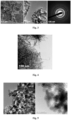
- the thickness of its single nanofilm was 0.25 nm ⁇ 3 nm, and the average area of the nanofilm was greater than 1000 nm 2 , and the as-prepared film showed the characteristics of an obvious two-dimensional material as shown in low magnification and high magnification TEM images in Fig. 1 .
- the titanate nanofilms are agglomerated together, their structures do not contain any nanoporous structures or porous skeletal structures; according to the observation in the low-magnification photographs of Fig.
- the thickness of the agglomerates is extremely thin, which suggests that the agglomerates are not structurally stable near-spherical bodies but rather flat aggregates of a large number of films, which were uniformly flattened out on the TEM carbon mesh during the TEM sample preparation process.
- the solid flocculent material after separation from alkaline solution as described above was dispersed in water, and 0.025 mol/L HCl solution was gradually added to it under stirring state, so that the pH value of the mixed solution decreased continuously, and the pH value of the mixed solution was finally controlled between 2 ⁇ 5. After 10 min, it was separated, cleaned, and dried, which led to the product of the titanic acid nanofilms, with thicknesses of about 0.25 nm ⁇ 3 nm for a single thin film, and the average area of the single film was larger than 1000 nm 2 ; its low magnification and high magnification TEM images is shown in Fig. 2 .
- the above titanic acid nanofilm material was heat-treated at 475°Cfor 2 h, i.e., the anatase-type nano-TiO 2 sheet powder material was obtained, and the thickness of the sheet was about 0.5 nm ⁇ 7 nm, and the average area of the sheet was greater than 200 nm 2 ; and its low magnification and high magnification TEM images, together with diffraction spectra were shown in Fig.
- the titanic acid nanofilm material was treated at 900°C for 2 h, i.e., the rutile nano-TiO 2 sheet powder material was obtained;
- the thickness of the as-prepared sheet was about 1 nm ⁇ 15 nm, and the average area of the as-prepared sheet was greater than 100 2 nm 2 .
- the sodium titanate nanofilm material, the titanic acid nanofilm material, and the TiO 2 nanosheet powder can be applied to polymer-basedd nanocomposite materials, ceramic materials, photocatalytic materials, hydrophobic materials, sewage degradation materials, bactericidal coatings, anticorrosive coatings, marine coatings, and other fields.
- the present example provides a method for preparing a sodium titanate nanofilm material, a titanic acid nanofilm material, and a TiO 2 nanosheet powder, comprising the following steps: Weighing metallic Ti and Al raw materials in accordance with the ratio of Ti 33.3 Al 66.7 (atomic percentage), melting these raw materialsto obtain an alloy melt with a composition of Ti 33.3 Al 66.7 , solidifying the alloy melt into an alloy ingot, and then crushing to an initial alloy powder with a particle size of no more than 100 ⁇ m, which is mainly composed of TiAl 2 intermetallic compound.
- the hydrogenation and Al-removal reaction was completed within 30 s. After holding the temperature for 2 h to ensure the completion of the hydrogenation and Al-removal reaction, the corresponding products could still be obtained by prolonging the holding time; the volume of the solution was maintained at 50 ml by replenishing the evaporated water during the holding time.
- the hot concentrated alkaline solution containing the solid flocculent product was poured onto a five-stacked copper mesh with pore sizes of 200 ⁇ m, 20 ⁇ m, 5 ⁇ m, 5 ⁇ m, 5 ⁇ m, respectively, at an angle of 45° to the horizontal plane; the solid flocculent product was retained on the five-stacked copper mesh, and the alkaline solution was filtered off, while the temperature of the solid flocculent product was reduced to less than 45°C in 20 s.
- the solid flocculent material was washed and dried, i.e., a sodium titanate nanofilm material was obtained, with a thickness ranging from 0.25 nm ⁇ 3 nm for a single film, and an average area of the film being greater than 1000 nm 2 .
- the solid flocculent material after separation from the alkaline solution as described above was dispersed in water, and 0.025 mol/L HCl solution was gradually added to it under stirring, so that the pH value of the mixed solution decreased continuouslyand finally kept between 2 ⁇ 5 for 10 min.
- the titanic acid nanofilm was obtained after separation, washing and dring, and the thickness of the single nanofilm was about 0.25 nm ⁇ 3 nm, with the average area of larger than 1000 nm 2 .
- the morphology shown in TEM images of Fig. 4 indicates that the target products of titanic acid nanofilms can still be obtained by continuing the holding time for 2 h after the end of the hydrogen evolution and Al-removal reaction, combined with the subsequent acid solution reaction.
- the above titanic acid nanofilm material was heat-treated at 550°C for 2 h, i.e., the anatase-type nano TiO 2 sheet powder material was obtained, with the thickness of about 0.5 nm ⁇ 10 nm, and the average area of more than 200 nm 2 as shown in the low-magnification and high-magnification TEM images of Fig. 5 , with its XRD spectrum as shown in Fig. 6 .
- the titanic acid nanofilm material was treated at 700°C for 1 h to obtain a powder material of anatase-type TiO 2 nanosheets mixed with rutile-type TiO 2 nanosheets, with the thickness of the flakes of about 1 nm ⁇ 12 nm, and the average area of the flakes of greater than 150 nm 2 .
- the above titanic acid nanofilm material was treated at 900°C for 2h to obtain a powder material of rutile-type TiO 2 nanosheets, the thickness of which was about 1 nm ⁇ 15 nm, and the average area s was greater than 100 nm 2 .
- the present example provides a potassium titanate nanofilm material and a method for preparing the titanic acid nanofilm material, comprising the following steps: Weighing the metallic Ti and Al raw materials in accordance with the ratio of Ti 40 Al 60 (atomic percentage), melting to obtain an alloy melt with the composition of Ti 40 Al 60 ; Then an initial alloy strip with a thickness of ⁇ 1 mm was prepared form the alloy melt by a rapid solidification method through melt spinning with a copper roller.
- the initial alloy strip mainly consists of TiAl 2 intermetallic compounds and TiAl intermetallic compounds.
- Ti 40 Al 60 initial alloy strip Under ambient pressure, 0.25 g of the above-made Ti 40 Al 60 initial alloy strip was added into 50 ml of aqueous KOH solution at a concentration of 15 mol/L and a temperature of its boiling point ( ⁇ 150°C) with continue stirring.
- the Ti 40 Al 60 initial alloy strip undergoes nano-fragmentation during the reaction with concentrated alkaline solution through intense hydrogenation and Al-removal reactions, and simultaneously undergoes shape and compositional reconfiguration to generate solid flocculent products diffusely distributed in the alkaline solution.
- the hydrogenation and Al-removal reaction was completed within 4 min, and the reaction was kept warm for another 1 min to ensure the completion of the reaction, and then 700 ml of water at room temperature was rapidly poured into the reaction system under stirring, and the concentration of alkali in the solution was reduced to less than 1 mol/L within 2 s, and the temperature was reduced to less than 45°C.
- the solid flocculent material was separated from the alkaline solution and washed and dried, i.e., the potassium titanate nanofilm material was obtained, with the thickness of a single film ranging from 0.25 nm ⁇ 3 nm, and the average area of the film being greater than 1,000 nm 2 , and the resulting film exhibited the characteristics of an obvious two-dimensional material.
- the solid flocculent material after separation from the alkaline solution as described above was dispersed in water, and 0.025 mol/L HCl solution was gradually added to it under stirring, so that the pH value of the mixed solution was continuously decreased, and finally kept between 2 ⁇ 5 for 10 min.
- the titanic acid nanofilm was obtained after separation, washing and dring, and the thickness of a single thin film was about 0.25 nm ⁇ 3 nm, and the average area of the single film was greater than 1000 nm 2 .
- the present example provides a method of preparing sodium titanate nanotubes, titanic acid nanotubes, and TiO 2 nanotubes/rods, comprising the following steps: Weighing the metallic Ti and Al raw materials in accordance with the ratio of Ti 33.3 Al 66.7 (atomic percentage), melting to obtain an alloy melt with the composition of Ti 33.3 Al 66.7 ; Then an initial alloy ribbon with a thickness of ⁇ 30 ⁇ m was prepared form the alloy melt by a rapid solidification method through melt spinning with a copper roller.
- the initial alloy ribbon mainly consists of TiAl 2 intermetallic compound.
- Ti 33.3 Al 66.7 initial alloy ribbon Under ambient pressure, 0.5 g of the Ti 33.3 Al 66.7 initial alloy ribbon was added into 50 mL of aqueous NaOH solution at a concentration of 10 mol/L and a temperature of its boiling point ( ⁇ 119°C) with continue stirring.
- the Ti 33.3 Al 66.7 initial alloy ribbon undergoes nano-fragmentation through intense hydrogenation and Al-removal reaction in concentrated alkaline solution, and simultaneously undergoes shape and compositional reconfiguration to generate solid flocculent products diffusely distributed in alkaline solution.
- the hydrogenation and Al-removal reaction was completed within 15 s, and then the hot aqueous NaOH solution containing the solid flocculent material as described above was sealed in a reaction vessel lined with polytetrafluoroethylene, and then the temperature of the sealed reaction vessel and the solid flocculent product with the aqueous NaOH solution inside the vessel was raised to 250°C within 10 min, and then kept warm for 20 min; at this time, the pressure inside the vessel was higher than the ambient pressure;
- the reactor After 20 min, the reactor is placed in cold water to cool rapidly. After the reaction vessel cools down to room temperature, the pressure inside the vessel is restored to ambient pressure, and then the solid material inside the reaction vessel is separated from the solution, cleaned and dried, i.e., sodium titanate nanotubes are obtained, and the outer diameter of the tubes is 3 nm ⁇ 12 nm, and the length of the tubes is more than 5 times of the outer diameter of the tubes.
- the solid substance in the reactor after separation from the alkaline solution was dispersed in water, and then 0.025 mol/L HCl solution was gradually added to it, so that the pH value of the mixed solution continuously decreased, and the pH value of the mixed solution was finally controlled between 2 ⁇ 4.
- solid-liquid separation, cleaning, and drying were carried out, i.e., titanic acid nanotubes were obtained; and the outer diameter of the tubes was in the range of 3 nm ⁇ 12 nm, the length of the tube is more than 5 times of the outer diameter of the tube.
- the titanic acid nanotubes obtained above are heat-treated at 550°C for 2 h, i.e., anatase TiO 2 nanotubes are obtained, and the outer diameter of the tubes ranges from 3nm ⁇ 15nm, and the length of the tubes is more than 5 times of the outer diameter of the tubes.
- titanic acid nanotubes are heat-treated at 900°C for 2 h, i.e., rutile-type TiO 2 nanotubes/rods are obtained, and the outer diameter of the tubes/rods is 4 nm ⁇ 20 nm, and the length of the tubes/rods is more than 3 times of the outer diameter of the tubes/rods.
- the present example provides a method of preparing a potassium titanate nanofilm material, a titanic acid nanofilm material, and a TiO 2 sheet powder, comprising the following steps: Weighing metallic Ti and Zn raw materials in accordance with the ratio of Ti 25 Zn 75 (atomic percentage), melting to obtain an alloy melt with a composition of Ti 25 Zn 75 ; Then an initial alloy ribbon with a thickness of ⁇ 30 ⁇ m was prepared form the alloy melt by a rapid solidification method through melt spinning with a copper roller.
- the initial alloy ribbon mainly consists of TiZn 3 intermetallic compound.
- Ti 25 Zn 75 initial alloy ribbon Under ambient pressure, 0.25 g of the above-made Ti 25 Zn 75 initial alloy ribbon was added into 50 ml of a KOH aqueous solution at a concentration of 15 mol/L and a temperature of 105°C ⁇ 115°C with continue stirring.
- the Ti 25 Zn 75 initial alloy ribbon undergoes nano-fragmentation during the reaction with concentrated alkaline solution through intense hydrogenation and Zn-removal reaction and simultaneously undergoes shape and compositional reconfiguration to generate solid flocculent products diffusely distributed in the alkaline solution.
- the hydrogenation and Zn-removal reaction was finished within 15 s, and the reaction temperature was hold for 2 min to ensure the complete completion of the reaction, and then 700 ml of room temperature water was rapidly poured into the reaction system at one time under stirring, and the alkali concentration in the solution was lowered to less than 1 mol/L within 2 s, and the temperature was lowered to less than 45°C.
- the above solid flocculent material was separated from the alkaline solution, and washed and dried, i.e., the potassium titanate nanofilm material was obtained,with the thickness of a single film ranging from 0.25 nm ⁇ 3 nm, and the average area of the film being greater than 1,000 nm 2 .
- the solid flocculent material after separation from the alkaline solution as described above is dispersed in water, and then 0.025 mol/L HCl solution is gradually added to it in a stirring state, so that the pH value of the mixed solution continuously decreased, and the pH value of the mixed solution was finally controlled between 2 ⁇ 5. After 10 min, it was separated, cleaned, and dried, which led to the product of the titanic acid nanofilms, and the thickness of a single thin film thereof is about 0.25 nm ⁇ 3 nm, and the average area of the single film is greater than 1000 nm 2 .
- the above titanic acid nanofilm material was heat treated at 500°C for 2 h, i.e., the anatase-type nano-TiO 2 sheet powder material was obtained, with a thickness of about 0.5 nm ⁇ 7 nm, and an average area of greater than 200 nm 2 ;
- the the titanic acid nanofilm material was treated at at 900°C for 2 h, i.e., the rutile nano-TiO 2 sheet powder material was obtained, with a thickness of about 1 nm to 15 nm, and an average area of greater than 100 nm 2 .
- the present example provides a method of preparing a sodium (lithium) titanate nanofilm material, a titanic acid nanofilm material, and a TiO 2 flake powder, comprising the following steps: Weighing metallic Ti and Al raw materials in accordance with the ratio of Ti 25 Al 75 (atomic percentage), melting to obtain an alloy melt with a composition of Ti 25 Al 75 ; Then an initial alloy ribbon with a thickness of ⁇ 200 ⁇ m was prepared form the alloy melt by a rapid solidification method through melt spinning with a copper roller.
- the initial alloy ribbon mainly consists of TiAl 3 intermetallic compound.
- a 6 mol/L LiOH solution, and a 14 mol/L NaOH solution were prepared separately, and the two solutions were mixed to obtain a mixed LiOH and NaOH solution with an OH - concentration of 10 mol/L.
- Ti 25 Al 75 initial alloy ribbon Under ambient pressure, 0.5 g of the above-made Ti 25 Al 75 initial alloy ribbon was added to 50 mL of the above mixed solution at a temperature of its boiling point temperature with continue stirring.
- the Ti 25 Al 75 initial alloy ribbon undergoes nano-fragmentation during reaction with concentrated alkaline solution through intense hydrogenation and Al-removalreactions, and simultaneously undergoes shape and compositional reconfiguration to generate solid flocculated products diffusely distributed in the alkaline solution.
- the hydrogenation and Al-removal reaction was finished within 2 min, and the reaction temperature was hold for 2 min to ensure the complete completion of the reaction, and then 450 ml of room temperature water was rapidly poured into the reaction system under stirring, and the alkali concentration in the solution was lowered to 1 mol/L within 2 s, and the temperature was lowered to less than 45°C.
- the above solid flocculent material was separated from the alkaline solution, washed and dried, i.e., the sodium (lithium) titanate nanofilm material was obtained, with a thickness of a single film of 0.25 nm ⁇ 3 nm and an average area of the film of more than 1000 nm 2 .
- the solid flocculent material after separation from the alkaline solution as described above was dispersed in water, and 0.025 mol/L HCl solution was gradually added to it under stirring, so as to continuously decrease the pH value of the mixed solution and ultimately control the pH value of the mixed solution between 2 - 5 for 10 min, and then separated, cleaned, and dried, which means that the titanic acid nanofilm was obtained, and the thickness of a single thin film thereof was about 0.25 nm ⁇ 3 nm, and the average area of the single film is greater than 1000 nm 2 .
- the above titanic acid nanofilm material was heat treated at 500°C for 2 h, i.e., the anatase-type nano-TiO 2 sheet powder material was obtained, and the thickness of which is about 0.5 nm ⁇ 7 nm, and the average area of which is greater than 200 nm 2 ;
- the the titanic acid nanofilm material was treated at at 900°C for 2 h, i.e., the rutile nano-TiO 2 sheet powder material was obtained, and the thickness of which is about 1 nm to 15 nm, and the average area of which is greater than 100 nm 2 .
- the present example provides a method of preparing sodium titanate nanotubes, titanic acid nanotubes, and TiO 2 nanotubes/rods, comprising the following steps: Weighing the metallic Ti and Al raw materials in accordance with the ratio of Ti 29 Al 71 (atomic percent), melting to obtain an alloy melt with a composition of Ti 29 Al 71 ; Then an initial alloy ribbon with a thickness of ⁇ 25 ⁇ m was prepared form the alloy melt by a rapid solidification method through melt spinning with a copper roller.
- the initial alloy ribbon mainly consists of TiAl 2 and TiAl 3 intermetallic compounds.
- the hydrogenation and Al-removal reaction was finished within 15 s, and then the above NaOH aqueous solution containing solid flocculent material was sealed in a reactor lined with PTFE, and then the temperature of the sealed reactor and the solid flocculent product and the NaOH aqueous solution inside the sealed reactor was increased to 275°C within 10 min, and then kept warm for 10 min; at this time, the pressure inside the reactor was higher than the ambient pressure;
- the reaction vessel After holding the temperature for 10min, the reaction vessel is placed in cold water to rapidly cooly. After the reaction vessel is cooled down to room temperature, the pressure inside the vessel is restored to ambient pressure, and then the solid material inside the reaction vessel is separated from the solution, cleaned, and dried, then sodium titanate nanotubes are obtained, with an outer diameter of 3 nm ⁇ 12 nm, and a length ofmore than 5 times of the outer diameter of the tubes.
- the solid substance in the reactor after separation from the alkaline solution is dispersed in water, and then 0.025 mol/L HCl solution is gradually added to it, so that the pH value of the mixed solution continuously decreased, and finally the pH value of the mixed solution is controlled between 2 ⁇ 5.
- solid-liquid separation, cleaning and drying are performed, i.e., titanic acidnanotubes are obtained;
- the outer diameter of the tube ranges from 3 nm ⁇ 12 nm, and the length of the tube is more than 5 times of the outer diameter of the tube.
- the titanic acid nanotubes obtained above are heat-treated at 500°C for 3 h, i.e., anatase TiO 2 nanotubes are obtained, and the outer diameter of the tubes is in the range of 3 nm ⁇ 15 nm, and the length of the tubes is more than 5 times of the outer diameter of the tubes.
- the titanic acid nanotubes produced above are heat-treated at 900°C for 2 h, i.e., rutile TiO 2 nanotubes/rods are obtained;
- the outer diameter of the tubes/rods is 4 nm ⁇ 20 nm, and the length of the tubes/rods is more than 3 times of the outer diameter of the tubes/rods.
- the present example provides a method of preparing sodium titanate nanotubes, titanic acid nanotubes, and TiO 2 nanotubes/rods, comprising the following steps: Weighing the metallic Ti and Al raw materials in accordance with the ratio of Ti 25 Al 75 (atomic percentage), melting to obtain an alloy melt with a composition of Ti 25 Al 75 ;Then an initial alloy ribbon with a thickness of ⁇ 25 ⁇ m was prepared form the alloy melt by a rapid solidification method through melt spinning with a copper roller.
- the initial alloy ribbon mainly consists ofTiAl3 intermetallic compound.
- the reactor After 20 min, the reactor is placed in cold water to rapidly cool down. After the reaction vessel cools down to room temperature, the pressure in the vessel is restored to ambient pressure, and then the solid material in the reaction vessel is separated from the solution, cleaned and dried, then sodium titanate nanotubes are obtained, with an outer diameter of 3 nm ⁇ 12 nm, and a length of more than 5 times of the outer diameter of the tubes.
- the titanate nanotubes obtained above were heat-treated at 550°C for 1 h, i.e., anatase TiO 2 nanotubes were obtained, and the outer diameter of the tubes was 3 nm ⁇ 15 nm, and the length of the tubes was more than 5 times of the outer diameter of the tubes.
- the above-made titanate nanotubes are heat-treated at 900°C for 2 h, i.e., rutile-type TiO 2 nanotubes/rods are obtained, and the outer diameter of the tubes/rods is 4 nm ⁇ 20 nm, and the length of the tubes/rods is more than 3 times of the outer diameter of the tubes/rods.
- the present example provides a method of preparing a sodium titanate nanofilm material, a titanic acid nanofilm material, and a TiO 2 sheet powder, comprising the following steps: Weighing metallic Ti and Zn raw materials in accordance with the ratio of Ti 25 Zn 75 (atomic percentage), melting to obtain an alloy melt with the composition of Ti 25 Zn 75 ;Then a Ti 25 Zn 75 initial alloy ribbon with a thickness of ⁇ 100 ⁇ m was prepared form the alloy melt by a rapid solidification method through melt spinning with a copper roller.
- the initial alloy ribbon mainly consists of TiZn 3 intermetallic compound.
- the intense hydrogenation and Zn-removal reaction was completed within 1 min, and the reaction temperature was hold for 2 min to ensure the complete completion of the reaction, and then 450 ml of room-temperature water was rapidly poured into the reaction system at one time under stirring, and the alkali concentration in the solution was lowered to 1 mol/L within 2 s, and the temperature was lowered to less than 45°C.
- the solid flocculent material was separated from the alkaline solution and washed and dried, i.e., the sodium titanate nanofilm material was obtained, with the thickness of a single film ranging from 0.25 nm ⁇ 3 nm, and the average area of the film being greater than 1,000 nm 2 , and the resulting film exhibited the characteristics of an obvious two-dimensional material.
- the solid flocculent material after separation from the alkaline solution as described above was dispersed in water, and 0.025 mol/L HCl solution was gradually added to it in the stirring state, so that the pH value of the mixed solution was continuously decreased, and the pH value of the mixed solution was finally controlled between 2 ⁇ 5. After 10 min, it was separated, cleaned, and dried, then the product of the titanic acid nanofilm was obtained, with a thickness of a single thin film about 0.25 nm ⁇ 3 nm, and an average area of the single film greater than 1000 nm 2 .
- the above titanic acid nanofilm material was heat treated at 500°C for 2 h, i.e., the anatase-type nano-TiO 2 sheet powder material was obtained, with a thickness of about 0.5 nm ⁇ 7 nm, and an average area ofgreater than 200 nm 2 ;
- Theabove titanic acid nanofilm material was treated at at 900°C for 2 h, i.e., the rutile nano-TiO 2 sheet powder material was obtained, with a thickness of about 1 nm to 15 nm, and an average area ofgreater than 100 nm 2 .
- the present example provides a preparation method of a titanate nanofilm powder material, and the titanic acid nanofilm powder material, comprising the following steps: Weighing the metallic Ti and Al raw materials in accordance with the ratio of Ti 25 Al 75 (atomic percentage), melting to obtain an alloy melt with the composition of Ti 25 Al 75 ; Then an initial alloy ribbon with a thickness of ⁇ 100 ⁇ m was prepared form the alloy melt by a rapid solidification method through melt spinning with a copper roller.
- the initial alloy ribbon mainly consists of TiAl 3 intermetallic compound.
- the hydrogen generation and T-removal reaction was completed within 30 s. After 30 s, the closed vessel and the reaction system were rapidly cooled down to near room temperature in cooling water, and the pressure in the closed vessel was restored to ambient pressure;
- anatase TiO 2 powder with particle size of 50 nm ⁇ 100 nm was added into 50 mL of NaOH aqueous solution with a concentration of 10 mol/L and a temperature of its boiling point temperature (119°C) with continue stirring.
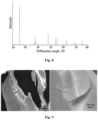
- the solid material in the solution was separated from the solution, cleaned and dried, and the XRD spectrum of its product was measured, as shown in Fig. 7 .
- the raw materials of metallic Ti and Al were weighed according to the ratio of Ti 25 Al 75 (atomic percentage), and the alloy melt with the composition of Ti 25 Al 75 was obtained by melting; solidifying the alloy melt into an alloy ingot, and then crushing to an initial alloy powder with a particle size of no more than 30 ⁇ m, which is mainly composed of TiAl 3 intermetallic compound.
- the above initial alloy powder was reacted with 10 mol/L NaOH solution at a temperature of 35°C for 2 h, and the resulting product is shown in Fig. 9 .
- the shape of the original initial alloy powder before and after the reaction was roughly unchanged, and it was still the original crushed and angular powder particles, such as the angular morphology shown in Fig. 9 , and its microstructure did not generate a large number of monolithic two-dimensional thin film products, but rather, it was the nanoporous network composed of the original angular powder particles. Therefore, the reaction equilibrium of the initial alloy and the alkaline solution occurring at a lower temperature is completely different from the reaction equilibrium of the present invention occurring near the boiling point temperature, and the product morphology is also completely different.
Landscapes
- Chemical & Material Sciences (AREA)
- Organic Chemistry (AREA)
- Life Sciences & Earth Sciences (AREA)
- Environmental & Geological Engineering (AREA)
- General Life Sciences & Earth Sciences (AREA)
- Geology (AREA)
- Inorganic Chemistry (AREA)
- Engineering & Computer Science (AREA)
- Nanotechnology (AREA)
- Physics & Mathematics (AREA)
- Condensed Matter Physics & Semiconductors (AREA)
- General Physics & Mathematics (AREA)
- Manufacturing & Machinery (AREA)
- Crystallography & Structural Chemistry (AREA)
- Inorganic Compounds Of Heavy Metals (AREA)
- Powder Metallurgy (AREA)
Applications Claiming Priority (2)
| Application Number | Priority Date | Filing Date | Title |
|---|---|---|---|
| CN202110442575 | 2021-04-23 | ||
| PCT/CN2022/088185 WO2022222998A1 (zh) | 2021-04-23 | 2022-04-21 | 一种纳米钛酸盐、纳米钛酸、纳米TiO2的制备方法及用途 |
Publications (2)
| Publication Number | Publication Date |
|---|---|
| EP4328186A1 true EP4328186A1 (de) | 2024-02-28 |
| EP4328186A4 EP4328186A4 (de) | 2025-12-24 |
Family
ID=83130695
Family Applications (1)
| Application Number | Title | Priority Date | Filing Date |
|---|---|---|---|
| EP22791104.7A Pending EP4328186A4 (de) | 2021-04-23 | 2022-04-21 | Herstellungsverfahren für nanotitanat, nanotitansäure und nano tio2 sowie verwendung davon |
Country Status (6)
| Country | Link |
|---|---|
| US (1) | US20240327235A1 (de) |
| EP (1) | EP4328186A4 (de) |
| JP (1) | JP2024518777A (de) |
| KR (1) | KR20230173193A (de) |
| CN (1) | CN115038666B (de) |
| AU (1) | AU2022263077B2 (de) |
Families Citing this family (3)
| Publication number | Priority date | Publication date | Assignee | Title |
|---|---|---|---|---|
| CN120051439A (zh) * | 2022-09-16 | 2025-05-27 | 赵远云 | 一种原位内生掺杂的钛氧基复合粉体材料及其制备方法与用途 |
| CN121568894A (zh) * | 2022-09-23 | 2026-02-24 | 赵远云 | 原位内生掺杂的纳米多孔复合粉体材料及其制备方法与用途 |
| EP4606770A1 (de) * | 2022-10-21 | 2025-08-27 | Zhao, Yuanyun | Herstellungsverfahren und verwendung von dotiertem nanometer-barium/lithiumtitanat-pulvermaterial |
Family Cites Families (5)
| Publication number | Priority date | Publication date | Assignee | Title |
|---|---|---|---|---|
| US8440162B1 (en) * | 2006-12-18 | 2013-05-14 | The Research Foundation Of State University Of New York | Titanate and titania nanostructures and nanostructure assemblies, and methods of making same |
| KR101507930B1 (ko) * | 2013-12-02 | 2015-04-07 | 자동차부품연구원 | 나노 구조체 및 그 제조방법 |
| JP6515419B2 (ja) * | 2014-05-27 | 2019-05-22 | 国立大学法人信州大学 | 金属酸化物ナノワイヤーの製造方法およびナノワイヤー |
| CN104628029A (zh) * | 2015-01-23 | 2015-05-20 | 济南大学 | 一种钛酸盐、锐钛矿TiO2和AgCl/Ag/TiO2复合材料的制备方法 |
| JP2020116504A (ja) * | 2019-01-22 | 2020-08-06 | 国立大学法人信州大学 | ナノ構造を持つ吸着剤の製造方法及びナノ構造を持つ吸着剤の造粒体 |
-
2022
- 2022-04-21 KR KR1020237040424A patent/KR20230173193A/ko active Pending
- 2022-04-21 CN CN202280002281.7A patent/CN115038666B/zh active Active
- 2022-04-21 EP EP22791104.7A patent/EP4328186A4/de active Pending
- 2022-04-21 JP JP2023565459A patent/JP2024518777A/ja active Pending
- 2022-04-21 AU AU2022263077A patent/AU2022263077B2/en active Active
-
2023
- 2023-10-18 US US18/489,664 patent/US20240327235A1/en active Pending
Also Published As
| Publication number | Publication date |
|---|---|
| AU2022263077A1 (en) | 2023-12-07 |
| KR20230173193A (ko) | 2023-12-26 |
| CN115038666A (zh) | 2022-09-09 |
| CN115038666B (zh) | 2024-07-05 |
| AU2022263077B2 (en) | 2025-12-11 |
| JP2024518777A (ja) | 2024-05-02 |
| US20240327235A1 (en) | 2024-10-03 |
| EP4328186A4 (de) | 2025-12-24 |
Similar Documents
| Publication | Publication Date | Title |
|---|---|---|
| US20240327235A1 (en) | Preparation method for nano titanate, nano titanic acid, and nano tio2, and a use thereof | |
| Wang et al. | One-step synthesis of titanium oxide nanoparticles by spray pyrolysis of organic precursors | |
| CN102596814B (zh) | 氧化钛溶胶、其制造方法、超微粒状氧化钛、其制造方法及用途 | |
| Wu et al. | Effects of alcohol solvents on anatase TiO2 nanocrystals prepared by microwave-assisted solvothermal method | |
| US20240132367A1 (en) | Method for preparing nano-titanate, nano-titanic acid and nano-tio2 containing embedded nanoparticles and method for preparing metal nanoparticles | |
| Gao et al. | Factors influencing formation of highly dispersed BaTiO3 nanospheres with uniform sizes in static hydrothermal synthesis | |
| Zhang et al. | A single-step direct hydrothermal synthesis of SrTiO3 nanoparticles from crystalline P25 TiO2 powders | |
| JP2014019617A (ja) | チタン酸リチウム微粒子とその製造方法 | |
| Arvisdea et al. | Synthesis of nanoparticles and nanocomposite of WO3 | |
| US20240132366A1 (en) | Nano-titanate, nano-titanic acid, and nano-tio2 containing doping ag, preparation method therefor and use thereof | |
| Zhang et al. | CTAB-assisted hydrothermal synthesis of nano-sized tetragonal zirconium dioxide | |
| Zheng et al. | Simple additive-free method to manganese monoxide mesocrystals and their template application for the synthesis of carbon and graphitic hollow octahedrons | |
| WO2022222998A1 (zh) | 一种纳米钛酸盐、纳米钛酸、纳米TiO2的制备方法及用途 | |
| JP2020531389A (ja) | 固体材料へのチタンの均一導入 | |
| EP4512775A1 (de) | Nanometalloxid, verfahren zur herstellung davon und verwendung davon | |
| Sahoo et al. | X-ray diffraction and microstructural studies on hydrothermally synthesized cubic barium titanate from TiO2–Ba (OH) 2–H2O system | |
| Ranu et al. | Synthesis and Characterization of V2O5 Nanorods Using Hydrothermal Method for Energy Application | |
| EP4512774A1 (de) | Herstellungsverfahren und verwendungen von mit edelmetallnanopartikeln dotierten nanometalloxid- und edelmetallnanopartikeln | |
| WO2022222997A1 (zh) | 含有嵌生纳米颗粒的纳米钛酸盐、纳米钛酸、纳米TiO 2的制备方法及金属纳米颗粒的制备方法 | |
| CA3289862A1 (en) | Nano metal oxides, preparation method therefor, and use therefor | |
| JP2010105904A (ja) | 粉体の合成方法及び電子部品の製造方法 | |
| CN119998237A (zh) | 一种复合纳米金属氧化物及其制备方法与用途 | |
| Ma et al. | A convenient inorganic solvent thermal route to nanocrystalline tantalum diboride | |
| WO2024055754A1 (zh) | 一种原位内生掺杂的钛氧基复合粉体材料及其制备方法与用途 | |
| JP2026515387A (ja) | 貴金属ナノ粒子がドープされた金属酸化物、および貴金属ナノ粒子の製造方法と用途 |
Legal Events
| Date | Code | Title | Description |
|---|---|---|---|
| STAA | Information on the status of an ep patent application or granted ep patent |
Free format text: STATUS: THE INTERNATIONAL PUBLICATION HAS BEEN MADE |
|
| PUAI | Public reference made under article 153(3) epc to a published international application that has entered the european phase |
Free format text: ORIGINAL CODE: 0009012 |
|
| STAA | Information on the status of an ep patent application or granted ep patent |
Free format text: STATUS: REQUEST FOR EXAMINATION WAS MADE |
|
| 17P | Request for examination filed |
Effective date: 20231122 |
|
| AK | Designated contracting states |
Kind code of ref document: A1 Designated state(s): AL AT BE BG CH CY CZ DE DK EE ES FI FR GB GR HR HU IE IS IT LI LT LU LV MC MK MT NL NO PL PT RO RS SE SI SK SM TR |
|
| DAV | Request for validation of the european patent (deleted) | ||
| DAX | Request for extension of the european patent (deleted) | ||
| RIC1 | Information provided on ipc code assigned before grant |
Ipc: C01G 23/00 20060101AFI20250707BHEP Ipc: C01G 23/08 20060101ALI20250707BHEP Ipc: B82Y 30/00 20110101ALI20250707BHEP Ipc: B82Y 40/00 20110101ALI20250707BHEP Ipc: C01G 23/04 20060101ALI20250707BHEP Ipc: C01G 23/047 20060101ALI20250707BHEP Ipc: C01G 23/053 20060101ALI20250707BHEP |
|
| A4 | Supplementary search report drawn up and despatched |
Effective date: 20251124 |
|
| RIC1 | Information provided on ipc code assigned before grant |
Ipc: C01G 23/00 20060101AFI20251118BHEP Ipc: C01G 23/08 20060101ALI20251118BHEP Ipc: B82Y 30/00 20110101ALI20251118BHEP Ipc: B82Y 40/00 20110101ALI20251118BHEP Ipc: C01G 23/04 20060101ALI20251118BHEP Ipc: C01G 23/047 20060101ALI20251118BHEP Ipc: C01G 23/053 20060101ALI20251118BHEP |