EP4512775A1 - Nanometalloxid, verfahren zur herstellung davon und verwendung davon - Google Patents
Nanometalloxid, verfahren zur herstellung davon und verwendung davon Download PDFInfo
- Publication number
- EP4512775A1 EP4512775A1 EP22937945.8A EP22937945A EP4512775A1 EP 4512775 A1 EP4512775 A1 EP 4512775A1 EP 22937945 A EP22937945 A EP 22937945A EP 4512775 A1 EP4512775 A1 EP 4512775A1
- Authority
- EP
- European Patent Office
- Prior art keywords
- nano
- oxide
- reaction
- initial alloy
- materials
- Prior art date
- Legal status (The legal status is an assumption and is not a legal conclusion. Google has not performed a legal analysis and makes no representation as to the accuracy of the status listed.)
- Pending
Links
Images


Classifications
-
- C—CHEMISTRY; METALLURGY
- C01—INORGANIC CHEMISTRY
- C01G—COMPOUNDS CONTAINING METALS NOT COVERED BY SUBCLASSES C01D OR C01F
- C01G33/00—Compounds of niobium
-
- C—CHEMISTRY; METALLURGY
- C01—INORGANIC CHEMISTRY
- C01F—COMPOUNDS OF THE METALS BERYLLIUM, MAGNESIUM, ALUMINIUM, CALCIUM, STRONTIUM, BARIUM, RADIUM, THORIUM, OR OF THE RARE-EARTH METALS
- C01F17/00—Compounds of rare earth metals
- C01F17/20—Compounds containing only rare earth metals as the metal element
- C01F17/206—Compounds containing only rare earth metals as the metal element oxide or hydroxide being the only anion
- C01F17/218—Yttrium oxides or hydroxides
-
- C—CHEMISTRY; METALLURGY
- C01—INORGANIC CHEMISTRY
- C01F—COMPOUNDS OF THE METALS BERYLLIUM, MAGNESIUM, ALUMINIUM, CALCIUM, STRONTIUM, BARIUM, RADIUM, THORIUM, OR OF THE RARE-EARTH METALS
- C01F17/00—Compounds of rare earth metals
- C01F17/20—Compounds containing only rare earth metals as the metal element
- C01F17/206—Compounds containing only rare earth metals as the metal element oxide or hydroxide being the only anion
- C01F17/224—Oxides or hydroxides of lanthanides
-
- C—CHEMISTRY; METALLURGY
- C01—INORGANIC CHEMISTRY
- C01G—COMPOUNDS CONTAINING METALS NOT COVERED BY SUBCLASSES C01D OR C01F
- C01G31/00—Compounds of vanadium
- C01G31/02—Oxides
-
- C—CHEMISTRY; METALLURGY
- C01—INORGANIC CHEMISTRY
- C01G—COMPOUNDS CONTAINING METALS NOT COVERED BY SUBCLASSES C01D OR C01F
- C01G35/00—Compounds of tantalum
-
- C—CHEMISTRY; METALLURGY
- C01—INORGANIC CHEMISTRY
- C01G—COMPOUNDS CONTAINING METALS NOT COVERED BY SUBCLASSES C01D OR C01F
- C01G37/00—Compounds of chromium
- C01G37/02—Oxides or hydrates thereof
-
- C—CHEMISTRY; METALLURGY
- C01—INORGANIC CHEMISTRY
- C01G—COMPOUNDS CONTAINING METALS NOT COVERED BY SUBCLASSES C01D OR C01F
- C01G37/00—Compounds of chromium
- C01G37/02—Oxides or hydrates thereof
- C01G37/033—Chromium trioxide; Chromic acid
-
- C—CHEMISTRY; METALLURGY
- C01—INORGANIC CHEMISTRY
- C01G—COMPOUNDS CONTAINING METALS NOT COVERED BY SUBCLASSES C01D OR C01F
- C01G39/00—Compounds of molybdenum
- C01G39/02—Oxides; Hydroxides
-
- C—CHEMISTRY; METALLURGY
- C01—INORGANIC CHEMISTRY
- C01G—COMPOUNDS CONTAINING METALS NOT COVERED BY SUBCLASSES C01D OR C01F
- C01G45/00—Compounds of manganese
- C01G45/02—Oxides
-
- C—CHEMISTRY; METALLURGY
- C01—INORGANIC CHEMISTRY
- C01P—INDEXING SCHEME RELATING TO STRUCTURAL AND PHYSICAL ASPECTS OF SOLID INORGANIC COMPOUNDS
- C01P2004/00—Particle morphology
- C01P2004/10—Particle morphology extending in one dimension, e.g. needle-like
-
- C—CHEMISTRY; METALLURGY
- C01—INORGANIC CHEMISTRY
- C01P—INDEXING SCHEME RELATING TO STRUCTURAL AND PHYSICAL ASPECTS OF SOLID INORGANIC COMPOUNDS
- C01P2004/00—Particle morphology
- C01P2004/20—Particle morphology extending in two dimensions, e.g. plate-like
-
- C—CHEMISTRY; METALLURGY
- C01—INORGANIC CHEMISTRY
- C01P—INDEXING SCHEME RELATING TO STRUCTURAL AND PHYSICAL ASPECTS OF SOLID INORGANIC COMPOUNDS
- C01P2004/00—Particle morphology
- C01P2004/30—Particle morphology extending in three dimensions
- C01P2004/32—Spheres
-
- C—CHEMISTRY; METALLURGY
- C01—INORGANIC CHEMISTRY
- C01P—INDEXING SCHEME RELATING TO STRUCTURAL AND PHYSICAL ASPECTS OF SOLID INORGANIC COMPOUNDS
- C01P2004/00—Particle morphology
- C01P2004/50—Agglomerated particles
-
- C—CHEMISTRY; METALLURGY
- C01—INORGANIC CHEMISTRY
- C01P—INDEXING SCHEME RELATING TO STRUCTURAL AND PHYSICAL ASPECTS OF SOLID INORGANIC COMPOUNDS
- C01P2004/00—Particle morphology
- C01P2004/54—Particles characterised by their aspect ratio, i.e. the ratio of sizes in the longest to the shortest dimension
-
- C—CHEMISTRY; METALLURGY
- C01—INORGANIC CHEMISTRY
- C01P—INDEXING SCHEME RELATING TO STRUCTURAL AND PHYSICAL ASPECTS OF SOLID INORGANIC COMPOUNDS
- C01P2004/00—Particle morphology
- C01P2004/60—Particles characterised by their size
- C01P2004/62—Submicrometer sized, i.e. from 0.1-1 micrometer
-
- C—CHEMISTRY; METALLURGY
- C01—INORGANIC CHEMISTRY
- C01P—INDEXING SCHEME RELATING TO STRUCTURAL AND PHYSICAL ASPECTS OF SOLID INORGANIC COMPOUNDS
- C01P2004/00—Particle morphology
- C01P2004/60—Particles characterised by their size
- C01P2004/64—Nanometer sized, i.e. from 1-100 nanometer
Definitions
- This invention relates to the field of nanomaterials technology, particularly to a nano metal oxide and its preparation method and applications.
- Nano metal oxide materials are widely used in fields such as composite materials, catalytic materials, ceramic materials, refractory materials, advanced electronic materials, battery materials, photochromic materials, wave-absorbing materials, wastewater degradation materials, antimicrobial materials, coatings, pigments, thermal spraying materials, sensors, and more.
- Current methods for preparing nano metal oxide materials include sol-gel methods, alkoxide hydrolysis, forced hydrolysis, solution gas-phase decomposition, wet chemical synthesis, microemulsion methods, etc. However, these methods either require high temperatures, high pressures, and other harsh equipment and conditions, or they involve multiple reactants and several reaction steps, greatly limiting the low-cost preparation and widespread application of nano metal oxide materials. Therefore, developing new preparation methods for nano metal oxides with mild reaction conditions, simple reactants, and short-flow process is of significant importance.
- the A-class elements are simultaneously introduced into the alloy melt, so that the initial alloy also contains A-class elements.
- ordinary rare earth raw materials contain oxygen (O)
- industrial remelting aluminum ingots contain silicon (Si), which results in the initial alloy containing O and Si elements.
- the A-class elements may also originate from the atmosphere or furnace lining during the alloy melting process.
- the alloy melting process is carried out in an atmospheric environment.
- the initial alloy when in ribbon form, it can be prepared by methods such as the melt spinning method.
- initial alloy ingot when the initial alloy is in granular form, a larger volume initial alloy ingot can be prepared by casting, and then the ingot is crushed into initial alloy particles.
- the alkali solution comprises at least one of NaOH, KOH, LiOH, RbOH, CsOH, Ba(OH) 2 , Ca(OH) 2 , and Sr(OH) 2 solutions.
- the solvent in the alkali solution contains water; preferably, the solvent in the alkali solution is water.
- the concentration of the alkali in the alkali solution is 3-30 mol/L; further, the concentration of the alkali in the alkali solution is 5.1-30 mol/L; preferably, the concentration of the alkali in the alkali solution is 5.1-15 mol/L; more preferably, the concentration of the alkali in the alkali solution is 7-15 mol/L.
- the alkali in the alkali solution reacting with the initial alloy is in an excess dosage, with the volume of the alkali solution being at least five times the volume of the initial alloy, allowing the reaction to proceed at a high alkali concentration.
- the volume of the alkali solution is at least ten times the volume of the initial alloy. Further, the volume of the alkali solution is at least twenty times the volume of the initial alloy. Further, the reaction temperature of the initial alloy and the alkali solution corresponds to the temperature of the alkali solution.
- the temperature of the alkali solution should ensure that during the hydrogen evolution and T-removal reaction, the reaction interface progresses into the initial alloy surface at an average rate of at least 2 ⁇ m/min, and the initial alloy undergoes nanofracture via the hydrogen evolution and T-removal reaction, i.e., the reaction rate or reaction time (since the reaction rate and initial alloy size are determined, the reaction time is also determined; the hydrogen evolution and T-removal reaction time is the time required for the reaction-generated gas to become undetectable by the naked eye) and the reaction effect determine the temperature T 1 and concentration of the alkali solution.
- the average rate of 2 ⁇ m/min is the critical reaction rate for nanofracture of the initial alloy via the hydrogen evolution and T-removal reaction.
- the nanofracture refers to the initial alloy being fractured by the hydrogen evolution and T-removal reaction into a single intermediate product or product with at least one dimension in the three-dimensional direction smaller than 500 nm.
- the nanofracture refers to the initial alloy being fractured by the hydrogen evolution and T-removal reaction into a single intermediate product or product with at least one dimension in the three-dimensional direction smaller than 250 nm.
- the temperature of the alkali solution is T 1 , and T 1 ⁇ 60°C; further, T 1 ⁇ 70°C; further, T 1 ⁇ 80°C; further, T 1 ⁇ 90°C.
- the initial alloy mainly comprises at least one of Cr, V, Nb, Ta, W, Mo, and Mn in the M element, T 1 ⁇ 60°C.
- the initial alloy mainly comprises at least one of Cr, V, Nb, Ta, W, and Mo in the M element, T 1 ⁇ 60°C.
- the initial alloy mainly comprises at least one of Y, La, Ce, Pr, Nd, Pm, Sm, Eu, Gd, Tb, Dy, Ho, Er, Tm, Yb, and Lu in the M element, T 1 > 100°C.
- the initial alloy comprises at least one of Cr, V, Nb, Ta, W, Mo, Mn, Y, La, Ce, Pr, Nd, Pm, Sm, Eu, Gd, Tb, Dy, Ho, Er, Tm, Yb, and Lu in the M element
- T element comprises Zn, T 1 ⁇ 60°C.
- the initial alloy comprises at least one of Cr, V, Nb, Ta, W, Mo, Mn, Y, La, Ce, Pr, Nd, Pm, Sm, Eu, Gd, Tb, Dy, Ho, Er, Tm, Yb and Lu in the M element
- T element comprises at least one of Al and Zn, 100°C ⁇ T 1 .
- reaction between the initial alloy and the alkali solution is carried out at atmospheric pressure or high pressure.
- reaction between the initial alloy and the alkali solution is carried out in a sealed container.
- the initial alloy and the alkali solution are first placed separately within the container. Once the temperature of the alkali solution reaches the set reaction temperature, the initial alloy and alkali solution are brought into contact to undergo the reaction.
- the temperature of the alkali solution can exceed its boiling point under atmosphere pressure.
- T f solution is the boiling point of the alkali solution at atmosphere pressure.
- the reaction is carried out under atmospheric pressure, which generally refers to 1 standard atmospheric pressure, where the boiling point of water is 100°C.
- atmospheric pressure generally refers to 1 standard atmospheric pressure, where the boiling point of water is 100°C.
- a 5 mol/L NaOH solution has a boiling point of about 108°C; a 7 mol/L NaOH solution has a boiling point of about 112°C; a 10 mol/L NaOH solution has a boiling point of about 119°C; a 12 mol/L NaOH solution has a boiling point of about 128°C; a 15 mol/L NaOH solution has a boiling point of about 140°C; a 17 mol/L NaOH solution has a boiling point of about 148°C; a 20 mol/L NaOH solution has a boiling point of about 160°C; a 25 mol/L NaOH solution has a boiling point of about 180°C; a 10 mol/L KOH solution has a boiling point of about 125°C; a 12 mol/L KOH solution has a boiling point of about 136°C; a 15 mol/L KOH solution has a boiling point of about 150°C.
- the reaction solution Since the highest temperature that the reaction solution can reach under atmospheric pressure is its boiling point temperature ( T f solution ), once the temperature reaches this point, further heating will not increase the temperature of the solution, and it will only boil. To increase the reaction temperature, the concentration of the alkali solution can be raised, thereby achieving a higher boiling point temperature. Therefore, controlling the boiling point temperature is the easiest, simplest, and most precise method. Moreover, under the same concentration, the required reaction time at the boiling point temperature is shorter than the reaction time at other temperatures below the boiling point.
- the T-class elements includes at least one of Al and Zn, both of which are amphoteric metals. They can react with hot concentrated alkali solutions to form salts that dissolve in the alkali solution.
- Al and Zn both of which are amphoteric metals. They can react with hot concentrated alkali solutions to form salts that dissolve in the alkali solution.
- the A-class elements although they are generally impurity elements in the initial alloy raw material or in the initial alloy itself, alkali metals or alkaline earth metals like Na, K, Mg, Ca, Li, etc., which share the same cations as those in the alkali solution, will also form ions and enter the solution. Under atmospheric pressure, elements like O and H are also present in the alkali solution. For Si elements, they can also react with hot concentrated alkali solution and enter the solution. Therefore, both the A elements and T elements can dissolve in the hot alkali solution.
- the initial alloy undergoes intense hydrogen evolution and T-removal reactions, resulting in nanofracture and the formation of nanoscale solid products containing M, with shape and composition reorganization.
- the characteristics of the hydrogen evolution and T-removal reaction include: the T element in the initial alloy dissolves into the solution while hydrogen gas is released.
- the intensity of the hydrogen evolution and T-removal reaction is related to the rate at which the reaction interface advances from the surface of the initial alloy towards the interior. The higher the alkali concentration and the higher the temperature of the alkali solution, the faster the advancement rate of the reaction interface, and the more intense of the reaction.
- ultrasound is applied to further enhance the nanofracture effect and increase the reaction rate.
- the frequency of the ultrasound is between 20 kHz and 10 6 kHz.
- the rate of advancement of the reaction interface from the surface of the initial alloy to the interior is as follows:
- reaction interface advances from the surface of the initial alloy to the interior at an average rate of at least 7 ⁇ m/min.
- reaction interface advances from the surface of the initial alloy to the interior at an average rate of at least 15 ⁇ m/min.
- reaction interface advances from the surface of the initial alloy to the interior at an average rate of at least 30 ⁇ m/min.
- the temperature of the alkali solution can be adjusted to ensure that during the hydrogen evolution and T-removal reaction, the reaction interface advances at an average rate of at least 2 ⁇ m/min from the surface of the initial alloy to the interior, and the initial alloy undergoes nano-fragmentation during the process. Therefore, under different initial alloy or alkali solution conditions, when the reaction interface advances at least 2 ⁇ m/min during the hydrogen evolution and T-removal reaction, the required reaction temperature may be below 60°C. Particularly when ultrasonic treatment is applied, the required reaction temperature may be even lower.
- the nano-fragmentation refers to the process in which the reaction interface of the initial alloy is fragmented into nanometer-scale intermediate products or products through the hydrogen evolution and T-removal reaction, and simultaneously undergoes shape and composition reorganization to form nanoscale solid products containing M.
- the intense release of hydrogen gas from the hydrogen evolution and T-removal reaction promotes the nano-fragmentation of the intermediate products or products, as well as the diffusion distribution of products in the alkaline solution when the products leave the reaction interface.
- nano-fragmentation refers to the case where the size of the solid product containing M is smaller than the size of the initial alloy before the nano-fragmentation.
- shape reorganization means that the nanoscale solid products containing M obtained from the hydrogen evolution and T-removal reaction do not merely undergo physical fragmentation into nanoporous structures (ligaments), but instead undergo shape changes in addition to physical fragmentation.
- the solid products containing M exhibit particle dispersibility.
- Mn oxide can be MnO or MnO 2 .
- the size of the solid product containing M is less than 0.25 times the size of the initial alloy before the nano-fragmentation.
- the size of the solid product containing M is less than 0.05 times the size of the initial alloy before the nano-fragmentation.
- the nano-fragmentation refers to the process in which the initial alloy is fragmented during the hydrogen evolution and T-removal reaction into intermediate products or products that have at least one dimension less than 500 nm.
- the solid products containing M have a shape in which at least one dimension in three-dimensional direction is no more than 500 nm.
- the solid products containing M are primarily in the form of thin films, their thickness ranges from 0.25 nm to 30 nm, and the average area of the thin films is larger than 100 nm 2 .
- the solid products containing M are primarily in the form of particles, their particle size range is from 1.5 nm to 500 nm, preferably 1.5 nm to 200 nm, and more preferably 1.5 nm to 100 nm.
- the solid products containing M are primarily in the form of platelets, their thickness range is from 1.5 nm to 100 nm, preferably 5 nm to 30 nm, and more preferably 5 nm to 20 nm. Additionally, the average area of the platelets is larger than 100 nm 2 .
- the size of the flocculent microstructure ranges from 1 nm to 15 nm.
- the solid products containing M when they are primarily in the form of rod-like structures, they include tubular or rod-like shapes, with diameters ranging from 2 nm to 200 nm, and preferably 2 nm to 50 nm.
- the length-to-diameter ratio is greater than 2.
- the rod-like structure can be considered fiber-like.
- the solid products containing M include at least one of the following: low crystallinity nano M oxide, crystalline nano M oxide, or nano hydrated M oxide.
- the low-crystallinity nano M oxide includes amorphous nano M oxide.
- nano- M hydroxide can be considered as a combination of nano M oxide and H 2 O, it can be converted into nano M oxide by heating and dehydrating at lower temperatures. Therefore, the nano hydrated M oxide is essentially nano M hydroxide.
- the nano M oxide can be a single nano M oxide, or it can be a composite of nano M oxides composed of different sub-elements of M, such as a composite of Y oxide and Ta oxide (both Y and Ta are sub-elements of M).
- the degree of nano-fragmentation and shape reorganization is related to the temperature of the alkali solution. The higher the temperature of the alkali solution, the greater the degree of nano-fragmentation, and the smaller the particle size of the solid products containing M.
- ultrasonic dispersion treatment can be applied.
- the degree of nano-fragmentation and shape reorganization is the highest and most thorough. This is because the boiling gas produced at the boiling point temperature greatly promotes the fracturing and shape reorganization process through the gas expansion effect generated by nucleation and growth on the solid products.
- the nanoscale solid products containing M generated by shape and composition reorganization will not remain at the original reaction interface of the initial alloy. Instead, as they are generated, they will diffuse and spread further into the alkali solution through diffusion and convective currents of the alkali solution.
- the shape and composition reorganization refers to the massive change in shape and composition of the products obtained after the hydrogen evolution and T-removal reaction and nano-fragmentation of the initial alloy.
- the products generated are nanoscale solid products containing M with completely different shapes and compositions compared to the initial micron-sized or millimeter-sized alloy. These products exhibit obvious fracturing at the nanoscale.
- the generated nanoscale solid products containing M are not primarily in the form of a three-dimensional continuous network nanoporous structure or a porous skeletal structure.
- the three-dimensional continuous network nanoporous structure or porous skeleton structure refers to the nanoporous structure or porous skeleton structure obtained through the ordinary de-alloying reaction, where the three-dimensional continuous network of pores exhibits rigid 3D geometry.
- the shape of such structures remains unchanged under the effects of gravity or surface tension.
- the solid M-containing products prepared in this application which have not undergone heat treatment or sintering, when aggregated into clusters, may appear to have characteristics similar to nanoporous structure or porous skeleton structures when observed under TEM or SEM.
- the particles are soft-agglomerated and the connection between particles does not exhibit rigidity.
- the shape of the agglomerate is variable under the effects of gravity or surface tension and can be dispersed through dispersion methods.
- the hydrogen evolution and T-removal reaction transforms the micron or millimeter-scale initial alloy into a large number of nanoscale solid M-containing products via a stepwise nano fragmentation and shape reconstruction process, starting from the surface inward.
- the reaction of the initial alloy with the alkaline solution at temperatures of T 1 ⁇ 60°C, especially when T 1 > 100°C, is critical for the preparation of the nanoscale solid M-containing products.
- the initial alloy powder primarily composed of NbAl 3 intermetallic compounds containing O and Si
- the shape of the initial alloy powder remains largely unchanged, still being micrometer-sized, original fragmented, and angular particles, as shown in Comparative Example 1.
- the microstructure does not predominantly generate nanoscale, fragmented solid M-containing products.
- nanoscale porous structures that retain rigidity on the microscopic level.
- This nano porosity formed through a three-dimensional network, maintains the original alloy powder's shape, including its angular appearance.
- the particle size remains similar to the original alloy powder, mainly in the micrometer range, as shown in Comparative Example 1. Therefore, the reaction between the initial alloy and the alkaline solution at lower temperatures, close to room temperature, leads to entirely different products with distinctly different morphologies compared to the reaction described in this application.
- the composition of the solution undergoes significant changes.
- the solvent primarily exists as liquid water.
- the solvent near or at the boiling point temperature of the alkaline solution, the solvent not only contains liquid water and steam generated by boiling but also includes critical state water transitioning from liquid to vapor.
- the solubility and state of atmospheric gases (oxygen and nitrogen) in water are also altered, as the boiling water vapor and hydrogen gas generated by the T-class elements reacting with the alkaline solution change the saturation pressure conditions of dissolved gases in the water.
- step three In step three :
- the completion time of the hydrogen evolution and T-removal reaction can be determined by whether the hydrogen gas evolution has stopped. When no gas evolution is visible to the naked eye, it can be assumed that the hydrogen evolution and T-removal reaction is complete.
- the reaction time required to completely remove T and A elements from the initial alloy through the hydrogen evolution and T-removal reaction is also related to the shape of the initial alloy: the smaller the initial alloy powder particles or the thinner the initial alloy ribbons, the shorter the reaction time needed for the hydrogen evolution and T-removal reaction to be completed. Conversely, the larger the particles or the thicker the initial alloy ribbons, the longer the reaction time will be. Based on the average advance rate of the reaction interface and the size of the initial alloy, the minimum reaction time required for the hydrogen evolution and T-removal reaction to complete can be calculated.
- the initial alloy ribbons composed of NbAl 3 intermetallic compounds containing O and Si, react with a 10 mol/L NaOH solution at its boiling point temperature (approximately 119°C).
- the average advance rate of the reaction interface is about 120 ⁇ m/min.
- the hydrogen evolution and Al-removal reaction can be completed in 10 seconds; for a 20 ⁇ m thick initial alloy ribbon, it can be completed in 5 seconds; even for initial alloy coarse particles with a 5 mm diameter, the reaction can be completed in 21 minutes.
- reaction time for the hydrogen evolution and T-removal process can range from 10 seconds to 59 minutes; more specifically, it can range from 10 seconds to 29 minutes, 10 seconds to 9.9 minutes, 10 seconds to 4.9 minutes, 10 seconds to 1 minute, or 10 seconds to 30 seconds.
- the shortest possible reaction time for the hydrogen evolution and T-removal process is 10 seconds.
- the nano M oxide has particle dispersibility.
- Mn oxide can be either MnO or MnO 2 .
- the size of the nano M oxide is less than 0.25 times the size of the initial alloy before nanofragmentation.
- the size of the nano M oxide is less than 0.05 times the size of the initial alloy before nanofragmentation; the size is defined as the volume size.
- the shape of the nano M oxide has at least one dimension in the three-dimensional direction that does not exceed 500 nm.
- the shape of the nano M oxide has at least one dimension in the three-dimensional direction that does not exceed 250 nm.
- the shape of the nano M oxide has at least one dimension in the three-dimensional direction that does not exceed 150 nm.
- the process of collecting the M-containing solid product includes the separation, cleaning, and drying of the M-containing solid product.
- the process of separating and collecting the M-containing solid product includes one of the following processes a) or b):
- the washing process includes cleaning the M-containing solid product with a diluted acid solution.
- the washing function includes removing residual alkali from the M-containing solid products.
- the shape of the nano M oxide includes at least one of the following: film-like, particle-like, sheet-like, bar-like, rod-like, and flocculent.
- the flocculent form refers to an extremely fine microstructure that has no obvious edges and is aggregated together.
- the shape of the nano M oxide may vary depending on the reaction conditions. For example, different reaction temperatures or different times for maintaining the reaction conditions after the hydrogen evolution and T-removal reaction may result in changes in shape.
- the nano M oxide may primarily adopt one shape, which may change to another predominant shape, or it may not change at all or only undergo minor changes. Regardless of how the shape changes, it includes at least one of the following: film-like, particle-like, sheet-like, bar-like, rod-like, and flocculent.
- the nano M oxide can form soft aggregates, it does not tightly connect in a three-dimensional continuous network structure to maintain the original appearance of the initial alloy.
- the shape of the nano M oxide is completely different from that of the initial alloy, and its particle size undergoes significant fragmentation and reduction.
- the nano M oxide when primarily film-like, its thickness is in the range of 0.25 nm to 30 nm, and the average area of the films is greater than 100 nm 2 .
- the nano M oxide when primarily particle-like, its particle size range is 1.5 nm to 500 nm; preferably 1.5 nm to 200 nm; more preferably 1.5 nm to 100 nm.
- the nano M oxide when primarily sheet-like, its thickness is in the range of 1.5 nm to 100 nm, preferably 5 nm to 30 nm, and more preferably 5 nm to 20 nm.
- the average area of the sheets is greater than 100 nm 2 .
- the size of its flocculent microstructure is in the range of 1 nm to 15 nm.
- the nano M oxide when primarily rod-like, it includes both tubular and rod-like structures.
- the diameter range is from 2 nm to 200 nm; preferably from 2 nm to 50 nm.
- the length-to-diameter ratio is greater than 2. When the length-to-diameter ratio is extremely large, the rod-like structure can be considered fiber-like.
- the nano M oxide includes at least one of the following: low-crystallinity nano-M oxide, crystalline nano M oxide, or nano hydrated M oxide.
- the low-crystallinity nano M oxide includes amorphous nano M oxide.
- nano M hydroxide can be considered a combination of nano oxide M and H 2 O
- nano oxide M can be obtained by heating and dehydrating at lower temperatures. Therefore, the nano hydrated M oxide described in this application refers to nano M hydroxide.
- the nano oxide M can either be a single nano oxide M or a composite nano oxide M composed of different M-type sub-elements, such as a composite of nano oxides formed from yttrium oxide and tantalum oxide (both Y and Ta are sub-elements of the M-type elements).
- this application also involves a method for preparing nano metal oxides, characterized by performing heat treatment on the nano M oxide prepared using the method described above, thereby obtaining a nano M oxide with improved crystallinity.
- the temperature for the heat treatment ranges from 300°C to 2000°C; further, the heat treatment temperature is between 400°C and 2000°C; further, the heat treatment temperature is between 500°C and 2000°C.
- changes in the morphology or composition of the nano metal oxide may occur.
- changes in composition include changes in the valence state of M (e.g., from a lower valence state to a higher valence state) or changes in the atomic arrangement structure of the oxide.
- the nano M oxide prepared by the method described in the first aspect is crystalline, heat treatment will lead to grain growth.
- nano M oxide prepared by the method described in the first aspect is partially crystalline, heat treatment will lead to crystallization and grain growth.
- nano M oxide prepared by the method described in the first aspect is amorphous, heat treatment will lead to crystallization and grain growth.
- the nano M oxide prepared by the method described in the first aspect is nano hydrated M oxide
- heat treatment will cause the nano hydrated M oxide to convert into nano M oxide, which will then undergo crystallization and grain growth.
- the nano M oxide with improved crystallinity can be a single crystalline nano M oxide or a crystalline nano M oxide composed of different M-type sub-elements, such as crystalline yttrium oxide (Y 2 O 3 ) and tantalum oxide (Ta 2 O 5 ) (both Y and Ta are sub-elements of M-class elements).
- M-type sub-elements such as crystalline yttrium oxide (Y 2 O 3 ) and tantalum oxide (Ta 2 O 5 ) (both Y and Ta are sub-elements of M-class elements).
- the valence state of M in the nano M oxide may change, for example, from a lower valence state to a higher valence state.
- the morphology of the nano M oxide with improved crystallinity includes at least one of the following: film-like, particle-like, sheet-like, bar-like, rod-like, and sintered agglomerated.
- the nano M oxide with improved crystallinity when the nano M oxide with improved crystallinity is film-like, its thickness ranges from 1 nm to 50 nm, and the average area of the film is greater than 50 nm 2 .
- the nano M oxide with improved crystallinity is particle-like, its particle size range is from 3 nm to 500 nm; preferably from 3 nm to 250 nm; more preferably from 3 nm to 150 nm; even more preferably from 3 nm to 75 nm.
- the nano M oxide with improved crystallinity when the nano M oxide with improved crystallinity is sheet-like, its thickness ranges from 3 nm to 200 nm, preferably from 6 nm to 75 nm, more preferably from 6 nm to 40 nm, and the average area of the sheets is greater than 100 nm 2 .
- the nano M oxide with improved crystallinity is bar-like, its diameter ranges from 3 nm to 60 nm, and the length-to-diameter ratio is greater than 2.
- the nano M oxide with improved crystallinity when rod-like, it includes both tubular and rod-like structures.
- the diameter range is from 3 nm to 200 nm, and the length-to-diameter ratio is greater than 2.
- the rod-like structure can be considered fiber-like.
- the nano M oxide with improved crystallinity when sintered agglomerated, its particle size increases significantly due to sintering agglomeration, and the particle size range is from 5 nm to 1 mm.
- the crystallinity of the nano M oxide with improved crystallinity is related to the heat treatment time and temperature. The higher the temperature and the longer the time, the higher the crystallinity.
- the crystallinity of the nano M oxide with improved crystallinity is higher than 50%; further, the crystallinity of the nano M oxide with improved crystallinity is higher than 95%.
- this application also involves a method for preparing nano metal oxides, characterized by comprising the following steps:
- Step 1 in this aspect of the method for preparing nano metal oxides is identical to Step 1 described in the first aspect of the method for preparing nano metal oxides, including the detailed description corresponding to Step 1 in the first aspect. Therefore, the detailed explanation of Step 1 is not repeated here.
- the alkali solution includes at least one of the following: NaOH, KOH, LiOH, RbOH, CsOH, Ba(OH) 2 , Ca(OH) 2 , and Sr(OH) 2 solution.
- the solvent in the alkali solution contains water; preferably, the solvent in the alkali solution is water.
- the concentration of the alkali in the alkali solution is 3 ⁇ 30 mol/L; more preferably, the concentration of the alkali in the alkali solution is 5 ⁇ 30 mol/L; and even more preferably, the concentration of the alkali in the alkali solution is 7-15 mol/L.
- the alkali in the alkali solution mixed with the initial alloy is in excess, and the volume of the alkali solution is at least 5 times the volume of the initial alloy; more specifically, the volume of the alkali solution is at least 10 times the volume of the initial alloy; even more specifically, the volume of the alkali solution is at least 20 times the volume of the initial alloy.
- Step 2 in the first aspect When, during the hydrogen evolution and T-removal reaction process, the reaction interface advances from the surface of the initial alloy inward at an average rate of no less than 2 ⁇ m/min, it corresponds to the situation described in Step 2 in the first aspect.
- Step 2 in the first aspect In this case, during the reaction, the initial alloy undergoes nano-fragmentation via the hydrogen evolution and T-removal reaction and is transformed into nano-scale solid products containing M, with both shape and composition being reconstructed. These nano-oxides of M undergo a subsequent high-temperature and high-pressure reaction process in Step 3, where they can also be further modified in terms of shape and/or composition. Therefore, Step 2 in this aspect includes the situation described in Step 2 in the first aspect, and after this process, Step 3 ini this aspect is performed, which remains within the scope protected by the third aspect of this application.
- modification refers to the change in shape and/or composition of the nano-oxide of M obtained in Step 2 in this aspect.
- Composition changes may include changes in the oxidation state of M in the oxide (e.g., from low-valent Mn to high-valent Mn) or changes in the atomic arrangement of the oxide.
- Step 3 regardless of whether nano-fragmentation occurs in Step 2 or whether the hydrogen evolution and T-removal reaction in Step 2 is completed, the results of the reaction in Step 3 will not be fundamentally affected. This is because the reaction in Step 3 takes place under longer times, higher temperatures, and higher pressures, and regardless of the product obtained from Step 2, it will undergo modification in shape and/or composition during Step 3.
- Step 2 when the initial alloy is mixed with the alkali solution at a temperature of T 1 , the hydrogen evolution and T-removal reaction occurs simultaneously, and during the reaction, the reaction interface advances inward from the surface of the initial alloy at an average rate of less than 2 ⁇ m/min.
- the extent of the hydrogen evolution and T-removal reaction in the mixture of the initial alloy and the alkali solution is not limited. Therefore, the solid matter in the mixture can be either the initial alloy itself or a product formed after part or all of the hydrogen evolution and T-removal reaction, including products that have undergone sufficient nano-fragmentation or nano-porous products that have not undergone sufficient nano-fragmentation.
- the process of placing the mixture of the initial alloy and the alkali solution into a sealed container involves at least one of the following two options:
- the concentration of the new alkali solution is between 0.1 mol/L and 30 mol/L, and more preferably between 5 mol/L and 30 mol/L.
- the pressure is higher than atmospheric pressure, but less than 100 MPa; Further, the pressure is higher than atmospheric pressure, but less than 20 MPa.
- Step 3 The process described in Step 3 is similar to the strong alkali hydrothermal method, as both involve reactions under conditions of strong alkali, high temperature, and high pressure.
- the precursor used is generally a crystalline oxide with a low specific surface area. This requires a long reaction time (e.g., tens of hours) for the O-M bonds to first break and then recombine, achieving modification.
- the modification process in this patent uses alloy precursors, which, even before modification (during the mixing or heating process), have already been converted into oxide M.
- the material is a high surface area, low crystallinity nano M oxide, or even if it is crystalline, it still has a high surface area.
- the modified nano M oxide includes at least one of the following: low crystallinity nano M oxide, crystalline nano M oxide, or nano hydrated M oxide, where nano hydrated M oxide specifically refers to nano M hydroxide.
- the low crystallinity nano M oxide is primarily amorphous nano M oxide.
- nano M hydroxide can be considered a combination of nano M oxide and H 2 O, it can be converted into nano M oxide by dehydration at relatively low temperatures. Therefore, nano hydrated M oxide is essentially nano M hydroxide.
- the crystallinity of the modified nano M oxide is related to the time, temperature, and pressure of the modification process. The higher the temperature, the longer the treatment time, and the higher the pressure, the greater the crystallinity. Therefore, the high-temperature, high-pressure modification is a method to increase the crystallinity of the modified product without significantly lowering the specific surface area.
- the shapes of the modified nano M oxide include at least one of the following: film-like, flocculent, particle-like, sheet-like, bar-like and rod-like; Further, the oxidation states of M in nano M oxide correspond to different types of nanoxide M.
- Mn oxide can be MnO or MnO 2 .
- the modified nano M oxide exhibits at least one of the following characteristic changes compared to the nano M oxide produced after the hydrogen evolution and T-removal reaction: larger particle size, lower specific surface area, and increased crystallinity.
- the M element in the modified nano M oxide predominantly exists in a higher oxidation state.
- the modified nano M oxide have a shape in which at least one dimension in three-dimensional direction is no more than 500 nm.
- the modified nano M oxide when the modified nano M oxide is particle-like, its particle size range is 3 nm to 500 nm, preferably 3 nm to 200 nm, or more preferably 3 nm to 100 nm.
- the thickness range is 2 nm to 120 nm, preferably 5 nm to 30 nm, or more preferably 5 nm to 20 nm. Additionally, the average area of the plates will be greater than 100 nm 2 .
- the diameter will range from 3 nm to 50 nm, with an aspect ratio greater than 2.
- the structure when the modified nano M oxide is tubular rod-like, the structure may be tubular or rod-shaped, with diameters ranging from 3 nm to 200 nm, preferably 3 nm to 50 nm, and with an aspect ratio greater than 2. If the aspect ratio is extremely large, the tubular rods can be considered fiber-like structures.
- the modified nano M oxide can be a single type of nano M oxide or a composite nanoxide M consisting of different M sub-elements, such as a composite of nano metal oxides of Y oxide and Ta oxide (both Y and Ta are sub-elements of the M-class element).
- this application also relates to a nano metal oxide, characterized in that the nano metal oxide is prepared through the preparation method according to any one of the aspects from the first aspect to the third aspect, with specific characteristics as detailed in the methods described in those aspects; the specific characteristics include: the nano metal oxide is nano M oxide, wherein the M-class elements include at least one of the following: Cr, V, Nb, Ta, W, Mo, Mn, Y, La, Ce, Pr, Nd, Pm, Sm, Eu, Gd, Tb, Dy, Ho, Er, Tm, Yb, and Lu; the nano M oxide includes at least one of low-crystallinity nano M oxide, crystalline nano M oxide, and nano hydrated M oxide; wherein the nano hydrated M oxide specifically refers to nano M hydroxide; the shape of the nano M oxide has at least one dimension in the three-dimensional direction not exceeding 500 nm.
- the M-class elements include at least one of the following: Cr, V, Nb, Ta, W, Mo, Mn, Y, La,
- nano M oxide exhibits particle dispersibility
- Mn oxide can be MnO or MnO 2 .
- the shape of the nano M oxide includes at least one of the following: film-like, particle-like, sheet-like, bar-like, tubular rod-like, and flocculent.
- the nano M oxide when primarily film-like, its thickness is in the range of 0.25 nm to 50 nm, and the average area of the film is greater than 50 nm 2 .
- the particle size range is 1.5 nm to 500 nm, preferably 1.5 nm to 200 nm, or more preferably 1.5 nm to 100 nm.
- the thickness range is 1.5 nm to 200 nm, preferably 5 nm to 30 nm, and further preferably 5 nm to 20 nm. Additionally, the average area of the plate is greater than 100 nm 2 .
- the nano M oxide when primarily tubular rod-like, it includes both tubular and rod-like structures, with a diameter range of 2 nm to 200 nm, and an aspect ratio greater than 2.
- the particle size increases significantly due to sintering and agglomeration, with a size range from 5 nm to 1 mm.
- this invention also relates to an application of the product prepared according to the preparation method according to anyone of the aspects from the first aspect to the third aspect in composite materials, catalytic materials, ceramic materials, refractory materials, advanced electronic materials, battery materials, chromogenic materials, wave-absorbing materials, wastewater degradation materials, antibacterial materials, coatings, pigments, thermal spraying materials, and sensors.
- this invention also relates to the application of chromium oxide nanoparticles prepared by the method described in any of the aspects from the first aspect to the third aspect in pigments.
- this invention creatively achieves the nano-fragmentation of the original alloy while reconstructing its shape and composition to form nano-scale, dispersible nanoparticles of M oxide.
- This application discovered that when the M-T intermetallic compound reacts with an alkali solution at a relatively high temperature, preferably at the boiling point of the alkali solution, the original alloy's shape is rapidly and completely destroyed, leading to nano-fragmentation, while the shape and composition are reconstructed to form nano-scale M oxides that are highly dispersible.
- products prepared under room temperature or lower temperature conditions are generally nanoporous metal oxides or nanoporous metals, which still maintain the shape of the original alloy particles before the reaction, including their angular shapes.
- the shape of the initial alloy powder does not significantly change before and after the reaction. It remains as fragmented powder with angular particles, and no dispersible nanoparticles, nanosheets, or nanorods are formed.
- the product is a nanoporous structure that maintains the same appearance as the original alloy powder, with particle sizes generally in the micrometer or tens of micrometers range.
- the product obtained is a nano-scale M oxide with a particle size of no more than 500nm with high dispersibility.
- These nanoparticles do not contain secondary nanoporous structures within them, and although they may soft agglomerate together, they do not form a rigid three-dimensional network that maintains the original shape of the initial alloy, including its angular particle shape.
- the nano-fragmentation during the reaction ensures the formation of dispersible nano-M oxides as the final product.
- shape reconstruction occurs simultaneously with nano-fragmentation.
- shape reconstruction refers to the process where the nano-scale products obtained through hydrogen evolution and T-removal reactions are not merely fragmented nanoporous structures (ligaments), but instead undergo complete reconstruction. If a low-temperature hydrogen evolution and T-removal reaction results in nanoporous structures, and a high-temperature hydrogen evolution reaction only fragments these porous structures, then it can be called a simple fragmentation process, with the product morphology being fragmented porous ligaments. However, in this application, what happens is not simple fragmentation but shape reconstruction as well.
- the strong alkali hydrothermal method is a well-established technique for preparing nano metal oxides, it requires a high-pressure reaction vessel and typically uses cheap metal oxide raw materials with various morphologies and high-concentration strong alkali solutions (such as NaOH) under high-temperature conditions for long reaction times.
- the characteristics of the traditional strong alkali hydrothermal method for preparing nano-metal oxides are as follows: 1) It uses different morphologies of cheap metal oxides as precursors (which are already metal oxides); 2) It requires high-pressure reaction vessels under closed high-pressure conditions; 3) The reaction takes place at higher temperatures; and 4) The reaction time is relatively long, usually measured in hours.
- the method described in this application for preparing nano metal oxides and their subsequent products differs significantly from the traditional strong alkali hydrothermal method: 1) It primarily uses M-T intermetallic compounds as the precursors; 2) The reaction can be performed in open containers at atmospheric pressure, without the need for a high-pressure closed container; 3) The reaction is preferably conducted at or near the boiling point of the alkali solution, which is much easier to control precisely, and does not require very high temperatures; 4) The reaction can be completed in just a few minutes or even tens of seconds; 5) The M-T intermetallic compounds in the initial alloy precursor undergo intense hydrogen evolution and T-removal reactions, leading to nano-fragmentation, followed by shape and composition reconstruction to form nano M oxides at the nano-scale, instead of generating products with nanoporous structures.
- the M elements in this application such as Cr, V, Nb, Ta, W, Mo, Mn, and rare earth elements (Y, La, Ce, Pr, Nd, Pm, Sm, Eu, Gd, Tb, Dy, Ho, Er, Tm, Yb, Lu), have all been selected after extensive research, rather than being chosen arbitrarily.
- step two of the process of the first aspect results in a clear solution, and no nano-solid products containing M are formed (Zr and Hf will also dissolve in the alkali solution, not remaining as solid materials).
- step three of the first aspect is nano titanate acid, not nano Ti oxide.
- reaction temperature near or at the boiling point of the alkali solution (denoted as T f solution )
- T f solution the concentration of alkali in the solution
- the boiling point temperature at atmospheric pressure is also fixed, which means that the pressure and temperature in the reaction are precisely controlled.
- any excess heat added to the solution will be used to convert water into steam, preventing further increases in temperature. This enables the reaction temperature to be maintained constantly at the boiling point through continuous heating. Even when a large amount of reaction latent heat is generated during the alloy disintegration of M-T intermetallic compounds, the reaction temperature can still be maintained at the boiling point.
- the precise control of the reaction temperature ensures that the morphology and composition of the products can be carefully controlled, which is highly significant.
- the preparation process can be carried out in an open container at atmospheric pressure, and when the reaction needs to be terminated, it can be done by quickly adding cold water or room-temperature water to the reaction solution in just a few seconds or cooling it with a cold filter. This rapid cooling can almost instantaneously lower the temperature and concentration of the reaction system to levels where the reaction can no longer continue, thus preserving the original reaction equilibrium products' composition and morphology. Therefore, the method proposed in this application can ensure precise control over both the morphology and composition of the reaction products.
- reaction time can be less than 1 minute.
- reaction time for the entire preparation process described in this application is much shorter than those reported or disclosed in other methods, providing significant advantages.
- this application achieves the goal of preparing nano M oxides using low-purity M raw materials that contain considerable amounts of A elements or T elements, or low-purity initial alloys.
- the T elements and A elements in the initial alloy are mainly dissolved into the alkali solution, and through subsequent solid-liquid separation, they are removed.
- high-purity nano M oxide products can be prepared from low-purity initial alloys that contain substantial amounts of A elements.
- there is no requirement for controlling the oxygen content in the initial alloy which means the initial alloy can be prepared under low vacuum or atmospheric conditions, significantly reducing production costs and having clear beneficial effects.
- low-crystallinity nano M oxides including amorphous nano M oxides.
- Low-crystallinity or amorphous materials offer two significant advantages: 1) They are in a metastable state, so they have high energy and thus high reactivity, making them highly active with excellent properties, such as superior catalytic performance. 2) They can undergo controlled crystallization through subsequent heat treatment, resulting in products with different degrees of crystallinity or completely crystalline products, each exhibiting distinct properties and suitable for various applications.
- this application preferably operates at the boiling point or near the boiling point temperature of the alkali solution (typically in the range of 105°C to 200°C, depending on the alkali concentration), which is a relatively mild temperature range.
- the initial alloys required for this process can be mass-produced using methods such as alloy melting + casting + crushing or alloy melting + melt spinning, and the raw materials for melting can be of ordinary purity or low-purity M, T, etc. elements.
- the reaction time can be as short as several tens of seconds to a few minutes, making the process extremely efficient.
- reaction parameters like temperature and pressure can be precisely controlled and the reaction can be terminated quickly to obtain the desired product.
- the morphology and composition of the prepared nano metal oxides can be further adjusted. This includes altering product morphology, increasing product crystallinity, and adjusting the oxidation states of the M elements in the oxide, thereby enabling the product to be applied in a wide range of applications.
- the key innovation of this application lies in using alloy raw materials to provide a quick and simple method for preparing highly dispersible nano metal oxides.
- the method has the advantages of being simple, easy to operate, efficient, and low-cost. Coupled with heat treatment, this process can produce nano metal oxides with different crystallinities and compositions, making them applicable in a wide range of fields, including composite materials, catalytic materials, ceramic materials, refractory materials, advanced electronic materials, battery materials, chromogenic materials, wave-absorbing materials, wastewater degradation materials, antibacterial materials, coatings, pigments, thermal spray materials, and sensors.
- This example provides a method for preparing nanostructured niobium oxide, comprising the following steps: According to the nominal composition of Al7 5 Nb 25 (atomic percentage), a low-purity aluminum raw material containing impurities such as O and Si is melted with a niobium (Nb) raw material. The resulting alloy has a composition mainly of Nb 25 Al 74.5 O 0.15 Si 0.35 . This alloy melt is then rapidly solidified into an initial alloy ribbon with a thickness of 20 ⁇ m to 30 ⁇ m by using a melt spinning method with a copper roller. The average composition of the alloy ribbon is Nb 25 Al 74.5 O 0.15 Si 0.35 . The solidified microstructure mainly consists of NbAl 3 intermetallic compounds. (The nominal composition refers to an approximate composition or formula without considering impurities, and the actual composition of the melt may slightly differ from this after melting. The term nanostructured niobium oxide is equivalent to nanostructured Nb oxide.)
- the solid product is then separated from the diluted alkali solution.
- the product is further washed with 0.01 mol/L dilute hydrochloric acid solution to neutralize the residual alkali adsorbed on the solid product.
- a powder mainly consisting of low-crystallinity nanostructured niobium oxide (or niobium hydroxide) is obtained.
- XRD X-ray diffraction
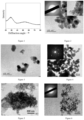
- Figure 1 X-ray diffraction
- TEM transmission electron microscope
- the low-crystallinity nanostructured niobium oxide obtained above is heat-treated at 600°C for 2 hours, resulting in nanostructured niobium oxide with particle sizes ranging from 3 nm to 150 nm and significantly improved crystallinity, but not fully crystallized.
- the TEM morphology of this product is shown in Figure 3 .
- the low-crystallinity nanostructured niobium oxide is then heat-treated at 900°C for 2 hours, resulting in crystalline niobium oxide with particle sizes ranging from 3 nm to 300 nm.
- the TEM morphology and diffraction pattern of the final product are shown in Figure 4 .
- some of the niobium oxide particles merged and grew larger.
- the crystalline niobium oxide after thermal treatment is further ball-milled to obtain dispersed nanostructured niobium oxide.
- This example provides a method for preparing vanadium oxide nanoparticles, comprising the following steps: According to the nominal composition of Al 75 V 25 (atomic percentage), low-purity aluminum raw material containing impurities such as O and Si is melted with vanadium (V) to obtain an alloy melt with the composition of V 24.9 Al 74.6 O 0.2 Si 0.3 . The alloy is cast into ingots with a composition of V 24.9 Al 74.6 O 0.2 Si 0.3 , which mainly consists of the VAl 3 intermetallic compound phase. The ingots are then mechanically crushed into an initial alloy powder with an average particle size not exceeding 50 ⁇ m.
- the solid product is then washed with 0.02 mol/L dilute hydrochloric acid solution to neutralize any residual alkali adsorbed on the solid product.
- nano vanadium oxide powder with minimal crystallization is obtained.
- the obtained vanadium oxide powder mainly consists of flocculent and thin-film structures, with the thickness of the films ranging from 2 nm to 15 nm and an average area greater than 200 nm 2 .
- the particle size range of the flocculent structure is from 1 nm to 15 nm.
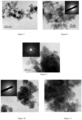
- the TEM morphology and diffraction pattern of the product are shown in Figures 5 and 6 , with the TEM image showing the characteristic flocculent structures.
- the as-prepared nano vanadium oxide powder with minimal crystallization is heat-treated at 600°C for 2 hours, resulting in the formation of predominantly crystalline vanadium oxide.
- the shapes of the particles mainly consist of thickened films and granular structures, with the thickness of the films ranging from 3 nm to 25 nm and an average area greater than 200 nm 2 .
- the particle size range of the granular structures is from 5 nm to 50 nm.
- the TEM morphology and diffraction pattern of the heat-treated product are shown in Figures 7 and 8 .
- the as-prepared nano vanadium oxide powder with minimal crystallization is further heat-treated at 900°C for 2 hours to obtain crystalline vanadium oxide.
- the shapes of the particles mainly consist of short rod-like structures, with the diameter of the rods ranging from 10 nm to 100 nm.
- the TEM morphology and diffraction pattern of the final product are shown in Figure 9 .
- This example provides a method for preparing nanostructured chromium oxide, comprising the following steps: According to the nominal composition of Al 80 Cr 20 (atomic percentage), low-purity aluminum raw material containing impurities such as O and Si is melted with chromium (Cr) to obtain an alloy melt with the composition of Cr 20 Al 79.5 O 0.1 Si 0.4 . The alloy is then solidified into ingots, which are crushed into initial alloy powder with an average particle size of 100 ⁇ m and a composition of Cr 20 Al 79.5 O 0.1 Si 0.4 . The solidified microstructure mainly consists of the CrAl 4 intermetallic compound phase.
- the Cr 20 Al 79.5 O 0.1 Si 0.4 initial alloy powder is reacted with NaOH solution under continuous stirring.
- the NaOH solution has a concentration of 12 mol/L, and its volume is approximately 100 times the volume of the initial alloy powder.
- the temperature is maintained at its boiling point of the NaOH solution ( ⁇ 128°C).
- the hydrogen evolution and Al-removal reaction is completed, and the Cr 20 Al 79.5 O 0.1 Si 0.4 initial alloy undergoes nano fragmentation through the hydrogen evolution and Al-removal reaction, while also undergoing shape and composition reconstruction to generate nanoscale solid flocculent products;
- water with a temperature of 20°C and a volume of 10 times the volume of the reaction mixture
- the resulting solid flocculent product is separated from the diluted alkali solution and washed with a 0.01 mol/L dilute hydrochloric acid solution to neutralize any residual alkali.
- the composition is mainly amorphous chromium oxide (Cr 2 O 3 ) or amorphous chromium hydroxide (Cr(OH) 3 ).
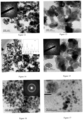
- the TEM morphology and diffraction pattern are shown in Figures 10 and 11 , indicating the product consists of extremely fine flocculent microstructures with particle sizes ranging from 1.0 nm to 15 nm. This flocculent structure is not a rigid nanoporous structure but a loosely distributed structure that can be flattened and dispersed.
- the collected powder which is mainly composed of low-crystallinity nanostructured chromium oxide, is heat-treated at 600°C for 2 hours.
- the resulting crystalline nanostructured chromium oxide has particles with sizes ranging from 3 nm to 100 nm.
- the TEM morphology and diffraction pattern of this treated product are shown in Figures 12 and 13 . After medium-temperature heat treatment, the particles exhibit good dispersion.
- the collected powder which is mainly composed of low-crystallinity nanostructured chromium oxide is heat-treated at 900°C for 2 hours.
- the resulting crystalline nanostructured chromium oxide particles have sizes ranging from 3 nm to 150 nm.
- the TEM morphology, XRD spectrum, and diffraction pattern of the heat-treated product are shown in Figures 14 and 15 .
- the nanostructured chromium oxide particles exhibit some sintering and agglomeration. However, they still maintain excellent dispersion or looseness.
- the sintered structure resembles a nano porous, loose structure.
- the alkali solution and solid product are directly transferred into a sealed reaction vessel.
- the temperature inside the vessel is raised to 250°C and maintained for 20 minutes, causing the pressure inside the vessel to exceed atmospheric pressure.
- the temperature and pressure of the reaction vessel were lowered, and the products in the reaction vessel were subjected to solid-liquid separation.
- the modified nanostructured chromium oxide with significantly improved crystallization degree is obtained.
- the morphology of the product is mainly granular, with a particle size range of 3nm-100nm.
- the low-crystallinity, crystalline, and modified nanostructured chromium oxide powders obtained through this process can be applied in a wide range of fields, including pigments, coatings, ceramic materials, refractory materials, electronic materials, and composite materials.
- This example provides a method for preparing nanostructured tantalum oxide, comprising the following steps: According to the nominal composition of Al 75 Ta 25 (atomic percentage) , low-purity aluminum raw material containing impurities such as O and Si is melted with tantalum (Ta) to obtain an alloy melt with the composition of Ta 24.5 Al 74.5 O 0.5 Si 0.5 (atomic percentage). The alloy melt is then rapidly solidified into an initial alloy ribbon with a thickness of ⁇ 25 ⁇ m by using a melt spinning method with a copper roller; the composition of the initial alloy ribbon is Ta 24.5 Al 74 , 5 O 0 . 5 Si 0.5 .
- the microstructure of initial alloy ribbon mainly consists of the TaAl 3 intermetallic compound phase.
- 0.5 g of the Ta 24.5 Al 74.5 O 0.5 Si 0.5 initial alloy ribbon is reacted with 50 mL of NaOH solution under continuous stirring.
- the NaOH solution has a concentration of 12 mol/L, and its temperature is maintained at its boiling point ( ⁇ 128°C).
- the hydrogen evolution and Al-removal reaction is completed, and the initial alloy undergoes nano fragmentation through the hydrogen evolution and Al-removal reaction, while also undergoing shape and composition reconstruction to generate nanoscale solid products containing Ta.
- the solid product is separated from the solution.
- the product is washed, and then dried to obtain a solid powder containing Ta.
- the composition of the powder is crystalline nanostructured tantalum oxide (Ta 2 O 5 ).
- the TEM morphology and diffraction pattern are shown in Figures 16 and 17 .
- the product exhibits excellent particle dispersion, with particle sizes ranging from 3 nm to 100 nm.
- This example provides a method for preparing nanostructured tungsten oxide, comprising the following steps: According to the nominal composition of Al 80 W 20 (atomic percentage) , low-purity aluminum raw material containing impurities such as O and Si is melted with tungsten (W) to obtain an alloy melt with the composition of W 20 Al 79.5 Si 0.5 (atomic percentage). The alloy melt is then solidified into ingots, which are subsequently crushed to form initial alloy powders with an average particle size of 50 ⁇ m.
- the initial alloy mainly consists of WAl 4 intermetallic compound.
- the W 20 Al 79.5 Si 0.5 initial alloy powder (0.5 g) is reacted with 50 mL of NaOH solution under continuous stirring.
- the NaOH solution has a concentration of 10 mol/L, and its temperature is maintained at its boiling point ( ⁇ 119°C).
- the volume of the NaOH solution is approximately 100 times the volume of the initial alloy powder.
- the as-prepared low-crystallinity nanostructured tungsten oxide is heat-treated at 600°C for 2 hours, resulting in crystalline nanostructured tungsten oxide particles with a particle size range of 10 nm to 400 nm.
- the TEM morphology and diffraction pattern after heat treatment are shown in Figure 19 . During the sintering process, some of the tungsten oxide particles merged and grew larger. After heat treatment, the crystalline nanostructured tungsten oxide is subjected to sand milling, which results in well-dispersed nanostructured tungsten oxide particles.
- This example provides a method for preparing nanostructured molybdenum oxide, comprising the following steps: According to the nominal composition of Al 77 Mo 23 (atomic percentage), commercial aluminum (Al) raw material is melted with molybdenum (Mo) raw material, which contains oxygen impurities, to obtain an alloy melt with a composition of Mo 23 Al 79.95 O 0.05 (atomic percentage). The alloy melt is then rapidly solidified into an initial alloy ribbon with a thickness of ⁇ 25 ⁇ m by using a melt spinning method with a copper roller; the composition of the initial alloy ribbon is Mo 23 Al 79.95 O 0.05 .
- the solidified structure of the alloy mainly consists of MoAl 4 and Mo 3 Al 8 intermetallic compounds.
- the Mo 23 Al 79.95 O 0.05 initial alloy ribbon is reacted with a 15 mol/L KOH solution under continuous stirring.
- the temperature is maintained at the boiling point of the KOH solution( ⁇ 150°C).
- the volume of KOH solution is approximately 50 times the volume of the initial alloy ribbon.
- the hydrogen evolution and Al-removal reaction is completed, and the initial alloy undergoes nano fragmentation through the hydrogen evolution and Al-removal reaction, while also undergoing shape and composition reconstruction to generate nanoscale solid flocculent product.
- the composition of the powder consists of amorphous nanostructured molybdenum oxide or amorphous molybdenum hydroxide.
- the morphology of the powder mainly consists of very fine flocculent microstructures, with a particle size range of 1.0 nm to 10 nm.
- the low-crystallinity nanostructured molybdenum oxide powder is heat-treated at 600°C for 2 hours. This process results in crystalline molybdenum oxide particles with a particle size range of 3 nm to 100 nm.
- This example provides a method for preparing nanostructured manganese oxide, comprising the following steps: According to the nominal composition of Al 73.3 Mn 26.7 (atomic percentage), Aluminum (Al) raw material is melted with manganese (Mn) raw material to obtain an alloy melt with a composition of Al 73.3 Mn 26.7 . The alloy melt is then rapidly solidified into an initial alloy ribbon with a thickness of ⁇ 25 ⁇ m by using a melt spinning method with a copper roller; the composition of the initial alloy ribbon is Al 73.3 Mn 26.7 .
- the solidified structure of the alloy mainly consists of Al 11 Mn 4 intermetallic compound.
- the Al 73.3 Mn 26.7 initial alloy ribbon is reacted with a 12 mol/L NaOH solution under continuous stirring.
- the temperature is maintained at the boiling point of the NaOH solution( ⁇ 128°C).
- the volume of NaOH solution is approximately 75 times the volume of the initial alloy ribbon.
- the hydrogen evolution and Al-removal reaction is completed, and the Al 73.3 Mn 26.7 initial alloy undergoes nano fragmentation through the hydrogen evolution and Al-removal reaction, while also undergoing shape and composition reconstruction to generate nanoscale solid products.
- the morphology of the powder mainly consists of flake-like particles (as shown in Figure 20 ), and also includes some thin-film structures (as shown in Figure 20 , lower left inset).
- the thickness of the flake-like particles ranges from 3 nm to 150 nm, and the flake diameter ranges from 5 nm to 500 nm.
- the thickness of the thin-film structures ranges from 1 nm to 20 nm, with an average area greater than 100 nm 2 .
- This example provides a method for preparing nanostructured manganese oxide, comprising the following steps: According to the nominal composition of Al 73.3 Mn 26.7 (atomic percentage), commercial Aluminum (Al) raw material of with Si impurity is melted with manganese (Mn) raw material to obtain an alloy melt with a composition of Al 73.3 Mn 26.5 Si 0.2 (atomic percentage). The alloy melt is then rapidly solidified into an initial alloy ribbon with a thickness of ⁇ 25 ⁇ m by using a melt spinning method with a copper roller; the composition of the initial alloy ribbon is Al 73.3 Mn 26.7 .
- the solidified structure of the alloy mainly consists of Al 11 Mn 4 intermetallic compound.
- the Al 73.3 Mn 26.5 Si 0.2 initial alloy ribbon is reacted with a 10 mol/L NaOH solution under continuous stirring.
- the temperature is maintained between 105°C and 115°C, and the volume of NaOH solution is approximately 75 times the volume of the initial alloy ribbon.
- the hydrogen evolution and Al-removal reaction is completed, and the Al 73.3 Mn 26.5 Si 0.2 initial alloy undergoes nano fragmentation through the hydrogen evolution and Al-removal reaction, while also undergoing shape and composition reconstruction to generate nanoscale solid flocculent product.
- the reaction is maintained under these conditions for 2 hours, with water being added to maintain the concentration of the alkaline solution.
- the solid product generated from the hydrogen evolution and Al-removal reaction further undergoes morphological changes under the original reaction temperature and environment.
- the solid product is separated from the solution, washed, and dried, resulting in partially crystallized nanostructured manganese oxide.
- the morphology of the powder mainly consists of plate-like particles, with the thickness of the plates ranging from 3 nm to 75 nm and the plate diameter ranging from 3 nm to 300 nm.
- the partially crystallized nanostructured manganese oxide is then heat-treated at 600°C for 2 hours.
- the result is manganese oxide that is almost fully crystallized, with a change in the oxidation state of Mn from low to high.
- the SEM morphology of the heat-treated nanostructured manganese oxide is shown in Figure 21 .
- the shape of the nanostructured manganese oxide particles is mainly plate-like, with some hexagonal plate-shaped particles.
- the thickness of the plates ranges from 3 nm to 150 nm, and the plate diameter ranges from 5 nm to 500 nm.
- This example provides a method for preparing nanostructured vanadium oxide, comprising the following steps: According to the nominal composition of Zn 75 V 25 (atomic percentage), the alloy is melted to obtain an alloy melt with a composition primarily of Zn 75 V 25 . The melt alloy is then solidified into an alloy ingot, which is subsequently crushed into initial alloy powder with an average particle size of 50 ⁇ m.
- the solidified structure of the alloy mainly consists of VZn 3 intermetallic compound.
- the powder mainly consists of flocculent structures, with the size of the flocculent microstructures ranging from 1.0 nm to 15 nm.
- This example provides a method for preparing nanostructured chromium oxide, comprising the following steps: According to the nominal composition of Al 61 Cr 39 (atomic percentage), commercial Al and Cr raw material are melted to obtain an alloy melt with a composition primarily of Al 60.7 Cr 39 O 0.1 Si 0.2 . The melt is then solidified into an alloy ingot, which is subsequently crushed into initial alloy coarse powder with an average particle size of approximately 2 mm. The solidified structure of the alloy consists mainly of Al 8 Cr 5 intermetallic compound.
- the Al 60.7 Cr 39 O 0.1 Si 0.2 initial alloy coarse powder is reacted with an NaOH aqueous solution under continuous stirring.
- the concentration of the NaOH solution is 12 mol/L, and the temperature is maintained at the boiling point of the solution ( ⁇ 128°C).
- the volume of NaOH solution is approximately 50 times the volume of the initial alloy coarse powder.
- the powder mainly consists of flocculent microstructures, with particle sizes ranging from 1.0 nm to 15 nm.
- the low crystallinity nanostructured chromium oxide powder is heat-treated at 600°C for 2 hours. This treatment results in crystallized nanostructured chromium oxide particles with particle sizes ranging from 3 nm to 100 nm.
- the same low crystallinity nanostructured chromium oxide powder is then heat-treated at 900°C for 2 hours. This produces crystallized chromium oxide particles with particle sizes ranging from 3 nm to 150 nm.
- the Al 60.7 Cr 39 O 0.1 Si 0.2 initial alloy coarse powder is mixed with 12 mol/L NaOH aqueous solution (50 times the volume of the alloy powder) and placed in a high-pressure reactor.
- the reactor is then sealed, and the temperature is raised to 250°C, where it is maintained for 20 minutes. In this sealed environment, the pressure inside the reactor is higher than atmospheric pressure. After 20 minutes of heating, the pressure and temperature are reduced, and the modified solid product is collected.
- the product is then washed and dried, yielding modified nanostructured chromium oxide.
- the morphology of the modified chromium oxide is primarily composed of tubular and rod-shaped particles, with the rod diameter ranging from 2 nm to 10 nm, and a length-to-diameter ratio greater than 2.
- the particle size of the modified product ranges from 2 nm to 100 nm.
- These low crystallinity, crystalline, and modified nanostructured chromium oxide materials have excellent potential for applications in fields such as pigments, coatings, ceramics, refractory materials, electronic materials, and composite materials..
- This example provides a method for modifying nanostructured vanadium oxide, comprising the following steps: According to the nominal composition of Al 75 V 25 (atomic percentage), low-purity aluminum (Al) raw material of with O and Si impurity is melted with vanadium (V) raw material to obtain an alloy melt with a composition primarily of V 24.9 Al 74.6 O 0.2 Si 0.3 . The melt is then cast into an alloy ingot. The ingot mainly consists of the VAl 3 intermetallic compound. The alloy ingot is subsequently mechanically broken down into initial alloy powder with an average particle size not exceeding 50 ⁇ m.
- V 2 O 5 modified nanostructured vanadium oxide
- the morphology of the modified product consists primarily of short rod-shaped and particle-shaped structures.
- the diameter of the short rods ranges from 2 nm to 30 nm, and the particle size ranges from 5 nm to 200 nm.
- This example provides a method for preparing nanostructured niobium oxide, comprising the following steps: According to the nominal composition of Al 75 Nb 25 (atomic percentage), the alloy is melted using commercially available Al and Nb raw materials, which may contain impurities such as O and Si. The resulting alloy melt has a composition primarily of Nb 25 Al 74.7 O 0.1 Si 0.2 . The alloy melt is then rapidly solidified into a Nb 25 Al 74.7 O 0.1 Si 0.2 initial alloy ribbon with a thickness of ⁇ 25 ⁇ m by using a melt spinning method with a copper roller; This alloy ribbon primarily consists of the NbAl 3 intermetallic compound.
- the solid product and the NaOH solution are transferred to a high-pressure reactor, which is sealed.
- the reactor containing the solid product and NaOH solution, is heated to 200°C and maintained at this temperature for 1 hour. During this process, the pressure inside the reactor is higher than atmospheric pressure due to the sealed environment. After 1 hour of heating, the pressure and temperature inside the reactor are reduced.
- the modified solid product is collected, washed, and dried.
- the resulting nanostructured niobium oxide is predominantly crystalline.
- the morphology of the final product consists mainly of short rod-like and particle-like structures. The diameter of the short rods ranges from 2 nm to 10 nm, and the particle size ranges from 2 nm to 75 nm.
- This example outlines the preparation of nanostructured yttrium oxide, comprising the following steps:
- the alloy is produced by melting commercially available Al and yttrium (Y) raw materials, which may contain oxygen impurities.
- the resulting alloy melt has a primarily composition of Y 50 A 149.5 O 0.5 .
- the melt is then rapidly cooled using a copper roller to form a thin, solidified alloy sheet with a thickness of approximately 200 ⁇ m.
- the solidified sheet primarily consists of the YAl intermetallic compound.
- 0.5 g of the Y 50 A 149.5 O 0.5 initial alloy sheet is mixed with 50 mL of NaOH solution.
- the NaOH solution has a concentration of 10 mol/L, and the temperature is maintained at the boiling point (approximately 119°C) under normal atmospheric pressure.
- the hydrogen evolution and Al-removal reaction is completed within 2 minutes, leading to the nano fragmentation of the initial alloy sheet.
- the shape and composition of the material undergo reconstruction, resulting in the formation of a nanoscale solid product containing yttrium.
- the resulting solid product containing yttrium is separated from the NaOH solution.
- the solid product is then washed and dried, resulting in the formation of nanostructured yttrium oxide powder.
- the powder is predominantly crystalline in nature.
- the shape of the final nanostructured yttrium oxide powder is mostly particulate, and the particle size ranges from 3 nm to 350 nm.
- the X-ray diffraction (XRD) pattern of the powder shown in Figure 22 , confirms its crystalline structure.
- This example describes the preparation of nanostructured yttrium oxide using a specific alloy composition, comprising the following steps: According to the nominal composition of Al 37.5 Zn 37.5 Y 25 (atomic percentage), the alloy is produced by melting commercially available raw materials of Al, Zn, and Y (which may contain oxygen impurities). The resulting alloy has a primarily composition of Al 37.5 Zn 37.2 Y 24.8 O 0.5 . This molten alloy is rapidly solidified using a copper roller, forming thin alloy ribbons approximately 25 ⁇ m in thickness. The solidified structure is primarily composed of YAl 3 and YZn 3 intermetallic compounds.
- the initial alloy ribbon (Al 37.5 Zn 37.2 Y 24.8 O 0.5 ) is placed into a reaction vessel with a mixed NaOH and KOH aqueous solution.
- the concentration of OH - in the solution is 7 mol/L, and the temperature is maintained at 110°C to 115°C.
- the volume of the solution is about 50 times the volume of the alloy ribbon.
- the nanostructured yttrium oxide powder consists of predominantly crystalline particles and short rod-like particles, with particle sizes ranging from 5 nm to 300 nm.
- the aspect ratio (length-to-diameter ratio) of the rod-like particles ranges from 1:1 to 5:1.
- This example outlines the process for preparing nanostructured gadolinium oxide, comprising the following steps: According to the nominal composition of A 67 Gd 33 (atomic percentage), the alloy is produced by melting commercially available raw materials of Al, Zn, and gadolinium (Gd) containing oxygen impurities. The resulting alloy composition is primarily Al 67 Gd 32.3 O 0.5 Si 0.2. The alloy is then rapidly solidified using a copper roller, forming thin ribbons approximately 25 ⁇ m in thickness. The solidified structure is primarily composed of the GdAl 2 intermetallic compound.
- the initial alloy ribbons (Al 67 Gd 32.3 O 0.5 Si 0.2 ) are then mixed with a NaOH solution.
- the NaOH solution has a concentration of 10 mol/L, and the temperature is maintained at the boiling point (around 119°C).
- the reaction occurs under normal atmospheric pressure, and within 1 minute, the hydrogen evolution and Al-removal reaction completes. This leads to the fragmentation of the alloy into nanoparticles, with shape and composition reconstruction, producing nanoscale gadolinium-containing solid products.
- the solid products containing gadolinium are separated from the alkaline solution.
- the solid product is washed, separated, and dried to yield nanostructured gadolinium oxide powder.
- the obtained gadolinium oxide powder is primarily crystalline, with particle shapes consisting of both particles and short rod-like structures.
- the particle sizes range from 5 nm to 300 nm.
- the rod-like particles have an aspect ratio (length-to-diameter ratio) ranging from 1:1 to 5:1.
- the X-ray diffraction (XRD) pattern of the powder is shown in Figure 23
- the TEM morphology and diffraction pattern are shown in Figure 24 .
- This example presents a method for preparing nanostructured chromium oxide, comprising the following steps: According to the nominal composition of Al 80 Cr 20 (atomic percentage), the alloy is produced by melting commercially available raw materials of aluminum (Al) containing silicon (Si) impurity and chromium (Cr). The resulting alloy composition is primarily Si 0.25 Al 80 Cr 19.75 . The molten alloy is then rapidly solidified using a copper roller, forming thin strips approximately 25 ⁇ m in thickness. The solidified structure of the alloy is primarily composed of Al 4 Cr intermetallic compounds.
- the Si 0.25 Al 80 Cr 19.75 initial alloy ribbons are then subjected to reaction with a 15 mol/L NaOH solution at 60°C.
- the volume of the NaOH solution is approximately 100 times the volume of the initial alloy strips.
- Ultrasound treatment at a frequency of 40 kHz is applied to facilitate the reaction.
- the hydrogen evolution and Al-removal reaction is completed, leading to the breakdown of the alloy into nanoparticles.
- shape and composition reconstruction occurs, resulting in nanoscale solid products in the form of a fine flocculent structure.
- the solid flocculent products are separated from the alkaline solution.
- the solid product is then washed, separated, and dried to obtain low crystallinity nanostructured chromium oxide.
- the product is primarily in the amorphous form of nanostructured chromium oxide or amorphous chromium hydroxide.
- the obtained nanostructured chromium oxide has a morphology consisting mainly of very fine flocculent microstructures.
- the size range of the flocculent microstructures is from 1.0 nm to 15 nm, as shown in Figure 25 .
- This example details the preparation of nanostructured chromium oxide, comprising the following steps: According to the nominal composition of Al 80 Cr 20 (atomic percentage), the alloy is prepared by melting commercially available aluminum (Al) containing silicon (Si) and chromium (Cr). The resulting alloy composition is primarily Si 0.25 Al 80 Cr 19.75 . The molten alloy is then rapidly solidified into thin strips, approximately 25 ⁇ m thick, using a copper roller. The solidified structure is mainly composed of Al 4 Cr intermetallic compound.
- the temperature is raised to 250°C and maintained for 20 minutes. In this closed environment, the pressure increases due to both the elevated temperature and the hydrogen gas produced during the reaction. This creates a high-pressure environment, which enhances the reaction process.
- the reaction vessel is cooled and depressurized. The solid-liquid separation is performed, followed by washing and drying of the product to obtain modified nanostructured chromium oxide.
- the product primarily consists of crystalline chromium oxide, with a morphology made up of particle-like and short rod-like structures. The particle size ranges from 2 nm to 50 nm, and the rod-like structures have diameters between 2 nm and 30 nm, with aspect ratios ranging from 1:1 to 5:1.
- This example describes the preparation of nanostructured niobium (Nb) oxide / tantalum (Ta) oxide, comprising the following steps:
- the alloy is prepared with a nominal composition of Al 75 Nb 20 Ta 5 (atomic percentage) by melting commercially available aluminum (Al), niobium (Nb), and tantalum (Ta).
- the resulting alloy composition is primarily Al 75 Nb 20 Ta 5 .
- the molten alloy is then rapidly solidified into thin ribbons approximately 25 ⁇ m thick using a copper roller.
- the solidified alloy consists mainly of the intermetallic compound Al 3 Nb(Ta).
- the Al 75 Nb 20 Ta 5 initial alloy ribbons are placed in a NaOH solution (concentration of 10 mol/L) and stirred continuously.
- the reaction is carried out at 119°C (boiling point of NaOH solution under atmosphere pressure), with the solution volume being approximately 50 times the volume of the alloy ribbons.
- the hydrogen evolution and Al-removal reaction is completed, and the initial alloy undergoes nano fragmentation through the hydrogen evolution and Al-removal reaction, while also undergoing shape and composition reconstruction to generate nanometer-scale solid products containing Nb and Ta.
- the solid Nb/Ta-containing product is separated from the alkaline solution.
- the solid product is washed thoroughly to remove excess NaOH, followed by drying to obtain a low-crystallinity nanostructured Nb/Ta oxide powder.
- the product predominantly consists of fine flocculent structures, with the size of these structures ranging from 1.0 nm to 15 nm.
- the low-crystallinity nanostructured Nb/Ta oxide powder is subjected to heat treatment at 750°C for 2 hours. This step induces crystallization, and the resulting crystalline Nb/Ta oxide particles with a size range of 3 nm to 200 nm.
- This example outlines a method for preparing nanostructured chromium oxide, comprising the following steps:
- the initial alloy is prepared with a nominal composition of Al 80 Cr 20 (atomic percentage) by melting commercially available aluminum (Al, including a small amount of Si) and chromium (Cr), where the alloy composition is mainly Si 0.25 Al 80 Cr 19.75 .
- the molten alloy is then rapidly solidified using a copper roller to form thin ribbon of approximately 25 ⁇ m in thickness.
- the solidified alloy primarily consists of the intermetallic compound Al 4 Cr.
- the hydrogen evolution and aluminum removal reaction is completed within 10 seconds. After 10 seconds, the sealed container and the reaction system are rapidly cooled by immersion in cooling water until the temperature reaches near room temperature, while the pressure inside the sealed container is reduced to atmospheric pressure.
- the solid flocculent product is separated from the alkaline solution, followed by washing and drying.
- the result is low-crystallinity nano chromium oxide primarily in the amorphous state, or amorphous chromium hydroxide.
- the morphology of the nano chromium oxide consists mainly of extremely fine flocculent microstructures, with the size of these structures ranging from 1.0 nm to 15 nm.
- a melt of the alloy with a composition of Al 74.5 Nb 25 O 0.3 Si 0.2 was prepared by melting commercially available Al material with Si and O impurities with Nb material. The alloy melt was then cast into an Al 74.5 Nb 25 O 0.3 Si 0.2 alloy ingot, which was mainly composed of the NbAl 3 intermetallic compound phase. This alloy ingot was further mechanically crushed into an initial alloy powder with an average particle size of approximately 25 ⁇ m.
- the initial alloy powder was reacted with a 10mol/L NaOH solution at 25°C for 2 hours (the average rate of advance of the reaction interface was less than 0.5 ⁇ m/min).
- the product obtained was mainly nanoporous Nb oxide or nano porous Nb, as shown in Figure 26 .
- the shape of the initial alloy powder before and after the reaction remained roughly unchanged. It was still in the form of fractured powder particles with sharp edges, and no significant nano fragmentation occurred. Additionally, there was no generation of a large number of dispersed nanoscale oxide powder particles. Instead, a coarse powder particle structure with retained sharp edges was formed, made up of nanoporous network structures.
- the particle size of the product remained similar to that of the initial alloy powder. Therefore, the reaction between the initial alloy and the alkaline solution at the lower temperature was completely different from the reaction under the higher temperature conditions, especially those near the boiling point, and the morphology of the products was also completely different.
Landscapes
- Chemical & Material Sciences (AREA)
- Organic Chemistry (AREA)
- Inorganic Chemistry (AREA)
- Life Sciences & Earth Sciences (AREA)
- Geology (AREA)
- Manufacture Of Metal Powder And Suspensions Thereof (AREA)
- Compounds Of Alkaline-Earth Elements, Aluminum Or Rare-Earth Metals (AREA)
- Inorganic Compounds Of Heavy Metals (AREA)
Applications Claiming Priority (1)
| Application Number | Priority Date | Filing Date | Title |
|---|---|---|---|
| PCT/CN2022/088502 WO2023201709A1 (zh) | 2022-04-22 | 2022-04-22 | 纳米金属氧化物及其制备方法与用途 |
Publications (2)
| Publication Number | Publication Date |
|---|---|
| EP4512775A1 true EP4512775A1 (de) | 2025-02-26 |
| EP4512775A4 EP4512775A4 (de) | 2026-05-13 |
Family
ID=88418945
Family Applications (1)
| Application Number | Title | Priority Date | Filing Date |
|---|---|---|---|
| EP22937945.8A Pending EP4512775A4 (de) | 2022-04-22 | 2022-04-22 | Nanometalloxid, verfahren zur herstellung davon und verwendung davon |
Country Status (4)
| Country | Link |
|---|---|
| EP (1) | EP4512775A4 (de) |
| JP (1) | JP2025522577A (de) |
| CN (1) | CN119317602A (de) |
| WO (1) | WO2023201709A1 (de) |
Family Cites Families (8)
| Publication number | Priority date | Publication date | Assignee | Title |
|---|---|---|---|---|
| US8822030B2 (en) * | 2006-08-11 | 2014-09-02 | Aqua Resources Corporation | Nanoplatelet metal hydroxides and methods of preparing same |
| JP2008105912A (ja) * | 2006-10-27 | 2008-05-08 | National Institute Of Advanced Industrial & Technology | ナノ複酸化物AxMyOzの製造方法 |
| CN101787502B (zh) * | 2010-01-19 | 2011-10-05 | 中国科学院化学研究所 | 制备金属、金属氧化物或金属氢氧化物与碳纳米管复合物的方法 |
| CN104162679A (zh) * | 2014-08-21 | 2014-11-26 | 浙江高成绿能科技有限公司 | 一种纳米金属/金属氧化物的制备方法 |
| CN104628029A (zh) * | 2015-01-23 | 2015-05-20 | 济南大学 | 一种钛酸盐、锐钛矿TiO2和AgCl/Ag/TiO2复合材料的制备方法 |
| CN110721318B (zh) * | 2019-11-20 | 2023-06-13 | 温州医科大学 | 一种双硫仑纳米颗粒及其制备方法和用途 |
| CN112276101A (zh) * | 2020-08-19 | 2021-01-29 | 赵远云 | 一种高纯粉体材料的制备方法及其应用及一种合金条带 |
| CN111634938B (zh) * | 2020-06-16 | 2021-11-09 | 东莞理工学院 | 一种纳米多孔粉体材料的制备方法 |
-
2022
- 2022-04-22 CN CN202280096150.XA patent/CN119317602A/zh active Pending
- 2022-04-22 EP EP22937945.8A patent/EP4512775A4/de active Pending
- 2022-04-22 JP JP2024575763A patent/JP2025522577A/ja active Pending
- 2022-04-22 WO PCT/CN2022/088502 patent/WO2023201709A1/zh not_active Ceased
Also Published As
| Publication number | Publication date |
|---|---|
| EP4512775A4 (de) | 2026-05-13 |
| WO2023201709A1 (zh) | 2023-10-26 |
| CN119317602A (zh) | 2025-01-14 |
| JP2025522577A (ja) | 2025-07-15 |
Similar Documents
| Publication | Publication Date | Title |
|---|---|---|
| Song et al. | Controllable synthesis of VO 2 (D) and their conversion to VO 2 (M) nanostructures with thermochromic phase transition properties | |
| Wu et al. | Size-and shape-tailored hydrothermal synthesis of YVO 4 crystals in ultra-wide pH range conditions | |
| US20240327235A1 (en) | Preparation method for nano titanate, nano titanic acid, and nano tio2, and a use thereof | |
| CN112143926B (zh) | 一种含铝合金粉体的制备方法及其应用及一种合金条带 | |
| He et al. | Solvothermal synthesis and characterization of ceria with solid and hollow spherical and multilayered morphologies | |
| Yang et al. | Cobalt ferrite nanoparticles prepared by coprecipitation/mechanochemical treatment | |
| Xu et al. | Microwave-assisted ionic liquid solvothermal rapid synthesis of hollow microspheres of alkaline earth metal fluorides (MF 2, M= Mg, Ca, Sr) | |
| US20240228315A9 (en) | Method for preparing nano-titanate, nano-titanic acid and nano-tio2 containing embedded nanoparticles and method for preparing metal nanoparticles | |
| TWI477437B (zh) | 由閥金屬及閥金屬次氧化物所組成之奈米結構及製造彼等之方法 | |
| Wang et al. | Formation of single-crystal SrTiO3 dendritic nanostructures via a simple hydrothermal method | |
| EP4606770A1 (de) | Herstellungsverfahren und verwendung von dotiertem nanometer-barium/lithiumtitanat-pulvermaterial | |
| CA3289862A1 (en) | Nano metal oxides, preparation method therefor, and use therefor | |
| Li et al. | The synthesis of ZnO acicular particles by the hydrothermal discharging-gas method | |
| Orlov et al. | Niobium powders of mesoporous structure | |
| US20240132366A1 (en) | Nano-titanate, nano-titanic acid, and nano-tio2 containing doping ag, preparation method therefor and use thereof | |
| EP4512774A1 (de) | Herstellungsverfahren und verwendungen von mit edelmetallnanopartikeln dotierten nanometalloxid- und edelmetallnanopartikeln | |
| JP2025522577A (ja) | 金属酸化物ナノ粒子、その製造方法および使用 | |
| CA3289859A1 (en) | Preparation methods and uses of precious metal nanoparticle-doped nano metal oxide and precious metal nanoparticles | |
| CA3290294A1 (en) | Preparation method and use of doped nano barium titanate/lithium titanate powder material | |
| Dai et al. | Preparation of Eu3+ doped (Y, Gd) 2O3 flowers from (Y, Gd) 2 (CO3) 3· nH2O flowerlike precursors: Microwave hydrothermal synthesis, growth mechanism and luminescence property | |
| JP2026515387A (ja) | 貴金属ナノ粒子がドープされた金属酸化物、および貴金属ナノ粒子の製造方法と用途 | |
| Lan et al. | Synthesis of ultrafine boehmite from waste coal fly ash by integrating sol-gel process with sodium aluminate decomposition and hydrothermal treatment | |
| CN115490262B (zh) | 一种纳米氧化锆/铪及金属纳米颗粒的制备方法 | |
| Orlov et al. | X-ray diffraction study of magnesiothermic tantalum powders | |
| Gao et al. | Facile synthesis of uniform and well-defined single-crystal sodium tantalate cubes and their assembly into oriented two-dimensional nanofilm |
Legal Events
| Date | Code | Title | Description |
|---|---|---|---|
| STAA | Information on the status of an ep patent application or granted ep patent |
Free format text: STATUS: THE INTERNATIONAL PUBLICATION HAS BEEN MADE |
|
| PUAI | Public reference made under article 153(3) epc to a published international application that has entered the european phase |
Free format text: ORIGINAL CODE: 0009012 |
|
| STAA | Information on the status of an ep patent application or granted ep patent |
Free format text: STATUS: REQUEST FOR EXAMINATION WAS MADE |
|
| 17P | Request for examination filed |
Effective date: 20241122 |
|
| AK | Designated contracting states |
Kind code of ref document: A1 Designated state(s): AL AT BE BG CH CY CZ DE DK EE ES FI FR GB GR HR HU IE IS IT LI LT LU LV MC MK MT NL NO PL PT RO RS SE SI SK SM TR |
|
| DAV | Request for validation of the european patent (deleted) | ||
| DAX | Request for extension of the european patent (deleted) | ||
| REG | Reference to a national code |
Ref country code: DE Ref legal event code: R079 Free format text: PREVIOUS MAIN CLASS: C01G0023000000 Ipc: C01F0017218000 |
|
| RIC1 | Information provided on ipc code assigned before grant |
Ipc: C01F 17/218 20200101AFI20260115BHEP Ipc: C01F 17/224 20200101ALI20260115BHEP Ipc: C01G 31/02 20060101ALI20260115BHEP Ipc: C01G 33/00 20060101ALI20260115BHEP Ipc: C01G 35/00 20060101ALI20260115BHEP Ipc: C01G 37/02 20060101ALI20260115BHEP Ipc: C01G 37/033 20060101ALI20260115BHEP Ipc: C01G 39/02 20060101ALI20260115BHEP Ipc: C01G 45/02 20250101ALI20260115BHEP |
|
| A4 | Supplementary search report drawn up and despatched |
Effective date: 20260413 |
|
| RIC1 | Information provided on ipc code assigned before grant |
Ipc: C01F 17/218 20200101AFI20260407BHEP Ipc: C01F 17/224 20200101ALI20260407BHEP Ipc: C01G 31/02 20060101ALI20260407BHEP Ipc: C01G 33/00 20060101ALI20260407BHEP Ipc: C01G 35/00 20060101ALI20260407BHEP Ipc: C01G 37/02 20060101ALI20260407BHEP Ipc: C01G 37/033 20060101ALI20260407BHEP Ipc: C01G 39/02 20060101ALI20260407BHEP Ipc: C01G 45/02 20250101ALI20260407BHEP |