EP4322306B1 - Verbundaufschlämmung sowie herstellungsverfahren und verwendung davon - Google Patents
Verbundaufschlämmung sowie herstellungsverfahren und verwendung davon Download PDFInfo
- Publication number
- EP4322306B1 EP4322306B1 EP23215042.5A EP23215042A EP4322306B1 EP 4322306 B1 EP4322306 B1 EP 4322306B1 EP 23215042 A EP23215042 A EP 23215042A EP 4322306 B1 EP4322306 B1 EP 4322306B1
- Authority
- EP
- European Patent Office
- Prior art keywords
- aramid
- isocyanate
- modified
- nanoceramic
- particle
- Prior art date
- Legal status (The legal status is an assumption and is not a legal conclusion. Google has not performed a legal analysis and makes no representation as to the accuracy of the status listed.)
- Active
Links
Images
Classifications
-
- H—ELECTRICITY
- H01—ELECTRIC ELEMENTS
- H01M—PROCESSES OR MEANS, e.g. BATTERIES, FOR THE DIRECT CONVERSION OF CHEMICAL ENERGY INTO ELECTRICAL ENERGY
- H01M10/00—Secondary cells; Manufacture thereof
- H01M10/05—Accumulators with non-aqueous electrolyte
- H01M10/052—Li-accumulators
-
- C—CHEMISTRY; METALLURGY
- C08—ORGANIC MACROMOLECULAR COMPOUNDS; THEIR PREPARATION OR CHEMICAL WORKING-UP; COMPOSITIONS BASED THEREON
- C08G—MACROMOLECULAR COMPOUNDS OBTAINED OTHERWISE THAN BY REACTIONS ONLY INVOLVING UNSATURATED CARBON-TO-CARBON BONDS
- C08G83/00—Macromolecular compounds not provided for in groups C08G2/00 - C08G81/00
- C08G83/001—Macromolecular compounds containing organic and inorganic sequences, e.g. organic polymers grafted onto silica
-
- H—ELECTRICITY
- H01—ELECTRIC ELEMENTS
- H01M—PROCESSES OR MEANS, e.g. BATTERIES, FOR THE DIRECT CONVERSION OF CHEMICAL ENERGY INTO ELECTRICAL ENERGY
- H01M10/00—Secondary cells; Manufacture thereof
- H01M10/05—Accumulators with non-aqueous electrolyte
- H01M10/052—Li-accumulators
- H01M10/0525—Rocking-chair batteries, i.e. batteries with lithium insertion or intercalation in both electrodes; Lithium-ion batteries
-
- H—ELECTRICITY
- H01—ELECTRIC ELEMENTS
- H01M—PROCESSES OR MEANS, e.g. BATTERIES, FOR THE DIRECT CONVERSION OF CHEMICAL ENERGY INTO ELECTRICAL ENERGY
- H01M50/00—Constructional details or processes of manufacture of the non-active parts of electrochemical cells other than fuel cells, e.g. hybrid cells
- H01M50/40—Separators; Membranes; Diaphragms; Spacing elements inside cells
- H01M50/403—Manufacturing processes of separators, membranes or diaphragms
-
- H—ELECTRICITY
- H01—ELECTRIC ELEMENTS
- H01M—PROCESSES OR MEANS, e.g. BATTERIES, FOR THE DIRECT CONVERSION OF CHEMICAL ENERGY INTO ELECTRICAL ENERGY
- H01M50/00—Constructional details or processes of manufacture of the non-active parts of electrochemical cells other than fuel cells, e.g. hybrid cells
- H01M50/40—Separators; Membranes; Diaphragms; Spacing elements inside cells
- H01M50/409—Separators, membranes or diaphragms characterised by the material
- H01M50/411—Organic material
- H01M50/414—Synthetic resins, e.g. thermoplastics or thermosetting resins
-
- H—ELECTRICITY
- H01—ELECTRIC ELEMENTS
- H01M—PROCESSES OR MEANS, e.g. BATTERIES, FOR THE DIRECT CONVERSION OF CHEMICAL ENERGY INTO ELECTRICAL ENERGY
- H01M50/00—Constructional details or processes of manufacture of the non-active parts of electrochemical cells other than fuel cells, e.g. hybrid cells
- H01M50/40—Separators; Membranes; Diaphragms; Spacing elements inside cells
- H01M50/409—Separators, membranes or diaphragms characterised by the material
- H01M50/411—Organic material
- H01M50/414—Synthetic resins, e.g. thermoplastics or thermosetting resins
- H01M50/423—Polyamide resins
-
- H—ELECTRICITY
- H01—ELECTRIC ELEMENTS
- H01M—PROCESSES OR MEANS, e.g. BATTERIES, FOR THE DIRECT CONVERSION OF CHEMICAL ENERGY INTO ELECTRICAL ENERGY
- H01M50/00—Constructional details or processes of manufacture of the non-active parts of electrochemical cells other than fuel cells, e.g. hybrid cells
- H01M50/40—Separators; Membranes; Diaphragms; Spacing elements inside cells
- H01M50/409—Separators, membranes or diaphragms characterised by the material
- H01M50/431—Inorganic material
-
- H—ELECTRICITY
- H01—ELECTRIC ELEMENTS
- H01M—PROCESSES OR MEANS, e.g. BATTERIES, FOR THE DIRECT CONVERSION OF CHEMICAL ENERGY INTO ELECTRICAL ENERGY
- H01M50/00—Constructional details or processes of manufacture of the non-active parts of electrochemical cells other than fuel cells, e.g. hybrid cells
- H01M50/40—Separators; Membranes; Diaphragms; Spacing elements inside cells
- H01M50/409—Separators, membranes or diaphragms characterised by the material
- H01M50/431—Inorganic material
- H01M50/434—Ceramics
-
- H—ELECTRICITY
- H01—ELECTRIC ELEMENTS
- H01M—PROCESSES OR MEANS, e.g. BATTERIES, FOR THE DIRECT CONVERSION OF CHEMICAL ENERGY INTO ELECTRICAL ENERGY
- H01M50/00—Constructional details or processes of manufacture of the non-active parts of electrochemical cells other than fuel cells, e.g. hybrid cells
- H01M50/40—Separators; Membranes; Diaphragms; Spacing elements inside cells
- H01M50/409—Separators, membranes or diaphragms characterised by the material
- H01M50/443—Particulate material
-
- H—ELECTRICITY
- H01—ELECTRIC ELEMENTS
- H01M—PROCESSES OR MEANS, e.g. BATTERIES, FOR THE DIRECT CONVERSION OF CHEMICAL ENERGY INTO ELECTRICAL ENERGY
- H01M50/00—Constructional details or processes of manufacture of the non-active parts of electrochemical cells other than fuel cells, e.g. hybrid cells
- H01M50/40—Separators; Membranes; Diaphragms; Spacing elements inside cells
- H01M50/409—Separators, membranes or diaphragms characterised by the material
- H01M50/446—Composite material consisting of a mixture of organic and inorganic materials
-
- H—ELECTRICITY
- H01—ELECTRIC ELEMENTS
- H01M—PROCESSES OR MEANS, e.g. BATTERIES, FOR THE DIRECT CONVERSION OF CHEMICAL ENERGY INTO ELECTRICAL ENERGY
- H01M50/00—Constructional details or processes of manufacture of the non-active parts of electrochemical cells other than fuel cells, e.g. hybrid cells
- H01M50/40—Separators; Membranes; Diaphragms; Spacing elements inside cells
- H01M50/409—Separators, membranes or diaphragms characterised by the material
- H01M50/449—Separators, membranes or diaphragms characterised by the material having a layered structure
-
- H—ELECTRICITY
- H01—ELECTRIC ELEMENTS
- H01M—PROCESSES OR MEANS, e.g. BATTERIES, FOR THE DIRECT CONVERSION OF CHEMICAL ENERGY INTO ELECTRICAL ENERGY
- H01M50/00—Constructional details or processes of manufacture of the non-active parts of electrochemical cells other than fuel cells, e.g. hybrid cells
- H01M50/40—Separators; Membranes; Diaphragms; Spacing elements inside cells
- H01M50/409—Separators, membranes or diaphragms characterised by the material
- H01M50/449—Separators, membranes or diaphragms characterised by the material having a layered structure
- H01M50/451—Separators, membranes or diaphragms characterised by the material having a layered structure comprising layers of only organic material and layers containing inorganic material
-
- H—ELECTRICITY
- H01—ELECTRIC ELEMENTS
- H01M—PROCESSES OR MEANS, e.g. BATTERIES, FOR THE DIRECT CONVERSION OF CHEMICAL ENERGY INTO ELECTRICAL ENERGY
- H01M50/00—Constructional details or processes of manufacture of the non-active parts of electrochemical cells other than fuel cells, e.g. hybrid cells
- H01M50/40—Separators; Membranes; Diaphragms; Spacing elements inside cells
- H01M50/489—Separators, membranes, diaphragms or spacing elements inside the cells, characterised by their physical properties, e.g. swelling degree, hydrophilicity or shut down properties
-
- Y—GENERAL TAGGING OF NEW TECHNOLOGICAL DEVELOPMENTS; GENERAL TAGGING OF CROSS-SECTIONAL TECHNOLOGIES SPANNING OVER SEVERAL SECTIONS OF THE IPC; TECHNICAL SUBJECTS COVERED BY FORMER USPC CROSS-REFERENCE ART COLLECTIONS [XRACs] AND DIGESTS
- Y02—TECHNOLOGIES OR APPLICATIONS FOR MITIGATION OR ADAPTATION AGAINST CLIMATE CHANGE
- Y02E—REDUCTION OF GREENHOUSE GAS [GHG] EMISSIONS, RELATED TO ENERGY GENERATION, TRANSMISSION OR DISTRIBUTION
- Y02E60/00—Enabling technologies; Technologies with a potential or indirect contribution to GHG emissions mitigation
- Y02E60/10—Energy storage using batteries
Definitions
- the present disclosure relates to the technical field of lithium battery materials, and particularly relates to an isocyanate-modified nanoceramic particle/aromatic polyamide (aramid) in-situ composite slurry, a preparation method thereof, and a method for preparing a lithium battery separator and lithium battery separator obtained by this method.
- aramid nanoceramic particle/aromatic polyamide
- a separator is one of the key internal components for a lithium battery.
- the separator is located between a positive electrode and a negative electrode.
- a major role of the separator is to separate active materials of the positive and negative electrodes to avoid a short circuit caused by contact between the two electrodes, and to allow the rapid transportation of charged ions.
- the separator is generally coated with a slurry, which not only improves the heat resistance of the separator, but also helps protect positive and negative electrodes of a lithium battery.
- the slurry in the related prior art exhibits poor compatibility with the separator, and thus the slurry is easy to fall off from the separator to weaken the heat resistance of the separator, thereby affecting a service life of the lithium battery.
- commercial lithium battery separators are mainly polyolefin (PO) separators based on polyethylene (PE) and polypropylene (PP), including single-layer PP separators, single-layer PE separators, and multi-layer PP/PE/PP composite separators.
- PO materials have advantages such as high strength, excellent acid and alkali resistance, and excellent solvent resistance, but have a low melting point of 180°C or lower.
- the separator will undergo deformation retraction or melt fracture to cause a short circuit in positive and negative electrodes of the lithium battery, which will accelerate the thermal runaway of the lithium battery.
- the rise of a temperature inside the lithium battery is correlated with impedance, which requires a separator in the lithium battery to have excellent impedance performance.
- a binder is required to improve the adhesion among ceramic particles and the adhesion between ceramic particles and a PO film, thereby avoiding the phenomenon of powder dropping.
- Chinese patent application No. CN 109411679 A discloses a ceramic slurry, a ceramic separator, and a lithium-ion battery (LIB).
- the ceramic slurry includes: a ceramic powder; a binder including a polar binder and a non-polar binder; a dispersing agent; and a surfactant.
- the binder in the ceramic slurry includes too many polar functional groups.
- a manner for the coating in the step (2) is one selected from a group consisting of slit-extrusion, roller-coating, scraper-coating, and wire rod-coating, and the coating is conducted at room temperature.
- the degassing in the step (2) is conducted for 5 min to 30 min, and the degassing refers to static degassing or vacuum degassing, where the vacuum degassing is conducted with a vacuum degree of 10 mmHg to 90 mmHg; a curing agent in the curing tank includes an organic solvent and water, where a volume fraction of the organic solvent in the curing agent is 0% to 60%; the curing is conducted for 10 s to 300 s at 0°C to 60°C; the water-washing is conducted for 10 s to 300 s at 0°C to 60°C; the drying is conducted for 5 s to 300 s at 40°C to 100°C; and the heat-setting is conducted for 0.15 min to 30 min at 40°C to 200°C.
- a room-temperature capacity of the battery is 3.8362 Ah to 3.8467 Ah.
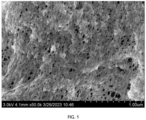
- FIG. 1 is a scanning electron microscopy (SEM) image of a surface of the lithium battery separator in Example 7 of the present disclosure.
- Examples 1 to 4 are examples of preparation of a composite slurry.
- Examples 5 to 8 are examples of preparation of lithium battery separators with the isocyanate-modified nanoceramic particle/aramid in-situ composite slurries prepared in Examples 1 to 4.
- Examples 9 to 12 are examples of preparation of batteries with the lithium battery separators prepared in Examples 5 to 8.
- Comparative Examples 1 and 2 are comparative examples of batteries prepared with the lithium battery separators in the prior art.
- a preparation method of a composite slurry including the following steps:
- the nanoceramic particle was alumina.
- An isocyanate was MDI.
- the modified nanoceramic particle obtained in the step (2) was mixed with an aramid-containing polymerization solution, and a grafting reaction was conducted at 20°C for 20 min to obtain the composite slurry.
- the slurry has a viscosity of 50 mPa ⁇ s (cp), and a mass ratio of the aramid to the modified nanoceramic particle was 2:0.5.
- the nanoceramic particle and the aramid can be compounded without a binder, and the nanoceramic particle will not fall off.
- the aramid was meta-aramid
- a preparation process of the aramid-containing polymerization solution was as follows: 4.3256 g of m-phenylenediamine (MPD) was fully dissolved in 500 g of DMAc to obtain a mixed solution, and with the mixed solution kept at room temperature, 8.1208 g of isophthaloyl chloride (IPC) was added to allow a reaction for 40 min. A pH of a resulting reaction system was adjusted with calcium hydroxide to 7.5 to obtain a meta-aramid slurry, which was the aramid-containing polymerization solution used in this example, where a mass percentage of meta-aramid in the aramid-containing polymerization solution was 2%.
- MPD m-phenylenediamine
- IPC isophthaloyl chloride
- the aramid-containing polymerization solution is adopted due to the following reason: Solid aramid has low solubility, and different solid aramid products need to be dissolved by different solvents under different dissolution conditions to obtain liquid aramid.
- the aramid-containing polymerization solution produced in preparation of aramid is directly used, that is, aramid in a liquid state is directly used before becoming a solid, which can effectively avoid the above problem.
- a preparation method of a composite slurry including the following steps:
- the modified nanoceramic particle obtained in the step (2) was mixed with an aramid-containing polymerization solution, and a grafting reaction was conducted at 90°C for 120 min to obtain the composite slurry.
- the slurry has a viscosity of 20,000 mPa ⁇ s (cp), and a mass ratio of the aramid to the modified nanoceramic particle was 1:2.
- the nanoceramic particle and the aramid can be compounded without a binder, and the nanoceramic particle will not fall off.
- the aramid was para-aramid
- a preparation process of the aramid-containing polymerization solution was as follows: 21.628 g of p-phenylenediamine (PPD) was fully dissolved in 500 g of NMP/CaCl 2 (a mass fraction of CaCl 2 was 7%) to obtain a mixed solution, the mixed solution was cooled to 0°C, and then 42.192 g of terephthaloyl chloride (TPC) was added to allow a reaction for 40 min.
- PPD p-phenylenediamine
- NMP/CaCl 2 a mass fraction of CaCl 2 was 7%
- a pH of a resulting reaction system was adjusted with calcium hydroxide to 6.5 to obtain a para-aramid slurry, which was the aramid-containing polymerization solution used in this example, where a mass percentage of para-aramid in the aramid-containing polymerization solution was 10%.
- the aramid-containing polymerization solution is adopted due to the following reason: Solid aramid has low solubility, and different solid aramid products need to be dissolved by different solvents under different dissolution conditions to obtain liquid aramid.
- the aramid-containing polymerization solution produced in preparation of aramid is directly used, that is, aramid in a liquid state is directly used before becoming a solid, which can effectively avoid the above problem.
- the nanoceramic particle was titanium oxide.
- the isocyanate was 2,6-TDI.
- the modified nanoceramic particle obtained in the step (2) was mixed with an aramid-containing polymerization solution, and a grafting reaction was conducted at 40°C for 80 min to obtain the composite slurry.
- the slurry has a viscosity of 8,000 mPa ⁇ s (cp), and a mass ratio of the aramid to the modified nanoceramic particle was 1:2.
- the nanoceramic particle and the aramid can be compounded without a binder, and the nanoceramic particle will not fall off.
- a pH of a resulting reaction system was adjusted with calcium hydroxide to 6.5 to obtain a heterocyclic aramid slurry, which was the aramid-containing polymerization solution used in this example, where a molar ratio of the PPD to the 2-(4-aminophenyl)-5-aminobenzimidazole was 1:2, and a total molar amount of the PPD and the 2-(4-aminophenyl)-5-aminobenzimidazole was 0.1 mol; and a mass percentage of heterocyclic aramid in the aramid-containing polymerization solution was 5%.
- the lithium battery separator was used to assemble a 4 Ah 811 ternary lithium battery (sample 13). Test results of the battery were shown in Table 3.
- a commercially-available 9+2+2 ⁇ m PE/ceramic-coated film was adopted as a lithium battery separator.
- the lithium battery separator exhibited a peeling strength of 90 Nm -1 , a gas permeability of 175 s/100 cc, a horizontal thermal shrinkage of 2.0% at 150°C within 1 h, a longitudinal thermal shrinkage of 2.0% at 150°C within 1 h, a breakage temperature of 156°C, and an electrolyte contact angle of 31°.
- the lithium battery separator was used to assemble a 4 Ah 811 ternary lithium battery (sample 14). Test results of the battery were shown in Table 3. Table 3 Performance test results of the batteries No. Capacity retention rate Room-temperature capacity/Ah High-temperature capacity (55°C)/Ah Low-temperature capacity (-20°C)/Ah Example 9 95% 3.8467 3.7171 1.9726 Example 10 88% 3.8365 3.6385 1.9486 Example 11 85% 3.8362 3.6112 1.9309 Example 12 94% 3.8460 3.7072 1.9537 Comparative Example 1 63.5% 3.8260 3.2681 1.6985 Comparative Example 2 65.2% 3.8359 3.2825 1.7510
- the lithium battery separators prepared with the composite slurries prepared in Examples 1 to 4 exhibit significantly-improved properties.
- the lithium battery separator prepared with the composite slurry in the present disclosure has a peeling strength of higher than or equal to 120 Nm -1 , a gas permeability of less than or equal to 300 s/100 cc, a horizontal thermal shrinkage of less than or equal to 2.0% at 150°C within 1 h, a longitudinal thermal shrinkage of less than or equal to 2.0% at 150°C within 1 h, a breakage temperature of higher than or equal to 200°C, and an electrolyte contact angle of smaller than or equal to 25°.
Landscapes
- Chemical & Material Sciences (AREA)
- Chemical Kinetics & Catalysis (AREA)
- Electrochemistry (AREA)
- General Chemical & Material Sciences (AREA)
- Engineering & Computer Science (AREA)
- Inorganic Chemistry (AREA)
- Manufacturing & Machinery (AREA)
- Materials Engineering (AREA)
- Composite Materials (AREA)
- Health & Medical Sciences (AREA)
- Medicinal Chemistry (AREA)
- Polymers & Plastics (AREA)
- Organic Chemistry (AREA)
- Ceramic Engineering (AREA)
- Compositions Of Macromolecular Compounds (AREA)
- Polyurethanes Or Polyureas (AREA)
- Secondary Cells (AREA)
- Cell Separators (AREA)
Claims (14)
- Schlamm von in situ zusammengesetztem aromatischem Polyamid, dadurch gekennzeichnet, dass zunächst Nanokeramikpartikel mit Isocyanat in situ verbunden modifiziert werden, wobei die Modifikation darin besteht, dass Hydroxylgruppen auf der Oberfläche der Nanokeramikpartikel mit Isocyanatgruppen des Isocyanats reagieren, um modifizierte Nanokeramikpartikel zu erhalten, und anschließend die modifizierten Nanokeramikpartikel mit aromatischem Polyamid durch eine Pfropfreaktion in situ verbunden werden, wobei während des Verbundprozesses die Isocyanatgruppen der modifizierten Nanokeramikpartikel mit den Amidbindungen des aromatischen Polyamids eine Pfropfreaktion eingehen, wodurch die beiden Materialien Nanokeramikpartikel und aromatisches Polyamid verbunden werden, um den Schlamm von in situ zusammengesetztem aromatischem Polyamid zu erhalten, wobei die Viskosität des Schlamms 50-20000 mPa·s (cp) beträgt, wobei das Isocyanat mindestens 2 Isocyanatgruppen umfasst und wobei die Viskosität unter Verwendung eines Rotationsviskosimeters geprüft wird.
- Schlamm von in situ zusammengesetztem aromatischem Polyamid nach Anspruch 1, dadurch gekennzeichnet, dass die Nanokeramikpartikel eines aus Aluminiumoxid, Siliziumoxid oder Titanoxid sind.
- Schlamm von in situ zusammengesetztem aromatischem Polyamid nach Anspruch 2, dadurch gekennzeichnet, dass das aromatische Polyamid eines aus meta-aromatischem Polyamid, para-aromatischem Polyamid, heterozyklischem Aramid, Polyamidimid ist.
- Schlamm von in situ zusammengesetztem aromatischem Polyamid nach Anspruch 3, dadurch gekennzeichnet, dass die Strukturformel des Isocyanats O=C=N-R1-N=C=O ist, wobei die Strukturformel von R 1


- Verfahren zur Herstellung eines Schlamms von in situ zusammengesetztem aromatischem Polyamid nach einem der Ansprüche 1 bis 4, dadurch gekennzeichnet, dass es die folgenden Schritte umfasst:(1) Trocknen von Nanokeramikpartikeln bei einer Trocknungstemperatur von 100-150°C und einer Trocknungszeit von 2-10h;(2) Zugabe der in Schritt (1) getrockneten Nanokeramikpartikel in den Reaktor, anschließend Zugabe einer Toluollösung, die Isocyanat enthält, Rühren und Dispergieren und dann Einleiten eines Inertgases in den Reaktor, Erhitzen auf eine feste Temperatur unter dem Schutz des Inertgases, und dann Reagieren und Erhalten eines modifizierten nanokeramischen partikelnrohlings nach Abschluss der Reaktion, erneutes Trocknen nach dem Waschen, um modifizierte Nanokeramikpartikel zu erhalten;(3) Mischen der in Schritt (2) erhaltenen modifizierten Nanokeramikpartikel mit einer Arylpolyamid-Polymerisationslösung und anschließendes Durchführen einer Pfropfreaktion, um den Schlamm von in situ zusammengesetztem aromatischem Polyamid zu erhalten, wobei der Schlamm eine Viskosität von 50-20.000 mPa-s (cp) aufweist.
- Verfahren zur Herstellung eines Schlamms von in situ zusammengesetztem aromatischem Polyamid nach Anspruch 5, dadurch geennzeichnet, dass die Konzentration des Isocyanats in der Toluollösung in Schritt (2) 0,1-0,5 mol/L beträgt und die Masse der Nanokeramikpartikel 1-20 % der Masse der Toluollösung ausmacht.
- Verfahren zur Herstellung eines Schlamms von in situ zusammengesetztem aromatischem Polyamid nach Anspruch 5, dadurch gekennzeichnet, dass die Rühr- und Dispergiertemperatur in Schritt (2) 20-30 °C beträgt und die Zeit 20-60 Minuten beträgt.
- Verfahren zur Herstellung eines Schlamms von in situ zusammengesetztem aromatischem Polyamid nach Anspruch 5, dadurch gekennzeichnet, dass das in Schritt (2) verwendete Inertgas Stickstoff ist, die feste Temperatur nach Einleiten des Stickstoffs 30-60 °C beträgt und die Reaktionszeit 30-120 Minuten beträgt.
- Verfahren zur Herstellung eines Schlamms von in situ zusammengesetztem aromatischem Polyamid nach Anspruch 5, dadurch gekennzeichnet, dass in Schritt (2) das organische Lösungsmittel Aceton ist und die Anzahl der Waschvorgänge des Rohprodukts der modifizierten Nanokeramikpartikel mit Aceton 3-5 beträgt.
- Verfahren zur Herstellung eines Schlamms von in situ zusammengesetztem aromatischem Polyamid nach Anspruch 5, dadurch gekennzeichnet, dass die Temperatur beim erneuten Trocknen in Schritt (2) 30-60 °C beträgt und die Zeit für das erneute Trocknen 10-30 Minuten beträgt.
- Verfahren zur Herstellung eines Schlamms von in situ zusammengesetztem aromatischem Polyamid nach Anspruch 5, dadurch gekennzeichnet, dass die aromatische Polyamid-Polymerisationslösung in Schritt (3) aromatisches Polyamid umfasst, wobei das Massenverhältnis von aromatischem Polyamid zu den modifizierten Nanokeramikpartikeln (2-10):(0,5-20) beträgt; wobei der Massenanteil des aromatischen Polyamids in der aromatischen Polyamid-Polymerisationslösung 2-10% beträgt .
- Verfahren zur Herstellung eines Schlamms von in situ zusammengesetztem aromatischem Polyamid nach Anspruch 5, dadurch gekennzeichnet, dass die Temperatur der Pfropfreaktion in Schritt (3) 20-90 °C beträgt und die Reaktionszeit 20-120 Minuten beträgt.
- Verfahren zur Herstellung von Lithiumbatterie-Trennmembran, umfassend die folgenden Schritte:(1) Mischen des Schlamms von in situ zusammengesetztem aromatischem Polyamid nach einem der Ansprüche 1 bis 4 mit einem Porenbildner und einem polaren Lösungsmittel, um eine Mischung zu erhalten;(2) Auftragen der entlüfteten Mischung auf eine oder beide Seiten der Basisschicht, anschließend Eintauchen in ein Koagulationsbad zur Koagulation, wodurch auf einer oder beiden Seiten der Basisschicht eine Überzugsschicht gebildet wird; Eintauchen der Überzugsschicht in ein Wasserbad zur Wasserwäsche, TTrocknen und Thermofixieren, um die Lithiumbatterie-Trennmembran zu erhalten.
- Lithiumbatterie-Trennmembran, die nach dem Verfahren nach Anspruch 13 hergestellt ist.
Applications Claiming Priority (1)
| Application Number | Priority Date | Filing Date | Title |
|---|---|---|---|
| CN202310820727.3A CN116544616B (zh) | 2023-07-06 | 2023-07-06 | 一种原位复合芳族聚酰胺的浆料及其制备方法和用途 |
Publications (3)
| Publication Number | Publication Date |
|---|---|
| EP4322306A2 EP4322306A2 (de) | 2024-02-14 |
| EP4322306A3 EP4322306A3 (de) | 2024-06-05 |
| EP4322306B1 true EP4322306B1 (de) | 2025-07-09 |
Family
ID=87458246
Family Applications (1)
| Application Number | Title | Priority Date | Filing Date |
|---|---|---|---|
| EP23215042.5A Active EP4322306B1 (de) | 2023-07-06 | 2023-12-07 | Verbundaufschlämmung sowie herstellungsverfahren und verwendung davon |
Country Status (3)
| Country | Link |
|---|---|
| EP (1) | EP4322306B1 (de) |
| CN (1) | CN116544616B (de) |
| WO (1) | WO2025007396A1 (de) |
Families Citing this family (3)
| Publication number | Priority date | Publication date | Assignee | Title |
|---|---|---|---|---|
| CN116544616B (zh) * | 2023-07-06 | 2023-09-05 | 烟台泰和新材高分子新材料研究院有限公司 | 一种原位复合芳族聚酰胺的浆料及其制备方法和用途 |
| CN119307175B (zh) * | 2024-12-13 | 2025-04-22 | 烟台泰和电池新材料科技有限公司 | 一种锂离子电池疏水芳纶涂覆液、涂覆隔膜及制备方法 |
| CN119852643B (zh) * | 2025-02-22 | 2025-09-23 | 泰州集萃丰芳新材料科技有限公司 | 一种锂电池用芳纶隔膜及其制备方法 |
Family Cites Families (19)
| Publication number | Priority date | Publication date | Assignee | Title |
|---|---|---|---|---|
| TW460505B (en) * | 1998-04-27 | 2001-10-21 | Sumitomo Chemical Co | Separator for nonaqueous electrolyte battery and lithium secondary battery made from the same |
| JP2004137370A (ja) * | 2002-10-17 | 2004-05-13 | Hitachi Chem Co Ltd | ポリアミドイミド樹脂ペースト及びそれを含む被膜形成材料 |
| CN103066227B (zh) * | 2012-12-26 | 2015-11-18 | 中科院广州化学有限公司 | 具有低温闭孔性能和良好尺寸稳定性的柔性复合陶瓷膜 |
| CN103311486B (zh) * | 2013-05-14 | 2016-06-08 | 中南大学 | 一种有机-无机复合隔膜及其制备和应用 |
| CN108666501A (zh) * | 2018-04-26 | 2018-10-16 | 烟台泰和新材料股份有限公司 | 一种以静电纺丝法制取的可用于锂离子电池的对位芳纶聚合物隔膜的制备方法 |
| CN109411679A (zh) | 2018-10-22 | 2019-03-01 | 乐凯胶片股份有限公司 | 陶瓷浆料、陶瓷隔膜和锂离子电池 |
| CN109411680A (zh) * | 2018-10-29 | 2019-03-01 | 东莞理工学院 | 一种芳纶树脂基微孔锂电隔膜及其制备方法 |
| CN110048063A (zh) * | 2019-03-25 | 2019-07-23 | 重庆云天化纽米科技股份有限公司 | 无机纳米颗粒改性芳纶浆液及芳纶涂覆的锂电池复合隔膜 |
| CN112521616B (zh) * | 2019-08-30 | 2022-06-14 | 比亚迪股份有限公司 | 接枝陶瓷粉体及制备方法、陶瓷隔膜及制备方法、锂离子电池、电池模组和电池包 |
| CN111116963B (zh) * | 2019-12-27 | 2022-07-22 | 深圳中兴新材技术股份有限公司 | 一种陶瓷涂层隔膜的制备方法、隔膜及陶瓷涂覆浆料 |
| CN112216928A (zh) * | 2020-10-10 | 2021-01-12 | 广东中显自动化设备有限公司 | 一种改性复合耐热锂离子电池隔膜及其制备方法 |
| CN112694610B (zh) | 2020-12-16 | 2022-05-27 | 烟台泰和新材料股份有限公司 | 一种改性对位芳纶聚合液、涂覆浆料、锂电池隔膜及其制备方法 |
| CN112531285B (zh) * | 2020-12-21 | 2023-07-07 | 中材锂膜有限公司 | 一种耐高温对位芳纶涂覆锂离子电池隔膜及其制备方法 |
| CN113140867B (zh) | 2021-04-14 | 2022-08-02 | 合肥利夫生物科技有限公司 | 一种基于生物质呋喃基聚合物的锂电池隔膜及其制备方法 |
| CN113136121B (zh) | 2021-04-14 | 2022-04-19 | 合肥利夫生物科技有限公司 | 一种生物基隔膜涂敷液及其制备方法和在锂电池中的应用 |
| CN113764823B (zh) * | 2021-09-17 | 2023-06-30 | 江苏卓高新材料科技有限公司 | 高性能梯度复合凝胶聚合物隔膜及其制备方法 |
| CN115207559B (zh) * | 2022-06-28 | 2024-03-22 | 陈克复 | 一种高性能芳纶隔膜及其制备方法与应用 |
| CN115663394A (zh) | 2022-08-29 | 2023-01-31 | 上海恩捷新材料科技有限公司 | 对位芳纶的溶解体系及其应用、芳纶隔膜及其制备方法、芳纶陶瓷复合隔膜及其制备方法 |
| CN116544616B (zh) * | 2023-07-06 | 2023-09-05 | 烟台泰和新材高分子新材料研究院有限公司 | 一种原位复合芳族聚酰胺的浆料及其制备方法和用途 |
-
2023
- 2023-07-06 CN CN202310820727.3A patent/CN116544616B/zh active Active
- 2023-08-23 WO PCT/CN2023/114417 patent/WO2025007396A1/zh not_active Ceased
- 2023-12-07 EP EP23215042.5A patent/EP4322306B1/de active Active
Non-Patent Citations (1)
| Title |
|---|
| BIOLIN SCIENTIFIC: "The Washburn Method", TECHNOLOGY NOTE 5, 28 April 2023 (2023-04-28), pages 1 - 2, XP093042812 * |
Also Published As
| Publication number | Publication date |
|---|---|
| CN116544616B (zh) | 2023-09-05 |
| EP4322306A2 (de) | 2024-02-14 |
| WO2025007396A1 (zh) | 2025-01-09 |
| CN116544616A (zh) | 2023-08-04 |
| EP4322306A3 (de) | 2024-06-05 |
Similar Documents
| Publication | Publication Date | Title |
|---|---|---|
| EP4322306B1 (de) | Verbundaufschlämmung sowie herstellungsverfahren und verwendung davon | |
| CN111509168B (zh) | 一种具有耐高温涂层的锂离子电池隔膜及其制备方法 | |
| KR101255494B1 (ko) | 방향족 폴리아미드 다공성 필름의 제조 방법 | |
| CN109411676B (zh) | 对位芳纶涂层浆料及其制备方法、对位芳纶隔膜及其制备方法和二次电池 | |
| WO2020155001A1 (zh) | 一种具有耐高温涂层的锂离子电池隔膜及其制备方法 | |
| CN102132442B (zh) | 电极用隔膜及其制造方法、以及锂离子二次电池及其制造方法 | |
| CN111477816A (zh) | 一种锂离子电池隔膜及其制备方法 | |
| JP5439772B2 (ja) | 多孔性フィルムおよび蓄電デバイス | |
| CN116315447B (zh) | 一种锂电池用聚酰亚胺多孔微球涂覆隔膜及其制备方法 | |
| CN110120549A (zh) | 聚合物电解质膜及其制备方法和锂离子电池 | |
| WO2025020751A1 (zh) | 基于反应控制剂的锂电池隔膜及其制备方法 | |
| CN110660947A (zh) | 电池隔膜及其制备方法和锂离子电池及电动汽车 | |
| CN119253192B (zh) | 一种用于锂离子电池的复合涂覆隔膜及其制备方法 | |
| CN117374514A (zh) | 一种锂离子电池浆料、隔膜及锂离子电池 | |
| CN120357143A (zh) | 一种锂离子电池隔膜浆料及锂离子电池隔膜 | |
| WO2026051275A1 (zh) | 一种隔膜及其制备方法 | |
| EP4481926A1 (de) | Verbundstoffseparator auf ölbasis und herstellungsverfahren dafür sowie sekundärbatterie | |
| CN117559082A (zh) | 一种锂电池隔膜用陶瓷浆料及其制备方法和超薄耐高温锂电池隔膜 | |
| CN111834596A (zh) | 非水电解液二次电池用多孔层 | |
| KR101657084B1 (ko) | 2차 전지 바인더용 수용성 폴리이미드 전구체, 이의 조성물, 이를 제조하는 방법 및 이를 포함하는 2차 전지용 수용성 바인더 | |
| CN114709558A (zh) | 一种高耐热聚酰胺酰亚胺复合隔膜及其制备方法 | |
| CN114079124A (zh) | 有机-无机复合锂离子电池隔膜及其制备方法 | |
| CN121227109B (zh) | 一种芳纶纳米纤维涂覆浆料、涂覆隔膜及其制备方法 | |
| CN119601904B (zh) | 高剥离强度高耐热电池隔膜及其制备方法和二次电池 | |
| KR101657081B1 (ko) | 2차 전지 바인더용 수용성 폴리이미드 전구체, 이의 조성물, 이를 제조하는 방법 및 이를 포함하는 2차 전지용 수용성 바인더 |
Legal Events
| Date | Code | Title | Description |
|---|---|---|---|
| PUAI | Public reference made under article 153(3) epc to a published international application that has entered the european phase |
Free format text: ORIGINAL CODE: 0009012 |
|
| STAA | Information on the status of an ep patent application or granted ep patent |
Free format text: STATUS: REQUEST FOR EXAMINATION WAS MADE |
|
| 17P | Request for examination filed |
Effective date: 20231207 |
|
| AK | Designated contracting states |
Kind code of ref document: A2 Designated state(s): AL AT BE BG CH CY CZ DE DK EE ES FI FR GB GR HR HU IE IS IT LI LT LU LV MC ME MK MT NL NO PL PT RO RS SE SI SK SM TR |
|
| PUAL | Search report despatched |
Free format text: ORIGINAL CODE: 0009013 |
|
| STAA | Information on the status of an ep patent application or granted ep patent |
Free format text: STATUS: EXAMINATION IS IN PROGRESS |
|
| AK | Designated contracting states |
Kind code of ref document: A3 Designated state(s): AL AT BE BG CH CY CZ DE DK EE ES FI FR GB GR HR HU IE IS IT LI LT LU LV MC ME MK MT NL NO PL PT RO RS SE SI SK SM TR |
|
| RIC1 | Information provided on ipc code assigned before grant |
Ipc: H01M 50/443 20210101ALI20240430BHEP Ipc: H01M 50/431 20210101ALI20240430BHEP Ipc: H01M 50/423 20210101ALI20240430BHEP Ipc: H01M 10/0525 20100101ALI20240430BHEP Ipc: H01M 50/451 20210101ALI20240430BHEP Ipc: H01M 50/489 20210101ALI20240430BHEP Ipc: H01M 50/449 20210101ALI20240430BHEP Ipc: H01M 50/446 20210101ALI20240430BHEP Ipc: H01M 50/434 20210101ALI20240430BHEP Ipc: H01M 50/414 20210101ALI20240430BHEP Ipc: H01M 10/052 20100101ALI20240430BHEP Ipc: H01M 50/403 20210101AFI20240430BHEP |
|
| 17Q | First examination report despatched |
Effective date: 20240517 |
|
| GRAP | Despatch of communication of intention to grant a patent |
Free format text: ORIGINAL CODE: EPIDOSNIGR1 |
|
| STAA | Information on the status of an ep patent application or granted ep patent |
Free format text: STATUS: GRANT OF PATENT IS INTENDED |
|
| INTG | Intention to grant announced |
Effective date: 20250228 |
|
| RIN1 | Information on inventor provided before grant (corrected) |
Inventor name: SONG, XIQUAN Inventor name: LI, MENG Inventor name: YANG, DONGPING Inventor name: GUAN, ZHENHONG Inventor name: JIANG, MING Inventor name: CHEN, QI |
|
| GRAS | Grant fee paid |
Free format text: ORIGINAL CODE: EPIDOSNIGR3 |
|
| GRAA | (expected) grant |
Free format text: ORIGINAL CODE: 0009210 |
|
| STAA | Information on the status of an ep patent application or granted ep patent |
Free format text: STATUS: THE PATENT HAS BEEN GRANTED |
|
| AK | Designated contracting states |
Kind code of ref document: B1 Designated state(s): AL AT BE BG CH CY CZ DE DK EE ES FI FR GB GR HR HU IE IS IT LI LT LU LV MC ME MK MT NL NO PL PT RO RS SE SI SK SM TR |
|
| REG | Reference to a national code |
Ref country code: GB Ref legal event code: FG4D |
|
| REG | Reference to a national code |
Ref country code: CH Ref legal event code: EP |
|
| REG | Reference to a national code |
Ref country code: IE Ref legal event code: FG4D |
|
| REG | Reference to a national code |
Ref country code: DE Ref legal event code: R096 Ref document number: 602023004709 Country of ref document: DE |
|
| REG | Reference to a national code |
Ref country code: NL Ref legal event code: MP Effective date: 20250709 |
|
| PG25 | Lapsed in a contracting state [announced via postgrant information from national office to epo] |
Ref country code: PT Free format text: LAPSE BECAUSE OF FAILURE TO SUBMIT A TRANSLATION OF THE DESCRIPTION OR TO PAY THE FEE WITHIN THE PRESCRIBED TIME-LIMIT Effective date: 20251110 |
|
| PG25 | Lapsed in a contracting state [announced via postgrant information from national office to epo] |
Ref country code: NL Free format text: LAPSE BECAUSE OF FAILURE TO SUBMIT A TRANSLATION OF THE DESCRIPTION OR TO PAY THE FEE WITHIN THE PRESCRIBED TIME-LIMIT Effective date: 20250709 |
|
| REG | Reference to a national code |
Ref country code: AT Ref legal event code: MK05 Ref document number: 1812769 Country of ref document: AT Kind code of ref document: T Effective date: 20250709 |
|
| PG25 | Lapsed in a contracting state [announced via postgrant information from national office to epo] |
Ref country code: IS Free format text: LAPSE BECAUSE OF FAILURE TO SUBMIT A TRANSLATION OF THE DESCRIPTION OR TO PAY THE FEE WITHIN THE PRESCRIBED TIME-LIMIT Effective date: 20251109 |
|
| PG25 | Lapsed in a contracting state [announced via postgrant information from national office to epo] |
Ref country code: NO Free format text: LAPSE BECAUSE OF FAILURE TO SUBMIT A TRANSLATION OF THE DESCRIPTION OR TO PAY THE FEE WITHIN THE PRESCRIBED TIME-LIMIT Effective date: 20251009 |
|
| REG | Reference to a national code |
Ref country code: LT Ref legal event code: MG9D |
|
| PG25 | Lapsed in a contracting state [announced via postgrant information from national office to epo] |
Ref country code: AT Free format text: LAPSE BECAUSE OF FAILURE TO SUBMIT A TRANSLATION OF THE DESCRIPTION OR TO PAY THE FEE WITHIN THE PRESCRIBED TIME-LIMIT Effective date: 20250709 |
|
| PG25 | Lapsed in a contracting state [announced via postgrant information from national office to epo] |
Ref country code: FI Free format text: LAPSE BECAUSE OF FAILURE TO SUBMIT A TRANSLATION OF THE DESCRIPTION OR TO PAY THE FEE WITHIN THE PRESCRIBED TIME-LIMIT Effective date: 20250709 |
|
| PG25 | Lapsed in a contracting state [announced via postgrant information from national office to epo] |
Ref country code: HR Free format text: LAPSE BECAUSE OF FAILURE TO SUBMIT A TRANSLATION OF THE DESCRIPTION OR TO PAY THE FEE WITHIN THE PRESCRIBED TIME-LIMIT Effective date: 20250709 |
|
| PGFP | Annual fee paid to national office [announced via postgrant information from national office to epo] |
Ref country code: FR Payment date: 20251231 Year of fee payment: 3 |
|
| PG25 | Lapsed in a contracting state [announced via postgrant information from national office to epo] |
Ref country code: GR Free format text: LAPSE BECAUSE OF FAILURE TO SUBMIT A TRANSLATION OF THE DESCRIPTION OR TO PAY THE FEE WITHIN THE PRESCRIBED TIME-LIMIT Effective date: 20251010 |
|
| PG25 | Lapsed in a contracting state [announced via postgrant information from national office to epo] |
Ref country code: SE Free format text: LAPSE BECAUSE OF FAILURE TO SUBMIT A TRANSLATION OF THE DESCRIPTION OR TO PAY THE FEE WITHIN THE PRESCRIBED TIME-LIMIT Effective date: 20250709 |
|
| PG25 | Lapsed in a contracting state [announced via postgrant information from national office to epo] |
Ref country code: LV Free format text: LAPSE BECAUSE OF FAILURE TO SUBMIT A TRANSLATION OF THE DESCRIPTION OR TO PAY THE FEE WITHIN THE PRESCRIBED TIME-LIMIT Effective date: 20250709 |
|
| PG25 | Lapsed in a contracting state [announced via postgrant information from national office to epo] |
Ref country code: PL Free format text: LAPSE BECAUSE OF FAILURE TO SUBMIT A TRANSLATION OF THE DESCRIPTION OR TO PAY THE FEE WITHIN THE PRESCRIBED TIME-LIMIT Effective date: 20250709 Ref country code: BG Free format text: LAPSE BECAUSE OF FAILURE TO SUBMIT A TRANSLATION OF THE DESCRIPTION OR TO PAY THE FEE WITHIN THE PRESCRIBED TIME-LIMIT Effective date: 20250709 |
|
| PG25 | Lapsed in a contracting state [announced via postgrant information from national office to epo] |
Ref country code: RS Free format text: LAPSE BECAUSE OF FAILURE TO SUBMIT A TRANSLATION OF THE DESCRIPTION OR TO PAY THE FEE WITHIN THE PRESCRIBED TIME-LIMIT Effective date: 20251009 |
|
| PG25 | Lapsed in a contracting state [announced via postgrant information from national office to epo] |
Ref country code: ES Free format text: LAPSE BECAUSE OF FAILURE TO SUBMIT A TRANSLATION OF THE DESCRIPTION OR TO PAY THE FEE WITHIN THE PRESCRIBED TIME-LIMIT Effective date: 20250709 |
|
| PG25 | Lapsed in a contracting state [announced via postgrant information from national office to epo] |
Ref country code: RO Free format text: LAPSE BECAUSE OF FAILURE TO SUBMIT A TRANSLATION OF THE DESCRIPTION OR TO PAY THE FEE WITHIN THE PRESCRIBED TIME-LIMIT Effective date: 20250709 |
|
| PG25 | Lapsed in a contracting state [announced via postgrant information from national office to epo] |
Ref country code: SM Free format text: LAPSE BECAUSE OF FAILURE TO SUBMIT A TRANSLATION OF THE DESCRIPTION OR TO PAY THE FEE WITHIN THE PRESCRIBED TIME-LIMIT Effective date: 20250709 |
|
| PG25 | Lapsed in a contracting state [announced via postgrant information from national office to epo] |
Ref country code: DK Free format text: LAPSE BECAUSE OF FAILURE TO SUBMIT A TRANSLATION OF THE DESCRIPTION OR TO PAY THE FEE WITHIN THE PRESCRIBED TIME-LIMIT Effective date: 20250709 |
|
| PGFP | Annual fee paid to national office [announced via postgrant information from national office to epo] |
Ref country code: DE Payment date: 20251231 Year of fee payment: 3 |
|
| PG25 | Lapsed in a contracting state [announced via postgrant information from national office to epo] |
Ref country code: IT Free format text: LAPSE BECAUSE OF FAILURE TO SUBMIT A TRANSLATION OF THE DESCRIPTION OR TO PAY THE FEE WITHIN THE PRESCRIBED TIME-LIMIT Effective date: 20250709 |
|
| PG25 | Lapsed in a contracting state [announced via postgrant information from national office to epo] |
Ref country code: CZ Free format text: LAPSE BECAUSE OF FAILURE TO SUBMIT A TRANSLATION OF THE DESCRIPTION OR TO PAY THE FEE WITHIN THE PRESCRIBED TIME-LIMIT Effective date: 20250709 |
|
| PG25 | Lapsed in a contracting state [announced via postgrant information from national office to epo] |
Ref country code: SK Free format text: LAPSE BECAUSE OF FAILURE TO SUBMIT A TRANSLATION OF THE DESCRIPTION OR TO PAY THE FEE WITHIN THE PRESCRIBED TIME-LIMIT Effective date: 20250709 Ref country code: EE Free format text: LAPSE BECAUSE OF FAILURE TO SUBMIT A TRANSLATION OF THE DESCRIPTION OR TO PAY THE FEE WITHIN THE PRESCRIBED TIME-LIMIT Effective date: 20250709 |