EP4312903B1 - Fussorthese mit drehgelenk zur korrektur von fussfehlstellungen - Google Patents
Fussorthese mit drehgelenk zur korrektur von fussfehlstellungen Download PDFInfo
- Publication number
- EP4312903B1 EP4312903B1 EP22717568.4A EP22717568A EP4312903B1 EP 4312903 B1 EP4312903 B1 EP 4312903B1 EP 22717568 A EP22717568 A EP 22717568A EP 4312903 B1 EP4312903 B1 EP 4312903B1
- Authority
- EP
- European Patent Office
- Prior art keywords
- foot
- joint
- splint
- toe
- metatarsal
- Prior art date
- Legal status (The legal status is an assumption and is not a legal conclusion. Google has not performed a legal analysis and makes no representation as to the accuracy of the status listed.)
- Active
Links
Images





Classifications
-
- A—HUMAN NECESSITIES
- A61—MEDICAL OR VETERINARY SCIENCE; HYGIENE
- A61F—FILTERS IMPLANTABLE INTO BLOOD VESSELS; PROSTHESES; DEVICES PROVIDING PATENCY TO, OR PREVENTING COLLAPSING OF, TUBULAR STRUCTURES OF THE BODY, e.g. STENTS; ORTHOPAEDIC, NURSING OR CONTRACEPTIVE DEVICES; FOMENTATION; TREATMENT OR PROTECTION OF EYES OR EARS; BANDAGES, DRESSINGS OR ABSORBENT PADS; FIRST-AID KITS
- A61F5/00—Orthopaedic methods or devices for non-surgical treatment of bones or joints; Nursing devices ; Anti-rape devices
- A61F5/01—Orthopaedic devices, e.g. long-term immobilising or pressure directing devices for treating broken or deformed bones such as splints, casts or braces
- A61F5/019—Toe correcting or spreading devices
Definitions
- the present invention relates to a foot orthosis for correcting foot deformities, in particular for treating hallux valgus.
- Pathological misalignments in the metatarsal and forefoot area of a patient can have various causes, such as genetic predisposition, wearing the wrong footwear, especially shoes that are too tight or have high heels, or a flattening of the longitudinal and transverse arches as a result of instability of the connective tissue in the metatarsal area.
- the misalignment of the big toe in the metatarsophalangeal joint, known as hallux valgus is becoming more and more important due to the constantly growing number of cases.
- Hallux valgus occurs when the big toe is pulled in the direction of the inside of the foot by muscle tension.
- the first metatarsal bone protrudes as a ball-shaped bulge on the inside of the metatarsal joint, which is also known as pseudoexostosis.
- the ball-shaped bulge is also described in medical literature as a protrusion in the area of the metatarsal joint or as swelling in the ball area, which can lead to painful inflammation of the protruding ball of the toe as hallux valgus progresses.
- hallux valgus is often accompanied by a change in the length and direction of pull of the tendons, which can make the misalignment worse over time. This leads to arthrosis of the metatarsal joint of the big toe, which must be treated surgically in advanced stages.
- the use of conservative therapy methods is known in addition to surgical interventions.
- the use of tape bandages or orthoses is known to treat the foot in a resting position. Due to the required resting position of the foot during therapy, these are mainly used at night.
- orthoses which, when attached to the foot, allow a splinted big toe a degree of freedom of movement along the flexion-extension direction.
- the DE 102 40 121 B4 and US 2006/0155233 A1 an orthopedic device in the form of a joint-flexing splint, which is articulated around a flexion-extension movement axis of the toe to be corrected.
- the joint-flexing splint is provided with a joint device on the inside of the foot, from which two bending legs extend along the inside of the foot.
- the joint device comprises a curved joint plate on the side of the foot.
- a first bending leg is attached to the toe via a first bandage and a second bending leg is attached to the metatarsal via a second bandage.
- a foot orthosis for correcting misalignments of a foot, in particular for treating or preventing hallux valgus.
- the foot orthosis comprises a toe splint that can be attached to a toe and a metatarsal splint that can be attached in the area of a metatarsal, which are coupled so that they can pivot relative to one another by means of a swivel joint.
- the foot orthosis is designed to exert a first corrective force on the toe via the toe splint when properly attached to a foot and to exert a second corrective force, opposite to the first corrective force, on a metatarsal joint via the swivel joint.
- the swivel joint is provided with a recess in the form of a through-opening along its pivot axis and designed such that, when the foot orthosis is attached to the foot, a laterally bulging part of the metatarsophalangeal joint is at least partially received in the through-opening.
- the pivot joint comprises a first joint element in the form of a joint ring connected to the toe splint and a second joint element in the form of a joint pin connected to the metatarsal splint, which engage in a form-fitting manner along the pivot axis and transversely to the pivot axis of the pivot joint, wherein the joint pin is provided with a receiving groove in which a corresponding connecting ring of the joint ring is guided, and wherein the joint pin comprises a circumferential radial shoulder at a proximal end, which provides a form-fitting connection between the joint ring and the joint pin in the direction of the pivot axis and is received in a correspondingly designed further recess on the joint ring.
- a particularly effective therapeutic effect can be achieved by the proposed foot orthosis providing not only the first corrective force acting on the toe but also the second corrective force acting on the metatarsophalangeal joint via the swivel joint.
- the proposed design of the foot orthosis can simultaneously achieve a therapeutic effect on a valgus position of the toe and a varus position of the metatarsophalangeal joint. This means that the symptoms and cause of the foot misalignment can be treated simultaneously.
- the corrective forces acting on the foot and the associated therapeutic effects are described in more detail below in connection with the associated components of the foot orthosis.
- the laterally bulging part of the metatarsophalangeal joint is sensitive and pressure-sensitive, particularly in the presence of pseudoexostosis, as occurs in hallux valgus.
- the proposed foot orthosis is equipped with the swivel joint provided with the recess, in the recess of which the laterally bulging part of the metatarsophalangeal joint is at least partially accommodated when the foot orthosis is worn. This can prevent the foot orthosis from resting on a distal end of the laterally bulging part of the metatarsophalangeal joint and exerting forces directly on it.
- the proposed The geometric design of the swivel joint of the foot orthosis reduces or avoids stress on pressure-sensitive areas of the foot.
- the design of the proposed swivel joint allows the foot orthosis to be guided closer to the foot and its extension in the direction of the width of the foot to be reduced. This applies in particular to those areas or sections of the foot orthosis which, when properly attached to the foot, are arranged laterally on the metatarsophalangeal joint of the wearer. Accordingly, the proposed swivel joint can contribute to a compact design of the foot orthosis. Wearing the proposed foot orthosis in normal footwear can thus be significantly more comfortable for a patient than with known devices and is only made possible by the compact design.
- the proposed foot orthosis is intended to treat, counteract and/or prevent a pathological misalignment of a foot, in particular a toe and/or a metatarsophalangeal joint.
- the foot orthosis can be used to prevent or treat hallux valgus, but is not limited to this application.
- the foot orthosis is intended to be attached to a patient's foot and, when attached to the foot, to have a therapeutic effect on the foot, in particular on the toe and/or the metatarsophalangeal joint.
- the expression "in a state properly attached to the foot”, also abbreviated here to “in the attached state”, refers to a state in which the foot orthosis is properly attached to a patient's foot and accordingly brings about a desired therapeutic effect for correcting or preventing misalignments.
- the foot orthosis can be designed foot-specifically for a patient's left or right foot. In other words, the foot orthosis can be intended and designed for use on either the patient's left or right foot.
- a foot orthosis intended for the left foot can be designed to be mirror-symmetrical to a foot orthosis intended for the patient's right foot.
- the proposed foot orthosis is designed in such a way that it exerts corrective forces on the foot when fastened.
- corrective forces is understood here to mean forces that have a therapeutic effect on the foot to be treated.
- the corrective forces cause the parts of the foot affected by the misalignment to be brought into a anatomically correct or intended position to achieve a desired therapeutic effect.
- the proposed foot orthosis is designed to apply, in particular directly, at least the first and second corrective force to the foot to be treated by means of the toe splint and the metatarsal splint when attached to the patient's foot.
- This design makes the present foot orthosis significantly different from known devices that intentionally or unintentionally shield a metatarsophalangeal joint and the ball of the toe associated with it or a pathological pseudoexostosis caused by the misalignment from external forces, in particular from forces acting on the foot through the device.
- a toe of the foot In connection with the toe splint, for the sake of simplicity, reference is generally made to a toe of the foot. This is particularly the big toe of the foot to be treated. However, the foot orthosis is not restricted to this, so that the term can also refer to the little toe, for example.
- the foot orthosis in particular with respect to the foot to be treated, a reference system is used that is aligned with the midline of a patient's body, as is common in anatomy.
- the position and direction of the individual components of the proposed foot orthosis in the fastened state can be specified with respect to the foot accommodated in the foot orthosis.
- the term “medial” refers to a direction or side of the foot orthosis that points towards a medial plane of the wearer's body.
- the term “medial plane”, also called the “midsagittal plane” generally refers to an anatomical plane that divides the body into two symmetrical parts.
- the term “in the medial direction” means a direction that is directed from the foot to be treated. foot of the patient in the direction of his or her other foot.
- the term “lateral” refers to a direction or side of the foot orthosis that faces away from the medial plane of the wearer's body. Accordingly, when describing a foot orthosis that is attached to one foot of the wearer, the term “laterally” means in a direction that faces away from the wearer's other foot.
- the foot orthosis is equipped with the swivel joint, which is designed in particular as a hollow pivot swivel joint.
- a "swivel joint” is understood to mean a joint in which two components of the joint that can be pivoted and engaged relative to one another are mounted so that they can pivot or rotate relative to one another.
- the term "hollow pivot swivel joint”, which can also be referred to as a hubless swivel joint refers to a joint that is hollow at least in sections along its swivel axis in order to form the recess.
- the components forming the swivel joint are hollow along the swivel axis, so that the swivel joint is provided with the recess or through-opening around and along its swivel axis.
- the swivel joint can have components that can be pivoted relative to one another about the swivel axis and that are guided relative to one another in the swivel joint.
- the area provided for guiding the components which can be formed by bearing points and/or bearing surfaces, in particular by contact surfaces and/or sliding surfaces, is preferably arranged circumferentially around the swivel axis and at a distance from it.
- the area provided for guiding the components of the swivel joint can be arranged at a distance from the swivel axis by a guide radius.
- the guide radius can in particular indicate a mean radius of the area provided for guiding the components of the swivel joint around the swivel axis.
- the guide radius can essentially lie in the area of an outer radius of the swivel joint, which describes an extension of the swivel joint in the radial direction.
- the guide radius can be at least 70% of the outer radius of the swivel joint. In particular, the guide radius can be at least 80% or at least 90% of the outer radius.
- the swivel joint can be provided in the form of a ring joint, in which the guide surface between the relatively pivotable components of the swivel joint is ring-shaped around the joint or swivel axis of the swivel joint is/are arranged.
- the swivel joint can be particularly robust against bending forces and bending moments, so that the swivel joint can transmit high forces and moments and introduce them into the foot to be treated, while at the same time the foot orthosis has a compact design.
- the swivel joint can be designed such that, in the fastened state of the foot orthosis, the swivel joint is arranged on the foot and the metatarsophalangeal joint in such a way that the swivel joint can be arranged circumferentially around the laterally bulging part of the metatarsophalangeal joint, for example around the pseudoexostosis, wherein the laterally bulging part of the metatarsophalangeal joint is at least partially arranged in the recess of the swivel joint.
- the recess is designed in the form of a through-opening, in particular along the pivot axis.
- the recess can extend along the entire width or thickness of the swivel joint.
- the terms "width” or “thickness” of the swivel joint refer to an extension of the swivel joint along the pivot axis.
- the swivel joint can have a width, in particular a maximum width, of at most 1.0 cm or at most 0.6 cm.
- the foot orthosis can be designed such that, in the fastened state, the laterally bulging part of the metatarsophalangeal joint extends along at least 50% or at least 70% or at least 80% of the maximum width of the pivot joint. Furthermore, the foot orthosis can be designed such that, in the fastened state, the laterally bulging part of the metatarsophalangeal joint protrudes or essentially protrudes through the recess, in particular the through-opening, along the pivot axis. In this way, the foot orthosis can be guided particularly closely to the foot.
- the swivel joint can comprise a side wall that delimits the recess and is arranged radially around the swivel axis.
- the side wall can have a minimum radius of curvature of 1 mm or 2 mm or 5 mm.
- the swivel joint can be designed in such a way that the side wall does not have a radius of curvature that is below the minimum radius of curvature at any point.
- the reciprocal of the radius of curvature corresponds to the curvature of the side wall, in particular its inner surface facing the recess.
- the recess can have a minimum diameter, in particular along a direction transverse to the pivot axis or around the pivot axis, of at least 1.5 cm or at least 2.0 cm or at least 2.5 cm.
- the recess can have a circular or elliptical shape in cross section along the pivot axis, the minimum diameter of which can be at least 1.5 cm or at least 2.0 cm or at least 2.5 cm.
- the diameter can be 3.0 cm or substantially 3.0 cm.
- the shape of the recess in particular its cross-sectional shape and diameter, can be adapted to the foot to be treated, in particular to the shape of the laterally bulging part of the metatarsophalangeal joint. This can be done on a user-group-specific basis based on orthopedic or physiological classification.
- foot orthoses can be provided in this way for user groups with different sized feet and/or different sized laterally bulging parts of the metatarsophalangeal joint or pseudoexostoses.
- the toe splint and the metatarsal splint are pivotally coupled relative to one another by means of the pivot joint.
- the toe splinted by means of the proposed foot orthosis can be moved along the flexion-extension movement direction relative to the metatarsal.
- the foot orthosis and the corresponding pivot joint can be set up in such a way that, when the foot orthosis is attached to the foot, the toe to be treated can be moved relative to the metatarsophalangeal joint in the flexion and extension direction.
- the pivot joint can be set up in such a way that, when the foot orthosis is attached to the foot, the pivot axis of the pivot joint is parallel or substantially parallel to a metatarsophalangeal joint axis, in particular parallel or substantially parallel to the flexion-extension movement axis of the metatarsophalangeal joint.
- the pivot axis of the rotary joint can be aligned with the metatarsophalangeal joint axis of the metatarsophalangeal joint, in particular with the flexion-extension movement axis, i.e. coincide with it or be essentially aligned.
- the pivot axis of the rotary joint can be arranged parallel or essentially parallel to the first and/or second corrective force.
- the pivot joint can be designed to transmit shear and/or bending forces between the toe splint and the metatarsal splint in order to exert the first and/or second corrective force on the foot.
- the pivot joint of the foot orthosis can be designed to transmit forces acting parallel to the corrective forces in the fastened state, in particular Shear forces or pushing forces, in order to generate the first and/or second corrective force.
- the swivel joint can be designed to transmit forces between the metatarsal splint and the toe splint in the direction of the pivot axis of the swivel joint.
- the swivel joint can be designed to transmit bending forces between the metatarsal splint and the toe splint along a longitudinal extension of the foot orthosis, which runs from the metatarsal splint via the swivel joint to the toe splint and which, when the foot orthosis is attached to the foot, essentially corresponds to the longitudinal direction of the foot.
- the bending forces can run in a medial-lateral direction and/or lateral-medial direction. The forces transmitted along the splint in this way can bring about the corrective forces to be exerted on the foot by the foot orthosis.
- the proposed foot orthosis allows a splinted toe sufficient freedom of movement so that the foot orthosis supports the foot in its natural walking movement and at the same time has a therapeutic effect on it.
- This enables the use of the proposed foot orthosis in the patient's everyday life, which increases their willingness to wear the foot orthosis and therefore the acceptance and thus the success of the therapeutic treatment.
- the swivel joint can be designed such that, when the foot orthosis is attached to the foot, a relative swivel movement between the toe splint and the metatarsal splint about an axis arranged obliquely or orthogonally to the swivel axis is blocked.
- the swivel joint can be designed such that a relative swivel movement between the toe splint and the metatarsal splint is only permitted about the swivel axis.
- the swivel joint can be structurally designed such that swivel movements about the swivel axis can take place, but swivel movements about an axis obliquely or transversely to the swivel axis are blocked. In this way, a simple and compact design of the swivel joint can be provided.
- the foot orthosis is preferably designed in such a way that, when attached to the foot, the swivel joint is arranged on the side of the foot.
- the swivel joint can be arranged on a medial side of the foot when attached.
- the swivel joint when attached to the foot, can be arranged on the inside of the foot, i.e. medially on the foot, whereby in particular the toe splint and the metatarsal splint can be arranged medially.
- the pivot joint can be formed by areas of the toe splint and the metatarsal splint that are structurally engaged with one another.
- the pivot joint can be formed by end sections of the toe splint and the metatarsal splint that are structurally engaged with one another.
- the pivot joint can be formed at least partially by the areas of the toe splint and the metatarsal splint that are engaged, or can be formed exclusively by the areas of the toe splint and the metatarsal splint that are engaged.
- the part of the toe splint and/or the metatarsal splint that forms the pivot joint can be an integral part of the toe splint and/or the metatarsal splint. In this way, a simple construction of the foot orthosis can be ensured by using a small number of components.
- the swivel joint can comprise a first joint element coupled to the toe splint, in particular integrally or materially connected, and a second joint element complementary to it and in engagement, preferably in direct engagement, which is coupled to the metatarsal splint, in particular integrally or materially connected.
- the first joint element and the second joint element can be in positive engagement along the pivot axis, in particular in a first and a second direction opposite thereto along the pivot axis, and/or transversely to the pivot axis of the swivel joint.
- the swivel joint can be designed in such a way that, in the fastened state, the second joint element is arranged between the foot and the first joint element. In this way, it can be prevented that, during a bending movement of the splinted toe, the part of the swivel joint that rests on the foot is pivoted relative to the part that bulges out at the side. This can increase the comfort of wearing the foot orthosis.
- the second joint element can form the joint pin of the rotary joint, which guides the first joint element forming the joint ring around the pivot axis.
- the joint pin is preferably designed as a hollow pin, with the hollow part of the hollow pin forming the recess.
- the joint ring and the joint pin are designed and engaged in such a way that they are in positive engagement along the pivot axis, in particular in the first and the opposite second direction along the pivot axis.
- the geometric design of the pivot pin can be adapted to the shape of the pivot ring.
- the pivot ring can have a first guide surface, which can be designed to correspond to a second guide surface of the pivot pin.
- the first and second guide surfaces which in particular form sliding and bearing surfaces, can be in engagement, in particular essentially free of play or with a predetermined play. During a pivoting movement, the first and second guide surfaces can be moved relative to one another.
- the first guide surface of the joint ring can be or comprise a surface directed radially inwards, i.e. facing the pivot axis.
- the first guide surface can extend in the circumferential direction around the pivot axis and be arranged in a ring around the pivot axis.
- the second guide surface of the pivot pin can be or comprise a surface directed radially outwards and in particular form a lateral surface of the pivot pin.
- the second guide surface can extend accordingly in the circumferential direction around the pivot axis and be arranged in a ring around the pivot axis.
- the pivot pin comprises a circumferential radial shoulder at a proximal end, which preferably provides a positive connection or undercut securing between the pivot ring and pivot pin in the direction of the axis of rotation, in particular in the form of a snap hook.
- the radial shoulder can be received in the correspondingly formed further recess on the pivot ring.
- a separate securing ring can be provided, which can be inserted into a corresponding groove on the pivot ring or pivot pin.
- the radial shoulder can extend along the pivot axis in such a way that it is arranged in the axial direction of the pivot joint so as to overlap the pivot ring and in particular surrounds it. This design can prevent the foot to be treated from coming into contact with the receiving groove in order to increase wearing comfort for a patient.
- the first and second guide surfaces can comprise at least one, for example two opposite axially delimiting side surfaces in order to provide the positive connection along the pivot axis. In this way, forces, in particular bending forces in the direction of the pivot axis of the rotary joint can be transmitted between the components.
- the pivot pin in particular the second joint element, or the joint ring can be provided with a receiving groove arranged around the pivot axis, which extends in the radial direction, ie extends towards the pivot axis, and in the axial Direction along the pivot axis is limited, i.e. is limited laterally.
- the inner surfaces of the receiving groove form a contact and sliding surface, i.e. the first or second guide surface.
- the receiving groove can form a substantially U-shaped contact or sliding surface in longitudinal section along the pivot axis.
- the corresponding guide surface can be a connecting ring designed to correspond to the receiving groove, which is guided in the receiving groove and can be rotated relative to the receiving groove in the circumferential direction about the pivot axis.
- the pivot pin can be provided with a receiving groove in which a corresponding connecting ring of the pivot ring is guided.
- the pivot ring can be provided with the receiving groove in which the corresponding connecting ring of the pivot pin is guided.
- the foot orthosis further comprises the toe splint.
- the toe splint can be designed to be engaged with the toe of the foot at a predetermined position in order to provide a force-transmitting coupling between the toe and the toe splint in the state of the foot orthosis attached to the foot. Accordingly, the toe splint is held in a desired position on the foot in the state of the foot orthosis attached to the foot.
- the toe splint is further designed to exert the first corrective force on the toe in the state of the foot.
- the first corrective force can act on the toe in a medial direction, wherein the corrective force exerted by the pivot joint can act in a lateral direction.
- the foot orthosis further comprises the metatarsal splint.
- the metatarsal splint can be designed to exert a holding force on the metatarsal when attached to the foot.
- the holding force can act in a direction parallel to the first corrective force and, together with the first corrective force, form a counterforce to the second corrective force.
- the foot orthosis can be reliably held stable on the foot to be treated in a position intended for therapeutic treatment.
- the foot orthosis can be attached to the foot to be treated with the effect of a tension clamp or clip.
- the holding force exerted by the metatarsal splint can have a therapeutic effect on the foot to be treated, which in particular contributes to the therapeutic effect of the first and second corrective force and/or provides a further therapeutic effect that is different from this.
- the further corrective force exerted by the metatarsal splint can cause the arch of the foot to be straightened.
- the foot orthosis can also comprise a foot cushion, also known as a pad, which is arranged below the sole of the foot, in particular the arch of the foot in the metatarsal area. Such a foot cushion can be detachably connected to the metatarsal splint.
- the toe splint and/or the metatarsal splint may comprise a bracket element extending along the toe to be splinted or along the metatarsal to be splinted.
- brace element is understood here and in general to mean a component that is designed and intended to absorb and transmit different loads, such as longitudinal forces, transverse forces, shear forces, bending forces, bending moments, torsional moments, etc.
- a brace element is therefore designed to absorb and transmit not only tensile forces but also compressive forces along its longitudinal axis and transverse forces transverse to its axis of extension, in particular its longitudinal axis. This property distinguishes a brace significantly from a bandage, which is designed to transmit tensile forces but not compressive and/or transverse forces.
- the bracket element of the toe splint and/or the metatarsal splint can be designed in such a way that, when fastened to the foot, it absorbs and transmits shear forces and/or bending forces, in particular in the direction of the first and second corrective force, in order to exert the first corrective force on the toe and/or to exert the holding force on the metatarsal.
- the bracket element of the toe splint and/or the metatarsal splint can be designed in the form of a tension bracket or a bending spring.
- the first corrective force and/or the second corrective force and/or the holding force can be provided in the form of a tension force induced by elastic deformation of the bracket element of the toe splint and/or the metatarsal splint.
- the foot orthosis can be designed such that, in the state attached to the foot, the pivot joint transmits bending forces parallel to the first or second corrective force between the metatarsal splint and the toe splint, wherein the first corrective force and/or the second corrective force and/or the holding force is provided in the form of a bending force induced by an elastic deformation of the toe splint and the metatarsal splint.
- the corrective forces are continuously exerted on the toe and the metatarsophalangeal joint when the foot orthosis is worn, ie even when the toe moves relative to the metatarsal, as is the case when walking, for example.
- the foot orthosis can be designed in such a way that when the foot orthosis is decoupled from the foot, i.e. in a state in which the foot orthosis is not engaged with the foot to be treated and is accordingly exposed, the foot orthosis, in particular the bracket element of the toe splint and/or the metatarsal splint, is arranged in a resting position in which the foot orthosis, in particular the bracket element of the toe splint and/or the metatarsal splint, is not elastically deformed.
- the foot orthosis when the foot orthosis is attached to the foot, the foot orthosis, in particular the bracket element of the toe splint and/or the metatarsal splint, can, however, be arranged in a tensioned position in which the foot orthosis, in particular the bracket element of the toe splint and/or the metatarsal splint, is elastically deformed.
- the bracket element of the toe splint and/or the metatarsal splint, in particular an end section of the bracket element can be elastically deflected in the tensioned position compared to the resting position in a direction opposite to the first correction force.
- the bracket element of the toe splint and/or the metatarsal splint, in particular its end section can be deflected or translationally displaced in the clamping position relative to the rest position by at least 0.2 cm, for example by at least 0.3 cm or at least 0.5 cm or at least 1.0 cm, in particular along the direction opposite to the first corrective force.
- the bow element of the toe splint and/or the metatarsal splint can be tensioned or pre-tensioned in the direction of the first corrective force due to its elastic deformation.
- the tensioning force or bending force acting on the bow element of the toe splint or the metatarsal splint can correspond to the first corrective force and/or holding force.
- the bracket element In order to couple the bracket element of the toe splint or the metatarsal splint in a force-transmitting manner to the toe or metatarsal to be splinted, the bracket element can be designed in such a way that it at least partially surrounds the toe or metatarsal.
- the bracket element of the toe splint and/or the metatarsal splint can be designed in such a way that it at least partially surrounds the toe or metatarsal when attached to the foot.
- encompassing the toe or metatarsal means that the bracket element, when attached to the foot, extends in the circumferential direction of the toe.
- the bracket element extends along the toe or extends in the metatarsal circumferential direction along the metatarsal.
- the bracket element extends around the toe or metatarsal over a radian measure of at least 1/2 ⁇ rad or ⁇ rad around the toe longitudinal axis or the metatarsal longitudinal axis. This means that the bracket element extends in the circumferential direction at least along a quarter or a half of the circumference of a toe or metatarsal.
- the bracket element is preferably designed in the shape of a plate and/or a shell.
- the bracket element can be designed in the shape of a belt or band in its geometric design and can be particularly rigid.
- the bracket element can be designed with a contact surface intended for the toe and an opposite support surface. When the foot orthosis is attached to the foot, the contact surface of the bracket element can rest against the toe, in particular directly against it.
- the contact surface can be designed in the form of a turning surface, the orientation of which, i.e. the surface normal of which changes along the longitudinal axis of the toe and preferably points towards the longitudinal axis of the toe. In this way, the contact surface and thus also the bracket element can extend along a helical line around the longitudinal axis of the toe.
- the bracket element can be designed such that the size of the bracket element, in particular its span along the transverse axis of the foot orthosis, can be adapted to the size of the foot to be treated.
- the bracket element can, for example, be designed in several parts, with a corresponding plurality of parts of the bracket element being coupled to one another and being displaceable relative to one another along the transverse axis of the foot orthosis.
- the coupling between the plurality of parts can be selectively locked or released. In a released state of the coupling between the plurality of parts, these can be moved translationally relative to one another in order to set a desired relative position to one another. The coupling can then be locked by force and/or form locking, so that a relative translational movement between the plurality of parts is blocked.
- the bracket element of the toe splint and/or the metatarsal splint can run along the toe or along the metatarsal on the inside of the foot, in particular in the form of a bending leg, and can be attached to the toe or metatarsal in a force-transmitting manner using a support band.
- the support band which can also be referred to as a bandage, can rest on the toe or metatarsal at least in sections in the circumferential direction, with the support band being connected to the bracket element in order to shape and/or to fix it force-fittingly relative to the toe or the metatarsal.
- the support band can be provided in the form of a strap, a loop, a band, a belt, etc.
- support band is understood here and in general to mean a component that is designed and intended to absorb and transmit loads, in particular tensile forces. Furthermore, in the case of support bands, this can in particular be length-adjustable loop elements. Accordingly, the circumferential length of the support band can be adjusted by a user. This enables foot-specific adjustments on the one hand and ensures an effective flow of force on the other.
- the support bands are tensile-rigid along their circumference, or essentially tensile-rigid.
- the support bands can be elastic along their circumference or elastic in sections. Specifically, the support bands can be in the form of tensile-rigid and/or elastic, or elastic in sections, ring bandages or loop elements.
- the support band can rest on a lateral side of the toe or the metatarsal and exert the corrective force or holding force on these or these.
- the support band can be subjected to a tensile force at its end sections by means of the bracket element.
- the support band can be arranged at least partially around the toe or the metatarsal in the circumferential direction.
- the swivel joint can be designed to transmit shear forces and/or bending forces parallel to the first or second corrective force between the metatarsal splint and the toe splint when attached to the foot.
- the swivel joint can thus generate the second corrective force via an interaction of the first corrective force with the holding force.
- This also allows the amount of the second corrective force to be varied by a user by setting or adjusting the toe splint or the metatarsal splint, for example the circumferential length of the support band(s).
- the toe splint and/or the metatarsal splint can be made of a plastic, in particular a thermoplastic, a thermoplastic elastomer, etc.
- the toe splint and/or the metatarsal splint can be made by an additive manufacturing process or an injection molding process.
- the individual components can also comprise different materials, in particular plastics, which preferably have different material properties.
- the use of an additive manufacturing process or an injection molding process This allows the individual segments to be integrally formed and yet still be made of different materials and have different material properties. In other words, the parts of the individual components made of different materials can be connected to one another integrally or materially.
- the foot orthosis in particular the toe splint and/or the metatarsal splint and/or the swivel joint, can have a support or coating on the inside, in particular a cushioning coating, for example a cushioning polyvinyl chloride (PVC) coating or a polyurethane (PU) coating, wherein the coating is in particular softer, i.e. has a lower hardness, than the part of the foot orthosis that bears the coating.
- PVC polyvinyl chloride
- PU polyurethane
- the coating can be applied to the inside of at least one of the components of the foot orthosis.
- the term "inside" refers to those areas of the foot orthosis that face the foot when fastened.
- the cushioning coating can be applied to the inside of the foot orthosis or the splints in an additive process as a solid or gel.
- the cushioning coating can be applied by lamination or covering.
- a suitable PVC material or PU material can be melted and pressed onto the splint to produce the coating.
- the coating may be applied in the liquid state, whereby the application may be carried out by dipping, doctoring, roller application, spraying, foaming or any other suitable method.
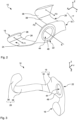
- Figure 1 shows an embodiment of a foot orthosis 10 for correcting foot deformities. More precisely, the Figure 1 The foot orthosis shown is intended to treat the pathological misalignment of a big toe 12, also known as valgus position of the big toe, and a metatarsophalangeal joint 14, also known as varus position of the metatarsophalangeal joint, known as hallux valgus.
- the foot orthosis 10 shown here can also be used to prevent hallux valgus.
- big toe is abbreviated to the term “toe” below and the term “metatarsal joint” is abbreviated to "metatarsal joint”.
- the foot orthosis 10 is intended to be attached to a foot to be treated in the manner of a clamp, in particular a tension clamp, and to be fixed in a predetermined position.
- the foot orthosis 10 is designed and configured to have a therapeutic effect on the foot when attached to the foot by introducing targeted corrective forces into the foot, in particular in the area of the toe 12 and the metatarsophalangeal joint 14, as will be described in more detail below.
- the foot orthosis 10 shown is intended for use on the patient's right foot.
- a foot orthosis 10 shown in Figure 1 A mirror-symmetrical foot orthosis can be used in the configuration shown.
- the foot orthosis 10 comprises a toe splint 16 that can be fastened to the toe 12 and a metatarsal splint 17 that can be fastened in the region of a metatarsal, comprising a ball segment 18 and a metatarsal segment 20.
- the toe splint 16 and the metatarsal splint 17 are pivotably coupled relative to one another by means of a swivel joint 22.
- the metatarsal splint 17 is formed by the ball segment 18 to be arranged in the region of the metatarsophalangeal joint 14 and the metatarsal segment 20 that can be fastened on or in the region of the metatarsal.
- the foot orthosis 10 is designed to exert a first corrective force F1 on the toe 12 via the toe splint 16, to exert a second corrective force F2 on the metatarsophalangeal joint 14 via the pivot joint 22, which is opposite to the first corrective force F1 and spaced apart therefrom, and to exert a holding force F3, which can form a third corrective force, on the metatarsal region via the metatarsal splint 17, wherein the holding force F3 points in the direction of the first corrective force F1 and is arranged parallel to it at a spaced apart distance therefrom.
- the individual components of the foot orthosis 10, in particular the toe splint 16 and the metatarsal splint 17, are elastically deformable, the different forces F1, F2, F3 acting on the foot through the foot orthosis 10 being provided in the form of tension and/or bending forces induced by elastic deformation of the foot orthosis 10.
- This design can ensure that the forces F1, F2, F3 exerted by the foot orthosis 10 continue to act on the foot even when the foot is moved and, as a result, the shape of the foot changes during use.
- the corrective force acting on it is adjusted, for example by increasing the elastic deformation of the foot orthosis, in particular the toe splint 16 and/or the metatarsal splint 17. This can improve the therapeutic effect of the foot orthosis.
- the first correction force F1, the second correction force F2 and the holding force F3 are arranged parallel or substantially parallel to each other and spaced apart from each other.
- the first correction force F1 and the holding force F3 point in the medial direction and are parallel or substantially parallel to a transverse axis Y of the foot orthosis 10.
- the second corrective force F2 points in a lateral direction.
- the first corrective force F1, the second corrective force F2 and the holding force F3 are furthermore arranged orthogonally or essentially orthogonally to a longitudinal axis X and a vertical axis Z of the foot orthosis 10.
- the toe splint 16 is designed in the form of a bracket element, in particular a tensioning or bending bracket, which, when attached to the foot, encompasses the toe 12.
- the toe splint 16 extends from a medial side of the foot, starting from the ball segment 18, over the underside of the toe to a lateral side of the toe 12.
- the toe splint 16 thus extends in sections along the underside of the toe.
- the toe splint 16 can also extend along the top of the toe.
- the toe splint 16 extends over a radian measure of essentially ⁇ rad around a toe longitudinal axis L, so that the toe splint 16 extends from one side of the toe 12 and the metatarsophalangeal joint 14 to the opposite side of the toe 12, as in Figure 1 shown.
- the toe splint 16 is designed with a contact surface 24 intended for the toe 12.
- the contact surface 24 is designed in the form of a turning surface, the orientation of which, i.e. the surface normal of which changes along the toe's longitudinal axis L and preferably points towards the toe's longitudinal axis. In this way, the contact surface 24 and thus also the toe splint 16 extend along a helical line around the toe 12.
- the toe splint 16 is designed, when attached to the foot, to transmit shear forces and/or bending forces in the direction of the first corrective force F1 between the pivot joint 22 and the toe 12 to be treated, in order to contribute to the generation of the first corrective force F1.
- the toe splint 16 In order to exert the first corrective force F1 on the toe 12, the toe splint 16 comprises a toe support section 26 which, in the fastened state of the foot orthosis 10, rests against a lateral side of the toe 12, ie against a side of the toe 12 pointing in the lateral direction.
- the toe support section 26 is formed by a distal end section of the toe splint 16.
- the toe splint 16 further comprises a toe base section 28 which is integrally and materially connected to the toe support section 26 and adjoins it, as indicated by a dotted line in Figure 2 indicated.
- the toe splint 16, in particular the toe support section 26, is provided in the form of a bending spring.
- the first corrective force F1 is thus provided in the form of a tensioning force or bending force induced by an elastic deformation of the toe splint 16.
- the toe splint 16 is designed such that, in the state fastened to the foot, the toe splint 16 is arranged in a tensioning position in which the toe splint 16 is elastically deflected relative to a resting position of the toe segment 16, in which the toe splint 16 is arranged in a state of the foot orthosis 10 decoupled from the foot, in a direction opposite to the first corrective force F1.
- FIG. 4 the foot orthosis 10 is shown in a state decoupled from the foot and therefore exposed, in which the toe splint 16 is arranged in its rest position. Furthermore, a state of the toe splint 16 is indicated by means of a dashed line 30 in which it is arranged in the tensioned position, ie in the state fastened to the foot. An end section of the toe support section 26 in the tensioned position is deflected by at least 0.3 cm or 0.5 cm, for example by at least 1.0 cm, compared to the rest position and is translationally displaced along the direction opposite to the first correction force F1.
- the ball segment 18 is arranged in the area of the metatarsophalangeal joint 14 when the foot orthosis is attached to the foot and rests against the foot in the area of the metatarsophalangeal joint 14.
- the ball segment 18 comprises a ball support section 32 which, in the attached state of the foot orthosis 10, rests against the ball of the metatarsophalangeal joint, in particular medially and plantarly against the foot.
- the ball segment 18 further comprises a ball base section 34 which forms the part of the ball segment 18 which extends along the sole of the foot.
- the ball base section 34 is integrally and materially connected to the ball support section 32 and adjoins it, as shown by a dotted line in Figure 3 indicated.
- the ball segment 18, in particular the ball support section 32, is provided in the form of a bending spring.
- the second correction force F2 is thus provided in the form of a tensioning force or bending force induced by an elastic deformation of the ball segment 18 and the toe splint 16.
- the ball segment 18 is designed such that, in the state fastened to the foot, the ball segment 18 is arranged in a tensioning position in which the ball segment is elastically deflected in a direction opposite to the second correction force F2 compared to a rest position in which the ball segment 18 is arranged in a state of the foot orthosis 10 decoupled from the foot.
- An end section of the ball support section 32 in the tensioning position can be deflected by at least 0.3 cm or 0.5 cm relative to the rest position and can be translationally displaced along the direction opposite to the second corrective force F2.
- the ball segment 18 is connected to the metatarsal segment 20 in a force and moment-transmitting manner.
- the metatarsal segment 20 can be fastened to the metatarsal of the foot to be treated and is arranged partially opposite the ball segment 18, in particular the ball support section 32.
- the metatarsal segment 20 is provided in the form of a bracket, in particular a tensioning bracket, which partially encompasses a lateral metatarsal region, in particular a lateral metatarsal region, when the foot orthosis 10 is fastened to the foot.
- the metatarsal segment 20 designed as a bracket can be designed to absorb shear forces and/or bending forces, in particular in the direction of the holding force, when fastened to the foot, and to transmit them between the ball segment 18 and the metatarsal to be treated.
- the metatarsal splint 17 is designed in the form of a bracket element, in particular in the form of a tensioning or bending bracket, which partially encompasses the metatarsal when attached to the foot.
- the midfoot segment 20 comprises a midfoot support section 36, which rests laterally on the midfoot in the fastened state of the foot orthosis 10.
- the midfoot support section 36 can be formed by an end section of the midfoot segment 20.
- the midfoot segment 20 further comprises a midfoot base section 38.
- the midfoot base section 38 is integrally and materially connected to the midfoot support section 36 and adjoins it, as shown by a dotted line in Figure 2 indicated.
- the holding force F3 is thus provided in the form of a tensioning force or bending force induced by an elastic deformation of the metatarsal segment 20.
- the metatarsal segment 20 is designed such that, in the state fastened to the foot, the metatarsal segment 20 is arranged in a tensioning position in which the metatarsal segment 20 is elastically deflected in a direction opposite to the holding force F3 compared to a resting position of the metatarsal segment 20, in which the metatarsal segment 20 is arranged in a state of the foot orthosis 10 decoupled from the foot.
- FIG. 4 This property is in Figure 4 illustrated by means of a further dashed line 40, which indicates a state of the metatarsal segment 20 in which it is arranged in the tensioning position, ie in the position attached to the foot. State.
- An end portion of the metatarsal support portion 36 in the clamping position is deflected by at least 0.5 cm or 1.0 cm, for example by 2 cm, relative to the rest position and is translationally displaced along the direction opposite to the holding force F3.
- the metatarsal splint 17 and/or the toe splint 16 can optionally be provided with bandages or support bands.
- the toe splint 16 can fix the toe 12 clamped in the toe splint 16 in a form-fitting and/or force-fitting manner relative to the toe splint 16 by means of a bandage or a support band.
- the bandage or the support band can rest against the toe 12 in the circumferential direction at least in sections and be connected to the toe splint 16.
- the metatarsal segment 20 can be provided with a second bandage or a second support band, which is guided around the metatarsal in the circumferential direction and is connected at its ends to the metatarsal segment 20 in order to fix the metatarsal in the metatarsal segment 20 in a form-fitting and/or force-fitting manner.
- the toe splint 16 and/or the metatarsal splint 17, in particular the ball segment 18 and/or the metatarsal segment 22, are designed with thin walls.
- the toe splint 16 and/or the ball segment 18 and/or the metatarsal segment 22 can be constructed or consist of plate-shaped and/or shell-shaped elements that have a maximum wall thickness of less than 3 mm or 2 mm or 1 mm.
- the toe splint 16, the ball segment 18 and the metatarsal segment 22 are preferably made of plastic.
- plastics that can be plastically deformed under high force, i.e. higher than the correction forces F1, F2 and the holding force F3, or under the influence of heat are suitable for this purpose.
- the foot orthosis can be adapted to the geometric design of a foot to be treated with reduced effort.
- the correction and holding forces F1, F2, F3 caused by elastic deformation can also be adapted in this way.
- At least one of the support sections 26, 32, 36 can have a lower rigidity, in particular with respect to shear and/or bending forces in the direction of the first or second correction force F1, F2, than the base section 28, 34, 38 adjacent thereto.
- the at least one support section 26, 32, 36 can be made of a material which has a lower modulus of elasticity or a lower hardness, for example a lower Shore hardness, than the material of the adjacent base element 28, 34, 38.
- the ball base section 34 and the metatarsal base section 38 are coupled in such a way that they are translationally displaceable relative to one another along an axis that lies in a plane with the longitudinal axis X and a transverse axis Y of the foot orthosis 10, but runs transversely to these, as indicated in the figure by the arrow A.
- the two sections 34, 38 are translationally displaceable relative to one another along the longitudinal axis X and the transverse axis Y of the foot orthosis 10.
- the foot orthosis 10 is designed in such a way that the two sections 34, 38 can be fixed in a desired position relative to one another in a force-fitting and/or form-fitting manner.
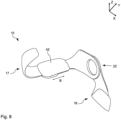
- the foot orthosis 10 may further comprise a foot cushion 42 that can be releasably connected to the ball base portion 34 and/or the metatarsal base portion 38 and is displaceable relative thereto in order to arrange the foot cushion 42 in a patient-specific manner, as in Figure 8 indicated by arrow B.
- a foot cushion 42 that can be releasably connected to the ball base portion 34 and/or the metatarsal base portion 38 and is displaceable relative thereto in order to arrange the foot cushion 42 in a patient-specific manner, as in Figure 8 indicated by arrow B.
- the toe splint 16 and the metatarsal splint 17 are coupled by means of the pivot joint 22 so as to be pivotable relative to one another about the pivot axis S.
- the pivot joint 22 is designed to transmit bending forces parallel to the first or second correction force F1, F2 between the metatarsal splint 17 and the toe splint 16 when the foot orthosis 10 is fastened to the foot, wherein the first correction force F1, the second correction force F2 and the holding force F3 are provided in the form of a bending force induced by an elastic deformation of the toe splint 16 and the metatarsal splint 17.
- the foot orthosis 10 is equipped with the swivel joint 22.
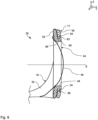
- the design of the swivel joint 22 is described below with reference to Figure 9 which shows a longitudinal section along the pivot axis S through the pivot joint 22.
- the pivot joint 22 is provided with a recess 44 along its pivot axis S and is designed such that, when the foot orthosis 10 is attached to the foot, a laterally bulging part 46 of the metatarsophalangeal joint 14 is at least partially received in the recess 44.
- a laterally bulging part 46 of the metatarsophalangeal joint 14 can be or form a pseudoexostosis.
- the swivel joint 22 is a hollow pivot joint.
- the components forming the swivel joint 22 are hollow along the pivot axis S, so that the swivel joint 22 is provided with the recess 44 around and along its pivot axis S.
- the swivel joint is designed such that, in the fastened state of the foot orthosis 10, the swivel joint 22 is arranged on the foot and the metatarsophalangeal joint 14 such that the swivel joint 22 is arranged circumferentially around the laterally bulging part 46 of the metatarsophalangeal joint 12, for example around the pseudoexostosis, wherein the laterally bulging part 46 of the metatarsophalangeal joint 14 is at least partially arranged in the recess of the swivel joint.
- the recess 44 is designed in the form of a through-opening along the pivot axis S.
- the pivot joint 22 is designed such that in the fastened state the laterally bulging part 46 of the metatarsophalangeal joint extends along at least 50% or at least 70% or at least 80% of the maximum width of the pivot joint.
- the laterally bulging part 46 of the metatarsophalangeal joint 14 extends through the recess 44 along the pivot axis S.
- the pivot joint has a maximum width along the pivot axis S, i.e. along the transverse axis Y, of at most 1.0 cm or 0.6 cm.
- the swivel joint 22 comprises a side wall 48 which delimits the recess 44 and is arranged radially around the swivel axis S.
- the side wall 48 has a minimum radius of curvature of 1 mm or 2 mm or 5 mm.
- the recess 44 has a minimum diameter along a direction transverse to the pivot axis S of at least 1.5 cm or at least 2.0 cm or at least 2.5 cm. More precisely, the diameter in the embodiment shown here is substantially 3.0 cm.
- the pivot axis S of the pivot joint 22 is aligned or substantially aligned with the flexion-extension joint axis of the metatarsophalangeal joint 14.
- the flexion-extension joint axis is understood to be the joint axis about which the toe 12 is pivoted relative to the metatarsal during flexion and extension movements.
- the pivot joint 22 is arranged on the medial side of the foot when attached to the foot.
- the pivot joint 22 is designed such that a relative pivoting movement between the toe splint 16 and the metatarsal splint 17 is only permitted about the pivot axis S.
- the pivot joint 22 is formed from at least two components, but is not limited thereto and may be formed from more than two components in alternative embodiments.
- the swivel joint 22 comprises a first joint element 50 coupled to the toe splint 16, in particular integrally or materially connected thereto, and a complementary and engaged second joint element 52 which is coupled to the metatarsal splint 17, in particular the ball segment 18, in particular integrally or materially connected thereto.
- the first joint element 50 is formed by an end section of the toe base section 28 and the second joint element 52 by an end section of the ball base section 38.
- the second joint element 52 is arranged along the pivot axis S between the foot and the first joint element 50.
- the first joint element 50 is provided in the form of a joint ring.
- the second joint element 52 is provided in the form of a hollow joint pin on which the joint ring, i.e. the first joint element 50, is guided along a guide surface.
- the first and second joint elements 50, 52 are designed and engaged in such a way that they are positively coupled along the pivot axis S and transversely to it.
- the second joint element 52 is provided with a radial receiving groove 54 which runs around the pivot axis S and which engages with a connecting ring 56 of complementary design of the first joint element 50.
- the receiving groove 54 extends in the radial direction to the pivot axis S such that the receiving groove 54 is laterally delimited in both directions along the pivot axis S and has an opening in the radially outward direction through which the connecting ring 56 projects into the receiving groove 54.
- the receiving groove 54 has, in the longitudinal section along the pivot axis S, a substantially U-shaped contact and sliding surface 58, also referred to as a guide surface, for the connecting ring 56.
- the receiving groove 54 and the connecting ring 56 are thus positively engaged in both directions along the pivot axis S.
- the connecting ring 56 is guided in the receiving groove 54.
- an unintentional loosening of the connection between the first and second joint elements 50, 52 can be effectively counteracted and at the same time a simple and robust construction of the joint unit can be ensured.
- the first joint element can be designed with a receiving groove and the second joint element with a corresponding connecting ring.
- the swivel joint 22 is designed such that, when the foot orthosis 10 is attached to the foot, the second joint element 52 is arranged between the foot and the first joint element 50, wherein a connecting web 60 of the second joint element 52, which forms the receiving groove 54, delimits the recess 44 all the way around in the radial direction.
- the connecting web 60 extends along the swivel axis S such that the connecting web 60 is arranged in the axial direction of the swivel joint 22, i.e. along the swivel axis S, overlapping the first joint element 50 and enclosing the connecting ring 56.
- An end section 62 which laterally delimits the recess 44, is arranged in a further laterally outer recess 64 in the first joint element 50, so that a flush lateral closure of the swivel joint 22 is achieved.
- Figures 10 to 12 show another embodiment of the foot orthosis, which differs from the one in Figures 1 to 9 shown embodiment by the design of the toe splint 16 and the metatarsal splint 17.
- the design of the pivot joint 22, in particular of the first and second joint elements 50, 52, is corresponding to the Figures 9 shown and described in this context design of the rotary joint 22 in the embodiment described above.
- Figure 10 shows the foot orthosis in a state attached to the foot.
- the toe splint 16 comprises a toe shank in the form of a bracket element running along the inside of the toe and a first support band 66 in the form of a bandage coupled to it.
- the first support band 66 is guided around the toe 12 along its circumferential direction and is connected at its ends to the toe shank in order to fix the toe shank in a form-fitting and/or force-fitting manner relative to the toe 12.
- the toe shank forms a bending spring that can be attached to the toe 12 by means of the first support band 66.
- the toe shank comprises coupling elements 68, via which end sections of the first support band 66 are force-fittingly connected to the toe shank.
- the coupling elements 68 are provided as slotted openings through which the first support band 66 is guided when wrapping around the toe 12 in order to fix the foot orthosis 10 to the foot to be treated and to introduce the first corrective force into the foot via the first support band 66.
- the metatarsal splint 17 comprises a metatarsal leg in the form of a bracket element running along the inside of the foot and a second support band 70 in the form of a bandage coupled thereto.
- the second support band 70 is guided around the metatarsal along its circumferential direction and is connected at its ends to the metatarsal leg in order to support the metatarsal leg relative to the metatarsal to be fixed in a form-fitting and/or force-fitting manner.
- the metatarsal limb forms a bending spring that can be fastened to the metatarsal by means of the second support band 70.
- the metatarsal limb comprises further coupling elements 72, via which end sections of the second support band 70 are connected to the toe limb in a force-fitting manner.
- the further coupling elements 72 are provided as slotted openings through which the second support band 70 is guided when looping around the metatarsal, in order to fix the foot orthosis 10 to the foot to be treated and to introduce the holding force into the foot via the second support band 70.
- Figures 11 and 12 show the foot orthosis 10 in a state decoupled from the foot, in which the support straps 66, 70 are not shown for reasons of clarity.
- the pivot joint 22 is accordingly designed to transmit bending forces parallel to the first and second correction forces F1, F2 between the metatarsal splint 17 and the toe splint 16 when the foot orthosis 10 is fastened to the foot, wherein the first correction force F1, the second correction force F2 and the holding force F3 are provided in the form of a bending force induced by an elastic deformation of the toe splint 16, in particular of the toe shank, and the metatarsal splint 17, in particular of the metatarsal shank.
Landscapes
- Health & Medical Sciences (AREA)
- Nursing (AREA)
- Orthopedic Medicine & Surgery (AREA)
- Engineering & Computer Science (AREA)
- Biomedical Technology (AREA)
- Heart & Thoracic Surgery (AREA)
- Vascular Medicine (AREA)
- Life Sciences & Earth Sciences (AREA)
- Animal Behavior & Ethology (AREA)
- General Health & Medical Sciences (AREA)
- Public Health (AREA)
- Veterinary Medicine (AREA)
- Orthopedics, Nursing, And Contraception (AREA)
Description
- Die vorliegende Erfindung betrifft eine Fußorthese zur Korrektur von Fußfehlstellungen, insbesondere zur Behandlung von Hallux valgus.
- Pathologische Fehlstellungen im Mittelfuß- und Vorfußbereich eines Patienten können unterschiedliche Ursachen haben, wie beispielsweise genetische Veranlagung, das Tragen von falschem Schuhwerk, insbesondere von zu engen oder hochhackigen Schuhen, oder eine Abflachung des Längs- und Quergewölbes infolge einer Instabilität des Bindegewebes im Mittelfußbereich. Insbesondere die als Hallux valgus bezeichnete Fehlstellung der Großzehe im Großzehengrundgelenk, auch als Valgusstellung bezeichnet, kommt hierbei aufgrund der stetig wachsenden Fallzahlen mehr Bedeutung zu.
- Hallux valgus entsteht, indem die Großzehe im Großzehengrundgelenk durch Muskelzug in die fußinnenseitige Richtung gezogen wird. Dabei tritt der erste Mittelfußknochen als ballenförmige Ausbuchtung am Zehengrundgelenk fußinnenseitig hervor, was auch als Pseudoexostose bezeichnet wird. Die ballenförmige Ausbuchtung wird in der medizinischen Literatur auch als eine Vorwölbung im Bereich des Zehengrundgelenks oder als im Ballenbereich auftretende Schwellung beschrieben, welche bei fortschreitendem Hallux valgus zu schmerzhaften Entzündungen des hervorstehenden Zehenballens führen kann. Zudem geht mit dem Hallux valgus häufig eine Änderung der Länge und der Zugrichtung der Sehnen einher, wodurch sich die Fehlstellung im Laufe der Zeit weiter verstärken kann. Dabei entwickelt sich eine Arthrose des Großzehengrundgelenks, die im fortgeschrittenen Stadium chirurgisch behandelt werden muss.
- Um den Krankheitsprozess aufzuhalten oder diesem entgegenzuwirken, sind neben chirurgischen Eingriffen auch die Anwendung konservativer Therapiemethoden bekannt. Beispielsweise ist die Verwendung von Tapeverbänden oder Orthesen bekannt zur Behandlung des Fußes in einer Ruhestellung. Aufgrund der verlangten Ruhestellung des Fußes während der Therapie werden diese vorwiegend nachts eingesetzt.
- Weiterhin sind Orthesen bekannt, die in einem am Fuß befestigten Zustand einer geschienten Großzehe einen Bewegungsfreiheitsgrad entlang der Flexion-Extension-Bewegungsrichtung einräumen. Beispielsweise offenbaren die
DE 102 40 121 B4 undUS 2006/0155233 A1 eine orthopädische Vorrichtung in Form einer Gelenkbiegeschiene, die um eine Flexions-Extensions-Bewegungsachse der zu korrigierenden Zehe gelenkig ausgebildet ist. Hierzu ist die Gelenkbiegeschiene mit einer an der Fußinnenseite anliegenden Gelenkeinrichtung versehen, von der sich zwei Biegeschenkel entlang der Fußinnenseite erstrecken. Die Gelenkeinrichtung umfasst einen seitlich am Fuß anliegenden gewölbten Gelenkteller. Um die Gelenkbiegeschiene am Fuß zu befestigen, ist ein erster Biegeschenkel über eine erste Bandage an der Zehe und ein zweiter Biegeschenkel über eine zweite Bandage am Mittelfuß befestigt. - Weiterer Stand der Technik ist aus der
US 2016/0242944 A1 und derDE 10 2004 008 909 A1 bekannt. - Ausgehend von dem bekannten Stand der Technik ist es eine Aufgabe der vorliegenden Erfindung, eine verbesserte Fußorthese zur Korrektur von Fehlstellungen, insbesondere zur Behandlung von Hallux valgus, bereitzustellen, die insbesondere eine effektive therapeutische Behandlung sicherstellt und gleichzeitig kompakt ausgestaltet und angenehm zu tragen ist.
- Die Aufgabe wird durch eine Fußorthese mit den Merkmalen des unabhängigen Anspruchs gelöst. Vorteilhafte Weiterbildungen ergeben sich aus den Unteransprüchen sowie der vorliegenden Beschreibung und den Figuren.
- Entsprechend wird eine Fußorthese zur Korrektur von Fehlstellungen eines Fußes, insbesondere zur Behandlung oder Vorbeugung von Hallux valgus, bereitgestellt. Die Fußorthese umfasst eine an einer Zehe befestigbare Zehenschiene und eine im Bereich eines Mittelfußes befestigbare Mittelfußschiene, die mittels eines Drehgelenks relativ zueinander verschwenkbar gekoppelt sind. Die Fußorthese ist dazu eingerichtet, in einem an einem Fuß ordnungsgemäß befestigten Zustand über die Zehenschiene eine erste Korrekturkraft auf die Zehe auszuüben und über das Drehgelenk eine zu der ersten Korrekturkraft entgegengesetzte zweite Korrekturkraft auf ein Zehengrundgelenk auszuüben. Das Drehgelenk ist mit einer Ausnehmung in der Form einer Durchgangsöffnung entlang seiner Schwenkachse versehen und derart ausgebildet, dass in dem an dem Fuß befestigten Zustand der Fußorthese ein seitlich ausbuchtender Teil des Zehengrundgelenks in der Durchgangsöffnung zumindest teilweise aufgenommen ist. Das Drehgelenk umfasst ein mit der Zehenschiene verbundenes erstes Gelenkelement in der Form eines Gelenkrings und ein mit der Mittelfußschiene verbundenes zweites Gelenkelement in der Form eines Gelenkzapfens umfasst, die entlang der Schwenkachse und quer zu der Schwenkachse des Drehgelenks formschlüssig im Eingriff stehen, wobei der Gelenkzapfen mit einer Aufnahmenut versehen ist, in der ein dazu korrespondierender Verbindungsring des Gelenkrings geführt ist, und wobei der Gelenkzapfen an einem proximalen Ende einen umlaufenden radialen Absatz umfasst, der in Richtung der Schwenkachse eine formschlüssige Verbindung zwischen dem Gelenkring und dem Gelenkzapfen bereitstellt und in einer korrespondierend ausgebildeten weiteren Ausnehmung am Gelenkring aufgenommen ist.
- Indem die vorgeschlagene Fußorthese neben der auf die Zehe wirkenden ersten Korrekturkraft zusätzlich die auf das Zehengrundgelenk mittels des Drehgelenks wirkende zweite Korrekturkraft bereitstellt, kann eine besonders effektive therapeutische Wirkung erzielt werden. Denn durch die vorgeschlagene Ausgestaltung der Fußorthese kann gleichzeitig eine therapeutische Wirkung auf eine Valgusstellung der Zehe als auch auf eine Varusstellung des Zehengrundgelenks erzielt werden. Somit können Symptomatik und Ursache der Fußfehlstellung gleichzeitig behandelt werden. Die auf den Fuß wirkenden Korrekturkräfte und damit einhergehenden therapeutischen Effekte werden nachstehend im Zusammenhang mit den damit in Verbindung stehenden Komponenten der Fußorthese genauer beschrieben.
- Im Rahmen der vorliegenden Erfindung wurde erkannt, dass der seitlich ausbuchtende Teil des Zehengrundgelenks, insbesondere beim Vorhandensein der Pseudoexostose, wie diese bei Hallux valgus vorkommt, sensibel und druckempfindlich ist. Um diesen Umstand Rechnung zu tragen, ist die vorgeschlagene Fußorthese mit dem mit der Ausnehmung versehenen Drehgelenk ausgestattet, in dessen Ausnehmung der seitlich ausbuchtende Teil des Zehengrundgelenks beim Tragen der Fußorthese zumindest teilweise aufgenommen ist. Dadurch kann verhindert werden, dass die Fußorthese an einem distalen Ende des seitlich ausbuchtenden Teils des Zehengrundgelenks anliegt und auf diesen Kräfte unmittelbar ausübt. So kann im Vergleich zu bekannten Orthesen, die an dem seitlich ausbuchtenden Teil des Zehengrundgelenks anliegen und auf diesen unmittelbar Kräfte ausüben, die auf den sensiblen und druckempfindlichen Teil des Zehengrundgelenks wirkende Belastung beim Tragen verringert werden. Mit anderen Worten ermöglicht die vorgeschlagene Fußorthese durch die geometrische Ausgestaltung des Drehgelenks eine Reduzierung oder Vermeidung von Belastungen auf druckempfindliche Bereiche des Fußes.
- Weiterhin ermöglicht die Ausgestaltung des vorgeschlagenen Drehgelenks, dass die Fußorthese enger am Fuß geführt werden kann und deren Erstreckung in Fußbreitenrichtung verringert werden kann. Dies gilt insbesondere für jene Bereiche oder Abschnitte der Fußorthese, welche im am Fuß ordnungsgemäß befestigten Zustand seitlich an dem Zehengrundgelenk des Trägers angeordnet sind. Entsprechend kann das vorgeschlagene Drehgelenk zu einer kompakten Bauform der Fußorthese beitragen. Das Tragen der vorgeschlagenen Fußorthese in üblichem Schuhwerk kann so für einen Patienten gegenüber bekannten Vorrichtungen deutlich angenehmer sein und durch die kompakte Bauweise überhaupt erst ermöglicht werden.
- Die vorgeschlagene Fußorthese ist dafür vorgesehen, eine pathologische Fehlstellung eines Fußes, insbesondere einer Zehe und/oder eines Zehengrundgelenks, zu behandeln, entgegenzuwirken und/oder vorzubeugen. Insbesondere kann die Fußorthese zur Vorbeugung oder Behandlung von Hallux valgus eingesetzt werden, ist aber nicht auf diese Anwendung beschränkt. Entsprechend ist die Fußorthese dafür vorgesehen, an einem Fuß eines Patienten befestigt zu werden und in dem am Fuß befestigten Zustand auf den Fuß, insbesondere auf die Zehe und/oder das Zehengrundgelenk, therapeutisch einzuwirken.
- In der vorliegenden Offenbarung bezieht sich der Ausdruck "in einem/dem am Fuß ordnungsgemäß befestigten Zustand", vorliegend auch mit "in dem befestigten Zustand" abgekürzt, auf einen Zustand, in dem die Fußorthese an einem Fuß eines Patienten bestimmungsgemäß befestigt ist und entsprechend einen gewünschten therapeutischen Effekt zur Korrektur oder zur Vorbeugung von Fehlstellungen bewirkt. Die Fußorthese kann fußspezifisch für einen linken oder rechten Fuß eines Patienten ausgestaltet sein. Mit anderen Worten kann die Fußorthese entweder zur Verwendung an dem linken oder dem rechten Fuß des Patienten vorgesehen und ausgebildet sein. Eine für den linken Fuß vorgesehene Fußorthese kann spiegelsymmetrisch zu einer für den rechten Fuß eines Patienten vorgesehenen Fußorthese ausgebildet sein.
- Die vorgeschlagene Fußorthese ist derart ausgestaltet, dass sie in dem befestigten Zustand Korrekturkräfte auf den Fuß ausübt. Unter dem Begriff "Korrekturkräfte" werden vorliegend solche Kräfte verstanden, die eine therapeutische Wirkung auf den zu behandelnden Fuß haben. Insbesondere bewirken die Korrekturkräfte, dass die von der Fehlstellung betroffenen Teile des Fußes in eine anatomisch korrekte oder beabsichtigte Position gelenkt werden, um einen gewünschten therapeutischen Effekt zu erzielen.
- Die vorgeschlagene Fußorthese ist dazu eingerichtet, in dem am Fuß des Patienten befestigten Zustand wenigstens die erste und zweite Korrekturkraft mittels der Zehenschiene und der Mittelfußschiene auf den zu behandelnden Fuß auszuüben, insbesondere unmittelbar auszuüben. Durch diese Ausgestaltung unterscheidet sich die vorliegende Fußorthese wesentlich von bekannten Vorrichtungen, die ein Zehengrundgelenk und den diesem zugeordneten Zehenballen oder eine durch die Fehlstellung bewirkte pathologische Pseudoexostose vor äußerer Krafteinwirkung, insbesondere von durch die Vorrichtung auf den Fuß wirkenden Kräften, gewollt oder ungewollt abschirmen. Wir vorrangehend beschrieben wurde im Rahmen der vorliegenden Fußorthese erkannt, dass eine besonders effektive therapeutische Wirkung erzielt werden kann, indem die Fußorthese neben der auf die Zehe wirkenden ersten Korrekturkraft zusätzlich die auf das Zehengrundgelenk wirkende zweite Korrekturkraft ausübt. Das dadurch resultierende Zusammenspiel von auf den Fuß ausgeübten Korrekturkräften kann besonders vorteilhaft bei der Behandlung von Hallux valgus sein.
- Im Zusammenhang mit der Zehenschiene wird nachfolgend zur Vereinfachung allgemein auf eine Zehe des Fußes Bezug genommen. Hierbei handelt es sich insbesondere um die Großzehe des zu behandelnden Fußes. Die Fußorthese ist hierauf aber nicht beschränkt, sodass mit dem Ausdruck beispielsweise auch die Kleinzehe gemeint sein kann. Im Zusammenhang mit dem Drehgelenk und der damit in Verbindung stehenden zweiten Korrekturkraft wird entsprechend zur Vereinfachung allgemein auf ein Zehengrundgelenk Bezug genommen, wobei insbesondere das Großzehengrundgelenk gemeint ist, die Fußorthese hierauf aber nicht beschränkt ist. Alternativ kann es sich beispielsweise auch um das Kleinzehengrundgelenk handeln.
- In der vorliegenden Offenbarung wird zur Beschreibung der Fußorthese, insbesondere in Bezug auf den zu behandelnden Fuß, ein Bezugssystem verwendet, das auf die Mittellinie des Körpers eines Patienten ausgerichtet ist, wie in der Anatomie üblich. So können die Position und Richtung der einzelnen Komponenten der vorgeschlagenen Fußorthese in dem befestigten Zustand in Bezug auf den in der Fußorthese aufgenommenen Fuß angegeben werden. Dementsprechend bezieht sich der Begriff "medial" auf eine Richtung oder Seite der Fußorthese, die in Richtung einer medialen Ebene des Körpers des Trägers zeigt. In der Anatomie bezieht sich der Begriff "mediale Ebene", die auch als "Mittelsagittalebene" bezeichnet wird, im Allgemeinen auf eine anatomische Ebene, die den Körper in zwei symmetrische Teile teilt. Dementsprechend bedeutet der Begriff "in medialer Richtung" bei der Beschreibung einer Fußorthese eine Richtung, die von dem zu behandelnden Fuß des Patienten in Richtung seines anderen Fußes zeigt. In diesem Sinne bezieht sich der Begriff "lateral" auf eine Richtung oder Seite der Fußorthese, die von der medialen Ebene des Körpers des Trägers weg weist. Dementsprechend bedeutet der Begriff "in lateraler Richtung" bei der Beschreibung einer Fußorthese, welche an einem Fuß des Trägers befestigt ist, in einer Richtung, die von dem anderen Fuß des Trägers weg weist.
- Zur Interaktion mit dem Zehengrundgelenk des zu behandelnden Fußes, das heißt zum Ausüben der zweiten Korrekturkraft, ist die Fußorthese mit dem Drehgelenk ausgestattet, das insbesondere als Hohlzapfendrehgelenk ausgeführt ist. Vorliegend wird als "Drehgelenk" ein Gelenk verstanden, bei dem zwei relativ zueinander verschwenkbar und in Eingriff gebrachte Komponenten des Gelenks relativ zueinander verschwenkbar oder rotierbar gelagert sind. Im Zusammenhang mit der vorliegenden Offenbarung betrifft der Begriff "Hohlzapfendrehgelenk", das auch als nabenloses Drehgelenk bezeichnet werden kann, ein Gelenk, das entlang seiner Schwenkachse zumindest abschnittsweise hohl ausgebildet ist, um die Ausnehmung auszubilden. Mit anderen Worten sind die das Drehgelenk bildenden Komponenten entlang der Schwenkachse hohl ausgebildet, sodass das Drehgelenk um und entlang dessen Schwenkachse mit der Ausnehmung oder Durchgangsöffnung versehen ist.
- Das Drehgelenk kann relativ zueinander um die Schwenkachse verschwenkbare Komponenten aufweisen, die relativ zueinander in dem Drehgelenk geführt sind. Der für die Führung der Komponenten vorgesehene Bereich, der durch Lagerpunkte und/oder Lagerflächen, insbesondere durch Kontaktflächen und/oder Gleitflächen, gebildet sein kann, ist vorzugsweise umlaufend um die Schwenkachse und beabstandet zu dieser angeordnet.
- Der für die Führung der Komponenten des Drehgelenks vorgesehene Bereich kann um einen Führungsradius beabstandet zu der Schwenkachse angeordnet sein. Der Führungsradius kann insbesondere einen mittleren Radius des für die Führung der Komponenten des Drehgelenks vorgesehenen Bereichs um die Schwenkachse angeben. Der Führungsradius kann im Wesentlichen im Bereich eines Außenradius des Drehgelenks liegen, der eine Erstreckung des Drehgelenks in radialer Richtung beschreibt. Der Führungsradius kann wenigstens 70% des Außenradius des Drehgelenks betragen. Im Speziellen kann der Führungsradius wenigstens 80% oder wenigstens 90% des Außenradius betragen.
- Das Drehgelenk kann in Form eines Ringgelenks bereitgestellt sein, bei dem die Führungsfläche zwischen den relativ zueinander verschwenkbaren Komponenten des Drehgelenks ringförmig um die Gelenk- oder Schwenkachse des Drehgelenks angeordnet sind/ist. Auf diese Weise kann das Drehgelenk besonders robust gegenüber Biegekräften und Biegemomenten sein, sodass das Drehgelenk hohe Kräfte und Momente übertragen und in den zu behandelnden Fuß einleiten kann, bei einer gleichzeitig kompakten Bauweise der Fußorthese.
- Das Drehgelenk kann derart ausgebildet sein, dass in dem befestigten Zustand der Fußorthese das Drehgelenk derart an dem Fuß und dem Zehengrundgelenk angeordnet ist, dass das Drehgelenk umlaufend um den seitlich ausbuchtenden Teil des Zehengrundgelenks, beispielsweise um die Pseudoexostose, angeordnet sein kann, wobei der seitlich ausbuchtende Teil des Zehengrundgelenks zumindest teilweise in der Ausnehmung des Drehgelenks angeordnet ist.
- Die Ausnehmung ist in Form einer Durchgangsöffnung, insbesondere entlang der Schwenkachse ausgebildet. Mit anderen Worten kann sich die Ausnehmung entlang der gesamten Breite oder Dicke des Drehgelenks erstrecken. Vorliegend betreffen die Begriffe "Breite" oder "Dicke" des Drehgelenks eine Erstreckung des Drehgelenks entlang der Schwenkachse. Das Drehgelenk kann eine Breite, insbesondere maximale Breite, von höchstens 1,0 cm oder von höchstens 0,6 cm aufweisen.
- Die Fußorthese kann derart ausgestaltet sein, dass in dem befestigten Zustand der seitlich ausbuchtende Teil des Zehengrundgelenks sich entlang wenigstens 50% oder wenigstens 70% oder wenigstens 80% der maximalen Breite des Drehgelenks erstreckt. Weiterhin kann die Fußorthese derart ausgestaltet sein, dass in dem befestigten Zustand der seitlich ausbuchtende Teil des Zehengrundgelenks durch die Ausnehmung, insbesondere die Durchgangsöffnung, entlang der Schwenkachse hindurchragt oder im Wesentlichen hindurchragt. Auf diese Weise kann die Fußorthese besonders eng am Fuß geführt werden.
- Das Drehgelenk kann eine die Ausnehmung begrenzende und radial um die Schwenkachse angeordnete Seitenwand umfassen. Die Seitenwand kann einen minimalen Krümmungsradius von 1 mm oder 2 mm oder 5 mm aufweisen. Mit anderen Worten kann das Drehgelenk derart ausgebildet sein, dass die Seitenwand an keiner Stelle einen Krümmungsradius aufweist, der unterhalb des minimalen Krümmungsradius liegt. Der Kehrwert des Krümmungsradius entspricht hierbei der Krümmung der Seitenwand, insbesondere deren der Ausnehmung zugewandten Innenfläche. Auf diese Weise kann sichergestellt werden, dass der an dem seitlich ausbuchtenden Teil des Zehengrundgelenks anliegende Bereich des Drehgelenks nicht mit spitzen Kanten versehen ist, um so Druckspitzen am Fuß des Patienten beim Tragen der Fußorthese zu verhindern.
- Die Ausnehmung kann einen minimalen Durchmesser, insbesondere entlang einer Richtung quer zur Schwenkachse oder um die Schwenkachse, von wenigstens 1,5 cm oder wenigstens 2,0 cm oder wenigstens 2,5 cm betragen. Beispielsweise kann die Ausnehmung im Querschnitt entlang der Schwenkachse eine kreisförmige oder elliptische Form aufweisen, deren minimaler Durchmesser wenigstens 1,5 cm oder wenigstens 2,0 cm oder wenigstens 2,5 cm betragen kann. Beispielsweise kann der Durchmesser 3,0 cm oder im Wesentlichen 3,0 cm betragen.
- Die Form der Ausnehmung, insbesondere deren Querschnittsform und Durchmesser, kann an den zu behandelnden Fuß, insbesondere an die Form des seitlich ausbuchtenden Teils des Zehengrundgelenks, angepasst sein. Dies kann aufgrund orthopädischer beziehungsweise physiologischer Klassifikation anwendergruppenspezifisch erfolgen. Beispielsweise können auf diese Weise Fußorthesen für Anwendergruppen mit unterschiedlich großen Füßen und/oder unterschiedlich großen seitlich ausbuchtenden Teilen des Zehengrundgelenks beziehungsweise Pseudoexostosen bereitgestellt werden.
- Wie vorangehend beschrieben, sind die Zehenschiene und die Mittelfußschiene mittels des Drehgelenks relativ zueinander verschwenkbar gekoppelt. Auf diese Weise wird ermöglicht, dass beim Tragen der Fußorthese die mittels der vorgeschlagenen Fußorthese geschiente Zehe entlang der Flexion-Extension-Bewegungsrichtung bewegt werden kann relativ zu dem Mittelfuß. Mit anderen Worten kann die Fußorthese und entsprechend das Drehgelenk derart eingerichtet sein, dass in dem am Fuß befestigten Zustand der Fußorthese die zu behandelnde Zehe relativ zu dem Großzehengrundgelenk in Flexion-und Extensionsrichtung bewegbar ist. Entsprechend kann das Drehgelenk derart eingerichtet sein, dass in dem am Fuß befestigten Zustand die Schwenkachse des Drehgelenks parallel oder im Wesentlichen parallel zu einer Grundgelenkachse des Zehengrundgelenks ist, insbesondere parallel oder im Wesentlichen parallel zu der Flexions-Extensions-Bewegungsachse des Zehengrundgelenks ist. Weiterhin kann die Schwenkachse des Drehgelenks mit der Grundgelenkachse des Zehengrundgelenks, insbesondere mit der Flexions-Extensions-Bewegungsachse, fluchten, d.h. mit dieser zusammenfallen, oder im Wesentlichen fluchten. Alternativ oder zusätzlich kann die Schwenkachse des Drehgelenks parallel oder im Wesentlichen parallel zu der ersten und/oder zweiten Korrekturkraft angeordnet sein.
- Weiterhin kann das Drehgelenk dazu eingerichtet sein, Scher- und/oder Biegekräfte zwischen der Zehenschiene und der Mittelfußschiene zu übertragen, um die erste und/oder zweite Korrekturkraft auf den Fuß auszuüben. Mit anderen Worten kann das Drehgelenk der Fußorthese dazu eingerichtet sein, in dem befestigten Zustand parallel zu den Korrekturkräften wirkende Kräfte, insbesondere Scherkräfte oder Schubkräfte, zu übertragen, um die erste und/oder zweite Korrekturkraft zu generieren. Hierzu kann das Drehgelenk dazu ausgebildet sein, zwischen der Mittelfußschiene und der Zehenschiene Kräfte in Richtung der Schwenkachse des Drehgelenks zu übertragen. Insbesondere kann das Drehgelenk derart ausgebildet sein, zwischen der Mittelfußschiene und der Zehenschiene entlang einer Längserstreckung der Fußorthese, welche von der Mittelfußschiene über das Drehgelenk hin zur Zehenschiene verläuft und welche entsprechend im an dem Fuß angebrachten Zustand der Fußorthese im Wesentlichen in Richtung der Längsrichtung des Fußes entspricht, Biegekräfte zu übertragen. Die Biegekräfte können in medial-lateral Richtung und/oder lateral-medial Richtung verlaufen. Die so entlang der Schiene übertragenen Kräfte können die durch die Fußorthese auf den Fuß auszuübenden Korrekturkräfte bewirken.
- Auf diese Weise räumt die vorgeschlagene Fußorthese einer geschienten Zehe eine ausreichende Bewegungsfreiheit ein, sodass die Fußorthese den Fuß in seiner natürlichen Gehbewegung unterstützt und gleichzeitig therapeutisch auf diesen einwirkt. Dies ermöglicht den Einsatz der vorgeschlagenen Fußorthese im Alltag des Patienten, was dessen Bereitschaft zum Tragen der Fußorthese und daher die Akzeptanz und damit einhergehend den Erfolg der therapeutischen Behandlung erhöht.
- Das Drehgelenk kann derart ausgebildet sein, dass in dem am Fuß befestigten Zustand der Fußorthese eine relative Schwenkbewegung zwischen der Zehenschiene und der Mittelfußschiene um eine zu der Schwenkachse schräg oder orthogonal angeordnete Achse gesperrt ist. Das Drehgelenk kann derart ausgebildet sein, dass eine relative Schwenkbewegung zwischen der Zehenschiene und der Mittelfußschiene nur um die Schwenkachse zugelassen ist. Mit anderen Worten kann das Drehgelenk strukturell derart ausgebildet sein, dass Schwenkbewegungen um die Schwenkachse erfolgen können, aber Schwenkbewegungen um eine Achse schräg oder quer zu der Schwenkachse gesperrt sind. Auf diese Weise kann eine einfache und kompakte Bauweise des Drehgelenks bereitgestellt sein.
- Die Fußorthese ist vorzugsweise derart ausgebildet, dass in dem am Fuß befestigten Zustand das Drehgelenk seitlich am Fuß angeordnet ist. Insbesondere kann das Drehgelenk an einer medialen Seite des Fußes in dem befestigten Zustand angeordnet sein. Mit anderen Worten kann das Drehgelenk in dem am Fuß befestigten Zustand fußinnenseitig, also medial am Fuß angeordnet sein, wobei insbesondere die Zehenschiene und die Mittelfußschiene medial angeordnet sein können.
- Das Drehgelenk kann durch miteinander strukturell im Eingriff stehende Bereiche der Zehenschiene und der Mittelfußschiene gebildet sein. Insbesondere kann das Drehgelenk durch miteinander strukturell im Eingriff stehende Endabschnitte der Zehenschiene und der Mittelfußschiene gebildet sein. Das Drehgelenk kann wenigstens teilweise durch die im Eingriff stehenden Bereiche der Zehenschiene und der Mittelfußschiene gebildet sein oder ausschließlich durch die im Eingriff stehende Bereiche der Zehenschien und der Mittelfußschiene gebildet sein. Der das Drehgelenk bildende Teil der Zehenschiene und/oder der Mittelfußschiene kann integraler Bestandteil der Zehenschiene und/oder der Mittelfußschiene sein. Auf diese Weise kann ein einfacher Aufbau der Fußorthese durch die Verwendung einer geringen Anzahl von Komponenten sichergestellt werden.
- Gemäß einer Weiterbildung der Fußorthese kann das Drehgelenk ein mit der Zehenschiene gekoppeltes, insbesondere integral oder stoffschlüssig verbundenes, erstes Gelenkelement und ein dazu komplementär ausgebildetes und im Eingriff, bevorzugt im direktem Eingriff, stehendes zweites Gelenkelement umfassen, das mit der Mittelfußschiene gekoppelt ist, insbesondere integral oder stoffschlüssig verbunden ist. Das erste Gelenkelement und das zweite Gelenkelement können entlang der Schwenkachse, insbesondere in einer ersten und einer dazu entgegengesetzten zweiten Richtung entlang der Schwenkachse, und/oder quer zu der Schwenkachse des Drehgelenks formschlüssig im Eingriff stehen.
- Das Drehgelenk kann derart ausgestaltet sein, dass in dem befestigten Zustand das zweite Gelenkelement zwischen dem Fuß und dem ersten Gelenkelement angeordnet ist. Auf diese Weise kann verhindert werden, dass bei einer Beugebewegung der geschienten Zehe, der an dem Fuß anliegende Teil des Drehgelenks relativ zu dem seitlich ausbuchtenden Teil verschwenkt wird. Dies kann den Tragekomfort der Fußorthese erhöhen.
- Das zweite Gelenkelement kann den Gelenkzapfen des Drehgelenks bilden, der das den Gelenkring bildende erste Gelenkelement um die Schwenkachse führt. Der Gelenkzapfen ist vorzugsweise als Hohlzapfen ausgebildet, wobei der hohle Teil des Hohlzapfens die Ausnehmung bildet. Der Gelenkring und der Gelenkzapfen sind derart ausgebildet und stehen derart im Eingriff, dass diese entlang der Schwenkachse, insbesondere in der ersten und der dazu entgegengesetzten zweiten Richtung entlang der Schwenkachse, formschlüssig im Eingriff stehen.
- Der Gelenkzapfen kann in seiner geometrischen Ausgestaltung an die Form des Gelenkrings angepasst sein. Der Gelenkring kann eine erste Führungsfläche aufweisen, die korrespondierend zu einer zweiten Führungsfläche des Gelenkzapfens ausgestaltet sein kann. Die erste und zweite Führungsfläche, die insbesondere Gleit- und Lagerflächen bilden, können im Eingriff stehen, insbesondere im Wesentlichen spielfrei oder mit einem vorgegebenen Spiel. Bei einer Schwenkbewegung können die erste und zweite Führungsfläche relativ zueinander bewegt werden.
- Die erste Führungsfläche des Gelenkrings kann eine radial nach innen gerichtete, d.h. der Schwenkachse zugewandte, Fläche sein oder umfassen. Die erste Führungsfläche kann sich entsprechend in Umfangsrichtung um die Schwenkachse erstrecken und ringförmig um die Schwenkachse angeordnet sein.
- Die zweite Führungsfläche des Gelenkzapfens kann eine radial nach außen gerichtete Fläche sein oder umfassen und insbesondere eine Mantelfläche des Gelenkzapfens bilden. Die zweite Führungsfläche kann sich entsprechend in Umfangsrichtung um die Schwenkachse erstrecken und ringförmig um die Schwenkachse angeordnet sein.
- Der Gelenkzapfen umfasst an einem proximalen Ende einen umlaufenden radialen Absatz, welcher vorzugsweise, insbesondere im Sinne eines Schnapphakens, in Richtung der Drehachse eine formschlüssige Verbindung bzw. hinterschnittige Sicherung zwischen dem Gelenkring und Gelenkzapfen bereitstellt. Um an der medialen Außenseite der Fußorthese eine im Wesentlichen ebene Außenkontur bzw. Außenfläche bereitzustellen, kann der radiale Absatz in der korrespondierend ausgebildeten weiteren Ausnehmung am Gelenkring aufgenommen sein. Alternativ oder zusätzlich kann ein separater Sicherungsring vorgesehen sein, welcher in eine entsprechende Nut am Gelenkring oder Gelenkzapfen eingesetzt werden kann. Der radiale Absatz kann sich entlang der Schwenkachse derart erstrecken, dass dieser in Axialrichtung des Drehgelenks überlappend zu dem Gelenkring angeordnet ist und diesen insbesondere umgreift. Durch diese Ausgestaltung kann verhindert werden, dass der zu behandelnde Fuß mit der Aufnahmenut in Kontakt tritt, um den Tragekomfort für einen Patienten zu erhöhen.
- Die erste und zweite Führungsfläche können wenigstens eine, beispielsweise zwei gegenüberliegenden axial begrenzende Seitenflächen umfassen, um die formschlüssige Verbindung entlang der Schwenkachse bereitzustellen. Auf diese Weise können Kräfte, insbesondere Biegekräfte in Richtung der Schwenkachse des Drehgelenks zwischen den Komponenten übertragen werden.
- Gemäß einer Ausgestaltung kann der Gelenkzapfen, insbesondere das zweite Gelenkelement, oder der Gelenkring mit einer um die Schwenkachse umlaufend angeordneten Aufnahmenut versehen sein, die sich in radialer Richtung erstreckt, d.h. zu der Schwenkachse hin erstreckt, und in axialer Richtung entlang der Schwenkachse begrenzt ist, d.h. seitlich begrenzt ist. Die Innenflächen der Aufnahmenut bilden hierbei eine Kontakt- und Gleitfläche, d.h. die erste oder zweite Führungsfläche. Mit anderen Worten kann die Aufnahmenut im Längsschnitt entlang der Schwenkachse eine im Wesentlichen U-förmige Kontakt- oder Gleitfläche ausbilden. Die dazu korrespondierende Führungsfläche kann ein zu der Aufnahmenut korrespondierend ausgebildeter Verbindungsring sein, der in der Aufnahmenut geführt ist und relativ zu der Aufnahmenut in Umfangsrichtung um die Schwenkachse verdrehbar ist. In dem im Eingriff stehenden Zustand der Aufnahmenut und des Verbindungsrings ist der Verbindungsring derart in der Aufnahmenut angeordnet, dass das erste Gelenkelement und das zweite Gelenkelement formschlüssig in Axialrichtung der Schwenkachse miteinander verbunden sind.
- Mit anderen Worten kann der Gelenkzapfen mit einer Aufnahmenut versehen sein, in der ein dazu korrespondierender Verbindungsring des Gelenkrings geführt ist. Alternativ kann der Gelenkring mit der Aufnahmenut versehen sein, in der der dazu korrespondierende Verbindungsring des Gelenkzapfens geführt ist.
- Die Fußorthese umfasst ferner die Zehenschiene. Die Zehenschiene kann dafür vorgesehen sein, an der Zehe des Fußes an einer vorgegebenen Position in Eingriff gebracht zu werden, um in dem am Fuß befestigten Zustand der Fußorthese eine kraftübertragende Kopplung zwischen der Zehe und der Zehenschiene bereitzustellen. Entsprechend wird die Zehenschiene in dem am Fuß befestigten Zustand der Fußorthese in einer gewünschten Position an dem Fuß gehalten. Die Zehenschiene ist ferner dafür vorgesehen, in dem am Fuß befestigten Zustand die erste Korrekturkraft auf die Zehe auszuüben. Die erste Korrekturkraft kann auf die Zehe in medialer Richtung wirken, wobei die durch das Drehgelenk ausgeübte Korrekturkraft in lateraler Richtung wirken kann.
- Die Fußorthese umfasst ferner die Mittelfußschiene. Die Mittelfußschiene kann dafür vorgesehen sein, in dem am Fuß befestigten Zustand eine Haltekraft auf den Mittelfuß auszuüben. Die Haltekraft kann in einer Richtung parallel zu der ersten Korrekturkraft wirken und zusammen mit der ersten Korrekturkraft eine Gegenkraft zu der zweiten Korrekturkraft bilden. Durch das Zusammenwirken dieser Kräfte kann die Fußorthese zuverlässig an dem zu behandelnden Fuß in einer für die therapeutische Behandlung vorgesehenen Position stabil gehalten werden. Durch diese Ausgestaltung kann die Fußorthese mit der Wirkungsweise einer Spannklemme oder -klammer an dem zu behandelnden Fuß befestigt werden.
- In einer Weiterentwicklung kann die durch die Mittelfußschiene auszuübende Haltekraft eine therapeutische Wirkung auf den zu behandelnden Fuß haben, die insbesondere zur therapeutischen Wirkung der ersten und zweiten Korrekturkraft beiträgt und/oder eine davon zu unterscheidende, weitere therapeutische Wirkung bereitstellt. Beispielsweise kann die durch die Mittelfußschiene ausgeübte weitere Korrekturkraft ein Aufrichten des Fußgewölbes bewirken. Zur Unterstützung dieser Wirkung, kann die Fußorthese weiterhin ein unterhalb der Fußsohle, insbesondere des Fußgewölbes im Mittelfußbereich anzuordnendes Fußkissen, auch als Pelotte bezeichnet, umfassen. Ein derartiges Fußkissen kann lösbar mit der Mittelfußschiene verbunden sein.
- Die Zehenschiene und/oder die Mittelfußschiene kann/können ein Bügelelement umfassen, das sich entlang der zu schienenden Zehe oder entlang des zu schienenden Mittelfußes erstreckt.
- Unter dem Begriff "Bügelelement" wird vorliegend und im Allgemeinen eine Komponente verstanden, die dazu eingerichtet und dafür vorgesehen ist, unterschiedliche Belastungen aufzunehmen und zu übertragen, wie zum Beispiel Längskräfte, Querkräfte, Scherkräfte, Biegekräfte, Biegemomente, Torsionsmomente, etc. So ist ein Bügelelement dafür vorgesehen, neben Zugkräften auch Druckkräfte entlang seiner Längsachse und Querkräfte quer zu seiner Erstreckungsachse, insbesondere seiner Längsachse, aufzunehmen und zu übertragen. Diese Eigenschaft unterscheidet einen Bügel wesentlich von einer Bandage, die zwar zur Übertragung von Zugkräften, aber nicht zur Übertragung von Druck- und/oder Querkräften vorgesehen ist.
- Entsprechend kann das Bügelelement der Zehenschiene und/oder der Mittelfußschiene derart ausgebildet sein, in dem am Fuß befestigten Zustand Scherkräfte und/oder Biegekräfte, insbesondere in Richtung der ersten und zweiten Korrekturkraft, aufzunehmen und zu übertragen um die erste Korrekturkraft auf die Zehe auszuüben und/oder die Haltekraft auf den Mittelfuß auszuüben.
- Gemäß einer Weiterentwicklung kann das Bügelelement der Zehenschiene und/oder der Mittelfußschiene in Form eines Spannbügels oder einer Biegefeder ausgebildet sein. In dieser Ausgestaltung kann die erste Korrekturkraft und/oder die zweite Korrekturkraft und/oder die Haltekraft in Form einer durch elastische Verformung des Bügelelements der Zehenschiene und/oder der Mittelfußschiene induzierten Spannkraft bereitgestellt sein.
- Entsprechend kann die Fußorthese derart eingerichtet sein, dass in dem an dem Fuß befestigten Zustand das Drehgelenk zu der ersten oder zweiten Korrekturkraft parallele Biegekräfte zwischen der Mittelfußschiene und der Zehenschiene überträgt, wobei die erste Korrekturkraft und/oder die zweite Korrekturkraft und/oder die Haltekraft in Form einer durch eine elastische Verformung der Zehenschiene und der Mittelfußschiene induzierte Biegekraft bereitgestellt ist. Auf diese Weise kann sichergestellt werden, dass auf die Zehe und das Zehengrundgelenk beim Tragen der Fußorthese anhaltend die Korrekturkräfte ausgeübt werden, d.h. auch dann, wenn sich die Zehe relativ zum Mittelfuß bewegt, wie dies beispielsweise beim Gehen der Fall ist.
- Die Fußorthese kann derart ausgestaltet sein, dass in einem vom Fuß entkoppelten Zustand der Fußorthese, d.h. in einem Zustand, in dem die Fußorthese in keinem Eingriff mit dem zu behandelnden Fuß steht und entsprechend freiliegt, die Fußorthese, insbesondere das Bügelelement der Zehenschiene und/oder die Mittelfußschiene, in einer Ruheposition angeordnet ist, in der die Fußorthese, insbesondere das Bügelelement der Zehenschiene und/oder der Mittelfußschiene, nicht elastisch verformt ist. In dem am Fuß befestigten Zustand der Fußorthese kann die Fußorthese, insbesondere das Bügelelement der Zehenschiene und/oder der Mittelfußschiene, hingegen in einer Spannposition angeordnet sein, in der die Fußorthese, insbesondere das Bügelelement der Zehenschiene und/oder der Mittelfußschiene, elastisch verformt ist. Das Bügelelement der Zehenschiene und/oder der Mittelfußschiene, insbesondere eine Endabschnitt des Bügelelements, kann in der Spannposition gegenüber der Ruheposition in einer der ersten Korrekturkraft entgegengesetzten Richtung elastisch ausgelenkt sein. Beispielsweise kann das Bügelelement der Zehenschiene und/oder die Mittelfußschiene, insbesondere dessen Endabschnitt, in der Spannposition gegenüber der Ruheposition um wenigstens 0,2 cm, beispielsweise um wenigstens 0,3 cm oder wenigstens 0,5 cm oder wenigstens 1,0 cm, ausgelenkt oder translatorisch verschoben sein, insbesondere entlang der zu der ersten Korrekturkraft entgegengesetzten Richtung.
- In der Spannposition kann das Bügelelement der Zehenschiene und/oder der Mittelfußschiene durch dessen elastische Verformung gespannt oder vorgespannt sein in Richtung der ersten Korrekturkraft. Die auf das Bügelelement der Zehenschiene oder der Mittelfußschiene wirkende Spannkraft oder Biegekraft kann der ersten Korrekturkraft und/oder Haltekraft entsprechen.
- Um das Bügelelement der Zehenschiene oder der Mittelfußschiene kraftübertragend mit der zu schienenden Zehe oder dem zu schienenden Mittelfuß zu koppeln, kann das Bügelelement derart ausgebildet sein, dass dieses die Zehe oder den Mittelfuß zumindest teilweise umgreift. Mit anderen Worten kann das Bügelelement der Zehenschiene und/oder der Mittelfußschiene derart ausgestaltet sein, dass es in dem am Fuß befestigten Zustand die Zehe oder den Mittelfuß zumindest teilweise umgreift. Unter einem Umgreifen der Zehe oder des Mittelfußes wird vorliegend verstanden, dass das Bügelelement sich in dem am Fuß befestigten Zustand in Zehenumfangsrichtung entlang der Zehe erstreckt oder in Mittelfußumfangsrichtung entlang des Mittelfußes erstreckt. Vorzugsweise erstreckt sich das Bügelelement um die Zehe oder den Mittelfuß über ein Bogenmaß von wenigstens 1/2 π rad oder π rad um die Zehenlängsachse oder die Mittelfußlängsachse. Das bedeutet, dass sich das Bügelelement in Umfangsrichtung wenigstens entlang eines Viertels oder einer Hälfte des Umfangs einer Zehe oder des Mittelfußes erstreckt.
- Im Hinblick auf die geometrische Ausgestaltung ist das Bügelelement vorzugsweise platten- und/oder schalenförmig ausgebildet. Beispielsweise kann das Bügelelement in seiner geometrischen Ausgestaltung riemen- oder bandförmig ausgebildet sein und insbesondere biegesteif sein. Entsprechend kann das Bügelelement mit einer für die Zehe vorgesehenen Kontaktfläche und einer gegenüberliegenden Auflagefläche ausgestaltet sein. In dem am Fuß befestigten Zustand der Fußorthese kann die Kontaktfläche des Bügelelements an der Zehe anliegen, insbesondere unmittelbar anliegen. Die Kontaktfläche kann hierbei in Form einer Wendefläche ausgestaltet sein, deren Orientierung, d.h. deren Flächennormale, sich entlang der Zehenlängsachse ändert und vorzugsweise auf die Zehenlängsachse zeigt. Auf diese Weise kann sich die Kontaktfläche und damit auch das Bügelelement entlang einer Schraubenlinie um die Zehenlängsachse erstrecken.
- Gemäß einer Ausführungsform kann das Bügelelement derart ausgebildet sein, dass sich die Größe des Bügelelements, insbesondere dessen Spannweite entlang der Querachse der Fußorthese, an die Größe des zu behandelnden Fußes anpassen lässt. Hierzu kann das Bügelelement beispielsweise mehrteilig ausgeführt sein, wobei eine entsprechende Vielzahl von Teilen des Bügelelements miteinander gekoppelt sind und entlang der Querachse der Fußorthese relativ zueinander verschiebbar sind. Zur Größenanpassung des Bügelelements kann die Kopplung zwischen der Vielzahl von Teilen selektiv gesperrt oder freigegeben werden. In einem freigegebenen Zustand der Kopplung zwischen der Vielzahl von Teilen können diese relativ zueinander translatorisch verschoben werden, um eine gewünschte relative Position zueinander einzustellen. Daraufhin kann die Kopplung durch Kraft- und/oder Formschluss gesperrt werden, sodass eine relative translatorische Bewegung zwischen der Vielzahl von Teilen gesperrt ist.
- Alternativ oder zusätzlich kann das Bügelelement der Zehenschiene und/oder der Mittelfußschiene entlang der Zehe oder entlang des Mittelfußes an einer Fußinnenseite verlaufen, insbesondere in Form eines Biegeschenkels, und mit Hilfe eines Stützbandes an der Zehe oder an dem Mittelfuß kraftübertragend befestigt sein. Hierzu kann das Stützband, das auch als Bandage bezeichnet werden kann, in Umfangsrichtung zumindest abschnittsweise an der Zehe oder dem Mittelfuß anliegen, wobei das Stützband mit dem Bügelelement verbunden ist, um so das Bügelelement form- und/oder kraftschlüssig relativ zu der Zehe oder dem Mittelfuß zu fixieren. Das Stützband kann in Form eines Riemens, einer Schlaufe, eines Bandes, eines Gurtes, etc. bereitgestellt sein.
- Unter dem Begriff "Stützband" wird vorliegend und im Allgemeinen eine Komponente verstanden, die dazu eingerichtet und dafür vorgesehen ist, Belastungen aufzunehmen und zu übertragen, insbesondere Zugkräfte. Weiterhin kann es sich im Fall von Stützbändern vorliegend insbesondere um längenverstellbare Schlaufenelemente handeln. Entsprechend kann die Umfangslänge des Stützbandes durch einen Anwender einstellbar sein. Dadurch sind zum einen fußspezifische Anpassungen möglich und zum anderen kann ein effektiver Kraftfluss gewährleistet werden. Im Allgemeinen sind die Stützbänder entlang ihres Umfangs zugstarr, beziehungsweise im Wesentlichen zugstarr. Zusätzlich oder alternativ können die Stützbänder entlang ihres Umfangs elastisch oder abschnittsweise elastisch sein. Konkret können die Stützbänder in Form von zugstarren und/oder elastischen, beziehungsweise abschnittsweise elastischen Ringbandagen oder Schlaufenelementen vorliegen.
- Das Stützband kann an einer lateralen Seite der Zehe oder des Mittelfußes anliegen und auf diese oder diesen die Korrekturkraft oder Haltekraft ausüben. Hierzu kann das Stützband an dessen Endabschnitten mittels des Bügelelements mit einer Zugkraft beaufschlagt sein. In dem befestigten Zustand der Fußorthese kann das Stützband zumindest teilweise um die Zehe oder den Mittelfuß in Umfangsrichtung angeordnet sein.
- Gemäß einer Weiterbildung der Fußorthese kann das Drehgelenk dazu eingerichtet sein, in dem am Fuß befestigen Zustand Scherkräfte und/oder Biegekräfte parallel zu der ersten oder zweiten Korrekturkraft zwischen der Mittelfußschiene und der Zehenschiene zu übertragen. Somit kann das Drehgelenk über ein Zusammenwirken der ersten Korrekturkraft mit der Haltekraft die zweite Korrekturkraft generieren. Dadurch kann ferner der Betrag der zweiten Korrekturkraft durch einen Anwender variiert werden, indem die Zehenschiene oder die Mittelfußschiene, beispielsweise die Umfangslänge des oder der Stützbänder, durch den Anwender eingestellt beziehungsweise angepasst wird/werden.
- Die Zehenschiene und/oder die Mittelfußschiene können/kann aus einem Kunststoff hergestellt sein, insbesondere aus einem Thermoplast, einem thermoplastischen Elastomer, etc. Die Zehenschiene und/oder die Mittelfußschiene können/kann durch ein additives Fertigungsverfahren oder ein Spritzgussverfahren hergestellt sein. Auch können die einzelnen Komponenten unterschiedliche Materialien, insbesondere Kunststoffe umfassen, die vorzugsweise unterschiedliche Werkstoffeigenschaften aufweisen. Die Verwendung eines additiven Fertigungsverfahrens oder eines Spritzgussverfahrens ermöglicht hierbei, dass die einzelnen Segmente integral ausgebildet sein können und trotzdem aus unterschiedlichen Materialien bestehen können und unterschiedliche Materialeigenschaften aufweisen können. Mit anderen Worten können die aus unterschiedlichen Materialien bestehenden Teile der einzelnen Komponenten integral oder stoffschlüssig miteinander verbunden sein.
- In einer Weiterentwicklung kann die Fußorthese, insbesondere die Zehenschiene und/oder die Mittelfußschiene und/oder das Drehgelenk, innenseitig eine Auflage oder Beschichtung, insbesondere eine Polsterbeschichtung, beispielsweise eine polsternde Polyvinylchlorid(PVC)-Beschichtung oder eine Polyurethan(PU)-Beschichtung, aufweisen, wobei die Beschichtung insbesondere weicher ist, d.h. eine geringere Härte aufweist, als das die Beschichtung tragende Teil der Fußorthese. Die Beschichtung kann auf wenigstens einer der Komponenten der Fußorthese innenseitig aufgebracht sein. Der Begriff "innenseitig" betrifft jene Bereiche der Fußorthese, die im befestigten Zustand dem Fuß zugewandt sind. Die Polsterbeschichtung kann in einem additiven Verfahren als Feststoff oder Gel auf die Innenseiten der Fußorthese beziehungsweise der Schienen aufgebracht werden. Beispielsweise kann die Polsterbeschichtung durch Laminieren oder Kaschieren aufgebracht werden. Weiterhin kann ein geeignetes PVC-Material oder PU-Material aufgeschmolzen und auf die Schiene aufgepresst werden, um die Beschichtung zu erzeugen. Zusätzlich oder alternativ kann ein Auftrag der Beschichtung im flüssigen Zustand erfolgen, wobei der Auftrag mittels Tauchen, Rakeln, Walzenauftrag, Spritzverfahren, Schäumen oder einem anderen geeigneten Verfahren vorgenommen werden kann.
- Bevorzugte weitere Ausführungsformen der Erfindung werden durch die nachfolgende Beschreibung der Figuren näher erläutert. Dabei zeigen schematisch:
- Figur 1
- eine perspektivische Ansicht auf eine Fußorthese in einem an einem Fuß eines Patienten befestigten Zustand;
- Figur 2 und 3
- die in
Figur 1 gezeigte Fußorthese in unterschiedlichen perspektivischen Ansichten, bei denen aus Übersichtsgründen der Fuß nicht dargestellt ist; - Figur 4 bis 8
- unterschiedliche Ansichten auf die in
Figuren 1 bis 3 gezeigte Fußorthese in einem vom Fuß entkoppelten Zustand; - Figur 9
- einen Längsschnitt entlang eines Drehgelenks der in
Figuren 1 bis 8 gezeigten Fußorthese; - Figur 10
- eine weitere Ausführungsform der Fußorthese in einer perspektivischen Ansicht, in der die Fußorthese an dem Fuß des Patienten befestigt ist; und
- Figur 11 und 12
- die in
Figur 10 gezeigte Fußorthese in einem vom Fuß entkoppelten Zustand. - Im Folgenden werden bevorzugte Ausführungsbeispiele anhand der Figuren beschrieben. Dabei werden gleiche, ähnliche oder gleichwirkende Elemente in den unterschiedlichen Figuren mit identischen Bezugszeichen versehen, und auf eine wiederholte Beschreibung dieser Elemente wird teilweise verzichtet, um Redundanzen zu vermeiden.
-
Figur 1 zeigt eine Ausführungsform einer Fußorthese 10 zur Korrektur von Fußfehlstellungen. Genauer ist die inFigur 1 gezeigte Fußorthese dafür vorgesehen, die als Hallux valgus bekannte pathologische Fehlstellung einer Großzehe 12, auch als Valgusstellung der Großzehe bezeichnet, und eines Großzehengrundgelenks 14, auch als Varusstellung des Großzehengrundgelenks bezeichnet, zu behandeln. Auch kann die hier gezeigte Fußorthese 10 zur Vorbeugung von Hallux valgus verwendet werden. Zur Vereinfachung wird nachstehend der Begriff "Großzehe" durch den Begriff "Zehe" abgekürzt und der Begriff "Großzehengrundgelenk" durch "Zehengrundgelenk". - Wie in
Figur 1 gezeigt, ist die Fußorthese 10 dafür vorgesehen, an einem zu behandelnden Fuß in der Art einer Klammer, insbesondere Spannklammer, befestigt und in einer vorgegebenen Position fixiert zu werden. Die Fußorthese 10 ist derart ausgebildet und dazu eingerichtet, in dem am Fuß befestigten Zustand therapeutisch auf den Fuß einzuwirken, indem gezielt Korrekturkräfte in den Fuß, insbesondere im Bereich der Zehe 12 und des Zehengrundgelenks 14, eingeleitet werden, wie nachstehend genauer beschrieben wird. - Die gezeigte Fußorthese 10 ist zur Anwendung an dem rechten Fuß des Patienten vorgesehen. Zur Behandlung des linken Fußes des Patienten kann eine zu der in
Figur 1 gezeigten Ausgestaltung spiegelsymmetrische Fußorthese eingesetzt werden. - Die Fußorthese 10 umfasst eine an der Zehe 12 befestigbare Zehenschiene 16 und eine im Bereich eines Mittelfußes befestigbare Mittelfußschiene 17, umfassend ein Ballensegment 18 und ein Mittelfußsegment 20. Die Zehenschiene 16 und die Mittelfußschiene 17 sind mittels eines Drehgelenks 22 relativ zueinander verschwenkbar gekoppelt. In der hier gezeigten Ausführungsform ist die Mittelfußschiene 17 durch das im Bereich des Zehengrundgelenks 14 anzuordnende Ballensegment 18 und das am oder im Bereich des Mittelfußes befestigbare Mittelfußsegment 20 gebildet.
- In dem am Fuß befestigten Zustand, wie in
Figur 2 angedeutet, ist die Fußorthese 10 dazu eingerichtet, über die Zehenschiene16 eine erste Korrekturkraft F1 auf die Zehe 12 auszuüben, über das Drehgelenk 22 eine zu der ersten Korrekturkraft F1 entgegengesetzte und dazu beabstandete parallele zweite Korrekturkraft F2 auf das Zehengrundgelenk 14 auszuüben und über die Mittelfußschiene 17 eine Haltekraft F3, die eine dritte Korrekturkraft bilden kann, auf den Mittelfußbereich auszuüben, wobei die Haltekraft F3 in Richtung der ersten Korrekturkraft F1 zeigt und zu dieser beabstandet parallel angeordnet ist. - Die auf den Fuß einwirkenden Kräfte F1, F2, F3 bei Gebrauch der Fußorthese 10 sind in
Figuren 2 dargestellt, in der aus Übersichtsgründen der behandelte Fuß nicht gezeigt ist. Zur Vereinfachung werden die entsprechenden Kräfte F1, F2, F3 als einzelne Vektoren dargestellt, wobei im Gebrauch diese über eine Kontaktfläche zwischen Fuß und Fußorthese 10 verteilt wirken. - Wie nachstehend im Detail beschrieben wird, sind die einzelnen Komponenten der Fußorthese 10, insbesondere die Zehenschiene 16 und die Mittelfußschiene 17 elastisch verformbar, wobei die unterschiedlichen auf den Fuß durch die Fußorthese 10 wirkenden Kräfte F1, F2, F3 in Form von durch elastische Verformung der Fußorthese 10 induzierte Spann- und/oder Biegekräfte bereitgestellt werden. Diese Ausgestaltung kann bewirken, dass auch beim Bewegen des Fußes und damit einhergehend bei Veränderung der Form des Fußes im Gebrauch die durch die Fußorthese 10 ausgeübten Kräfte F1, F2, F3 anhaltend auf den Fuß wirken. Auch kann so erreicht werden, dass bei einer Auslenkung der Zehe 12 relativ zu dem Mittelfuß, die auf diese wirkende Korrekturkraft angepasst wird, beispielsweise verstärkt wird, indem die elastische Verformung der Fußorthese, insbesondere der Zehenschiene 16 und/oder der Mittelfußschiene 17, zunimmt. Dies kann die therapeutische Wirkung der Fußorthese verbessern.
- Die erste Korrekturkraft F1, die zweite Korrekturkraft F2 und die Haltekraft F3 sind relativ zueinander parallel oder im Wesentlichen parallel und beabstandet zueinander angeordnet. Hierbei zeigen die erste Korrekturkraft F1 und die Haltekraft F3 in mediale Richtung und sind parallel oder im Wesentlichen parallel zu einer Querachse Y der Fußorthese 10. Die zweite Korrekturkraft F2 zeigt in laterale Richtung. Die erste Korrekturkraft F1, die zweite Korrekturkraft F2 und die Haltekraft F3 sind weiterhin orthogonal oder im Wesentlichen orthogonal zu einer Längsachse X und einer Höhenachse Z der Fußorthese 10 angeordnet.
- Die Zehenschiene 16 ist in Form eines Bügelelements ausgebildet, insbesondere eines Spann- oder Biegebügels, der in dem am Fuß befestigten Zustand die Zehe 12 umgreift. In der hier gezeigten Ausführungsform erstreckt sich die Zehenschiene 16 von einer medialen Seite des Fußes ausgehend von dem Ballensegment 18 über eine Zehenunterseite bis hin zu einer lateralen Seite der Zehe 12. Somit erstreckt sich die Zehenschiene 16 abschnittsweise entlang der Zehenunterseite. Alternativ kann sich die Zehenschiene 16 auch entlang einer Zehenoberseite erstrecken. In der hier gezeigten Ausführungsform erstreckt sich die Zehenschiene 16 über ein Bogenmaß von im Wesentlichen π rad um eine Zehenlängsachse L, sodass sich die Zehenschiene 16 von einer Seite der Zehe 12 und des Zehengrundgelenks 14 zu der entgegengesetzten Seite der Zehe 12 erstreckt, wie in
Figur 1 gezeigt. - Die Zehenschiene 16 ist mit einer für die Zehe 12 vorgesehenen Kontaktfläche 24 ausgestaltet. Die Kontaktfläche 24 ist in Form einer Wendefläche ausgestaltet, deren Orientierung, d.h. deren Flächennormale, sich entlang der Zehenlängsachse L ändert und vorzugsweise auf die Zehenlängsachse zeigt. Auf diese Weise erstreckt sich die Kontaktfläche 24 und damit auch Die Zehenschiene 16 entlang einer Schraubenlinie um die Zehe 12.
- Die Zehenschiene 16 ist dazu eingerichtet, in dem am Fuß befestigten Zustand Scherkräfte und/oder Biegekräfte in Richtung der ersten Korrekturkraft F1 zwischen dem Drehgelenk 22 und der zu behandelnden Zehe 12 zu übertragen, um so zur Generierung der ersten Korrekturkraft F1 beizutragen.
- Um die erste Korrekturkraft F1 auf die Zehe 12 auszuüben, umfasst Die Zehenschiene 16 einen Zehenstützabschnitt 26, der in dem befestigten Zustand der Fußorthese 10 an einer lateralen Seite der Zehe 12, d.h. an einer in lateraler Richtung zeigenden Seite der Zehe 12, anliegt. Der Zehenstützabschnitt 26 ist durch einen distalen Endabschnitt der Zehenschiene 16 gebildet. Die Zehenschiene 16 umfasst ferner einen Zehenbasisabschnitt 28, der mit dem Zehenstützabschnitt 26 integral und stoffschlüssig verbunden ist und an diesen angrenzt, wie durch eine gepunktete Linie in
Figur 2 angedeutet. - Die Zehenschiene 16, insbesondere der Zehenstützabschnitt 26, ist in der Art einer Biegefeder bereitgestellt. So wird die erste Korrekturkraft F1 in Form einer durch eine elastische Verformung der Zehenschiene 16 induzierte Spannkraft oder Biegekraft bereitgestellt. Mit anderen Worten ist die Zehenschiene 16 derart ausgestaltet, dass in dem am Fuß befestigten Zustand die Zehenschiene 16 in einer Spannposition angeordnet ist, in der die Zehenschiene 16 gegenüber einer Ruheposition des Zehensegments 16, in der die Zehenschiene 16 in einem vom Fuß entkoppelten Zustand der Fußorthese 10 angeordnet ist, elastisch ausgelenkt und zwar in einer der ersten Korrekturkraft F1 entgegengesetzten Richtung.
- Zur Veranschaulichung dieser Eigenschaft der Zehenschiene 16 ist in
Figur 4 die Fußorthese 10 in einem vom Fuß entkoppelten und daher freiliegenden Zustand gezeigt, in dem die Zehenschiene 16 in ihrer Ruheposition angeordnet ist. Weiterhin ist mithilfe einer gestrichelten Linie 30 ein Zustand der Zehenschiene 16 angedeutet, in dem diese in der Spannposition angeordnet ist, d.h. in dem am Fuß befestigten Zustand. Ein Endabschnitt des Zehenstützabschnitts 26 in der Spannposition ist gegenüber der Ruheposition um wenigstens 0,3 cm oder 0,5 cm, beispielsweise um wenigstens 1,0 cm, ausgelenkt und translatorisch verschoben entlang der zu der ersten Korrekturkraft F1 entgegengesetzten Richtung. - Das Ballensegment 18 ist in dem am Fuß befestigten Zustand der Fußorthese im Bereich des Zehengrundgelenks 14 angeordnet und liegt im Bereich des Zehengrundgelenks 14 an dem Fuß an. Das Ballensegment 18 umfasst einen Ballenstützabschnitt 32, der in dem befestigten Zustand der Fußorthese 10 im Bereich des Grundgelenkfußballens anliegt, im Speziellen medial und plantar an dem Fuß anliegt. Das Ballensegment 18 umfasst ferner einen Ballenbasisabschnitt 34, der denjenigen Teil des Ballensegments 18 bildet, der sich entlang der Fußsohle des Fußes erstreckt. Der Ballenbasisabschnitt 34 ist mit dem Ballenstützabschnitt 32 integral und stoffschlüssig verbunden und grenzt an diesen an, wie durch eine gepunktete Linie in
Figur 3 angedeutet. - Das Ballensegment 18, insbesondere der Ballenstützabschnitt 32, ist in der Art einer Biegefeder bereitgestellt. So wird die zweite Korrekturkraft F2 in Form einer durch eine elastische Verformung des Ballensegments 18 und der Zehenschiene 16 induzierte Spannkraft oder Biegekraft bereitgestellt. Mit anderen Worten ist das Ballensegment 18 derart ausgestaltet, dass in dem am Fuß befestigten Zustand das Ballensegment 18 in einer Spannposition angeordnet ist, in der das Ballensegment gegenüber einer Ruheposition, in der das Ballensegment 18 in einem vom Fuß entkoppelten Zustand der Fußorthese 10 angeordnet ist, elastisch ausgelenkt ist in einer der zweiten Korrekturkraft F2 entgegengesetzten Richtung. Ein Endabschnitt des Ballenstützabschnitts 32 in der Spannposition kann gegenüber der Ruheposition um wenigstens 0,3 cm oder 0,5 cm ausgelenkt und translatorisch verschoben sein entlang der zu der zweiten Korrekturkraft F2 entgegengesetzten Richtung.
- Das Ballensegment 18 ist mit dem Mittelfußsegment 20 kraft- und momentübertragend verbunden. Das Mittelfußsegment 20 ist am Mittelfuß des zu behandelnden Fußes befestigbar und teilweise gegenüberliegend zu dem Ballensegment 18, insbesondere dem Ballenstützabschnitt 32, angeordnet. Das Mittelfußsegment 20 ist in Form eines Bügels, insbesondere Spannbügels, bereitgestellt, der in dem am Fuß befestigten Zustand der Fußorthese 10 einen seitlichen Mittelfußbereich, insbesondere einen lateralen Mittfußbereich, teilweise umgreift. Das als Bügel ausgebildete Mittelfußsegment 20 kann dazu eingerichtet sein, in dem am Fuß befestigten Zustand Scherkräfte und/oder Biegekräfte, insbesondere in Richtung der Haltekraft, aufzunehmen und zwischen dem Ballensegment 18 und dem zu behandelnden Mittelfuß zu übertragen.
- Mit anderen Worten ist die Mittelfußschiene 17 in Form eines Bügelelements ausgebildet, insbesondere in Form eines Spann- oder Biegebügels, der in dem am Fuß befestigten Zustand den Mittelfuß teilweise umgreift.
- Um die Haltekraft in den Mittelfuß einzuleiten, umfasst das Mittelfußsegment 20 einen Mittelfußstützabschnitt 36, der in dem befestigten Zustand der Fußorthese 10 an dem Mittelfuß lateral anliegt. Der Mittelfußstützabschnitt 36 kann durch einen Endabschnitt des Mittelfußsegments 20 gebildet sein. Das Mittelfußsegment 20 umfasst ferner einen Mittelfußbasisabschnitt 38. Der Mittelfußbasisabschnitt 38 ist mit dem Mittelfußstützabschnitt 36 integral und stoffschlüssig verbunden und grenzt an diesen an, wie durch eine gepunktete Linie in
Figur 2 angedeutet. - Das Mittelfußsegment 20, insbesondere der Mittelfußstützabschnitt 36 und der Mittelfußbasisabschnitt 38, ist in der Art einer Biegefeder bereitgestellt. So wird die Haltekraft F3 in Form einer durch eine elastische Verformung des Mittelfußsegments 20 induzierte Spannkraft oder Biegekraft bereitgestellt. Mit anderen Worten ist das Mittelfußsegment 20 derart ausgestaltet, dass in dem am Fuß befestigten Zustand das Mittelfußsegment 20 in einer Spannposition angeordnet ist, in der das Mittelfußsegment 20 gegenüber einer Ruheposition des Mittelfußsegments 20, in der das Mittelfußsegment 20 in einem vom Fuß entkoppelten Zustand der Fußorthese 10 angeordnet ist, elastisch ausgelenkt ist in einer der Haltekraft F3 entgegengesetzten Richtung. Diese Eigenschaft ist in
Figur 4 veranschaulicht mithilfe einer weiteren gestrichelten Linie 40, die ein Zustand des Mittelfußsegments 20 andeutet, in dem dieses in der Spannposition angeordnet ist, d.h. in dem am Fuß befestigten Zustand. Ein Endabschnitt des Mittelfußstützabschnitts 36 in der Spannposition ist gegenüber der Ruheposition um wenigstens 0,5 cm oder 1,0 cm, beispielsweise um 2 cm, ausgelenkt und translatorisch verschoben entlang der zu der Haltekraft F3 entgegengesetzten Richtung. - Zum Fixieren der Fußorthese an dem Fuß kann die Mittelfußschiene 17 und/der die Zehenschiene 16 optional mit Bandagen oder Stützbändern versehen sein. Beispielsweise kann die Zehenschiene 16 mittels einer Bandage oder eines Stützbandes die in der Zehenschiene 16 eingespannte Zehe 12 form- und/oder kraftschlüssig relativ zu der Zehenschiene 16 fixieren. Hierzu kann die Bandage oder das Stützband in Umfangsrichtung zumindest abschnittsweise an der Zehe 12 anliegen und mit der Zehenschiene 16 verbunden sein. Weiterhin kann das Mittelfußsegment 20 mit einer zweiten Bandage oder einem zweiten Stützband versehen sein, die um den Mittelfuß in Umfangsrichtung geführt ist und an dessen Enden mit dem Mittelfußsegment 20 verbunden ist, um den Mittelfuß in dem Mittelfußsegment 20 form- und/oder kraftschlüssig zu fixieren.
- Die Zehenschiene 16 und/oder die Mittelfußschiene 17, insbesondere das Ballensegment 18 und/oder das Mittelfußsegment 22, sind dünnwandig ausgestaltet. Insbesondere kann/können Die Zehenschiene 16 und/oder das Ballensegment 18 und/oder das Mittelfußsegment 22 aus plattenförmigen und/oder schalenförmigen Elementen aufgebaut sein oder bestehen, die eine maximale Wanddicke von weniger als 3 mm oder 2 mm oder 1 mm aufweisen.
- Die Zehenschiene 16, das Ballensegment 18 und das Mittelfußsegment 22 sind vorzugsweise aus Kunststoff hergestellt. Insbesondere kommen hierfür Kunststoffe in Frage, die unter hoher Krafteinwirkung, d.h. die höher als die Korrekturkräfte F1, F2 und die Haltekraft F3 sind, oder unter Wärmeeinwirkung plastisch verformbar sind. Auf diese Weise kann die Fußorthese aufwandsreduziert an einen zu behandelnden Fuß in ihrer geometrischen Ausgestaltung angepasst werden. Auch lassen sich so die durch elastische Verformung bewirkten Korrektur- und Haltekräfte F1, F2, F3 anpassen.
- Gemäß einer Weiterentwicklung kann wenigstens einer der Stützabschnitte 26, 32, 36 eine geringere Steifigkeit aufweisen, insbesondere gegenüber Scher- und/oder Biegekräfte in Richtung der ersten oder zweiten Korrekturkraft F1, F2, als der daran angrenzende Basisabschnitt 28, 34, 38. Hierzu kann der wenigstens eine Stützabschnitt 26, 32, 36 aus einem Material hergestellt sein, das gegenüber dem Material des angrenzenden Basiselements 28, 34, 38 ein geringeres Elastizitätsmodul oder eine geringere Härte, beispielsweise eine geringer Shore-Härte, aufweist.
- Wie in
Figur 7 gezeigt, sind der Ballenbasisabschnitt 34 und der Mittelfußbasisabschnitt 38 derart gekoppelt, dass diese relativ zueinander translatorisch verschiebbar sind entlang einer Achse, die in einer Ebene mit der Längsachse X und einer Querachse Y der Fußorthese 10 liegt, aber quer zu diesen verläuft, wie in Figur durch den Pfeil A angedeutet. Mit anderen Worten sind die beiden Abschnitte 34, 38 relativ zueinander translatorisch verschiebbar entlang der Längsachse X und der Querachse Y der Fußorthese 10. Die Fußorthese 10 ist hierbei derart ausgestaltet, dass die beiden Abschnitte 34, 38 in einer gewünschten Position relativ zueinander kraft- und/oder formschlüssig fixierbar sind. - Optional kann die Fußorthese 10 ferner ein Fußkissen 42 umfassen, das lösbar mit dem Ballenbasisabschnitt 34 und/oder dem Mittelfußbasisabschnitt 38 verbunden werden kann und relativ zu diesen verschiebbar ist, um das Fußkissen 42 patientenspezifisch anzuordnen, wie in
Figur 8 durch den Pfeil B angedeutet. - Wie vorangehend beschrieben, sind die Zehenschiene 16 und die Mittelfußschiene 17 mittels des Drehgelenks 22 relativ zueinander um die Schwenkachse S verschwenkbar gekoppelt. Das Drehgelenk 22 ist dazu eingerichtet, in dem an dem Fuß befestigten Zustand der Fußorthese 10 zu der ersten oder zweiten Korrekturkraft F1, F2 parallele Biegekräfte zwischen der Mittelfußschiene 17 und der Zehenschiene 16 zu übertragen, wobei die erste Korrekturkraft F1, die zweite Korrekturkraft F2 und die Haltekraft F3 in Form einer durch eine elastische Verformung der Zehenschiene 16 und der Mittelfußschiene 17 induzierte Biegekraft bereitgestellt sind.
- Zur Interaktion mit dem Zehengrundgelenk 14 des zu behandelnden Fußes, das heißt zum Ausüben der zweiten Korrekturkraft F2, ist die Fußorthese 10 mit dem Drehgelenk 22 ausgestattet. Die Ausgestaltung des Drehgelenks 22 wird nachstehend unter Bezugnahme auf
Figur 9 spezifiziert, die einen Längsschnitt entlang der Schwenkachse S durch das Drehgelenk 22 zeigt. - Wie in
Figur 9 veranschaulicht, ist das Drehgelenk 22 mit einer Ausnehmung 44 entlang seiner Schwenkachse S versehen und derart ausgebildet, dass in dem an dem Fuß befestigten Zustand der Fußorthese 10 ein seitlich ausbuchtender Teil 46 des Zehengrundgelenks 14 in der Ausnehmung 44 zumindest teilweise aufgenommen ist. Dies ist inFigur 9 durch die gestrichelte Linie mit dem Bezugszeichen "46" veranschaulicht. Der seitlich ausbuchtende Teil 46 des Zehengrundgelenks 14 kann eine Pseudoexostose sein oder bilden. - Das Drehgelenk 22 ist ein Hohlzapfendrehgelenk. Mit anderen Worten sind die das Drehgelenk 22 bildenden Komponenten entlang der Schwenkachse S hohl ausgebildet, sodass das Drehgelenk 22 um und entlang dessen Schwenkachse S mit der Ausnehmung 44 versehen ist. Das Drehgelenk ist derart ausgebildet, dass in dem befestigten Zustand der Fußorthese 10 das Drehgelenk 22 derart an dem Fuß und dem Zehengrundgelenk 14 angeordnet ist, dass das Drehgelenk 22 umlaufend um den seitlich ausbuchtenden Teil 46 des Zehengrundgelenks 12, beispielsweise um die Pseudoexostose, angeordnet ist, wobei der seitlich ausbuchtende Teil 46 des Zehengrundgelenks 14 zumindest teilweise in der Ausnehmung des Drehgelenks angeordnet ist.
- Die Ausnehmung 44 ist in Form einer Durchgangsöffnung entlang der Schwenkachse S ausgebildet. Das Drehgelenk 22 ist derart ausgestaltet, dass in dem befestigten Zustand der seitlich ausbuchtende Teil 46 des Zehengrundgelenks sich entlang wenigstens 50 % oder wenigstens 70% oder wenigstens 80% der maximalen Breite des Drehgelenks erstreckt. In der hier gezeigten Ausführungsform ragt der seitlich ausbuchtende Teil 46 des Zehengrundgelenks 14 entlang der Schwenkachse S durch die Ausnehmung 44 hindurch. Das Drehgelenk hat eine maximale Breite entlang der Schwenkachse S, d.h. entlang der Querachse Y, von höchstens 1,0 cm oder 0,6 cm.
- Das Drehgelenk 22 umfasst eine die Ausnehmung 44 begrenzende und radial um die Schwenkachse S angeordnete Seitenwand 48. Die Seitenwand 48 hat einen minimalen Krümmungsradius von 1 mm oder 2 mm oder 5 mm.
- Die Ausnehmung 44 hat einen minimalen Durchmesser entlang einer Richtung quer zur Schwenkachse S von wenigstens 1,5 cm oder wenigstens 2,0 cm oder wenigstens 2,5 cm. Genauer beträgt der Durchmesser in der hier gezeigten Ausführungsform im Wesentlichen 3,0 cm.
- In der gezeigten Konfiguration ist die Schwenkachse S des Drehgelenks 22 fluchtend oder im Wesentlichen fluchtend zu der Flexion-Extension-Gelenkachse des Zehengrundgelenks 14 angeordnet. Unter der Flexion-Extension-Gelenkachse wird diejenige Gelenkachse verstanden, um die die Zehe 12 bei Flexions- und Extensionsbewegungen verschwenkt wird relativ zum Mittelfuß. Hierzu ist das Drehgelenk 22 in dem am Fuß befestigten Zustand an der medialen Seite des Fußes angeordnet. Im Speziellen ist das Drehgelenk 22 derart ausgebildet, dass eine relative Schwenkbewegung zwischen der Zehenschiene 16 und der Mittelfußschiene 17 nur um die Schwenkachse S zugelassen ist.
- Wie in
Figur 9 gezeigt, ist das Drehgelenk 22 aus wenigstens zwei Komponenten gebildet, ist hierauf aber nicht beschränkt und kann in alternativen Ausführungsformen aus mehr als zwei Komponenten gebildet sein. - Genauer umfasst die Drehgelenk 22 ein mit der Zehenschiene16 gekoppeltes, insbesondere integral oder stoffschlüssig damit verbundenes, erstes Gelenkelement 50 und ein dazu komplementär ausgebildetes und im Eingriff stehendes zweites Gelenkelement 52, das mit der Mittelfußschiene 17, insbesondere dem Ballensegment 18, gekoppelt ist, insbesondere integral oder stoffschlüssig damit verbunden ist. Genauer ist das erste Gelenkelement 50 durch einen Endabschnitt des Zehenbasisabschnitts 28 gebildet und das zweite Gelenkelement 52 durch einen Endabschnitt des Ballenbasisabschnitts 38. In dem an dem Fuß befestigten Zustand ist das zweite Gelenkelement 52 entlang der Schwenkachse S zwischen dem Fuß und dem ersten Gelenkelement 50 angeordnet.
- In der gezeigten Ausführungsform ist das erste Gelenkelement 50 in Form eines Gelenkrings bereitgestellt. Das zweite Gelenkelement 52 ist in Form eines hohlen Gelenkzapfens bereitgestellt, auf dem der Gelenkring, d.h. das erste Gelenkelement 50, entlang einer Führungsfläche geführt ist. Das erste und zweite Gelenkelement 50, 52 sind derart ausgebildet und stehen derart im Eingriff, dass diese entlang der Schwenkachse S und quer zu dieser formschlüssig gekoppelt sind.
- Hierzu ist das zweite Gelenkelement 52 ist mit einer um die Schwenkachse S umlaufenden radialen Aufnahmenut 54 versehen, die mit einem dazu komplementär gestalteten Verbindungsring 56 des ersten Gelenkelements 50 im Eingriff steht. Die Aufnahmenut 54 erstreckt sich in radialer Richtung zu der Schwenkachse S derart, dass die Aufnahmenut 54 in beiden Richtungen entlang der Schwenkachse S seitlich begrenzt ist und in der radial nach außen zeigenden Richtung eine Öffnung aufweist, über die der Verbindungsring 56 in die Aufnahmenut 54 ragt. Mit anderen Worten hat die Aufnahmenut 54 im Längsschnitt entlang der Schwenkachse S im Profil eine im Wesentlichen U-förmige Kontakt- und Gleitfläche 58, auch als Führungsfläche bezeichnet, für den Verbindungsring 56. So sind die Aufnahmenut 54 und der Verbindungsring 56 in beiden Richtungen entlang der Schwenkachse S formschlüssig im Eingriff. Mit anderen Worten wird der Verbindungsring 56 in der Aufnahmenut 54 geführt. Auf diese Weise kann einem unbeabsichtigten Lösen der Verbindung zwischen dem ersten und dem zweiten Gelenkelement 50, 52 effektiv entgegengewirkt werden und gleichzeitig ein einfacher und robuster Aufbau der Gelenkeinheit sichergestellt werden. Alternativ kann das erste Gelenkelement mit einer Aufnahmenut und das zweite Gelenkelement mit einem dazu korrespondierenden Verbindungsring ausgebildet sein.
- Das Drehgelenk 22 ist derart ausgestaltet, dass in dem am Fuß befestigten Zustand der Fußorthese 10, das zweite Gelenkelement 52 zwischen dem Fuß und dem ersten Gelenkelement 50 angeordnet ist, wobei ein Verbindungssteg 60 des zweiten Gelenkelements 52, der die Aufnahmenut 54 ausbildet, die Ausnehmung 44 umlaufend in radialer Richtung begrenzt. Der Verbindungssteg 60 erstreckt sich entlang der Schwenkachse S derart, dass der Verbindungssteg 60 in Axialrichtung des Drehgelenks 22, d.h. entlang der Schwenkachse S, überlappend zu dem ersten Gelenkelement 50 angeordnet ist und den Verbindungsring 56 umgreift. Ein Endabschnitt 62, der die Ausnehmung 44 seitlich begrenzt, ist hierbei in einer weiteren seitlich außen liegenden Ausnehmung 64 in dem ersten Gelenkelement 50 angeordnet, sodass ein bündiger seitlicher Abschluss des Drehgelenks 22 erreicht wird.
-
Figuren 10 bis 12 zeigen eine weitere Ausführungsform der Fußorthese, die sich gegenüber der inFigur 1 bis 9 gezeigten Ausführungsform durch die Ausgestaltung der Zehenschiene 16 und der Mittelfußschiene 17 unterscheidet. Die Ausgestaltung des Drehgelenks 22, insbesondere des ersten und des zweiten Gelenkelements 50, 52, ist entsprechend zu der inFiguren 9 gezeigten und in diesem Zusammenhang beschriebenen Ausgestaltung des Drehgelenks 22 in der voranstehend beschriebenen Ausführungsform. -
Figur 10 zeigt die Fußorthese in einem am Fuß befestigten Zustand. Die Zehenschiene 16 umfasst einen an der Zeheninnenseite verlaufenden Zehenschenkel in der Form eines Bügelelements und ein daran gekoppeltes erstes Stützband 66 in Form einer Bandage. Das erste Stützband 66 ist um die Zehe 12 entlang dessen Umfangsrichtung geführt und an dessen Enden mit dem Zehenschenkel verbunden, um den Zehenschenkel relativ zu der Zehe 12 form- und/oder kraftschlüssig zu fixieren. Der Zehenschenkel bildet eine Biegefeder, die mittels des ersten Stützbandes 66 an der Zehe 12 befestigbar ist. Der Zehenschenkel umfasst Kopplungselemente 68, über die Endabschnitte des ersten Stützbandes 66 mit dem Zehenschenkel kraftschlüssig verbunden sind. Die Kopplungselemente 68 sind in der hier gezeigten Ausführungsform als Schlitzöffnungen bereitgestellt, durch welche das erste Stützband 66 beim Umschlingen der Zehe 12 geführt ist, um so die Fußorthese 10 am zu behandelnden Fuß zu fixieren und entsprechend die erste Korrekturkraft über das erste Stützband 66 in den Fuß einzuleiten. - Die Mittelfußschiene 17 umfasst einen an der Fußinnenseite verlaufenden Mittelfußschenkel in der Form eines Bügelelements und ein daran gekoppeltes zweites Stützband 70 in Form einer Bandage. Das Zweite Stützband 70 ist um den Mittelfuß entlang dessen Umfangsrichtung geführt und an dessen Enden mit dem Mittelfußschenkel verbunden, um den Mittelfußschenkel relativ zu dem Mittelfuß form- und/oder kraftschlüssig zu fixieren. Der Mittelfußschenkel bildet eine Biegefeder, die mittels des zweiten Stützbandes 70 an dem Mittelfuß befestigbar ist. Der Mittelfußschenkel umfasst weitere Kopplungselemente 72, über die Endabschnitte des zweiten Stützbandes 70 mit dem Zehenschenkel kraftschlüssig verbunden sind. Die weiteren Kopplungselemente 72 sind in der hier gezeigten Ausführungsform als Schlitzöffnungen bereitgestellt, durch welche das zweite Stützband 70 beim Umschlingen des Mittelfußes geführt ist, um so die Fußorthese 10 am zu behandelnden Fuß zu fixieren und entsprechend die Haltekraft über das zweite Stützband 70 in den Fuß einzuleiten.
-
Figuren 11 und 12 zeigen die Fußorthese 10 in einem vom Fuß entkoppelten Zustand, in dem aus Übersichtsgründen die Stützbänder 66, 70 nicht gezeigt sind. - Das Drehgelenk 22 ist entsprechend dazu eingerichtet, in dem an dem Fuß befestigten Zustand der Fußorthese 10 zu der ersten und zweiten Korrekturkraft F1, F2 parallele Biegekräfte zwischen der Mittelfußschiene 17 und der Zehenschiene 16 zu übertragen, wobei die erste Korrekturkraft F1, die zweite Korrekturkraft F2 und die Haltekraft F3 in Form einer durch eine elastische Verformung der Zehenschiene 16, insbesondere des Zehenschenkels, und der Mittelfußschiene 17, insbesondere des Mittelfußschenkels, induzierte Biegekraft bereitgestellt sind.
- Soweit anwendbar, können alle einzelnen Merkmale, die in den Ausführungsbeispielen dargestellt sind, miteinander kombiniert und/oder ausgetauscht werden, ohne den Bereich der Erfindung zu verlassen.
-
- 10
- Fußorthese
- 12
- Zehe
- 14
- Zehengrundgelenk
- 16
- Zehenschiene
- 17
- Mittelfußschiene
- 18
- Ballensegment
- 20
- Mittelfußsegment
- 22
- Drehgelenk
- 24
- Kontaktfläche
- 26
- Zehenstützabschnitt
- 28
- Zehenbasisabschnitt
- 30
- Spannposition der Zehenschiene
- 32
- Ballenstützabschnitt
- 34
- Ballenbasisabschnitt
- 36
- Mittelfußstützabschnitt
- 38
- Mittelfußbasisabschnitt
- 40
- Spannposition des Mittelfußsegments
- 42
- Fußkissen
- 44
- Ausnehmung
- 46
- seitlich ausbuchtende Teil des Zehengrundgelenks
- 48
- Seitenwand
- 50
- erstes Gelenkelement
- 52
- zweites Gelenkelement
- 54
- Aufnahmenut
- 56
- Verbindungsring
- 58
- Kontakt- und Gleitfläche
- 60
- Verbindungssteg
- 62
- Endabschnitt
- 64
- weitere Ausnehmung
- 66
- erstes Stützband
- 68
- Kopplungselemente
- 70
- zweites Stützband
- 72
- weitere Kopplungselemente
- F1
- erste Korrekturkraft
- F2
- zweite Korrekturkraft
- F3
- Haltekraft
- S
- Gelenkachse
Claims (12)
- Fußorthese (10) zur Korrektur von Fußfehlstellungen, insbesondere zur Behandlung von Hallux valgus, umfassend eine an einer Zehe (12) befestigbare Zehenschiene (16) und eine im Bereich eines Mittelfußes befestigbare Mittelfußschiene (17), die mittels eines Drehgelenks (22) relativ zueinander verschwenkbar gekoppelt sind, wobei die Fußorthese (10) dazu eingerichtet ist, in einem an einem Fuß ordnungsgemäß befestigten Zustand über die Zehenschiene (16) eine erste Korrekturkraft (F1) auf die Zehe (12) auszuüben und über das Drehgelenk (22) eine zu der ersten Korrekturkraft (F1) entgegengesetzte zweite Korrekturkraft (F2) auf ein Zehengrundgelenk (14) auszuüben, wobei das Drehgelenk (22) mit einer Ausnehmung in der Form einer Durchgangsöffnung (44) entlang einer Schwenkachse (S) des Drehgelenks (22) versehenes ist und derart ausgebildet ist, dass in dem an dem Fuß befestigten Zustand der Fußorthese (10) ein seitlich ausbuchtender Teil (46) des Zehengrundgelenks (14) in der Durchgangsöffnung (44) aufgenommen ist, wobei das Drehgelenk ein mit der Zehenschiene (16) verbundenes erstes Gelenkelement (50) in der Form eines Gelenkrings und ein mit der Mittelfußschiene (17) verbundenes zweites Gelenkelement (52) in der Form eines Gelenkzapfens umfasst, die entlang der Schwenkachse (S) und quer zu der Schwenkachse (S) des Drehgelenks (20) formschlüssig im Eingriff stehen, wobei der Gelenkzapfen (52) mit einer Aufnahmenut (54) versehen ist, in der ein dazu korrespondierender Verbindungsring (56) des Gelenkrings (50) geführt ist, und wobei der Gelenkzapfen (52) an einem proximalen Ende einen umlaufenden radialen Absatz (62) umfasst, der in Richtung der Schwenkachse (S) eine formschlüssige Verbindung zwischen dem Gelenkring (50) und dem Gelenkzapfen (52) bereitstellt und in einer korrespondierend ausgebildeten weiteren Ausnehmung (64) am Gelenkring (50) aufgenommen ist.
- Fußorthese nach Anspruch 1, wobei das Drehgelenk (22) ein Hohlzapfendrehgelenk ist.
- Fußorthese nach einem der Ansprüche 1 oder 2, wobei das Drehgelenk (22) eine maximale Breite entlang der Schwenkachse (S) von höchstens 0,6 cm aufweist.
- Fußorthese nach einem der Ansprüche 1 bis 3, wobei in dem an dem Fuß befestigten Zustand der Fußorthese (10) der seitlich ausbuchtende Teil (46) des Zehengrundgelenks (14) sich entlang wenigstens 50 % der maximalen Breite des Drehgelenks (22) entlang der Schwenkachse (S) erstreckt.
- Fußorthese nach einem der Ansprüche 1 bis 4, wobei in dem an dem Fuß befestigten Zustand der Fußorthese (10) der seitlich ausbuchtende Teil (46) des Zehengrundgelenks (14) durch die Durchgangsöffnung entlang der Schwenkachse (S) hindurchragt.
- Fußorthese nach einem der Ansprüche 1 bis 5, wobei das Drehgelenk (22) derart ausgestaltet ist, dass eine die Ausnehmung (44) begrenzende Seitenwand (48) des Drehgelenks (22) einen minimalen Krümmungsradius von 1 mm oder 2 mm oder 5 mm aufweist.
- Fußorthese nach einem der Ansprüche 1 bis 6, wobei ein minimaler Durchmesser der Ausnehmung (44) um die Schwenkachse (S) wenigstens 2,0 cm oder wenigstens 2,5 cm beträgt.
- Fußorthese nach einem der Ansprüche 1 bis 7, wobei in dem an dem Fuß befestigten Zustand der Fußorthese (10) die Schwenkachse (S) des Drehgelenks (22) mit einer Grundgelenkachse des Zehengrundgelenks (14) im Wesentlichen fluchtet.
- Fußorthese nach einem der Ansprüche 1 bis 8, wobei das Drehgelenk (22) derart ausgebildet ist, dass eine relative Schwenkbewegung zwischen der Zehenschiene (16) und der Mittelfußschiene (17) nur um die Schwenkachse (S) zugelassen ist.
- Fußorthese nach einem der Ansprüche 1 bis 9, wobei das erste Gelenkelement (50) mit der Zehenschiene (16) integral oder stoffschlüssig verbunden ist, und das zweite Gelenkelement (52) mit der Mittelfußschiene (17) integral oder stoffschlüssig verbunden ist.
- Fußorthese nach einem der Ansprüche 1 bis 10, wobei in dem an dem Fuß befestigten Zustand das mit der Mittelfußschiene (17) verbundene zweite Gelenkelement (52) entlang der Schwenkachse (S) zwischen dem Fuß und dem mit der Zehenschiene (16) verbundenen ersten Gelenkelement (50) angeordnet ist.
- Fußorthese nach einem der Ansprüche 1 bis 11, die dazu eingerichtet ist, in dem an dem Fuß befestigten Zustand über die Mittelfußschiene (17) eine zu der zweiten Korrekturkraft (F2) entgegengesetzte Haltekraft (F3) auf den Mittelfuß auzuüben, wobeidas Drehgelenk (22) dazu eingerichtet ist, in dem an dem Fuß befestigten Zustand der Fußorthese (10) zu der ersten oder zweiten Korrekturkraft (F1, F2) parallele Biegekräfte zwischen der Mittelfußschiene (17) und der Zehenschiene (16) zu übertragen, und wobeiin dem an dem Fuß befestigten Zustand die erste Korrekturkraft (F1), die zweite Korrekturkraft (F2) und die Haltekraft (F3) in Form einer durch eine elastische Verformung der Zehenschiene (16) und der Mittelfußschiene (17) induzierte Biegekraft bereitgestellt sind.
Applications Claiming Priority (2)
| Application Number | Priority Date | Filing Date | Title |
|---|---|---|---|
| DE102021107084.8A DE102021107084A1 (de) | 2021-03-22 | 2021-03-22 | Fussorthese mit drehgelenk zur korrektur von fussfehlstellungen |
| PCT/EP2022/057525 WO2022200369A1 (de) | 2021-03-22 | 2022-03-22 | FUßORTHESE MIT DREHGELENK ZUR KORREKTUR VON FUßFEHLSTELLUNGEN |
Publications (4)
| Publication Number | Publication Date |
|---|---|
| EP4312903A1 EP4312903A1 (de) | 2024-02-07 |
| EP4312903B1 true EP4312903B1 (de) | 2025-02-12 |
| EP4312903C0 EP4312903C0 (de) | 2025-02-12 |
| EP4312903B8 EP4312903B8 (de) | 2025-03-26 |
Family
ID=81344283
Family Applications (1)
| Application Number | Title | Priority Date | Filing Date |
|---|---|---|---|
| EP22717568.4A Active EP4312903B8 (de) | 2021-03-22 | 2022-03-22 | Fussorthese mit drehgelenk zur korrektur von fussfehlstellungen |
Country Status (9)
| Country | Link |
|---|---|
| US (1) | US12440363B2 (de) |
| EP (1) | EP4312903B8 (de) |
| JP (1) | JP2024510825A (de) |
| KR (1) | KR20230163435A (de) |
| DE (1) | DE102021107084A1 (de) |
| ES (1) | ES3020611T3 (de) |
| HU (1) | HUE071251T2 (de) |
| PL (1) | PL4312903T3 (de) |
| WO (1) | WO2022200369A1 (de) |
Families Citing this family (1)
| Publication number | Priority date | Publication date | Assignee | Title |
|---|---|---|---|---|
| USD1069135S1 (en) * | 2024-07-15 | 2025-04-01 | Weiying Technology (Dongguan) Co., Ltd | Toe straightener |
Family Cites Families (6)
| Publication number | Priority date | Publication date | Assignee | Title |
|---|---|---|---|---|
| US1213786A (en) | 1915-07-30 | 1917-01-23 | Scholl Mfg Company | Foot-treatment apparatus. |
| DE10240121B4 (de) * | 2002-08-30 | 2010-09-02 | Vitus Maria Huber | Orthopädische Vorrichtung zur Korrektur von Zehenfehlstellungen |
| DE102004008909A1 (de) * | 2004-02-24 | 2005-09-08 | Bauerfeind Ag | Orthese zur Korrektur der Stellung eines Körpergelenks |
| JP5369321B2 (ja) * | 2010-01-15 | 2013-12-18 | 株式会社古河テクノマテリアル | 外反母趾矯正装具及び外反母趾矯正装具の製造方法 |
| EP3054903A1 (de) * | 2013-10-07 | 2016-08-17 | Ciesielski, Albert | Orthopädische vorrichtung für die korrektion von hallux valgus |
| JP6746405B2 (ja) * | 2016-07-01 | 2020-08-26 | 株式会社古河テクノマテリアル | 外反母趾矯正装具 |
-
2021
- 2021-03-22 DE DE102021107084.8A patent/DE102021107084A1/de active Pending
-
2022
- 2022-03-22 ES ES22717568T patent/ES3020611T3/es active Active
- 2022-03-22 JP JP2023558627A patent/JP2024510825A/ja active Pending
- 2022-03-22 PL PL22717568.4T patent/PL4312903T3/pl unknown
- 2022-03-22 EP EP22717568.4A patent/EP4312903B8/de active Active
- 2022-03-22 KR KR1020237034185A patent/KR20230163435A/ko active Pending
- 2022-03-22 HU HUE22717568A patent/HUE071251T2/hu unknown
- 2022-03-22 US US18/551,757 patent/US12440363B2/en active Active
- 2022-03-22 WO PCT/EP2022/057525 patent/WO2022200369A1/de not_active Ceased
Also Published As
| Publication number | Publication date |
|---|---|
| WO2022200369A1 (de) | 2022-09-29 |
| EP4312903B8 (de) | 2025-03-26 |
| PL4312903T3 (pl) | 2025-06-02 |
| HUE071251T2 (hu) | 2025-08-28 |
| US20240173160A1 (en) | 2024-05-30 |
| KR20230163435A (ko) | 2023-11-30 |
| US12440363B2 (en) | 2025-10-14 |
| EP4312903A1 (de) | 2024-02-07 |
| JP2024510825A (ja) | 2024-03-11 |
| EP4312903C0 (de) | 2025-02-12 |
| ES3020611T3 (en) | 2025-05-23 |
| DE102021107084A1 (de) | 2022-09-22 |
Similar Documents
| Publication | Publication Date | Title |
|---|---|---|
| DE10240121B4 (de) | Orthopädische Vorrichtung zur Korrektur von Zehenfehlstellungen | |
| DE102009041180B4 (de) | Korrektureinlegesohle zur Behandlung von Fehlstellungen im Mittel- und Vorderfußbereich | |
| EP0627205A1 (de) | Sprunggelenkorthese | |
| EP2840918B1 (de) | Hallux-valgus-sandale | |
| EP1179325A1 (de) | Bandage für das Sprunggelenk | |
| DE202013004834U1 (de) | Gel-Seitenkissen | |
| EP4312902B1 (de) | Fussorthese mit zehensegment in form eines bügels zur korrektur von fussfehlstellungen | |
| DE102011051083A1 (de) | Orthopädische Vorrichtung, insbesondere zur Korrektur von Zehenfehlstellungen | |
| EP0931528B1 (de) | Bandage für das Sprunggelenk | |
| EP4312903B1 (de) | Fussorthese mit drehgelenk zur korrektur von fussfehlstellungen | |
| EP1280487A1 (de) | Bandage für das sprunggelenk | |
| DE9314920U1 (de) | Fußentlastungsschiene | |
| EP4312645B1 (de) | Schuhwerk mit einem elastischen korrekturband zur behandlung und vorbeugung von fussfehlstellungen | |
| DE102019113147B4 (de) | Verstärkungselement für eine Knöchelschiene und Knöchelschiene | |
| WO2021198031A1 (de) | FLEXIBEL ANPASSBARE ORTHOPÄDISCHE HILFSMITTEL FÜR GELENKE ENTHALTENDE GLIEDMAßEN | |
| EP3417838B1 (de) | Elastisches korrekturband und system zur korrektur von zehfehlstellungen eines menschlichen fusses | |
| EP3854358A1 (de) | Kniegelenkbandage | |
| DE202020100382U1 (de) | Kniegelenkbandage | |
| EP4574103B1 (de) | Sprunggelenkorthese | |
| DE202010010277U1 (de) | Schuh zur Korrektur von Fehlstellungen der Großzehe eines Fußes | |
| DE102024120974A1 (de) | Orthese mit einer Schiene und einem Riemen | |
| EP3429514B1 (de) | Medizinischer strumpf | |
| EP3854357B1 (de) | Kniegelenkbandage | |
| EP4652973A1 (de) | Orthese zur behandlung, zur korrektur und/oder zur vorbeugung von fussfehlstellungen | |
| DE102020129452A1 (de) | Fussbandage zur entlastung und unterstützung des fusslängsgewölbes einer person |
Legal Events
| Date | Code | Title | Description |
|---|---|---|---|
| STAA | Information on the status of an ep patent application or granted ep patent |
Free format text: STATUS: UNKNOWN |
|
| STAA | Information on the status of an ep patent application or granted ep patent |
Free format text: STATUS: THE INTERNATIONAL PUBLICATION HAS BEEN MADE |
|
| PUAI | Public reference made under article 153(3) epc to a published international application that has entered the european phase |
Free format text: ORIGINAL CODE: 0009012 |
|
| STAA | Information on the status of an ep patent application or granted ep patent |
Free format text: STATUS: REQUEST FOR EXAMINATION WAS MADE |
|
| 17P | Request for examination filed |
Effective date: 20231011 |
|
| AK | Designated contracting states |
Kind code of ref document: A1 Designated state(s): AL AT BE BG CH CY CZ DE DK EE ES FI FR GB GR HR HU IE IS IT LI LT LU LV MC MK MT NL NO PL PT RO RS SE SI SK SM TR |
|
| DAV | Request for validation of the european patent (deleted) | ||
| DAX | Request for extension of the european patent (deleted) | ||
| GRAP | Despatch of communication of intention to grant a patent |
Free format text: ORIGINAL CODE: EPIDOSNIGR1 |
|
| STAA | Information on the status of an ep patent application or granted ep patent |
Free format text: STATUS: GRANT OF PATENT IS INTENDED |
|
| INTG | Intention to grant announced |
Effective date: 20240903 |
|
| GRAS | Grant fee paid |
Free format text: ORIGINAL CODE: EPIDOSNIGR3 |
|
| GRAA | (expected) grant |
Free format text: ORIGINAL CODE: 0009210 |
|
| STAA | Information on the status of an ep patent application or granted ep patent |
Free format text: STATUS: THE PATENT HAS BEEN GRANTED |
|
| AK | Designated contracting states |
Kind code of ref document: B1 Designated state(s): AL AT BE BG CH CY CZ DE DK EE ES FI FR GB GR HR HU IE IS IT LI LT LU LV MC MK MT NL NO PL PT RO RS SE SI SK SM TR |
|
| REG | Reference to a national code |
Ref country code: GB Ref legal event code: FG4D Free format text: NOT ENGLISH |
|
| REG | Reference to a national code |
Ref country code: CH Ref legal event code: EP |
|
| REG | Reference to a national code |
Ref country code: DE Ref legal event code: R081 Ref document number: 502022002881 Country of ref document: DE Owner name: LUDWIG BERTRAM GMBH, DE Free format text: FORMER OWNER: HALLUFIX AG, 82031 GRUENWALD, DE |
|
| REG | Reference to a national code |
Ref country code: CH Ref legal event code: PK Free format text: BERICHTIGUNG B8 |
|
| REG | Reference to a national code |
Ref country code: DE Ref legal event code: R096 Ref document number: 502022002881 Country of ref document: DE |
|
| REG | Reference to a national code |
Ref country code: IE Ref legal event code: FG4D Free format text: LANGUAGE OF EP DOCUMENT: GERMAN |
|
| RAP2 | Party data changed (patent owner data changed or rights of a patent transferred) |
Owner name: LUDWIG BERTRAM GMBH |
|
| U01 | Request for unitary effect filed |
Effective date: 20250227 |
|
| U07 | Unitary effect registered |
Designated state(s): AT BE BG DE DK EE FI FR IT LT LU LV MT NL PT RO SE SI Effective date: 20250305 |
|
| U20 | Renewal fee for the european patent with unitary effect paid |
Year of fee payment: 4 Effective date: 20250320 |
|
| REG | Reference to a national code |
Ref country code: ES Ref legal event code: FG2A Ref document number: 3020611 Country of ref document: ES Kind code of ref document: T3 Effective date: 20250523 |
|
| PG25 | Lapsed in a contracting state [announced via postgrant information from national office to epo] |
Ref country code: RS Free format text: LAPSE BECAUSE OF FAILURE TO SUBMIT A TRANSLATION OF THE DESCRIPTION OR TO PAY THE FEE WITHIN THE PRESCRIBED TIME-LIMIT Effective date: 20250512 |
|
| PGFP | Annual fee paid to national office [announced via postgrant information from national office to epo] |
Ref country code: PL Payment date: 20250321 Year of fee payment: 4 |
|
| PGFP | Annual fee paid to national office [announced via postgrant information from national office to epo] |
Ref country code: ES Payment date: 20250401 Year of fee payment: 4 |
|
| PG25 | Lapsed in a contracting state [announced via postgrant information from national office to epo] |
Ref country code: IS Free format text: LAPSE BECAUSE OF FAILURE TO SUBMIT A TRANSLATION OF THE DESCRIPTION OR TO PAY THE FEE WITHIN THE PRESCRIBED TIME-LIMIT Effective date: 20250612 |
|
| PGFP | Annual fee paid to national office [announced via postgrant information from national office to epo] |
Ref country code: HU Payment date: 20250409 Year of fee payment: 4 |
|
| PG25 | Lapsed in a contracting state [announced via postgrant information from national office to epo] |
Ref country code: HR Free format text: LAPSE BECAUSE OF FAILURE TO SUBMIT A TRANSLATION OF THE DESCRIPTION OR TO PAY THE FEE WITHIN THE PRESCRIBED TIME-LIMIT Effective date: 20250212 |
|
| PGFP | Annual fee paid to national office [announced via postgrant information from national office to epo] |
Ref country code: GR Payment date: 20250516 Year of fee payment: 4 |
|
| PGFP | Annual fee paid to national office [announced via postgrant information from national office to epo] |
Ref country code: CH Payment date: 20250509 Year of fee payment: 4 |
|
| PGFP | Annual fee paid to national office [announced via postgrant information from national office to epo] |
Ref country code: TR Payment date: 20250502 Year of fee payment: 4 |
|
| REG | Reference to a national code |
Ref country code: GR Ref legal event code: EP Ref document number: 20250400932 Country of ref document: GR Effective date: 20250613 |
|
| REG | Reference to a national code |
Ref country code: HU Ref legal event code: AG4A Ref document number: E071251 Country of ref document: HU |
|
| PG25 | Lapsed in a contracting state [announced via postgrant information from national office to epo] |
Ref country code: SM Free format text: LAPSE BECAUSE OF FAILURE TO SUBMIT A TRANSLATION OF THE DESCRIPTION OR TO PAY THE FEE WITHIN THE PRESCRIBED TIME-LIMIT Effective date: 20250212 |
|
| PG25 | Lapsed in a contracting state [announced via postgrant information from national office to epo] |
Ref country code: CZ Free format text: LAPSE BECAUSE OF FAILURE TO SUBMIT A TRANSLATION OF THE DESCRIPTION OR TO PAY THE FEE WITHIN THE PRESCRIBED TIME-LIMIT Effective date: 20250212 |
|
| PG25 | Lapsed in a contracting state [announced via postgrant information from national office to epo] |
Ref country code: SK Free format text: LAPSE BECAUSE OF FAILURE TO SUBMIT A TRANSLATION OF THE DESCRIPTION OR TO PAY THE FEE WITHIN THE PRESCRIBED TIME-LIMIT Effective date: 20250212 |
|
| PLBE | No opposition filed within time limit |
Free format text: ORIGINAL CODE: 0009261 |
|
| STAA | Information on the status of an ep patent application or granted ep patent |
Free format text: STATUS: NO OPPOSITION FILED WITHIN TIME LIMIT |
|
| PG25 | Lapsed in a contracting state [announced via postgrant information from national office to epo] |
Ref country code: MC Free format text: LAPSE BECAUSE OF FAILURE TO SUBMIT A TRANSLATION OF THE DESCRIPTION OR TO PAY THE FEE WITHIN THE PRESCRIBED TIME-LIMIT Effective date: 20250212 |
|
| REG | Reference to a national code |
Ref country code: CH Ref legal event code: L10 Free format text: ST27 STATUS EVENT CODE: U-0-0-L10-L00 (AS PROVIDED BY THE NATIONAL OFFICE) Effective date: 20251224 |
|
| PG25 | Lapsed in a contracting state [announced via postgrant information from national office to epo] |
Ref country code: IE Free format text: LAPSE BECAUSE OF NON-PAYMENT OF DUE FEES Effective date: 20250322 |
|
| 26N | No opposition filed |
Effective date: 20251113 |
|
| REG | Reference to a national code |
Ref country code: CH Ref legal event code: U11 Free format text: ST27 STATUS EVENT CODE: U-0-0-U10-U11 (AS PROVIDED BY THE NATIONAL OFFICE) Effective date: 20260401 |
|
| PGFP | Annual fee paid to national office [announced via postgrant information from national office to epo] |
Ref country code: GB Payment date: 20260324 Year of fee payment: 5 |
|
| PGFP | Annual fee paid to national office [announced via postgrant information from national office to epo] |
Ref country code: NO Payment date: 20260320 Year of fee payment: 5 |