EP4303961A1 - Composition polymerisable pour electrolyte polymere solide - Google Patents
Composition polymerisable pour electrolyte polymere solide Download PDFInfo
- Publication number
- EP4303961A1 EP4303961A1 EP22182849.4A EP22182849A EP4303961A1 EP 4303961 A1 EP4303961 A1 EP 4303961A1 EP 22182849 A EP22182849 A EP 22182849A EP 4303961 A1 EP4303961 A1 EP 4303961A1
- Authority
- EP
- European Patent Office
- Prior art keywords
- polymerizable composition
- activatable
- group
- oligomer
- polymerization
- Prior art date
- Legal status (The legal status is an assumption and is not a legal conclusion. Google has not performed a legal analysis and makes no representation as to the accuracy of the status listed.)
- Pending
Links
- 239000000203 mixture Substances 0.000 title claims abstract description 141
- 239000007787 solid Substances 0.000 title claims abstract description 60
- 239000005518 polymer electrolyte Substances 0.000 title claims abstract description 57
- 229920000642 polymer Polymers 0.000 claims abstract description 64
- 230000005855 radiation Effects 0.000 claims abstract description 59
- 238000006116 polymerization reaction Methods 0.000 claims abstract description 47
- 229910052784 alkaline earth metal Inorganic materials 0.000 claims abstract description 39
- 229910052783 alkali metal Inorganic materials 0.000 claims abstract description 38
- 150000001340 alkali metals Chemical class 0.000 claims abstract description 34
- 150000001342 alkaline earth metals Chemical class 0.000 claims abstract description 32
- 230000000694 effects Effects 0.000 claims abstract description 30
- 150000003839 salts Chemical class 0.000 claims abstract description 23
- 239000003505 polymerization initiator Substances 0.000 claims abstract description 16
- 239000002904 solvent Substances 0.000 claims abstract description 16
- 150000001768 cations Chemical class 0.000 claims abstract description 10
- -1 alkali metal salt Chemical class 0.000 claims description 20
- 229920003171 Poly (ethylene oxide) Polymers 0.000 claims description 16
- 229910052744 lithium Inorganic materials 0.000 claims description 13
- WHXSMMKQMYFTQS-UHFFFAOYSA-N Lithium Chemical compound [Li] WHXSMMKQMYFTQS-UHFFFAOYSA-N 0.000 claims description 10
- 238000000034 method Methods 0.000 claims description 10
- FYYHWMGAXLPEAU-UHFFFAOYSA-N Magnesium Chemical compound [Mg] FYYHWMGAXLPEAU-UHFFFAOYSA-N 0.000 claims description 6
- 229910052749 magnesium Inorganic materials 0.000 claims description 6
- 239000011777 magnesium Substances 0.000 claims description 6
- PEEHTFAAVSWFBL-UHFFFAOYSA-N Maleimide Chemical compound O=C1NC(=O)C=C1 PEEHTFAAVSWFBL-UHFFFAOYSA-N 0.000 claims description 3
- 239000003999 initiator Substances 0.000 claims 1
- 238000004519 manufacturing process Methods 0.000 abstract description 4
- 230000000379 polymerizing effect Effects 0.000 abstract 1
- 210000004027 cell Anatomy 0.000 description 33
- 239000003792 electrolyte Substances 0.000 description 15
- 229910003002 lithium salt Inorganic materials 0.000 description 10
- 159000000002 lithium salts Chemical class 0.000 description 10
- 238000004132 cross linking Methods 0.000 description 7
- 239000007788 liquid Substances 0.000 description 7
- 239000002202 Polyethylene glycol Substances 0.000 description 6
- 230000000977 initiatory effect Effects 0.000 description 6
- 229920001223 polyethylene glycol Polymers 0.000 description 6
- 239000011244 liquid electrolyte Substances 0.000 description 5
- 229910001416 lithium ion Inorganic materials 0.000 description 5
- 239000011159 matrix material Substances 0.000 description 5
- 239000002608 ionic liquid Substances 0.000 description 4
- 125000005439 maleimidyl group Chemical group C1(C=CC(N1*)=O)=O 0.000 description 4
- 229910052751 metal Inorganic materials 0.000 description 4
- 239000002184 metal Substances 0.000 description 4
- CERQOIWHTDAKMF-UHFFFAOYSA-M methacrylate group Chemical group C(C(=C)C)(=O)[O-] CERQOIWHTDAKMF-UHFFFAOYSA-M 0.000 description 4
- OZAIFHULBGXAKX-UHFFFAOYSA-N 2-(2-cyanopropan-2-yldiazenyl)-2-methylpropanenitrile Chemical compound N#CC(C)(C)N=NC(C)(C)C#N OZAIFHULBGXAKX-UHFFFAOYSA-N 0.000 description 3
- 230000004913 activation Effects 0.000 description 3
- 238000007600 charging Methods 0.000 description 3
- 238000007599 discharging Methods 0.000 description 3
- 229910003473 lithium bis(trifluoromethanesulfonyl)imide Inorganic materials 0.000 description 3
- VDVLPSWVDYJFRW-UHFFFAOYSA-N lithium;bis(fluorosulfonyl)azanide Chemical compound [Li+].FS(=O)(=O)[N-]S(F)(=O)=O VDVLPSWVDYJFRW-UHFFFAOYSA-N 0.000 description 3
- QSZMZKBZAYQGRS-UHFFFAOYSA-N lithium;bis(trifluoromethylsulfonyl)azanide Chemical compound [Li+].FC(F)(F)S(=O)(=O)[N-]S(=O)(=O)C(F)(F)F QSZMZKBZAYQGRS-UHFFFAOYSA-N 0.000 description 3
- 159000000003 magnesium salts Chemical group 0.000 description 3
- 238000002844 melting Methods 0.000 description 3
- 230000008018 melting Effects 0.000 description 3
- 229920001451 polypropylene glycol Polymers 0.000 description 3
- 239000007784 solid electrolyte Substances 0.000 description 3
- 125000006850 spacer group Chemical group 0.000 description 3
- OZAIFHULBGXAKX-VAWYXSNFSA-N AIBN Substances N#CC(C)(C)\N=N\C(C)(C)C#N OZAIFHULBGXAKX-VAWYXSNFSA-N 0.000 description 2
- XPDWGBQVDMORPB-UHFFFAOYSA-N Fluoroform Chemical compound FC(F)F XPDWGBQVDMORPB-UHFFFAOYSA-N 0.000 description 2
- 229910010707 LiFePO 4 Inorganic materials 0.000 description 2
- 229910013528 LiN(SO2 CF3)2 Inorganic materials 0.000 description 2
- HBBGRARXTFLTSG-UHFFFAOYSA-N Lithium ion Chemical compound [Li+] HBBGRARXTFLTSG-UHFFFAOYSA-N 0.000 description 2
- 241001082241 Lythrum hyssopifolia Species 0.000 description 2
- 239000004698 Polyethylene Substances 0.000 description 2
- NIXOWILDQLNWCW-UHFFFAOYSA-M acrylate group Chemical group C(C=C)(=O)[O-] NIXOWILDQLNWCW-UHFFFAOYSA-M 0.000 description 2
- 229910001413 alkali metal ion Inorganic materials 0.000 description 2
- 229910001420 alkaline earth metal ion Inorganic materials 0.000 description 2
- 239000002585 base Substances 0.000 description 2
- 229920006037 cross link polymer Polymers 0.000 description 2
- 238000000157 electrochemical-induced impedance spectroscopy Methods 0.000 description 2
- 238000010438 heat treatment Methods 0.000 description 2
- 238000009776 industrial production Methods 0.000 description 2
- GELKBWJHTRAYNV-UHFFFAOYSA-K lithium iron phosphate Chemical compound [Li+].[Fe+2].[O-]P([O-])([O-])=O GELKBWJHTRAYNV-UHFFFAOYSA-K 0.000 description 2
- 238000006384 oligomerization reaction Methods 0.000 description 2
- 229920000573 polyethylene Polymers 0.000 description 2
- RUOJZAUFBMNUDX-UHFFFAOYSA-N propylene carbonate Chemical compound CC1COC(=O)O1 RUOJZAUFBMNUDX-UHFFFAOYSA-N 0.000 description 2
- GJKGAPPUXSSCFI-UHFFFAOYSA-N 2-Hydroxy-4'-(2-hydroxyethoxy)-2-methylpropiophenone Chemical compound CC(C)(O)C(=O)C1=CC=C(OCCO)C=C1 GJKGAPPUXSSCFI-UHFFFAOYSA-N 0.000 description 1
- OYPRJOBELJOOCE-UHFFFAOYSA-N Calcium Chemical compound [Ca] OYPRJOBELJOOCE-UHFFFAOYSA-N 0.000 description 1
- WOBHKFSMXKNTIM-UHFFFAOYSA-N Hydroxyethyl methacrylate Chemical compound CC(=C)C(=O)OCCO WOBHKFSMXKNTIM-UHFFFAOYSA-N 0.000 description 1
- DGAQECJNVWCQMB-PUAWFVPOSA-M Ilexoside XXIX Chemical compound C[C@@H]1CC[C@@]2(CC[C@@]3(C(=CC[C@H]4[C@]3(CC[C@@H]5[C@@]4(CC[C@@H](C5(C)C)OS(=O)(=O)[O-])C)C)[C@@H]2[C@]1(C)O)C)C(=O)O[C@H]6[C@@H]([C@H]([C@@H]([C@H](O6)CO)O)O)O.[Na+] DGAQECJNVWCQMB-PUAWFVPOSA-M 0.000 description 1
- 229910012851 LiCoO 2 Inorganic materials 0.000 description 1
- 229910010941 LiFSI Inorganic materials 0.000 description 1
- 229910013870 LiPF 6 Inorganic materials 0.000 description 1
- 239000004793 Polystyrene Substances 0.000 description 1
- ZLMJMSJWJFRBEC-UHFFFAOYSA-N Potassium Chemical compound [K] ZLMJMSJWJFRBEC-UHFFFAOYSA-N 0.000 description 1
- RTAQQCXQSZGOHL-UHFFFAOYSA-N Titanium Chemical compound [Ti] RTAQQCXQSZGOHL-UHFFFAOYSA-N 0.000 description 1
- 150000001450 anions Chemical class 0.000 description 1
- 229910052790 beryllium Inorganic materials 0.000 description 1
- ATBAMAFKBVZNFJ-UHFFFAOYSA-N beryllium atom Chemical compound [Be] ATBAMAFKBVZNFJ-UHFFFAOYSA-N 0.000 description 1
- 230000015572 biosynthetic process Effects 0.000 description 1
- 229910052791 calcium Inorganic materials 0.000 description 1
- 239000011575 calcium Substances 0.000 description 1
- 239000002131 composite material Substances 0.000 description 1
- 238000010277 constant-current charging Methods 0.000 description 1
- 230000001351 cycling effect Effects 0.000 description 1
- 210000001787 dendrite Anatomy 0.000 description 1
- 238000010494 dissociation reaction Methods 0.000 description 1
- 230000005593 dissociations Effects 0.000 description 1
- 238000005265 energy consumption Methods 0.000 description 1
- 238000005516 engineering process Methods 0.000 description 1
- 229920002313 fluoropolymer Polymers 0.000 description 1
- 239000004811 fluoropolymer Substances 0.000 description 1
- 238000009472 formulation Methods 0.000 description 1
- MHCFAGZWMAWTNR-UHFFFAOYSA-M lithium perchlorate Chemical compound [Li+].[O-]Cl(=O)(=O)=O MHCFAGZWMAWTNR-UHFFFAOYSA-M 0.000 description 1
- BFZPBUKRYWOWDV-UHFFFAOYSA-N lithium;oxido(oxo)cobalt Chemical compound [Li+].[O-][Co]=O BFZPBUKRYWOWDV-UHFFFAOYSA-N 0.000 description 1
- 239000000463 material Substances 0.000 description 1
- 238000005259 measurement Methods 0.000 description 1
- 239000000178 monomer Substances 0.000 description 1
- 238000000465 moulding Methods 0.000 description 1
- 239000004014 plasticizer Substances 0.000 description 1
- 229920002239 polyacrylonitrile Polymers 0.000 description 1
- 239000004417 polycarbonate Substances 0.000 description 1
- 229920000515 polycarbonate Polymers 0.000 description 1
- 229920000728 polyester Polymers 0.000 description 1
- 229920005554 polynitrile Polymers 0.000 description 1
- 229920002223 polystyrene Polymers 0.000 description 1
- 239000011118 polyvinyl acetate Substances 0.000 description 1
- 229920002689 polyvinyl acetate Polymers 0.000 description 1
- 229920002981 polyvinylidene fluoride Polymers 0.000 description 1
- 229910052700 potassium Inorganic materials 0.000 description 1
- 239000011591 potassium Substances 0.000 description 1
- 229910052708 sodium Inorganic materials 0.000 description 1
- 239000011734 sodium Substances 0.000 description 1
- 229910001220 stainless steel Inorganic materials 0.000 description 1
- 239000010935 stainless steel Substances 0.000 description 1
- 150000005846 sugar alcohols Polymers 0.000 description 1
- 229920006250 telechelic polymer Polymers 0.000 description 1
- 229920000428 triblock copolymer Polymers 0.000 description 1
- 238000010792 warming Methods 0.000 description 1
Images

Classifications
-
- H—ELECTRICITY
- H01—ELECTRIC ELEMENTS
- H01M—PROCESSES OR MEANS, e.g. BATTERIES, FOR THE DIRECT CONVERSION OF CHEMICAL ENERGY INTO ELECTRICAL ENERGY
- H01M10/00—Secondary cells; Manufacture thereof
- H01M10/05—Accumulators with non-aqueous electrolyte
- H01M10/056—Accumulators with non-aqueous electrolyte characterised by the materials used as electrolytes, e.g. mixed inorganic/organic electrolytes
- H01M10/0564—Accumulators with non-aqueous electrolyte characterised by the materials used as electrolytes, e.g. mixed inorganic/organic electrolytes the electrolyte being constituted of organic materials only
- H01M10/0565—Polymeric materials, e.g. gel-type or solid-type
-
- H—ELECTRICITY
- H01—ELECTRIC ELEMENTS
- H01M—PROCESSES OR MEANS, e.g. BATTERIES, FOR THE DIRECT CONVERSION OF CHEMICAL ENERGY INTO ELECTRICAL ENERGY
- H01M10/00—Secondary cells; Manufacture thereof
- H01M10/05—Accumulators with non-aqueous electrolyte
- H01M10/052—Li-accumulators
-
- H—ELECTRICITY
- H01—ELECTRIC ELEMENTS
- H01M—PROCESSES OR MEANS, e.g. BATTERIES, FOR THE DIRECT CONVERSION OF CHEMICAL ENERGY INTO ELECTRICAL ENERGY
- H01M10/00—Secondary cells; Manufacture thereof
- H01M10/05—Accumulators with non-aqueous electrolyte
- H01M10/052—Li-accumulators
- H01M10/0525—Rocking-chair batteries, i.e. batteries with lithium insertion or intercalation in both electrodes; Lithium-ion batteries
-
- H—ELECTRICITY
- H01—ELECTRIC ELEMENTS
- H01M—PROCESSES OR MEANS, e.g. BATTERIES, FOR THE DIRECT CONVERSION OF CHEMICAL ENERGY INTO ELECTRICAL ENERGY
- H01M4/00—Electrodes
- H01M4/02—Electrodes composed of, or comprising, active material
- H01M4/36—Selection of substances as active materials, active masses, active liquids
- H01M4/38—Selection of substances as active materials, active masses, active liquids of elements or alloys
- H01M4/381—Alkaline or alkaline earth metals elements
- H01M4/382—Lithium
-
- H—ELECTRICITY
- H01—ELECTRIC ELEMENTS
- H01M—PROCESSES OR MEANS, e.g. BATTERIES, FOR THE DIRECT CONVERSION OF CHEMICAL ENERGY INTO ELECTRICAL ENERGY
- H01M4/00—Electrodes
- H01M4/02—Electrodes composed of, or comprising, active material
- H01M4/36—Selection of substances as active materials, active masses, active liquids
- H01M4/38—Selection of substances as active materials, active masses, active liquids of elements or alloys
- H01M4/46—Alloys based on magnesium or aluminium
- H01M4/466—Magnesium based
-
- H—ELECTRICITY
- H01—ELECTRIC ELEMENTS
- H01M—PROCESSES OR MEANS, e.g. BATTERIES, FOR THE DIRECT CONVERSION OF CHEMICAL ENERGY INTO ELECTRICAL ENERGY
- H01M4/00—Electrodes
- H01M4/02—Electrodes composed of, or comprising, active material
- H01M2004/026—Electrodes composed of, or comprising, active material characterised by the polarity
- H01M2004/027—Negative electrodes
-
- H—ELECTRICITY
- H01—ELECTRIC ELEMENTS
- H01M—PROCESSES OR MEANS, e.g. BATTERIES, FOR THE DIRECT CONVERSION OF CHEMICAL ENERGY INTO ELECTRICAL ENERGY
- H01M2300/00—Electrolytes
- H01M2300/0017—Non-aqueous electrolytes
- H01M2300/0065—Solid electrolytes
- H01M2300/0082—Organic polymers
-
- H—ELECTRICITY
- H01—ELECTRIC ELEMENTS
- H01M—PROCESSES OR MEANS, e.g. BATTERIES, FOR THE DIRECT CONVERSION OF CHEMICAL ENERGY INTO ELECTRICAL ENERGY
- H01M2300/00—Electrolytes
- H01M2300/0085—Immobilising or gelification of electrolyte
-
- Y—GENERAL TAGGING OF NEW TECHNOLOGICAL DEVELOPMENTS; GENERAL TAGGING OF CROSS-SECTIONAL TECHNOLOGIES SPANNING OVER SEVERAL SECTIONS OF THE IPC; TECHNICAL SUBJECTS COVERED BY FORMER USPC CROSS-REFERENCE ART COLLECTIONS [XRACs] AND DIGESTS
- Y02—TECHNOLOGIES OR APPLICATIONS FOR MITIGATION OR ADAPTATION AGAINST CLIMATE CHANGE
- Y02E—REDUCTION OF GREENHOUSE GAS [GHG] EMISSIONS, RELATED TO ENERGY GENERATION, TRANSMISSION OR DISTRIBUTION
- Y02E60/00—Enabling technologies; Technologies with a potential or indirect contribution to GHG emissions mitigation
- Y02E60/10—Energy storage using batteries
Definitions
- the present invention relates to a composition for a solid polymer electrolyte, the composition being polymerizable.
- the present invention also relates to a solid polymer electrolyte comprising said polymerized composition, to a battery cell comprising said electrolyte, and to a method for producing said battery cell.
- Li-ion type batteries comprising a liquid electrolyte
- Li-ion type batteries comprising a liquid electrolyte
- these liquid electrolytes can harm battery safety, for example through the generation of lithium metal dendrites which can cause short circuits in the battery.
- electrolyte leaks if the battery seal fails.
- a new type of battery has been developed with the aim of improving battery performance, particularly its power and capacity.
- This is the type comprising an anode made of pure metal, more particularly of pure alkali metal or of pure alkaline earth metal, for example the lithium metal type battery having an anode of metallic lithium.
- conventional liquid electrolytes are not suitable for this type of battery due to the wider contact with the metal (e.g. metallic lithium) than in alkali metal or alkaline earth metal - ion batteries (p .e.g. Li-ion). For example, this higher contact can easily cause short circuits.
- Solid electrolytes are used to replace liquid electrolytes in batteries of the alkali metal or alkaline earth metal - ion type (e.g. Li-ion) and of the type having an anode of pure alkali metal or pure alkaline earth metal (p .e.g. Li-metal), because they offer a solution to the safety and leakage problems associated with liquid electrolytes.
- alkali metal or alkaline earth metal - ion type e.g. Li-ion
- p .e.g. Li-metal pure alkali metal or pure alkaline earth metal
- solid electrolytes In general, three types of solid electrolytes are considered: solid inorganic electrolytes, solid polymer electrolytes, and polymer composite electrolytes.
- solid polymer electrolytes are known today, such as a system comprising the salt LiN(SO 2 CF 3 ) 2 dissolved in a polyethylene oxide (PEO) polymer matrix.
- PEO polyethylene oxide
- Polyethylene oxide has ether-type coordination sites which allow the dissociation of the lithium salt and a flexible molecular chain which facilitates ionic transport, such as the transport of lithium ions (Li + ).
- Other polymers that are currently used in solid polymer electrolytes include, among others, polycarbonate, polyesters, polynitriles (e.g. polyacrylonitrile), polyalcohols (e.g. poly(vinyl acetate), and fluoropolymers (e.g. poly(vinylidene fluoride).
- the document US2013157146 describes a solid polymer electrolyte having a polymer matrix comprising -(CH 2 -CH 2 -O)-(PEO based) segments obtained by polymerization of two monomers, and a lithium salt dispersed in the polymer matrix.
- the lithium salt include lithium perchlorate (LiClO 4 ), lithium hexafluorophosphate (LiPF 6 ), lithium cobalt dioxide (LiCoO 2 ), and lithium iron phosphate (LiFePO 4 ).
- a disadvantage of this type of solid polymer electrolyte is that the electrolyte does not possess the combination of mechanical properties and sufficiently high ionic conductivity properties in order to produce battery cells which are dimensionally stable and have sufficient ionic conductivity.
- a system with a matrix based on polyethylene oxide has good conductivity ionic but has low mechanical stability at a temperature above the melting temperature of PEO (65 °C), and has good mechanical stability thanks to the limited mobility of the chains but has low ionic conductivity at a temperature below of the melting temperature of PEO (65 °C).
- the rigid blocks derived from polystyrene, provide mechanical strength.
- the soft blocks being made of polyethylene oxide, provide good ionic conductivity at temperatures above the melting temperature of PEO (65°C), such as at 80°C.
- cross-linking bridges are not easy to control, resulting in random placement, leading to short chains. This thus largely limits the ionic conductivity of these solid crosslinked polymer electrolytes (the value of 0.33 mS/cm is considered in the field to be insufficient for a commercial battery cell).
- the use of an ionic liquid makes the formulation sticky and therefore difficult to handle.
- the document WO2014126570 describes a solid polymer electrolyte comprising a lithium salt and a crosslinked polymer obtained by crosslinking telechelic polymers having at least two photoactivatable end groups.
- the polymers have a molecular mass before crosslinking of between approximately 1000 Daltons and 1000000 Daltons. This results in a composition for a solid polymer electrolyte that is very viscous or even very crystalline, which deteriorates the applicability on a surface such as that of an anode or cathode.
- crosslinking requires heating the composition over a period of several hours, typically between 3 hours and 5 hours.
- the invention aims to solve one or more of the problems of the prior art.
- the object of the invention is to provide an improved solid polymer electrolyte composition, which makes it possible to obtain a solid polymer electrolyte having excellent properties in terms of ionic conductivity, mechanical stability and mechanical strength.
- the invention also aims to provide a process for obtaining a battery element comprising such a solid polymer electrolyte, the process being less complex, having a shorter duration and having a lower energy consumption than those of prior art processes.
- a first aspect of the invention relates to a polymerizable composition for a solid polymer electrolyte as described in the appended claims.
- the polymerizable composition comprises a first polymer comprising a first group and a second group.
- the first group is capable of coordinating cations of an alkali metal and/or an alkaline earth metal.
- the first group contains a polyethylene oxide (PEO) group.
- the second group is photo-activatable and/or heat-activatable. In other words, the second group contains a photo-activatable and/or heat-activatable group.
- photo-activatable includes components, molecules, groups or moieties which can be activated under the effect of radiation, such as - but not limited to - ultraviolet (UV) radiation, infrared (IR) radiation, visible light radiation, or combinations thereof.
- UV ultraviolet
- IR infrared
- thermo-activatable includes components, molecules, groups or moieties which can be activated under the effect of a change in temperature.
- temperature change is warming.
- the activation temperature is between 20°C and 150°C, preferably between 25°C and 100°C.
- Activation by heat and/or radiation includes, but is not limited to, activation allowing oligomerization, polymerization or crosslinking, and/or initiation of oligomerization, polymerization or crosslinking.
- the polymerizable composition further contains an oligomer having at least two photo-activatable and/or heat-activatable groups.
- at least one of the photo-activatable and/or heat-activatable groups is an end group.
- An “end group” of the oligomer is considered to be a group that is present at one end (of the chain) of the oligomer.
- at least one of the ends of the oligomer chain contains a photo-activatable and/or thermo-activatable group.
- each end (of the chain) of the oligomer contains at least one photo-activatable and/or thermo-activatable group, and the oligomer is a telechelic oligomer.
- a “telechelic oligomer” as used in the present disclosure is considered an oligomer capable of undergoing further polymerization due to the presence of at least one reactive group at each of the ends (of the chain) of the oligomer.
- all photo-activatable and/or heat-activatable groups are end groups.
- one or more of the second group of the first polymer and of the photo-activatable and/or thermo-activatable groups of the oligomer is a maleimide.
- the oligomer has a molar mass of between 500 g/mol and 5000 g/mol, preferably between 750 g/mol and 4000 g/mol.
- the polymerizable composition further comprises a second polymer.
- the second polymer contains a third group.
- the third group comprises an alkali metal salt and/or an alkaline earth metal salt.
- the alkali metal contains, or consists substantially of, lithium
- the salt is a lithium salt.
- the alkaline earth metal contains, or consists substantially of, magnesium
- the salt is a magnesium salt.
- the polymerizable composition further comprises a solvent.
- the solvent makes it possible to solubilize the components of the polymerizable composition so as to obtain a liquid polymerizable composition.
- This allows easy application of the polymerizable composition to a surface, for example a surface of an electrode, for example an anode or a cathode.
- the application of the polymerizable composition in liquid form facilitates application compared to viscous or crystalline compositions.
- the polymerizable composition further comprises a polymerization initiator.
- the polymerization initiator makes it possible to initiate the polymerization between the second group of the first polymer, the photo-activatable and/or thermo-activatable groups of the oligomer, and advantageously the second polymer.
- the initiation of polymerization, and/or the polymerization itself is carried out under the effect of a temperature between 20°C and 150°C, preferably between 25°C and 100°C, or under the effect of radiation.
- the radiation contains one or more of UV radiation, IR radiation and visible light (VIS) radiation.
- the polymerizable composition contains between 10 and 50% by weight of the first polymer, between 1% and 20% by weight of the oligomer, between 1% and 20% by weight of the second polymer, between 20% and 60% by weight of the solvent, and between 0.01% and 2% by weight of the polymerization initiator, based on the total weight of the polymerizable composition.
- the polymerizable composition may also contain an alkali metal salt and/or an alkaline earth metal salt.
- the polymerizable composition comprises between 0.5% and 5% by weight of the salt, based on the total weight of the polymerizable composition.
- the alkali metal salt contains, or substantially consists of, a lithium salt.
- the alkaline earth metal salt contains, or substantially consists of, a magnesium salt.
- a second aspect of the invention relates to a solid polymer electrolyte as described in the appended claims.
- the solid polymer electrolyte is obtained by polymerization of a polymerizable composition, preferably a polymerizable composition according to the first aspect of the invention.
- the polymerization is a polymerization between the second group of the first polymer, one or more of the photo-activatable and/or thermo-activatable groups of the oligomer, and advantageously the second polymer.
- the polymerization is carried out under the effect of a temperature between 20°C and 150°C, preferably between 25°C and 100°C, or under the effect of radiation.
- the radiation contains one or more of UV radiation, IR radiation and visible light (VIS) radiation.
- the first polymer, the oligomer and the second polymer are polymerized in the solid polymer electrolyte.
- the solid polymer electrolyte according to the invention contains, or consists of, a polymeric network, advantageously a linear polymeric network.
- a third aspect of the invention relates to a battery cell as described in the appended claims.
- the battery cell comprises the solid polymer electrolyte according to the second aspect of the invention.
- the battery cell is thus a solid battery cell.
- the battery element further contains an anode and a cathode.
- the anode and/or the cathode are in contact, for example share an interface, with the solid polymer electrolyte.
- the anode contains an alkali metal or an alkaline earth metal.
- the alkali metal contains, or consists of, lithium.
- the alkaline earth metal contains, or consists of, magnesium.
- a fourth aspect of the invention relates to a method of producing a battery cell comprising a solid polymer electrolyte.
- a polymerizable composition is formed.
- the polymerizable composition is according to the first aspect of the invention.
- the polymerizable composition is formed by mixing a first polymer, comprising a first group capable of coordinating cations of an alkali metal and/or an alkaline earth metal and a second photo-activatable and/or heat-activatable group, a oligomer having at least two photo-activatable and/or heat-activatable groups, a second polymer comprising a third group which contains a salt of an alkali metal or an alkaline earth metal and a polymerization initiator with a solvent.
- the polymerizable composition is applied to at least part of a surface of an anode and/or to at least part of a surface of a cathode.
- the polymerizable composition can be applied to a surface of an anode and to a surface of a cathode.
- the polymerizable composition is polymerized at least partially under the effect of a temperature between 20°C and 150°C, preferably between 25°C and 100°C, or under the effect of radiation.
- the radiation contains one or more of UV radiation, IR radiation and visible light (VIS) radiation. A partially polymerized composition is thus obtained.
- the anode and the cathode are brought into contact so as to obtain a structure comprising the partially polymerized polymerizable composition positioned between the anode and the cathode.
- Good contact, or a good interface, between the anode and the partially polymerized polymerizable composition, and between the cathode and the partially polymerized polymerizable composition is thus advantageously achieved.
- the polymerization of the partially polymerized polymerizable composition is finalized, in order to transform the partially polymerized polymerizable composition into the solid polymer electrolyte and to obtain a battery cell.
- the final polymerization is carried out by exposing the cathode-composition-anode structure to a temperature between 20°C and 150°C, preferably between 25°C and 100°C, or under the effect of radiation.
- the radiation contains one or more of UV radiation, IR radiation and visible light (VIS) radiation.
- the polymerizable composition according to the invention makes it possible to obtain solid polymer electrolytes having excellent ionic conductivity and excellent mechanical stability.
- the battery elements according to the invention contain excellent contact (or interface) between the electrodes (the anode and the cathode) and the solid polymer electrolyte, which makes it possible to produce battery elements having excellent conductivity. ionic and an improved lifespan, compared to battery cells according to the prior art. This excellent interface is achieved in particular by the methods of the present invention.
- the composition is also easy to apply to the electrodes of a battery cell.
- the process for obtaining the solid polymer electrolyte and the battery cell is particularly suitable for implementation in mass production lines.
- the first group of the first polymer of the polymerizable composition according to the invention is capable of coordinating cations of an alkali metal and/or an alkaline earth metal, advantageously the cations of the alkali metal and/or the alkaline earth metal in the solid polymer electrolyte according to the invention, obtained by polymerization of the polymerizable composition.
- the first group is advantageously chosen so as to ensure the ionic conductivity of the solid polymer electrolyte.
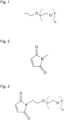
- Non-limiting examples of the first group are a polyethylene oxide (PEO) group as shown in the figure 1 , and a polyethylene glycol (PEG) group.
- u indicates the number of repetitions and is chosen between 20 and 80, preferably between 30 and 70, more preferably between 40 and 60, for example between 50 and 55.
- the second group of the first polymer of the polymerizable composition according to the invention is a group provided to allow the polymerization of the polymerizable composition in order to obtain a solid polymer electrolyte.
- the second group is therefore photo-activatable and/or heat-activatable.
- Non-limiting examples are a maleimide group, as shown in figure 2 , an acrylate group and a methacrylate group.
- the first polymer has a molar mass of between 1000 g/mol and 5000 g/mol, preferably between 1500 g/mol and 4000 g/mol, such as between 2000 g/mol and 3000 g/mol, more preferably between 2250 g/mol and 2750 g/mol, for example between 2350 g/mol and 2600 g/mol.
- the first polymer contains between 0.1 and 0.7 mEq (milli-equivalent) of the second group per gram of the first polymer, preferably between 0.2 and 0.6 mEq, more preferably between 0.3 and 0.5 mEq, for example between 0.35 and 0.45 mEq, or 0.4 mEq.
- first polymer polyethylene a-methoxy ⁇ -maleimide oxide, as shown in Figure 3 , polyethylene glycol methacrylate (PEGMA), and ⁇ -methoxy ⁇ -maleimide polyethylene glycol.
- the polymerizable composition contains between 10% and 50% by weight of the first polymer, preferably between 12% and 45% by weight, for example between 15% and 40% by weight, based on the total weight of the polymerizable composition.
- the temperature is between 20 ° C and 200 ° C, preferably between 20 °C and 150°C, more preferably between 25°C and 100°C, such as between 30°C and 80°C.
- these are groups and groupings which are heat-activatable.
- the radiation is ultraviolet radiation (UV), infrared radiation (IR) , visible light radiation, or combinations thereof.
- UV ultraviolet radiation
- IR infrared radiation
- visible light radiation or combinations thereof.
- UV ultraviolet radiation
- these are groups and groupings which are photo-activatable.
- the photo-activatable groups and moieties are also heat-activatable, and vice versa.
- the polymerizable composition also contains an oligomer.
- the oligomer has at least two photo-activatable and/or heat-activatable groups. These groups can be polymerized with the second group of the first polymer and/or with a third group of a second polymer. Preferably, the groups of the oligomer can be polymerized with at least the third group of a second polymer.
- the photo-activatable and/or heat-activatable groups may be, without being limited, a maleimide group, an acrylate and a methacrylate.
- the oligomer contains between 0.1 and 0.7 mEq (milli-equivalent) of photo-activatable and/or heat-activatable groups per gram of the oligomer, preferably between 0.2 and 0.9 mEq, more preferably between 0.3 and 0.8 mEq, for example between 0.4 and 0.7 mEq, or between 0.5 and 0.6 mEq.
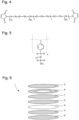
- oligomer is PPG-block-PEG-block-PPG, ⁇ , ⁇ -bis(maleimide), demonstrated in Figure 4 .
- It is a polyethylene polypropylene oxide (PEO-PPO) having a maleimide group at each end of the chain.
- PEO-PPO polyethylene polypropylene oxide
- x + z is between 2 and 20, preferably between 5 and 15, more preferably between 6 and 12, for example between 8 and 9.
- y is between 20 and 100, preferably between 40 and 80, more preferably between 50 and 75, for example between 60 and 70, or between 62 and 67.
- oligomer is polyethylene glycol (PEG) having a methacrylate (MA) group at each end of the chain (PEG-DiMA).
- PEG polyethylene glycol
- MA methacrylate
- the oligomer has a molar mass of between 250 g/mol and 10,000 g/mol, preferably between 500 g/mol and 5000 g/mol, more preferably between 750 g/mol and 4000 g/mol, for example between 1000 g/mol and 3750 g/mol, or between 2000 g/mol and 3600 g/mol.
- the polymerizable composition contains between 1% and 20% by weight of the oligomer, preferably between 2% and 15% by weight, for example between 3% and 15% by weight, based on the total weight of the polymerizable composition. .
- the oligomer comprises at least one photo-activatable and/or thermo-activatable group at each end of the chain of the oligomer, the oligomer being in this case a telechelic oligomer.
- a telechelic oligomer to the polymerizable composition, it is possible to better control the polymerization and therefore the structure of the polymer network obtained.
- the polymeric network is a linear polymeric network.
- the chains between two nodes of the polymerized composition (hence the solid polymer electrolyte) thus obtained are sufficiently long so that the polymerized composition is quite “loose” and that the electrolyte has excellent ionic conductivity.
- the oligomer is capable of acting in the solid polymer electrolyte as a plasticizer and/or an ionic conductivity amplifier of the electrolyte.
- the second polymer of the polymerizable composition contains a third group.
- the third group comprises a salt of an alkali metal and/or a salt of an alkaline earth metal.
- the alkali metal contains lithium, sodium, potassium, or combinations thereof.
- the alkali metal is lithium.
- the alkaline earth metal contains magnesium, beryllium, calcium, or combinations thereof.
- the alkaline earth metal is magnesium.
- the third group is capable of providing cations of the alkali metal and/or the alkaline earth metal.
- the cations of the alkali metal and/or the alkaline earth metal can, in the solid polymer electrolyte, move along the first polymer and the oligomer. This movement induces the ionic conductivity of the solid polymer electrolyte.
- the third group being integrated into the chain of the second polymer, also makes it possible, in the electrolyte, to reduce the mobility of the counter-anions of the alkali metal and/or the alkaline earth metal, which makes it possible to increase the mobility of the alkali metal and/or the alkaline earth metal.
- FIG. 5 shows an example of the second polymer of the polymerizable composition of the invention, in which the third group is lithium bis(trifluoromethane)sulfimide (LiSTFSI, CAS no. 210226-98-5).
- the polymerizable composition contains between 1% and 20% by weight of the second polymer, preferably between 2% and 15% by weight, for example between 5% and 10% by weight, based on the total weight of the polymerizable composition.
- the solvent in the polymerizable composition advantageously makes it possible to solubilize the components of the composition so as to obtain a liquid polymerizable composition.
- the solvent makes it possible to obtain a liquid composition which is easy to spread on a surface. It is thus possible to easily apply the polymerizable composition to a surface before at least partially initiating the polymerization.
- An example of the solvent includes, but is not limited to, propylene carbonate.
- the polymerizable composition contains between 20% and 60% by weight of the solvent, preferably between 25% and 55% by weight, for example between 30% and 50% by weight, based on the total weight of the polymerizable composition.
- the composition also includes a polymerization initiator.
- the polymerization initiator makes it possible to initiate the polymerization between the second group of the first polymer, the photo-activatable and/or thermo-activatable groups of the oligomer and the third group of the second polymer.
- the initiation of the polymerization, and/or the polymerization itself is carried out under the effect of a temperature between 20°C and 200°C, preferably between 20°C and 150°C, more preferably between 25°C and 100°C, such as between 30°C and 80°C, or under the effect of radiation.
- the radiation contains one or more of UV radiation, IR radiation and visible light (VIS) radiation.
- the polymerization initiator is advantageously of a radical nature. This means, in the present disclosure, that the polymerization initiator is capable of releasing radicals under the effect of temperature or radiation as described above. These radicals then initiate the polymerization between the first polymer, the second polymer and the oligomer of the composition.
- polymerization initiator examples include, but are not limited to, 2,2'-azobis(isobutyronitrile) (AIBN) and 2-hydroxy-4'-(2-hydroxyethoxy)-2-methylpropiophenone (CAS number 106797-53 -9).
- the polymerizable composition contains between 0.01% and 2% by weight of the polymerization initiator, preferably between 0.1% and 1.5% by weight, for example between 0.25% and 1% by weight, based on the total weight of the polymerizable composition.
- the polymerizable composition may also contain an alkali metal salt and/or an alkaline earth metal salt.
- the alkali metal salt contains, or substantially consists of, a lithium salt.
- the alkaline earth metal salt contains, or substantially consists of, a magnesium salt.
- the salts include lithium bis(fluorosulfonyl) imide (LIFSI) and lithium bis(trifluoromethanesulfonyl) imide (LITFSI).
- the inventors have surprisingly discovered that by adding a salt of an alkali metal and/or a salt of an alkaline earth metal in the polymerizable composition, the polymerized electrolyte obtained has better ionic conductivity compared to the electrolytes obtained from 'a composition without an added alkaline metal salt and/or an alkaline earth metal salt.
- the inventors believe that the increased conductivity is achieved through a synergy between the salt of the third group of the second polymer and the separate salt added in the composition.
- the polymerizable composition comprises a salt of an alkali metal and/or a salt of an alkaline earth metal
- the composition contains between 0.5% and 5% by weight of the salt, preferably between 0.75% and 4% by weight, for example between 1% and 3% by weight, based on the total weight of the polymerizable composition.
- a solid polymer electrolyte is obtained by polymerization of a polymerizable composition according to the present disclosure.
- the polymerization is a polymerization between the second group of the first polymer and one or more of the photo-activatable and/or thermo-activatable groups of the telechelic oligomer.
- the polymerization is carried out under the effect of temperature or under the effect of radiation as described above.
- the first polymer, the oligomer and the second polymer are polymerized in the solid polymer electrolyte, thus forming a polymer network, advantageously a linear polymer network.
- the present disclosure also relates to a battery cell comprising a solid polymer electrolyte according to the invention.
- the battery cell is thus a solid battery cell.
- the battery cell may be a secondary battery.
- the battery cell 1 has a button cell type configuration, known in the prior art as the CR2032 type configuration.
- the battery cell 1 comprises an anode 2 and a cathode 3.
- the battery cell 1 additionally comprises a solid polymer electrolyte 4 between the anode 2 and the cathode 3.
- the anode contains an alkali metal or an alkaline earth metal.
- the alkali metal contains, or consists of, lithium.
- the alkaline earth metal contains, or consists of, magnesium.
- the battery element 1 further comprises a button cell battery cover 5, a button cell battery base 6, a spacer 7 and a spring 8.
- the spacer 7 and the spring 8 provide good contact between the other components 2 , 3, 4, 5, 6 of battery cell 1.
- the present invention further relates to a method for producing a battery cell comprising a solid polymer electrolyte.
- the battery cell is a battery cell according to the present disclosure.
- the solid polymer electrolyte is a solid polymer electrolyte according to the present disclosure.
- a polymerizable composition is formed.
- a first polymer comprising a first group capable of coordinating cations of an alkali metal and/or an alkaline earth metal and a second photo-activatable and/or thermo-activatable group, a oligomer having at least two photo-activatable and/or heat-activatable groups, a second polymer comprising a third group which contains a salt of an alkali metal or an alkaline earth metal, a polymerization initiator and optionally a salt of An alkali metal and/or a salt of an alkaline earth metal are mixed.
- a solvent may be added at the same time before mixing the components, or may be added in one or more portions after mixing the components.
- At least two of the components mentioned below can be mixed, for example with a first portion of the solvent, thus forming a first mixture.
- At least one, e.g. one or two, other mixture may be formed by mixing the other components with a second portion, e.g. the remainder, of the solvent. Then the mixtures can be combined and mixed, thus forming the polymerizable composition.
- the formation of the polymerizable composition is not limited to these two modes of execution, and other modes of execution known in the prior art can also be applied.
- the polymerizable composition thus obtained is in liquid form. It is then applied to at least part of a surface of the anode and/or to at least part of a surface of a cathode.
- the polymerizable composition can be applied to cover an entire surface of a cathode.
- the polymerizable composition is applied to a surface of an anode and to a surface of a cathode.
- the application of the polymerizable composition to a surface can be carried out by means known from the prior art, for example by molding.
- a layer of polymerizable composition is thus deposited.
- the layer has a thickness between 1 ⁇ m and 1 mm, preferably between 50 ⁇ m and 750 ⁇ m, more preferably between 100 ⁇ m and 500 ⁇ m, for example between 250 ⁇ m and 400 ⁇ m.
- the application of the polymerizable composition in liquid form facilitates application compared to viscous or crystalline compositions.
- the polymerizable composition is polymerized at least, and preferably, partially under the effect of a temperature between 20°C and 200°C, preferably between 20°C and 150°C, more preferably between 25°C. and 100°C, such as between 30°C and 80°C, or under the effect of radiation.
- the radiation contains one or more of UV radiation, IR radiation and visible light (VIS) radiation. A partially polymerized composition is thus obtained.
- this step of (at least) partial polymerization under the effect of radiation has a duration of between 5 seconds and 20 minutes, for example between 10 seconds and 15 minutes, preferably between 20 seconds and 10 minutes, more preferably between 30 seconds and 5 minutes, such as 4 minutes, 3 minutes, 2 minutes, 1 minute, or 55 seconds, 50 seconds or 45 seconds.
- a duration facilitates the implementation of the process in industrial production lines.
- the (at least) partial polymerization if carried out under the effect of temperature, it has a duration of between 1 minute and 5 hours, preferably between 5 minutes and 4 hours, for example between 10 minutes and 3 hours, between 20 minutes and 2.5 hours, or between 30 minutes and 2 hours.
- this preferably partial polymerization step before bringing the anode and the cathode into contact makes it possible to prevent the electrodes from being in short circuit.
- the polymerizable composition is liquid, it has low mechanical strength.
- the at least partial polymerization increases the mechanical resistance of the composition, thus preventing the electrodes from being in short circuit when they are brought into contact.
- this preferably partial polymerization step allows good contact (a good interface) between the electrodes and the partially polymerized composition. This also allows good contact between the two layers of the partially polymerized composition if the composition is applied to the anode and the cathode.
- the anode and the cathode are brought into contact so as to obtain a structure comprising the partially polymerized polymerizable composition positioned between the anode and the cathode.
- Good contact, or a good interface, between the anode and the partially polymerized polymerizable composition, and between the cathode and the partially polymerized polymerizable composition is thus achieved. This makes it possible to obtain battery cells with excellent ionic conductivity.
- the final polymerization is carried out by exposing the cathode-composition-anode structure to a temperature between 20 °C and 200 °C, preferably between 20 °C and 150 °C, more preferably between 25 °C and 100 °C, such between 30°C and 80°C, or under the effect of radiation.
- the radiation contains one or more of UV radiation, IR radiation and visible light (VIS) radiation.
- this final or complete polymerization step under the effect of radiation has a duration of between 5 seconds and 20 minutes, for example between 10 seconds and 15 minutes, preferably between 20 seconds and 10 minutes, more preferably between 30 seconds and 5 minutes, such as 4 minutes, 3 minutes, 2 minutes, 1 minute, 55 seconds, 50 seconds or 45 seconds.
- a duration facilitates the implementation of the process in industrial production lines.
- the final or complete polymerization if carried out under the effect of temperature, it has a duration of between 1 minute and 10 hours, preferably between 10 minutes and 7.5 hours, for example between 30 minutes and 5 hours, between 45 minutes and 4 hours, or between 1 hour and 3 hours.
- the polymerizable composition is first partially polymerized, and it is then applied to at least part of a surface of the anode and/or to at least part of a surface of a cathode. Then the polymerization is finalized.
- a polymerizable composition was produced by adding 0.6 grams of a-methoxy ⁇ -maleimide polyethylene oxide (a first polymer), 0.085 grams of PPG-block-PEG-block-PPG, ⁇ , ⁇ -bis(maleimide) (a telechelic oligomer), 0.14 grams of STFSILi (a third group of the second polymer), 0.027 grams of LiFSI (a lithium salt) to 0.75 grams of propylene carbonate (the solvent). The solution was then stirred for 12 hours. After 12 hours, 0.0125 grams of AIBN as the polymerization initiator was added and the polymerizable composition was stirred for 10 minutes.
- AIBN as the polymerization initiator
- the composition was applied to an anode comprising lithium titanate (Li 2 TiO 3 , noted as LTO), and to a cathode comprising lithium iron phosphate (LiFePO 4 , noted as LFP).
- LTO lithium titanate
- LFP lithium iron phosphate
- the electrodes covered with the composition were then subjected to UV radiation for 1 minute at 200 W (OMNICURE Series 2000, wavelength between 320 nm - 500 nm) in order to at least partially polymerize the composition.
- the anode and the cathode with the at least partially polymerized composition were then brought into contact and were deposited in a CR2032 type casing containing 3 stainless steel discs of 0.8 mm thick and 17 mm in diameter. The case was sealed using a press.
- the polymerization was finalized by heating the whole in an oven at 80°C for 3 hours.
- the ionic conductivity measured thus was 0.51 mS/cm, which is above the minimum value of 0.1 mS/cm which guarantees sufficient ionic conductivity.
- Battery life was tested by charging and discharging the battery for over 450 cycles between 1.4 V and 1.5 V.
- the cycling rate was C/20, which corresponds to a 0.1 mA charge.
- Charging was done by applying a constant current and discharging was done by applying the same current but negative. During each cycle, the battery was charged and discharged to 100%.
Landscapes
- Chemical & Material Sciences (AREA)
- Engineering & Computer Science (AREA)
- Chemical Kinetics & Catalysis (AREA)
- Electrochemistry (AREA)
- General Chemical & Material Sciences (AREA)
- Manufacturing & Machinery (AREA)
- Condensed Matter Physics & Semiconductors (AREA)
- Physics & Mathematics (AREA)
- Materials Engineering (AREA)
- Dispersion Chemistry (AREA)
- General Physics & Mathematics (AREA)
- Inorganic Chemistry (AREA)
- Compositions Of Macromolecular Compounds (AREA)
- Secondary Cells (AREA)
- Conductive Materials (AREA)
- Polymerisation Methods In General (AREA)
Abstract
Description
- La présente invention se rapporte à une composition pour un électrolyte polymère solide, la composition étant polymérisable. La présente invention se rapporte aussi à un électrolyte polymère solide comprenant ladite composition polymérisée, à un élément de batterie comprenant ledit électrolyte, et à un procédé de production dudit élément de batterie.
- Des batteries classiques, telles que des batteries du type lithium-ion (Li-ion), comprenant un électrolyte liquide sont connues depuis des décennies. Cependant, il est connu que ces électrolytes liquides peuvent nuire à la sécurité de la batterie, par exemple suite à la génération de dendrites de lithium métallique qui peuvent causer des court-circuits dans la batterie. En outre, il est possible d'avoir des fuites d'électrolyte si l'étanchéité de la batterie est défaillante.
- Plus récemment, un nouveau type de batterie a été développé en vue d'améliorer la performance de la batterie, en particulier sa puissance et sa capacité. Il s'agit du type comprenant une anode en métal pur, plus particulièrement en métal alcalin pur ou en métal alcalino-terreux pur, par exemple la batterie du type lithium métal ayant une anode en lithium métallique. Cependant, les électrolytes liquides classiques ne sont pas adaptés à ce type de batterie à cause du contact plus large avec le métal (p.ex. du lithium métallique) que dans les batteries du type métal alcalin ou métal alcalino-terreux - ion (p.ex. Li-ion). Par exemple, ce contact plus élevé peut facilement provoquer des court-circuits.
- Récemment, des batteries comprenant un électrolyte solide (anglais : solid state electrolyte, abréviation : SSE) ont été développées. Les électrolytes solides servent à remplacer les électrolytes liquides dans les batteries du type métal alcalin ou métal alcalino-terreux - ion (p.ex. Li-ion) et du type ayant une anode en métal alcalin pur ou en métal alcalino-terreux pur (p.ex. Li-métal), parce qu'ils offrent une solution aux problèmes de sécurité et de fuites liés aux électrolytes liquides.
- En général, trois types d'électrolytes solides sont considérés : les électrolytes inorganiques solides, les électrolytes polymères solides, et les électrolytes composites polymériques. Plusieurs électrolytes polymères solides sont connus aujourd'hui, tels qu'un système comprenant le sel LiN(SO2CF3)2 dissous dans une matrice polymère d'oxyde de polyéthylène (PEO). L'oxyde de polyéthylène possède des sites de coordination type éther qui permettent la dissociation du sel de lithium et une chaine moléculaire flexible qui facilite le transport ionique, comme le transport des ions de lithium (Li+). D'autres polymères qui sont actuellement utilisés dans les électrolytes polymères solides sont, entre autres, le polycarbonate, des polyesters, des polynitriles (p.ex. le polyacrylonitrile), des polyalcools (p.ex. le poly(acétate de vinyle), et des polymères fluorés (p.ex. le poly(fluorure de vinylidène).
- Le document
US2013157146 décrit un électrolyte polymère solide ayant une matrice de polymère comprenant des segments -(CH2-CH2-O)-(basé sur le PEO) obtenus par polymérisation de deux monomères, et un sel de lithium dispersé dans la matrice polymérique. Des exemples du sel de lithium incluent le perchlorate de lithium (LiClO4), le hexafluorophosphate de lithium (LiPF6), le dioxyde de cobalt et de lithium (LiCoO2) et le phosphate de fer et de lithium (LiFePO4). - Cependant, un désavantage de ce type d'électrolyte polymère solide est que l'électrolyte ne possède pas la combinaison de propriétés mécaniques et de propriétés de conductivité ionique suffisamment élevée afin de réaliser des éléments de batterie qui sont dimensionnellement stables et ayant une conductivité ionique suffisante. Par exemple, un système avec une matrice basée sur l'oxyde de polyéthylène a une bonne conductivité ionique mais a une faible stabilité mécanique à une température au-dessus de la température de fusion du PEO (65 °C), et a une bonne stabilité mécanique grâce à la mobilité limitée des chaines mais a une faible conductivité ionique à une température en dessous de la température de fusion du PEO (65 °C).
- Le document 'Single-ion BAB triblock copolymers as highly efficient electrolytes for lithium-metal batteries', Bouchet R., Maria S., et al., Nature Materials, vol. 12, pages 452 - 457 (2013), décrit une solution qui consiste en l'utilisation de polymères constitués d'une alternance de blocs rigides et de blocs mous. Les blocs rigides, dérivés du polystyrène, assurent la tenue mécanique. Les blocs mous, étant faits d'oxyde de polyéthylène, assurent une bonne conductivité ionique à des températures supérieures à la température de fusion du PEO (65 °C), telles qu'à 80 °C.
- Le document 'UV cross-linked, lithium-conducting ternary polymer electrolytes containing ionic liquids', Kim G.T., Appetecchi G.B., et al., Journal of Power Sources 195 (2010), pages 6130-6137 décrit un électrolyte polymère solide obtenu par une réticulation sous l'effet de radiation UV d'une matrice polymère d'oxyde polyéthylène en présence de LiN(SO2CF3)2 (abrévié en LiTFSI) comme le sel de lithium et du liquide ionique N-alkyl-N-methylpyrrolidinium TFSI. Ce liquide ionique a un anion commun avec le sel de lithium, TFSI-. L'électrolyte obtenu a une conductivité ionique à température ambiante d'environ 0.33 mS/cm.
- Cependant, les ponts de réticulation ne sont pas faciles à contrôler, ce qui résulte en un placement aléatoire, menant à des chaines courtes. Ceci limite ainsi largement la conductivité ionique de ces électrolytes polymères réticulés solides (la valeur de 0.33 mS/cm est considérée dans le domaine comme étant insuffisante pour un élément de batterie commercial). En outre, l'usage d'un liquide ionique rend la formulation collante et donc difficile à manipuler.
- Le document
WO2014126570 décrit un électrolyte polymère solide comprenant un sel de lithium et un polymère réticulé obtenu par la réticulation des polymères téléchéliques ayant au moins deux groupes d'extrémité photo-activables. Les polymères ont une masse moléculaire avant réticulation comprise entre environ 1000 Daltons et 1000000 Daltons. Cela résulte en une composition pour un électrolyte polymère solide très visqueuse ou même très cristalline, ce qui détériore l'applicabilité sur une surface telle que celle d'une anode ou d'une cathode. En plus, la réticulation nécessite un chauffage de la composition sur une durée de plusieurs heures, typiquement entre 3 heures et 5 heures. - L'invention a pour but de résoudre un ou plusieurs des problèmes de l'art antérieur. L'invention a pour but de fournir une composition pour électrolyte polymère solide améliorée, qui permette d'obtenir un électrolyte polymère solide ayant d'excellentes propriétés en termes de conductivité ionique, de stabilité mécanique et de résistance mécanique. L'invention a aussi pour but de fournir un procédé d'obtention d'un élément de batterie comprenant un tel électrolyte polymère solide, le procédé étant moins complexe, ayant une durée plus courte et ayant une consommation d'énergie plus basse que celles des procédés de l'art antérieur.
- Un premier aspect de l'invention concerne une composition polymérisable pour un électrolyte polymère solide telle que décrite dans les revendications annexées.
- La composition polymérisable comprend un premier polymère comprenant un premier groupement et un deuxième groupement. Le premier groupement est capable de coordonner des cations d'un métal alcalin et/ou d'un métal alcalino-terreux. Avantageusement, le premier groupement contient un groupement d'oxyde de polyéthylène (PEO). Le deuxième groupement est photo-activable et/ou thermo-activable. Autrement dit, le deuxième groupement contient un groupe photo-activable et/ou thermo-activable.
- Le terme «photo-activable» tel qu'utilisé dans la présente divulgation inclut des composants, des molécules, des groupes ou des groupements qui peuvent être activés sous l'effet d'un rayonnement, tel que - sans être limité à celui-ci - un rayonnement ultraviolet (UV), un rayonnement infrarouge (IR), un rayonnement de la lumière visible, ou des combinaisons de ceux-ci.
- Le terme « thermo-activable » tel qu'utilisé dans la présente divulgation inclut des composants, des molécules, des groupes ou des groupements qui peuvent être activés sous l'effet d'un changement de température. En particulier, le changement de température est un réchauffement. Avantageusement, la température d'activation est entre 20 °C et 150 °C, de préférence entre 25 °C et 100 °C.
- L'activation par chaleur et/ou par un rayonnement inclut, sans être limitatif, une activation permettant une oligomérisation, une polymérisation ou une réticulation, et/ou l'initiation d'une oligomérisation, une polymérisation ou une réticulation.
- La composition polymérisable contient en outre un oligomère ayant au moins deux groupes photo-activables et/ou thermo-activables. Avantageusement, au moins un des groupes photo-activables et/ou thermo-activables est un groupe d'extrémité. Un « groupe d'extrémité » de l'oligomère est considéré comme un groupe qui est présent à une extrémité (de la chaîne) de l'oligomère. Avantageusement, au moins une des extrémités de la chaîne de l'oligomère contient un groupe photo-activable et/ou thermo-activable.
- De préférence, chaque extrémité (de la chaîne) de l'oligomère contient au moins un groupe photo-activable et/ou thermo-activable, et l'oligomère est un oligomère téléchélique. Un « oligomère téléchélique » tel qu'utilisé dans la présente divulgation est considéré comme un oligomère capable de subir une polymérisation ultérieure du fait de la présence d'au moins un groupe réactif à chacune des extrémités (de la chaîne) de l'oligomère. De préférence, tous les groupes photo-activables et/ou thermo-activables sont des groupes d'extrémité.
- Avantageusement, un ou plusieurs du deuxième groupement du premier polymère et des groupes photo-activables et/ou thermo-activables de l'oligomère est un maléimide.
- Avantageusement, l'oligomère a une masse molaire comprise entre 500 g/mol et 5000 g/mol, de préférence entre 750 g/mol et 4000 g/mol.
- La composition polymérisable comprend en outre un deuxième polymère. Le deuxième polymère contient un troisième groupement. Le troisième groupement comprend un sel d'un métal alcalin et/ou un sel d'un métal alcalino-terreux. Avantageusement, le métal alcalin contient, ou consiste substantiellement en, du lithium, et le sel est un sel de lithium. Avantageusement, le métal alcalino-terreux contient, ou consiste substantiellement en, du magnésium, et le sel est un sel de magnésium.
- La composition polymérisable comprend en outre un solvant. Avantageusement, le solvant permet de solubiliser les composants de la composition polymérisable de façon à obtenir une composition polymérisable liquide. Ceci permet l'application facile de la composition polymérisable à une surface, par exemple une surface d'une électrode, par exemple d'une anode ou d'une cathode. L'application de la composition polymérisable sous forme liquide facilite l'application comparé à des compositions visqueuses ou cristallines.
- La composition polymérisable comprend en outre un initiateur de polymérisation. L'initiateur de polymérisation permet d'initier la polymérisation entre le deuxième groupement du premier polymère, les groupes photo-activables et/ou thermo-activables de l'oligomère, et avantageusement le deuxième polymère. L'initiation de la polymérisation, et/ou la polymérisation elle-même, est réalisée sous l'effet d'une température comprise entre 20 °C et 150 °C, de préférence entre 25 °C et 100 °C, ou sous l'effet d'un rayonnement. Avantageusement, le rayonnement contient un ou plusieurs d'un rayonnement UV, d'un rayonnement IR et d'un rayonnement de la lumière visible (VIS).
- Avantageusement, la composition polymérisable contient entre 10 et 50 % en poids du premier polymère, entre 1 % et 20 % en poids de l'oligomère, entre 1 % et 20 % en poids du deuxième polymère, entre 20 % et 60 % en poids du solvant, et entre 0.01 % et 2 % en poids de l'initiateur de polymérisation, basé sur le poids total de la composition polymérisable.
- La composition polymérisable peut aussi contenir un sel d'un métal alcalin et/ou un sel d'un métal alcalino-terreux. Avantageusement, la composition polymérisable comprend entre 0.5 % et 5 % en poids du sel, basé sur le poids total de la composition polymérisable. Avantageusement, le sel d'un métal alcalin contient, ou substantiellement consiste en, un sel de lithium. Avantageusement, le sel d'un métal alcalino-terreux contient, ou substantiellement consiste en, un sel de magnésium.
- Un deuxième aspect de l'invention concerne un électrolyte polymère solide tel que décrit dans les revendications annexées. L'électrolyte polymère solide est obtenu par polymérisation d'une composition polymérisable, de préférence une composition polymérisable selon le premier aspect de l'invention. Avantageusement, la polymérisation est une polymérisation entre le deuxième groupement du premier polymère, un ou plusieurs des groupes photo-activables et/ou thermo-activables de l'oligomère, et avantageusement le deuxième polymère. Avantageusement, la polymérisation est réalisée sous l'effet d'une température comprise entre 20 °C et 150 °C, de préférence entre 25 °C et 100 °C, ou sous l'effet d'un rayonnement. Avantageusement, le rayonnement contient un ou plusieurs d'un rayonnement UV, d'un rayonnement IR et d'un rayonnement de la lumière visible (VIS).
- Avantageusement, le premier polymère, l'oligomère et le deuxième polymère sont polymérisé dans l'électrolyte polymère solide. Autrement dit, l'électrolyte polymère solide selon l'invention contient, ou consiste en, un réseau polymérique, avantageusement un réseau linéaire polymérique.
- Un troisième aspect de l'invention concerne un élément de batterie tel que décrit dans les revendications annexées. Avantageusement, l'élément de batterie comprend l'électrolyte polymère solide selon le deuxième aspect de l'invention. L'élément de batterie est ainsi un élément de batterie solide.
- Avantageusement, l'élément de batterie contient en outre une anode et une cathode. Avantageusement, l'anode et/ou la cathode sont en contact, p.ex. partagent une interface, avec l'électrolyte polymère solide. Avantageusement, l'anode contient un métal alcalin ou un métal alcalino-terreux. Avantageusement, le métal alcalin contient, ou consiste en, du lithium. Avantageusement, le métal alcalino-terreux contient, ou consiste en, du magnésium.
- Un quatrième aspect de l'invention concerne un procédé de production d'un élément de batterie comprenant un électrolyte polymère solide. Dans une première étape, une composition polymérisable est formée. Avantageusement, la composition polymérisable est selon le premier aspect de l'invention. La composition polymérisable est formée en mélangeant un premier polymère, comprenant un premier groupement capable de coordonner des cations d'un métal alcalin et/ou d'un métal alcalino-terreux et un deuxième groupement photo-activable et/ou thermo-activable, un oligomère ayant au moins deux groupes photo-activables et/ou thermo-activables, un deuxième polymère comprenant un troisième groupement qui contient un sel d'un métal alcalin ou d'un métal alcalino-terreux et un initiateur de polymérisation avec un solvant.
- Ensuite, la composition polymérisable est appliquée à au moins une partie d'une surface d'une anode et/ou à au moins une partie d'une surface d'une cathode. Par exemple, la composition polymérisable peut être appliquée à une surface d'une anode et à une surface d'une cathode.
- Ensuite, la composition polymérisable est polymérisée au moins partiellement sous l'effet d'une température comprise entre 20 °C et 150 °C, de préférence entre 25 °C et 100 °C, ou sous l'effet d'un rayonnement. Avantageusement, le rayonnement contient un ou plusieurs d'un rayonnement UV, d'un rayonnement IR et d'un rayonnement de la lumière visible (VIS). Une composition partiellement polymérisée est ainsi obtenue.
- Après avoir polymérisé au moins partiellement la composition polymérisable, l'anode et la cathode sont mises en contact de façon à obtenir une structure comprenant la composition polymérisable partiellement polymérisée positionnée entre l'anode et la cathode. Un bon contact, ou une bonne interface, entre l'anode et la composition polymérisable partiellement polymérisée, et entre la cathode et la composition polymérisable partiellement polymérisée est ainsi avantageusement réalisé.
- Puis, la polymérisation de la composition polymérisable partiellement polymérisée est finalisée, afin de transformer la composition polymérisable partiellement polymérisée en l'électrolyte polymère solide et d'obtenir un élément de batterie. La polymérisation finale est réalisée en exposant la structure cathode-composition-anode à une température comprise entre 20 °C et 150 °C, de préférence entre 25 °C et 100 °C, ou sous l'effet d'un rayonnement. Avantageusement, le rayonnement contient un ou plusieurs d'un rayonnement UV, d'un rayonnement IR et d'un rayonnement de la lumière visible (VIS).
- La composition polymérisable selon l'invention permet d'obtenir des électrolytes polymères solides ayant une excellente conductivité ionique et une excellente stabilité mécanique. En plus, les éléments de batterie selon l'invention contiennent un excellent contact (ou interface) entre les électrodes (l'anode et la cathode) et l'électrolyte polymère solide, ce qui permet de réaliser des éléments de batterie ayant une excellente conductivité ionique et une durée de vie améliorée, comparée aux éléments de batterie selon l'art antérieur. Cette excellente interface est réalisée en particulier par les méthodes de la présente invention.
- La composition est aussi facile à appliquer aux électrodes d'un élément de batterie. Le procédé d'obtention de l'électrolyte polymère solide et de l'élément de batterie est particulièrement apte à être implémenté dans les lignes de production en masse.
- Les buts, avantages et caractéristiques sont montrés dans les figures, qui illustrent des modes d'exécution sans être limitatif :
- la
figure 1 représente un premier groupement d'un composant de la composition polymérisable ; - la
figure 2 représente un deuxième groupement d'un composant de la composition polymérisable ; - la
figure 3 représente un premier composant de la composition polymérisable ; - la
figure 4 représente un deuxième composant de la composition polymérisable ; - la
figure 5 représente un troisième composant de la composition polymérisable ; - la
figure 6 représente les composants d'un élément de batterie ; - la
figure 7 représente le courant en fonction du voltage d'une batterie selon l'invention ; et - la
figure 8 représente la capacité spécifique d'une batterie après être chargée-déchargée plusieurs fois. - Le premier groupement du premier polymère de la composition polymérisable selon l'invention est capable de coordonner des cations d'un métal alcalin et/ou d'un métal alcalino-terreux, avantageusement les cations du métal alcalin et/ou du métal alcalino-terreux dans l'électrolyte polymère solide selon l'invention, obtenu par polymérisation de la composition polymérisable. Autrement dit, le premier groupement est avantageusement choisi de façon à assurer la conductivité ionique de l'électrolyte polymère solide. Des exemples non-limitatifs du premier groupement sont un groupement d'oxyde de polyéthylène (PEO) tel que montré dans la
figure 1 , et un groupement de glycol de polyéthyléne (PEG). Avantageusement, dans lafigure 1 , u indique le nombre de répétitions et est choisi entre 20 et 80, de préférence entre 30 et 70, plus préférentiellement entre 40 et 60, par exemple entre 50 et 55. - Le deuxième groupement du premier polymère de la composition polymérisable selon l'invention est un groupement fourni afin de permettre la polymérisation de la composition polymérisable afin d'obtenir un électrolyte polymère solide. Le deuxième groupement est donc photo-activable et/ou thermo-activable. Des exemples non-limitatifs sont un groupement maléimide, tel que montré dans la
figure 2 , un groupement acrylate et un groupement méthacrylate. - Avantageusement, le premier polymère a une masse molaire comprise entre 1000 g/mol et 5000 g/mol, de préférence entre 1500 g/mol et 4000 g/mol, tel qu'entre 2000 g/mol et 3000 g/mol, plus préférentiellement entre 2250 g/mol et 2750 g/mol, par exemple entre 2350 g/mol et 2600 g/mol.
- Avantageusement, le premier polymère contient entre 0.1 et 0.7 mEq (milli-équivalent) du deuxième groupement par gramme du premier polymère, de préférence entre 0.2 et 0.6 mEq, plus préférentiellement entre 0.3 et 0.5 mEq, par exemple entre 0.35 et 0.45 mEq, ou 0.4 mEq.
- Des exemples particuliers du premier polymère sont l'a-methoxy ω-maléimide oxyde de polyéthylène, tel que montré dans la
figure 3 , le polyéthylène glycol méthacrylate (PEGMA), et l'α-methoxy ω-maléimide polyéthylène glycol. - Avantageusement, la composition polymérisable contient entre 10 % et 50 % en poids du premier polymère, de préférence entre 12 % et 45 % en poids, par exemple entre 15 % et 40 % en poids, basé sur le poids total de la composition polymérisable.
- Avantageusement, quand la polymérisation, partielle ou entière, et/ou l'initiation de la polymérisation de la composition polymérisable a lieu sous l'effet de la température, la température est comprise entre 20 °C et 200 °C, de préférence entre 20 °C et 150 °C, plus préférentiellement entre 25 °C et 100 °C, telle que entre 30 °C et 80 °C. Dans ce cas, il s'agit des groupes et des groupements qui sont thermo-activables.
- Avantageusement, quand la polymérisation, partielle ou entière, et/ou l'initiation de la polymérisation de la composition polymérisable a lieu sous l'effet d'un rayonnement, le rayonnement est un rayonnement ultraviolet (UV), un rayonnement infrarouge (IR), un rayonnement de la lumière visible, ou des combinaisons de ceux-ci. Dans ce cas, il s'agit des groupes et des groupements qui sont photo-activables.
- Dans la présente divulgation, il est possible que les groupes et les groupements photo-activables soient également thermo-activables, et vice-versa.
- La composition polymérisable contient aussi un oligomère. L'oligomère a au moins deux groupes photo-activables et/ou thermo-activables. Ces groupes peuvent être polymérisés avec le deuxième groupement du premier polymère et/ou avec un troisième groupement d'un deuxième polymère. De préférence, les groupes de l'oligomère peuvent être polymérisés avec au moins le troisième groupement d'un deuxième polymère. Les groupes photo-activables et/ou thermo-activables peuvent être, sans être limitatif, un groupe maléimide, un acrylate et un méthacrylate.
- Avantageusement, l'oligomère contient entre 0.1 et 0.7 mEq (milli-équivalent) de groupes photo-activables et/ou thermo-activables par gramme de l'oligomère, de préférence entre 0.2 et 0.9 mEq, plus préférentiellement entre 0.3 et 0.8 mEq, par exemple entre 0.4 et 0.7 mEq, ou entre 0.5 et 0.6 mEq.
- Un exemple de l'oligomère est le PPG-block-PEG-block-PPG, α,ω-bis(maléimide), démontré dans la
figure 4 . Il s'agit d'un oxyde de polyéthylène et de polypropylène (PEO-PPO) ayant un groupe maléimide à chaque extrémité de la chaîne. Avantageusement, x + z est comprise entre 2 et 20, de préférence entre 5 et 15, plus préférentiellement entre 6 et 12, par exemple entre 8 et 9. Avantageusement, y est comprise entre 20 et 100, de préférence entre 40 et 80, plus préférentiellement entre 50 et 75, par exemple entre 60 et 70, ou entre 62 et 67. - Un autre exemple de l'oligomère est du glycol de polyéthylène (PEG) ayant un groupe méthacrylate (MA) à chaque extrémité de la chaîne (PEG-DiMA).
- Avantageusement, l'oligomère a une masse molaire comprise entre 250 g/mol et 10000 g/mol, de préférence entre 500 g/mol et 5000 g/mol, plus préférentiellement entre 750 g/mol et 4000 g/mol, par exemple entre 1000 g/mol et 3750 g/mol, ou entre 2000 g/mol et 3600 g/mol.
- Avantageusement, la composition polymérisable contient entre 1 % et 20 % en poids de l'oligomère, de préférence entre 2 % et 15 % en poids, par exemple entre 3 % et 15 % en poids, basé sur le poids total de la composition polymérisable.
- Avantageusement, l'oligomère comprend au moins un groupe photo-activable et/ou thermo-activable à chaque extrémité de la chaîne de l'oligomère, l'oligomère étant dans ce cas un oligomère téléchélique. En ajoutant un oligomère téléchélique dans la composition polymérisable, il est possible de mieux contrôler la polymérisation et donc la structure du réseau polymérique obtenu. Avantageusement, le réseau polymérique est un réseau linéaire polymérique. De plus, les chaînes entre deux nœuds de la composition polymérisée (donc l'électrolyte polymère solide) obtenues ainsi sont suffisamment longues pour que la composition polymérisée soit assez « lâche » et que l'électrolyte présente une excellente conductivité ionique.
- Avantageusement, l'oligomère est capable d'agir dans l'électrolyte polymère solide comme un plastifiant et/ou un amplificateur de conductivité ionique de l'électrolyte.
- Le deuxième polymère de la composition polymérisable contient un troisième groupement. Avantageusement, le troisième groupement comprend un sel d'un métal alcalin et/ou un sel d'un métal alcalino-terreux. Avantageusement, le métal alcalin contient du lithium, du sodium, du potassium, ou des combinaisons de ceux-ci. De préférence, le métal alcalin est du lithium. Avantageusement, le métal alcalino-terreux contient du magnésium, du béryllium, du calcium, ou des combinaisons de ceux-ci. De préférence, le métal alcalino-terreux est du magnésium.
- Avantageusement, dans l'électrolyte polymère solide obtenu, le troisième groupement est capable de fournir des cations du métal alcalin et/ou du métal alcalino-terreux. Avantageusement, les cations du métal alcalin et/ou du métal alcalino-terreux peuvent, dans l'électrolyte polymère solide, se déplacer le long du premier polymère et de l'oligomère. Ce déplacement induit la conductivité ionique de l'électrolyte polymère solide. De plus, le troisième groupement, étant intégré à la chaîne du deuxième polymère, permet aussi, dans l'électrolyte, de réduire la mobilité des contre-anions du métal alcalin et/ou du métal alcalino-terreux, ce qui permet d'accroître la mobilité du métal alcalin et/ou du métal alcalino-terreux.
- La
figure 5 montre un exemple du deuxième polymère de la composition polymérisable de l'invention, dans lequel le troisième groupement est du lithium bis(trifluorométhane)sulfimide (LiSTFSI, CAS n° 210226-98-5). - Avantageusement, la composition polymérisable contient entre 1 % et 20 % en poids du deuxième polymère, de préférence entre 2 % et 15 % en poids, par exemple entre 5 % et 10 % en poids, basé sur le poids total de la composition polymérisable.
- Le solvant dans la composition polymérisable permet avantageusement de solubiliser les composants de la composition de façon à obtenir une composition polymérisable liquide. Avantageusement, le solvant permet d'obtenir une composition liquide qui est facile à étaler sur une surface. Ainsi il est possible d'appliquer facilement la composition polymérisable à une surface avant d'initier au moins partiellement la polymérisation. Un exemple du solvant inclut, sans être limitatif, le propylène carbonate.
- Avantageusement, la composition polymérisable contient entre 20 % et 60 % en poids du solvant, de préférence entre 25 % et 55 % en poids, par exemple entre 30 % et 50 % en poids, basé sur le poids total de la composition polymérisable.
- La composition comprend aussi un initiateur de polymérisation. L'initiateur de polymérisation permet d'initier la polymérisation entre le deuxième groupement du premier polymère, les groupes photo-activables et/ou thermo-activables de l'oligomère et le troisième groupement du deuxième polymère. L'initiation de la polymérisation, et/ou la polymérisation elle-même, est réalisée sous l'effet d'une température comprise entre 20 °C et 200 °C, de préférence entre 20 °C et 150 °C, plus préférentiellement entre 25 °C et 100 °C, telle que entre 30 °C et 80 °C, ou sous l'effet d'un rayonnement. Avantageusement, le rayonnement contient un ou plusieurs d'un rayonnement UV, d'un rayonnement IR et d'un rayonnement de la lumière visible (VIS).
- L'initiateur de polymérisation est avantageusement de nature radicalaire. Cela veut dire, dans la présente divulgation, que l'initiateur de polymérisation est capable de libérer des radicaux sous l'effet de la température ou d'un rayonnement tel que décrit ci-dessus. Ces radicaux initient ensuite la polymérisation entre le premier polymère, le deuxième polymère et l'oligomère de la composition.
- Des exemples de l'initiateur de polymérisation incluent, sans être limitatif, le 2,2'-azobis(isobutyronitrile) (AIBN) et 2-hydroxy-4'-(2-hydroxyéthoxy)-2-méthylpropiophenone (numéro CAS 106797-53-9).
- Avantageusement, la composition polymérisable contient entre 0.01 % et 2 % en poids de l'initiateur de polymérisation, de préférence entre 0.1 % et 1.5 % en poids, par exemple entre 0.25 % et 1 % en poids, basé sur le poids total de la composition polymérisable.
- La composition polymérisable peut aussi contenir un sel d'un métal alcalin et/ou un sel d'un métal alcalino-terreux. Avantageusement, le sel d'un métal alcalin contient, ou substantiellement consiste en, un sel de lithium. Avantageusement, le sel d'un métal alcalino-terreux contient, ou substantiellement consiste en, un sel de magnésium. Des exemples non-limitatifs des sels incluent le lithium bis(fluorosulfonyl) imide (LIFSI) et le lithium bis(trifluoromethanesulfonyl) imide (LITFSI).
- Les inventeurs ont découvert de façon surprenante qu'en ajoutant un sel d'un métal alcalin et/ou un sel d'un métal alcalino-terreux dans la composition polymérisable, l'électrolyte polymérisé obtenu a une meilleure conductivité ionique comparé aux électrolytes obtenus d'une composition sans sel d'un métal alcalin et/ou un sel d'un métal alcalino-terreux ajouté. Les inventeurs pensent que la conductivité augmentée est réalisée grâce à une synergie entre le sel du troisième groupement du deuxième polymère et le sel séparé ajouté dans la composition.
- Avantageusement, si la composition polymérisable comprend un sel d'un métal alcalin et/ou un sel d'un métal alcalino-terreux, la composition contient entre 0.5 % et 5 % en poids du sel, de préférence entre 0.75 % et 4 % en poids, par exemple entre 1 % et 3 % en poids, basé sur le poids total de la composition polymérisable.
- Un électrolyte polymère solide est obtenu par polymérisation d'une composition polymérisable selon la présente divulgation. Avantageusement, la polymérisation est une polymérisation entre le deuxième groupement du premier polymère et un ou plusieurs des groupes photo-activables et/ou thermo-activables de l'oligomère téléchélique. Avantageusement, la polymérisation est réalisée sous l'effet de la température ou sous l'effet d'un rayonnement tel que décrit ci-dessus.
- Avantageusement, le premier polymère, l'oligomère et le deuxième polymère sont polymérisés dans l'électrolyte polymère solide, ainsi formant un réseau polymérique, avantageusement un réseau linéaire polymérique.
- La présente divulgation concerne aussi un élément de batterie comprenant un électrolyte polymère solide selon l'invention. L'élément de batterie est ainsi un élément de batterie solide. L'élément de batterie peut être une batterie secondaire.
- La
figure 6 montre un mode d'exécution d'un élément de batterie 1. L'élément de batterie 1 a une configuration du type pile bouton, connu dans l'art antérieur comme la configuration du type CR2032. - L'élément de batterie 1 comprend une anode 2 et une cathode 3. L'élément de batterie 1 comprend en plus un électrolyte polymère solide 4 entre l'anode 2 et la cathode 3.
- Avantageusement, l'anode contient un métal alcalin ou un métal alcalino-terreux. Avantageusement, le métal alcalin contient, ou consiste en, du lithium. Avantageusement, le métal alcalino-terreux contient, ou consiste en, du magnésium.
- Avantageusement, l'élément de batterie 1 comprend en outre un couvercle de pile bouton 5, une base de pile bouton 6, une entretoise 7 et un ressort 8. L'entretoise 7 et le ressort 8 réalisent un bon contact entre les autres composants 2, 3, 4, 5, 6 de l'élément de batterie 1.
- La présente invention concerne en outre un procédé de production d'un élément de batterie comprenant un électrolyte polymère solide. Avantageusement, l'élément de batterie est un élément de batterie selon la présente divulgation. Avantageusement, l'électrolyte polymère solide est un électrolyte polymère solide selon la présente divulgation.
- D'abord, une composition polymérisable est formée. Selon un premier mode d'exécution, un premier polymère comprenant un premier groupement capable de coordonner des cations d'un métal alcalin et/ou d'u métal alcalino-terreux et un deuxième groupement photo-activable et/ou thermo-activable, un oligomère ayant au moins deux groupes photo-activables et/ou thermo-activables, un deuxième polymère comprenant un troisième groupement qui contient un sel d'un métal alcalin ou d'un métal alcalino-terreux, un initiateur de polymérisation et optionnellement un sel d'un métal alcalin et/ou un sel d'un métal alcalino-terreux sont mélangés. Un solvant peut être ajouté en même temps avant de mélanger les composants, ou peut être ajouté en une ou plusieurs portions après avoir mélangé les composants.
- Selon un autre mode d'exécution, au moins deux des composants mentionnés ci-dessous peuvent être mélangés, par exemple avec une première portion du solvant, ainsi formant un premier mélange. Au moins un, par exemple un ou deux, autre mélange peut être formé en mélangeant les autres composants avec une deuxième portion, par exemple le reste, du solvant. Ensuite, les mélanges peuvent être combinés et mélangés, ainsi formant la composition polymérisable.
- La formation de la composition polymérisable n'est pas limitée à ces deux modes d'exécution, et d'autres modes d'exécution connu dans l'art antérieur peuvent aussi être appliqués.
- La composition polymérisable ainsi obtenue est sous forme liquide. Elle est ensuite appliquée à au moins une partie d'une surface de l'anode et/ou à au moins une partie d'une surface d'une cathode. Par exemple, la composition polymérisable peut être appliquée de façon à couvrir une surface entière d'une cathode. Avantageusement, la composition polymérisable est appliquée à une surface d'une anode et à une surface d'une cathode.
- L'application à une surface de la composition polymérisable peut être réalisée par des moyens connus de l'art antérieur, par exemple par du moulage. Une couche de composition polymérisable est ainsi déposée. Avantageusement, la couche a une épaisseur entre 1 µm et 1 mm, de préférence entre 50 µm et 750 µm, plus préférentiellement entre 100 µm et 500 µm, par exemple entre 250 µm et 400 µm. L'application de la composition polymérisable sous forme liquide facilite l'application comparé à des compositions visqueuses ou cristallines.
- Ensuite, la composition polymérisable est polymérisée au moins, et de préférence, partiellement sous l'effet d'une température comprise entre 20 °C et 200 °C, de préférence entre 20 °C et 150 °C, plus préférentiellement entre 25 °C et 100 °C, telle qu'entre 30 °C et 80 °C, ou sous l'effet d'un rayonnement. Avantageusement, le rayonnement contient un ou plusieurs d'un rayonnement UV, d'un rayonnement IR et d'un rayonnement de la lumière visible (VIS). Une composition partiellement polymérisée est ainsi obtenue.
- Avantageusement, cette étape de polymérisation (au moins) partielle sous l'effet d'un rayonnement, de préférence un rayonnement UV, a une durée comprise entre 5 secondes et 20 minutes, par exemple entre 10 secondes et 15 minutes, de préférence entre 20 secondes et 10 minutes, plus préférentiellement entre 30 secondes et 5 minutes, telle que 4 minutes, 3 minutes, 2 minutes, 1 minute, ou 55 secondes, 50 secondes ou 45 secondes. Une telle durée facilite l'implémentation du procédé dans des lignes de production industrielles.
- Avantageusement, si la polymérisation (au moins) partielle est effectuée sous l'effet de la température, elle a une durée comprise entre 1 minute et 5 heures, de préférence entre 5 minutes et 4 heures, par exemple entre 10 minutes et 3 heures, entre 20 minutes et 2,5 heures, ou entre 30 minutes et 2 heures.
- Les inventeurs ont découvert que cette étape de polymérisation de préférence partielle avant de mettre en contact l'anode et la cathode permet d'éviter que les électrodes soient en court-circuit. Comme la composition polymérisable est liquide, elle a une faible résistance mécanique. La polymérisation au moins partielle augmente la résistance mécanique de la composition, ainsi évitant que les électrodes soient en court-circuit au moment où elles sont mises en contact.
- Les inventeurs ont également découvert que cette étape de polymérisation de préférence partielle permet un bon contact (une bonne interface) entre les électrodes et la composition partiellement polymérisée. Cela permet également un bon contact entre les deux couches de la composition partiellement polymérisée si la composition est appliquée à l'anode et à la cathode.
- Ensuite, l'anode et la cathode sont mises en contact de façon à obtenir une structure comprenant la composition polymérisable partiellement polymérisée positionnée entre l'anode et la cathode. Un bon contact, ou une bonne interface, entre l'anode et la composition polymérisable partiellement polymérisée, et entre la cathode et la composition polymérisable partiellement polymérisée est ainsi réalisé. Cela permet d'obtenir des éléments de batterie ayant une excellente conductivité ionique.
- Puis, la polymérisation de la composition polymérisable qui est partiellement polymérisée est finalisée, afin de convertir la composition polymérisable partiellement polymérisée en l'électrolyte polymère solide et d'obtenir un élément de batterie. La polymérisation finale est fait en exposant la structure cathode-composition-anode à une température comprise entre 20 °C et 200 °C, de préférence entre 20 °C et 150 °C, plus préférentiellement entre 25 °C et 100 °C, telle qu'entre 30 °C et 80 °C, ou sous l'effet d'un rayonnement. Avantageusement, le rayonnement contient un ou plusieurs d'un rayonnement UV, d'un rayonnement IR et d'un rayonnement de la lumière visible (VIS). Une composition polymérisée est ainsi obtenue.
- Avantageusement, cette étape de polymérisation finale ou complète sous l'effet d'un rayonnement, de préférence un rayonnement UV, a une durée comprise entre 5 secondes et 20 minutes, par exemple entre 10 secondes et 15 minutes, de préférence entre 20 secondes et 10 minutes, plus préférentiellement entre 30 secondes et 5 minutes, telle que 4 minutes, 3 minutes, 2 minutes, 1 minute, 55 secondes, 50 secondes ou 45 secondes. Une telle durée facilite l'implémentation du procédé dans des lignes de production industrielles.
- Avantageusement, si la polymérisation finale ou complète est effectuée sous l'effet de la température, elle a une durée comprise entre 1 minute et 10 heures, de préférence entre 10 minutes et 7,5 heures, par exemple entre 30 minutes et 5 heures, entre 45 minutes et 4 heures, ou entre 1 heure et 3 heures.
- Selon un deuxième mode d'exécution du procédé, la composition polymérisable est d'abord partiellement polymérisée, et elle est ensuite appliquée à au moins une partie d'une surface de l'anode et/ou à au moins une partie d'une surface d'une cathode. Puis la polymérisation est finalisée.
- Une composition polymérisable a été produite en ajoutant 0.6 grammes d'a-methoxy ω-maléimide oxyde de polyéthylène (un premier polymère), 0.085 grammes de PPG-block-PEG-block-PPG, α,ω-bis(maléimide) (un oligomère téléchélique), 0.14 grammes de STFSILi (un troisième groupement du deuxième polymère), 0.027 grammes de LiFSI (un sel de lithium) à 0.75 grammes de propylène carbonate (le solvant). La solution a ensuite été agitée pendant 12 heures. Après 12 heures, 0.0125 grammes d'AIBN comme l'initiateur de polymérisation ont été ajouté et la composition polymérisable a été agitée pendant 10 minutes.
- Ensuite, la composition a été appliquée sur une anode comprenant du titanate de lithium (Li2TiO3, noté comme LTO), et sur une cathode comprenant du phosphate de fer et de lithium (LiFePO4, noté comme LFP). Les électrodes recouvertes de la composition ont ensuite été soumises à un rayonnement UV pendant 1 minute à 200 W (OMNICURE Series 2000, longueur d'onde comprise entre 320 nm - 500 nm) afin de polymériser au moins partiellement la composition.
- L'anode et la cathode avec la composition au moins partiellement polymérisée ont ensuite été mises en contact et ont été déposées dans un boîtier du type CR2032 contenant 3 disques d'inox de 0.8 mm d'épaisseur et 17 mm de diamètre. Le boîtier a été scellé à l'aide d'une presse.
- Puis, la polymérisation a été finalisée en chauffant l'ensemble dans un four à 80 °C pendant 3 heures.
- La conductivité ionique de l'électrolyte polymère solide a été mesurée par spectroscopie d'impédance électrochimique (EIS) à de différentes températures, suivi par le mesurage de la conductivité ionique selon la formule (I)

- σ représente la conductivité ionique,
- Rb représente la résistance mesurée,
- I représente l'épaisseur de l'électrolyte polymère solide, et
- S représente la surface de l'électrolyte.
- La conductivité ionique mesurée ainsi était de 0.51 mS/cm, ce qui est en dessus de la valeur minimale de 0.1 mS/cm qui garantit une conductivité ionique suffisante.
- La
figure 7 montre le courant en fonction du voltage. Il est clair que la fenêtre de stabilité électrochimique de l'électrolyte est de 1,5 V à 4 V. - La durée de vie de la batterie a été testée en chargeant et déchargeant la batterie pendant plus de 450 cycles entre 1.4 V et 1.5 V. La vitesse de cyclage était de C/20, ce qui correspond à une charge de 0.1 mA. La charge était faite en appliquant un courant constant et la décharge était faite en appliquant le même courant mais en négatif. Pendant chaque cycle, la batterie a été chargée et déchargée à 100 %.
- Les résultats sont montrés sur la
figure 8 , qui représente la capacité spécifique en fonction du nombre de cycles, dans lequel un cycle veut dire un cycle complet de charge-décharge. Il ressort de lafigure 8 que la perte de capacité spécifique après 200 cycles est en dessous de 5 % par rapport à la capacité spécifique du premier cycle. Il est donc clair que la batterie a une excellente stabilité de capacité et donc une excellente résistance à des charges et décharges répétées et donc une excellente durée de vie. -
- 1.
- élément de batterie
- 2.
- anode
- 3.
- cathode
- 4.
- électrolyte polymère solide
- 5.
- couvercle de pile bouton
- 6.
- base de pile bouton
- 7.
- entretoise
- 8.
- ressort
Claims (15)
- Une composition polymérisable pour un électrolyte polymère solide comprenant :- Un premier polymère comprenant un premier groupement et un deuxième groupement, le premier groupement étant capable de coordonner des cations d'un métal alcalin et/ou d'u métal alcalino-terreux, le deuxième groupement étant photo-activable et/ou thermo-activable ;- Un oligomère ayant au moins deux groupes photo-activables et/ou thermo-activables ;- Un deuxième polymère comprenant un troisième groupement, le troisième groupement comprenant un sel d'un métal alcalin ou d'un métal alcalino-terreux ;- Un solvant ; et- Un initiateur de polymérisation ;caractérisée en ce que l'initiateur de polymérisation permet d'initier la polymérisation entre le deuxième groupement du premier polymère et les groupes photo-activables et/ou thermo-activables de l'oligomère sous l'effet d'une température comprise entre 20 °C et 150 °C ou d'un rayonnement.
- La composition polymérisable selon la revendication 1, comprenant entre 10 % et 50 % en poids du premier polymère, entre 1 % et 20 % en poids de l'oligomère, entre 1 % et 20 % en poids du deuxième polymère, entre 20 % et 60 % en poids du solvant, et entre 0.01 % et 2 % en poids de l'initiateur de polymérisation, basé sur le poids total de la composition polymérisable.
- La composition polymérisable selon l'une quelconque des revendications précédentes, comprenant en outre un sel d'un métal alcalin et/ou un sel d'un métal alcalino-terreux.
- La composition polymérisable selon la revendication 3, comprenant entre 0.5 % et 5 % en poids du sel, basé sur le poids total de la composition polymérisable.
- La composition polymérisable selon l'une quelconque des revendications précédentes, dans laquelle le premier groupement contient un groupement d'oxyde de polyéthylène.
- La composition polymérisable selon l'une quelconque des revendications précédentes, dans laquelle au moins un des groupes photo-activables et/ou thermo-activables est un groupe d'extrémité.
- La composition polymérisable selon la revendication 6, dans laquelle tous les groupes photo-activables et/ou thermo-activables de l'oligomère sont des groupes d'extrémité, et l'oligomère est un oligomère téléchélique.
- La composition polymérisable selon l'une quelconque des revendications précédentes, dans laquelle un ou plusieurs du deuxième groupement et des groupes photo-activables et/ou thermo-activables est un maléimide.
- La composition polymérisable selon l'une quelconque des revendications précédentes, dans laquelle l'oligomère a une masse molaire comprise entre 500 g/mol et 5000 g/mol, de préférence entre 750 g/mol et 4000 g/mol.
- Un électrolyte polymère solide obtenu par polymérisation d'une composition polymérisable selon l'une quelconque des revendications précédentes, caractérisé en ce que la polymérisation est une polymérisation entre le deuxième groupement du premier polymère, les groupes photo-activables et/ou thermo-activables de l'oligomère et avantageusement le deuxième polymère sous l'effet d'une température comprise entre 20 °C et 150 °C ou d'un rayonnement.
- L'électrolyte polymère solide selon la revendication 9, dans lequel la polymérisation est réalisée sous l'effet d'un rayonnement UV.
- Un élément de batterie, comprenant l'électrolyte polymère solide selon l'une quelconque des revendications 10 à 11.
- Un élément de batterie selon la revendication 12, comprenant en outre une anode comprenant un métal alcalin ou un métal alcalino-terreux.
- Un élément de batterie selon la revendication 13, dans lequel le métal alcalin est du lithium ou le métal alcalino-terreux est du magnésium.
- Un procédé de production d'un élément de batterie selon l'une quelconque des revendications 12 à 14 comprenant un électrolyte polymère solide selon l'une quelconque des revendications 9 à 10, comprenant les étapes de :- Mélanger un premier polymère comprenant un premier groupement et un deuxième groupement, le premier groupement étant capable de coordonner des cations d'un métal alcalin et/ou d'u métal alcalino-terreux, le deuxième groupement étant photo-activable et/ou thermo-activable, un oligomère ayant au moins deux groupes photo-activables et/ou thermo-activables, un deuxième polymère comprenant un troisième groupement, le troisième groupement comprenant un sel d'un métal alcalin ou d'un métal alcalino-terreux et un initiateur de polymérisation dans un solvant, ainsi obtenant une composition polymérisable ;- Polymériser au moins partiellement la composition polymérisable sous l'effet d'une température comprise entre 20 °C et 150 °C ou d'un rayonnement ;- Appliquer la composition polymérisable partiellement polymérisée à au moins une partie d'une surface d'une anode et/ou à au moins une partie d'une surface d'une cathode ;- Mettre en contact l'anode et la cathode de façon à obtenir une structure comprenant la composition polymérisable partiellement polymérisée positionnée entre l'anode et la cathode ; et- Polymériser entièrement la composition polymérisable partiellement polymérisée sous l'effet d'une température comprise entre 20 °C et 150 °C ou d'un rayonnement, ainsi obtenant un élément de batterie comprenant un électrolyte polymère solide.
Priority Applications (4)
| Application Number | Priority Date | Filing Date | Title |
|---|---|---|---|
| EP22182849.4A EP4303961A1 (fr) | 2022-07-04 | 2022-07-04 | Composition polymerisable pour electrolyte polymere solide |
| US18/163,919 US20240006659A1 (en) | 2022-07-04 | 2023-02-03 | Polymerisable composition for a solid polymer electrolyte |
| JP2023034485A JP7542670B2 (ja) | 2022-07-04 | 2023-03-07 | 固体ポリマー電解質の重合性組成物 |
| CN202310295882.8A CN117352832A (zh) | 2022-07-04 | 2023-03-24 | 用于固体聚合物电解质的可聚合的组合物 |
Applications Claiming Priority (1)
| Application Number | Priority Date | Filing Date | Title |
|---|---|---|---|
| EP22182849.4A EP4303961A1 (fr) | 2022-07-04 | 2022-07-04 | Composition polymerisable pour electrolyte polymere solide |
Publications (1)
| Publication Number | Publication Date |
|---|---|
| EP4303961A1 true EP4303961A1 (fr) | 2024-01-10 |
Family
ID=82547073
Family Applications (1)
| Application Number | Title | Priority Date | Filing Date |
|---|---|---|---|
| EP22182849.4A Pending EP4303961A1 (fr) | 2022-07-04 | 2022-07-04 | Composition polymerisable pour electrolyte polymere solide |
Country Status (4)
| Country | Link |
|---|---|
| US (1) | US20240006659A1 (fr) |
| EP (1) | EP4303961A1 (fr) |
| JP (1) | JP7542670B2 (fr) |
| CN (1) | CN117352832A (fr) |
Citations (4)
| Publication number | Priority date | Publication date | Assignee | Title |
|---|---|---|---|---|
| US20050003276A1 (en) * | 2001-12-27 | 2005-01-06 | Tetsuo Sakai | Lithium polymer cell and manufacturing method thereof |
| US20130157146A1 (en) | 2011-12-17 | 2013-06-20 | Li Wang | Solid electrolyte and lithium based battery using the same |
| WO2014126570A2 (fr) | 2013-02-14 | 2014-08-21 | Contour Energy Systems Inc. | Électrolyte polymère réticulé |
| US20160190641A1 (en) * | 2014-12-26 | 2016-06-30 | Samsung Electronics Co., Ltd. | Polymer, and electrolyte and lithium secondary battery including the same |
Family Cites Families (5)
| Publication number | Priority date | Publication date | Assignee | Title |
|---|---|---|---|---|
| JP2000222939A (ja) | 1998-08-05 | 2000-08-11 | Sony Corp | 電解質用組成物ならびに電解質およびその製造方法およびそれを用いた電池 |
| JP2000306605A (ja) | 1999-04-22 | 2000-11-02 | Dainippon Ink & Chem Inc | 活性エネルギー線硬化性高分子固体電解質およびその製造方法 |
| KR101932795B1 (ko) * | 2012-05-25 | 2018-12-26 | 캠브리지 메카트로닉스 리미티드 | 형상 기억 합금 작동 장치 |
| US10854919B2 (en) | 2017-03-09 | 2020-12-01 | Blue Solutions Canada Inc. | Block copolymer electrolyte for lithium batteries |
| KR102510293B1 (ko) | 2018-09-20 | 2023-03-14 | 주식회사 엘지에너지솔루션 | 고체 고분자 전해질 조성물 및 이를 포함하는 고체 고분자 전해질 |
-
2022
- 2022-07-04 EP EP22182849.4A patent/EP4303961A1/fr active Pending
-
2023
- 2023-02-03 US US18/163,919 patent/US20240006659A1/en active Pending
- 2023-03-07 JP JP2023034485A patent/JP7542670B2/ja active Active
- 2023-03-24 CN CN202310295882.8A patent/CN117352832A/zh active Pending
Patent Citations (4)
| Publication number | Priority date | Publication date | Assignee | Title |
|---|---|---|---|---|
| US20050003276A1 (en) * | 2001-12-27 | 2005-01-06 | Tetsuo Sakai | Lithium polymer cell and manufacturing method thereof |
| US20130157146A1 (en) | 2011-12-17 | 2013-06-20 | Li Wang | Solid electrolyte and lithium based battery using the same |
| WO2014126570A2 (fr) | 2013-02-14 | 2014-08-21 | Contour Energy Systems Inc. | Électrolyte polymère réticulé |
| US20160190641A1 (en) * | 2014-12-26 | 2016-06-30 | Samsung Electronics Co., Ltd. | Polymer, and electrolyte and lithium secondary battery including the same |
Non-Patent Citations (5)
| Title |
|---|
| BOUCHET R.MARIA S. ET AL.: "Single-ion BAB triblock copolymers as highly efficient electrolytes for lithium-metal batteries", NATURE MATERIALS, vol. 12, 2013, pages 452 - 457, XP055316945, DOI: 10.1038/nmat3602 |
| CAS , no. 210226-98-5 |
| CAS, no. 106797-53-9 |
| KIM G.T.APPETECCHI G. B. ET AL.: "UV cross-linked, lithium-conducting temary polymer electrolytes containing ionic liquids", JOURNAL OF POWER SOURCES, vol. 195, 2010, pages 6130 - 6137 |
| RENAUD BOUCHET ET AL: "Single-ion BAB triblock copolymers as highly efficient electrolytes for lithium-metal batteries", NATURE MATERIALS, vol. 12, no. 5, 31 March 2013 (2013-03-31), London, pages 452 - 457, XP055316945, ISSN: 1476-1122, DOI: 10.1038/nmat3602 * |
Also Published As
| Publication number | Publication date |
|---|---|
| CN117352832A (zh) | 2024-01-05 |
| JP2024006942A (ja) | 2024-01-17 |
| JP7542670B2 (ja) | 2024-08-30 |
| US20240006659A1 (en) | 2024-01-04 |
Similar Documents
| Publication | Publication Date | Title |
|---|---|---|
| JP5394239B2 (ja) | ゲル状ポリマー電解質及びこれを備えた電気化学デバイス | |
| JP6469879B2 (ja) | ゲル高分子電解質、その製造方法およびゲル高分子電解質を含む電気化学素子 | |
| JP2896361B2 (ja) | 高分子固体電解質、その製造方法及び該高分子固体電解質を採用したリチウム2次電池 | |
| WO2003063287A2 (fr) | Électrolyte polymère à haute stabilité, son utilisation dans les systèmes électrochimiques | |
| CA2967918A1 (fr) | Batterie lithium organique | |
| EP4231404A1 (fr) | Électrolyte composite et batterie à semi-conducteur le comprenant | |
| EP3049471B1 (fr) | Compositions polymeres conductrices d'ions lithium pour generateur electrochimique au lithium | |
| EP0818839A2 (fr) | Electrode composite contenant une composé de bisulphure organique et procédé pour sa fabrication | |
| CH719858A2 (fr) | Composant polymérisable pour électrolyte polymère solide. | |
| JP2002500813A (ja) | 重合体ゲル電解質 | |
| EP1329976B1 (fr) | Pile secondaire au lithium | |
| WO2019243519A1 (fr) | Électrolyte polymere solide, son procede de preparation et accumulateur/cellule electrochimique en comprenant | |
| US20240006659A1 (en) | Polymerisable composition for a solid polymer electrolyte | |
| JP3346661B2 (ja) | ポリマー電極、その製造方法およびリチウム二次電池 | |
| WO2023057486A2 (fr) | Procédé de fonctionnement d'une batterie au lithium | |
| FR2542322A1 (fr) | Materiau macromoleculaire a conduction ionique constitue par un sel en solution dans un copolymere | |
| FR3138568A1 (fr) | Elément électrochimique au lithium comprenant une électrode positive à base d’un phosphate lithié de manganèse et de fer | |
| EP4535441A1 (fr) | Électrode sans solvant | |
| CH721173A2 (fr) | Électrode sans solvant | |
| JP2007134245A (ja) | 電解液および電池 | |
| HK40104831A (zh) | 用於固体聚合物电解质的可聚合的组合物 | |
| JP4703155B2 (ja) | 非水電解質電池 | |
| JP3460941B2 (ja) | 高分子ゲル電解質及び二次電池 | |
| FR3073672A1 (fr) | Procede de preparation d'une cellule electrochimique pour batterie au lithium comprenant un electrolyte gelifie specifique | |
| HK40126398A (zh) | 无溶剂电极 |
Legal Events
| Date | Code | Title | Description |
|---|---|---|---|
| PUAI | Public reference made under article 153(3) epc to a published international application that has entered the european phase |
Free format text: ORIGINAL CODE: 0009012 |
|
| STAA | Information on the status of an ep patent application or granted ep patent |
Free format text: STATUS: THE APPLICATION HAS BEEN PUBLISHED |
|
| AK | Designated contracting states |
Kind code of ref document: A1 Designated state(s): AL AT BE BG CH CY CZ DE DK EE ES FI FR GB GR HR HU IE IS IT LI LT LU LV MC MK MT NL NO PL PT RO RS SE SI SK SM TR |
|
| P01 | Opt-out of the competence of the unified patent court (upc) registered |
Effective date: 20240319 |
|
| STAA | Information on the status of an ep patent application or granted ep patent |
Free format text: STATUS: REQUEST FOR EXAMINATION WAS MADE |
|
| 17P | Request for examination filed |
Effective date: 20240620 |
|
| RBV | Designated contracting states (corrected) |
Designated state(s): AL AT BE BG CH CY CZ DE DK EE ES FI FR GB GR HR HU IE IS IT LI LT LU LV MC MK MT NL NO PL PT RO RS SE SI SK SM TR |