EP4294233B1 - Vorrichtung mit einer gegenform zur reinigung des haares mittels ultraschall - Google Patents
Vorrichtung mit einer gegenform zur reinigung des haares mittels ultraschall Download PDFInfo
- Publication number
- EP4294233B1 EP4294233B1 EP22701257.2A EP22701257A EP4294233B1 EP 4294233 B1 EP4294233 B1 EP 4294233B1 EP 22701257 A EP22701257 A EP 22701257A EP 4294233 B1 EP4294233 B1 EP 4294233B1
- Authority
- EP
- European Patent Office
- Prior art keywords
- probe
- hair
- counter
- lock
- cleansing
- Prior art date
- Legal status (The legal status is an assumption and is not a legal conclusion. Google has not performed a legal analysis and makes no representation as to the accuracy of the status listed.)
- Active
Links
Images

Classifications
-
- A—HUMAN NECESSITIES
- A45—HAND OR TRAVELLING ARTICLES
- A45D—HAIRDRESSING OR SHAVING EQUIPMENT; EQUIPMENT FOR COSMETICS OR COSMETIC TREATMENTS, e.g. FOR MANICURING OR PEDICURING
- A45D19/00—Devices for washing the hair or the scalp; Similar devices for colouring the hair
-
- A—HUMAN NECESSITIES
- A45—HAND OR TRAVELLING ARTICLES
- A45D—HAIRDRESSING OR SHAVING EQUIPMENT; EQUIPMENT FOR COSMETICS OR COSMETIC TREATMENTS, e.g. FOR MANICURING OR PEDICURING
- A45D19/00—Devices for washing the hair or the scalp; Similar devices for colouring the hair
- A45D19/0041—Processes for treating the hair of the scalp
-
- A—HUMAN NECESSITIES
- A45—HAND OR TRAVELLING ARTICLES
- A45D—HAIRDRESSING OR SHAVING EQUIPMENT; EQUIPMENT FOR COSMETICS OR COSMETIC TREATMENTS, e.g. FOR MANICURING OR PEDICURING
- A45D19/00—Devices for washing the hair or the scalp; Similar devices for colouring the hair
- A45D19/0041—Processes for treating the hair of the scalp
- A45D19/005—Shampooing; Conditioning; Washing hair for hairdressing purposes
-
- A—HUMAN NECESSITIES
- A45—HAND OR TRAVELLING ARTICLES
- A45D—HAIRDRESSING OR SHAVING EQUIPMENT; EQUIPMENT FOR COSMETICS OR COSMETIC TREATMENTS, e.g. FOR MANICURING OR PEDICURING
- A45D19/00—Devices for washing the hair or the scalp; Similar devices for colouring the hair
- A45D19/02—Hand-actuated implements, e.g. hand-actuated spray heads
-
- A—HUMAN NECESSITIES
- A45—HAND OR TRAVELLING ARTICLES
- A45D—HAIRDRESSING OR SHAVING EQUIPMENT; EQUIPMENT FOR COSMETICS OR COSMETIC TREATMENTS, e.g. FOR MANICURING OR PEDICURING
- A45D19/00—Devices for washing the hair or the scalp; Similar devices for colouring the hair
- A45D19/02—Hand-actuated implements, e.g. hand-actuated spray heads
- A45D19/024—Hand-actuated implements, e.g. hand-actuated spray heads comprising two clamping surfaces for insertion of hair there between
-
- A—HUMAN NECESSITIES
- A45—HAND OR TRAVELLING ARTICLES
- A45D—HAIRDRESSING OR SHAVING EQUIPMENT; EQUIPMENT FOR COSMETICS OR COSMETIC TREATMENTS, e.g. FOR MANICURING OR PEDICURING
- A45D19/00—Devices for washing the hair or the scalp; Similar devices for colouring the hair
- A45D19/04—Portable wash stands
-
- A—HUMAN NECESSITIES
- A45—HAND OR TRAVELLING ARTICLES
- A45D—HAIRDRESSING OR SHAVING EQUIPMENT; EQUIPMENT FOR COSMETICS OR COSMETIC TREATMENTS, e.g. FOR MANICURING OR PEDICURING
- A45D2200/00—Details not otherwise provided for in A45D
- A45D2200/20—Additional enhancing means
- A45D2200/207—Vibration, e.g. ultrasound
Definitions
- the present invention relates to a hand-held device for cleansing the hair by ultrasound. It also relates to a method that uses said hand-held device, in the presence of a cosmetic composition, in particular of a shampoo.
- a cosmetic product is a product as defined in Regulation (EC) No 1223/2009 of the European Parliament and of the Council of 30 November 2009 on cosmetic products.
- bowls or basins for cleansing the hair such as CN204448700 , JP2015019670 or CN107716391 .
- Still other documents relate to shower devices, such as CN2191621 .
- US2018207690 refers to the use of emulsifier for cleansing hair extensions with movement of the locks through a plurality of compartments respectively allowing washing, rinsing and then drying.
- the patent application WO2011001084 relates to a method for treating hair fibres with application of a cosmetic composition and sonication, these two steps being separate. Said document does not mention the application of ultrasound for washing the hair. Shampoo washing is only mentioned as a post-treatment to dyeing, therefore outside the sonication, since the two objectives conflict with one another, namely closing the scales for shampooing and opening them for sonication.
- the patent application WO2017118984 relates to a system for removing parasites from the head of hair by means of a device comprising an ultrasonic transmitter for generating ultrasound radiation and a plurality of teeth extending from a base of the device, wherein the plurality of teeth comprises a vibrating tooth and a reflecting tooth, wherein the ultrasound radiation is transmitted by the vibrating tooth and reflected by the reflecting tooth so as to allow damage to a parasite situated between these same teeth.
- This document never mentions an application other than that of destroying parasites and their larvae. In particular, washing the hair is never mentioned. What is more, the use of the device described in this document is never accompanied by the use of a composition, whether cosmetic or otherwise.
- Patent application AU2012221702 relates to a device for damaging a parasite while it is on a surface of the body of a mammal, comprising an ultrasonic transmitter for generating ultrasound radiation; a hand-held device coupled to said ultrasonic transmitter suitable for being placed in proximity to the parasite and to transfer ultrasound radiation thereto, where said hand-held device comprises a plurality of teeth extending from a base of the device, wherein the plurality of teeth and/or the ultrasonic transmitter comprises at least one vibrating element, which is coupled to the plurality of teeth.
- the removal of the parasites can take place after irradiation by combing or under vacuum. There is no mention of an application for washing the hair during irradiation.
- JP2002 282788 discloses a cosmetic device having an ultrasonic transmitter.
- Ultrasonication only occurs in a variant of the device with an electrostatic charger and more particularly a variant of the nebulizer for generating mist from a shampoo formulation.
- the nebulizer is situated in the device upstream of the teeth of the comb. This mist is expelled through an orifice situated at the distal end of the teeth.
- the nebulizer which may be provided with the ultrasound generator, is situated in the device upstream of the teeth of the comb. Ultrasound is therefore not emitted at the hair.
- the creation of electrostatic charges on the hair can be a curb on the adsorption of the active agents of the shampoo as a result of repulsion phenomena, hence a possible deterioration in their effectiveness.
- the hair is negatively charged, the adsorption of anionic surfactants and anionic polymers can be limited. If they are positively charged, the adsorption of cationic conditioning polymers can be limited.
- a subject of the invention is a cosmetic device for cleansing the hair, comprising:
- the handpiece also comprises a counter-form provided with a bearing surface, so as to at least partially receive the lock of hair to be treated, the probe cooperating with the counter-form so as to pinch the lock of hair between the bearing surface of the counter-form and the distal outer surface of the probe, and the counter-form delimits a receptacle of which the bottom defines the bearing surface.
- Ultrasound can also contribute towards the release of chemical species of the cleansing composition that contribute towards the more rigorous cleansing of the keratin materials, such as free radicals for example.
- the bubbles of the cleansing composition generate shock waves that can exert a mechanical effect on the hair, thus improving the cleansing.
- the distal outer surface of the probe is placed "in the immediate vicinity of the surface of the hair to be cleansed".
- the invention also relates to a cosmetic method for cleansing the hair, comprising the operations consisting in:
- the method comprises an operation (v) consisting in applying to the hair, during operation (iii), a metered amount of cleansing composition preferably comprising at least one surfactant, which is in particular anionic.
- the method is carried out dynamically with a speed of movement of said lock with respect to the probe of between 5 mm/s and 5 cm/s.
- the device does not have an electrostatic charger, so as not to inhibit the action of the cleansing composition and to avoid charging the hair and making it lank.
- the counter-form does not have a cross section that is circular or semicircular perpendicular to the longitudinal axis X, in order to optimize the quality of the cleansing.
- a "cross section of a component of axis X" is a section perpendicular to the axis X of the component.
- longitudinal axis of a component denotes the line connecting all the centres of mass of the cross sections of a component.
- the expression "in the immediate vicinity of the surface of the hair to be cleansed” should be understood as meaning close enough for the effect of the acoustic waves to have a beneficial effect on the cleansing action.
- the distal outer surface is placed less than 15 mm from the surface of the lock to be cleansed, better still less than 10 mm and even better still less than 5 mm, most preferentially less than 2.5 mm.
- the probe may be in contact with the lock to be cleansed.
- counter-form denotes a component of complementary shape to that of the probe, capable of blocking the hair between it and the probe.
- the counter-form and the probe are advantageously able to move with respect to each other in order to be able, in the position in which the probe and the counter-form are spaced apart, to insert the hair to be treated and then, in the position in which the probe and the counter-form are moved together or position of use of the device, apply pressure to the hair so as to ensure in particular better contact of the latter with the probe delivering the ultrasound.
- Ultrasound consists of radio waves with frequencies ranging from 16 KHz to 10 MHz.
- a "high frequency generator” converts the normal mains frequency of 50 to 60 Hz into high frequency oscillations ranging preferably from 16 to 60 kHz.
- the "ultrasound transducers” or transducers then convert these electrical oscillations into acoustic vibrations of the same frequency.
- the transducer is nothing more than a resonance system, which is driven by energy provision appropriate to the natural oscillations. It converts electrical energy into acoustic energy in the ultrasonic range, from a few mW to a few kW.
- the "sonotrode” is a metal component or tool that is coupled to the transducer, and restores this vibrational energy to a target element, for example the hair.
- the sonotrode According to a standard ultrasound use frequency range, the sonotrode resonates in frequency by "contracting" and “expanding” x times per second in an amplitude of a few micrometres.
- This half-wavelength acoustic wave resonance follows the characteristics of constant elasticity of the material, of its density ⁇ , of the speed of sound propagation through this material, and the frequency. They are made of titanium, aluminium, or steel, with or without heat treatment. Small diameter sonotrodes are sometimes called probes.
- the shape of the sonotrode depends on the amount of vibrational energy and on a physical constraint for a precise application.
- the "acoustic waves" are generated by one or more ultrasonic transducers. According to the invention, the acoustic waves are ultrasonic waves.
- the acoustic waves may be generated by a single transducer or, as a variant, by at least two transducers.
- Each transducer may include a sonotrode, typically made of metal, which can define a surface via which the acoustic waves are emitted.
- the transducer may include at least one piezoelectric material.
- the acoustic waves may be generated permanently as soon as the device is switched on or, as a variant, may be generated only when certain operating conditions are met, for instance the presence of the device in proximity to the hair.
- the acoustic waves may be generated by a sinusoidal signal or by a signal of more complex shape, for example with frequency modulation or with amplitude modulation.
- the acoustic waves are preferably emitted at a single frequency, which may enable them to be focused more precisely on a given area, but, as a variant, may be emitted at several different frequencies.
- the acoustic waves may be emitted continuously or in the form of pulses.
- the device may also include a system for detecting the presence of the device on contact with the hair to be treated, and condition the functioning of the transducer(s) to this detection.
- a “probe” allows the emission and reception of a signal, for example of ultrasound.
- the device according to the invention may have, in order to recover the spent cleansing composition and the residues that result from washing (natural or chemical soiling, damaged keratin residues present on the surface of the hair), a suction system.
- the suction system may for example have a fan and a filter and/or a pump and a filter and/or a liquid recovery system, collecting the particles, and/or an electrostatic system that, by creating a potential field, attracts the particles to a surface.
- the device according to the invention may have a reservoir of spent surfactant composition, which composition is drawn in by the suction system.
- the power of the suction unit is set between 80 and 120 air watts.
- the air watts therefore indicate the overall performance of the motor of the suction unit, and thus the effectiveness of the suction unit.
- the cleansing composition is sent into contact with the hair so as to be at least partially recovered in order to be recycled and/or filtered.
- the recovered composition may be filtered to be freed of the solid debris or of its particulate phase, before being sent again to the lock of hair to be cleansed.
- the composition is recovered by suction or by absorption, for example using a porous support.
- a treatment and purification unit comprises a treatment unit inlet for receiving a spent composition comprising the composition which has been in contact with the hair, and a separator.
- the treatment and purification unit includes a disinfection unit which kills bacteria in the recycled composition, said disinfection unit comprising a UV lamp and/or an ozone or oxidant generator and/or a chemical product or bactericide dispenser and/or a heating device.
- the treatment and purification unit comprises a filter having a pore size of less than or equal to 50 microns.
- the filter may be a nonwoven fabric, with or without folds.
- the application element according to the invention has one or more of the following features, taken alone or in combination:
- the counter-form delimits a receptacle of which the bottom defines the bearing surface. This shape promotes blocking and holding of the lock.
- the bearing surface of the counter-form and the distal outer surface of the probe are parallel.
- the contact angle between the longitudinal axis of the probe and the hair is close to 90°.
- the base of the probe is advantageously flat against the hair, and this affords better effectiveness of the treatment.
- the handpiece comprises a first comb or a first brush disposed next to the probe and oriented towards the counter-form, in order to disentangle and aerate the lock of hair before, during or after its treatment by ultrasound, thus promoting the passage of the ultrasound between the individual hairs.
- the counter-form comprises a second comb or a second brush disposed on the outside of the bearing surface and oriented towards the probe.
- the counter-form is then preferably equipped with a groove formed in its inner contour and disposed, in the position of use of the device, between the first comb or the first brush and the second comb or the second brush.
- This groove may provide a space promoting the evacuation of the spent composition during combing or brushing.
- the ultrasonic frequency used by the transducer ranges from 16 kHz to 10 MHz, and preferably from 16 kHz to 60 kHz.
- It comprises a cleansing composition supply duct connected to an outlet of a reservoir containing the cleansing composition.
- It preferably comprises a spent composition evacuation duct connected to the counter-form.
- the device preferably comprises a unit for treating and recycling a spent cleansing composition.
- the device then comprises a system for recovering the spent cleansing composition, in particular a soiled surfactant solution. Even more preferentially, this recovery device comprises a suction device.
- the treatment device comprises an ultrasonic transducer 13 for emitting acoustic waves at the input of the probe.
- the transducer 13 is powered by a current generator 15, which may or may not form part of the handpiece 18, for example being present in a base station to which the handpiece 18 is connected via a cable.
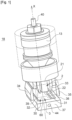
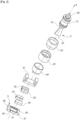
- the device 1 has a counter-form 3 for receiving a lock of hair subjected to the acoustic waves emitted by the hollowed-out and flared probe 2.
- the probe 2 has a longitudinal axis X extending between its proximal outer surface 21 and its distal outer surface 22.
- the probe 2 and the counter-form 3 are able to move with respect to one another between a spaced-apart configuration (not shown) for the introduction therebetween of a lock of hair, and a moved-together configuration for treatment, illustrated in Figure 1 .
- the probe 2 and the counter-form 3 may be carried by an upper arm and a lower arm, respectively, which are for example independent of one another or connected together at one end by a joint, the handpiece 18 thus forming tongs.
- the invention is not limited to a particular way of connecting the probe 2 and the counter-form 3. However, the presence of a joint may be preferred for the ergonomics it provides.
- the probe 2 and the counter-form 3 define between them an area for treatment of the head of hair, which is intended to receive a lock of hair to be treated, which is moved during the treatment, for example in the direction going from the root to the end of the hairs so as to ensure that the lock is completely cleansed.
- the probe 2 comprises a partially hollow elongate body comprising a flared and flattened head intended to come into contact with or in proximity to a lock of hair that is spread out in a sheet on the bearing surface 31 formed by the bottom of the receptacle 30, such that an area of the lock to be treated is situated facing the distal outer surface 22 of the probe 2.
- the probe 2 forms a removable component associated with the counter-form 3, of cooperating shape, by providing, between the bearing surface 31 and the distal outer surface 22, a space constituting a recess 60 for the lock.
- the probe 2 is moved by the user along the longitudinal axis X of the handpiece 18, so as to be moved away from or closer to the counter-form 3, so as to place the distal outer surface 22 and the bearing surface 31 facing one another and simultaneously allowing the pinching of the lock.
- a groove 39 can be arranged on the edges of the upper surface 36 of the counter-form 3, for example in order to promote the evacuation of the spent cleansing composition.
- two first combs 32, 33 are disposed facing each other on either side of the probe and two second combs 34, 35 are arranged facing each other on either side of the longitudinal edges of the counter-form.
- the two first combs 32, 33 are symmetrical to each other with respect to a median plane of the probe 2 and the two second combs 34, 35 are symmetrical with one another with respect to a median plane of the counter-form 3.
- Figure 3 shows a device in accordance with Figures 1 and 2 that is supplied with cleansing composition via a supply duct 45 connected to a mixer 41 that may be connected to a water reservoir 42 and to a reservoir of a concentrated cleansing solution 43, which advantageously comprises at least one surfactant, which is preferably anionic.
- the hair composition passes through the probe via the axial guiding channel before being dispensed onto the hair, for example by a sprayer or nebulizer, after having passed through the outlet orifice of the guiding channel.
- the counter-form 3 has a spent hair composition evacuation duct 44, which passes for example through a lateral wall 37 of the recess 60 receiving the lock of hair and opens into a cup 48 that collects the spent composition.
- the supply and evacuation ducts can be equipped with a motor system 40 that makes drainage easier.
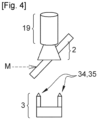
- Figure 4 schematically shows a lock of hair M ready to be inserted between the probe 2 and the combs 34, 35 of the counter-form 3 when the probe 2 is moved closer to the counter-form 3.
- the probe 2 and the counter-form 3 are moved away from each other, so that a lock of hair can be placed between them.
- the probe 2 and the counter-form 3 are then moved closer to one another, so as to pinch the lock between the distal outer surface 22 of the probe 2 and the bearing surface 31 of the counter-form 3.
- the handpiece 18 has a base station 19 that preferably has a cylindrical shape. It houses a source of electrical energy, for example one or more accumulators or cells, and a printed circuit board carrying the electronic components of the device. These components ensure, for example, the generation of the pressure necessary for the possible spraying of the cleansing composition, the control of the various electrical elements and can perform ancillary functions such as for example the calculation of the quantity of product that remains to be sprayed, in order to notify the user of the need to replace a cartridge containing the cleansing composition.
- a source of electrical energy for example one or more accumulators or cells
- a printed circuit board carrying the electronic components of the device.
- the user switches on the electrical power supply so as to expose the lock of hair to ultrasonic vibrations for a selected duration, in particular at least 1 second.
- the spraying of the cleansing composition may start at the same time that the transducer 13 is switched on and also stop at the same time, or the start of the spraying and the switching on of the transducer may be offset in time.
- the cleansing composition preferably comprises one or more surfactants.
- the preferred surfactants are nonionic, anionic, or amphoteric surfactants. Even more preferentially, the cleansing composition contains at least one anionic surfactant.
- the anionic surfactant may in particular be an alkyl sulfate salt or an alkyl ether sulfate salt.
- the concentration of surfactants in the cleansing composition varies from 0.05% to 20% by weight, better still from 0.1% to 10% by weight, even better still from 0.2% to 5% by weight, with respect to the total weight of the composition.
- the cleansing composition may also comprise one or more hair conditioning agents chosen in particular from non-silicone cationic or amphoteric polymers, nonionic or cationic silicone oils or gums, mineral oils, oils of plant origin, waxes or butters of plant origin.
- hair conditioning agents chosen in particular from non-silicone cationic or amphoteric polymers, nonionic or cationic silicone oils or gums, mineral oils, oils of plant origin, waxes or butters of plant origin.
- It can also comprise other compounds chosen from thickening agents, pearlescent or mattifying agents, basifying or acidifying agents, anti-UV agents, preserving agents, antibacterial agents, agents for preventing hair loss, grease-control agents, perfuming agents.
- the invention is not limited to the examples specifically described. It encompasses in particular other structures of the handpiece 18 and other modes of relative arrangement of the transducer 13 and of the probe 2, falling under the scope of the invention as disclosed in the appended claims.
Landscapes
- Health & Medical Sciences (AREA)
- Dermatology (AREA)
- General Health & Medical Sciences (AREA)
- Brushes (AREA)
- Cosmetics (AREA)
- Cleaning And Drying Hair (AREA)
Claims (14)
- Kosmetische Vorrichtung zur Haarreinigung, umfassend:- einen Ultraschallsender mit einem Ultraschallwandler (13), der von einem Stromgenerator angetrieben wird und ausgelegt ist, um Ultraschallschwingungen zu generieren,- ein Handstück (18), umfassend eine Sonde (2), die an den Ultraschallsender gekoppelt ist, um die von dem Wandler (13) generierten Ultraschallschwingungen auf eine zu behandelnde Haarsträhne zu übertragen, wobei sich die Sonde (2) entlang einer Längsachse (X) zwischen einer proximalen Außenoberfläche (21) und einer distalen Außenoberfläche (22) erstreckt,wobei das Handstück (18) auch eine Gegenform (3) umfasst, die mit einer Auflageoberfläche (31) ausgestattet ist, um die zu behandelnde Haarsträhne zumindest teilweise aufzunehmen, wobei die Sonde (2) mit der Gegenform (3) zusammenwirkt, um die Haarsträhne zwischen die Auflageoberfläche (31) der Gegenform (3) und die distale Außenoberfläche (22) der Sonde (2) zu klemmen, dadurch gekennzeichnet, dassdie Gegenform (3) einen Behälter (30) begrenzt, dessen Boden die Auflageoberfläche (31) definiert.
- Vorrichtung nach dem vorhergehenden Anspruch, dadurch gekennzeichnet, dass die Sonde (2) einen axialen Führungskanal aufweist, der durch sie verläuft.
- Vorrichtung nach einem der vorhergehenden Ansprüche, dadurch gekennzeichnet, dass die Sonde (2) eine Form aufweist, die in Richtung ihres distalen Endes aufgeweitet ist.
- Vorrichtung nach einem der vorhergehenden Ansprüche, dadurch gekennzeichnet, dass die Auflageoberfläche (31) der Gegenform (3) und die distale Außenoberfläche (22) der Sonde (2) parallel sind.
- Vorrichtung nach einem der vorhergehenden Ansprüche, dadurch gekennzeichnet, dass das Handstück (18) einen ersten Kamm oder eine erste Bürste (32) aufweist, der/die neben der Sonde (2) angeordnet und zur Gegenform (3) orientiert ist.
- Vorrichtung nach einem der vorhergehenden Ansprüche, dadurch gekennzeichnet, dass die Gegenform (3) einen zweiten Kamm oder eine zweite Bürste (34) aufweist, der/die auf der Außenseite der Auflageoberfläche (31) angeordnet und zur Sonde (2) orientiert ist.
- Vorrichtung nach einem der vorhergehenden Ansprüche, dadurch gekennzeichnet, dass die Gegenform (3) mit einer in ihrer Innenkontur ausgebildeten Rille (39) ausgestattet ist und diese in der Verwendungsposition der Vorrichtung zwischen dem ersten Kamm oder der ersten Bürste (32) und dem zweiten Kamm oder der zweiten Bürste (34) angeordnet ist.
- Vorrichtung nach einem der vorhergehenden Ansprüche, dadurch gekennzeichnet, dass die vom Wandler (13) verwendete Ultraschallfrequenz von 16 kHz bis 10 MHz und vorzugsweise von 16 kHz bis 60 kHz reicht.
- Vorrichtung nach einem der vorhergehenden Ansprüche, dadurch gekennzeichnet, dass sie einen Zuführkanal (45) aufweist, der mit einem Mischer (41) verbunden ist, der mit einem Reservoir für eine konzentrierte Reinigungslösung (43) verbunden ist.
- Vorrichtung nach dem vorhergehenden Anspruch, dadurch gekennzeichnet, dass die konzentrierte Reinigungslösung (43) mindestens ein Tensid umfasst, das vorzugsweise anionisch ist.
- Vorrichtung nach einem der vorhergehenden Ansprüche, dadurch gekennzeichnet, dass sie einen mit der Gegenform (3) verbundenen Evakuierungskanal (44) für verbrauchte Reinigungszusammensetzung umfasst.
- Vorrichtung nach einem der vorhergehenden Ansprüche, dadurch gekennzeichnet, dass sie eine Einheit zum Behandeln und Recyceln einer verbrauchten Reinigungszusammensetzung umfasst.
- Kosmetisches Verfahren zur Haarreinigung, das folgende Vorgänge umfasst, bestehend aus:(i) Bereitstellen einer Vorrichtung nach einem der vorhergehenden Ansprüche,(ii) Klemmen mindestens eines Bereichs einer Haarsträhne zwischen die Auflageoberfläche (31) der Gegenform (3) und die distale Außenoberfläche (22) der Sonde (2),(iii) Generieren von Ultraschall,(iv) gegebenenfalls nach relativen Bewegungen der Strähne in Bezug zu der Sonde (2) aufeinander folgendes Behandeln von einem oder mehreren anderen Bereichen, um den gewünschten Teil der Strähne zu reinigen.
- Verfahren nach dem vorhergehenden Anspruch, umfassend einen Vorgang (v), der darin besteht, während des Vorgangs (iii) eine abgemessene Menge an Reinigungszusammensetzung, vorzugsweise umfassend mindestens ein Tensid, das insbesondere anionisch ist, auf das Haar aufzutragen.
Applications Claiming Priority (2)
| Application Number | Priority Date | Filing Date | Title |
|---|---|---|---|
| FR2101553A FR3119739B1 (fr) | 2021-02-18 | 2021-02-18 | Dispositif avec contre-forme pour le nettoyage des cheveux par ultrasons |
| PCT/EP2022/051302 WO2022175018A1 (en) | 2021-02-18 | 2022-01-21 | Device with counter-form for cleansing the hair by ultrasound |
Publications (3)
| Publication Number | Publication Date |
|---|---|
| EP4294233A1 EP4294233A1 (de) | 2023-12-27 |
| EP4294233B1 true EP4294233B1 (de) | 2025-03-05 |
| EP4294233C0 EP4294233C0 (de) | 2025-03-05 |
Family
ID=75690444
Family Applications (1)
| Application Number | Title | Priority Date | Filing Date |
|---|---|---|---|
| EP22701257.2A Active EP4294233B1 (de) | 2021-02-18 | 2022-01-21 | Vorrichtung mit einer gegenform zur reinigung des haares mittels ultraschall |
Country Status (8)
| Country | Link |
|---|---|
| US (1) | US20240225231A9 (de) |
| EP (1) | EP4294233B1 (de) |
| JP (1) | JP7606004B2 (de) |
| KR (1) | KR102891903B1 (de) |
| CN (1) | CN116940262A (de) |
| ES (1) | ES3031659T3 (de) |
| FR (1) | FR3119739B1 (de) |
| WO (1) | WO2022175018A1 (de) |
Families Citing this family (3)
| Publication number | Priority date | Publication date | Assignee | Title |
|---|---|---|---|---|
| FR3148358B1 (fr) * | 2023-05-04 | 2025-05-02 | Oreal | Dispositif de traitement des matières kératiniques humaines incluant un nettoyage en boucle fermée |
| FR3148371A1 (fr) * | 2023-05-04 | 2024-11-08 | L'oreal | Dispositif de traitement des matières kératiniques humaines incluant une désinfection par UV |
| CN121419792A (zh) * | 2023-05-04 | 2026-01-27 | 莱雅公司 | 包括闭环清洁的用于处理人类角蛋白材料的设备 |
Family Cites Families (24)
| Publication number | Priority date | Publication date | Assignee | Title |
|---|---|---|---|---|
| JPH081104B2 (ja) | 1992-06-10 | 1996-01-10 | 宮田自動機販売株式会社 | 駐車装置 |
| CN2191621Y (zh) | 1994-01-27 | 1995-03-15 | 李荣生 | 超声波洗浴器 |
| JPH09308518A (ja) | 1996-05-24 | 1997-12-02 | Matsushita Electric Works Ltd | 毛髪処理方法と毛髪処理器 |
| JP2001275737A (ja) * | 2000-04-03 | 2001-10-09 | Takaomi Kitamura | 洗浄装置 |
| JP4529313B2 (ja) * | 2001-03-27 | 2010-08-25 | パナソニック電工株式会社 | 超音波発生装置 |
| JP3989237B2 (ja) * | 2001-11-30 | 2007-10-10 | 株式会社エロイカコーポレーション | 超音波洗浄装置 |
| CN2720876Y (zh) | 2004-04-27 | 2005-08-31 | 唐海斌 | 一种超声波洗头器 |
| JP2006334110A (ja) * | 2005-06-01 | 2006-12-14 | Matsushita Electric Works Ltd | 超音波毛髪処理装置 |
| JP4839800B2 (ja) * | 2005-11-25 | 2011-12-21 | パナソニック電工株式会社 | 超音波ヘアセット器 |
| US20080283079A1 (en) * | 2007-05-14 | 2008-11-20 | Ying Chung Huang | Hair dyeing and treatment tongs that emit supersonic energy |
| EP2095737B1 (de) * | 2008-02-29 | 2012-04-18 | The Procter & Gamble Company | Vorrichtung zur Haarbehandlung durch Ultraschall |
| FR2947157A1 (fr) | 2009-06-29 | 2010-12-31 | Seb Sa | Procede de traitement des cheveux a l'aide d'ultrasons |
| EP2677893B1 (de) * | 2011-02-25 | 2020-12-09 | Parasonic Ltd. | System und verfahren zur schädigung von parasiten |
| JP2015019670A (ja) | 2013-07-16 | 2015-02-02 | 酒井医療株式会社 | 洗髪装置及び洗髪方法 |
| FR3031021B1 (fr) * | 2014-12-30 | 2018-03-23 | Oreal | Dispositif de traitement de la chevelure pour controler l'application d'un produit |
| CN204448700U (zh) | 2015-02-13 | 2015-07-08 | 青岛利泰新能源科技有限公司 | 一种美容美发用模型头发清洗池 |
| CN204909967U (zh) | 2015-09-05 | 2015-12-30 | 于慧 | 护理架 |
| CN105124902B (zh) | 2015-09-25 | 2018-03-06 | 覃杰 | 一种多功能护发梳 |
| WO2017118984A1 (en) | 2016-01-06 | 2017-07-13 | Parasonic Ltd. | Device and method for damaging parasites using ultrasonic reflection |
| JP2018089612A (ja) * | 2016-11-25 | 2018-06-14 | ガードナー株式会社 | 洗浄ヘッド、本体装置及び洗浄システム |
| EP3338590A1 (de) * | 2016-12-23 | 2018-06-27 | BaByliss Faco sprl | Haarpflegevorrichtung |
| US20180207690A1 (en) | 2017-01-20 | 2018-07-26 | Cynthia Tochi Ugorji | Apparatus and Method of Ultrasonic Cleaning |
| CN107716391A (zh) | 2017-09-22 | 2018-02-23 | 河南师范大学 | 一种用于人发假发洗涤的处理装置 |
| CN109198839A (zh) * | 2018-09-25 | 2019-01-15 | 覃小鹏 | 一种声波震动多功能洗发仪 |
-
2021
- 2021-02-18 FR FR2101553A patent/FR3119739B1/fr active Active
-
2022
- 2022-01-21 CN CN202280015405.5A patent/CN116940262A/zh active Pending
- 2022-01-21 ES ES22701257T patent/ES3031659T3/es active Active
- 2022-01-21 EP EP22701257.2A patent/EP4294233B1/de active Active
- 2022-01-21 US US18/546,380 patent/US20240225231A9/en active Pending
- 2022-01-21 JP JP2023549090A patent/JP7606004B2/ja active Active
- 2022-01-21 KR KR1020237031853A patent/KR102891903B1/ko active Active
- 2022-01-21 WO PCT/EP2022/051302 patent/WO2022175018A1/en not_active Ceased
Also Published As
| Publication number | Publication date |
|---|---|
| WO2022175018A1 (en) | 2022-08-25 |
| KR20230146626A (ko) | 2023-10-19 |
| FR3119739A1 (fr) | 2022-08-19 |
| US20240225231A9 (en) | 2024-07-11 |
| JP7606004B2 (ja) | 2024-12-24 |
| US20240130504A1 (en) | 2024-04-25 |
| ES3031659T3 (en) | 2025-07-10 |
| EP4294233A1 (de) | 2023-12-27 |
| KR102891903B1 (ko) | 2025-11-27 |
| CN116940262A (zh) | 2023-10-24 |
| EP4294233C0 (de) | 2025-03-05 |
| FR3119739B1 (fr) | 2025-05-09 |
| JP2024507357A (ja) | 2024-02-19 |
Similar Documents
| Publication | Publication Date | Title |
|---|---|---|
| EP4294233B1 (de) | Vorrichtung mit einer gegenform zur reinigung des haares mittels ultraschall | |
| US20060191562A1 (en) | Ultrasonic washing device | |
| EP4294234B1 (de) | Reinigungsvorrichtung mit einem zerstäuber und einer saugeinheit | |
| US20250302711A1 (en) | Method for cleansing human keratin materials | |
| JP7440652B2 (ja) | 乾いた状態に近づく毛髪洗浄用シャンプーアプリケータ及びリムーバ | |
| JP2006006570A (ja) | 超音波オーラルケア用品 | |
| US20210267345A1 (en) | Shampoo applicator and remover for cleansing hair to near dry conditions | |
| KR100804741B1 (ko) | 초음파를 이용한 얼굴 세척기 | |
| US20250302172A1 (en) | Device for treating human keratin materials | |
| US20250295212A1 (en) | Device for treating the hair, and method | |
| JP2012085785A (ja) | 美容装置 | |
| US20210267344A1 (en) | Device for electrostatically charging the scalp or hair to attract formulations | |
| WO2022258365A1 (en) | Magnetic brush with dispensing of composition for cleansing the hair |
Legal Events
| Date | Code | Title | Description |
|---|---|---|---|
| STAA | Information on the status of an ep patent application or granted ep patent |
Free format text: STATUS: UNKNOWN |
|
| STAA | Information on the status of an ep patent application or granted ep patent |
Free format text: STATUS: THE INTERNATIONAL PUBLICATION HAS BEEN MADE |
|
| PUAI | Public reference made under article 153(3) epc to a published international application that has entered the european phase |
Free format text: ORIGINAL CODE: 0009012 |
|
| STAA | Information on the status of an ep patent application or granted ep patent |
Free format text: STATUS: REQUEST FOR EXAMINATION WAS MADE |
|
| 17P | Request for examination filed |
Effective date: 20230918 |
|
| AK | Designated contracting states |
Kind code of ref document: A1 Designated state(s): AL AT BE BG CH CY CZ DE DK EE ES FI FR GB GR HR HU IE IS IT LI LT LU LV MC MK MT NL NO PL PT RO RS SE SI SK SM TR |
|
| DAV | Request for validation of the european patent (deleted) | ||
| DAX | Request for extension of the european patent (deleted) | ||
| GRAP | Despatch of communication of intention to grant a patent |
Free format text: ORIGINAL CODE: EPIDOSNIGR1 |
|
| STAA | Information on the status of an ep patent application or granted ep patent |
Free format text: STATUS: GRANT OF PATENT IS INTENDED |
|
| INTG | Intention to grant announced |
Effective date: 20241021 |
|
| GRAS | Grant fee paid |
Free format text: ORIGINAL CODE: EPIDOSNIGR3 |
|
| GRAA | (expected) grant |
Free format text: ORIGINAL CODE: 0009210 |
|
| STAA | Information on the status of an ep patent application or granted ep patent |
Free format text: STATUS: THE PATENT HAS BEEN GRANTED |
|
| AK | Designated contracting states |
Kind code of ref document: B1 Designated state(s): AL AT BE BG CH CY CZ DE DK EE ES FI FR GB GR HR HU IE IS IT LI LT LU LV MC MK MT NL NO PL PT RO RS SE SI SK SM TR |
|
| REG | Reference to a national code |
Ref country code: GB Ref legal event code: FG4D |
|
| REG | Reference to a national code |
Ref country code: CH Ref legal event code: EP |
|
| REG | Reference to a national code |
Ref country code: IE Ref legal event code: FG4D |
|
| REG | Reference to a national code |
Ref country code: DE Ref legal event code: R096 Ref document number: 602022011412 Country of ref document: DE |
|
| U01 | Request for unitary effect filed |
Effective date: 20250306 |
|
| U07 | Unitary effect registered |
Designated state(s): AT BE BG DE DK EE FI FR IT LT LU LV MT NL PT RO SE SI Effective date: 20250313 |
|
| PG25 | Lapsed in a contracting state [announced via postgrant information from national office to epo] |
Ref country code: RS Free format text: LAPSE BECAUSE OF FAILURE TO SUBMIT A TRANSLATION OF THE DESCRIPTION OR TO PAY THE FEE WITHIN THE PRESCRIBED TIME-LIMIT Effective date: 20250605 |
|
| REG | Reference to a national code |
Ref country code: ES Ref legal event code: FG2A Ref document number: 3031659 Country of ref document: ES Kind code of ref document: T3 Effective date: 20250710 |
|
| PG25 | Lapsed in a contracting state [announced via postgrant information from national office to epo] |
Ref country code: NO Free format text: LAPSE BECAUSE OF FAILURE TO SUBMIT A TRANSLATION OF THE DESCRIPTION OR TO PAY THE FEE WITHIN THE PRESCRIBED TIME-LIMIT Effective date: 20250605 |
|
| PG25 | Lapsed in a contracting state [announced via postgrant information from national office to epo] |
Ref country code: HR Free format text: LAPSE BECAUSE OF FAILURE TO SUBMIT A TRANSLATION OF THE DESCRIPTION OR TO PAY THE FEE WITHIN THE PRESCRIBED TIME-LIMIT Effective date: 20250305 |
|
| PG25 | Lapsed in a contracting state [announced via postgrant information from national office to epo] |
Ref country code: GR Free format text: LAPSE BECAUSE OF FAILURE TO SUBMIT A TRANSLATION OF THE DESCRIPTION OR TO PAY THE FEE WITHIN THE PRESCRIBED TIME-LIMIT Effective date: 20250606 |
|
| PG25 | Lapsed in a contracting state [announced via postgrant information from national office to epo] |
Ref country code: SM Free format text: LAPSE BECAUSE OF FAILURE TO SUBMIT A TRANSLATION OF THE DESCRIPTION OR TO PAY THE FEE WITHIN THE PRESCRIBED TIME-LIMIT Effective date: 20250305 |
|
| PG25 | Lapsed in a contracting state [announced via postgrant information from national office to epo] |
Ref country code: PL Free format text: LAPSE BECAUSE OF FAILURE TO SUBMIT A TRANSLATION OF THE DESCRIPTION OR TO PAY THE FEE WITHIN THE PRESCRIBED TIME-LIMIT Effective date: 20250305 |
|
| PG25 | Lapsed in a contracting state [announced via postgrant information from national office to epo] |
Ref country code: CZ Free format text: LAPSE BECAUSE OF FAILURE TO SUBMIT A TRANSLATION OF THE DESCRIPTION OR TO PAY THE FEE WITHIN THE PRESCRIBED TIME-LIMIT Effective date: 20250305 |
|
| PG25 | Lapsed in a contracting state [announced via postgrant information from national office to epo] |
Ref country code: SK Free format text: LAPSE BECAUSE OF FAILURE TO SUBMIT A TRANSLATION OF THE DESCRIPTION OR TO PAY THE FEE WITHIN THE PRESCRIBED TIME-LIMIT Effective date: 20250305 |
|
| PG25 | Lapsed in a contracting state [announced via postgrant information from national office to epo] |
Ref country code: IS Free format text: LAPSE BECAUSE OF FAILURE TO SUBMIT A TRANSLATION OF THE DESCRIPTION OR TO PAY THE FEE WITHIN THE PRESCRIBED TIME-LIMIT Effective date: 20250705 |
|
| PGFP | Annual fee paid to national office [announced via postgrant information from national office to epo] |
Ref country code: GB Payment date: 20251204 Year of fee payment: 5 |
|
| PLBE | No opposition filed within time limit |
Free format text: ORIGINAL CODE: 0009261 |
|
| STAA | Information on the status of an ep patent application or granted ep patent |
Free format text: STATUS: NO OPPOSITION FILED WITHIN TIME LIMIT |
|
| REG | Reference to a national code |
Ref country code: CH Ref legal event code: L10 Free format text: ST27 STATUS EVENT CODE: U-0-0-L10-L00 (AS PROVIDED BY THE NATIONAL OFFICE) Effective date: 20260114 |
|
| U20 | Renewal fee for the european patent with unitary effect paid |
Year of fee payment: 5 Effective date: 20251205 |
|
| 26N | No opposition filed |
Effective date: 20251208 |