EP4286830A1 - Verfahren zur bewertung der adhäsion eines separators - Google Patents
Verfahren zur bewertung der adhäsion eines separators Download PDFInfo
- Publication number
- EP4286830A1 EP4286830A1 EP22895900.3A EP22895900A EP4286830A1 EP 4286830 A1 EP4286830 A1 EP 4286830A1 EP 22895900 A EP22895900 A EP 22895900A EP 4286830 A1 EP4286830 A1 EP 4286830A1
- Authority
- EP
- European Patent Office
- Prior art keywords
- electrode
- separator
- measuring
- composite
- adhesive
- Prior art date
- Legal status (The legal status is an assumption and is not a legal conclusion. Google has not performed a legal analysis and makes no representation as to the accuracy of the status listed.)
- Granted
Links
Images




Classifications
-
- G—PHYSICS
- G01—MEASURING; TESTING
- G01L—MEASURING FORCE, STRESS, TORQUE, WORK, MECHANICAL POWER, MECHANICAL EFFICIENCY, OR FLUID PRESSURE
- G01L5/00—Apparatus for, or methods of, measuring force, work, mechanical power, or torque, specially adapted for specific purposes
- G01L5/0028—Force sensors associated with force applying means
- G01L5/0042—Force sensors associated with force applying means applying a torque
-
- G—PHYSICS
- G01—MEASURING; TESTING
- G01N—INVESTIGATING OR ANALYSING MATERIALS BY DETERMINING THEIR CHEMICAL OR PHYSICAL PROPERTIES
- G01N19/00—Investigating materials by mechanical methods
- G01N19/04—Measuring adhesive force between materials, e.g. of sealing tape, of coating
-
- G—PHYSICS
- G01—MEASURING; TESTING
- G01L—MEASURING FORCE, STRESS, TORQUE, WORK, MECHANICAL POWER, MECHANICAL EFFICIENCY, OR FLUID PRESSURE
- G01L3/00—Measuring torque, work, mechanical power, or mechanical efficiency, in general
-
- H—ELECTRICITY
- H01—ELECTRIC ELEMENTS
- H01M—PROCESSES OR MEANS, e.g. BATTERIES, FOR THE DIRECT CONVERSION OF CHEMICAL ENERGY INTO ELECTRICAL ENERGY
- H01M10/00—Secondary cells; Manufacture thereof
- H01M10/04—Construction or manufacture in general
-
- H—ELECTRICITY
- H01—ELECTRIC ELEMENTS
- H01M—PROCESSES OR MEANS, e.g. BATTERIES, FOR THE DIRECT CONVERSION OF CHEMICAL ENERGY INTO ELECTRICAL ENERGY
- H01M50/00—Constructional details or processes of manufacture of the non-active parts of electrochemical cells other than fuel cells, e.g. hybrid cells
- H01M50/40—Separators; Membranes; Diaphragms; Spacing elements inside cells
- H01M50/46—Separators, membranes or diaphragms characterised by their combination with electrodes
-
- Y—GENERAL TAGGING OF NEW TECHNOLOGICAL DEVELOPMENTS; GENERAL TAGGING OF CROSS-SECTIONAL TECHNOLOGIES SPANNING OVER SEVERAL SECTIONS OF THE IPC; TECHNICAL SUBJECTS COVERED BY FORMER USPC CROSS-REFERENCE ART COLLECTIONS [XRACs] AND DIGESTS
- Y02—TECHNOLOGIES OR APPLICATIONS FOR MITIGATION OR ADAPTATION AGAINST CLIMATE CHANGE
- Y02E—REDUCTION OF GREENHOUSE GAS [GHG] EMISSIONS, RELATED TO ENERGY GENERATION, TRANSMISSION OR DISTRIBUTION
- Y02E60/00—Enabling technologies; Technologies with a potential or indirect contribution to GHG emissions mitigation
- Y02E60/10—Energy storage using batteries
-
- Y—GENERAL TAGGING OF NEW TECHNOLOGICAL DEVELOPMENTS; GENERAL TAGGING OF CROSS-SECTIONAL TECHNOLOGIES SPANNING OVER SEVERAL SECTIONS OF THE IPC; TECHNICAL SUBJECTS COVERED BY FORMER USPC CROSS-REFERENCE ART COLLECTIONS [XRACs] AND DIGESTS
- Y02—TECHNOLOGIES OR APPLICATIONS FOR MITIGATION OR ADAPTATION AGAINST CLIMATE CHANGE
- Y02P—CLIMATE CHANGE MITIGATION TECHNOLOGIES IN THE PRODUCTION OR PROCESSING OF GOODS
- Y02P70/00—Climate change mitigation technologies in the production process for final industrial or consumer products
- Y02P70/50—Manufacturing or production processes characterised by the final manufactured product
Definitions
- the present application relates to a method for evaluating an adhesive strength of a separator.
- the secondary batteries may be divided into a nickel-cadmium battery, a nickel-metal hydride battery, a nickel-hydrogen battery, and a lithium secondary battery.
- the lithium secondary battery has a higher operating voltage than the nickel-cadmium battery or nickel-metal hydride battery, and have an excellent characteristics of energy density per unit weight, such that they are mainly used in portable electronic devices or high-output hybrid vehicles.
- the lithium secondary battery may include an electrode assembly having a positive electrode, a negative electrode, and a separator, electrode tabs extending from the electrode assembly, and electrode leads welded to the electrode tabs.
- the electrode assembly is a power generating element in which positive and negative electrodes are stacked with the separator interposed therebetween.
- the electrode assembly is manufactured using a method in which the negative electrode, separator, and positive electrode are respectively manufactured in a separate process, and then laminated and adhered by applying heat and pressure at the same time.
- the separator containing a less binder that is, the thin separator with a low binder content, is often applied. For this reason, when the battery is manufactured in the above-mentioned method, there is a problem in that a sufficient adhesive strength is not secured between the electrode and the separator.
- the peel test is performed as illustrated in FIG. 2 .
- a separator 1 with a width of 25 mm and a length of 60 mm and an electrode 2 are stacked, placed between a polyethylene terephthalate (PET) film 3, and pressed with a heated press.
- PET polyethylene terephthalate
- FIG. 2A An electrode-separator composite in which an adhesive strength is generated between the separator and the electrode is manufactured
- a slide glass 6 is attached using a double-sided adhesive tape 5 to an electrode surface of the electrode-separator composite manufactured as described above, and the PET film is attached using a single-sided adhesive tape 4 to a partial region of a separator surface of the electrode-separator composite, resulting in manufacturing the specimen (FIG. 2B).
- the specimen manufactured as described above is mounted on a universal material testing machine and a force required to separate the separator and the electrode is measured (FIG. 2C).
- the present application has been made in an effort to provide a method capable of efficiently performing an evaluation of an adhesive strength of a separator over a large region.
- An exemplary embodiment of the present disclosure provides a method for evaluating an adhesive strength of a separator, the method including: manufacturing an electrode-separator composite in which an electrode is stacked on at least one surface of a separator, and surfaces of the separator and the electrode facing each other include adhesive surfaces and non-adhesive surfaces of the separator and the electrode, and the adhesive surfaces and the non-adhesive surfaces are alternately disposed; moving the electrode-separator composite; cutting the electrode-separator composite in a direction parallel to the moving direction; attaching measuring rolls respectively to both surfaces of the cut electrode-separator composite; separating the electrode-separator composite by rotating each of the attached measuring rolls and spacing the measuring rolls apart from each other; and measuring a torque generated by the measuring rolls while separating the electrode-separator composite.
- a method for evaluating an adhesive strength of a separator according to an exemplary embodiment of the present application may reduce the time required for the evaluation.
- a method for evaluating an adhesive strength of a separator according to an exemplary embodiment of the present application may continuously evaluate the adhesive strength of the separator, thereby reducing the possibility of occurring failure in the process.
- a method for evaluating an adhesive strength of a separator according to an exemplary embodiment of the present application may often and easily perform the evaluation, thereby efficiently controlling the process.
- the term 'adhesion' means a method of respectively manufacturing a negative electrode, a separator, and a positive electrode in a separate process, and then stacking the separator and the negative electrode and/or positive electrode, and simultaneously applying heat and pressure.
- the term 'adhesion' is also called a 'lamination'.
- the term 'adhesive surface' means a portion in which the adhesion is made, and the term 'non-adhesive surface' means a portion in which the adhesion is not made.
- a method for evaluating an adhesive strength of a separator may include: manufacturing an electrode-separator composite in which an electrode is stacked on at least one surface of a separator, and surfaces of the separator and the electrode facing each other include an adhesive surface and a non-adhesive surface of the separator and the electrode, and the adhesive surface and the non-adhesive surface are alternately disposed; moving the electrode-separator composite; cutting the electrode-separator composite in a direction parallel to the moving direction; attaching measuring rolls respectively to both surfaces of the cut electrode-separator composite; separating the electrode-separator composite by rotating each of the attached measuring rolls and spacing the measuring rolls apart from each other; and measuring a torque generated by the measuring rolls while separating the electrode-separator composite.
- the manufacturing of the electrode-separator composite in which the electrode is stacked on at least one surface of the separator, and the surfaces of the separator and the electrode facing each other include the adhesive surface and the non-adhesive surface of the separator and the electrode, and the adhesive surface and the non-adhesive surface are alternately disposed may include: manufacturing a laminate by stacking the electrode on at least one surface of the separator; and heating and pressurizing only a partial region of the laminate, in which the partial region may correspond to the adhesive surface of the electrode-separator composite.
- the heating and pressurizing of only the partial region of the laminate corresponding to the adhesive surface of the electrode-separator composite may heat and pressurize the partial region so that the adhesive surface is formed at a predetermined interval.
- the 'predetermined interval' means that a distance from one specific position to another specific position is not only the same, but also different from each other.
- the 'distance' means the shortest length from one specific position to another specific position.
- the distance between the adhesive surfaces may be the same.
- the distance between the adhesive surfaces may be different.
- the manufacturing of the laminate by stacking the electrode on at least one surface of the separator and the heating and pressurizing of only the partial region of the laminate may be performed simultaneously using a lamination roll including a spaced pattern.
- the adhesive surface may be formed in a stripe shape in a direction parallel to a rotating axis of the measuring roll.
- the 'lamination roll' is a device for manufacturing the electrode-separator composite by adhering the separator to at least one surface of the electrode, and while the separator and the electrode are passing through the lamination roll, laminating, heating, and pressurizing of the separator and the electrode may be simultaneously performed to manufacture the electrode-separator composite.
- the lamination roll may have a pattern with a predetermined interval, and while the separator and electrode pass through the two lamination rolls, laminating, heating, and pressurizing of the separator and electrode may be performed simultaneously, such that the separator and electrode may be adhered.
- laminating, heating, and pressurizing of the separator and electrode may be performed simultaneously, such that the separator and electrode may be adhered.
- only a portion corresponding to a region having the pattern may be heated and pressurized to manufacture the electrode-separator composite in which the adhesive and non-adhesive surfaces of the separator and electrode are alternately disposed.
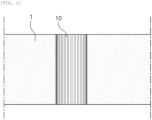
- FIG. 3 is a top plane view illustrating a lamination process for the method for evaluating the adhesive strength of the separator according to the present disclosure. While the separator 1 and the electrode 2 are supplied between lamination rolls 10 and 11, the electrode is stacked on at least one surface of the separator, heated and pressurized to form the electrode-separator composite in which the adhesive and non-adhesive surfaces of the separator and electrode are alternately disposed.
- the adhesive and non-adhesive surfaces may be formed alternately in accordance with a shape of the pattern formed in the lamination rolls (the adhesive and non-adhesive surfaces and some configurations are not illustrated).
- the adhesive and non-adhesive surfaces are alternatively disposed in the electrode-separator composite, in which the adhesive surfaces of the separator and electrode are adhered in a stripe shape in a direction parallel to the rotating axis of the measuring roll, which is defined herein as 'pattern lamination' in the present specification.
- the adhesive surfaces of the separator and electrode are adhered so as to form a stripe shape in a direction parallel to the rotating axis of the measuring roll, which may be defined herein as the pattern lamination.
- the electrode-separator composite When the electrode-separator composite is manufactured by the pattern lamination, the electrode-separator composite having a plurality of adhesive surfaces at a predetermined interval may be manufactured. Therefore, a torque measured when a portion (non-adhesive surfaces) where the adhesive strength is not made is opened may be used as the basis for zero-point adjustment, such that there is an advantage that the measuring of the adhesive strength of the separator may be often performed.
- the heating and pressurizing of only the partial region of the laminate may heat and pressurize the partial region of the laminate at a temperature of 60 °C to 120 °C and a pressure of 10 kgf/cm 2 to 100 kgf/cm 2 .
- the heating and pressurizing of only the partial region of the laminate may heat and pressurize the partial region of the laminate at a temperature of 70 °C to 110 °C and a pressure of 20 kgf /cm 2 to 80 kgf /cm 2 .
- the heating may be performed at a temperature of 60 °C to 120 °C, preferably 70 °C. to 110 °C.
- the pressurizing may be performed at a pressure of 10 kgf/cm 2 to 100 kgf/cm 2 , preferably at a pressure of 20 kgf/cm 2 to 80 kgf/cm 2 .
- the separator may be prevented from being deformed due to heat or pressure, thereby enabling a stable adhesion.
- the 'measuring roll' means a device for applying a force respectively to the electrode and separator which are separated from the electrode-separator composite for evaluating the adhesive strength of the separator.
- the attaching of the measuring rolls to each of two surfaces of the cut electrode-separator composite may include: fixing a partial region of both surfaces of the electrode-separator composite with the measuring rolls; and rotating each measuring roll.
- the rotating of the measuring rolls in the attaching of the measuring rolls is to further ensure to fix the measuring rolls with the electrode-separator composite before separating the electrode-separator composite.
- the separating of the electrode-separator composite by rotating each of the attached measuring rolls and spacing the measuring rolls apart from each other may mean applying a force to the electrode-separator composite by each measuring roll.
- the applying of the force to the electrode-separator composite by each measuring roll may include: spacing the measuring rolls attached to both surfaces of the electrode-separator composite apart in a vertical direction with respect to the moving direction of the electrode-separator composite while rotating the measuring rolls attached to both surfaces of the electrode-separator composite.
- the partial region of both surfaces of the electrode-separator composite are fixed (a: fixed portion) with the measuring rolls. After rotating the measuring rolls, the measuring rolls is spaced apart in the vertical direction with respect to the moving direction by applying the force to the electrode-separator composite, thereby separating the electrode-separator composite.
- the electrode-separator composite may be separated by rotating two measuring rolls and spacing the two measuring rolls apart from each other.
- the adhesive strength of the separator may be evaluated from a result of measuring the torque generated by the measuring rolls when the electrode-separator composite is separated. Therefore, it is possible that the adhesive strength of a plurality of separators is evaluated and the time in the process is reduced. In addition, it is possible to often and easily perform the evaluation, thereby efficiently controlling the process.
- the electrode may be a positive or negative electrode, preferably a negative electrode.
- the separator may be a safety reinforced separator (SRS) including a non-aqueous binder on a surface thereof.
- SRS safety reinforced separator
- the electrode is a negative electrode
- the separator may be the safety reinforced separator
- the safety reinforced separator may be the separator to which a method of coating ceramic particles and a polymer binder on the separator surface is applied, and may be the separator with reinforced durability and heat resistant.
- the polymer binder may be the non-aqueous binder.
- the positive electrode may be manufactured using a positive electrode active material including metal oxide primary particle, in this case, a concave-convex structure may be formed on the positive electrode surface by the metal oxide primary particle.
- a concave-convex structure may be formed on the positive electrode surface by the metal oxide primary particle.
- the non-aqueous binder of the safety reinforced separator surface may be physically coupled with the concave-convex structure formed on the positive electrode surface to implement high adhesive strength of the positive electrode-separator.
- the negative electrode is manufactured using a negative electrode active material including carbon, it is relatively difficult to form the concave-convex structure on the negative electrode surface, therefore the adhesive strength of the positive electrode-separator is generally higher than the adhesive strength of the negative electrode-separator.
- the electrode may be in a shape of an electrode sheet.
- the positive electrode may be a positive electrode sheet
- the negative electrode may be a negative electrode sheet.
- the electrode sheet may have a shape of an electrode plate of a specific or predetermined size by the cutting of the electrode-separator composite.
- the positive electrode and the positive electrode sheet may be manufactured by a method for manufacturing the positive electrode sheet using the positive electrode active material which is well known in the art, for example, by a method in which the positive electrode sheet is mixed with a binder or the like to manufacture a positive electrode slurry and the manufactured positive electrode slurry is applied, rolled, and dried on a positive electrode current collector.
- the positive electrode active material is not particularly limited if it is generally used for the positive electrode of the secondary battery in the art, but for example, lithium metal oxide (LiMO 2 ) in a layered structure such as lithium cobaltate (LiCoO 2 ) and a triatomic system, spinel material (LiM 2 O 4 ) represented by lithium manganese oxide (LiM 2 O 4 ), or olivine-based material (LiMPO 4 ) such as lithium iron phosphate (LiFePO 4 ) may be used.
- lithium metal oxide (LiMO 2 ) in a layered structure such as lithium cobaltate (LiCoO 2 ) and a triatomic system, spinel material (LiM 2 O 4 ) represented by lithium manganese oxide (LiM 2 O 4 ), or olivine-based material (LiMPO 4 ) such as lithium iron phosphate (LiFePO 4 ) may be used.
- aluminum may be used as the positive electrode current collector.
- the negative electrode and the negative electrode sheet may be manufactured by a method for manufacturing the negative electrode sheet using the negative electrode active material which is well known in the art, for example, by a method in which the negative electrode sheet is mixed with a binder or the like to manufacture a negative electrode slurry and the manufactured positive electrode slurry is subsequently applied, rolled, and dried on a negative electrode current collector.
- the negative electrode active material is not particularly limited if it is generally used for the negative electrode of the secondary battery in the art, but for example, a carbon (C) based material, Si, Sn, tin oxide, composite tin alloys, transition metal oxide or lithium metal oxide, and the like may be used.
- a carbon (C) based material Si, Sn, tin oxide, composite tin alloys, transition metal oxide or lithium metal oxide, and the like may be used.
- copper or nickel may be used as the negative electrode current collector.
- the binder is for improving the adhering force between the positive or negative active materials
- those well known in the art may be used without limitation, for example, polyvinylidene fluoride (PVDF), polytetrafluoroethylene (PTFE), cellulose, polyvinyl alcohol, carboxymethylcellulose (CMC), starch, hydroxypropyl cellulose, regenerated cellulose, polyvinylpyrrolidone, tetrafluoroethylene, polyethylene, polypropylene, EPDM rubber, sulfonated EPDM or styrene butadiene rubber (SBR) and the like may be used, but not limited thereto.
- PVDF polyvinylidene fluoride
- PTFE polytetrafluoroethylene
- CMC carboxymethylcellulose
- SBR styrene butadiene rubber
- the positive electrode slurry or negative electrode slurry may further include a conductive material or a filler. Materials commonly used in the art may be used as the conductive material and the filler.
- carbon black such as Denka black, acetylene black, Ketjen black, furnace black, thermal black, etc., one or more types selected from a group consisting of natural graphite and artificial graphite may be used as the conductive material, but the conductive material is not limited thereto, and the conductive material which has conductivity without causing chemical changes in the constituted battery may be generally used.
- one or more types selected from a group consisting of polyethylene, polypropylene, glass fiber, and carbon fiber may be used as the filler, but is not limited thereto, and a fibrous material which does not cause chemical changes in the constituted battery may be generally used as the filler.
- a thickness of the positive electrode is 50 um to 300 um, preferably 100 um to 200 ⁇ m, but not limited thereto.
- a thickness of the negative electrode is 50 um to 300 um, preferably 100 um to 200 ⁇ m, but not limited thereto.
- the thickness of the negative electrode is thicker than that of the positive electrode.
- the thickness of the electrode may be measured by scanning a cross-section of the electrode using a Scanning Electron Microscope (SEM).
- the thickness of the electrode means the thickness including both the electrode current collector and the electrode active material layer.
- the separator may be in a shape of a separator sheet.
- the separator sheet may have a separator shape of a specific or predetermined size by the cutting of the electrode-separator composite.
- an olefin-based polymer a sheet, a non-woven fabric, and kraft paper made of glass fiber, polyethylene, or the like may be used as the separator, and the olefin-based polymer may be preferably used.
- one or more types selected from a group consisting of high density polyethylene, low density polyethylene, linear low density polyethylene, ultra-high molecular weight polyethylene, polypropylene, polyethyleneterephthalate, polybutyleneterephthalate, polyester, polyacetal, polyamide, polycarbonate, polyimide, polyetheretherketone, polyethersulfone, polyphenyleneoxide, polyphenylenesulfidro, polyethylenenaphthalene and mixtures thereof may be used as the separator, but not limited thereto.
- a thickness of the separator is 3 um to 50 um, preferably 10 um to 30 ⁇ m, but not limited thereto.
- the thickness of the separator may be measured by scanning a cross-section of the separator using SEM.
- the cutting of the electrode-separator composite may be performed using a knife, a mold, scissors or a laser, but not limited thereto.
- the cutting of the electrode-separator composite may be performed by a cutting roll.
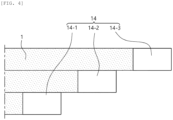
- FIG. 4 is a top plan view illustrating a cutting process of the method for evaluating the adhesive strength of the separator according to the present disclosure. While the separator 1 and the electrode 2 are supplied between the cutting rolls 12 and 13, the electrode is stacked on at least one surface of the separator, heated and pressurized, and subsequently the electrode-separator composite in which the adhesive and non-adhesive surfaces of the separator and electrode are alternately disposed passes through the cutting rolls, the electrode-separator composite may be cut in a direction parallel to the moving direction (the adhesive and non-adhesive surfaces and some configurations are not illustrated).
- a distance between the cut portions in the cutting of the electrode-separator composite in the direction parallel to the moving direction may be equal.
- a distance between portions which is cut in the cutting of the electrode-separator composite in the direction parallel to the moving direction may be different.
- the 'cutting roll' is a device for cutting the electrode-separator composite.
- the moving of the electrode-separator composite may be performed by a conveyor belt, but not limited thereto, all means for moving the electrode-separator composite in a predetermined direction may be used.
- the direction in which the electrode-separator composite is moved may be referred to as a 'manufacturing direction'. That is, the cutting of the electrode-separator composite in the direction parallel to the moving direction means that the cutting of the electrode-separator composite cuts the electrode-separator composite at a predetermined interval parallel to the manufacturing direction (MD).
- MD manufacturing direction
- the cutting of the electrode-separator composite in the direction parallel to the moving direction may be cutting the electrode-separator composite at a predetermined interval.
- 'cutting the electrode-separator composite at a predetermined interval' means that a distance between one cutting surface of one electrode-separator composite which is cut parallel to the manufacturing direction (MD) and the opposite cutting surface thereof has a predetermined size (or length).
- the predetermined size (or length) means that a deviation of size (or length) is ⁇ 1 mm.
- the attaching of the measuring rolls to each of the two surfaces of the cut electrode-separator composite means that the measuring rolls are in contact with each of both surfaces of the electrode-separator composite so that a predetermined force may be applied to both surfaces of the cut electrode-separator composite.
- FIG. 5 is a top plan view of a measurement process of the method for evaluating the adhesive strength of the separator according to the present disclosure.
- the measuring rolls 14 and 15 are attached to the electrode-separator composite which is cut in the direction parallel to the moving direction by the cutting rolls 12 and 13, and the evaluation of the adhesive strength of the separator is performed as described below (adhesive and non-adhesive surfaces and some configurations are not illustrated).
- the measuring of the torque generated by the measuring rolls while separating the electrode-separator composite may use a torque sensor.
- the measuring of the torque generated by the measuring rolls while separating the electrode-separator composite may include: measuring a torque generated by the measuring rolls when the non-adhesive surfaces in the electrode-separator composite are separated by the measuring rolls; determining the torque measured when the non-adhesive surfaces are separated by the measuring rolls as a reference for zero-point adjustment; and measuring a torque generated by the measuring rolls when the adhesive surfaces in the electrode-separator composite are separated by the measuring rolls.
- the torque measured when portions (non-adhesive surfaces) in which the adhesive strength is not made in the electrode-composite are separated (or opened) is set to zero-point, and thereafter, the torque when portions in which the adhesive strength is made (adhesive surfaces) are separated (or opened) may be measured.
- the adhesive strength of the electrode-separator composite may be expressed as a specific value from the measured torque value, thereby evaluating the adhesive strength.
- the method for evaluating the adhesive strength of the separator according to the exemplary embodiment of the present disclosure further includes obtaining the adhesive strength from the measured torque, in which the adhesive strength may be calculated by equation 1 below.
- S F / d ⁇ sin A
- a magnitude of the torque generated by the measuring rolls while separating the electrode-separator composite means a value measuring a torque generated by the measuring rolls using a torque sensor or the like. That is, it means a torque measured by the measuring rolls.
- sin means trigonometric function
- sin A means the sin value of angle A (unit: radian).
- the method for evaluating the adhesive strength of the separator may be to evaluate the adhesive strength of the electrode-separator composite from a difference between the adhesive strength calculated by Equation 1 when the non-adhesive surfaces in the electrode-separator composite are separated by the measuring rolls and the adhesive strength calculated by Equation 1 when the adhesive surfaces in the electrode-separator composite are separated by the measuring rolls.
- the method for evaluating the adhesive strength of the separator according to the exemplary embodiment of the present disclosure may be performed by a roll-to-roll process. Therefore, the evaluation of the adhesive strength may be performed at one time by a continuous process.
- the method for evaluating the adhesive strength of the separator of the present disclosure is performed as described below.
- a lamination process is performed, in which the separator 1 and the electrode 2 are supplied between two lamination rolls 10 and 11 with a predetermined pattern formed and the electrode is stacked on at least one surface of the separator and heated and pressurized to form the electrode-separator composite in which the adhesive and non-adhesive surfaces of the separator and electrode are alternatively disposed.
- the process of stacking, heating and pressurizing may be performed together. That is, the electrode-separator composite is manufactured by the pattern lamination.
- the manufactured electrode-separator composite is supplied between the cutting rolls 12 and 13 and a cutting process is performed to cut the electrode-separator composite at a predetermined interval on the basis of the manufacturing direction (MD).
- MD manufacturing direction
- the measuring rolls 14 and 15 are attached to both surfaces of the electrode-separator composite which is cut at the predetermined interval, and the electrode and separator are fixed to the measuring rolls, respectively, while each measuring roll rotates.
- a force is applied to both surfaces of the electrode-separator composite, that is, to the separator and the electrode, respectively. Therefore, as the separation of the electrode-separator composite is performed, the electrode and the separator are detached, and the electrode-separator composite is opened.
- the torque measured when the portions (non-adhesive surfaces) in which the adhesive strength is not made are separated (or opened) is set to zero-point, and thereafter, the torque when the portions in which the adhesive strength is made (adhesive surfaces) are separated (or opened) may be measured, thereby, evaluating the adhesive strength of the electrode-separator composite. More specifically, the adhesive strength is evaluated from the value of the difference between the adhesive strength calculated by Equation 1 when the non-adhesive surfaces in the electrode-separator composite are separated by the measuring rolls and the adhesive strength calculated by Equation 1 when the adhesive surfaces in the electrode-separator composite are separated by the measuring rolls. In this case, the process from the deformation by the measuring rolls 14 and 15 to the evaluation of the adhesive strength is defined as a measurement process.
- the cutting rolls 12, 13, and measuring rolls may be applied in one or more pairs.
- the electrode-separator composite may be divided into three pieces by cutting the electrode-separator composite to have a predetermined interval by a pair of cutting rolls 12 and 13, and the measuring rolls 14 and 15 may be attached to each of the electrode-separator composites, thereby applying the evaluation of the adhesive strength. That is, three pairs of measuring rolls 14-1, 15-1, 14-2, 15-2, 14-3, and 15-3 may be used.
- ZD corresponds to a thickness direction of material in a facility
- MD means a direction parallel to the moving direction of material in the facility, that is, the manufacturing direction
- CD means a direction parallel to a width direction of material in the facility and perpendicular to the MD.
- the electrode 2 is stacked on at least one surface of the separator 1, and surfaces of the separator and the electrode facing each other include the adhesive surfaces and non-adhesive surfaces of the separator and electrode, and when the electrode-separator composite in which the adhesive and non-adhesive surfaces of the separator 1 and electrode 2 are alternately disposed is separated by the measuring rolls 14 and 15, the torque sensed in the measuring roll 15 to which the electrode is attached by the torque sensor (not illustrated) is recorded in real time.
- the angle A formed by the electrode-separator composite and the electrode after separation is also recorded by a computer vision system (not illustrated).
- the value measured from the record may be substituted into Equation 1 to obtain the adhesive strength of the separator in real time. That is, it is possible to continuously perform the evaluation of the adhesive strength of the separator at various positions of the electrode-separator composite. Therefore, according to the exemplary embodiment of the method for evaluating the adhesive strength of the separator of the present application, it is possible to obtain an advantageous effect of reducing the time required for the evaluation, reducing the possibility of defects occurring in the process, and also efficiently controlling the process.
Landscapes
- Chemical & Material Sciences (AREA)
- Physics & Mathematics (AREA)
- General Physics & Mathematics (AREA)
- Chemical Kinetics & Catalysis (AREA)
- Electrochemistry (AREA)
- General Chemical & Material Sciences (AREA)
- Analytical Chemistry (AREA)
- Health & Medical Sciences (AREA)
- Life Sciences & Earth Sciences (AREA)
- Biochemistry (AREA)
- General Health & Medical Sciences (AREA)
- Immunology (AREA)
- Pathology (AREA)
- Manufacturing & Machinery (AREA)
- Engineering & Computer Science (AREA)
- Secondary Cells (AREA)
- Cell Separators (AREA)
- Battery Electrode And Active Subsutance (AREA)
Applications Claiming Priority (2)
| Application Number | Priority Date | Filing Date | Title |
|---|---|---|---|
| KR1020210160462A KR102978733B1 (ko) | 2021-11-19 | 2021-11-19 | 분리막의 접착력 평가 방법 |
| PCT/KR2022/016936 WO2023090693A1 (ko) | 2021-11-19 | 2022-11-01 | 분리막의 접착력 평가 방법 |
Publications (3)
| Publication Number | Publication Date |
|---|---|
| EP4286830A1 true EP4286830A1 (de) | 2023-12-06 |
| EP4286830A4 EP4286830A4 (de) | 2024-09-18 |
| EP4286830B1 EP4286830B1 (de) | 2025-06-25 |
Family
ID=86397371
Family Applications (1)
| Application Number | Title | Priority Date | Filing Date |
|---|---|---|---|
| EP22895900.3A Active EP4286830B1 (de) | 2021-11-19 | 2022-11-01 | Verfahren zur bewertung der adhäsion eines separators |
Country Status (8)
| Country | Link |
|---|---|
| US (1) | US12625062B2 (de) |
| EP (1) | EP4286830B1 (de) |
| JP (1) | JP7655633B2 (de) |
| KR (1) | KR102978733B1 (de) |
| CN (1) | CN117063058A (de) |
| ES (1) | ES3041947T3 (de) |
| HU (1) | HUE072943T2 (de) |
| WO (1) | WO2023090693A1 (de) |
Families Citing this family (2)
| Publication number | Priority date | Publication date | Assignee | Title |
|---|---|---|---|---|
| CN118425028B (zh) * | 2024-07-03 | 2024-10-22 | 深圳铱创科技有限公司 | 阳极表面的涂层质量在线检测装置及检测方法 |
| CN118518581B (zh) * | 2024-07-23 | 2024-09-27 | 湖南新美佳鞋业股份有限公司 | 一种胶粘接拉力检测装置 |
Family Cites Families (23)
| Publication number | Priority date | Publication date | Assignee | Title |
|---|---|---|---|---|
| JPH0715438B2 (ja) | 1986-09-27 | 1995-02-22 | 新王子製紙株式会社 | 粘着強度測定方法及び測定器 |
| JP2733133B2 (ja) * | 1990-11-13 | 1998-03-30 | 川崎製鉄株式会社 | 積層体のt字はく離強度の連続測定装置 |
| JPH07104266B2 (ja) * | 1991-04-26 | 1995-11-13 | 日本製紙株式会社 | シート状物の内部結合強度測定方法及びその測定装置 |
| JP2002005817A (ja) | 2000-06-16 | 2002-01-09 | Mitsubishi Heavy Ind Ltd | 塗膜の密着性評価方法及び評価装置ならびに電極板の製造方法 |
| CA2373344C (en) | 2001-02-28 | 2012-03-20 | Daido Tokushuko Kabushiki Kaisha | Corrosion-resistant metallic member, metallic separator for fuel cell comprising the same, and process for production thereof |
| JP2003035658A (ja) | 2001-07-18 | 2003-02-07 | Shibaura Mechatronics Corp | 接合強度検査方法及び装置 |
| JP4960032B2 (ja) | 2006-07-25 | 2012-06-27 | サントリーホールディングス株式会社 | 接着力検査装置及びこれを用いた接着力検査方法 |
| JP2009210463A (ja) * | 2008-03-05 | 2009-09-17 | Bridgestone Corp | 粘着力測定装置 |
| JP2013062139A (ja) | 2011-09-13 | 2013-04-04 | Toyota Motor Corp | 電極の評価方法 |
| KR101664945B1 (ko) | 2014-08-21 | 2016-10-11 | 주식회사 엘지화학 | 전극 조립체의 제조방법 및 이를 이용하여 제조된 전극 조립체 |
| FR3028313B1 (fr) * | 2014-11-06 | 2021-01-01 | Snecma | Dispositif et procede de tests en pelage |
| CN104596923B (zh) * | 2014-12-31 | 2017-02-01 | 山东华夏神舟新材料有限公司 | 柔性基底材料涂层附着强度的测量方法 |
| KR101965830B1 (ko) | 2016-02-23 | 2019-04-04 | 주식회사 엘지화학 | 롤 프레스 및 롤 프레스를 이용한 라미네이션 방법 |
| KR102111105B1 (ko) | 2016-10-10 | 2020-05-14 | 주식회사 엘지화학 | 젖음성이 향상된 이차전지용 단위 셀 및 그 제조방법 |
| CN106769845A (zh) * | 2016-12-27 | 2017-05-31 | 深圳市星源材质科技股份有限公司 | 一种聚合物涂覆锂电池隔膜与极片之间粘结力的表征方法 |
| KR102254354B1 (ko) | 2017-01-20 | 2021-05-24 | 주식회사 엘지화학 | 코로나 표면 처리된 분리막을 포함하는 전극조립체 및 이를 포함하는 이차전지 |
| KR102315719B1 (ko) * | 2017-04-12 | 2021-10-21 | 주식회사 엘지에너지솔루션 | 전극 합제층의 접착력이 불균일한 전극조립체 및 이의 제조 장치 |
| KR102606425B1 (ko) * | 2018-09-05 | 2023-11-27 | 주식회사 엘지에너지솔루션 | 이차 전지용 전극의 성능 예측 방법 |
| US11811093B2 (en) | 2018-09-28 | 2023-11-07 | Lg Energy Solution, Ltd. | Separator for lithium secondary battery with improved adhesiveness towards electrode and resistance characteristics and lithium secondary battery comprising the separator |
| CN109870353A (zh) | 2018-12-21 | 2019-06-11 | 东莞东阳光科研发有限公司 | 一种锂离子电池极片剥离强度的测试方法 |
| KR102716984B1 (ko) | 2019-03-08 | 2024-10-15 | 주식회사 엘지에너지솔루션 | 전극과의 건식 접착력이 개선된 분리막 및 이를 이용한 리튬 이차전지의 제조 방법 |
| KR102901180B1 (ko) | 2019-10-25 | 2025-12-17 | 주식회사 엘지에너지솔루션 | 가열과 가압을 동시에 적용하는 단계를 포함하는 전극조립체 제조방법 |
| JP7338523B2 (ja) | 2020-03-17 | 2023-09-05 | 株式会社村田製作所 | テープの剥離強度測定装置 |
-
2021
- 2021-11-19 KR KR1020210160462A patent/KR102978733B1/ko active Active
-
2022
- 2022-11-01 JP JP2023556839A patent/JP7655633B2/ja active Active
- 2022-11-01 EP EP22895900.3A patent/EP4286830B1/de active Active
- 2022-11-01 ES ES22895900T patent/ES3041947T3/es active Active
- 2022-11-01 WO PCT/KR2022/016936 patent/WO2023090693A1/ko not_active Ceased
- 2022-11-01 HU HUE22895900A patent/HUE072943T2/hu unknown
- 2022-11-01 CN CN202280024968.0A patent/CN117063058A/zh active Pending
- 2022-11-01 US US18/282,952 patent/US12625062B2/en active Active
Also Published As
| Publication number | Publication date |
|---|---|
| EP4286830B1 (de) | 2025-06-25 |
| JP7655633B2 (ja) | 2025-04-02 |
| US12625062B2 (en) | 2026-05-12 |
| WO2023090693A1 (ko) | 2023-05-25 |
| HUE072943T2 (hu) | 2025-12-28 |
| CN117063058A (zh) | 2023-11-14 |
| JP2024511344A (ja) | 2024-03-13 |
| US20240159653A1 (en) | 2024-05-16 |
| KR102978733B1 (ko) | 2026-06-16 |
| EP4286830A4 (de) | 2024-09-18 |
| ES3041947T3 (en) | 2025-11-17 |
| KR20230073753A (ko) | 2023-05-26 |
Similar Documents
| Publication | Publication Date | Title |
|---|---|---|
| KR102303703B1 (ko) | 전고체전지 및 그 제조 방법 | |
| CN103959539B (zh) | 电极组件、所述电极组件的制造方法和含有所述电极组件的电化学电池 | |
| KR101664945B1 (ko) | 전극 조립체의 제조방법 및 이를 이용하여 제조된 전극 조립체 | |
| CN103959542B (zh) | 电极组件、所述电极组件的制造方法和包含所述电极组件的电化学电池 | |
| EP4286830B1 (de) | Verfahren zur bewertung der adhäsion eines separators | |
| JP6358911B2 (ja) | 蓄電デバイスの製造装置および蓄電デバイスの製造方法 | |
| CN108933266B (zh) | 电池及其制造方法 | |
| US12164005B2 (en) | Examination method for malfunction detection | |
| US20190027777A1 (en) | Unit cell for secondary battery with improved wettability and method for manufacturing the same | |
| CN111540902A (zh) | 全固体电池及其制造方法 | |
| KR102913788B1 (ko) | 용접 불량 검사 방법 | |
| JP7442655B2 (ja) | 電極の圧延装置及び電極の圧延方法 | |
| WO2022244759A1 (ja) | 積層シートの検査方法、積層シートの製造方法、及び、組電池の製造方法 | |
| EP4156360B1 (de) | Vorrichtung zur herstellung von einzelzellen mit glanzmesser und herstellungsverfahren damit | |
| US20230098222A1 (en) | Evaluation method and evaluation system for separator for battery, production method for separator for battery, production method for electrode unit, and production method for battery | |
| KR102940139B1 (ko) | 전극 활물질 탈리 평가 방법 | |
| WO2022244760A1 (ja) | 電池用部材の検査方法、電池用部材の製造方法、及び、組電池の製造方法 | |
| JP2022176624A (ja) | 積層シートの検査方法、積層シートの製造方法、及び、組電池の製造方法 | |
| KR20230040511A (ko) | 분리막과 전극 사이의 접착력 추산 방법 | |
| EP4668386A1 (de) | Verdichtungsvorrichtung zur echtzeitüberwachung der druckkraft zur bildung einer sekundärbatterie und verdichtungsverfahren dafür | |
| EP4465395A1 (de) | Sekundärbatterie mit nichtwässrigem elektrolyten | |
| KR20220136086A (ko) | 광택계가 구비된 모노셀 제조장치 및 이를 이용한 제조방법 | |
| KR20220118250A (ko) | 모노셀 형태의 분리막 손상 검출 장치 및 방법 | |
| JP2022176623A (ja) | 積層シートの検査方法、積層シートの製造方法、及び、組電池の製造方法 | |
| JP2022176622A (ja) | 電池用部材の検査方法、電池用部材の製造方法、及び、組電池の製造方法 |
Legal Events
| Date | Code | Title | Description |
|---|---|---|---|
| STAA | Information on the status of an ep patent application or granted ep patent |
Free format text: STATUS: THE INTERNATIONAL PUBLICATION HAS BEEN MADE |
|
| PUAI | Public reference made under article 153(3) epc to a published international application that has entered the european phase |
Free format text: ORIGINAL CODE: 0009012 |
|
| STAA | Information on the status of an ep patent application or granted ep patent |
Free format text: STATUS: REQUEST FOR EXAMINATION WAS MADE |
|
| 17P | Request for examination filed |
Effective date: 20230901 |
|
| AK | Designated contracting states |
Kind code of ref document: A1 Designated state(s): AL AT BE BG CH CY CZ DE DK EE ES FI FR GB GR HR HU IE IS IT LI LT LU LV MC ME MK MT NL NO PL PT RO RS SE SI SK SM TR |
|
| A4 | Supplementary search report drawn up and despatched |
Effective date: 20240819 |
|
| RIC1 | Information provided on ipc code assigned before grant |
Ipc: H01M 50/46 20210101ALI20240812BHEP Ipc: G01L 3/00 20060101ALI20240812BHEP Ipc: G01N 19/04 20060101AFI20240812BHEP |
|
| DAV | Request for validation of the european patent (deleted) | ||
| DAX | Request for extension of the european patent (deleted) | ||
| GRAP | Despatch of communication of intention to grant a patent |
Free format text: ORIGINAL CODE: EPIDOSNIGR1 |
|
| STAA | Information on the status of an ep patent application or granted ep patent |
Free format text: STATUS: GRANT OF PATENT IS INTENDED |
|
| INTG | Intention to grant announced |
Effective date: 20250324 |
|
| GRAS | Grant fee paid |
Free format text: ORIGINAL CODE: EPIDOSNIGR3 |
|
| GRAA | (expected) grant |
Free format text: ORIGINAL CODE: 0009210 |
|
| STAA | Information on the status of an ep patent application or granted ep patent |
Free format text: STATUS: THE PATENT HAS BEEN GRANTED |
|
| P01 | Opt-out of the competence of the unified patent court (upc) registered |
Free format text: CASE NUMBER: APP_21195/2025 Effective date: 20250505 |
|
| AK | Designated contracting states |
Kind code of ref document: B1 Designated state(s): AL AT BE BG CH CY CZ DE DK EE ES FI FR GB GR HR HU IE IS IT LI LT LU LV MC ME MK MT NL NO PL PT RO RS SE SI SK SM TR |
|
| REG | Reference to a national code |
Ref country code: GB Ref legal event code: FG4D |
|
| REG | Reference to a national code |
Ref country code: CH Ref legal event code: EP |
|
| REG | Reference to a national code |
Ref country code: CH Ref legal event code: EP |
|
| REG | Reference to a national code |
Ref country code: IE Ref legal event code: FG4D |
|
| REG | Reference to a national code |
Ref country code: DE Ref legal event code: R096 Ref document number: 602022016630 Country of ref document: DE |
|
| PG25 | Lapsed in a contracting state [announced via postgrant information from national office to epo] |
Ref country code: FI Free format text: LAPSE BECAUSE OF FAILURE TO SUBMIT A TRANSLATION OF THE DESCRIPTION OR TO PAY THE FEE WITHIN THE PRESCRIBED TIME-LIMIT Effective date: 20250625 |
|
| REG | Reference to a national code |
Ref country code: LT Ref legal event code: MG9D |
|
| PG25 | Lapsed in a contracting state [announced via postgrant information from national office to epo] |
Ref country code: GR Free format text: LAPSE BECAUSE OF FAILURE TO SUBMIT A TRANSLATION OF THE DESCRIPTION OR TO PAY THE FEE WITHIN THE PRESCRIBED TIME-LIMIT Effective date: 20250926 Ref country code: NO Free format text: LAPSE BECAUSE OF FAILURE TO SUBMIT A TRANSLATION OF THE DESCRIPTION OR TO PAY THE FEE WITHIN THE PRESCRIBED TIME-LIMIT Effective date: 20250925 |
|
| PG25 | Lapsed in a contracting state [announced via postgrant information from national office to epo] |
Ref country code: BG Free format text: LAPSE BECAUSE OF FAILURE TO SUBMIT A TRANSLATION OF THE DESCRIPTION OR TO PAY THE FEE WITHIN THE PRESCRIBED TIME-LIMIT Effective date: 20250625 |
|
| PG25 | Lapsed in a contracting state [announced via postgrant information from national office to epo] |
Ref country code: HR Free format text: LAPSE BECAUSE OF FAILURE TO SUBMIT A TRANSLATION OF THE DESCRIPTION OR TO PAY THE FEE WITHIN THE PRESCRIBED TIME-LIMIT Effective date: 20250625 |
|
| PG25 | Lapsed in a contracting state [announced via postgrant information from national office to epo] |
Ref country code: RS Free format text: LAPSE BECAUSE OF FAILURE TO SUBMIT A TRANSLATION OF THE DESCRIPTION OR TO PAY THE FEE WITHIN THE PRESCRIBED TIME-LIMIT Effective date: 20250925 |
|
| PG25 | Lapsed in a contracting state [announced via postgrant information from national office to epo] |
Ref country code: LV Free format text: LAPSE BECAUSE OF FAILURE TO SUBMIT A TRANSLATION OF THE DESCRIPTION OR TO PAY THE FEE WITHIN THE PRESCRIBED TIME-LIMIT Effective date: 20250625 |
|
| REG | Reference to a national code |
Ref country code: NL Ref legal event code: MP Effective date: 20250625 |
|
| PG25 | Lapsed in a contracting state [announced via postgrant information from national office to epo] |
Ref country code: NL Free format text: LAPSE BECAUSE OF FAILURE TO SUBMIT A TRANSLATION OF THE DESCRIPTION OR TO PAY THE FEE WITHIN THE PRESCRIBED TIME-LIMIT Effective date: 20250625 |
|
| REG | Reference to a national code |
Ref country code: ES Ref legal event code: FG2A Ref document number: 3041947 Country of ref document: ES Kind code of ref document: T3 Effective date: 20251117 |
|
| PG25 | Lapsed in a contracting state [announced via postgrant information from national office to epo] |
Ref country code: PT Free format text: LAPSE BECAUSE OF FAILURE TO SUBMIT A TRANSLATION OF THE DESCRIPTION OR TO PAY THE FEE WITHIN THE PRESCRIBED TIME-LIMIT Effective date: 20251027 |
|
| PGFP | Annual fee paid to national office [announced via postgrant information from national office to epo] |
Ref country code: HU Payment date: 20251127 Year of fee payment: 4 |
|
| REG | Reference to a national code |
Ref country code: AT Ref legal event code: MK05 Ref document number: 1806904 Country of ref document: AT Kind code of ref document: T Effective date: 20250625 |
|
| REG | Reference to a national code |
Ref country code: HU Ref legal event code: AG4A Ref document number: E072943 Country of ref document: HU |
|
| PG25 | Lapsed in a contracting state [announced via postgrant information from national office to epo] |
Ref country code: IS Free format text: LAPSE BECAUSE OF FAILURE TO SUBMIT A TRANSLATION OF THE DESCRIPTION OR TO PAY THE FEE WITHIN THE PRESCRIBED TIME-LIMIT Effective date: 20251025 |
|
| PGFP | Annual fee paid to national office [announced via postgrant information from national office to epo] |
Ref country code: DE Payment date: 20251020 Year of fee payment: 4 |
|
| PG25 | Lapsed in a contracting state [announced via postgrant information from national office to epo] |
Ref country code: AT Free format text: LAPSE BECAUSE OF FAILURE TO SUBMIT A TRANSLATION OF THE DESCRIPTION OR TO PAY THE FEE WITHIN THE PRESCRIBED TIME-LIMIT Effective date: 20250625 Ref country code: SM Free format text: LAPSE BECAUSE OF FAILURE TO SUBMIT A TRANSLATION OF THE DESCRIPTION OR TO PAY THE FEE WITHIN THE PRESCRIBED TIME-LIMIT Effective date: 20250625 |
|
| PGFP | Annual fee paid to national office [announced via postgrant information from national office to epo] |
Ref country code: FR Payment date: 20251021 Year of fee payment: 4 |
|
| PGFP | Annual fee paid to national office [announced via postgrant information from national office to epo] |
Ref country code: BE Payment date: 20251020 Year of fee payment: 4 |
|
| PG25 | Lapsed in a contracting state [announced via postgrant information from national office to epo] |
Ref country code: CZ Free format text: LAPSE BECAUSE OF FAILURE TO SUBMIT A TRANSLATION OF THE DESCRIPTION OR TO PAY THE FEE WITHIN THE PRESCRIBED TIME-LIMIT Effective date: 20250625 |
|
| PG25 | Lapsed in a contracting state [announced via postgrant information from national office to epo] |
Ref country code: PL Free format text: LAPSE BECAUSE OF FAILURE TO SUBMIT A TRANSLATION OF THE DESCRIPTION OR TO PAY THE FEE WITHIN THE PRESCRIBED TIME-LIMIT Effective date: 20250625 |
|
| PG25 | Lapsed in a contracting state [announced via postgrant information from national office to epo] |
Ref country code: EE Free format text: LAPSE BECAUSE OF FAILURE TO SUBMIT A TRANSLATION OF THE DESCRIPTION OR TO PAY THE FEE WITHIN THE PRESCRIBED TIME-LIMIT Effective date: 20250625 |
|
| PG25 | Lapsed in a contracting state [announced via postgrant information from national office to epo] |
Ref country code: SK Free format text: LAPSE BECAUSE OF FAILURE TO SUBMIT A TRANSLATION OF THE DESCRIPTION OR TO PAY THE FEE WITHIN THE PRESCRIBED TIME-LIMIT Effective date: 20250625 |
|
| PGFP | Annual fee paid to national office [announced via postgrant information from national office to epo] |
Ref country code: ES Payment date: 20251215 Year of fee payment: 4 |
|
| PG25 | Lapsed in a contracting state [announced via postgrant information from national office to epo] |
Ref country code: RO Free format text: LAPSE BECAUSE OF FAILURE TO SUBMIT A TRANSLATION OF THE DESCRIPTION OR TO PAY THE FEE WITHIN THE PRESCRIBED TIME-LIMIT Effective date: 20250625 |
|
| REG | Reference to a national code |
Ref country code: DE Ref legal event code: R097 Ref document number: 602022016630 Country of ref document: DE |
|
| PG25 | Lapsed in a contracting state [announced via postgrant information from national office to epo] |
Ref country code: DK Free format text: LAPSE BECAUSE OF FAILURE TO SUBMIT A TRANSLATION OF THE DESCRIPTION OR TO PAY THE FEE WITHIN THE PRESCRIBED TIME-LIMIT Effective date: 20250625 |
|
| PG25 | Lapsed in a contracting state [announced via postgrant information from national office to epo] |
Ref country code: IT Free format text: LAPSE BECAUSE OF FAILURE TO SUBMIT A TRANSLATION OF THE DESCRIPTION OR TO PAY THE FEE WITHIN THE PRESCRIBED TIME-LIMIT Effective date: 20250625 |
|
| PLBE | No opposition filed within time limit |
Free format text: ORIGINAL CODE: 0009261 |
|
| STAA | Information on the status of an ep patent application or granted ep patent |
Free format text: STATUS: NO OPPOSITION FILED WITHIN TIME LIMIT |
|
| REG | Reference to a national code |
Ref country code: CH Ref legal event code: L10 Free format text: ST27 STATUS EVENT CODE: U-0-0-L10-L00 (AS PROVIDED BY THE NATIONAL OFFICE) Effective date: 20260507 |
|
| 26N | No opposition filed |
Effective date: 20260326 |
|
| REG | Reference to a national code |
Ref country code: CH Ref legal event code: H13 Free format text: ST27 STATUS EVENT CODE: U-0-0-H10-H13 (AS PROVIDED BY THE NATIONAL OFFICE) Effective date: 20260623 |
|
| PG25 | Lapsed in a contracting state [announced via postgrant information from national office to epo] |
Ref country code: LT Free format text: LAPSE BECAUSE OF FAILURE TO SUBMIT A TRANSLATION OF THE DESCRIPTION OR TO PAY THE FEE WITHIN THE PRESCRIBED TIME-LIMIT Effective date: 20250625 |
|
| PG25 | Lapsed in a contracting state [announced via postgrant information from national office to epo] |
Ref country code: MC Free format text: LAPSE BECAUSE OF FAILURE TO SUBMIT A TRANSLATION OF THE DESCRIPTION OR TO PAY THE FEE WITHIN THE PRESCRIBED TIME-LIMIT Effective date: 20250625 |
|
| PG25 | Lapsed in a contracting state [announced via postgrant information from national office to epo] |
Ref country code: LU Free format text: LAPSE BECAUSE OF NON-PAYMENT OF DUE FEES Effective date: 20251101 Ref country code: CH Free format text: LAPSE BECAUSE OF NON-PAYMENT OF DUE FEES Effective date: 20251130 |
|
| PG25 | Lapsed in a contracting state [announced via postgrant information from national office to epo] |
Ref country code: SE Free format text: LAPSE BECAUSE OF FAILURE TO SUBMIT A TRANSLATION OF THE DESCRIPTION OR TO PAY THE FEE WITHIN THE PRESCRIBED TIME-LIMIT Effective date: 20250625 |