EP4279477B1 - Verfahren zur herstellung von glykolsäure und methylglykolat durch hydrolyse von methylmethoxyacetat und methoxyessigsäure - Google Patents
Verfahren zur herstellung von glykolsäure und methylglykolat durch hydrolyse von methylmethoxyacetat und methoxyessigsäure Download PDFInfo
- Publication number
- EP4279477B1 EP4279477B1 EP21923690.8A EP21923690A EP4279477B1 EP 4279477 B1 EP4279477 B1 EP 4279477B1 EP 21923690 A EP21923690 A EP 21923690A EP 4279477 B1 EP4279477 B1 EP 4279477B1
- Authority
- EP
- European Patent Office
- Prior art keywords
- acidic
- molecular sieve
- catalyst
- acid
- methyl
- Prior art date
- Legal status (The legal status is an assumption and is not a legal conclusion. Google has not performed a legal analysis and makes no representation as to the accuracy of the status listed.)
- Active
Links
Images
Classifications
-
- C—CHEMISTRY; METALLURGY
- C07—ORGANIC CHEMISTRY
- C07C—ACYCLIC OR CARBOCYCLIC COMPOUNDS
- C07C51/00—Preparation of carboxylic acids or their salts, halides or anhydrides
- C07C51/09—Preparation of carboxylic acids or their salts, halides or anhydrides from carboxylic acid esters or lactones
-
- C—CHEMISTRY; METALLURGY
- C07—ORGANIC CHEMISTRY
- C07C—ACYCLIC OR CARBOCYCLIC COMPOUNDS
- C07C51/00—Preparation of carboxylic acids or their salts, halides or anhydrides
- C07C51/347—Preparation of carboxylic acids or their salts, halides or anhydrides by reactions not involving formation of carboxyl groups
- C07C51/377—Preparation of carboxylic acids or their salts, halides or anhydrides by reactions not involving formation of carboxyl groups by splitting-off hydrogen or functional groups; by hydrogenolysis of functional groups
-
- C—CHEMISTRY; METALLURGY
- C07—ORGANIC CHEMISTRY
- C07C—ACYCLIC OR CARBOCYCLIC COMPOUNDS
- C07C59/00—Compounds having carboxyl groups bound to acyclic carbon atoms and containing any of the groups OH, O—metal, —CHO, keto, ether, groups, groups, or groups
- C07C59/01—Saturated compounds having only one carboxyl group and containing hydroxy or O-metal groups
- C07C59/06—Glycolic acid
-
- C—CHEMISTRY; METALLURGY
- C07—ORGANIC CHEMISTRY
- C07C—ACYCLIC OR CARBOCYCLIC COMPOUNDS
- C07C67/00—Preparation of carboxylic acid esters
- C07C67/08—Preparation of carboxylic acid esters by reacting carboxylic acids or symmetrical anhydrides with the hydroxy or O-metal group of organic compounds
-
- C—CHEMISTRY; METALLURGY
- C07—ORGANIC CHEMISTRY
- C07C—ACYCLIC OR CARBOCYCLIC COMPOUNDS
- C07C67/00—Preparation of carboxylic acid esters
- C07C67/30—Preparation of carboxylic acid esters by modifying the acid moiety of the ester, such modification not being an introduction of an ester group
- C07C67/31—Preparation of carboxylic acid esters by modifying the acid moiety of the ester, such modification not being an introduction of an ester group by introduction of functional groups containing oxygen only in singly bound form
-
- C—CHEMISTRY; METALLURGY
- C07—ORGANIC CHEMISTRY
- C07C—ACYCLIC OR CARBOCYCLIC COMPOUNDS
- C07C69/00—Esters of carboxylic acids; Esters of carbonic or haloformic acids
- C07C69/02—Esters of acyclic saturated monocarboxylic acids having the carboxyl group bound to an acyclic carbon atom or to hydrogen
- C07C69/12—Acetic acid esters
- C07C69/14—Acetic acid esters of monohydroxylic compounds
-
- Y—GENERAL TAGGING OF NEW TECHNOLOGICAL DEVELOPMENTS; GENERAL TAGGING OF CROSS-SECTIONAL TECHNOLOGIES SPANNING OVER SEVERAL SECTIONS OF THE IPC; TECHNICAL SUBJECTS COVERED BY FORMER USPC CROSS-REFERENCE ART COLLECTIONS [XRACs] AND DIGESTS
- Y02—TECHNOLOGIES OR APPLICATIONS FOR MITIGATION OR ADAPTATION AGAINST CLIMATE CHANGE
- Y02P—CLIMATE CHANGE MITIGATION TECHNOLOGIES IN THE PRODUCTION OR PROCESSING OF GOODS
- Y02P20/00—Technologies relating to chemical industry
- Y02P20/50—Improvements relating to the production of bulk chemicals
- Y02P20/584—Recycling of catalysts
Definitions
- the present application relates to a method for preparing glycolic acid and methyl glycolate through hydrolysis of methyl methoxyacetate and methoxyacetic acid, and belongs to the technical field of preparation of chemical products.
- Glycolic acid also known as hydroxyacetic acid
- Methyl glycolate can be hydrogenated to produce ethylene glycol (EG), and can also be easily hydrolyzed under mild conditions to produce glycolic acid.
- EG ethylene glycol
- glycolic acid can undergo self-polymerization to produce polyglycolic acid (PGA).
- PGA has not only excellent biocompatibility, but also safe biodegradability. Therefore, PGA is widely used not only for medical surgical sutures, drug sustained-release materials, and degradable human tissue scaffolds, but also in production of common plastic products.
- Glycolic acid can also undergo copolymerization with monomers such as lactic acid and hydroxypropionic acid to produce a polymer material with excellent performance and extensive applications.
- glycolic acid is an excellent chemical cleaning agent and cosmetic raw material.
- Preparation methods of glycolic acid mainly include a chloroacetic acid hydrolysis method, a formaldehyde carbonylation method, and an oxalate hydrogenation/hydrolysis method.
- the chloroacetic acid hydrolysis method the preparation process of the raw material chloroacetic acid causes heavy pollution, and the hydrolysis process of chloroacetic acid leads to a large amount of waste salt, heavy pollution, and poor quality product.
- the chloroacetic acid hydrolysis method has been basically eliminated.
- the formaldehyde carbonylation method involves cheap and easily-available raw materials, but needs to be implemented under conditions such as a high temperature, a high pressure, a strong liquid acid, and an organic solvent.
- the device in the formaldehyde carbonylation method, the device is easily corroded, and the product purification is difficult, resulting in a high industrial production cost.
- an oxalate is partially hydrogenated to produce methyl glycolate, and then methyl glycolate is hydrolyzed to produce glycolic acid.
- the catalyst for partial hydrogenation of the oxalate is not mature and has low conversion efficiency and poor stability; and the oxalate production process is cumbersome and costly.
- DMM dimethoxymethane
- methyl methoxyacetate produced from DMM carbonylation has not been applied to preparation of glycolic acid and methyl glycolate.
- methoxyacetic acid resulting from hydrolysis of an ester bond of methyl methoxyacetate is relatively less used, resulting in waste of the raw material.
- CN 107602388 discloses the conversion of methyl methoxy acetate to methyl glycolate and glycolic acid using hydroiodic acid as a catalyst.
- a method for preparing glycolic acid and methyl glycolate through hydrolysis of methyl methoxyacetate and methoxyacetic acid is provided.
- the method of the present application is particularly suitable for carbonylation of DMM produced in the coal chemical industry to produce methyl methoxyacetate and then hydrolysis to produce glycolic acid and methyl glycolate.
- This reaction process can be used in combination with DMM carbonylation for preparing methyl methoxyacetate to allow efficient, environmentally-friendly, and economical conversion of DMM (a platform chemical in the coal chemical industry) into glycolic acid and methyl glycolate, which expands the use of methyl methoxyacetate and methoxyacetic acid and brings beneficial effects.
- a method for preparing glycolic acid and methyl glycolate through hydrolysis of methyl methoxyacetate and methoxyacetic acid including: allowing raw materials including the methyl methoxyacetate, the methoxyacetic acid, and water to contact and react with a catalyst to produce the glycolic acid and the methyl glycolate,
- the DMM carbonylation reaction to prepare methyl methoxyacetate has received widespread attention.
- This reaction is based on a molecular sieve catalyst, can be conducted at a low reaction temperature, and has high atomic economy.
- the raw material DMM can be produced by a very mature industrialized technology with high efficiency, and thus is cheap.
- glycolic acid, methyl glycolate, and methoxyacetic acid can be obtained through hydrolysis of ether and ester bonds in the methyl methoxyacetate. Because methoxyacetic acid is relatively less used and can be returned to a reactor to undergo co-hydrolysis with methyl methoxyacetate, the method of the present application becomes an environmentally-friendly and economical production path for glycolic acid and methyl glycolate.
- the acidic molecular sieve is at least one selected from the group consisting of an acidic MFI-structured molecular sieve, an acidic FAU-structured molecular sieve, an acidic FER-structured molecular sieve, an acidic BEA-structured molecular sieve, an acidic MOR-structured molecular sieve, and an acidic MWW-structured molecular sieve.
- the acidic molecular sieve is any one selected from the group consisting of an acidic MFI-structured molecular sieve and an acidic FER-structured molecular sieve.
- the acidic molecular sieve is at least one selected from the group consisting of an acidic ZSM-5 molecular sieve, an acidic Y molecular sieve, an acidic ZSM-35 molecular sieve, an acidic ⁇ molecular sieve, an acidic MOR molecular sieve, and an acidic MCM-22 molecular sieve.
- the acidic molecular sieve is at least one selected from the group consisting of an acidic ZSM-5 molecular sieve and an acidic ZSM-35 molecular sieve.
- the acidic molecular sieve is at least one selected from the group consisting of a hydrogen-type ZSM-5 molecular sieve, a hydrogen-type Y molecular sieve, a hydrogen-type ZSM-35 molecular sieve, a hydrogen-type ⁇ molecular sieve, a hydrogen-type MOR molecular sieve, and a hydrogen-type MCM-22 molecular sieve.
- the acidic molecular sieve is at least one selected from the group consisting of a hydrogen-type ZSM-5 molecular sieve and a hydrogen-type ZSM-35 molecular sieve.
- a Si/Al atom ratio of the acidic molecular sieve is 3 to 500.
- an upper limit of the Si/Al atom ratio of the acidic molecular sieve is selected from the group consisting of 20, 10, 50, 100, and 500; and a lower limit of the Si/Al atom ratio of the acidic molecular sieve is selected from the group consisting of 3, 10, 20, 50, and 100.
- a Si/Al atom ratio of the acidic molecular sieve is 20 to 500.
- a content of the acidic molecular sieve in the acidic molecular sieve catalyst is 50 wt% to 100 wt%.
- the acidic molecular sieve catalyst further includes a forming agent; the forming agent is an oxide; and the oxide is one selected from the group consisting of alumina and silicon oxide.
- a content of the forming agent in the acidic molecular sieve catalyst is m, and 0 ⁇ m ⁇ 50 wt%.
- the acidic molecular sieve catalyst is a fresh acidic molecular sieve catalyst and/or a regenerated acidic molecular sieve catalyst; and the fresh acidic molecular sieve catalyst is an unused acidic molecular sieve catalyst.
- a regeneration method of the acidic molecular sieve catalyst includes: treating an inactivated acidic molecular sieve catalyst with an oxygen-containing regeneration gas at 400°C to 800°C for 0.5 h to 24 h to obtain the regenerated acidic molecular sieve catalyst, where a volume fraction of oxygen in the oxygen-containing regeneration gas is 0.5% to 50%.
- the acidic resin catalyst is any strongly-acidic cation exchange resin.
- a skeleton structure in the strongly-acidic cation exchange resin is a copolymer of styrene and divinylbenzene (DVB); and an acidic group in the strongly-acidic cation exchange resin is a sulfonic acid group.
- the acidic alumina catalyst is ⁇ -alumina.
- conditions of the reaction are as follows:
- an upper limit of the reaction temperature is selected from the group consisting of 130°C, 160°C, 200°C, and 260°C; and a lower limit of the reaction temperature is selected from the group consisting of 60°C, 130°C, 160°C, and 200°C.
- An upper limit of the reaction pressure is selected from the group consisting of 0.3 MPa, 1 MPa, 5 MPa, and 10 MPa; and a lower limit of the reaction pressure is selected from the group consisting of 0.1 MPa, 0.3 MPa, 1 MPa, and 5 MPa.
- An upper limit of the ratio of a total mole number of the methyl methoxyacetate and the methoxyacetic acid to a mole number of the water is selected from the group consisting of 1:3, 1:6, 1:8, 1:10, 1:15, and 1:20; and a lower limit of the ratio of a total mole number of the methyl methoxyacetate and the methoxyacetic acid to a mole number of the water is selected from the group consisting of 1:2, 1:3, 1:6, 1:8, 1:10, and 1:15.
- the conditions of the reaction are as follows:
- an upper limit of the molar ratio of the methyl methoxyacetate to the methoxyacetic acid is selected from the group consisting of 5:1 and 9:1; and a lower limit of the molar ratio of the methyl methoxyacetate to the methoxyacetic acid is selected from the group consisting of 4:1 and 5:1.
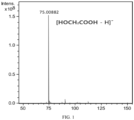
- FIG. 1 is a negative-ion mass spectrum of glycolic acid among reaction products analyzed by liquid chromatography-mass spectrometry in Example 1 of the present application.
- the present application discloses a method for preparing glycolic acid and methyl glycolate through hydrolysis of methyl methoxyacetate and methoxyacetic acid.
- the method of the present application is particularly suitable for carbonylation of DMM produced in the coal chemical industry to produce methyl methoxyacetate and then hydrolysis to produce glycolic acid and methyl glycolate.
- the present application provides a method for preparing glycolic acid and methyl glycolate through hydrolysis of methyl methoxyacetate and methoxyacetic acid, where raw materials of methyl methoxyacetate, methoxyacetic acid, and water are allowed to pass through a reaction zone loaded with a catalyst, such that the raw materials undergo a reaction under specified conditions to produce glycolic acid and methyl glycolate.
- the catalyst is one or a mixture of two or more selected from the group consisting of a solid acid catalyst, a liquid acid catalyst, a solid base catalyst, and a liquid base catalyst.
- the reaction zone includes a single fixed-bed reactor, or a plurality of fixed-bed reactors connected in series and/or parallel; or a single tank reactor, or a plurality of tank reactors connected in series and/or parallel; or a single catalytic distillation reactor, or a plurality of catalytic distillation reactors connected in series and/or parallel.
- Conditions of the reaction are as follows: a reaction temperature is 60°C to 260°C; in the raw materials, a molar ratio of methyl methoxyacetate + methoxyacetic acid to water is 1:20 to 1:2, and a molar ratio of methyl methoxyacetate to methoxyacetic acid is any ratio; and a reaction pressure is 0.1 MPa to 10 MPa.
- Reactions (1) to (4) are reversible reactions.
- methanol resulting from hydrolysis can also be partially dehydrated to produce dimethyl ether (DME).
- the solid acid catalyst is one or a mixture of two or more selected from the group consisting of an acidic molecular sieve catalyst, an acidic resin catalyst, and an acidic alumina catalyst.
- the acidic molecular sieve catalyst further includes a catalyst forming agent with a weight percentage of 0% to 50%; and the catalyst forming agent is one selected from the group consisting of alumina and silicon oxide.
- the acidic molecular sieve catalyst is a fresh acidic molecular sieve catalyst and/or a regenerated acidic molecular sieve catalyst.
- a preparation method of the regenerated acidic molecular sieve catalyst includes: using a gas including oxygen in a volume fraction of 0.5% to 50% to treat an inactivated acidic molecular sieve catalyst obtained after hydrolysis of methyl methoxyacetate and methoxyacetic acid at 400°C to 800°C for 0.5 h to 24 h.
- the acidic resin catalyst is a strongly-acidic cation exchange resin.
- a skeleton structure in the strongly-acidic cation exchange resin is a copolymer of styrene and DVB; and an acidic group in the strongly-acidic cation exchange resin is a sulfonic acid group.
- the acidic alumina catalyst is ⁇ -alumina.
- the ⁇ -alumina is prepared by calcining an SB powder at 400°C to 800°C.
- the liquid acid catalyst is an acidic liquid.
- the liquid acid catalyst is one or more selected from the group consisting of sulfuric acid, hydrochloric acid, nitric acid, and phosphoric acid.
- a concentration of H + in the liquid acid catalyst is 0.01 mol/L to 10 mol/L.
- the solid base catalyst is one or more selected from the group consisting of hydrotalcite, an anion exchange resin, and hydroxyapatite.
- a composition of the hydrotalcite can be expressed as [Mg 1-x Al x (OH) 2 ] x+ [CO 3 2- ] x/2 ⁇ n H 2 O, where x is 0.1 to 0.34 and n is an integer of 0 to 4; and Mg can undergo isomorphous replacement by Zn, Fe, Co, Ni, and Cu and Al can be replaced by Cr, Fe, and In.
- a composition of the hydroxyapatite can be expressed as Ca 10 - x (HPO 4 ) x (PO 4 ) 6-x (OH) 2-x , where x is 0 to 1.
- the liquid base catalyst is an alkaline liquid.
- the liquid base catalyst is one or more selected from the group consisting of a sodium hydroxide aqueous solution, a potassium hydroxide aqueous solution, a calcium hydroxide aqueous solution, and a magnesium hydroxide aqueous solution.
- a concentration of OH - in the liquid base catalyst is 0.01 mol/L to 10 mol/L.
- Conditions of the reaction are as follows: a reaction temperature is 130°C to 200°C; in the raw materials, a molar ratio of methyl methoxyacetate + methoxyacetic acid to water is 1:8 to 1:3, and a molar ratio of methyl methoxyacetate to methoxyacetic acid is 4:1 to 9:1; and a reaction pressure is 0.1 MPa to 0.3 MPa.
- a WHSV of the methyl methoxyacetate and the methoxyacetic acid in the raw materials is 0.1 h -1 to 3 h -1 .
- the methyl methoxyacetate, methoxyacetic acid, and water in the raw materials each are a freshly-added raw material and/or an unreacted raw material left after a product is separated.
- an inert carrier gas selected from the group consisting of nitrogen and argon is introduced.
- An Agilent7890B gas chromatograph is used to analyze products other than glycolic acid and unreacted raw materials, where an FID detector is connected to a DB-FFAP capillary column and a TCD detector is connected to a Porapak Q packed column.
- a liquid chromatograph is used to analyze glycolic acid, where a separation column is a C 18 column and a detector is an ultraviolet (UV) detector.
- the acidic molecular sieve exhibits excellent catalytic performance in hydrolysis of methyl methoxyacetate and methoxyacetic acid to produce glycolic acid and methyl glycolate, and leads to high selectivity for a target product.
- Example 9 Reaction results of different reaction times in Example 9 were shown in Table 2.
- Table 2 Catalytic reaction results in Example 9 Reaction time (h) Methyl methoxyacetate conversion rate (%) Methoxyacetic acid conversion rate (%) Glycolic acid selectivity (%) Methyl glycolate selectivity (%) 24 80.1 49.9 45.7 9.0 100 80.2 49.8 45.6 9.2 500 81.1 46.3 45.8 9.1 1000 78.3 47.1 45.1 8.7 2000 73.3 47.1 44.8 8.2 4000 73.6 45.1 44.9 8.5 8000 73.2 44.7 44.1 9.2
- the acidic molecular sieve catalyst especially the H-ZSM-5 molecular sieve catalyst, leads to a high raw material conversion rate during the hydrolysis, and has a long life.
- Example 10 ⁇ -alumina with an ammonia adsorption capacity of 0.29 mmol/g commercially purchased from Beijing Yanxin Technology Development Co., Ltd was used instead of the catalyst in Example 10, and other conditions and operations were the same as in Example 10. Reaction results were shown in Table 3.
- the solid acid and base catalysts such as a strongly-acidic resin, ⁇ -alumina, an alkaline resin, hydrotalcite, and hydroxyapatite can also catalyze hydrolysis of methyl methoxyacetate and methoxyacetic acid to produce glycolic acid and methyl glycolate.
- Example 15 Example Catalyst Methyl methoxyacetate conversion rate (%) Methoxyacetic acid conversion rate (%) Glycolic acid selectivity (%) Methyl glycolate selectivity (%) 15 Sulfuric acid aqueous solution 65.3 42.2 40.8 27.9
- liquid acid can also catalyze hydrolysis of methyl methoxyacetate and methoxyacetic acid to produce glycolic acid and methyl glycolate.
- a hydrolysis reaction of methyl methoxyacetate and methoxyacetic acid was tested by a batch catalytic distillation method.
- a distillation column was a glass column with a diameter of 30 mm, and the distillation column body was filled with an inert annular packing material of 3.0 mm ⁇ 3.0 mm, with a packing height of 2.0 m.
- the distillation column was heated by a heating jacket, and a condenser at a top of the column had a temperature of -15°C.
- Example 1 The acidic H-ZSM-5 molecular sieve with a Si/Al ratio of 20 in Example 1 was molded with alumina or silicon oxide into a strip, and after the molding, a content of the alumina or silicon oxide in the molded catalyst was 20 wt%. Other conditions and operations remained unchanged. Reaction results were shown in Table 5. Table 5 Catalytic reaction results in Examples 1 and 17 Example Forming agent Methyl methoxyacetate conversion rate (%) Methoxyacetic acid conversion rate (%) Glycolic acid selectivity (%) Methyl glycolate selectivity (%) 1 None 80.1 49.9 45.7 9.0 17 Alumina 75.3 40.2 44.2 10.1 17 Silicon oxide 75.6 41.8 44.9 10.3
- a catalyst obtained after 8,000 h of the reaction in Example 9 was treated with 500 mL min -1 of a mixed gas of oxygen and nitrogen in a molar ratio of 5/95 at 600°C for 4 h, and then used in the reaction in Example 9. Reaction results were shown in Table 6. Table 6 Catalytic reaction results in Example 18 Reaction time (h) Methyl methoxyacetate conversion rate (%) Methoxyacetic acid conversion rate (%) Glycolic acid selectivity (%) Methyl glycolate selectivity (%) 24 80.3 50.2 44.7 9.7 100 80.0 49.7 44.8 9.6 500 79.5 48.8 45.3 8.9
Landscapes
- Chemical & Material Sciences (AREA)
- Organic Chemistry (AREA)
- Engineering & Computer Science (AREA)
- Oil, Petroleum & Natural Gas (AREA)
- Chemical Kinetics & Catalysis (AREA)
- Organic Low-Molecular-Weight Compounds And Preparation Thereof (AREA)
- Catalysts (AREA)
- Low-Molecular Organic Synthesis Reactions Using Catalysts (AREA)
Claims (15)
- Verfahren zur Herstellung von Glykolsäure und Methylglykolat durch Hydrolyse von Methylmethoxyacetat und Methoxyessigsäure, umfassend: In Kontakt Bringen und Reagieren lassen von Rohmaterialien, umfassend das Methylmethoxyacetat, die Methoxyessigsäure und Wasser, mit einem Katalysator zur Herstellung von Glykolsäure und Methylglykolat,
dadurch gekennzeichnet, dassder Katalysator ein fester saurer Katalysator ist;der feste saure Katalysator mindestens einer ist, der aus der Gruppe ausgewählt ist, die aus einem sauren Molekularsiebs-Katalysator, einem sauren Harzkatalysator und einem sauren Aluminiumoxidkatalysator besteht; undder saure Molekularsiebs-Katalysator ein saures Molekularsieb umfasst. - Verfahren nach Anspruch 1, wobei das saure Molekularsieb mindestens eines ist, das aus der Gruppe ausgewählt ist, die aus einem sauren Molekularsieb mit MFI-Struktur, einem sauren Molekularsieb mit FAU-Struktur, einem sauren Molekularsieb mit FER-Struktur, einem sauren Molekularsieb mit BEA-Struktur, einem sauren Molekularsieb mit MOR-Struktur und einem sauren Molekularsieb mit MWW-Struktur besteht.
- Verfahren nach Anspruch 1, wobei das saure Molekularsieb mindestens eines ist, das aus der Gruppe ausgewählt ist, die aus einem sauren ZSM-5-Molekularsieb, einem sauren Y-Molekularsieb, einem sauren ZSM-35-Molekularsieb, einem sauren β-Molekularsieb, einem sauren MOR-Molekularsieb und einem sauren MCM-22-Molekularsieb besteht.
- Verfahren nach Anspruch 1, wobei das saure Molekularsieb mindestens eines ist, das aus der Gruppe ausgewählt ist, die aus einem ZSM-5-Molekularsieb vom Wasserstoff-Typ, einem Y-Molekularsieb vom Wasserstoff-Typ, einem ZSM-35-Molekularsieb vom Wasserstoff-Typ, einem β-Molekularsieb vom Wasserstoff-Typ, einem MOR-Molekularsieb vom Wasserstoff-Typ und einem MCM-22-Molekularsieb vom Wasserstoff-Typ besteht.
- Verfahren nach Anspruch 1, wobei das Si/Al-Atomverhältnis des sauren Molekularsiebs 3 bis 500 beträgt.
- Verfahren nach Anspruch 1, wobei der Gehalt des sauren Molekularsiebs im sauren Molekularsiebs-Katalysator 50 Gew.-% bis 100 Gew.-% beträgt.
- Verfahren nach Anspruch 1, wobei der saure Molekularsiebs-Katalysator ferner ein Formungsmittel umfasst;das Formungsmittel ein Oxid ist; unddas Oxid eines ist, das aus der Gruppe ausgewählt ist, die aus Aluminiumoxid und Siliziumoxid besteht.
- Verfahren nach Anspruch 7, wobei ein Gehalt des Formungsmittels in dem sauren Molekularsiebs-Katalysator m ist und 0 < m ≤ 50 Gew.-%.
- Verfahren nach Anspruch 1, wobei der saure Molekularsiebs-Katalysator ein frischer saurer Molekularsiebs-Katalysator und/oder ein regenerierter saurer Molekularsiebs-Katalysator ist; und
der frische saure Molekularsiebs-Katalysator ein unbenutzter saurer Molekularsiebs-Katalysator ist. - Verfahren nach Anspruch 9, wobei ein Regenerierungsverfahren des sauren Molekularsiebs-Katalysators umfasst:behandeln eines inaktivierten sauren Molekularsiebs-Katalysators mit einem sauerstoffhaltigen Regenerierungsgas bei 400 °C bis 800 °C für 0,5 h bis 24 h, um den regenerierten sauren Molekularsiebs-Katalysator zu erhalten,wobei der Volumenanteil von Sauerstoff in dem sauerstoffhaltigen Regenerationsgas 0,5 % bis 50 % beträgt.
- Verfahren nach Anspruch 1, wobei der saure Harzkatalysator ein beliebiges stark saures Kationenaustauscherharz ist.
- Verfahren nach Anspruch 11, wobei eine Gerüststruktur in dem stark sauren Kationenaustauscherharz ein Copolymer aus Styrol und Divinylbenzol (DVB) ist; und
eine saure Gruppe in dem stark sauren Kationenaustauscherharz eine Sulfonsäuregruppe ist. - Verfahren nach Anspruch 1, wobei der saure Aluminiumoxidkatalysator γ-Aluminiumoxid ist.
- Verfahren nach Anspruch 1, wobei die Reaktionsbedingungen wie folgt sind:eine Reaktionstemperatur beträgt 60 °C bis 260 °C;ein Reaktionsdruck 0,1 MPa bis 10 Mpa beträgt; undin den Rohmaterialien das Verhältnis der Gesamtmolzahl von Methylmethoxyacetat und Methoxyessigsäure zur Molzahl von Wasser 1:2 bis 1:20 beträgt.
- Verfahren nach Anspruch 14, wobei die Reaktionsbedingungen wie folgt sind:die Reaktionstemperatur beträgt 130 °C bis 200 °C;der Reaktionsdruck 0,1 MPa bis 0,3 MPa beträgt; undin den Rohmaterialien das Verhältnis der Gesamtmolzahl von Methylmethoxyacetat und Methoxyessigsäure zur Molzahl des Wassers 1:3 bis 1:8 beträgt unddas Molverhältnis von Methylmethoxyacetat zur Methoxyessigsäure 4:1 bis 9:1 beträgt.
Applications Claiming Priority (1)
| Application Number | Priority Date | Filing Date | Title |
|---|---|---|---|
| PCT/CN2021/075023 WO2022165662A1 (zh) | 2021-02-03 | 2021-02-03 | 甲氧基乙酸甲酯和甲氧基乙酸水解制取乙醇酸和乙醇酸甲酯的方法 |
Publications (3)
| Publication Number | Publication Date |
|---|---|
| EP4279477A1 EP4279477A1 (de) | 2023-11-22 |
| EP4279477A4 EP4279477A4 (de) | 2024-04-03 |
| EP4279477B1 true EP4279477B1 (de) | 2024-10-23 |
Family
ID=82740671
Family Applications (1)
| Application Number | Title | Priority Date | Filing Date |
|---|---|---|---|
| EP21923690.8A Active EP4279477B1 (de) | 2021-02-03 | 2021-02-03 | Verfahren zur herstellung von glykolsäure und methylglykolat durch hydrolyse von methylmethoxyacetat und methoxyessigsäure |
Country Status (5)
| Country | Link |
|---|---|
| US (1) | US20240109833A1 (de) |
| EP (1) | EP4279477B1 (de) |
| JP (1) | JP7588730B2 (de) |
| WO (1) | WO2022165662A1 (de) |
| ZA (1) | ZA202307576B (de) |
Families Citing this family (3)
| Publication number | Priority date | Publication date | Assignee | Title |
|---|---|---|---|---|
| CN116239472B (zh) * | 2022-11-22 | 2024-04-26 | 中国科学院青岛生物能源与过程研究所 | 由乙醛和乙酸甲酯制备3-羟基丁酸甲酯的方法及该方法中采用的催化剂 |
| CN116328825B (zh) * | 2023-02-22 | 2024-06-25 | 中国科学院青岛生物能源与过程研究所 | 一种催化剂,其制备方法以及采用其催化甲醇和乙酸甲酯制备3-甲氧基丙酸甲酯的方法 |
| WO2026123357A1 (zh) * | 2024-12-13 | 2026-06-18 | 中国科学院大连化学物理研究所 | 一种乙醇酸甲酯的生产方法 |
Family Cites Families (9)
| Publication number | Priority date | Publication date | Assignee | Title |
|---|---|---|---|---|
| DE1130431B (de) * | 1958-08-27 | 1962-05-30 | Degussa | Verfahren zur Herstellung von wasserfreien kristallisierten ª‡-Oxycarbonsaeuren aus ihren Estern |
| CN1060467C (zh) * | 1997-07-11 | 2001-01-10 | 清华大学 | 同时合成羟基乙酸甲酯和甲氧基乙酸甲酯的方法 |
| JP2003300926A (ja) * | 2002-04-08 | 2003-10-21 | Nippon Shokubai Co Ltd | α−ヒドロキシカルボン酸又はα−オキソカルボン酸の製造方法 |
| US8829234B2 (en) * | 2012-03-27 | 2014-09-09 | Eastman Chemical Company | Hydrocarboxylation of formaldehyde in the presence of a higher order carboxylic acid and heterogeneous catalyst |
| CN106554250B (zh) * | 2015-09-30 | 2019-06-21 | 中国科学院大连化学物理研究所 | 一种乙二醇单甲醚水解制备乙二醇的方法 |
| GB201615762D0 (en) * | 2016-09-16 | 2016-11-02 | Johnson Matthey Davy Technologies Ltd | Process |
| CN107602388B (zh) * | 2017-09-12 | 2020-10-30 | 沈阳化工大学 | 一种制备乙醇酸甲酯并副产卤代烷烃的方法 |
| CN109603907B (zh) * | 2019-01-04 | 2024-03-26 | 丹东明珠特种树脂有限公司 | 催化水解乙醇酸甲酯的乙醇酸制备方法 |
| CN115181019B (zh) * | 2022-08-26 | 2024-03-19 | 东华工程科技股份有限公司 | 一种由乙醇酸甲酯水解制电子级乙醇酸溶液的工艺 |
-
2021
- 2021-02-03 WO PCT/CN2021/075023 patent/WO2022165662A1/zh not_active Ceased
- 2021-02-03 US US18/275,444 patent/US20240109833A1/en active Pending
- 2021-02-03 JP JP2023546202A patent/JP7588730B2/ja active Active
- 2021-02-03 EP EP21923690.8A patent/EP4279477B1/de active Active
-
2023
- 2023-07-31 ZA ZA2023/07576A patent/ZA202307576B/en unknown
Also Published As
| Publication number | Publication date |
|---|---|
| ZA202307576B (en) | 2023-12-20 |
| US20240109833A1 (en) | 2024-04-04 |
| WO2022165662A1 (zh) | 2022-08-11 |
| JP7588730B2 (ja) | 2024-11-22 |
| EP4279477A4 (de) | 2024-04-03 |
| EP4279477A1 (de) | 2023-11-22 |
| JP2024504821A (ja) | 2024-02-01 |
Similar Documents
| Publication | Publication Date | Title |
|---|---|---|
| CN114853605B (zh) | 甲氧基乙酸甲酯和甲氧基乙酸水解制取乙醇酸和乙醇酸甲酯的方法 | |
| US7846861B2 (en) | Process for regenerating a catalyst | |
| EP4279477A1 (de) | Verfahren zur herstellung von glykolsäure und methylglykolat durch hydrolyse von methylmethoxyacetat und methoxyessigsäure | |
| EP3142785B1 (de) | Verfahren zur herstellung von alkenolen und verwendung davon zur herstellung von 1,3-butadien | |
| TW201113250A (en) | Process for the production of acetic acid and dimethyl ether | |
| EP0524713B1 (de) | Verfahren zur Herstellung von 1,3-Propandiol | |
| JPWO2006059729A1 (ja) | 高分子アルコールの合成法 | |
| CN108495837B (zh) | 由甲醇和醛有效合成异丁烯醛和其他α,β-不饱和醛 | |
| JP5209941B2 (ja) | α,β−不飽和エーテルの製造方法 | |
| EP2100868A1 (de) | Verfahren zur herstellung des produkts der hydrogenolyse von mehrere hydroxylgruppen enthaltenden alkoholen | |
| CN114853592B (zh) | 一种烷氧基乙酸酯水解制取乙醇酸的方法 | |
| EP4438587A1 (de) | Verfahren zur herstellung einer methylesterverbindung | |
| CN115745751B (zh) | 在固定床反应器上用苯酚和甲醇原料连续生产苯甲醚的液固相反应方法 | |
| CN101466657A (zh) | 氢化羟甲基链烷醛的方法 | |
| MXPA06003819A (es) | Proceso para la produccion de 1,3-propanodiol por hidrogenacion catalitica de 3-hidroxipropanal en la presencia de un co-catalizador de hidratacion. | |
| EP4279478B1 (de) | Verfahren zur herstellung von glycolsäure durch hydrolyse von alkoxyacetat | |
| EA048957B1 (ru) | Способ получения гликолевой кислоты и метилгликолята путем гидролиза метилметоксиацетата и метоксиуксусной кислоты | |
| JP2562150B2 (ja) | シクロヘキシルヒドロペルオキシドを含有する反応混合物の後処理法 | |
| US4471141A (en) | Preparation of aldehydes | |
| BR112023015333B1 (pt) | Método de preparação de ácido glicólico e glicolato de metila através da hidrólise de metoxiacetato de metila e ácido metoxiacético | |
| EA047949B1 (ru) | Способ получения гликолевой кислоты путем гидролиза алкоксиацетата | |
| CN116217373B (zh) | 一种催化合成甲基丙烯酸的方法 | |
| CA3037049C (en) | Method for acid treatment conditioning of a catalyst in the production of glycols | |
| CN116262681A (zh) | 一种以聚甲醛和乙烯为原料制备1,3-丙二醇的方法 | |
| CN120169415A (zh) | 一种负载型用于丙烯醛水合反应催化剂的制备方法 |
Legal Events
| Date | Code | Title | Description |
|---|---|---|---|
| STAA | Information on the status of an ep patent application or granted ep patent |
Free format text: STATUS: THE INTERNATIONAL PUBLICATION HAS BEEN MADE |
|
| PUAI | Public reference made under article 153(3) epc to a published international application that has entered the european phase |
Free format text: ORIGINAL CODE: 0009012 |
|
| STAA | Information on the status of an ep patent application or granted ep patent |
Free format text: STATUS: REQUEST FOR EXAMINATION WAS MADE |
|
| 17P | Request for examination filed |
Effective date: 20230817 |
|
| AK | Designated contracting states |
Kind code of ref document: A1 Designated state(s): AL AT BE BG CH CY CZ DE DK EE ES FI FR GB GR HR HU IE IS IT LI LT LU LV MC MK MT NL NO PL PT RO RS SE SI SK SM TR |
|
| A4 | Supplementary search report drawn up and despatched |
Effective date: 20240301 |
|
| RIC1 | Information provided on ipc code assigned before grant |
Ipc: C07C 67/31 20060101ALI20240226BHEP Ipc: C07C 51/377 20060101ALI20240226BHEP Ipc: C07C 69/675 20060101ALI20240226BHEP Ipc: C07C 69/145 20060101ALI20240226BHEP Ipc: C07C 59/06 20060101ALI20240226BHEP Ipc: C07C 67/08 20060101ALI20240226BHEP Ipc: C07C 51/09 20060101AFI20240226BHEP |
|
| DAV | Request for validation of the european patent (deleted) | ||
| DAX | Request for extension of the european patent (deleted) | ||
| GRAP | Despatch of communication of intention to grant a patent |
Free format text: ORIGINAL CODE: EPIDOSNIGR1 |
|
| STAA | Information on the status of an ep patent application or granted ep patent |
Free format text: STATUS: GRANT OF PATENT IS INTENDED |
|
| INTG | Intention to grant announced |
Effective date: 20240612 |
|
| GRAS | Grant fee paid |
Free format text: ORIGINAL CODE: EPIDOSNIGR3 |
|
| GRAA | (expected) grant |
Free format text: ORIGINAL CODE: 0009210 |
|
| STAA | Information on the status of an ep patent application or granted ep patent |
Free format text: STATUS: THE PATENT HAS BEEN GRANTED |
|
| AK | Designated contracting states |
Kind code of ref document: B1 Designated state(s): AL AT BE BG CH CY CZ DE DK EE ES FI FR GB GR HR HU IE IS IT LI LT LU LV MC MK MT NL NO PL PT RO RS SE SI SK SM TR |
|
| REG | Reference to a national code |
Ref country code: GB Ref legal event code: FG4D |
|
| REG | Reference to a national code |
Ref country code: CH Ref legal event code: EP |
|
| REG | Reference to a national code |
Ref country code: DE Ref legal event code: R096 Ref document number: 602021020831 Country of ref document: DE |
|
| REG | Reference to a national code |
Ref country code: IE Ref legal event code: FG4D |
|
| P01 | Opt-out of the competence of the unified patent court (upc) registered |
Free format text: CASE NUMBER: APP_68357/2024 Effective date: 20241227 |
|
| REG | Reference to a national code |
Ref country code: LT Ref legal event code: MG9D |
|
| REG | Reference to a national code |
Ref country code: NL Ref legal event code: MP Effective date: 20241023 |
|
| REG | Reference to a national code |
Ref country code: AT Ref legal event code: MK05 Ref document number: 1734745 Country of ref document: AT Kind code of ref document: T Effective date: 20241023 |
|
| PG25 | Lapsed in a contracting state [announced via postgrant information from national office to epo] |
Ref country code: NL Free format text: LAPSE BECAUSE OF FAILURE TO SUBMIT A TRANSLATION OF THE DESCRIPTION OR TO PAY THE FEE WITHIN THE PRESCRIBED TIME-LIMIT Effective date: 20241023 |
|
| PG25 | Lapsed in a contracting state [announced via postgrant information from national office to epo] |
Ref country code: NL Free format text: LAPSE BECAUSE OF FAILURE TO SUBMIT A TRANSLATION OF THE DESCRIPTION OR TO PAY THE FEE WITHIN THE PRESCRIBED TIME-LIMIT Effective date: 20241023 |
|
| PG25 | Lapsed in a contracting state [announced via postgrant information from national office to epo] |
Ref country code: IS Free format text: LAPSE BECAUSE OF FAILURE TO SUBMIT A TRANSLATION OF THE DESCRIPTION OR TO PAY THE FEE WITHIN THE PRESCRIBED TIME-LIMIT Effective date: 20250223 Ref country code: HR Free format text: LAPSE BECAUSE OF FAILURE TO SUBMIT A TRANSLATION OF THE DESCRIPTION OR TO PAY THE FEE WITHIN THE PRESCRIBED TIME-LIMIT Effective date: 20241023 Ref country code: PT Free format text: LAPSE BECAUSE OF FAILURE TO SUBMIT A TRANSLATION OF THE DESCRIPTION OR TO PAY THE FEE WITHIN THE PRESCRIBED TIME-LIMIT Effective date: 20250224 |
|
| PG25 | Lapsed in a contracting state [announced via postgrant information from national office to epo] |
Ref country code: FI Free format text: LAPSE BECAUSE OF FAILURE TO SUBMIT A TRANSLATION OF THE DESCRIPTION OR TO PAY THE FEE WITHIN THE PRESCRIBED TIME-LIMIT Effective date: 20241023 |
|
| PG25 | Lapsed in a contracting state [announced via postgrant information from national office to epo] |
Ref country code: BG Free format text: LAPSE BECAUSE OF FAILURE TO SUBMIT A TRANSLATION OF THE DESCRIPTION OR TO PAY THE FEE WITHIN THE PRESCRIBED TIME-LIMIT Effective date: 20241023 |
|
| PG25 | Lapsed in a contracting state [announced via postgrant information from national office to epo] |
Ref country code: ES Free format text: LAPSE BECAUSE OF FAILURE TO SUBMIT A TRANSLATION OF THE DESCRIPTION OR TO PAY THE FEE WITHIN THE PRESCRIBED TIME-LIMIT Effective date: 20241023 |
|
| PG25 | Lapsed in a contracting state [announced via postgrant information from national office to epo] |
Ref country code: NO Free format text: LAPSE BECAUSE OF FAILURE TO SUBMIT A TRANSLATION OF THE DESCRIPTION OR TO PAY THE FEE WITHIN THE PRESCRIBED TIME-LIMIT Effective date: 20250123 |
|
| PG25 | Lapsed in a contracting state [announced via postgrant information from national office to epo] |
Ref country code: LV Free format text: LAPSE BECAUSE OF FAILURE TO SUBMIT A TRANSLATION OF THE DESCRIPTION OR TO PAY THE FEE WITHIN THE PRESCRIBED TIME-LIMIT Effective date: 20241023 Ref country code: GR Free format text: LAPSE BECAUSE OF FAILURE TO SUBMIT A TRANSLATION OF THE DESCRIPTION OR TO PAY THE FEE WITHIN THE PRESCRIBED TIME-LIMIT Effective date: 20250124 Ref country code: AT Free format text: LAPSE BECAUSE OF FAILURE TO SUBMIT A TRANSLATION OF THE DESCRIPTION OR TO PAY THE FEE WITHIN THE PRESCRIBED TIME-LIMIT Effective date: 20241023 |
|
| PGFP | Annual fee paid to national office [announced via postgrant information from national office to epo] |
Ref country code: BE Payment date: 20250214 Year of fee payment: 5 |
|
| PG25 | Lapsed in a contracting state [announced via postgrant information from national office to epo] |
Ref country code: PL Free format text: LAPSE BECAUSE OF FAILURE TO SUBMIT A TRANSLATION OF THE DESCRIPTION OR TO PAY THE FEE WITHIN THE PRESCRIBED TIME-LIMIT Effective date: 20241023 |
|
| PGFP | Annual fee paid to national office [announced via postgrant information from national office to epo] |
Ref country code: IT Payment date: 20250129 Year of fee payment: 5 |
|
| PG25 | Lapsed in a contracting state [announced via postgrant information from national office to epo] |
Ref country code: RS Free format text: LAPSE BECAUSE OF FAILURE TO SUBMIT A TRANSLATION OF THE DESCRIPTION OR TO PAY THE FEE WITHIN THE PRESCRIBED TIME-LIMIT Effective date: 20250123 |
|
| PG25 | Lapsed in a contracting state [announced via postgrant information from national office to epo] |
Ref country code: SM Free format text: LAPSE BECAUSE OF FAILURE TO SUBMIT A TRANSLATION OF THE DESCRIPTION OR TO PAY THE FEE WITHIN THE PRESCRIBED TIME-LIMIT Effective date: 20241023 |
|
| PG25 | Lapsed in a contracting state [announced via postgrant information from national office to epo] |
Ref country code: DK Free format text: LAPSE BECAUSE OF FAILURE TO SUBMIT A TRANSLATION OF THE DESCRIPTION OR TO PAY THE FEE WITHIN THE PRESCRIBED TIME-LIMIT Effective date: 20241023 |
|
| PG25 | Lapsed in a contracting state [announced via postgrant information from national office to epo] |
Ref country code: EE Free format text: LAPSE BECAUSE OF FAILURE TO SUBMIT A TRANSLATION OF THE DESCRIPTION OR TO PAY THE FEE WITHIN THE PRESCRIBED TIME-LIMIT Effective date: 20241023 |
|
| PG25 | Lapsed in a contracting state [announced via postgrant information from national office to epo] |
Ref country code: RO Free format text: LAPSE BECAUSE OF FAILURE TO SUBMIT A TRANSLATION OF THE DESCRIPTION OR TO PAY THE FEE WITHIN THE PRESCRIBED TIME-LIMIT Effective date: 20241023 |
|
| REG | Reference to a national code |
Ref country code: DE Ref legal event code: R097 Ref document number: 602021020831 Country of ref document: DE |
|
| PG25 | Lapsed in a contracting state [announced via postgrant information from national office to epo] |
Ref country code: SK Free format text: LAPSE BECAUSE OF FAILURE TO SUBMIT A TRANSLATION OF THE DESCRIPTION OR TO PAY THE FEE WITHIN THE PRESCRIBED TIME-LIMIT Effective date: 20241023 |
|
| PG25 | Lapsed in a contracting state [announced via postgrant information from national office to epo] |
Ref country code: CZ Free format text: LAPSE BECAUSE OF FAILURE TO SUBMIT A TRANSLATION OF THE DESCRIPTION OR TO PAY THE FEE WITHIN THE PRESCRIBED TIME-LIMIT Effective date: 20241023 |
|
| PLBE | No opposition filed within time limit |
Free format text: ORIGINAL CODE: 0009261 |
|
| STAA | Information on the status of an ep patent application or granted ep patent |
Free format text: STATUS: NO OPPOSITION FILED WITHIN TIME LIMIT |
|
| REG | Reference to a national code |
Ref country code: DE Ref legal event code: R119 Ref document number: 602021020831 Country of ref document: DE |
|
| PG25 | Lapsed in a contracting state [announced via postgrant information from national office to epo] |
Ref country code: SE Free format text: LAPSE BECAUSE OF FAILURE TO SUBMIT A TRANSLATION OF THE DESCRIPTION OR TO PAY THE FEE WITHIN THE PRESCRIBED TIME-LIMIT Effective date: 20241023 |
|
| PG25 | Lapsed in a contracting state [announced via postgrant information from national office to epo] |
Ref country code: MC Free format text: LAPSE BECAUSE OF FAILURE TO SUBMIT A TRANSLATION OF THE DESCRIPTION OR TO PAY THE FEE WITHIN THE PRESCRIBED TIME-LIMIT Effective date: 20241023 |
|
| REG | Reference to a national code |
Ref country code: CH Ref legal event code: PL |
|
| 26N | No opposition filed |
Effective date: 20250724 |
|
| PG25 | Lapsed in a contracting state [announced via postgrant information from national office to epo] |
Ref country code: LU Free format text: LAPSE BECAUSE OF NON-PAYMENT OF DUE FEES Effective date: 20250203 |
|
| PG25 | Lapsed in a contracting state [announced via postgrant information from national office to epo] |
Ref country code: CH Free format text: LAPSE BECAUSE OF NON-PAYMENT OF DUE FEES Effective date: 20250228 |
|
| GBPC | Gb: european patent ceased through non-payment of renewal fee |
Effective date: 20250203 |
|
| PG25 | Lapsed in a contracting state [announced via postgrant information from national office to epo] |
Ref country code: DE Free format text: LAPSE BECAUSE OF NON-PAYMENT OF DUE FEES Effective date: 20250902 |
|
| PG25 | Lapsed in a contracting state [announced via postgrant information from national office to epo] |
Ref country code: GB Free format text: LAPSE BECAUSE OF NON-PAYMENT OF DUE FEES Effective date: 20250203 |
|
| PG25 | Lapsed in a contracting state [announced via postgrant information from national office to epo] |
Ref country code: FR Free format text: LAPSE BECAUSE OF NON-PAYMENT OF DUE FEES Effective date: 20250228 |
|
| PG25 | Lapsed in a contracting state [announced via postgrant information from national office to epo] |
Ref country code: IE Free format text: LAPSE BECAUSE OF NON-PAYMENT OF DUE FEES Effective date: 20250203 |
|
| PG25 | Lapsed in a contracting state [announced via postgrant information from national office to epo] |
Ref country code: CY Free format text: LAPSE BECAUSE OF FAILURE TO SUBMIT A TRANSLATION OF THE DESCRIPTION OR TO PAY THE FEE WITHIN THE PRESCRIBED TIME-LIMIT Effective date: 20241023 |
|
| PG25 | Lapsed in a contracting state [announced via postgrant information from national office to epo] |
Ref country code: TR Free format text: LAPSE BECAUSE OF FAILURE TO SUBMIT A TRANSLATION OF THE DESCRIPTION OR TO PAY THE FEE WITHIN THE PRESCRIBED TIME-LIMIT Effective date: 20241023 |
|
| PG25 | Lapsed in a contracting state [announced via postgrant information from national office to epo] |
Ref country code: LT Free format text: LAPSE BECAUSE OF FAILURE TO SUBMIT A TRANSLATION OF THE DESCRIPTION OR TO PAY THE FEE WITHIN THE PRESCRIBED TIME-LIMIT Effective date: 20241023 |