EP4265930B1 - Klimaschrank mit einer wellendichtung zum luftdichten drehbaren führen einer welle durch eine wand des klimaschranks - Google Patents
Klimaschrank mit einer wellendichtung zum luftdichten drehbaren führen einer welle durch eine wand des klimaschranks Download PDFInfo
- Publication number
- EP4265930B1 EP4265930B1 EP23168660.1A EP23168660A EP4265930B1 EP 4265930 B1 EP4265930 B1 EP 4265930B1 EP 23168660 A EP23168660 A EP 23168660A EP 4265930 B1 EP4265930 B1 EP 4265930B1
- Authority
- EP
- European Patent Office
- Prior art keywords
- segment
- wall
- roller bearing
- shaft
- accordance
- Prior art date
- Legal status (The legal status is an assumption and is not a legal conclusion. Google has not performed a legal analysis and makes no representation as to the accuracy of the status listed.)
- Active
Links
Images
Classifications
-
- F—MECHANICAL ENGINEERING; LIGHTING; HEATING; WEAPONS; BLASTING
- F16—ENGINEERING ELEMENTS AND UNITS; GENERAL MEASURES FOR PRODUCING AND MAINTAINING EFFECTIVE FUNCTIONING OF MACHINES OR INSTALLATIONS; THERMAL INSULATION IN GENERAL
- F16C—SHAFTS; FLEXIBLE SHAFTS; ELEMENTS OR CRANKSHAFT MECHANISMS; ROTARY BODIES OTHER THAN GEARING ELEMENTS; BEARINGS
- F16C27/00—Elastic or yielding bearings or bearing supports, for exclusively rotary movement
- F16C27/06—Elastic or yielding bearings or bearing supports, for exclusively rotary movement by means of parts of rubber or like materials
- F16C27/066—Ball or roller bearings
-
- F—MECHANICAL ENGINEERING; LIGHTING; HEATING; WEAPONS; BLASTING
- F24—HEATING; RANGES; VENTILATING
- F24F—AIR-CONDITIONING; AIR-HUMIDIFICATION; VENTILATION; USE OF AIR CURRENTS FOR SCREENING
- F24F13/00—Details common to, or for air-conditioning, air-humidification, ventilation or use of air currents for screening
-
- F—MECHANICAL ENGINEERING; LIGHTING; HEATING; WEAPONS; BLASTING
- F04—POSITIVE - DISPLACEMENT MACHINES FOR LIQUIDS; PUMPS FOR LIQUIDS OR ELASTIC FLUIDS
- F04D—NON-POSITIVE-DISPLACEMENT PUMPS
- F04D29/00—Details, component parts, or accessories
- F04D29/08—Sealings
- F04D29/10—Shaft sealings
- F04D29/102—Shaft sealings especially adapted for elastic fluid pumps
-
- A—HUMAN NECESSITIES
- A47—FURNITURE; DOMESTIC ARTICLES OR APPLIANCES; COFFEE MILLS; SPICE MILLS; SUCTION CLEANERS IN GENERAL
- A47F—SPECIAL FURNITURE, FITTINGS, OR ACCESSORIES FOR SHOPS, STOREHOUSES, BARS, RESTAURANTS OR THE LIKE; PAYING COUNTERS
- A47F3/00—Show cases or show cabinets
- A47F3/04—Show cases or show cabinets air-conditioned, refrigerated
- A47F3/0404—Cases or cabinets of the closed type
- A47F3/0408—Cases or cabinets of the closed type with forced air circulation
-
- F—MECHANICAL ENGINEERING; LIGHTING; HEATING; WEAPONS; BLASTING
- F04—POSITIVE - DISPLACEMENT MACHINES FOR LIQUIDS; PUMPS FOR LIQUIDS OR ELASTIC FLUIDS
- F04D—NON-POSITIVE-DISPLACEMENT PUMPS
- F04D29/00—Details, component parts, or accessories
- F04D29/05—Shafts or bearings, or assemblies thereof, specially adapted for elastic fluid pumps
- F04D29/056—Bearings
- F04D29/059—Roller bearings
-
- B—PERFORMING OPERATIONS; TRANSPORTING
- B60—VEHICLES IN GENERAL
- B60K—ARRANGEMENT OR MOUNTING OF PROPULSION UNITS OR OF TRANSMISSIONS IN VEHICLES; ARRANGEMENT OR MOUNTING OF PLURAL DIVERSE PRIME-MOVERS IN VEHICLES; AUXILIARY DRIVES FOR VEHICLES; INSTRUMENTATION OR DASHBOARDS FOR VEHICLES; ARRANGEMENTS IN CONNECTION WITH COOLING, AIR INTAKE, GAS EXHAUST OR FUEL SUPPLY OF PROPULSION UNITS IN VEHICLES
- B60K17/00—Arrangement or mounting of transmissions in vehicles
- B60K17/22—Arrangement or mounting of transmissions in vehicles characterised by arrangement, location, or type of main drive shafting, e.g. cardan shaft
- B60K17/24—Arrangement of mountings for shafting
-
- F—MECHANICAL ENGINEERING; LIGHTING; HEATING; WEAPONS; BLASTING
- F04—POSITIVE - DISPLACEMENT MACHINES FOR LIQUIDS; PUMPS FOR LIQUIDS OR ELASTIC FLUIDS
- F04D—NON-POSITIVE-DISPLACEMENT PUMPS
- F04D25/00—Pumping installations or systems
- F04D25/02—Units comprising pumps and their driving means
- F04D25/08—Units comprising pumps and their driving means the working fluid being air, e.g. for ventilation
-
- F—MECHANICAL ENGINEERING; LIGHTING; HEATING; WEAPONS; BLASTING
- F16—ENGINEERING ELEMENTS AND UNITS; GENERAL MEASURES FOR PRODUCING AND MAINTAINING EFFECTIVE FUNCTIONING OF MACHINES OR INSTALLATIONS; THERMAL INSULATION IN GENERAL
- F16C—SHAFTS; FLEXIBLE SHAFTS; ELEMENTS OR CRANKSHAFT MECHANISMS; ROTARY BODIES OTHER THAN GEARING ELEMENTS; BEARINGS
- F16C19/00—Bearings with rolling contact, for exclusively rotary movement
- F16C19/02—Bearings with rolling contact, for exclusively rotary movement with bearing balls essentially of the same size in one or more circular rows
- F16C19/04—Bearings with rolling contact, for exclusively rotary movement with bearing balls essentially of the same size in one or more circular rows for radial load mainly
- F16C19/06—Bearings with rolling contact, for exclusively rotary movement with bearing balls essentially of the same size in one or more circular rows for radial load mainly with a single row or balls
-
- F—MECHANICAL ENGINEERING; LIGHTING; HEATING; WEAPONS; BLASTING
- F16—ENGINEERING ELEMENTS AND UNITS; GENERAL MEASURES FOR PRODUCING AND MAINTAINING EFFECTIVE FUNCTIONING OF MACHINES OR INSTALLATIONS; THERMAL INSULATION IN GENERAL
- F16C—SHAFTS; FLEXIBLE SHAFTS; ELEMENTS OR CRANKSHAFT MECHANISMS; ROTARY BODIES OTHER THAN GEARING ELEMENTS; BEARINGS
- F16C2226/00—Joining parts; Fastening; Assembling or mounting parts
- F16C2226/50—Positive connections
- F16C2226/70—Positive connections with complementary interlocking parts
- F16C2226/74—Positive connections with complementary interlocking parts with snap-fit, e.g. by clips
-
- F—MECHANICAL ENGINEERING; LIGHTING; HEATING; WEAPONS; BLASTING
- F16—ENGINEERING ELEMENTS AND UNITS; GENERAL MEASURES FOR PRODUCING AND MAINTAINING EFFECTIVE FUNCTIONING OF MACHINES OR INSTALLATIONS; THERMAL INSULATION IN GENERAL
- F16C—SHAFTS; FLEXIBLE SHAFTS; ELEMENTS OR CRANKSHAFT MECHANISMS; ROTARY BODIES OTHER THAN GEARING ELEMENTS; BEARINGS
- F16C2226/00—Joining parts; Fastening; Assembling or mounting parts
- F16C2226/50—Positive connections
- F16C2226/70—Positive connections with complementary interlocking parts
- F16C2226/76—Positive connections with complementary interlocking parts with tongue and groove or key and slot
-
- F—MECHANICAL ENGINEERING; LIGHTING; HEATING; WEAPONS; BLASTING
- F16—ENGINEERING ELEMENTS AND UNITS; GENERAL MEASURES FOR PRODUCING AND MAINTAINING EFFECTIVE FUNCTIONING OF MACHINES OR INSTALLATIONS; THERMAL INSULATION IN GENERAL
- F16C—SHAFTS; FLEXIBLE SHAFTS; ELEMENTS OR CRANKSHAFT MECHANISMS; ROTARY BODIES OTHER THAN GEARING ELEMENTS; BEARINGS
- F16C2360/00—Engines or pumps
- F16C2360/46—Fans, e.g. ventilators
-
- F—MECHANICAL ENGINEERING; LIGHTING; HEATING; WEAPONS; BLASTING
- F16—ENGINEERING ELEMENTS AND UNITS; GENERAL MEASURES FOR PRODUCING AND MAINTAINING EFFECTIVE FUNCTIONING OF MACHINES OR INSTALLATIONS; THERMAL INSULATION IN GENERAL
- F16C—SHAFTS; FLEXIBLE SHAFTS; ELEMENTS OR CRANKSHAFT MECHANISMS; ROTARY BODIES OTHER THAN GEARING ELEMENTS; BEARINGS
- F16C35/00—Rigid support of bearing units; Housings, e.g. caps, covers
- F16C35/04—Rigid support of bearing units; Housings, e.g. caps, covers in the case of ball or roller bearings
- F16C35/06—Mounting or dismounting of ball or roller bearings; Fixing them onto shaft or in housing
- F16C35/07—Fixing them on the shaft or housing with interposition of an element
- F16C35/077—Fixing them on the shaft or housing with interposition of an element between housing and outer race ring
Definitions
- the invention relates to a climate cabinet with a shaft seal for the airtight, rotatable guidance of a shaft through a wall.
- Such shaft seals are used in climate cabinets in whose interior a fan is to be operated in order to ensure air circulation in the climate cabinet and thus ensure a homogeneous distribution of humidity and temperature, while at the same time the drive of the fan is to be arranged outside the air-conditioned interior of the climate cabinet on the one hand for reasons of space, but on the other hand also to avoid the entry of motor waste heat into the interior of the fan.
- a shaft must be guided through an opening in a wall, in particular the boiler wall of the climate cabinet, since the motor is located outside and the fan wheel driven by the motor is located inside the boiler.
- this opening must be sealed in order to prevent air exchange between the environment and the interior of the climate cabinet as best as possible, which would otherwise compromise the climate inside the climate cabinet.
- a widely used design of a shaft seal in practice is shaft sealing rings. These usually consist of a ring-shaped structure, in particular made of metal, which is attached to the wall with a tight fit, in particular at the edge of the opening, and which has an elastic sealing lip protruding into the interior of the ring.
- the sealing lip can be pressed radially onto the shaft surface, for example with a spring element, in order to improve the seal.
- this design is not able to compensate for coaxiality and/or concentricity deviations.
- signs of wear and tear on the sealing surface and increasingly severe leaks on the shaft occur over time.
- shaft seal In order to avoid these problems or at least reduce them, a different design of shaft seal is used in some of the applicant's climate cabinets.
- This design also has a ring-shaped structure, in particular made of metal.
- a plastic disk with a central hole in which the shaft runs is slightly pressed into the interior of the ring, so that a sealing effect is achieved, but at the same time a certain mobility of the disk within the ring is maintained, which compensates for deviations in coaxiality and/or concentricity.
- shaft seals are subject to considerable frictional forces and there is considerable material wear, particularly of the plastic disk, so that here too the seal must be regularly replaced or reworked by using a new plastic disk.
- bushings for the airtight, rotatable guiding of a shaft through the opening of a wall with a roller bearing to accommodate the shaft and a one-piece seal made of an elastic material are known from EP 2 878 827 A1 or the WO 2019/016107 A1 Further implementations reveal the WO 2008/125792 A1 , the US 3 372 960 A and the US 2016/ 195101 A1 .
- the object of the invention is therefore to provide a climate chamber with a shaft seal that only has minimal wear, has a good sealing effect and can also compensate for coaxiality and/or concentricity deviations.
- This object is achieved by a climate chamber with the features of patent claim 1.
- the climate cabinet according to the invention has a wall that forms a boiler wall and a fan arranged on the wall.
- the fan has a motor arranged outside the wall forming the boiler wall, which drives a fan wheel via a shaft that passes through an opening in this wall.
- the opening is hermetically sealed with a bushing, so that the shaft is passed through the wall in an hermetically sealed manner.
- the passage of the climate cabinet according to the invention serves to guide the shaft in an airtight, rotatable manner through the opening in the wall.
- the desired direction of the shaft determines the axial direction
- the radial direction(s) are determined by the connecting lines between the shaft and the edge of the opening, which are perpendicular to the axis.
- the implementation of the climate cabinet according to the invention has a rolling bearing for receiving the shaft and a one-piece seal made of an elastic material.
- the one-piece seal in turn has a rolling bearing receiving section in which the rolling bearing, preferably a ball bearing, is received, a wall receiving section and a flexible connecting section which seamlessly connects the rolling bearing receiving section and the wall receiving section.
- the rolling bearing sits directly on the shaft and its inner part can be connected to it in an airtight manner.
- Rolling bearings can be Due to their design, they can absorb radial loads well and ensure that the shaft can rotate. In particular, wear can be further reduced if the rolling bearing is not loaded with weight, which is particularly possible if the weight of the shaft is supported by the bearings of the components that are connected to one another by the shaft.
- Coaxiality and concentricity deviations are absorbed by the one-piece seal, which is made possible in particular by the fact that the flexible connecting section allows a relative movement between the rolling bearing receiving section and the wall receiving section.
- the seamless connection between the rolling bearing receiving section and the wall receiving section also ensures that the feedthrough is airtight.
- the rolling bearing receiving section is annular.
- the rolling bearing receiving section on its side facing the rolling bearing - i.e. towards the inside or, in other words, towards the shaft - surrounds the outer edge of the rolling bearing in a U-shape, i.e. the edge pointing away from the shaft and towards the edge of the opening when the feedthrough is used as intended.
- This can be achieved, for example, by at least this section of the rolling bearing being accommodated in a circumferential annular groove.
- the annular groove can have a slight undercut so that the base of the groove has a length adapted to the length of the rolling bearing in the axial direction, but its clear width tapers in the direction away from the base so that the walls of the groove are prestressed against the rolling bearing inserted into them.
- the wall receiving section is ring-shaped and preferably has a groove on its side facing away from the rolling bearing for inserting the edge of the opening in the wall.
- This groove can also be designed in such a way that a clamping effect is created between the wall receiving section and the wall according to the same principles as described above.
- the wall receiving section also tapers conically at least in sections, i.e. the outer diameter of the ring which defines the shape of the wall receiving section decreases in the axial direction towards the interior of the boiler, the bushing can be inserted particularly well into the opening and thus facilitates the tool-free assembly of the bushing by hand, which is possible with the bushing according to the invention.
- the flexible connecting section the thickness of which in the axial direction preferably has only a fraction of the thickness of the rolling bearing receiving section and the wall receiving section, has, in the unloaded state, a first subsection which runs offset in the axial direction relative to a second subsection of the connecting section and has a third subsection which connects the first subsection to the second subsection and bridges the axial offset.
- connection section being longer than the distance between the rolling bearing receiving section and the wall receiving section when these two sections are arranged concentrically to the shaft, which on the one hand facilitates the compensation of the coaxiality and concentricity deviations and on the other hand means that the shaft is not supported by the bearing and does not cause any damping of the shaft vibration, which also counteracts wear phenomena.
- the first subsection and the second subsection can extend substantially in the radial direction and the third subsection can extend substantially in the axial direction.
- the preferred elastic material from which the one-piece seal is made is silicone.
- the design of the passage of the climate chamber according to the invention allows in particular that the passage in advantageous embodiments of the invention from the rolling bearing and the one-piece seal, so no additional components such as support rings, retaining rings, steel springs, flange parts, stops or mounting feet are required.
- the wall receiving section is designed to be long enough in the axial direction that it still projects beyond the rolling bearing receiving section in the axial direction when the rolling bearing section is displaced in the axial direction as far as the connecting section allows and/or still projects beyond it in the opposite direction when the rolling bearing section is displaced in the opposite direction as far as the connecting section allows. This provides mechanical protection, particularly for the connecting section, but also for the rolling bearing section.
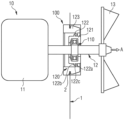
- Figure 1 shows a fan 10 arranged on a climate cabinet, of which only one wall 1, the boiler wall, is shown, with a motor 11 arranged outside the wall 1, which drives a fan wheel 13 via a shaft 12 guided through the wall 1.
- the wall 1 has an opening which is hermetically sealed with a passage 100, which consists only of a roller bearing 110 and a seal 120, so that the shaft 12 is guided hermetically through the wall 1.
- the seal 120 has an annular roller bearing receiving section 121 which surrounds the outer edge of the roller bearing 110 facing it in a U-shape and thus clamps the roller bearing 110.
- the annular roller bearing receiving section 121 is connected via a flexible, significantly thinner connecting section 122 to a likewise annular wall receiving section 123 which has an annular groove into which the inner edge 2 of the opening facing the shaft 12 engages so that it is secured.
- the outer side of the wall receiving section 123 facing away from the shaft 12 tapers conically in the axial direction A.
- the flexible connecting section 122 has a first section 122a which runs offset in the axial direction A relative to a second section 122b of the connecting section and a third section 122c which connects the first section 122a to the second section 122b and bridges the axial offset. Accordingly, the length of the entire flexible connecting section 122 is greater than the distance between the rolling bearing receiving section 121 and the wall receiving section 123, which makes it possible to move the rolling bearing receiving section 121 relative to the wall receiving section 123 and thus compensate for coaxiality and concentricity deviations.
- the first section 122a and the second section 122b run essentially in the radial direction and the third section 122c runs essentially in the axial direction A.
- the wall receiving section 123 is designed to be long enough in the axial direction A to accommodate the rolling bearing receiving section 121 then still projects against the axial direction when the rolling bearing section is displaced against the axial direction as far as the connecting section allows and is thus mechanically protected.
Landscapes
- Engineering & Computer Science (AREA)
- General Engineering & Computer Science (AREA)
- Mechanical Engineering (AREA)
- Chemical & Material Sciences (AREA)
- Combustion & Propulsion (AREA)
- Physics & Mathematics (AREA)
- Thermal Sciences (AREA)
- Sealing Of Bearings (AREA)
- Rolling Contact Bearings (AREA)
- Rolls And Other Rotary Bodies (AREA)
Description
- Die Erfindung betrifft einen Klimaschrank mit einer Wellendichtung zum luftdichten drehbaren Führen einer Welle durch eine Wand.
- Derartige Wellendichtungen finden bei Klimaschränken Verwendung, in deren Innenraum ein Lüfter betrieben werden soll, um die Luftumwälzung im Klimaschrank sicherzustellen und so für eine homogene Verteilung von Feuchtigkeit und Temperatur zu sorgen, während gleichzeitig einerseits aus Platzgründen, andererseits aber auch um den Eintrag von Motorabwärme in den Innenraum des Lüfters zu vermeiden, der Antrieb des Lüfters außerhalb des klimatisierten Innenraums des Klimaschranks angeordnet werden soll.
- Dementsprechend muss bei einer solchen Anwendung eine Welle drehbar durch eine Öffnung in einer Wand, insbesondere die Kesselwand des Klimaschranks, geführt werden, da der Motor außerhalb und das vom Motor angetriebene Lüfterrad innerhalb des Kessels angeordnet ist. Diese Öffnung muss aber abgedichtet werden, um einen Luftaustausch zwischen Umgebung und Innenraum des Klimaschrank bestmöglich zu unterbinden, der sonst das Klima im Inneren des Klimaschranks kompromittieren würden. Eine in der Praxis weit verbreitete Ausführungsform einer Wellendichtung sind Wellendichtringe. Diese bestehen in der Regel aus einer ringförmigen Struktur, insbesondere aus Metall, die mit festem Sitz an der Wand, insbesondere am Rand der Öffnung, angebaut ist und die eine elastische, in den Ringinnenraum ragende Dichtlippe aufweisen. Die Dichtlippe kann dabei, beispielsweise mit einem Federelement, radial auf die Wellenoberfläche gedrückt werden, um die Dichtigkeit zu verbessern. Diese Konstruktion ist aber nicht in der Lage, Koaxialitätsund/oder Rundlaufabweichungen zu kompensieren. Zudem kommt es bereits nach kurzer Zeit zu Abnutzungserscheinungen und Verschleiß an der Dichtfläche und zu mit der Zeit immer stärker werdenden Undichtigkeiten an der Welle.
- Um diese Probleme zu vermeiden oder zumindest zu reduzieren, wird in manchen Klimaschränken der Anmelderin eine andere Konstruktion einer Wellendichtung verwendet. Auch diese Konstruktion weist eine ringförmige Struktur, insbesondere aus Metall auf. Im Ringinnenraum ist eine Kunststoffscheiben mit einer zentralen Bohrung, in der die Welle läuft, leicht eingepresst, so dass eine Dichtwirkung realisiert wird, gleichzeitig aber eine gewisse Beweglichkeit der Scheibe innerhalb des Rings erhalten bleibt, wodurch Koaxialitäts- und/oder Rundlaufabweichungen ausgeglichen werden. Bei solchen Wellendichtungen wirken aber erhebliche Reibungskräfte und es kommt zu großem Materialverschleiß insbesondere der Kunststoffscheibe, so dass auch hier die Dichtung regelmäßig erneuert oder durch Einsatz einer neuen Kunststoffscheibe überarbeitet werden muss.
- Durchführungen zum luftdichten, drehbaren Führen einer Welle durch die Öffnung einer Wand mit einem Wälzlager zur Aufnahme der Welle und einer einteiligen Dichtung aus einem elastischen Material sind beispielsweise aus der
EP 2 878 827 A1 oder derWO 2019/016107 A1 bekannt. Weitere Durchführungen offenbaren dieWO 2008/125792 A1 , dieUS 3 372 960 A und dieUS 2016/ 195101 A1 . - Die Aufgabe der Erfindung besteht daher darin, einen Klimaschrank mit einer Wellendichtung bereitzustellen, die lediglich geringen Verschleiß aufweist, eine gute Dichtwirkung hat und zudem Koaxialitäts- und/oder Rundlaufabweichungen kompensieren kann. Diese Aufgabe wird gelöst durch einen Klimaschrank mit den Merkmalen des Patentanspruchs 1. Vorteilhafte Weiterbildungen der Erfindung sind Gegenstand der abhängigen Ansprüche.
- Der erfindungsgemäße Klimaschrank hat eine Wand, die eine Kesselwand bildet, und einen an der Wand angeordneten Lüfter. Der Lüfter weist einen außerhalb der die Kesselwand bildende Wand angeordneten Motor auf, der über eine durch eine Öffnung, die diese Wand aufweist, hindurch geführte Welle ein Lüfterrad antreibt. Dabei ist die Öffnung erfindungsgemäß mit einer Durchführung luftdicht abgedichtet, so dass die Welle luftdicht durch die Wand geführt wird.
- Die Durchführung des erfindungsgemäßen Klimaschranks dient zum luftdichten, drehbaren Führen der Welle durch die Öffnung der Wand. Die Soll-Verlaufsrichtung der Welle gibt dabei die axiale Richtung vor, die radiale Richtung(en) werden durch die senkrecht auf der Achse stehenden Verbindungslinien zwischen der Welle und dem Rand der Öffnung vorgegeben.
- Die Durchführung des erfindungsgemäßen Klimaschranks weist ein Wälzlager zur Aufnahme der Welle und eine einteiligen Dichtung aus einem elastischen Material auf.
- Die einteilige Dichtung weist ihrerseits einen Wälzlageraufnahmeabschnitt, in den das Wälzlager, vorzugsweise ein Kugellager, aufgenommen ist, einen Wandaufnahmeabschnitt und einen flexiblen Verbindungsabschnitt, der den Wälzlageraufnahmeabschnitt und den Wandaufnahmeabschnitt lückenlos miteinander verbindet, auf.
- In der Einsatzsituation der derart aufgebauten Dichtung sitzt das Wälzlager direkt auf der Welle und sein Innenteil kann luftdicht mit dieser verbunden sein. Wälzlager können bedingt durch ihre Konstruktion radiale Belastungen gut aufnehmen und stellen die Drehbarkeit der Welle sicher. Insbesondere kann der Verschleiß weiter reduziert werden, wenn das Wälzlager nicht mit Gewicht belastet wird, was insbesondere möglich ist, wenn durch die Lagerung der Komponenten, die durch die Welle miteinander verbunden werden, das Gewicht der Welle getragen wird.
- Koaxialitäts- und Rundlaufabweichungen werden durch die einteilige Dichtung aufgenommen, was insbesondere dadurch ermöglicht wird, dass der flexible Verbindungsabschnitt eine Relativbewegung zwischen dem Wälzlageraufnahmeabschnitt und dem Wandaufnahmeabschnitt ermöglicht. Zugleich ist durch die lückenlose Verbindung zwischen Wälzlageraufnahmeabschnitt und Wandaufnahmeabschnitt auch sichergestellt, dass die Durchführung luftdicht ist.
- Besonders vorteilhaft ist es, aus geometrischen Gründen, wenn der Wälzlageraufnahmeabschnitt ringförmig ist.
- Gemäß einer Weiterbildung der Erfindung umfasst der Wälzlageraufnahmeabschnitt an seiner dem Wälzlager zugewandten Seite -also nach innen hin oder, mit anderen Worten gesagt in Richtung auf die Welle hin- den äußeren, also bei bestimmungsgemä-ßem Einsatz der Durchführung von der Welle weg und auf den Rand der Öffnung hin weisenden Rand des Wälzlagers U-förmig umfasst. Dies kann beispielsweise dadurch realisiert sein, dass zumindest dieser Abschnitt des Wälzlagers in eine umlaufende Ringnut aufgenommen ist.
- Auf diese Weise kann man einerseits eine hohe Dichtigkeit gegen den Durchtritt von Luft durch die Verbindungsstelle zwischen Wälzlager und einteiliger Dichtung sicherstellen und das Lager zumindest teilweise vor direkter Luftströmung schützen.
- Andererseits schafft man so eine Konfiguration, in der das Wälzlager gemäß einer vorteilhaften Weiterbildung der Erfindung fest mit der einteiligen Dichtung verklemmt ist. Dazu kann die Ringnut einen leichten Hinterschnitt aufweisen, so dass der Grund der Nut eine an die Länge des Wälzlagers in axialer Richtung angepasste Länge hat, ihre lichte Weite sich aber in den sich vom Grund weg weisenden Richtung verjüngt, so dass die Wände der Nut gegen das in sie eingesetzte Wälzlager vorgespannt sind.
- Gemäß einer anderen vorteilhaften Weiterbildung der Erfindung ist der Wandaufnahmeabschnitt ringförmig und weist vorzugsweise an seiner vom Wälzlager abgewandten Seite eine Nut zum Einführen des Rands der Öffnung der Wand aufweist. Dies hat Vorteile bei der Schaffung einer luftdichten Verbindung zur Wand, da Befestigungsbohrungen oder -füße unnötig sind.
- Auch diese Nut kann so gestaltet sein, dass nach denselben Prinzipien wie eben beschrieben eine Klemmwirkung zwischen Wandaufnahmeabschnitt und Wand erzeugt wird.
- Wenn der Wandaufnahmeabschnitt zudem zumindest abschnittsweise konisch zuläuft, also der Außendurchmesser des Rings, der die Form des Wandaufnahmeabschnitts vorgibt, in axialer Richtung zum Innenraum des Kessels hin abnimmt, lässt sich die Durchführung besonders gut in die Öffnung einführen und erleichtert so die bei der erfindungsgemäßen Durchführung mögliche werkzeugfreie Montage der Durchführung von Hand.
- Bevorzugt ist es weiterhin, wenn der flexible Verbindungsabschnitt, dessen Dicke in axialer Richtung bevorzugt nur einen Bruchteil der Dicke des Wälzlageraufnahmeabschnitts und des Wandaufnahmeabschnitts aufweist, im unbelasteten Zustand einen ersten Teilabschnitt aufweist, der in axialer Richtung relativ zu einem zweiten Teilabschnitt des Verbindungsabschnitts versetzt verläuft und einen dritten Teilabschnitt aufweist, der den ersten Teilabschnitt mit dem zweiten Teilabschnitt verbindet und den axialen Versatz überbrückt.
- Dies führt insbesondere dazu, dass der Verbindungsabschnitt länger ist als der Abstand zwischen dem Wälzlageraufnahmeabschnitt und dem Wandaufnahmeabschnitt, wenn diese beiden Abschnitte konzentrisch zur Welle angeordnet sind, was einerseits den Ausgleich der Koaxialitäts- und Rundlaufsabweichungen erleichtert und andererseits dazu führt, dass die Welle vom Lager nicht abgestützt wird und keine Dämpfung der Wellenschwingung herbeiführt, was ebenfalls Verschleisserscheinungen entgegenwirkt.
- Insbesondere können im unbelasteten Zustand des flexiblen Verbindungsabschnitts der erste Teilabschnitt und der zweite Teilabschnitt im Wesentlichen in radialer Richtung verlaufen und der dritte Teilabschnitt im Wesentlichen in axialer Richtung verlaufen.
- Das bevorzugte elastische Material, aus dem die einteilige Dichtung gefertigt ist, ist Silikon.
- Die Konstruktion der Durchführung des erfindungsgemäßen Klimaschranks erlaubt insbesondere, dass die Durchführung in vorteilhaften Ausführungsformen der Erfindung aus dem Wälzlager und der einteiligen Dichtung besteht, also keinerlei weitere Bauteile wie etwa Stützringe, Sicherungsringe, Stahlfedern, Flanschteile, Anschläge oder Befestigungsfüße benötigt werden.
- Besonders vorteilhaft ist es ferner, wenn der Wandaufnahmeabschnitt in axialer Richtung so lang ausgeführt ist, dass er den Wälzlageraufnahmeabschnitt dann noch in axialer Richtung überragt, wenn der Wälzlagerabschnitt so weit es der Verbindungsabschnitt erlaubt in axialer Richtung verschoben ist und/oder dann noch entgegen der axialen Richtung überragt, wenn der Wälzlagerabschnitt so weit es der Verbindungsabschnitt erlaubt entgegen der axialen Richtung verschoben ist. Dadurch wird ein mechanischer Schutz insbesondere für den Verbindungsabschnitt, aber auch für den Wälzlagerabschnitt erreicht.
- Die Erfindung wird nachfolgend anhand einer Figur, die ein Ausführungsbeispiel darstellt, näher erläutert. Es zeigt:
- Fig. 1:
- eine als Lüfterwellendichtung eingesetzte Durchführung für eine Welle in einer Einbausituation in einem Klimaschrank im Querschnitt.
- Figur 1 zeigt einen an einem Klimaschrank, von dem lediglich eine Wand 1, die Kesselwand, gezeigt ist, angeordneten Lüfter 10 mit einem außerhalb der Wand 1 angeordneten Motor 11, der über eine durch die Wand 1 hindurch geführte Welle 12 ein Lüfterrad 13 antreibt. Die Wand 1 weist dazu eine Öffnung auf, die mit einer Durchführung 100, die lediglich aus einem Wälzlager 110 und einer Dichtung 120 besteht, luftdicht abgedichtet ist, so dass die Welle 12 luftdicht durch die Wand 1 geführt wird.
- Die Dichtung 120 weist einen ringförmigen Wälzlageraufnahmeabschnitt 121 auf, die den ihr zugewandten äußeren Rand des Wälzlagers 110 U-förmig umgreift und das Wälzlager 110 so festklemmt. Der ringförmige Wälzlageraufnahmeabschnitt 121 ist über einen flexiblen, deutlich dünneren Verbindungsabschnitt 122 mit einem ebenfalls ringförmigen Wandaufnahmeabschnitt 123 verbunden, der eine ringförmige Nut aufweist, in die der innere, der Welle 12 zugewandte Rand 2 der Öffnung eingreift, so dass er befestigt ist. Um das Einsetzen der Durchführung 100 in die Öffnung zu erleichtern, ist läuft die von der Welle 12 abgewandte Außenseite des Wandaufnahmeabschnitts 123 in axialer Richtung A konisch zu.
- Der flexible Verbindungsabschnitt 122 weist im in der Figur 1 dargestellten unbelasteten Zustand einen ersten Teilabschnitt 122a auf, der in axialer Richtung A relativ zu einem zweiten Teilabschnitt 122b des Verbindungsabschnitts versetzt verläuft und einen dritten Teilabschnitt 122c auf, der den ersten Teilabschnitt 122a mit dem zweiten Teilabschnitt 122b verbindet und den axialen Versatz überbrückt. Dementsprechend ist die Länge des gesamten flexiblen Verbindungsabschnitts 122 größer als der Abstand zwischen dem Wälzlageraufnahmeabschnitt 121 und dem Wandaufnahmeabschnitt 123, was es ermöglicht, den Wälzlageraufnahmenabschnitt 121 relativ zum Wandaufnahmeabschnitt 123 zu bewegen und so Koaxialitäts- und Rundlaufabweichungen zu kompensieren. Dabei verlaufen im unbelasteten Zustand des flexiblen Verbindungsabschnitts 122 der erste Teilabschnitt 122a und der zweite Teilabschnitt 122b im Wesentlichen in radialer Richtung und der dritte Teilabschnitt 122c verläuft im Wesentlichen in axialer Richtung A.
- Zudem ist der Wandaufnahmeabschnitt 123 in axialer Richtung A so lang ausgeführt, dass er den Wälzlageraufnahmeabschnitt 121 dann noch entgegen der axialen Richtung überragt, wenn der Wälzlagerabschnitt so weit es der Verbindungsabschnitt erlaubt entgegen der axialen Richtung verschoben ist und dadurch mechanisch geschützt.
- Um die Welle 12 drehbar durch die Wand 1 zu führen, ist sie in das Wälzlager 110 aufgenommen und mit diesem verbunden.
-
- 1
- Wand
- 2
- Rand
- 10
- Lüfter
- 11
- Motor
- 12
- Welle
- 13
- Lüfterrad
- 100
- Durchführung
- 110
- Wälzlager
- 120
- Dichtung
- 121
- Wälzlageraufnahmeabschnitt
- 122
- Verbindungsabschnitt
- 122a
- erster Teilabschnitt
- 122b
- zweiter Teilabschnitt
- 122c
- dritter Teilabschnitt
- 123
- Wandaufnahmeabschnitt
- A
- axiale Richtung
Claims (12)
- Klimaschrank mit einer Wand (1), die eine Kesselwand bildet, und mit einem an der Wand angeordneten Lüfter (10), wobei der Lüfter (10) einen außerhalb der Wand (1) angeordneten Motor (11) aufweist, der über eine durch die Wand (1) hindurch geführte Welle (12) ein Lüfterrad (13) antreibt, wobei die Wand (1) eine Öffnung aufweist, die mit einer Durchführung (100), luftdicht abgedichtet ist, so dass die Welle (12) luftdicht durch die Wand (1) geführt wird,
wobei die Durchführung (100) zum luftdichten, drehbaren Führen der Welle (12) durch die Öffnung der Wand (1) ein Wälzlager (110) zur Aufnahme der Welle (12) und eine einteiligen Dichtung (120) aus einem elastischen Material aufweist, wobei die einteilige Dichtung (120) einen Wälzlageraufnahmeabschnitt (121), mit dem das Wälzlager (110) verbunden ist, einen Wandaufnahmeabschnitt (123) und einen flexiblen Verbindungsabschnitt (122), der den Wälzlageraufnahmeabschnitt (121) und den Wandaufnahmeabschnitt (123) lückenlos miteinander verbindet, aufweist. - Klimaschrank nach Anspruch 1,
dadurch gekennzeichnet, dass der Wälzlageraufnahmeabschnitt (121) ringförmig ist. - Klimaschrank nach Anspruch 1 oder 2,
dadurch gekennzeichnet, dass der Wälzlageraufnahmeabschnitt (121) an seiner dem Wälzlager (110) zugewandten Seite den äußeren Rand des Wälzlagers (110) U-förmig umfasst. - Klimaschrank nach einem der Ansprüche 1 bis 3,
dadurch gekennzeichnet, dass der Wandaufnahmeabschnitt (123) ringförmig ist. - Klimaschrank nach einem der Ansprüche 1 bis 4,
dadurch gekennzeichnet, dass der Wandaufnahmeabschnitt (123) an seiner vom Wälzlager (110) abgewandten Seite eine Nut zum Einführen des Rands(2) der Öffnung der Wand (1) aufweist. - Klimaschrank nach einem der Ansprüche 1 bis 5,
dadurch gekennzeichnet, dass der Wandaufnahmeabschnitt (123) zumindest abschnittsweise konisch zuläuft. - Klimaschrank nach einem der Ansprüche 1 bis 6,
dadurch gekennzeichnet, dass das Wälzlager (110) mit dem Wälzlageraufnahmeabschnitt (121) fest verklemmt ist. - Klimaschrank nach einem der Ansprüche 1 bis 7,
dadurch gekennzeichnet, dass der flexible Verbindungsabschnitt (122) im unbelasteten Zustand einen ersten Teilabschnitt (122a) aufweist, der in axialer Richtung (A) relativ zu einem zweiten Teilabschnitt (122b) des Verbindungsabschnitts (122) versetzt verläuft und einen dritten Teilabschnitt (122c) aufweist, der den ersten Teilabschnitt (122a) mit dem zweiten Teilabschnitt (122b) verbindet und den axialen Versatz überbrückt. - Klimaschrank nach Anspruch 8,
dadurch gekennzeichnet, dass im unbelasteten Zustand des flexiblen Verbindungsabschnitts (122) der erste Teilabschnitt (122a) und der zweite Teilabschnitt (122b) im Wesentlichen in radialer Richtung verlaufen und dass der dritte Teilabschnitt (122c) im Wesentlichen in axialer Richtung (A) verläuft. - Klimaschrank nach einem der Ansprüche 1 bis 9,
dadurch gekennzeichnet, dass das elastische Material, aus dem die einteilige Dichtung (120) gefertigt ist, Silikon ist. - Klimaschrank nach einem der Ansprüche 1 bis 10,
dadurch gekennzeichnet, dass die Durchführung (100) aus dem Wälzlager (110) und der einteiligen Dichtung (120) besteht. - Klimaschrank nach einem der Ansprüche 1 bis 11,
dadurch gekennzeichnet, dass der Wandaufnahmeabschnitt (123) in axialer Richtung (A) so lang ausgeführt ist, dass er den Wälzlageraufnahmeabschnitt (121) dann noch in axialer Richtung (A) überragt, wenn der Wälzlagerabschnitt (121) soweit es der Verbindungsabschnitt (122) erlaubt in axialer Richtung (A) verschoben ist und/oder dann noch entgegen der axialen Richtung (A) überragt, wenn der Wälzlagerabschnitt (121) soweit es der Verbindungsabschnitt (122) erlaubt, entgegen der axialen Richtung (A) verschoben ist.
Applications Claiming Priority (1)
| Application Number | Priority Date | Filing Date | Title |
|---|---|---|---|
| DE102022109718.8A DE102022109718A1 (de) | 2022-04-22 | 2022-04-22 | Wellendichtung zum luftdichten drehbaren Führen einer Welle durch eine Wand |
Publications (2)
| Publication Number | Publication Date |
|---|---|
| EP4265930A1 EP4265930A1 (de) | 2023-10-25 |
| EP4265930B1 true EP4265930B1 (de) | 2024-04-24 |
Family
ID=86095889
Family Applications (1)
| Application Number | Title | Priority Date | Filing Date |
|---|---|---|---|
| EP23168660.1A Active EP4265930B1 (de) | 2022-04-22 | 2023-04-19 | Klimaschrank mit einer wellendichtung zum luftdichten drehbaren führen einer welle durch eine wand des klimaschranks |
Country Status (5)
| Country | Link |
|---|---|
| US (1) | US12607196B2 (de) |
| EP (1) | EP4265930B1 (de) |
| CN (1) | CN116928133A (de) |
| DE (1) | DE102022109718A1 (de) |
| PL (1) | PL4265930T3 (de) |
Family Cites Families (18)
| Publication number | Priority date | Publication date | Assignee | Title |
|---|---|---|---|---|
| US2225472A (en) | 1940-01-27 | 1940-12-17 | Albert W Franklin | Bushing |
| US2933354A (en) * | 1958-06-27 | 1960-04-19 | Gen Motors Corp | Drive shaft bearing support |
| US3372960A (en) | 1965-10-21 | 1968-03-12 | Illinois Tool Works | Self-locking bushing |
| US3961829A (en) * | 1972-09-20 | 1976-06-08 | Dunlop Limited | Improvements in or relating to resilient mountings |
| JPH0627458Y2 (ja) * | 1985-09-21 | 1994-07-27 | 日産自動車株式会社 | プロペラシャフトのセンターベアリング支持装置 |
| US5275558A (en) * | 1992-12-15 | 1994-01-04 | Seney John S | Dental handpiece, bur mount operating system |
| DE4317062C2 (de) * | 1993-05-21 | 1995-08-17 | Freudenberg Carl Fa | Kardanwellenlager |
| DE19939054A1 (de) | 1999-08-18 | 2001-02-22 | Volkswagen Ag | Dichtendes Lagerelement für eine Antriebswelle |
| DE102005044324B4 (de) * | 2005-09-16 | 2008-03-27 | Mtu Friedrichshafen Gmbh | Verfahren zur Herstellung eines Zwischenlagers für Gelenkwellen |
| WO2008125792A1 (en) | 2007-04-17 | 2008-10-23 | Gkn Driveline Walsall Limited | Bearing assembly for drive shaft |
| DE102008037786A1 (de) * | 2007-09-18 | 2009-03-26 | Schaeffler Kg | Einheitliche eingegossene Mittelträger-Lagerunterbaugruppe |
| JP5397256B2 (ja) | 2010-02-15 | 2014-01-22 | 住友電装株式会社 | ワイヤハーネス用のグロメット |
| DE102013109402A1 (de) | 2013-08-02 | 2015-02-05 | Ebm-Papst Landshut Gmbh | Radialgebläse mit kombinierter Dichtung und Schwingungsentkopplung |
| TWI539082B (zh) | 2013-12-02 | 2016-06-21 | 建準電機工業股份有限公司 | 氣體鼓風裝置 |
| DE102016120458B4 (de) * | 2016-10-26 | 2021-08-26 | Vibracoustic Gmbh | Elastomerkörper für ein Wellenlager sowie Wellenlager |
| DE102017113999B4 (de) | 2017-06-23 | 2022-04-28 | Vibracoustic Se | Wellenlager |
| DE102017116324B4 (de) * | 2017-07-19 | 2020-06-04 | Vibracoustic Gmbh | Wellenlager |
| JP6560809B1 (ja) * | 2018-12-10 | 2019-08-14 | 株式会社ショーワ | 軸受組立体およびその製造方法、推進軸の製造方法 |
-
2022
- 2022-04-22 DE DE102022109718.8A patent/DE102022109718A1/de not_active Ceased
-
2023
- 2023-04-18 CN CN202310417760.1A patent/CN116928133A/zh active Pending
- 2023-04-19 PL PL23168660.1T patent/PL4265930T3/pl unknown
- 2023-04-19 US US18/302,896 patent/US12607196B2/en active Active
- 2023-04-19 EP EP23168660.1A patent/EP4265930B1/de active Active
Also Published As
| Publication number | Publication date |
|---|---|
| US20230383966A1 (en) | 2023-11-30 |
| CN116928133A (zh) | 2023-10-24 |
| US12607196B2 (en) | 2026-04-21 |
| EP4265930A1 (de) | 2023-10-25 |
| PL4265930T3 (pl) | 2024-10-21 |
| DE102022109718A1 (de) | 2023-10-26 |
Similar Documents
| Publication | Publication Date | Title |
|---|---|---|
| DE69409925T2 (de) | Wälzlager mit fluiddichter Verbindungsvorrichtung | |
| EP0086250A1 (de) | Kassettendichtung | |
| DE102010019442A1 (de) | Wälzlager mit integrierter Abdichtung | |
| EP1739316A2 (de) | Abgedichtetes Wälzlager | |
| DE102007046248A1 (de) | Fluiddynamisches Lager mit Rezirkulationskanal | |
| DE29610299U1 (de) | Zahnkupplung | |
| DE102019217379A1 (de) | Wälzlageranordnung | |
| EP4265930B1 (de) | Klimaschrank mit einer wellendichtung zum luftdichten drehbaren führen einer welle durch eine wand des klimaschranks | |
| DE7816941U1 (de) | Kugellager | |
| DE102010015200A1 (de) | Kasettendichtung | |
| DE102006028200A1 (de) | Winkeleinstellbares Wälzlager | |
| DE2342747A1 (de) | Selbstausrichtendes lager | |
| WO2010108776A1 (de) | Ausrücklager | |
| DE102014205095A1 (de) | Abdichtung einer Radlagereinheit | |
| EP1125619A1 (de) | Dampfdurchführungssystem für einen Rotationsverdampfer und Rotationsverdampfer | |
| DE202015104151U1 (de) | Stellventil | |
| DE10140054B4 (de) | Absperrarmatur mit einem drehbeweglichen, in einem Gehäuse gelagerten Drossel- und Verschlusskörper | |
| EP4226061B1 (de) | Dichtungsanordnung für radlager und radlagereinheit mit dichtungsanordnung | |
| DE102019127890B3 (de) | Armatur mit Ausblassicherung | |
| DE102022127980A1 (de) | Wälzlager | |
| DE10022408A1 (de) | Festplattenlaufwerk mit Spindellagersystem | |
| DE102022204801A1 (de) | Dichtvorrichtung für eine Lagereinheit | |
| DE102020200555B3 (de) | Baugruppe für ein Kraftfahrzeug | |
| EP3417192B1 (de) | Wellendichtung | |
| DE102014104499A1 (de) | Luftklappenbaugruppe eines Fahrzeugheizungs / lüftungs- oder klimagerätes |
Legal Events
| Date | Code | Title | Description |
|---|---|---|---|
| STAA | Information on the status of an ep patent application or granted ep patent |
Free format text: STATUS: THE APPLICATION HAS BEEN PUBLISHED |
|
| PUAI | Public reference made under article 153(3) epc to a published international application that has entered the european phase |
Free format text: ORIGINAL CODE: 0009012 |
|
| AK | Designated contracting states |
Kind code of ref document: A1 Designated state(s): AL AT BE BG CH CY CZ DE DK EE ES FI FR GB GR HR HU IE IS IT LI LT LU LV MC ME MK MT NL NO PL PT RO RS SE SI SK SM TR |
|
| STAA | Information on the status of an ep patent application or granted ep patent |
Free format text: STATUS: REQUEST FOR EXAMINATION WAS MADE |
|
| 17P | Request for examination filed |
Effective date: 20231110 |
|
| P01 | Opt-out of the competence of the unified patent court (upc) registered |
Effective date: 20231114 |
|
| RBV | Designated contracting states (corrected) |
Designated state(s): AL AT BE BG CH CY CZ DE DK EE ES FI FR GB GR HR HU IE IS IT LI LT LU LV MC ME MK MT NL NO PL PT RO RS SE SI SK SM TR |
|
| GRAP | Despatch of communication of intention to grant a patent |
Free format text: ORIGINAL CODE: EPIDOSNIGR1 |
|
| STAA | Information on the status of an ep patent application or granted ep patent |
Free format text: STATUS: GRANT OF PATENT IS INTENDED |
|
| INTG | Intention to grant announced |
Effective date: 20240104 |
|
| GRAS | Grant fee paid |
Free format text: ORIGINAL CODE: EPIDOSNIGR3 |
|
| GRAA | (expected) grant |
Free format text: ORIGINAL CODE: 0009210 |
|
| STAA | Information on the status of an ep patent application or granted ep patent |
Free format text: STATUS: THE PATENT HAS BEEN GRANTED |
|
| AK | Designated contracting states |
Kind code of ref document: B1 Designated state(s): AL AT BE BG CH CY CZ DE DK EE ES FI FR GB GR HR HU IE IS IT LI LT LU LV MC ME MK MT NL NO PL PT RO RS SE SI SK SM TR |
|
| REG | Reference to a national code |
Ref country code: GB Ref legal event code: FG4D Free format text: NOT ENGLISH |
|
| REG | Reference to a national code |
Ref country code: CH Ref legal event code: EP |
|
| REG | Reference to a national code |
Ref country code: DE Ref legal event code: R096 Ref document number: 502023000014 Country of ref document: DE |
|
| REG | Reference to a national code |
Ref country code: IE Ref legal event code: FG4D Free format text: LANGUAGE OF EP DOCUMENT: GERMAN |
|
| REG | Reference to a national code |
Ref country code: LT Ref legal event code: MG9D |
|
| REG | Reference to a national code |
Ref country code: NL Ref legal event code: MP Effective date: 20240424 |
|
| PG25 | Lapsed in a contracting state [announced via postgrant information from national office to epo] |
Ref country code: NL Free format text: LAPSE BECAUSE OF FAILURE TO SUBMIT A TRANSLATION OF THE DESCRIPTION OR TO PAY THE FEE WITHIN THE PRESCRIBED TIME-LIMIT Effective date: 20240424 |
|
| PG25 | Lapsed in a contracting state [announced via postgrant information from national office to epo] |
Ref country code: NL Free format text: LAPSE BECAUSE OF FAILURE TO SUBMIT A TRANSLATION OF THE DESCRIPTION OR TO PAY THE FEE WITHIN THE PRESCRIBED TIME-LIMIT Effective date: 20240424 |
|
| PG25 | Lapsed in a contracting state [announced via postgrant information from national office to epo] |
Ref country code: IS Free format text: LAPSE BECAUSE OF FAILURE TO SUBMIT A TRANSLATION OF THE DESCRIPTION OR TO PAY THE FEE WITHIN THE PRESCRIBED TIME-LIMIT Effective date: 20240824 |
|
| PG25 | Lapsed in a contracting state [announced via postgrant information from national office to epo] |
Ref country code: BG Free format text: LAPSE BECAUSE OF FAILURE TO SUBMIT A TRANSLATION OF THE DESCRIPTION OR TO PAY THE FEE WITHIN THE PRESCRIBED TIME-LIMIT Effective date: 20240424 |
|
| PG25 | Lapsed in a contracting state [announced via postgrant information from national office to epo] |
Ref country code: FI Free format text: LAPSE BECAUSE OF FAILURE TO SUBMIT A TRANSLATION OF THE DESCRIPTION OR TO PAY THE FEE WITHIN THE PRESCRIBED TIME-LIMIT Effective date: 20240424 Ref country code: HR Free format text: LAPSE BECAUSE OF FAILURE TO SUBMIT A TRANSLATION OF THE DESCRIPTION OR TO PAY THE FEE WITHIN THE PRESCRIBED TIME-LIMIT Effective date: 20240424 |
|
| PG25 | Lapsed in a contracting state [announced via postgrant information from national office to epo] |
Ref country code: GR Free format text: LAPSE BECAUSE OF FAILURE TO SUBMIT A TRANSLATION OF THE DESCRIPTION OR TO PAY THE FEE WITHIN THE PRESCRIBED TIME-LIMIT Effective date: 20240725 |
|
| PG25 | Lapsed in a contracting state [announced via postgrant information from national office to epo] |
Ref country code: PT Free format text: LAPSE BECAUSE OF FAILURE TO SUBMIT A TRANSLATION OF THE DESCRIPTION OR TO PAY THE FEE WITHIN THE PRESCRIBED TIME-LIMIT Effective date: 20240826 |
|
| PG25 | Lapsed in a contracting state [announced via postgrant information from national office to epo] |
Ref country code: ES Free format text: LAPSE BECAUSE OF FAILURE TO SUBMIT A TRANSLATION OF THE DESCRIPTION OR TO PAY THE FEE WITHIN THE PRESCRIBED TIME-LIMIT Effective date: 20240424 |
|
| PG25 | Lapsed in a contracting state [announced via postgrant information from national office to epo] |
Ref country code: LV Free format text: LAPSE BECAUSE OF FAILURE TO SUBMIT A TRANSLATION OF THE DESCRIPTION OR TO PAY THE FEE WITHIN THE PRESCRIBED TIME-LIMIT Effective date: 20240424 |
|
| PG25 | Lapsed in a contracting state [announced via postgrant information from national office to epo] |
Ref country code: PT Free format text: LAPSE BECAUSE OF FAILURE TO SUBMIT A TRANSLATION OF THE DESCRIPTION OR TO PAY THE FEE WITHIN THE PRESCRIBED TIME-LIMIT Effective date: 20240826 Ref country code: NO Free format text: LAPSE BECAUSE OF FAILURE TO SUBMIT A TRANSLATION OF THE DESCRIPTION OR TO PAY THE FEE WITHIN THE PRESCRIBED TIME-LIMIT Effective date: 20240724 Ref country code: LV Free format text: LAPSE BECAUSE OF FAILURE TO SUBMIT A TRANSLATION OF THE DESCRIPTION OR TO PAY THE FEE WITHIN THE PRESCRIBED TIME-LIMIT Effective date: 20240424 Ref country code: IS Free format text: LAPSE BECAUSE OF FAILURE TO SUBMIT A TRANSLATION OF THE DESCRIPTION OR TO PAY THE FEE WITHIN THE PRESCRIBED TIME-LIMIT Effective date: 20240824 Ref country code: HR Free format text: LAPSE BECAUSE OF FAILURE TO SUBMIT A TRANSLATION OF THE DESCRIPTION OR TO PAY THE FEE WITHIN THE PRESCRIBED TIME-LIMIT Effective date: 20240424 Ref country code: GR Free format text: LAPSE BECAUSE OF FAILURE TO SUBMIT A TRANSLATION OF THE DESCRIPTION OR TO PAY THE FEE WITHIN THE PRESCRIBED TIME-LIMIT Effective date: 20240725 Ref country code: FI Free format text: LAPSE BECAUSE OF FAILURE TO SUBMIT A TRANSLATION OF THE DESCRIPTION OR TO PAY THE FEE WITHIN THE PRESCRIBED TIME-LIMIT Effective date: 20240424 Ref country code: ES Free format text: LAPSE BECAUSE OF FAILURE TO SUBMIT A TRANSLATION OF THE DESCRIPTION OR TO PAY THE FEE WITHIN THE PRESCRIBED TIME-LIMIT Effective date: 20240424 Ref country code: BG Free format text: LAPSE BECAUSE OF FAILURE TO SUBMIT A TRANSLATION OF THE DESCRIPTION OR TO PAY THE FEE WITHIN THE PRESCRIBED TIME-LIMIT Effective date: 20240424 Ref country code: RS Free format text: LAPSE BECAUSE OF FAILURE TO SUBMIT A TRANSLATION OF THE DESCRIPTION OR TO PAY THE FEE WITHIN THE PRESCRIBED TIME-LIMIT Effective date: 20240724 |
|
| PG25 | Lapsed in a contracting state [announced via postgrant information from national office to epo] |
Ref country code: DK Free format text: LAPSE BECAUSE OF FAILURE TO SUBMIT A TRANSLATION OF THE DESCRIPTION OR TO PAY THE FEE WITHIN THE PRESCRIBED TIME-LIMIT Effective date: 20240424 |
|
| PG25 | Lapsed in a contracting state [announced via postgrant information from national office to epo] |
Ref country code: EE Free format text: LAPSE BECAUSE OF FAILURE TO SUBMIT A TRANSLATION OF THE DESCRIPTION OR TO PAY THE FEE WITHIN THE PRESCRIBED TIME-LIMIT Effective date: 20240424 |
|
| PG25 | Lapsed in a contracting state [announced via postgrant information from national office to epo] |
Ref country code: CZ Free format text: LAPSE BECAUSE OF FAILURE TO SUBMIT A TRANSLATION OF THE DESCRIPTION OR TO PAY THE FEE WITHIN THE PRESCRIBED TIME-LIMIT Effective date: 20240424 |
|
| PG25 | Lapsed in a contracting state [announced via postgrant information from national office to epo] |
Ref country code: SK Free format text: LAPSE BECAUSE OF FAILURE TO SUBMIT A TRANSLATION OF THE DESCRIPTION OR TO PAY THE FEE WITHIN THE PRESCRIBED TIME-LIMIT Effective date: 20240424 Ref country code: RO Free format text: LAPSE BECAUSE OF FAILURE TO SUBMIT A TRANSLATION OF THE DESCRIPTION OR TO PAY THE FEE WITHIN THE PRESCRIBED TIME-LIMIT Effective date: 20240424 |
|
| REG | Reference to a national code |
Ref country code: DE Ref legal event code: R097 Ref document number: 502023000014 Country of ref document: DE |
|
| PG25 | Lapsed in a contracting state [announced via postgrant information from national office to epo] |
Ref country code: SM Free format text: LAPSE BECAUSE OF FAILURE TO SUBMIT A TRANSLATION OF THE DESCRIPTION OR TO PAY THE FEE WITHIN THE PRESCRIBED TIME-LIMIT Effective date: 20240424 |
|
| PG25 | Lapsed in a contracting state [announced via postgrant information from national office to epo] |
Ref country code: SM Free format text: LAPSE BECAUSE OF FAILURE TO SUBMIT A TRANSLATION OF THE DESCRIPTION OR TO PAY THE FEE WITHIN THE PRESCRIBED TIME-LIMIT Effective date: 20240424 Ref country code: SK Free format text: LAPSE BECAUSE OF FAILURE TO SUBMIT A TRANSLATION OF THE DESCRIPTION OR TO PAY THE FEE WITHIN THE PRESCRIBED TIME-LIMIT Effective date: 20240424 Ref country code: RO Free format text: LAPSE BECAUSE OF FAILURE TO SUBMIT A TRANSLATION OF THE DESCRIPTION OR TO PAY THE FEE WITHIN THE PRESCRIBED TIME-LIMIT Effective date: 20240424 Ref country code: EE Free format text: LAPSE BECAUSE OF FAILURE TO SUBMIT A TRANSLATION OF THE DESCRIPTION OR TO PAY THE FEE WITHIN THE PRESCRIBED TIME-LIMIT Effective date: 20240424 Ref country code: DK Free format text: LAPSE BECAUSE OF FAILURE TO SUBMIT A TRANSLATION OF THE DESCRIPTION OR TO PAY THE FEE WITHIN THE PRESCRIBED TIME-LIMIT Effective date: 20240424 Ref country code: CZ Free format text: LAPSE BECAUSE OF FAILURE TO SUBMIT A TRANSLATION OF THE DESCRIPTION OR TO PAY THE FEE WITHIN THE PRESCRIBED TIME-LIMIT Effective date: 20240424 |
|
| PLBE | No opposition filed within time limit |
Free format text: ORIGINAL CODE: 0009261 |
|
| STAA | Information on the status of an ep patent application or granted ep patent |
Free format text: STATUS: NO OPPOSITION FILED WITHIN TIME LIMIT |
|
| 26N | No opposition filed |
Effective date: 20250127 |
|
| PG25 | Lapsed in a contracting state [announced via postgrant information from national office to epo] |
Ref country code: SI Free format text: LAPSE BECAUSE OF FAILURE TO SUBMIT A TRANSLATION OF THE DESCRIPTION OR TO PAY THE FEE WITHIN THE PRESCRIBED TIME-LIMIT Effective date: 20240424 |
|
| PGFP | Annual fee paid to national office [announced via postgrant information from national office to epo] |
Ref country code: DE Payment date: 20250526 Year of fee payment: 3 |
|
| PGFP | Annual fee paid to national office [announced via postgrant information from national office to epo] |
Ref country code: FR Payment date: 20250422 Year of fee payment: 3 |
|
| PGFP | Annual fee paid to national office [announced via postgrant information from national office to epo] |
Ref country code: AT Payment date: 20250721 Year of fee payment: 3 |
|
| PG25 | Lapsed in a contracting state [announced via postgrant information from national office to epo] |
Ref country code: SE Free format text: LAPSE BECAUSE OF FAILURE TO SUBMIT A TRANSLATION OF THE DESCRIPTION OR TO PAY THE FEE WITHIN THE PRESCRIBED TIME-LIMIT Effective date: 20240424 |
|
| PG25 | Lapsed in a contracting state [announced via postgrant information from national office to epo] |
Ref country code: LU Free format text: LAPSE BECAUSE OF NON-PAYMENT OF DUE FEES Effective date: 20250419 |
|
| PG25 | Lapsed in a contracting state [announced via postgrant information from national office to epo] |
Ref country code: MC Free format text: LAPSE BECAUSE OF FAILURE TO SUBMIT A TRANSLATION OF THE DESCRIPTION OR TO PAY THE FEE WITHIN THE PRESCRIBED TIME-LIMIT Effective date: 20240424 |
|
| REG | Reference to a national code |
Ref country code: BE Ref legal event code: MM Effective date: 20250430 |
|
| PGFP | Annual fee paid to national office [announced via postgrant information from national office to epo] |
Ref country code: IT Payment date: 20250430 Year of fee payment: 3 |
|
| PG25 | Lapsed in a contracting state [announced via postgrant information from national office to epo] |
Ref country code: BE Free format text: LAPSE BECAUSE OF NON-PAYMENT OF DUE FEES Effective date: 20250430 |
|
| PG25 | Lapsed in a contracting state [announced via postgrant information from national office to epo] |
Ref country code: IE Free format text: LAPSE BECAUSE OF NON-PAYMENT OF DUE FEES Effective date: 20250419 |
|
| PGFP | Annual fee paid to national office [announced via postgrant information from national office to epo] |
Ref country code: PL Payment date: 20260331 Year of fee payment: 4 |