EP4265742A1 - Procédé de détection de la hauteur d'un matériau en fusion et procédé de fonctionnement d'un haut-fourneau - Google Patents
Procédé de détection de la hauteur d'un matériau en fusion et procédé de fonctionnement d'un haut-fourneau Download PDFInfo
- Publication number
- EP4265742A1 EP4265742A1 EP21924888.7A EP21924888A EP4265742A1 EP 4265742 A1 EP4265742 A1 EP 4265742A1 EP 21924888 A EP21924888 A EP 21924888A EP 4265742 A1 EP4265742 A1 EP 4265742A1
- Authority
- EP
- European Patent Office
- Prior art keywords
- height
- molten material
- furnace
- molten
- bosh
- Prior art date
- Legal status (The legal status is an assumption and is not a legal conclusion. Google has not performed a legal analysis and makes no representation as to the accuracy of the status listed.)
- Pending
Links
Images
Classifications
-
- C—CHEMISTRY; METALLURGY
- C21—METALLURGY OF IRON
- C21B—MANUFACTURE OF IRON OR STEEL
- C21B7/00—Blast furnaces
- C21B7/24—Test rods or other checking devices
-
- C—CHEMISTRY; METALLURGY
- C21—METALLURGY OF IRON
- C21B—MANUFACTURE OF IRON OR STEEL
- C21B5/00—Making pig-iron in the blast furnace
-
- C—CHEMISTRY; METALLURGY
- C21—METALLURGY OF IRON
- C21B—MANUFACTURE OF IRON OR STEEL
- C21B5/00—Making pig-iron in the blast furnace
- C21B5/006—Automatically controlling the process
-
- F—MECHANICAL ENGINEERING; LIGHTING; HEATING; WEAPONS; BLASTING
- F27—FURNACES; KILNS; OVENS; RETORTS
- F27D—DETAILS OR ACCESSORIES OF FURNACES, KILNS, OVENS OR RETORTS, IN SO FAR AS THEY ARE OF KINDS OCCURRING IN MORE THAN ONE KIND OF FURNACE
- F27D21/00—Arrangement of monitoring devices; Arrangement of safety devices
-
- F—MECHANICAL ENGINEERING; LIGHTING; HEATING; WEAPONS; BLASTING
- F27—FURNACES; KILNS; OVENS; RETORTS
- F27D—DETAILS OR ACCESSORIES OF FURNACES, KILNS, OVENS OR RETORTS, IN SO FAR AS THEY ARE OF KINDS OCCURRING IN MORE THAN ONE KIND OF FURNACE
- F27D21/00—Arrangement of monitoring devices; Arrangement of safety devices
- F27D21/0028—Devices for monitoring the level of the melt
-
- F—MECHANICAL ENGINEERING; LIGHTING; HEATING; WEAPONS; BLASTING
- F27—FURNACES; KILNS; OVENS; RETORTS
- F27D—DETAILS OR ACCESSORIES OF FURNACES, KILNS, OVENS OR RETORTS, IN SO FAR AS THEY ARE OF KINDS OCCURRING IN MORE THAN ONE KIND OF FURNACE
- F27D21/00—Arrangement of monitoring devices; Arrangement of safety devices
- F27D21/02—Observation or illuminating devices
-
- F—MECHANICAL ENGINEERING; LIGHTING; HEATING; WEAPONS; BLASTING
- F27—FURNACES; KILNS; OVENS; RETORTS
- F27B—FURNACES, KILNS, OVENS OR RETORTS IN GENERAL; OPEN SINTERING OR LIKE APPARATUS
- F27B1/00—Shaft or like vertical or substantially vertical furnaces
- F27B1/10—Details, accessories or equipment specially adapted for furnaces of these types
- F27B1/28—Arrangements of monitoring devices, of indicators, of alarm devices
-
- F—MECHANICAL ENGINEERING; LIGHTING; HEATING; WEAPONS; BLASTING
- F27—FURNACES; KILNS; OVENS; RETORTS
- F27D—DETAILS OR ACCESSORIES OF FURNACES, KILNS, OVENS OR RETORTS, IN SO FAR AS THEY ARE OF KINDS OCCURRING IN MORE THAN ONE KIND OF FURNACE
- F27D19/00—Arrangements of controlling devices
-
- Y—GENERAL TAGGING OF NEW TECHNOLOGICAL DEVELOPMENTS; GENERAL TAGGING OF CROSS-SECTIONAL TECHNOLOGIES SPANNING OVER SEVERAL SECTIONS OF THE IPC; TECHNICAL SUBJECTS COVERED BY FORMER USPC CROSS-REFERENCE ART COLLECTIONS [XRACs] AND DIGESTS
- Y02—TECHNOLOGIES OR APPLICATIONS FOR MITIGATION OR ADAPTATION AGAINST CLIMATE CHANGE
- Y02P—CLIMATE CHANGE MITIGATION TECHNOLOGIES IN THE PRODUCTION OR PROCESSING OF GOODS
- Y02P10/00—Technologies related to metal processing
- Y02P10/20—Recycling
Definitions
- the present invention relates to a molten-material-height detection method for detecting the height of a molten material on a bottom part of a smelting furnace and relates to a smelting-furnace operation method.
- a blast furnace is one kind of smelting furnaces having a tuyere through which gas is blown in.
- a blast furnace is a smelting furnace in which pig iron is made by charging ore with high iron content and coke from a furnace top and by blowing in mixed gas of, for example, air and pure oxygen from a furnace lower part.
- Pig iron and slag produced by the above-described method accumulates on a bottom part of the blast furnace and is discharged from a hole called a tapping hole in certain cycles.
- the blast furnace is required to be operated in a stable manner without any trouble to achieve a planned production amount of pig iron.
- a malfunction of equipment for opening a tapping hole and reduction in the fluidity of the pig iron and slag in the blast furnace may cause an excessive accumulation of the pig iron and slag on the bottom part of the blast furnace.
- gas permeability may be reduced, and a tuyere may be blocked by molten slag, and, in the worst case, production operations may be stopped.
- Patent Literature 1 discloses a technique in which three rod-shaped electrodes are inserted in a furnace lower part, a voltage is applied to the electrodes, and the height of a molten material is determined by measuring the electric currents passing through the electrodes.
- Patent Literature 2 discloses a technique for measuring an in-furnace void fraction and the height of a molten material by a value obtained by dividing a difference between the air-blowing pressure in a furnace lower part and the pressure in a shaft lower part by a variation of a bosh gas volume.
- the techniques disclosed in Patent Literatures 1 and 2 are both for measuring the height of the molten material that is accumulated on the furnace bottom part of the smelting furnace.
- the measurement of the molten material height with the method disclosed in Patent Literature 1 requires the rod-shaped electrodes for generating a voltage in the furnace, a voltage generation device, an electric-current detection device for measuring an electric current generated by a voltage, and cables for connecting the electrodes and devices.
- the method disclosed in Patent Literature 1 has a problem of increase in the production cost of pig iron due to such addition of the equipment.
- the in-furnace void fraction and the height of the molten material are measured by the value obtained by dividing a difference between the air-blowing pressure in the furnace lower part and the pressure in the shaft lower part by a variation of the bosh gas volume.
- the air-blowing pressure in the furnace lower part and the pressure in the shaft lower part vary greatly depending on the grain diameters of the grains and the grain size distribution in the furnace.
- the in-furnace void fraction which is obtained by a difference between the air-blowing pressure in the furnace lower part and the pressure in the shaft lower part and the volume of change in the bosh gas volume, also varies greatly depending on the in-furnace pressure according to the grain diameters of the grains and the grain size distribution in the furnace.
- Patent Literature 2 As described above, although the air-blowing pressure in the furnace lower part, the pressure in the shaft lower part, and the in-furnace void fraction are influenced greatly by the grain diameters of the grains and the grain size in the furnace, such influences of the grain diameters of the grains in the furnace and the particle size are not considered in Patent Literature 2. Thus, the method disclosed in Patent Literature 2 has a problem that the height of the molten material that is accumulated on the bottom part of the smelting furnace is hardly be determined with accuracy.
- the present invention has been made in view of such problems of the related art, and an object thereof is to provide a molten-material-height detection method with which the height of a molten material can be determined with high accuracy while the production cost of pig iron is suppressed from increasing and to provide a smelting-furnace operation method using the detected height of the molten material.
- the correspondence relationship between the rate of pressure drop increase in the bosh part relative to the tuyere front pressure and the height of the molten material remains constant regardless of the grain diameter of a raw material, a void fraction, and a bosh gas volume.
- the present invention will be described through the description of embodiments thereof.
- an embodiment of a molten-material-height detection method for a blast furnace serving as a smelting furnace will be described.
- the molten-material-height detection method according to the present invention is applicable not only to the blast furnace but also to any smelting furnace having plural tuyeres in a lower part of a furnace body and including a bosh part.
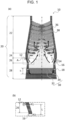
- Fig. 1(a) is a schematic sectional view of the blast furnace 10.
- Fig. 1(b) is an enlarged view of part A in Fig. 1(a) .
- the blast furnace 10 has a furnace main body 20, a pressure sensor 12, and plural temperature sensors 14.
- the furnace main body 20 is a bottomed tubular furnace body constituted by a shaft part 22, a belly part 24, a bosh part 26, and a hearth part 28.
- the pressure sensor 12 is disposed at the upper end of the bosh part 26.
- the plural temperature sensors 14 are arranged at different positions, in the height direction, of the bosh part 26.
- the hearth part 28 has plural tuyeres 16 that are arranged in the circumferential direction of the blast furnace and through which a hot blast at high temperature is blown into the blast furnace.
- the number of the tuyeres 16 is, for example, 40.
- the hearth part 28 further has tapping holes 18 that are arranged in the circumferential direction of the blast furnace and through which pig iron 32 and molten slag 34 are tapped off.
- the number of the tapping holes 18 is, for example, four.
- a hot blast and a reducing material such as powdered coal are blown in through the tuyeres 16 formed in a lower part of the blast furnace, and the pig iron 32 is thus produced.
- the produced pig iron 32 and the molten slag 34 that has been produced as a by-product during the production of the pig iron 32 are accumulated on a furnace bottom part and are tapped off from the tapping holes 18 in predetermined cycles.
- the pig iron 32 and the molten slag 34 are collectively referred to as a molten material 30.
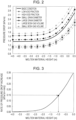
- Fig. 2 is a graph illustrating the relationship between the molten material height and the pressure drop.
- the horizontal axis represents the molten material height (m), and the height is relative to the height of the tuyere 16 (0.0 m).
- the vertical axis represents the pressure drop (kPa/m), that is, the pressure drop of an internal pressure P1 at the upper end of the bosh part 26 relative to a tuyere front pressure P2.
- Fig. 1(b) illustrates, when L is the height from the tuyere 16 to the pressure sensor 12, the pressure drop is calculated by (P2 - P1)/L.
- the pressure drop and the molten material height were obtained by a simulation using a numerical model of two-dimensional gas flow in the lower part of the blast furnace. Specifically, the analysis of the gas flow in the lower part of the blast furnace and the analysis of the liquid surface shape of the molten material, both described in Non Patent Literature 1, were repeated until a predetermined convergence condition (a relative error between the liquid surface shape obtained by one analysis and the liquid surface shape obtained by the immediately preceding analysis is less than or equal to 0.001%) was satisfied, and the liquid surface shape of the molten material that satisfies the convergence condition and the pressure distribution of the lower part of the blast furnace were obtained. The pressure drop was calculated from the pressure distribution, and the molten material height was calculated from the liquid surface shape of the molten material.
- a predetermined convergence condition a relative error between the liquid surface shape obtained by one analysis and the liquid surface shape obtained by the immediately preceding analysis is less than or equal to 0.001%
- Expression (1) is derived from the equation of motion of the gas in a packed bed of the blast furnace.
- Expression (2) is derived from the equation of state of gas, and
- Expression (3) is derived from the equation of state of gas.
- Expression (4) is derived from the liquid surface shape of the molten material and is given as a boundary condition for the analysis of the gas flow.
- Table 1 below gives calculation methods and measurement methods for the variables in Expressions (1) to (4) below.
- ⁇ (T) represents the viscosity (Pa-s) at the average in-furnace temperature.
- V bosh represents the bosh gas volume (Nm 3 /min)
- BV represents an air-blowing volume from the tuyeres 16 (Nm 3 /min).
- the pressure value (P1) that is measured by the pressure sensor 12 may be used as the average in-furnace pressure.
- the average value of the temperatures that are measured by the plural temperature sensors 14 may be used as the average in-furnace temperature.
- ⁇ g represents the gas density (kg/m 3 ) after correction
- V bosh represents the bosh gas volume (Nm 3 /min)
- P represents a pressure (Pa)
- T represents a temperature (K).
- the in-furnace void fraction can be calculated, for example, by substituting the values of the blast furnace whose molten material height is to be detected, such as P1, P2, and L in Fig. 1(b) for the Ergun equation (flow equation of the gas that flows through voids in the packed bed).
- the void fraction value given in Non Patent Literature 2 may also be used.
- the molten material density (kg/m 3 ) may be determined, for example, by measuring the density of the molten slag 34 that is tapped off from the tapping hole 18 and is then air-cooled.
- an actual measured average grain diameter of the coke that is charged from the furnace top may be used, or a value obtained by correcting the actual measured value with the height of the blast furnace may be used as described in Non Patent Literature 3.
- the analysis of the gas flow and the analysis of the liquid surface shape, both described above, were conducted while the grain diameter of a raw material, the void fraction, or the bosh gas volume was changed relative to a basic condition, and, in each of such various conditions, the relationship between the pressure drop and the height of the molten material 30 was obtained.
- the low void fraction means a condition in which the void fraction is lower than that of the basic condition
- the high void fraction means a condition in which the void fraction is higher than that of the basic condition.
- the small grain diameter and the small bosh gas volume mean a condition in which the grain diameter is smaller than that of the basic condition and a condition in which the bosh gas volume is smaller than that of the basic condition, respectively.
- the large grain diameter and the large bosh gas volume mean a condition in which the grain diameter is larger than that of the basic condition and a condition in which the bosh gas volume is larger than that of the basic condition, respectively.
- the void fraction, the grain diameter, and the bosh gas volume had the profiles translated in the up-down direction relative to the profile of the basic condition; thus, it is clear that the height of the molten material 30 can be detected without the influences of the void fraction, the grain diameter, and the bosh gas volume, when the height of the molten material 30 is detected by using the correspondence relationship between the gradient of a tangent at any point on the profiles, that is, the amount of pressure drop increase at any molten material height and the height of the molten material 30.
- checking the amount of pressure drop increase at any molten material height is synonymous with checking the rate of pressure drop increase that is calculated by Expression (12) above, as described above, it is clear that the molten material height can be detected without the influences of the void fraction, the grain diameter, and the bosh gas volume, even when the correspondence relationship between the rate of pressure drop increase and the molten material height is used instead of the amount of pressure drop increase at any molten material height given in Fig. 2 .
- the pressure value P1 which is measured by the pressure sensor 12 disposed at the upper end of the bosh part 26, is used as the internal pressure of the bosh part 26.
- the tuyere front pressure value P2 is used as the pressure at the front of the tuyere.
- the gas velocity vector and the gas pressure distribution in the furnace are calculated by the analysis of the gas flow in the lower part of the blast furnace conducted with Expressions (1) to (3) described above, and the tuyere front pressure value P2 is obtained from the gas pressure distribution.
- the rate of pressure drop increase of the internal pressure of the bosh part 26 relative to the tuyere front pressure is then obtained by using, at times t1 and t2, the internal pressures P1 of the bosh part 26, the tuyere front pressures P2, the heights L from the tuyere 16 to the pressure sensor 12, and Expression (12) above.
- Fig. 3 is a graph illustrating the relationship between the rate of pressure drop increase and the molten material height.
- the horizontal axis in Fig. 3 represents the molten material height (m) relative to the height of the tuyere (0.0 m).
- the vertical axis in Fig. 3 represents the rate of pressure drop increase (kPa/(m ⁇ min)).
- the graph shown in Fig. 3 is made with operational parameters, in the case where the blast furnace having an inner capacity of 5000 m 3 is used, during a period when there is no operational trouble.
- the rate of rise of the molten material that accumulates on the bottom part of the blast furnace was calculated by dividing a pig iron production amount per unit time (iron tapping ratio: 2) by the effective bottom area of a hearth of the furnace.
- the effective bottom area of the hearth of the furnace is a value obtained by multiplying the bottom area of the hearth of the furnace by the void fraction.
- An initial position of the molten material height is set 4.0 m below the tuyere height, and the pressure drop was calculated every time when the molten material height rose 0.5 m.
- the rate of pressure drop increase was then calculated from the time required until the molten material height reached each of the heights from the position of -4.0 m and the value of the pressure drop at each time. Due to the calculation, the profile in Fig. 3 illustrating the correspondence relationship between the rate of pressure drop increase and the molten material height (m) can be obtained.
- the correspondence relationship between the rate of pressure drop increase and the molten material height in Fig. 3 is determined in advance. Then, when the molten material height is detected, the internal pressure of the bosh part and the tuyere front pressure at each of the times t1 and t2 are obtained, the rate of pressure drop increase is obtained from these values, L, and Expression (12) above, and, by using the rate of the increase and the correspondence relationship above, the height of the molten material that accumulates on the bottom part of the blast furnace is detected.
- the rate of pressure drop increase is calculated as 0.15 (kPa/(m ⁇ min)), it is detected that the molten material is accumulated up to a level of -1.0 m from the tuyere height.
- the correspondence relationship between the rate of pressure drop increase and the molten material height is not affected by the void fraction, the grain diameter, and the bosh gas volume.
- the molten-material-height detection method of the present embodiment for detecting the molten material height by using the correspondence relationship between the rate of pressure drop increase and the molten material height may be regarded as a method that enables detection of the height of the molten material that accumulates on the furnace bottom part with higher accuracy than methods of the related art.
- the molten-material-height detection method of the present embodiment may be regarded as a method that enables detection of the molten material height with high accuracy while enabling suppression of increase in pig iron production cost.
- an operational action that reduces the production speed of the molten material is preferably performed. Due to such an action, it is possible to avoid an excessive accumulation of the molten material on the bottom part of the blast furnace and to avoid troubles such as reduction in gas permeability and tuyere blockage due to the molten slag.
- Such an action that reduces the production speed of the molten material is, for example, reducing the air-blowing volume from the tuyeres 16.
- an operational action that increases the discharge speed of the molten material may be performed. Due to such an action, it is possible to avoid an excessive accumulation of the molten material on the bottom part of the blast furnace and to avoid troubles such as reduction in gas permeability and tuyere blockage due to the molten slag.
- the pressure sensor 12 is disposed at the upper end of the bosh part 26 in the present embodiment, this is not the only option.
- the pressure sensor 12 may be disposed not only at the upper end of the bosh part 26 but also at any position within the range of the bosh part 26.
Landscapes
- Engineering & Computer Science (AREA)
- Chemical & Material Sciences (AREA)
- Mechanical Engineering (AREA)
- General Engineering & Computer Science (AREA)
- Manufacturing & Machinery (AREA)
- Materials Engineering (AREA)
- Metallurgy (AREA)
- Organic Chemistry (AREA)
- Blast Furnaces (AREA)
- Manufacture Of Iron (AREA)
- Waste-Gas Treatment And Other Accessory Devices For Furnaces (AREA)
Applications Claiming Priority (2)
| Application Number | Priority Date | Filing Date | Title |
|---|---|---|---|
| JP2021015650 | 2021-02-03 | ||
| PCT/JP2021/048673 WO2022168503A1 (fr) | 2021-02-03 | 2021-12-27 | Procédé de détection de la hauteur d'un matériau en fusion et procédé de fonctionnement d'un haut-fourneau |
Publications (2)
| Publication Number | Publication Date |
|---|---|
| EP4265742A1 true EP4265742A1 (fr) | 2023-10-25 |
| EP4265742A4 EP4265742A4 (fr) | 2024-07-31 |
Family
ID=82742259
Family Applications (1)
| Application Number | Title | Priority Date | Filing Date |
|---|---|---|---|
| EP21924888.7A Pending EP4265742A4 (fr) | 2021-02-03 | 2021-12-27 | Procédé de détection de la hauteur d'un matériau en fusion et procédé de fonctionnement d'un haut-fourneau |
Country Status (4)
| Country | Link |
|---|---|
| EP (1) | EP4265742A4 (fr) |
| JP (1) | JP7074274B1 (fr) |
| KR (1) | KR102855715B1 (fr) |
| WO (1) | WO2022168503A1 (fr) |
Family Cites Families (8)
| Publication number | Priority date | Publication date | Assignee | Title |
|---|---|---|---|---|
| JPS5319218B2 (fr) * | 1972-12-14 | 1978-06-20 | ||
| JPS5127809A (en) | 1974-08-31 | 1976-03-09 | Sumitomo Metal Ind | Yosensaireberu no sokuteiho |
| JP2000192124A (ja) | 1998-12-28 | 2000-07-11 | Nippon Steel Corp | 高炉炉床部内の溶融体レベル測定方法およびその装置 |
| JP5412819B2 (ja) * | 2008-12-10 | 2014-02-12 | Jfeスチール株式会社 | 竪型炉内の溶融物レベルの計測方法およびその装置 |
| JP5353740B2 (ja) | 2010-02-02 | 2013-11-27 | Jfeスチール株式会社 | 溶融物レベル計測装置および溶融物レベル計測方法 |
| JP6602238B2 (ja) * | 2016-03-10 | 2019-11-06 | 株式会社神戸製鋼所 | 竪型炉における溶融物レベルの推定方法 |
| KR101839841B1 (ko) * | 2016-11-24 | 2018-03-19 | 주식회사 포스코 | 탕면높이 측정장치 및 측정방법 |
| KR101932233B1 (ko) * | 2017-05-30 | 2018-12-24 | (주)에프비지코리아 | 용광로의 용융물 높이측정장치 및 방법 |
-
2021
- 2021-12-27 JP JP2022514573A patent/JP7074274B1/ja active Active
- 2021-12-27 WO PCT/JP2021/048673 patent/WO2022168503A1/fr not_active Ceased
- 2021-12-27 EP EP21924888.7A patent/EP4265742A4/fr active Pending
- 2021-12-27 KR KR1020237025335A patent/KR102855715B1/ko active Active
Also Published As
| Publication number | Publication date |
|---|---|
| EP4265742A4 (fr) | 2024-07-31 |
| KR102855715B1 (ko) | 2025-09-04 |
| JP7074274B1 (ja) | 2022-05-24 |
| JPWO2022168503A1 (fr) | 2022-08-11 |
| KR20230124064A (ko) | 2023-08-24 |
| WO2022168503A1 (fr) | 2022-08-11 |
Similar Documents
| Publication | Publication Date | Title |
|---|---|---|
| EP4286539A1 (fr) | Procédé de détection de hauteur de laitier de fonte et dispositif de détection de hauteur de laitier de fonte | |
| JP2015086461A (ja) | 高炉操業方法 | |
| JP7074274B1 (ja) | 溶融物高さの検出方法および溶鉱炉の操業方法 | |
| JP5560726B2 (ja) | 高炉の吹卸し操業方法 | |
| CN116761900B (zh) | 熔融物高度的检测方法和熔矿炉的操作方法 | |
| JP7111277B1 (ja) | 溶融物の液面高さの検出方法および検出装置、ならびに竪型炉の操業方法 | |
| KR20140016635A (ko) | 고로의 장입물 강하 판단 방법 | |
| JP7111278B1 (ja) | 溶融物の残留量検出方法および検出装置、ならびに竪型炉の操業方法 | |
| US8192521B2 (en) | Method of suppressing slag foaming in continuous melting furnace | |
| KR101277237B1 (ko) | 노내 중심류 판단방법 및 그 판단장치 | |
| JPH0711019B2 (ja) | 高炉操業における吹抜け防止方法 | |
| JP2007031040A (ja) | 微粉炭分配流量制御装置 | |
| US12577629B2 (en) | Residual liquid amount detection method and detection apparatus for the same, residual molten material amount detection method and detection apparatus for the same, and method for operating vertical furnace | |
| US12584690B2 (en) | Liquid level detection method and detection apparatus for the same, molten material liquid level detection method and detection apparatus for the same, and method for operating vertical furnace | |
| KR20000028284A (ko) | 용광로 내부의 통기성 판단방법 | |
| JP7694748B1 (ja) | 高炉炉内の溶融物レベルの計測方法、高炉炉内の溶融物レベルの計測装置、及び高炉の操業方法 | |
| JP7861927B2 (ja) | 筒状容器内に収容された充填層の処理方法 | |
| JP2003306708A (ja) | 高炉の安定操業方法 | |
| JPH0711018B2 (ja) | 高炉操業における吹抜け防止方法 | |
| KR100862158B1 (ko) | 노정 가스 폭발 방지를 위한 노정온도 제어장치 및 방법 | |
| JP2931497B2 (ja) | 高炉の操業方法 | |
| JPH0978111A (ja) | 高炉操業法 | |
| JP3465295B2 (ja) | コークス充填層型溶融還元炉の操業方法及び仕様設定方法 | |
| SU821495A1 (ru) | Устройство дл измерени расходадуТь B фуРМЕННОМ пРибОРЕ дОМЕННОйпЕчи | |
| KR20020089683A (ko) | 미분탄 취입량 제어장치 |
Legal Events
| Date | Code | Title | Description |
|---|---|---|---|
| STAA | Information on the status of an ep patent application or granted ep patent |
Free format text: STATUS: THE INTERNATIONAL PUBLICATION HAS BEEN MADE |
|
| PUAI | Public reference made under article 153(3) epc to a published international application that has entered the european phase |
Free format text: ORIGINAL CODE: 0009012 |
|
| STAA | Information on the status of an ep patent application or granted ep patent |
Free format text: STATUS: REQUEST FOR EXAMINATION WAS MADE |
|
| 17P | Request for examination filed |
Effective date: 20230718 |
|
| AK | Designated contracting states |
Kind code of ref document: A1 Designated state(s): AL AT BE BG CH CY CZ DE DK EE ES FI FR GB GR HR HU IE IS IT LI LT LU LV MC MK MT NL NO PL PT RO RS SE SI SK SM TR |
|
| DAV | Request for validation of the european patent (deleted) | ||
| DAX | Request for extension of the european patent (deleted) | ||
| A4 | Supplementary search report drawn up and despatched |
Effective date: 20240628 |
|
| RIC1 | Information provided on ipc code assigned before grant |
Ipc: F27B 1/28 20060101ALI20240624BHEP Ipc: F27D 19/00 20060101ALI20240624BHEP Ipc: F27D 21/00 20060101ALI20240624BHEP Ipc: C21B 7/24 20060101ALI20240624BHEP Ipc: C21B 5/00 20060101AFI20240624BHEP |
|
| STAA | Information on the status of an ep patent application or granted ep patent |
Free format text: STATUS: EXAMINATION IS IN PROGRESS |
|
| 17Q | First examination report despatched |
Effective date: 20260126 |