EP4263394B1 - Rollenförderer - Google Patents
Rollenförderer Download PDFInfo
- Publication number
- EP4263394B1 EP4263394B1 EP21839069.8A EP21839069A EP4263394B1 EP 4263394 B1 EP4263394 B1 EP 4263394B1 EP 21839069 A EP21839069 A EP 21839069A EP 4263394 B1 EP4263394 B1 EP 4263394B1
- Authority
- EP
- European Patent Office
- Prior art keywords
- roller
- conveyor
- truncated cone
- fastening
- polygonal bore
- Prior art date
- Legal status (The legal status is an assumption and is not a legal conclusion. Google has not performed a legal analysis and makes no representation as to the accuracy of the status listed.)
- Active
Links
Images


Classifications
-
- B—PERFORMING OPERATIONS; TRANSPORTING
- B65—CONVEYING; PACKING; STORING; HANDLING THIN OR FILAMENTARY MATERIAL
- B65G—TRANSPORT OR STORAGE DEVICES, e.g. CONVEYORS FOR LOADING OR TIPPING, SHOP CONVEYOR SYSTEMS OR PNEUMATIC TUBE CONVEYORS
- B65G39/00—Rollers, e.g. drive rollers, or arrangements thereof incorporated in roller-ways or other types of mechanical conveyors
- B65G39/10—Arrangements of rollers
- B65G39/12—Arrangements of rollers mounted on framework
-
- F—MECHANICAL ENGINEERING; LIGHTING; HEATING; WEAPONS; BLASTING
- F16—ENGINEERING ELEMENTS AND UNITS; GENERAL MEASURES FOR PRODUCING AND MAINTAINING EFFECTIVE FUNCTIONING OF MACHINES OR INSTALLATIONS; THERMAL INSULATION IN GENERAL
- F16B—DEVICES FOR FASTENING OR SECURING CONSTRUCTIONAL ELEMENTS OR MACHINE PARTS TOGETHER, e.g. NAILS, BOLTS, CIRCLIPS, CLAMPS, CLIPS OR WEDGES; JOINTS OR JOINTING
- F16B29/00—Screwed connection with deformation of nut or auxiliary member while fastening
-
- F—MECHANICAL ENGINEERING; LIGHTING; HEATING; WEAPONS; BLASTING
- F16—ENGINEERING ELEMENTS AND UNITS; GENERAL MEASURES FOR PRODUCING AND MAINTAINING EFFECTIVE FUNCTIONING OF MACHINES OR INSTALLATIONS; THERMAL INSULATION IN GENERAL
- F16B—DEVICES FOR FASTENING OR SECURING CONSTRUCTIONAL ELEMENTS OR MACHINE PARTS TOGETHER, e.g. NAILS, BOLTS, CIRCLIPS, CLAMPS, CLIPS OR WEDGES; JOINTS OR JOINTING
- F16B35/00—Screw-bolts; Stay-bolts; Screw-threaded studs; Screws; Set screws
- F16B35/04—Screw-bolts; Stay-bolts; Screw-threaded studs; Screws; Set screws with specially-shaped head or shaft in order to fix the bolt on or in an object
- F16B35/041—Specially-shaped shafts
- F16B35/048—Specially-shaped necks
Definitions
- a roller conveyor comprises a plurality of rollers mounted on a support frame. Material can be transported on these rollers.
- the rollers can be motorized rollers, which themselves have a drive motor.
- Such rollers have a mounting axle that is connected to the support frame via a torque-proof connection to provide support for the drive torque.
- the torque-proof connection is achieved through a positive locking mechanism.
- the rollers can also be passive rollers. These passive rollers are either driven by an external motor or can rotate freely. Since no torque support is required, they are simply clamped to the support frame.
- the GB 2 101 061 A and DE 195 32 390 A1 each disclose a conveyor with a conveyor roller.
- the conveyor roller is attached to a frame with a specially designed screw.
- GB 2 101 061 A a roller conveyor according to the preamble of claim 1.
- the DE 27 36 131 A1 discloses a screw which is secured against rotation, in which a cone is arranged between the screw head and the shaft.
- the present invention is based on the object of providing a simple method for mounting rollers on a support frame. This object is achieved by a roller conveyor and a method according to the main claims; refinements are the subject of the subclaims and the description.
- the invention enables a simple method for mounting a roller on a support frame. It is particularly important that the fastening screw can be attached to a polygonal hole that is also suitable for other types of fastening. This allows the polygonal hole to also be used for a positive, rotationally fixed connection with a particularly complementary fastening axis. Overall, this supports a modular design and reduces component complexity.
- the invention is used for fastening a poly-V roller.
- the circular truncated cone section is used specifically to construct the Working tension of the poly-V belt. This allows for easier pre-assembly with reduced pre-tension.
- the fastening screw 2 after Figure 1 has a threaded shaft 21 with an external thread and a screw head 23.
- a circular truncated cone section 22 is arranged axially between the screw head 23 and the threaded shaft 21.
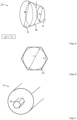
- the structure of the circular truncated cone section 23 is shown schematically in Figure 5
- the circular truncated cone section 23 has a base region G with a base diameter g and a cover region D with a cover diameter d.
- the cover diameter d is smaller than the base diameter g.
- the base area G faces the screw head 23, and the cover area D faces the threaded shaft 21.
- the circular truncated cone section 22 and the screw head 23 directly adjoin one another.
- the base area directly adjoins a radial clamping surface S of the screw head 23.
- the circular truncated cone section 22 can be formed separately by a conical sleeve that is attached or screwed onto the threaded shaft 21.
- the screw can thus be constructed in several parts.
- the radial clamping surface S does not have to be a smooth surface but can have a friction-increasing surface, as in Figure 1b shown.
- the fastening screw 2 is inserted into a roller conveyor according to Figure 2 used.
- the roller conveyor has a plurality of conveyor rollers 3, which are fastened to a support frame 4. At least one of the conveyor rollers 3 is fastened to the support frame 4 by means of a fastening screw 2 of the aforementioned type.
- the support frame 4 can have a support plate 41 to which the fastening takes place ( Figures 3, 4 ).
- a polygonal bore 42 is provided on the support frame 4.
- the screw is arranged in the polygonal bore 42 with the circular truncated cone section 22.
- the fastening screw 2 rests with the circular truncated cone section 22 on an inscribed circle I of the polygonal bore 42 ( Figure .4 , 6 ).
- the inscribed circle diameter i of the polygonal bore 42 is 42 smaller than the base circle diameter g of the circular truncated cone section 22.
- the inscribed circle diameter i is larger than a cover circle diameter d of the circular truncated cone section 22.
- the circular truncated cone section 22 interacts with the non-circular polygonal bore 42 in a centering manner, so that the threaded shaft 21 is held coaxially to the polygonal bore 42 in the clamped state.
- This is particularly advantageous when assembling so-called poly-V rollers (e.g., as disclosed in DE 103 36 304 B4 ).
- a high-tension poly-V belt 11 is attached to the roller head.
- the threaded hole can initially be held eccentrically to the polygonal hole 42, which reduces the tension on the poly-V belt 11. With increasing rotation of the fastening screw 2, the centering effect occurs, which simultaneously significantly increases the tension on the poly-V belt 11.
- the advantage here is that during pre-assembly, the poly-V belt is held under low tension when the conveyor roller 3 is attached to the support frame 4, which simplifies assembly.
- the polygonal hole 42 can be a hexagonal hole. Alternatively, other shapes are also conceivable, as long as they allow for a rotationally fixed connection.
- the support frame 4 is clamped in sections between the screw head 23 and a fastening section 33 of the conveyor roller 3.
- the threaded shaft 21 is screwed into a threaded hole of the fastening section 33.
- the fastening section 33 is mounted relative to a roller head and/or a roller body via a pivot bearing (not shown). Figure 4 ).
- the polygonal hole is also suitable for another type of roller attachment.
- Figure 7 a roller having a fastening axis 34 with an outer circumference (here an external hexagon) that is complementary to the polygonal recess 42.
- the fastening axis 34 can now be inserted into the polygonal recess 42, thereby creating a rotationally fixed connection between the fastening axis 34 and the support frame 4 by means of a positive fit.
- the roller according to Figure 7 is in particular a motor roller.
- both the force-locking connection (Option 1) and the non-rotatable form-locking connection (Option 2) can be used on the support frame 4 with the polygonal bore.
- An installer can therefore select the type of assembly method on site depending on the type of roller.
Landscapes
- Engineering & Computer Science (AREA)
- General Engineering & Computer Science (AREA)
- Mechanical Engineering (AREA)
- Rollers For Roller Conveyors For Transfer (AREA)
Description
- Die Erfindung betrifft einen Rollenförderer sowie ein Verfahren zum Herstellen eines Rollenförderers.
- Eine Rollenförderer umfasst eine Vielzahl an Rollen, die auf einem Traggestell gehalten sind. Auf den Rollen kann ein Fördergut transportiert werden. Die Rollen können einerseits Motorrollen sein, die selbst über einen Antriebsmotor verfügen. Solche Rollen verfügen über eine Befestigungsachse, die über eine drehfest mit dem Traggestell verbunden wird, um eine Abstützung für die Bereitstellung des Antriebsmomentes zu erreichen. Die Drehfestigkeit wird über einen Formschluss bewirkt.
- Die Rollen können andererseits passive Rollen sein. Solche passiven Rollen werden entweder über einen externen Motor angetrieben oder können sich frei drehen. Da hierbei keine Drehmomentabstützung erforderlich ist, werden diese lediglich kraftschlüssig am Traggestell verspannt.
- Die
GB 2 101 061 A DE 195 32 390 A1 offenbaren jeweils einen Förderer mit einer Förderrolle. Die Förderrollrolle ist mit einer speziell gestalteten Schraube an einem Gestell befestigt. Insbesondere, offenbartGB 2 101 061 A - Die
DE 27 36 131 A1 offenbart eine Schraube, die gegen Drehen gesichert ist, bei welcher zwischen dem Schraubenkopf und dem Schaft ein Konus angeordnet ist. - Der vorliegenden Erfindung liegt die Aufgabe zugrunde, eine einfache Möglichkeit zur Montage von Rollen an einem Traggestell bereitzustellen. Die Aufgabe wird gelöst durch einen Rollenförderer und ein Verfahren nach den Hauptansprüchen; Ausgestaltungen sind Gegenstand der Unteransprüche sowie der Beschreibung.
- Die Erfindung ermöglich eine einfache Möglichkeit zur Montage eine Rollen an einem Traggestell. Dabei ist von besonderer Bedeutung, dass die Befestigungsschraube an einer Mehrkantbohrung befestigbar ist, die zugleich für anderen Arten der Befestigung geeignet ist. So kann die Mehrkantbohrung auch für eine formschlüssig drehfeste Verbindung mit einer insbesondere komplementär ausgebildeten Befestigungsachse verwendet werden. Insgesamt kann so ein Baukastenprinzip unterstützt und die Bauteilkomplexität reduziert werden.
- In einer vorteilhaften Ausgestaltung wird die Erfindung zur Befestigung einer Poly-V-Rolle verwendet. Hierbei dient der Kreiskegelstumpfabschnitt gezielt zum Aufbau der Arbeitsspannung des Poly-V-Riemen. Dabei ist eine erleichtere Vormontage bei reduzierter Vorspannung möglich.
- Die Erfindung wird anhand der Figuren nachfolgend näher erläutert; hierin zeigt:
- Figur 1
- eine Befestigungsschraube unterschiedlichen Ansichten
- Figur 2
- eine erfindungsgemäße Rollenförderer
- Figur 3
- ausschnittsweise da Traggestell mit daran gehaltener Rolle;
- Figur 4
- einen Querschnitt durch die Rolle und das Traggestell an der Befestigungsschraube;
- Figur 5
- den Kreiskegelstumpfabschnitt der Befestigungsschraube in isolierter schematischer Darstellung;
- Figur 6
- die Befestigungsöffnung am Traggestell in isolierter schematischer Darstellung,
- Figur 7
- eine Förderrolle mit einer Befestigungsachse, die einen Sechskant-Außenumfang aufweist.
- Die Befestigungsschraube 2 nach
Figur 1 hat einen Gewindeschaft 21 mit einem Außengewinde und einen Schraubenkopf 23. Axial zwischen dem Schraubenkopf 23 und dem Gewindeschaft 21 ist ein Kreiskegelstumpfabschnitt 22 angeordnet. - Die Struktur des Kreiskegelstumpfabschnitts 23 ist schematisch in
Figur 5 dargestellt. Der Kreiskegelstumpfabschnitt 23 weist einen Grundbereich G mit einem Grunddurchmesser g sowie einen Deckbereich D mit einem Deckdurchmesser d auf. Der Deckdurchmesser d ist geringer ist als der Grunddurchmesser g. - Der Grundbereich G ist dem Schraubenkopf 23 zugewandt und der Deckbereich D ist dem Gewindeschaft 21 zugewandt. Dabei schließen sich der Kreiskegelstumpfabschnitt 22 und der Schraubenkopf 23 unmittelbar aneinander an. Der Grundbereich schließt sich unmittelbar an eine radialer Spannfläche S des Schraubenkopfs 23 an.
- Der Kreiskegelstumpfabschnitt 22 kann separat durch eine konische Hülse gebildet sein, die auf den Gewindeschaft 21 aufgesteckt oder aufgeschraubt ist. Die Schraube kann insofern mehrteilig ausgebildet sein.
- Die radiale Spannfläche S muss dabei keine glatte Fläche sein sondern kann eine reibungserhöhende Oberfläche aufweisen, wie in
Figur 1b gezeigt. - In einer Ausgestaltung wird die Befestigungsschraube 2 in einem Rollenförderer nach
Figur 2 verwendet. Der Rollenförderer weist eine Mehrzahl an Förderrollen 3 auf, die an einem Tragestell 4 befestigt sind. Zumindest eine der Förderrollen 3 ist anhand einer Befestigungsschraube 2 der vorgenannten Art an dem Traggestell 4 befestigt. Das Traggestell 4 kann dazu ein Tragblech 41 aufweisen, an dem die Befestigung erfolgt (Figuren 3, 4 ). - Zur Befestigung ist eine Mehrkantbohrung 42 am Traggestell 4 vorgesehen. Mit dem Kreiskegelstumpfabschnitt 22 ist die Schraube in der Mehrkantbohrung 42 angeordnet. Die Befestigungsschraube 2 liegt mit dem Kreiskegelstumpfabschnitt an 22 einem Inkreis I der Mehrkantbohrung 42 an (
Figur .4 ,6 ). - Der Inkreisdurchmesser i der Mehrkantbohrung 42 ist dabei 42 geringer als der Grundkreisdurchmesser g des Kreiskegelstumpfabschnitts 22. Der Inkreisdurchmesser i ist größer ist als ein Deckkreisdurchmesser d des Kreiskegelstumpfabschnitts 22. Diese Bedingungen gelten insbesondere vor der Montage. Bei der Montage kann es zu Verformungen an der Schraube und/oder der Mehrkantbohrung kommen.
- Der Kreiskegelstumpfabschnitt 22 wirkt mit der unrunden Mehrkantbohrung 42 zentrierend zusammen, so dass der Gewindeschaft 21 im verspannten Zustand koaxial zur Mehrkantbohrung 42 gehalten ist. Dies wirkt sich insbesondere vorteilhaft bei der Montage von sog. Poly-V-Rollen aus (z.B offenbart in
DE 103 36 304 B4 ). Dabei ist am Rollenkopf ein Poly-V-Riemen 11 mit hoher Spannung angebracht. Zur Montage kann die Gewindebohrung zunächst exzentrisch zur Mehrkantbohrung 42 gehalten werden, was die Spannung am Poly-V-Riemen 11 verringert. Mit zunehmender Verdrehung der Befestigungsschraube 2 stellt sich der Zentrierungseffekt ein, was zugleich die Spannung am Poly-V-Riemen 11 signifikant erhöht. Vorteilhaft ist hierbei nun, dass bei der Vormontage der Poly-V-Riemen unter geringer Spannung gehalten ist, wenn die Förderrolle 3 am Traggestell 4 angebracht wird, was die Montage vereinfacht. - Die Mehrkantbohrung 42 kann eine Sechskantbohrung sein. Alternativ sind auch anderer Formen denkbar, solange damit eine drehfeste Verbindung herstellbar ist.
- Zur Befestigung ist das Traggestell 4 abschnittsweise zwischen dem Schraubenkopf 23 und einem Befestigungsabschnitt 33 der Förderrolle 3 eingespannt. Der Gewindeschaft 21 ist in eine Gewindebohrung des Befestigungsabschnitts 33 eingeschraubt. Der Befestigungsabschnitt 33 ist über ein nicht dargestelltes Drehlager gegenüber einem Rollenkopf und/oder einem Rollenkörper gelagert (
Figur 4 ). - Die Mehrkantbohrung eignet sich auch für eine andere Art der Befestigung einer Rolle. So zeigt
Figur 7 eine Rolle, die eine Befestigungsachse 34 mit einer Außenumfang (hier einem Außensechskant) aufweist, der komplementär zur Mehrkantausnehmung 42 ausgebildet ist. Die Befestigungsachse 34 kann nun in die Mehrkantausnehmung 42 eingesteckt werden, wodurch ein drehfeste Verbindung zwischen der Befestigungsachse 34 und dem Traggestell 4 durch Formschluss erzeugt wird. Die Rolle nachFigur 7 ist insbesondere eine Motorrolle. - Bei der Montage kann folglich an dem Traggestell 4 mit der Mehrkantbohrung sowohl die kraftschlüssige Verbindung (Option 1) als auch die drehfest formschlüssige Verbindung (Option 2) zur Anwendung kommen. Ein Monteur kann daher je nach Art der Rolle vor Ort die Art der Montagemethode auswählen.
-
- 1
- Rollenförderer
- 11
- Poly-V-Riemen
- 2
- Befestigungsschraube
- 21
- Gewindeschaft
- 22
- Kreiskegelstumpfabschnitt
- 23
- Schraubenkopf
- 24
- Werkzeugeingriffsmittel
- G
- Grundbereich
- g
- Grunddurchmesser
- D
- Deckbereich
- d
- Deckdurchmesser
- M
- Mantelfläche
- S
- Spannfläche
- 3
- Förderrolle
- 31
- Rollenkörper
- 32
- Rollenkopf
- 33
- Befestigungsabschnitt mit Gewindebohrung
- 34
- Befestigungsachse mit Sechskantquerschnitt
- 4
- Traggestell
- 41
- Tragblech
- 42
- Sechskantbohrung / Mehrkantbohrung
- I
- Inkreis der Sechskantbohrung
- i
- Inkreisdurchmesser
- 9
- Fördergut
Claims (10)
- Rollenförderer (1),umfassend eine Mehrzahl an Förderrollen (3), die an einem Tragestell (4) gehalten sind,wobei zumindest eine Förderrolle (3) anhand einer Befestigungsschraube (2) an dem Traggestell (4) befestigt ist;die Befestigungsschraube (2) umfassteinen Gewindeschaft (21) mit einem Außengewinde,einen Schraubenkopf (23),wobei axial zwischen dem Schraubenkopf (23) und dem Gewindeschaft (21) ein Kreiskegelstumpfabschnitt (22) vorgesehen ist;wobei das Traggestell (4) abschnittsweise zwischen dem Schraubenkopf (23) und einem Befestigungsabschnitt (33) der Förderrolle (3) eingespannt ist,dadurch gekennzeichnet,dass das Traggestell (4) eine Mehrkantbohrung (42) aufweist und der Kreiskegelstumpfabschnitt (22) in der Mehrkantbohrung (42) angeordnet ist.
- Rollenförderer (1) nach dem vorherigen Anspruch,
dadurch gekennzeichnet,
dass der Kreiskegelstumpfabschnitt (23) einen Grundbereich (G) mit einem Grunddurchmesser (g) sowie einen Deckbereich (D) mit einem Deckdurchmesser (d) aufweist, wobei der Deckdurchmesser (d) geringer ist als der Grunddurchmesser (g). - Rollenförderer (1) nach dem vorherigen Anspruch,
dadurch gekennzeichnet,dass der Grundbereich (G) dem Schraubenkopf (23) zugewandt ist;und dass der Deckbereich (D) dem Gewindeschaft (21) zugewandt ist. - Rollenförderer (1) nach einem der vorherigen Ansprüche,
dadurch gekennzeichnet,dass der Kreiskegelstumpfabschnitt (22) und der Schraubenkopf (23) unmittelbar aneinander anschließen,insbesondere dass sich der Grundbereich (G) unmittelbar an eine radiale Spannfläche (S) des Schraubenkopfs (23) anschließt. - Rollenförderer (1) nach einem der vorherigen Ansprüche,
dadurch gekennzeichnet,
dass der Kreiskegelstumpfabschnitt (22) derart in der Mehrkantbohrung (42) angeordnet ist, dass dadurch die Befestigungsschraube zentriert gegenüber der Mehrkantbohrung gehalten ist. - Rollenförderer nacheinem der vorherigen Ansprüche,
dadurch gekennzeichnet,
dass die Mehrkantbohrung (42) eine Sechskantbohrung ist. - Rollenförderer (1) nach einem der vorherigen Ansprüche,
dadurch gekennzeichnet,
dass der Befestigungsabschnitt (33) eine Gewindebohrung aufweist, die komplementär zum Gewindeschaft (21) ausgestaltet ist. - Rollenförderer (1) nach einem der vorherigen Ansprüche,
dadurch gekennzeichnet,
dass ein Inkreisdurchmesser (i) der Mehrkantbohrung (42) geringer ist als ein Grundkreisdurchmesser (g) des Kreiskegelstumpfabschnitts (22), insbesondere dass der Inkreisdurchmesser (i) größer ist als ein Deckkreisdurchmesser (d) des Kreiskegelstumpfabschnitts (22). - Rollenförderer nach einem der vorherigen Ansprüche,
dadurch gekennzeichnet,
dass die Förderrolle an einem Ende einen Rollenkopf (32) aufweist, an dem die Befestigungsschraube (2) angebracht ist, wobei an dem Rollenkopf ein Poly-V-Riemen (11) angebracht ist. - Verfahren zum Herstellen eines Rollenförderers (1) nach einem der vorherigen Ansprüche, umfassend die folgenden Verfahrensschritte:Bereitstellen des Traggestells (4) mit einer Mehrkantbohrung (42),Bereitstellen einer Förderrolle (3),das Verfahren umfasst einen Auswahlschritt, wobei eine Auswahl aus den beiden nachfolgenden Optionen stattfindet:- (Option 1) Einfügen der Befestigungsschraube (2) in die Mehrkantbohrung (42), wobei zur Befestigen der, insbesondere passiven, Rolle an dem Traggestell der Kreiskegelstumpfabschnitt (22) in der Mehrkantbohrung (42) angeordnet ist,
und- (Option 2) Einfügen einer Befestigungsachse (34) der Rolle, insbesondere einer Motorrolle, in die Mehrkantbohrung (42), wobei die Befestigungsachse (34) einen Außenumfang aufweist, welcher durch Formschluss eine drehfeste Verbindung mit der Mehrkantbohrung (42) eingeht.
Applications Claiming Priority (2)
| Application Number | Priority Date | Filing Date | Title |
|---|---|---|---|
| DE102020133619.5A DE102020133619B8 (de) | 2020-12-15 | 2020-12-15 | Rollenförderer |
| PCT/EP2021/085262 WO2022128806A1 (de) | 2020-12-15 | 2021-12-10 | Befestigungsschraube |
Publications (2)
| Publication Number | Publication Date |
|---|---|
| EP4263394A1 EP4263394A1 (de) | 2023-10-25 |
| EP4263394B1 true EP4263394B1 (de) | 2025-04-02 |
Family
ID=79270284
Family Applications (1)
| Application Number | Title | Priority Date | Filing Date |
|---|---|---|---|
| EP21839069.8A Active EP4263394B1 (de) | 2020-12-15 | 2021-12-10 | Rollenförderer |
Country Status (5)
| Country | Link |
|---|---|
| US (1) | US12404111B2 (de) |
| EP (1) | EP4263394B1 (de) |
| CN (1) | CN116583680A (de) |
| DE (1) | DE102020133619B8 (de) |
| WO (1) | WO2022128806A1 (de) |
Family Cites Families (21)
| Publication number | Priority date | Publication date | Assignee | Title |
|---|---|---|---|---|
| US1241324A (en) | 1917-06-14 | 1917-09-25 | Alvey Mfg Company | Bearing for conveyer-rollers. |
| CH585140A5 (de) * | 1974-08-27 | 1977-02-28 | Masyc Ag | |
| DE2736131A1 (de) | 1977-08-11 | 1979-02-22 | Fritz Dipl Ing Kutter | Gegen drehen gesicherte schraube |
| US4148386A (en) * | 1978-02-17 | 1979-04-10 | Rexnord Inc. | Conveyor roller mounting device with curved surfaces |
| GB2101061B (en) * | 1981-05-30 | 1984-11-28 | Bridge Bearings | Conveyors |
| CZ278254B6 (en) * | 1992-04-01 | 1993-10-13 | Bouchal Milan | Belt conveyor roller |
| CA2140475C (en) * | 1995-01-18 | 2000-03-07 | Uli Walther | Screw |
| GB9508596D0 (en) * | 1995-04-27 | 1995-06-14 | Conveyor Units Ltd | "conveyors" |
| US5657854A (en) * | 1995-07-26 | 1997-08-19 | Industrial Technology Research Institute | Roller conveyor |
| DE19532390B4 (de) * | 1995-09-02 | 2004-07-01 | Robert Bosch Gmbh | Vorrichtung zur Aufnahme von wenigstens einer Förderrolle |
| DE20007323U1 (de) | 2000-04-20 | 2001-08-23 | A-Z Ausrüstung und Zubehör GmbH & Co. KG, 45525 Hattingen | Senkkopfschraube |
| US6481564B2 (en) * | 2001-01-31 | 2002-11-19 | Kalm-Forsythe Global Innovations, Inc. | Conveyor side frame shaft opening reconditioning device and method |
| JP2003056528A (ja) | 2001-08-21 | 2003-02-26 | Ito Denki Kk | 支軸の固定装置、並びに、ローラ装置の固定装置 |
| AU2003903340A0 (en) * | 2003-07-01 | 2003-07-17 | Eznut Pty Ltd | Elastic joint element and threaded fastener assembly incorporating same |
| DE10336304B4 (de) | 2003-07-31 | 2020-08-27 | Interroll Holding Ag | Motorbetriebene Förderrolle, Steuervorrichtung für eine motorbetriebene Förderrolle, Rollenförderanlage und Steuerverfahren für eine Rollenförderanlage |
| DE102008040705A1 (de) | 2008-07-24 | 2010-01-28 | Robert Bosch Gmbh | Scheibenwischerantrieb |
| AT514980B1 (de) | 2013-10-11 | 2015-12-15 | Tgw Mechanics Gmbh | Schwenklager und Förderrolle für einen schrägen Einbau derselben in eine Förderanlage |
| AT514981B1 (de) | 2013-10-11 | 2016-01-15 | Tgw Mechanics Gmbh | Förderrolle und Förderanlage mit Feuchtigkeitsschutz |
| DE202016102116U1 (de) | 2016-04-21 | 2016-07-27 | Rittal Gmbh & Co. Kg | Befestigungsanordnung für die Befestigung einer Flanschplatte an einem Schaltschrankgehäuse und ein entsprechendes Schaltschrankgehäuse |
| US10711814B2 (en) * | 2017-02-20 | 2020-07-14 | The Boeing Company | Tapered lead-in for interference fit fasteners |
| DE202018105098U1 (de) | 2018-02-28 | 2018-09-18 | Alexander Schophoff | Befestigungssystem zum Befestigen eines Gegenstands an einem Träger |
-
2020
- 2020-12-15 DE DE102020133619.5A patent/DE102020133619B8/de active Active
-
2021
- 2021-12-10 US US18/267,462 patent/US12404111B2/en active Active
- 2021-12-10 WO PCT/EP2021/085262 patent/WO2022128806A1/de not_active Ceased
- 2021-12-10 CN CN202180084105.8A patent/CN116583680A/zh active Pending
- 2021-12-10 EP EP21839069.8A patent/EP4263394B1/de active Active
Also Published As
| Publication number | Publication date |
|---|---|
| EP4263394A1 (de) | 2023-10-25 |
| DE102020133619B4 (de) | 2023-02-23 |
| US12404111B2 (en) | 2025-09-02 |
| US20240043221A1 (en) | 2024-02-08 |
| DE102020133619A1 (de) | 2022-06-15 |
| DE102020133619B8 (de) | 2023-07-06 |
| CN116583680A (zh) | 2023-08-11 |
| WO2022128806A1 (de) | 2022-06-23 |
Similar Documents
| Publication | Publication Date | Title |
|---|---|---|
| EP2241781B2 (de) | Getriebe, insbesondere Planetengetriebe mit einem Flansch und einem Hohlrad | |
| DE10215883B4 (de) | Verbindungselement mit einer Schraube und einem daran unverlierbar angeordneten Stützelement | |
| EP2130722B1 (de) | Toleranzausgleichselement | |
| EP3384167B1 (de) | Verstellbare distanzhülse | |
| EP3597943B1 (de) | Verfahren zum verbinden von bauteilen sowie baugruppe | |
| DE102007014479B4 (de) | Spannvorrichtung | |
| DE102007028873B4 (de) | Adapter für eine Ausgangswelle eines Getriebes | |
| EP4388206B1 (de) | Toleranzausgleichselement mit einem doppelgewindebolzen, eine schraubverbindung zwischen zwei bauteilen mithilfe des toleranzausgleichselements sowie ein herstellungsverfahren für das toleranzausgleichselement | |
| EP3611404B1 (de) | Kettenzahnrad | |
| EP4263394B1 (de) | Rollenförderer | |
| DE102013208163A1 (de) | Adapter für eine Ausgangswelle eines Getriebes | |
| EP3850246B1 (de) | Getriebe | |
| EP3290552B1 (de) | Galettenwalze | |
| DE102006021679A1 (de) | Antrieb für ein Flurförderzeug | |
| EP4414567A1 (de) | Verbindungselement zweier zueinander beabstandeter bauteile mit toleranzausgleichsfunktion sowie ein installationsverfahren dafür | |
| EP1944211B1 (de) | Wischerantrieb für ein Fahrzeug | |
| DE29708324U1 (de) | Kraftübertragungswelle aus faserverstärktem Kunststoff | |
| DE3836372C2 (de) | ||
| DE20115350U1 (de) | Drehverbindung | |
| DE102009013566B4 (de) | Spannvorrichtung | |
| DE19635542C2 (de) | Welle-Nabe-Verbindung | |
| EP1555072B1 (de) | Axialgewinderollkopf | |
| EP1527287B1 (de) | Verfahren zur Herstellung einer Welle-Nabev-Verbindung | |
| EP0863290A2 (de) | Rolloeinrichtung | |
| DE9303862U1 (de) | Befestigung für eine vormontierte Verstelleinheit eines Kraftfahrzeugs |
Legal Events
| Date | Code | Title | Description |
|---|---|---|---|
| STAA | Information on the status of an ep patent application or granted ep patent |
Free format text: STATUS: UNKNOWN |
|
| STAA | Information on the status of an ep patent application or granted ep patent |
Free format text: STATUS: THE INTERNATIONAL PUBLICATION HAS BEEN MADE |
|
| PUAI | Public reference made under article 153(3) epc to a published international application that has entered the european phase |
Free format text: ORIGINAL CODE: 0009012 |
|
| STAA | Information on the status of an ep patent application or granted ep patent |
Free format text: STATUS: REQUEST FOR EXAMINATION WAS MADE |
|
| 17P | Request for examination filed |
Effective date: 20230508 |
|
| AK | Designated contracting states |
Kind code of ref document: A1 Designated state(s): AL AT BE BG CH CY CZ DE DK EE ES FI FR GB GR HR HU IE IS IT LI LT LU LV MC MK MT NL NO PL PT RO RS SE SI SK SM TR |
|
| DAV | Request for validation of the european patent (deleted) | ||
| DAX | Request for extension of the european patent (deleted) | ||
| GRAP | Despatch of communication of intention to grant a patent |
Free format text: ORIGINAL CODE: EPIDOSNIGR1 |
|
| STAA | Information on the status of an ep patent application or granted ep patent |
Free format text: STATUS: GRANT OF PATENT IS INTENDED |
|
| GRAS | Grant fee paid |
Free format text: ORIGINAL CODE: EPIDOSNIGR3 |
|
| INTG | Intention to grant announced |
Effective date: 20250123 |
|
| GRAA | (expected) grant |
Free format text: ORIGINAL CODE: 0009210 |
|
| STAA | Information on the status of an ep patent application or granted ep patent |
Free format text: STATUS: THE PATENT HAS BEEN GRANTED |
|
| AK | Designated contracting states |
Kind code of ref document: B1 Designated state(s): AL AT BE BG CH CY CZ DE DK EE ES FI FR GB GR HR HU IE IS IT LI LT LU LV MC MK MT NL NO PL PT RO RS SE SI SK SM TR |
|
| REG | Reference to a national code |
Ref country code: GB Ref legal event code: FG4D Free format text: NOT ENGLISH |
|
| REG | Reference to a national code |
Ref country code: CH Ref legal event code: EP |
|
| REG | Reference to a national code |
Ref country code: IE Ref legal event code: FG4D Free format text: LANGUAGE OF EP DOCUMENT: GERMAN |
|
| REG | Reference to a national code |
Ref country code: DE Ref legal event code: R096 Ref document number: 502021007125 Country of ref document: DE |
|
| REG | Reference to a national code |
Ref country code: NL Ref legal event code: MP Effective date: 20250402 |
|
| PG25 | Lapsed in a contracting state [announced via postgrant information from national office to epo] |
Ref country code: NL Free format text: LAPSE BECAUSE OF FAILURE TO SUBMIT A TRANSLATION OF THE DESCRIPTION OR TO PAY THE FEE WITHIN THE PRESCRIBED TIME-LIMIT Effective date: 20250402 |
|
| PG25 | Lapsed in a contracting state [announced via postgrant information from national office to epo] |
Ref country code: ES Free format text: LAPSE BECAUSE OF FAILURE TO SUBMIT A TRANSLATION OF THE DESCRIPTION OR TO PAY THE FEE WITHIN THE PRESCRIBED TIME-LIMIT Effective date: 20250402 Ref country code: PT Free format text: LAPSE BECAUSE OF FAILURE TO SUBMIT A TRANSLATION OF THE DESCRIPTION OR TO PAY THE FEE WITHIN THE PRESCRIBED TIME-LIMIT Effective date: 20250804 Ref country code: FI Free format text: LAPSE BECAUSE OF FAILURE TO SUBMIT A TRANSLATION OF THE DESCRIPTION OR TO PAY THE FEE WITHIN THE PRESCRIBED TIME-LIMIT Effective date: 20250402 |
|
| REG | Reference to a national code |
Ref country code: LT Ref legal event code: MG9D |
|
| PG25 | Lapsed in a contracting state [announced via postgrant information from national office to epo] |
Ref country code: GR Free format text: LAPSE BECAUSE OF FAILURE TO SUBMIT A TRANSLATION OF THE DESCRIPTION OR TO PAY THE FEE WITHIN THE PRESCRIBED TIME-LIMIT Effective date: 20250703 Ref country code: NO Free format text: LAPSE BECAUSE OF FAILURE TO SUBMIT A TRANSLATION OF THE DESCRIPTION OR TO PAY THE FEE WITHIN THE PRESCRIBED TIME-LIMIT Effective date: 20250702 |
|
| PG25 | Lapsed in a contracting state [announced via postgrant information from national office to epo] |
Ref country code: PL Free format text: LAPSE BECAUSE OF FAILURE TO SUBMIT A TRANSLATION OF THE DESCRIPTION OR TO PAY THE FEE WITHIN THE PRESCRIBED TIME-LIMIT Effective date: 20250402 |
|
| PG25 | Lapsed in a contracting state [announced via postgrant information from national office to epo] |
Ref country code: BG Free format text: LAPSE BECAUSE OF FAILURE TO SUBMIT A TRANSLATION OF THE DESCRIPTION OR TO PAY THE FEE WITHIN THE PRESCRIBED TIME-LIMIT Effective date: 20250402 |
|
| PG25 | Lapsed in a contracting state [announced via postgrant information from national office to epo] |
Ref country code: HR Free format text: LAPSE BECAUSE OF FAILURE TO SUBMIT A TRANSLATION OF THE DESCRIPTION OR TO PAY THE FEE WITHIN THE PRESCRIBED TIME-LIMIT Effective date: 20250402 |
|
| PG25 | Lapsed in a contracting state [announced via postgrant information from national office to epo] |
Ref country code: RS Free format text: LAPSE BECAUSE OF FAILURE TO SUBMIT A TRANSLATION OF THE DESCRIPTION OR TO PAY THE FEE WITHIN THE PRESCRIBED TIME-LIMIT Effective date: 20250702 |
|
| PG25 | Lapsed in a contracting state [announced via postgrant information from national office to epo] |
Ref country code: IS Free format text: LAPSE BECAUSE OF FAILURE TO SUBMIT A TRANSLATION OF THE DESCRIPTION OR TO PAY THE FEE WITHIN THE PRESCRIBED TIME-LIMIT Effective date: 20250802 |
|
| PG25 | Lapsed in a contracting state [announced via postgrant information from national office to epo] |
Ref country code: LV Free format text: LAPSE BECAUSE OF FAILURE TO SUBMIT A TRANSLATION OF THE DESCRIPTION OR TO PAY THE FEE WITHIN THE PRESCRIBED TIME-LIMIT Effective date: 20250402 |
|
| REG | Reference to a national code |
Ref country code: DE Ref legal event code: R097 Ref document number: 502021007125 Country of ref document: DE |
|
| PG25 | Lapsed in a contracting state [announced via postgrant information from national office to epo] |
Ref country code: DK Free format text: LAPSE BECAUSE OF FAILURE TO SUBMIT A TRANSLATION OF THE DESCRIPTION OR TO PAY THE FEE WITHIN THE PRESCRIBED TIME-LIMIT Effective date: 20250402 Ref country code: SM Free format text: LAPSE BECAUSE OF FAILURE TO SUBMIT A TRANSLATION OF THE DESCRIPTION OR TO PAY THE FEE WITHIN THE PRESCRIBED TIME-LIMIT Effective date: 20250402 |
|
| PGFP | Annual fee paid to national office [announced via postgrant information from national office to epo] |
Ref country code: AT Payment date: 20260113 Year of fee payment: 5 |
|
| PGFP | Annual fee paid to national office [announced via postgrant information from national office to epo] |
Ref country code: FR Payment date: 20251218 Year of fee payment: 5 |
|
| PG25 | Lapsed in a contracting state [announced via postgrant information from national office to epo] |
Ref country code: CZ Free format text: LAPSE BECAUSE OF FAILURE TO SUBMIT A TRANSLATION OF THE DESCRIPTION OR TO PAY THE FEE WITHIN THE PRESCRIBED TIME-LIMIT Effective date: 20250402 |
|
| PG25 | Lapsed in a contracting state [announced via postgrant information from national office to epo] |
Ref country code: EE Free format text: LAPSE BECAUSE OF FAILURE TO SUBMIT A TRANSLATION OF THE DESCRIPTION OR TO PAY THE FEE WITHIN THE PRESCRIBED TIME-LIMIT Effective date: 20250402 |
|
| PG25 | Lapsed in a contracting state [announced via postgrant information from national office to epo] |
Ref country code: SK Free format text: LAPSE BECAUSE OF FAILURE TO SUBMIT A TRANSLATION OF THE DESCRIPTION OR TO PAY THE FEE WITHIN THE PRESCRIBED TIME-LIMIT Effective date: 20250402 |
|
| PG25 | Lapsed in a contracting state [announced via postgrant information from national office to epo] |
Ref country code: IT Free format text: LAPSE BECAUSE OF FAILURE TO SUBMIT A TRANSLATION OF THE DESCRIPTION OR TO PAY THE FEE WITHIN THE PRESCRIBED TIME-LIMIT Effective date: 20250402 |
|
| PLBE | No opposition filed within time limit |
Free format text: ORIGINAL CODE: 0009261 |
|
| STAA | Information on the status of an ep patent application or granted ep patent |
Free format text: STATUS: NO OPPOSITION FILED WITHIN TIME LIMIT |
|
| REG | Reference to a national code |
Ref country code: CH Ref legal event code: L10 Free format text: ST27 STATUS EVENT CODE: U-0-0-L10-L00 (AS PROVIDED BY THE NATIONAL OFFICE) Effective date: 20260211 |
|
| PG25 | Lapsed in a contracting state [announced via postgrant information from national office to epo] |
Ref country code: RO Free format text: LAPSE BECAUSE OF FAILURE TO SUBMIT A TRANSLATION OF THE DESCRIPTION OR TO PAY THE FEE WITHIN THE PRESCRIBED TIME-LIMIT Effective date: 20250402 |
|
| 26N | No opposition filed |
Effective date: 20260105 |
|
| PGFP | Annual fee paid to national office [announced via postgrant information from national office to epo] |
Ref country code: DE Payment date: 20251222 Year of fee payment: 5 |