EP4260918A1 - Ausrüstung und trainingsverfahren - Google Patents
Ausrüstung und trainingsverfahren Download PDFInfo
- Publication number
- EP4260918A1 EP4260918A1 EP21906394.8A EP21906394A EP4260918A1 EP 4260918 A1 EP4260918 A1 EP 4260918A1 EP 21906394 A EP21906394 A EP 21906394A EP 4260918 A1 EP4260918 A1 EP 4260918A1
- Authority
- EP
- European Patent Office
- Prior art keywords
- main body
- instrument
- body portion
- instrument according
- user
- Prior art date
- Legal status (The legal status is an assumption and is not a legal conclusion. Google has not performed a legal analysis and makes no representation as to the accuracy of the status listed.)
- Granted
Links
Images







Classifications
-
- A—HUMAN NECESSITIES
- A63—SPORTS; GAMES; AMUSEMENTS
- A63B—APPARATUS FOR PHYSICAL TRAINING, GYMNASTICS, SWIMMING, CLIMBING, OR FENCING; BALL GAMES; TRAINING EQUIPMENT
- A63B23/00—Exercising apparatus specially adapted for particular parts of the body
- A63B23/035—Exercising apparatus specially adapted for particular parts of the body for limbs, i.e. upper or lower limbs, e.g. simultaneously
- A63B23/12—Exercising apparatus specially adapted for particular parts of the body for limbs, i.e. upper or lower limbs, e.g. simultaneously for upper limbs or related muscles, e.g. chest, upper back or shoulder muscles
- A63B23/16—Exercising apparatus specially adapted for particular parts of the body for limbs, i.e. upper or lower limbs, e.g. simultaneously for upper limbs or related muscles, e.g. chest, upper back or shoulder muscles for hands or fingers
-
- A—HUMAN NECESSITIES
- A61—MEDICAL OR VETERINARY SCIENCE; HYGIENE
- A61H—PHYSICAL THERAPY APPARATUS, e.g. DEVICES FOR LOCATING OR STIMULATING REFLEX POINTS IN THE BODY; ARTIFICIAL RESPIRATION; MASSAGE; BATHING DEVICES FOR SPECIAL THERAPEUTIC OR HYGIENIC PURPOSES OR SPECIFIC PARTS OF THE BODY
- A61H1/00—Apparatus for passive exercising; Vibrating apparatus; Chiropractic devices, e.g. body impacting devices, external devices for briefly extending or aligning unbroken bones
- A61H1/02—Stretching or bending or torsioning apparatus for exercising
- A61H1/0274—Stretching or bending or torsioning apparatus for exercising for the upper limbs
- A61H1/0285—Hand
- A61H1/0288—Fingers
-
- A—HUMAN NECESSITIES
- A61—MEDICAL OR VETERINARY SCIENCE; HYGIENE
- A61H—PHYSICAL THERAPY APPARATUS, e.g. DEVICES FOR LOCATING OR STIMULATING REFLEX POINTS IN THE BODY; ARTIFICIAL RESPIRATION; MASSAGE; BATHING DEVICES FOR SPECIAL THERAPEUTIC OR HYGIENIC PURPOSES OR SPECIFIC PARTS OF THE BODY
- A61H7/00—Devices for suction-kneading massage; Devices for massaging the skin by rubbing or brushing not otherwise provided for
- A61H7/001—Devices for suction-kneading massage; Devices for massaging the skin by rubbing or brushing not otherwise provided for without substantial movement between the skin and the device
-
- A—HUMAN NECESSITIES
- A63—SPORTS; GAMES; AMUSEMENTS
- A63B—APPARATUS FOR PHYSICAL TRAINING, GYMNASTICS, SWIMMING, CLIMBING, OR FENCING; BALL GAMES; TRAINING EQUIPMENT
- A63B21/00—Exercising apparatus for developing or strengthening the muscles or joints of the body by working against a counterforce, with or without measuring devices
- A63B21/0004—Exercising devices moving as a whole during exercise
-
- A—HUMAN NECESSITIES
- A63—SPORTS; GAMES; AMUSEMENTS
- A63B—APPARATUS FOR PHYSICAL TRAINING, GYMNASTICS, SWIMMING, CLIMBING, OR FENCING; BALL GAMES; TRAINING EQUIPMENT
- A63B21/00—Exercising apparatus for developing or strengthening the muscles or joints of the body by working against a counterforce, with or without measuring devices
- A63B21/40—Interfaces with the user related to strength training; Details thereof
- A63B21/4027—Specific exercise interfaces
- A63B21/4033—Handles, pedals, bars or platforms
- A63B21/4035—Handles, pedals, bars or platforms for operation by hand
-
- A—HUMAN NECESSITIES
- A63—SPORTS; GAMES; AMUSEMENTS
- A63B—APPARATUS FOR PHYSICAL TRAINING, GYMNASTICS, SWIMMING, CLIMBING, OR FENCING; BALL GAMES; TRAINING EQUIPMENT
- A63B22/00—Exercising apparatus specially adapted for conditioning the cardio-vascular system, for training agility or co-ordination of movements
-
- A—HUMAN NECESSITIES
- A63—SPORTS; GAMES; AMUSEMENTS
- A63B—APPARATUS FOR PHYSICAL TRAINING, GYMNASTICS, SWIMMING, CLIMBING, OR FENCING; BALL GAMES; TRAINING EQUIPMENT
- A63B22/00—Exercising apparatus specially adapted for conditioning the cardio-vascular system, for training agility or co-ordination of movements
- A63B2022/0092—Exercising apparatus specially adapted for conditioning the cardio-vascular system, for training agility or co-ordination of movements for training agility or co-ordination of movements
-
- A—HUMAN NECESSITIES
- A63—SPORTS; GAMES; AMUSEMENTS
- A63B—APPARATUS FOR PHYSICAL TRAINING, GYMNASTICS, SWIMMING, CLIMBING, OR FENCING; BALL GAMES; TRAINING EQUIPMENT
- A63B22/00—Exercising apparatus specially adapted for conditioning the cardio-vascular system, for training agility or co-ordination of movements
- A63B2022/0094—Exercising apparatus specially adapted for conditioning the cardio-vascular system, for training agility or co-ordination of movements for active rehabilitation, e.g. slow motion devices
-
- A—HUMAN NECESSITIES
- A63—SPORTS; GAMES; AMUSEMENTS
- A63B—APPARATUS FOR PHYSICAL TRAINING, GYMNASTICS, SWIMMING, CLIMBING, OR FENCING; BALL GAMES; TRAINING EQUIPMENT
- A63B23/00—Exercising apparatus specially adapted for particular parts of the body
- A63B2023/006—Exercising apparatus specially adapted for particular parts of the body for stretching exercises
-
- A—HUMAN NECESSITIES
- A63—SPORTS; GAMES; AMUSEMENTS
- A63B—APPARATUS FOR PHYSICAL TRAINING, GYMNASTICS, SWIMMING, CLIMBING, OR FENCING; BALL GAMES; TRAINING EQUIPMENT
- A63B21/00—Exercising apparatus for developing or strengthening the muscles or joints of the body by working against a counterforce, with or without measuring devices
- A63B21/40—Interfaces with the user related to strength training; Details thereof
- A63B21/4001—Arrangements for attaching the exercising apparatus to the user's body, e.g. belts, shoes or gloves specially adapted therefor
- A63B21/4017—Arrangements for attaching the exercising apparatus to the user's body, e.g. belts, shoes or gloves specially adapted therefor to the upper limbs
- A63B21/4019—Arrangements for attaching the exercising apparatus to the user's body, e.g. belts, shoes or gloves specially adapted therefor to the upper limbs to the hand
Definitions
- the present invention relates to an instrument and a training method for increasing a range of motion of a joint.
- This flexibility is one of human physical strengths, is an ability to stretch muscles and tendons, is one of motion ability together with muscle strength, instantaneous force, endurance, and adjustment force, and is a physical ability that is a basis of basic actions.
- the high flexibility means that the range of motion of the joint increases, and flexible movement is realized.
- it is one of very important approaches to increase and maintain the flexibility, which is a force to smoothly perform an action of a constituent of physical strength as the physical ability that is the basis of basic actions.
- Patent Literature 1 proposes a stretching auxiliary instrument including a footboard, a heel stopper protruding from an upper portion of a rear end portion of the footboard, and a support member that supports the footboard while inclining the footboard at a desired angle, in which a desired number of engagement recessed grooves for angle adjustment in a width direction of the footboard are formed in parallel on an upper surface of the footboard at a predetermined interval in a front-back direction of the footboard, and the support member includes a pair of leg rods having a predetermined length that are placed parallel to each other with a distance slightly longer than a width of the footboard, a connecting rod that connects and fixes both leg rods, an engaging rod that is located on a straight line connecting both leg rods and formed in a perpendicular direction at an upper end of both leg rods and engages with the recessed groove, and a support rod that is located below the engaging rod and is horizontally bridged and fixed between both leg rods with a
- the stretching auxiliary instrument when the footboard is inserted between the engaging rod and the support rod of the support member from a tip side to engage the engaging rod with the engagement recessed groove, and the footboard is grounded by opening the leg rod forwardly of the footboard in that state, the footboard is supported by the support rod, fixed by wedge action with the engaging rod, and stably supported in an inclined state. Therefore, by standing on the footboard and using the footboard in the same way as before, it is said that it exhibits various excellent effects of stretching such as strengthening of the Achilles tendon.
- Patent Literature 1 JP 11-299926 A
- the conventional method for increasing the range of motion of the joint uses a large-scale apparatus or is accompanied with muscle pain or suffering during muscle stretching, and thus there is a problem that it is difficult to perform the method easily and continuously. In addition, there is a problem that the flexibility returns to an original state unless stretching is performed for a while. As described above, the conventional method for increasing the range of motion of the joint has little or no effect. Therefore, a more effective method is desired.
- the present invention has been made in view of the above problems, and an object of the present invention is to provide an instrument and a training method capable of promoting muscle stretching and increasing the range of motion of the joint.
- the present inventors have found that when a specific Pacinian corpuscle (specifically, a Pacinian corpuscle present in a palm) among a large number of Pacinian corpuscles present in a human body is pressed, the muscle stretching is promoted, and the range of motion of the joint can be increased by reducing the muscle pain, and completed the present invention.
- a specific Pacinian corpuscle specifically, a Pacinian corpuscle present in a palm
- an instrument and a training method capable of promoting muscle stretching and increasing the range of motion of the j oint.
- an effect of maintaining a muscle stretching effect for a certain period of time (for example, 5 minutes) after use is also exhibited.
- Positions of the Pacinian corpuscles on palms of a human body are almost the same, but the positions are slightly different depending on a person and left and right hands.
- An instrument according to the embodiment has a structure in which, in a hand tool held in one hand and used, when gripped in the palm, a Pacinian ball (a contact portion 21 of a pressing portion 20), which is a protrusion provided in a main body, hits an accurate position of the Pacinian corpuscle every time.
- the instrument according to the embodiment is characterized in that a force or a pressure can be adjusted so that an appropriate pressure capable of maximally exhibiting an effect (muscle relaxation effect) of the Pacinian corpuscle is applied.
- the Pacinian corpuscle is a sensory receptor that detects the pressure, and in the hand, as illustrated in Fig. 30 , the Pacinian corpuscles are present near a central portion of the palm (a surface from a wrist to a base of finger that is the inner side when the hand is gripped) on the little finger side (A in the figure) and at a tip portion of a middle finger (B in the figure).
- the Pacinian corpuscle according to the present invention is the Pacinian corpuscle present in the palm (A in the figure).
- An instrument 1 according to the embodiment stimulates the Pacinian corpuscle present near the central portion of the palm on the little finger side.
- An object of the present invention is to reduce pain on a side on which a muscle extends during muscle stretching by pressure stimulation to the Pacinian corpuscle (for the Pacinian corpuscle, see for example, Shoichi Ishiura (Superviser), "Motion and Body Illustration; Mechanism of Brain and Nerves", Mynavi Publishing Corporation, March 29, 2016, p. 45-46 , and Seiji Ozawa and Koichiro Fukuda (Editors), "Standard physiology", Igaku-Shoin Ltd., April 1, 2009, p.
- the instrument 1 is an instrument for increasing a range of motion of a j oint.
- an object of the instrument is to promote muscle stretching while reducing pain on the side on which the muscle extends during the muscle stretching, and increase the range of motion of the joint during motion, thereby making it possible to exercise more smoothly.
- Fig. 1(a) is a plan view of the instrument 1
- Fig. 1(b) is a right side view of the instrument 1
- Fig. 1(c) is a bottom view of the instrument 1
- Fig. 1(d) is a rear view of the instrument 1
- Fig. 1(e) is a front view of the instrument 1.
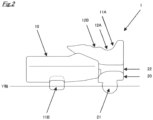
- Fig. 2 is an enlarged view of Fig. 1(b) .
- Fig. 3(a) is a plan view of the instrument 1
- Fig. 3(b) is a left side view of the instrument 1.
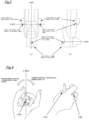
- Figs. 4 and 5 are views for explaining functions of respective units of the instrument 1.
- a horizontal direction with respect to an imaginary line that is perpendicular to a Y-axis and connects two second stoppers 11B will be described as an X-axis
- a longitudinal direction of the instrument 1 will be described as the Y-axis
- a horizontal direction with respect to an imaginary line that is perpendicular to the Y-axis and connects a first recess 12A and a contact portion 21 will be described as a Z-axis.
- the instrument 1 is designed so that the contact portion 21 of the instrument 1 hits the position of the Pacinian corpuscle by grasping the instrument 1 by a grasping method to be described later.
- the instrument 1 is designed to apply stimulation by pressing the Pacinian corpuscle with a contact surface 21A of the contact portion 21 of the instrument 1 with a gripping force of the little finger and an auxiliary gripping force of a ring finger.
- the contact portion 21 has a spherical shape so that only the Pacinian corpuscle can be pressed at a pinpoint (it is preferable to have a shape that does not stimulate (does not touch or hardly touch) a portion other than the Pacinian corpuscle).
- the instrument 1 includes a main body portion 10 grasped by a user, and the pressing portion 20 that is provided to protrude from the main body portion 10, and presses to stimulate the Pacinian corpuscle present in the palm of the user in a state where the main body portion 10 is grasped by the user.
- the pressing portion 20 includes the contact portion 21 (Pacinian ball) having the contact surface 21A that contacts the Pacinian corpuscle, and a connecting portion 22 that is separated from the palm of the user in the state where the main body portion 10 is grasped by the user and connects the main body portion 10 and the contact portion 21.
- the contact portion 21 has a shape (although it has a ball shape in the present embodiment, it is sufficient that only the Pacinian corpuscle can be pressed at the pinpoint, and other shapes are not excluded) capable of pressing only the Pacinian corpuscle at the pinpoint (it is preferable to have the shape that does not stimulate (does not touch or hardly touch) the portion other than the Pacinian corpuscle).
- the main body portion 10 of the instrument 1 includes a first stopper 11A that is provided to protrude from the main body portion 10, and contacts the little finger of the user in the state where the main body portion 10 is grasped by the user to position the instrument 1 in the palm of the user.
- the first stopper 11A restricts movement in an upward direction of the Y-axis.
- the main body portion 10 of the instrument 1 includes a second stopper 11B that is provided to protrude from the main body portion 10, positioned between an index finger and the middle finger of the user in the state where the main body portion 10 is grasped by the user, and restricts rotation of the instrument 1 in the palm of the user.
- the first stopper 11A restricts movement in a downward direction of the Y-axis.
- the main body portion 10 of the instrument 1 includes a third stopper 11C that is provided to protrude from the main body portion 10, and contacts a portion near a base of thumb of the user in the state where the main body portion 10 is grasped by the user to restrict the rotation of the instrument 1 in the palm of the user.
- the first stopper 11A restricts the movement in the downward direction of the Y-axis.
- the movement of the instrument 1 in the downward direction of the Y-axis is restricted by the first to third stoppers 11A to 11C, and the position of the instrument 1 in the palm does not move in the Y-axis direction at a gripping position.
- the contact portion 21 is displaced from the position of the Pacinian corpuscle. In order to press the Pacinian corpuscle with the contact portion 21 by a force of the little finger, the instrument 1 should not rotate in the palm. Therefore, as illustrated in Fig.
- the instrument 1 is designed so that the instrument 1 comes to an intended position of the palm (a position where the contact portion 21 (Pacinian ball) of the pressing portion 20 contacts the Pacinian corpuscle) at three points of the first stopper 11A as a starting point, the second stopper 11B, and the third stopper 11C.
- the main body portion of the instrument 1 has the first recess 12A for positioning the little finger of the user at a position substantially opposite to a position where the pressing portion 20 is provided.
- the main body portion 1 of the instrument 1 has a second recess 12B for positioning the ring finger of the user adjacent to the first recess 12A.
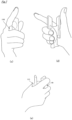
- the instrument 1 of the embodiment is configured such that by grasping the main body portion 10 with the little finger of the user positioned in the first recess 12A and the ring finger of the user positioned in the second recess 12B of the main body portion 10, the Pacinian corpuscle is pressed by the pressing portion 20 with an appropriate force as illustrated in Fig. 5 .
- the pressing portion 20 has a spherical shape. This is because when the Pacinian corpuscle is pressed and stimulated, if stimulation is applied to other sensory receptors and the like around the Pacinian corpuscle, they become disturbance, and sensitivity of pressure stimulation to the Pacinian corpuscle is reduced.
- the contact portion 21 (Pacinian ball) of the pressing portion 20 spherical, the pressure stimulation can be concentrated only on the Pacinian corpuscle, so that a space of a predetermined range is formed around the contact portion 21 of the ball-shaped pressing portion 20 that applies pressure, and effects of the present invention is increased.
- the space of the predetermined range is formed around the contact portion 21 of the pressing portion 20 and the pressure stimulation can be concentrated only on the Pacinian corpuscle, and the contact portion 21 of the pressing portion 20 does not necessarily have a spherical shape.
- the instrument is preferably designed so that a pressure applied to the Pacinian corpuscle of the palm is greater than a pressure applied to the other mechanoreceptors of the palm. From another point of view, it is preferred that a space is formed around the contact portion when the instrument of the present invention is used. In other words, a region (non-contact region) where the instrument does not contact the palm is preferably formed outside a region (contact region) where the contact portion is in contact with the palm so as to surround the contact region.
- the pressing portion 20 preferably press the Pacinian corpuscle of the palm in a pinpoint manner. It is preferred that the pressing portion 20 can be directed toward the Pacinian corpuscle of the palm when used and the contact portion 21 has a curved surface bulging toward the Pacinian corpuscle.
- the curved surface may be spherical or aspherical.
- degree of bulging is appropriately determined. For example, when the Pacinian corpuscle is strongly stimulated, the degree of bulging is increased, and when the Pacinian corpuscle is weakly stimulated, the degree of bulging is reduced (brought close to a plane).
- the pressing portion 20 may be formed of a column.
- the pressing portion 20 When the pressing portion 20 is formed of a column, a bottom surface of the column serves as the contact portion 21, and the contact portion 21 has a planar shape. The plane faces and contacts the Pacinian corpuscle. Further, the pressing portion 20 may be formed of a plurality of columns having different radii and concentrically arranged. The pressing portion 20 may have any shape as long as it can be directed to the Pacinian corpuscle of the palm and can concentrate pressure on the Pacinian corpuscle when used.
- a method of using the instrument 1 (The grasping method) will be described with reference to Figs. 6 and 7 .
- the instrument 1 is configured to be bilaterally symmetrical about the Y-axis in plan view, but does not necessarily have to be configured to bilaterally symmetrical about the Y-axis in plan view.
- the instrument 1 is an instrument for increasing the range of motion of the joint.
- the instrument 1 includes the main body portion 10 grasped by the user, and the pressing portion 20 that is provided to protrude from the main body portion 10, and presses to stimulate the Pacinian corpuscle present in the palm of the user in the state where the main body portion 10 is grasped by the user. Therefore, stretching can be performed in a state where the Pacinian corpuscle is stimulated, and the range of motion of the joint can be more effectively increased.
- the pressing portion 20 of the instrument 1 includes the contact portion 21 having the contact surface that contacts the Pacinian corpuscle, and the connecting portion 22 that is separated from the palm of the user in the state where the main body portion 10 is grasped by the user and connects the main body portion 10 and the contact portion. Therefore, it is possible to press and stimulate only the Pacinian corpuscle, and to increase the range of motion of the joint by causing muscle relaxation more effectively.
- the main body portion 10 of the instrument 1 includes the first recess 12A for positioning the little finger of the user at the position substantially opposite to the position where the pressing portion 20 is provided, and is configured such that the Pacinian corpuscle is pressed by the pressing portion 20 by grasping the main body portion 10 in a state where the little finger of the user is positioned in the first recess 12A of the main body portion 10. In this way, since the instrument 1 can be positioned in the palm of the user, the Pacinian corpuscle can be reliably pressed and stimulated.
- the main body portion 10 of the instrument 1 includes the second recess 12B for positioning the ring finger of the user adjacent to the first recess 12A, and is configured such that the Pacinian corpuscle is pressed by the pressing portion 20 by grasping the main body portion 10 in a state where the ring finger of the user is positioned in the second recess 12B of the main body portion 10. In this way, since the instrument 1 can be positioned in the palm of the user, the Pacinian corpuscle can be reliably pressed and stimulated.
- the main body portion 10 of the instrument 1 includes the first stopper 11A that is provided to protrude from the main body portion 10, and contacts the little finger of the user in the state where the main body portion 10 is grasped by the user to position the instrument in the palm of the user. In this way, since the instrument 1 can be positioned in the palm of the user, the Pacinian corpuscle can be reliably pressed and stimulated.
- the main body portion 10 of the instrument 1 includes the second stopper 11B that is provided to protrude from the main body portion 10, positioned between the index finger and the middle finger of the user in the state where the main body portion 10 is grasped by the user, and restricts the rotation of the instrument 1 in the palm of the user. In this way, since the instrument 1 can be positioned in the palm of the user, the Pacinian corpuscle can be reliably pressed and stimulated.
- the main body portion 10 of the instrument 1 includes the third stopper 11C that is provided to protrude from the main body portion 10, and contacts the portion near the base of the thumb of the user in the state where the main body portion 10 is grasped by the user to restrict the rotation of the instrument in the palm of the user. In this way, since the instrument 1 can be positioned in the palm of the user, the Pacinian corpuscle can be reliably pressed and stimulated.
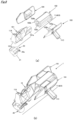
- Fig. 8 is a view illustrating a configuration of the instrument 1 according to a modification of the embodiment.
- Fig. 8(a) is a view in which the instrument 1 according to the modification of the embodiment is exploded
- Fig. 8(b) is a view in which the instrument 1 according to the modification of the embodiment is assembled.
- positions of the pressing portion 20 and the first to third stoppers 11A to 11C of the instrument 1 are fixed to the main body portion 10, but the instrument 1 according to the modification of the embodiment is configured such that the pressing portion 20 and the first to third stoppers 11A to 11C can be separated from the main body portion 10.
- the main body portion 10 is configured to be separable into a first main body portion 101, a second main body portion 102, a third main body portion 103, and a fourth main body portion 104.
- the first main body portion 101 is provided with a recess 101b with a longitudinal direction parallel to the Y-axis
- the pressing portion 20 is provided with a protrusion 20a slidably engaged with the recess 101b.
- the protrusion 20a of the pressing portion 20 is slidably engaged with the recess 101b of the first main body portion 101, so that a position of the contact portion 21 (Pacinian ball) of the pressing portion 20 can be adjusted in parallel to the Y-axis.
- first main body portion 101 is provided with a protrusion 101a with a longitudinal direction parallel to the Y-axis
- the second main body portion 102 is provided with a recess 102c slidably engaged with the protrusion 101a of the first main body portion 101.
- the protrusion 101a of the first main body portion 101 is slidably engaged with the recess 102c of the second main body portion 102, so that a position of the first stopper 11A (little finger stopper) can be adjusted parallel to the Y-axis (note that the position of the contact portion 21 (Pacinian ball) is also adjusted by adjusting the position of the first stopper 11A (little finger stopper)).
- the second main body portion 102 is provided with a protrusion 102a with a longitudinal direction parallel to the Y-axis
- the third main body portion 103 is provided with a recess 103b slidably engaged with the protrusion 102a of the second main body portion 102. Then, the recess 103b of the third main body portion 103 is slidably engaged with the protrusion 102a of the second main body portion 102, so that a position of the third stopper 11C (a thumb stopper) can be adjusted in parallel with the Y-axis.
- the second main body portion 102 is provided with the protrusion 102b with a longitudinal direction parallel to the Y-axis
- the fourth main body portion 104 is provided with a recess 104b slidably engaged with the protrusion 102b of the second main body portion 102. Then, the recess 104b of the fourth main body portion 104 is slidably engaged with the protrusion 102b of the second main body portion 102, so that a position of the second stopper 11B (a middle finger stopper) can be adjusted in parallel with the Y-axis.
- the instrument 1 according to the modification of the embodiment illustrated in Fig. 8 is equivalent to the instrument 1 according to the embodiment described with reference to Figs. 1 to 7 in terms of functions and configurations other than that the positions of the contact portion 21 (Pacinian ball) of the pressing portion 20 and the first to third stoppers 11A to 11C can be adjusted according to the differences in size and shape of the hand of each user. Therefore, redundant description of the functions and the grasping method of the instrument 1 according to the modification of the embodiment illustrated in Fig. 8 will be omitted (see Figs. 4 to 7 and corresponding descriptions for the functions and the grasping method).
- the instrument 1 does not necessarily have a shape to be grasped with one hand, and may be, for example, a clip-shaped instrument provided with a pressing portion that contacts the Pacinian corpuscle so as to sandwich the palm and apply stimulation to the Pacinian corpuscle by pressing.
- a pressing portion having a contact surface in contact with the Pacinian corpuscle may be provided inside a glove.
- the instrument according to the present invention promotes the muscle stretching, it is effective for various applications involving the muscle stretching.
- specific applications can include instruments for improving motion function (for example, for muscle stretching training (for example, stretching, yoga, and muscle training), for athletics (for example, sprint, marathon, and long jump), for ball game (for example, baseball and golf), for ice sports (for example, figure skating and jumping), and for rehabilitation (for example, low back pain, frozen shoulder, and stiff shoulder)).
- muscle stretching training for example, stretching, yoga, and muscle training
- athletics for example, sprint, marathon, and long jump
- ball game for example, baseball and golf
- ice sports for example, figure skating and jumping
- rehabilitation for example, low back pain, frozen shoulder, and stiff shoulder
- the number of rotations can be expected to be further increased.
- the present invention can further improve performance for athletes, and can improve muscle flexibility without pain for ordinary people. Note that in order to further achieve the effects of the present invention, it is preferable to continuously press the Pacinian corpuscle for a predetermined time (for example, about 5 minutes).
- test was performed on the following 8 men and women (hereinafter referred to as a subject) of different ages by the following method using a grip (the instrument 1 described with reference to Figs. 1 to 5 ).
- Attributes of the subject measured this time are shown in Table 1 below.
- Table 1 Attribute Subject number Age (years old) Sex 1 29 Female 2 34 Female 3 36 Male 4 39 Male 5 41 Male 6 41 Female 7 42 Female 8 70 Female
- the subject was asked to perform three types of measurement motions (three types of lateral bending, leg raising, and waist twisting) under three types of states, that is, an empty hand (a state in which nothing is grasped), a stick grasping state (a state in which a stick is grasped), and a grip grasping state (a state in which the grip is grasped), and the subject was asked about muscle pain and stretching during the muscle stretching.
- an empty hand a state in which nothing is grasped
- a stick grasping state a state in which a stick is grasped
- a grip grasping state a state in which the grip is grasped
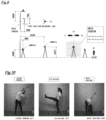
- the subject was caused to stand at a predetermined position, the three types of measurement motions (three types of lateral bending, leg raising, and waist twisting) were photographed by a video camera (a camera 1 and a camera 2), and angles of the range of motion of the joint were measured under states of the empty hand (the state in which nothing is grasped), the stick grasping state (the state in which a stick is grasped), and the grip grasping state (the state in which the grip is grasped).
- a mat for fixing a position of a foot of the subject was placed on the floor. Photographing with the video camera was performed on the subject by placing one video camera in front of and one video camera in a side of the subject (see Fig. 9 ).
- the subject was measured by the following procedure.
- the subject stands in line with a predetermined foot position reference line and performs the three types of measurement motions.
- the camera 1 photographs the range of motion of the joint in various motions of the subject, and used them as data to check increase of the range of motion of the joint.
- measurement motions As motions for effect measurement (hereinafter referred to as measurement motions), the three types of lateral bending, leg raising, and waist twisting were respectively performed on left and right sides (see Fig. 10 ).
- a distance of the subject from the camera 1 was kept constant and positioning for the subject to stand at a right angle to a line of sight of the camera 1 was performed as follows.
- the Pacinian corpuscles in the palm are one of mechanical receptors found in skin, and as described with reference to Fig. 1 , are in a tip of the middle finger and the palm below the little finger, and are the range of motion of the joint that detects the pressure.
- the Pacinian corpuscle is in the tip of the middle finger, it is easy to detect the position, and it was performed in order to allow the user to feel sensation of throbbing when the Pacinian corpuscle was pressed.
- the Pacinian corpuscle in the palm pressed was detected in the measurement of the present example.
- Fig. 14 is an image illustrating the position of the Pacinian corpuscle detected on the palm of each subject. Note that a mark marked with a marker is surrounded by "O" because it is difficult to see in the image of Fig. 14 .
- An origin of the body of the subject (an origin for measuring an effect of increasing the range of motion of the joint) was defined as follows.
- a position on the vertical axis center line (CL) at a position of 150 cm from the floor surface was defined as a grid origin for use in the measurement.
- origins were defined as origins for measuring the effect of increasing the range of motion of the joint.
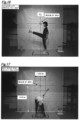
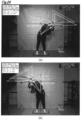
- Lateral bending is a motion of bending sides of the body. How to do it is to stand on the floor with the body straight and raise a right arm straight up so as to be parallel to the vertical axis center line, and it is a motion of bending only an upper body to the left or right side without moving a lower body as in a lower image.
- the subject bends the side about the vertical axis center line and a lateral bending origin, a tilt angle ( ⁇ 1) of the trunk during the empty hand, a tilt angle ( ⁇ 2) of the trunk during the stick grasping, and a tilt angle ( ⁇ 3) of the trunk during the grip grasping were measured, and differences therebetween were compared.
- Fig. 21 shows an image when the tilt angle ( ⁇ 1) of the trunk during the empty hand (dotted line) and the tilt angle ( ⁇ 3) of the trunk during the grip grasping (solid line) were measured.
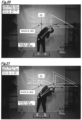
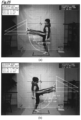
- the leg raising is a motion of standing up straight with both feet aligned, and swinging a left foot or a right foot forward as in the image without back action.
- a bending angle ( ⁇ 1) between an axial leg and a swing leg during the empty hand, a bending angle ( ⁇ 2) between the axial leg and the swing leg during the stick grasping, and a bending angle ( ⁇ 3) between the axial leg and the swing leg in the grip grasping were measured from a leg raising origin, and differences therebetween were compared.
- Fig. 22 shows an image when the bending angle ( ⁇ 1) between the axial leg and the swing leg during the empty hand (dotted line) and the bending angle ( ⁇ 3) between the axial leg and the swing leg during the grip grasping (solid line) were measured.
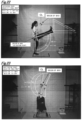
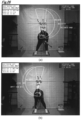
- the waist twisting is a motion of standing with the body straight, and then bending the body forward to the maximum, keeping the lower body not to move, directing the left hand in a direction of a positioning tape of a shoe of the right foot, stretching the right hand straight down, slowly raising the right hand toward the vertical axis center line at an upper side, and twisting the body only with the upper body.
- centering on an intersection of a vertical line of the vertical axis center line and a line of a twist angle, a twist angle ( ⁇ 1) during the empty hand, a twist angle ( ⁇ 2) during the stick grasping, and a twist angle ( ⁇ 3) during the grip grasping were measured, and differences therebetween were compared.
- Fig. 23 shows an image when the twist angle ( ⁇ 1) during the empty hand (dotted line) and the twist angle ( ⁇ 3) during the grip grasping (solid line) were measured.
- Figs. 24 to 26 illustrate measurement images of the lateral bending, the leg raising, and the waist twisting.
- Fig. 24(a) is an image of lateral bending left
- Fig. 24(b ) is an image of lateral bending right
- Fig. 25(a) is an image of the leg raising left
- Fig. 25(b) is an image of the leg raising right
- Fig. 26(a) is an image of the waist twisting left
- Fig. 26(b) is an image of the waist twisting right.
- Figs. 24 to 26 illustrate a measurement image of the empty hand in addition to the measurement image of "stick” and the measurement image of "grip (instrument 1)".
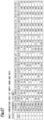
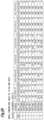
- Fig. 27 is a diagram showing measurement results of the angle ( ⁇ 1) with the "empty hand” and the angle ( ⁇ 3) during the "grip (instrument 1)" grasping measured as described above and differences ( ⁇ 1) therebetween.
- Fig. 28 is a diagram showing measurement results of the angle ( ⁇ 2) during the “stick” gripping and the angle ( ⁇ 3) during the "grip (instrument 1)" grasping measured as described above and differences ( ⁇ 2) therebetween.
- Fig. 29 is a diagram showing measurement results of the angle ( ⁇ 1) with the "empty hand” and the angle ( ⁇ 2) during the “stick” grasping measured as described above and differences ( ⁇ 4) therebetween.
- each of the above embodiments is merely an example of implementation in implementing the present invention, and the technical scope of the present invention should not be construed to be limited by this. That is, the present invention can be implemented in various forms without departing from the gist or main features thereof. For example, each configuration of the embodiments may be combined and implemented.
- An instrument for promoting the muscle stretching or for increasing the range of motion of the j oint including a pressing portion capable of pressing a Pacinian corpuscle present in a palm.
- the instrument including a main body portion and the pressing portion provided to protrude from the main body portion, in which by grasping the main body portion with one hand, the pressing portion can contact skin on the Pacinian corpuscle present in the palm to press the Pacinian corpuscle.
- the main body portion includes a first stopper that is provided to protrude from the main body portion, and contacts the little finger of the user in a state where the main body portion is grasped by the user to position the instrument in the palm of the user.
- the main body portion includes a second stopper that is provided to protrude from the main body portion, positioned between an index finger and the middle finger of the user in a state where the main body portion is grasped by the user, and restricts rotation of the instrument in the palm of the user.
- the main body portion includes a third stopper that is provided to protrude from the main body portion, and contacts a portion near a base of thumb of the user in a state where the main body portion is grasped by the user to restrict rotation of the instrument in the palm of the user.
- a training method for increasing a range of motion of a j oint including grasping with one hand a main body portion of an instrument including: a main body portion; and a pressing portion that is provided to protrude from the main body portion and presses to stimulate a Pacinian corpuscle present in a palm of a user, so that the pressing portion contacts skin on the Pacinian corpuscle to move the joint in a state where the Pacinian corpuscle is pressed.
- the instrument according to any one of the means 1 to 9, which is for improving motion function or for rehabilitation.
Landscapes
- Health & Medical Sciences (AREA)
- General Health & Medical Sciences (AREA)
- Physical Education & Sports Medicine (AREA)
- Orthopedic Medicine & Surgery (AREA)
- Life Sciences & Earth Sciences (AREA)
- Epidemiology (AREA)
- Pain & Pain Management (AREA)
- Rehabilitation Therapy (AREA)
- Animal Behavior & Ethology (AREA)
- Public Health (AREA)
- Veterinary Medicine (AREA)
- Dermatology (AREA)
- Biophysics (AREA)
- Cardiology (AREA)
- Vascular Medicine (AREA)
- Finger-Pressure Massage (AREA)
- Rehabilitation Tools (AREA)
- Measurement Of The Respiration, Hearing Ability, Form, And Blood Characteristics Of Living Organisms (AREA)
Applications Claiming Priority (2)
| Application Number | Priority Date | Filing Date | Title |
|---|---|---|---|
| JP2020207094A JP6894565B1 (ja) | 2020-12-14 | 2020-12-14 | 器具、トレーニング方法 |
| PCT/JP2021/044544 WO2022131031A1 (ja) | 2020-12-14 | 2021-12-03 | 器具、トレーニング方法 |
Publications (4)
| Publication Number | Publication Date |
|---|---|
| EP4260918A1 true EP4260918A1 (de) | 2023-10-18 |
| EP4260918A4 EP4260918A4 (de) | 2024-10-30 |
| EP4260918C0 EP4260918C0 (de) | 2026-01-28 |
| EP4260918B1 EP4260918B1 (de) | 2026-01-28 |
Family
ID=76540368
Family Applications (1)
| Application Number | Title | Priority Date | Filing Date |
|---|---|---|---|
| EP21906394.8A Active EP4260918B1 (de) | 2020-12-14 | 2021-12-03 | Ausrüstung und trainingsverfahren |
Country Status (4)
| Country | Link |
|---|---|
| US (1) | US12102871B2 (de) |
| EP (1) | EP4260918B1 (de) |
| JP (2) | JP6894565B1 (de) |
| WO (1) | WO2022131031A1 (de) |
Families Citing this family (2)
| Publication number | Priority date | Publication date | Assignee | Title |
|---|---|---|---|---|
| JP7674732B2 (ja) * | 2021-06-22 | 2025-05-12 | 株式会社レモン | 器具、位置特定方法 |
| JP7674733B2 (ja) * | 2021-06-22 | 2025-05-12 | 株式会社レモン | 日用把持対象品 |
Family Cites Families (21)
| Publication number | Priority date | Publication date | Assignee | Title |
|---|---|---|---|---|
| US4590625A (en) * | 1985-03-18 | 1986-05-27 | Keim George F | Golfer's glove |
| US4882787A (en) * | 1988-09-02 | 1989-11-28 | Hull Harold L | Golf glove |
| EP0435521B1 (de) | 1989-12-15 | 1994-06-22 | Atuhiko Sato | Fingertrainingsgerät |
| JPH0626624B2 (ja) * | 1989-12-15 | 1994-04-13 | 敦彦 佐藤 | 指訓練器 |
| JPH10137320A (ja) * | 1996-11-13 | 1998-05-26 | Nobuyuki Machida | 手指健康器具 |
| JPH1142296A (ja) * | 1997-07-24 | 1999-02-16 | Takeshige Fujitani | 指屈伸運動助成具 |
| JPH11299926A (ja) | 1998-04-16 | 1999-11-02 | Bunbuku:Kk | ストレッチング用補助器具 |
| JP3078881U (ja) * | 2000-11-18 | 2001-07-27 | 和恵 菊地 | 手の介護具 |
| JP3472924B2 (ja) * | 2001-03-12 | 2003-12-02 | 靖則 鎮守 | 多機能遊具 |
| US7010835B2 (en) * | 2001-10-24 | 2006-03-14 | Tillim Stephen L | Parallel handle system and method for designing a parallel handle system |
| JP2007268056A (ja) * | 2006-03-31 | 2007-10-18 | Toto Ltd | 歩行訓練器 |
| WO2010033055A1 (en) * | 2008-09-17 | 2010-03-25 | Handmedic Hb | A system for applying controlled selective vibration stimuli to the hand |
| JP5320012B2 (ja) * | 2008-10-10 | 2013-10-23 | パナソニック株式会社 | 姿勢改善支援装置 |
| US10500744B1 (en) * | 2014-01-31 | 2019-12-10 | Dryfhout Properties, Llc | Safety razor with plurality of comb and integrated blade groups |
| JP6563665B2 (ja) * | 2015-03-26 | 2019-08-21 | カワイチ株式会社 | 手のひらのツボを刺激するための及び/又は手の示指、中指及び環指における爪の先端から第二関節までを屈曲させる筋力を増強するための器具 |
| JP2017035450A (ja) * | 2015-08-08 | 2017-02-16 | 茂幸 麻生 | 手指健康具 |
| JP6667810B2 (ja) * | 2016-07-15 | 2020-03-18 | 国立大学法人電気通信大学 | 触覚提示装置 |
| US10213640B2 (en) * | 2017-01-17 | 2019-02-26 | Chris St. Jeor | Anatomical yoga hand grip and trainer for relieving wrist strain |
| US20180236337A1 (en) * | 2017-02-22 | 2018-08-23 | Rocky Frith, Jr. | Training Equipment for Athletic Skills |
| RU2708949C2 (ru) | 2017-07-26 | 2019-12-12 | Фёдор Валентинович Беломоев | Устройство и способ имитации и передачи контактных экстероцептивных ощущений |
| US9918504B1 (en) * | 2017-11-02 | 2018-03-20 | Lanny L. Johnson | Sensitivity enhancement glove |
-
2020
- 2020-12-14 JP JP2020207094A patent/JP6894565B1/ja active Active
-
2021
- 2021-06-02 JP JP2021092996A patent/JP2022094281A/ja active Pending
- 2021-12-03 WO PCT/JP2021/044544 patent/WO2022131031A1/ja not_active Ceased
- 2021-12-03 US US18/257,253 patent/US12102871B2/en active Active
- 2021-12-03 EP EP21906394.8A patent/EP4260918B1/de active Active
Also Published As
| Publication number | Publication date |
|---|---|
| US20240033567A1 (en) | 2024-02-01 |
| EP4260918A4 (de) | 2024-10-30 |
| WO2022131031A1 (ja) | 2022-06-23 |
| JP2022094199A (ja) | 2022-06-24 |
| JP6894565B1 (ja) | 2021-06-30 |
| JP2022094281A (ja) | 2022-06-24 |
| EP4260918C0 (de) | 2026-01-28 |
| US12102871B2 (en) | 2024-10-01 |
| EP4260918B1 (de) | 2026-01-28 |
Similar Documents
| Publication | Publication Date | Title |
|---|---|---|
| Szeto et al. | A comparison of symptomatic and asymptomatic office workers performing monotonous keyboard work—2: neck and shoulder kinematics | |
| Naik et al. | Prevalence of MSDs and postural risk assessment in floor mopping activity through subjective and objective measures | |
| Khuu et al. | Not all single leg squats are equal: a biomechanical comparison of three variations | |
| Jaspers et al. | Review of quantitative measurements of upper limb movements in hemiplegic cerebral palsy | |
| Falla et al. | People with chronic neck pain walk with a stiffer spine | |
| Michael et al. | What is the effect of compression garments on a balance task in female athletes? | |
| Prudente et al. | Lower limb muscle activation during the sit-to-stand task in subjects who have had a stroke | |
| Pourahmadi et al. | Kinematics of the spine during sit-to-stand movement using motion analysis systems: a systematic review of literature | |
| Grooten et al. | Is active sitting as active as we think? | |
| Cortell-Tormo et al. | Lumbatex: a wearable monitoring system based on inertial sensors to measure and control the lumbar spine motion | |
| Zabihhosseinian et al. | Neck muscle fatigue differentially alters scapular and humeral kinematics during humeral elevation in subclinical neck pain participants versus healthy controls | |
| Choi et al. | Effects of game-based constraint-induced movement therapy on balance in patients with stroke: a single-blind randomized controlled trial | |
| EP4260918B1 (de) | Ausrüstung und trainingsverfahren | |
| Martinez et al. | K-score: A novel scoring system to quantify fatigue-related ergonomic risk based on joint angle measurements via wearable inertial measurement units | |
| Granacher et al. | Relationships between trunk muscle strength, spinal mobility, and balance performance in older adults | |
| Vanezis et al. | The reliability of the ELEPAP clinical protocol for the 3D kinematic evaluation of upper limb function | |
| Minn et al. | Gender differences in sensorimotor characteristics associated with the performance of a manual dexterity task at shoulder height | |
| Rucco et al. | A new technical method to analyse the kinematics of the human movements and sports gesture | |
| Eveleigh et al. | Principal component analysis of whole-body kinematics using markerless motion capture during static balance tasks | |
| Haddas et al. | The relationship between fear-avoidance and neuromuscular measures of function in patients with adult degenerative scoliosis | |
| Waslen et al. | Do sex and age influence scapular and thoracohumeral kinematics during a functional task protocol? | |
| Spreitzer et al. | Challenging stability limits in old and young individuals with a functional reaching task | |
| Musalem et al. | Biomechanical and electromyographic comparisons of isometric trunk flexor endurance test postures: Prone plank versus V-sit | |
| Barroso et al. | Improvement of hand function in children with cerebral palsy via an orthosis that provides wrist extension and thumb abduction | |
| Fatahi et al. | The effect of lower extremity muscle fatigue on dynamic postural control analyzed by electromyography |
Legal Events
| Date | Code | Title | Description |
|---|---|---|---|
| STAA | Information on the status of an ep patent application or granted ep patent |
Free format text: STATUS: THE INTERNATIONAL PUBLICATION HAS BEEN MADE |
|
| PUAI | Public reference made under article 153(3) epc to a published international application that has entered the european phase |
Free format text: ORIGINAL CODE: 0009012 |
|
| STAA | Information on the status of an ep patent application or granted ep patent |
Free format text: STATUS: REQUEST FOR EXAMINATION WAS MADE |
|
| 17P | Request for examination filed |
Effective date: 20230710 |
|
| AK | Designated contracting states |
Kind code of ref document: A1 Designated state(s): AL AT BE BG CH CY CZ DE DK EE ES FI FR GB GR HR HU IE IS IT LI LT LU LV MC MK MT NL NO PL PT RO RS SE SI SK SM TR |
|
| DAV | Request for validation of the european patent (deleted) | ||
| DAX | Request for extension of the european patent (deleted) | ||
| A4 | Supplementary search report drawn up and despatched |
Effective date: 20240926 |
|
| RIC1 | Information provided on ipc code assigned before grant |
Ipc: A63B 23/00 20060101ALI20240920BHEP Ipc: A63B 22/00 20060101ALI20240920BHEP Ipc: A63B 21/00 20060101ALI20240920BHEP Ipc: A63B 71/14 20060101ALI20240920BHEP Ipc: A61H 1/02 20060101ALI20240920BHEP Ipc: A63B 23/16 20060101AFI20240920BHEP |
|
| STAA | Information on the status of an ep patent application or granted ep patent |
Free format text: STATUS: EXAMINATION IS IN PROGRESS |
|
| 17Q | First examination report despatched |
Effective date: 20250422 |
|
| GRAP | Despatch of communication of intention to grant a patent |
Free format text: ORIGINAL CODE: EPIDOSNIGR1 |
|
| STAA | Information on the status of an ep patent application or granted ep patent |
Free format text: STATUS: GRANT OF PATENT IS INTENDED |
|
| INTG | Intention to grant announced |
Effective date: 20250911 |
|
| GRAS | Grant fee paid |
Free format text: ORIGINAL CODE: EPIDOSNIGR3 |
|
| GRAA | (expected) grant |
Free format text: ORIGINAL CODE: 0009210 |
|
| STAA | Information on the status of an ep patent application or granted ep patent |
Free format text: STATUS: THE PATENT HAS BEEN GRANTED |
|
| AK | Designated contracting states |
Kind code of ref document: B1 Designated state(s): AL AT BE BG CH CY CZ DE DK EE ES FI FR GB GR HR HU IE IS IT LI LT LU LV MC MK MT NL NO PL PT RO RS SE SI SK SM TR |
|
| REG | Reference to a national code |
Ref country code: CH Ref legal event code: F10 Free format text: ST27 STATUS EVENT CODE: U-0-0-F10-F00 (AS PROVIDED BY THE NATIONAL OFFICE) Effective date: 20260128 Ref country code: GB Ref legal event code: FG4D |
|
| REG | Reference to a national code |
Ref country code: IE Ref legal event code: FG4D |
|
| U01 | Request for unitary effect filed |
Effective date: 20260128 |
|
| U07 | Unitary effect registered |
Designated state(s): AT BE BG DE DK EE FI FR IT LT LU LV MT NL PT RO SE SI Effective date: 20260203 |