EP4251374B1 - Handwerkzeugmaschine - Google Patents
Handwerkzeugmaschine Download PDFInfo
- Publication number
- EP4251374B1 EP4251374B1 EP21806256.0A EP21806256A EP4251374B1 EP 4251374 B1 EP4251374 B1 EP 4251374B1 EP 21806256 A EP21806256 A EP 21806256A EP 4251374 B1 EP4251374 B1 EP 4251374B1
- Authority
- EP
- European Patent Office
- Prior art keywords
- hand
- power tool
- held power
- tool according
- button
- Prior art date
- Legal status (The legal status is an assumption and is not a legal conclusion. Google has not performed a legal analysis and makes no representation as to the accuracy of the status listed.)
- Active
Links
Images

Classifications
-
- B—PERFORMING OPERATIONS; TRANSPORTING
- B25—HAND TOOLS; PORTABLE POWER-DRIVEN TOOLS; MANIPULATORS
- B25D—PERCUSSIVE TOOLS
- B25D17/00—Details of, or accessories for, portable power-driven percussive tools
-
- B—PERFORMING OPERATIONS; TRANSPORTING
- B25—HAND TOOLS; PORTABLE POWER-DRIVEN TOOLS; MANIPULATORS
- B25F—COMBINATION OR MULTI-PURPOSE TOOLS NOT OTHERWISE PROVIDED FOR; DETAILS OR COMPONENTS OF PORTABLE POWER-DRIVEN TOOLS NOT PARTICULARLY RELATED TO THE OPERATIONS PERFORMED AND NOT OTHERWISE PROVIDED FOR
- B25F5/00—Details or components of portable power-driven tools not particularly related to the operations performed and not otherwise provided for
-
- H—ELECTRICITY
- H01—ELECTRIC ELEMENTS
- H01H—ELECTRIC SWITCHES; RELAYS; SELECTORS; EMERGENCY PROTECTIVE DEVICES
- H01H9/00—Details of switching devices, not covered by groups H01H1/00 - H01H7/00
- H01H9/02—Bases, casings, or covers
- H01H9/06—Casing of switch constituted by a handle serving a purpose other than the actuation of the switch, e.g. by the handle of a vacuum cleaner
-
- H—ELECTRICITY
- H02—GENERATION; CONVERSION OR DISTRIBUTION OF ELECTRIC POWER
- H02J—ELECTRIC POWER NETWORKS; CIRCUIT ARRANGEMENTS OR SYSTEMS FOR SUPPLYING OR DISTRIBUTING ELECTRIC POWER; SYSTEMS FOR STORING ELECTRIC ENERGY
- H02J7/00—Circuit arrangements for charging or discharging batteries or for supplying loads from batteries
- H02J7/70—Circuit arrangements for charging or discharging batteries or for supplying loads from batteries characterised by the mechanical construction
-
- H—ELECTRICITY
- H02—GENERATION; CONVERSION OR DISTRIBUTION OF ELECTRIC POWER
- H02P—CONTROL OR REGULATION OF ELECTRIC MOTORS, ELECTRIC GENERATORS OR DYNAMO-ELECTRIC CONVERTERS; CONTROLLING TRANSFORMERS, REACTORS OR CHOKE COILS
- H02P29/00—Arrangements for regulating or controlling electric motors, appropriate for both AC and DC motors
- H02P29/02—Providing protection against overload without automatic interruption of supply
- H02P29/024—Detecting a fault condition, e.g. short circuit, locked rotor, open circuit or loss of load
- H02P29/028—Detecting a fault condition, e.g. short circuit, locked rotor, open circuit or loss of load the motor continuing operation despite the fault condition, e.g. eliminating, compensating for or remedying the fault
-
- B—PERFORMING OPERATIONS; TRANSPORTING
- B25—HAND TOOLS; PORTABLE POWER-DRIVEN TOOLS; MANIPULATORS
- B25D—PERCUSSIVE TOOLS
- B25D2250/00—General details of portable percussive tools; Components used in portable percussive tools
- B25D2250/255—Switches
Definitions
- the present invention relates to a hand-held power tool, in particular an electric hand-held power tool, such as an electric screwdriver.
- Electrically operated handheld power tools often have an electric motor that is supplied with energy from an electrical energy source.
- high-frequency interference voltages or interference currents can occur in the control circuit. These can be short-circuited to ground using an interference suppression capacitor, for example, in order to reduce or prevent the generation of electromagnetic interference signals.
- the interference suppression capacitor is integrated into the handle of the main switch, for example, for reasons of space, and is wired directly to the phase conductor, which carries the current for the electric motor, and to the neutral conductor. This requires a lot of wiring effort.
- a hand-held power tool with a control circuit for providing a setting signal depending on the actuation of a button and a control device for setting a drive current for an electric motor of the hand-held power tool depending on the setting signal.
- the control device is connected via a first electrical line arrangement to an electrical energy source for operating the hand-held power tool and the control circuit is connected via a second electrical line arrangement to the Control device connected.
- a drive current line carrying the drive current for the electric motor is routed via an interruption switch coupled to the button for interrupting the drive current, wherein an interference suppression capacitor is connected via a first node to the drive current line and via a second node to the second electrical line arrangement.
- This handheld power tool has the advantage that the wiring effort is reduced compared to conventional solutions. Because the interference suppression capacitor is connected via the second electrical line arrangement, a separate line connecting the interference suppression capacitor to a neutral conductor of the electrical energy source is not required. This also eliminates the need for plugs or sockets that may be necessary to run such a line through the walls inside the housing.
- the hand-held power tool can be designed as a mains-operated device that must be connected to a power supply during operation, or as a mains-independent device that is supplied with energy via a rechargeable battery, for example.
- the handheld power tool is designed, for example, as a drill, an impact drill, a hammer drill, a demolition hammer, a grinder, a cut-off grinder, a mixer or a saw. This list is merely exemplary and should not be understood as exhaustive.
- the button is designed, for example, as a lagging button, which requires a continuous pressure in order to be activated.
- the button can also be referred to as an on-off switch, a main switch, a torque regulator or the like.
- the button is activated by the user of the hand-held power tool to operate the hand-held power tool.
- the control circuit provides the setting signal depending on the button being pressed.
- the setting signal can also be referred to as a speed setpoint, speed control signal, control signal or the like.
- the setting signal can comprise a plurality of discrete levels and/or the setting signal can be continuous.
- the setting signal corresponds, for example, to a value between 0% and 100% for the drive current.
- the setting signal is determined in particular as a function of the pressure exerted on the button.
- the button has, for example, a certain actuation path, for example the button can be moved by up to 10 mm pressed, whereby the setting signal is, for example, proportional to a current button position.
- the control device is connected to the electrical energy source via the first electrical line arrangement.
- the control device comprises in particular a driver circuit.
- the electrical energy source is, for example, an electrical power network or a battery.
- the first electrical line arrangement comprises at least two conductors that are insulated from one another, in particular a phase conductor and a neutral conductor. A protective conductor can also be provided.
- the hand-held power tool is supplied with electrical energy via the first electrical line arrangement even when the button is not actuated. This means that, for example, integrated circuits, display elements and/or other peripheral elements can be permanently supplied with power.
- the interruption switch serves as a safety device that completely interrupts the drive current as soon as the button is no longer pressed or falls below an actuation threshold.
- the interruption switch is preferably mechanically coupled directly to the button.
- the drive current line is an additional current line that runs between the control device and the interruption switch on the one hand and between the interruption switch and the electrical energy source on the other.
- the level of the drive current is set by the control device depending on the setting signal. It can also be said that the drive current is controlled or regulated by the control device.
- the setting signal is 100%
- the electric motor is supplied with the maximum electrical power. Then the electric motor has, for example, the highest torque and/or the highest speed.
- the interference suppression capacitor is connected between the drive current line and the second electrical line arrangement.
- the connection to the second electrical line arrangement can be made directly or via an intermediate circuit, such as the control circuit.
- the potential required for the function of the interference suppression capacitor can be looped through the control circuit, for example.
- the interference suppression capacitor is directly connected to the second electrical line arrangement.
- Directly connected means in particular that no active or passive electrical component is arranged between the interference suppression capacitor and the second electrical line arrangement. If the interference suppression capacitor is connected to the second electrical line arrangement via a line looped through the control circuit, this is also considered “directly connected”.
- the interference suppression capacitor is connected directly to the second electrical line arrangement via a separate line. This embodiment excludes a connection via a looped line.
- the interference suppression capacitor is connected to a neutral conductor potential or to a ground potential via the second electrical line arrangement.
- the neutral conductor potential refers in particular to a phase conductor potential of an electrical power network.
- the drive current line is accordingly coupled to the phase conductor of the power network.
- the interruption switch is connected to the control device via a first section of the drive current line and to the electrical energy source via a second section of the drive current line, wherein the interference suppression capacitor is connected to the second section of the drive current line via the first node.
- interference suppression capacitor is coupled to the electrical energy source. This has the advantage that when the interrupter switch is opened, a charge stored in the interference suppression capacitor can flow into the electrical energy source. This prevents any interference, impairment or damage to elements in the handheld power tool.
- the interruption switch is opened or closed depending on an actuation of the button.
- the interruption switch is closed when the button is pressed by 10% - 20%. For a button with a 10 mm adjustment range, this corresponds to an actuation of 1 mm - 2 mm.
- control circuit the button, the interference suppression capacitor and the interruption switch are part of a common component.
- the common component comprises in particular a common fastening unit, for example a mounting plate or the like.
- control circuit the interference suppression capacitor and the interrupt button can be arranged in a housing, with the button being arranged on the housing in such a way that it can be actuated from the outside.
- the housing can preferably have sockets or plugs via which the second electrical line arrangement and the drive current line are led into the housing.
- control circuit comprises a circuit board on which at least one detection unit coupled to the button is integrated for detecting the actuation of the button.
- the detection unit is designed in particular to detect a current position of the button and to output the setting signal depending on the detected current position.
- the detection unit comprises, for example, a voltage divider that outputs an analog voltage signal depending on an input voltage and the current position. Additionally and/or alternatively, the detection unit can comprise a digital converter that outputs the setting signal in the form of a duty cycle.
- the current position of the button can be detected optically or magnetically, for example.
- the interference suppression capacitor is integrated on the circuit board.
- the interference suppression capacitor is designed as an SMD component.
- control circuit is integrated in a handle of the hand-held power tool and the button can be actuated from the outside on the handle.
- interrupter switch and the interference suppression capacitor with the control circuit are also arranged in the handle.
- control device is configured to provide an operating voltage for the control circuit via the second electrical line arrangement.
- the control circuit is operated with a low voltage, for example in a range between 1 V - 20 V.
- the second electrical line arrangement comprises lines with a maximum cross-section of 1 mm 2 , preferably 0.5 mm 2 , more preferably 0.33 mm 2 .
- cables with a thin cross-section can be used, which reduces the amount of material required.
- the drive current cable has a cable cross-section between 1.5 mm 2 - 5 mm 2 .
- High currents and high power can be transmitted via this cable, which is advantageous for the operation of the electric motor in order to generate high torque.
- the interference suppression capacitor has a capacitance between 0.1 - 1 ⁇ F.
- the interference suppression capacitor is designed as a class X1 or a class X2 capacitor.
- Class X1 capacitors are designed for voltage peaks between 2500 - 4000 V and Class X2 capacitors are designed for voltage peaks up to 2500 V.
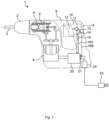
- Fig.1 shows a schematic of a hand-held power tool 1, which in this example is designed as a hammer drill.
- the hammer drill 1 has a tool holder 2, into which a drill bit 3 can be inserted as a tool.
- a primary drive of the hammer drill 1 is an electric motor 4, which drives a percussion mechanism 5 and a drive shaft 6.
- a user can guide the hammer drill 1 using a handle 8 and start the hammer drill 1 using a button 12.
- the hammer drill 1 continuously rotates the drill bit 3 about a working axis and can drive the drill bit 3 into a substrate along the working axis.
- An electrical arrangement 10 is arranged in the handle 8, which fulfils various functions.
- a control circuit 11 is used to provide a setting signal SIG (see Fig.2 ) depending on an actuation of the button 12.
- the control circuit 11 is coupled to a control device 20 by means of the second electrical line arrangement 15.
- the setting signal SIG is transmitted in particular via the second electrical line arrangement 15.
- the control circuit 11 provides the Setting signal SIG is available depending on a current position of the button 12, which is designed in particular as a lagging button.
- the combination of the button 12 and the control circuit 11 can also be referred to as speed control.
- the electrical arrangement 10 further comprises an interruption switch 14, which is arranged in a drive current line 16A, 16B carrying the drive current for the electric motor 4.
- the interruption switch 14 is coupled to the button 12 and is opened or closed depending on whether the button 12 is actuated.
- the interruption switch 14 ensures that the electric motor 4 is only supplied with power when the button 12 is actuated.
- the arrangement 10 also comprises an interference suppression capacitor 13, which is connected on the one hand to the drive current line 16A, 16B and on the other hand to the second electrical line arrangement 15. In this example, the connection to the second electrical line arrangement 15 is realized via the control circuit 11.
- the tool holder 2 has a sleeve into which one end of the drill bit 3 can be inserted.
- the torque is provided by the electric motor 4 and transmitted to the sleeve via a drive train.
- the drive train includes, for example, the output shaft 6 and a gear between the motor 4 and the drive shaft 6.
- the gear can, for example, adapt a speed of the motor 4 to a desired speed of the drill bit 3.
- the speed and/or the torque of the electric motor 4 is set by a control device 20 depending on the setting signal SIG. It can also be said that the control device 20 controls the electric motor and/or regulates it to a setpoint.
- the control device 20 is coupled via a first electrical line arrangement 21 to a connection terminal 24, which can be coupled to a power network (not shown) by means of a plug 23.
- the hammer drill 1 can also be supplied with power via a battery (not shown).
- a power consumption of the electric motor 4 during operation, the operating value preferably corresponds approximately to the nominal power of the electric motor 4, whereby an optimal ratio of power to weight is obtained.
- the electric motor 4 is in particular a mechanically commutating universal motor and/or an electronically commutating motor.
- Fig. 2 shows a schematic view of an embodiment of an internal wiring of a hand tool 1, for example the hammer drill 1 of Fig.1 .
- a hand tool 1 for example the hammer drill 1 of Fig.1 .
- it is a mains-operated hand tool 1 that can be connected to a power supply (not shown) via a plug 23.
- a Connection terminal 24 which is in particular in a housing 9 (see Fig.1 ) of the hand-held power tool 1, in this example a phase conductor L and a neutral conductor N are provided.
- a control device 20 is connected to the connection terminal 24 and the two phases L, N of the power grid via a first electrical line arrangement 21.
- the control device 20 can thus be supplied with electrical energy as soon as the plug 23 is coupled to the power grid.
- the first electrical line arrangement 21 comprises lines with a cross-section of up to 5 mm 2 .
- the control device 20 comprises, for example, a transformer (not shown) which is designed to generate and provide a low voltage.
- the low voltage is, for example, one or more voltage values between 1 V and 20 V.
- the low voltage can be used to operate, for example, integrated components such as a control unit (ASIC: application specific integrated circuit, PLC: programmable logic controller, CPU: central processing unit), storage units (ROM: read only memory, RAM: random access memory), display devices (LCD: liquid crystal display), lighting devices (LED: light emitting diode) and the like.
- ASIC application specific integrated circuit
- PLC programmable logic controller
- CPU central processing unit
- storage units ROM: read only memory
- RAM random access memory
- display devices LCD: liquid crystal display
- LED light emitting diode
- a control circuit 11 is connected to the control device 20 via a second electrical line arrangement 15 and is supplied with the low voltage via this.
- the second electrical line arrangement 15 in this example comprises three separate lines N, V, SIG, whereby the lines N and V correspond to the poles of the low voltage and the setting signal SIG is transmitted via the third line.
- the low voltage refers to the neutral conductor potential of the power grid, but this does not necessarily have to be the case. In embodiments, further lines can be provided, for example to provide additional potentials.
- the control circuit 11 is coupled to a button 12 and is set up to provide the setting signal SIG depending on an actuation of the button 12.
- the control circuit 11 comprises in particular a detection unit 17, which in this example is designed as a voltage converter.
- the lines N, V, SIG of the second electrical line arrangement 15 have, for example, a line cross-section of 0.33 mm 2 .
- the button 12 is further coupled to an interrupt switch 14.
- the interrupt switch 14 When the button 12 is actuated, for example pressed in by 10%, the interrupt switch 14 closes.
- the interrupt switch 14 is connected to the control device 20 via a first section 16A of the drive current line and via a second Section 16B of the drive current line is connected to the connection terminal 24 and the phase conductor L of the power grid.
- the drive current line 16A, 16B has a cross-section of 3 mm 2.
- a suppression capacitor 13 is connected to the second section 16B of the drive current line via a first node K1 and the suppression capacitor 13 is connected to the second electrical line arrangement 15, in this example to the neutral conductor potential N, via a second node K2, which is looped through the control circuit 11.
- the suppression capacitor 13 which has a capacitance of 0.22 ⁇ F and can withstand a peak voltage of 4000 V (class X1), is thus designed to filter high-frequency voltage fluctuations that occur during operation of the electric motor 4 (see Fig.1 ) can occur.
- control circuit 11 the button 12, the interference suppression capacitor 13 and the interruption switch 14 preferably form a common component 10.
- control circuit 11 is designed as a circuit board, with the interference suppression capacitor 13 being integrated on the circuit board, preferably as an SMD component (SMD: surface-mounted device).
- SMD surface-mounted device
- the control circuit 11 can have other electronic components or be set up to operate them, such as an LED, a torque sensor, an acceleration sensor, a temperature sensor and the like.
Landscapes
- Engineering & Computer Science (AREA)
- Mechanical Engineering (AREA)
- Power Engineering (AREA)
- Control Of Ac Motors In General (AREA)
- Portable Power Tools In General (AREA)
Description
- Die vorliegende Erfindung betrifft eine Handwerkzeugmaschine, insbesondere eine elektrische Handwerkzeugmaschine, wie zum Beispiel einen Elektroschrauber.
- Elektrisch betriebene Handwerkzeugmaschinen weisen häufig einen Elektromotor auf, der von einer elektrischen Energiequelle mit Energie versorgt wird. Im Betrieb der Handwerkzeugmaschine können in dem Ansteuerschaltkreis hochfrequente Störspannungen oder Störströme auftreten. Diese können beispielsweise mit einem Entstörkondensator gegen Masse kurzgeschlossen werden, um so die Erzeugung von elektromagnetischen Störsignalen zu reduzieren oder zu verhindern.
- In herkömmlichen Handwerkzeugmaschinen ist der Entstörkondensator aus Platzgründen beispielsweise bei dem Hauptschalter in dem Handgriff integriert und direkt mit dem Phasenleiter, der den Strom für den Elektromotor führt, und mit dem Neutralleiter verkabelt. Dies erfordert einen hohen Verkabelungsaufwand.
- Weitere bekannte Handwerkzeugmaschinen sind in der
EP 3 427 899 A1 , die die Präambel des Hauptanspruches offenbart, und derDE 21 2015 000 143 U1 offenbart. - Vor diesem Hintergrund ist es eine Aufgabe der vorliegenden Erfindung, die Erzeugung von elektromagnetischen Störsignalen und einen Verkabelungsaufwand zu reduzieren.
- Demgemäß wird eine Handwerkzeugmaschine mit einer Ansteuerschaltung zum Bereitstellen eines Einstellsignals in Abhängigkeit einer Betätigung eines Tasters und einer Steuervorrichtung zum Einstellen eines Antriebsstroms für einen Elektromotor der Handwerkzeugmaschine in Abhängigkeit des Einstellsignals vorgeschlagen. Die Steuervorrichtung ist über eine erste elektrische Leitungsanordnung mit einer elektrischen Energiequelle zum Betreiben der Handwerkzeugmaschine verbunden und die Ansteuerschaltung ist über eine zweite elektrische Leitungsanordnung mit der Steuervorrichtung verbunden. Eine den Antriebsstrom für den Elektromotor führende Antriebsstromleitung ist über einen mit dem Taster gekoppelten Unterbrechungsschalter zum Unterbrechen des Antriebsstroms geführt, wobei ein Entstörkondensator über einen ersten Knoten mit der Antriebsstromleitung und über einen zweiten Knoten mit der zweiten elektrischen Leitungsanordnung verbunden ist.
- Diese Handwerkzeugmaschine weist den Vorteil auf, dass ein Verkabelungsaufwand gegenüber herkömmlichen Lösungen reduziert ist. Aufgrund der Anbindung des Entstörkondensators über die zweite elektrische Leitungsanordnung kann auf eine separate Leitung, die den Entstörkondensator mit einem Neutralleiter der elektrischen Energiequelle verbindet, verzichtet werden. Damit entfallen auch Stecker oder Buchsen, die zur Durchführung einer solchen Leitung durch gehäuseinterne Wände notwendig sein können.
- Die Handwerkzeugmaschine kann als ein netzbetriebenes Gerät, das im Betrieb mit einem Stromnetz verbunden sein muss, oder auch als ein netzunabhängig betriebenes Gerät, das beispielsweise über einen Akkumulator mit Energie versorgt wird, ausgebildet sein.
- Die Handwerkzeugmaschine ist beispielsweise als eine Bohrmaschine, ein Schlagbohrschrauber, ein Bohrhammer, ein Abbruchhammer, eine Schleifmaschine, ein Trennschleifer, ein Rührwerk oder eine Säge ausgebildet. Diese Liste ist lediglich beispielhaft und nicht abschließend zu verstehen.
- Der Taster ist beispielsweise als nacheilender Taster ausgebildet, bei dem ein dauerhafter Druck benötigt wird, um betätigt zu sein. Der Taster kann auch als Ein-Aus-Schalter, als Hauptschalter, als Drehmomentregler oder dergleichen bezeichnet werden. Der Taster wird zum Betreiben der Handwerkzeugmaschine durch den Nutzer der Handwerkzeugmaschine betätigt.
- Die Ansteuerschaltung stellt das Einstellsignal in Abhängigkeit einer Betätigung des Tasters bereit. Das Einstellsignal kann auch als Drehzahlsollwert, Drehzahlregelungssignal, Steuersignal oder dergleichen bezeichnet werden.
- Das Einstellsignal kann eine Mehrzahl diskreter Stufen umfassen und/oder das Einstellsignal kann kontinuierlich sein. Das Einstellsignal entspricht beispielsweise einem Wert zwischen 0% und 100% für den Antriebsstrom. Das Einstellsignal wird insbesondere in Abhängigkeit eines auf den Taster ausgeübten Drucks ermittelt. Der Taster weist beispielsweise einen bestimmten Betätigungsweg auf, beispielsweise kann der Taster um bis zu 10 mm eingedrückt werden, wobei das Einstellsignal beispielsweise proportional zu einer aktuellen Tasterposition ist.
- Die Steuervorrichtung ist über die erste elektrische Leitungsanordnung mit der elektrischen Energiequelle verbunden. Die Steuervorrichtung umfasst hierzu insbesondere eine Treiberschaltung. Die elektrische Energiequelle ist beispielsweise ein elektrisches Stromnetz oder ein Akkumulator. Die erste elektrische Leitungsanordnung umfasst wenigstens zwei gegeneinander isolierte Leiter, insbesondere einen Phasenleiter und einen Neutralleiter. Zusätzlich kann ein Schutzleiter vorgesehen sein. Über die erste elektrische Leitungsanordnung wird die Handwerkzeugmaschine auch dann mit elektrischer Energie versorgt, wenn der Taster nicht betätigt ist. Damit können beispielswiese integrierte Schaltungen, Anzeigeelemente, und/oder weitere periphere Elemente dauerhaft mit Strom versorgt werden.
- Der Elektromotor der Handwerkzeugmaschine wird jedoch nur dann mit elektrischer Energie versorgt, wenn der Taster betätigt wird. Der Unterbrechungsschalter dient hierbei als eine Sicherheitseinrichtung, die den Antriebsstrom komplett unterbricht, sobald der Taster nicht mehr betätigt wird oder einen Betätigungsschwellwert unterschreitet. Der Unterbrechungsschalter ist vorzugsweise mechanisch direkt mit dem Taster gekoppelt. Die Antriebsstromleitung ist eine zusätzliche Stromleitung, die zwischen Steuervorrichtung und dem Unterbrechungsschalter einerseits und zwischen dem Unterbrechungsschalter und der elektrischen Energiequelle andererseits verläuft.
- Die Höhe des Antriebsstroms wird von der Steuervorrichtung in Abhängigkeit des Einstellsignals eingestellt. Man kann auch sagen, dass der Antriebsstrom von der Steuervorrichtung gesteuert oder geregelt wird. Wenn das Einstellsignal 100% beträgt, wird der Elektromotor mit der maximalen elektrischen Leistung versorgt. Dann hat der Elektromotor beispielsweise das höchste Drehmoment und/oder die höchste Drehzahl.
- Der Entstörkondensator ist zwischen die Antriebsstromleitung und die zweite elektrische Leitungsanordnung geschaltet. Die Verbindung mit der zweiten elektrischen Leitungsanordnung kann hierbei direkt oder über eine zwischengeschaltete Schaltung, wie beispielsweise die Ansteuerschaltung, erfolgen. Das für die Funktion des Entstörkondensators notwendige Potential kann hierbei beispielsweise durch die Ansteuerschaltung durchgeschleift sein.
- Gemäß einer Ausführungsform der Handwerkzeugmaschine ist der Entstörkondensator unmittelbar mit der zweiten elektrischen Leitungsanordnung verbunden.
- "Unmittelbar verbunden" bedeutet insbesondere, dass kein aktives oder passives elektrisches Bauteil zwischen dem Entstörkondensator und der zweiten elektrischen Leitungsanordnung angeordnet ist. Wenn der Entstörkondensator über eine durch die Ansteuerschaltung durchgeschleifte Leitung mit der zweiten elektrischen Leitungsanordnung verbunden ist, gilt dies ebenfalls als "unmittelbar verbunden".
- In Ausführungsformen ist der Entstörkondensator über eine separate Leitung unmittelbar mit der zweiten elektrischen Leitungsanordnung verbunden. Diese Ausführungsform schließt eine Verbindung über eine durchgeschleifte Leitung aus.
- Gemäß einer weiteren Ausführungsform der Handwerkzeugmaschine ist der Entstörkondensator über die zweite elektrische Leitungsanordnung mit einem Neutralleiter-Potential oder mit einem Massepotential verbunden.
- Das Neutralleiter-Potential bezieht sich insbesondere auf ein Phasenleiter-Potential eines elektrischen Stromnetzes. Die Antriebsstromleitung ist entsprechend an den Phasenleiter des Stromnetzes gekoppelt.
- Gemäß einer weiteren Ausführungsform der Handwerkzeugmaschine ist der Unterbrechungsschalter über einen ersten Abschnitt der Antriebsstromleitung mit der Steuervorrichtung verbunden und über einen zweiten Abschnitt der Antriebsstromleitung mit der elektrischen Energiequelle verbunden, wobei der Entstörkondensator über den ersten Knoten mit dem zweiten Abschnitt der Antriebsstromleitung verbunden ist.
- Damit ist der Entstörkondensator auf Seiten der elektrischen Energiequelle gekoppelt. Dies hat den Vorteil, dass bei einem Öffnen des Unterbrechungsschalters eine in dem Entstörkondensator gespeicherte Ladung in die elektrische Energiequelle abfließen kann. Eine Störung, Beeinträchtigung oder Beschädigung von Elementen in der Handwerkzeugmaschine kann damit vermieden werden.
- Gemäß einer weiteren Ausführungsform der Handwerkzeugmaschine ist der Unterbrechungsschalter in Abhängigkeit einer Betätigung des Tasters geöffnet oder geschlossen.
- Beispielsweise wird der Unterbrechungsschalter bei einer Betätigung des Tasters um 10% - 20 % geschlossen. Bei einem Taster mit 10 mm Einstellweg entspricht dies einer Betätigung um 1 mm - 2mm.
- Gemäß einer weiteren Ausführungsform der Handwerkzeugmaschine sind die Ansteuerschaltung, der Taster, der Entstörkondensator und der Unterbrechungsschalter Teil eines gemeinsamen Bauteils.
- Das gemeinsame Bauteil umfasst insbesondere eine gemeinsame Befestigungseinheit, beispielsweise eine Montageplatte oder dergleichen.
- Insbesondere können die Ansteuerschaltung, der Entstörkondensator und der Unterbrechungstaster in einem Gehäuse angeordnet sein, wobei der Taster derart an dem Gehäuse angeordnet ist, dass dieser von außen betätigbar ist. Das Gehäuse kann vorzugsweise Buchsen oder Stecker aufweisen, über welche die zweite elektrische Leitungsanordnung sowie die Antriebsstromleitung in das Gehäuse geführt sind.
- Gemäß einer weiteren Ausführungsform der Handwerkzeugmaschine umfasst die Ansteuerschaltung eine Platine, auf welcher zumindest eine mit dem Taster gekoppelte Erfassungseinheit zum Erfassen der Betätigung des Tasters integriert ist.
- Die Erfassungseinheit ist insbesondere zum Erfassen einer aktuellen Position des Tasters und zum Ausgeben des Einstellsignals in Abhängigkeit der erfassten aktuellen Position eingerichtet.
- Die Erfassungseinheit umfasst beispielsweise einen Spannungsteiler, der ein analoges Spannungssignal in Abhängigkeit einer Eingangsspannung und der aktuellen Position ausgibt. Zusätzlich und/oder alternativ kann die Erfassungseinheit einen digitalen Umsetzer umfassen, der das Einstellsignal in Form eines Tastverhältnisses ausgibt. Hierbei kann die aktuelle Position des Tasters beispielsweise optisch oder magnetisch erfasst werden.
- Gemäß einer weiteren Ausführungsform der Handwerkzeugmaschine ist der Entstörkondensator auf der Platine integriert.
- Dies reduziert den Verkabelungsaufwand noch weiter.
- Gemäß einer weiteren Ausführungsform der Handwerkzeugmaschine ist der Entstörkondensator als ein SMD-Bauteil ausgebildet.
- Damit kann die Platine vorzugsweise vollautomatisch bestückt werden, was einen Herstellungsprozess für die Handwerkzeugmaschine weiter verbessert.
- Gemäß einer weiteren Ausführungsform der Handwerkzeugmaschine ist die Ansteuerschaltung in einem Handgriff der Handwerkzeugmaschine integriert und der Taster ist von außen an dem Handgriff betätigbar.
- Insbesondere sind der Unterbrechungsschalter und der Entstörkondensator mit der Ansteuerschaltung ebenfalls in dem Handgriff angeordnet.
- Gemäß einer weiteren Ausführungsform der Handwerkzeugmaschine ist die Steuervorrichtung zum Bereitstellen einer Betriebsspannung für die Ansteuerschaltung über die zweite elektrische Leitungsanordnung eingerichtet.
- Die Ansteuerschaltung wird beispielsweise mit einer Niederspannung betrieben, die beispielsweise in einem Bereich zwischen 1 V - 20 V liegt.
- Gemäß einer weiteren Ausführungsform der Handwerkzeugmaschine nach umfasst die zweite elektrische Leitungsanordnung Leitungen mit einem maximalen Querschnitt von 1 mm2, bevorzugt 0,5 mm2, weiter bevorzugt 0,33 mm2.
- Da über die zweite elektrische Leitungsanordnung nur geringe Ströme übertragen werden, können Leitungen mit einem dünnen Querschnitt verwendet werden, was den Materialaufwand reduziert.
- Gemäß einer weiteren Ausführungsform der Handwerkzeugmaschine weist die Antriebsstromleitung einen Leitungsquerschnitt zwischen 1,5 mm2 - 5 mm2 auf.
- Über diese Leitung lassen sich hohe Ströme und hohe Leistungen übertragen, was für den Betrieb des Elektromotors von Vorteil ist, um ein hohes Drehmoment zu erzeugen.
- Gemäß einer weiteren Ausführungsform der Handwerkzeugmaschine weist der Entstörkondensator eine Kapazität zwischen 0,1 - 1 µF auf.
- Gemäß einer weiteren Ausführungsform der Handwerkzeugmaschine ist der Entstörkondensator als ein Klasse X1 oder ein Klasse X2 Kondensator ausgebildet.
- Klasse X1 Kondensatoren sind für Spannungsspitzen zwischen 2500 - 4000 V ausgelegt und Klasse X2 Kondensatoren sind für Spannungsspitzen bis 2500 V ausgelegt.
- Die nachfolgende Beschreibung erläutert die Erfindung anhand von exemplarischen Ausführungsformen und Figuren. In den Figuren zeigt:
- Fig. 1
- eine schematische Ansicht einer Handwerkzeugmaschine; und
- Fig. 2
- eine schematische Ansicht einer internen Verdrahtung einer Handwerkzeugmaschine.
- Gleiche oder funktionsgleiche Elemente werden durch gleiche Bezugszeichen in den Figuren indiziert, soweit nicht anders angegeben.
-
Fig. 1 zeigt schematisch eine Handwerkzeugmaschine 1, die in diesem Beispiel als Bohrhammer ausgebildet ist. Der Bohrhammer 1 hat eine Werkzeugaufnahme 2, in welche als Werkzeug ein Bohrmeißel 3 eingesetzt werden kann. Ein primärer Antrieb des Bohrhammers 1 bildet ein Elektromotor 4, welcher ein Schlagwerk 5 und eine Antriebswelle 6 antreibt. Ein Anwender kann den Bohrhammer 1 mittels eines Handgriffs 8 führen und mittels eines Tasters 12 den Bohrhammer 1 in Betrieb nehmen. Im Betrieb dreht der Bohrhammer 1 den Bohrmeißel 3 kontinuierlich um eine Arbeitsachse und kann dabei den Bohrmeißel 3 längs der Arbeitsachse in einen Untergrund schlagen. - In dem Handgriff 8 ist eine elektrische Anordnung 10 angeordnet, die verschiedene Funktionen erfüllt. Eine Ansteuerschaltung 11 ist zum Bereitstellen eines Einstellsignals SIG (siehe
Fig. 2 ) in Abhängigkeit einer Betätigung des Tasters 12 eingerichtet. Hierzu ist die Ansteuerschaltung 11 mittels der zweiten elektrischen Leitungsanordnung 15 mit einer Steuervorrichtung 20 gekoppelt. Über die zweite elektrische Leitungsanordnung 15 wird insbesondere des Einstellsignal SIG übertragen. Die Ansteuerschaltung 11 stellt das Einstellsignal SIG in Abhängigkeit einer aktuellen Position des Tasters 12 bereit, der insbesondere als ein nacheilender Taster ausgebildet ist. Man kann die Kombination aus dem Taster 12 und der Ansteuerschaltung 11 auch als Drehzahlsteuerung bezeichnen. Die elektrische Anordnung 10 umfasst weiterhin einen Unterbrechungsschalter 14, der in einer den Antriebsstrom für den Elektromotor 4 führenden Antriebsstromleitung 16A, 16B angeordnet ist. Der Unterbrechungsschalter 14 ist mit dem Taster 12 gekoppelt und ist in Abhängigkeit einer Betätigung des Tasters 12 geöffnet oder geschlossen. Mit dem Unterbrechungsschalter 14 ist sichergestellt, dass der Elektromotor 4 nur mit Strom versorgt wird, wenn der Taster 12 betätigt wird. Zudem umfasst die Anordnung 10 einen Entstörkondensator 13, der einerseits mit der Antriebsstromleitung 16A, 16B und andererseits mit der zweiten elektrischen Leitungsanordnung 15 verbunden ist. In diesem Beispiel ist die Verbindung mit der zweiten elektrischen Leitungsanordnung 15 über die Ansteuerschaltung 11 realisiert. - Die Werkzeugaufnahme 2 hat eine Hülse, in welche ein Ende des Bohrmeißels 3 eingesteckt werden kann. Das Drehmoment wird von dem Elektromotor 4 bereitgestellt und über einen Antriebsstrang an die Hülse weitergeleitet. Der Antriebsstrang beinhaltet beispielsweise die Abtriebswelle 6 und ein Getriebe zwischen Motor 4 und der Antriebswelle 6. Das Getriebe kann beispielsweise eine Drehzahl des Motors 4 auf eine gewünschte Drehzahl des Bohrmeißels 3 anpassen.
- Die Drehzahl und/oder das Drehmoment des Elektromotors 4 wird durch eine Steuervorrichtung 20 in Abhängigkeit des Einstellsignals SIG eingestellt. Man kann auch sagen, dass die Steuervorrichtung 20 den Elektromotor steuert und/oder auf einen Sollwert regelt. Die Steuervorrichtung 20 ist über eine erste elektrische Leitungsanordnung 21 mit einem Anschlussterminal 24 gekoppelt, welches mittels eines Steckers 23 mit einem Stromnetz (nicht gezeigt) gekoppelt werden kann. Alternativ kann der Bohrhammer 1 auch über einen Akkumulator (nicht gezeigt) mit Strom versorgt werden. Eine Leistungsaufnahme des Elektromotors 4 im Betrieb, der Betriebswert, entspricht vorzugweise etwa der Nennleistung des Elektromotors 4, wodurch ein optimales Verhältnis von Leistung und Gewicht erhalten wird. Der Elektromotor 4 ist insbesondere ein mechanisch kommutierender Universalmotor und/oder ein elektronisch kommutierender Motor.
-
Fig. 2 zeigt eine schematische Ansicht eines Ausführungsbeispiels einer inneren Verdrahtung einer Handwerkzeugmaschine 1, beispielsweise des Bohrhammers 1 derFig. 1 . Es handelt sich beispielsweise um eine netzbetriebene Handwerkzeugmaschine 1, die über einen Stecker 23 mit einem Stromnetz (nicht gezeigt) verbunden werden kann. Über ein Anschlussterminal 24, das insbesondere in einem Gehäuse 9 (sieheFig. 1 ) der Handwerkzeugmaschine 1 angeordnet ist, wird in diesem Beispiel ein Phasenleiter L und ein Neutralleiter N bereitgestellt. - Eine Steuervorrichtung 20 ist über eine erste elektrische Leitungsanordnung 21 mit dem Anschlussterminal 24 und den beiden Phasen L, N des Stromnetzes verbunden. Damit kann die Steuervorrichtung 20 mit elektrischer Energie versorgt werden, sobald der Stecker 23 mit dem Stromnetz gekoppelt ist. Die erste elektrische Leitungsanordnung 21 umfasst Leitungen mit einem Querschnitt von bis zu 5 mm2. Die Steuervorrichtung 20 umfasst beispielsweise einen Transformator (nicht gezeigt), der zum Erzeugen und Bereitstellen einer Niederspannung eingerichtet ist. Die Niederspannung beträgt beispielsweise einen oder mehrere Spannungswerte zwischen 1 V und 20 V. Mit der Niederspannung können beispielsweise integrierte Bauelemente, wie eine Steuereinheit (ASIC: application specific integrated circuit, PLC: programmable logic controller, CPU: central processing unit), Speichereinheiten (ROM: read only memory, RAM: random access memory), Anzeigevorrichtungen (LCD: liquid crystal display), Beleuchtungseinrichtungen (LED: light emitting diode) und dergleichen betrieben werden.
- Insbesondere ist eine Ansteuerschaltung 11 über eine zweite elektrische Leitungsanordnung 15 mit der Steuervorrichtung 20 verbunden und wird über diese mit der Niederspannung gespeist. Die zweite elektrische Leitungsanordnung 15 umfasst in diesem Beispiel drei separate Leitungen N, V, SIG, wobei die Leitungen N und V den Polen der Niederspannung entsprechen und über die dritte Leitung das Einstellsignal SIG übertragen wird. In diesem Beispiel bezieht sich die Niederspannung auf das Neutralleiter-Potential des Stromnetzes, was jedoch nicht zwingend der Fall sein muss. In Ausführungsformen können noch weitere Leitungen vorgesehen sein, beispielsweise um zusätzliche Potentiale bereitzustellen. Die Ansteuerschaltung 11 ist mit einem Taster 12 gekoppelt und ist zum Bereitstellen des Einstellsignals SIG in Abhängigkeit eine Betätigung des Tasters 12 eingerichtet. Hierzu umfasst die Ansteuerschaltung 11 insbesondere eine Erfassungseinheit 17, die in diesem Beispiel als Spannungswandler ausgebildet ist. Die Leitungen N, V, SIG der zweiten elektrischen Leitungsanordnung 15 weisen beispielsweise einen Leitungsquerschnitt von 0,33 mm2 auf.
- Der Taster 12 ist ferner mit einem Unterbrechungsschalter 14 gekoppelt. Wenn der Taster 12 betätigt wird, beispielsweise um 10% eingedrückt wird, schließt der Unterbrechungsschalter 14. Der Unterbrechungsschalter 14 ist über einen ersten Abschnitt 16A der Antriebsstromleitung mit der Steuervorrichtung 20 verbunden und über einen zweiten Abschnitt 16B der Antriebsstromleitung mit dem Anschlussterminal 24 und dem Phasenleiter L des Stromnetzes verbunden. Die Antriebsstromleitung 16A, 16B weist einen Querschnitt von 3 mm2 auf. Über einen ersten Knoten K1 ist ein Entstörkondensator 13 mit dem zweiten Abschnitt 16B der Antriebsstromleitung verbunden und über einen zweiten Knoten K2 ist der Entstörkondensator 13 mit der zweiten elektrischen Leitungsanordnung 15, in diesem Beispiel mit dem Neutralleiter-Potential N verbunden, das durch die Ansteuerschaltung 11 durchgeschleift ist. Damit ist der Entstörkondensator 13, der eine Kapazität von 0,22 µF aufweist und einer Spitzenspannung von 4000 V standhält (Klasse X1), zum Filtern von hochfrequenten Spannungsschwankungen eingerichtet, die während des Betriebs des Elektromotors 4 (siehe
Fig. 1 ) auftreten können. - Die Ansteuerschaltung 11, der Taster 12, der Entstörkondensator 13 und der Unterbrechungsschalter 14 bilden vorzugsweise ein gemeinsames Bauteil 10. In bevorzugten Ausführungsformen ist die Ansteuerschaltung 11 als eine Platine ausgebildet, wobei der Entstörkondensator 13 auf der Platine integriert ist, bevorzugt als ein SMD-Bauteil (SMD: surface-mounted device). Die Ansteuerschaltung 11 kann weitere elektronische Bauelemente aufweisen oder zu deren Betrieb eingerichtet sein, wie beispielsweise eine LED, einen Drehmomentsensor, einen Beschleunigungssensor, einen Temperatursensor und dergleichen mehr.
-
- 1
- Handwerkzeugmaschine (Bohrhammer)
- 2
- Werkzeugaufnahme
- 3
- Werkzeug
- 4
- Motor
- 5
- Schlagwerk
- 6
- Antriebswelle
- 7
- Akkumulator
- 8
- Handgriff
- 9
- Gehäuse
- 10
- Anordnung
- 11
- Ansteuerschaltung
- 12
- Taster
- 13
- Entstörkondensator
- 14
- Unterbrechungsschalter
- 15
- zweite elektrische Leitungsanordnung
- 16A
- Abschnitt
- 16B
- Abschnitt
- 17
- Spannungsteiler
- 20
- Steuervorrichtung
- 21
- erste elektrische Leitungsanordnung
- 23
- Stecker
- 24
- Anschlussterminal
- K1
- Knoten
- K2
- Knoten
- L
- Phasenleiter
- N
- Neutralleiter
- SIG
- Einstellsignal
- V
- Niederspannungs-Potential
Claims (15)
- Handwerkzeugmaschine (1), mit:einer Ansteuerschaltung (11) zum Bereitstellen eines Einstellsignals (SIG) in Abhängigkeit einer Betätigung eines Tasters (12),einer Steuervorrichtung (20) zum Einstellen eines Antriebsstroms für einen Elektromotor (4) der Handwerkzeugmaschine (1) in Abhängigkeit des Einstellsignals (SIG), wobei die Steuervorrichtung (20) über eine erste elektrische Leitungsanordnung (21) mit einer elektrischen Energiequelle zum Betreiben der Handwerkzeugmaschine (1) verbunden ist,die Ansteuerschaltung (11) über eine zweite elektrische Leitungsanordnung (15) mit der Steuervorrichtung (20) verbunden ist,eine den Antriebsstrom für den Elektromotor (4) führende Antriebsstromleitung (16A, 16B) über einen mit dem Taster (12) gekoppelten Unterbrechungsschalter (14) zum Unterbrechen des Antriebsstroms geführt ist,dadurch gekennzeichnet, dass ein Entstörkondensator (13) über einen ersten Knoten (K1) mit der Antriebsstromleitung (16A, 16B) und über einen zweiten Knoten (K2) mit der zweiten elektrischen Leitungsanordnung (15) verbunden ist.
- Handwerkzeugmaschine nach Anspruch 1, dadurch gekennzeichnet, dass der Entstörkondensator (13) unmittelbar mit der zweiten elektrischen Leitungsanordnung (15) verbunden ist.
- Handwerkzeugmaschine nach Anspruch 1 oder 2, dadurch gekennzeichnet, dass der Entstörkondensator (13) über die zweite elektrische Leitungsanordnung (15) mit einem Neutralleiter-Potential (N) oder mit einem Massepotential verbunden ist.
- Handwerkzeugmaschine nach einem der Ansprüche 1 - 3, dadurch gekennzeichnet, dass der Unterbrechungsschalter (14) über einen ersten Abschnitt (16A) der Antriebsstromleitung mit der Steuervorrichtung (20) verbunden ist und über einen zweiten Abschnitt (16B) der Antriebsstromleitung mit der elektrischen Energiequelle verbunden ist, wobei der Entstörkondensator (13) über den ersten Knoten (K1) mit dem zweiten Abschnitt (16B) der Antriebsstromleitung verbunden ist.
- Handwerkzeugmaschine nach einem der Ansprüche 1 - 4, dadurch gekennzeichnet, dass der Unterbrechungsschalter (14) in Abhängigkeit einer Betätigung des Tasters (12) geöffnet oder geschlossen ist.
- Handwerkzeugmaschine nach einem der Ansprüche 1 - 5, dadurch gekennzeichnet, dass die Ansteuerschaltung (11), der Taster (12), der Entstörkondensator (13) und der Unterbrechungsschalter (14) Teil eines gemeinsamen Bauteils (10) sind.
- Handwerkzeugmaschine nach einem der Ansprüche 1 - 6, dadurch gekennzeichnet, dass die Ansteuerschaltung (11) eine Platine umfasst, auf welcher zumindest eine mit dem Taster (12) gekoppelte Erfassungseinheit (17) zum Erfassen der Betätigung des Tasters (12) integriert ist.
- Handwerkzeugmaschine nach Anspruch 7, dadurch gekennzeichnet, dass der Entstörkondensator (13) auf der Platine integriert ist.
- Handwerkzeugmaschine nach Anspruch 8, dadurch gekennzeichnet, dass der Entstörkondensator (13) als ein SMD-Bauteil ausgebildet ist.
- Handwerkzeugmaschine nach einem der Ansprüche 1 - 9, dadurch gekennzeichnet, dass die Ansteuerschaltung (11) in einem Handgriff (8) der Handwerkzeugmaschine (1) integriert ist und der Taster (12) von außen an dem Handgriff (8) betätigbar ist.
- Handwerkzeugmaschine nach einem der Ansprüche 1 - 10, dadurch gekennzeichnet, dass die Steuervorrichtung (20) zum Bereitstellen einer Betriebsspannung (V) für die Ansteuerschaltung (11) über die zweite elektrische Leitungsanordnung (15) eingerichtet ist.
- Handwerkzeugmaschine nach einem der Ansprüche 1 - 11, dadurch gekennzeichnet, dass die zweite elektrische Leitungsanordnung (15) Leitungen mit einem maximalen Querschnitt von 1 mm2, bevorzugt 0,5 mm2, weiter bevorzugt 0,33 mm2, umfasst.
- Handwerkzeugmaschine nach einem der Ansprüche 1 - 12, dadurch gekennzeichnet, dass die Antriebsstromleitung (16A, 16B) einen Leitungsquerschnitt zwischen 1,5 mm2 - 5 mm2 aufweist.
- Handwerkzeugmaschine nach einem der Ansprüche 1 - 13, dadurch gekennzeichnet, dass der Entstörkondensator (13) eine Kapazität zwischen 0,1 - 1 µF aufweist.
- Handwerkzeugmaschine nach einem der Ansprüche 1 - 14, dadurch gekennzeichnet, dadurch gekennzeichnet, dass der Entstörkondensator (13) als ein Klasse X1 oder ein Klasse X2 Kondensator ausgebildet ist.
Applications Claiming Priority (2)
| Application Number | Priority Date | Filing Date | Title |
|---|---|---|---|
| EP20210255.4A EP4005738A1 (de) | 2020-11-27 | 2020-11-27 | Handwerkzeugmaschine |
| PCT/EP2021/081064 WO2022111988A1 (de) | 2020-11-27 | 2021-11-09 | Handwerkzeugmaschine |
Publications (2)
| Publication Number | Publication Date |
|---|---|
| EP4251374A1 EP4251374A1 (de) | 2023-10-04 |
| EP4251374B1 true EP4251374B1 (de) | 2024-09-11 |
Family
ID=73642630
Family Applications (2)
| Application Number | Title | Priority Date | Filing Date |
|---|---|---|---|
| EP20210255.4A Withdrawn EP4005738A1 (de) | 2020-11-27 | 2020-11-27 | Handwerkzeugmaschine |
| EP21806256.0A Active EP4251374B1 (de) | 2020-11-27 | 2021-11-09 | Handwerkzeugmaschine |
Family Applications Before (1)
| Application Number | Title | Priority Date | Filing Date |
|---|---|---|---|
| EP20210255.4A Withdrawn EP4005738A1 (de) | 2020-11-27 | 2020-11-27 | Handwerkzeugmaschine |
Country Status (4)
| Country | Link |
|---|---|
| US (1) | US12220800B2 (de) |
| EP (2) | EP4005738A1 (de) |
| CN (1) | CN116529029B (de) |
| WO (1) | WO2022111988A1 (de) |
Families Citing this family (3)
| Publication number | Priority date | Publication date | Assignee | Title |
|---|---|---|---|---|
| EP3822033A1 (de) * | 2019-11-14 | 2021-05-19 | Hilti Aktiengesellschaft | Verfahren zum steuern und regeln einer werkzeugmaschine |
| USD1034128S1 (en) * | 2022-02-07 | 2024-07-09 | Robert Bosch Gmbh | Hammer drill |
| DE102022207602A1 (de) | 2022-07-26 | 2024-02-01 | Robert Bosch Gesellschaft mit beschränkter Haftung | Handwerkzeugmaschine |
Family Cites Families (10)
| Publication number | Priority date | Publication date | Assignee | Title |
|---|---|---|---|---|
| GB2111330B (en) * | 1981-12-09 | 1985-09-04 | Black & Decker Inc | Control circuit arrangement for an electromagnetically operated power tool |
| DE102004025231A1 (de) * | 2004-05-22 | 2005-12-08 | Robert Bosch Gmbh | Handwerkzeugmaschine, die ihre Betriebsspannung aus einer Stromversorgungseinheit erhält |
| DE102009045946A1 (de) * | 2009-10-23 | 2011-04-28 | Robert Bosch Gmbh | Handwerkzeug |
| US9281770B2 (en) * | 2012-01-27 | 2016-03-08 | Ingersoll-Rand Company | Precision-fastening handheld cordless power tools |
| DE102014202585A1 (de) * | 2013-04-29 | 2014-10-30 | Robert Bosch Gmbh | Handwerkzeugbedieneinheit |
| US11123846B2 (en) | 2014-05-30 | 2021-09-21 | Koki Holdings Co., Ltd. | Electric tool |
| EP3117963A1 (de) * | 2015-07-17 | 2017-01-18 | HILTI Aktiengesellschaft | Handwerkzeugmaschine |
| JP6776046B2 (ja) | 2016-07-29 | 2020-10-28 | 株式会社マキタ | 電動作業機 |
| EP3427899A1 (de) * | 2017-07-13 | 2019-01-16 | HILTI Aktiengesellschaft | Handwerkzeugmaschine |
| EP3435474A1 (de) * | 2017-07-27 | 2019-01-30 | HILTI Aktiengesellschaft | Bypass-schaltung an einem akkumulator |
-
2020
- 2020-11-27 EP EP20210255.4A patent/EP4005738A1/de not_active Withdrawn
-
2021
- 2021-11-09 WO PCT/EP2021/081064 patent/WO2022111988A1/de not_active Ceased
- 2021-11-09 EP EP21806256.0A patent/EP4251374B1/de active Active
- 2021-11-09 US US18/035,394 patent/US12220800B2/en active Active
- 2021-11-09 CN CN202180072648.8A patent/CN116529029B/zh active Active
Also Published As
| Publication number | Publication date |
|---|---|
| US20240009824A1 (en) | 2024-01-11 |
| US12220800B2 (en) | 2025-02-11 |
| WO2022111988A1 (de) | 2022-06-02 |
| CN116529029A (zh) | 2023-08-01 |
| CN116529029B (zh) | 2025-10-28 |
| EP4251374A1 (de) | 2023-10-04 |
| EP4005738A1 (de) | 2022-06-01 |
Similar Documents
| Publication | Publication Date | Title |
|---|---|---|
| EP4251374B1 (de) | Handwerkzeugmaschine | |
| DE102014202585A1 (de) | Handwerkzeugbedieneinheit | |
| EP3203005B1 (de) | Rohrförmige antriebseinrichtung | |
| DE10212721A1 (de) | Ansteuereinrichtung für einen Elektromotor | |
| DE10228129A1 (de) | Elektrowerkzeug | |
| DE102004003202A1 (de) | Handgriff mit Erfassungseinrichtung | |
| DE60202913T2 (de) | Wechselstromgeneratorfelderregung verwendende Steuereinrichtung | |
| DE102020123649A1 (de) | Technik zum Detektieren einer Verdrehungsbewegung einer elektrischen Arbeitsmaschine | |
| EP3362226A1 (de) | Handwerkzeugmaschine | |
| DE19816684C2 (de) | Elektrowerkzeug mit separater Stromversorgungseinheit | |
| DE102007011658A1 (de) | Elektrischer Schalter | |
| EP4057475A1 (de) | Energieversorgung eines elektrogeräts mittels eines akkupacks und laden eines akkupacks anhand eines adapters | |
| EP0298278B1 (de) | Stromversorgungseinrichtung mit wenigstens einem über ein Verbindungskabel daran anschliessbaren Elektrowerkzeug | |
| DE102005015900B4 (de) | Elektrowerkzeug, insbesondere Schlagschrauber | |
| EP0815639A1 (de) | Schaltung zum betreiben eines elektromotors | |
| EP1788597B1 (de) | Elektrowerkzeug, insbesondere Akku-Elektrowerkzeug | |
| EP0141166B1 (de) | Schaltanordnung für Elektrowerkzeuge | |
| EP2195917B1 (de) | Schaltungsanordnung für ein elektrowerkzeug | |
| EP3684556A1 (de) | Werkzeugmaschinenvorrichtung | |
| EP1518316B1 (de) | Elektrowerkzeuggerät | |
| DE3501947C2 (de) | ||
| EP3861362B1 (de) | Anzeigevorrichtung für einen akkupack | |
| DE10235787B4 (de) | Last-Treibervorrichtung für ein Fahrzeug | |
| EP3792005B1 (de) | Handwerkzeugmaschine mit einem getriebeflansch | |
| DE102004025231A1 (de) | Handwerkzeugmaschine, die ihre Betriebsspannung aus einer Stromversorgungseinheit erhält |
Legal Events
| Date | Code | Title | Description |
|---|---|---|---|
| STAA | Information on the status of an ep patent application or granted ep patent |
Free format text: STATUS: UNKNOWN |
|
| STAA | Information on the status of an ep patent application or granted ep patent |
Free format text: STATUS: THE INTERNATIONAL PUBLICATION HAS BEEN MADE |
|
| PUAI | Public reference made under article 153(3) epc to a published international application that has entered the european phase |
Free format text: ORIGINAL CODE: 0009012 |
|
| STAA | Information on the status of an ep patent application or granted ep patent |
Free format text: STATUS: REQUEST FOR EXAMINATION WAS MADE |
|
| 17P | Request for examination filed |
Effective date: 20230627 |
|
| AK | Designated contracting states |
Kind code of ref document: A1 Designated state(s): AL AT BE BG CH CY CZ DE DK EE ES FI FR GB GR HR HU IE IS IT LI LT LU LV MC MK MT NL NO PL PT RO RS SE SI SK SM TR |
|
| DAV | Request for validation of the european patent (deleted) | ||
| DAX | Request for extension of the european patent (deleted) | ||
| GRAP | Despatch of communication of intention to grant a patent |
Free format text: ORIGINAL CODE: EPIDOSNIGR1 |
|
| STAA | Information on the status of an ep patent application or granted ep patent |
Free format text: STATUS: GRANT OF PATENT IS INTENDED |
|
| INTG | Intention to grant announced |
Effective date: 20240627 |
|
| GRAS | Grant fee paid |
Free format text: ORIGINAL CODE: EPIDOSNIGR3 |
|
| GRAA | (expected) grant |
Free format text: ORIGINAL CODE: 0009210 |
|
| STAA | Information on the status of an ep patent application or granted ep patent |
Free format text: STATUS: THE PATENT HAS BEEN GRANTED |
|
| AK | Designated contracting states |
Kind code of ref document: B1 Designated state(s): AL AT BE BG CH CY CZ DE DK EE ES FI FR GB GR HR HU IE IS IT LI LT LU LV MC MK MT NL NO PL PT RO RS SE SI SK SM TR |
|
| REG | Reference to a national code |
Ref country code: GB Ref legal event code: FG4D Free format text: NOT ENGLISH |
|
| REG | Reference to a national code |
Ref country code: CH Ref legal event code: EP |
|
| REG | Reference to a national code |
Ref country code: DE Ref legal event code: R096 Ref document number: 502021005148 Country of ref document: DE |
|
| REG | Reference to a national code |
Ref country code: IE Ref legal event code: FG4D Free format text: LANGUAGE OF EP DOCUMENT: GERMAN |
|
| REG | Reference to a national code |
Ref country code: LT Ref legal event code: MG9D |
|
| PG25 | Lapsed in a contracting state [announced via postgrant information from national office to epo] |
Ref country code: NO Free format text: LAPSE BECAUSE OF FAILURE TO SUBMIT A TRANSLATION OF THE DESCRIPTION OR TO PAY THE FEE WITHIN THE PRESCRIBED TIME-LIMIT Effective date: 20241211 |
|
| REG | Reference to a national code |
Ref country code: NL Ref legal event code: MP Effective date: 20240911 |
|
| PG25 | Lapsed in a contracting state [announced via postgrant information from national office to epo] |
Ref country code: GR Free format text: LAPSE BECAUSE OF FAILURE TO SUBMIT A TRANSLATION OF THE DESCRIPTION OR TO PAY THE FEE WITHIN THE PRESCRIBED TIME-LIMIT Effective date: 20241212 Ref country code: FI Free format text: LAPSE BECAUSE OF FAILURE TO SUBMIT A TRANSLATION OF THE DESCRIPTION OR TO PAY THE FEE WITHIN THE PRESCRIBED TIME-LIMIT Effective date: 20240911 |
|
| PG25 | Lapsed in a contracting state [announced via postgrant information from national office to epo] |
Ref country code: BG Free format text: LAPSE BECAUSE OF FAILURE TO SUBMIT A TRANSLATION OF THE DESCRIPTION OR TO PAY THE FEE WITHIN THE PRESCRIBED TIME-LIMIT Effective date: 20240911 |
|
| PG25 | Lapsed in a contracting state [announced via postgrant information from national office to epo] |
Ref country code: LV Free format text: LAPSE BECAUSE OF FAILURE TO SUBMIT A TRANSLATION OF THE DESCRIPTION OR TO PAY THE FEE WITHIN THE PRESCRIBED TIME-LIMIT Effective date: 20240911 |
|
| PG25 | Lapsed in a contracting state [announced via postgrant information from national office to epo] |
Ref country code: HR Free format text: LAPSE BECAUSE OF FAILURE TO SUBMIT A TRANSLATION OF THE DESCRIPTION OR TO PAY THE FEE WITHIN THE PRESCRIBED TIME-LIMIT Effective date: 20240911 |
|
| PG25 | Lapsed in a contracting state [announced via postgrant information from national office to epo] |
Ref country code: RS Free format text: LAPSE BECAUSE OF FAILURE TO SUBMIT A TRANSLATION OF THE DESCRIPTION OR TO PAY THE FEE WITHIN THE PRESCRIBED TIME-LIMIT Effective date: 20241211 Ref country code: ES Free format text: LAPSE BECAUSE OF FAILURE TO SUBMIT A TRANSLATION OF THE DESCRIPTION OR TO PAY THE FEE WITHIN THE PRESCRIBED TIME-LIMIT Effective date: 20240911 |
|
| PG25 | Lapsed in a contracting state [announced via postgrant information from national office to epo] |
Ref country code: RS Free format text: LAPSE BECAUSE OF FAILURE TO SUBMIT A TRANSLATION OF THE DESCRIPTION OR TO PAY THE FEE WITHIN THE PRESCRIBED TIME-LIMIT Effective date: 20241211 Ref country code: NO Free format text: LAPSE BECAUSE OF FAILURE TO SUBMIT A TRANSLATION OF THE DESCRIPTION OR TO PAY THE FEE WITHIN THE PRESCRIBED TIME-LIMIT Effective date: 20241211 Ref country code: LV Free format text: LAPSE BECAUSE OF FAILURE TO SUBMIT A TRANSLATION OF THE DESCRIPTION OR TO PAY THE FEE WITHIN THE PRESCRIBED TIME-LIMIT Effective date: 20240911 Ref country code: HR Free format text: LAPSE BECAUSE OF FAILURE TO SUBMIT A TRANSLATION OF THE DESCRIPTION OR TO PAY THE FEE WITHIN THE PRESCRIBED TIME-LIMIT Effective date: 20240911 Ref country code: GR Free format text: LAPSE BECAUSE OF FAILURE TO SUBMIT A TRANSLATION OF THE DESCRIPTION OR TO PAY THE FEE WITHIN THE PRESCRIBED TIME-LIMIT Effective date: 20241212 Ref country code: FI Free format text: LAPSE BECAUSE OF FAILURE TO SUBMIT A TRANSLATION OF THE DESCRIPTION OR TO PAY THE FEE WITHIN THE PRESCRIBED TIME-LIMIT Effective date: 20240911 Ref country code: ES Free format text: LAPSE BECAUSE OF FAILURE TO SUBMIT A TRANSLATION OF THE DESCRIPTION OR TO PAY THE FEE WITHIN THE PRESCRIBED TIME-LIMIT Effective date: 20240911 Ref country code: BG Free format text: LAPSE BECAUSE OF FAILURE TO SUBMIT A TRANSLATION OF THE DESCRIPTION OR TO PAY THE FEE WITHIN THE PRESCRIBED TIME-LIMIT Effective date: 20240911 |
|
| PG25 | Lapsed in a contracting state [announced via postgrant information from national office to epo] |
Ref country code: NL Free format text: LAPSE BECAUSE OF FAILURE TO SUBMIT A TRANSLATION OF THE DESCRIPTION OR TO PAY THE FEE WITHIN THE PRESCRIBED TIME-LIMIT Effective date: 20240911 |
|
| PG25 | Lapsed in a contracting state [announced via postgrant information from national office to epo] |
Ref country code: IS Free format text: LAPSE BECAUSE OF FAILURE TO SUBMIT A TRANSLATION OF THE DESCRIPTION OR TO PAY THE FEE WITHIN THE PRESCRIBED TIME-LIMIT Effective date: 20250111 Ref country code: PT Free format text: LAPSE BECAUSE OF FAILURE TO SUBMIT A TRANSLATION OF THE DESCRIPTION OR TO PAY THE FEE WITHIN THE PRESCRIBED TIME-LIMIT Effective date: 20250113 |
|
| PG25 | Lapsed in a contracting state [announced via postgrant information from national office to epo] |
Ref country code: RO Free format text: LAPSE BECAUSE OF FAILURE TO SUBMIT A TRANSLATION OF THE DESCRIPTION OR TO PAY THE FEE WITHIN THE PRESCRIBED TIME-LIMIT Effective date: 20240911 Ref country code: SM Free format text: LAPSE BECAUSE OF FAILURE TO SUBMIT A TRANSLATION OF THE DESCRIPTION OR TO PAY THE FEE WITHIN THE PRESCRIBED TIME-LIMIT Effective date: 20240911 |
|
| PG25 | Lapsed in a contracting state [announced via postgrant information from national office to epo] |
Ref country code: EE Free format text: LAPSE BECAUSE OF FAILURE TO SUBMIT A TRANSLATION OF THE DESCRIPTION OR TO PAY THE FEE WITHIN THE PRESCRIBED TIME-LIMIT Effective date: 20240911 |
|
| PG25 | Lapsed in a contracting state [announced via postgrant information from national office to epo] |
Ref country code: CZ Free format text: LAPSE BECAUSE OF FAILURE TO SUBMIT A TRANSLATION OF THE DESCRIPTION OR TO PAY THE FEE WITHIN THE PRESCRIBED TIME-LIMIT Effective date: 20240911 Ref country code: PL Free format text: LAPSE BECAUSE OF FAILURE TO SUBMIT A TRANSLATION OF THE DESCRIPTION OR TO PAY THE FEE WITHIN THE PRESCRIBED TIME-LIMIT Effective date: 20240911 |
|
| PG25 | Lapsed in a contracting state [announced via postgrant information from national office to epo] |
Ref country code: IT Free format text: LAPSE BECAUSE OF FAILURE TO SUBMIT A TRANSLATION OF THE DESCRIPTION OR TO PAY THE FEE WITHIN THE PRESCRIBED TIME-LIMIT Effective date: 20240911 Ref country code: SK Free format text: LAPSE BECAUSE OF FAILURE TO SUBMIT A TRANSLATION OF THE DESCRIPTION OR TO PAY THE FEE WITHIN THE PRESCRIBED TIME-LIMIT Effective date: 20240911 |
|
| REG | Reference to a national code |
Ref country code: DE Ref legal event code: R097 Ref document number: 502021005148 Country of ref document: DE |
|
| REG | Reference to a national code |
Ref country code: CH Ref legal event code: PL |
|
| PG25 | Lapsed in a contracting state [announced via postgrant information from national office to epo] |
Ref country code: MC Free format text: LAPSE BECAUSE OF FAILURE TO SUBMIT A TRANSLATION OF THE DESCRIPTION OR TO PAY THE FEE WITHIN THE PRESCRIBED TIME-LIMIT Effective date: 20240911 |
|
| PG25 | Lapsed in a contracting state [announced via postgrant information from national office to epo] |
Ref country code: DK Free format text: LAPSE BECAUSE OF FAILURE TO SUBMIT A TRANSLATION OF THE DESCRIPTION OR TO PAY THE FEE WITHIN THE PRESCRIBED TIME-LIMIT Effective date: 20240911 |
|
| PG25 | Lapsed in a contracting state [announced via postgrant information from national office to epo] |
Ref country code: LU Free format text: LAPSE BECAUSE OF NON-PAYMENT OF DUE FEES Effective date: 20241109 |
|
| REG | Reference to a national code |
Ref country code: CH Ref legal event code: PL |
|
| PLBE | No opposition filed within time limit |
Free format text: ORIGINAL CODE: 0009261 |
|
| STAA | Information on the status of an ep patent application or granted ep patent |
Free format text: STATUS: NO OPPOSITION FILED WITHIN TIME LIMIT |
|
| PG25 | Lapsed in a contracting state [announced via postgrant information from national office to epo] |
Ref country code: CH Free format text: LAPSE BECAUSE OF NON-PAYMENT OF DUE FEES Effective date: 20241130 |
|
| 26N | No opposition filed |
Effective date: 20250612 |
|
| REG | Reference to a national code |
Ref country code: BE Ref legal event code: MM Effective date: 20241130 |
|
| PG25 | Lapsed in a contracting state [announced via postgrant information from national office to epo] |
Ref country code: SE Free format text: LAPSE BECAUSE OF FAILURE TO SUBMIT A TRANSLATION OF THE DESCRIPTION OR TO PAY THE FEE WITHIN THE PRESCRIBED TIME-LIMIT Effective date: 20240911 |
|
| PG25 | Lapsed in a contracting state [announced via postgrant information from national office to epo] |
Ref country code: BE Free format text: LAPSE BECAUSE OF NON-PAYMENT OF DUE FEES Effective date: 20241130 |
|
| PG25 | Lapsed in a contracting state [announced via postgrant information from national office to epo] |
Ref country code: IE Free format text: LAPSE BECAUSE OF NON-PAYMENT OF DUE FEES Effective date: 20241109 |
|
| PGFP | Annual fee paid to national office [announced via postgrant information from national office to epo] |
Ref country code: DE Payment date: 20251119 Year of fee payment: 5 |
|
| PGFP | Annual fee paid to national office [announced via postgrant information from national office to epo] |
Ref country code: GB Payment date: 20251121 Year of fee payment: 5 |
|
| PGFP | Annual fee paid to national office [announced via postgrant information from national office to epo] |
Ref country code: AT Payment date: 20260113 Year of fee payment: 5 |
|
| PGFP | Annual fee paid to national office [announced via postgrant information from national office to epo] |
Ref country code: FR Payment date: 20251126 Year of fee payment: 5 |
|
| PG25 | Lapsed in a contracting state [announced via postgrant information from national office to epo] |
Ref country code: HU Free format text: LAPSE BECAUSE OF FAILURE TO SUBMIT A TRANSLATION OF THE DESCRIPTION OR TO PAY THE FEE WITHIN THE PRESCRIBED TIME-LIMIT; INVALID AB INITIO Effective date: 20211109 |
|
| PG25 | Lapsed in a contracting state [announced via postgrant information from national office to epo] |
Ref country code: CY Free format text: LAPSE BECAUSE OF FAILURE TO SUBMIT A TRANSLATION OF THE DESCRIPTION OR TO PAY THE FEE WITHIN THE PRESCRIBED TIME-LIMIT; INVALID AB INITIO Effective date: 20211109 |