EP4239728A1 - Positivelektrode für lithiumsekundärbatterie und lithiumsekundärbatterie damit - Google Patents
Positivelektrode für lithiumsekundärbatterie und lithiumsekundärbatterie damit Download PDFInfo
- Publication number
- EP4239728A1 EP4239728A1 EP22807715.2A EP22807715A EP4239728A1 EP 4239728 A1 EP4239728 A1 EP 4239728A1 EP 22807715 A EP22807715 A EP 22807715A EP 4239728 A1 EP4239728 A1 EP 4239728A1
- Authority
- EP
- European Patent Office
- Prior art keywords
- positive electrode
- active material
- electrode active
- rechargeable lithium
- lithium battery
- Prior art date
- Legal status (The legal status is an assumption and is not a legal conclusion. Google has not performed a legal analysis and makes no representation as to the accuracy of the status listed.)
- Pending
Links
Images
Classifications
-
- H—ELECTRICITY
- H01—ELECTRIC ELEMENTS
- H01M—PROCESSES OR MEANS, e.g. BATTERIES, FOR THE DIRECT CONVERSION OF CHEMICAL ENERGY INTO ELECTRICAL ENERGY
- H01M10/00—Secondary cells; Manufacture thereof
- H01M10/42—Methods or arrangements for servicing or maintenance of secondary cells or secondary half-cells
- H01M10/4235—Safety or regulating additives or arrangements in electrodes, separators or electrolyte
-
- H—ELECTRICITY
- H01—ELECTRIC ELEMENTS
- H01M—PROCESSES OR MEANS, e.g. BATTERIES, FOR THE DIRECT CONVERSION OF CHEMICAL ENERGY INTO ELECTRICAL ENERGY
- H01M10/00—Secondary cells; Manufacture thereof
- H01M10/05—Accumulators with non-aqueous electrolyte
- H01M10/052—Li-accumulators
-
- H—ELECTRICITY
- H01—ELECTRIC ELEMENTS
- H01M—PROCESSES OR MEANS, e.g. BATTERIES, FOR THE DIRECT CONVERSION OF CHEMICAL ENERGY INTO ELECTRICAL ENERGY
- H01M10/00—Secondary cells; Manufacture thereof
- H01M10/05—Accumulators with non-aqueous electrolyte
- H01M10/052—Li-accumulators
- H01M10/0525—Rocking-chair batteries, i.e. batteries with lithium insertion or intercalation in both electrodes; Lithium-ion batteries
-
- H—ELECTRICITY
- H01—ELECTRIC ELEMENTS
- H01M—PROCESSES OR MEANS, e.g. BATTERIES, FOR THE DIRECT CONVERSION OF CHEMICAL ENERGY INTO ELECTRICAL ENERGY
- H01M4/00—Electrodes
- H01M4/02—Electrodes composed of, or comprising, active material
- H01M4/13—Electrodes for accumulators with non-aqueous electrolyte, e.g. for lithium-accumulators; Processes of manufacture thereof
- H01M4/131—Electrodes based on mixed oxides or hydroxides, or on mixtures of oxides or hydroxides, e.g. LiCoOx
-
- H—ELECTRICITY
- H01—ELECTRIC ELEMENTS
- H01M—PROCESSES OR MEANS, e.g. BATTERIES, FOR THE DIRECT CONVERSION OF CHEMICAL ENERGY INTO ELECTRICAL ENERGY
- H01M4/00—Electrodes
- H01M4/02—Electrodes composed of, or comprising, active material
- H01M4/36—Selection of substances as active materials, active masses, active liquids
- H01M4/48—Selection of substances as active materials, active masses, active liquids of inorganic oxides or hydroxides
- H01M4/52—Selection of substances as active materials, active masses, active liquids of inorganic oxides or hydroxides of nickel, cobalt or iron
- H01M4/525—Selection of substances as active materials, active masses, active liquids of inorganic oxides or hydroxides of nickel, cobalt or iron of mixed oxides or hydroxides containing iron, cobalt or nickel for inserting or intercalating light metals, e.g. LiNiO2, LiCoO2 or LiCoOxFy
-
- H—ELECTRICITY
- H01—ELECTRIC ELEMENTS
- H01M—PROCESSES OR MEANS, e.g. BATTERIES, FOR THE DIRECT CONVERSION OF CHEMICAL ENERGY INTO ELECTRICAL ENERGY
- H01M4/00—Electrodes
- H01M4/02—Electrodes composed of, or comprising, active material
- H01M4/62—Selection of inactive substances as ingredients for active masses, e.g. binders, fillers
-
- H—ELECTRICITY
- H01—ELECTRIC ELEMENTS
- H01M—PROCESSES OR MEANS, e.g. BATTERIES, FOR THE DIRECT CONVERSION OF CHEMICAL ENERGY INTO ELECTRICAL ENERGY
- H01M4/00—Electrodes
- H01M4/02—Electrodes composed of, or comprising, active material
- H01M2004/026—Electrodes composed of, or comprising, active material characterised by the polarity
- H01M2004/028—Positive electrodes
-
- Y—GENERAL TAGGING OF NEW TECHNOLOGICAL DEVELOPMENTS; GENERAL TAGGING OF CROSS-SECTIONAL TECHNOLOGIES SPANNING OVER SEVERAL SECTIONS OF THE IPC; TECHNICAL SUBJECTS COVERED BY FORMER USPC CROSS-REFERENCE ART COLLECTIONS [XRACs] AND DIGESTS
- Y02—TECHNOLOGIES OR APPLICATIONS FOR MITIGATION OR ADAPTATION AGAINST CLIMATE CHANGE
- Y02E—REDUCTION OF GREENHOUSE GAS [GHG] EMISSIONS, RELATED TO ENERGY GENERATION, TRANSMISSION OR DISTRIBUTION
- Y02E60/00—Enabling technologies; Technologies with a potential or indirect contribution to GHG emissions mitigation
- Y02E60/10—Energy storage using batteries
Definitions
- a positive electrode for a rechargeable lithium battery and a rechargeable lithium battery including the same are disclosed.
- rechargeable lithium batteries As a driving power source for mobile information terminals such as cell phones, laptops, smart phones, and the like, small-sized rechargeable lithium batteries being easily portable and having high energy density are mainly used.
- rechargeable lithium batteries are used in medium and large-sized batteries used as a driving power source or a power storage for hybrid vehicles and electric vehicles and also used for an energy storage system. From these medium and large-sized rechargeable lithium batteries to the small rechargeable lithium batteries, rechargeable lithium batteries in all fields require high-capacity. Accordingly, high nickel-based compounds having high-capacity are widely used as a positive electrode active material. However, as a content of nickel in the positive electrode active material increases, the capacity increases, but there are problems such as a decrease in cycle-life, safety, and the like.
- a positive electrode for a rechargeable lithium battery with improved thermal safety and improved high-temperature cycle-life and a rechargeable lithium battery including the same.
- a positive electrode for a rechargeable lithium battery includes a current collector and a positive electrode active material layer on the current collector, wherein the positive electrode active material layer includes a positive electrode active material and an aromatic monovalent carboxylic acid.
- Another embodiment provides a rechargeable lithium battery including the positive electrode, the negative electrode, a separator between the positive electrode and the negative electrode, and an electrolyte.
- a positive electrode for a rechargeable lithium battery according to an embodiment and a rechargeable lithium battery including the same have improved thermal safety and improved high-temperature cycle-life.
- layer herein includes not only a shape formed on the whole surface when viewed from a plan view, but also a shape formed on a partial surface.
- a positive electrode for a rechargeable lithium battery includes a current collector and a positive electrode active material layer on the current collector, wherein the positive electrode active material layer includes a positive electrode active material and an aromatic monovalent carboxylic acid.
- the positive electrode for a rechargeable lithium battery according to an embodiment may improve high-temperature cycle-life characteristics and thermal safety while maintaining basic battery characteristics such as high capacity, charge/discharge efficiency, and rate capability at a high level.
- the aromatic monocarboxylic acid refers to an aromatic compound having one carboxyl group (-COOH) in the molecule.
- the aromatic compound may be benzene, naphthalene, anthracene, phenanthrene, azulene, pyridine, thiophene, indole, or purine.
- the aromatic compound may be, for example, benzene, naphthalene, anthracene, phenanthrene, or azulene, which is an aromatic compound composed of only carbon and hydrogen atoms without having a heteroatom.
- the positive electrode including an aromatic compound having one carboxyl group and a rechargeable lithium battery including the same may secure improved thermal safety and high temperature cycle-life characteristics.
- an aromatic compound having two or more carboxyl groups for example, aromatic divalent carboxylic acid, aromatic trivalent carboxylic acid, and the like and also, an aliphatic compound having at least one carboxyl group
- the aromatic monovalent carboxylic acid may exert much superior effects of improving thermal safety and high temperature cycle-life characteristics of a battery.
- the aromatic monovalent carboxylic acid may include, for example, a compound represented by Chemical Formula 1, a compound represented by Formula 2, or a combination thereof.
- n1 is any one of integers from 0 to 3
- X is a substituted or unsubstituted C1 to C5 alkyl group
- -OR 3 R 3 is hydrogen, or a substituted or unsubstituted C1 to C5 alkyl group
- a halogen or a combination thereof
- m1 is any one of integers from 0 to 5
- "*" means a bond.
- n2 is any one of integers from 0 to 3
- Y is a substituted or unsubstituted C1 to C5 alkyl group
- -OR 3 R 3 is hydrogen, or a substituted or unsubstituted C1 to C5 alkyl group
- a halogen or a combination thereof
- m2 is any one of integers from 0 to 7
- "*" means a bond.
- substituted in "substituted or unsubstituted” herein means that a hydrogen atom is replaced by, for example, a halogen (e.g., F, Br, Cl, or I), a hydroxyl group, an amino group, an alkyl group, or the like.
- a halogen e.g., F, Br, Cl, or I
- the C1 to C5 alkyl group may be, for example, a C1 to C4 alkyl group, a C1 to C3 alkyl group, or a C1 to C2 alkyl group.
- n1 may be, for example, an integer of 0 to 2, and may be, for example, 0 or 1.
- m1 means the number of substitution with X among the remaining 5 hydrogens of the benzene ring, and may be, for example, an integer from 0 to 3, for example 0 or 1.
- n2 may be, for example, an integer of 0 to 2, and may be, for example, 0 or 1.
- m2 means the number of substitution with Y among the remaining 7 hydrogens of the naphthalene ring, and may be, for example, an integer from 0 to 3, for example 0 or 1.
- the positive electrode including the aromatic monovalent carboxylic acid including the compound represented by Chemical Formula 1, the compound represented by Chemical Formula 2, or a combination thereof and a rechargeable lithium battery including the same may exhibit excellent thermal safety and high-temperature cycle-life characteristics.
- the aromatic monovalent carboxylic acids may be, for example, benzoic acid, salicylic acid, acetyl salicylic acid, 1-naphthalene acetic acid, 4-acetylnaphthalene-1-carboxylic acid, 3-hydroxynaphthalene-2-carboxylic acid, 6-hydroxynaphthalene-2-carboxylic acid, or 8-hydroxynaphthalene-2-carboxylic acid, but is not limited thereto.
- the aromatic monovalent carboxylic acid may be included in an amount of 0.01 wt% to 1 wt%, for example 0.01 wt% to 0.9 wt%, 0.01 wt% to 0.8 wt%, 0.01 wt% to 0.7 wt%, 0.01 wt% to 0.6 wt%, 0.01 wt% to 0.5 wt%, 0.01 wt% to 0.4 wt%, or 0.01 wt% to 0.3 wt%, or 0.05 wt% to 1 wt%, 0.1 wt% to 1 wt%, or 0.1 wt% to 0.5 wt% based on 100 wt% of the positive electrode active material layer.
- a rechargeable lithium battery including the same may improve thermal safety and high-temperature cycle-life characteristics while maintaining all other battery characteristics such as capacity and efficiency.
- the positive electrode active material may include a lithium nickel-based transition metal oxide containing 88 mol% or more of nickel based on the total content of the transition metal other than lithium.
- the lithium nickel-based transition metal oxide may include 88 mol% or more, 89 mol% or more, or 90 mol% or more of nickel based on the total content of the transition metal other than lithium.
- the positive electrode active material containing nickel at an ultra-high concentration is very advantageous for realizing a high-capacity battery.
- the content of nickel is 88 mol% or more, cycle-life characteristics are significantly lowered at high temperatures, and problems with thermal safety frequently occur.
- the positive electrode for a rechargeable lithium battery contains an aromatic monovalent carboxylic acid together with a high nickel-based positive electrode active material, thereby securing thermal stability while maintaining a high capacity, and dramatically improving high-temperature cycle-life characteristics.
- the application of the aromatic monovalent carboxylic acid to the high-nickel-based positive electrode active material may exhibit much superior high-temperature cycle-life characteristics to the addition of an aromatic compound having two or more carboxyl groups, for example, aromatic divalent carboxylic acid, aromatic trivalent carboxylic acid, and the like, or to the addition of an aliphatic compound having one or more carboxyl groups.
- the positive electrode active material may include, for example, a compound represented by Chemical Formula 11. [Chemical Formula 11] Li a Ni x M 1 y M 2 z O 2
- M 1 and M 2 are each independently at least one element selected from Co, Mn, Al, Cr, Fe, V, Mg, Ti, Zr, Nb, Mo, W, Cu, Zn, Ga, In, Sn, La, and Ce.
- x representing the content of nickel may be 0.88 or more, and for example, 0.90 or more, 0.92 or more, or 0.94 or more.
- a battery including the compound may exhibit excellent battery characteristics while realizing a very high capacity.
- the positive electrode active material may include, for example, a compound represented by Chemical Formula 12.
- Chemical Formula 12 Li a2 Ni x2 Co y2 Al 1-x2-y2 O 2
- Chemical Formula 12 0.9 ⁇ a2 ⁇ 1.2, 0.88 ⁇ x2 ⁇ 1, and 0 ⁇ y2 ⁇ 0.12. Alternatively, 0.90 ⁇ x2 ⁇ 1 and 0 ⁇ y2 ⁇ 0.10, or 0.92 ⁇ x2 ⁇ 1 and 0 ⁇ y2 ⁇ 0.08.
- a battery including the compound may exhibit excellent battery characteristics while realizing a very high capacity.
- the positive electrode active material layer may further include a binder, and in this case, the binder may be included in an amount of 0.1 wt% to 5 wt% or 0.1 wt% to 4 wt%, 0.1 wt% to 3 wt%, 0.5 wt% to 2 wt% based on 100 wt% of the positive electrode active material layer.
- the binder improves binding properties of positive electrode active material particles with one another and with a current collector.
- the binder may be polyvinyl alcohol, carboxylmethyl cellulose, hydroxypropyl cellulose, diacetyl cellulose, polyvinylchloride, carboxylated polyvinylchloride, polyvinylfluoride, an ethylene oxide-containing polymer, polyvinylpyrrolidone, polyurethane, polytetrafluoroethylene, polyvinylidene fluoride, polyethylene, polypropylene, a styrene-butadiene rubber, an acrylated styrene-butadiene rubber, an epoxy resin, nylon, and the like, but are not limited thereto.
- the positive electrode active material layer may further include a conductive material, and in this case, the conductive material may be included in an amount of 0.1 wt% to 5 wt%, or 0.1 wt% to 4 wt%, 0.1 wt% to 3 wt%, 0.5 wt% to 2 wt% based on 100 wt% of the positive electrode active material layer.
- the conductive material is included to provide electrode conductivity and may be, for example, a carbon-based material such as natural graphite, artificial graphite, carbon black, acetylene black, ketjen black, a carbon fiber, a carbon nanotube, and the like; a metal-based material of a powder or a fiber including copper, nickel, aluminum, silver, and the like; a conductive polymer such as a polyphenylene derivative; or a mixture thereof.
- the positive electrode active material layer further includes a conductive material and a binder
- the positive electrode active material may be included in an amount of 90 wt% to 99 wt%
- the aromatic monovalent carboxylic acid may be included in an amount of .01 wt% to 1 wt%
- the binder may be included in an amount of 0.1 wt% to 5 wt%
- the conductive material may be included in an amount of 0.1 wt% to 5 wt%.
- the content of the positive electrode active material may be appropriately adjusted according to the content of other components, and may be, for example, 91 wt% to 99 wt%, 92 wt% to 99 wt%, 93 wt% to 99 wt%, 94 wt% to 99 wt%, or 95 wt% to 98 wt% based on 100 wt% of the positive electrode active material layer.
- the current collector may be selected from an aluminum foil, a copper foil, a nickel foil, a stainless steel foil, a titanium foil, a nickel foam, a copper foam, a polymer substrate coated with a conductive metal, and a combination thereof.
- Another embodiment provides a rechargeable lithium battery including the positive electrode, the negative electrode, a separator between the positive electrode and the negative electrode, and an electrolyte.
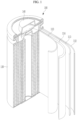
- FIG. 1 is a schematic view illustrating a rechargeable lithium battery according to an embodiment.
- a rechargeable lithium battery 100 according to an embodiment of the present invention includes a battery cell including a positive electrode 114, a negative electrode 112 facing the positive electrode 114, a separator 113 between the positive electrode 114 and the negative electrode 112, and an electrolyte for a rechargeable lithium battery impregnating the positive electrode 114, negative electrode 112, and separator 113, a battery case 120 housing the battery cell, and a sealing member 140 sealing the battery case 120.
- a negative electrode 112 for a rechargeable lithium battery includes a current collector and a negative electrode active material layer formed on the current collector and including a negative electrode active material.
- the negative electrode active material may include a material that reversibly intercalates/deintercalates lithium ions, a lithium metal, a lithium metal alloy, a material capable of doping/dedoping lithium, or transition metal oxide.
- the material that reversibly intercalates/deintercalates lithium ions may include, for example crystalline carbon, amorphous carbon, or a combination thereof as a carbon-based negative electrode active material.
- the crystalline carbon may be non-shaped, or sheet, flake, spherical, or fiber shaped natural graphite or artificial graphite and the amorphous carbon may be a soft carbon, a hard carbon, a mesophase pitch carbonization product, calcined coke, and the like.
- the lithium metal alloy includes an alloy of lithium and a metal selected from Na, K, Rb, Cs, Fr, Be, Mg, Ca, Sr, Si, Sb, Pb, In, Zn, Ba, Ra, Ge, Al, and Sn.
- the material capable of doping/dedoping lithium may be a Si-based negative electrode active material or a Sn-based negative electrode active material, wherein the Si-based negative electrode active material may include silicon, a silicon-carbon composite, SiO x (0 ⁇ x ⁇ 2), a Si-Q alloy (wherein Q is an alkali metal, an alkaline-earth metal, a Group 13 element, a Group 14 element, a Group 15 element, a Group 16 element, a transition metal, a rare earth element, and a combination thereof, but not Si) and the Sn-based negative electrode active material may include Sn, SnO 2 , a Sn-R alloy (wherein R is an alkali metal, an alkaline-earth metal, a Group 13 element, a Group 14 element, a Group 15 element, a Group 16 element, a transition metal, a rare earth element, and a combination thereof, but not Sn), and at least one of these materials may be mixed with SiO 2 .
- the elements Q and R may be selected from Mg, Ca, Sr, Ba, Ra, Sc, Y, Ti, Zr, Hf, Rf, V, Nb, Ta, Db, Cr, Mo, W, Sg, Tc, Re, Bh, Fe, Pb, Ru, Os, Hs, Rh, Ir, Pd, Pt, Cu, Ag, Au, Zn, Cd, B, Al, Ga, Sn, In, Tl, Ge, P, As, Sb, Bi, S, Se, Te, Po, and a combination thereof.
- the silicon-carbon composite may be a silicon-carbon composite including a core including crystalline carbon and silicon particles and an amorphous carbon coating layer disposed on the surface of the core.
- the crystalline carbon may be artificial graphite, natural graphite, or a combination thereof.
- the amorphous carbon precursor may be a coal-based pitch, mesophase pitch, petroleum-based pitch, coal-based oil, petroleum-based heavy oil, or a polymer resin such as a phenol resin, a furan resin, or a polyimide resin.
- the content of silicon may be 10 wt% to 50 wt% based on the total weight of the silicon-carbon composite.
- the content of the crystalline carbon may be 10 wt% to 70 wt% based on the total weight of the silicon-carbon composite, and the content of the amorphous carbon may be 20 wt% to 40 wt% based on the total weight of the silicon-carbon composite.
- a thickness of the amorphous carbon coating layer may be 5 nm to 100 nm.
- An average particle diameter (D50) of the silicon particles may be 10 nm to 20 ⁇ m.
- the average particle diameter (D50) of the silicon particles may be preferably 10 nm to 200 nm.
- the silicon particles may exist in an oxidized form, and in this case, an atomic content ratio of Si:O in the silicon particles indicating a degree of oxidation may be a weight ratio of 99:1 to 33:67.
- the silicon particles may be SiO x particles, and in this case, the range of x in SiO x may be greater than 0 and less than 2.
- an average particle diameter (D50) indicates a particle where a cumulative volume is 50 volume% in a particle distribution.
- the Si-based negative electrode active material or Sn-based negative electrode active material may be mixed with the carbon-based negative electrode active material.
- the mixing ratio may be a weight ratio of 1 : 99 to 10 : 90.
- the negative electrode active material may be included in an amount of 90 wt% to 99 wt% based on the total weight of the negative electrode active material layer.
- the negative electrode active material layer further includes a binder, and may optionally further include a conductive material.
- the content of the binder in the negative electrode active material layer may be 0.1 wt% to 5 wt% based on the total weight of the negative electrode active material layer.
- the negative electrode active material layer may include 90 wt% to 98 wt% of the negative electrode active material, 0.1 wt% to 5 wt% of the binder, and 0.1 wt% to 5 wt% of the conductive material.
- the binder serves to well adhere the negative electrode active material particles to each other and also to adhere the negative electrode active material to the current collector.
- the binder may be a water-insoluble binder, a water-soluble binder, or a combination thereof.
- water-insoluble binder examples include polyvinyl chloride, carboxylated polyvinyl chloride, polyvinyl fluoride, an ethylene oxide-containing polymer, an ethylene propylene copolymer, polystyrene, polyvinylpyrrolidone, polyurethane, polytetrafluoro ethylene, polyvinylidene fluoride, polyethylene, polypropylene, polyamideimide, polyimide, or a combination thereof.
- the water-soluble binder may include a rubber binder or a polymer resin binder.
- the rubber binder may be selected from a styrene-butadiene rubber, an acrylated styrene-butadiene rubber, an acrylonitrile-butadiene rubber, an acrylic rubber, a butyl rubber, a fluororubber, and a combination thereof.
- the polymer resin binder may be selected from polyethylene oxide, polyvinylpyrrolidone, polyepichlorohydrin, polyphosphazene, polyacrylonitrile, an ethylene propylene diene copolymer, polyvinylpyridine, chlorosulfonated polyethylene, latex, a polyester resin, an acrylic resin, a phenol resin, an epoxy resin, polyvinyl alcohol, and a combination thereof.
- a cellulose-based compound capable of imparting viscosity may be further included.
- the cellulose-based compound one or more of carboxymethyl cellulose, hydroxypropylmethyl cellulose, methyl cellulose, or alkali metal salts thereof may be mixed and used.
- the alkali metal Na, K or Li may be used.
- the amount of the thickener used may be 0.1 parts by weight to 3 parts by weight based on 100 parts by weight of the negative electrode active material.
- the conductive material is included to provide electrode conductivity and any electrically conductive material may be used as a conductive material unless it causes a chemical change.
- the conductive material include a carbon-based material such as natural graphite, artificial graphite, carbon black, acetylene black, ketjen black, a carbon fiber, a carbon nanotube, and the like; a metal-based material of a powder or a fiber including copper, nickel, aluminum silver, and the like; a conductive polymer such as a polyphenylene derivative; or a mixture thereof.
- the current collector may include one selected from a copper foil, a nickel foil, a stainless steel foil, a titanium foil, a nickel foam, a copper foam, a polymer substrate coated with a conductive metal, and a combination thereof.
- the electrolyte includes a non-aqueous organic solvent and a lithium salt.
- the non-aqueous organic solvent serves as a medium for transmitting ions taking part in the electrochemical reaction of a battery.
- the non-aqueous organic solvent may be a carbonate-based, ester-based, ether-based, ketone-based, or alcohol-based solvent, or aprotic solvent.
- the carbonate-based solvent includes dimethyl carbonate (DMC), diethyl carbonate (DEC), dipropyl carbonate (DPC), methylpropyl carbonate (MPC), ethylpropyl carbonate (EPC), methylethyl carbonate (MEC), ethylene carbonate (EC), propylene carbonate (PC), butylene carbonate (BC), and the like.
- the ester-based solvent includes methyl acetate, ethyl acetate, n-propyl acetate, dimethyl acetate, methyl propionate, ethyl propionate, ⁇ -butyrolactone, decanolide, valerolactone, mevalonolactone, caprolactone, and the like.
- the ether-based solvent may be dibutyl ether, tetraglyme, diglyme, dimethoxyethane, 2-methyltetrahydrofuran, tetrahydrofuran, and the like and the ketone-based solvent may be cyclohexanone, and the like.
- the alcohol-based solvent may be ethyl alcohol, isopropyl alcohol, etc. and the aprotic solvent may be nitriles such as R-CN (where R is a C2 to C20 linear, branched, or cyclic hydrocarbon group and may include a double bond, an aromatic ring, or an ether bond), amides such as dimethylformamide, dioxolanes such as 1,3-dioxolane, sulfolanes, and the like.
- R-CN where R is a C2 to C20 linear, branched, or cyclic hydrocarbon group and may include a double bond, an aromatic ring, or an ether bond
- amides such as dimethylformamide
- dioxolanes such as 1,3-dioxolane
- sulfolanes and the like.
- the non-aqueous organic solvent may be used alone or in a mixture, and when used in a mixture, the mixing ratio may be appropriately adjusted in accordance with a desired battery performance, which is widely understood by those skilled in the art.
- a mixture of a cyclic carbonate and a chain carbonate may be used.
- the electrolyte may exhibit excellent performance.
- the non-aqueous organic solvent may further include an aromatic hydrocarbon-based organic solvent in addition to the carbonate-based solvent.
- the carbonate-based solvent and the aromatic hydrocarbon-based organic solvent may be mixed in a volume ratio of about 1:1 to about 30:1.
- the aromatic hydrocarbon-based solvent may be an aromatic hydrocarbon-based compound represented by Chemical Formula I.
- R 4 to R 9 are the same or different and are selected from hydrogen, a halogen, a C1 to C10 alkyl group, a haloalkyl group, and a combination thereof.
- aromatic hydrocarbon-based solvent may be selected from benzene, fluorobenzene, 1,2-difluorobenzene, 1,3-difluorobenzene, 1,4-difluorobenzene, 1,2,3-trifluorobenzene, 1,2,4-trifluorobenzene, chlorobenzene, 1,2-dichlorobenzene, 1,3-dichlorobenzene, 1,4-dichlorobenzene, 1,2,3-trichlorobenzene, 1,2,4-trichlorobenzene, iodobenzene, 1,2-diiodobenzene, 1,3-diiodobenzene, 1,4-diiodobenzene, 1,2,3-triiodobenzene, 1,2,4-triiodobenzene, toluene, fluorotoluene, 2,3-difluorotoluene, 2,4-difluorobenz
- the electrolyte may further include vinylene carbonate or an ethylene carbonate-based compound represented by Chemical Formula II in order to improve cycle-life of a battery.
- R 10 and R 11 are the same or different and selected from hydrogen, a halogen, a cyano group, a nitro group, and fluorinated C1 to C5 alkyl group, provided that at least one of R 10 and R 11 is a halogen, a cyano group, a nitro group, and fluorinated C1 to C5 alkyl group, and R 10 and R 11 are not simultaneously hydrogen.
- Examples of the ethylene carbonate-based compound may be difluoro ethylenecarbonate, chloroethylene carbonate, dichloroethylene carbonate, bromoethylene carbonate, dibromoethylene carbonate, nitroethylene carbonate, cyanoethylene carbonate, or fluoroethylene carbonate.
- the amount of the additive for improving cycle-life may be used within an appropriate range.
- the lithium salt dissolved in the non-organic solvent supplies lithium ions in a battery, enables a basic operation of a rechargeable lithium battery, and improves transportation of the lithium ions between positive and negative electrodes.
- lithium salt examples include at least one supporting salt selected from LiPF 6 , LiBF 4 , LiSbF 6 , LiAsF 6 , LiN(SO 2 C 2 F 5 ) 2 , Li(CF 3 SO 2 ) 2 N, LiN(SO 3 C 2 F 5 ) 2 , Li(FSO 2 ) 2 N (lithium bis(fluorosulfonyl)imide); LiFSI), LiC 4 F 9 SO 3 , LiClO 4 , LiAlO 2 , LiAlCl 4 , LiPO 2 F 2 , LiN(C x F 2x+1 SO 2 )(C y F 2y+1 SO 2 ), wherein x and y are natural numbers, for example, an integer ranging from 1 to 20, lithium difluoro(bisoxolato) phosphate, LiCl, Lil, LiB(C 2 O 4 ) 2 (lithium bis(oxalato) borate; LiBOB), and lithium difluoro(oxala
- the lithium salt may be used in a concentration ranging from 0.1 M to 2.0 M.
- an electrolyte may have excellent performance and lithium ion mobility due to optimal electrolyte conductivity and viscosity.
- the separator 113 that is also called a separating layer separates a positive electrode 114 and a negative electrode 112 and provides a transporting passage for lithium ions and may be any generally-used separator in a lithium ion battery. In other words, it may have low resistance to ion transport and excellent impregnation for an electrolyte.
- separator may be selected from a glass fiber, polyester, Teflon, polyethylene, polypropylene, polytetrafluoroethylene, or a combination thereof. It may have a form of a nonwoven fabric or a woven fabric.
- a polyolefin-based polymer separator such as polyethylene and polypropylene is mainly used.
- a coated separator including a ceramic component or a polymer material may be used.
- it may have a mono-layered or multi-layered structure.
- Rechargeable lithium batteries may be classified as lithium ion batteries, lithium ion polymer batteries, and lithium polymer batteries according to the presence of a separator and the kind of electrolyte used therein.
- the rechargeable lithium batteries may have a variety of shapes and sizes, and include cylindrical, prismatic, coin, or pouch-type batteries, and may be thin film batteries or may be rather bulky in size. Structures and manufacturing methods of these batteries are well known in the art, and thus detailed descriptions thereof will be omitted.
- a positive electrode active material of Li 1 ⁇ a Ni 0.916 Co 0.07 Al 0.014 O 2 1.0 wt% of a conductive material of carbon nanotube, 1.3 wt% of a binder of PVDF, and 0.1 wt% of acetyl salicylic acid are mixed in a solvent of NMP, preparing slurry for positive electrode coating. This slurry is coated to have current density of 2 mAh/cm 2 on one surface of an aluminum current collector and dried at 110 °C for 3 hours, manufacturing a positive electrode.
- the positive electrode, a separator with a polyethylene/polypropylene multi-layer structure, and a negative electrode of lithium metal are sequentially stacked, and an electrolyte prepared by adding a 1.0 M LiPF 6 lithium salt, to a solvent of ethylene carbonate and diethyl carbonate mixed in a volume ratio of 50:50 is injected thereinto, manufacturing a half cell.
- a positive electrode, a negative electrode, and a battery cell are manufactured in the same manner as in Example 1 except that 0.1 wt% of 1-naphthalene acetic acid is added instead of the acetyl salicylic acid.
- a positive electrode, a negative electrode, and a battery cell are manufactured in the same manner as in Example 1 except that 97.5 wt% of the positive electrode active material and 0.2 wt% of the acetyl salicylic acid are used to manufacture the positive electrode.
- a positive electrode, a negative electrode, and a battery cell are manufactured in the same manner as in Example 2 except that 97.5 wt% of the positive electrode active material and 0.2 wt% of 1-naphthalene acetic acid are used to manufacture the positive electrode.
- a positive electrode, a negative electrode, and a battery cell are manufactured in the same manner as in Example 1 except that 97.7 wt% of the positive electrode active material, 1.0 wt% of the conductive material, and 1.3 wt% of the binder of PVDF are mixed in the solvent of NMP.
- a positive electrode, a negative electrode, and a battery cell are manufactured in the same manner as in Example 1 except that 0.1 wt% of oxalic acid corresponding to aliphatic divalent carboxylic acid is used instead of the acetyl salicylic acid.
- a positive electrode, a negative electrode, and a battery cell are manufactured in the same manner as in Example 1 except that 0.1 wt% of phthalic acid corresponding to aromatic divalent carboxylic acid is used instead of the acetyl salicylic acid.
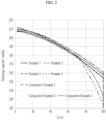
- the half cells according to Examples 1 to 4 and Comparative Examples 1 to 3 are charged and discharged at a 1.0 C rate at 45 °C to evaluate high temperature cycle-life characteristics, and a change in discharge capacity according to the number of cycles of each cell is shown in FIG. 2 .
- the half cells of Comparative Examples 1 to 3 exhibit sharp deterioration of discharge capacity from about 80 cycles, but the half-cells of Examples 1 to 4 exhibit no sharp deterioration of discharge capacity after the 80 cycles and thus improvement of a high temperature cycle-life.
- Examples 1 to 4 exhibit no deteriorated charge/discharge efficiency but maintain equivalent excellent efficiency, compared with the comparative examples. Accordingly, an embodiment may accomplish an effect of improving high temperature cycle-life and excellent charge/discharge efficiency at the same time.
Landscapes
- Chemical & Material Sciences (AREA)
- Chemical Kinetics & Catalysis (AREA)
- Electrochemistry (AREA)
- General Chemical & Material Sciences (AREA)
- Engineering & Computer Science (AREA)
- Manufacturing & Machinery (AREA)
- Materials Engineering (AREA)
- Inorganic Chemistry (AREA)
- Secondary Cells (AREA)
- Battery Electrode And Active Subsutance (AREA)
Applications Claiming Priority (2)
| Application Number | Priority Date | Filing Date | Title |
|---|---|---|---|
| KR1020210060891A KR20220153376A (ko) | 2021-05-11 | 2021-05-11 | 리튬 이차 전지용 양극 및 이를 포함하는 리튬 이차 전지 |
| PCT/KR2022/006434 WO2022240067A1 (ko) | 2021-05-11 | 2022-05-04 | 리튬 이차 전지용 양극 및 이를 포함하는 리튬 이차 전지 |
Publications (2)
| Publication Number | Publication Date |
|---|---|
| EP4239728A1 true EP4239728A1 (de) | 2023-09-06 |
| EP4239728A4 EP4239728A4 (de) | 2025-07-09 |
Family
ID=84029271
Family Applications (1)
| Application Number | Title | Priority Date | Filing Date |
|---|---|---|---|
| EP22807715.2A Pending EP4239728A4 (de) | 2021-05-11 | 2022-05-04 | Positivelektrode für lithiumsekundärbatterie und lithiumsekundärbatterie damit |
Country Status (4)
| Country | Link |
|---|---|
| US (1) | US20230352749A1 (de) |
| EP (1) | EP4239728A4 (de) |
| KR (1) | KR20220153376A (de) |
| WO (1) | WO2022240067A1 (de) |
Family Cites Families (8)
| Publication number | Priority date | Publication date | Assignee | Title |
|---|---|---|---|---|
| JPH1186846A (ja) * | 1997-07-07 | 1999-03-30 | Asahi Chem Ind Co Ltd | 電池正極電極 |
| KR100657951B1 (ko) * | 2005-02-18 | 2006-12-14 | 삼성에스디아이 주식회사 | 양극 활물질, 그 제조 방법 및 이를 채용한 양극과 리튬 전지 |
| US20090194747A1 (en) * | 2008-02-04 | 2009-08-06 | Vale Inco Limited | Method for improving environmental stability of cathode materials for lithium batteries |
| KR101608733B1 (ko) * | 2011-12-06 | 2016-04-04 | 에스케이이노베이션 주식회사 | 리튬이차전지용 양극 활물질의 제조방법 |
| US20160218352A1 (en) * | 2013-08-29 | 2016-07-28 | Commonwealth Scientific And Industrial Research Organisation | Lithium-sulfur electric current producing cell |
| JP6605391B2 (ja) * | 2016-04-27 | 2019-11-13 | ユミコア | リチウム金属複合酸化物粉末の改質方法 |
| KR101997152B1 (ko) * | 2017-04-25 | 2019-07-05 | 주식회사 포스코 | 리튬 이차 전지용 양극 활물질의 제조 방법, 이를 이용하여 제조된 리튬 이차 전지용 양극 활물질 및 이를 포함하는 리튬 이차 전지 |
| WO2019093313A1 (ja) * | 2017-11-08 | 2019-05-16 | 株式会社Gsユアサ | 正極、非水電解質蓄電素子、正極の製造方法、及び非水電解質蓄電素子の製造方法 |
-
2021
- 2021-05-11 KR KR1020210060891A patent/KR20220153376A/ko active Pending
-
2022
- 2022-05-04 EP EP22807715.2A patent/EP4239728A4/de active Pending
- 2022-05-04 US US18/003,688 patent/US20230352749A1/en active Pending
- 2022-05-04 WO PCT/KR2022/006434 patent/WO2022240067A1/ko not_active Ceased
Also Published As
| Publication number | Publication date |
|---|---|
| WO2022240067A1 (ko) | 2022-11-17 |
| KR20220153376A (ko) | 2022-11-18 |
| EP4239728A4 (de) | 2025-07-09 |
| US20230352749A1 (en) | 2023-11-02 |
Similar Documents
| Publication | Publication Date | Title |
|---|---|---|
| US11342586B2 (en) | Rechargeable lithium battery | |
| US10637042B2 (en) | Positive active material for rechargeable lithium battery and rechargeable lithium battery including same | |
| US11949098B2 (en) | Positive active material for rechargeable lithium battery and rechargeable lithium battery including same | |
| EP4057386A1 (de) | Positives aktivmaterial für wiederaufladbare lithiumbatterie, verfahren zur herstellung davon und wiederaufladbare lithiumbatterie damit | |
| KR102816123B1 (ko) | 리튬 이차 전지용 양극 활물질, 이의 제조 방법 및 이를 포함하는 리튬 이차 전지 | |
| US20230135650A1 (en) | Negative active material composite for rechargeable lithium battery, method of preparing the same, negative electrode including the same, and rechargeable lithium battery including the same | |
| US10784499B2 (en) | Positive active material for rechargeable lithium battery and rechargeable lithium battery including same | |
| US20230268512A1 (en) | Positive electrode for rechargeable lithium battery and rechargeable lithium battery including the same | |
| EP4411863A1 (de) | Positivelektrode für eine wiederaufladbare lithiumbatterie und wiederaufladbare lithiumbatterie damit | |
| EP4328998A1 (de) | Positives aktivmaterial für eine wiederaufladbare lithiumbatterie und wiederaufladbare lithiumbatterie damit | |
| US20200373616A1 (en) | Lithium secondary battery | |
| US20260074187A1 (en) | Electrode for rechargeable lithium battery and rechargeable lithium battery including the same | |
| KR102764219B1 (ko) | 리튬 이차 전지용 전해액 및 이를 포함하는 리튬 이차 전지 | |
| US20220352502A1 (en) | Positive electrode for rechargeable lithium battery and rechargeable lithium battery including the same | |
| KR102851465B1 (ko) | 리튬 이차 전지용 양극 활물질 및 이를 포함하는 리튬 이차 전지 | |
| EP4286342A1 (de) | Positivaktivmaterial für eine wiederaufladbare lithiumbatterie, positivelektrode für eine wiederaufladbare lithiumbatterie und wiederaufladbare lithiumbatterie | |
| EP4239728A1 (de) | Positivelektrode für lithiumsekundärbatterie und lithiumsekundärbatterie damit | |
| EP4385952B1 (de) | Positives aktivmaterial für eine wiederaufladbare lithiumbatterie und wiederaufladbare lithiumbatterie damit | |
| US20250070131A1 (en) | Negative electrode for rechargeable lithium battery and rechargeable lithium battery including same | |
| KR102816660B1 (ko) | 첨가제, 이를 포함하는 리튬 이차 전지용 전해액 및 리튬 이차 전지 | |
| US20240213457A1 (en) | Negative active material for rechargeable lithium battery and rechargeable lithium battery including same | |
| US12597595B2 (en) | Positive electrode active material for rechargeable lithium battery and rechargeable lithium battery including same | |
| KR20240174259A (ko) | 스택형 리튬 이차 전지용 양극 및 이를 포함하는 스택형 리튬 이차 전지 | |
| KR20240048870A (ko) | 양극 활물질, 이의 제조방법 및 이를 포함하는 리튬 이차 전지 | |
| KR20240048871A (ko) | 표면 개질된 양극 활물질, 이의 제조방법 및 이를 포함하는 리튬 이차 전지 |
Legal Events
| Date | Code | Title | Description |
|---|---|---|---|
| STAA | Information on the status of an ep patent application or granted ep patent |
Free format text: STATUS: THE INTERNATIONAL PUBLICATION HAS BEEN MADE |
|
| PUAI | Public reference made under article 153(3) epc to a published international application that has entered the european phase |
Free format text: ORIGINAL CODE: 0009012 |
|
| STAA | Information on the status of an ep patent application or granted ep patent |
Free format text: STATUS: REQUEST FOR EXAMINATION WAS MADE |
|
| 17P | Request for examination filed |
Effective date: 20230530 |
|
| AK | Designated contracting states |
Kind code of ref document: A1 Designated state(s): AL AT BE BG CH CY CZ DE DK EE ES FI FR GB GR HR HU IE IS IT LI LT LU LV MC MK MT NL NO PL PT RO RS SE SI SK SM TR |
|
| DAV | Request for validation of the european patent (deleted) | ||
| DAX | Request for extension of the european patent (deleted) | ||
| A4 | Supplementary search report drawn up and despatched |
Effective date: 20250610 |
|
| RIC1 | Information provided on ipc code assigned before grant |
Ipc: H01M 10/0525 20100101ALI20250603BHEP Ipc: H01M 4/02 20060101ALI20250603BHEP Ipc: H01M 10/052 20100101ALI20250603BHEP Ipc: H01M 4/525 20100101ALI20250603BHEP Ipc: H01M 4/131 20100101ALI20250603BHEP Ipc: H01M 10/42 20060101ALI20250603BHEP Ipc: H01M 4/62 20060101AFI20250603BHEP |