EP4234510A2 - Verfahren zur kontinuierlichen herstellung von alpha-calciumsulfat-halbhydrat - Google Patents
Verfahren zur kontinuierlichen herstellung von alpha-calciumsulfat-halbhydrat Download PDFInfo
- Publication number
- EP4234510A2 EP4234510A2 EP23176522.3A EP23176522A EP4234510A2 EP 4234510 A2 EP4234510 A2 EP 4234510A2 EP 23176522 A EP23176522 A EP 23176522A EP 4234510 A2 EP4234510 A2 EP 4234510A2
- Authority
- EP
- European Patent Office
- Prior art keywords
- gypsum
- alpha
- slurry
- calcium sulphate
- sulphate hemihydrate
- Prior art date
- Legal status (The legal status is an assumption and is not a legal conclusion. Google has not performed a legal analysis and makes no representation as to the accuracy of the status listed.)
- Pending
Links
Images
Classifications
-
- C—CHEMISTRY; METALLURGY
- C04—CEMENTS; CONCRETE; ARTIFICIAL STONE; CERAMICS; REFRACTORIES
- C04B—LIME, MAGNESIA; SLAG; CEMENTS; COMPOSITIONS THEREOF, e.g. MORTARS, CONCRETE OR LIKE BUILDING MATERIALS; ARTIFICIAL STONE; CERAMICS; REFRACTORIES; TREATMENT OF NATURAL STONE
- C04B11/00—Calcium sulfate cements
- C04B11/02—Methods and apparatus for dehydrating gypsum
- C04B11/028—Devices therefor characterised by the type of calcining devices used therefor or by the type of hemihydrate obtained
- C04B11/0281—Kettles; Marmites; Autoclaves
- C04B11/0282—Autoclaves, e.g. using chariots
-
- C—CHEMISTRY; METALLURGY
- C04—CEMENTS; CONCRETE; ARTIFICIAL STONE; CERAMICS; REFRACTORIES
- C04B—LIME, MAGNESIA; SLAG; CEMENTS; COMPOSITIONS THEREOF, e.g. MORTARS, CONCRETE OR LIKE BUILDING MATERIALS; ARTIFICIAL STONE; CERAMICS; REFRACTORIES; TREATMENT OF NATURAL STONE
- C04B11/00—Calcium sulfate cements
- C04B11/06—Calcium sulfate cements starting from anhydrite
-
- C—CHEMISTRY; METALLURGY
- C04—CEMENTS; CONCRETE; ARTIFICIAL STONE; CERAMICS; REFRACTORIES
- C04B—LIME, MAGNESIA; SLAG; CEMENTS; COMPOSITIONS THEREOF, e.g. MORTARS, CONCRETE OR LIKE BUILDING MATERIALS; ARTIFICIAL STONE; CERAMICS; REFRACTORIES; TREATMENT OF NATURAL STONE
- C04B11/00—Calcium sulfate cements
- C04B11/002—Mixtures of different CaSO4-modifications, e.g. plaster of Paris and anhydrite, used as cements
Definitions
- the present invention relates to a process for the continuous preparation of alpha-calcium sulphate hemihydrate.
- the present invention further relates to a particulate gypsum for use in the process.
- Gypsum occurs naturally as a raw material in the form of calcium sulphate dihydrate (CaSO 4 2(H 2 O)).
- Gypsum containing products such as plasterboard, are prepared by forming a mixture of calcined or dehydrated gypsum, namely calcium sulphate hemihydrate (CaSO 4 0.5(H 2 O)), with water, to form a settable slurry that is then cast into a pre-determined shape.
- the calcium sulphate hemihydrate reacts with the water and becomes re-hydrated to the dihydrate crystal, which is then cured or dried to the solid state.
- the calcium sulphate hemihydrate can be categorised into two basic forms, alpha-calcium sulphate hemihydrate and beta-calcium sulphate hemihydrate.
- Beta-calcium sulphate hemihydrate is typically formed by heating gypsum under atmospheric conditions.
- alpha-calcium sulphate hemihydrate is produced from gypsum under conditions of elevated temperature and pressure. Whilst both alpha-calcium sulphate hemihydrate and beta-calcium sulphate hemihydrate can be used to create gypsum products, gypsum products made with alpha-hemihydrate tend to be harder, with greater strength and density.
- alpha-calcium sulphate hemihydrate In commercial industrial environments where gypsum products are continuously produced, it is often desirable or necessary to continuously produce alpha-calcium sulphate hemihydrate.
- the continuous production of alpha-calcium sulphate hemihydrate can be more difficult than a batch production process, as particles of gypsum introduced to a calcination vessel used in a continuous process will have a distribution of residence times rather than the single residence time of a batch process.
- a process for the continuous production of alpha-calcium sulphate hemihydrate comprising the steps of: providing particulate gypsum, providing water, mixing the particulate gypsum and the water to form a gypsum slurry and maintaining the gypsum slurry under raised pressure and temperature to convert the particulate gypsum into alpha-calcium sulphate hemihydrate and provide an alpha-calcium sulphate hemihydrate slurry, characterised in that the particulate gypsum comprises a D10 value greater than or equal to 2 ⁇ m, a D90 value smaller than or equal to 90 ⁇ m and a D50 value smaller than or equal to 25 ⁇ m.
- Such a process may have several advantageous features over existing processes of producing alpha-calcium sulphate hemihydrate, Firstly, given the continuous nature of the production process, limiting the number of particles of gypsum above 90 ⁇ m in diameter ensures that the majority of particles of gypsum will have sufficient time to move into solution within the gypsum slurry during the production process. Additionally, limiting the number of particles of gypsum below 2 ⁇ m in diameter may be advantageous in reducing the water required to ensure sufficient fluidity of the alpha-calcium sulphate hemihydrate slurry during the process.
- D50 being smaller than or equal to 25 ⁇ m may be desirable as providing particulate gypsum in this form may help ensure the majority of the particulate gypsum enters solution in the gypsum slurry and is converted to alpha-calcium sulphate hemihydrate within the period of raised temperature and pressure.
- the gypsum particle size distribution used in the process of claim 1 may prove advantageous.
- the particulate gypsum comprises a D10 value greater than or equal to 2.5 ⁇ m. More preferably, the particulate gypsum comprises a D10 value greater than or equal to 3 ⁇ m.
- the particulate gypsum comprises a D90 value smaller than or equal to 80 ⁇ m. More preferably, the particulate gypsum comprises a D90 value smaller than or equal to 70 ⁇ m.
- the particle size distribution satisfies the following relationship: 0.4 ⁇ D 90 / D 50 / D 50 / D 10 ⁇ 1.5
- the particle size distribution complies with the following criterion: 1.25 > q 0.5 d , d / q d , 2 d > 0.75 where q(d1,d2) is the mass fraction of particle comprised between d1 and d2
- the particulate gypsum comprises a D50 value smaller than or equal to 20 ⁇ m.
- the particulate gypsum comprises a D50 value smaller than or equal to 18 ⁇ m.
- the particulate gypsum comprises a D50 value smaller than or equal to 15 ⁇ m.
- the particulate gypsum comprises a D50 value greater than or equal to 8 ⁇ m. More preferably, the particulate gypsum comprises a D50 value greater than or equal to 10 ⁇ m.
- the D50 value of the particulate gypsum may preferably lie in any of the following ranges: 8 ⁇ m ⁇ D50 ⁇ 25 ⁇ m, 8 ⁇ m ⁇ D50 ⁇ 20 ⁇ m, 8 ⁇ m ⁇ D50 ⁇ 18 ⁇ m, 8 ⁇ m ⁇ D50 ⁇ 15 ⁇ m, 10 ⁇ m ⁇ D50 ⁇ 25 ⁇ m, 10 ⁇ m ⁇ D50 ⁇ 20 ⁇ m, 10 ⁇ m ⁇ D50 ⁇ 18 ⁇ m, 10 ⁇ m ⁇ D50 ⁇ 15 ⁇ m.
- the raised temperature is in the range 110°C to 170°C inclusive. More preferably the raised temperature is in the range 120°C to 160°C inclusive. Still more preferably, the raised temperature is in the range 125°C to 150°C inclusive.
- the raised pressure is in the range 0.15 MPa to 0.80 MPa inclusive. More preferably, the raised pressure is in the range 0.25 MPa to 0.50 MPa inclusive.
- a gypsum particle within the gypsum slurry is maintained under conditions of raised temperature and pressure for a mean residence time within the range 10 minutes to 120 minutes inclusive. More preferably, a gypsum particle within the gypsum slurry is maintained under conditions of raised temperature and pressure for a mean residence time within the range 30 minutes to 90 minutes inclusive. Still more preferably, a gypsum particle within the gypsum slurry is maintained under conditions of raised temperature and pressure for a mean residence time within the range 45 minutes to 90 minutes inclusive. Still more preferably, a gypsum particle within the gypsum slurry is maintained under conditions of raised temperature and pressure for a mean residence time for around 45 minutes.
- the residence time may lie within any of these ranges to ensure that there is sufficient time of the particles of gypsum to be calcined to form alpha-calcium sulphate hemihydrate.
- the conditions of raised temperature include a temperature of 150 °C or higher, the residence time may be in the range 10 minutes to 30 minutes inclusive.
- the gypsum slurry comprises a water to gypsum ratio of between 0.4 and 1.5 by weight inclusive. More preferably, the gypsum slurry comprises a water to gypsum ratio of between 0.4 and 1.3 by weight inclusive. Still more preferably, the gypsum slurry comprises a water to gypsum ratio of between 0.7 and 1.2 by weight inclusive. Still more preferably, the gypsum slurry comprises a water to gypsum ratio of between 0.7 and 1.0 by weight inclusive.
- the process comprises incorporating a habit modifier into the gypsum slurry.
- the incorporation of a habit modifier in the gypsum slurry may assist in controlling the shape and form of the alpha-calcium sulphate hemihydrate crystals produced by the continuous process.
- the habit modifier is incorporated into the gypsum slurry in an amount of between 0.1 wt.% and 0.15 wt.% relative to the weight of the gypsum.
- the habit modifier is succinic acid.
- the gypsum slurry comprises a Brookfield viscosity in the range of 15 to 0.5 cP inclusive at 80°C. More preferably, the alpha-calcium sulphate hemihydrate slurry comprises a Brookfield viscosity in the range of 10 to 1 cP inclusive at 80°C. Still more preferably, the alpha-calcium sulphate hemihydrate slurry comprises a Brookfield viscosity in the range of 8 to 1 cP inclusive at 80°C. Yet more preferably, the alpha-calcium sulphate hemihydrate slurry comprises a Brookfield viscosity in the range of 7 to 2 cP inclusive at 80°C.
- the Brookfield viscosity of the alpha-calcium sulphate hemihydrate slurry may lie within any one or these ranges to ensure that it can freely flow during the process. Ensuring the gypsum slurry has a Brookfield viscosity in the ranges described above results in the output of an alpha-calcium sulphate hemihydrate slurry with a suitable behaviour in terms of flow, sedimentation and viscosity. The output slurry's Brookfield viscosity will be lower than the Brookfield viscosity of the gypsum slurry due to the effect of the calcination process.
- the process comprises the further step of grinding the particulate gypsum to reduce the size of particles therein. More preferably, the grinding step occurs prior to the step of mixing the particulate gypsum and the water. Grinding the particulate gypsum may be preferable as it may increase the solubility of the gypsum particles in the water.
- the process comprises filtering the particulate gypsum.
- filtering may advantageous remove gypsum particles of undesirable sizes from the particulate gypsum.
- the step of providing particulate gypsum comprises substantially continuously providing particulate gypsum. It may be advantageous to continuously provide particulate gypsum as this may allow for a consistent output in the volume and or quality of the alpha-calcium sulphate hemihydrate slurry. More preferably, particulate gypsum is provided at a substantially constant mass per second.
- the step of providing water comprises substantially continuously providing water. It may be advantageous to continuously provide water as this may allow for a consistent output in the volume and or quality of the alpha-calcium sulphate hemihydrate slurry. More preferably, water is provided at a substantially constant flow rate. Preferably, water is provided at a substantially constant temperature. Most preferably, water is provided at a substantially constant flow rate and substantially constant temperature.
- the step of maintaining the gypsum slurry under raised pressure and temperature to convert the particulate gypsum into alpha-calcium sulphate hemihydrate and provide an alpha-calcium sulphate hemihydrate slurry comprises holding the gypsum slurry within a calcination vessel.
- the process comprises removing water from the alpha-calcium sulphate hemihydrate slurry.
- removing the water comprises heating the alpha-calcium sulphate hemihydrate slurry.
- removing the water comprises filtering the alpha-calcium sulphate hemihydrate slurry.
- removing the water comprises separating the water from the alpha-calcium sulphate hemihydrate with a hydrocyclone. It may be preferable to remove water from the alpha-calcium sulphate hemihydrate slurry as this may reduce the amount of water that must be removed from the slurry during the production of a gypsum product such as a plasterboard.
- the step of providing water comprises mixing the water removed from the alpha-calcium sulphate hemihydrate slurry with additional water.
- the energy used in the process may be reduced as water removed from the alpha-calcium sulphate hemihydrate slurry may not need to be heated, or may require reduced heating, before it is mixed with the particulate gypsum or during the calcination process.
- the particulate gypsum comprises desulphogypsum.
- the particulate gypsum comprises recycled gypsum.
- the alpha-calcium sulphate hemihydrate slurry comprises particles of alpha-calcium sulphate hemihydrate with an aspect ratio of 0.8 and 1.2 inclusive. More preferably, the alpha-calcium sulphate hemihydrate slurry comprises particles of alpha-calcium sulphate hemihydrate with an aspect ratio of 0.9 and 1.0 inclusive. Typically, the aspect ratio of the alpha-calcium sulphate hemihydrate would be undertaken via scanning electron microscope image analysis.
- the alpha-calcium sulphate hemihydrate slurry comprises particles of alpha-calcium sulphate hemihydrate wherein 8 wt.% to 22 wt.% inclusive of the particles within the alpha-calcium sulphate hemihydrate pass through 10 ⁇ m. More preferably, the alpha-calcium sulphate hemihydrate slurry comprises particles of alpha-calcium sulphate hemihydrate wherein 12 wt.% to 16 wt.% inclusive of the particles within the alpha-calcium sulphate hemihydrate pass through 10 ⁇ m.
- Such measurements may be undertaken using a laser granulometer.
- particulate gypsum for use in the process as hereinbefore described, the particulate gypsum comprising a D10 value greater than or equal to 2 ⁇ m, a D90 value smaller than or equal to 90 ⁇ m and a D50 value smaller than or equal to 25 ⁇ m.
- the particulate gypsum of the second aspect of the invention may have any or all of the features described in relation to the first aspect of the invention alone or in combination.
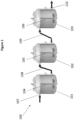
- the apparatus 100 comprises three calcination vessels 101, 102, 103 in series for the continuous production of alpha-calcium sulphate hemihydrate.
- Each of the calcination vessels includes a mixing arm 104, 105, 106, configured to mix the content of the calcination vessel 101, 102, 103.
- each mixing member 104, 105, 106 extends downwardly within the interior of the calcination vessel 101, 102, 103, from the top of the calcination vessel 101, 102, 103 to a position adjacent the bottom of the interior of the calcination vessel 101, 102, 103.
- the mixing members 104, 105, 106 effectively mix the content of the calcination vessels 101, 102 103 even when they are partially filled.
- Each mixing member 104, 105, 106 comprises a plurality of mixing paddles located close to the base of the calcination vessel 101, 102, 103 to improve mixing.
- pre-heated gypsum slurry is fed into the first calcination vessel 101 through an aperture 107.
- the aperture 107 is located towards the top of the first calcination vessel 101.
- the first pipe 108 extends from a position towards the base of the first calcination vessel 101 to a position towards the top of the second calcination vessel 102.
- the second calcination vessel 102 is fluidly connected to the third calcination vessel 103 by a second pipe 109.
- the second pipe 109 extends from a position towards the base of the second calcination vessel 102 to a position towards the top of the third calcination vessel 103.
- the slurry can travel freely from the second calcination vessel 102 to the third calcination vessel.
- gypsum slurry is continually introduced into the first calcination vessel 101, and pumped between the calcination vessels 101, 102, 103, there is a continuous passage of slurry from the first calcination vessel 101 to the third calcination vessel 103, via the second calcination vessel 102.
- the outlet 110 is located towards the base of the third calcination vessel 103. The positioning of the aperture 107, the first pipe 108, the second pipe 109 and the outlet 110 ensures the slurry has to travel through all areas of the apparatus 100, and the residence time of the slurry within the apparatus 100 can be controlled.
- the slurry exits the third calcination vessel as an alpha-calcium sulphate hemihydrate slurry.
- the calcination process occurs as the calcination vessels 101, 102, 103 are maintained at an elevated temperature and pressure.
- the apparatus 100 of Figure 1 comprises three calcination vessels 101, 102, 103, the number and size of the calcination vessels 101, 102, 103 may be varied. This variation ensures the total volume of the calcination vessels 101, 102, 103 is sufficient that the introduced gypsum slurry has a mean residence time that allows for an acceptable conversion of the gypsum slurry into alpha-calcium sulphate hemihydrate slurry. The length of time required for this conversion process varies on the temperature and pressure experienced by the slurry within the calcination vessels 101, 102, 103 during the calcination process.
- the applicant considers the mean residence time of a particle within the apparatus should be in the range 10 to 120 minutes inclusive. Additionally, the applicant considers the temperature of the calcination vessels should be in the range 110°C to 170°C inclusive. Finally, the applicant considers the raised pressure should be in the range 0.15 to 0.80 MPa inclusive.
- Each of the residence time, temperature and pressure are can be varied independently to ensure efficient conversion of the gypsum into alpha-calcium sulphate hemihydrate.
- the output of the apparatus 100 can be monitored and tested to ensure the continuous calcination process is proceeding as desired. If necessary, the temperature and/or pressure in each calcination vessel may differ to ensure the overall calcination process within the apparatus 100 proceeds as required. Additionally, the volume of each calcination vessel may be controlled independently.
- D10, D50 and D90 were measured using a Horiba LA-950 laser diffractometer. All particle size measurements were carried out in isopropanol with a thirty second ultrasonic pre-dispersion step.
- gypsum particles within the slurry must convert into alpha-calcium sulphate hemihydrate relatively rapidly.
- An acceptably rapid conversion rate was determined to be a 95 wt.% conversion (T95) of the gypsum particles into alpha-calcium sulphate hemihydrate in 25 minutes or less, where calcination was undertaken at a temperature of 150°C and a pressure of 0.5 MPa. Conversion rate measurements were performed in a batch reactor to allow for precise control of particle residence time and an accurate determination of T95.
- the slurry In a continuous process, the slurry must have an acceptable fluidity throughout the calcination. Suitable fluidity occurs when viscosity is low enough to obtain an optimal wall exchange thermal coefficient in the calcination vessels, viscosity is low enough to limit the risk of blockages and/or pressure drops within the calcination apparatus, and viscosity is high enough to minimise settling and/or sedimentation of the slurry.
- a suitable viscosity for the gypsum slurry was determined to be achieved when the Brookfield viscosity measured at 80°C was in the range 0.5 to 15 cP inclusive. When measuring the viscosity of the gypsum slurry, the gypsum particles were mixed with water at a ratio of 1:1 by weight.
- Brookfield viscosity of the gypsum slurry was measured using a Brookfield dial reading viscometer using an RV/HA/HB-2 spindle.
- the output alpha-calcium sulphate hemihydrate must include particles with the correct aspect ratio for optimal water demand during future plasterboard manufacture, and sufficient fine particles to ensure any future plasterboards set with the required speed during manufacture.
- a suitable aspect ratio was determined to be between 0.8 and 1.2 inclusive, and a sufficient level of fine particles was determined to be between 8 wt.% and 22wt.% inclusive of particles within the output alpha-calcium sulphate hemihydrate passing through 10 ⁇ m.
- the aspect ratio of the alpha-calcium sulphate hemihydrate was determined by scanning electron microscopy image analysis, and the level of fine particles was measure with a laser granulometer.
- the output alpha-calcium sulphate hemihydrate was characterised after the input slurries were calcined at a temperature of 150°C and a pressure of 0.5 MPa for a period of 45 minutes in a batch reactor.
- gypsum particle size distributions with a D10 value greater than or equal to 2 ⁇ m, a D90 value smaller than or equal to 90 ⁇ m and a D50 value smaller than or equal to 25 ⁇ m satisfied the four criteria for use in a continuous calcination process summarised in Table 2.
- gypsum slurries with these particle size distributions are suitable for use in a continuous calcination process as described in relation to Figure 1 .
- the measured conversion is of the gypsum particles within the input slurries into alpha-calcium sulphate hemihydrate in the output slurries.
- Example 3 For each of the experiments involving the slurries of Example 2, Example 3 and Example 4, the measured conversion rates were above 95 wt.%. However, the conversion rate measured for the experiment using the slurry of Comparative Example 1 was a relatively poor 89.5 wt.%.
- Example 2 Example 3 and Example 4 were observed to retain an acceptable fluidity throughout the continuous calcination process.
- the output alpha-calcium sulphate hemihydrate slurries produced by the experiments using the slurries of Example 2, Example 3 and Example 4 were suitable for the production of plasterboards using standard commercial processes.
- each of the slurries of Example 2, Example 3 and Example 4 were again determined to be suitable for use in a continuous calcination process.
- the low conversion percentage observed with the slurry of Comparative Example 4 rendered this slurry unsuitable for use in a continuous calcination process.
Landscapes
- Chemical & Material Sciences (AREA)
- Engineering & Computer Science (AREA)
- Ceramic Engineering (AREA)
- Materials Engineering (AREA)
- Structural Engineering (AREA)
- Organic Chemistry (AREA)
- Compounds Of Alkaline-Earth Elements, Aluminum Or Rare-Earth Metals (AREA)
- Curing Cements, Concrete, And Artificial Stone (AREA)
Priority Applications (1)
| Application Number | Priority Date | Filing Date | Title |
|---|---|---|---|
| EP23176522.3A EP4234510A3 (de) | 2021-03-19 | 2021-03-19 | Verfahren zur kontinuierlichen herstellung von alpha-calciumsulfat-halbhydrat |
Applications Claiming Priority (2)
| Application Number | Priority Date | Filing Date | Title |
|---|---|---|---|
| EP23176522.3A EP4234510A3 (de) | 2021-03-19 | 2021-03-19 | Verfahren zur kontinuierlichen herstellung von alpha-calciumsulfat-halbhydrat |
| EP21305344.0A EP4059904B1 (de) | 2021-03-19 | 2021-03-19 | Verfahren zur kontinuierlichen herstellung von alpha-calciumsulfat-halbhydrat |
Related Parent Applications (2)
| Application Number | Title | Priority Date | Filing Date |
|---|---|---|---|
| EP21305344.0A Division EP4059904B1 (de) | 2021-03-19 | 2021-03-19 | Verfahren zur kontinuierlichen herstellung von alpha-calciumsulfat-halbhydrat |
| EP21305344.0A Division-Into EP4059904B1 (de) | 2021-03-19 | 2021-03-19 | Verfahren zur kontinuierlichen herstellung von alpha-calciumsulfat-halbhydrat |
Publications (2)
| Publication Number | Publication Date |
|---|---|
| EP4234510A2 true EP4234510A2 (de) | 2023-08-30 |
| EP4234510A3 EP4234510A3 (de) | 2023-09-27 |
Family
ID=75302487
Family Applications (2)
| Application Number | Title | Priority Date | Filing Date |
|---|---|---|---|
| EP21305344.0A Active EP4059904B1 (de) | 2021-03-19 | 2021-03-19 | Verfahren zur kontinuierlichen herstellung von alpha-calciumsulfat-halbhydrat |
| EP23176522.3A Pending EP4234510A3 (de) | 2021-03-19 | 2021-03-19 | Verfahren zur kontinuierlichen herstellung von alpha-calciumsulfat-halbhydrat |
Family Applications Before (1)
| Application Number | Title | Priority Date | Filing Date |
|---|---|---|---|
| EP21305344.0A Active EP4059904B1 (de) | 2021-03-19 | 2021-03-19 | Verfahren zur kontinuierlichen herstellung von alpha-calciumsulfat-halbhydrat |
Country Status (15)
| Country | Link |
|---|---|
| US (1) | US20240116810A1 (de) |
| EP (2) | EP4059904B1 (de) |
| JP (1) | JP2024510707A (de) |
| CN (1) | CN116917248B (de) |
| BR (1) | BR112023015397A2 (de) |
| CA (1) | CA3207480A1 (de) |
| CL (1) | CL2023002774A1 (de) |
| DK (1) | DK4059904T3 (de) |
| ES (1) | ES2961610T3 (de) |
| FI (1) | FI4059904T3 (de) |
| HU (1) | HUE063727T2 (de) |
| MX (1) | MX2023008778A (de) |
| PL (1) | PL4059904T3 (de) |
| PT (1) | PT4059904T (de) |
| WO (1) | WO2022194499A1 (de) |
Families Citing this family (1)
| Publication number | Priority date | Publication date | Assignee | Title |
|---|---|---|---|---|
| FR3166631A1 (fr) | 2024-09-20 | 2026-03-27 | Saint-Gobain Placo | Procédé de préparation d’hémihydrate alpha de sulfate de calcium. |
Family Cites Families (13)
| Publication number | Priority date | Publication date | Assignee | Title |
|---|---|---|---|---|
| JPS55162426A (en) * | 1979-06-05 | 1980-12-17 | Kawasaki Heavy Ind Ltd | Manufacture of alpha-type hemihydrate gypsum |
| WO2001079116A1 (en) | 2000-04-14 | 2001-10-25 | The Research Foundation Of State University Of New York | Alpha calcium sulfate hemihydrate and a method of making alpha calcium sulfate hemihydrate |
| JP4371801B2 (ja) | 2003-03-27 | 2009-11-25 | 吉野石膏株式会社 | 石膏ボード廃材からα型半水石膏を製造する方法および石膏ボード用原紙の回収方法 |
| CN101058488A (zh) | 2007-04-10 | 2007-10-24 | 山东金信新型建材有限公司 | 液相法生产α石膏粉工艺 |
| US20090208392A1 (en) * | 2008-02-14 | 2009-08-20 | Georgia-Pacific Gypsum, Llc | Process for producing alpha-hemihydrate gypsum |
| EP2418184B2 (de) | 2010-08-12 | 2021-02-17 | Lindner GFT GmbH | Verfahren zur Herstellung von alpha-Calciumsulfat-Halbhydrat |
| US20120090508A1 (en) | 2010-10-19 | 2012-04-19 | United States Gypsum Company | Method for producing wet gypsum accelerator |
| GB2497574B (en) * | 2011-12-15 | 2019-10-02 | Saint Gobain Placo Sas | A method of forming a gypsum based product |
| CN102786241A (zh) * | 2012-04-24 | 2012-11-21 | 河北钢铁集团矿业有限公司 | 用于全尾砂胶结充填的凝胶材料 |
| CN103723986A (zh) * | 2013-12-27 | 2014-04-16 | 金川集团股份有限公司 | 一种基于磷石膏的棒磨砂充填料早强胶凝材料 |
| JP7134668B2 (ja) * | 2018-03-28 | 2022-09-12 | Ube三菱セメント株式会社 | セメント系固化材組成物 |
| CN108840646A (zh) | 2018-08-14 | 2018-11-20 | 广东雅穗集成家居科技有限公司 | 一种无机凝胶材料及其制备方法与用途 |
| CN112408936B (zh) * | 2020-11-04 | 2022-06-07 | 泰山石膏有限公司 | 一种提高石膏基材料力学性能的方法 |
-
2021
- 2021-03-19 FI FIEP21305344.0T patent/FI4059904T3/fi active
- 2021-03-19 HU HUE21305344A patent/HUE063727T2/hu unknown
- 2021-03-19 DK DK21305344.0T patent/DK4059904T3/da active
- 2021-03-19 ES ES21305344T patent/ES2961610T3/es active Active
- 2021-03-19 PL PL21305344.0T patent/PL4059904T3/pl unknown
- 2021-03-19 EP EP21305344.0A patent/EP4059904B1/de active Active
- 2021-03-19 EP EP23176522.3A patent/EP4234510A3/de active Pending
- 2021-03-19 PT PT213053440T patent/PT4059904T/pt unknown
-
2022
- 2022-02-22 WO PCT/EP2022/054409 patent/WO2022194499A1/en not_active Ceased
- 2022-02-22 MX MX2023008778A patent/MX2023008778A/es unknown
- 2022-02-22 CN CN202280017416.7A patent/CN116917248B/zh active Active
- 2022-02-22 JP JP2023547100A patent/JP2024510707A/ja active Pending
- 2022-02-22 BR BR112023015397A patent/BR112023015397A2/pt unknown
- 2022-02-22 CA CA3207480A patent/CA3207480A1/en active Pending
- 2022-02-22 US US18/263,033 patent/US20240116810A1/en active Pending
-
2023
- 2023-09-18 CL CL2023002774A patent/CL2023002774A1/es unknown
Also Published As
| Publication number | Publication date |
|---|---|
| PL4059904T3 (pl) | 2024-02-19 |
| EP4234510A3 (de) | 2023-09-27 |
| ES2961610T3 (es) | 2024-03-12 |
| HUE063727T2 (hu) | 2024-01-28 |
| PT4059904T (pt) | 2023-09-13 |
| DK4059904T3 (en) | 2023-10-09 |
| MX2023008778A (es) | 2023-08-28 |
| WO2022194499A1 (en) | 2022-09-22 |
| EP4059904B1 (de) | 2023-09-06 |
| JP2024510707A (ja) | 2024-03-11 |
| CN116917248B (zh) | 2025-10-17 |
| CN116917248A (zh) | 2023-10-20 |
| EP4059904A1 (de) | 2022-09-21 |
| FI4059904T3 (fi) | 2023-10-03 |
| US20240116810A1 (en) | 2024-04-11 |
| CL2023002774A1 (es) | 2024-04-19 |
| BR112023015397A2 (pt) | 2023-09-26 |
| CA3207480A1 (en) | 2022-09-22 |
Similar Documents
| Publication | Publication Date | Title |
|---|---|---|
| US7754006B2 (en) | Process for manufacturing ready-mixed setting alpha-calcium sulphate hemi-hydrate and kit for same | |
| RU2653152C2 (ru) | Ультратонкодисперсная композиция известкового молока | |
| EP2371783B2 (de) | Porenbetonformkörper sowie Verfahren zu seiner Herstellung | |
| US20080069762A1 (en) | Process for manufacturing ultra low consistency alpha- and beta- blend stucco | |
| EP2794511B1 (de) | Abbindebeschleuniger für bindemittel auf basis von calciumsulfat | |
| EP3789362B1 (de) | Verfahren zur herstellung von hydrothermal gehärteten poren- oder schaumbetonformkörpern | |
| EP4059904B1 (de) | Verfahren zur kontinuierlichen herstellung von alpha-calciumsulfat-halbhydrat | |
| EP2163534A1 (de) | Porenbetonmaterial sowie verfahren zu seiner herstellung | |
| EP0007586B1 (de) | Verfahren zur Herstellung von Calciumsilikatgranulaten beziehungsweise -pulvern mit Mikroporenstruktur | |
| EP0772570B1 (de) | Magnesiumhydroxidaufschlammungen | |
| EP2824086B1 (de) | Hydrothermal gehärtetes Poren- oder Schaumbetonmaterial sowie Verfahren zu dessen Herstellung | |
| DE2330728A1 (de) | Verfahren zur herstellung eines synthetischen anhydrits einheitlicher qualitaet und mit besonderen eigenschaften | |
| US20060275203A1 (en) | Calco-magnesian aqueous suspension and method for the production thereof | |
| JP2019045195A (ja) | シリカフュームの評価方法、コンクリート組成物の製造方法、コンクリート組成物及びコンクリート硬化体 | |
| CN119137082A (zh) | 方法和石膏板 | |
| DE2414182A1 (de) | Verfahren zur kontinuierlichen herstellung von gips aus abfallschwefelsaeure | |
| CN108059376A (zh) | 一种牙科模型石膏的制备方法 | |
| CN101346323A (zh) | 以蓖麻油为基础的新型多羟基化合物乳状液 | |
| EP3538499A1 (de) | Erhärtungsbeschleuniger | |
| CN119841566B (zh) | 一种石膏复合外加剂及其在制备α型高强石膏中的应用 | |
| CN110526269A (zh) | 一种超微铝酸钙粉的制备方法 | |
| EP3872050B1 (de) | Nassbeschleuniger, verfahren zur herstellung eines nassbeschleunigers und verfahren zur herstellung eines gipsprodukts | |
| JP7451333B2 (ja) | 二水石膏粒子の析出方法 | |
| JP2020523276A (ja) | 石膏繊維ボード用石膏の無繊維焼成 | |
| DE102023208724A9 (de) | Verfahren zur Herstellung von hydrothermal gehärteten Poren- oder Schaumbetonformkörpern und mittels des Verfahrens hergestellter Poren- oder Schaumbetonformkörper |
Legal Events
| Date | Code | Title | Description |
|---|---|---|---|
| PUAI | Public reference made under article 153(3) epc to a published international application that has entered the european phase |
Free format text: ORIGINAL CODE: 0009012 |
|
| STAA | Information on the status of an ep patent application or granted ep patent |
Free format text: STATUS: THE APPLICATION HAS BEEN PUBLISHED |
|
| PUAL | Search report despatched |
Free format text: ORIGINAL CODE: 0009013 |
|
| AC | Divisional application: reference to earlier application |
Ref document number: 4059904 Country of ref document: EP Kind code of ref document: P |
|
| AK | Designated contracting states |
Kind code of ref document: A2 Designated state(s): AL AT BE BG CH CY CZ DE DK EE ES FI FR GB GR HR HU IE IS IT LI LT LU LV MC MK MT NL NO PL PT RO RS SE SI SK SM TR |
|
| AK | Designated contracting states |
Kind code of ref document: A3 Designated state(s): AL AT BE BG CH CY CZ DE DK EE ES FI FR GB GR HR HU IE IS IT LI LT LU LV MC MK MT NL NO PL PT RO RS SE SI SK SM TR |
|
| RIC1 | Information provided on ipc code assigned before grant |
Ipc: C04B 11/028 20060101AFI20230821BHEP |
|
| STAA | Information on the status of an ep patent application or granted ep patent |
Free format text: STATUS: REQUEST FOR EXAMINATION WAS MADE |
|
| 17P | Request for examination filed |
Effective date: 20240320 |
|
| RBV | Designated contracting states (corrected) |
Designated state(s): AL AT BE BG CH CY CZ DE DK EE ES FI FR GB GR HR HU IE IS IT LI LT LU LV MC MK MT NL NO PL PT RO RS SE SI SK SM TR |
|
| STAA | Information on the status of an ep patent application or granted ep patent |
Free format text: STATUS: EXAMINATION IS IN PROGRESS |
|
| 17Q | First examination report despatched |
Effective date: 20240902 |