EP4224291B1 - Position indicator - Google Patents
Position indicator Download PDFInfo
- Publication number
- EP4224291B1 EP4224291B1 EP23179283.9A EP23179283A EP4224291B1 EP 4224291 B1 EP4224291 B1 EP 4224291B1 EP 23179283 A EP23179283 A EP 23179283A EP 4224291 B1 EP4224291 B1 EP 4224291B1
- Authority
- EP
- European Patent Office
- Prior art keywords
- core body
- position indicator
- signal
- state
- shielding member
- Prior art date
- Legal status (The legal status is an assumption and is not a legal conclusion. Google has not performed a legal analysis and makes no representation as to the accuracy of the status listed.)
- Active
Links
Images







Classifications
-
- G—PHYSICS
- G06—COMPUTING OR CALCULATING; COUNTING
- G06F—ELECTRIC DIGITAL DATA PROCESSING
- G06F3/00—Input arrangements for transferring data to be processed into a form capable of being handled by the computer; Output arrangements for transferring data from processing unit to output unit, e.g. interface arrangements
- G06F3/01—Input arrangements or combined input and output arrangements for interaction between user and computer
- G06F3/03—Arrangements for converting the position or the displacement of a member into a coded form
- G06F3/033—Pointing devices displaced or positioned by the user, e.g. mice, trackballs, pens or joysticks; Accessories therefor
- G06F3/038—Control and interface arrangements therefor, e.g. drivers or device-embedded control circuitry
- G06F3/0383—Signal control means within the pointing device
-
- G—PHYSICS
- G06—COMPUTING OR CALCULATING; COUNTING
- G06F—ELECTRIC DIGITAL DATA PROCESSING
- G06F3/00—Input arrangements for transferring data to be processed into a form capable of being handled by the computer; Output arrangements for transferring data from processing unit to output unit, e.g. interface arrangements
- G06F3/01—Input arrangements or combined input and output arrangements for interaction between user and computer
- G06F3/03—Arrangements for converting the position or the displacement of a member into a coded form
- G06F3/033—Pointing devices displaced or positioned by the user, e.g. mice, trackballs, pens or joysticks; Accessories therefor
- G06F3/0338—Pointing devices displaced or positioned by the user, e.g. mice, trackballs, pens or joysticks; Accessories therefor with detection of limited linear or angular displacement of an operating part of the device from a neutral position, e.g. isotonic or isometric joysticks
-
- G—PHYSICS
- G06—COMPUTING OR CALCULATING; COUNTING
- G06F—ELECTRIC DIGITAL DATA PROCESSING
- G06F3/00—Input arrangements for transferring data to be processed into a form capable of being handled by the computer; Output arrangements for transferring data from processing unit to output unit, e.g. interface arrangements
- G06F3/01—Input arrangements or combined input and output arrangements for interaction between user and computer
- G06F3/03—Arrangements for converting the position or the displacement of a member into a coded form
- G06F3/033—Pointing devices displaced or positioned by the user, e.g. mice, trackballs, pens or joysticks; Accessories therefor
- G06F3/0354—Pointing devices displaced or positioned by the user, e.g. mice, trackballs, pens or joysticks; Accessories therefor with detection of two-dimensional [2D] relative movements between the device, or an operating part thereof, and a plane or surface, e.g. 2D mice, trackballs, pens or pucks
- G06F3/03545—Pens or stylus
-
- G—PHYSICS
- G06—COMPUTING OR CALCULATING; COUNTING
- G06F—ELECTRIC DIGITAL DATA PROCESSING
- G06F3/00—Input arrangements for transferring data to be processed into a form capable of being handled by the computer; Output arrangements for transferring data from processing unit to output unit, e.g. interface arrangements
- G06F3/01—Input arrangements or combined input and output arrangements for interaction between user and computer
- G06F3/03—Arrangements for converting the position or the displacement of a member into a coded form
- G06F3/041—Digitisers, e.g. for touch screens or touch pads, characterised by the transducing means
- G06F3/044—Digitisers, e.g. for touch screens or touch pads, characterised by the transducing means by capacitive means
- G06F3/0441—Digitisers, e.g. for touch screens or touch pads, characterised by the transducing means by capacitive means using active external devices, e.g. active pens, for receiving changes in electrical potential transmitted by the digitiser, e.g. tablet driving signals
-
- G—PHYSICS
- G06—COMPUTING OR CALCULATING; COUNTING
- G06F—ELECTRIC DIGITAL DATA PROCESSING
- G06F3/00—Input arrangements for transferring data to be processed into a form capable of being handled by the computer; Output arrangements for transferring data from processing unit to output unit, e.g. interface arrangements
- G06F3/01—Input arrangements or combined input and output arrangements for interaction between user and computer
- G06F3/03—Arrangements for converting the position or the displacement of a member into a coded form
- G06F3/041—Digitisers, e.g. for touch screens or touch pads, characterised by the transducing means
- G06F3/044—Digitisers, e.g. for touch screens or touch pads, characterised by the transducing means by capacitive means
- G06F3/0442—Digitisers, e.g. for touch screens or touch pads, characterised by the transducing means by capacitive means using active external devices, e.g. active pens, for transmitting changes in electrical potential to be received by the digitiser
-
- G—PHYSICS
- G06—COMPUTING OR CALCULATING; COUNTING
- G06F—ELECTRIC DIGITAL DATA PROCESSING
- G06F3/00—Input arrangements for transferring data to be processed into a form capable of being handled by the computer; Output arrangements for transferring data from processing unit to output unit, e.g. interface arrangements
- G06F3/01—Input arrangements or combined input and output arrangements for interaction between user and computer
- G06F3/03—Arrangements for converting the position or the displacement of a member into a coded form
- G06F3/041—Digitisers, e.g. for touch screens or touch pads, characterised by the transducing means
- G06F3/044—Digitisers, e.g. for touch screens or touch pads, characterised by the transducing means by capacitive means
- G06F3/0446—Digitisers, e.g. for touch screens or touch pads, characterised by the transducing means by capacitive means using a grid-like structure of electrodes in at least two directions, e.g. using row and column electrodes
Definitions
- the present invention relates to a capacitance type position indicator used in conjunction with a position detecting device, and particularly to an invention for detecting an inclination angle with respect to an input surface.
- a position indicator of this kind that enables detection of the inclination angle of a pen (inclination angle of the axial direction of a core body) with respect to the input surface (sensor surface) of a sensor of the position detecting device.
- the detected inclination angle is used to correct a cursor position on a display screen which corresponds to the position of a pen tip of the position indicator to the pen tip position irrespective of the inclination angle of the position indicator, and is used to operate an application according to the inclination angle.
- a method of detecting the inclination angle of a capacitance type position indicator As a method of detecting the inclination angle of a capacitance type position indicator, a method has conventionally been proposed which detects the inclination angle by detecting two signals on a sensor side, the two signals being a signal sent out from a core body (signal electrode) to the sensor and a signal sent out from another signal electrode disposed at a position separated in an axial direction from a tip position of the core body with respect to the sensor surface (see, for example, ( JP 2016-153954 A and EP 3059 665 A2 ) and the like).
- FIG. 16 is a diagram of assistance in explaining an inclination angle detecting method disclosed in JP 2016-153954 A and EP 3059 665 A2 .
- a position indicator of JP 2016-153954 A and EP 3059 665 A2 is provided with a core body 101 sending out a signal for position detection and a tubular electrode 102 disposed separately from the core body 101 so as to surround the periphery of the core body 101 in the present example.
- the tubular electrode 102 is illustrated in section.
- the core body 101 penetrates a hollow portion of the tubular electrode 102, and the pen tip side of the core body 101 protrudes more to a sensor surface 103 side than the tubular electrode 102.
- FIG. 16(D) illustrates a state in which the axial direction of the core body 101 of the position indicator is inclined at a predetermined inclination angle with respect to the sensor surface.
- the region in which the signal from the core body 101 is detected at the predetermined signal level or higher on the sensor surface 103 is an elliptical region 113 illustrated in FIG. 16(E)
- the region in which the signal from the electrode 102 is detected at the predetermined signal level or higher is a deformed doughnut-shaped region 114 illustrated in FIG. 16(E) .
- the above-described conventional core body inclination angle detecting method needs to send out signals from the two electrodes to the sensor.
- a configuration for supplying the signals to the two electrodes becomes complex.
- the two electrodes may be driven at the same time.
- driving two circuits increases power consumption.
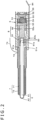
- FIG. 1 is a diagram of assistance in explaining an example of a configuration of a position indicator 1 according to a first embodiment of the present invention, and is a partial longitudinal sectional view of mainly a pen tip side.
- the position indicator 1 is formed such that an external appearance of the position indicator 1 has a pen shape.
- An end portion of the core body 6 which end portion is on an opposite side from a pen tip side projecting to the outside of the casing 2 is fitted into the pen pressure detection unit 5 disposed within a hollow portion of the casing 2.
- the core body 6 is thereby locked within the hollow portion of the casing 2 of the position indicator 1.
- the core body 6 is configured to be released from the state of being fitted to the pen pressure detection unit 5 by being pulled out. That is, the core body is replaceable for the position indicator 1.
- the core body 6 is formed by a conductor, for example, a metal or a hard resin mixed with conductor powder.
- the core body 6 is electrically connected to the signal transmission control circuit 30 through a conductive pattern 31a.
- the signal for position detection and the additional information generated by the signal transmission control circuit 30 are sent out to a sensor of a position detecting device through the core body 6 formed of the conductor.
- the shielding member 7 in the present embodiment has a constitution in which an insulating layer 72 covers substantially the entire surface of the tubular conductor 71 formed by a conductive material, the entire surface including the outer wall surface and inner wall surface of the tubular conductor 71.
- the pen pressure detection unit 5 has a constitution of a variable capacitance capacitor that receives a pen pressure applied to the core body 6 through a pressure transmitting member 8 and has a variable capacitance.
- the pen pressure detection unit 5 in the present example uses pen pressure detection means having a well-known constitution described in Patent Document: Japanese Patent Laid-Open No. 2011-186803 , for example, and constitutes a variable capacitance capacitor whose capacitance changes according to the pen pressure applied to the core body 6.
- the pen pressure detection unit 5 in the present example is formed by housing a plurality of parts, that is, a dielectric 52, a conductive member 53, an elastic member 54, a slide member 55, and a terminal member 56 within a housing member 51 made of an insulative material, for example, a resin.
- the terminal member 56 constitutes a first electrode of the variable capacitance capacitor formed by the pen pressure detection unit 5.
- the conductive member 53 and the elastic member 54 are electrically connected to each other to form a second electrode of the variable capacitance capacitor.
- a terminal portion 73 in which a part of the insulating layer 72 of the shielding member 7 is peeled off and the surface of the tubular conductor 71 is thus exposed, and the signal transmission control circuit 30 on the printed wiring board 3 are electrically connected to each other through a gold wire 74 (and the conductive pattern 31c), for example.
- the shielding member 7 is thereby controlled by the signal transmission control circuit 30.
- the oscillating circuit 302 is supplied with the power supply voltage VDD from the battery 4 via the power switch Psw.
- a continuous wave of a predetermined duration of the alternating-current signal from the oscillating circuit 302, that is, a burst signal becomes a signal for position detection which signal is sent out to the sensor.
- the tubular conductor 71 of the shielding member 7 is in a state of floating in terms of potential.
- the core body main body portion 61 of the core body 6 is not electrostatically shielded. A signal from the position indicator 1 is therefore sent out from substantially the whole of the core body main body portion 61 of the core body 6.
- the switch circuit 303 is provided to produce the state in which the core body 6 is electrostatically shielded by the tubular conductor 71 of the shielding member 7 and the state in which the core body 6 is not electrostatically shielded.
- a configuration may be adopted in which the output terminal of the oscillating circuit 302 is connected to the fixed terminal b of the switch circuit 303.
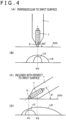
- the position detecting device can detect the inclination angle of the axial direction of the core body 6 of the position indicator 1 with respect to the sensor surface 200 by detecting received signals in the two respective states, that is, the state in which the core body 6 is electrostatically shielded by the shielding member 7 in the position indicator 1 and the state in which the electrostatic shielding of the core body 6 by the shielding member 7 is cleared, and detecting positions at which peak values of levels of the respective received signals are exhibited.
- first conductor 211Y when each of the first conductors 211Y 1 , 211Y 2 , ..., 211Y m does not need to be distinguished, the conductor will be referred to as a first conductor 211Y.
- second conductor 212X when each of the second conductors 212X 1 , 212X 2 , ..., 212X n does not need to be distinguished, the conductor will be referred to as a second conductor 212X.
- the pen indication detecting circuit 203 includes a selecting circuit 221 as an input-output interface with the sensor 202, an amplifier circuit 222, a band-pass filter 223, a detecting circuit 224, a sample and hold circuit 225, an AD (Analog to Digital) converting circuit 226, and a control circuit 220.
- a selecting circuit 221 as an input-output interface with the sensor 202, an amplifier circuit 222, a band-pass filter 223, a detecting circuit 224, a sample and hold circuit 225, an AD (Analog to Digital) converting circuit 226, and a control circuit 220.
- the output signal of the band-pass filter 223 is detected by the detecting circuit 224.
- the output signal of the detecting circuit 224 is supplied to the sample and hold circuit 225 to be sampled and held in predetermined timing by a sampling signal from the control circuit 220, and thereafter converted into a digital value by the AD converting circuit 226.
- Digital data from the AD converting circuit 226 is read and processed by the control circuit 220.
- the control circuit 220 operates so as to send out a control signal to each of the sample and hold circuit 225, the AD converting circuit 226, and the selecting circuit 221 according to a program stored in an internal ROM of the control circuit 220.
- the control circuit 220 calculates position coordinates on the sensor 202 which position coordinates are indicated by the position indicator 1 from the digital data from the AD converting circuit 226, and outputs data on the position coordinates to another processing processor or the like within the electronic apparatus such, for example, as a tablet type information terminal or the like.
- control circuit 220 of the position detecting device 201 detects, as signals from the position indicator 1, a signal in the state in which the core body main body portion 61 of the core body 6 is electrostatically shielded and a signal in the state in which the electrostatic shielding of the core body main body portion 61 of the core body 6 is cleared, as described above. Then, information based on a distance between positions at which peak values of the received signals in those two detected states, respectively, are exhibited is detected, and the inclination angle of the core body 6 of the position indicator 1 with respect to the sensor surface 200 is calculated on the basis of the detected information on the distance.
- the control circuit 220 of the position detecting device 201 has a correspondence table of data on the distance between the positions at which the peak values of the received signals in the two states, respectively, are exhibited and data on the inclination angle of the axial direction of the core body 6 of the position indicator 1 with respect to the sensor surface 200.
- the control circuit 220 of the position detecting device 201 detects information on the inclination angle of the axial direction of the core body 6 of the position indicator 1 with respect to the sensor surface 200 by detecting the information on the distance between the positions at which the peak values of the received signals in the two states, respectively, are exhibited, and referring to the correspondence table.
- control circuit 220 of the position detecting device 201 may not have the correspondence table as described above, but may calculate the information on the inclination angle of the core body 6 of the position indicator 1 by calculation from the detected information on the distance between the positions at which the peak values of the received signals in the two states, respectively, are exhibited.
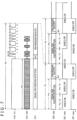
- the additional information is transmitted also in the period of the state in which the switching control signal SW of the switch circuit 303 is set to the low level and thus the electrostatic shielding of the core body 6 is cleared.
- the additional information may not be transmitted in the period of the state in which the electrostatic shielding of the core body 6 is cleared.
- the position indicator 1A has a conductor sleeve 23 at a pen tip portion of an insulator portion 21A of a casing 2A, the conductor sleeve 23 being provided as a configuration for receiving an instruction signal from the position detecting device.
- the conductor sleeve 23 has a tubular cap-like shape covering the pen tip portion of the insulator portion 21A of the casing 2A.
- the conductor sleeve 23 is electrically insulated from a conductor portion (not illustrated in FIG. 8 ) of the casing 2A.
- the conductor sleeve 23 is capable of receiving a signal from the sensor of the position detecting device by electrostatic coupling. Though not illustrated, the conductor sleeve 23 is electrically connected to the electronic circuit on the printed wiring board 3A.
- the controller 301A monitors for reception of a request signal from the position detecting device.
- the request signal from the position detecting device is received by the conductor sleeve 23 through electrostatic coupling to the sensor, as described above.
- the request signal from the position detecting device which request signal is received by the conductor sleeve 23 is supplied to the controller 301A through the received signal detecting circuit 305.
- the received signal detecting circuit 305 is also supplied with the voltage from the voltage converting circuit 304 as power.
- the voltage converting circuit 3043 may be a step-up/step-down type that operates as a step-down circuit when the voltage across the electric double layer capacitor 3042 is higher than a certain voltage, and operates as a step-up circuit when the voltage across the electric double layer capacitor 3042 is lower than the certain voltage.
- the position indicator 1A in accordance with the foregoing second embodiment, when an inclination angle detection request signal is received from the position detecting device, it suffices to perform a signal sequence so as to produce two states, that is, the state in which the core body 6Ais electrostatically shielded by the shielding member 7A and the state in which the electrostatic shielding of the core body 6A by the shielding member 7A is cleared, in response to the received inclination angle detection request signal.
- the coil 75 is used as the shielding member 7A for electrostatically shielding the core body 6A, and the coil 75 is used as a coil for noncontact charging.
- the coil 75 is used as a coil for noncontact charging.
- signal sending-out energy in a so-called hovering state before the position indicator is coupled to the sensor can be increased, and detection of the position of the position indicator in the hovering state becomes relatively easy. Then, after the position indicator and the sensor are set in the coupled state, only the reception time interval is set to monitor the signal from the sensor of the position detecting device at all times, and request signal determination is made.
- control performed in response to a request signal from the position detecting device side so as to produce two states as one pair (one set), the two states being a state in which the core body is electrostatically shielded and a state in which the electrostatic shielding is cleared, while a signal is sent out from the core body.
- control may be performed so as to normally send out a signal from the core body in the electrostatically shielded state, and clear the electrostatic shielding when there is a request signal from the position detecting device side.
- control may be performed so as to normally send out a signal from the core body in the state in which the electrostatic shielding is cleared, and perform the electrostatic shielding when there is a request signal from the position detecting device side.
- the position indicator in the foregoing second embodiment executes two states, that is, a state in which a signal is sent out in the state in which the core body is electrostatically shielded and a state in which a signal is sent out in the state in which the electrostatic shielding of the core body is cleared.
- the position indicator may always send out a signal in one of the state in which the core body is electrostatically shielded or the state in which the electrostatic shielding of the core body is cleared while the request signal is not received, and send out a signal in the other of the state in which the core body is electrostatically shielded or the state in which the electrostatic shielding of the core body is cleared when the request signal is received.
- the position detecting device can detect the inclination angle of the core body of the position indicator from the received signal before the request signal is sent out and the received signal after the request signal is sent out.
- a third embodiment to be described in the following is an example of a configuration enabling detection of not only the inclination angle of the axial direction of the core body of the position indicator but also rotation of the position indicator.
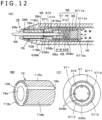
- FIG. 12(A) is an enlarged sectional view of the pen tip side of a position indicator 1B according to the third embodiment.
- FIGS. 12(B) and 12(C) are diagrams illustrating an example of constitution of principal parts of the position indicator 1B according to the third embodiment.
- the pen pressure detection unit 5B includes an outside holder 57 and an inside holder 58 formed of a resin, for example, and a pressure sensing device 59.
- conductor pieces 5711, 5712, and 5713 corresponding to the three electrodes 71Ba, 71Bb, and 71Bc formed in the outer circumferential surface of the tubular body 72B of the shielding member 7B are formed on an inner circumferential surface on the bottom surface side of the recessed portion 571 of the outside holder 57 of the pen pressure detection unit 5B.
- a protrusion 7Bb for alignment is formed on the tubular body 72B of the shielding member 7B, and a recessed hole 571d corresponding to the protrusion 7Bb is formed in the bottom surface of the recessed portion 571, as illustrated in FIG. 12(C) .
- connecting lines (see dotted lines in FIG. 12(A) ) 5711a, 5712a, and 5713a having one ends connected to the respective conductor pieces 5711, 5712, and 5713 are provided by insert molding within the outside holder 57 formed of a resin.
- Other ends of the connecting lines 5711a, 5712a, and 5713a are connected to a signal transmission control circuit 30B (see FIG. 13 ) disposed on a printed wiring board 3B.
- the three electrodes 71Ba, 71Bb, and 71Bc formed in the outer circumferential surface of the shielding member 7B are connected to the signal transmission control circuit 30B disposed on the printed wiring board 3B through the conductor pieces 5711, 5712, and 5713 and the connecting lines 5711a, 5712a, and 5713a.
- the outside holder 57 on the side of the core body 6B in the axial direction abuts against a stepped portion 2Bc of the casing 2B, and the outside holder 57 on an opposite side from the core body 6B also abuts against axial direction position regulating means, so that the outside holder 57 is fixed so as not to move in the axial direction within the casing 2B.
- An end portion on the pen tip side of the shielding member 7B abuts against a stepped portion 2Bb provided in the vicinity of an opening portion 2Ba on the pen tip side of the casing 2B.
- the shielding member 7B fitted to the outside holder 57 is also fixed so as not to move in the axial direction within the casing 2B.
- the inside holder 58 holds the pressure sensing device 59 constituting a pen pressure detecting element.
- the pressure sensing device 59 is formed by a semiconductor chip constituting a capacitance type pressure sensing unit.
- the pressure sensing device 59 is configured as a variable capacitance capacitor constituted of a MEMS (Mico Elector Mechanical Systems) element, the variable capacitance capacitor having a capacitance variable according to a pen pressure as disclosed in Japanese Patent Laid-Open No. 2013-161307 , for example.
- the pressure sensing device 59 can be formed by using a semiconductor element.
- the configuration of the pressure sensing device 59 is described in the above-described publication, and therefore description thereof will be omitted here.
- two electrodes of the variable capacitance capacitor formed by the pressure sensing device 59 are connected to the signal transmission control circuit 30B formed on the printed wiring board 3B.
- a pressure transmitting member 8B for transmitting a pressure applied to the core body 6B to the pressure sensing device 59 held by the inside holder 58 is also provided in the housing space 573 of the outside holder 57.
- the pressure transmitting member 8B is constituted of a core body fitting portion 81B into which the core body 6B is fitted and a pressing portion 82B that presses the pressure sensing device 59.
- the pressing portion 82B has a projecting portion 82Ba that presses the pressure sensing device 59.
- the core body fitting portion 81B has a recessed hole 81Ba into which the core body 6B is inserted and fitted. An end portion 6Ba of the core body 6B which end portion is on an opposite side from the pen tip side of the core body 6B is inserted and detachably fitted into the recessed hole 81Ba.
- a conductor layer 53Ba is deposited and formed on the wall surface of the through hole 572 of the outside holder 57 by printing, deposition, or the like, and a conductor brush 53Bb is formed from the conductor layer 53Ba.
- a connecting line 53Bc for connecting the conductor layer 53Ba and the signal transmission control circuit 30B on the printed wiring board 3 is provided by insert molding, for example.
- the core body 6B as a conductor when the core body 6B as a conductor is inserted through the through hole 572 of the outside holder 57, and fitted into the core body fitting portion 81B of the pressure transmitting member 8B, the core body 6B is electrically connected to the conductor layer 53Ba via the conductor brush 53Bb of the through hole 572, as illustrated in FIG. 12(A) . Consequently, the core body 6B as a conductor is connected to an output terminal of an oscillating circuit in the signal transmission control circuit 30B on the printed wiring board 3B, and the core body 6B operates as a signal electrode.
- the pressure transmitting member 8B engaged with the core body 6B in the pen pressure detection unit 5B is displaced within the outside holder 57 so as to press the pressure sensing device 59 in the axial direction according to the applied pen pressure.
- the capacitance of the variable capacitance capacitor formed between the two electrodes of the pressure sensing device 59 therefore changes according to the pen pressure.
- the position indicator 1B detects the pen pressure applied to the core body 6B on the basis of the change in the capacitance as in the foregoing, disposes the detected pen pressure data as an ASK modulated signal in the transmission period of additional information, and sends out the ASK modulated signal to the position detecting device.
- the signal transmission control circuit 30B of the position indicator 1B performs switching control of the three electrodes 71Ba, 71Bb, and 71Bc of the shielding member 7B in a state of sending out a signal to the sensor of the position detecting device through the core body 6B.
- the position detecting device 201 detects a position indicated by the position indicator 1B, and detects the inclination angle and rotation angle of the position indicator 1B.
- description will be made of an example of constitution and operation of the signal transmission control circuit 30B of the position indicator 1B according to the present third embodiment.
- FIG. 13 illustrates an example of constitution of the signal transmission control circuit 30B of the position indicator 1B according to the third embodiment.
- the same parts as in the signal transmission control circuit 30 of the position indicator 1 according to the first embodiment described with reference to FIG. 3 are identified by the same reference numerals, and description thereof will be omitted.
- a controller 301B is formed by a microprocessor as with the controller 301 in the first embodiment.
- the controller 301B is different from the controller 301 in the first embodiment only in terms of a manner of control of electronic parts connected to the controller 301B.
- the controller 301B is supplied with a power supply voltage VDD from a battery 4 as a power supply circuit, and is connected with an oscillating circuit 302.
- the controller 301B supplies an enable signal CTB as a control signal to the oscillating circuit 302.
- the controller 301B is connected with a variable capacitance capacitor 59C formed by the pressure sensing device 59 of the pen pressure detection unit 5B, and a discharging resistor Rd is connected in parallel with the variable capacitance capacitor 59C.
- the switch circuits 303Ba, 303Bb, and 303Bc each have a fixed terminal b supplied with a signal from the oscillating circuit 302, have a fixed terminal c grounded, and have a fixed terminal d as a free end.
- the switch circuit 303Ba is supplied with a switching control signal SWa from the controller 301B
- the switch circuit 303Bb is supplied with a switching control signal SWb from the controller 301B
- the switch circuit 303Bc is supplied with a switching control signal SWc from the controller 301B.
- the switch circuits 303Ba, 303Bb, and 303Bc are thereby switching-controlled.
- the signal from the oscillating circuit 302 is sent out not only from the core body 6B but also from the three electrodes 71Ba, 71Bb, and 71Bc of the shielding member 7B in a so-called hovering state, in which the tip portion of the core body 6B of the position indicator 1B is not in contact with the sensor of the position detecting device 201.
- the position detecting device 201 can thereby detect the position of the position indicator 1B even when the position indicator 1B is in the hovering state.
- the controller 301B determines whether or not the position indicator 1B is in the hovering state on the basis of a pen pressure detected on the basis of the capacitance of the pressure sensing device 59 of the pen pressure detection unit 5B.
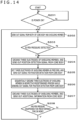
- FIG. 14 is a flowchart of assistance in explaining an example of processing operation of the controller 301B of the signal transmission control circuit 30B of the position indicator 1B according to the present third embodiment.
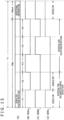
- FIG. 15 is a timing diagram of assistance in explaining a signal transmission control method in the signal transmission control circuit 30B when the tip portion of the core body 6B of the position indicator 1B is in contact with the sensor of the position detecting device 201.
- description will be made of the transmission signal control method in the signal transmission control circuit 30B of the position indicator 1B according to the present third embodiment.
- the controller 301B determines whether or not a pen pressure is detected, by detecting the capacitance of the variable capacitance capacitor 59C formed by the pressure sensing device 59 of the pen pressure detection unit 5 as described above (step S203).
- the controller 301B determines in this step S203 that no pen pressure is detected, the controller 301B returns the processing to step S202, and repeats the processing from step S202 on down.
- step S203 When the controller 301B determines in step S203 that a pen pressure is detected and that the pen tip of the core body 6B of the position indicator 1B is therefore in contact with the sensor surface of the sensor of the position detecting device 201, the controller 301B sequentially performs steps S204 to S207, and thereby performs signal transmission control to make the position detecting device 201 detect a position indicated by the position indicator 1B and make the position detecting device 201 detect the inclination angle of the axial direction of the core body 6B of the position indicator 1B with respect to the sensor surface and the rotation of the position indicator 1B, as will be described in the following.
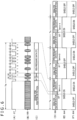
- This signal transmission control is performed by repeating, as one cycle Tc, a period constituted of a transmission period PBs of a signal for position detection and a transmission period PBad of additional information as illustrated in FIG. 15(A) .
- the transmission period PBs of the signal for position detection is a period having a length five times that of the sending-out period of the signal for position detection in which period a position indicated by the position indicator 1B can be detected on the position detecting device side, as described with reference to FIGS. 6(A) to 6(C) .
- the transmission period PBad of the additional information may be similar to the transmission period of the additional information as described with reference to FIGS. 6(A) to 6(C) .
- the controller 301B determines in step S203 that a pen pressure is detected, as illustrated in FIG. 15 , the controller 301B sends out a signal for position detection from the oscillating circuit 302, and grounds all of the three electrodes 71Ba, 71Bb, and 71Bc by switching-controlling the movable terminals a of the switch circuits 303Ba, 303Bb, and 303Bc to a state of being connected to the fixed terminals c by the switching control signal SWa (see FIG. 15(B) ), the switching control signal SWb (see FIG. 15(C) ), and the switching control signal SWc (see FIG.
- the core body 6B thereby sends out the signal for position detection to the sensor through the core body 6B in a state in which electrostatic shielding is performed by the three electrodes 71Ba, 71Bb, and 71Bc (shield on).
- the controller 301B sets all of the three electrodes 71Ba, 71Bb, and 71Bc in a state of floating in terms of potential by switching-controlling the movable terminals a of the switch circuits 303Ba, 303Bb, and 303Bc to a state of being connected to the fixed terminals d by the switching control signal SWa (see FIG. 15(B) ), the switching control signal SWb (see FIG. 15(C) ), and the switching control signal SWc (see FIG. 15(D) ) (step S205).
- the core body 6B thereby sends out the signal for position detection to the sensor through the core body 6B in a state in which the electrostatic shielding by the three electrodes 71Ba, 71Bb, and 71Bc is cleared.
- the position detecting device detects a received signal as the signal from the position indicator 1B in the transmission period P1, and can detect a position indicated by the position indicator 1B from the level of the received signal.
- the position detecting device detects received signals as the signals from the position indicator 1B in the two transmission periods, that is, the transmission period P1 and the transmission period P2, and can detect the inclination angle of the axial direction of the core body 6B of the position indicator 1B with respect to the sensor surface from a difference between positions on the sensor at which positions the levels of the received signals exhibit peak values.
- the controller 301B controls one of the three electrodes 71Ba, 71Bb, and 71Bc to a grounded state in each of a third transmission period P3, a fourth transmission period P4, and a fifth transmission period P5 each having 1/5 of the length of the transmission period PBs (step S206).
- control is performed so as to connect the movable terminal a of the switch circuit 303Ba to the fixed terminal c by the switching control signal SWa (see FIG.
- the core body 6B is electrostatically shielded by only one of the three electrodes 71Ba, 71Bb, and 71Bc in each of the third transmission period P3, the fourth transmission period P4, and the fifth transmission period P5.
- the position detecting device receives a received signal differing according to the electrode acting as an electrostatic shield and the electrodes in which electrostatic shielding is cleared in each of the third transmission period P3, the fourth transmission period P4, and the fifth transmission period P5.
- the position detecting device can detect in which direction and to which degree the position indicator 1B is rotated according to a change in the received signal.
- the controller 301B controls the oscillating circuit 302 so as to send out the additional information constituted of pen pressure data or the like, and grounds all of the three electrodes 71Ba, 71Bb, and 71Bc by switching-controlling the movable terminals a of the switch circuits 303Ba, 303Bb, and 303Bc to a state of being connected to the fixed terminals c by the switching control signal SWa (see FIG. 15(B) ), the switching control signal SWb (see FIG. 15(C) ), and the switching control signal SWc (see FIG. 15(D) ) (step S204).
- the core body 6B thereby sends out the additional information to the sensor through the core body 6B in a state in which electrostatic shielding is cleared by the three electrodes 71Ba, 71Bb, and 71Bc (shield off).
- the position detecting device can detect the additional information from the position indicator 1B.
- the controller 301B determines whether or not disappearance of the pen pressure applied to the core body 6B has continued for a predetermined time or more (step S208). When the disappearance of the pen pressure has not continued for the predetermined time or more, the controller 301B returns the processing to step S204, and repeats the transmission control processing operation in the above-described cycle Tc from this step S204 on down. In addition, when the controller 301B determines that the disappearance of the pen pressure has continued for the predetermined time or more, the controller 301B returns the processing to step S202, and repeats the processing from step S202 on down.
- the predetermined time for which the disappearance of the pen pressure is determined to have continued in step S208 is a time such that the user temporarily stops indication input on the sensor surface by the position indicator 1B. Therefore, when the user temporarily separates the position indicator 1B from the sensor surface and immediately performs indication input by bringing the position indicator 1B into contact with the sensor surface again, the operation of repeating the above-described cycle Tc can be continued assuming the state in which the pen pressure is detected. This is thus convenient.
- the position detecting device can detect not only the inclination angle of the core body 6B of the position indicator 1B with respect to the sensor surface but also the rotation of the position indicator 1B. Though inclination detection accuracy is decreased, it is also possible to omit the shield-off period in the interval for inclination angle detection, and calculate the inclination angle from the signals detected during the interval for rotation detection.
- the foregoing third embodiment notifies the state of shielding of the core body 6B by the shielding member 7B by using the second example of the signal transmission control method in the first embodiment.
- signal sending-out control for detecting the inclination angle and the rotation may be performed in response to a request signal from the position detecting device side.
- a method may be adopted in which a conductor such as a conductor sleeve or the like is provided to the pen tip side of the casing of the position indicator as in the second embodiment, and the request signal from the position detecting device is received by electrostatic coupling between the conductor sleeve and the sensor of the position detecting device, or as illustrated in FIG. 11 , the request signal may be sent and received by communication between the position indicator and the position detecting device using wireless communicating means using radio waves or the like.
Landscapes
- Engineering & Computer Science (AREA)
- General Engineering & Computer Science (AREA)
- Theoretical Computer Science (AREA)
- Human Computer Interaction (AREA)
- Physics & Mathematics (AREA)
- General Physics & Mathematics (AREA)
- Position Input By Displaying (AREA)
Applications Claiming Priority (3)
| Application Number | Priority Date | Filing Date | Title |
|---|---|---|---|
| JP2017111236A JP6908442B2 (ja) | 2017-06-06 | 2017-06-06 | 位置指示器 |
| PCT/JP2018/014180 WO2018225358A1 (ja) | 2017-06-06 | 2018-04-03 | 位置指示器 |
| EP18814095.8A EP3605283B1 (en) | 2017-06-06 | 2018-04-03 | Position indicator |
Related Parent Applications (2)
| Application Number | Title | Priority Date | Filing Date |
|---|---|---|---|
| EP18814095.8A Division-Into EP3605283B1 (en) | 2017-06-06 | 2018-04-03 | Position indicator |
| EP18814095.8A Division EP3605283B1 (en) | 2017-06-06 | 2018-04-03 | Position indicator |
Publications (2)
| Publication Number | Publication Date |
|---|---|
| EP4224291A1 EP4224291A1 (en) | 2023-08-09 |
| EP4224291B1 true EP4224291B1 (en) | 2024-07-10 |
Family
ID=64566702
Family Applications (2)
| Application Number | Title | Priority Date | Filing Date |
|---|---|---|---|
| EP23179283.9A Active EP4224291B1 (en) | 2017-06-06 | 2018-04-03 | Position indicator |
| EP18814095.8A Active EP3605283B1 (en) | 2017-06-06 | 2018-04-03 | Position indicator |
Family Applications After (1)
| Application Number | Title | Priority Date | Filing Date |
|---|---|---|---|
| EP18814095.8A Active EP3605283B1 (en) | 2017-06-06 | 2018-04-03 | Position indicator |
Country Status (6)
| Country | Link |
|---|---|
| US (4) | US11269468B2 (https=) |
| EP (2) | EP4224291B1 (https=) |
| JP (3) | JP6908442B2 (https=) |
| KR (1) | KR102397349B1 (https=) |
| CN (2) | CN118331441A (https=) |
| WO (1) | WO2018225358A1 (https=) |
Families Citing this family (12)
| Publication number | Priority date | Publication date | Assignee | Title |
|---|---|---|---|---|
| KR102646080B1 (ko) * | 2014-11-17 | 2024-03-12 | 가부시키가이샤 와코무 | 위치 지시기 |
| JP6908442B2 (ja) * | 2017-06-06 | 2021-07-28 | 株式会社ワコム | 位置指示器 |
| CN113227949B (zh) * | 2019-01-17 | 2024-06-11 | 株式会社和冠 | 静电耦合方式的电子笔 |
| JP7323336B2 (ja) * | 2019-05-24 | 2023-08-08 | 株式会社ワコム | 位置指示器及び座標入力装置 |
| CN121657880A (zh) | 2019-10-16 | 2026-03-13 | 株式会社和冠 | 电子笔及电子笔用主体部 |
| WO2021149535A1 (ja) * | 2020-01-21 | 2021-07-29 | 株式会社ワコム | 電子ペン及び電子ペン用カートリッジ並びに電子ペン用充電トレー |
| JP7660527B2 (ja) * | 2020-02-06 | 2025-04-11 | 株式会社ワコム | 静電容量方式の電子ペン及び静電容量方式の電子ペンカートリッジ並びに電子ペン用の充電トレー及び電子ペンカートリッジ用の充電トレー |
| CN114930275B (zh) * | 2020-02-28 | 2025-11-11 | 株式会社和冠 | 信息输入输出系统 |
| US11832934B1 (en) | 2020-05-04 | 2023-12-05 | Qingbin Zheng | Joint monitoring |
| JP2022104105A (ja) * | 2020-12-28 | 2022-07-08 | 日本電産株式会社 | 入力デバイス、及び、表示入力システム |
| KR20240065507A (ko) | 2022-10-31 | 2024-05-14 | 삼성디스플레이 주식회사 | 펜 및 그것을 포함하는 표시 장치 |
| KR20250158071A (ko) * | 2023-06-27 | 2025-11-05 | 가부시키가이샤 와코무 | 위치 검출 방법, 위치 검출기 및 집적 회로 |
Family Cites Families (33)
| Publication number | Priority date | Publication date | Assignee | Title |
|---|---|---|---|---|
| JPH07334291A (ja) * | 1994-06-14 | 1995-12-22 | Graphtec Corp | デジタイザ |
| JP2005149140A (ja) * | 2003-11-14 | 2005-06-09 | Wacom Co Ltd | 位置検出装置及び位置指示器 |
| US20070146351A1 (en) * | 2005-12-12 | 2007-06-28 | Yuji Katsurahira | Position input device and computer system |
| JP4709674B2 (ja) * | 2006-03-23 | 2011-06-22 | 株式会社ワコム | 位置検出装置及びコンピュータ |
| US10168801B2 (en) * | 2006-08-31 | 2019-01-01 | Semiconductor Energy Laboratory Co., Ltd. | Electronic pen and electronic pen system |
| JP4872113B2 (ja) * | 2007-09-10 | 2012-02-08 | 株式会社ワコム | 位置検出装置 |
| CN101539816B (zh) * | 2009-04-16 | 2012-10-17 | 台均科技(深圳)有限公司 | 电磁笔、电磁信号处理方法、装置及设备 |
| JP5534419B2 (ja) | 2010-03-09 | 2014-07-02 | 株式会社ワコム | 位置指示器、可変容量コンデンサ及び入力装置 |
| TWI423194B (zh) * | 2010-09-21 | 2014-01-11 | Waltop Int Corp | 整合電磁式感應輸入之平面顯示裝置與薄膜電晶體陣列基板 |
| JP5669263B2 (ja) * | 2011-04-11 | 2015-02-12 | 株式会社ワコム | 位置指示器 |
| JP5892595B2 (ja) | 2012-02-06 | 2016-03-23 | 株式会社ワコム | 位置指示器 |
| US10379666B2 (en) * | 2012-05-11 | 2019-08-13 | Samsung Electronics Co., Ltd. | Position measuring apparatus, pen and position measuring method |
| JP6008392B2 (ja) * | 2012-07-24 | 2016-10-19 | 株式会社ワコム | 指示体位置検出装置 |
| JP6021174B2 (ja) * | 2012-08-08 | 2016-11-09 | 株式会社ワコム | 位置検出装置およびその位置指示器 |
| JP6012069B2 (ja) * | 2012-09-13 | 2016-10-25 | 株式会社ワコム | 電磁誘導方式の位置指示器及び電子インクカートリッジ |
| JP6080256B2 (ja) * | 2012-12-17 | 2017-02-15 | 株式会社ワコム | 静電方式スタイラスペン |
| WO2014174771A1 (ja) * | 2013-04-25 | 2014-10-30 | シャープ株式会社 | タッチパネルシステムおよび電子機器 |
| JP5667708B2 (ja) * | 2013-06-20 | 2015-02-12 | 株式会社ワコム | 位置指示器及び位置指示器の芯体 |
| CN105829997B (zh) * | 2013-12-25 | 2019-05-17 | 株式会社和冠 | 位置指示用模块及触控笔 |
| JP6304814B2 (ja) * | 2014-05-23 | 2018-04-04 | 株式会社ワコム | 位置検出装置及び位置指示器 |
| JP5869193B1 (ja) * | 2014-08-29 | 2016-02-24 | 株式会社ワコム | 位置指示器及び位置指示器用カートリッジ |
| JP6472196B2 (ja) * | 2014-09-17 | 2019-02-20 | 株式会社ワコム | センサ信号処理回路及びセンサ信号処理方法 |
| KR102646080B1 (ko) * | 2014-11-17 | 2024-03-12 | 가부시키가이샤 와코무 | 위치 지시기 |
| WO2016084424A1 (ja) * | 2014-11-28 | 2016-06-02 | 株式会社ワコム | 電子ペン |
| JP6487694B2 (ja) * | 2014-12-26 | 2019-03-20 | 株式会社ワコム | 位置指示器及び信号処理装置 |
| KR102389701B1 (ko) * | 2015-01-19 | 2022-04-22 | 가부시키가이샤 와코무 | 위치 지시기 |
| JP5978416B1 (ja) | 2015-01-29 | 2016-08-24 | 株式会社ワコム | 電子ペン |
| KR102394205B1 (ko) * | 2015-02-09 | 2022-05-09 | 가부시키가이샤 와코무 | 통신 방법, 통신 시스템, 센서 컨트롤러 및 스타일러스 |
| JP6544791B2 (ja) * | 2015-02-20 | 2019-07-17 | 株式会社ワコム | 位置指示器、信号処理回路、信号供給制御方法及び信号処理方法 |
| KR102414407B1 (ko) * | 2015-03-31 | 2022-06-30 | 가부시키가이샤 와코무 | 전자 펜 및 전자 펜 본체부 |
| CN107949822B (zh) * | 2015-09-10 | 2021-05-07 | 株式会社和冠 | 电子笔及电子笔用主体部 |
| JP6908442B2 (ja) * | 2017-06-06 | 2021-07-28 | 株式会社ワコム | 位置指示器 |
| CN111373357B (zh) * | 2017-11-29 | 2023-09-22 | 株式会社和冠 | 在主动笔与传感器控制器之间执行的通信方法及主动笔 |
-
2017
- 2017-06-06 JP JP2017111236A patent/JP6908442B2/ja active Active
-
2018
- 2018-04-03 EP EP23179283.9A patent/EP4224291B1/en active Active
- 2018-04-03 KR KR1020197038416A patent/KR102397349B1/ko active Active
- 2018-04-03 CN CN202410318850.XA patent/CN118331441A/zh active Pending
- 2018-04-03 CN CN201880025550.5A patent/CN110520828B/zh active Active
- 2018-04-03 EP EP18814095.8A patent/EP3605283B1/en active Active
- 2018-04-03 WO PCT/JP2018/014180 patent/WO2018225358A1/ja not_active Ceased
-
2019
- 2019-10-03 US US16/592,694 patent/US11269468B2/en active Active
-
2021
- 2021-03-29 JP JP2021054849A patent/JP7053920B2/ja active Active
- 2021-07-01 JP JP2021109806A patent/JP7088621B2/ja active Active
-
2022
- 2022-01-28 US US17/588,132 patent/US11675467B2/en active Active
-
2023
- 2023-05-02 US US18/311,165 patent/US12236052B2/en active Active
-
2025
- 2025-01-16 US US19/025,666 patent/US20250156017A1/en active Pending
Also Published As
| Publication number | Publication date |
|---|---|
| JP6908442B2 (ja) | 2021-07-28 |
| WO2018225358A1 (ja) | 2018-12-13 |
| US11675467B2 (en) | 2023-06-13 |
| KR20200014349A (ko) | 2020-02-10 |
| JP2021096884A (ja) | 2021-06-24 |
| US20250156017A1 (en) | 2025-05-15 |
| CN118331441A (zh) | 2024-07-12 |
| EP3605283A1 (en) | 2020-02-05 |
| US20200033958A1 (en) | 2020-01-30 |
| EP3605283A4 (en) | 2020-02-05 |
| US20220155908A1 (en) | 2022-05-19 |
| CN110520828B (zh) | 2024-04-09 |
| EP3605283B1 (en) | 2023-07-26 |
| KR102397349B1 (ko) | 2022-05-13 |
| JP7053920B2 (ja) | 2022-04-12 |
| CN110520828A (zh) | 2019-11-29 |
| US12236052B2 (en) | 2025-02-25 |
| JP7088621B2 (ja) | 2022-06-21 |
| EP4224291A1 (en) | 2023-08-09 |
| US20230315240A1 (en) | 2023-10-05 |
| JP2021157849A (ja) | 2021-10-07 |
| US11269468B2 (en) | 2022-03-08 |
| JP2018206093A (ja) | 2018-12-27 |
Similar Documents
| Publication | Publication Date | Title |
|---|---|---|
| EP4224291B1 (en) | Position indicator | |
| US11314365B2 (en) | Electronic pen and electronic pen main body | |
| EP2947544B1 (en) | Active stylus and digitizer | |
| US10459539B2 (en) | Electronic pen and electronic pen main body | |
| KR102184579B1 (ko) | 위치 지시기, 신호 처리 회로, 신호 공급 제어 방법 및 신호 처리 방법 | |
| US10296113B2 (en) | Position indicator | |
| KR20230110697A (ko) | 전자 펜 | |
| CN105739723B (zh) | 位置指示器以及信号处理装置 | |
| US11429207B2 (en) | Capacitive-coupling electronic pen | |
| JP2019091495A (ja) | 位置指示器及び信号処理装置 |
Legal Events
| Date | Code | Title | Description |
|---|---|---|---|
| PUAI | Public reference made under article 153(3) epc to a published international application that has entered the european phase |
Free format text: ORIGINAL CODE: 0009012 |
|
| STAA | Information on the status of an ep patent application or granted ep patent |
Free format text: STATUS: THE APPLICATION HAS BEEN PUBLISHED |
|
| AC | Divisional application: reference to earlier application |
Ref document number: 3605283 Country of ref document: EP Kind code of ref document: P |
|
| AK | Designated contracting states |
Kind code of ref document: A1 Designated state(s): AL AT BE BG CH CY CZ DE DK EE ES FI FR GB GR HR HU IE IS IT LI LT LU LV MC MK MT NL NO PL PT RO RS SE SI SK SM TR |
|
| STAA | Information on the status of an ep patent application or granted ep patent |
Free format text: STATUS: REQUEST FOR EXAMINATION WAS MADE |
|
| 17P | Request for examination filed |
Effective date: 20231116 |
|
| RBV | Designated contracting states (corrected) |
Designated state(s): AL AT BE BG CH CY CZ DE DK EE ES FI FR GB GR HR HU IE IS IT LI LT LU LV MC MK MT NL NO PL PT RO RS SE SI SK SM TR |
|
| GRAP | Despatch of communication of intention to grant a patent |
Free format text: ORIGINAL CODE: EPIDOSNIGR1 |
|
| STAA | Information on the status of an ep patent application or granted ep patent |
Free format text: STATUS: GRANT OF PATENT IS INTENDED |
|
| INTG | Intention to grant announced |
Effective date: 20240201 |
|
| GRAS | Grant fee paid |
Free format text: ORIGINAL CODE: EPIDOSNIGR3 |
|
| GRAA | (expected) grant |
Free format text: ORIGINAL CODE: 0009210 |
|
| STAA | Information on the status of an ep patent application or granted ep patent |
Free format text: STATUS: THE PATENT HAS BEEN GRANTED |
|
| AC | Divisional application: reference to earlier application |
Ref document number: 3605283 Country of ref document: EP Kind code of ref document: P |
|
| AK | Designated contracting states |
Kind code of ref document: B1 Designated state(s): AL AT BE BG CH CY CZ DE DK EE ES FI FR GB GR HR HU IE IS IT LI LT LU LV MC MK MT NL NO PL PT RO RS SE SI SK SM TR |
|
| REG | Reference to a national code |
Ref country code: CH Ref legal event code: EP |
|
| REG | Reference to a national code |
Ref country code: DE Ref legal event code: R096 Ref document number: 602018071777 Country of ref document: DE |
|
| REG | Reference to a national code |
Ref country code: LT Ref legal event code: MG9D |
|
| REG | Reference to a national code |
Ref country code: NL Ref legal event code: MP Effective date: 20240710 |
|
| PG25 | Lapsed in a contracting state [announced via postgrant information from national office to epo] |
Ref country code: PT Free format text: LAPSE BECAUSE OF FAILURE TO SUBMIT A TRANSLATION OF THE DESCRIPTION OR TO PAY THE FEE WITHIN THE PRESCRIBED TIME-LIMIT Effective date: 20241111 |
|
| REG | Reference to a national code |
Ref country code: AT Ref legal event code: MK05 Ref document number: 1702619 Country of ref document: AT Kind code of ref document: T Effective date: 20240710 |
|
| PG25 | Lapsed in a contracting state [announced via postgrant information from national office to epo] |
Ref country code: NL Free format text: LAPSE BECAUSE OF FAILURE TO SUBMIT A TRANSLATION OF THE DESCRIPTION OR TO PAY THE FEE WITHIN THE PRESCRIBED TIME-LIMIT Effective date: 20240710 |
|
| PG25 | Lapsed in a contracting state [announced via postgrant information from national office to epo] |
Ref country code: PT Free format text: LAPSE BECAUSE OF FAILURE TO SUBMIT A TRANSLATION OF THE DESCRIPTION OR TO PAY THE FEE WITHIN THE PRESCRIBED TIME-LIMIT Effective date: 20241111 Ref country code: NL Free format text: LAPSE BECAUSE OF FAILURE TO SUBMIT A TRANSLATION OF THE DESCRIPTION OR TO PAY THE FEE WITHIN THE PRESCRIBED TIME-LIMIT Effective date: 20240710 |
|
| PG25 | Lapsed in a contracting state [announced via postgrant information from national office to epo] |
Ref country code: NO Free format text: LAPSE BECAUSE OF FAILURE TO SUBMIT A TRANSLATION OF THE DESCRIPTION OR TO PAY THE FEE WITHIN THE PRESCRIBED TIME-LIMIT Effective date: 20241010 |
|
| PG25 | Lapsed in a contracting state [announced via postgrant information from national office to epo] |
Ref country code: GR Free format text: LAPSE BECAUSE OF FAILURE TO SUBMIT A TRANSLATION OF THE DESCRIPTION OR TO PAY THE FEE WITHIN THE PRESCRIBED TIME-LIMIT Effective date: 20241011 Ref country code: FI Free format text: LAPSE BECAUSE OF FAILURE TO SUBMIT A TRANSLATION OF THE DESCRIPTION OR TO PAY THE FEE WITHIN THE PRESCRIBED TIME-LIMIT Effective date: 20240710 Ref country code: PL Free format text: LAPSE BECAUSE OF FAILURE TO SUBMIT A TRANSLATION OF THE DESCRIPTION OR TO PAY THE FEE WITHIN THE PRESCRIBED TIME-LIMIT Effective date: 20240710 |
|
| PG25 | Lapsed in a contracting state [announced via postgrant information from national office to epo] |
Ref country code: BG Free format text: LAPSE BECAUSE OF FAILURE TO SUBMIT A TRANSLATION OF THE DESCRIPTION OR TO PAY THE FEE WITHIN THE PRESCRIBED TIME-LIMIT Effective date: 20240710 |
|
| PG25 | Lapsed in a contracting state [announced via postgrant information from national office to epo] |
Ref country code: LV Free format text: LAPSE BECAUSE OF FAILURE TO SUBMIT A TRANSLATION OF THE DESCRIPTION OR TO PAY THE FEE WITHIN THE PRESCRIBED TIME-LIMIT Effective date: 20240710 |
|
| PG25 | Lapsed in a contracting state [announced via postgrant information from national office to epo] |
Ref country code: IS Free format text: LAPSE BECAUSE OF FAILURE TO SUBMIT A TRANSLATION OF THE DESCRIPTION OR TO PAY THE FEE WITHIN THE PRESCRIBED TIME-LIMIT Effective date: 20241110 Ref country code: AT Free format text: LAPSE BECAUSE OF FAILURE TO SUBMIT A TRANSLATION OF THE DESCRIPTION OR TO PAY THE FEE WITHIN THE PRESCRIBED TIME-LIMIT Effective date: 20240710 |
|
| PG25 | Lapsed in a contracting state [announced via postgrant information from national office to epo] |
Ref country code: HR Free format text: LAPSE BECAUSE OF FAILURE TO SUBMIT A TRANSLATION OF THE DESCRIPTION OR TO PAY THE FEE WITHIN THE PRESCRIBED TIME-LIMIT Effective date: 20240710 |
|
| PG25 | Lapsed in a contracting state [announced via postgrant information from national office to epo] |
Ref country code: ES Free format text: LAPSE BECAUSE OF FAILURE TO SUBMIT A TRANSLATION OF THE DESCRIPTION OR TO PAY THE FEE WITHIN THE PRESCRIBED TIME-LIMIT Effective date: 20240710 Ref country code: RS Free format text: LAPSE BECAUSE OF FAILURE TO SUBMIT A TRANSLATION OF THE DESCRIPTION OR TO PAY THE FEE WITHIN THE PRESCRIBED TIME-LIMIT Effective date: 20241010 |
|
| PG25 | Lapsed in a contracting state [announced via postgrant information from national office to epo] |
Ref country code: RS Free format text: LAPSE BECAUSE OF FAILURE TO SUBMIT A TRANSLATION OF THE DESCRIPTION OR TO PAY THE FEE WITHIN THE PRESCRIBED TIME-LIMIT Effective date: 20241010 Ref country code: PL Free format text: LAPSE BECAUSE OF FAILURE TO SUBMIT A TRANSLATION OF THE DESCRIPTION OR TO PAY THE FEE WITHIN THE PRESCRIBED TIME-LIMIT Effective date: 20240710 Ref country code: NO Free format text: LAPSE BECAUSE OF FAILURE TO SUBMIT A TRANSLATION OF THE DESCRIPTION OR TO PAY THE FEE WITHIN THE PRESCRIBED TIME-LIMIT Effective date: 20241010 Ref country code: LV Free format text: LAPSE BECAUSE OF FAILURE TO SUBMIT A TRANSLATION OF THE DESCRIPTION OR TO PAY THE FEE WITHIN THE PRESCRIBED TIME-LIMIT Effective date: 20240710 Ref country code: IS Free format text: LAPSE BECAUSE OF FAILURE TO SUBMIT A TRANSLATION OF THE DESCRIPTION OR TO PAY THE FEE WITHIN THE PRESCRIBED TIME-LIMIT Effective date: 20241110 Ref country code: HR Free format text: LAPSE BECAUSE OF FAILURE TO SUBMIT A TRANSLATION OF THE DESCRIPTION OR TO PAY THE FEE WITHIN THE PRESCRIBED TIME-LIMIT Effective date: 20240710 Ref country code: GR Free format text: LAPSE BECAUSE OF FAILURE TO SUBMIT A TRANSLATION OF THE DESCRIPTION OR TO PAY THE FEE WITHIN THE PRESCRIBED TIME-LIMIT Effective date: 20241011 Ref country code: FI Free format text: LAPSE BECAUSE OF FAILURE TO SUBMIT A TRANSLATION OF THE DESCRIPTION OR TO PAY THE FEE WITHIN THE PRESCRIBED TIME-LIMIT Effective date: 20240710 Ref country code: ES Free format text: LAPSE BECAUSE OF FAILURE TO SUBMIT A TRANSLATION OF THE DESCRIPTION OR TO PAY THE FEE WITHIN THE PRESCRIBED TIME-LIMIT Effective date: 20240710 Ref country code: BG Free format text: LAPSE BECAUSE OF FAILURE TO SUBMIT A TRANSLATION OF THE DESCRIPTION OR TO PAY THE FEE WITHIN THE PRESCRIBED TIME-LIMIT Effective date: 20240710 Ref country code: AT Free format text: LAPSE BECAUSE OF FAILURE TO SUBMIT A TRANSLATION OF THE DESCRIPTION OR TO PAY THE FEE WITHIN THE PRESCRIBED TIME-LIMIT Effective date: 20240710 |
|
| REG | Reference to a national code |
Ref country code: DE Ref legal event code: R097 Ref document number: 602018071777 Country of ref document: DE |
|
| PG25 | Lapsed in a contracting state [announced via postgrant information from national office to epo] |
Ref country code: DK Free format text: LAPSE BECAUSE OF FAILURE TO SUBMIT A TRANSLATION OF THE DESCRIPTION OR TO PAY THE FEE WITHIN THE PRESCRIBED TIME-LIMIT Effective date: 20240710 Ref country code: SM Free format text: LAPSE BECAUSE OF FAILURE TO SUBMIT A TRANSLATION OF THE DESCRIPTION OR TO PAY THE FEE WITHIN THE PRESCRIBED TIME-LIMIT Effective date: 20240710 Ref country code: RO Free format text: LAPSE BECAUSE OF FAILURE TO SUBMIT A TRANSLATION OF THE DESCRIPTION OR TO PAY THE FEE WITHIN THE PRESCRIBED TIME-LIMIT Effective date: 20240710 |
|
| PG25 | Lapsed in a contracting state [announced via postgrant information from national office to epo] |
Ref country code: EE Free format text: LAPSE BECAUSE OF FAILURE TO SUBMIT A TRANSLATION OF THE DESCRIPTION OR TO PAY THE FEE WITHIN THE PRESCRIBED TIME-LIMIT Effective date: 20240710 |
|
| PG25 | Lapsed in a contracting state [announced via postgrant information from national office to epo] |
Ref country code: CZ Free format text: LAPSE BECAUSE OF FAILURE TO SUBMIT A TRANSLATION OF THE DESCRIPTION OR TO PAY THE FEE WITHIN THE PRESCRIBED TIME-LIMIT Effective date: 20240710 |
|
| PG25 | Lapsed in a contracting state [announced via postgrant information from national office to epo] |
Ref country code: SK Free format text: LAPSE BECAUSE OF FAILURE TO SUBMIT A TRANSLATION OF THE DESCRIPTION OR TO PAY THE FEE WITHIN THE PRESCRIBED TIME-LIMIT Effective date: 20240710 Ref country code: IT Free format text: LAPSE BECAUSE OF FAILURE TO SUBMIT A TRANSLATION OF THE DESCRIPTION OR TO PAY THE FEE WITHIN THE PRESCRIBED TIME-LIMIT Effective date: 20240710 |
|
| PLBE | No opposition filed within time limit |
Free format text: ORIGINAL CODE: 0009261 |
|
| STAA | Information on the status of an ep patent application or granted ep patent |
Free format text: STATUS: NO OPPOSITION FILED WITHIN TIME LIMIT |
|
| 26N | No opposition filed |
Effective date: 20250411 |
|
| PGFP | Annual fee paid to national office [announced via postgrant information from national office to epo] |
Ref country code: DE Payment date: 20250422 Year of fee payment: 8 |
|
| PG25 | Lapsed in a contracting state [announced via postgrant information from national office to epo] |
Ref country code: SE Free format text: LAPSE BECAUSE OF FAILURE TO SUBMIT A TRANSLATION OF THE DESCRIPTION OR TO PAY THE FEE WITHIN THE PRESCRIBED TIME-LIMIT Effective date: 20240710 |
|
| REG | Reference to a national code |
Ref country code: CH Ref legal event code: H13 Free format text: ST27 STATUS EVENT CODE: U-0-0-H10-H13 (AS PROVIDED BY THE NATIONAL OFFICE) Effective date: 20251125 |
|
| PG25 | Lapsed in a contracting state [announced via postgrant information from national office to epo] |
Ref country code: LU Free format text: LAPSE BECAUSE OF NON-PAYMENT OF DUE FEES Effective date: 20250403 |
|
| PG25 | Lapsed in a contracting state [announced via postgrant information from national office to epo] |
Ref country code: MC Free format text: LAPSE BECAUSE OF FAILURE TO SUBMIT A TRANSLATION OF THE DESCRIPTION OR TO PAY THE FEE WITHIN THE PRESCRIBED TIME-LIMIT Effective date: 20240710 |
|
| GBPC | Gb: european patent ceased through non-payment of renewal fee |
Effective date: 20250403 |
|
| REG | Reference to a national code |
Ref country code: BE Ref legal event code: MM Effective date: 20250430 |
|
| PG25 | Lapsed in a contracting state [announced via postgrant information from national office to epo] |
Ref country code: GB Free format text: LAPSE BECAUSE OF NON-PAYMENT OF DUE FEES Effective date: 20250403 |
|
| PG25 | Lapsed in a contracting state [announced via postgrant information from national office to epo] |
Ref country code: FR Free format text: LAPSE BECAUSE OF NON-PAYMENT OF DUE FEES Effective date: 20250430 |
|
| PG25 | Lapsed in a contracting state [announced via postgrant information from national office to epo] |
Ref country code: BE Free format text: LAPSE BECAUSE OF NON-PAYMENT OF DUE FEES Effective date: 20250430 |
|
| PG25 | Lapsed in a contracting state [announced via postgrant information from national office to epo] |
Ref country code: CH Free format text: LAPSE BECAUSE OF NON-PAYMENT OF DUE FEES Effective date: 20250430 |
|
| PG25 | Lapsed in a contracting state [announced via postgrant information from national office to epo] |
Ref country code: IE Free format text: LAPSE BECAUSE OF NON-PAYMENT OF DUE FEES Effective date: 20250403 |