EP4222470B1 - Computergestütztes verfahren und vorrichtung zur wahrscheinlichkeitsbasierten geschwindigkeitsprognose für fahrzeuge - Google Patents
Computergestütztes verfahren und vorrichtung zur wahrscheinlichkeitsbasierten geschwindigkeitsprognose für fahrzeuge Download PDFInfo
- Publication number
- EP4222470B1 EP4222470B1 EP21800978.5A EP21800978A EP4222470B1 EP 4222470 B1 EP4222470 B1 EP 4222470B1 EP 21800978 A EP21800978 A EP 21800978A EP 4222470 B1 EP4222470 B1 EP 4222470B1
- Authority
- EP
- European Patent Office
- Prior art keywords
- acceleration
- value
- driving
- velocity
- values
- Prior art date
- Legal status (The legal status is an assumption and is not a legal conclusion. Google has not performed a legal analysis and makes no representation as to the accuracy of the status listed.)
- Active
Links
Images

Classifications
-
- G—PHYSICS
- G01—MEASURING; TESTING
- G01M—TESTING STATIC OR DYNAMIC BALANCE OF MACHINES OR STRUCTURES; TESTING OF STRUCTURES OR APPARATUS, NOT OTHERWISE PROVIDED FOR
- G01M17/00—Testing of vehicles
- G01M17/007—Wheeled or endless-tracked vehicles
- G01M17/06—Steering behaviour; Rolling behaviour
-
- G—PHYSICS
- G01—MEASURING; TESTING
- G01M—TESTING STATIC OR DYNAMIC BALANCE OF MACHINES OR STRUCTURES; TESTING OF STRUCTURES OR APPARATUS, NOT OTHERWISE PROVIDED FOR
- G01M99/00—Subject matter not provided for in other groups of this subclass
- G01M99/004—Testing the effects of speed or acceleration
-
- B—PERFORMING OPERATIONS; TRANSPORTING
- B60—VEHICLES IN GENERAL
- B60W—CONJOINT CONTROL OF VEHICLE SUB-UNITS OF DIFFERENT TYPE OR DIFFERENT FUNCTION; CONTROL SYSTEMS SPECIALLY ADAPTED FOR HYBRID VEHICLES; ROAD VEHICLE DRIVE CONTROL SYSTEMS FOR PURPOSES NOT RELATED TO THE CONTROL OF A PARTICULAR SUB-UNIT
- B60W30/00—Purposes of road vehicle drive control systems not related to the control of a particular sub-unit, e.g. of systems using conjoint control of vehicle sub-units
- B60W30/14—Adaptive cruise control
-
- B—PERFORMING OPERATIONS; TRANSPORTING
- B60—VEHICLES IN GENERAL
- B60W—CONJOINT CONTROL OF VEHICLE SUB-UNITS OF DIFFERENT TYPE OR DIFFERENT FUNCTION; CONTROL SYSTEMS SPECIALLY ADAPTED FOR HYBRID VEHICLES; ROAD VEHICLE DRIVE CONTROL SYSTEMS FOR PURPOSES NOT RELATED TO THE CONTROL OF A PARTICULAR SUB-UNIT
- B60W50/00—Details of control systems for road vehicle drive control not related to the control of a particular sub-unit, e.g. process diagnostic or vehicle driver interfaces
- B60W50/0097—Predicting future conditions
-
- G—PHYSICS
- G01—MEASURING; TESTING
- G01M—TESTING STATIC OR DYNAMIC BALANCE OF MACHINES OR STRUCTURES; TESTING OF STRUCTURES OR APPARATUS, NOT OTHERWISE PROVIDED FOR
- G01M15/00—Testing of engines
- G01M15/02—Details or accessories of testing apparatus
-
- G—PHYSICS
- G01—MEASURING; TESTING
- G01M—TESTING STATIC OR DYNAMIC BALANCE OF MACHINES OR STRUCTURES; TESTING OF STRUCTURES OR APPARATUS, NOT OTHERWISE PROVIDED FOR
- G01M15/00—Testing of engines
- G01M15/04—Testing internal-combustion engines
- G01M15/10—Testing internal-combustion engines by monitoring exhaust gases or combustion flame
-
- G—PHYSICS
- G01—MEASURING; TESTING
- G01M—TESTING STATIC OR DYNAMIC BALANCE OF MACHINES OR STRUCTURES; TESTING OF STRUCTURES OR APPARATUS, NOT OTHERWISE PROVIDED FOR
- G01M17/00—Testing of vehicles
-
- G—PHYSICS
- G01—MEASURING; TESTING
- G01M—TESTING STATIC OR DYNAMIC BALANCE OF MACHINES OR STRUCTURES; TESTING OF STRUCTURES OR APPARATUS, NOT OTHERWISE PROVIDED FOR
- G01M17/00—Testing of vehicles
- G01M17/007—Wheeled or endless-tracked vehicles
-
- G—PHYSICS
- G06—COMPUTING OR CALCULATING; COUNTING
- G06F—ELECTRIC DIGITAL DATA PROCESSING
- G06F30/00—Computer-aided design [CAD]
- G06F30/20—Design optimisation, verification or simulation
-
- G—PHYSICS
- G06—COMPUTING OR CALCULATING; COUNTING
- G06F—ELECTRIC DIGITAL DATA PROCESSING
- G06F30/00—Computer-aided design [CAD]
- G06F30/20—Design optimisation, verification or simulation
- G06F30/27—Design optimisation, verification or simulation using machine learning, e.g. artificial intelligence, neural networks, support vector machines [SVM] or training a model
-
- G—PHYSICS
- G06—COMPUTING OR CALCULATING; COUNTING
- G06N—COMPUTING ARRANGEMENTS BASED ON SPECIFIC COMPUTATIONAL MODELS
- G06N3/00—Computing arrangements based on biological models
- G06N3/02—Neural networks
- G06N3/08—Learning methods
-
- G—PHYSICS
- G06—COMPUTING OR CALCULATING; COUNTING
- G06N—COMPUTING ARRANGEMENTS BASED ON SPECIFIC COMPUTATIONAL MODELS
- G06N3/00—Computing arrangements based on biological models
- G06N3/02—Neural networks
- G06N3/08—Learning methods
- G06N3/09—Supervised learning
-
- G—PHYSICS
- G06—COMPUTING OR CALCULATING; COUNTING
- G06N—COMPUTING ARRANGEMENTS BASED ON SPECIFIC COMPUTATIONAL MODELS
- G06N7/00—Computing arrangements based on specific mathematical models
- G06N7/01—Probabilistic graphical models, e.g. probabilistic networks
-
- G—PHYSICS
- G06—COMPUTING OR CALCULATING; COUNTING
- G06Q—INFORMATION AND COMMUNICATION TECHNOLOGY [ICT] SPECIALLY ADAPTED FOR ADMINISTRATIVE, COMMERCIAL, FINANCIAL, MANAGERIAL OR SUPERVISORY PURPOSES; SYSTEMS OR METHODS SPECIALLY ADAPTED FOR ADMINISTRATIVE, COMMERCIAL, FINANCIAL, MANAGERIAL OR SUPERVISORY PURPOSES, NOT OTHERWISE PROVIDED FOR
- G06Q10/00—Administration; Management
- G06Q10/04—Forecasting or optimisation specially adapted for administrative or management purposes, e.g. linear programming or "cutting stock problem"
-
- G—PHYSICS
- G06—COMPUTING OR CALCULATING; COUNTING
- G06Q—INFORMATION AND COMMUNICATION TECHNOLOGY [ICT] SPECIALLY ADAPTED FOR ADMINISTRATIVE, COMMERCIAL, FINANCIAL, MANAGERIAL OR SUPERVISORY PURPOSES; SYSTEMS OR METHODS SPECIALLY ADAPTED FOR ADMINISTRATIVE, COMMERCIAL, FINANCIAL, MANAGERIAL OR SUPERVISORY PURPOSES, NOT OTHERWISE PROVIDED FOR
- G06Q50/00—Information and communication technology [ICT] specially adapted for implementation of business processes of specific business sectors, e.g. utilities or tourism
- G06Q50/40—Business processes related to the transportation industry
-
- G—PHYSICS
- G08—SIGNALLING
- G08G—TRAFFIC CONTROL SYSTEMS
- G08G1/00—Traffic control systems for road vehicles
- G08G1/01—Detecting movement of traffic to be counted or controlled
- G08G1/0104—Measuring and analyzing of parameters relative to traffic conditions
- G08G1/0125—Traffic data processing
- G08G1/0129—Traffic data processing for creating historical data or processing based on historical data
-
- G—PHYSICS
- G08—SIGNALLING
- G08G—TRAFFIC CONTROL SYSTEMS
- G08G1/00—Traffic control systems for road vehicles
- G08G1/01—Detecting movement of traffic to be counted or controlled
- G08G1/0104—Measuring and analyzing of parameters relative to traffic conditions
- G08G1/0137—Measuring and analyzing of parameters relative to traffic conditions for specific applications
- G08G1/0145—Measuring and analyzing of parameters relative to traffic conditions for specific applications for active traffic flow control
-
- G—PHYSICS
- G09—EDUCATION; CRYPTOGRAPHY; DISPLAY; ADVERTISING; SEALS
- G09B—EDUCATIONAL OR DEMONSTRATION APPLIANCES; APPLIANCES FOR TEACHING, OR COMMUNICATING WITH, THE BLIND, DEAF OR MUTE; MODELS; PLANETARIA; GLOBES; MAPS; DIAGRAMS
- G09B9/00—Simulators for teaching or training purposes
- G09B9/02—Simulators for teaching or training purposes for teaching control of vehicles or other craft
- G09B9/04—Simulators for teaching or training purposes for teaching control of vehicles or other craft for teaching control of land vehicles
- G09B9/042—Simulators for teaching or training purposes for teaching control of vehicles or other craft for teaching control of land vehicles providing simulation in a real vehicle
Definitions
- the invention relates to a computer-aided method and a device for generating a driving cycle for a vehicle, which is suitable for simulating a driving operation, in particular a real driving operation.
- Emissions guidelines for vehicles with internal combustion engines are subject to constant change, with the aim of taking into account driving conditions that increasingly approximate real-world driving conditions.
- One example of such emissions guidelines is the European Union's regulation of test procedures to determine vehicle emissions under real-world driving conditions, so-called Real Driving Emissions (RDE).
- RDE Real Driving Emissions
- These test procedures are, for example, part of the approval process for vehicle types. Emissions tests can therefore no longer be conducted exclusively on a vehicle test bench with generally defined driving cycles, but must be conducted under real-world driving conditions in order to take into account, for example, the influence of real-world traffic conditions and the driver's actual driving behavior.
- RDE-compliant driving cycle which serves as the basis for determining emissions in accordance with the guidelines.
- emissions guidelines designed to reflect real-world driving conditions on the road permit a wide variety of different driving cycles, which entails enormous testing effort for vehicle manufacturers during vehicle development.
- fuel consumption is typically determined for approximately 1,000 RDE-compliant driving cycles. This testing effort can be reduced by simulating a wide variety of different, guideline-compliant driving cycles that take realistic driving behavior into account.
- a first aspect of the invention relates to a computer-aided method for generating a driving cycle for a vehicle, which is suitable for simulating a driving operation, in particular a real one.
- the computer-aided method comprises determining a state vector of the driving cycle for a current time interval from a past speed profile, providing an acceleration prediction model, determining an acceleration value taking into account probabilities resulting from the acceleration prediction model and the state vector, integrating the determined acceleration value over the current time interval to obtain a predicted speed value for a next time interval in the future, and appending the predicted speed value to the past speed profile to generate the driving cycle.
- a driving cycle within the meaning of the invention is in particular a time interval to which a constant speed value is assigned, or a temporal sequence of several time intervals to which a constant speed value is each assigned.
- a current time interval of a driving cycle within the meaning of the invention is in particular a time interval which directly follows past time intervals of the driving cycle and to which a current speed value is assigned, which can have a finite value or be zero.
- a past speed profile within the meaning of the invention is, in particular, a current time interval to which a speed value is assigned and/or a past time interval to which a speed value is assigned, and/or a plurality of past time intervals to which a speed value is each assigned.
- a speed value can have a finite value or be zero.
- An acceleration value in the sense of the invention is a positive value in the case of a positive acceleration or a negative value in the case of a negative acceleration, here also called deceleration.
- a state vector of a driving cycle for a current time interval within the meaning of the invention is in particular a vector whose components correspond to one or more speed values and/or one or more acceleration values and/or one or more values of an acceleration change and/or one or more values which indicate a number of time intervals.
- An acceleration prediction model within the meaning of the invention is, in particular, a model for determining one or more acceleration values for a current time interval or for one or more time intervals that follow the current time interval.
- An acceleration prediction model within the meaning of the invention can also be referred to as a conditional acceleration prediction (CAP).
- CAP conditional acceleration prediction
- the invention is based in particular on the approach that from a speed profile of the past, i.e. at least one speed value which is assigned to a current time interval and/or at least one past time interval, a state vector is determined which represents the current state of a driving cycle at a current time interval, and with the aid of the state vector and a probability-based acceleration prediction model, a An acceleration value is determined for the current time interval. By integrating the acceleration value thus determined over the current time interval, a predicted speed value for a future time interval is obtained, which is then appended to the past speed curve.
- the computer-aided method for generating a driving cycle for a vehicle according to the present invention has the advantage over the prior art that any number of driving cycles can be generated which, on the one hand, are not similar to one another in terms of their speed profile and, on the other hand, by using the acceleration prediction model, have a high degree of similarity to driving cycles measured under real conditions.
- determining an acceleration value while taking into account probabilities resulting from the acceleration prediction model and the state vector comprises determining, by means of the acceleration prediction model as a function of the state vector, a probability value for a current scenario of acceleration and a probability value for a current scenario of deceleration and a probability value for a current scenario of a state of constant speed.
- Determining an acceleration value while taking into account probabilities further comprises randomly selecting, for the current time interval, a scenario of acceleration, deceleration, or constant speed based on the probability values for current scenarios of acceleration, deceleration, and constant speed and/or determining, by means of the acceleration prediction model as a function of the state vector, a probability distribution of acceleration values of the randomly selected scenario and randomly selecting, for the current time interval, an acceleration value based on the probability distribution of acceleration values of the randomly selected scenario.
- a current scenario within the meaning of the invention is in particular an acceleration, a deceleration or a state of constant speed in a current time interval.
- a random selection within the meaning of the invention is in particular a drawing of a random sample or a random drawing in the statistical sense.
- Randomly selecting an acceleration, deceleration, or constant speed scenario based on probability values for current acceleration, deceleration, and constant speed scenarios, as well as randomly selecting an acceleration value for the current time interval based on a probability distribution of acceleration values has the following advantages: Starting from the same past speed history, the acceleration prediction model can be used to generate a large number of driving cycles that are not similar to one another. Furthermore, these provide sufficient variability to determine a vehicle's average fuel consumption under real-world driving conditions.
- the driving cycle is generated by iteratively executing the steps of the method in the listed order, and the predicted speed values are each appended to the past speed curve from a previous iteration.
- a plurality of predicted speed values are obtained for the same time intervals in the future based on the past speed profile, so that statistical speed distributions are obtained for time intervals in the future.
- the statistical speed distributions for the time intervals in the future allow a statistical evaluation of the generated driving cycle. For example, a driving cycle can be created in this way whose speed values correspond to the respective expected value of the statistical speed distributions.
- the state vector for a current time interval has at least one current speed value and/or one or more speed values the past and/or one or more acceleration values of one or more time intervals and/or one or more values of an acceleration change of one or more time intervals and/or a value corresponding to a number of time intervals according to the duration of a currently ongoing acceleration maneuver and/or a value corresponding to a number of time intervals according to the duration of a currently ongoing deceleration maneuver and/or a value corresponding to a number of time intervals according to the duration of a currently ongoing state of constant speed.
- An acceleration change of a time interval within the meaning of the invention is in particular the difference between an acceleration value within the time interval and an acceleration value in a previous time interval.
- An acceleration maneuver within the meaning of the invention is, in particular, an uninterrupted acceleration process of any acceleration values over one or more time intervals, which began in the past, i.e., in a past time interval before the current time interval.
- a currently ongoing acceleration maneuver means that the acceleration maneuver continues until the time interval immediately before the current time interval.
- a deceleration maneuver within the meaning of the invention is, in particular, an uninterrupted process of decelerating any negative acceleration values over one or more time intervals, which began in the past, i.e., in a past time interval before the current time interval.
- a currently ongoing deceleration maneuver means that the deceleration maneuver continues until the time interval immediately before the current time interval.
- a constant speed state within the meaning of the invention is, in particular, the maintenance of a constant speed value over one or more time intervals, which began in the past, ie in a past time interval before the current time interval.
- a currently ongoing constant speed state means that the constant Speed continues until the time interval immediately before the current time interval.
- the duration of acceleration maneuvers, deceleration maneuvers and/or the duration of a state of constant speed within an already generated part of a driving cycle influences the further course of the driving cycle.
- the probability determined according to the present invention for the continuation of the acceleration maneuver in the current time interval and in future time intervals of a driving cycle is influenced by the duration of an acceleration maneuver in the past of the driving cycle.
- the determined probability distribution of acceleration values of a randomly selected scenario for a current time interval and future time intervals is also dependent on the duration of an acceleration maneuver, deceleration maneuver, or constant speed condition in the past of the driving cycle. This has the advantage of further increasing the similarity of the generated driving cycle to driving cycles measured under real conditions.
- the acceleration value which is determined taking into account probabilities resulting from the acceleration prediction model and the state vector, is based on the duration of a currently ongoing acceleration maneuver, a currently ongoing deceleration maneuver, or a currently ongoing state of constant speed.
- the past speed profile has at least one speed value.
- the at least one speed value can have a finite value or be zero. This has the advantage that a driving cycle can be generated from a single speed value.
- the current acceleration scenario and/or the current deceleration scenario and/or the current constant speed scenario each have a probability distribution of acceleration values. This enables a statistical evaluation of the generated driving cycle. For example, a driving cycle can be created whose speed values are based on acceleration values that correspond to the respective expected value of the probability distributions of acceleration values in the individual time intervals.
- an expected value of the probability distribution of acceleration values is set based on the past speed profile.
- the expected value of the modeled probability distribution is preferably derived based on the current speed value and a past speed value.
- the expected value of the modeled probability distribution is preferably set based on the current speed value and the direct temporal predecessor of the current speed value.
- the acceleration prediction model is based on a statistical Evaluation of measured driving data of at least one real vehicle, wherein the measured driving data of the at least one real vehicle preferably exclusively comprise a temporal sequence of speed values.
- the driving data of the real vehicle measured under real driving conditions are preferably used for model training, in particular for determining model parameters. This has the advantage of increasing the similarity of the driving cycles generated using the acceleration prediction model to driving cycles measured under real conditions.
- a further aspect of the invention relates to a method for driving a vehicle by means of an adaptive cruise control system, in particular a driver assistance system, in particular for predictive driving functions, wherein the driving cycle of the vehicle preceding the vehicle is determined by means of a computer-aided method according to one of the aforementioned embodiments.
- the distance between the vehicle and the vehicle in front is not used as an input value or boundary condition for the adaptive cruise control, wherein the distance between the vehicle and the vehicle in front is preferably based on a solution of a cost function or cost optimization function.
- the distance between the vehicle and the vehicle in front is thus not a constant value, which has the advantage that the distance can be adapted to current traffic conditions.
- safety conditions for driving the vehicle include, in particular, determining a minimum distance between the vehicle and the vehicle in front, which must be maintained. to prevent a collision between the two vehicles. This can increase safety when driving the vehicle.
- a further aspect of the invention relates to a method for generating a driving cycle for a vehicle, which is suitable for use by driver assistance systems, in particular for predictive driving functions, and has the working steps of a method for generating a driving cycle according to one of the aforementioned embodiments.
- a further aspect of the invention relates to a method for analyzing at least one component of a motor vehicle, wherein the at least one component or the motor vehicle is subjected to a real or simulated test operation on the basis of at least one driving cycle, which is determined by means of a method for generating a driving cycle according to one of the aforementioned embodiments.
- the method for analyzing at least one component of a motor vehicle comprises checking the conformity of the plurality of predicted speed values with at least one boundary condition, in particular Real Driving Emissions (RDE) guidelines, after a defined number of iterations.
- RDE Real Driving Emissions
- the checking is performed periodically after the specified number of iterations has elapsed, wherein, in particular, the specified number of iterations corresponds to a predefined total time interval, for example, 5 minutes.
- the method for analyzing at least one component of a motor vehicle comprises correcting, for the current time interval, the probability value for a current acceleration scenario and/or the probability value for a current deceleration scenario and/or the probability value for a current constant speed scenario, and/or correcting the acceleration value for the current time interval based on the checking.
- a further aspect of the invention relates to a computer program product comprising instructions which, when executed by a computer, cause the computer to carry out the steps of a method according to one of the aforementioned embodiments.
- a further aspect of the invention relates to a computer-readable medium on which a computer program product according to one of the aforementioned embodiments is stored.
- a further aspect of the invention relates to a device for generating a driving cycle for a vehicle, which is suitable for simulating a, in particular real, driving operation, and has means for determining a state vector of the driving cycle for a current time interval from a past speed profile, means for providing an acceleration prediction model, means for determining an acceleration value taking into account probabilities resulting from the acceleration prediction model and the state vector, means for integrating the selected acceleration value over the current time interval in order to obtain a predicted speed value for a next time interval in the future and means for appending the predicted speed value to the past speed profile to generate the driving cycle.
- a means within the meaning of the invention can be implemented in hardware and/or software and, in particular, can comprise a processing unit, in particular a microprocessor unit (CPU), preferably connected to a memory and/or bus system for data or signals, and/or one or more programs or program modules.
- the CPU can be configured to process commands implemented as a program stored in a memory system, to acquire input signals from a data bus, and/or to output signals to a data bus.
- a memory system can comprise one or more, in particular different, storage media, in particular optical, magnetic, solid-state, and/or other non-volatile media.
- the program can be designed in such a way that it embodies or is capable of executing the methods described here, so that the CPU can execute the steps of such methods. and can therefore in particular control and/or monitor a reciprocating piston machine.
- Fig. 1 shows a preferred embodiment of a computer-aided method 100 according to the invention for generating a driving cycle for a vehicle, wherein the method 100 is suitable for simulating real driving operation.
- past data represents past speed data or a past speed profile and consists of speed values, each of which is assigned to successive, defined time intervals.
- the defined time intervals can be constant time intervals or vary in their temporal length.
- the past data can consist of a single speed value, which is assigned to a single time interval. This single speed value can also be zero.
- the most recent speed value of the past speed profile is assigned to a current time interval.
- the state vector xt is determined for the current time interval from the speed data or the past speed profile.
- the state vector xt has as components the current speed value vt of the current time interval t, the acceleration value a t-1 of the time interval t-1 that is immediately before the current time interval t, a value s a,t that corresponds to the number of time intervals in which an acceleration maneuver took place immediately before the current time interval, a value s e,t that corresponds to the number of time intervals in which a deceleration maneuver took place immediately before the current time interval, and a value sk,t that corresponds to the number of time intervals in which a state of constant speed persisted immediately before the current time interval.
- the Fig. 1 The notation s j,t used denotes the three values s a,t , s e,t and sk,t , where the index j can be either a for an acceleration maneuver, e for a deceleration maneuver, or k for a state of constant velocity.
- the state vector can have further components or other components that correspond to velocity values, acceleration values, changes in acceleration values, or a number of time intervals.
- a probability value p(xt) for a current acceleration scenario and a probability value q(xt) for a current deceleration scenario are determined from the state vector using an acceleration prediction model.
- the acceleration prediction model is preferably based on a statistical evaluation of measured driving data from a real vehicle, wherein the measured driving data consists exclusively of a temporal sequence of speed values assigned to successive time intervals.
- a random selection in the sense of a statistical random drawing of one of the three scenarios takes place, i.e. an acceleration scenario, a deceleration scenario or the scenario of the state of a constant Speed based on the probability values p(xt), q(xt) and 1-p(xt)-q(xt) determined in step 103.
- a probability distribution of acceleration values is determined depending on the state vector for the randomly selected scenario.
- a continuous probability distribution is modeled for this purpose.
- a probability can be assigned to each possible acceleration value within the randomly selected scenario.
- a random selection in the sense of a statistical random drawing of an arbitrary acceleration value at for the current time interval t is carried out from the determined probability distribution of the randomly selected scenario.
- a step 106 the randomly selected acceleration value at is integrated over the current time interval t to obtain a next predicted velocity value v t+1 for a next time interval t+1 in the future.
- step 107 the new speed value v t+1 is appended to the past speed profile.
- the new speed value v t+1 for the time interval t+1 is then treated as the current time interval in a second iteration of the method in step 102.
- a driving cycle is created which, due to the nature of the acceleration prediction model, is similar to a driving cycle measured under real conditions.
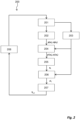
- Fig. 2 shows a preferred embodiment of a computer-aided method 200 according to the invention for generating an RDE-compliant driving cycle for a vehicle.
- Step 201 of method 200 is identical to step 101 of method 100 described above. Historical speed data is provided.
- Step 202 of method 200 includes the above-described steps 102 and 103 of method 100.
- the state vector xt is determined from the past speed history.
- a probability value p(xt) for a current acceleration scenario and a probability value q(xt) for a current deceleration scenario are determined from the state vector.
- step 203 of method 200 the previously predicted, i.e., previously generated, speed values are periodically checked for compliance with the criteria of the RDE guidelines after a defined number of iterations of method 100. For example, this periodically recurring check can be performed after a number of time intervals corresponding to the expiration of a five-minute period of the driving cycle; however, other time periods for the periodic check are also possible.
- step 204 After the probability values p(xt) and q(xt) for a current acceleration scenario and for a current deceleration scenario have been determined in step 202, if the check in step 203 has shown that the criteria of the RDE guidelines are not met by the speed values already predicted and attached to the past speed history, the determined probability values p(xt) and q(xt) are corrected accordingly in a step 204.
- the current acceleration or deceleration scenario thus receives corrected probability values p'(xt) and q'(xt). For example, if the check in step 203 reveals that the duration of a highway journey at increased speed according to the criteria of the RDE guidelines is not met by the already predicted speed values and corresponding time intervals, the probability of an acceleration scenario is increased by the correction in step 204, and the probability of a deceleration scenario is correspondingly reduced.
- one of the three scenarios i.e. an acceleration scenario, a deceleration scenario or a scenario of the state of a constant speed, is then randomly selected based on the probability values p'(x t ), q'(xt) and 1- p'(xt)-q'(xt) corrected by step 204 and an arbitrary acceleration value ⁇ t is randomly selected from the probability distribution of the randomly selected scenario determined as described in the context of the method 100.
- a correction of the randomly selected acceleration value at can be carried out in step 206 according to the check in step 203, whereby the corrected acceleration value a't is generated.
- the corrected acceleration value a't is integrated over the current time interval t to obtain a next predicted speed value v t+1 for a next time interval t+1 in the future.
- step 208 the new speed value v t+1 is appended to the past speed profile.
- the new speed value v t+1 for the time interval t+1 is then treated as the current time interval in the next iteration of the method 200 in step 202.
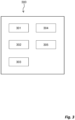
- Fig. 3 shows a preferred embodiment of a device 300 for generating a driving cycle for a vehicle, which is suitable for simulating real driving conditions.
- the device for generating the driving cycle for a vehicle has means 301 for determining a state vector of the driving cycle for a current time interval from a past speed profile.
- the device for generating the driving cycle has means 302 for providing an acceleration prediction model, means 303 for determining an acceleration value taking into account probabilities resulting from the acceleration prediction model and the state vector, Means 304 for integrating the determined acceleration value over the current time interval to obtain a predicted speed value for a next time interval in the future and means 305 for appending the predicted speed value to the past speed history to generate the drive cycle.
Landscapes
- Engineering & Computer Science (AREA)
- Physics & Mathematics (AREA)
- General Physics & Mathematics (AREA)
- Theoretical Computer Science (AREA)
- Evolutionary Computation (AREA)
- General Engineering & Computer Science (AREA)
- Business, Economics & Management (AREA)
- Artificial Intelligence (AREA)
- Software Systems (AREA)
- Data Mining & Analysis (AREA)
- Mathematical Physics (AREA)
- Computing Systems (AREA)
- Chemical & Material Sciences (AREA)
- General Health & Medical Sciences (AREA)
- Economics (AREA)
- Strategic Management (AREA)
- Health & Medical Sciences (AREA)
- Human Resources & Organizations (AREA)
- Computer Hardware Design (AREA)
- Geometry (AREA)
- Automation & Control Theory (AREA)
- Transportation (AREA)
- Mechanical Engineering (AREA)
- Mathematical Analysis (AREA)
- Probability & Statistics with Applications (AREA)
- Pure & Applied Mathematics (AREA)
- Mathematical Optimization (AREA)
- Computational Mathematics (AREA)
- Algebra (AREA)
- Marketing (AREA)
- Biomedical Technology (AREA)
- Analytical Chemistry (AREA)
- Life Sciences & Earth Sciences (AREA)
- Biophysics (AREA)
- Tourism & Hospitality (AREA)
- General Business, Economics & Management (AREA)
- Computational Linguistics (AREA)
- Molecular Biology (AREA)
- Combustion & Propulsion (AREA)
- Computer Vision & Pattern Recognition (AREA)
Applications Claiming Priority (2)
| Application Number | Priority Date | Filing Date | Title |
|---|---|---|---|
| ATA50847/2020A AT523850B1 (de) | 2020-10-02 | 2020-10-02 | Computergestütztes Verfahren und Vorrichtung zur wahrscheinlichkeitsbasierten Geschwindigkeitsprognose für Fahrzeuge |
| PCT/AT2021/060355 WO2022067368A1 (de) | 2020-10-02 | 2021-10-01 | Computergestütztes verfahren und vorrichtung zur wahrscheinlichkeitsbasierten geschwindigkeitsprognose für fahrzeuge |
Publications (3)
| Publication Number | Publication Date |
|---|---|
| EP4222470A1 EP4222470A1 (de) | 2023-08-09 |
| EP4222470B1 true EP4222470B1 (de) | 2025-05-14 |
| EP4222470C0 EP4222470C0 (de) | 2025-05-14 |
Family
ID=78463304
Family Applications (1)
| Application Number | Title | Priority Date | Filing Date |
|---|---|---|---|
| EP21800978.5A Active EP4222470B1 (de) | 2020-10-02 | 2021-10-01 | Computergestütztes verfahren und vorrichtung zur wahrscheinlichkeitsbasierten geschwindigkeitsprognose für fahrzeuge |
Country Status (7)
| Country | Link |
|---|---|
| US (1) | US20230236088A1 (https=) |
| EP (1) | EP4222470B1 (https=) |
| JP (1) | JP2023543302A (https=) |
| KR (1) | KR20230078740A (https=) |
| CN (1) | CN116438434A (https=) |
| AT (1) | AT523850B1 (https=) |
| WO (1) | WO2022067368A1 (https=) |
Families Citing this family (4)
| Publication number | Priority date | Publication date | Assignee | Title |
|---|---|---|---|---|
| DE102021106515A1 (de) * | 2021-03-17 | 2022-09-22 | Bayerische Motoren Werke Aktiengesellschaft | Prädizieren einer zukünftigen Ist-Geschwindigkeit eines Kraftfahrzeugs |
| CN115731713A (zh) * | 2022-11-30 | 2023-03-03 | 广东联合电子服务股份有限公司 | 一种预测异常车辆高速出口及时间的方法 |
| CN117325875B (zh) * | 2023-12-01 | 2024-02-02 | 北京航空航天大学 | 一种基于个性驾驶特征的车辆长时速度预测方法 |
| CN119749572B (zh) * | 2024-12-16 | 2026-04-28 | 中国重汽集团济南动力有限公司 | 车速预测方法、装置和计算机程序产品 |
Family Cites Families (13)
| Publication number | Priority date | Publication date | Assignee | Title |
|---|---|---|---|---|
| JP5533157B2 (ja) * | 2010-04-07 | 2014-06-25 | トヨタ自動車株式会社 | 将来挙動予測装置 |
| JP5640705B2 (ja) * | 2010-12-07 | 2014-12-17 | トヨタ自動車株式会社 | 車両制御装置 |
| JP2012168037A (ja) * | 2011-02-15 | 2012-09-06 | Toyota Central R&D Labs Inc | 速度予測装置及びプログラム |
| EP2537727B1 (en) * | 2011-06-22 | 2015-03-11 | Volvo Car Corporation | Method for estimating a speed profile for a vehicle |
| JP5889085B2 (ja) * | 2012-03-29 | 2016-03-22 | 株式会社デンソーアイティーラボラトリ | 運転支援装置 |
| JP5974916B2 (ja) * | 2013-01-30 | 2016-08-23 | トヨタ自動車株式会社 | 車速制御装置 |
| DE102013018967A1 (de) * | 2013-11-12 | 2015-05-13 | Valeo Schalter Und Sensoren Gmbh | Verfahren zur Prognose des Fahrweges eines Kraftfahrzeuges und Prognoseeinrichtung |
| JP5885170B1 (ja) * | 2014-09-25 | 2016-03-15 | 三菱電機株式会社 | 車両用エネルギーマネジメント装置 |
| JP6409744B2 (ja) * | 2015-11-06 | 2018-10-24 | 株式会社アドヴィックス | 車両の走行支援装置 |
| DE102017107271A1 (de) * | 2016-04-14 | 2017-07-06 | FEV Europe GmbH | Verfahren zur Ermittlung eines Leitfahrzyklus für Fahrversuche zur Ermittlung von Abgasemissionen von Kraftfahrzeugen |
| KR101952037B1 (ko) * | 2017-10-23 | 2019-02-25 | 한양대학교 산학협력단 | 차량의 속도를 예측하는 방법 |
| EP3540403B1 (de) * | 2018-03-15 | 2023-08-09 | AVL List GmbH | Verfahren zur durchführung eines prüflaufs eines prüflings |
| CN110264721B (zh) * | 2019-07-01 | 2021-04-20 | 北京理工大学 | 一种城市交叉口周边车辆轨迹预测方法 |
-
2020
- 2020-10-02 AT ATA50847/2020A patent/AT523850B1/de active
-
2021
- 2021-10-01 KR KR1020237014202A patent/KR20230078740A/ko not_active Withdrawn
- 2021-10-01 EP EP21800978.5A patent/EP4222470B1/de active Active
- 2021-10-01 WO PCT/AT2021/060355 patent/WO2022067368A1/de not_active Ceased
- 2021-10-01 CN CN202180073024.8A patent/CN116438434A/zh active Pending
- 2021-10-01 US US18/247,535 patent/US20230236088A1/en active Pending
- 2021-10-01 JP JP2023519538A patent/JP2023543302A/ja active Pending
Also Published As
| Publication number | Publication date |
|---|---|
| US20230236088A1 (en) | 2023-07-27 |
| JP2023543302A (ja) | 2023-10-13 |
| CN116438434A (zh) | 2023-07-14 |
| EP4222470A1 (de) | 2023-08-09 |
| WO2022067368A1 (de) | 2022-04-07 |
| KR20230078740A (ko) | 2023-06-02 |
| EP4222470C0 (de) | 2025-05-14 |
| AT523850A4 (de) | 2021-12-15 |
| AT523850B1 (de) | 2021-12-15 |
Similar Documents
| Publication | Publication Date | Title |
|---|---|---|
| EP4222470B1 (de) | Computergestütztes verfahren und vorrichtung zur wahrscheinlichkeitsbasierten geschwindigkeitsprognose für fahrzeuge | |
| DE102018128289B4 (de) | Verfahren und vorrichtung für eine autonome systemleistung und zur einstufung | |
| EP4226248B1 (de) | Verfahren und ein system zum testen eines fahrerassistenzsystems für ein fahrzeug | |
| EP2999998B1 (de) | Methode zur ermittlung eines modells einer ausgangsgrösse eines technischen systems | |
| EP3726434B1 (de) | Verfahren zur reduzierung von abgasemissionen eines antriebssystems eines fahrzeugs mit verbrennungsmotor | |
| DE102019124018B4 (de) | Verfahren zum Optimieren von Tests von Regelsystemen für automatisierte Fahrdynamiksysteme | |
| WO2021058223A1 (de) | Verfahren zur effizienten, simulativen applikation automatisierter fahrfunktionen | |
| DE102018128890A1 (de) | Verfahren und Testvorrichtung zum Testen eines Fahrassistenzsystems für ein Kraftfahrzeug | |
| DE102019134053A1 (de) | Verfahren zur kontinuierlichen Absicherung im Fahrversuch applizierter automatisierter Fahrfunktionen | |
| DE102011088805A1 (de) | Verfahren zum Entwickeln und/oder Testen eines Fahrerassistenzsystems | |
| EP4105811B1 (de) | Computerimplementiertes verfahren zum szenariobasierten testen und/oder homologation von zu testenden zumindest teilweise autonomen fahrfunktionen durch key performance indicators (kpi) | |
| WO2022251890A1 (de) | Verfahren und system zum testen eines fahrerassistenzsystems für ein fahrzeug | |
| WO2022057979A1 (de) | Verfahren zur bereitstellung einer maschinell gelernten steuerfunktion zur fahrzeugsteuerung anhand bereitgestellter fahrzeugsensordaten | |
| DE102022107338B3 (de) | Verfahren zum Testen von automatisierten Fahrzeugfunktionen | |
| DE112020006317T5 (de) | Computersystem und verfahren zum trainieren eines verkehrsagenten in einer simulationsumgebung | |
| DE102020205962B3 (de) | Vorrichtung und Verfahren zum Betreiben eines Prüfstands | |
| EP4508621B1 (de) | Verfahren zur prädiktion eines einflusses eines verkehrsteilnehmers auf zumindest einen anderen verkehrsteilnehmer und verfahren zum betrieb eines fahrzeugs | |
| DE102023000357B3 (de) | Verfahren zum Erzeugen von Testdaten für eine Simulation eines Assistenzsystems eines zumindest teilweise assistiert betriebenen Kraftfahrzeugs, Computerprogrammprodukt, computerlesbares Speichermedium sowie elektronische Recheneinrichtung | |
| WO2021089499A1 (de) | Verfahren und system zum prüfen einer automatisierten fahrfunktion durch reinforcement-learning | |
| DE102020212921A1 (de) | Verfahren, Computerprogramm und Vorrichtung zum Bewerten einer Verwendbarkeit von Simulationsdaten | |
| EP4191469B1 (de) | Verfahren zum bestimmen ähnlicher szenarien,trainingsverfahren und trainingssteuergerät | |
| WO2019162293A2 (de) | Verfahren zur identifikation kritischer testfälle im kontext des hochautomatisierten fahrens | |
| AT521927A1 (de) | Verfahren zur Kalibirierung eines technischen Systems | |
| DE102022203171A1 (de) | Verfahren zum Validieren einer Steuersoftware für eine Robotervorrichtung | |
| DE102021114044A1 (de) | Verfahren zum Bereitstellen eines künstlichen neuronalen Netzes zur dreidimensionalen Objekterkennung, Recheneinrichtung für ein Fahrzeug, Computerprogramm sowie Computerlesbares (Speicher)Medium |
Legal Events
| Date | Code | Title | Description |
|---|---|---|---|
| STAA | Information on the status of an ep patent application or granted ep patent |
Free format text: STATUS: UNKNOWN |
|
| STAA | Information on the status of an ep patent application or granted ep patent |
Free format text: STATUS: THE INTERNATIONAL PUBLICATION HAS BEEN MADE |
|
| PUAI | Public reference made under article 153(3) epc to a published international application that has entered the european phase |
Free format text: ORIGINAL CODE: 0009012 |
|
| STAA | Information on the status of an ep patent application or granted ep patent |
Free format text: STATUS: REQUEST FOR EXAMINATION WAS MADE |
|
| 17P | Request for examination filed |
Effective date: 20230428 |
|
| AK | Designated contracting states |
Kind code of ref document: A1 Designated state(s): AL AT BE BG CH CY CZ DE DK EE ES FI FR GB GR HR HU IE IS IT LI LT LU LV MC MK MT NL NO PL PT RO RS SE SI SK SM TR |
|
| DAV | Request for validation of the european patent (deleted) | ||
| DAX | Request for extension of the european patent (deleted) | ||
| P01 | Opt-out of the competence of the unified patent court (upc) registered |
Effective date: 20240516 |
|
| GRAP | Despatch of communication of intention to grant a patent |
Free format text: ORIGINAL CODE: EPIDOSNIGR1 |
|
| STAA | Information on the status of an ep patent application or granted ep patent |
Free format text: STATUS: GRANT OF PATENT IS INTENDED |
|
| RIC1 | Information provided on ipc code assigned before grant |
Ipc: G06Q 50/40 20240101ALI20241121BHEP Ipc: G06N 7/01 20230101ALI20241121BHEP Ipc: G06N 3/08 20230101ALI20241121BHEP Ipc: G01M 17/06 20060101ALI20241121BHEP Ipc: G08G 1/01 20060101ALI20241121BHEP Ipc: F02D 29/02 20060101ALI20241121BHEP Ipc: G06Q 10/04 20230101ALI20241121BHEP Ipc: G09B 9/042 20060101ALI20241121BHEP Ipc: G06N 3/02 20060101ALI20241121BHEP Ipc: G01M 15/02 20060101AFI20241121BHEP |
|
| INTG | Intention to grant announced |
Effective date: 20241205 |
|
| GRAS | Grant fee paid |
Free format text: ORIGINAL CODE: EPIDOSNIGR3 |
|
| GRAA | (expected) grant |
Free format text: ORIGINAL CODE: 0009210 |
|
| STAA | Information on the status of an ep patent application or granted ep patent |
Free format text: STATUS: THE PATENT HAS BEEN GRANTED |
|
| AK | Designated contracting states |
Kind code of ref document: B1 Designated state(s): AL AT BE BG CH CY CZ DE DK EE ES FI FR GB GR HR HU IE IS IT LI LT LU LV MC MK MT NL NO PL PT RO RS SE SI SK SM TR |
|
| REG | Reference to a national code |
Ref country code: GB Ref legal event code: FG4D Free format text: NOT ENGLISH |
|
| REG | Reference to a national code |
Ref country code: CH Ref legal event code: EP |
|
| REG | Reference to a national code |
Ref country code: DE Ref legal event code: R096 Ref document number: 502021007489 Country of ref document: DE |
|
| REG | Reference to a national code |
Ref country code: IE Ref legal event code: FG4D Free format text: LANGUAGE OF EP DOCUMENT: GERMAN |
|
| U01 | Request for unitary effect filed |
Effective date: 20250612 |
|
| U07 | Unitary effect registered |
Designated state(s): AT BE BG DE DK EE FI FR IT LT LU LV MT NL PT RO SE SI Effective date: 20250624 |
|
| P04 | Withdrawal of opt-out of the competence of the unified patent court (upc) registered |
Free format text: CASE NUMBER: APP_29238/2025 Effective date: 20250618 |
|
| PG25 | Lapsed in a contracting state [announced via postgrant information from national office to epo] |
Ref country code: ES Free format text: LAPSE BECAUSE OF FAILURE TO SUBMIT A TRANSLATION OF THE DESCRIPTION OR TO PAY THE FEE WITHIN THE PRESCRIBED TIME-LIMIT Effective date: 20250514 |
|
| PG25 | Lapsed in a contracting state [announced via postgrant information from national office to epo] |
Ref country code: GR Free format text: LAPSE BECAUSE OF FAILURE TO SUBMIT A TRANSLATION OF THE DESCRIPTION OR TO PAY THE FEE WITHIN THE PRESCRIBED TIME-LIMIT Effective date: 20250815 Ref country code: NO Free format text: LAPSE BECAUSE OF FAILURE TO SUBMIT A TRANSLATION OF THE DESCRIPTION OR TO PAY THE FEE WITHIN THE PRESCRIBED TIME-LIMIT Effective date: 20250814 |
|
| PG25 | Lapsed in a contracting state [announced via postgrant information from national office to epo] |
Ref country code: PL Free format text: LAPSE BECAUSE OF FAILURE TO SUBMIT A TRANSLATION OF THE DESCRIPTION OR TO PAY THE FEE WITHIN THE PRESCRIBED TIME-LIMIT Effective date: 20250514 |
|
| PG25 | Lapsed in a contracting state [announced via postgrant information from national office to epo] |
Ref country code: HR Free format text: LAPSE BECAUSE OF FAILURE TO SUBMIT A TRANSLATION OF THE DESCRIPTION OR TO PAY THE FEE WITHIN THE PRESCRIBED TIME-LIMIT Effective date: 20250514 |
|
| PG25 | Lapsed in a contracting state [announced via postgrant information from national office to epo] |
Ref country code: RS Free format text: LAPSE BECAUSE OF FAILURE TO SUBMIT A TRANSLATION OF THE DESCRIPTION OR TO PAY THE FEE WITHIN THE PRESCRIBED TIME-LIMIT Effective date: 20250814 |
|
| PG25 | Lapsed in a contracting state [announced via postgrant information from national office to epo] |
Ref country code: IS Free format text: LAPSE BECAUSE OF FAILURE TO SUBMIT A TRANSLATION OF THE DESCRIPTION OR TO PAY THE FEE WITHIN THE PRESCRIBED TIME-LIMIT Effective date: 20250914 |
|
| U20 | Renewal fee for the european patent with unitary effect paid |
Year of fee payment: 5 Effective date: 20251027 |
|
| PGFP | Annual fee paid to national office [announced via postgrant information from national office to epo] |
Ref country code: GB Payment date: 20251024 Year of fee payment: 5 |
|
| PG25 | Lapsed in a contracting state [announced via postgrant information from national office to epo] |
Ref country code: SM Free format text: LAPSE BECAUSE OF FAILURE TO SUBMIT A TRANSLATION OF THE DESCRIPTION OR TO PAY THE FEE WITHIN THE PRESCRIBED TIME-LIMIT Effective date: 20250514 |
|
| PG25 | Lapsed in a contracting state [announced via postgrant information from national office to epo] |
Ref country code: CZ Free format text: LAPSE BECAUSE OF FAILURE TO SUBMIT A TRANSLATION OF THE DESCRIPTION OR TO PAY THE FEE WITHIN THE PRESCRIBED TIME-LIMIT Effective date: 20250514 |
|
| PG25 | Lapsed in a contracting state [announced via postgrant information from national office to epo] |
Ref country code: SK Free format text: LAPSE BECAUSE OF FAILURE TO SUBMIT A TRANSLATION OF THE DESCRIPTION OR TO PAY THE FEE WITHIN THE PRESCRIBED TIME-LIMIT Effective date: 20250514 |
|
| PLBE | No opposition filed within time limit |
Free format text: ORIGINAL CODE: 0009261 |
|
| STAA | Information on the status of an ep patent application or granted ep patent |
Free format text: STATUS: NO OPPOSITION FILED WITHIN TIME LIMIT |
|
| REG | Reference to a national code |
Ref country code: CH Ref legal event code: L10 Free format text: ST27 STATUS EVENT CODE: U-0-0-L10-L00 (AS PROVIDED BY THE NATIONAL OFFICE) Effective date: 20260325 |
|
| 26N | No opposition filed |
Effective date: 20260217 |