EP4196397B1 - Beutelbahn mit führung und beutel aus unterschiedlichen materialien - Google Patents
Beutelbahn mit führung und beutel aus unterschiedlichen materialien Download PDFInfo
- Publication number
- EP4196397B1 EP4196397B1 EP21765834.3A EP21765834A EP4196397B1 EP 4196397 B1 EP4196397 B1 EP 4196397B1 EP 21765834 A EP21765834 A EP 21765834A EP 4196397 B1 EP4196397 B1 EP 4196397B1
- Authority
- EP
- European Patent Office
- Prior art keywords
- bags
- guide
- bag
- web
- paper
- Prior art date
- Legal status (The legal status is an assumption and is not a legal conclusion. Google has not performed a legal analysis and makes no representation as to the accuracy of the status listed.)
- Active
Links
Images





Classifications
-
- B—PERFORMING OPERATIONS; TRANSPORTING
- B65—CONVEYING; PACKING; STORING; HANDLING THIN OR FILAMENTARY MATERIAL
- B65B—MACHINES, APPARATUS OR DEVICES FOR, OR METHODS OF, PACKAGING ARTICLES OR MATERIALS; UNPACKING
- B65B43/00—Forming, feeding, opening or setting-up containers or receptacles in association with packaging
- B65B43/12—Feeding flexible bags or carton blanks in flat or collapsed state; Feeding flat bags connected to form a series or chain
- B65B43/123—Feeding flat bags connected to form a series or chain
-
- B—PERFORMING OPERATIONS; TRANSPORTING
- B65—CONVEYING; PACKING; STORING; HANDLING THIN OR FILAMENTARY MATERIAL
- B65B—MACHINES, APPARATUS OR DEVICES FOR, OR METHODS OF, PACKAGING ARTICLES OR MATERIALS; UNPACKING
- B65B43/00—Forming, feeding, opening or setting-up containers or receptacles in association with packaging
- B65B43/26—Opening or distending bags; Opening, erecting, or setting-up boxes, cartons, or carton blanks
- B65B43/267—Opening of bags interconnected in a web
-
- B—PERFORMING OPERATIONS; TRANSPORTING
- B65—CONVEYING; PACKING; STORING; HANDLING THIN OR FILAMENTARY MATERIAL
- B65D—CONTAINERS FOR STORAGE OR TRANSPORT OF ARTICLES OR MATERIALS, e.g. BAGS, BARRELS, BOTTLES, BOXES, CANS, CARTONS, CRATES, DRUMS, JARS, TANKS, HOPPERS, FORWARDING CONTAINERS; ACCESSORIES, CLOSURES, OR FITTINGS THEREFOR; PACKAGING ELEMENTS; PACKAGES
- B65D33/00—Details of, or accessories for, sacks or bags
- B65D33/002—Rolls, strips or like assemblies of bags
-
- B—PERFORMING OPERATIONS; TRANSPORTING
- B65—CONVEYING; PACKING; STORING; HANDLING THIN OR FILAMENTARY MATERIAL
- B65D—CONTAINERS FOR STORAGE OR TRANSPORT OF ARTICLES OR MATERIALS, e.g. BAGS, BARRELS, BOTTLES, BOXES, CANS, CARTONS, CRATES, DRUMS, JARS, TANKS, HOPPERS, FORWARDING CONTAINERS; ACCESSORIES, CLOSURES, OR FITTINGS THEREFOR; PACKAGING ELEMENTS; PACKAGES
- B65D75/00—Packages comprising articles or materials partially or wholly enclosed in strips, sheets, blanks, tubes or webs of flexible sheet material, e.g. in folded wrappers
- B65D75/40—Packages formed by enclosing successive articles, or increments of material, in webs, e.g. folded or tubular webs, or by subdividing tubes filled with liquid, semi-liquid, or plastic materials
- B65D75/44—Individual packages cut from webs or tubes
-
- B—PERFORMING OPERATIONS; TRANSPORTING
- B65—CONVEYING; PACKING; STORING; HANDLING THIN OR FILAMENTARY MATERIAL
- B65D—CONTAINERS FOR STORAGE OR TRANSPORT OF ARTICLES OR MATERIALS, e.g. BAGS, BARRELS, BOTTLES, BOXES, CANS, CARTONS, CRATES, DRUMS, JARS, TANKS, HOPPERS, FORWARDING CONTAINERS; ACCESSORIES, CLOSURES, OR FITTINGS THEREFOR; PACKAGING ELEMENTS; PACKAGES
- B65D33/00—Details of, or accessories for, sacks or bags
- B65D33/02—Local reinforcements or stiffening inserts, e.g. wires, strings, strips or frames
Definitions
- the present invention relates to a web of bags configured to be guided through a filling station.
- the web of bags may comprise a continuous guide of a guide material configured to be guided through the filling station.
- the guide may be connected with one or more bags of a bag material and with a bag opening.
- the present invention also relates to methods of filling such bags on a web of bags and use of such web of bags.
- Filling stations may be those disclosed in EP1087890 or EP3160862 or EP3160863 or EP3307641 or EP3277595 or WO2020108719 and known as Schur ® Star or Schur ® StarLight. Other similar filling stations or alternative filling stations may be used. Bags often serve a purpose beyond keeping the content or articles in portions for delivery. Bags may provide protection to the content or articles and improve or even enable delivery and presentation of their content. A barrier on the bag may be required.
- Polymers have shown to provide both effective handling and operation as a guide and operational interface with a filling station. Polymers or the likes have shown to be very suitable as guides on a web bag since they are flexible i.e. durable and tear resistant.
- bags of a material optimized and e.g. with automated or semi-automated processes have shown to pose a negative impact on the environment when disposed. Accordingly, there is a need to improve and provide alternatives to the art of industrial filling of bags on an industrial scale.
- EP0266438 discloses a prior art web of bags configured to be guided through the filling station.
- JPS56164940U discloses a prior art web of bags.
- US 4 569 083 discloses a chain of bags connected to a strip, the material of the strip being different to the bag material.
- a web of bags configured to be guided through a filling station, wherein the web of bags is according to claim 1.
- bags of environmentally more sound materials than guide materials can be filled in an optimized fashion in an automated or semi-automated process. Even on an industrial scale.
- a further advantage is achieved by providing durability; that is a bag that is durable during the filling process and during use as a bag per se, and a bag that can be disposed with low environmental impact. That is that the bag can be filled, i.e. withstand an automated or semi-automated industrial process to provide high quantities of environmentally sound bags.
- a further advantage is that highly effective filling systems and machinery can be used and maintained and thereby existing effective production systems, i.e. effective filling stations that are automated or semi-automated can be used.
- the guide material may be a flexible i.e. stretchable material that is used in existing filling systems.
- the bag material may be an environmentally sound material such as paper or aluminum.
- the bag material may be selected amongst fibrous materials such as paper or metallic foils such as aluminum foils.
- the bag material of the web of bags is paper.
- the paper used may vary according to the need.
- the paper may be coated with a protective barrier.
- the paper may have a density of 30 to 150 g/m2 or even to 250 g/m2.
- the paper may be laminated or layered structure of a, in example, 25g/m2 and a 50 g/m2 .
- the paper may be partially or fully coated paper.
- the coating may constitute 18-22 weight %.
- the thickness may be in the order of 10-500 um, such as 50-200 um, or say about 100-120 um.
- the tensile stiffness (MD) may be in the order of 10 kNm/g.
- the paper or fibrous material may be carton or cardboard types.
- the bag material of the web of bags may also be aluminum or aluminum foils.
- Such fibrous materials and metallic foils generally have lower flexibilities and are subject to tear during handling and in particular during industrial scale handling. Such materials however possess advantageous properties in respect of environmental soundness or protective properties.
- the guide material of the web of bags is polymer or plastic, such as a thermoplastic or thermoplastic polymer.
- Guide materials may be a polymer such as polypropylene or polyethylene.
- polypropylene or polyethylene A person skilled in the art will appreciate the differences and be able to select configurations providing the flexibility and durability suitable for existing filling stations.
- Such polymers exist with different sealing and densities suitable for specific packaging or filling purposes.
- the polymers are sealable, temperature resistant and have suitable mechanical properties in respect of sufficient puncture resistance and flexibility balanced with rigidity.
- the guide material is a polymer and the bag material is a paper.
- This particular combination of a polymer, such as polypropylene or polyethylene, and paper provides an effective production on an industrial scale of environmentally sound bags with content, which bags can be disposed or recycled.
- a bag of paper made of paper with a density of 60-70 g/m2 may be produced and with as little additives as possible such as less than 5 weight %.
- the web of bags may at least in one or more of the bags be attached to the guide by means of a splicing.
- the bag material may be prepared with a print defining a splicing path and the bag and the guide may be connected along at least part of the splicing path.
- a splicing may be a way of connecting the guide and bag material.
- the splicing may be made by welding, including warm welding, or by gluing using glues or other means of gluing. Other ways may be by sewing.
- the print on the bag of the web of bags may be made by a lacquer or glue.
- polymer dispersion that is aqueous and acid-modified.
- Polyolefin dispersion may be used.
- Such polymer dispersion may be been designed or formulated according to specific uses of guide materials and bag materials
- polyolefin dispersion may be mixed and serve as a starting point and base can be modified with rheology modifiers, waxes, etc. as required and thereby forming a resistant bonding upon proper treatment such as thermal curing.
- a lacquer or varnish as well as glue with binding properties may be selected.
- the guide is connected to one or more bags on the inside of one or more of the bags.
- the connection may be placed substantially along the bag opening of one or more of the bags of the web of bags.
- a bag has an inside and an outside. Attaching or connecting the guide material on the inside of the bag reduces the risk of tearing or destroying a bag or the bag web during the process of filling.
- the paper of the web of bags is pure paper comprising no more than a certain weight % of additives, such as less than or equal to 5 weight %, 20 weight % or 50 weight %.
- pure paper By pure paper is understood a pure pulp part.
- the pulp may be so-called virgin pulp or recycled pulp.
- the additives may be additives mixed into the paper or provided as a full or partial coating on one or more sides of the paper.
- the method allows for effective industrial production of environmentally sound bags packed with content or articles.
- the bag may be cut of or otherwise separated.
- the cut may be in part of the bag material without any guide material. Alternatively part of the guide material may be left for later process.
- the bag may be closed by use of splicing, welding or gluing as disclosed previously.
- Such bag may be of an environmental sound or disposable material contrary to the guide material
- the guide material may be a polymer and the bag material may be a paper.
- the guide material and the polymer material may be as previously disclosed.
- This particular combination of a polymer, such as polypropylene or polyethylene, and paper provides an effective production on an industrial scale of environmentally sound bags with content, which bags can be disposed or recycled.
- a bag of paper made of paper with a density of 60-70 g/m2 may be produced and possibly with as little additives as possible such as less than 5 weight %.
- an end product bag, or consumer product bag, of a specific material such as paper being an environmentally sound material may be provided.
- the bag has no guiding material left a durable bag may be readily disposable.
- a polymer may be used as guiding material and paper may be used as a bag material.
- Durable bag of paper with a density of 60-70 g/m2 may be produced.
- the weight % of additives may be controlled by simple and result in a bag that can be disposed within environmental requirements.
- the bag being paper is pure paper comprising no more than a certain weight % of additives, such as less than or equal to 5 weight %, 20 weight % or 50 weight %.
- a disposable paper bag with a weight % of less than 5 weight % may be produced on an industrial scale.
- a web of bags according to claim 10.
- the bag material is different from the guide material.
- the web of bags may comprise bags of a bag material less flexible than the guide material.
- the web of bags is according to claim 1.
- % indicates % weight/weight (w/w).
- the terms “about”, “around”, “approximately” or the symbol “ ⁇ ” can be used interchangeably, and are meant to comprise variations generally accepted in the field, e.g. comprising analytical errors and the like. Thus “about” may also indicate measuring uncertainty commonly experienced in the art, which can be in the order of magnitude of e.g. +/- 1, 2, 5, 10, 20, or even 50 percent.
- composition comprising a chemical compound may thus comprise additional chemical compounds.
- the following aspect and/or embodiment are not according to the invention and are present for illustrations purposes only.
- a web of bags configured to be guided through a filling station, wherein the web of bags comprises a continuous guide of a guide material configured to be guided through the filling station.
- the guide is connected with one or more bags of a bag material and with a bag opening.
- the bag material comprises the same material as the guide material.
- the bag material and guide material is selected amongst fibrous materials such as paper.
- the bag material may be less flexible than the guide material.
- bags and guides of environmentally more sound materials can be filled in an optimized fashion in an automated or semi-automated process. Even on an industrial scale.
- a further advantage is achieved by providing durability; that is a bag that is durable during the filling process and during use as a bag per se, and a bag that can be disposed with low environmental impact. That is that the bag can be filled, i.e. withstand an automated or semi-automated industrial process to provide high quantities of environmentally sound bags.
- guide material shares the same advantageous characteristics after use as mentioned for the bag.
- a further advantage is that highly effective filling systems and machinery can be used and maintained and thereby existing effective production systems, i.e. effective filling stations that are automated or semi-automated can be used.
- the guide material may be a more flexible material than the bag material.
- the web of bags is formed from a single piece of fibrous material, e.g. a sheet or a roll.
- the guide material is a first fibrous material such as a first paper material and the bag material is a second fibrous material such as a second paper material.
- the materials may be disposable and environmentally friendly to the same extend.
- the guide may be recycled or disposed.
- the bags may be of different properties the first and second materials may be distinct and separated.
- the guide material may be a first type of fibrous material such as a first paper material.
- the guide material can be selected as disclosed below.
- the guide material may comprise additives to increase the flexibility and stretchability of the guide.
- a guide of paper made of paper with a density of 60-70 g/m2 or less.
- the guide may be produced with as little additives as possible such as less than 50 weight %, 20 weight %, and 5 weight %.
- the bag material of the web of bags is paper.
- the paper used may vary according to the need.
- the paper may be coated with a protective barrier.
- the paper may have a density of 30 to 150 g/m2 or even to 250 g/m2.
- the paper may be laminated or layered structure of a, in example, 25g/m2 and a 50 g/m2.
- the paper may be partially or fully coated paper.
- the coating may constitute 18-22 weight %.
- the thickness may be in the order of 10-500 um, such as 50-200 um, or say about 100-120 um.
- the tensile stiffness (MD) may be in the order of 10 kNm/g.
- the web of bags may at least in one or more of the bags be attached to the guide by means of a splicing.
- the bag material may be prepared with a print defining a splicing path and the bag and the guide may be connected along at least part of the splicing path.
- a splicing may be a way of connecting the guide and bag material.
- the splicing may be made by welding, including warm welding, or by gluing using glues or other means of gluing. Other ways may be by sewing.
- the print on the bag of the web of bags may be made by a lacquer or glue.
- polymer dispersion that is aqueous and acid-modified.
- Polyolefin dispersion may be used.
- Such polymer dispersion may be been designed or formulated according to specific uses of guide materials and bag materials
- polyolefin dispersion may be mixed and serve as a starting point and base can be modified with rheology modifiers, waxes, etc. as required and thereby forming a resistant bonding upon proper treatment such as thermal curing.
- a lacquer or varnish as well as a glue with binding properties may be selected.
- the guide may be connected to one or more bags on the inside of one or more of the bags.
- the connection may be placed substantially along the bag opening of one or more of the bags of the web of bags.
- a bag has an inside and an outside. Attaching or connecting the guide material on the inside of the bag reduces the risk of tearing or destroying a bag or the bag web during the process of filling.
- the paper of the web of bags is pure paper mixed with no more than a certain weight % of additives, such as less than or equal to 5 weight %, 20 weight % or 50 weight %.
- pure paper By pure paper is understood a pure pulp part.
- the pulp may be so-called virgin pulp or recycled pulp.
- the additives may be additives mixed into the paper or provided as a full or partial coating on one or more sides of the paper.
- a web of bags as a continuous guide of a guide material configured to be guided through the filling station and wherein the guide is connected to one or more bags of a bag material and with a bag opening, wherein the bag material comprises the same material as the guide material and wherein the guide material and bag material is selected amongst fibrous materials such as paper.
- the method allows for effective industrial production of environmentally sound bags packed with content or articles.
- the method also allows for environmentally sound guide material.
- the bag may be cut of or otherwise separated.
- the cut may be in part of the bag material without any guide material. Alternatively part of the guide material may be left.
- a web of bags in a filling station configured to guide a web of bags with a guide of a fibrous material such as paper and to fill bags, wherein the web of bags comprises bags of a bag material of a fibrous material such as paper.
- the web of bags as disclosed may be used.
- the exemplary embodiment also concerns alternative aspects as will be described in the following.
- there is a web of bags configured to be guided through a filling station.
- Fig. 1 illustrates a known system with a filling station 80 for filling a web of bags 10.
- the filling station 80 may be a manual filling station 80 or a semi-automatic filling station 80 or an automatic filling station 80.
- the system is designed to fill bags 30 from a roll of web of bags, wherein the web of bags is made from a plastic material.
- plastic materials are used.
- the used plastic materials' characteristics are well known and the systems with filling stations are designed to work with these plastic materials.
- the problem is that the present systems are designed for polymer or plastic materials and the characteristics of paper differ significantly from the used plastics or polymers. Paper's tear resistance is lower than the presently used plastics. Furthermore, paper cannot undergo the same elastic or plastic deformation as the polymer or plastics.
- Fig. 2 illustrates a known system with a full-automatic filling station 80 for filling a web of bags 10.
- the web of bags 10 is fed to the system from a box.
- the system is designed to be used with a web of bags 10 made of plastic or polymers such as polypropylene (PP) or polyethylene (PE).
- PP polypropylene
- PE polyethylene
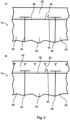
- Fig. 3 illustrates a web of bags 30 without (3A) and with perforations (3B).
- the disclosed web of bags 30 can be used in filling systems as shown in Fig. 1 and 2 even though the bag is made of a non-plastic material such as paper or aluminum.
- the resulting bag 30 filled with content will be a paper bag 30 filled on a system designed for plastic bags.
- the disclosed web of bags 30 comprises a continuous guide 20 of a guide material configured to be guided through a filling station 80 such as but not limited to the filling system in Fig. 1 and 2 .
- the guide 22 is connected with one or more bags 30 made of a bag material.
- the one or more bags 30 have a bag opening 34 for receiving content.
- the guide material may advantageously be known plastic or polymer materials presently used in a web of bags 30 such as polypropylene (PP) or polyethylene (PE), because the systems are designed with said plastic materials in mind.
- PP polypropylene
- PE polyethylene
- the one or more bags 30 and the guide 20 are interconnected along a splicing path 38.
- the connection may be made by heat welding or pressure welding or by any other process capable of connecting the guide material with the bag material.
- the individual bags 30 are separated by a separation line, thereby allowing individual movement of the bags.
- the separation line 40 has a T-shape in the guide 20 for allowing some movement.
- the one or more bags may have a print 36 for enabling the connection between the guide 20 and the one or more bags 30.
- the print 36 defines the splicing path 38.
- the print 38 may be a lacquer or glue. It will be necessary to add a print 36 if the one or more bags 30 are made of paper with equal to or less than 15 weight% of additives, or equal to or less than 10 weight% of additives, or, preferably equal to or less than 5 weight% of additives.
- the need for a print 36 increases as the amount of additives decreases because the strength of the splicing between the bag 30 and the guide 20 decreases as with the amount of additives; the print will compensate for the weakening of the splicing.
- a bag material made of paper with a weight% of additives equal to or below 5 % is preferred because most of the EU has a limit for the amount of additives a recyclable paper may contain.
- the guide 20 may comprise two plastics flaps on each side of the bag opening 34 for enabling the system to guide the bag of webs 10.
- the two plastics flaps may each be folded to form two channels for receiving guiding means.
- the guide 20 may have perforations as shown in Fig. 3B for insertions of studs.
- the guide 20 may have other means for enabling the guide through a system with a filling station.
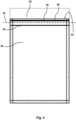
- Fig. 4 illustrates a bag 30 disconnected from a web of bags 10. The bag 30 will after it is filled with content be disconnected from web of bags 10.
- the guide 20 is made of a guide material.
- the guide material may be a polymer or plastic such as polypropylene (PP) or polyethylene (PE).
- PP polypropylene
- PE polyethylene
- the guide material is unwanted and must be removed.
- the guide 20 is removed by cutting along a cut path 42 and the bag 30 is spliced along a post-filling splicing path 39 below the cut path 42 to prevent spillage from the now closed bag opening 34.
- Fig. 4 illustrates the steps to be performed on the bag 30.
- the skilled person would know that the post-filling splicing may be done before disconnecting the bag 30 from the web of bags 10 and/or cutting along the cut path.
- the resulting bag 30 can thus be made of a material which otherwise could not be used in present systems for filling webs of bags 10 as they are designed to filling webs of bags 30 made of a plastic material or the like.
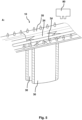
- Fig. 5 illustrates a web of bags 10 comprising dual bags 30 moving through a filling station 80.
- the figure discloses an embodiment of a dual bag 30 from a web of bags 10 as shown in EP3160863 .
- the web of bags 10 can be modified in accordance with the invention such that the bags 30 are made of a different material than plastic. This is shown in greater detail in figure 6 .
- the web of bags 10 comprises a guide 20 connected to two bags 30. The connection is shown in figure 6 .
- Fig. 6 illustrates a web of bags 10 comprising dual bags 30.
- the embodiment is identical to the embodiment disclosed in figure 5 .
- the web of bags 10 comprises a guide 20 made of a guide material, which will typically be a plastic or polymer material such as polypropylene (PP) or polyethylene (PE).
- a guide material which will typically be a plastic or polymer material such as polypropylene (PP) or polyethylene (PE).
- the guide 20 comprises a center part connected to both bags 30 and flaps with perforations connected to each bag 30 opposite to the center part.
- the perforations are necessary for the shown guide system which comprises studs.
- the flaps may form channels or just be flaps.
- the web of bags has been modified by the bags 30 being a different material than the guide, wherein the guide 20 and bags 30 are connected along a splicing path 38 in order to connect the materials.
- the bag material is paper or aluminum it is necessary to print a print 36 on the inside of the bag 30 to ensure a sufficiently strong connection.
- the print 36 will define the splicing path 38.
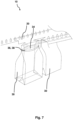
- Fig. 7 illustrates another embodiment of a web of bags 10.
- the overall web of bags 10 design is known, however, previously the web of bags 10 was made of a single material.
- the shown web of bags 10 comprises a guide 20 made of a guide material, which typically will be a plastic material.
- the web of bags has been modified by the bags 30 being a different material than the guide, wherein the guide 20 and bags 30 are connected along a splicing path 38 in order to connect the materials.
- the bag material is paper or aluminum it is necessary to print a print 36 on the inside of the bag 30 to ensure a sufficiently strong connection.
- the print 36 will define the splicing path 38.
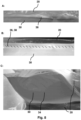
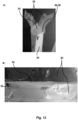
- Fig. 8 illustrates the splicing path 38 from an outside view (A) and an inside view (B) of a bag 30, and top view (C) of an open bag 30.
- Fig. 8A discloses the connection between a guide 20 made of a polymer or plastic material, which may be polypropylene (PP) or polyethylene (PE), and a bag 30 made of a paper material from an outside view.
- the splicing path 38 is, in this embodiment, clearly shown as an indent.
- Fig. 8B discloses the connection between a guide 20 made of a plastic material and a bag 30 made of paper material from an inside view. The splicing path 38 is most visible on the left side of figure 8B .
- the plastic or polymer material, i.e. guide 20 may be removed at a later stage by cutting along a cut path below the guide 20.
- Fig. 8C illustrates a view into the bag 20 though the bag opening 34.
- the guide 20 is connected to the bag 30 on both sides of the bag opening 34.
- the web of bags particular in this embodiment uses standard polymer as the guide and a paper bag made of 65 g/m2 paper with a thickness of about 100 um.
- the print is polyolefin dispersion.
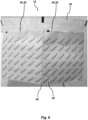
- Fig. 9 illustrates another embodiment of a web of bags 10.
- the web of bags 10 are configured to be guided through a filling station 80, the web of bags 10 comprising a continuous guide 20 of a guide material 22 being a plastic material.
- the guide 20 is configured to be guided through the filling station 80.
- the guide 20 is connected with one or more bags 30 of a bag material 32 being paper.
- the one or more bags 30 have bag openings 34 for receiving content.
- the bag of webs 10 is disclosed with only two bags 30, however it could in effect be endless.
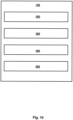
- Fig. 10 illustrates a method of filling a bag 100.
- the method 100 comprises an act of providing 200 a web of bags 10 as a continuous guide 20 of a guide material 22 configured to be guided through a filling station 80 and wherein the guide 20 has connected one or more bags 30 of a bag material and with a bag opening 34, wherein the bag material of a different material than the guide material.
- the guide 20 can be made of a material optimal for interacting with a conveyor system or the like to and from a filling station, while the bag material is chosen for other characteristics such as recyclability.
- the method 100 comprises an act of guiding 300 the web of bags 10 though a filling station 80 using the guide 20.
- the method 100 comprises an act filling 400 content or articles into one or more bags 30.
- the act of filling 400 may be an act performed manually or semi-automatic or full-automatic.
- the method 100 comprises disconnecting 500 the one or more bags 30 from the guide 20. Thereby, the resulting bags 30 have little to none residue of guide material.
- the guide material is a polymer and the bag material is a paper.
- the paper is recyclable paper.
- the effect of disconnecting the bags 30 from the guide 20 is that the recyclable paper is not contaminated by the guide material.
- the guide material may be polypropylene (PP) or polyethylene (PE) which is unwanted in paper recycling as the material would be a contamination. If left with the bag 30, then the guide material would in effect increase the weight % of additives of the paper without providing any positive effect.
- PP polypropylene
- PE polyethylene
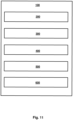
- Fig. 11 illustrates a process of producing a bag 30.
- the bag 30 with content is by a process 100 comprising an act of providing 200 a web of bags 10 as a continuous guide 20 of a guide material configured to be guided through a filling station 80 and wherein the guide 20 has connected one or more bags 30 of a bag material and with a bag opening 34.
- the bag material is less flexible than the guide material and the bag material is paper with a sheet weight of 30-150 g/m2, such as 60-70 g/m2 and the paper is pure paper comprising no more than a certain weight % of additives, such as less than or equal to 5 weight %, 20 weight % or 50 weight %.
- a weight % of additives less than or equal to 20 weight % is preferred over 50 weight % as the resulting paper bag 30 will be deemed recyclable in some countries.
- a weight % of additives less than or equal to 5 weight % is most preferred as the resulting paper bag 30 will be deemed recyclable/disposable in the EU.
- the process 100 may further comprise an act of guiding 300 the web of bags 10 though a filling station 80 in the guide 20.
- the process 100 may further comprise an act of filling 400 content into one or more bags 30.
- the act of filling 300 may be performed manually or semi-automatic or full-automatic.
- the process 100 may further comprise an act disconnecting 500 the one or more bags 30 from the guide 20. Thereby, the resulting bag 30 is not contaminated by the guide material and this makes it easier to have low weight % of additives.
- the guide material may be polypropylene (PP) or polyethylene (PE) which is unwanted in paper recycling as the material would be a contamination. If left with the bag 30, then the guide material would in effect increase the weight % of additives of the paper without providing any positive effect.
- PP polypropylene
- PE polyethylene
- the process 100 may further comprise an act of closing 600 the bag 30.
- the act of closing the bag may be performed by splicing or by stitching.
- a bag with content is produced by a process 100.
- the process 100 comprises an act of providing 200 a web of bags 10 as a continuous guide 20 of a guide material configured to be guided through a filling station 80.
- the guide is connected to one or more bags 30 of a bag material and with a bag opening 34, wherein the bag material is less flexible than the guide material.
- the bag 30 is attached to the guide 20 by way of a splicing defining a splicing path 38 and wherein the bag 30 and the guide are connected along at least part of the splicing path 38.
- the process 100 further comprises an act of guiding 300 the web of bags 10 though a filling station 80 by the guide 20.
- the process 100 further comprises an act of filling 400 content into one or more bags 30.
- the act of filling 300 may be performed manually or semi-automatic or full-automatic.
- the process 100 further comprises an act of disconnecting 500 the one or more bags 30 from the guide 20 leaving at least part of the guide material along the slicing path 38 on the paper bag 30.
- the process 100 further comprises an act of closing 600 the bag 30 by splicing the left guide material on the paper bag 30. Thereby, part of the guide 20 is used for closing the bag, thereby simplifying the process.
- the bag material may be paper and the filling station is configured to guide a web of bags with a polymer guide.
- Fig. 12 illustrates two different embodiments of guides 20.
- Fig. 12A discloses a guide 20 connected to a bag 30.
- the guide 20 comprises two channels for being guided through a system comprising a filling station.
- the guide 20 is made of a guide material being a plastic material such as polypropylene (PP) and polyethylene (PE).
- PP polypropylene
- PE polyethylene
- the bag 30 is made of a bag material being paper.
- the bag 30 near the bag opening 34 is provided with a print 36, which enables the bag material to be connected to the guide material by splicing along said print 36.
- the print 36 defines the splicing path 38.
- Fig. 12B discloses an embodiment of a guide 20 of the kind shown in fig. 3B .
- the guide 20 is connected to a bag 30.
- the guide 20 comprises two flaps having perforations for engaging with studs for being guided through a system comprising a filling station. One of the flaps is standing upwardly and one of the flaps is extending downwardly towards the bottom of the bag 30.
- the guide 20 is made of guide material being a plastic material such as polypropylene (PP) and polyethylene (PE).
- PP polypropylene
- PE polyethylene
- the bag 30 is made of a bag material being paper as exemplified.
- the bag 30 near the bag opening 34 is provided with a print 36 (not shown), which enables the bag material to be connected to the guide material by splicing along said print 36.
- the print 36 defines the splicing path 38. This is shown in great detail in Fig. 8B along the hatched line.
- Fig. 13 illustrates two embodiments of a web of bags 10 made of a fibrous material.
- Fig. 13A discloses web of bags 10 configured to be guided through a filling station 80, the web of bags 10 comprising a continuous guide 20 of a guide material configured to be guided through a filling station 80.
- the guide 20 is connected with one or more bags 30 of a bag material and with a bag opening 34.
- the bag material comprises the same material as the guide material, wherein the bag material and guide material is selected amongst fibrous materials such as paper.
- the transition between the guide 20 and the bags 30 is a smooth transition which has been indicated by a dashed line.
- the one or more bags 30 are separated along a T-shaped separation line 40.
- the T-shaped separation 40 enables that the bags can be individually displaced.
- the guide 30 has perforations in a longitudinal direction for engaging with studs in a system for conveying the web of bags 10 through a filling station 80.
- Fig. 13B discloses web of bags 10 configured to be guided through a filling station 80, the web of bags 10 comprising a continuous guide 20 of a guide material configured to be guided through a filling station 80.
- the guide 20 is connected with one or more bags 30 of a bag material and with a bag opening 34.
- the bag material comprises the same material as the guide material, wherein the bag material and guide material is selected amongst fibrous materials such as paper.
- the transition between the guide 20 and the bags 30 is a smooth transition which has been indicated by a dashed line.
- the one or more bags 30 are separated along a T-shaped separation line 40.
- the T-shaped separation 40 enables that the bags can be individually displaced.
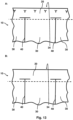
- Fig. 14 illustrates a bag 30 made of a fibrous material having a bag opening 34. In this case the bag 30 is still connected to a guide 20.
- the guide 20 is to be removed by cutting along a cut path 42 and the bag can afterwards be closed along a splicing path by splicing or by stitching or by any other closing means.
- Fig. 15 illustrates another bag 30 made of a fibrous material having a bag opening 34.
- the bag 30 is still connected to a guide 20.
- the guide 20 is to be removed by cutting along a cut path 42 and the bag can afterwards be closed along a splicing path by splicing or by stitching or by any other closing means.
Landscapes
- Engineering & Computer Science (AREA)
- Mechanical Engineering (AREA)
- Bag Frames (AREA)
- Supplying Of Containers To The Packaging Station (AREA)
- Basic Packing Technique (AREA)
- Packages (AREA)
- Containers And Plastic Fillers For Packaging (AREA)
Claims (10)
- Beutelbahn (10), die dazu konfiguriert ist, durch eine Füllstation (80) geführt zu werden, wobei die Beutelbahn (10) Folgendes umfasst- eine durchgehende Führung (20) aus einem Führungsmaterial (22), die dazu konfiguriert ist, durch die Füllstation (80) geführt zu werden, und wobei die Führung (20) mit einem oder mehreren Beuteln (30) aus einem Beutelmaterial (32) verbunden ist, wobei sich das Beutelmaterial (32) von dem Führungsmaterial (22) unterscheidet,das Führungsmaterial (22) ein Polymer oder Kunststoff ist und das Beutelmaterial (32) ausgewählt ist unter Fasermaterialien, wie Papier, oderdas Beutelmaterial (32) ausgewählt ist unter metallischen Folien, wie Aluminiumfolien, dadurch gekennzeichnet, dass der eine oder die mehreren Beutel (30) eine Beutelöffnung (34) umfassen und die Führung (20) an der Innenseite des einen oder der mehreren Beutel (30) mit dem einen oder den mehreren Beuteln (30) verbunden ist.
- Beutelbahn (10) nach Anspruch 1, wobei das Führungsmaterial (22) Polypropylen (PP) oder Polyethylen (PE) ist.
- Beutelbahn (10) nach Anspruch 1, wobei das Beutelmaterial (32) ein Papier ist.
- Beutelbahn (10) nach einem oder mehreren der vorhergehenden Ansprüche, wobei mindestens einer oder mehrere der Beutel (30) mittels eines Spleißens an der Führung (20) angebracht ist und wobei das Beutelmaterial (32) mit einem Aufdruck (36) hergestellt ist, der einen Spleißpfad (38) definiert, und wobei der Beutel (30) und die Führung (20) entlang mindestens eines Teils des Spleißpfads (38) verbunden sind.
- Beutelbahn (10) nach Anspruch 4, wobei der Aufdruck (36) auf dem Beutel (30) durch einen Lack oder einen Klebstoff hergestellt ist.
- Beutelbahn (10) nach einem oder mehreren der vorhergehenden Ansprüche, wobei die Führung (20) im Wesentlichen entlang der Beutelöffnung (34) des einen oder der mehreren Beutel (30) mit dem einen oder den mehreren Beuteln (30) verbunden ist.
- Beutelbahn (10) nach einem oder mehreren der vorhergehenden Ansprüche, wobei das Papier reines Papier ist, das nicht mehr als ein bestimmtes Gew.-% an Zusätzen, wie weniger als oder gleich 5 Gew.-%, 20 Gew.-% oder 50 Gew.-%, umfasst.
- Verfahren zum Füllen eines Beutels (100) mit Inhalt, wobei das Verfahren (100) folgende Aktionen umfasst- Bereitstellen (200) einer Beutelbahn (10) als eine durchgehende Führung (20) eines Führungsmaterials (22), die dazu konfiguriert ist, durch die Füllstation (80) geführt zu werden, und wobei die Führung (20) einen oder mehrere Beutel (30) aus einem Beutelmaterial (32) und mit einer Beutelöffnung (34) verbunden hat, wobei sich das Beutelmaterial (32) von dem Führungsmaterial (22) unterscheidet;- Führen (300) der Beutelbahn (10) durch eine Füllstation (80) in der Führung (20);- Füllen (400) von Inhalt in einen oder mehrere Beutel (30);- Trennen (500) des einen oder der mehreren Beutel (30) von der Führung (20), wobei das Führungsmaterial (22) ein Polymer oder Kunststoff ist und das Beutelmaterial (32) ausgewählt ist unter Fasermaterialien, wie Papier, oderdas Beutelmaterial (32) ausgewählt ist unter metallischen Folien, wie Aluminiumfolien, und wobei die Führung (20) an der Innenseite des einen oder der mehreren Beutel (30) mit dem einen oder den mehreren Beuteln (30) verbunden ist.
- Beutel (30) mit Inhalt, produziert durch ein Verfahren von- Bereitstellen (100) einer Beutelbahn (10) als eine durchgehende Führung () eines Führungsmaterials (22), die dazu konfiguriert ist, durch die Füllstation () geführt zu werden, und wobei die Führung (20) mit einem oder mehreren Beuteln (30) aus einem Beutelmaterial (32) und mit einer Beutelöffnung (34) verbunden ist, wobei sich das Beutelmaterial (32) von dem Führungsmaterial (22) unterscheidet; wobei der Beutel (30) mittels eines Spleißens, das einen Spleißpfad (38) definiert, an der Führung (20) angebracht ist und wobei der Beutel (30) und die Führung entlang mindestens eines Teils des Spleißpfads (38) verbunden sind;- Führen (200) der Beutelbahn (10) durch eine Füllstation (80) in der Führung (20);- Füllen (300) von Inhalt in einen oder mehrere Beutel (30);- Trennen (400) des einen oder der mehreren Beutel (30) von der Führung (20), wobei mindestens ein Teil des Führungsmaterials entlang eines Spleißpfads (38) auf dem Papierbeutel (30) verbleibt;- Schließen (500) des Beutels (30) durch Spleißen des Führungsmaterials entlang des Spleißpfads (38) auf dem Papierbeutel (30),wobei das Beutelmaterial (32) ausgewählt ist unter Fasermaterialien, wie Papier, oder das Beutelmaterial (32) ausgewählt ist unter metallischen Folien, wie Aluminiumfolien, und die Füllstation (80) dazu konfiguriert ist, eine Beutelbahn (10) mit einer kontinuierlichen Führung (20) aus einem Führungsmaterial (22) zu führen, wobei das Führungsmaterial ein Polymer oder Kunststoff ist und wobei die Führung (20) an der Innenseite des einen oder der mehreren Beutel (30) mit dem einen oder den mehreren Beuteln (30) verbunden ist.
- Verwendung einer Beutelbahn (10) in einer Füllstation (80), die dazu konfiguriert ist, eine Beutelbahn (10) mit einer Führung (20) aus einem flexiblen Material zu führen und Beutel (30) zu füllen, dadurch gekennzeichnet, dass die Beutelbahn (10) nach einem oder mehreren der Ansprüche 1 bis 7 ist.
Priority Applications (2)
| Application Number | Priority Date | Filing Date | Title |
|---|---|---|---|
| HRP20250751TT HRP20250751T1 (hr) | 2020-08-14 | 2021-08-13 | Mreža vrećica sa vodilicama i vrećice od različitih materijala |
| RS20250621A RS66929B1 (sr) | 2020-08-14 | 2021-08-13 | Mreža kesa sa vođicom i kesama od različitih materijala |
Applications Claiming Priority (4)
| Application Number | Priority Date | Filing Date | Title |
|---|---|---|---|
| DKPA202070534A DK181110B2 (en) | 2020-08-14 | 2020-08-14 | A Web of Bags with Guide and Bags of Different Materials, a method of filling a bag and bags filled with content |
| DKPA202070535A DK202070535A1 (en) | 2020-08-14 | 2020-08-14 | A Web of Bags with Guide and Bags of Fibrous Material |
| DKBA202000077U DK202000077Y3 (da) | 2020-08-14 | 2020-08-14 | Føringsfolie med papirpose |
| PCT/DK2021/050259 WO2022033647A1 (en) | 2020-08-14 | 2021-08-13 | A web of bags with guide and bags of different materials |
Publications (3)
| Publication Number | Publication Date |
|---|---|
| EP4196397A1 EP4196397A1 (de) | 2023-06-21 |
| EP4196397C0 EP4196397C0 (de) | 2025-05-07 |
| EP4196397B1 true EP4196397B1 (de) | 2025-05-07 |
Family
ID=80246993
Family Applications (1)
| Application Number | Title | Priority Date | Filing Date |
|---|---|---|---|
| EP21765834.3A Active EP4196397B1 (de) | 2020-08-14 | 2021-08-13 | Beutelbahn mit führung und beutel aus unterschiedlichen materialien |
Country Status (12)
| Country | Link |
|---|---|
| US (1) | US12195217B2 (de) |
| EP (1) | EP4196397B1 (de) |
| CN (1) | CN116137851B (de) |
| AU (1) | AU2021323890A1 (de) |
| CA (1) | CA3189023A1 (de) |
| ES (1) | ES3025476T3 (de) |
| HR (1) | HRP20250751T1 (de) |
| HU (1) | HUE071686T2 (de) |
| MX (1) | MX2023001869A (de) |
| PL (1) | PL4196397T3 (de) |
| RS (1) | RS66929B1 (de) |
| WO (1) | WO2022033647A1 (de) |
Citations (11)
| Publication number | Priority date | Publication date | Assignee | Title |
|---|---|---|---|---|
| US3559874A (en) * | 1968-05-08 | 1971-02-02 | Dow Chemical Co | Series bag construction |
| US3791573A (en) * | 1971-11-15 | 1974-02-12 | Basic Packaging Sys Inc | Bag construction |
| US4569083A (en) * | 1984-02-08 | 1986-02-04 | Basic Packaging Systems, Inc. | Chain of open mouth bags |
| US4945713A (en) * | 1987-11-24 | 1990-08-07 | New Pac Systems Ab | Method and apparatus for packeting objects in a chain of bags |
| WO1999057017A1 (en) * | 1998-04-21 | 1999-11-11 | Schur Packaging Systems A/S | A method and a system for filling goods in bags from a coherent series of bag members |
| WO2003008272A1 (en) * | 2001-07-19 | 2003-01-30 | Joker System Ab | Method and apparatus for guiding a web for package blanks |
| WO2007139466A1 (en) * | 2006-05-26 | 2007-12-06 | Pronova Ab | A carrier or transport strip. |
| WO2007139465A1 (en) * | 2006-05-26 | 2007-12-06 | Pronova Ab | A method of sealingly packing piece goods in a bag, as well as bag units adapted herefor |
| WO2011133102A2 (en) | 2010-04-22 | 2011-10-27 | Pronova Aktiebolag | Method and device for manufacturing a continuous web of baglike package blanks |
| WO2016000718A1 (en) * | 2014-06-30 | 2016-01-07 | Schur Technology A/S | Bag web and method for packing a product in film bags by using such a bag web |
| WO2016000717A1 (en) * | 2014-06-30 | 2016-01-07 | Schur Technology A/S | Method and apparatus for packing items, liquid or loose material in film bags, and a bag web |
Family Cites Families (21)
| Publication number | Priority date | Publication date | Assignee | Title |
|---|---|---|---|---|
| US3199671A (en) * | 1963-04-09 | 1965-08-10 | Coroga Company | Package assembly |
| GB1195959A (en) | 1968-02-20 | 1970-06-24 | Riegel Paper Corp | Packaging Method and Machine for Forming and Filling Bags of Different Lenghts and Widths. |
| US3699746A (en) | 1971-04-09 | 1972-10-24 | Basic Packaging Systems Inc | Apparatus for filling a chain of connected bag elements |
| JPS4723315U (de) | 1971-04-09 | 1972-11-15 | ||
| JPS49137959U (de) | 1973-03-30 | 1974-11-27 | ||
| JPS5183575A (en) | 1975-01-20 | 1976-07-22 | Torio Kk | Jidosoinkairo |
| JPS5931551Y2 (ja) | 1980-05-08 | 1984-09-06 | 株式会社東京商会 | 連続分包袋 |
| US4630311A (en) * | 1984-11-29 | 1986-12-16 | Minigrip, Inc. | Zipper-lock bag chain with tearable strip interconnection means |
| DE3671618D1 (de) * | 1986-11-01 | 1990-07-05 | Minigrip Europe Gmbh | Druckverschlussbeutelkette mit zerreissbarem verbindungsmittel. |
| FR2746369B1 (fr) | 1996-03-21 | 1998-06-05 | Filpack | Procede et machine pour le remplissage et la fermeture de sacs textiles, et sacs textiles obtenus |
| US6598374B1 (en) * | 1999-11-18 | 2003-07-29 | Ensor Equipment, Inc. | Method and apparatus for bagging particulate matter |
| JP3672469B2 (ja) * | 1999-12-03 | 2005-07-20 | 株式会社細川洋行 | ガセット袋の製造方法および装置 |
| ITMI20010488A1 (it) * | 2001-03-08 | 2002-09-08 | Goglio Spa Luigi Milano | Metodo ed apparecchiatura per realizzare in modo completamente automatico il riempimento e la chiusura sotto vuoto di coppie di contenitori |
| DK200200669A (da) * | 2002-05-02 | 2003-11-03 | Schur Packaging Systems As | Fremgangsmåde og apparat til fyldning af indhold i folieposer samt emballageemne til anvendelse ved fremgangsmåden og i apparatet |
| US20100266223A1 (en) * | 2006-06-15 | 2010-10-21 | Standard Multiwall Bag Manufacturing Co. | Pinch bottom open mouth bag |
| US20120093443A1 (en) * | 2010-10-14 | 2012-04-19 | Christopher Joseph Klein | Leak-proof recyclable paper bag and method of manufacturer |
| BR112013021240A2 (pt) | 2011-02-21 | 2020-10-27 | Automated Packaging Systems, Inc. | conjunto transportador e método de apreender primeira e segunda bordas de um material de folha contínua e movimentar o material de folha contínua ao longo de um trajeto de deslocamento |
| DE102011012048A1 (de) | 2011-02-22 | 2012-08-23 | Christian Schmidt | Kettenbeutel |
| DK178614B1 (da) | 2015-04-01 | 2016-08-22 | Schur Tech As | Posebane samt fremgangsmåde til fremstilling af sådan posebane |
| DK179813B1 (da) | 2015-06-15 | 2019-07-04 | Schur Technology A/S | Pose med lynlåslukke og sidefals |
| DK180075B1 (da) | 2018-11-29 | 2020-03-25 | Schur Technology A/S | Fremgangsmåde til brug af en drænpose, drænpose samt anvendelse af sådan drænpose |
-
2021
- 2021-08-13 US US18/020,978 patent/US12195217B2/en active Active
- 2021-08-13 HU HUE21765834A patent/HUE071686T2/hu unknown
- 2021-08-13 MX MX2023001869A patent/MX2023001869A/es unknown
- 2021-08-13 CA CA3189023A patent/CA3189023A1/en active Pending
- 2021-08-13 EP EP21765834.3A patent/EP4196397B1/de active Active
- 2021-08-13 HR HRP20250751TT patent/HRP20250751T1/hr unknown
- 2021-08-13 PL PL21765834.3T patent/PL4196397T3/pl unknown
- 2021-08-13 AU AU2021323890A patent/AU2021323890A1/en active Pending
- 2021-08-13 WO PCT/DK2021/050259 patent/WO2022033647A1/en not_active Ceased
- 2021-08-13 RS RS20250621A patent/RS66929B1/sr unknown
- 2021-08-13 CN CN202180055306.5A patent/CN116137851B/zh active Active
- 2021-08-13 ES ES21765834T patent/ES3025476T3/es active Active
Patent Citations (11)
| Publication number | Priority date | Publication date | Assignee | Title |
|---|---|---|---|---|
| US3559874A (en) * | 1968-05-08 | 1971-02-02 | Dow Chemical Co | Series bag construction |
| US3791573A (en) * | 1971-11-15 | 1974-02-12 | Basic Packaging Sys Inc | Bag construction |
| US4569083A (en) * | 1984-02-08 | 1986-02-04 | Basic Packaging Systems, Inc. | Chain of open mouth bags |
| US4945713A (en) * | 1987-11-24 | 1990-08-07 | New Pac Systems Ab | Method and apparatus for packeting objects in a chain of bags |
| WO1999057017A1 (en) * | 1998-04-21 | 1999-11-11 | Schur Packaging Systems A/S | A method and a system for filling goods in bags from a coherent series of bag members |
| WO2003008272A1 (en) * | 2001-07-19 | 2003-01-30 | Joker System Ab | Method and apparatus for guiding a web for package blanks |
| WO2007139466A1 (en) * | 2006-05-26 | 2007-12-06 | Pronova Ab | A carrier or transport strip. |
| WO2007139465A1 (en) * | 2006-05-26 | 2007-12-06 | Pronova Ab | A method of sealingly packing piece goods in a bag, as well as bag units adapted herefor |
| WO2011133102A2 (en) | 2010-04-22 | 2011-10-27 | Pronova Aktiebolag | Method and device for manufacturing a continuous web of baglike package blanks |
| WO2016000718A1 (en) * | 2014-06-30 | 2016-01-07 | Schur Technology A/S | Bag web and method for packing a product in film bags by using such a bag web |
| WO2016000717A1 (en) * | 2014-06-30 | 2016-01-07 | Schur Technology A/S | Method and apparatus for packing items, liquid or loose material in film bags, and a bag web |
Non-Patent Citations (2)
| Title |
|---|
| D7 - MARCUS PETERSSON: "Editor in chief", PACKMARKNADEN, 1 November 2008 (2008-11-01) |
| D7A - PARTIAL ENGLISH TRANSLATION OF M7, PAGES 25 AND 32 |
Also Published As
| Publication number | Publication date |
|---|---|
| HRP20250751T1 (hr) | 2025-08-15 |
| US20230294861A1 (en) | 2023-09-21 |
| EP4196397A1 (de) | 2023-06-21 |
| CA3189023A1 (en) | 2022-02-17 |
| CN116137851A (zh) | 2023-05-19 |
| EP4196397C0 (de) | 2025-05-07 |
| AU2021323890A1 (en) | 2023-02-23 |
| WO2022033647A1 (en) | 2022-02-17 |
| RS66929B1 (sr) | 2025-07-31 |
| ES3025476T3 (en) | 2025-06-09 |
| HUE071686T2 (hu) | 2025-09-28 |
| MX2023001869A (es) | 2023-03-23 |
| CN116137851B (zh) | 2025-05-13 |
| PL4196397T3 (pl) | 2025-08-04 |
| US12195217B2 (en) | 2025-01-14 |
Similar Documents
| Publication | Publication Date | Title |
|---|---|---|
| EP1089912B1 (de) | Gasdichte lebensmittelverpackung sowie verfahren und tray zu deren herstellung | |
| CA2604414C (en) | Film packaging bag | |
| CZ283265B6 (cs) | Ohebný skládaný materiál | |
| WO2007098342A2 (en) | A method for producing a detachably connected container having barrier properties | |
| KR100831377B1 (ko) | 친환경 다층 플라스틱 봉투 및 그 제조방법 | |
| CA1099878A (en) | All-plastic heat-sealable container material and method of making | |
| US20090004439A1 (en) | Reinforcing strips for corrugated paperboard and related method and apparatus for its manufacture | |
| EP1585677B1 (de) | Verpackung mit einer öffnungsanordnung sowie verfahren zur bereitstellung einer verpackung mit einer öffnungsanordnung | |
| EP0946391B1 (de) | Verfahren zur Herstellung einer sauerstoffdichten Verpackung, Vorrichtung zur Durchführung eines derartigen Verfahrens | |
| CA2344397C (en) | Film tape for forming a cutting edge on dispenser cartons | |
| US12195217B2 (en) | Web of bags with guide and bags of different materials | |
| EP4526225A1 (de) | Vakuumverpackung und verfahren zur vakuumverpackung | |
| DK181110B2 (en) | A Web of Bags with Guide and Bags of Different Materials, a method of filling a bag and bags filled with content | |
| CA2121930C (en) | Packaging material and packaging containers produced therefrom | |
| EP4588819A1 (de) | Beutelbahn und beutelbahn mit einer führung und verfahren zum herstellen und füllen von beuteln auf einer bahn | |
| DK202070535A1 (en) | A Web of Bags with Guide and Bags of Fibrous Material | |
| SE520431C2 (sv) | Sätt att framställa en med öppningsanordning försedd förpackningsbehållare | |
| KR102870208B1 (ko) | 누액이 방지되고 재활용이 가능한 단일소재를 활용한 파우치팩의 제조방법 및 그를 이용한 파우치팩 | |
| CN109823668A (zh) | 一种包装袋及其制备方法 | |
| WO2026008861A1 (en) | Paperboard based container | |
| KR20260047835A (ko) | 실링 정밀도 및 접착력을 높인 종량제 봉투와, 이의 제조 방법 | |
| CA3215438A1 (en) | Easy-open pouch with score line and retention of torn section | |
| EP2502844B1 (de) | Sicherheitsumschlag für Dokumente bzw. Wertgegenstände und entsprechendes Herstellungsverfahren | |
| CN113165779A (zh) | 制袋填充用膜以及制袋填充方法 | |
| AU2002343274A1 (en) | Bag |
Legal Events
| Date | Code | Title | Description |
|---|---|---|---|
| REG | Reference to a national code |
Ref country code: HR Ref legal event code: TUEP Ref document number: P20250751T Country of ref document: HR |
|
| STAA | Information on the status of an ep patent application or granted ep patent |
Free format text: STATUS: UNKNOWN |
|
| STAA | Information on the status of an ep patent application or granted ep patent |
Free format text: STATUS: THE INTERNATIONAL PUBLICATION HAS BEEN MADE |
|
| PUAI | Public reference made under article 153(3) epc to a published international application that has entered the european phase |
Free format text: ORIGINAL CODE: 0009012 |
|
| STAA | Information on the status of an ep patent application or granted ep patent |
Free format text: STATUS: REQUEST FOR EXAMINATION WAS MADE |
|
| 17P | Request for examination filed |
Effective date: 20230207 |
|
| AK | Designated contracting states |
Kind code of ref document: A1 Designated state(s): AL AT BE BG CH CY CZ DE DK EE ES FI FR GB GR HR HU IE IS IT LI LT LU LV MC MK MT NL NO PL PT RO RS SE SI SK SM TR |
|
| STAA | Information on the status of an ep patent application or granted ep patent |
Free format text: STATUS: EXAMINATION IS IN PROGRESS |
|
| TPAC | Observations filed by third parties |
Free format text: ORIGINAL CODE: EPIDOSNTIPA |
|
| 17Q | First examination report despatched |
Effective date: 20231011 |
|
| DAV | Request for validation of the european patent (deleted) | ||
| DAX | Request for extension of the european patent (deleted) | ||
| GRAP | Despatch of communication of intention to grant a patent |
Free format text: ORIGINAL CODE: EPIDOSNIGR1 |
|
| STAA | Information on the status of an ep patent application or granted ep patent |
Free format text: STATUS: GRANT OF PATENT IS INTENDED |
|
| GRAS | Grant fee paid |
Free format text: ORIGINAL CODE: EPIDOSNIGR3 |
|
| GRAA | (expected) grant |
Free format text: ORIGINAL CODE: 0009210 |
|
| STAA | Information on the status of an ep patent application or granted ep patent |
Free format text: STATUS: THE PATENT HAS BEEN GRANTED |
|
| INTG | Intention to grant announced |
Effective date: 20250317 |
|
| RAP3 | Party data changed (applicant data changed or rights of an application transferred) |
Owner name: SCHUR AUTOMATION A/S |
|
| AK | Designated contracting states |
Kind code of ref document: B1 Designated state(s): AL AT BE BG CH CY CZ DE DK EE ES FI FR GB GR HR HU IE IS IT LI LT LU LV MC MK MT NL NO PL PT RO RS SE SI SK SM TR |
|
| REG | Reference to a national code |
Ref country code: GB Ref legal event code: FG4D |
|
| REG | Reference to a national code |
Ref country code: CH Ref legal event code: EP |
|
| REG | Reference to a national code |
Ref country code: DE Ref legal event code: R096 Ref document number: 602021030484 Country of ref document: DE |
|
| REG | Reference to a national code |
Ref country code: IE Ref legal event code: FG4D |
|
| REG | Reference to a national code |
Ref country code: ES Ref legal event code: FG2A Ref document number: 3025476 Country of ref document: ES Kind code of ref document: T3 Effective date: 20250609 |
|
| U01 | Request for unitary effect filed |
Effective date: 20250516 |
|
| U07 | Unitary effect registered |
Designated state(s): AT BE BG DE DK EE FI FR IT LT LU LV MT NL PT RO SE SI Effective date: 20250522 |
|
| REG | Reference to a national code |
Ref country code: SK Ref legal event code: T3 Ref document number: E 46610 Country of ref document: SK |
|
| REG | Reference to a national code |
Ref country code: HR Ref legal event code: T1PR Ref document number: P20250751 Country of ref document: HR |
|
| REG | Reference to a national code |
Ref country code: GR Ref legal event code: EP Ref document number: 20250401260 Country of ref document: GR Effective date: 20250707 |
|
| REG | Reference to a national code |
Ref country code: HR Ref legal event code: ODRP Ref document number: P20250751 Country of ref document: HR Payment date: 20250731 Year of fee payment: 5 |
|
| PGFP | Annual fee paid to national office [announced via postgrant information from national office to epo] |
Ref country code: HU Payment date: 20250730 Year of fee payment: 5 |
|
| REG | Reference to a national code |
Ref country code: HU Ref legal event code: AG4A Ref document number: E071686 Country of ref document: HU |
|
| U20 | Renewal fee for the european patent with unitary effect paid |
Year of fee payment: 5 Effective date: 20250827 |
|
| PGFP | Annual fee paid to national office [announced via postgrant information from national office to epo] |
Ref country code: ES Payment date: 20250901 Year of fee payment: 5 |
|
| PGFP | Annual fee paid to national office [announced via postgrant information from national office to epo] |
Ref country code: GR Payment date: 20250826 Year of fee payment: 5 Ref country code: NO Payment date: 20250827 Year of fee payment: 5 |
|
| PGFP | Annual fee paid to national office [announced via postgrant information from national office to epo] |
Ref country code: PL Payment date: 20250721 Year of fee payment: 5 |
|
| PGFP | Annual fee paid to national office [announced via postgrant information from national office to epo] |
Ref country code: GB Payment date: 20250827 Year of fee payment: 5 |
|
| PGFP | Annual fee paid to national office [announced via postgrant information from national office to epo] |
Ref country code: HR Payment date: 20250731 Year of fee payment: 5 |
|
| PGFP | Annual fee paid to national office [announced via postgrant information from national office to epo] |
Ref country code: CH Payment date: 20250901 Year of fee payment: 5 |
|
| PGFP | Annual fee paid to national office [announced via postgrant information from national office to epo] |
Ref country code: IE Payment date: 20250827 Year of fee payment: 5 Ref country code: RS Payment date: 20250718 Year of fee payment: 5 Ref country code: CZ Payment date: 20250724 Year of fee payment: 5 |
|
| PGFP | Annual fee paid to national office [announced via postgrant information from national office to epo] |
Ref country code: SK Payment date: 20250721 Year of fee payment: 5 |
|
| PGFP | Annual fee paid to national office [announced via postgrant information from national office to epo] |
Ref country code: IS Payment date: 20250807 Year of fee payment: 5 |
|
| PG25 | Lapsed in a contracting state [announced via postgrant information from national office to epo] |
Ref country code: SM Free format text: LAPSE BECAUSE OF FAILURE TO SUBMIT A TRANSLATION OF THE DESCRIPTION OR TO PAY THE FEE WITHIN THE PRESCRIBED TIME-LIMIT Effective date: 20250507 |
|
| PLBI | Opposition filed |
Free format text: ORIGINAL CODE: 0009260 |
|
| REG | Reference to a national code |
Ref country code: CH Ref legal event code: L10 Free format text: ST27 STATUS EVENT CODE: U-0-0-L10-L00 (AS PROVIDED BY THE NATIONAL OFFICE) Effective date: 20260218 |
|
| PLAX | Notice of opposition and request to file observation + time limit sent |
Free format text: ORIGINAL CODE: EPIDOSNOBS2 |
|
| 26 | Opposition filed |
Opponent name: PRONOVA AB Effective date: 20260206 |
|
| PG25 | Lapsed in a contracting state [announced via postgrant information from national office to epo] |
Ref country code: MC Free format text: LAPSE BECAUSE OF FAILURE TO SUBMIT A TRANSLATION OF THE DESCRIPTION OR TO PAY THE FEE WITHIN THE PRESCRIBED TIME-LIMIT Effective date: 20250507 |