EP4191318A1 - Optische abtastvorrichtung, verfahren zur ansteuerung davon und bildzeichensystem - Google Patents
Optische abtastvorrichtung, verfahren zur ansteuerung davon und bildzeichensystem Download PDFInfo
- Publication number
- EP4191318A1 EP4191318A1 EP21850380.3A EP21850380A EP4191318A1 EP 4191318 A1 EP4191318 A1 EP 4191318A1 EP 21850380 A EP21850380 A EP 21850380A EP 4191318 A1 EP4191318 A1 EP 4191318A1
- Authority
- EP
- European Patent Office
- Prior art keywords
- angle detection
- axis
- pair
- mirror portion
- signal
- Prior art date
- Legal status (The legal status is an assumption and is not a legal conclusion. Google has not performed a legal analysis and makes no representation as to the accuracy of the status listed.)
- Granted
Links
Images











Classifications
-
- G—PHYSICS
- G02—OPTICS
- G02B—OPTICAL ELEMENTS, SYSTEMS OR APPARATUS
- G02B26/00—Optical devices or arrangements for the control of light using movable or deformable optical elements
- G02B26/08—Optical devices or arrangements for the control of light using movable or deformable optical elements for controlling the direction of light
- G02B26/10—Scanning systems
- G02B26/101—Scanning systems with both horizontal and vertical deflecting means, e.g. raster or XY scanners
-
- G—PHYSICS
- G02—OPTICS
- G02B—OPTICAL ELEMENTS, SYSTEMS OR APPARATUS
- G02B26/00—Optical devices or arrangements for the control of light using movable or deformable optical elements
- G02B26/08—Optical devices or arrangements for the control of light using movable or deformable optical elements for controlling the direction of light
- G02B26/0816—Optical devices or arrangements for the control of light using movable or deformable optical elements for controlling the direction of light by means of one or more reflecting elements
- G02B26/0833—Optical devices or arrangements for the control of light using movable or deformable optical elements for controlling the direction of light by means of one or more reflecting elements the reflecting element being a micromechanical device, e.g. a MEMS mirror, DMD
- G02B26/0858—Optical devices or arrangements for the control of light using movable or deformable optical elements for controlling the direction of light by means of one or more reflecting elements the reflecting element being a micromechanical device, e.g. a MEMS mirror, DMD the reflecting means being moved or deformed by piezoelectric means
Definitions
- the technique of the present disclosure relates to an optical scanning device, a method of driving the optical scanning device, and an image drawing system.
- a micromirror device (also referred to as a microscanner) is known as one of micro electro mechanical systems (MEMS) devices manufactured using the silicon (Si) nanofabrication technique. Since an optical scanning device comprising the micromirror device is small and has low power consumption, it is expected to have a range of applications in an image drawing system such as a laser display or a laser projector.
- MEMS micro electro mechanical systems
- a mirror portion is formed to be swingable around a first axis and a second axis that are orthogonal to each other, and two-dimensional scan with light reflected by the mirror portion is made by allowing the mirror portion to swing around each axis.
- a micromirror device capable of performing Lissajous scanning with light by allowing the mirror portion to resonate around each axis.
- JP2019-082639A discloses "obtaining an amplitude of rotation of a mirror portion based on an output signal of a detection signal acquisition unit”. Specifically, JP2019-082639A discloses "obtaining a peak to peak (P-P) value of a change of a signal voltage corresponding to rotation of the mirror portion, and obtaining an amplitude of rotation of the mirror portion based on data indicating a relationship between the signal voltage and the amplitude of rotation of the mirror portion”. The amplitude of rotation of the mirror portion corresponds to the maximum value of the deflection angle (hereinafter, the maximum deflection angle).
- JP2018-063228A discloses "acquiring a swing angle of a MEMS mirror based on an amount of change in an angle of the MEMS mirror with respect to a resonance direction in a case where the MEMS mirror is driven at a resonance frequency".
- JP2019-082639A and JP2018-063228A disclose that a first angle detection sensor that detects an angle of the mirror portion around a first axis and a second angle detection sensor that detects an angle of the mirror portion around a second axis are provided.
- a vibration component caused by the swing of the mirror portion around the second axis is superimposed on an output signal of the first angle detection sensor.
- a vibration component caused by the swing of the mirror portion around the first axis is superimposed on the output signal of the second angle detection sensor.
- vibration noise As described above, in a biaxial drive type micromirror device, there is a problem that vibration of an axis different from an axis to be detected is superimposed as noise on an output signal of an angle detection sensor. Hereinafter, this noise is referred to as a vibration noise.
- An object of the technique of the present disclosure is to provide an optical scanning device, a method of driving the optical scanning device, and an image drawing system which can accurately control swing of a mirror portion.
- an optical scanning device a method of driving the optical scanning device, and an image drawing system which can accurately control a deflection angle of a mirror portion.
- an optical scanning device comprising: a mirror portion having a reflecting surface for reflecting incident light; a first actuator that allows the mirror portion to swing around a first axis located in a plane including the reflecting surface of the mirror portion in a stationary state; a second actuator that allows the mirror portion to swing around a second axis which is located in the plane including the reflecting surface of the mirror portion in the stationary state and is orthogonal to the first axis; a pair of first angle detection sensors that output a signal corresponding to an angle of the mirror portion around the first axis, the pair of first angle detection sensors being disposed at positions facing each other across the first axis or the second axis; and at least one processor, in which the processor generates a first angle detection signal representing the angle of the mirror portion around the first axis by adding or subtracting a pair of first output signals output from the pair of first angle detection sensors.
- the processor adjusts an amplitude level of at least one of the pair of first output signals to match amplitudes of vibration noises respectively included in the pair of first output signals with each other, and then adds or subtracts the pair of first output signals.
- the pair of first angle detection sensors are disposed at the positions facing each other across the first axis, and that the processor generates the first angle detection signal by subtracting one of the pair of first output signals whose amplitude level has been adjusted from the other.
- the pair of first angle detection sensors are disposed at the positions facing each other across the second axis, and that the processor generates the first angle detection signal by adding the pair of first output signals whose amplitude level has been adjusted.
- the processor includes a first driving signal generation unit that generates a first driving signal applied to the first actuator, and feeds back the first angle detection signal to the first driving signal generation unit.
- the first driving signal generation unit is a drive circuit having a phase synchronization circuit.
- the first driving signal is a sinusoidal wave.
- the first angle detection sensor is a piezoelectric element.
- the optical scanning device further comprises: a pair of second angle detection sensors that output a signal corresponding to an angle of the mirror portion around the second axis, the pair of second angle detection sensors being disposed at positions facing each other across the first axis or the second axis, and that the processor generates a second angle detection signal representing the angle of the mirror portion around the second axis by adjusting an amplitude level of at least one of a pair of second output signals output from the pair of second angle detection sensors and adding or subtracting the pair of second output signals whose amplitude level has been adjusted.
- the processor adjusts the amplitude level of at least one of the pair of second output signals to match amplitudes of vibration noises respectively included in the pair of second output signals with each other, and then adds or subtracts the pair of second output signals.
- the pair of second angle detection sensors are disposed at the positions facing each other across the second axis, and that the processor generates the second angle detection signal by subtracting one of the pair of second output signals whose amplitude level has been adjusted from the other.
- the pair of second angle detection sensors are disposed at the positions facing each other across the first axis, and that the processor generates the second angle detection signal by adding the pair of second output signals whose amplitude level has been adjusted.
- the processor includes a second driving signal generation unit that generates a second driving signal applied to the second actuator, and feeds back the second angle detection signal to the second driving signal generation unit.
- the second driving signal generation unit is a drive circuit having a phase synchronization circuit.
- the second driving signal is a sinusoidal wave.
- the second angle detection sensor is a piezoelectric element.
- an image drawing system comprising: the optical scanning device according to any one of the aspects; and a light source that irradiates the mirror portion with light, in which the processor controls a light irradiation timing of the light source based on the first angle detection signal and the second angle detection signal.
- a method of driving an optical scanning device including a mirror portion having a reflecting surface for reflecting incident light, a first actuator that allows the mirror portion to swing around a first axis located in a plane including the reflecting surface of the mirror portion in a stationary state, a second actuator that allows the mirror portion to swing around a second axis which is located in the plane including the reflecting surface of the mirror portion in the stationary state and is orthogonal to the first axis, and a pair of first angle detection sensors that output a signal corresponding to an angle of the mirror portion around the first axis, the pair of first angle detection sensors being disposed at positions facing each other across the first axis or the second axis, the method comprising: generating a first angle detection signal representing the angle of the mirror portion around the first axis by adding or subtracting a pair of first output signals output from the pair of first angle detection sensors.
- an optical scanning device a method of driving the optical scanning device, and an image drawing system which can accurately control swing of a mirror portion.
- Fig. 1 schematically shows an image drawing system 10 according to an embodiment.
- the image drawing system 10 includes an optical scanning device 2 and a light source 3.
- the optical scanning device 2 includes a micromirror device (hereinafter, referred to as micromirror device (MMD)) 4 and a driving controller 5.
- MMD micromirror device
- the driving controller 5 is an example of a "processor" according to the technique of the present disclosure.
- the image drawing system 10 draws an image by reflecting a light beam L emitted from the light source 3 by the MMD 4 and optically scanning a surface to be scanned 6 with the reflected light beam under the control of the driving controller 5.
- the surface to be scanned 6 is, for example, a screen.
- the image drawing system 10 is applied to, for example, a Lissajous scanning type laser display.
- the image drawing system 10 can be applied to a laser scanning display such as augmented reality (AR) glass or virtual reality (VR) glass.
- AR augmented reality
- VR virtual reality
- the MMD 4 is a piezoelectric biaxial drive type micromirror device capable of allowing a mirror portion 20 (see Fig. 2 ) to swing around a first axis a 1 and a second axis a 2 orthogonal to the first axis a 1 .
- the direction parallel to the second axis a 2 is referred to as an X direction
- the direction parallel to the first axis a 1 is a Y direction
- the direction orthogonal to the first axis a 1 and the second axis a 2 is referred to as a Z direction.
- the light source 3 is a laser device that emits, for example, laser light as the light beam L. It is preferable that the light source 3 emits the light beam L perpendicularly to a reflecting surface 20A (see Fig. 2 ) included in the mirror portion 20 in a state where the mirror portion 20 of the MMD 4 is stationary. In a case where the light beam L is emitted from the light source 3 perpendicularly to the reflecting surface 20A, the light source 3 may become an obstacle in scanning the surface to be scanned 6 the light beam L for drawing. Therefore, it is preferable that the light beam L emitted from the light source 3 is controlled by an optical system to be emitted perpendicularly to the reflecting surface 20A.
- the optical system may include a lens or may not include a lens.
- An angle at which the light beam L emitted from the light source 3 is applied to the reflecting surface 20A is not limited to the perpendicular direction, and the light beam L may be emitted obliquely to the reflecting surface 20A.
- the driving controller 5 outputs a driving signal to the light source 3 and the MMD 4 based on optical scanning information.
- the light source 3 generates the light beam L based on the input driving signal and emits the light beam L to the MMD 4.
- the MMD 4 allows the mirror portion 20 to swing around the first axis a 1 and the second axis a 2 based on the input driving signal.
- the driving controller 5 allows the mirror portion 20 to resonate around the first axis a 1 and the second axis a 2 , so that the surface to be scanned 6 is scanned with the light beam L reflected by the mirror portion 20 such that a Lissajous waveform is drawn.
- This optical scanning method is called a Lissajous scanning method.
- Fig. 2 is an external perspective view of the MMD 4.
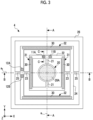
- Fig. 3 is a plan view of the MMD 4 as viewed from the light incident side.
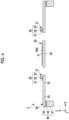
- Fig. 4 is a cross-sectional view taken along the line A-A in Fig. 3 .
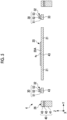
- Fig. 5 is a cross-sectional view taken along the line B-B of Fig. 3 .
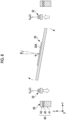
- Fig. 6 is a cross-sectional view taken along the line C-C of Fig. 3 .
- the MMD 4 includes a mirror portion 20, a first support portion 21, a first movable frame 22, a second support portion 23, a second movable frame 24, a connecting portion 25, and a fixed frame 26.
- the MMD 4 is a so-called MEMS scanner.
- the mirror portion 20 has a reflecting surface 20A for reflecting incident light.
- the reflecting surface 20A is provided on one surface of the mirror portion 20, and is formed of a metal thin film such as gold (Au), aluminum (Al), silver (Ag), or an alloy of silver.
- the shape of the reflecting surface 20A is, for example, circular with the intersection of the first axis a 1 and the second axis a 2 as the center.
- the first axis a 1 and the second axis a 2 exist in a plane including the reflecting surface 20A in a case where the mirror portion 20 is stationary.
- the planar shape of the MMD 4 is rectangular, line-symmetrical with respect to the first axis a 1 , and line-symmetrical with respect to the second axis a 2 .
- the first support portions 21 are disposed on an outside of the mirror portion 20 at positions facing each other across the second axis a 2 .
- the first support portions 21 are connected to the mirror portion 20 on the first axis a 1 , and swingably support the mirror portion 20 around the first axis a 1 .
- the first support portion 21 is a torsion bar stretched along the first axis a 1 .
- the first movable frame 22 is a rectangular frame that surrounds the mirror portion 20 and is connected to the mirror portion 20 on the first axis a 1 via the first support portion 21.
- Piezoelectric elements 30 are formed on the first movable frame 22 at positions facing each other across the first axis a 1 . In this way, a pair of first actuators 31 are configured by forming two piezoelectric elements 30 on the first movable frame 22.
- the pair of first actuators 31 are disposed at positions facing each other across the first axis a 1 .
- the first actuators 31 allow the mirror portion 20 to swing around the first axis a 1 by applying rotational torque around the first axis a 1 to the mirror portion 20.
- the second support portions 23 are disposed on an outside of the first movable frame 22 at positions facing each other across the first axis a 1 .
- the second support portions 23 are connected to the first movable frame 22 on the second axis a 2 , and swingably support the first movable frame 22 and the mirror portion 20 around the second axis a 2 .
- the second support portion 23 is a torsion bar stretched along the second axis a 2 .
- the second movable frame 24 is a rectangular frame that surrounds the first movable frame 22 and is connected to the first movable frame 22 on the second axis a 2 via the second support portion 23.
- the piezoelectric elements 30 are formed on the second movable frame 24 at positions facing each other across the second axis a 2 . In this way, a pair of second actuators 32 are configured by forming two piezoelectric elements 30 on the second movable frame 24.
- the pair of second actuators 32 are disposed at positions facing each other across the second axis a 2 .
- the second actuators 32 allow the mirror portion 20 to swing around the second axis a 2 by applying rotational torque around the second axis a 2 to the mirror portion 20 and the first movable frame 22.
- the connecting portions 25 are disposed on an outside of the second movable frame 24 at positions facing each other across the first axis a 1 .
- the connecting portions 25 are connected to the second movable frame 24 on the second axis a 2 .
- the fixed frame 26 is a rectangular frame that surrounds the second movable frame 24 and is connected to the second movable frame 24 on the second axis a 2 via the connecting portion 25.
- the first movable frame 22 is provided with a pair of first angle detection sensors 11A and 11B at positions facing each other across the first axis a 1 in the vicinity of the first support portion 21.
- Each of the pair of first angle detection sensors 11A and 11B is composed of a piezoelectric element.
- Each of the first angle detection sensors 11A and 11B converts a force applied by deformation of the first support portion 21 accompanying the rotation of the mirror portion 20 around the first axis a 1 into a voltage and outputs a signal. That is, the first angle detection sensors 11A and 11B output signals corresponding to angles of the mirror portion 20 around the first axis a 1 .
- the second movable frame 24 is provided with a pair of second angle detection sensors 12A and 12B at positions facing each other across the second axis a 2 in the vicinity of the second support portion 23.
- Each of the pair of second angle detection sensors 12A and 12B is composed of a piezoelectric element.
- Each of the second angle detection sensors 12A and 12B converts a force applied by deformation of the second support portion 23 accompanying the rotation of the mirror portion 20 around the second axis a 2 into a voltage and outputs a signal. That is, the second angle detection sensors 12A and 12B output signals corresponding to angles of the mirror portion 20 around the second axis a 2 .
- Figs. 2 and 3 the wiring line and the electrode pad for giving the driving signal to the first actuator 31 and the second actuator 32 are not shown.
- a wiring line and an electrode pad for outputting signals from the first angle detection sensors 11A and 11B and the second angle detection sensors 12A and 12B are not shown.
- a plurality of the electrode pads are provided on the fixed frame 26.
- the MMD 4 is formed, for example, by performing an etching treatment on a silicon on insulator (SOI) substrate 40.
- SOI substrate 40 is a substrate in which a silicon oxide layer 42 is provided on a first silicon active layer 41 made of single crystal silicon, and a second silicon active layer 43 made of single crystal silicon is provided on the silicon oxide layer 42.
- the mirror portion 20, the first support portion 21, the first movable frame 22, the second support portion 23, the second movable frame 24, and the connecting portion 25 are formed of the second silicon active layer 43 remaining by removing the first silicon active layer 41 and the silicon oxide layer 42 from the SOI substrate 40 by an etching treatment.
- the second silicon active layer 43 functions as an elastic portion having elasticity.
- the fixed frame 26 is formed of three layers of the first silicon active layer 41, the silicon oxide layer 42, and the second silicon active layer 43.
- the first actuator 31 and the second actuator 32 have the piezoelectric element 30 on the second silicon active layer 43.
- the piezoelectric element 30 has a laminated structure in which a lower electrode 51, a piezoelectric film 52, and an upper electrode 53 are sequentially laminated on the second silicon active layer 43.
- An insulating film is provided on the upper electrode 53, but is not shown.
- the upper electrode 53 and the lower electrode 51 are formed of, for example, gold (Au) or platinum (Pt).
- the piezoelectric film 52 is formed of, for example, lead zirconate titanate (PZT), which is a piezoelectric material.
- the upper electrode 53 and the lower electrode 51 are electrically connected to the driving controller 5 described above via the wiring line and the electrode pad.
- a driving voltage is applied to the upper electrode 53 from the driving controller 5.
- the lower electrode 51 is connected to the driving controller 5 via the wiring line and the electrode pad, and a reference potential (for example, a ground potential) is applied thereto.
- the piezoelectric film 52 exerts a so-called inverse piezoelectric effect.
- the piezoelectric film 52 exerts an inverse piezoelectric effect by applying a driving voltage from the driving controller 5 to the upper electrode 53, and displaces the first actuator 31 and the second actuator 32.
- the first angle detection sensor 11A is also similarly composed of the piezoelectric element 30 consisting of the lower electrode 51, the piezoelectric film 52, and the upper electrode 53 laminated on the second silicon active layer 43.
- force pressure
- polarization proportional to the pressure is generated. That is, the piezoelectric film 52 exerts a piezoelectric effect.
- the piezoelectric film 52 exerts a piezoelectric effect and generates a voltage in a case where force is applied by deformation of the first support portion 21 accompanying the rotation of the mirror portion 20 around the first axis a 1 .
- first angle detection sensor 11B has the same configuration as the first angle detection sensor 11A, the first angle detection sensor 11B is not shown.
- second angle detection sensors 12A and 12B have the same configuration as the first angle detection sensor 11A, the second angle detection sensors 12A and 12B are not shown.
- Fig. 7 shows an example in which one piezoelectric film 52 of the pair of first actuators 31 is extended and the other piezoelectric film 52 is contracted, thereby generating rotational torque around the first axis a 1 in the first actuator 31.
- one of the pair of first actuators 31 and the other are displaced in opposite directions to each other, whereby the mirror portion 20 rotates around the first axis a 1 .
- Fig. 7 shows an example in which the first actuator 31 is driven in an anti-phase resonance mode in which the displacement direction of the pair of first actuators 31 and the rotation direction of the mirror portion 20 are opposite to each other.
- the first actuator 31 may be driven in an in-phase resonance mode in which the displacement direction of the pair of first actuators 31 and the rotation direction of the mirror portion 20 are the same direction.
- a deflection angle (hereinafter, referred to as a first deflection angle) ⁇ 1 of the mirror portion 20 around the first axis a 1 is controlled by the driving signal (hereinafter, referred to as a first driving signal) given to the first actuator 31 by the driving controller 5.
- the first driving signal is, for example, a sinusoidal AC voltage.
- the first driving signal includes a driving voltage waveform V 1A (t) applied to one of the pair of first actuators 31 and a driving voltage waveform V1 B (t) applied to the other.
- the driving voltage waveform V 1A (t) and the driving voltage waveform V 1B (t) are in an anti-phase with each other (that is, the phase difference is 180°).
- the first deflection angle ⁇ 1 is an angle at which the normal line of the reflecting surface 20A is inclined with respect to the Z direction in an XZ plane.
- Fig. 8 shows an example in which one piezoelectric film 52 of the pair of second actuators 32 is extended and the other piezoelectric film 52 is contracted, thereby generating rotational torque around the second axis a 2 in the second actuator 32.
- one of the pair of second actuators 32 and the other are displaced in opposite directions to each other, whereby the mirror portion 20 rotates around the second axis a 2 .
- Fig. 8 shows an example in which the second actuator 32 is driven in an anti-phase resonance mode in which the displacement direction of the pair of second actuators 32 and the rotation direction of the mirror portion 20 are opposite to each other.
- the second actuator 32 may be driven in an in-phase resonance mode in which the displacement direction of the pair of second actuators 32 and the rotation direction of the mirror portion 20 are the same direction.
- a deflection angle (hereinafter, referred to as a second deflection angle) ⁇ 2 of the mirror portion 20 around the second axis a 2 is controlled by the driving signal (hereinafter, referred to as a second driving signal) given to the second actuator 32 by the driving controller 5.
- the second driving signal is, for example, a sinusoidal AC voltage.
- the second driving signal includes a driving voltage waveform V 2A (t) applied to one of the pair of second actuators 32 and a driving voltage waveform V 2B (t) applied to the other.
- the driving voltage waveform V 2A (t) and the driving voltage waveform V 2B (t) are in an anti-phase with each other (that is, the phase difference is 180°).
- the second deflection angle ⁇ 2 is an angle at which the normal line of the reflecting surface 20A is inclined with respect to the Z direction in a YZ plane.
- Figs. 9A and 9B show examples of the first driving signal and the second driving signal.
- Fig. 9A shows the driving voltage waveforms V 1A (t) and V 1B (t) included in the first driving signal.
- Fig. 9B shows the driving voltage waveforms V 2A (t) and V 2B (t) included in the second driving signal.
- V 1A (t) and V 1B (t) are represented as follows, respectively.
- V 1 A t V off 1 + V 1 sin 2 ⁇ f d 1 t
- V 1 B t V off 1 + V 1 sin 2 ⁇ f d 1 t + ⁇
- V 1 is the amplitude voltage.
- V off1 is the bias voltage.
- f d1 is the driving frequency (hereinafter, referred to as the first driving frequency).
- t is time.
- the mirror portion 20 swings around the first axis a 1 at the first driving frequency f d1 (see Fig. 7 ).
- V 2A (t) and V 2B (t) are represented as follows, respectively.
- V 2 A t V off2 + V 2 sin 2 ⁇ f d2 t + ⁇
- V 2 B t V off2 + V 2 sin 2 ⁇ f d2 t + ⁇ + ⁇
- V 2 is the amplitude voltage.
- V off2 is the bias voltage.
- f d2 is the driving frequency (hereinafter, referred to as the second driving frequency).
- t is time.
- ⁇ is the phase difference between the driving voltage waveforms V 1A (t) and V 1B (t) and the driving voltage waveforms V 2A (t) and V 2B (t).
- the mirror portion 20 swings around the second axis a 2 at the second driving frequency f d2 (see Fig. 8 ).
- the first driving frequency f d1 is set so as to match the resonance frequency around the first axis a 1 of the mirror portion 20.
- the second driving frequency f d2 is set so as to match the resonance frequency around the second axis a 2 of the mirror portion 20.
- f d1 > f d2 . That is, in the mirror portion 20, a swing frequency around the first axis a 1 is higher than a swing frequency around the second axis a 2 .
- the first driving frequency f d1 and the second driving frequency f d2 do not necessarily have to match the resonance frequency.
- the first driving frequency f d1 and the second driving frequency f d2 may be frequencies within a frequency range in the vicinity of the resonance frequency (for example, a range of half-width of frequency distribution having the resonance frequency as a peak value).
- This frequency range is, for example, within a range of a so-called Q value.
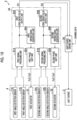
- Fig. 10 shows an example of a configuration of the driving controller 5.
- the driving controller 5 includes a mirror driving unit 4A and a light source driving unit 3A.
- the mirror driving unit 4A includes a first driving signal generation unit 60A, a first signal processing unit 61A, a first phase shift unit 62A, a first zero cross pulse output unit 63A, a second driving signal generation unit 60B, a second signal processing unit 61B, a second phase shift unit 62B, and a second zero cross pulse output unit 63B.
- the first driving signal generation unit 60A, the first signal processing unit 61A, and the first phase shift unit 62A perform feedback control such that the swing of the mirror portion 20 around the first axis a 1 maintains a resonance state.
- the second driving signal generation unit 60B, the second signal processing unit 61B, and the second phase shift unit 62B perform feedback control such that the swing of the mirror portion 20 around the second axis a 2 maintains a resonance state.
- the first driving signal generation unit 60A generates the first driving signal including the above-described driving voltage waveforms V 1A (t) and V 1B (t) based on a reference waveform, and applies the generated first driving signal to the pair of first actuators 31 via the first phase shift unit 62A. Thereby, the mirror portion 20 swings around the first axis a 1 .
- the first angle detection sensors 11A and 11B output signals corresponding to angles of the mirror portion 20 around the first axis a 1 .
- the second driving signal generation unit 60B generates the second driving signal including the above-described driving voltage waveforms V 2A (t) and V 2B (t) based on a reference waveform, and applies the generated second driving signal to the pair of second actuators 32 via the second phase shift unit 62B. Thereby, the mirror portion 20 swings around the second axis a 2 .
- the second angle detection sensors 12A and 12B output signals corresponding to angles of the mirror portion 20 around the second axis a 2 .
- the first driving signal generated by the first driving signal generation unit 60A and the second driving signal generated by the second driving signal generation unit 60B are phase-synchronized.
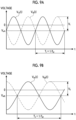
- Fig. 11 shows an example of signals output from the pair of first angle detection sensors 11A and 11B.
- S1a 1 and S1a 2 represent signals output from the pair of first angle detection sensors 11A and 11B in a case where the mirror portion 20 swings only around the first axis a 1 without swinging around the second axis a 2 .
- the signals S1a 1 and S1a 2 are waveform signals similar to a sinusoidal wave having the first driving frequency f d1 and are in an anti-phase with each other.
- a vibration noise RN1 caused by the swing of the mirror portion 20 around the second axis a 2 is superimposed on the output signals of the pair of first angle detection sensors 11A and 11B.
- S1b 1 represents a signal in which the vibration noise RN1 is superimposed on the signal S1a 1 .
- S1b 2 represents a signal in which the vibration noise RN1 is superimposed on the signal S1a 2 .
- the vibration noise RN1 is emphasized.
- the signals S1b 1 and S1b 2 on which the vibration noise RN1 is superimposed are output from the first angle detection sensors 11A and 11B, and amplitudes of the signals S1b 1 and S1b 2 fluctuate every cycle. Therefore, it is difficult to directly obtain the amplitude and the phase based on the signals S1b 1 and S1b 2 output from the first angle detection sensors 11A and 11B.
- Fig. 12 shows an example of signals output from the pair of second angle detection sensors 12A and 12B.
- S2a 1 and S2a 2 represent signals output from the pair of second angle detection sensors 12A and 12B in a case where the mirror portion 20 swings only around the second axis a 2 without swinging around the first axis a 1 .
- the signals S2a 1 and S2a 2 are waveform signals similar to a sinusoidal wave having the second driving frequency f d2 and are in an anti-phase with each other.
- a vibration noise RN2 caused by the swing of the mirror portion 20 around the first axis a 1 is superimposed on the output signals of the pair of second angle detection sensors 12A and 12B.
- S2b 1 represents a signal in which the vibration noise RN2 is superimposed on the signal S2a 1 .
- S2b 2 represents a signal in which the vibration noise RN2 is superimposed on the signal S2a 2 .
- the vibration noise RN2 is emphasized.
- the signals S12b 1 and S2b 2 on which the vibration noise RN2 is superimposed are output from the second angle detection sensors 12A and 12B, and amplitudes of the signals S2b 1 and S2b 2 fluctuate every cycle. Therefore, it is difficult to directly obtain the amplitude and the phase based on the signals S2b 1 and S2b 2 output from the second angle detection sensors 12A and 12B.
- the first signal processing unit 61A generates a signal (hereinafter, a first angle detection signal) S1c from which the vibration noise RN1 has been removed based on S1a 1 and S1a 2 output from the pair of first angle detection sensors 11A and 11B.
- the second signal processing unit 61B generates a signal (hereinafter, a second angle detection signal) S2c from which the vibration noise RN2 has been removed based on S2a 1 and S2a 2 output from the pair of second angle detection sensors 12A and 12B.
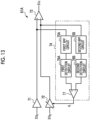
- Fig. 13 shows a configuration of the first signal processing unit 61A.
- the first signal processing unit 61A includes an analog arithmetic circuit.
- the first signal processing unit 61A is composed of a buffer amplifier 71, a variable gain amplifier 72, a subtraction circuit 73, and a gain adjustment circuit 74.
- the gain adjustment circuit 74 is composed of a first band pass filter (BPF) circuit 75A, a second BPF circuit 75B, a first detection circuit 76A, a second detection circuit 76B, and a subtraction circuit 77.
- BPF band pass filter
- the subtraction circuit 73 and the subtraction circuit 77 are differential amplification circuits including an operational amplifier.
- the signal S1b 1 output from the first angle detection sensor 11A is input to a positive input terminal (non-inverting input terminal) of the subtraction circuit 73 via the buffer amplifier 71.
- the signal output from the buffer amplifier 71 is branched in the middle of the process before being input to the subtraction circuit 73, and is input to the first BPF circuit 75A in the gain adjustment circuit 74.
- the signal S1b 2 output from the first angle detection sensor 11B is input to a negative input terminal (inverting input terminal) of the subtraction circuit 73 via the variable gain amplifier 72.
- the signal output from the variable gain amplifier 72 is branched in the middle of the process before being input to the subtraction circuit 73, and is input to the second BPF circuit 75B in the gain adjustment circuit 74.
- Each of the first BPF circuit 75A and the second BPF circuit 75B has a pass band B1 having the second driving frequency f d2 as a center frequency, as shown in Fig. 14 .
- the pass band B1 is, for example, a frequency band of f d2 ⁇ 5 kHz. Since the vibration noise RN1 has the second driving frequency f d2 , the vibration noise RN1 passes through the pass band B1. Therefore, the first BPF circuit 75A extracts and outputs the vibration noise RN1 (see Fig. 11 ) from the signal input from the buffer amplifier 71. The second BPF circuit 75B extracts and outputs the vibration noise RN1 (see Fig. 11 ) from the signal input from the variable gain amplifier 72.
- Each of the first detection circuit 76A and the second detection circuit 76B is composed of, for example, a root mean squared value to direct current converter (RMS-DC converter).
- the first detection circuit 76A converts the amplitude of the vibration noise RN1 input from the first BPF circuit 75A into a DC voltage signal and inputs the signal to the positive input terminal of the subtraction circuit 77.
- the second detection circuit 76B converts the amplitude of the vibration noise RN1 input from the second BPF circuit 75B into a DC voltage signal and inputs the signal to the negative input terminal of the subtraction circuit 77.
- the subtraction circuit 77 outputs a value d 1 obtained by subtracting the DC voltage signal input from the second detection circuit 76B from the DC voltage signal input from the first detection circuit 76A.
- the value d 1 corresponds to a difference between the amplitude of the vibration noise RN1 included in the signal S1b 1 output from the first angle detection sensor 11A and the amplitude of the vibration noise RN1 included in the signal S1b 2 output from the first angle detection sensor 11B.
- the subtraction circuit 77 inputs the value d 1 as a gain adjustment value to a gain adjustment terminal of the variable gain amplifier 72.
- the variable gain amplifier 72 adjusts an amplitude level of the signal S1b 2 by multiplying the signal S1b 2 input from the first angle detection sensor 11B by the value d 1 input as the gain adjustment value. In this way, a feedback control is performed by the gain adjustment circuit 74, so that the amplitude of the vibration noise RN1 included in the signal S1b 2 after passing through the variable gain amplifier 72 is adjusted so as to match the amplitude of the vibration noise RN1 included in the signal S1b 1 after passing through the buffer amplifier 71.
- the subtraction circuit 73 outputs a value obtained by subtracting the signal S1b 2 input to the negative input terminal from the signal S1b 1 input to the positive input terminal. Since the amplitudes of the vibration noise RN1 included in both signals match with each other by the feedback control, the vibration noise RN1 included in both signals is offset by the subtraction processing by the subtraction circuit 73. Therefore, the subtraction circuit 73 outputs the first angle detection signal S1c (see Fig. 15 ), which is a signal from which the vibration noise RN1 has been removed.
- Fig. 15 shows a state in which the first angle detection signal S1c is generated based on S1b 1 and S1b 2 output from the pair of first angle detection sensors 11A and 11B.
- the first angle detection signal S1c corresponds to a signal obtained by doubling an amplitude of a signal obtained by removing the vibration noise RN1 from the signal S1b 1 .
- the first angle detection signal S1c generated by the first signal processing unit 61A is input to the first driving signal generation unit 60A and the first zero cross pulse output unit 63A.
- the first angle detection signal S1c output from the first signal processing unit 61A has a phase delay of 90° with respect to the driving voltage waveform V 1A (t) included in the first driving signal.
- the second signal processing unit 61B is composed of a buffer amplifier 81, a variable gain amplifier 82, a subtraction circuit 83, and a gain adjustment circuit 84.
- the gain adjustment circuit 84 is composed of a first BPF circuit 85A, a second BPF circuit 85B, a first detection circuit 86A, a second detection circuit 86B, and a subtraction circuit 87.
- the subtraction circuit 83 and the subtraction circuit 87 are differential amplification circuits including an operational amplifier.
- the signal S2b 1 output from the second angle detection sensor 12A is input to a positive input terminal of the subtraction circuit 83 via the buffer amplifier 81.
- the signal output from the buffer amplifier 81 is branched in the middle of the process before being input to the subtraction circuit 83, and is input to the first BPF circuit 85A in the gain adjustment circuit 84.
- the signal S2b 2 output from the second angle detection sensor 12B is input to a negative input terminal of the subtraction circuit 83 via the variable gain amplifier 82.
- the signal output from the variable gain amplifier 82 is branched in the middle of the process before being input to the subtraction circuit 83, and is input to the second BPF circuit 85B in the gain adjustment circuit 84.
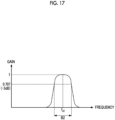
- Each of the first BPF circuit 85A and the second BPF circuit 85B has a pass band B2 having the first driving frequency f d1 as a center frequency, as shown in Fig. 17 .
- the pass band B2 is, for example, a frequency band of f d1 ⁇ 5 kHz. Since the vibration noise RN2 has the first driving frequency f d1 , the vibration noise RN2 passes through the pass band B2. Therefore, the first BPF circuit 85A extracts and outputs the vibration noise RN2 (see Fig. 12 ) from the signal input from the buffer amplifier 81. The second BPF circuit 85B extracts and outputs the vibration noise RN2 (see Fig. 12 ) from the signal input from the variable gain amplifier 82.
- Each of the first detection circuit 86A and the second detection circuit 86B is composed of, for example, an RMS-DC converter.
- the first detection circuit 86A converts the amplitude of the vibration noise RN2 input from the first BPF circuit 85A into a DC voltage signal and inputs the signal to the positive input terminal of the subtraction circuit 87.
- the second detection circuit 86B converts the amplitude of the vibration noise RN2 input from the second BPF circuit 85B into a DC voltage signal and inputs the signal to the negative input terminal of the subtraction circuit 87.
- the subtraction circuit 87 outputs a value d 2 obtained by subtracting the DC voltage signal input from the second detection circuit 86B from the DC voltage signal input from the first detection circuit 86A.
- the value d 2 corresponds to a difference between the amplitude of the vibration noise RN2 included in the signal S2b 1 output from the second angle detection sensor 12A and the amplitude of the vibration noise RN2 included in the signal S2b 2 output from the second angle detection sensor 12B.
- the subtraction circuit 87 inputs the value d 2 as a gain adjustment value to a gain adjustment terminal of the variable gain amplifier 82.
- the variable gain amplifier 82 adjusts an amplitude level of the signal S2b 2 by multiplying the signal S2b 2 input from the second angle detection sensor 12B by the value d 2 input as the gain adjustment value. In this way, a feedback control is performed by the gain adjustment circuit 84, so that the amplitude of the vibration noise RN2 included in the signal S2b 2 after passing through the variable gain amplifier 82 is adjusted so as to match the amplitude of the vibration noise RN2 included in the signal S2b 1 after passing through the buffer amplifier 81.
- the subtraction circuit 83 outputs a value obtained by subtracting the signal S2b 2 input to the negative input terminal from the signal S2b 1 input to the positive input terminal. Since the amplitudes of the vibration noise RN2 included in both signals match with each other by the feedback control, the vibration noise RN2 included in both signals is offset by the subtraction processing by the subtraction circuit 83. Therefore, the subtraction circuit 83 outputs the second angle detection signal S2c (see Fig. 18 ), which is a signal from which the vibration noise RN2 has been removed.
- Fig. 18 shows a state in which the second angle detection signal S2c is generated based on S2b 1 and S2b 2 output from the pair of second angle detection sensors 12A and 12B.
- the second angle detection signal S2c corresponds to a signal obtained by doubling an amplitude of a signal obtained by removing the vibration noise RN2 from the signal S2b 1 .
- the second angle detection signal S2c generated by the second signal processing unit 61B is input to the second driving signal generation unit 60B and the second zero cross pulse output unit 63B.
- the second angle detection signal S2c output from the second signal processing unit 61B has a phase delay of 90° with respect to the driving voltage waveform V 2A (t) included in the second driving signal.
- the first angle detection signal S1c input from the first signal processing unit 61A is fed back to the first driving signal generation unit 60A.
- the first phase shift unit 62A shifts the phase of the driving voltage waveform output from the first driving signal generation unit 60A.
- the first phase shift unit 62A shifts the phase by 90°, for example.
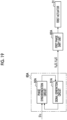
- Fig. 19 shows an example of a configuration of the first driving signal generation unit 60A.
- the first driving signal generation unit 60A includes a signal generation circuit 91A and a phase synchronization circuit 92A.
- the first driving signal generation unit 60A is a so-called phase locked loop (PLL) type drive circuit.
- PLL phase locked loop
- a sampling reset signal having the first driving frequency f d1 is input to the phase synchronization circuit 92A from the signal generation circuit 91A, and the first angle detection signal S1c is input from the first signal processing unit 61A (see Fig. 10 ).
- the phase synchronization circuit 92A adjusts a phase of a sampling clock signal generated by itself based on the sampling reset signal and the first angle detection signal S1c.
- the signal generation circuit 91A generates the driving voltage waveforms V 1A (t) and V 1B (t) constituting the first driving signal based on the sampling clock signal input from the phase synchronization circuit 92A.
- the feedback control is performed such that a phase difference between the first driving signal and the first angle detection signal S1c is maintained at 90° by the first phase shift unit 62A and the first driving signal generation unit 60A of the PLL type.
- the phase difference between the first driving signal and the first angle detection signal S1c is maintained at 90°, the swing of the mirror portion 20 around the first axis a 1 is maintained in a resonance state.
- the second angle detection signal S2c input from the second signal processing unit 61B is fed back to the second driving signal generation unit 60B.
- the second phase shift unit 62B shifts the phase of the driving voltage waveform output from the second driving signal generation unit 60B.
- the second phase shift unit 62B shifts the phase by 90°, for example.
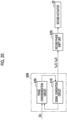
- Fig. 20 shows an example of a configuration of the second driving signal generation unit 60B.
- the second driving signal generation unit 60B includes a signal generation circuit 91B and a phase synchronization circuit 92B.
- the second driving signal generation unit 60B is a so-called PLL type drive circuit.
- a sampling reset signal having the second driving frequency f d2 is input to the phase synchronization circuit 92B from the signal generation circuit 91B, and the second angle detection signal S2c is input from the second signal processing unit 61B (see Fig. 10 ).
- the phase synchronization circuit 92B adjusts a phase of a sampling clock signal generated by itself based on the sampling reset signal and the second angle detection signal S2c.
- the signal generation circuit 91B generates the driving voltage waveforms V 2A (t) and V 2B (t) constituting the second driving signal based on the sampling clock signal input from the phase synchronization circuit 92B.
- the feedback control is performed such that a phase difference between the second driving signal and the second angle detection signal S2c is maintained at 90° by the second phase shift unit 62B and the second driving signal generation unit 60B of the PLL type.
- the phase difference between the second driving signal and the second angle detection signal S2c is maintained at 90°, the swing of the mirror portion 20 around the second axis a 2 is maintained in a resonance state.
- the first zero cross pulse output unit 63A generates a zero cross pulse (hereinafter, referred to as a first zero cross pulse) ZC1 based on the first angle detection signal S1c input from the first signal processing unit 61A.
- the first zero cross pulse output unit 63A is composed of a zero cross detection circuit.
- the first zero cross pulse output unit 63A generates the first zero cross pulse ZC1 at a timing at which the first angle detection signal S1c, which is an AC signal, crosses zero volt.
- the first zero cross pulse output unit 63A inputs the generated first zero cross pulse ZC1 to the light source driving unit 3A.
- the second zero cross pulse output unit 63B generates a zero cross pulse (hereinafter, referred to as a second zero cross pulse) ZC2 based on the second angle detection signal S2c input from the second signal processing unit 61B.
- the second zero cross pulse output unit 63B is composed of a zero cross detection circuit.
- the second zero cross pulse output unit 63B generates the second zero cross pulse ZC2 at a timing at which the second angle detection signal S2c, which is an AC signal, crosses zero volt.
- the second zero cross pulse output unit 63B inputs the generated second zero cross pulse ZC2 to the light source driving unit 3A.
- the light source driving unit 3A drives the light source 3 based on drawing data supplied from the outside of the image drawing system 10, for example.
- the light source driving unit 3A controls the irradiation timing such that the irradiation timing of the laser light is synchronized with the first zero cross pulse ZC1 and the second zero cross pulse ZC2 input from the mirror driving unit 4A.
- the technique of the present disclosure by subtracting one of the pair of first output signals output from the pair of first angle detection sensors from the other, the vibration noise caused by the swing of the mirror portion around the second axis is removed.
- the first angle detection signal representing the angle of the mirror portion around the first axis, from which the vibration noise is removed, is generated, the swing of the mirror portion can be accurately controlled.
- the amplitude (maximum deflection angle) of the swing of the mirror portion is maintained constant.
- the disposition of the pair of first angle detection sensors 11A and 11B and the pair of second angle detection sensors 12A and 12B in the MMD 4 is different from that of the first embodiment.
- the pair of first angle detection sensors 11A and 11B are disposed at positions facing each other across the first axis a 1
- the pair of first angle detection sensors 11A and 11B are disposed at positions facing each other across the second axis a 2 .
- the pair of second angle detection sensors 12A and 12B are disposed at positions facing each other across the second axis a 2
- the pair of second angle detection sensors 12A and 12B are disposed at positions facing each other across the first axis a 1 .
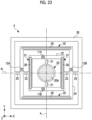
- Fig. 23 is a plan view showing the configuration of the MMD 4 according to the present embodiment.
- the pair of first angle detection sensors 11A and 11B are disposed in the vicinity of the first support portion 21 on the first movable frame 22.
- the first angle detection sensor 11A is disposed in the vicinity of the first support portion 21 connected to one side of the mirror portion 20.
- the first angle detection sensor 11B is disposed in the vicinity of the first support portion 21 connected to the other side of the mirror portion 20. Therefore, the pair of first angle detection sensors 11A and 11B are disposed at positions facing each other across the second axis a 2 and facing each other across the mirror portion 20.
- the pair of first angle detection sensors 11A and 11B are disposed at positions deviated from the first axis a 1 in the same direction (in the present embodiment, -X direction).
- the pair of second angle detection sensors 12A and 12B are disposed in the vicinity of the second support portion 23 on the second movable frame 24.
- the second angle detection sensor 12A is disposed in the vicinity of the second support portion 23 connected to one side of the first movable frame 22.
- the second angle detection sensor 12B is disposed in the vicinity of the second support portion 23 connected to the other side of the first movable frame 22. Therefore, the pair of second angle detection sensors 12A and 12B are disposed at positions facing each other across the first axis a 1 and facing each other across the mirror portion 20 and the first movable frame 22.
- the pair of second angle detection sensors 12A and 12B are disposed at positions deviated from the second axis a 2 in the same direction (in the present embodiment, +Y direction).
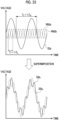
- Fig. 24 shows an example of signals output from the pair of first angle detection sensors 11A and 11B in the present embodiment.
- S1a represents a signal output from the pair of first angle detection sensors 11A and 11B in a case where the mirror portion 20 swings only around the first axis a 1 without swinging around the second axis a 2 .
- waveform signals having the same phase and having the first driving frequency f d1 are output from the first angle detection sensors 11A and 11B.
- a vibration noise RN1a caused by the swing of the mirror portion 20 around the second axis a 2 is superimposed on the output signal of the first angle detection sensor 11A.
- a vibration noise RN1b caused by the swing of the mirror portion 20 around the second axis a 2 is superimposed on the output signal of the first angle detection sensor 11B.
- the vibration noises RN1a and RN1b superimposed on the first angle detection sensors 11A and 11B are in an anti-phase with each other.
- the signal S1b 1 on which the vibration noise RN1a is superimposed is output from the first angle detection sensor 11A, and the signal S1b 2 on which the vibration noise RN1b is superimposed is output from the first angle detection sensor 11B.
- Fig. 25 shows an example of signals output from the pair of second angle detection sensors 12A and 12B in the present embodiment.
- S2a represents a signal output from the pair of second angle detection sensors 12A and 12B in a case where the mirror portion 20 swings only around the second axis a 2 without swinging around the first axis a 1 .
- waveform signals having the same phase and having the second driving frequency f d2 are output from the second angle detection sensors 12A and 12B.
- a vibration noise RN2a caused by the swing of the mirror portion 20 around the first axis a 1 is superimposed on the output signal of the second angle detection sensor 12A.
- a vibration noise RN2b caused by the swing of the mirror portion 20 around the first axis a 1 is superimposed on the output signal of the second angle detection sensor 12B.
- the vibration noises RN2a and RN2b superimposed on the second angle detection sensors 12A and 12B are in an anti-phase with each other.
- the signal S2b 1 on which the vibration noise RN2a is superimposed is output from the second angle detection sensor 12A, and the signal S2b 2 on which the vibration noise RN2b is superimposed is output from the second angle detection sensor 12B.
- the driving controller 5 is different from the configuration of the driving controller 5 of the first embodiment only in the configuration of the first signal processing unit 61A and the second signal processing unit 61B.
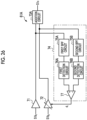
- the first signal processing unit 61A includes an addition circuit 73A instead of the subtraction circuit 73.
- the addition circuit 73A outputs a value obtained by adding the signal S1b 1 input from the first angle detection sensor 11A via the buffer amplifier 71 and the signal S1b 2 input from the first angle detection sensor 11B via the variable gain amplifier 72.
- the gain adjustment circuit 74 adjusts an amplitude level of the vibration noise RN1b included in the signal S1b 2 so as to match an amplitude level of the vibration noise RN1 a included in the signal S1b 1 . Therefore, the vibration noises RN1a and RN1b are offset by addition processing by the addition circuit 73A. Therefore, the addition circuit 73A outputs the first angle detection signal S1c which is a signal from which the vibration noises RN1a and RN1b have been removed.
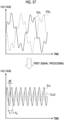
- Fig. 27 shows a state in which the first angle detection signal S1c is generated based on S1b 1 and S1b 2 output from the pair of first angle detection sensors 11A and 11B in the present embodiment. Also in the present embodiment, the same first angle detection signal S1c as in the first embodiment is obtained (see Fig. 15 ).
- the second signal processing unit 61B includes an addition circuit 83A instead of the subtraction circuit 83.
- the addition circuit 83A outputs a value obtained by adding the signal S2b 1 input from the second angle detection sensor 12A via the buffer amplifier 81 and the signal S2b 2 input from the second angle detection sensor 12B via the variable gain amplifier 82.
- the gain adjustment circuit 84 adjusts an amplitude level of the vibration noise RN2b included in the signal S2b 2 so as to match an amplitude level of the vibration noise RN2a included in the signal S2b 1 . Therefore, the vibration noises RN2a and RN2b are offset by addition processing by the addition circuit 83A. Therefore, the addition circuit 83A outputs the second angle detection signal S2c which is a signal from which the vibration noises RN2a and RN2b have been removed.
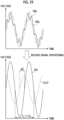
- Fig. 29 shows a state in which the second angle detection signal S2c is generated based on S2b 1 and S2b 2 output from the pair of second angle detection sensors 12A and 12B in the present embodiment. Also in the present embodiment, the same second angle detection signal S2c as in the first embodiment is obtained (see Fig. 15 ).
- the pair of first angle detection sensors 11A and 11B need only be disposed at positions facing each other across the first axis a 1 or the second axis a 2 .
- the vibration noise can be removed by subtracting one of the output signals of the first angle detection sensors 11A and 11B from the other.
- the vibration noise can be removed by adding the output signals of the first angle detection sensors 11A and 11B.
- the pair of second angle detection sensors 12A and 12B need only be disposed at positions facing each other across the first axis a 1 or the second axis a 2 .
- the vibration noise can be removed by subtracting one of the output signals of the second angle detection sensors 12A and 12B from the other.
- the vibration noise can be removed by adding the output signals of the second angle detection sensors 12A and 12B.
- the gain adjustment circuit 74 extracts a vibration noise having the second driving frequency f d2 by the first BPF circuit 75A and the second BPF circuit 75B.
- the vibration noise having the second driving frequency f d2 may be extracted by a low-pass filter circuit having a cutoff frequency between the first driving frequency f d1 and the second driving frequency f d2 .
- the gain adjustment circuit 84 extracts a vibration noise having the first driving frequency f d1 by the first BPF circuit 85A and the second BPF circuit 85B.
- the vibration noise having the first driving frequency f d1 may be extracted by a high-pass filter circuit having a cutoff frequency between the first driving frequency f d1 and the second driving frequency f d2 .
- the configuration of the MMD 4 shown in the above embodiment is an example.
- the configuration of the MMD 4 can be modified in various ways.
- the first actuator 31 that allows the mirror portion 20 to swing around the first axis a 1 may be disposed on the second movable frame 24, and the second actuator 32 that allows the mirror portion 20 to swing around the second axis a 2 may be disposed on the first movable frame 22.
- the hardware configuration of the driving controller 5 can be variously modified.
- the driving controller 5 includes an analog arithmetic circuit, and can also include a digital arithmetic circuit.
- the driving controller 5 may be composed of one processor or may be composed of a combination of two or more processors of the same type or different types.
- the processor includes, for example, a central processing unit (CPU), a programmable logic device (PLD), or a dedicated electric circuit.
- the CPU is a general-purpose processor that executes software (program) to function as various processing units.
- the PLD is a processor such as a field programmable gate array (FPGA) whose circuit configuration can be changed after manufacture.
- the dedicated electric circuit is a processor that has a dedicated circuit configuration designed to perform a specific process, such as an application specific integrated circuit (ASIC).
- ASIC application specific integrated circuit
- a vibration noise is removed by adding or subtracting a pair of output signals output from a pair of angle detection sensors as described above. With respect to this, it is considered to remove a vibration noise by performing frequency filter processing on the output signal output from the angle detection sensor.
- a comparative example an example of removing a vibration noise by frequency filter processing will be described.
- At least any one of the pair of first angle detection sensors 11A and 11B need only be provided.
- at least any one of the pair of second angle detection sensors 12A and 12B need only be provided.
- the first signal processing unit 61A is a band pass filter circuit that has a pass band having the first driving frequency f d1 as a center frequency.
- the second signal processing unit 61B is a band pass filter circuit that has a pass band having the second driving frequency f d2 as a center frequency.
- a vibration noise can be removed by using the first signal processing unit 61A and the second signal processing unit 61B as a band pass filter circuit, but accurate phase information may not be obtained from a signal from which the vibration noise has been removed. This is due to a phase response of the band pass filter circuit.
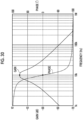
- Fig. 30 shows an example of gain and phase characteristics of the band pass filter circuit.
- a center frequency of the band pass filter circuit shown in Fig. 30 is 10 kHz.
- a phase changes abruptly in the vicinity of the center frequency. Therefore, in a case where a frequency of a signal input to the band pass filter circuit deviates from the center frequency, a phase of an output signal from the band pass filter circuit changes significantly. In this way, since the phase of the output signal from the angle detection sensor may change significantly due to passing through the band pass filter circuit, it is difficult to use the output signal from the band pass filter circuit as timing information for maintaining a resonance state.
- a vibration noise is removed by adding or subtracting a pair of output signals output from a pair of angle detection sensors without using a band pass filter circuit. Therefore, the phase of the output signal does not change significantly by the removal of the vibration noise, and the output signal can be used as timing information for maintaining a resonance state. Therefore, it is not necessary for the user to manually adjust the phase shifter.
Landscapes
- Physics & Mathematics (AREA)
- General Physics & Mathematics (AREA)
- Optics & Photonics (AREA)
- Mechanical Optical Scanning Systems (AREA)
- Mechanical Light Control Or Optical Switches (AREA)
- Micromachines (AREA)
Applications Claiming Priority (2)
| Application Number | Priority Date | Filing Date | Title |
|---|---|---|---|
| JP2020130627 | 2020-07-31 | ||
| PCT/JP2021/027606 WO2022025012A1 (ja) | 2020-07-31 | 2021-07-26 | 光走査装置、その駆動方法、及び画像描画システム |
Publications (3)
| Publication Number | Publication Date |
|---|---|
| EP4191318A1 true EP4191318A1 (de) | 2023-06-07 |
| EP4191318A4 EP4191318A4 (de) | 2024-01-17 |
| EP4191318B1 EP4191318B1 (de) | 2025-03-12 |
Family
ID=80036455
Family Applications (1)
| Application Number | Title | Priority Date | Filing Date |
|---|---|---|---|
| EP21850380.3A Active EP4191318B1 (de) | 2020-07-31 | 2021-07-26 | Optische abtastvorrichtung, verfahren zur ansteuerung davon und bildzeichensystem |
Country Status (5)
| Country | Link |
|---|---|
| US (1) | US20230176361A1 (de) |
| EP (1) | EP4191318B1 (de) |
| JP (1) | JP7505004B2 (de) |
| CN (1) | CN116209636B (de) |
| WO (1) | WO2022025012A1 (de) |
Families Citing this family (4)
| Publication number | Priority date | Publication date | Assignee | Title |
|---|---|---|---|---|
| US12306399B2 (en) * | 2021-02-09 | 2025-05-20 | Beijing Voyager Technology Co., Ltd. | System and method for driving a two-axis scanning mirror using drivers of different types |
| JP7770970B2 (ja) * | 2022-03-25 | 2025-11-17 | 富士フイルム株式会社 | 光走査装置、光走査装置の駆動方法、及び画像描画システム |
| WO2025204467A1 (ja) * | 2024-03-28 | 2025-10-02 | 富士フイルム株式会社 | ミラー駆動装置及び光走査装置 |
| WO2026070413A1 (ja) * | 2024-09-26 | 2026-04-02 | 富士フイルム株式会社 | ミラー装置及び光走査装置 |
Family Cites Families (17)
| Publication number | Priority date | Publication date | Assignee | Title |
|---|---|---|---|---|
| JP2002236009A (ja) * | 2001-02-08 | 2002-08-23 | Mitsubishi Electric Corp | 角度センサ |
| JP2003043405A (ja) * | 2001-08-02 | 2003-02-13 | Hitachi Via Mechanics Ltd | スキャナ装置 |
| CN100368864C (zh) * | 2005-04-18 | 2008-02-13 | 精工爱普生株式会社 | 光扫描装置、其控制方法及图像显示装置 |
| US7562573B2 (en) * | 2005-07-21 | 2009-07-21 | Evigia Systems, Inc. | Integrated sensor and circuitry and process therefor |
| JP2010256862A (ja) * | 2009-04-01 | 2010-11-11 | Seiko Epson Corp | ミラーデバイス駆動制御装置およびプロジェクター |
| JP5392106B2 (ja) * | 2010-01-20 | 2014-01-22 | 株式会社デンソー | 光走査装置 |
| JP5343903B2 (ja) | 2010-03-18 | 2013-11-13 | 株式会社豊田中央研究所 | 光偏向装置 |
| JP5769941B2 (ja) | 2010-09-10 | 2015-08-26 | 日本信号株式会社 | アクチュエータの駆動装置 |
| JP2012237788A (ja) * | 2011-05-10 | 2012-12-06 | Konica Minolta Advanced Layers Inc | 光走査装置およびそれを備えた画像投影装置 |
| JP6020719B2 (ja) | 2013-05-30 | 2016-11-02 | 株式会社村田製作所 | 生体センサ |
| JP2015014691A (ja) | 2013-07-04 | 2015-01-22 | パイオニア株式会社 | 表示制御装置 |
| JP6946708B2 (ja) * | 2016-06-20 | 2021-10-06 | 株式会社リコー | 制御装置、画像投影装置、および制御方法 |
| US10145680B2 (en) | 2016-08-12 | 2018-12-04 | Microvision, Inc. | Devices and methods for providing depth mapping with scanning laser image projection |
| JP6874321B2 (ja) | 2016-10-14 | 2021-05-19 | 富士通株式会社 | 距離測定装置、距離測定方法、及び距離測定プログラム |
| JP7143056B2 (ja) | 2016-12-08 | 2022-09-28 | Mmiセミコンダクター株式会社 | 静電容量型トランスデューサシステム、静電容量型トランスデューサ及び、音響センサ |
| JP6929198B2 (ja) | 2017-10-31 | 2021-09-01 | 太陽ホールディングス株式会社 | 感光性樹脂組成物、ドライフィルム、硬化物、半導体素子、プリント配線板および電子部品 |
| JP2020020916A (ja) * | 2018-07-31 | 2020-02-06 | 矢崎総業株式会社 | 光走査素子 |
-
2021
- 2021-07-26 CN CN202180059125.XA patent/CN116209636B/zh active Active
- 2021-07-26 EP EP21850380.3A patent/EP4191318B1/de active Active
- 2021-07-26 JP JP2022540306A patent/JP7505004B2/ja active Active
- 2021-07-26 WO PCT/JP2021/027606 patent/WO2022025012A1/ja not_active Ceased
-
2023
- 2023-01-27 US US18/160,888 patent/US20230176361A1/en active Pending
Also Published As
| Publication number | Publication date |
|---|---|
| JP7505004B2 (ja) | 2024-06-24 |
| EP4191318B1 (de) | 2025-03-12 |
| WO2022025012A1 (ja) | 2022-02-03 |
| CN116209636A (zh) | 2023-06-02 |
| CN116209636B (zh) | 2026-02-03 |
| JPWO2022025012A1 (de) | 2022-02-03 |
| US20230176361A1 (en) | 2023-06-08 |
| EP4191318A4 (de) | 2024-01-17 |
Similar Documents
| Publication | Publication Date | Title |
|---|---|---|
| EP4191318B1 (de) | Optische abtastvorrichtung, verfahren zur ansteuerung davon und bildzeichensystem | |
| CN110892306A (zh) | 光扫描装置以及光扫描装置的调整方法 | |
| US12320971B2 (en) | Optical scanning device, driving method of optical scanning device, and image drawing system | |
| EP4249985A1 (de) | Mikrospiegelvorrichtung und optische abtastvorrichtung | |
| JP2012237788A (ja) | 光走査装置およびそれを備えた画像投影装置 | |
| US12159562B2 (en) | Optical scanning device, method of driving optical scanning device, and image drawing system | |
| EP4209824A1 (de) | Mikrospiegelvorrichtung und optisches abtastgerät | |
| EP4105709A1 (de) | Optische abtastvorrichtung, antriebsverfahren einer optischen abtastvorrichtung und bildzeichnungssystem | |
| JP2013003526A (ja) | 光走査装置 | |
| EP4254043B1 (de) | Optische abtastvorrichtung, ansteuerungsverfahren für eine optische abtastvorrichtung und bildzeichensystem | |
| EP4249986A1 (de) | Optische abtastvorrichtung, ansteuerungsverfahren für eine optische abtastvorrichtung und bildzeichensystem | |
| EP4099083A1 (de) | Optische abtastvorrichtung, antriebsverfahren einer optischen abtastvorrichtung und bildzeichnungssystem | |
| US20260009999A1 (en) | Optical scanning device, image drawing system, and driving method of mirror device | |
| JP7815020B2 (ja) | 光走査装置 | |
| JP5309441B2 (ja) | 2次元光走査装置 | |
| US20250350699A1 (en) | Image drawing apparatus and driving method for image drawing apparatus | |
| WO2025022886A1 (ja) | アクチュエータ装置、光走査装置、及びアクチュエータ装置の駆動方法 |
Legal Events
| Date | Code | Title | Description |
|---|---|---|---|
| STAA | Information on the status of an ep patent application or granted ep patent |
Free format text: STATUS: THE INTERNATIONAL PUBLICATION HAS BEEN MADE |
|
| PUAI | Public reference made under article 153(3) epc to a published international application that has entered the european phase |
Free format text: ORIGINAL CODE: 0009012 |
|
| STAA | Information on the status of an ep patent application or granted ep patent |
Free format text: STATUS: REQUEST FOR EXAMINATION WAS MADE |
|
| 17P | Request for examination filed |
Effective date: 20230117 |
|
| AK | Designated contracting states |
Kind code of ref document: A1 Designated state(s): AL AT BE BG CH CY CZ DE DK EE ES FI FR GB GR HR HU IE IS IT LI LT LU LV MC MK MT NL NO PL PT RO RS SE SI SK SM TR |
|
| DAV | Request for validation of the european patent (deleted) | ||
| DAX | Request for extension of the european patent (deleted) | ||
| A4 | Supplementary search report drawn up and despatched |
Effective date: 20231220 |
|
| RIC1 | Information provided on ipc code assigned before grant |
Ipc: H02N 2/06 20060101ALI20231214BHEP Ipc: H02N 2/04 20060101ALI20231214BHEP Ipc: G02B 26/08 20060101ALI20231214BHEP Ipc: B81B 3/00 20060101ALI20231214BHEP Ipc: G02B 26/10 20060101AFI20231214BHEP |
|
| GRAP | Despatch of communication of intention to grant a patent |
Free format text: ORIGINAL CODE: EPIDOSNIGR1 |
|
| STAA | Information on the status of an ep patent application or granted ep patent |
Free format text: STATUS: GRANT OF PATENT IS INTENDED |
|
| INTG | Intention to grant announced |
Effective date: 20250102 |
|
| GRAS | Grant fee paid |
Free format text: ORIGINAL CODE: EPIDOSNIGR3 |
|
| GRAA | (expected) grant |
Free format text: ORIGINAL CODE: 0009210 |
|
| STAA | Information on the status of an ep patent application or granted ep patent |
Free format text: STATUS: THE PATENT HAS BEEN GRANTED |
|
| AK | Designated contracting states |
Kind code of ref document: B1 Designated state(s): AL AT BE BG CH CY CZ DE DK EE ES FI FR GB GR HR HU IE IS IT LI LT LU LV MC MK MT NL NO PL PT RO RS SE SI SK SM TR |
|
| P01 | Opt-out of the competence of the unified patent court (upc) registered |
Free format text: CASE NUMBER: APP_5771/2025 Effective date: 20250203 |
|
| REG | Reference to a national code |
Ref country code: GB Ref legal event code: FG4D |
|
| REG | Reference to a national code |
Ref country code: CH Ref legal event code: EP |
|
| REG | Reference to a national code |
Ref country code: DE Ref legal event code: R096 Ref document number: 602021027627 Country of ref document: DE |
|
| REG | Reference to a national code |
Ref country code: IE Ref legal event code: FG4D |
|
| PG25 | Lapsed in a contracting state [announced via postgrant information from national office to epo] |
Ref country code: RS Free format text: LAPSE BECAUSE OF FAILURE TO SUBMIT A TRANSLATION OF THE DESCRIPTION OR TO PAY THE FEE WITHIN THE PRESCRIBED TIME-LIMIT Effective date: 20250612 |
|
| PG25 | Lapsed in a contracting state [announced via postgrant information from national office to epo] |
Ref country code: FI Free format text: LAPSE BECAUSE OF FAILURE TO SUBMIT A TRANSLATION OF THE DESCRIPTION OR TO PAY THE FEE WITHIN THE PRESCRIBED TIME-LIMIT Effective date: 20250312 |
|
| PG25 | Lapsed in a contracting state [announced via postgrant information from national office to epo] |
Ref country code: ES Free format text: LAPSE BECAUSE OF FAILURE TO SUBMIT A TRANSLATION OF THE DESCRIPTION OR TO PAY THE FEE WITHIN THE PRESCRIBED TIME-LIMIT Effective date: 20250312 |
|
| REG | Reference to a national code |
Ref country code: LT Ref legal event code: MG9D |
|
| PG25 | Lapsed in a contracting state [announced via postgrant information from national office to epo] |
Ref country code: NO Free format text: LAPSE BECAUSE OF FAILURE TO SUBMIT A TRANSLATION OF THE DESCRIPTION OR TO PAY THE FEE WITHIN THE PRESCRIBED TIME-LIMIT Effective date: 20250612 |
|
| PG25 | Lapsed in a contracting state [announced via postgrant information from national office to epo] |
Ref country code: HR Free format text: LAPSE BECAUSE OF FAILURE TO SUBMIT A TRANSLATION OF THE DESCRIPTION OR TO PAY THE FEE WITHIN THE PRESCRIBED TIME-LIMIT Effective date: 20250312 |
|
| REG | Reference to a national code |
Ref country code: NL Ref legal event code: MP Effective date: 20250312 |
|
| PG25 | Lapsed in a contracting state [announced via postgrant information from national office to epo] |
Ref country code: LV Free format text: LAPSE BECAUSE OF FAILURE TO SUBMIT A TRANSLATION OF THE DESCRIPTION OR TO PAY THE FEE WITHIN THE PRESCRIBED TIME-LIMIT Effective date: 20250312 |
|
| PG25 | Lapsed in a contracting state [announced via postgrant information from national office to epo] |
Ref country code: GR Free format text: LAPSE BECAUSE OF FAILURE TO SUBMIT A TRANSLATION OF THE DESCRIPTION OR TO PAY THE FEE WITHIN THE PRESCRIBED TIME-LIMIT Effective date: 20250613 Ref country code: BG Free format text: LAPSE BECAUSE OF FAILURE TO SUBMIT A TRANSLATION OF THE DESCRIPTION OR TO PAY THE FEE WITHIN THE PRESCRIBED TIME-LIMIT Effective date: 20250312 |
|
| REG | Reference to a national code |
Ref country code: AT Ref legal event code: MK05 Ref document number: 1775468 Country of ref document: AT Kind code of ref document: T Effective date: 20250312 |
|
| PG25 | Lapsed in a contracting state [announced via postgrant information from national office to epo] |
Ref country code: NL Free format text: LAPSE BECAUSE OF FAILURE TO SUBMIT A TRANSLATION OF THE DESCRIPTION OR TO PAY THE FEE WITHIN THE PRESCRIBED TIME-LIMIT Effective date: 20250312 |
|
| PG25 | Lapsed in a contracting state [announced via postgrant information from national office to epo] |
Ref country code: SE Free format text: LAPSE BECAUSE OF FAILURE TO SUBMIT A TRANSLATION OF THE DESCRIPTION OR TO PAY THE FEE WITHIN THE PRESCRIBED TIME-LIMIT Effective date: 20250312 |
|
| PG25 | Lapsed in a contracting state [announced via postgrant information from national office to epo] |
Ref country code: SM Free format text: LAPSE BECAUSE OF FAILURE TO SUBMIT A TRANSLATION OF THE DESCRIPTION OR TO PAY THE FEE WITHIN THE PRESCRIBED TIME-LIMIT Effective date: 20250312 |
|
| PG25 | Lapsed in a contracting state [announced via postgrant information from national office to epo] |
Ref country code: PT Free format text: LAPSE BECAUSE OF FAILURE TO SUBMIT A TRANSLATION OF THE DESCRIPTION OR TO PAY THE FEE WITHIN THE PRESCRIBED TIME-LIMIT Effective date: 20250714 |
|
| PGFP | Annual fee paid to national office [announced via postgrant information from national office to epo] |
Ref country code: DE Payment date: 20250604 Year of fee payment: 5 |
|
| PG25 | Lapsed in a contracting state [announced via postgrant information from national office to epo] |
Ref country code: PL Free format text: LAPSE BECAUSE OF FAILURE TO SUBMIT A TRANSLATION OF THE DESCRIPTION OR TO PAY THE FEE WITHIN THE PRESCRIBED TIME-LIMIT Effective date: 20250312 |
|
| PGFP | Annual fee paid to national office [announced via postgrant information from national office to epo] |
Ref country code: IT Payment date: 20250623 Year of fee payment: 5 |
|
| PG25 | Lapsed in a contracting state [announced via postgrant information from national office to epo] |
Ref country code: AT Free format text: LAPSE BECAUSE OF FAILURE TO SUBMIT A TRANSLATION OF THE DESCRIPTION OR TO PAY THE FEE WITHIN THE PRESCRIBED TIME-LIMIT Effective date: 20250312 |
|
| PG25 | Lapsed in a contracting state [announced via postgrant information from national office to epo] |
Ref country code: CZ Free format text: LAPSE BECAUSE OF FAILURE TO SUBMIT A TRANSLATION OF THE DESCRIPTION OR TO PAY THE FEE WITHIN THE PRESCRIBED TIME-LIMIT Effective date: 20250312 Ref country code: EE Free format text: LAPSE BECAUSE OF FAILURE TO SUBMIT A TRANSLATION OF THE DESCRIPTION OR TO PAY THE FEE WITHIN THE PRESCRIBED TIME-LIMIT Effective date: 20250312 |
|
| PG25 | Lapsed in a contracting state [announced via postgrant information from national office to epo] |
Ref country code: RO Free format text: LAPSE BECAUSE OF FAILURE TO SUBMIT A TRANSLATION OF THE DESCRIPTION OR TO PAY THE FEE WITHIN THE PRESCRIBED TIME-LIMIT Effective date: 20250312 |
|
| PG25 | Lapsed in a contracting state [announced via postgrant information from national office to epo] |
Ref country code: SK Free format text: LAPSE BECAUSE OF FAILURE TO SUBMIT A TRANSLATION OF THE DESCRIPTION OR TO PAY THE FEE WITHIN THE PRESCRIBED TIME-LIMIT Effective date: 20250312 |
|
| PG25 | Lapsed in a contracting state [announced via postgrant information from national office to epo] |
Ref country code: IS Free format text: LAPSE BECAUSE OF FAILURE TO SUBMIT A TRANSLATION OF THE DESCRIPTION OR TO PAY THE FEE WITHIN THE PRESCRIBED TIME-LIMIT Effective date: 20250712 |
|
| REG | Reference to a national code |
Ref country code: DE Ref legal event code: R097 Ref document number: 602021027627 Country of ref document: DE |
|
| PG25 | Lapsed in a contracting state [announced via postgrant information from national office to epo] |
Ref country code: DK Free format text: LAPSE BECAUSE OF FAILURE TO SUBMIT A TRANSLATION OF THE DESCRIPTION OR TO PAY THE FEE WITHIN THE PRESCRIBED TIME-LIMIT Effective date: 20250312 |
|
| PLBE | No opposition filed within time limit |
Free format text: ORIGINAL CODE: 0009261 |
|
| STAA | Information on the status of an ep patent application or granted ep patent |
Free format text: STATUS: NO OPPOSITION FILED WITHIN TIME LIMIT |
|
| REG | Reference to a national code |
Ref country code: CH Ref legal event code: L10 Free format text: ST27 STATUS EVENT CODE: U-0-0-L10-L00 (AS PROVIDED BY THE NATIONAL OFFICE) Effective date: 20260121 |
|
| 26N | No opposition filed |
Effective date: 20251215 |
|
| REG | Reference to a national code |
Ref country code: CH Ref legal event code: H13 Free format text: ST27 STATUS EVENT CODE: U-0-0-H10-H13 (AS PROVIDED BY THE NATIONAL OFFICE) Effective date: 20260224 |
|
| PG25 | Lapsed in a contracting state [announced via postgrant information from national office to epo] |
Ref country code: LU Free format text: LAPSE BECAUSE OF NON-PAYMENT OF DUE FEES Effective date: 20250726 |
|
| GBPC | Gb: european patent ceased through non-payment of renewal fee |
Effective date: 20250726 |
|
| REG | Reference to a national code |
Ref country code: BE Ref legal event code: MM Effective date: 20250731 |
|
| PG25 | Lapsed in a contracting state [announced via postgrant information from national office to epo] |
Ref country code: GB Free format text: LAPSE BECAUSE OF NON-PAYMENT OF DUE FEES Effective date: 20250726 |
|
| PG25 | Lapsed in a contracting state [announced via postgrant information from national office to epo] |
Ref country code: BE Free format text: LAPSE BECAUSE OF NON-PAYMENT OF DUE FEES Effective date: 20250731 |
|
| PG25 | Lapsed in a contracting state [announced via postgrant information from national office to epo] |
Ref country code: FR Free format text: LAPSE BECAUSE OF NON-PAYMENT OF DUE FEES Effective date: 20250731 |