EP4190957B1 - System zum waschen von kleidung mit ionischem wasser mit nano-mikroblasen und verfahren zum waschen von kleidung mit ionischem wasser mit nano-mikroblasen - Google Patents
System zum waschen von kleidung mit ionischem wasser mit nano-mikroblasen und verfahren zum waschen von kleidung mit ionischem wasser mit nano-mikroblasen Download PDFInfo
- Publication number
- EP4190957B1 EP4190957B1 EP22167110.0A EP22167110A EP4190957B1 EP 4190957 B1 EP4190957 B1 EP 4190957B1 EP 22167110 A EP22167110 A EP 22167110A EP 4190957 B1 EP4190957 B1 EP 4190957B1
- Authority
- EP
- European Patent Office
- Prior art keywords
- unit
- fluid
- nano
- adjustment unit
- electrolysis
- Prior art date
- Legal status (The legal status is an assumption and is not a legal conclusion. Google has not performed a legal analysis and makes no representation as to the accuracy of the status listed.)
- Active
Links
Images



Classifications
-
- B—PERFORMING OPERATIONS; TRANSPORTING
- B01—PHYSICAL OR CHEMICAL PROCESSES OR APPARATUS IN GENERAL
- B01F—MIXING, e.g. DISSOLVING, EMULSIFYING OR DISPERSING
- B01F23/00—Mixing according to the phases to be mixed, e.g. dispersing or emulsifying
- B01F23/20—Mixing gases with liquids
- B01F23/23—Mixing gases with liquids by introducing gases into liquid media, e.g. for producing aerated liquids
- B01F23/231—Mixing gases with liquids by introducing gases into liquid media, e.g. for producing aerated liquids by bubbling
-
- C—CHEMISTRY; METALLURGY
- C02—TREATMENT OF WATER, WASTE WATER, SEWAGE, OR SLUDGE
- C02F—TREATMENT OF WATER, WASTE WATER, SEWAGE, OR SLUDGE
- C02F1/00—Treatment of water, waste water, or sewage
- C02F1/46—Treatment of water, waste water, or sewage by electrochemical methods
- C02F1/461—Treatment of water, waste water, or sewage by electrochemical methods by electrolysis
- C02F1/46104—Devices therefor; Their operating or servicing
-
- C—CHEMISTRY; METALLURGY
- C02—TREATMENT OF WATER, WASTE WATER, SEWAGE, OR SLUDGE
- C02F—TREATMENT OF WATER, WASTE WATER, SEWAGE, OR SLUDGE
- C02F1/00—Treatment of water, waste water, or sewage
- C02F1/46—Treatment of water, waste water, or sewage by electrochemical methods
- C02F1/461—Treatment of water, waste water, or sewage by electrochemical methods by electrolysis
- C02F1/467—Treatment of water, waste water, or sewage by electrochemical methods by electrolysis by electrochemical disinfection; by electrooxydation or by electroreduction
-
- D—TEXTILES; PAPER
- D06—TREATMENT OF TEXTILES OR THE LIKE; LAUNDERING; FLEXIBLE MATERIALS NOT OTHERWISE PROVIDED FOR
- D06F—LAUNDERING, DRYING, IRONING, PRESSING OR FOLDING TEXTILE ARTICLES
- D06F34/00—Details of control systems for washing machines, washer-dryers or laundry dryers
- D06F34/14—Arrangements for detecting or measuring specific parameters
-
- D—TEXTILES; PAPER
- D06—TREATMENT OF TEXTILES OR THE LIKE; LAUNDERING; FLEXIBLE MATERIALS NOT OTHERWISE PROVIDED FOR
- D06F—LAUNDERING, DRYING, IRONING, PRESSING OR FOLDING TEXTILE ARTICLES
- D06F35/00—Washing machines, apparatus, or methods not otherwise provided for
- D06F35/002—Washing machines, apparatus, or methods not otherwise provided for using bubbles
-
- D—TEXTILES; PAPER
- D06—TREATMENT OF TEXTILES OR THE LIKE; LAUNDERING; FLEXIBLE MATERIALS NOT OTHERWISE PROVIDED FOR
- D06F—LAUNDERING, DRYING, IRONING, PRESSING OR FOLDING TEXTILE ARTICLES
- D06F35/00—Washing machines, apparatus, or methods not otherwise provided for
- D06F35/003—Washing machines, apparatus, or methods not otherwise provided for using electrochemical cells
-
- D—TEXTILES; PAPER
- D06—TREATMENT OF TEXTILES OR THE LIKE; LAUNDERING; FLEXIBLE MATERIALS NOT OTHERWISE PROVIDED FOR
- D06F—LAUNDERING, DRYING, IRONING, PRESSING OR FOLDING TEXTILE ARTICLES
- D06F39/00—Details of washing machines not specific to a single type of machines covered by groups D06F9/00 - D06F27/00
- D06F39/04—Heating arrangements
-
- D—TEXTILES; PAPER
- D06—TREATMENT OF TEXTILES OR THE LIKE; LAUNDERING; FLEXIBLE MATERIALS NOT OTHERWISE PROVIDED FOR
- D06F—LAUNDERING, DRYING, IRONING, PRESSING OR FOLDING TEXTILE ARTICLES
- D06F2103/00—Parameters monitored or detected for the control of domestic laundry washing machines, washer-dryers or laundry dryers
- D06F2103/20—Washing liquid condition, e.g. turbidity
-
- D—TEXTILES; PAPER
- D06—TREATMENT OF TEXTILES OR THE LIKE; LAUNDERING; FLEXIBLE MATERIALS NOT OTHERWISE PROVIDED FOR
- D06F—LAUNDERING, DRYING, IRONING, PRESSING OR FOLDING TEXTILE ARTICLES
- D06F2105/00—Systems or parameters controlled or affected by the control systems of washing machines, washer-dryers or laundry dryers
- D06F2105/10—Temperature of washing liquids; Heating means therefor
-
- D—TEXTILES; PAPER
- D06—TREATMENT OF TEXTILES OR THE LIKE; LAUNDERING; FLEXIBLE MATERIALS NOT OTHERWISE PROVIDED FOR
- D06F—LAUNDERING, DRYING, IRONING, PRESSING OR FOLDING TEXTILE ARTICLES
- D06F35/00—Washing machines, apparatus, or methods not otherwise provided for
- D06F35/001—Washing machines, apparatus, or methods not otherwise provided for using ozone
Definitions
- the invention relates to a clothing washing system, and a method of washing clothes, and specifically, to a clothing washing system using nano microbubble ionic water as washing liquid.
- Clothing generally refers to woven or non-woven fabrics, including clothes, towels, gloves, window curtains and curtains that are large, and the like. Due to different sources, clothing dirt can be classified into two categories: clothing dirt in a process/clean room and general household clothing dirt.
- the clothing dirt in a process or clean room mainly includes dust and chemicals as contaminants.
- the general household clothing dirt commonly includes, in addition to dust, tannins (juice/coffee/wine), proteins (body sweat/saliva/urine), pen ink (ball pen/oily universal pen), oils (soup/liquid foundation), and the like.
- a laundry detergent or chemical detergent is used as a main cleaning and decontamination material.
- a clothing washing system and a method thereof without using a laundry detergent or chemical detergent have become an important issue in pursuit of environmental protection and maintenance of human health, including achieving the clothing washing effect by replacing a laundry liquid or chemical detergent with technologies such as electrolyzed water/nano ionic water, ozone, or nano microbubble water.
- a conventional composite fully automatic washing machine includes a sodium chloride adding apparatus and an electrolysis apparatus, delivers, by controlling the concentration of sodium chloride, ozone compressed air and hypochlorite-containing electrolyzed water into a washing tank, and stirs them together with clothes, so as to achieve the effects of sterilization, bleaching, and decontamination.
- Another conventional washing machine provides an apparatus for generating fine bubbles and a control apparatus.
- the fine bubbles mainly include nano microbubbles and are used to promote the dissolution efficiency of chemical laundry detergents.
- JP 2016 078010 A discloses an automatic washing device comprising: an electrolytic water generation unit generating electrolytic water by electrolyzing raw water to which an electrolyte is added; a bubble generation unit generating bubble electrolytic water by making the electrolytic water contain minute bubbles by using evolved gas generated in the electrolytic water generation unit; a washing unit washing a washing target by discharging the bubble electrolytic water to the target; and a control unit controlling a discharge timing and discharge rate of the bubble electrolytic water.
- the system of the invention is as defined in Claim 1 and includes a clothing washing system including an adjustment unit, an electrolysis unit, a first fluid circulation unit, a nano microbubble generation unit, a second fluid circulation unit, and a cleaning unit.
- the electrolysis unit is in fluid communication with the adjustment unit.
- the first fluid circulation unit is connected to the adjustment unit and the electrolysis unit.
- the nano microbubble generation unit is in fluid communication with the adjustment unit.
- the second fluid circulation unit is connected to the adjustment unit and the nano microbubble generation unit.
- the cleaning unit is in fluid communication with the adjustment unit.
- the method of the invention is defined in Claim 9 and includes a method of washing clothes, the method including: providing fluid from the outside into an adjustment unit; performing first fluid circulation, where the fluid in the adjustment unit is transferred to an electrolysis unit for electrolysis, and the electrolyzed fluid is transferred from the electrolysis unit to the adjustment unit; performing second fluid circulation, where the electrolyzed fluid is transferred from the adjustment unit to a nano microbubble generation unit for generating a plurality of nano microbubbles in the fluid, and the fluid with the plurality of nano microbubbles is transferred from the nano microbubble generation unit to the adjustment unit; and transferring the fluid with the plurality of nano microbubbles from the adjustment unit to a cleaning unit.
- first and second may explicitly or implicitly include one or more such features.
- a plurality of' means two or more.
- the terms “include”, “comprise” and any variant thereof are intended to cover non-exclusive inclusion.
- spatially relative terms can be used in the subject disclosure to describe a relationship between an assembly or a component and another assembly (other assemblies) or component (components), as shown in the figures.
- the spatially relative terms are also intended to encompass different orientations of the apparatus in use or operation.
- the device may be oriented in other manners (rotate by 90 degrees or in other orientations), and the spatially relative descriptors used in this specification can also be interpreted in this way.
- the terms “approximately”, “substantially”, “essentially”, and “about” are used to describe and explain small variations.
- the term may refer to an instance in which the event or condition occurs precisely and an instance in which the event or condition occurs extremely closely.
- the term may involve a variation range of less than or equal to ⁇ 10% of the value, for example, less than or equal to ⁇ 5%, less than or equal to ⁇ 4%, less than or equal to ⁇ 3%, less than or equal to ⁇ 2%, less than or equal to ⁇ 1%, less than or equal to ⁇ 0.5%, less than or equal to ⁇ 0.1%, or less than or equal to ⁇ 0.05%.
- a difference between two values is less than or equal to ⁇ 10% of an average value of the values (for example, less than or equal to ⁇ 5%, less than or equal to ⁇ 4%, less than or equal to ⁇ 3%, less than or equal to ⁇ 2%, less than or equal to ⁇ 1%, less than or equal to ⁇ 0.5%, less than or equal to ⁇ 0.1%, or less than or equal to ⁇ 0.05%)
- the values may be regarded as "substantially" the same or equal.
- being “substantially” parallel may involve an angular variation range of less than or equal to ⁇ 10° with respect to 0°, such as less than or equal to ⁇ 5°, less than or equal to ⁇ 4°, less than or equal to ⁇ 3°, less than or equal to ⁇ 2°, less than or equal to ⁇ 1°, less than or equal to ⁇ 0.5°, less than or equal to ⁇ 0.1°, or less than or equal to ⁇ 0.05°.
- being “substantially" perpendicular may involve an angular variation range of less than or equal to ⁇ 10° with respect to 90°, such as less than or equal to ⁇ 5°, less than or equal to ⁇ 4°, less than or equal to ⁇ 3°, less than or equal to ⁇ 2°, less than or equal to ⁇ 1°, less than or equal to ⁇ 0.5°, less than or equal to ⁇ 0.1°, or less than or equal to ⁇ 0.05°.
- Nano microbubbles are bubbles that are so small that they cannot be seen directly by the naked eye, and have extremely special physical and chemical properties. At present, fine bubbles below 1 ⁇ m are defined as nano microbubbles, and the nano microbubbles have extremely special physical and chemical properties (in terms of pressure, temperature, ejection, evaporation, dissolution, various reactions, and the like).
- the nano microbubbles are currently widely used in cleaning, water processing, agriculture/plant cultivation, medical treatment/medicine, chemistry, food/drink, cosmetics, liquid crystal/semiconductor/solar cell manufacturing, new material manufacturing, and the like.
- the subject disclosure provides a clothing washing system and a washing method using nano microbubble ionic water, which not only requires no use of chemical detergents, but also more specially, can obtain, by studying a descaling system and operating parameters for properties of soiled clothes, an efficient and environmentally friendly decontamination effect through a cleaning capability of nano ionic water, a cleaning capability of nano microbubble water, and the interaction of the two cleaning capabilities.
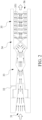
- FIG. 1 is a schematic diagram of a clothing washing system 100 according to an embodiment of the subject disclosure.
- the clothing washing system 100 includes an adjustment unit 1, an electrolysis unit 2, a nano microbubble generation unit 3, a cleaning unit 4, a first fluid circulation unit 101, and a second fluid circulation unit 102.
- the adjustment unit 1 includes an adjustment tank, configured to receive fluid from the outside and store the fluid.
- the adjustment unit 1 includes a fluid inlet 10.
- the fluid inlet 10 may be connected to an external fluid source (not disclosed), and fluid from the outside can flow into the adjustment unit 1 through the fluid inlet 10 from the external fluid source.
- the external fluid source includes a tap water source, and the fluid from the outside includes tap water.
- the electrolysis unit 2 is in fluid communication with the adjustment unit 1, and the electrolysis unit 2 is configured to perform electrolysis.
- the electrolysis unit 2 includes a cathode electrolysis cell 21 equipped with a negative electrode, an anode electrolysis cell 22 equipped with a positive electrode, and a waterproof ion exchange membrane 23 located between the cathode electrolysis cell 21 and the anode electrolysis cell 22 and configured to prevent fluid from circulating between the cathode electrolysis cell 21 and the anode electrolysis cell 22.
- the cathode electrolysis cell 21 is configured to receive the fluid from the adjustment unit 1 and perform electrolysis on the fluid.
- the electrolysis performed by the electrolysis unit 2 changes the pH value and oxidation-reduction potential (ORP) of the water in an electrolysis manner, and then decomposes the water to produce O 2 and H 2 .
- ORP oxidation-reduction potential
- the first fluid circulation unit 101 is connected to the adjustment unit 1 and the electrolysis unit 2.
- the first fluid circulation unit 101 is configured to transfer fluid loaded in the adjustment unit 1 to the electrolysis unit 2 and transfer the fluid loaded in the electrolysis unit 2 to the adjustment unit 1.
- the first fluid circulation unit 101 is configured to circulate the fluid between the adjustment unit 1 and the electrolysis unit 2, so that the first fluid circulation unit 101, the adjustment unit 1, and the electrolysis unit 2 may jointly form a fluid circulation path.
- the first fluid circulation unit 101 uses a pump as a power for transferring the fluid.
- the tap water may be injected into the adjustment unit 1 from the fluid inlet 10 of the adjustment unit 1, and injecting the tap water into the adjustment unit 1 is not stopped until the injected tap water reaches a target water level.
- the first fluid circulation unit 101 is started up to draw the tap water in the adjustment unit 1 to the cathode electrolysis cell 21 of the electrolysis unit 2 until the tap water reaches a specific liquid level in the cathode electrolysis cell 21, and then the electrolysis unit 2 is started up to perform the electrolysis on the tap water.
- the cathode electrolysis cell 21 electrolyzes the injected tap water to produce alkaline electrolyzed ionic water with hydroxide ions and hydrogen micron bubbles.
- the first fluid circulation unit 101 is started up to transfer, back to the adjustment unit 1, the alkaline electrolyzed ionic water with hydroxide ions and hydrogen micron bubbles generated by electrolysis in the cathode electrolysis cell 21.
- the foregoing process of transferring the fluid in the adjustment unit 1 to the electrolysis unit 2 through the first fluid circulation unit 101 for electrolysis, and then transferring the electrolyzed fluid from the electrolysis unit 2 back to the adjustment unit 1 through the first fluid circulation unit 101 is first fluid circulation.
- the cathode electrolysis cell 21 After several times of first fluid circulation, the cathode electrolysis cell 21 also produces nano alkaline electrolyzed ionic water.
- the nano alkaline electrolyzed ionic water includes 4 to 6 H 2 O molecules, and the pH value in the cathode electrolysis cell 21 is between 10 and 13.
- the nano microbubble generation unit 3 is in fluid communication with the adjustment unit 1, and the nano microbubble generation unit 3 is configured to cause the fluid to generate nano-sized microbubbles.
- the nano microbubble generation unit 3 uses a high-pressure and mechanical cutting assembly inside, which can cut gas (bubbles) in the fluid injected into the nano microbubble generation unit 3 into smaller nano-sized microbubbles and retain the nano microbubbles in the fluid without any external energy source.
- the nano microbubble generation unit 3 may include a fluid inlet 30.
- the fluid inlet 30 may be connected to an external fluid source (not disclosed), and fluid from the outside can flow into the adjustment unit 3 through the fluid inlet 30 from the external fluid source.
- the external fluid source includes a tap water source, and the fluid from the outside includes tap water. Therefore, the nano microbubble generation unit 3 may have external fluid (for example, tap water) injected thereto through the fluid inlet 30, and then introduce external gas such as air or introduce ozone from an injection apparatus of an ozone generator. Then, the external gas and the external fluid may generate nano microbubbles in the nano microbubble generation unit 3.
- the second fluid circulation unit 102 is connected to the adjustment unit 1 and the nano microbubble generation unit 3.
- the second fluid circulation unit 102 is configured to transfer fluid loaded in the adjustment unit 1 to the nano microbubble generation unit 3 and transfer the fluid loaded in the nano microbubble generation unit 3 to the adjustment unit 1.
- the second fluid circulation unit 102 is configured to circulate the fluid between the adjustment unit 1 and the nano microbubble generation unit 3, so that the second fluid circulation unit 102, the adjustment unit 1, and the nano microbubble generation unit 3 may jointly form a fluid circulation path.
- the second fluid circulation unit 102 uses a pump as a power for transferring the fluid.
- the alkaline electrolyzed ionic water and hydrogen micron bubbles generated by electrolysis in the electrolysis unit 2 and stored in the adjustment unit 1 may be transferred from the adjustment unit 1 to the nano microbubble generation unit 3 by the second fluid circulation unit 102.
- the nano microbubble generation unit 3 may cut the hydrogen micron bubbles into smaller hydrogen nano microbubbles, and keep the hydrogen nano microbubbles in the electrolyzed ionic water.
- the second fluid circulation unit 102 transfers the ionic water containing the hydrogen nano microbubbles from the nano microbubble generation unit 3 to the adjustment unit 1.
- the foregoing process of transferring the fluid containing microbubbles in the adjustment unit 1 to the nano microbubble generation unit 3 through the second fluid circulation unit 102 for generating nano microbubbles, and then transferring the fluid that has been subjected to the process and contains the nano microbubbles from the nano microbubble generation unit 3 back to the adjustment unit 1 through the second fluid circulation unit 102 is second fluid circulation. After several times of second fluid circulation, the number and concentration of the nano microbubbles contained in the fluid in the adjustment unit 1 may be increased to a specific extent.
- the cleaning unit 4 is in fluid communication with the adjustment unit 1 through a pipeline 13, so that the cleaning unit 4 may receive the fluid from the adjustment unit 1.
- the pipeline 13 may be in fluid communication with a fluid inlet 130, and therefore, the external fluid may enter the pipeline 13 through the fluid inlet 130.
- the cleaning unit 4 includes a cleaning tank. The cleaning unit 4 may accommodate to-be-washed clothes. After several times of second fluid circulation, the number and concentration of the nano microbubbles contained in the fluid (for example, ionic water containing hydrogen nano microbubbles) in the adjustment unit 1 may be increased to a specific extent.
- the fluid containing nano microbubbles may be injected from the adjustment unit 1 into the cleaning unit 4, and the fluid containing the nano microbubbles may be used as washing liquid for clothing washing to wash clothes.
- the cleaning unit 4 includes a discharge pipeline 42 configured to discharge excess or used washing liquid.
- the cleaning unit 4 may be in fluid communication with the nano microbubble generation unit 3 through a pipeline 39. Therefore, the cleaning unit 4 may receive the fluid from the nano microbubble generation unit 3 through the pipeline 39. In other words, the fluid with nano microbubbles generated by the nano microbubble generation unit 3 may be directly transferred to the cleaning unit 4.
- the clothing washing system 100 further includes a detection unit 16, a warming unit 17, and a hydrogen processing unit 18.
- the detection unit 16 may be connected to the adjustment unit 1, the electrolysis unit 2, and the nano microbubble generation unit 3, and its main function is to detect parameters and values in the apparatuses or tanks such as the adjustment unit 1, the electrolysis unit 2, and the nano microbubble generation unit 3, including the number of the hydrogen nano microbubbles, the pH value, the ORP, the temperature, electrical conductivity, and the like, so that the conditions and the composition of the washing liquid drawn from the adjustment unit 3 and injected into the cleaning unit 4 may achieve an optimized washing effect.
- the warming unit 17 is installed in the adjustment unit 1, and is configured to heat the fluid loaded in the adjustment unit 1.
- the hydrogen processing unit 18 is also installed in the adjustment unit 1.
- the (hydrogen) bubbles generated by the electrolysis unit 2 and the remaining oxygen that has passed through the nano microbubble generation unit 3 and does not become the nano microbubbles pass through the hydrogen processing unit 18, and the hydrogen processing unit 18 discharges the excess hydrogen, thereby reducing the hydrogen concentration to a safe level.
- the detection unit 16 further includes start-up and stopping instructions and control for a hydrogen processing apparatus 18, a warming apparatus 7, the first fluid circulation unit 101, the second fluid circulation unit 102, and the like.
- the issuance of the control and instructions is a response based on the parameters and values reported and detected by a detection apparatus 5.
- the detection unit 16 preferably enables the number of the hydrogen microbubbles continuously generated by the electrolysis unit 2 to meet the needs of the nano microbubble generation unit 3 for generating hydrogen nano microbubbles without using external hydrogen gas. Further, a drawing pump of the first fluid circulation unit 101 is controlled by the detection unit 16, so that the fluid leaving the electrolysis unit 2 is returned to the adjustment unit 1 and the concentration of the hydrogen microbubbles is gradually increased to a target concentration. Then, the fluid of which the concentration of the hydrogen microbubbles has been increased is drawn, using a drawing pump of a second fluid circulation apparatus 52, from the adjustment unit 1 to the nano microbubble generation unit 3 to manufacture hydrogen nano microbubbles.
- the detection unit 16 additionally performs safety management and control on the amount of escaping hydrogen gas.
- a detection apparatus 6 detects the concentration of the escaping hydrogen, further collects the escaping hydrogen, and dilutes the escaping hydrogen with air or other inert gas at least 500 times or more or to a safety threshold of less than 0.2% by a hydrogen processing apparatus.
- the detection unit 16 also performs temperature management and control on the fluid in the adjustment unit 1, and keeps the temperature between 200°C and 800°C according to a temperature range of a parameter target.
- the warming apparatus 7 is used to heat the fluid to the parameter target range.
- the detection unit 16 may control the input of the adjustment unit 1 to the cleaning unit 4, so that the fluid containing nano microbubbles starts to be injected into the cleaning unit, and after the injected fluid reaches a specific liquid level, a cleaning step is started.
- the foregoing parameter targets include at least: the pH value of 11 to 13, the ORP of -500 to -900 mV, the electrical conductivity of 5 to 10 mS/cm, and the temperature of 20°C to 80°C.
- the clothing washing system 100 of the subject disclosure may be regarded as including an apparatus for generating nano microbubble ionic water and a cleaning apparatus for washing clothes.
- the apparatus for generating nano microbubble ionic water may include the adjustment unit 1, the electrolysis unit 2, the nano microbubble generation unit 3, the first fluid circulation unit 101, the second fluid circulation unit 102, the detection unit 16, the warming unit 17, and the hydrogen processing unit 18.
- the cleaning apparatus for washing clothes may include the cleaning unit 4.
- FIG. 2 is a schematic diagram of the nano microbubble generation unit 3 according to an embodiment of the subject disclosure.
- the nano microbubble generation unit 3 includes a fluid inlet end 31, an external gas inlet end 32, a gas-liquid mixing section 33 including a plurality of water flow variable speed regions, a gas-liquid rotary pressurization section 34, a nano microbubble mechanical cutting section 35, and a fluid outlet end 36.
- the fluid inlet end 31 is connected to the second fluid circulation unit 102.
- the nano microbubble generation unit 3 may introduce the fluid with microbubbles (for example, electrolyzed ionic water with hydrogen micron bubbles) from the adjustment unit 1 into it through the fluid inlet end 31.
- the fluid with microbubbles enters the gas-liquid mixing section 33 through the fluid inlet end 31, the fluid and the microbubbles are mixed in a vortex manner in this section, and then enter the gas-liquid rotary pressurization section 34.
- the microbubbles and fluid mixed in a vortex manner are pressurized by mechanical rotation, and then enter the nano microbubble mechanical cutting section 35.
- the gas-liquid mixed fluid dissolved by pressurization forms a shear cutting action with an in-pipe cutter 351 of the nano microbubble mechanical cutting section 35 under high-speed rotation, thereby forming nano microbubbles.
- the diameters of the bubbles are less than 500 nm, preferably, between 50 and 200 nm.
- the fluid with nano microbubbles generated through the above process is conveyed out of the nano microbubble generation unit 3 through the fluid outlet end 36.
- the fluid inlet end 31 may be connected to an external fluid source to receive fluid (for example, tap water) from the outside.
- fluid for example, tap water
- the external gas inlet end 32 may simultaneously introduce external gas into the nano microbubble generation unit 3.
- the gas-liquid mixing section 33 the external fluid and the external gas are mixed in a vortex manner in this section, and then enter the gas-liquid rotary pressurization section 34.
- the gas-liquid rotary pressurization section 34 the gas-liquid mixed fluid mixed in a vortex manner is pressurized by mechanical rotation, and then enters the nano microbubble mechanical cutting section 35.
- the gas-liquid mixed fluid that is dissolved by pressurization forms a shear cutting action with the in-pipe cutter of the nano microbubble mechanical cutting section 35 under high-speed rotation, thereby forming nano microbubbles.
- the diameters of the bubbles are less than 500 nm, preferably, between 50 and 200 nm.
- the fluid with nano microbubbles produced in this way may be used as washing liquid for pre-washing, and the fluid may be introduced into the cleaning unit 4 before the clothes are formally washed, so as to pre-wash the clothes in the cleaning unit 4.
- the specific surface area of the former is theoretically 100 times that of the latter, that is, the gas-liquid contact area is increased by 100 times, and various reaction speeds are also increased by 100 times.
- the rising speed of the bubble in water is proportional to the square of the diameter of the bubble, and the smaller the diameter of the bubble, the lower the rising speed of the bubble.
- the rising speed of a bubble having a diameter of 1 mm in water is 6 mm/min, while the rising speed of a bubble having a diameter of 10 ⁇ m in water is 3 ⁇ m/min.
- the rising speed of the former is 2000 times that of the latter. If the increase in the specific surface area is taken into consideration, the retention capacity of the nano microbubbles in the fluid is increased by 200,000 (100*2000) times than that in ordinary air.
- the negative charge intensity on the surface of the nano microbubble not only depends on the size of the bubble, but also relates to the gas type of the bubble, and the surface charge of the nano microbubble using hydrogen as the nano microbubble gas is relatively high.
- the pH value is kept at a specific value, the hydrogen nano microbubble may obtain an extremely low ORP and have the cleaning capability improved.
- the pH value is between 12 and 12.5
- the ORP of the nano ionic water is between about -50 and -150 mV
- the ORP of the hydrogen nano microbubble (nano microbubble electrolyzed ionic water) is more preferably reduced to between -500 and -900 mV.
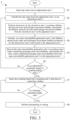
- FIG. 3 is a flowchart of a method 5 of washing clothes according to an embodiment of the subject disclosure.
- the method 5 of washing clothes includes steps 51, 52, 53, 54, 55, 56, 57, 58, and 59.
- a user may set target parameters of the clothing washing system 100 and start up the clothing washing system; and after the parameter setting and start-up, the fluid inlet 10 of the adjustment unit 1 may inject tap water into the adjustment unit 1 and continue the injection until the detection unit 16 detects that the tap water accommodated in the adjustment unit 1 reaches a target water volume, and then control is performed to stop the tap water injection.
- step 52 the first fluid circulation unit 101 is started up to draw the tap water in the adjustment unit 1 to the cathode electrolysis cell 21 of the electrolysis unit 2 until the tap water reaches a specific liquid level in the cathode electrolysis cell 21.
- step 53 the electrolysis unit 2 performs electrolysis, so that the injected tap water is electrolyzed to produce hydrogen micron bubbles and alkaline electrolyzed water with hydroxide ions; subsequently, the first fluid circulation unit 101 transfers the alkaline electrolyzed water with hydroxide ions and hydrogen micron bubbles generated by electrolysis from the electrolysis unit 2 to the adjustment unit 1.
- the electrolysis parameters are monitored by the detection unit 16 simultaneously, and the monitored items include a current, a voltage, a water flow rate, an electrolyte concentration in the anode electrolysis cell 22, and the like.
- Step 52 and step 53 are the foregoing first fluid circulation, and in some embodiments of the subject disclosure, step 52 and step 53 may be repeated a plurality of times.
- step 54 the second fluid circulation apparatus 52 is started up to draw, from the adjustment unit 1, the alkaline electrolyzed water and hydrogen micron bubbles continuously produced by the electrolysis unit 2 and transferred back to the adjustment unit 1, and inject them into the nano microbubble generation unit 3.
- step 55 the high-pressure and mechanical cutting assembly in the nano microbubble generation unit 3 cuts the hydrogen microbubbles injected into the nano microbubble generation unit 3 into smaller hydrogen nano microbubbles, and subsequently, the second fluid circulation apparatus 52 injects the fluid with hydrogen nano microbubbles generated by the nano microbubble generation unit 3 from the nano microbubble generation unit 3 into the adjustment unit 1.
- Step 54 and step 55 are the foregoing second fluid circulation, and in some embodiments of the subject disclosure, step 54 and step 55 may be repeated a plurality of times.
- the warming apparatus 7 may be started up to warm, according to the parameter target, the fluid (for example, electrolyzed water with hydrogen micron bubbles or electrolyzed water with hydrogen nano microbubbles) in the adjustment unit 1 to a target temperature range, which is monitored by the detection unit 16, and is preferably between 20°C and 80°C.
- the fluid for example, electrolyzed water with hydrogen micron bubbles or electrolyzed water with hydrogen nano microbubbles
- the hydrogen processing apparatus 8 may be started up to dilute the hydrogen that has not been completely converted into nano microbubbles by the nano microbubble generation unit 3 at least 500 times or more (or to a concentration less than 0.2%) in the adjustment unit 1, so as to discharge the hydrogen out of the adjustment unit 1 after a safe level is reached.
- the detection unit 16 detects whether the various parameters of the electrolyzed water with hydrogen nano microbubbles accommodated in the adjustment unit 1 have reached the set targets for use as washing liquid.
- the set targets for use as washing liquid include: the pH value of 11 to 13, the ORP of -500 to -900 mV, the electrical conductivity of 5 to 10 mS/cm, and the temperature of 20°C to 80°C.
- the procedure proceeds to the next step; and if the various parameters of the electrolyzed water with hydrogen nano microbubbles accommodated in the adjustment unit 1 do not reached the set targets, steps 52, 53, and 54 and/or 55 are performed again.
- step 57 the washing liquid that has reached the set target is injected into the cleaning unit 4 to wash clothes.
- the content of hydrogen is 0.5 to 2 ppm
- the number of the hydrogen nano microbubbles is 1 to 5 billion particles/ml
- the diameters of the hydrogen bubbles range from 100 to 500 nm.
- step 58 it is determined whether the parameter in the cleaning unit 4 meets a cleaning parameter target. If the cleaning parameter target has been reached, the procedure proceeds to the next step, and if the cleaning parameter target is been reached, step 57 is performed again.
- step 59 after the cleaning step is completed, the washing liquid is discharged through the discharge line 42 of the cleaning unit 4, and then dewatering or injection of rinsing water is performed.
- the rinsing water is tap water, which is injected from a direct input end of a cleaning tank 8, or is injected into the cleaning unit 4 after passing through the nano microbubble generation unit 3 to contain nano microbubbles.
- the latter contains nano microbubbles, it can have a higher cleaning capability, a shorter rinsing time, and a smaller number of times of rinsing than the tap water directly injected.
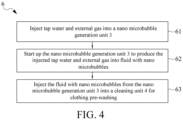
- FIG. 4 is a flowchart of a clothing pre-washing method 6 according to an embodiment of the subject disclosure.
- the clothing pre-washing method 6 includes steps 61, 62, and 63.
- step 61 external tap water and external air or ozone may be injected into the nano microbubble generation unit 3.
- step 62 the nano microbubble generation unit 3 is started up to produce the injected tap water and external gas into fluid with nano microbubbles.
- step 63 the fluid having nano microbubbles made by the nano microbubble generation unit 3 is injected into the cleaning unit 4 to perform a pre-washing procedure on the clothes placed in the cleaning unit 4.
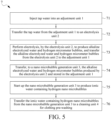
- FIG. 5 is a flowchart of another clothing pre-washing method 7 according to an embodiment of the subject disclosure.
- a clothing pre-washing method 7 includes steps 71, 72, 73, 75, and 76.
- step 71 external tap water may be injected into the adjustment unit 1.
- step 72 the first fluid circulation unit 101 is started up to draw the tap water in the adjustment unit 1 to the cathode electrolysis cell 21 of the electrolysis unit 2.
- step 73 the electrolysis unit 2 performs electrolysis, so that the injected tap water is electrolyzed to produce hydrogen micron bubbles and alkaline electrolyzed water with hydroxide ions; subsequently, the first fluid circulation unit 101 transfers the alkaline electrolyzed water with hydroxide ions and hydrogen micron bubbles generated by electrolysis from the electrolysis unit 2 to the adjustment unit 1.
- step 74 the second fluid circulation apparatus 52 is started up to draw, from the adjustment unit 1, the alkaline electrolyzed water and hydrogen micron bubbles continuously produced by the electrolysis unit 2 and transferred back to the adjustment unit 1, and inject them into the nano microbubble generation unit 3.
- step 75 the high-pressure and mechanical cutting assembly in the nano microbubble generation unit 3 cuts the hydrogen microbubbles injected into the nano microbubble generation unit 3 into smaller hydrogen nano microbubbles.
- step 76 the fluid having nano microbubbles made by the nano microbubble generation unit 3 is injected into the cleaning unit 4 to perform a pre-washing procedure on the clothes placed in the cleaning unit 4.
- the foregoing pre-washing methods 6 and 7 may be used in predetermined steps of improving the cleaning effect and reducing the cleaning time and the use amount of washing liquid.
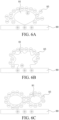
- FIG. 6A, FIG. 6B, and FIG. 6C Regarding the cleaning capability of nano ionic water, referring to FIG. 6A, FIG. 6B, and FIG. 6C , dirt 81 in FIG. 6A adhered to a surface of an object (that is, clothing 80), by the fine property of the nano ionic water, hydroxide ions 83 quickly diffuse to a surface of the dirt 81 and penetrate into an interface between the dirt 81 and the clothing 80 with a high penetration and diffusion rate (briefly referred to as "penetration"). Furthermore, the hydroxide ions 83 in FIG.
- the dirt 81 in FIG. 6C disintegrates because the hydroxide ions 83 can decompose oil or protein of the dirt 81 (briefly referred to as "alkalization"). Therefore, the descaling function of the nano ion is jointly implemented by mechanisms such as penetration, peeling, and alkalization.
- the pH value of the hydroxide ion or alkaline electrolyzed water is proportional to an electrolysis time, and is inversely proportional to the ORP and the conductivity concentration. It can be seen from the ORP that the hydroxide ion has reducing power, and the reducing power of the hydroxide ion is increased as the ORP decreases.
- NMR nuclear magnetic resonance
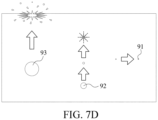
- a gas-liquid interface formed by nano microbubbles 91 in water in FIG. 7A has a characteristic of easily accepting H + and OH , and generally, it is easier for cations to leave the gas-liquid interface than anions, so that the interface is often negatively charged.
- FIG. 7B reveals that the nano microbubble 91 tends to adsorb counter ions in the medium, especially high-valent counter ions, thereby forming a stable electric double layer structure.
- the negatively charged nano microbubble 91 in FIG. 7C easily penetrates into dirt 90, and the dirt 90 is decomposed and separated due to the electric double layer structure.
- the nano microbubble 91 in FIG. 7D is, for example, hydrogen.
- the rising speed of the bubble in water is proportional to the square of the diameter of the bubble. The smaller the diameter of the bubble, the lower the rising speed of the bubble.
- the rising speed of a large bubble with a diameter of 1 mm in water is 6 mm/min, while the rising speed of a small bubble with a diameter of 10 ⁇ m in water is 3 ⁇ m/min.
- the rising speed of the small bubble is 1/2000 of that of the large bubble, and the rising speed of the nano microbubble is lower.
- the properties of the extremely low rising speed and high solubility helps the nano microbubble to stay in the washing liquid during the washing process, and the changes and differences in the number of bubbles and the bubble diameter are not easy to show.
- the nano microbubble 91 shown in FIG. 7D has a low rising speed and can exist for a long time in water.
- a micron bubble 92 rises faster than the nano microbubble 91 and can exist in water for a shorter time.
- a bubble 93 having a general size rises the fastest and can exist in water for the shortest time.
- the case of using the nano ionic water to generate hydrogen microbubbles after electrolysis in the electrolysis unit 2 and then generate hydrogen nano microbubbles through the nano microbubble generation unit 3 is more efficient and has a higher generation speed than using an external hydrogen source. Because the external hydrogen source is used as the main gas for generating bubbles in the nano microbubble system instead of separately using the hydrogen microbubbles generated after electrolysis in the subject disclosure, the amount of hydrogen escaping into the air is large, which is relatively unsafe.
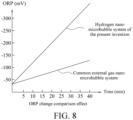
- the nano microbubble system of the subject disclosure when the circulation system is stopped and an ultrasonic apparatus is started up, although the microbubbles disappear quickly, the content of hydrogen of the nano ionic water in the liquid phase still remains above 0.8 ppm. During the cleaning process, the nano microbubbles of the subject disclosure continue to remain at a sufficient level, and the detected ORP also shows a high negative value, which means that the content of nano microbubbles in water is always maintained at a high level.
Landscapes
- Engineering & Computer Science (AREA)
- Textile Engineering (AREA)
- Chemical & Material Sciences (AREA)
- Chemical Kinetics & Catalysis (AREA)
- Electrochemistry (AREA)
- Life Sciences & Earth Sciences (AREA)
- General Chemical & Material Sciences (AREA)
- Hydrology & Water Resources (AREA)
- Environmental & Geological Engineering (AREA)
- Water Supply & Treatment (AREA)
- Organic Chemistry (AREA)
- Detail Structures Of Washing Machines And Dryers (AREA)
- Accessory Of Washing/Drying Machine, Commercial Washing/Drying Machine, Other Washing/Drying Machine (AREA)
Claims (11)
- System zum Waschen von Kleidung (100), das Folgendes umfasst:eine Verstelleinheit (1), die mit einer ersten externen Fluidquelle verbunden ist;eine Elektrolyseeinheit (2), die in Fluidverbindung mit der Einstelleinheit (1) steht und so konfiguriert ist, dass sie ein in sie eingebrachtes Fluid elektrolysiert;eine erste Fluidzirkulationseinheit (101), die mit der Einstelleinheit (1) und der Elektrolyseeinheit (2) verbunden ist und so konfiguriert ist, dass sie in die Einstelleinheit (1) eingebrachtes Fluid zu der Elektrolyseeinheit (2) und das in die Elektrolyseeinheit (2) eingebrachte Fluid zu der Einstelleinheit (1) überträgt;eine Nano-Mikroblasen-Erzeugungseinheit (3), die in Fluidverbindung mit der Einstelleinheit (1) steht und so konfiguriert ist, dass sie ein in sie eingebrachtes Fluid so verarbeitet, dass es Mikroblasen im Nanomaßstab enthält;eine zweite Fluidzirkulationseinheit (102), die mit der Einstelleinheit und der Nano-Mikroblasen-Erzeugungseinheit (3) verbunden und so konfiguriert ist, dass sie das in die Einstelleinheit (1) eingebrachte Fluid zu der Nano-Mikroblasen-Erzeugungseinheit (3) und das in die Nano-Mikroblasen-Erzeugungseinheit (3) eingebrachte Fluid zu der Einstelleinheit (1) überträgt; undeine Reinigungseinheit (4), die in Fluidverbindung mit der Einstelleinheit (1) steht.
- System zum Waschen von Kleidung nach Anspruch 1, das ferner eine Erfassungseinheit (16) umfasst, wobei die Erfassungseinheit so konfiguriert ist, dass sie die in die Einstelleinheit (1) eingefüllte Flüssigkeit erfasst und/oder die Elektrolyseeinheit (2) überwacht.
- System zum Waschen von Kleidung nach Anspruch 1 oder 2 umfasst ferner eine Wasserstoffverarbeitungseinheit (18), wobei die Wasserstoffverarbeitungseinheit so konfiguriert ist, dass sie Wasserstoff in der Einstelleinheit (1) verarbeitet.
- System zum Waschen von Kleidung nach einem der vorhergehenden Ansprüche, wobei die Nano-Mikroblasen-Erzeugungseinheit (3) mit einer zweiten externen Fluidquelle verbunden ist und in Fluidverbindung mit der Reinigungseinheit (4) steht.
- System zum Waschen von Kleidung nach einem der vorhergehenden Ansprüche, wobei die Einstelleinheit (1), die erste Fluidzirkulationseinheit (101) und die Elektrolyseeinheit (2) gemeinsam einen ersten Fluid-zirkulationsweg bilden, wobei der erste Fluidzirkulationsweg so konfiguriert ist, dass Fluid zwischen der Einstelleinheit (1) und der Elektrolyseeinheit (2) durch die erste Fluidzirkulationseinheit (101) zirkulieren kann, und wobei die Einstellungseinheit (1), die zweite Fluidzirkulationseinheit (102) und die Nano-Mikroblasen-Erzeugungseinheit (3) gemeinsam einen zweiten Fluid-zirkulationsweg bilden, wobei der zweite Fluidzirkulationsweg so konfiguriert ist, dass Fluid zwischen der Einstellungseinheit (1) und der Nano-Mikroblasen-Erzeugungseinheit (3) durch die zweite Fluidzirkulationseinheit (102) zirkulieren kann.
- System zum Waschen von Kleidung nach einem der vorhergehenden Ansprüche umfasst ferner eine Erwärmungseinheit (17), wobei die Erwärmungseinheit so konfiguriert ist, dass sie eine Temperatur der in die Einstelleinheit (1) eingefüllten Flüssigkeit einstellt.
- System zum Waschen von Kleidung nach Anspruch 1, wobei die Nano-Mikroblasen-Erzeugungseinheit (3) umfasst:einen Gas-Flüssigkeits-Mischabschnitt (33), der so konfiguriert ist, dass er Flüssigkeit von außerhalb der Nano-Mikroblasen-Erzeugungseinheit (3) und ein Gas, das dazu bestimmt ist, zu Mikroblasen zu werden, zu einem Gas-Flüssigkeits-Mischfluid wirbelförmig mischt;einen Gas-Flüssigkeits-Rotationsdruckerzeugungsabschnitt (34), der so konfiguriert ist, dass er das Gas-Flüssigkeits-Gemisch in Rotation versetzt und unter Druck setzt; undeinen mechanischen Nano-Mikroblasen-Schneideabschnitt (35), der so konfiguriert ist, dass er das unter Druck stehende Gas-Flüssigkeits-Gemisch schneidet, um ein Fluid zu erzeugen, das Mikroblasen im Nanomaßstab enthält.
- System zum Waschen von Kleidung nach Anspruch 7, wobei die Flüssigkeit und das Gas, die dazu bestimmt sind, Mikroblasen zu bilden, aus der Elektrolyseeinheit (2) stammen.
- Verfahren zum Waschen von Kleidung, umfassend:Zuführung von Fluid aus einer externen Fluidquelle in eine Verstelleinheit (1);Durchführen einer ersten Fluidzirkulation, wobei das Fluid in der Einstelleinheit (1) zu einer Elektrolyseeinheit (2) zur Elektrolyse übertragen wird und das elektrolysierte Fluid von der Elektrolyseeinheit (2) zu der Einstelleinheit (1) übertragen wird;Durchführen einer zweiten Fluidzirkulation, wobei das elektrolysierte Fluid von der Einstelleinheit (1) zu einer Nanomikroblasen-Erzeugungseinheit (3) zum Erzeugen einer Vielzahl von Nanomikroblasen in dem Fluid übertragen wird und das Fluid mit der Vielzahl von Nanomikroblasen von der Nanomikroblasen-Erzeugungseinheit (3) zu der Einstelleinheit (1) übertragen wird; undÜberführen der Flüssigkeit mit der Vielzahl von Nano-Mikrobläschen von der Einstelleinheit (1) zu einer Reinigungseinheit (4).
- Verfahren zum Waschen von Kleidung nach Anspruch 9, wobei eine Erfassungseinheit (16) verwendet wird, um einen Parameter des Fluids in der Einstelleinheit (1) zu erfassen und die Ausführung des ersten Fluidumlaufs und des zweiten Fluidumlaufs zu steuern.
- Verfahren zum Waschen von Kleidung nach Anspruch 9 oder 10, das außerdem ein Vorwaschverfahren umfasst, wobei das Vorwaschverfahren Folgendes umfasst:Bereitstellen von Vorwaschflüssigkeit in die Nano-Mikroblasen-Erzeugungseinheit (3) von außerhalb der Nano-Mikroblasen-Erzeugungs-einheit (3), um eine Vielzahl von Nano-Mikroblasen in der Vorwaschflüssigkeit zu erzeugen; undÜbertragen der Vorwaschflüssigkeit mit der Vielzahl von Nano-Mikrobläschen von der Nano-Mikrobläschen-Erzeugungseinheit (3) zur Reinigungseinheit (4).
Applications Claiming Priority (1)
| Application Number | Priority Date | Filing Date | Title |
|---|---|---|---|
| TW110145317A TWI831094B (zh) | 2021-12-03 | 2021-12-03 | 衣物洗滌系統、奈米微氣泡離子水產生裝置及衣物洗滌方法 |
Publications (3)
| Publication Number | Publication Date |
|---|---|
| EP4190957A1 EP4190957A1 (de) | 2023-06-07 |
| EP4190957C0 EP4190957C0 (de) | 2024-10-09 |
| EP4190957B1 true EP4190957B1 (de) | 2024-10-09 |
Family
ID=81328171
Family Applications (1)
| Application Number | Title | Priority Date | Filing Date |
|---|---|---|---|
| EP22167110.0A Active EP4190957B1 (de) | 2021-12-03 | 2022-04-07 | System zum waschen von kleidung mit ionischem wasser mit nano-mikroblasen und verfahren zum waschen von kleidung mit ionischem wasser mit nano-mikroblasen |
Country Status (5)
| Country | Link |
|---|---|
| US (2) | US12410547B2 (de) |
| EP (1) | EP4190957B1 (de) |
| JP (1) | JP7555129B2 (de) |
| KR (1) | KR102802045B1 (de) |
| TW (1) | TWI831094B (de) |
Families Citing this family (4)
| Publication number | Priority date | Publication date | Assignee | Title |
|---|---|---|---|---|
| US12320054B2 (en) * | 2022-10-20 | 2025-06-03 | Nanoplus Life Biomedical Technology Co., Ltd. | System for washing laundry |
| CN116605953A (zh) * | 2023-05-11 | 2023-08-18 | 悦芯光学科技(昆山)有限公司 | 一种洗衣污水处理方法及洗衣工厂 |
| EP4516982A1 (de) * | 2023-08-30 | 2025-03-05 | Nanoplus Life Biomedical Technology Co., Ltd. | System zum waschen von wäsche |
| WO2025044667A1 (zh) * | 2023-08-30 | 2025-03-06 | 无锡小天鹅电器有限公司 | 一种喷头体装置及衣物处理设备 |
Family Cites Families (27)
| Publication number | Priority date | Publication date | Assignee | Title |
|---|---|---|---|---|
| JP2006110092A (ja) * | 2004-10-14 | 2006-04-27 | Sanyo Electric Co Ltd | 洗濯機 |
| JP2006204562A (ja) | 2005-01-28 | 2006-08-10 | Matsushita Electric Ind Co Ltd | 洗濯機 |
| JP4498981B2 (ja) * | 2005-05-25 | 2010-07-07 | 三洋電機株式会社 | 洗濯水の再利用装置および方法 |
| JP4508963B2 (ja) | 2005-07-06 | 2010-07-21 | 三洋電機株式会社 | 洗濯水処理装置および当該処理装置付洗濯機 |
| JP4392393B2 (ja) | 2005-08-31 | 2009-12-24 | 矢崎総業株式会社 | 常時給電用のハーネス支持具とそれを用いたハーネス配索構造 |
| JP4722749B2 (ja) * | 2006-03-30 | 2011-07-13 | 島崎電機株式会社 | 電解装置における電解質槽の給排水装置 |
| US8371315B2 (en) * | 2008-12-17 | 2013-02-12 | Tennant Company | Washing systems incorporating charged activated liquids |
| CN102292491B (zh) * | 2009-01-23 | 2013-06-19 | 坦能公司 | 结合带电活化液体的清洗系统 |
| KR101161477B1 (ko) * | 2009-07-21 | 2012-07-02 | 오승환 | 나노버블의 물리화학적 특성을 활용한 세탁방법 및 그 장치 |
| JP2011088979A (ja) * | 2009-10-21 | 2011-05-06 | Panasonic Electric Works Co Ltd | 洗浄液、洗浄方法、洗浄液製造装置 |
| EP2397062B1 (de) * | 2011-07-12 | 2013-07-31 | V-Zug AG | Haushaltsgerät mit Tank zur Lagerung von Prozesswasser und mit Gassensor |
| CN103938414B (zh) * | 2014-04-12 | 2017-07-28 | 大连双迪创新科技研究院有限公司 | 洗涤助力装置 |
| CN103939413A (zh) * | 2014-05-08 | 2014-07-23 | 苏州皇森机电科技有限公司 | 一种悬挂式点焊机用x型气缸结构 |
| JP2016078010A (ja) * | 2014-10-21 | 2016-05-16 | 株式会社テックコーポレーション | 気泡電解水生成装置、洗浄装置、除菌消臭方法及び気泡電解水 |
| CN117065592A (zh) | 2015-11-17 | 2023-11-17 | 上海纳诺巴伯纳米科技有限公司 | 超饱和氢气溶液的制备装置及其制备方法 |
| WO2017110406A1 (ja) | 2015-12-25 | 2017-06-29 | 東芝ライフスタイル株式会社 | 洗濯機 |
| CN107022871B (zh) | 2016-01-29 | 2020-01-03 | 吴承焕 | 使用纳米气泡的有效溶解浓缩技术的洗涤方法及装置 |
| JP7185390B2 (ja) | 2017-04-13 | 2022-12-07 | 東芝ライフスタイル株式会社 | 洗浄方法、洗濯機、食器洗浄機、及び便器 |
| CN108166211A (zh) | 2018-01-05 | 2018-06-15 | 徐亦隽 | 一种工业泡沫洗涤方法及系统装置 |
| KR102111199B1 (ko) * | 2018-05-09 | 2020-05-14 | 오승환 | 전해수를 활용한 나노버블 세탁방법 및 그 장치 |
| CN211368109U (zh) | 2018-05-31 | 2020-08-28 | 陈浩航 | 基于微纳米爆气的洗衣机过滤装置 |
| CN108411326A (zh) | 2018-06-04 | 2018-08-17 | 深圳市赫拉铂氢时代科技有限公司 | 一种纳米气泡电解水机 |
| TWI696587B (zh) * | 2019-01-02 | 2020-06-21 | 英屬開曼群島商納諾股份有限公司 | 奈米微氣泡製造和清洗系統 |
| JPWO2020179667A1 (ja) | 2019-03-07 | 2021-03-11 | 株式会社超微細科学研究所 | 微細気泡含有水生成装置 |
| CN110482669A (zh) | 2019-09-29 | 2019-11-22 | 山东星辰健康科技有限公司 | 一种纳米级氢气泡水制备系统 |
| EP4063553A4 (de) * | 2019-11-22 | 2023-01-25 | Qingdao Haier Washing Machine Co., Ltd. | Mikroblasensprühkopf und waschmaschine damit |
| JP7420594B2 (ja) | 2020-03-02 | 2024-01-23 | 東芝ライフスタイル株式会社 | 洗濯機 |
-
2021
- 2021-12-03 TW TW110145317A patent/TWI831094B/zh active
-
2022
- 2022-04-07 EP EP22167110.0A patent/EP4190957B1/de active Active
- 2022-04-11 US US17/718,247 patent/US12410547B2/en active Active
- 2022-04-14 JP JP2022067093A patent/JP7555129B2/ja active Active
- 2022-04-18 KR KR1020220047770A patent/KR102802045B1/ko active Active
-
2025
- 2025-08-06 US US19/291,973 patent/US20250361667A1/en active Pending
Also Published As
| Publication number | Publication date |
|---|---|
| JP7555129B2 (ja) | 2024-09-24 |
| TWI831094B (zh) | 2024-02-01 |
| EP4190957A1 (de) | 2023-06-07 |
| US20250361667A1 (en) | 2025-11-27 |
| US20230175190A1 (en) | 2023-06-08 |
| EP4190957C0 (de) | 2024-10-09 |
| US12410547B2 (en) | 2025-09-09 |
| KR102802045B1 (ko) | 2025-04-30 |
| KR20230083978A (ko) | 2023-06-12 |
| TW202323627A (zh) | 2023-06-16 |
| JP2023083196A (ja) | 2023-06-15 |
Similar Documents
| Publication | Publication Date | Title |
|---|---|---|
| EP4190957B1 (de) | System zum waschen von kleidung mit ionischem wasser mit nano-mikroblasen und verfahren zum waschen von kleidung mit ionischem wasser mit nano-mikroblasen | |
| TWI606015B (zh) | A micro-bubble electrolyzed water generating device, and a method for producing micro-bubble electrolyzed water | |
| US20090032409A1 (en) | Method for cleaning, sterilising and disinfecting dishes and other kitchen utensils and cleaning device | |
| CN103938414B (zh) | 洗涤助力装置 | |
| CA2886200A1 (en) | Bubble electrolyzed water generation apparatus and automatic washing apparatus | |
| CN111286921A (zh) | 一种应用电解水的清洁装置和使用方法及其应用 | |
| EP2171783A1 (de) | Erzeuger und spender für reinigungsmittel | |
| EP3103771B1 (de) | Verfahren und vorrichtung zur kontrolle der konzentration von freiem chlor | |
| CN106715338A (zh) | 电解水生成器、电解水生成用电解质和除菌用电解水 | |
| JP2011157580A (ja) | オゾン微細気泡の電解合成方法 | |
| CN103938413B (zh) | 超量氢气杀菌洗衣机 | |
| CN203834220U (zh) | 超量氢气杀菌洗衣机 | |
| TW202444666A (zh) | 污水處理系統及具有污水處理系統的洗衣工廠 | |
| TW202405276A (zh) | 衣物洗滌系統 | |
| CN116334874A (zh) | 衣物洗涤系统、纳米微气泡离子水产生装置及衣物洗涤方法 | |
| KR101903387B1 (ko) | 전기를 이용하는 장치 | |
| CN110668537A (zh) | 臭氧水发生装置、臭氧微纳米气泡水装置及其应用和家用电器 | |
| TWM645471U (zh) | 衣物洗滌系統 | |
| Radha et al. | Electrochemical decolorization of the dye Acid orange 10 | |
| CN218145981U (zh) | 一种清洁和消毒一体湿巾机 | |
| US12320054B2 (en) | System for washing laundry | |
| KR100262355B1 (ko) | 폐가스중의 오존 제거방법 | |
| EP4516982A1 (de) | System zum waschen von wäsche | |
| KR20250000418U (ko) | 의류 세척 시스템 | |
| CN221626403U (zh) | 一种次氯酸钠生产装置 |
Legal Events
| Date | Code | Title | Description |
|---|---|---|---|
| PUAI | Public reference made under article 153(3) epc to a published international application that has entered the european phase |
Free format text: ORIGINAL CODE: 0009012 |
|
| STAA | Information on the status of an ep patent application or granted ep patent |
Free format text: STATUS: REQUEST FOR EXAMINATION WAS MADE |
|
| 17P | Request for examination filed |
Effective date: 20230121 |
|
| AK | Designated contracting states |
Kind code of ref document: A1 Designated state(s): AL AT BE BG CH CY CZ DE DK EE ES FI FR GB GR HR HU IE IS IT LI LT LU LV MC MK MT NL NO PL PT RO RS SE SI SK SM TR |
|
| RAP1 | Party data changed (applicant data changed or rights of an application transferred) |
Owner name: NANOPLUS LTD. |
|
| GRAP | Despatch of communication of intention to grant a patent |
Free format text: ORIGINAL CODE: EPIDOSNIGR1 |
|
| STAA | Information on the status of an ep patent application or granted ep patent |
Free format text: STATUS: GRANT OF PATENT IS INTENDED |
|
| INTG | Intention to grant announced |
Effective date: 20240716 |
|
| RIC1 | Information provided on ipc code assigned before grant |
Ipc: D06F 35/00 20060101AFI20240705BHEP |
|
| GRAS | Grant fee paid |
Free format text: ORIGINAL CODE: EPIDOSNIGR3 |
|
| GRAA | (expected) grant |
Free format text: ORIGINAL CODE: 0009210 |
|
| STAA | Information on the status of an ep patent application or granted ep patent |
Free format text: STATUS: THE PATENT HAS BEEN GRANTED |
|
| AK | Designated contracting states |
Kind code of ref document: B1 Designated state(s): AL AT BE BG CH CY CZ DE DK EE ES FI FR GB GR HR HU IE IS IT LI LT LU LV MC MK MT NL NO PL PT RO RS SE SI SK SM TR |
|
| REG | Reference to a national code |
Ref country code: CH Ref legal event code: EP |
|
| REG | Reference to a national code |
Ref country code: DE Ref legal event code: R096 Ref document number: 602022006596 Country of ref document: DE |
|
| REG | Reference to a national code |
Ref country code: IE Ref legal event code: FG4D |
|
| U01 | Request for unitary effect filed |
Effective date: 20241105 |
|
| U07 | Unitary effect registered |
Designated state(s): AT BE BG DE DK EE FI FR IT LT LU LV MT NL PT RO SE SI Effective date: 20241113 |
|
| U20 | Renewal fee for the european patent with unitary effect paid |
Year of fee payment: 4 Effective date: 20250203 |
|
| PG25 | Lapsed in a contracting state [announced via postgrant information from national office to epo] |
Ref country code: HR Free format text: LAPSE BECAUSE OF FAILURE TO SUBMIT A TRANSLATION OF THE DESCRIPTION OR TO PAY THE FEE WITHIN THE PRESCRIBED TIME-LIMIT Effective date: 20241009 Ref country code: IS Free format text: LAPSE BECAUSE OF FAILURE TO SUBMIT A TRANSLATION OF THE DESCRIPTION OR TO PAY THE FEE WITHIN THE PRESCRIBED TIME-LIMIT Effective date: 20250209 |
|
| PG25 | Lapsed in a contracting state [announced via postgrant information from national office to epo] |
Ref country code: ES Free format text: LAPSE BECAUSE OF FAILURE TO SUBMIT A TRANSLATION OF THE DESCRIPTION OR TO PAY THE FEE WITHIN THE PRESCRIBED TIME-LIMIT Effective date: 20241009 |
|
| PG25 | Lapsed in a contracting state [announced via postgrant information from national office to epo] |
Ref country code: NO Free format text: LAPSE BECAUSE OF FAILURE TO SUBMIT A TRANSLATION OF THE DESCRIPTION OR TO PAY THE FEE WITHIN THE PRESCRIBED TIME-LIMIT Effective date: 20250109 |
|
| PG25 | Lapsed in a contracting state [announced via postgrant information from national office to epo] |
Ref country code: GR Free format text: LAPSE BECAUSE OF FAILURE TO SUBMIT A TRANSLATION OF THE DESCRIPTION OR TO PAY THE FEE WITHIN THE PRESCRIBED TIME-LIMIT Effective date: 20250110 |
|
| PG25 | Lapsed in a contracting state [announced via postgrant information from national office to epo] |
Ref country code: PL Free format text: LAPSE BECAUSE OF FAILURE TO SUBMIT A TRANSLATION OF THE DESCRIPTION OR TO PAY THE FEE WITHIN THE PRESCRIBED TIME-LIMIT Effective date: 20241009 |
|
| PG25 | Lapsed in a contracting state [announced via postgrant information from national office to epo] |
Ref country code: RS Free format text: LAPSE BECAUSE OF FAILURE TO SUBMIT A TRANSLATION OF THE DESCRIPTION OR TO PAY THE FEE WITHIN THE PRESCRIBED TIME-LIMIT Effective date: 20250109 |
|
| PG25 | Lapsed in a contracting state [announced via postgrant information from national office to epo] |
Ref country code: SM Free format text: LAPSE BECAUSE OF FAILURE TO SUBMIT A TRANSLATION OF THE DESCRIPTION OR TO PAY THE FEE WITHIN THE PRESCRIBED TIME-LIMIT Effective date: 20241009 |
|
| PG25 | Lapsed in a contracting state [announced via postgrant information from national office to epo] |
Ref country code: SK Free format text: LAPSE BECAUSE OF FAILURE TO SUBMIT A TRANSLATION OF THE DESCRIPTION OR TO PAY THE FEE WITHIN THE PRESCRIBED TIME-LIMIT Effective date: 20241009 |
|
| PG25 | Lapsed in a contracting state [announced via postgrant information from national office to epo] |
Ref country code: CZ Free format text: LAPSE BECAUSE OF FAILURE TO SUBMIT A TRANSLATION OF THE DESCRIPTION OR TO PAY THE FEE WITHIN THE PRESCRIBED TIME-LIMIT Effective date: 20241009 |
|
| PLBE | No opposition filed within time limit |
Free format text: ORIGINAL CODE: 0009261 |
|
| STAA | Information on the status of an ep patent application or granted ep patent |
Free format text: STATUS: NO OPPOSITION FILED WITHIN TIME LIMIT |
|
| 26N | No opposition filed |
Effective date: 20250710 |
|
| REG | Reference to a national code |
Ref country code: CH Ref legal event code: H13 Free format text: ST27 STATUS EVENT CODE: U-0-0-H10-H13 (AS PROVIDED BY THE NATIONAL OFFICE) Effective date: 20251125 |