EP4190749A1 - Herstellung von verbundwerkstoffen mittels pyrolyse eines kohlenstoff- oder siliziumpulver-polychlorsilangemisches - Google Patents
Herstellung von verbundwerkstoffen mittels pyrolyse eines kohlenstoff- oder siliziumpulver-polychlorsilangemisches Download PDFInfo
- Publication number
- EP4190749A1 EP4190749A1 EP21211610.7A EP21211610A EP4190749A1 EP 4190749 A1 EP4190749 A1 EP 4190749A1 EP 21211610 A EP21211610 A EP 21211610A EP 4190749 A1 EP4190749 A1 EP 4190749A1
- Authority
- EP
- European Patent Office
- Prior art keywords
- silicon
- carbon
- powder
- paste
- pyrolysis
- Prior art date
- Legal status (The legal status is an assumption and is not a legal conclusion. Google has not performed a legal analysis and makes no representation as to the accuracy of the status listed.)
- Withdrawn
Links
- XUIMIQQOPSSXEZ-UHFFFAOYSA-N Silicon Chemical compound [Si] XUIMIQQOPSSXEZ-UHFFFAOYSA-N 0.000 title claims abstract description 71
- OKTJSMMVPCPJKN-UHFFFAOYSA-N Carbon Chemical compound [C] OKTJSMMVPCPJKN-UHFFFAOYSA-N 0.000 title claims abstract description 40
- 239000002131 composite material Substances 0.000 title claims abstract description 33
- 238000000197 pyrolysis Methods 0.000 title claims abstract description 32
- 239000011863 silicon-based powder Substances 0.000 title claims abstract description 24
- 238000004519 manufacturing process Methods 0.000 title claims abstract description 13
- 229910052799 carbon Inorganic materials 0.000 title claims description 22
- 239000000203 mixture Substances 0.000 title description 19
- 229910052710 silicon Inorganic materials 0.000 claims abstract description 48
- 239000010703 silicon Substances 0.000 claims abstract description 40
- 238000000034 method Methods 0.000 claims description 28
- IJGRMHOSHXDMSA-UHFFFAOYSA-N Atomic nitrogen Chemical compound N#N IJGRMHOSHXDMSA-UHFFFAOYSA-N 0.000 claims description 24
- 239000010405 anode material Substances 0.000 claims description 14
- 230000008569 process Effects 0.000 claims description 14
- 239000000306 component Substances 0.000 claims description 12
- 229910052757 nitrogen Inorganic materials 0.000 claims description 12
- 239000002245 particle Substances 0.000 claims description 11
- 239000006229 carbon black Substances 0.000 claims description 9
- 229910001416 lithium ion Inorganic materials 0.000 claims description 9
- 239000001301 oxygen Substances 0.000 claims description 8
- 229910052760 oxygen Inorganic materials 0.000 claims description 8
- 239000011159 matrix material Substances 0.000 claims description 7
- HBMJWWWQQXIZIP-UHFFFAOYSA-N silicon carbide Chemical compound [Si+]#[C-] HBMJWWWQQXIZIP-UHFFFAOYSA-N 0.000 claims description 7
- QVGXLLKOCUKJST-UHFFFAOYSA-N atomic oxygen Chemical compound [O] QVGXLLKOCUKJST-UHFFFAOYSA-N 0.000 claims description 6
- VNWKTOKETHGBQD-UHFFFAOYSA-N methane Chemical compound C VNWKTOKETHGBQD-UHFFFAOYSA-N 0.000 claims description 6
- 229910010271 silicon carbide Inorganic materials 0.000 claims description 6
- 238000002156 mixing Methods 0.000 claims description 4
- 239000000080 wetting agent Substances 0.000 claims description 3
- 235000012431 wafers Nutrition 0.000 claims description 2
- 239000002699 waste material Substances 0.000 claims description 2
- ZAMOUSCENKQFHK-UHFFFAOYSA-N Chlorine atom Chemical compound [Cl] ZAMOUSCENKQFHK-UHFFFAOYSA-N 0.000 description 9
- 239000000460 chlorine Substances 0.000 description 9
- 229910052801 chlorine Inorganic materials 0.000 description 9
- 239000000463 material Substances 0.000 description 9
- XEEYBQQBJWHFJM-UHFFFAOYSA-N Iron Chemical compound [Fe] XEEYBQQBJWHFJM-UHFFFAOYSA-N 0.000 description 8
- 239000004570 mortar (masonry) Substances 0.000 description 8
- 239000002184 metal Substances 0.000 description 7
- 229910052751 metal Inorganic materials 0.000 description 7
- 239000007789 gas Substances 0.000 description 6
- 239000000047 product Substances 0.000 description 6
- 239000011856 silicon-based particle Substances 0.000 description 6
- 239000003792 electrolyte Substances 0.000 description 5
- 239000000843 powder Substances 0.000 description 5
- 150000004756 silanes Chemical class 0.000 description 5
- BLRPTPMANUNPDV-UHFFFAOYSA-N Silane Chemical compound [SiH4] BLRPTPMANUNPDV-UHFFFAOYSA-N 0.000 description 4
- 239000012298 atmosphere Substances 0.000 description 4
- 238000006243 chemical reaction Methods 0.000 description 4
- 239000000446 fuel Substances 0.000 description 4
- 229910052742 iron Inorganic materials 0.000 description 4
- 239000005543 nano-size silicon particle Substances 0.000 description 4
- 239000012299 nitrogen atmosphere Substances 0.000 description 4
- VYPSYNLAJGMNEJ-UHFFFAOYSA-N silicon dioxide Inorganic materials O=[Si]=O VYPSYNLAJGMNEJ-UHFFFAOYSA-N 0.000 description 4
- 239000002153 silicon-carbon composite material Substances 0.000 description 4
- 125000001309 chloro group Chemical group Cl* 0.000 description 3
- 239000011888 foil Substances 0.000 description 3
- 239000012535 impurity Substances 0.000 description 3
- 230000009467 reduction Effects 0.000 description 3
- 235000012239 silicon dioxide Nutrition 0.000 description 3
- 238000012360 testing method Methods 0.000 description 3
- HSFWRNGVRCDJHI-UHFFFAOYSA-N Acetylene Chemical compound C#C HSFWRNGVRCDJHI-UHFFFAOYSA-N 0.000 description 2
- NLXLAEXVIDQMFP-UHFFFAOYSA-N Ammonia chloride Chemical compound [NH4+].[Cl-] NLXLAEXVIDQMFP-UHFFFAOYSA-N 0.000 description 2
- MYMOFIZGZYHOMD-UHFFFAOYSA-N Dioxygen Chemical compound O=O MYMOFIZGZYHOMD-UHFFFAOYSA-N 0.000 description 2
- HBBGRARXTFLTSG-UHFFFAOYSA-N Lithium ion Chemical compound [Li+] HBBGRARXTFLTSG-UHFFFAOYSA-N 0.000 description 2
- 230000008901 benefit Effects 0.000 description 2
- 230000015572 biosynthetic process Effects 0.000 description 2
- 239000001257 hydrogen Substances 0.000 description 2
- 229910052739 hydrogen Inorganic materials 0.000 description 2
- 239000007788 liquid Substances 0.000 description 2
- 238000002360 preparation method Methods 0.000 description 2
- 239000010453 quartz Substances 0.000 description 2
- FDNAPBUWERUEDA-UHFFFAOYSA-N silicon tetrachloride Chemical compound Cl[Si](Cl)(Cl)Cl FDNAPBUWERUEDA-UHFFFAOYSA-N 0.000 description 2
- 239000004071 soot Substances 0.000 description 2
- 238000003786 synthesis reaction Methods 0.000 description 2
- 238000012549 training Methods 0.000 description 2
- LXEXBJXDGVGRAR-UHFFFAOYSA-N trichloro(trichlorosilyl)silane Chemical compound Cl[Si](Cl)(Cl)[Si](Cl)(Cl)Cl LXEXBJXDGVGRAR-UHFFFAOYSA-N 0.000 description 2
- ZDHXKXAHOVTTAH-UHFFFAOYSA-N trichlorosilane Chemical compound Cl[SiH](Cl)Cl ZDHXKXAHOVTTAH-UHFFFAOYSA-N 0.000 description 2
- 239000005052 trichlorosilane Substances 0.000 description 2
- 238000005303 weighing Methods 0.000 description 2
- 239000002028 Biomass Substances 0.000 description 1
- 101000871498 Homo sapiens m7GpppX diphosphatase Proteins 0.000 description 1
- VEXZGXHMUGYJMC-UHFFFAOYSA-N Hydrochloric acid Chemical compound Cl VEXZGXHMUGYJMC-UHFFFAOYSA-N 0.000 description 1
- UFHFLCQGNIYNRP-UHFFFAOYSA-N Hydrogen Chemical compound [H][H] UFHFLCQGNIYNRP-UHFFFAOYSA-N 0.000 description 1
- 238000005481 NMR spectroscopy Methods 0.000 description 1
- MIQYPPGTNIFAPO-CABCVRRESA-N PS(6:0/6:0) Chemical compound CCCCCC(=O)OC[C@@H](OC(=O)CCCCC)COP(O)(=O)OC[C@H](N)C(O)=O MIQYPPGTNIFAPO-CABCVRRESA-N 0.000 description 1
- 229910004298 SiO 2 Inorganic materials 0.000 description 1
- 238000003917 TEM image Methods 0.000 description 1
- HMDDXIMCDZRSNE-UHFFFAOYSA-N [C].[Si] Chemical class [C].[Si] HMDDXIMCDZRSNE-UHFFFAOYSA-N 0.000 description 1
- -1 abbreviated “DCTS” Chemical compound 0.000 description 1
- 238000010521 absorption reaction Methods 0.000 description 1
- 239000011149 active material Substances 0.000 description 1
- 239000000853 adhesive Substances 0.000 description 1
- 230000001070 adhesive effect Effects 0.000 description 1
- 229910021417 amorphous silicon Inorganic materials 0.000 description 1
- 230000000035 biogenic effect Effects 0.000 description 1
- 230000008859 change Effects 0.000 description 1
- KOPOQZFJUQMUML-UHFFFAOYSA-N chlorosilane Chemical compound Cl[SiH3] KOPOQZFJUQMUML-UHFFFAOYSA-N 0.000 description 1
- 239000011248 coating agent Substances 0.000 description 1
- 238000000576 coating method Methods 0.000 description 1
- 239000000571 coke Substances 0.000 description 1
- 238000010924 continuous production Methods 0.000 description 1
- 239000013078 crystal Substances 0.000 description 1
- 238000005262 decarbonization Methods 0.000 description 1
- 238000000354 decomposition reaction Methods 0.000 description 1
- 230000006866 deterioration Effects 0.000 description 1
- 238000004821 distillation Methods 0.000 description 1
- 230000005611 electricity Effects 0.000 description 1
- 238000002149 energy-dispersive X-ray emission spectroscopy Methods 0.000 description 1
- 238000005516 engineering process Methods 0.000 description 1
- 239000012467 final product Substances 0.000 description 1
- 238000009472 formulation Methods 0.000 description 1
- 239000002803 fossil fuel Substances 0.000 description 1
- 239000012634 fragment Substances 0.000 description 1
- 230000008570 general process Effects 0.000 description 1
- 239000008187 granular material Substances 0.000 description 1
- 229930195733 hydrocarbon Natural products 0.000 description 1
- 150000002430 hydrocarbons Chemical class 0.000 description 1
- IXCSERBJSXMMFS-UHFFFAOYSA-N hydrogen chloride Substances Cl.Cl IXCSERBJSXMMFS-UHFFFAOYSA-N 0.000 description 1
- 229910000041 hydrogen chloride Inorganic materials 0.000 description 1
- 238000005470 impregnation Methods 0.000 description 1
- 102100033718 m7GpppX diphosphatase Human genes 0.000 description 1
- 238000005259 measurement Methods 0.000 description 1
- 239000000155 melt Substances 0.000 description 1
- 238000010309 melting process Methods 0.000 description 1
- 230000005012 migration Effects 0.000 description 1
- 238000013508 migration Methods 0.000 description 1
- 238000009343 monoculture Methods 0.000 description 1
- 239000011049 pearl Substances 0.000 description 1
- 229910021420 polycrystalline silicon Inorganic materials 0.000 description 1
- 229920005591 polysilicon Polymers 0.000 description 1
- 239000002243 precursor Substances 0.000 description 1
- 238000012545 processing Methods 0.000 description 1
- 238000000746 purification Methods 0.000 description 1
- 238000010791 quenching Methods 0.000 description 1
- 230000005855 radiation Effects 0.000 description 1
- 239000002994 raw material Substances 0.000 description 1
- 238000005096 rolling process Methods 0.000 description 1
- 230000009291 secondary effect Effects 0.000 description 1
- 239000004065 semiconductor Substances 0.000 description 1
- 238000000926 separation method Methods 0.000 description 1
- 229910000077 silane Inorganic materials 0.000 description 1
- 239000000377 silicon dioxide Substances 0.000 description 1
- 239000007787 solid Substances 0.000 description 1
- 238000001228 spectrum Methods 0.000 description 1
- 238000005507 spraying Methods 0.000 description 1
- 238000003892 spreading Methods 0.000 description 1
- 230000007480 spreading Effects 0.000 description 1
- 239000007858 starting material Substances 0.000 description 1
- 238000003860 storage Methods 0.000 description 1
- 239000000758 substrate Substances 0.000 description 1
- MSQITEWLCPTJBF-UHFFFAOYSA-N trichloro-[dichloro-[dichloro(trichlorosilyl)silyl]silyl]silane Chemical compound Cl[Si](Cl)(Cl)[Si](Cl)(Cl)[Si](Cl)(Cl)[Si](Cl)(Cl)Cl MSQITEWLCPTJBF-UHFFFAOYSA-N 0.000 description 1
- APLLVYZLAPKPFW-UHFFFAOYSA-N trichloro-[dichloro-[dichloro-[dichloro(trichlorosilyl)silyl]silyl]silyl]silane Chemical compound Cl[Si](Cl)(Cl)[Si](Cl)(Cl)[Si](Cl)(Cl)[Si](Cl)(Cl)[Si](Cl)(Cl)Cl APLLVYZLAPKPFW-UHFFFAOYSA-N 0.000 description 1
- XLYOFNOQVPJJNP-UHFFFAOYSA-N water Substances O XLYOFNOQVPJJNP-UHFFFAOYSA-N 0.000 description 1
- 239000002023 wood Substances 0.000 description 1
Images


Classifications
-
- C—CHEMISTRY; METALLURGY
- C01—INORGANIC CHEMISTRY
- C01B—NON-METALLIC ELEMENTS; COMPOUNDS THEREOF; METALLOIDS OR COMPOUNDS THEREOF NOT COVERED BY SUBCLASS C01C
- C01B32/00—Carbon; Compounds thereof
- C01B32/90—Carbides
- C01B32/914—Carbides of single elements
- C01B32/956—Silicon carbide
-
- C—CHEMISTRY; METALLURGY
- C01—INORGANIC CHEMISTRY
- C01B—NON-METALLIC ELEMENTS; COMPOUNDS THEREOF; METALLOIDS OR COMPOUNDS THEREOF NOT COVERED BY SUBCLASS C01C
- C01B33/00—Silicon; Compounds thereof
- C01B33/02—Silicon
- C01B33/021—Preparation
- C01B33/023—Preparation by reduction of silica or free silica-containing material
- C01B33/025—Preparation by reduction of silica or free silica-containing material with carbon or a solid carbonaceous material, i.e. carbo-thermal process
-
- C—CHEMISTRY; METALLURGY
- C01—INORGANIC CHEMISTRY
- C01B—NON-METALLIC ELEMENTS; COMPOUNDS THEREOF; METALLOIDS OR COMPOUNDS THEREOF NOT COVERED BY SUBCLASS C01C
- C01B33/00—Silicon; Compounds thereof
- C01B33/02—Silicon
- C01B33/021—Preparation
- C01B33/027—Preparation by decomposition or reduction of gaseous or vaporised silicon compounds other than silica or silica-containing material
-
- C—CHEMISTRY; METALLURGY
- C04—CEMENTS; CONCRETE; ARTIFICIAL STONE; CERAMICS; REFRACTORIES
- C04B—LIME, MAGNESIA; SLAG; CEMENTS; COMPOSITIONS THEREOF, e.g. MORTARS, CONCRETE OR LIKE BUILDING MATERIALS; ARTIFICIAL STONE; CERAMICS; REFRACTORIES; TREATMENT OF NATURAL STONE
- C04B35/00—Shaped ceramic products characterised by their composition; Ceramics compositions; Processing powders of inorganic compounds preparatory to the manufacturing of ceramic products
- C04B35/515—Shaped ceramic products characterised by their composition; Ceramics compositions; Processing powders of inorganic compounds preparatory to the manufacturing of ceramic products based on non-oxide ceramics
- C04B35/56—Shaped ceramic products characterised by their composition; Ceramics compositions; Processing powders of inorganic compounds preparatory to the manufacturing of ceramic products based on non-oxide ceramics based on carbides or oxycarbides
- C04B35/565—Shaped ceramic products characterised by their composition; Ceramics compositions; Processing powders of inorganic compounds preparatory to the manufacturing of ceramic products based on non-oxide ceramics based on carbides or oxycarbides based on silicon carbide
- C04B35/571—Shaped ceramic products characterised by their composition; Ceramics compositions; Processing powders of inorganic compounds preparatory to the manufacturing of ceramic products based on non-oxide ceramics based on carbides or oxycarbides based on silicon carbide obtained from Si-containing polymer precursors or organosilicon monomers
-
- C—CHEMISTRY; METALLURGY
- C04—CEMENTS; CONCRETE; ARTIFICIAL STONE; CERAMICS; REFRACTORIES
- C04B—LIME, MAGNESIA; SLAG; CEMENTS; COMPOSITIONS THEREOF, e.g. MORTARS, CONCRETE OR LIKE BUILDING MATERIALS; ARTIFICIAL STONE; CERAMICS; REFRACTORIES; TREATMENT OF NATURAL STONE
- C04B35/00—Shaped ceramic products characterised by their composition; Ceramics compositions; Processing powders of inorganic compounds preparatory to the manufacturing of ceramic products
- C04B35/515—Shaped ceramic products characterised by their composition; Ceramics compositions; Processing powders of inorganic compounds preparatory to the manufacturing of ceramic products based on non-oxide ceramics
- C04B35/56—Shaped ceramic products characterised by their composition; Ceramics compositions; Processing powders of inorganic compounds preparatory to the manufacturing of ceramic products based on non-oxide ceramics based on carbides or oxycarbides
- C04B35/565—Shaped ceramic products characterised by their composition; Ceramics compositions; Processing powders of inorganic compounds preparatory to the manufacturing of ceramic products based on non-oxide ceramics based on carbides or oxycarbides based on silicon carbide
- C04B35/573—Shaped ceramic products characterised by their composition; Ceramics compositions; Processing powders of inorganic compounds preparatory to the manufacturing of ceramic products based on non-oxide ceramics based on carbides or oxycarbides based on silicon carbide obtained by reaction sintering or recrystallisation
-
- H—ELECTRICITY
- H01—ELECTRIC ELEMENTS
- H01M—PROCESSES OR MEANS, e.g. BATTERIES, FOR THE DIRECT CONVERSION OF CHEMICAL ENERGY INTO ELECTRICAL ENERGY
- H01M10/00—Secondary cells; Manufacture thereof
- H01M10/05—Accumulators with non-aqueous electrolyte
- H01M10/052—Li-accumulators
-
- H—ELECTRICITY
- H01—ELECTRIC ELEMENTS
- H01M—PROCESSES OR MEANS, e.g. BATTERIES, FOR THE DIRECT CONVERSION OF CHEMICAL ENERGY INTO ELECTRICAL ENERGY
- H01M10/00—Secondary cells; Manufacture thereof
- H01M10/05—Accumulators with non-aqueous electrolyte
- H01M10/052—Li-accumulators
- H01M10/0525—Rocking-chair batteries, i.e. batteries with lithium insertion or intercalation in both electrodes; Lithium-ion batteries
-
- H—ELECTRICITY
- H01—ELECTRIC ELEMENTS
- H01M—PROCESSES OR MEANS, e.g. BATTERIES, FOR THE DIRECT CONVERSION OF CHEMICAL ENERGY INTO ELECTRICAL ENERGY
- H01M4/00—Electrodes
- H01M4/02—Electrodes composed of, or comprising, active material
- H01M4/04—Processes of manufacture in general
- H01M4/0471—Processes of manufacture in general involving thermal treatment, e.g. firing, sintering, backing particulate active material, thermal decomposition, pyrolysis
-
- H—ELECTRICITY
- H01—ELECTRIC ELEMENTS
- H01M—PROCESSES OR MEANS, e.g. BATTERIES, FOR THE DIRECT CONVERSION OF CHEMICAL ENERGY INTO ELECTRICAL ENERGY
- H01M4/00—Electrodes
- H01M4/02—Electrodes composed of, or comprising, active material
- H01M4/13—Electrodes for accumulators with non-aqueous electrolyte, e.g. for lithium-accumulators; Processes of manufacture thereof
- H01M4/134—Electrodes based on metals, Si or alloys
-
- H—ELECTRICITY
- H01—ELECTRIC ELEMENTS
- H01M—PROCESSES OR MEANS, e.g. BATTERIES, FOR THE DIRECT CONVERSION OF CHEMICAL ENERGY INTO ELECTRICAL ENERGY
- H01M4/00—Electrodes
- H01M4/02—Electrodes composed of, or comprising, active material
- H01M4/13—Electrodes for accumulators with non-aqueous electrolyte, e.g. for lithium-accumulators; Processes of manufacture thereof
- H01M4/139—Processes of manufacture
- H01M4/1393—Processes of manufacture of electrodes based on carbonaceous material, e.g. graphite-intercalation compounds or CFx
-
- H—ELECTRICITY
- H01—ELECTRIC ELEMENTS
- H01M—PROCESSES OR MEANS, e.g. BATTERIES, FOR THE DIRECT CONVERSION OF CHEMICAL ENERGY INTO ELECTRICAL ENERGY
- H01M4/00—Electrodes
- H01M4/02—Electrodes composed of, or comprising, active material
- H01M4/13—Electrodes for accumulators with non-aqueous electrolyte, e.g. for lithium-accumulators; Processes of manufacture thereof
- H01M4/139—Processes of manufacture
- H01M4/1395—Processes of manufacture of electrodes based on metals, Si or alloys
-
- H—ELECTRICITY
- H01—ELECTRIC ELEMENTS
- H01M—PROCESSES OR MEANS, e.g. BATTERIES, FOR THE DIRECT CONVERSION OF CHEMICAL ENERGY INTO ELECTRICAL ENERGY
- H01M4/00—Electrodes
- H01M4/02—Electrodes composed of, or comprising, active material
- H01M4/36—Selection of substances as active materials, active masses, active liquids
- H01M4/362—Composites
- H01M4/364—Composites as mixtures
-
- H—ELECTRICITY
- H01—ELECTRIC ELEMENTS
- H01M—PROCESSES OR MEANS, e.g. BATTERIES, FOR THE DIRECT CONVERSION OF CHEMICAL ENERGY INTO ELECTRICAL ENERGY
- H01M4/00—Electrodes
- H01M4/02—Electrodes composed of, or comprising, active material
- H01M4/36—Selection of substances as active materials, active masses, active liquids
- H01M4/362—Composites
- H01M4/366—Composites as layered products
-
- H—ELECTRICITY
- H01—ELECTRIC ELEMENTS
- H01M—PROCESSES OR MEANS, e.g. BATTERIES, FOR THE DIRECT CONVERSION OF CHEMICAL ENERGY INTO ELECTRICAL ENERGY
- H01M4/00—Electrodes
- H01M4/02—Electrodes composed of, or comprising, active material
- H01M4/36—Selection of substances as active materials, active masses, active liquids
- H01M4/38—Selection of substances as active materials, active masses, active liquids of elements or alloys
- H01M4/386—Silicon or alloys based on silicon
-
- H—ELECTRICITY
- H01—ELECTRIC ELEMENTS
- H01M—PROCESSES OR MEANS, e.g. BATTERIES, FOR THE DIRECT CONVERSION OF CHEMICAL ENERGY INTO ELECTRICAL ENERGY
- H01M4/00—Electrodes
- H01M4/02—Electrodes composed of, or comprising, active material
- H01M4/36—Selection of substances as active materials, active masses, active liquids
- H01M4/58—Selection of substances as active materials, active masses, active liquids of inorganic compounds other than oxides or hydroxides, e.g. sulfides, selenides, tellurides, halogenides or LiCoFy; of polyanionic structures, e.g. phosphates, silicates or borates
- H01M4/583—Carbonaceous material, e.g. graphite-intercalation compounds or CFx
- H01M4/587—Carbonaceous material, e.g. graphite-intercalation compounds or CFx for inserting or intercalating light metals
-
- H—ELECTRICITY
- H01—ELECTRIC ELEMENTS
- H01M—PROCESSES OR MEANS, e.g. BATTERIES, FOR THE DIRECT CONVERSION OF CHEMICAL ENERGY INTO ELECTRICAL ENERGY
- H01M4/00—Electrodes
- H01M4/02—Electrodes composed of, or comprising, active material
- H01M4/62—Selection of inactive substances as ingredients for active masses, e.g. binders, fillers
- H01M4/624—Electric conductive fillers
- H01M4/625—Carbon or graphite
-
- C—CHEMISTRY; METALLURGY
- C01—INORGANIC CHEMISTRY
- C01P—INDEXING SCHEME RELATING TO STRUCTURAL AND PHYSICAL ASPECTS OF SOLID INORGANIC COMPOUNDS
- C01P2004/00—Particle morphology
- C01P2004/60—Particles characterised by their size
- C01P2004/62—Submicrometer sized, i.e. from 0.1-1 micrometer
-
- C—CHEMISTRY; METALLURGY
- C01—INORGANIC CHEMISTRY
- C01P—INDEXING SCHEME RELATING TO STRUCTURAL AND PHYSICAL ASPECTS OF SOLID INORGANIC COMPOUNDS
- C01P2004/00—Particle morphology
- C01P2004/60—Particles characterised by their size
- C01P2004/64—Nanometer sized, i.e. from 1-100 nanometer
-
- C—CHEMISTRY; METALLURGY
- C01—INORGANIC CHEMISTRY
- C01P—INDEXING SCHEME RELATING TO STRUCTURAL AND PHYSICAL ASPECTS OF SOLID INORGANIC COMPOUNDS
- C01P2004/00—Particle morphology
- C01P2004/80—Particles consisting of a mixture of two or more inorganic phases
-
- C—CHEMISTRY; METALLURGY
- C04—CEMENTS; CONCRETE; ARTIFICIAL STONE; CERAMICS; REFRACTORIES
- C04B—LIME, MAGNESIA; SLAG; CEMENTS; COMPOSITIONS THEREOF, e.g. MORTARS, CONCRETE OR LIKE BUILDING MATERIALS; ARTIFICIAL STONE; CERAMICS; REFRACTORIES; TREATMENT OF NATURAL STONE
- C04B2235/00—Aspects relating to ceramic starting mixtures or sintered ceramic products
- C04B2235/02—Composition of constituents of the starting material or of secondary phases of the final product
- C04B2235/30—Constituents and secondary phases not being of a fibrous nature
- C04B2235/42—Non metallic elements added as constituents or additives, e.g. sulfur, phosphor, selenium or tellurium
- C04B2235/422—Carbon
-
- C—CHEMISTRY; METALLURGY
- C04—CEMENTS; CONCRETE; ARTIFICIAL STONE; CERAMICS; REFRACTORIES
- C04B—LIME, MAGNESIA; SLAG; CEMENTS; COMPOSITIONS THEREOF, e.g. MORTARS, CONCRETE OR LIKE BUILDING MATERIALS; ARTIFICIAL STONE; CERAMICS; REFRACTORIES; TREATMENT OF NATURAL STONE
- C04B2235/00—Aspects relating to ceramic starting mixtures or sintered ceramic products
- C04B2235/02—Composition of constituents of the starting material or of secondary phases of the final product
- C04B2235/30—Constituents and secondary phases not being of a fibrous nature
- C04B2235/42—Non metallic elements added as constituents or additives, e.g. sulfur, phosphor, selenium or tellurium
- C04B2235/428—Silicon
-
- C—CHEMISTRY; METALLURGY
- C04—CEMENTS; CONCRETE; ARTIFICIAL STONE; CERAMICS; REFRACTORIES
- C04B—LIME, MAGNESIA; SLAG; CEMENTS; COMPOSITIONS THEREOF, e.g. MORTARS, CONCRETE OR LIKE BUILDING MATERIALS; ARTIFICIAL STONE; CERAMICS; REFRACTORIES; TREATMENT OF NATURAL STONE
- C04B2235/00—Aspects relating to ceramic starting mixtures or sintered ceramic products
- C04B2235/02—Composition of constituents of the starting material or of secondary phases of the final product
- C04B2235/30—Constituents and secondary phases not being of a fibrous nature
- C04B2235/48—Organic compounds becoming part of a ceramic after heat treatment, e.g. carbonising phenol resins
- C04B2235/483—Si-containing organic compounds, e.g. silicone resins, (poly)silanes, (poly)siloxanes or (poly)silazanes
-
- C—CHEMISTRY; METALLURGY
- C04—CEMENTS; CONCRETE; ARTIFICIAL STONE; CERAMICS; REFRACTORIES
- C04B—LIME, MAGNESIA; SLAG; CEMENTS; COMPOSITIONS THEREOF, e.g. MORTARS, CONCRETE OR LIKE BUILDING MATERIALS; ARTIFICIAL STONE; CERAMICS; REFRACTORIES; TREATMENT OF NATURAL STONE
- C04B2235/00—Aspects relating to ceramic starting mixtures or sintered ceramic products
- C04B2235/02—Composition of constituents of the starting material or of secondary phases of the final product
- C04B2235/50—Constituents or additives of the starting mixture chosen for their shape or used because of their shape or their physical appearance
- C04B2235/54—Particle size related information
- C04B2235/5418—Particle size related information expressed by the size of the particles or aggregates thereof
- C04B2235/5445—Particle size related information expressed by the size of the particles or aggregates thereof submicron sized, i.e. from 0,1 to 1 micron
-
- C—CHEMISTRY; METALLURGY
- C04—CEMENTS; CONCRETE; ARTIFICIAL STONE; CERAMICS; REFRACTORIES
- C04B—LIME, MAGNESIA; SLAG; CEMENTS; COMPOSITIONS THEREOF, e.g. MORTARS, CONCRETE OR LIKE BUILDING MATERIALS; ARTIFICIAL STONE; CERAMICS; REFRACTORIES; TREATMENT OF NATURAL STONE
- C04B2235/00—Aspects relating to ceramic starting mixtures or sintered ceramic products
- C04B2235/02—Composition of constituents of the starting material or of secondary phases of the final product
- C04B2235/50—Constituents or additives of the starting mixture chosen for their shape or used because of their shape or their physical appearance
- C04B2235/54—Particle size related information
- C04B2235/5418—Particle size related information expressed by the size of the particles or aggregates thereof
- C04B2235/5454—Particle size related information expressed by the size of the particles or aggregates thereof nanometer sized, i.e. below 100 nm
-
- C—CHEMISTRY; METALLURGY
- C04—CEMENTS; CONCRETE; ARTIFICIAL STONE; CERAMICS; REFRACTORIES
- C04B—LIME, MAGNESIA; SLAG; CEMENTS; COMPOSITIONS THEREOF, e.g. MORTARS, CONCRETE OR LIKE BUILDING MATERIALS; ARTIFICIAL STONE; CERAMICS; REFRACTORIES; TREATMENT OF NATURAL STONE
- C04B2235/00—Aspects relating to ceramic starting mixtures or sintered ceramic products
- C04B2235/70—Aspects relating to sintered or melt-casted ceramic products
- C04B2235/80—Phases present in the sintered or melt-cast ceramic products other than the main phase
-
- H—ELECTRICITY
- H01—ELECTRIC ELEMENTS
- H01M—PROCESSES OR MEANS, e.g. BATTERIES, FOR THE DIRECT CONVERSION OF CHEMICAL ENERGY INTO ELECTRICAL ENERGY
- H01M4/00—Electrodes
- H01M4/02—Electrodes composed of, or comprising, active material
- H01M2004/026—Electrodes composed of, or comprising, active material characterised by the polarity
- H01M2004/027—Negative electrodes
Definitions
- the present invention relates to both a product and a method for producing inexpensive anode material for Li+ batteries or Si-air batteries.
- carbon powder or silicon powder is mixed with one or more polychlorosilanes to form a paste.
- this paste is applied to an anode support, and in a third step, a composite material is obtained by pyrolysis.
- the specific energy content of the semi-metal silicon as a battery fuel is around 9 kWh/kg.
- Silicon is produced in large quantities worldwide and is widely available. State-of-the-art technology can be used to obtain the highest purity.
- the presentation is based on the carbothermic reduction of quartz gravel with coke/wood chips in an electric shaft furnace.
- electrical energy is used for the reduction, which is provided in particular from renewable sources, for example from wind, sun, water, geothermal energy or biomass - as is the case, e.g. B. is currently the case in Norway.
- metallurgical silicon has been known for a long time.
- the material is available in standardized qualities in quantities of around 1.4 million tons per year.
- the different compositions of silicon depend on the one hand on the raw materials used and on the other hand on the intended application.
- Silicon blocks obtained from the melt so-called “mg-Si” or silicon obtained from other manufacturing processes, are first obtained using quartz and carbon in a carbothermal melting process.
- the "mg-Si” is broken up into so-called “chunks” or suitably granulated.
- the fragments or granules serve as the starting material for the next step, namely the production of silanes.
- This preparation can be, for example, a synthesis via the (chloro)silane route known to those skilled in the art.
- High purity silicon is commonly produced from metallurgical grade silicon by reacting the silicon with hydrogen chloride to form trichlorosilane and other silanes.
- the silanes are decomposed into silicon and other products on heated ultra-pure silicon rods, with the silicon being deposited on the ultra-pure silicon rods (Siemens process).
- Trichlorosilane synthesis may be mentioned here as an example.
- polysilicon can also be produced in other ways, e.g. B. in the monosilane route known to those skilled in the art.
- the object is therefore to provide an active material that fulfills the attributes mentioned above, ie is environmentally friendly and can be provided economically and inexpensively.
- the task can be solved by using a paste and pyrolyzing it, the paste containing polychlorosilane or polychlorosilanes and optionally carbon powder or silicon powder.
- the paste represents an inexpensive "powder-binding preparation" of metallic silicon or silicon products for use as a silicon-carbon composite anode (product), the silicon products being exemplified by decomposition Silicon bodies obtained from PCS, which are essentially semi-metallic components and silicon particles containing carbon, particularly advantageously have metallic companions, with proportions of up to about 1%.
- the silicon powder can be further processed into a silicon composite anode, which in an energy converter under (1) storage of electrical energy by migration of Li ions or (2) electrical energy by conversion to silicon dioxide (SiO 2 ) is released. This releases exergy, which occurs in the form of electrical energy.
- Batteries that work on these principles are suitable for many fields of application. Such batteries can preferably be used to drive vehicles of all kinds, in particular cars, trucks, buses, which are driven at least partially or temporarily by means of an electric motor.
- PCS polychlorosilane
- the method according to the invention has the advantage of being very inexpensive.
- a stable zone forms due to the interfacial tension between the liquid and solid silicon phase and due to the surface tension.
- the method has the further advantage that the forming silicon particles can be doped simultaneously during the pyrolysis carried out according to the invention by metal components.
- the composite material obtained after the pyrolysis in the method according to the invention can be regarded as a composite matrix which has at least silicon, optionally carbon-containing particles, such as silicon carbide and/or amorphous silicon.
- carbon-containing particles such as silicon carbide and/or amorphous silicon.
- metallic and semi-metallic components as well as nitrogen and oxygen may be present.
- step (A) carbon black, conductive carbon black or graphite powder is preferred.
- Graphite powder or conductive carbon black is particularly preferably used, which is mixed together with at least one polychlorosilane to form a paste.
- the mixing of the components carbon black or graphite powder and polychlorosilane or polychlorosilanes to form a paste is known to those skilled in the art.
- step (A) it is possible to use a polychlorosilane which, because of its high metal content, is not used in the semiconductor industry or in photovoltaics.
- contaminated polychlorosilanes occur, for example, in the production of hexachlorodisilane, "HCDS" for short.
- this powder can be obtained from raw silicon (Si MG). Silicon powder can preferably be selected, which accumulates as powdery waste during the sawing processes during the production of Si wafers.
- silicon powder can preferably be used which has been obtained from pyrolysis processes, for example in the pyrolysis of monosilane and hydrogen in a tubular reactor, shown schematically in Fig. 1 .
- silicon powder with an average particle size of 10 nm to 1000 nm.
- the support and the pyrolyzed material can be cooled in a subsequent quench zone.
- a customary wetting agent can preferably be used in order to adjust the viscosity and/or homogeneity of the paste.
- Particularly preferred is or are those wetting agents which escape or are expelled from the paste during the pyrolysis in step (C) without reacting with the other components of the paste.
- step (B) the paste is applied to an electrically conductive or semiconductive carrier, preferably as a film or layer, preferably by doctoring, spraying, rolling, or by means of any other procedure customary in the processing of pastes.
- the paste may preferably be applied to a metal foil, an electrode or a patterned electrode used in, for example, a secondary battery.
- the paste can also be applied to any other structure that has a conductive or semiconductive substrate.
- the structure can also be self-supporting or on a base material, e.g. B. a circuit board, be fixed. Electronic circuits can thus be realized after step (C) has been completed.
- the paste is subjected to pyrolysis.
- the pyrolysis can be carried out by introducing thermal energy, for example by means of a gas flame (chlorine-hydrogen burner) or infrared radiation.
- the pyrolysis can preferably be carried out in a tunnel oven or by means of electromagnetic irradiation, particularly preferably by means of laser irradiation.
- the spectrum of the irradiated light can be selected according to the absorption properties of the components in the paste.
- the PCS acts as a precursor.
- the PCS or PCS mixture converts to a silicon matrix in a particularly advantageous manner during pyrolysis.
- a residue is obtained on the carrier, which has at least silicon, carbon-containing particles, such as silicon carbide and/or soot, and metallic and semimetallic components.
- the silicon matrix also contains nitrogen and oxygen. If graphite powder was used in step (A), the pyrolyzed residue has carbon infiltrated with silicon. If carbon black was used in step (A), at least one matrix of silicon and carbon and silicon carbide with other impurities, in particular metallic impurities, remains after the inventive pyrolysis of a PCS carbon black paste obtained in (A).
- the composite material according to the invention preferably has a density of 800 to 2200 g/l, particularly preferably a density of 1100 g/l.
- this composite material can preferably contain silicon carbide and/or carbon black.
- the composite material according to the invention or obtained according to the invention can be used as a silicon composite anode.
- the composite material obtained by the process according to the invention can be used as an anode material in batteries, which has a performance comparable to conventional batteries.
- This is surprisingly easy to do by mixing graphite powder with a polychlorosilane mixture (PCS) to form a paste and applying it to an anode support in step (B).
- PCS polychlorosilane mixture
- Such a paste can preferably be doctored continuously onto a metal foil by means of a mechanical drive.
- the paste on the metal foil is decomposed to form the silicon-infiltrated carbon, preferably thermally, particularly preferably in a tunnel oven or preferably by means of laser irradiation.
- Steps (A), (B) and (C) can be carried out individually or continuously in their order according to the process.
- the method according to the invention therefore advantageously allows the continuous production of the anode material obtained in each case.
- Example 1 and Example 2 are inventive examples of a silicon composite, while Example 3 and Example 4 are inventive examples as an anode material for Li-ion batteries.
- Polychlorosilanes are understood to mean those silanes whose molecules have at least 2 silicon atoms and more than 2 chlorine atoms: Hexachlorodisilane, abbreviated to HCDS, is one of these.
- polychlorosilanes whose molecules have more than 2 silicon atoms and at least 3 chlorine atoms are octachlorotrisilanes, abbreviated “OCTS”, decachlorotetrasilane, abbreviated “DCTS”, dodecachloropentasilane, abbreviated “DCPS”, and structural isomers thereof.
- the composition is analyzed by means of the Si-NMR analysis known to the person skilled in the art (https://www.bruker.com/de/services/training/magnetic-resonance/nmr-trainings.html).
- Example 1 Composite material for a Si primary battery.
- Fig. 2a and Fig. 2b schematically illustrate the invention with conversion of the paste to anode material by means of pyrolysis.
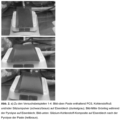
- Fig. 2c shows the photo documentation on the general process steps of doctoring or spreading the inventive pastes onto a metal support, pyrolysis process and obtaining a composite electrode for Examples 1 and 2: Picture above paste containing PCS, carbon black and/or silicon powder (black/brown ) painted on sheet iron (dark grey); Center of the image Green electrode compact during pyrolysis; Picture below: Silicon-carbon composites on sheet iron after pyrolysis of the paste (light brown).
- the device was installed in a test cell.
- the Si primary battery manufactured in this way shows schematically the Fig. 3 .
- the composite material according to the invention was additionally impregnated with an electrolyte in a further step before the battery was completed (in Fig. 3 Not shown).
- the impregnation with electrolytes and the selection thereof are known to those skilled in the art.
- Example 2 Composite material for a Si primary battery.
- Example 3 Anode material for a lithium-ion battery.
- Example 4 Anode material for a lithium-ion battery.
- Fig. 2. d shows a TEM image of the anode composite after the pyrolysis of the paste containing carbon-silicon composite (Example 4) for Experimental Examples 3-4 on the left.
- the dimension bar corresponds to 50 nm.
- the image on the right shows the EDX analysis in the area with carbon particles (C-particle contour with thin black line) and silicon nano-particle structures (contour with thick black line). It can be seen that silicon nanoparticles are lined up around the base particles like strings of pearls and the whole thing forms a network mesh.
Landscapes
- Chemical & Material Sciences (AREA)
- Engineering & Computer Science (AREA)
- Chemical Kinetics & Catalysis (AREA)
- Electrochemistry (AREA)
- General Chemical & Material Sciences (AREA)
- Organic Chemistry (AREA)
- Manufacturing & Machinery (AREA)
- Materials Engineering (AREA)
- Inorganic Chemistry (AREA)
- Composite Materials (AREA)
- Ceramic Engineering (AREA)
- Structural Engineering (AREA)
- Silicon Compounds (AREA)
Abstract
Description
- Die vorliegende Erfindung bezieht sich sowohl auf ein Produkt als auch ein Verfahren zum Herstellen von preiswertem Anodenmaterial für Li+-Batterien bzw. Si-Luft-Batterien. Zur Herstellung wird, erstens, Kohlenstoffpulver bzw. Siliziumpulver mit einem oder mehreren Polychlorsilanen zu einer Paste gemischt. Diese Paste wird in einem zweiten Schritt auf einen Anodenträger aufgebracht, und in einem dritten Schritt wird durch Pyrolyse ein Verbundwerkstoff erhalten.
- Eines der großen politischen Ziele auf europäischer und deutscher Ebene ist die Dekarbonisierung des Verkehrs. Der Einsatz von fossilen, überwiegend flüssigen Kraftstoffen wie Diesel und Benzin soll hierbei durch emissionsärmere Kraftstoffe ersetzt werden.
- Aktuell wird ein immer stärkerer Fokus auf sogenannte erneuerbare, nicht-biogene Kraftstoffe gesetzt, die Strom (bevorzugt aus erneuerbaren Energien) nutzen. Hierbei sollte der Wirkungsgrad der Umwandlungskette möglichst hoch sein und die Attribute aufweisen:
- 1.) maximale Emissionsminderung gegenüber fossilen Kraftstoffen;
- 2.) Vermeidung negativer Sekundäreffekte wie Monokulturen, Landverbrauch, Überdüngung u.ä.;
- 3.) hohe Energiedichte und Speicherbarfähigkeit;
- 4.) Gewährleistung lokaler Verfügbarkeit, sowie Nutzung bestehender Infrastrukturen, z. B. Tankstellen, zur Vermeidung von Kosten;
- 5.) wirtschaftliche Herstellung und eine möglichst wirtschaftliche Nutzung durch den Verbraucher.
- Der spezifische Energiegehalt des Halbmetalls Silizium als Batteriebrennstoff beträgt rund 9 kWh/kg.
- Silizium wird in großen Mengen weltweit hergestellt und ist breit verfügbar. Es kann nach dem Stand der Technik bis hin zu höchsten Reinheiten gewonnen werden. Die Darstellung erfolgt über die carbothermische Reduktion von Quarzkies mit Koks/Holzschnitzel im Elektroschachtofen. Hierbei wird überwiegend elektrische Energie für die Reduktion eingesetzt, die insbesondere aus erneuerbaren Quellen, beispielsweise aus Wind, Sonne, Wasser, Geothermie oder Biomasse, bereitgestellt wird - so, wie es z. B. in Norwegen aktuell der Fall ist.
- Die Herstellung von metallurgischem Silizium ist lange bekannt. Das Material steht in standardisierten Qualitäten in Mengen um etwa 1,4 Mio t pro Jahr zur Verfügung. Die verschiedenen Zusammensetzungen von Silizium hängt einerseits von den eingesetzten Rohstoffen und andererseits von der beabsichtigten Anwendung ab.
- Aus der Schmelze gewonnene Siliziumblöcke, sogenanntes "mg-Si" oder aus anderen Herstellverfahren erhaltenes Silizium wird zunächst unter Verwendung von Quarz und Kohlenstoff in einem carbothermischen Schmelzverfahren gewonnen. Das "mg-Si" wird zu sogenannten "Chunks" zerschlagen oder geeignet granuliert. Die Bruchstücke oder Granulate dienen in dieser Form als Ausgangsmaterial für den nächsten Schritt, nämlich der Herstellung von Silanen. Diese Herstellung kann zum Beispiel eine Synthese über die dem Fachmann bekannte (Chlor-)Silanroute sein.
- Silizium hoher Reinheit wird üblicherweise aus metallurgischem Silizium durch Reaktion des Siliziums mit Chlorwasserstoff unter Bildung von Trichlorsilan sowie anderen Silanen hergestellt. Hierzu werden die Silane nach einer Destillation und Trennung von den anderen Produkten und Verunreinigungen an beheizten Reinstsiliziumstäben in Silizium und andere Produkte zersetzt, wobei sich das Silizium an den Reinstsiliziumstäben niederschlägt (Siemens Verfahren). Beispielhaft sei an dieser Stelle die Trichlorsilansynthese genannt. Doch ist die Herstellung von Polysilizium auch auf anderem Wege z. B. in der Monosilanroute dem Fachmann bekannt.
- Im bisherigen Stand der Technik sind aufwendige Schritte zur Aufreinigung erforderlich, bis man letztlich zum Produkt Silizium kommt.
- Es stellt sich somit die Aufgabe, ein Aktivmaterial bereitzustellen, welches die oben genannten Attribute erfüllt, also umweltfreundlich ist und sich wirtschaftlich preiswert bereitstellen lässt.
- Überraschend wurde gefunden, dass sich die Aufgabe durch den Einsatz einer Paste und deren Pyrolyse lösen lässt, wobei die Paste Polychlorsilan oder Polychlorsilane und wahlweise Kohlenstoffpulver oder Siliziumpulver enthält.
- Im Fall des Kohlenstoffpulvers stellt die Paste eine preiswerte "pulververbindende Aufbereitung" von metallischem Silizium bzw. von Siliziumprodukten für die Nutzung als Silizum-Kohlenstoff-Komposit-Anode (Produkt) dar, wobei die Siliziumprodukte aus dem beispielhaft durch Zersetzung von PCS gewonnen Siliziumkörper, im Wesentlichen halbmetallische Bestandteile und Kohlenstoff enthaltende Silizium-Partikel sind, besonders vorteilhaft metallische Begleiter aufweisen, mit Anteilen bis zu etwa 1 %.
- Analoges gilt für den Fall des Siliziumpulvers. Dann wirkt oder wirken PCS als Verbindungskleber unter Erhaltung der Partikelstruktur. In dem erfindungsgemäßen Verfahren kann das Siliziumpulver zu einer Silizium-Komposite-Anode weiter verarbeitet werden, welche in einem Energiewandler unter (1) Speicherung elektrischer Energie durch Wanderung von Li-Ionen bzw. (2) elektrischer Energie durch Umwandlung zu Siliziumdioxid (SiO2) freigesetzt wird. Hierbei wird Exergie freigesetzt, die in Form von elektrischer Energie anfällt. Auf diesen Prinzipien funktionierende Batterien sind für viele Anwendungsfelder geeignet. Vorzugsweise können solche Batterien zum Antrieb von Fahrzeugen aller Art genutzt werden, insbesondere von PKW, LKW, Bussen, deren Antrieb zumindest teil- oder zeitweise mittels eines Elektromotors erfolgt.
- Im Rahmen der Erfindung wird unter "Polychlorsilan", abgekürzt "PCS", ein Silan mit mindestens 2 Siliziumatomen und mindestens 2 Chloratomen verstanden.
- Gegenstand der Erfindung ist demnach ein Verfahren zur Herstellung eines Silizium aufweisenden Verbundwerkstoffes, gekennzeichnet durch die Schritte
- (A) Bereitstellung einer Paste enthaltend
- Kohlenstoffpulver und zumindest ein Polychlorsilan, oder
- Siliziumpulver und zumindest ein Polychlorsilan,
- (B) Aufbringen der Paste auf einen elektrisch leitenden oder halbleitenden Träger, und anschließend
- (C) Pyrolyse der Paste auf dem Träger, wobei der Verbundwerkstoff erhalten wird.
- Bei der konventionellen thermischen Pyrolyse von Silanen und Kohlenwasserstoffen, z. B. von Monosilan und Ethin zu Silizium-Kohlenstoff-Kompositepulver, hat man den Nachteil, dass Teilchen in der gewünschten Größe von wenigen Nanometern nur unter sehr sorgfältig einzustellenden Bedingungen und dann auch nur zu einem gewissen Bruchteil des umgesetzten Materials erhalten werden. Ein übriger, erheblicher Anteil bildet typischerweise unerwünschte Kristalle, die sich an den Wänden des Umsetzungsgefäßes bzw. Reaktors absetzen und dort fest anhaften. Dieser Belag muß regelmäßig unter hohem Aufwand entfernt werden.
- Dem gegenüber hat das erfindungsgemäße Verfahren den Vorteil, sehr preisgünstig zu sein. Während der Durchführung des Verfahrens bildet sich eine stabile Zone aufgrund der Grenzflächenspannungen zwischen flüssiger und fester Siliziumphase sowie aufgrund der Oberflächenspannung aus. Dadurch hat das Verfahren den weiteren Vorteil, dass die sich bildenden Siliziumpartikel simultan während der erfindungsgemäß durchgeführten Pyrolyse durch Metallanteile dotiert werden können.
- Der nach der Pyrolyse im erfindungsgemäßen Verfahren erhaltene Verbundwerkstoff lässt sich als Kompositmatrix auffassen, die zumindest Silizium, gegebenenfalls Kohlenstoff enthaltende Partikel, wie zum Beispiel Siliziumcarbid und/oder amorphes Silizium aufweist. Außerdem können metallische und halbmetallische Bestandteile sowie Stickstoff und Sauerstoff enthalten sein.
- Falls im Schritt (A) Kohlenstoffpulver eingesetzt wird, ist Ruß, Leitruß oder Graphitpulver bevorzugt. Besonders bevorzugt wird Graphitpulver oder Leitruß eingesetzt, das zusammen mit zumindest einem Polychlorsilan zu einer Paste vermischt wird. Die Vermengung der Komponenten Ruß oder Graphitpulver und Polychlorsilan oder Polychlorsilanen zu einer Paste ist dem Fachmann bekannt.
- Des Weiteren kann im Schritt (A) ein solches Polychlorsilan eingesetzt werden, das wegen seines hohen Metallgehaltes keine Verwendung in der Halbleiterindustrie oder in der Photovoltaik findet. Derart verunreinigte Polychlorsilane fallen beispielsweise bei der Herstellung von Hexachlordisilan, abgekürzt "HCDS", an.
- Falls im Schritt (A) Siliziumpulver eingesetzt wird, kann dieses Pulver aus Rohsilizium (Si MG) gewonnen sein. Vorzugsweise kann Siliziumpulver ausgewählt sein, das bei den Sägevorgängen während der Herstellung von Si-Wafern als pulverförmiger Abfall anfällt.
- Weiterhin bevorzugt kann solches Siliziumpulver eingesetzt werden, das aus Pyrolysevorgängen erhalten worden ist, beispielsweise bei der Pyrolyse von Monosilan und Wasserstoff in einem Rohrreaktor, schematisch dargestellt in
Abb. 1 . - Weiterhin kann es vorteilhaft sein, Siliziumpulver mit einer mittleren Partikelgröße von 10 nm bis 1000 nm einzusetzen.
- Im Anschluß an die Pyrolyse im Schritt (C) können der Träger und das pyrolysierte Material in einer nachfolgenden Quenchzone abgekühlt werden.
- Vorzugsweise kann bei der Bereitstellung der Paste ein fachübliches Benetzungsmittel eingesetzt werden, um die Viskosität und/oder Homogenität der Paste einzustellen. Besonders ist oder sind solche Benetzungsmittel bevorzugt, das oder die während der Pyrolyse im Schritt (C) aus der Paste entweichen oder ausgetrieben werden, ohne Umsetzungsreaktionen mit den übrigen Komponenten der Paste einzugehen.
- Es kann vorteilhaft sein, den mit der Vermengung einhergehenden Energieeintrag derart zu begrenzen, dass Umsetzungsreaktionen der Polychlorsilane untereinander bzw. mit dem Kohlenstoffpulver oder Siliziumpulver vermieden sind.
- Im Schritt (B) wird die Paste auf einen elektrisch leitenden oder halbleitenden Träger aufgebracht, bevorzugt als Film oder Schicht, vorzugsweise durch Rakeln, Sprühen, Walzen, oder mittels jeder anderen bei der Verarbeitung von Pasten fachüblichen Vorgehensweise. Die Paste kann vorzugsweise auf eine Metallfolie, eine Elektrode oder strukturierte Elektrode aufgebracht werden, die beispielsweise in einer Sekundärbatterie verwendet wird. Die Paste kann auch auf jede andere Struktur aufgebracht werden, die einen leitenden oder halbleitenden Träger aufweist. Die Struktur kann ebenfalls freitragend oder auf einem Grundmaterial, z. B. einer Platine, fixiert sein. Somit können nach Abschluß des Schrittes (C) elektronische Schaltungen realisiert sein.
- Im Schritt (C) des erfindungsgemäßen Verfahrens wird die Paste einer Pyrolyse unterworfen. Die Pyrolyse kann durch Einbringen thermischer Energie, zum Beispiel mittels Gasflamme (Chlor-Wasserstoffbrenner) oder Infrarotstrahlung durchgeführt werden. Weiterhin bevorzugt kann die Pyrolyse in einem Tunnelofen oder mittels elektromagnetischer Bestrahlung, besonders bevorzugt mittels Laserbestrahlung durchgeführt werden. Das Spektrum des eingestrahlten Lichtes kann entsprechend den Absorptionseigenschaften der Komponenten in der Paste ausgewählt sein.
- Während der Pyrolyse im Schritt (C), die vorzugsweise bei Temperaturen größer oder gleich 200 °C durchgeführt wird, wirkt das PCS als Precursor. Das PCS oder PCS Gemisch wandelt sich während der Pyrolyse in besonders vorteilhafter Weise zu einer Siliziummatrix um. Das Chlor gast während Schritt (C) aus. Nach der Pyrolyse ist auf dem Träger ein Rückstand erhalten, der zumindest Silizium, Kohlenstoff enthaltende Partikel, wie zum Beispiel Siliziumcarbid und/oder Ruß, und metallische sowie halbmetallische Bestandteile aufweist. Die Siliziummatrix enthält außerdem Stickstoff und Sauerstoff. Wurde im Schritt (A) Graphitpulver eingesetzt, weist der pyrolysierte Rückstand Silizium infiltrierten Kohlenstoff auf. Wurde im Schritt (A) Ruß eingesetzt, bleibt nach der erfindungsgemäßen Pyrolyse einer in (A) erhaltenen PCS-Ruß-Paste wenigstens eine Matrix aus Silizium und Kohlenstoff sowie Siliziumkarbid mit weiteren Verunreinigungen, insbesondere metallischen Verunreinigungen, zurück.
- Der erfindungsgemäße Verbundwerkstoff weist vorzugsweise eine Dichte von 800 bis 2200 g/l, besonders bevorzugt eine Dichte von 1100 g/l auf.
- Gegenstand der Erfindung ist demnach ebenfalls ein Verbundwerkstoff, aufweisend
- (i) Silizium und metallische sowie halbmetallische Bestandteile, Stickstoff und Sauerstoff, oder
- (ii) Silizium und metallische sowie halbmetallische Bestandteile, Stickstoff und Sauerstoff, und Kohlenstoff enthaltende Partikel, und Silizium infiltrierter Kohlenstoff oder
- (iii) eine Matrix aus Silizium und Kohlenstoff, und Siliziumkarbid.
- Liegt der erfindungsgemäße Verbundwerkstoff gemäß (ii) oder (iii) vor, kann dieser Verbundwerkstoff vorzugsweise Siliziumcarbid und/oder Ruß enthalten.
- Es wurde gefunden, dass der erfindungsgemäße oder erfindungsgemäß erhaltene Verbundwerkstoff als Silizium-Komposite-Anode verwendet werden kann.
- Falls im Schritt (A) Kohlenstoffpulver eingesetzt wird, ist der nach dem erfindungsgemäßen Verfahren erhaltene Verbundwerkstoff als Anodenmaterial in Batterien einsetzbar, das eine mit üblichen Batterien vergleichbare Performance aufweist. Dies gelingt überraschend einfach durch Mischen von Graphitpulver mit Polychlorsilangemisch (PCS) zu einer Paste und Aufbringen auf einem Anodenträger im Schritt (B). Vorzugsweise kann eine solche Paste auf eine Metallfolie kontinuierlich mittels eines mechanischen Antriebs aufgerakelt werden. Im anschließenden Schritt (C) wird die Paste auf der Metallfolie zu dem siliziuminfiltrierten Kohlenstoff zersetzt, vorzugsweise thermisch, besonders bevorzugt in einem Tunnelofen oder vorzugsweise mittels Laserbestrahlung.
- Die Schritte (A), (B) und (C) können einzeln oder in ihrer verfahrensgemäßen Reihenfolge kontinuierlich durchgeführt werden. Das erfindungsgemäße Verfahren erlaubt deshalb vorteilhaft die kontinuierliche Herstellung des jeweils erhaltenen Anodenmaterials.
- Somit ist gleichfalls Gegenstand der Erfindung die Verwendung des Verbundwerkstoffes oder des verfahrensgemäß erhaltenen Verbundwerkstoffes
- als Anodenmaterial für Li-Ionen-Batterien, falls im Schritt (A) Kohlenstoffpulver eingesetzt worden ist, oder
- als Siliziumanodenmaterial für Si-Batterie-Zellen, falls im Schritt (A) Siliziumpulver eingesetzt worden ist.
- Die Erfindung wird im Folgenden anhand der folgenden Beispiele näher erläutert.
Einwaage Beispiel 1 Beispiel 2 Beispiel 3 Beispiel 4 Si-(mg) 174 310 33 19,7 Carbon (mg) 10 10 5 30 Anteil (Carbon) in Gew.-% 5% 3% 13% 60% Perchlorsilan (mL) 5 7 0,5 0,5 - Die Tabelle gibt eine Übersicht bezüglich der Rezeptur für die Beispiele 1 bis 4: Beispiel 1 und Beispiel 2 sind erfinderische Beispiele für ein Siliziumkomposit, wogegen Beispiel 3 und Beispiel 4 erfinderische Beispiele als Anodenmaterial für Li-Ionen Batterien darstellen.
- Unter "Polychlorsilane" werden solche Silane verstanden, deren Moleküle mindestens 2 Siliziumatome und mehr als 2 Chloratome aufweisen: Hexachlordisilan abgekürzt HCDS zählt hierzu. Polychlorsilane, deren Moleküle mehr als 2 Siliziumatome und mindestens 3 Chloratome aufweisen sind im Rahmen der Erfindung Octachlortrisilane, abgekürzt "OCTS", Decachlortetrasilan, abgekürzt "DCTS", Dodecachlorpentasilan, abgekürzt "DCPS", sowie deren Strukturisomere. Das verwendete Polychlorsilangemisch bestand aus 30 mol-% Si=2, 20 mol-% Si=3, 31 mol-% Si=4 sowie 14 mol-% Si=5. Die Analyse der Zusammensetzung erfolgt mittels der dem Fachmann bekannten Si-NMR-Analyse (https://www.bruker.com/de/services/training/magnetic-resonance/nmr-trainings.html).
- Unter Stickstoffatmosphäre wurden 2 Milliliter PCS Gemisch mit 10 mg Vulcanruß sowie 174 mg Siliziumpulver versetzt und gemörsert, um einen guten Kontakt zwischen den Polychlorsilanen und dem Leitruß sowie den Siliziumpartikeln zu gewährleisten. Anschließend wurde durch eine weitere Zugabe von nach und nach 3 Milliliter PCS Gemisch die dabei erhaltene Mischung im Mörser weiter zu einer streichfähigen Paste verrieben. Diese Paste wurde in den Anodenraum einer Batterie (verzinktes Eisenblech) gegeben, glattgestrichen, wobei der "Grünling" erhalten wurde, und anschließend in einem Ofen bei 600 C unter inerter Atmosphäre (Stickstoff) erwärmt, wobei der Verbundwerkstoff erhalten wurde. Dabei wurde das Ofengas zirkuliert und das während des Pyrolyseprozesses im Ofen freigesetzte Chlor abgezogen. Nach dem kein Chlor mehr freigesetzt wird, kann das Device abgekühlt werden. Der gewonnene Verbundwerkstoff kann offen an Luft gehandhabt werden.
- Dass beim Grünling eine hinreichende Leitfähigkeit in der erfindungsgemäß eingesetzten Paste vorlag, konnte dadurch gezeigt werden, dass während einiger Messungen der Anpressdruck verändert wurde. Dies hatte für die Leitfähigkeit keine Änderung zur Folge.
- Die
Abb. 2a und Abb. 2b illustrieren schematisch die Erfindung mit Umwandlung der Paste zu Anodenmaterial mittels Pyrolyse.Abb. 2c zeigt dazu die Photo-Dokumentation zu den allgemeinen Prozessschritten aufrakeln oder aufstreichen der erfinderischen Pasten auf einen Metallträger, Pyrolysevorgang sowie erhaltend eine Komposit-Elektrode für die Beispiele 1 und 2: Bild-oben Paste enthaltend PCS, Kohlenstoffruß und/oder Siliziumpulver (schwarz/braun) auf Eisenblech (dunkelgrau) aufgestrichen; Bild-Mitte Elektroden-Grünling während der Pyrolyse; Bild-unten: Silizium-Kohlenstoff-Komposite auf Eisenblech nach der Pyrolyse der Paste (hellbraun). - Nach der Pyrolyse wurde in keinem Fall eine nennenswerte Verschlechterung der elektrischen Eigenschaften beobachtet. Das Device wurde in eine Versuchszelle verbaut. Die so gefertigte Si-Primär-Batterie zeigt schematisch die
Abb. 3 . Der erfindungsgemäße Verbundwerkstoff war vor der Fertigstellung der Batterie in einem weiteren Schritt zusätzlich mit einem Elektrolyten imprägniert worden (in derAbb. 3 nicht gezeigt). Das Imprägnieren mit Elektrolyten und die Auswahl desselben sind dem Fachmann bekannt. - Die Hinweiszeichen bedeuten:
- 1 Ohmscher Lastwiderstand
- 2 Anodischer Stromsammler
- 3 erfindungsgemäßer Verbundwerkstoff, aufweisend Si-SiC-C
- 4 Löschpapier als Separator, imprägniert mit Elektrolyt
- 5 MnO2-C als Kathode, imprägniert mit Elektrolyt
- 6 Kathodischer Stromsammler
- 7 Klammer, ausübend einen mechanischen Druck auf die Batterie (2 - 6)
- Unter Stickstoffatmosphäre wurden 3,5 Milliliter PCS Gemisch mit 10 mg Vulcanruß sowie 310 mg Siliziumpulver versetzt und gemörsert, um einen guten Kontakt zwischen den Polychlorsilanen und dem Leitruß sowie den Siliziumpartikeln zu gewährleisten. Anschließend wurde durch eine weitere Zugabe von nach und nach 3,5 Milliliter PCS Gemisch die dabei erhaltene Mischung im Mörser weiter zu einer streichfähigen Paste verrieben. Diese Paste wurde in den Anodenraum einer Batterie (verzinktes Eisenblech) gegeben, glattgestrichen, wobei der "Grünling" erhalten wurde, und anschließend in einem Ofen bei 900°C unter inerter Atmosphäre (Stickstoff) erwärmt, wobei der Verbundwerkstoff erhalten wurde. Dabei wurde das Ofengas zirkuliert und das während des Pyrolyseprozesses im Ofen freigesetzte Chlor abgezogen. Nach dem kein Chlor mehr freigesetzt wird, dann das Device abgekühlt werden. Der gewonnene Verbundwerkstoff kann offen an Luft gehandhabt werden.
- Mit den der nach Beispiel 1 bis 2 erhaltenen Elektroden wurden in einer Primärzelle mit KOH-Elektrolyt Stromdichten von über 1,1 mA/cm2 bei einer Leerlaufspannung von 1,05 Volt (Anode nach Beispiel 1) bzw. 1,7 mA/cm2 bei einer Leerlaufspannung von 1,1 Volt (Anode nach Beispiel 2) erhalten.
- Unter Stickstoffatmosphäre wurden 0,2 Milliliter PCS Gemisch mit 5 mg Ruß sowie 33 mg Siliziumpulver versetzt und gemörsert, um einen guten Kontakt zwischen den Polychlorsilanen und dem Leitruß sowie den Siliziumpartikeln zu gewährleisten. Anschließend wurde durch eine weitere Zugabe von nach und nach 0,3 Milliliter PCS Gemisch die dabei erhaltene Mischung im Mörser weiter verrieben. Diese Paste wurde auf ein Carbon-Gitter gegeben und glattgestrichen, wobei der "Grünling" erhalten wurde, der anschließend in einem Ofen bei 600 C unter inerter Atmosphäre (Stickstoff) erwärmt, wobei dann erfinderisches Anodenmaterial erhalten wurde. Dabei wurde das Ofengas zirkuliert und das während des Pyrolyseprozesses im Ofen freigesetzte Chlor abgezogen. Nach dem kein Chlor mehr freigesetzt wird, wurde das gewonnen Material abgekühlt. Das so gewonnene Anodenmaterial kann offen an Luft gehandhabt werden. Durch Auswiegen konnte der Massenzuwachs an Silizium-Nanopartikeln auf ca. 108 mg bestimmt werden. Das Material wurde vermahlen und das so erhaltene Pulver in einer Li-Ionen-Versuchszelle getestet.
- Unter Stickstoffatmosphäre wurden 0,2 Milliliter PCS Gemisch mit 30 mg Ruß sowie 19,7 mg Siliziumpulver versetzt und gemörsert, um einen guten Kontakt zwischen den Polychlorsilanen und dem Leitruß sowie den Siliziumpartikeln zu gewährleisten. Anschließend wurde durch eine weitere Zugabe von nach und nach 0,3 Milliliter PCS Gemisch die dabei erhaltene Mischung im Mörser weiter verrieben. Diese Paste wurde auf ein Carbon-Gitter gegeben und glattgestrichen, wobei der "Grünling" erhalten wurde, der anschließend in einem Ofen bei 900 C unter inerter Atmosphäre (Stickstoff) erwärmt, wobei das erfinderische Anodenmaterial erhalten wurde. Dabei wurde das Ofengas zirkuliert und das während des Pyrolyseprozesses im Ofen freigesetzte Chlor abgezogen. Nach dem kein Chlor mehr freigesetzt wird, kann das gewonnen Material abgekühlt werden. Der gewonnene Werkstoff kann offen an Luft gehandhabt und vermalen werden. Durch Auswiegen konnte der Massenzuwachs an Silizium-Nanopartikeln auf ca. 101 mg bestimmt werden. Das Material wurde vermahlen und das so erhaltene Pulver in einer Li-Ionen-Versuchszelle getestet.
-
Abb. 2. d) zeigt zu den Versuchsbeispielen 3-4 links eine TEM-Aufnahme des Anoden-Komposit nach der Pyrolyse der Paste enthaltend Kohlenstoff-Silizium-Komposit (Beispiel 4). Der Dimensionsbalken entspricht 50 nm. Das Bild rechts zeigt die EDX-Analyse im Bereich mit Kohlenstoffpartikel (C-Partikel Kontur mit dünner schwarzer Linie) und Silizium Nano-Partikel-Strukturen (Kontur mit dicker schwarzer Linie). Es ist zu erkenne, das sich Silizium-Nanopartikel wie an Perlenschüren aufgereiht um die Basispartikel und das Ganze ein Netzwerkgeflecht bildet.
Claims (7)
- Verfahren zur Herstellung eines Silizium aufweisenden Verbundwerkstoffes,
gekennzeichnet durch die Schritte(A) Bereitstellung einer Paste enthaltend Kohlenstoffpulver und zumindest ein Polychlorsilan, und/oder Siliziumpulver und zumindest ein Polychlorsilan,(B) Aufbringen der Paste auf einen elektrisch leitenden oder halbleitenden Träger, und anschließend(C) Pyrolyse der Paste auf dem Träger, wobei der Verbundwerkstoff erhalten wird. - Verfahren nach Anspruch 1, wobei im Schritt (A)Ruß, Leitruß, Graphitpulver, oderSiliziumpulver eingesetzt wird, das bei den Sägevorgängen während derHerstellung von Si-Wafern als pulverförmiger Abfall anfällt, oder Siliziumpulver eingesetzt wird, das aus Pyrolysevorgängen erhalten ist,vorzugsweise Siliziumpulver mit einer mittleren Partikelgröße von 10 nm bis 1000 nm.
- Verfahren nach einem der vorhergehenden Ansprüche, wobei im Schritt (A) Benetzungsmittel eingesetzt wird oder werden, das oder die während der Pyrolyse im Schritt (C) aus der Paste entweichen oder ausgetrieben werden, ohne Umsetzungsreaktionen mit den übrigen Komponenten der Paste einzugehen.
- Verfahren nach einem der vorhergehenden Ansprüche, wobei im Schritt (A) der mit der Vermengung einhergehende Energieeintrag derart begrenzt ist, dass Umsetzungsreaktionen der Polychlorsilane untereinander bzw. mit dem Kohlenstoffpulver oder Siliziumpulver vermieden sind.
- Verfahren nach einem der vorhergehenden Ansprüche, wobei im Schritt (C) die Pyrolyse bei Temperaturen größer oder gleich 200 °C durchgeführt wird.
- Verbundwerkstoff, aufweisend(i) Silizium und metallische sowie halbmetallische Bestandteile, Stickstoff und Sauerstoff, oder(ii) Silizium und metallische sowie halbmetallische Bestandteile, Stickstoff und Sauerstoff, und Kohlenstoff enthaltende Partikel, und Silizium infiltrierter Kohlenstoff oder(iii) eine Matrix aus Silizium und Kohlenstoff, und Siliziumkarbid.
- Verwendung des Verbundwerkstoffes gemäß Anspruch 6 oder erhalten gemäß des Verfahrens nach einem der Ansprüche 1 - 5,- als Anodenmaterial für Li-Ionen-Batterien, falls im Schritt (A) Kohlenstoffpulver eingesetzt worden ist, oder- als Siliziumanodenmaterial für Si-Batterie-Zellen, falls im Schritt (A) Siliziumpulver eingesetzt worden ist.
Priority Applications (1)
| Application Number | Priority Date | Filing Date | Title |
|---|---|---|---|
| EP21211610.7A EP4190749A1 (de) | 2021-12-01 | 2021-12-01 | Herstellung von verbundwerkstoffen mittels pyrolyse eines kohlenstoff- oder siliziumpulver-polychlorsilangemisches |
Applications Claiming Priority (1)
| Application Number | Priority Date | Filing Date | Title |
|---|---|---|---|
| EP21211610.7A EP4190749A1 (de) | 2021-12-01 | 2021-12-01 | Herstellung von verbundwerkstoffen mittels pyrolyse eines kohlenstoff- oder siliziumpulver-polychlorsilangemisches |
Publications (1)
| Publication Number | Publication Date |
|---|---|
| EP4190749A1 true EP4190749A1 (de) | 2023-06-07 |
Family
ID=78820393
Family Applications (1)
| Application Number | Title | Priority Date | Filing Date |
|---|---|---|---|
| EP21211610.7A Withdrawn EP4190749A1 (de) | 2021-12-01 | 2021-12-01 | Herstellung von verbundwerkstoffen mittels pyrolyse eines kohlenstoff- oder siliziumpulver-polychlorsilangemisches |
Country Status (1)
| Country | Link |
|---|---|
| EP (1) | EP4190749A1 (de) |
Citations (3)
| Publication number | Priority date | Publication date | Assignee | Title |
|---|---|---|---|---|
| US20130011675A1 (en) * | 2009-11-30 | 2013-01-10 | Juergen Clade | Method for producing polysilane-polycarbosilane having reduced carbon content and fibers produced therefrom |
| US20190181426A1 (en) * | 2017-12-07 | 2019-06-13 | Enevate Corporation | Silicon particles for battery electrodes |
| CN112010663A (zh) * | 2019-06-01 | 2020-12-01 | 南京航空航天大学 | 一种具有难熔金属碳化物界面的C/SiC陶瓷基复合材料及其制备方法 |
-
2021
- 2021-12-01 EP EP21211610.7A patent/EP4190749A1/de not_active Withdrawn
Patent Citations (3)
| Publication number | Priority date | Publication date | Assignee | Title |
|---|---|---|---|---|
| US20130011675A1 (en) * | 2009-11-30 | 2013-01-10 | Juergen Clade | Method for producing polysilane-polycarbosilane having reduced carbon content and fibers produced therefrom |
| US20190181426A1 (en) * | 2017-12-07 | 2019-06-13 | Enevate Corporation | Silicon particles for battery electrodes |
| CN112010663A (zh) * | 2019-06-01 | 2020-12-01 | 南京航空航天大学 | 一种具有难熔金属碳化物界面的C/SiC陶瓷基复合材料及其制备方法 |
Similar Documents
| Publication | Publication Date | Title |
|---|---|---|
| DE112013006722B4 (de) | Negativelektrodenaktivmaterial, Herstellungsverfahren für selbiges und elektrischer Speicherapparat | |
| DE112015002533B4 (de) | Kupfer-enthaltendes Siliciummaterial, Verfahren für dessen Herstellung, Negativelektrodenaktivmaterial und Sekundärbatterie | |
| DE112013005568T5 (de) | Nanokristallines Siliciummaterial, Aktivmaterial für eine negative Elektrode, Herstellungsverfahren für das Material und elektrisches Speichergerät | |
| DE112014006065B4 (de) | Negativelektrodenaktivmaterial, Verfahren zum Herstellen desselben und elektrische Speichervorrichtung | |
| DE102015107399A1 (de) | Sulfidfestelektrolytmaterial, batterie und verfahren zum herstellen des sulfidfestelektrolytmaterials | |
| DE102015111373A1 (de) | Sulfidfestelektrolytmaterial, batterie und verfahren zum herstellen des sulfidfestelektrolytmaterials | |
| DE112014004476B4 (de) | Sulfidfestelektrolytmaterial, Batterie und Herstellungsverfahren für Sulfidfestelektrolytmaterial | |
| DE112014006301T5 (de) | Negativelektrode für nicht-wässrige Sekundärbatterien; nicht-wässrige Sekundärbatterie; Negativelektrodenaktivmaterial; Verfahren zum Herstellen eines Negativelektrodenaktivmaterials; Kompositkörper, der Nanosilicium, Kohlenstoffschicht und kationische Polymerschicht umfasst; und Verfahren zum Herstellen eines Kompositkörpers, der aus Nanosilicium und Kohlenstoffschicht aufgebaut ist | |
| EP2576439B1 (de) | Kohlenstoff-lithiumübergangsmetallphosphat-verbundmaterial mit einem niedrigen kohlenstoffgehalt | |
| DE112015003654T5 (de) | Schwefel-pan-kompositwerkstoff, verfahren zur herstellung des kompositwerkstoffs, sowie den kompositwerkstoff enthaltende elektrode und lithium-schwefel-batterie | |
| DE112016000887T5 (de) | Kohlenstoffmaterial, Verfahren zur Herstellung desselben und Verwendung desselben | |
| WO2012097969A1 (de) | Verfahren zur herstellung von einem kohlenstoffträger mit auf der öberfläche befindlichen nanoskaligen siliciumpartikeln sowie ein entsprechender kohlenstoffträger | |
| DE102011085828A1 (de) | THERMOELEKTRISCHES MATERIAL AUS EINER VERBINDUNG AUF Mg2Si-BASIS UND HERSTELLUNGSVERFAHREN DAFÜR | |
| DE112016000661T5 (de) | Kohlenstoffmaterial, Verfahren zur Herstellung desselben und Verwendung desselben | |
| DE112010005552T5 (de) | Trägerkatalysator | |
| WO2021245166A1 (de) | Verfahren zur herstellung eines elektrodenmaterials auf siliciumbasis | |
| DE112022001813T5 (de) | Mikrokristalline nanoskalige siliciumteilchen und deren verwendung als aktives anodenmaterial in sekundären lithium-ionen-batterien | |
| DE102020118227A1 (de) | Aktivmaterial | |
| DE2918940A1 (de) | Verfahren zur herstellung fester thermodynamisch stabiler ionenleitermaterialien und neue feste ionenleiter und deren verwendung | |
| KR20200132291A (ko) | 몰리브덴 디셀레나이드를 포함하는 복합체 및 이를 포함하는 수소 발생 반응용 촉매 | |
| EP4190749A1 (de) | Herstellung von verbundwerkstoffen mittels pyrolyse eines kohlenstoff- oder siliziumpulver-polychlorsilangemisches | |
| AU597690B2 (en) | Carbon electrodes | |
| DE69024602T2 (de) | Leitfähiger Harzverbundstoff | |
| DE102019102083A1 (de) | Nanopartikuläres Siliziumcarbid und Elektrode umfassend nanopartikuläres Siliziumcarbid | |
| EP3404747A1 (de) | Zusammensetzungen zur herstellung von expanderfreien elektroden für bleisäurebatterie und leistung davon |
Legal Events
| Date | Code | Title | Description |
|---|---|---|---|
| PUAI | Public reference made under article 153(3) epc to a published international application that has entered the european phase |
Free format text: ORIGINAL CODE: 0009012 |
|
| STAA | Information on the status of an ep patent application or granted ep patent |
Free format text: STATUS: THE APPLICATION HAS BEEN PUBLISHED |
|
| AK | Designated contracting states |
Kind code of ref document: A1 Designated state(s): AL AT BE BG CH CY CZ DE DK EE ES FI FR GB GR HR HU IE IS IT LI LT LU LV MC MK MT NL NO PL PT RO RS SE SI SK SM TR |
|
| RIN1 | Information on inventor provided before grant (corrected) |
Inventor name: NAGEL, MANFRED Inventor name: LANG, JUERGEN ERWIN |
|
| STAA | Information on the status of an ep patent application or granted ep patent |
Free format text: STATUS: THE APPLICATION IS DEEMED TO BE WITHDRAWN |
|
| 18D | Application deemed to be withdrawn |
Effective date: 20231208 |