EP4186892B1 - Neuartige verbindung, beschichtungszusammensetzung damit, organische lichtemittierende vorrichtung damit und herstellungsverfahren dafür - Google Patents
Neuartige verbindung, beschichtungszusammensetzung damit, organische lichtemittierende vorrichtung damit und herstellungsverfahren dafür Download PDFInfo
- Publication number
- EP4186892B1 EP4186892B1 EP21877986.6A EP21877986A EP4186892B1 EP 4186892 B1 EP4186892 B1 EP 4186892B1 EP 21877986 A EP21877986 A EP 21877986A EP 4186892 B1 EP4186892 B1 EP 4186892B1
- Authority
- EP
- European Patent Office
- Prior art keywords
- group
- substituted
- unsubstituted
- compound
- layer
- Prior art date
- Legal status (The legal status is an assumption and is not a legal conclusion. Google has not performed a legal analysis and makes no representation as to the accuracy of the status listed.)
- Active
Links
Images

Classifications
-
- C—CHEMISTRY; METALLURGY
- C09—DYES; PAINTS; POLISHES; NATURAL RESINS; ADHESIVES; COMPOSITIONS NOT OTHERWISE PROVIDED FOR; APPLICATIONS OF MATERIALS NOT OTHERWISE PROVIDED FOR
- C09D—COATING COMPOSITIONS, e.g. PAINTS, VARNISHES OR LACQUERS; FILLING PASTES; CHEMICAL PAINT OR INK REMOVERS; INKS; CORRECTING FLUIDS; WOODSTAINS; PASTES OR SOLIDS FOR COLOURING OR PRINTING; USE OF MATERIALS THEREFOR
- C09D7/00—Features of coating compositions, not provided for in group C09D5/00; Processes for incorporating ingredients in coating compositions
- C09D7/40—Additives
- C09D7/41—Organic pigments; Organic dyes
-
- C—CHEMISTRY; METALLURGY
- C07—ORGANIC CHEMISTRY
- C07C—ACYCLIC OR CARBOCYCLIC COMPOUNDS
- C07C211/00—Compounds containing amino groups bound to a carbon skeleton
- C07C211/43—Compounds containing amino groups bound to a carbon skeleton having amino groups bound to carbon atoms of six-membered aromatic rings of the carbon skeleton
- C07C211/57—Compounds containing amino groups bound to a carbon skeleton having amino groups bound to carbon atoms of six-membered aromatic rings of the carbon skeleton having amino groups bound to carbon atoms of six-membered aromatic rings being part of condensed ring systems of the carbon skeleton
- C07C211/61—Compounds containing amino groups bound to a carbon skeleton having amino groups bound to carbon atoms of six-membered aromatic rings of the carbon skeleton having amino groups bound to carbon atoms of six-membered aromatic rings being part of condensed ring systems of the carbon skeleton with at least one of the condensed ring systems formed by three or more rings
-
- C—CHEMISTRY; METALLURGY
- C07—ORGANIC CHEMISTRY
- C07C—ACYCLIC OR CARBOCYCLIC COMPOUNDS
- C07C217/00—Compounds containing amino and etherified hydroxy groups bound to the same carbon skeleton
- C07C217/78—Compounds containing amino and etherified hydroxy groups bound to the same carbon skeleton having amino groups and etherified hydroxy groups bound to carbon atoms of six-membered aromatic rings of the same carbon skeleton
- C07C217/94—Compounds containing amino and etherified hydroxy groups bound to the same carbon skeleton having amino groups and etherified hydroxy groups bound to carbon atoms of six-membered aromatic rings of the same carbon skeleton having amino groups bound to carbon atoms of six-membered aromatic rings being part of condensed ring systems and etherified hydroxy groups bound to carbon atoms of six-membered aromatic rings of the same carbon skeleton
-
- C—CHEMISTRY; METALLURGY
- C07—ORGANIC CHEMISTRY
- C07D—HETEROCYCLIC COMPOUNDS
- C07D307/00—Heterocyclic compounds containing five-membered rings having one oxygen atom as the only ring hetero atom
- C07D307/77—Heterocyclic compounds containing five-membered rings having one oxygen atom as the only ring hetero atom ortho- or peri-condensed with carbocyclic rings or ring systems
- C07D307/91—Dibenzofurans; Hydrogenated dibenzofurans
-
- C—CHEMISTRY; METALLURGY
- C07—ORGANIC CHEMISTRY
- C07D—HETEROCYCLIC COMPOUNDS
- C07D311/00—Heterocyclic compounds containing six-membered rings having one oxygen atom as the only hetero atom, condensed with other rings
- C07D311/02—Heterocyclic compounds containing six-membered rings having one oxygen atom as the only hetero atom, condensed with other rings ortho- or peri-condensed with carbocyclic rings or ring systems
- C07D311/78—Ring systems having three or more relevant rings
- C07D311/80—Dibenzopyrans; Hydrogenated dibenzopyrans
- C07D311/82—Xanthenes
-
- C—CHEMISTRY; METALLURGY
- C07—ORGANIC CHEMISTRY
- C07D—HETEROCYCLIC COMPOUNDS
- C07D311/00—Heterocyclic compounds containing six-membered rings having one oxygen atom as the only hetero atom, condensed with other rings
- C07D311/96—Heterocyclic compounds containing six-membered rings having one oxygen atom as the only hetero atom, condensed with other rings spiro-condensed with carbocyclic rings or ring systems
-
- C—CHEMISTRY; METALLURGY
- C07—ORGANIC CHEMISTRY
- C07D—HETEROCYCLIC COMPOUNDS
- C07D333/00—Heterocyclic compounds containing five-membered rings having one sulfur atom as the only ring hetero atom
- C07D333/50—Heterocyclic compounds containing five-membered rings having one sulfur atom as the only ring hetero atom condensed with carbocyclic rings or ring systems
- C07D333/76—Dibenzothiophenes
-
- C—CHEMISTRY; METALLURGY
- C07—ORGANIC CHEMISTRY
- C07F—ACYCLIC, CARBOCYCLIC OR HETEROCYCLIC COMPOUNDS CONTAINING ELEMENTS OTHER THAN CARBON, HYDROGEN, HALOGEN, OXYGEN, NITROGEN, SULFUR, SELENIUM OR TELLURIUM
- C07F7/00—Compounds containing elements of Groups 4 or 14 of the Periodic Table
- C07F7/02—Silicon compounds
- C07F7/08—Compounds having one or more C—Si linkages
- C07F7/0803—Compounds with Si-C or Si-Si linkages
- C07F7/081—Compounds with Si-C or Si-Si linkages comprising at least one atom selected from the elements N, O, halogen, S, Se or Te
- C07F7/0812—Compounds with Si-C or Si-Si linkages comprising at least one atom selected from the elements N, O, halogen, S, Se or Te comprising a heterocyclic ring
- C07F7/0816—Compounds with Si-C or Si-Si linkages comprising at least one atom selected from the elements N, O, halogen, S, Se or Te comprising a heterocyclic ring said ring comprising Si as a ring atom
-
- C—CHEMISTRY; METALLURGY
- C09—DYES; PAINTS; POLISHES; NATURAL RESINS; ADHESIVES; COMPOSITIONS NOT OTHERWISE PROVIDED FOR; APPLICATIONS OF MATERIALS NOT OTHERWISE PROVIDED FOR
- C09D—COATING COMPOSITIONS, e.g. PAINTS, VARNISHES OR LACQUERS; FILLING PASTES; CHEMICAL PAINT OR INK REMOVERS; INKS; CORRECTING FLUIDS; WOODSTAINS; PASTES OR SOLIDS FOR COLOURING OR PRINTING; USE OF MATERIALS THEREFOR
- C09D201/00—Coating compositions based on unspecified macromolecular compounds
-
- C—CHEMISTRY; METALLURGY
- C09—DYES; PAINTS; POLISHES; NATURAL RESINS; ADHESIVES; COMPOSITIONS NOT OTHERWISE PROVIDED FOR; APPLICATIONS OF MATERIALS NOT OTHERWISE PROVIDED FOR
- C09D—COATING COMPOSITIONS, e.g. PAINTS, VARNISHES OR LACQUERS; FILLING PASTES; CHEMICAL PAINT OR INK REMOVERS; INKS; CORRECTING FLUIDS; WOODSTAINS; PASTES OR SOLIDS FOR COLOURING OR PRINTING; USE OF MATERIALS THEREFOR
- C09D7/00—Features of coating compositions, not provided for in group C09D5/00; Processes for incorporating ingredients in coating compositions
- C09D7/40—Additives
- C09D7/60—Additives non-macromolecular
- C09D7/63—Additives non-macromolecular organic
-
- C—CHEMISTRY; METALLURGY
- C09—DYES; PAINTS; POLISHES; NATURAL RESINS; ADHESIVES; COMPOSITIONS NOT OTHERWISE PROVIDED FOR; APPLICATIONS OF MATERIALS NOT OTHERWISE PROVIDED FOR
- C09K—MATERIALS FOR MISCELLANEOUS APPLICATIONS, NOT PROVIDED FOR ELSEWHERE
- C09K11/00—Luminescent materials, e.g. electroluminescent or chemiluminescent
- C09K11/06—Luminescent materials, e.g. electroluminescent or chemiluminescent containing organic luminescent materials
-
- H—ELECTRICITY
- H10—SEMICONDUCTOR DEVICES; ELECTRIC SOLID-STATE DEVICES NOT OTHERWISE PROVIDED FOR
- H10K—ORGANIC ELECTRIC SOLID-STATE DEVICES
- H10K50/00—Organic light-emitting devices
- H10K50/10—OLEDs or polymer light-emitting diodes [PLED]
- H10K50/17—Carrier injection layers
-
- H—ELECTRICITY
- H10—SEMICONDUCTOR DEVICES; ELECTRIC SOLID-STATE DEVICES NOT OTHERWISE PROVIDED FOR
- H10K—ORGANIC ELECTRIC SOLID-STATE DEVICES
- H10K85/00—Organic materials used in the body or electrodes of devices covered by this subclass
- H10K85/60—Organic compounds having low molecular weight
- H10K85/615—Polycyclic condensed aromatic hydrocarbons, e.g. anthracene
-
- H—ELECTRICITY
- H10—SEMICONDUCTOR DEVICES; ELECTRIC SOLID-STATE DEVICES NOT OTHERWISE PROVIDED FOR
- H10K—ORGANIC ELECTRIC SOLID-STATE DEVICES
- H10K85/00—Organic materials used in the body or electrodes of devices covered by this subclass
- H10K85/60—Organic compounds having low molecular weight
- H10K85/615—Polycyclic condensed aromatic hydrocarbons, e.g. anthracene
- H10K85/622—Polycyclic condensed aromatic hydrocarbons, e.g. anthracene containing four rings, e.g. pyrene
-
- H—ELECTRICITY
- H10—SEMICONDUCTOR DEVICES; ELECTRIC SOLID-STATE DEVICES NOT OTHERWISE PROVIDED FOR
- H10K—ORGANIC ELECTRIC SOLID-STATE DEVICES
- H10K85/00—Organic materials used in the body or electrodes of devices covered by this subclass
- H10K85/60—Organic compounds having low molecular weight
- H10K85/615—Polycyclic condensed aromatic hydrocarbons, e.g. anthracene
- H10K85/626—Polycyclic condensed aromatic hydrocarbons, e.g. anthracene containing more than one polycyclic condensed aromatic rings, e.g. bis-anthracene
-
- H—ELECTRICITY
- H10—SEMICONDUCTOR DEVICES; ELECTRIC SOLID-STATE DEVICES NOT OTHERWISE PROVIDED FOR
- H10K—ORGANIC ELECTRIC SOLID-STATE DEVICES
- H10K85/00—Organic materials used in the body or electrodes of devices covered by this subclass
- H10K85/60—Organic compounds having low molecular weight
- H10K85/631—Amine compounds having at least two aryl rest on at least one amine-nitrogen atom, e.g. triphenylamine
- H10K85/633—Amine compounds having at least two aryl rest on at least one amine-nitrogen atom, e.g. triphenylamine comprising polycyclic condensed aromatic hydrocarbons as substituents on the nitrogen atom
-
- H—ELECTRICITY
- H10—SEMICONDUCTOR DEVICES; ELECTRIC SOLID-STATE DEVICES NOT OTHERWISE PROVIDED FOR
- H10K—ORGANIC ELECTRIC SOLID-STATE DEVICES
- H10K85/00—Organic materials used in the body or electrodes of devices covered by this subclass
- H10K85/60—Organic compounds having low molecular weight
- H10K85/631—Amine compounds having at least two aryl rest on at least one amine-nitrogen atom, e.g. triphenylamine
- H10K85/636—Amine compounds having at least two aryl rest on at least one amine-nitrogen atom, e.g. triphenylamine comprising heteroaromatic hydrocarbons as substituents on the nitrogen atom
-
- H—ELECTRICITY
- H10—SEMICONDUCTOR DEVICES; ELECTRIC SOLID-STATE DEVICES NOT OTHERWISE PROVIDED FOR
- H10K—ORGANIC ELECTRIC SOLID-STATE DEVICES
- H10K85/00—Organic materials used in the body or electrodes of devices covered by this subclass
- H10K85/60—Organic compounds having low molecular weight
- H10K85/649—Aromatic compounds comprising a hetero atom
- H10K85/657—Polycyclic condensed heteroaromatic hydrocarbons
- H10K85/6574—Polycyclic condensed heteroaromatic hydrocarbons comprising only oxygen in the heteroaromatic polycondensed ring system, e.g. cumarine dyes
-
- C—CHEMISTRY; METALLURGY
- C07—ORGANIC CHEMISTRY
- C07C—ACYCLIC OR CARBOCYCLIC COMPOUNDS
- C07C2602/00—Systems containing two condensed rings
- C07C2602/02—Systems containing two condensed rings the rings having only two atoms in common
- C07C2602/04—One of the condensed rings being a six-membered aromatic ring
- C07C2602/06—One of the condensed rings being a six-membered aromatic ring the other ring being four-membered
-
- C—CHEMISTRY; METALLURGY
- C07—ORGANIC CHEMISTRY
- C07C—ACYCLIC OR CARBOCYCLIC COMPOUNDS
- C07C2603/00—Systems containing at least three condensed rings
- C07C2603/02—Ortho- or ortho- and peri-condensed systems
- C07C2603/04—Ortho- or ortho- and peri-condensed systems containing three rings
- C07C2603/06—Ortho- or ortho- and peri-condensed systems containing three rings containing at least one ring with less than six ring members
- C07C2603/10—Ortho- or ortho- and peri-condensed systems containing three rings containing at least one ring with less than six ring members containing five-membered rings
- C07C2603/12—Ortho- or ortho- and peri-condensed systems containing three rings containing at least one ring with less than six ring members containing five-membered rings only one five-membered ring
- C07C2603/18—Fluorenes; Hydrogenated fluorenes
-
- C—CHEMISTRY; METALLURGY
- C09—DYES; PAINTS; POLISHES; NATURAL RESINS; ADHESIVES; COMPOSITIONS NOT OTHERWISE PROVIDED FOR; APPLICATIONS OF MATERIALS NOT OTHERWISE PROVIDED FOR
- C09K—MATERIALS FOR MISCELLANEOUS APPLICATIONS, NOT PROVIDED FOR ELSEWHERE
- C09K2211/00—Chemical nature of organic luminescent or tenebrescent compounds
- C09K2211/10—Non-macromolecular compounds
- C09K2211/1003—Carbocyclic compounds
- C09K2211/1007—Non-condensed systems
-
- C—CHEMISTRY; METALLURGY
- C09—DYES; PAINTS; POLISHES; NATURAL RESINS; ADHESIVES; COMPOSITIONS NOT OTHERWISE PROVIDED FOR; APPLICATIONS OF MATERIALS NOT OTHERWISE PROVIDED FOR
- C09K—MATERIALS FOR MISCELLANEOUS APPLICATIONS, NOT PROVIDED FOR ELSEWHERE
- C09K2211/00—Chemical nature of organic luminescent or tenebrescent compounds
- C09K2211/10—Non-macromolecular compounds
- C09K2211/1003—Carbocyclic compounds
- C09K2211/1011—Condensed systems
-
- C—CHEMISTRY; METALLURGY
- C09—DYES; PAINTS; POLISHES; NATURAL RESINS; ADHESIVES; COMPOSITIONS NOT OTHERWISE PROVIDED FOR; APPLICATIONS OF MATERIALS NOT OTHERWISE PROVIDED FOR
- C09K—MATERIALS FOR MISCELLANEOUS APPLICATIONS, NOT PROVIDED FOR ELSEWHERE
- C09K2211/00—Chemical nature of organic luminescent or tenebrescent compounds
- C09K2211/10—Non-macromolecular compounds
- C09K2211/1003—Carbocyclic compounds
- C09K2211/1014—Carbocyclic compounds bridged by heteroatoms, e.g. N, P, Si or B
-
- C—CHEMISTRY; METALLURGY
- C09—DYES; PAINTS; POLISHES; NATURAL RESINS; ADHESIVES; COMPOSITIONS NOT OTHERWISE PROVIDED FOR; APPLICATIONS OF MATERIALS NOT OTHERWISE PROVIDED FOR
- C09K—MATERIALS FOR MISCELLANEOUS APPLICATIONS, NOT PROVIDED FOR ELSEWHERE
- C09K2211/00—Chemical nature of organic luminescent or tenebrescent compounds
- C09K2211/10—Non-macromolecular compounds
- C09K2211/1018—Heterocyclic compounds
-
- H—ELECTRICITY
- H10—SEMICONDUCTOR DEVICES; ELECTRIC SOLID-STATE DEVICES NOT OTHERWISE PROVIDED FOR
- H10K—ORGANIC ELECTRIC SOLID-STATE DEVICES
- H10K50/00—Organic light-emitting devices
- H10K50/10—OLEDs or polymer light-emitting diodes [PLED]
- H10K50/11—OLEDs or polymer light-emitting diodes [PLED] characterised by the electroluminescent [EL] layers
Definitions
- the present disclosure relates to a novel compound, a coating composition including the compound, an organic light emitting device formed using the coating composition, and a method for manufacturing the same.
- An organic light emission phenomenon is one of examples converting a current to visible light by an internal process of specific organic molecules.
- a principle of an organic light emission phenomenon is as follows. When an organic material layer is placed between an anode and a cathode and a current is applied between the two electrodes, electrons and holes are injected to the organic material layer from the cathode and the anode, respectively. The holes and the electrons injected to the organic material layer recombine to form excitons, and light emits when these excitons fall back to the ground state.
- An organic electroluminescent device using such a principle may be generally formed with a cathode, an anode, and an organic material layer placed therebetween, for example, a hole injection layer, a hole transfer layer, a light emitting layer, an electron injection layer and an electron transfer layer.
- a deposition process has been mainly used in the art to manufacture an organic light emitting device.
- manufacturing an organic light emitting device using a deposition process has problems in that it causes much material loss and manufacturing a large area device is difficult, and a device using a solution process has been developed in order to resolve these problems.
- EP3511322 discloses compounds which can be used in a solution process for the preparation of organic light emitting devices.
- the present disclosure is directed to providing a novel compound and/or an organic light emitting device including the same.
- One embodiment of the present disclosure provides a compound represented by the following Chemical Formula 1.
- Another embodiment of the present disclosure provides a coating composition including the compound.
- one embodiment of the present disclosure provides an organic light emitting device including a first electrode; a second electrode; and one or more organic material layers provided between the first electrode and the second electrode, wherein one or more layers of the one or more organic material layers include the coating composition described above or a cured material thereof.
- one embodiment of the present disclosure provides a method for manufacturing an organic light emitting device, the method including preparing a first electrode; forming one or more organic material layers on the first electrode; and forming a second electrode on the one or more organic material layers, wherein the forming of one or more organic material layers includes forming one or more layers using the coating composition.
- a compound of Chemical Formula 1 of the present disclosure can be used as a material of an organic material layer of an organic light emitting device, and, while obtaining a device having low driving voltage, excellent light emission efficiency and/or lifetime properties, a device having a large area can be manufactured by using a solution process.
- the compound of Chemical Formula 1 has excellent solubility for an organic solvent by including fluorene and tricyclic or higher cyclic group together with one nitrogen atom in the molecule, and by forming a deep HOMO energy level, holes smoothly migrate, which enhances a lifetime of a device.
- FIG. 1 illustrates an organic light emitting device according to one embodiment of the present disclosure.
- One embodiment of the present disclosure provides a compound represented by the following Chemical Formula 1.
- the compound of Chemical Formula 1 includes an amine group to which a fluorene group, to which a curable group and a halogen group (specifically, a fluoro group) are introduced, bonds, and also includes a tricyclic or higher cyclic group therewith. Accordingly, the compound has increased stability by suppressing radical formation at the corresponding position, and has high HOMO (highest occupied molecular orbital) energy level value and excellent hole-mobility.
- HOMO highest occupied molecular orbital
- a description of a certain member (layer) being placed "on" another member (layer) includes not only a case of the certain member (layer) being in contact with the another member but a case of still another member (layer) being present between the two members (layers).
- the "curable group” means a photocurable group or a thermal curable group, and may mean a reactive substituent crosslinking compounds by being exposed to heat and/or light.
- the crosslinking may be produced by linking radicals generated while a carbon-carbon multiple bond or a cyclic structure is decomposed by heat treatment or light irradiation.
- substitution means a hydrogen atom bonding to a carbon atom of a compound being changed to another substituent
- position of substitution is not limited as long as it is a position at which the hydrogen atom is substituted, that is, a position at which a substituent is capable of substituting, and when two or more substituents substitute, the two or more substituents may be the same as or different from each other.
- the term "substituted or unsubstituted” means being substituted with one or more substituents selected from the group consisting of deuterium, a halogen group, a nitrile group, an alkyl group having 1 to 20 carbon atoms, a cycloalkyl group having 3 to 30 carbon atoms, an alkoxy group having 1 to 20 carbon atoms, an aryl group having 6 to 60 carbon atoms and a heteroaryl group having 2 to 60 carbon atoms or being unsubstituted, or being substituted with a substituent linking two or more substituents among the substituents illustrated above or being unsubstituted.
- the "substituent linking two or more substituents” may include a biphenyl group.
- a biphenyl group may be an aryl group, or interpreted as a substituent linking two phenyl groups.
- the halogen group is a fluoro group (-F), a chloro group (-Cl), a bromo group (-Br) or an iodo group (-I).
- the alkyl group may be linear or branched, and although not particularly limited thereto, the number of carbon atoms may be from 1 to 20. According to another embodiment, the number of carbon atoms of the alkyl group is from 1 to 10. Specific examples of the alkyl group may include a methyl group, an ethyl group, an n-propyl group, an isopropyl group, an n-butyl group, an isobutyl group, a tert-butyl group, an n-pentyl group, an n-hexyl group, an n-heptyl group and the like, but are not limited thereto.
- the cycloalkyl group is not particularly limited, but may have 3 to 60 carbon atoms, and according to one embodiment, the number of carbon atoms of the cycloalkyl group is from 3 to 30. According to another embodiment, the number of carbon atoms of the cycloalkyl group is from 3 to 20. Specific examples of the cycloalkyl group may include a cyclopropyl group, a cyclobutyl group, a cyclopentyl group, a cyclohexyl group, a cycloheptyl group, a cyclooctyl group and the like, but are not limited thereto.
- the alkoxy group may be linear or branched.
- the number of carbon atoms of the alkoxy group is not particularly limited, but may be from 1 to 20.
- Specific examples of the alkoxy group may include a methoxy group, an ethoxy group, an n-propoxy group, an n-butoxy group, a tert-butoxy group, an n-pentyloxy group, an n-hexyloxy group, an n-octyloxy group, an n-nonyloxy group, an n-decyloxy group and the like, but are not limited thereto.
- the aryl group is not particularly limited, but may have 6 to 60 carbon atoms, and the aryl group may be a monocyclic aryl group or a polycyclic aryl group. According to one embodiment, the number of carbon atoms of the aryl group is from 6 to 30. According to one embodiment, the number of carbon atoms of the aryl group is from 6 to 20.
- the aryl group is a monocyclic aryl group, examples thereof may include a phenyl group, a biphenyl group, a terphenyl group and the like, but are not limited thereto.
- aryl group is a polycyclic aryl group
- examples thereof may include a naphthyl group, an anthracenyl group, a phenanthrenyl group, a pyrenyl group, a perylenyl group, a triphenylenyl group, a chrysenyl group, a fluorenyl group and the like, but are not limited thereto.
- the fluorenyl group may be substituted, and two substituents may bond to each other to form a spiro structure.
- a spirofluorenyl group such as and
- a substituted fluorenyl group such as (9,9-dimethylfluorenyl group) and (9,9-diphenylfluorenyl group) may be included.
- the structure is not limited thereto.
- the heteroaryl group is an aromatic cyclic group including one or more of N, O, P, S, Si and Se as a heteroatom, and although not particularly limited thereto, the number of carbon atoms may be from 2 to 60. According to one embodiment, the number of carbon atoms of the heteroaryl group is from 2 to 30.
- the heteroaryl group may include a pyridine group, a pyrrole group, a pyrimidine group, a pyridazine group, a furan group, a thiophene group, a benzothiophene group, a benzofuran group, a dibenzothiophene group, a dibenzofuran group and the like, but are not limited thereto.
- the descriptions on the aryl group provided above may be applied to the arylene group except that the arylene group is divalent.
- the "adjacent" group may mean a substituent substituting an atom directly linked to an atom substituted by the corresponding substituent, a substituent sterically most closely positioned to the corresponding substituent, or another substituent substituting an atom substituted by the corresponding substituent.
- two substituents substituting ortho positions in a benzene ring, and two substituents substituting the same carbon in an aliphatic ring may be interpreted as groups "adjacent" to each other.
- Ra and Rb may be adjacent groups
- Rc and Rd may be adjacent groups.
- the "ring" in the substituted or unsubstituted ring formed by bonding to each other means a hydrocarbon ring; or a heteroring.
- the hydrocarbon ring may be aromatic, aliphatic, or a fused ring of aromatic and aliphatic.
- the heteroring the descriptions on the heterocyclic group may be applied except for those that are divalent.
- the "energy level” means magnitude of energy. Accordingly, the energy level is interpreted to mean an absolute value of the corresponding energy value. For example, having a deep energy level means that the absolute value increases in a negative direction from a vacuum level.
- a HOMO highest occupied molecular orbital
- a LUMO lowest unoccupied molecular orbital
- a HOMO energy level means a distance from a vacuum level to the HOMO
- a LUMO energy level means a distance from a vacuum level to the LUMO.
- Lz1 to Lz3 are the same as or different from each other, and each independently a direct bond; or a substituted or unsubstituted arylene group having 6 to 30 carbon atoms.
- Lz1 to Lz3 are the same as or different from each other, and each independently a direct bond; a substituted or unsubstituted phenylene group; or a substituted or unsubstituted naphthylene group.
- Lz1 and Lz2 are a direct bond.
- Lz3 is a direct bond; a substituted or unsubstituted phenylene group; or a substituted or unsubstituted naphthylene group.
- Chemical Formula 1 is represented by any one of the following Chemical Formulae 3 to 5.
- n1 and m2 are each independently an integer of 1 to 5.
- Lz11 and Lz12 are the same as or different from each other, and each independently a direct bond; a substituted or unsubstituted alkylene group having 1 to 20 carbon atoms; or a substituted or unsubstituted arylene group having 6 to 30 carbon atoms.
- Lz11 and Lz12 are the same as or different from each other, and each independently a direct bond; a substituted or unsubstituted butylene group; or a substituted or unsubstituted phenylene group.
- Xz1 and Xz2 are the same as or different from each other, and each independently a curable group.
- the curable group is any one selected from the group consisting of the following structures.
- Yz1 and Yz2 are the same as or different from each other, and each independently a direct bond, O, S, CRaRb or SiRcRd.
- any one of Yz1 and Yz2 is a direct bond
- the other one is O, S, CRaRb or SiRcRd.
- Yz1 and Yz2 are the same as or different from each other and each independently a direct bond, O, S, CRaRb or SiRcRd, and when any one of Yz1 and Yz2 is a direct bond, the other one is O, S, CRaRb or SiRcRd.
- Ra, Rb, Rc and Rd are the same as or different from each other, and each independently hydrogen; deuterium; a substituted or unsubstituted alkyl group; a substituted or unsubstituted aryl group; or a substituted or unsubstituted heteroaryl group, or bond to adjacent groups to form a substituted or unsubstituted ring.
- Ra, Rb, Rc and Rd are the same as or different from each other, and each independently hydrogen; deuterium; a substituted or unsubstituted alkyl group having 1 to 30 carbon atoms; a substituted or unsubstituted aryl group having 6 to 30 carbon atoms; or a substituted or unsubstituted heteroaryl group having 2 to 30 carbon atoms, or bond to adjacent groups to form a substituted or unsubstituted ring having 2 to 30 carbon atoms.
- Ra, Rb, Rc and Rd are the same as or different from each other, and each independently hydrogen; deuterium; a substituted or unsubstituted alkyl group having 1 to 10 carbon atoms; or a substituted or unsubstituted aryl group having 6 to 10 carbon atoms, or bond to adjacent groups to form a substituted or unsubstituted fluorene ring having 6 to 30 carbon atoms; or a substituted or unsubstituted heteroring having 2 to 30 carbon atoms.
- Ra, Rb, Rc and Rd are the same as or different from each other, and each independently hydrogen; deuterium; a substituted or unsubstituted alkyl group having 1 to 10 carbon atoms; or an aryl group having 6 to 10 carbon atoms unsubstituted or substituted with a halogen group, or bond to adjacent groups to form a substituted or unsubstituted fluorene ring having 6 to 30 carbon atoms; or a substituted or unsubstituted heteroring having 2 to 30 carbon atoms.
- Ra, Rb, Rc and Rd are the same as or different from each other, and each independently a substituted or unsubstituted methyl group; or a substituted or unsubstituted phenyl group, or bond to adjacent groups to form a substituted or unsubstituted fluorene ring; or a substituted or unsubstituted xanthene ring.
- Ra, Rb, Rc and Rd are the same as or different from each other, and each independently a substituted or unsubstituted methyl group; or a phenyl group unsubstituted or substituted with a halogen group, or bond to adjacent groups to form a substituted or unsubstituted fluorene ring; or a substituted or unsubstituted xanthene ring.
- Cy1 and Cy2 are the same as or different from each other, and each independently a substituted or unsubstituted benzene ring; or a substituted or unsubstituted naphthalene ring.
- Cy1 and Cy2 when any one of Cy1 and Cy2 is a substituted or unsubstituted benzene ring, the other one is a substituted or unsubstituted benzene ring; or a substituted or unsubstituted naphthalene ring.
- Cy1 and Cy2 when any one of Cy1 and Cy2 is a substituted or unsubstituted naphthalene ring, the other one is a substituted or unsubstituted benzene ring.
- Cy1 and Cy2 are the same as or different from each other, and each independently a substituted or unsubstituted benzene ring; or a substituted or unsubstituted naphthalene ring, and at least one of Cy1 and Cy2 is a substituted or unsubstituted benzene ring.
- Cy1 and Cy2 are the same as or different from each other, and each independently any one selected from the group consisting of the following structures.
- Rz11 to Rz13 are the same as or different from each other, and each independently hydrogen; deuterium; a halogen group; a substituted or unsubstituted alkyl group having 1 to 20 carbon atoms; a substituted or unsubstituted alkoxy group having 1 to 20 carbon atoms; a substituted or unsubstituted aryl group having 6 to 30 carbon atoms; or a substituted or unsubstituted heteroaryl group having 2 to 30 carbon atoms.
- Rz11 to Rz13 are hydrogen or deuterium.
- Rz11 to Rz13 are hydrogen.
- m11 to m13 are each independently 0 or 1.
- Rz1 and Rz2 are the same as or different from each other, and each independently hydrogen; deuterium; a halogen group; a substituted or unsubstituted alkyl group having 1 to 20 carbon atoms; a substituted or unsubstituted alkoxy group having 1 to 20 carbon atoms; a substituted or unsubstituted aryl group having 6 to 30 carbon atoms; or a substituted or unsubstituted heteroaryl group having 2 to 30 carbon atoms.
- Rz1 and Rz2 are hydrogen or deuterium.
- Rz1 and Rz2 are hydrogen.
- Rz3 and Rz4 are the same as or different from each other, and each independently hydrogen; deuterium; a substituted or unsubstituted alkyl group having 1 to 20 carbon atoms; a substituted or unsubstituted alkoxy group having 1 to 20 carbon atoms; a substituted or unsubstituted aryl group having 6 to 30 carbon atoms; or a substituted or unsubstituted heteroaryl group having 2 to 30 carbon atoms.
- Rz3 and Rz4 are the same as or different from each other, and each independently hydrogen; an alkyl group having 1 to 20 carbon atoms; or an aryl group having 6 to 30 carbon atoms.
- Rz3 and Rz4 are the same as or different from each other, and each independently hydrogen; a substituted or unsubstituted methyl group; or a substituted or unsubstituted phenyl group.
- Rz3 and Rz4 are the same as or different from each other, and each independently hydrogen; a methyl group; or a phenyl group.
- n1 and n2 are each independently 0 or 1.
- Rz21 and Rz22 are the same as or different from each other, and each independently hydrogen; deuterium; a halogen group; a substituted or unsubstituted alkyl group having 1 to 20 carbon atoms; a substituted or unsubstituted alkoxy group having 1 to 20 carbon atoms; a substituted or unsubstituted aryl group having 6 to 30 carbon atoms; or a substituted or unsubstituted heteroaryl group having 2 to 30 carbon atoms.
- Rz21 and Rz22 are hydrogen or deuterium.
- Rz21 and Rz22 are hydrogen.
- the organic light emitting device includes one organic material layer, and the organic material layer includes the compound of Chemical Formula 1.
- the organic material layer including the compound of Chemical Formula 1 is a light emitting layer.
- the hole injection layer is a layer receiving holes from an electrode.
- the hole injection material materials having a hole transferring ability, and thereby having a hole receiving effect from an anode and an excellent hole injection effect for a light emitting layer or a light emitting material are preferred.
- materials having an excellent ability of preventing excitons generated in the light emitting layer from moving to an electron injection layer or an electron injection material are preferred.
- materials having an excellent thin film forming ability are preferred.
- the HOMO of the hole injection material is preferably in between the work function of an anode material and the HOMO of surrounding organic material layers.
- the hole transfer material is the compound of Chemical Formula 1; or the coating composition including the compound of Chemical Formula 1 or a cured material thereof.
- fluorenone anthraquinodimethane, diphenoquinone, thiopyran dioxide, oxazole, oxadiazole, triazole, imidazole, perylene tetracarboxylic acid, fluorenylidene methane, anthrone or the like, and derivatives thereof, metal complex compounds, nitrogen-containing 5-membered ring derivatives, and the like, but are not limited there.
- the electron injection and transfer layer may include the materials of the electron injection layer and the electron transfer layer described above.
- the organic material layers may be formed with materials the same as or different from each other.
- One embodiment of the present disclosure provides an electronic device including an organic light emitting device including an organic material layer including the compound of Chemical Formula 1; or the coating composition including the compound of Chemical Formula 1 or a cured material thereof, or formed using the coating composition.
- THF tetrahydrofuran
- n-BuLi 2.5 M Hex
- 2-Bromofluorenone 38.9 g, 150 mmol
- the reaction was terminated by introducing distilled water thereto, and the result was extracted with ethyl acetate and water.
- the organic layer was collected, dried using MgSO 4 , and filtered.
- the filtrate was dried using a vacuum rotary concentrator to remove the organic solvent, and used for the next reaction.
- 9,9-Dimethyl-9H-xanthen-2-amine (563 mg, 2.5 mmol), Intermediate 1-4 (2.8 g, 5.25 mmol), Pd(PtBu 3 ) 2 (64 mg, 0.125 mmol) and NaOtBu (961 mg, 10 mmol) were introduced to RBF.
- the flask was substituted with nitrogen, toluene (12.5 mL) was introduced thereto, and the mixture was stirred for 1 hour at 90°C.
- the result was extracted with ethyl acetate and water, and the organic layer was collected, dried using MgSO 4 and filtered. The filtrate was dried using a vacuum rotary concentrator to remove the organic solvent.
- a glass substrate on which indium tin oxide (ITO) was coated as a thin film to a thickness of 1,500 ⁇ was placed in detergent-dissolved distilled water and ultrasonic cleaned.
- ITO indium tin oxide
- a product of Fischer Co. was used as the detergent
- distilled water distilled water filtered twice with a filter manufactured by Millipore Co. was used.
- ultrasonic cleaning was repeated twice using distilled water for 10 minutes.
- the substrate was ultrasonic cleaned with solvents of isopropyl alcohol and acetone, dried, then washed for 5 minutes, and then transported to a glove box.
- a 2 wt% cyclohexanone ink including Compound 1 prepared in Preparation Example 1 and the following Compound G in a weight ratio of 8:2 was spin coated on the ITO surface, and heat treated for 30 minutes at 220°C to form a hole injection layer having a thickness of 400 ⁇ .
- a 2 wt% toluene ink of the following Compound A was spin coated and heat treated for 10 minutes at 120°C to form a hole transfer layer having a thickness of 200 ⁇ .
- the following Compound B and Compound C were vacuum deposited on the hole transfer layer in a weight ratio of 92:8 to form a light emitting layer having a thickness of 200 ⁇ .
- the following Compound D was vacuum deposited on the light emitting layer to form an electron injection and transfer layer having a thickness of 350 ⁇ .
- LiF and aluminum were consecutively deposited to thicknesses of 10 ⁇ and 1000 ⁇ , respectively, to form a cathode.
- the deposition rates of the organic materials were maintained at 0.4 ⁇ /sec to 0.7 ⁇ /sec, the deposition rates of the lithium fluoride and the aluminum of the cathode were maintained at 0.3 ⁇ /sec and 2 ⁇ /sec, respectively, and the degree of vacuum during the deposition was maintained at 5 ⁇ 10 -8 torr to 2 ⁇ 10 -7 torr.
- Organic light emitting devices were manufactured in the same manner as in Example 1 except that compounds described in the following Table 1 were used instead of Compound 1 when preparing the hole injection layer.
- Organic light emitting devices were manufactured in the same manner as in Example 1 except that any one compound of the following Compounds CE1 to CE4 was used as described in the following Table 1 instead of Compound 1 when preparing the hole injection layer.
Landscapes
- Chemical & Material Sciences (AREA)
- Organic Chemistry (AREA)
- Engineering & Computer Science (AREA)
- Materials Engineering (AREA)
- Physics & Mathematics (AREA)
- Spectroscopy & Molecular Physics (AREA)
- Life Sciences & Earth Sciences (AREA)
- Wood Science & Technology (AREA)
- Optics & Photonics (AREA)
- Electroluminescent Light Sources (AREA)
- Organic Low-Molecular-Weight Compounds And Preparation Thereof (AREA)
Claims (12)
- Verbindung, dargestellt durch die folgende chemische Formel 1:
 Yz1 und Yz2 gleich oder verschieden voneinander sind und jeweils unabhängig eine direkte Bindung, O, S, CRaRb oder SiRcRd sind, und wenn eines von Yz1 und Yz2 eine direkte Bindung ist, das andere O, S, CRaRb oder SiRcRd ist;Ra, Rb, Rc und Rd gleich oder verschieden voneinander sind und jeweils unabhängig Wasserstoff; Deuterium; eine substituierte oder unsubstituierte Alkylgruppe; eine substituierte oder unsubstituierte Arylgruppe; eine substituierte oder unsubstituierte Heteroarylgruppe oder eine Bindung an benachbarte Gruppen sind, um einen substituierten oder unsubstituierten Ring zu bilden;Cy1 und Cy2 gleich oder verschieden voneinander sind und jeweils unabhängig ein substituierter oder unsubstituierter Benzolring oder ein substituierter oder unsubstituierter Naphthalinring sind;Lz1 bis Lz3 gleich oder verschieden voneinander sind und jeweils unabhängig eine direkte Bindung oder eine substituierte oder unsubstituierte Arylengruppe sind;Lz11 und Lz12 gleich oder verschieden voneinander sind und jeweils unabhängig eine substituierte oder unsubstituierte Arylengruppe sind;Xz1 und Xz2 gleich oder verschieden voneinander sind und jeweils unabhängig eine härtbare Gruppe sind;Rz1 und Rz2 gleich oder verschieden voneinander sind und jeweils unabhängig Wasserstoff; Deuterium; eine Halogengruppe; eine substituierte oder unsubstituierte Alkylgruppe; eine substituierte oder unsubstituierte Alkoxygruppe; eine substituierte oder unsubstituierte Arylgruppe; oder eine substituierte oder unsubstituierte Heteroarylgruppe sind;Rz3 und Rz4 gleich oder verschieden voneinander sind und jeweils unabhängig Wasserstoff; Deuterium; eine substituierte oder unsubstituierte Alkylgruppe; eine substituierte oder unsubstituierte Alkoxygruppe; eine substituierte oder unsubstituierte Arylgruppe; oder eine substituierte oder unsubstituierte Heteroarylgruppe sind;lz1 bis lz3 jeweils unabhängig 0 oder 1 sind;n1 und n2 jeweils unabhängig eine ganze Zahl von 0 bis 7 sind, und wenn n1 und n2 jeweils unabhängig 2 oder größer sind, jedes Vorkommen von Rz1 und Rz2 gleich oder verschieden voneinander ist;n3 und n4 jeweils unabhängig eine ganze Zahl von 0 bis 4 sind, und wenn n3 und n4 jeweils unabhängig 2 oder größer sind, jedes Vorkommen von Rz3 und Rz4 gleich oder verschieden voneinander ist;m1 und m2 jeweils unabhängig eine ganze Zahl von 1 bis 5 sind; undm1+n3 5 oder weniger ist, und m2+n4 5 oder weniger ist,wobei die härtbare Gruppe eine beliebige Gruppe ist, die ausgewählt ist aus einer Gruppe bestehend aus den folgenden Strukturen, wobei ---- eine Position bedeutet, die an die chemische Formel 1 bindet:


 worin der Ausdruck "substituiert oder unsubstituiert" oben bedeutet, dass sie mit einem oder mehreren Substituenten substituiert sind, die ausgewählt sind aus einer Gruppe bestehend aus Deuterium, einer Halogengruppe, einer Nitrilgruppe, einer Alkylgruppe mit 1 bis 20 Kohlenstoffatomen, einer Cycloalkylgruppe mit 3 bis 30 Kohlenstoffatomen, einer Alkoxygruppe mit 1 bis 20 Kohlenstoffatomen, einer Arylgruppe mit 6 bis 60 Kohlenstoffatomen und einer Heteroarylgruppe mit 2 bis 60 Kohlenstoffatomen, oder dass sie unsubstituiert sind, oder dass sie mit einem Substituenten substituiert sind, der zwei oder mehr Substituenten unter den oben aufgeführten Substituenten miteinander verbindet, oder dass sie unsubstituiert sind.
 - Verbindung gemäß Anspruch 1, worin die chemische Formel 1 durch folgende chemische Formel 2 dargestellt wird:
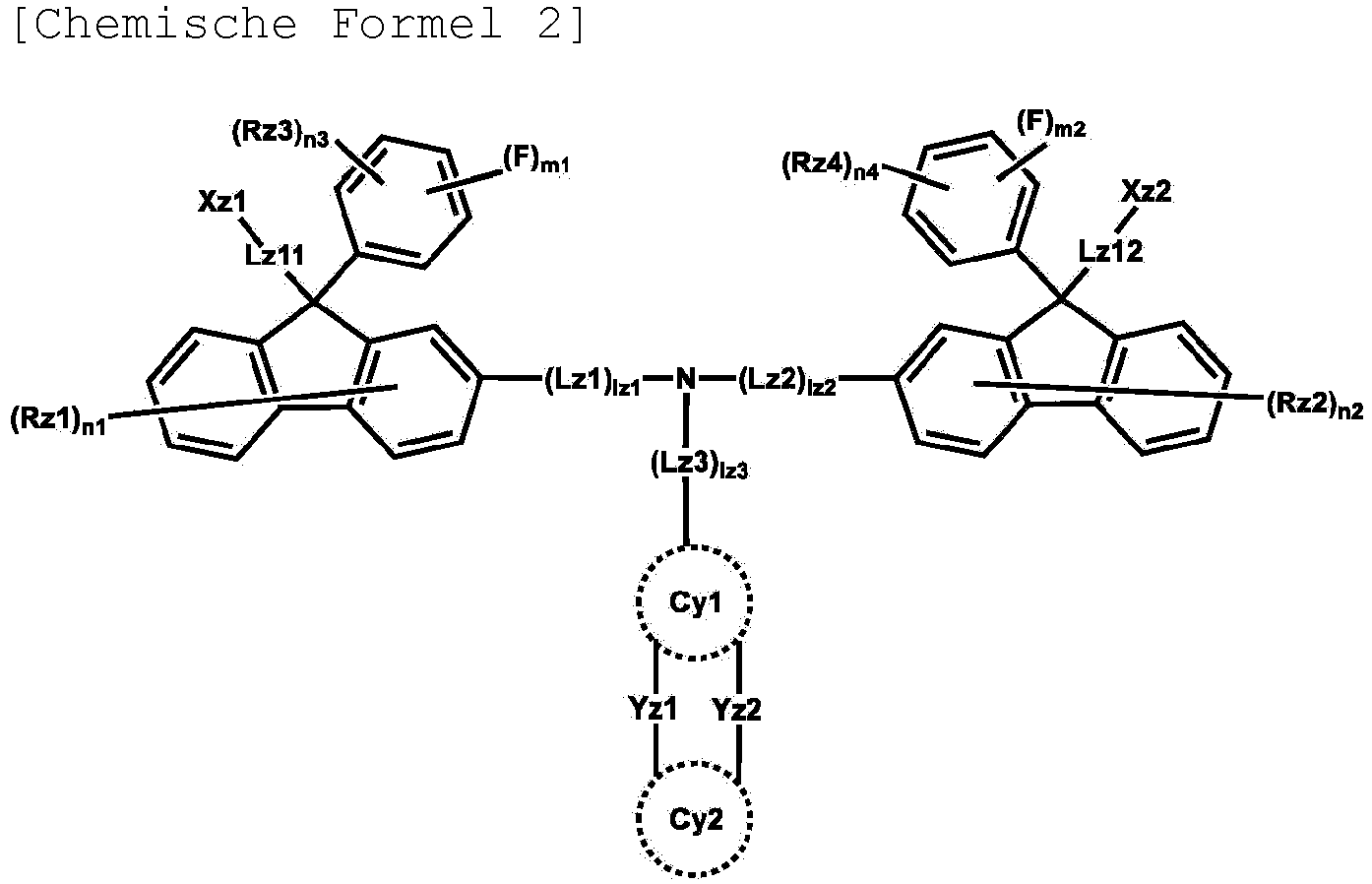
Lz1 bis Lz3, Lz11, Lz12, Xz1, Xz2, Rz1 bis Rz4, Yz1, Yz2, Cy1, Cy2, lz1 bis lz3, n1 bis n4, m1 und m2 die gleichen Definitionen wie in der chemischen Formel 1 haben. - Verbindung gemäß Anspruch 1, worin die chemische Formel 1 durch eine der folgenden chemischen Formeln 3 bis 5 dargestellt wird:


 Lz11, Lz12, Xz1, Xz2, Rz1 bis Rz4, Cy1, Cy2, Yz1, Yz2, n1 bis n4, m1 und m2 die gleichen Definitionen wie in der chemischen Formel 1 haben;Rz21 und Rz22 gleich oder verschieden voneinander sind und jeweils unabhängig Wasserstoff, Deuterium, eine Halogengruppe, eine substituierte oder unsubstituierte Alkylgruppe, eine substituierte oder unsubstituierte Alkoxygruppe, eine substituierte oder unsubstituierte Arylgruppe oder eine substituierte oder unsubstituierte Heteroarylgruppe sind; undm21 eine ganze Zahl von 0 bis 4 ist, m22 eine ganze Zahl von 0 bis 6 ist, und wenn m21 und m22 jeweils eine ganze Zahl von 2 oder größer sind, jedes Auftreten von Rz21 und Rz22 gleich oder verschieden voneinander ist,worin der Ausdruck "substituiert oder unsubstituiert" für Rz21 und Rz22 bedeutet, dass sie mit einem oder mehreren Substituenten substituiert sind, die ausgewählt sind aus einer Gruppe bestehend aus Deuterium, einer Halogengruppe, einer Nitrilgruppe, einer Alkylgruppe mit 1 bis 20 Kohlenstoffatomen, einer Cycloalkylgruppe mit 3 bis 30 Kohlenstoffatomen, einer Alkoxygruppe mit 1 bis 20 Kohlenstoffatomen, einer Arylgruppe mit 6 bis 60 Kohlenstoffatomen und einer Heteroarylgruppe mit 2 bis 60 Kohlenstoffatomen oder unsubstituiert sind, oder mit einem Substituenten substituiert sind, der zwei oder mehr Substituenten unter den oben aufgeführten Substituenten miteinander verbindet, oder unsubstituiert sind.
 - Verbindung gemäß Anspruch 1, worin Cy1 und Cy2 gleich oder verschieden voneinander sind und jeweils unabhängig durch eine der folgenden Strukturen dargestellt werden:
 ---- eine Bindungsposition bedeutet;Rz11 bis Rz13 gleich oder verschieden voneinander sind und jeweils unabhängig Wasserstoff; Deuterium; eine Halogengruppe; eine substituierte oder unsubstituierte Alkylgruppe; eine substituierte oder unsubstituierte Alkoxygruppe; eine substituierte oder unsubstituierte Arylgruppe; oder eine substituierte oder unsubstituierte Heteroarylgruppe sind;m11 eine ganze Zahl von 0 bis 4 ist; undm12 und m13 jeweils unabhängig eine ganze Zahl von 0 bis 6 sind, und wenn m11 bis m13 jeweils eine ganze Zahl von 2 oder größer sind, jedes Vorkommen von Rz11 bis Rz13 gleich oder verschieden voneinander ist,worin der Ausdruck "substituiert oder unsubstituiert" für Rz11 bis Rz13 bedeutet, dass sie mit einem oder mehreren Substituenten substituiert sind, die ausgewählt sind aus einer Gruppe bestehend aus Deuterium, einer Halogengruppe, einer Nitrilgruppe, einer Alkylgruppe mit 1 bis 20 Kohlenstoffatomen, einer Cycloalkylgruppe mit 3 bis 30 Kohlenstoffatomen, einer Alkoxygruppe mit 1 bis 20 Kohlenstoffatomen, einer Arylgruppe mit 6 bis 60 Kohlenstoffatomen und einer Heteroarylgruppe mit 2 bis 60 Kohlenstoffatomen oder unsubstituiert sind, oder mit einem Substituenten substituiert sind, der zwei oder mehr Substituenten unter den oben aufgeführten Substituenten miteinander verbindet, oder unsubstituiert sind.
 - Verbindung gemäß Anspruch 1, worin Lz11 und Lz12 gleich oder verschieden voneinander sind und jeweils unabhängig eine direkte Bindung, eine substituierte oder unsubstituierte Alkylengruppe mit 1 bis 20 Kohlenstoffatomen oder eine substituierte oder unsubstituierte Arylengruppe mit 6 bis 30 Kohlenstoffatomen sind.
- Verbindung gemäß Anspruch 1, worin Ra, Rb, Rc und Rd gleich oder verschieden voneinander sind und jeweils unabhängig eine substituierte oder unsubstituierte Methylgruppe; oder eine substituierte oder unsubstituierte Phenylgruppe sind oder an benachbarte Gruppen gebunden sind, um einen substituierten oder unsubstituierten Fluorenring; oder einen substituierten oder unsubstituierten Xanthenring zu bilden.
- Verbindung gemäß Anspruch 1, worin die Verbindung der chemischen Formel 1 eine beliebige Verbindung ist, die ausgewählt ist aus einer Gruppe bestehend aus den folgenden Verbindungen:


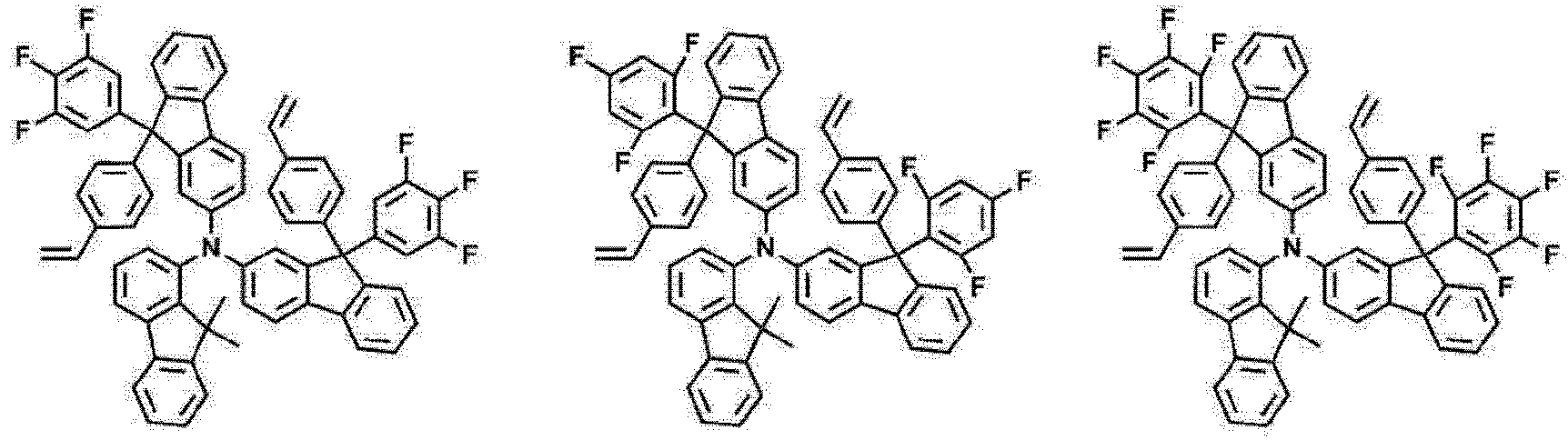


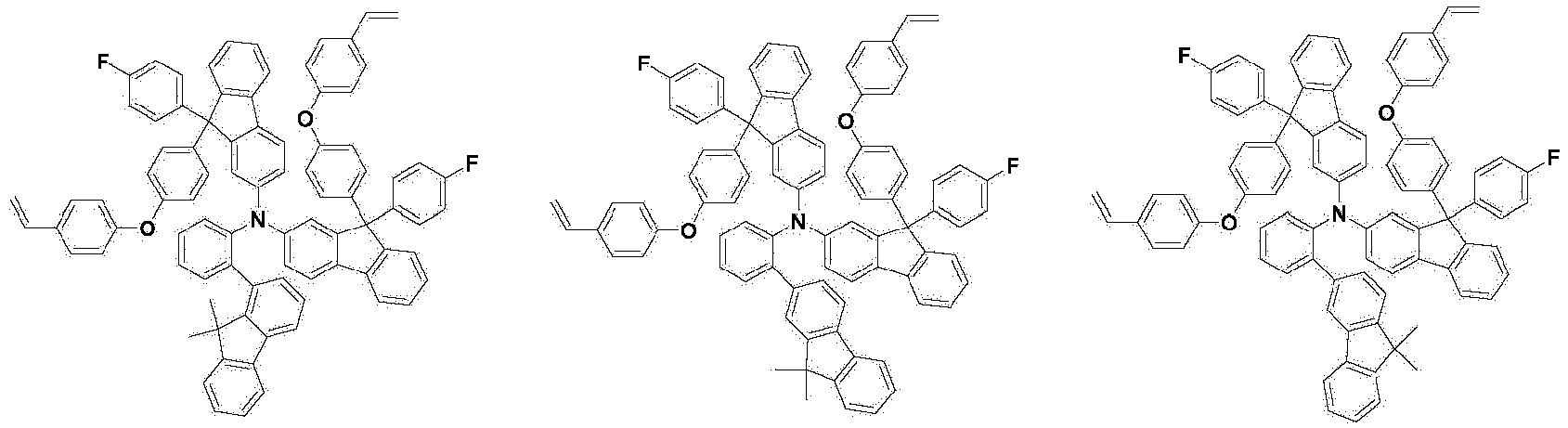


- Beschichtungszusammensetzung, umfassend die Verbindung gemäß mindestens einem der Ansprüche 1 bis 7.
- Organische lichtemittierende Vorrichtung, umfassend:eine erste Elektrode;eine zweite Elektrode; undeine oder mehrere Schichten aus organischem Material, die zwischen der ersten Elektrode und der zweiten Elektrode angeordnet sind,wobei die eine oder mehreren Schichten aus organischem Material die Beschichtungszusammensetzung gemäß Anspruch 8 oder ein gehärtetes Material davon umfassen.
- Organische lichtemittierende Vorrichtung gemäß Anspruch 9, wobei die eine oder mehreren Schichten aus organischem Material, die die Beschichtungszusammensetzung oder ein gehärtetes Material davon umfassen, eine Lochübertragungsschicht oder eine Lochinjektionsschicht sind.
- Verfahren zur Herstellung einer organischen lichtemittierenden Vorrichtung, wobei das Verfahren umfasst:Herstellen einer ersten Elektrode;Bilden einer Schicht aus organischem Material auf der ersten Elektrode;Bilden einer zweiten Elektrode auf der Schicht aus organischem Material,wobei das Bilden der Schicht aus organischem Material das Bilden einer oder mehrerer Schichten unter Verwendung der Beschichtungszusammensetzung gemäß Anspruch 8 umfasst.
- Verfahren zur Herstellung einer organischen lichtemittierenden Vorrichtung gemäß Anspruch 11, wobei das Bilden der einen oder mehreren Schichten unter Verwendung der Beschichtungszusammensetzung umfasst:Beschichten der Beschichtungszusammensetzung; undWärmebehandlung oder Lichtbehandlung der beschichteten Beschichtungszusammensetzung.
Applications Claiming Priority (2)
| Application Number | Priority Date | Filing Date | Title |
|---|---|---|---|
| KR20200130338 | 2020-10-08 | ||
| PCT/KR2021/013685 WO2022075735A1 (ko) | 2020-10-08 | 2021-10-06 | 신규한 화합물, 이를 포함하는 코팅 조성물, 이를 포함하는 유기 발광 소자 및 이의 제조방법 |
Publications (3)
| Publication Number | Publication Date |
|---|---|
| EP4186892A1 EP4186892A1 (de) | 2023-05-31 |
| EP4186892A4 EP4186892A4 (de) | 2024-01-17 |
| EP4186892B1 true EP4186892B1 (de) | 2025-03-05 |
Family
ID=81126281
Family Applications (1)
| Application Number | Title | Priority Date | Filing Date |
|---|---|---|---|
| EP21877986.6A Active EP4186892B1 (de) | 2020-10-08 | 2021-10-06 | Neuartige verbindung, beschichtungszusammensetzung damit, organische lichtemittierende vorrichtung damit und herstellungsverfahren dafür |
Country Status (6)
| Country | Link |
|---|---|
| US (1) | US20230329095A1 (de) |
| EP (1) | EP4186892B1 (de) |
| JP (1) | JP7508151B2 (de) |
| KR (1) | KR102729501B1 (de) |
| CN (1) | CN116034100B (de) |
| WO (1) | WO2022075735A1 (de) |
Families Citing this family (3)
| Publication number | Priority date | Publication date | Assignee | Title |
|---|---|---|---|---|
| JP7596016B2 (ja) * | 2021-01-11 | 2024-12-09 | エルジー・ケム・リミテッド | 新規な化合物、それを含むコーティング組成物、それを用いた有機発光素子、およびその製造方法 |
| US20240407256A1 (en) * | 2022-05-10 | 2024-12-05 | Lg Chem, Ltd. | Compound, Coating Composition Comprising Same, Organic Light-Emitting Device Using Same, and Manufacturing Method Therefor |
| CN117050043A (zh) * | 2022-05-13 | 2023-11-14 | 中国海洋大学 | 一种3-苯基二苯并呋喃类化合物及其制备方法和用途 |
Family Cites Families (14)
| Publication number | Priority date | Publication date | Assignee | Title |
|---|---|---|---|---|
| JP3838766B2 (ja) * | 1997-11-06 | 2006-10-25 | 三井化学株式会社 | 有機電界発光素子 |
| KR101513727B1 (ko) * | 2007-06-20 | 2015-04-20 | 에스케이이노베이션 주식회사 | 불소기를 포함하는 전기발광고분자 및 이를 이용한전기발광소자 |
| KR101463298B1 (ko) | 2011-04-01 | 2014-11-20 | 주식회사 엘지화학 | 새로운 유기 발광 소자 재료 및 이를 이용한 유기 발광 소자 |
| CN105733562B (zh) * | 2016-03-25 | 2019-03-05 | 石家庄诚志永华显示材料有限公司 | 一系列芴衍生物发光材料 |
| CN109843850B (zh) * | 2017-02-28 | 2022-12-16 | 株式会社Lg化学 | 基于芴的化合物、使用其的有机发光器件及其制备方法 |
| KR102154386B1 (ko) * | 2017-06-16 | 2020-09-09 | 주식회사 엘지화학 | 화합물, 이를 포함하는 코팅 조성물, 이를 이용한 유기 발광 소자 및 이의 제조방법 |
| KR102128646B1 (ko) * | 2017-06-16 | 2020-06-30 | 주식회사 엘지화학 | 화합물, 이를 포함하는 코팅 조성물, 이를 이용한 유기 발광 소자 및 이의 제조방법 |
| KR102141281B1 (ko) * | 2017-09-26 | 2020-08-05 | 주식회사 엘지화학 | 화합물, 이를 포함하는 코팅 조성물, 이를 이용한 유기 발광 소자 및 이의 제조방법 |
| KR102555233B1 (ko) * | 2017-12-29 | 2023-07-14 | 주식회사 동진쎄미켐 | 신규 화합물 및 이를 포함하는 유기 발광 소자 |
| KR20200130338A (ko) | 2018-03-09 | 2020-11-18 | 도날드슨 컴파니, 인코포레이티드 | 코어레서를 구비한 연료 필터 |
| KR102164775B1 (ko) * | 2018-05-24 | 2020-10-13 | 주식회사 엘지화학 | 유기 발광 소자 |
| JP7004804B2 (ja) * | 2018-05-30 | 2022-01-21 | エルジー・ケム・リミテッド | コーティング組成物、これを用いた有機発光素子およびその製造方法 |
| KR102651100B1 (ko) * | 2018-10-29 | 2024-03-22 | 주식회사 엘지화학 | 유기 발광 소자용 잉크 조성물 |
| CN114945554B (zh) * | 2020-01-31 | 2024-02-09 | 株式会社Lg化学 | 化合物、包含其的涂覆组合物、使用其的有机发光器件、及其制造方法 |
-
2021
- 2021-10-06 KR KR1020210132517A patent/KR102729501B1/ko active Active
- 2021-10-06 EP EP21877986.6A patent/EP4186892B1/de active Active
- 2021-10-06 WO PCT/KR2021/013685 patent/WO2022075735A1/ko not_active Ceased
- 2021-10-06 CN CN202180056003.5A patent/CN116034100B/zh active Active
- 2021-10-06 JP JP2023507455A patent/JP7508151B2/ja active Active
- 2021-10-06 US US18/022,416 patent/US20230329095A1/en active Pending
Also Published As
| Publication number | Publication date |
|---|---|
| EP4186892A1 (de) | 2023-05-31 |
| KR102729501B1 (ko) | 2024-11-13 |
| KR20220047179A (ko) | 2022-04-15 |
| JP7508151B2 (ja) | 2024-07-01 |
| CN116034100A (zh) | 2023-04-28 |
| CN116034100B (zh) | 2024-05-14 |
| JP2023536488A (ja) | 2023-08-25 |
| EP4186892A4 (de) | 2024-01-17 |
| WO2022075735A1 (ko) | 2022-04-14 |
| US20230329095A1 (en) | 2023-10-12 |
Similar Documents
| Publication | Publication Date | Title |
|---|---|---|
| EP4180416B1 (de) | Neuartige verbindung, beschichtungszusammensetzung damit, organische lichtemittierende vorrichtung damit und herstellungsverfahren dafür | |
| CN114945554B (zh) | 化合物、包含其的涂覆组合物、使用其的有机发光器件、及其制造方法 | |
| EP4186892A1 (de) | Neuartige verbindung, beschichtungszusammensetzung damit, organische lichtemittierende vorrichtung damit und herstellungsverfahren dafür | |
| CN114144402B (zh) | 化合物及包含其的有机发光器件 | |
| EP4253389B1 (de) | Verbindung, beschichtungszusammensetzung damit, organische lichtemittierende vorrichtung damit und herstellungsverfahren dafür | |
| EP4403554B1 (de) | Verbindung, beschichtungszusammensetzung damit, organische lichtemittierende vorrichtung damit und herstellungsverfahren dafür | |
| EP4375342A1 (de) | Tintenzusammensetzung, organische materialschicht damit und organische lichtemittierende vorrichtung damit | |
| KR102859869B1 (ko) | 화합물, 이를 포함하는 코팅 조성물, 이를 이용한 유기 발광 소자 및 이의 제조방법 | |
| KR20230132040A (ko) | 코팅 조성물, 이를 포함하는 유기 발광 소자 및 이의 제조 방법 | |
| KR102623891B1 (ko) | 신규한 화합물 및 이를 포함하는 유기 발광 소자 | |
| KR102817426B1 (ko) | 신규한 화합물, 이를 포함하는 코팅 조성물, 이를 이용한 유기 발광 소자 및 이의 제조 방법 | |
| EP4373242A1 (de) | Beschichtungszusammensetzung, organische lichtemittierende vorrichtung damit und herstellungsverfahren dafür | |
| EP4245760B1 (de) | Neuartige verbindung und organische lichtemittierende vorrichtung damit | |
| EP4484506A1 (de) | Tintenzusammensetzung, organische materialschicht damit und organische lichtemittierende vorrichtung damit | |
| KR102679685B1 (ko) | 신규한 화합물 및 이를 이용한 유기발광 소자 | |
| KR20230153692A (ko) | 화합물, 이를 포함하는 코팅 조성물, 이를 포함하는 유기 발광 소자, 이를 포함하는 전자 소자 및 이의 제조 방법 | |
| KR20230153690A (ko) | 화합물, 이를 포함하는 코팅 조성물, 이를 포함하는 유기 발광 소자 및 이의 제조 방법 | |
| CN120647607A (zh) | 有机化合物及包含其的有机发光器件 | |
| CN120647639A (zh) | 有机化合物、组合物、有机电致发光器件及电子装置 | |
| KR20220057190A (ko) | 신규한 화합물, 이를 포함하는 코팅 조성물, 이를 이용한 유기 발광 소자 및 이의 제조방법 | |
| KR20210056219A (ko) | 신규한 화합물 및 이를 이용한 유기 발광 소자 |
Legal Events
| Date | Code | Title | Description |
|---|---|---|---|
| STAA | Information on the status of an ep patent application or granted ep patent |
Free format text: STATUS: THE INTERNATIONAL PUBLICATION HAS BEEN MADE |
|
| PUAI | Public reference made under article 153(3) epc to a published international application that has entered the european phase |
Free format text: ORIGINAL CODE: 0009012 |
|
| STAA | Information on the status of an ep patent application or granted ep patent |
Free format text: STATUS: REQUEST FOR EXAMINATION WAS MADE |
|
| 17P | Request for examination filed |
Effective date: 20230223 |
|
| AK | Designated contracting states |
Kind code of ref document: A1 Designated state(s): AL AT BE BG CH CY CZ DE DK EE ES FI FR GB GR HR HU IE IS IT LI LT LU LV MC MK MT NL NO PL PT RO RS SE SI SK SM TR |
|
| A4 | Supplementary search report drawn up and despatched |
Effective date: 20231219 |
|
| DAV | Request for validation of the european patent (deleted) | ||
| DAX | Request for extension of the european patent (deleted) | ||
| RIC1 | Information provided on ipc code assigned before grant |
Ipc: C09D 201/00 20060101ALI20231213BHEP Ipc: C09D 7/63 20180101ALI20231213BHEP Ipc: C07C 211/61 20060101ALI20231213BHEP Ipc: C07D 307/91 20060101AFI20231213BHEP |
|
| GRAP | Despatch of communication of intention to grant a patent |
Free format text: ORIGINAL CODE: EPIDOSNIGR1 |
|
| STAA | Information on the status of an ep patent application or granted ep patent |
Free format text: STATUS: GRANT OF PATENT IS INTENDED |
|
| INTG | Intention to grant announced |
Effective date: 20241107 |
|
| GRAS | Grant fee paid |
Free format text: ORIGINAL CODE: EPIDOSNIGR3 |
|
| GRAA | (expected) grant |
Free format text: ORIGINAL CODE: 0009210 |
|
| STAA | Information on the status of an ep patent application or granted ep patent |
Free format text: STATUS: THE PATENT HAS BEEN GRANTED |
|
| AK | Designated contracting states |
Kind code of ref document: B1 Designated state(s): AL AT BE BG CH CY CZ DE DK EE ES FI FR GB GR HR HU IE IS IT LI LT LU LV MC MK MT NL NO PL PT RO RS SE SI SK SM TR |
|
| REG | Reference to a national code |
Ref country code: GB Ref legal event code: FG4D |
|
| REG | Reference to a national code |
Ref country code: CH Ref legal event code: EP |
|
| REG | Reference to a national code |
Ref country code: IE Ref legal event code: FG4D |
|
| REG | Reference to a national code |
Ref country code: DE Ref legal event code: R096 Ref document number: 602021027325 Country of ref document: DE |
|
| PG25 | Lapsed in a contracting state [announced via postgrant information from national office to epo] |
Ref country code: RS Free format text: LAPSE BECAUSE OF FAILURE TO SUBMIT A TRANSLATION OF THE DESCRIPTION OR TO PAY THE FEE WITHIN THE PRESCRIBED TIME-LIMIT Effective date: 20250605 |
|
| PG25 | Lapsed in a contracting state [announced via postgrant information from national office to epo] |
Ref country code: FI Free format text: LAPSE BECAUSE OF FAILURE TO SUBMIT A TRANSLATION OF THE DESCRIPTION OR TO PAY THE FEE WITHIN THE PRESCRIBED TIME-LIMIT Effective date: 20250305 |
|
| REG | Reference to a national code |
Ref country code: NL Ref legal event code: MP Effective date: 20250305 |
|
| PG25 | Lapsed in a contracting state [announced via postgrant information from national office to epo] |
Ref country code: ES Free format text: LAPSE BECAUSE OF FAILURE TO SUBMIT A TRANSLATION OF THE DESCRIPTION OR TO PAY THE FEE WITHIN THE PRESCRIBED TIME-LIMIT Effective date: 20250305 |
|
| REG | Reference to a national code |
Ref country code: LT Ref legal event code: MG9D |
|
| PG25 | Lapsed in a contracting state [announced via postgrant information from national office to epo] |
Ref country code: NO Free format text: LAPSE BECAUSE OF FAILURE TO SUBMIT A TRANSLATION OF THE DESCRIPTION OR TO PAY THE FEE WITHIN THE PRESCRIBED TIME-LIMIT Effective date: 20250605 |
|
| PG25 | Lapsed in a contracting state [announced via postgrant information from national office to epo] |
Ref country code: HR Free format text: LAPSE BECAUSE OF FAILURE TO SUBMIT A TRANSLATION OF THE DESCRIPTION OR TO PAY THE FEE WITHIN THE PRESCRIBED TIME-LIMIT Effective date: 20250305 |
|
| PG25 | Lapsed in a contracting state [announced via postgrant information from national office to epo] |
Ref country code: LV Free format text: LAPSE BECAUSE OF FAILURE TO SUBMIT A TRANSLATION OF THE DESCRIPTION OR TO PAY THE FEE WITHIN THE PRESCRIBED TIME-LIMIT Effective date: 20250305 |
|
| PG25 | Lapsed in a contracting state [announced via postgrant information from national office to epo] |
Ref country code: BG Free format text: LAPSE BECAUSE OF FAILURE TO SUBMIT A TRANSLATION OF THE DESCRIPTION OR TO PAY THE FEE WITHIN THE PRESCRIBED TIME-LIMIT Effective date: 20250305 Ref country code: GR Free format text: LAPSE BECAUSE OF FAILURE TO SUBMIT A TRANSLATION OF THE DESCRIPTION OR TO PAY THE FEE WITHIN THE PRESCRIBED TIME-LIMIT Effective date: 20250606 |
|
| REG | Reference to a national code |
Ref country code: AT Ref legal event code: MK05 Ref document number: 1772871 Country of ref document: AT Kind code of ref document: T Effective date: 20250305 |
|
| PG25 | Lapsed in a contracting state [announced via postgrant information from national office to epo] |
Ref country code: NL Free format text: LAPSE BECAUSE OF FAILURE TO SUBMIT A TRANSLATION OF THE DESCRIPTION OR TO PAY THE FEE WITHIN THE PRESCRIBED TIME-LIMIT Effective date: 20250305 |
|
| PG25 | Lapsed in a contracting state [announced via postgrant information from national office to epo] |
Ref country code: SE Free format text: LAPSE BECAUSE OF FAILURE TO SUBMIT A TRANSLATION OF THE DESCRIPTION OR TO PAY THE FEE WITHIN THE PRESCRIBED TIME-LIMIT Effective date: 20250305 |
|
| PG25 | Lapsed in a contracting state [announced via postgrant information from national office to epo] |
Ref country code: SM Free format text: LAPSE BECAUSE OF FAILURE TO SUBMIT A TRANSLATION OF THE DESCRIPTION OR TO PAY THE FEE WITHIN THE PRESCRIBED TIME-LIMIT Effective date: 20250305 |
|
| PG25 | Lapsed in a contracting state [announced via postgrant information from national office to epo] |
Ref country code: PT Free format text: LAPSE BECAUSE OF FAILURE TO SUBMIT A TRANSLATION OF THE DESCRIPTION OR TO PAY THE FEE WITHIN THE PRESCRIBED TIME-LIMIT Effective date: 20250707 |
|
| PG25 | Lapsed in a contracting state [announced via postgrant information from national office to epo] |
Ref country code: PL Free format text: LAPSE BECAUSE OF FAILURE TO SUBMIT A TRANSLATION OF THE DESCRIPTION OR TO PAY THE FEE WITHIN THE PRESCRIBED TIME-LIMIT Effective date: 20250305 Ref country code: IT Free format text: LAPSE BECAUSE OF FAILURE TO SUBMIT A TRANSLATION OF THE DESCRIPTION OR TO PAY THE FEE WITHIN THE PRESCRIBED TIME-LIMIT Effective date: 20250305 |
|
| PG25 | Lapsed in a contracting state [announced via postgrant information from national office to epo] |
Ref country code: AT Free format text: LAPSE BECAUSE OF FAILURE TO SUBMIT A TRANSLATION OF THE DESCRIPTION OR TO PAY THE FEE WITHIN THE PRESCRIBED TIME-LIMIT Effective date: 20250305 |
|
| PGFP | Annual fee paid to national office [announced via postgrant information from national office to epo] |
Ref country code: FR Payment date: 20250925 Year of fee payment: 5 |
|
| PG25 | Lapsed in a contracting state [announced via postgrant information from national office to epo] |
Ref country code: EE Free format text: LAPSE BECAUSE OF FAILURE TO SUBMIT A TRANSLATION OF THE DESCRIPTION OR TO PAY THE FEE WITHIN THE PRESCRIBED TIME-LIMIT Effective date: 20250305 Ref country code: CZ Free format text: LAPSE BECAUSE OF FAILURE TO SUBMIT A TRANSLATION OF THE DESCRIPTION OR TO PAY THE FEE WITHIN THE PRESCRIBED TIME-LIMIT Effective date: 20250305 |
|
| PG25 | Lapsed in a contracting state [announced via postgrant information from national office to epo] |
Ref country code: RO Free format text: LAPSE BECAUSE OF FAILURE TO SUBMIT A TRANSLATION OF THE DESCRIPTION OR TO PAY THE FEE WITHIN THE PRESCRIBED TIME-LIMIT Effective date: 20250305 |
|
| PG25 | Lapsed in a contracting state [announced via postgrant information from national office to epo] |
Ref country code: SK Free format text: LAPSE BECAUSE OF FAILURE TO SUBMIT A TRANSLATION OF THE DESCRIPTION OR TO PAY THE FEE WITHIN THE PRESCRIBED TIME-LIMIT Effective date: 20250305 |
|
| PG25 | Lapsed in a contracting state [announced via postgrant information from national office to epo] |
Ref country code: IS Free format text: LAPSE BECAUSE OF FAILURE TO SUBMIT A TRANSLATION OF THE DESCRIPTION OR TO PAY THE FEE WITHIN THE PRESCRIBED TIME-LIMIT Effective date: 20250705 |
|
| REG | Reference to a national code |
Ref country code: DE Ref legal event code: R097 Ref document number: 602021027325 Country of ref document: DE |
|
| PGFP | Annual fee paid to national office [announced via postgrant information from national office to epo] |
Ref country code: DE Payment date: 20250922 Year of fee payment: 5 |
|
| PLBE | No opposition filed within time limit |
Free format text: ORIGINAL CODE: 0009261 |
|
| STAA | Information on the status of an ep patent application or granted ep patent |
Free format text: STATUS: NO OPPOSITION FILED WITHIN TIME LIMIT |
|
| PG25 | Lapsed in a contracting state [announced via postgrant information from national office to epo] |
Ref country code: DK Free format text: LAPSE BECAUSE OF FAILURE TO SUBMIT A TRANSLATION OF THE DESCRIPTION OR TO PAY THE FEE WITHIN THE PRESCRIBED TIME-LIMIT Effective date: 20250305 |
|
| REG | Reference to a national code |
Ref country code: CH Ref legal event code: L10 Free format text: ST27 STATUS EVENT CODE: U-0-0-L10-L00 (AS PROVIDED BY THE NATIONAL OFFICE) Effective date: 20260114 |
|
| 26N | No opposition filed |
Effective date: 20251208 |