EP4181661B1 - Mobile arbeitsmaschine, insbesondere forstmaschine - Google Patents
Mobile arbeitsmaschine, insbesondere forstmaschine Download PDFInfo
- Publication number
- EP4181661B1 EP4181661B1 EP21739997.1A EP21739997A EP4181661B1 EP 4181661 B1 EP4181661 B1 EP 4181661B1 EP 21739997 A EP21739997 A EP 21739997A EP 4181661 B1 EP4181661 B1 EP 4181661B1
- Authority
- EP
- European Patent Office
- Prior art keywords
- working machine
- stanchion
- machine according
- mobile working
- ramp plate
- Prior art date
- Legal status (The legal status is an assumption and is not a legal conclusion. Google has not performed a legal analysis and makes no representation as to the accuracy of the status listed.)
- Active
Links
Images

Classifications
-
- A—HUMAN NECESSITIES
- A01—AGRICULTURE; FORESTRY; ANIMAL HUSBANDRY; HUNTING; TRAPPING; FISHING
- A01G—HORTICULTURE; CULTIVATION OF VEGETABLES, FLOWERS, RICE, FRUIT, VINES, HOPS OR SEAWEED; FORESTRY; WATERING
- A01G23/00—Forestry
- A01G23/003—Collecting felled trees
- A01G23/006—Log skidders
-
- A—HUMAN NECESSITIES
- A01—AGRICULTURE; FORESTRY; ANIMAL HUSBANDRY; HUNTING; TRAPPING; FISHING
- A01G—HORTICULTURE; CULTIVATION OF VEGETABLES, FLOWERS, RICE, FRUIT, VINES, HOPS OR SEAWEED; FORESTRY; WATERING
- A01G23/00—Forestry
- A01G23/003—Collecting felled trees
-
- B—PERFORMING OPERATIONS; TRANSPORTING
- B60—VEHICLES IN GENERAL
- B60D—VEHICLE CONNECTIONS
- B60D1/00—Traction couplings; Hitches; Draw-gear; Towing devices
- B60D1/48—Traction couplings; Hitches; Draw-gear; Towing devices characterised by the mounting
- B60D1/52—Traction couplings; Hitches; Draw-gear; Towing devices characterised by the mounting removably mounted
-
- B—PERFORMING OPERATIONS; TRANSPORTING
- B60—VEHICLES IN GENERAL
- B60P—VEHICLES ADAPTED FOR LOAD TRANSPORTATION OR TO TRANSPORT, TO CARRY, OR TO COMPRISE SPECIAL LOADS OR OBJECTS
- B60P1/00—Vehicles predominantly for transporting loads and modified to facilitate loading, consolidating the load, or unloading
- B60P1/43—Vehicles predominantly for transporting loads and modified to facilitate loading, consolidating the load, or unloading using a loading ramp mounted on the vehicle
- B60P1/433—Vehicles predominantly for transporting loads and modified to facilitate loading, consolidating the load, or unloading using a loading ramp mounted on the vehicle the loading floor or a part thereof being movable to form the ramp
-
- B—PERFORMING OPERATIONS; TRANSPORTING
- B60—VEHICLES IN GENERAL
- B60P—VEHICLES ADAPTED FOR LOAD TRANSPORTATION OR TO TRANSPORT, TO CARRY, OR TO COMPRISE SPECIAL LOADS OR OBJECTS
- B60P3/00—Vehicles adapted to transport, to carry or to comprise special loads or objects
- B60P3/40—Vehicles adapted to transport, to carry or to comprise special loads or objects for carrying long loads, e.g. with separate wheeled load supporting elements
- B60P3/41—Vehicles adapted to transport, to carry or to comprise special loads or objects for carrying long loads, e.g. with separate wheeled load supporting elements for log transport
-
- G—PHYSICS
- G05—CONTROLLING; REGULATING
- G05D—SYSTEMS FOR CONTROLLING OR REGULATING NON-ELECTRIC VARIABLES
- G05D1/00—Control of position, course, altitude or attitude of land, water, air or space vehicles, e.g. using automatic pilots
- G05D1/0011—Control of position, course, altitude or attitude of land, water, air or space vehicles, e.g. using automatic pilots associated with a remote control arrangement
Definitions
- the invention relates to a mobile work machine, in particular a forestry machine, which is provided with a chassis, a drive unit, a cable winch, a stanchion and an adjustable ramp plate arranged at the rear of a vehicle body, wherein the work machine does not have a driver's workplace for an operator and is designed as a remote-controlled work machine.
- a generic remote-controlled work machine is from the DE 10 2018 104 810 A1 known.
- Such mobile forestry machines are used as tree felling aids and as forwarding aids for delivering felled trees to a forest road. Since the machine does not have a driver's cab, this type of machine can be built compactly and lightweight, allowing it to be used in forest areas unsuitable for conventional large machines.
- the ramp shield serves exclusively to pull a tree trunk onto the stanchion using the cable winch.
- a tree trunk placed on the stanchion provides high traction due to the weight of the log acting on the work machine, despite the machine's low dead weight.
- the present invention is based on the object of providing a work machine of the type mentioned at the beginning, which can be used for more universal applications.
- the ramp sign is provided with at least one fastening interface to which an additional stanchion can be releasably attached, and/or the ramp sign is provided with a fastening interface to which a trailer coupling head can be releasably attached.
- the work machine can be used for a wide variety of transport tasks in addition to its function as a felling aid and as a forwarding aid, and can therefore be used for more universal applications.
- the fastening interface is formed by a receiving sleeve arranged in the ramp plate, into which the additional stanchion and/or the trailer coupling head can be inserted and which is arranged countersunk in the ramp plate.
- An additional stanchion or a trailer coupling head can be quickly and easily inserted and removed from such receiving sleeves, thus enabling rapid conversion of the work machine for transport tasks.
- a countersunk arrangement of the receiving sleeves in the ramp plate ensures that the receiving sleeves do not protrude upwards from the ramp plate, thus preventing any disruptive edges from being created by the receiving sleeves that could hinder the pulling of a tree trunk onto the stanchion.
- the additional stanchion and/or the trailer coupling head is provided with a stop flange, with which the additional stanchion and/or the trailer coupling head rests against the upper side of the receiving sleeve when inserted.
- a stop flange With such a stop flange, a stop can be easily formed that facilitates the insertion of the additional stanchion. and/or the trailer coupling head in the corresponding receiving sleeve.
- the additional stanchion and/or the trailer coupling head can be secured in the receiving sleeve with a securing element, in particular a cotter pin or a lock nut.
- the cotter pin can be designed, for example, as a spring pin or a linch pin.
- a securing element designed as a cotter pin or lock nut the additional stanchion and/or the trailer coupling head inserted into the receiving sleeve can be quickly and easily secured against falling out of the receiving sleeve.
- two fastening interfaces arranged at a distance from one another in the transverse direction of the vehicle are provided, to each of which an additional stanchion can be releasably fastened.
- a row of additional stanchions consisting of two additional stanchions arranged laterally and spaced apart in the transverse direction of the vehicle can be temporarily formed on the ramp shield in a simple manner.
- a fastening interface is provided, arranged substantially centrally in the transverse direction of the vehicle, to which the trailer coupling head can be releasably fastened.
- This fastening interface makes it easy to temporarily arrange a trailer coupling head centrally on the ramp shield in the transverse direction of the vehicle.
- the ramp shield can be supported in a substantially horizontal position on the vehicle body of the work machine by means of at least one support strut. With such a support strut, the ramp shield can be locked and secured in a substantially horizontal position for transport tasks in a simpler and faster manner.
- the support strut can be designed as a fixed strut. Advantages arise when the support strut is designed as a threaded strut, especially a double-threaded rod.
- a threaded strut allows the length of the support strut to be easily adjusted to support the ramp shield for transport tasks in a selected position of the adjustable ramp shield.
- the threaded strut is preferably designed as a double-threaded rod, for example, as a so-called top link, which is known from 3-point hydraulic systems on tractors.
- the support strut can be detachably attached to the vehicle body by means of a bolt connection and to the ramp shield by means of a bolt connection. This allows the support strut to be attached to the vehicle body and the ramp shield quickly and easily, if necessary.
- the adjustable ramp shield is preferably arranged at the rear of the work machine so that it can be adjusted around a horizontal transverse axis of the vehicle.
- the adjustable ramp shield can be adjusted around the vehicle's transverse axis using at least one hydraulic cylinder. This allows the ramp shield to be easily tilted around the horizontal transverse axis of the vehicle as needed, allowing it to be adjusted to a substantially horizontal position for transport tasks or lowered to the ground for forwarding tasks.
- the hydraulic cylinder is actuated by means of a control valve having a floating position.
- the ramp blade In the floating position, the ramp blade, lowered to the ground, can follow the contours of the ground and slide over the ground, thereby making it possible to clear forest paths with the ramp blade lowered to the ground.
- the stanchion has two vertical stanchion rods spaced apart in the transverse direction of the vehicle and mounted so that they can rotate about a vertical axis.
- a tree trunk can easily be placed between two such stanchion rods when the machine is used as a forwarding aid.
- a transverse reinforcement is arranged on the vehicle body in the longitudinal direction of the vehicle between the stanchion and the ramp shield.
- the transverse reinforcement enables a torsionally rigid and stable design of the work machine at the rear of the vehicle, on which the adjustable ramp shield is mounted.
- Logs are pulled onto the stanchion by means of the cable winch or on which corresponding loads are transported for transport purposes.
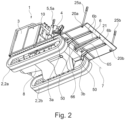
- a remote-controlled mobile work machine 1 for example a forestry machine, is shown in a perspective view.
- the mobile work machine 1 comprises a chassis 2 formed by two crawler tracks 2a, 2b, each driven, for example, by a hydraulic drive motor 3a, 3b.
- the drive motors 3a, 3b are each arranged at the rear end, i.e., at the rear end, of the crawler tracks 2a, 2b, as viewed in the vehicle's longitudinal direction L.
- the mobile work machine 1 has a drive unit 3, a cable winch 4, a stanchion 5, and an adjustable ramp shield 6, which is arranged at the rear of a vehicle body 8 and is adjustable about a horizontal transverse vehicle axis 7.
- the work machine 1 does not have a driver's workplace for an operator and can be operated by an operator using a remote control (not shown in detail).
- the drive unit 3 can have an internal combustion engine that drives one or more hydraulic pumps that supply the travel drive motors 3a, 3b, a hydraulic motor driving the cable winch 4, and other hydraulic consumers of the work machine, for example, hydraulic cylinders for adjusting the ramp shield 6.
- the drive unit 3 is arranged at the front of the vehicle, viewed in the vehicle's longitudinal direction L, the cable winch 4 is arranged adjacent to the drive motor 3, the stanchion 5 is arranged adjacent to the cable winch 4, and the adjustable ramp plate 7 is arranged at the rear of the vehicle.
- the cable winch 4 is thus arranged between the stanchion 5 and the drive motor 3, viewed in the vehicle's longitudinal direction.
- the stanchion 5 is arranged vertically above a floor plate 10 of the vehicle body 8.
- the drive unit 3 and the cable winch 4 are arranged in a front half of the working machine 1.
- the base plate 10 with the stanchion 5 located thereon forms a rear half of the working machine 1.
- the stanchion 5 is preferably mounted for rotation about a vertical axis V.
- the rotatable stanchion 5 can advantageously be locked in one or more positions by means of a locking device.
- the stanchion 5 has two vertical stanchion rods 5a, 5b arranged at a distance from one another in the vehicle transverse direction Q, which are fastened to a cross member 5c that is mounted on the base plate 10 for rotation about the vertical axis V.
- a transverse stiffener 15 is also arranged on the upper side of the floor plate 10.
- the ramp sign 6 is provided with at least one fastening interface 20a, 20b, 21.
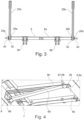
- a Figures 1 to 3 The additional stanchions 25a, 25b shown in the drawing can be releasably attached.
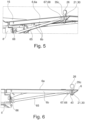
- Figures 1 , 5 and 6 The trailer coupling head 26 shown can be releasably attached.
- the fastening interface 20a, 20b, 21 is - as can be seen from the Figures 3 , 5 and 6 as can be seen, is formed by a receiving sleeve 30 arranged in the ramp plate 6, into which the additional stanchion 25a, 25b or the trailer coupling head 26 can be inserted from above.
- the ramp plate 6 consists of an upper cover plate 6a and stiffening supports 6b arranged below the cover plate 6a.
- the receiving sleeves 30 are countersunk in the cover plate 6a of the ramp plate 6 and are thus arranged below the cover plate 6a.
- the additional stanchions 25a, 25b and the trailer coupling head 26 are each provided with a stop flange 35a, 35b, 35c, with which the additional stanchions 25a, 25b and the trailer coupling head 26 rest against the upper side of the receiving sleeve 30 when inserted.
- the additional stanchions 25a, 25b and the trailer coupling head 26 can each be secured with a securing element 40 in the receiving sleeve 30.
- the securing element 40 is preferably designed as a securing split pin, for example a spring pin or linch pin, or as a screwed-on locking nut.
- two fastening interfaces 20a, 20b are provided, arranged at a distance from one another in the vehicle transverse direction Q, to each of which an additional stanchion 25a, 25b designed as a stanchion rod can be detachably fastened.
- the fastening interfaces 20a, 20b for the Additional stakes 25a, 25b are preferably arranged in the rear half of the ramp shield 6 and arranged on the outer sides of the ramp shield 6.
- a fastening interface 21 is provided, arranged essentially centrally in the vehicle transverse direction Q, to which the trailer coupling head 26 can be releasably fastened.
- the fastening interface 21 for the trailer coupling head 26 is arranged at the rear end of the ramp plate 6.
- At least one hydraulic cylinder 50 is provided for adjusting the ramp shield 6 about the vehicle's transverse axis 7.
- two hydraulic cylinders 50 are provided, which are installed below the base plate 10 and engage the stiffening supports 6b of the ramp shield 6 at a distance from the axis 7.
- the ramp shield 6 When the ramp shield 6 is lowered to the ground with its rear end, the ramp shield 6 serves to improve the support of the work machine 1 when a tree trunk is pulled towards the work machine 1 using the cable winch 4.
- Ground hooks (not shown in detail) can be arranged at the rear end of the ramp shield 6 for improved support in the ground. These hooks can be designed as hooks, angles, brackets, or clamp-like staples.
- the hydraulic cylinders 50 can be actuated by means of a control valve which has a lifting position for raising the ramp shield 6, a lowering position for lowering the ramp shield 6 and a floating position in which a ramp shield 6 lowered to the ground can follow the ground contour.
- the control valve controlling the hydraulic cylinders 50 may further have a locking position to enable the load of the ramp shield 6 to be held in a selected position.
- a parallel drive of the travel drive motors 2a, 2b and the hydraulic cylinders 50 actuating the ramp plate 6 is preferably made possible, whereby an effective Rumbling of tree trunks and pushing of tree trunks as well as positioning of the ramp plate 6 while the work machine 1 is traveling is made possible.
- At least one support strut 65 is provided in order to lock the ramp plate 6 in a substantially horizontal position for transport tasks, in which the ramp plate 6 is arranged as an extension of the base plate 10.
- a support strut 65 is provided which is arranged substantially centrally in the vehicle transverse direction Q.
- the support strut 65 In the horizontal position of the ramp plate 6, the support strut 65 is located below the cover plate 6a of the ramp plate 6.
- the support strut 65 thus supports the ramp plate 6 independently of the hydraulic cylinders 50, so that the hydraulic cylinders 50 are relieved of the forces acting on the ramp plate 6 during transport tasks and the ramp plate is held in a desired position regardless of leaks at the hydraulic cylinder 50.
- the support strut 65 is preferably designed as a threaded strut, for example as a double threaded rod (top link).
- the support strut 65 can be releasably fastened by means of bolt connections (not shown in detail) to a bearing flange 66 arranged at the rear of the vehicle body 8 and to a bearing flange 67 of the ramp shield 6.
- the bearing flange 67 is preferably formed by bearing bores 68 for a bolt in a stiffening beam 6b of the ramp shield 6 arranged centrally in the vehicle transverse direction Q.
- the additional stanchions 25a, 25b inserted into the fastening interfaces 20a, 20b thus form an additional row of stanchions on the ramp plate 6 in addition to the stanchion 5 on the base plate 10.
- the trailer coupling head 26 inserted into the fastening interface 21 forms a trailer coupling with which trailers can be towed in the forward direction of travel of the work machine 1.
- the work machine 1 preferably has a maximum width of 1.5 m, so that the work machine 1 can be transported to the work sites on a car trailer.
- the shape of the ramp shield 6, in particular the shape of the cover plate 6a of the ramp shield 6, can be selected depending on the main application of the work machine 1.
- the cover plate 6a can be designed to be hollowed downwards in the vehicle's longitudinal direction L to enable improved reception and transport of a tree trunk, or alternatively, it can be designed to be hollowed upwards in the vehicle's longitudinal direction L to enable improved rope access of a tree trunk from a slightly inclined direction.
Landscapes
- Engineering & Computer Science (AREA)
- Mechanical Engineering (AREA)
- Transportation (AREA)
- Life Sciences & Earth Sciences (AREA)
- Biodiversity & Conservation Biology (AREA)
- Ecology (AREA)
- Forests & Forestry (AREA)
- Environmental Sciences (AREA)
- General Physics & Mathematics (AREA)
- Automation & Control Theory (AREA)
- Physics & Mathematics (AREA)
- Remote Sensing (AREA)
- Radar, Positioning & Navigation (AREA)
- Aviation & Aerospace Engineering (AREA)
- Health & Medical Sciences (AREA)
- Public Health (AREA)
- Agricultural Machines (AREA)
Description
- Die Erfindung betrifft eine mobile Arbeitsmaschine, insbesondere Forstmaschine, die mit einem Fahrwerk, einer Antriebseinheit, einer Seilwinde, einer Runge und mit einem am Fahrzeugheck eines Fahrzeugkörpers angeordneten verstellbaren Rampenschild versehen ist, wobei die Arbeitsmaschine keinen Fahrerarbeitsplatz für einen Bediener aufweist und als ferngesteuerte Arbeitsmaschine ausgebildet ist.
- Eine gattungsgemäße ferngesteuerte Arbeitsmaschine ist aus der
DE 10 2018 104 810 A1 bekannt. - Aus der
US 2 156 183 A ist eine Vorrichtung für den Holzeinschlag mit einem Rampenschild bekannt. - Derartige mobile als Forstmaschinen ausgebildete Arbeitsmaschinen werden als Fällhilfe für Bäume und als Rückehilfe zum Vorliefern von gefällten Bäumen an einen Waldweg benutzt. Da die Arbeitsmaschine keinen Fahrerarbeitsplatz für einen Bediener aufweist, kann eine gattungsgemäße Arbeitsmaschine kompakt und leicht gebaut werden und ermöglicht es, in Waldgebieten eingesetzt zu werden, die für herkömmliche Großmaschinen nicht geeignet sind.
- Bei gattungsgemäßen mobilen Arbeitsmaschinen dient das Rampenschild ausschließlich dazu, mit der Seilwinde einen Baumstamm auf die Runge zu ziehen. Ein auf der Runge abgelegter Baumstamm führt durch das auf die Arbeitsmaschine wirkende Gewicht des Baustamms trotz geringem Eigengewicht der Arbeitsmaschine zu einer hohen Traktion.
- Der vorliegenden Erfindung liegt die Aufgabe zugrunde, eine Arbeitsmaschine der eingangs genannten Gattung zur Verfügung zu stellen, die für universellere Einsätze verwendet werden kann.
- Diese Aufgabe wird erfindungsgemäß dadurch gelöst, dass das Rampenschild mit mindestens einer Befestigungsschnittstelle versehen ist, an der eine Zusatzrunge lösbar befestigbar ist, und/oder das Rampenschild mit einer Befestigungsschnittstelle versehen ist, an der ein Anhängekupplungskopf lösbar befestigbar ist.
- Mit derartigen Befestigungsschnittsellen ist es möglich, an dem Rampenschild temporär eine zweite von zwei Zusatzrungen gebildete Zusatzrungenzeile zu bilden, die es ermöglicht, zwischen der Runge und den Zusatzrungen Holzstangen, beispielsweise Zaunpfähle und/oder Zaunbaumaterial, beispielsweise Maschendrahtgeflecht, zu transportieren, das beispielsweise zum Einzäunen von Wiederaufforstungsflächen benötigt wird. Weiterhin ist es möglich, zwischen der Runge und der Zusatzrunge einen Wassertank zu transportieren, um Wiederaufforstungsflächen und neu angepflanzte Bäume zu gießen. Mit der temporär bildbaren Zusatzrunge kann somit das Rampenschild als Transportplattform genutzt werden. Mit einer derartigen Befestigungsschnittstellen ist es alternativ oder zusätzlich möglich, an dem Rampenschild temporär einen Anhängekupplungskopf zu befestigen, mit dem ein Anhänger gezogen werden kann. Mit den Befestigungsschnittstellen an dem Rampenschild und den daran befestigbaren Zusatzrungen bzw. Anhängekupplungskopf kann somit die Arbeitsmaschine zusätzlich zu der Funktion als Fällhilfe und als Rückehilfe für verschiedenste Transportaufgaben genutzt und somit für universellere Einsätze verwendet werden.
- Gemäß einer vorteilhaften Ausführungsform der Erfindung ist die Befestigungsschnittstelle jeweils von einer in dem Rampenschild angeordneten Aufnahmehülse gebildet, in die die Zusatzrunge und/oder der Anhängekupplungskopf einsteckbar ist und die in dem Rampenschild versenkt angeordnet sind. In derartige Aufnahmehülsen kann eine Zusatzrunge bzw. ein Anhängekupplungskopf in schneller und einfacher Weise eingesteckt und wieder herausgezogen werden, so dass sich ein schneller Umbau der Arbeitsmaschine für Transportaufgaben ergibt. Mit einer versenkten Anordnung der Aufnahmehülsen in dem Rampenschlild wird erzielt, dass die Aufnahmehülsen nicht nach oben aus dem Rampenschild herausragen, so dass keine störenden Kanten durch die Aufnahmehülsen entstehen, die ein Aufziehen eines Baumstammes auf die Runge behindern könnten.
- Vorteile ergeben sich, wenn gemäß einer Weiterbildung der Erfindung die Zusatzrunge und/oder der Anhängekupplungskopf mit einem Anschlagflansch versehen ist, mit dem im eingesteckten Zustand die Zusatzrunge und/oder der Anhängekupplungskopf an der Oberseite der Aufnahmehülse anliegt. Mit einem derartigen Anschlagflansch kann auf einfache Weise ein Anschlag gebildet werden, der das Einstecken der Zusatzrunge und/oder des Anhängekupplungskopfes in der entsprechenden Aufnahmehülse erleichtert.
- Gemäß einer Weiterbildung der Erfindung ist die Zusatzrunge und/oder der Anhängekupplungskopf mit einem Sicherungselement, insbesondere eines Sicherungssplintes oder einer Sicherungsmutter, in der Aufnahmehülse sicherbar. Der Sicherungssplint kann beispielsweise als Federstecker oder Klappsplint ausgeführt sein. Mit einem als Sicherungssplint oder Sicherungsmutter ausgebildeten Sicherungselement kann die in der Aufnahmehülse eingesteckte Zusatzrunge und/oder der in der Aufnahmehülse eingesteckte Anhängekupplungskopf in schneller und einfacher Weise gegen Herausfallen aus der Aufnahmehülse gesichert werden.
- Gemäß einer besonders vorteilhaften Ausführungsform der Erfindung sind zwei in Fahrzeugquerrichtung voneinander beabstandet angeordnete Befestigungsschnittstellen vorgesehen, an denen jeweils eine Zusatzrunge lösbar befestigbar ist. An dem Rampenschild kann somit in einfacher Weise eine aus zwei seitlich, in Fahrzeugquerrichtung beabstandet angeordneten Zusatzrungen gebildete Zusatzrungenzeile temporär gebildet werden.
- Gemäß einer besonders vorteilhaften Ausführungsform der Erfindung ist eine in Fahrzeugquerrichtung im Wesentlichen mittig angeordnete Befestigungsschnittstelle vorgesehen, an der der Anhängekupplungskopf lösbar befestigbar ist. Diese Befestigungsschnittstelle ermöglicht es in einfacher Weise, temporär einen Anhängekupplungskopf in Fahrzeugquerrichtung mittig an dem Rampenschild anzuordnen.
- Besondere Vorteile ergeben sich, wenn das Rampenschild gemäß einer vorteilhaften Weiterbildung der Erfindung mittels mindestens einer Abstützstrebe in einer im Wesentlichen horizontalen Stellung an dem Fahrzeugkörper der Arbeitsmaschine abstützbar ist. Mit einer derartigen Abstützstrebe kann das Rampenschild für Transportaufgaben in einer im Wesentlichen horizontalen Stellung in einfacher und schnellerer Weise arretiert und festgestellt werden.
- Die Abstützstrebe kann als feste Strebe ausgebildet sein. Vorteile ergeben sich, wenn die Abstützstrebe als Gewindestrebe, insbesondere Doppelgewindestange, ausgebildet ist. Eine Gewindestrebe ermöglicht es in einfacher Weise, die Länge der Abstützstrebe anzupassen, um in einer gewählten Stellung des verstellbaren Rampenschildes das Rampenschid für Transortaufgaben abzustützen. Die Gewindestrebe ist bevorzugt als Doppelgewindestange, beispielsweise als sogenannter Oberlenker, ausgebildet, der aus 3-Punkt-Hydrauliksystemen von Traktoren bekannt ist.
- Die Abstützstrebe ist gemäß einer vorteilhaften Ausführungsform der Erfindung mittels einer Bolzenverbindung an dem Fahrzeugkörper und mittels einer Bolzenverbindung an dem Rampenschild lösbar befestigbar. Dies ermöglich es in einfacher und schneller Weise, die Abstützstrebe im Bedarfsfall an dem Fahrzeugkörper und dem Rampenschild anzubauen.
- Das verstellbare Rampenschild ist bevorzugt um eine horizontale Fahrzeugquerachse verstellbar am Fahrzeugheck der Arbeitsmaschine angeordnet.
- Vorteile ergeben sich, wenn das verstellbares Rampenschild mittels mindestens eines Hydraulikzylinders um die Fahrzeugquerachse verstellbar ist. Dadurch kann das Rampenschild in einfacher Weise im Bedarfsfall um die horizontale Fahrzeugquerachse geneigt werden, um dieses für Transportaufgaben in eine im Wesentlichen horizontale Stellung zu verstellen bzw. für Rückeaufgaben nach unten auf den Boden abzusenken.
- Bevorzugt ist der Hydraulikzylinder mittels eines eine Schwimmstellung aufweisenden Steuerventils betätigbar. In der Schwimmstellung kann das auf den Boden abgesenkte Rampenschild der Kontur des Bodens folgen und auf dem Boden gleiten, wodurch es ermöglicht wird, mit dem auf den Boden abgesenkten Rampenschild Waldwege abzuziehen.
- Besondere Vorteile ergeben sich, wenn die Runge zwei in Fahrzeugquerrichtung beabstandet angeordnete vertikale Rungenstangen aufweist und um eine vertikale Achse drehbar gelagert ist. Zwischen zwei derartigen Rungenstangen kann in einfacher Weise ein Baumstamm abgelegt werden, wenn die Arbeitsmaschine als Rückehilfe genutzt wird.
- Gemäß einer Weiterbildung der Erfindung ist in Fahrzeuglängsrichtung zwischen der Runge und dem Rampenschild an dem Fahrzeugkörper eine Querversteifung angeordnet. Die Querversteifung ermöglicht eine verwindungssteife und stabile Ausführung der Arbeitsmaschine am Fahrzeugheck, an dem das verstellbare Rampenschild gelagert ist und über das Baustämme mittels der Seilwinde auf die Runge gezogen werden oder auf dem für Transportaufgaben entsprechende Lasten transportiert werden.
- Weitere Vorteile und Einzelheiten der Erfindung werden anhand des in den schematischen Figuren dargestellten Ausführungsbeispiels näher erläutert. Hierbei zeigt
- Figur 1
- eine perspektivische Darstellung einer erfindungsgemäßen mobilen Arbeitsmaschine,
- Figur 2
- die Arbeitsmaschine in einer perspektivischen Darstellung von unten,
- Figur 3
- einen Schnitt entlang der Linie A-A der
Figur 1 , - Figur 4
- einen Ausschnitt der
Figur 2 in einer vergrößerten Darstellung, - Figur 5
- einen Schnitt entlang der Linie B-B der
Figur 1 in einer perspektivischen Darstellung und - Figur 6
- einen Schnitt entlang der Linie B-B der
Figur 1 in einer Seitenansicht. - In den
Figuren 1 und2 ist eine erfindungsgemäße ferngesteuerte mobile Arbeitsmaschine 1, beispielsweise Forstmaschine, in einer perspektivischen Darstellung dargestellt. - Die mobile Arbeitsmaschine 1 umfasst ein Fahrwerk 2, das von zwei Raupenfahrwerken 2a, 2b gebildet ist, die jeweils beispielsweise von einem hydraulischen Fahrantriebsmotor 3a, 3b angetrieben sind. Die Fahrantriebsmotor 3a, 3b sind in Fahrzeuglängsrichtung L gesehen jeweils am hinteren Ende, d.h. am fahrzeugheckseitigen Ende, der Raupenfahrwerke 2a, 2b angeordnet.
- Die mobile Arbeitsmaschine 1 weist eine Antriebseinheit 3, eine Seilwinde 4, eine Runge 5 und ein verstellbares Rampenschild 6 auf, das um eine horizontale Fahrzeugquerachse 7 verstellbar am Fahrzeugheck eines Fahrzeugkörpers 8 angeordnet ist. Die Arbeitsmaschine 1 weist keinen Fahrerarbeitsplatz für einen Bediener auf und ist mittels einer nicht näher dargestellten Fernbedienung von einem Bediener bedienbar. Die Antriebseinheit 3 kann einen Verbrennungsmotor aufweisen, der eine oder mehrere Hydraulikpumpen antreibt, die die Fahrantriebsmotoren 3a, 3b, einen die Seilwinde 4 antreibenden Hydraulikmotor und weitere hydraulische Verbraucher der Arbeitsmaschine, beispielsweise Hydraulkzylinder zum Verstellen des Rampenschildes 6, versorgen.
- Bei der erfindungsgemäßen Arbeitsmaschine 1 sind in Fahrzeuglängsrichtung L gesehen vorne an der Fahrzeugfront die Antriebseinheit 3, benachbart zum Antriebsmotor 3 die Seilwinde 4, benachbart zur Seilwinde 4 die Runge 5 und am Fahrzeugheck das verstellbare Rampenschild 7 angeordnet. Die Seilwinde 4 in somit in Fahrzeuglängsrichtung gesehen zwischen der Runge 5 und dem Antriebsmotor 3 angeordnet.
- Die Runge 5 ist in vertikaler Richtung oberhalb einer Bodenplatte 10 des Fahrzeugkörpers 8 angeordnet.
- Die Antriebseinheit 3 und die Seilwinde 4 sind in einer vorderen Hälfte der Arbeitsmaschine 1 angeordnet. Die Bodenplatte 10 mit der darauf befindlichen Runge 5 bildet eine hintere Hälfte der Arbeitsmaschine 1.
- Die Runge 5 ist bevorzugt um eine vertikale Achse V drehbar gelagert. Die drehbare Runge 5 kann vorteilhafterweise mittels einer Arretiervorrichtung in einer oder mehreren Stellungen arretierbar sein. Die Runge 5 weist im dargestellten Ausführungsbeispiel zwei in Fahrzeugquerrichtung Q beabstandet angeordnete vertikale Rungenstangen 5a, 5b auf, die an einem Querträger 5c befestigt sind, der um die vertikale Achse V drehbar auf der Bodenplatte 10 gelagert ist.
- In Fahrzeuglängsrichtung L zwischen der Runge 5 und dem am Fahrzeugheck angeordneten Rampenschild 6 ist an der Oberseite der Bodenplatte 10 weiterhin eine Querversteifung 15 angeordnet.
- Erfindungsgemäß ist das Rampenschild 6 mit mindestens einer Befestigungsschnittstelle 20a, 20b, 21 versehen. An der Befestigungsschnittstelle 20a, 20b kann jeweils eine in den
Figuren 1 bis 3 dargestellte Zusatzrunge 25a, 25b lösbar befestigt werden. An der Befestigungsschnittstelle 21 kann ein in denFiguren 1 ,5 und 6 dargestellter Anhängekupplungskopf 26 lösbar befestigt werden. - Die Befestigungsschnittstelle 20a, 20b, 21 ist jeweils - wie aus den
Figuren 3 ,5 und 6 ersichtlich ist - von einer in dem Rampenschild 6 angeordneten Aufnahmehülse 30 gebildet, in die die Zusatzrunge 25a, 25b bzw. der Anhängekupplungskopf 26 von oben einsteckbar ist. Das Rampenschild 6 besteht aus einem oberen Deckblech 6a und unter dem Deckblech 6a angeordneten Versteifungsträgern 6b. Die Aufnahmehülsen 30 sind in dem Deckblech 6a des Rampenschild 6 versenkt und somit unterhalb des Deckblechs 6a angeordnet. - Die Zusatzrunge 25a, 25b bzw. der Anhängekupplungskopf 26 sind jeweils mit einem Anschlagflansch 35a, 35b, 35c versehen, mit dem im eingesteckten Zustand die Zusatzrunge 25a, 25b bzw. der Anhängekupplungskopf 26 an der Oberseite der Aufnahmehülse 30 anliegt.
- Um die Zusatzrunge 25a, 25b und den Anhängekupplungskopf 26 in der Aufnahmehülse 30 in dem eingesteckten Zustand zu sichern, sind die Zusatzrunge 25a, 25b und der Anhängekupplungskopf 26 jeweils mit einem Sicherungselement 40 in der Aufnahmehülse 30 sicherbar. Das Sicherungselement 40 ist bevorzugt als Sicherungssplint, beispielsweise Federstecker oder Klappsplint oder als aufgeschraubte Sicherungsmutter ausgebildet.
- Im dargestellten Ausführungsbeispiel sind zwei in Fahrzeugquerrichtung Q voneinander beabstandet angeordnete Befestigungsschnittstellen 20a, 20b vorgesehen, an denen jeweils eine als Rungenstange ausgebildete Zusatzrunge 25a, 25b lösbar befestigbar ist. Die Befestigungsschnittstellen 20a, 20b für die Zusatzrungen 25a, 25b sind bevorzugt in der hinteren Hälfte des Rampenschildes 6 angeordnet und an den Außenseiten des Rampenschildes 6 angeordnet.
- Für den Anhängekupplungskopf 26 ist eine in Fahrzeugquerrichtung Q im Wesentlichen mittig angeordnete Befestigungsschnittstelle 21 vorgesehen, an der der Anhängekupplungskopf 26 lösbar befestigbar ist. Die Befestigungsschnittstellen 21 für den Anhängekupplungskopf 26 ist am hinteren Ende des Rampenschildes 6 angeordnet.
- Zur Verstellung des Rampenschildes 6 um die Fahrzeugquerachse 7 ist mindestens ein Hydraulikzylinder 50 vorgesehen. Im dargestellten Ausführungsbeispiel sind zwei Hydraulikzylinder 50 vorgesehen, die unterhalb der Bodenplatte 10 eingebaut sind und an den Versteifungsträgern 6b des Rampenschildes 6 beabstandet zur Achse 7 angreifen.
- Wenn das Rampenschild 6 mit dem hinteren Ende auf den Boden abgesenkt ist, dient das Rampenschild 6 zur verbesserten Abstützung der Arbeitsmaschine 1, wenn mit der Seilwinde 4 ein Baumstamm zu der Arbeitsmaschine 1 herangezogen wird. Am hinteren Ende des Rampenschildes 6 können zur verbesserten Abstützung im Boden nicht näher dargestellte Bodenhaken angeordnet sein, die als Haken, Winkel, Bügel oder klammerartige Krampen ausgestaltet sein können.
- Die Hydraulikzylinder 50 sind mittels eines Steuerventils betätigbar, das eine Hebenstellung zum Anheben des Rampenschildes 6, einen Senkenstellung zum Absenken des Rampenschildes 6 und eine Schwimmstellung aufweist, in der ein auf den Boden abgesenktes Rampenschild 6 der Bodenkontur folgen kann.
- Das die Hydraulikzylinder 50 steuernde Steuerventil kann weiterhin eine Sperrstellung aufweisen, um eine Lasthaltung des Rampenschildes 6 in einer gewählten Position zu ermöglichen.
- Bei der erfindungsgemäßen Arbeitsmaschine 1 ist bevorzugt ein Paralleletrieb der Fahrantriebsmotoren 2a, 2b und der das Rampenschild 6 betätigenden Hydraulikzylinder 50 ermöglicht, wodurch mit der Arbeitsmaschine 1 ein effektives Poltern vom Baumstämmen und Schieben von Baumstämmen sowie ein Positionieren des Rampenschildes 6 während der Fahrt der Arbeitsmaschine 1 ermöglicht wird.
- Um für Transportaufgaben das Rampenschild 6 in einer im Wesentlichen horizontalen Stellung zu arretieren, in der das Rampenschild 6 in Verlängerung der Bodenplatte 10 angeordnet ist, ist mindestens eine Abstützstrebe 65 vorgesehen. Im dargestellten Ausführungsbeispiel ist eine Abstützstrebe 65 vorgesehen, die in Fahrzeugquerrichtung Q im Wesentlichen mittig angeordnet ist. Die Abstützstrebe 65 befindet sich in der horizontalen Stellung des Rampenschildes 6 unterhalb des Deckblechs 6a des Rampenschildes 6. Die Abstützstrebe 65 stützt somit das Rampenschild 6 unabhängig von den Hydraulikzylindern 50 ab, so dass die Hydraulikzylinder 50 von der an dem Rampenschild 6 angreifenden Kräften während Transportaufgaben entlastet sind und das Rampenschild unabhängig von Leckagen an den Hydraulikzylinder 50 in einer gewünschten Stellung gehalten wird.
- Die Abstützstrebe 65 ist bevorzugt als Gewindestrebe, beispielsweise als Doppelgewindestange (Oberlenker), ausgebildet.
- Die Abstützstrebe 65 ist mittels nicht näher dargestellten Bolzenverbindungen an einem an dem Fahrzeugheck des Fahrzeugkörper 8 angeordneten Lagerflansch 66 und an einem Lagerflansch 67 des Rampenschildes 6 lösbar befestigbar. Der Lagerflansch 67 ist bevorzugt von Lagerbohrungen 68 für einen Bolzen in einem in Fahrzeugquerrichtung Q mittig angeordneten Versteifungsträger 6b des Rampenschildes 6 gebildet.
- Die in die Befestigungsschnittstellen 20a, 20b eingesteckten Zusatzrungen 25a, 25b bilden somit eine zusätzliche Rungenzeile an dem Rampenschild 6 zu der Runge 5 an der Bodenplatte 10. Der in der Befestigungsschnittstelle 21 eingesteckte Anhängekupplungskopf 26 bildet eine Anhängevorrichtung, mit der in Vorwärtsfahrtrichtung der Arbeitsmaschine 1 Anhänger gezogen werden können.
- Die Arbeitsmaschine 1 weist bevorzugt eine Breite von maximal 1,5m auf, so dass die Arbeitsmaschine 1 auf einem Autoanhänger zu den Einsatzorten transportiert werden kann.
- Das mittels der Abstützstrebe 65 in der horizontalen Stellung abgestützte Rampenschild 6 bildet somit eine Transportplattform von beispielswiese 2m2 Grundfläche, die die Bodenplatte 10 verlängert und die es ermöglicht, verschiedenste Transportgüter, beispielsweise Zäune, Wassercontainer, Baumaterialien oder Agrargüter, zu transportieren und Anhänger zu ziehen.
- Die Form des Rampenschildes 6, insbesondere die Form des Deckblechs 6a des Rampenschildes 6 kann je nach Hauptanwendung der Arbeitsmaschine 1 gewählt sein. Neben einer ebenen Form des Deckblechs 6a kann das Deckblech 6a in Fahrzeuglängsrichtung L nach unten hohlgebogen ausgeführt sein, um eine verbesserte Aufnahme eines Baumstammes und einen verbesserten Transport eines Baumstammes zu ermöglichen, oder alternativ in Fahrzeuglängsrichtung L nach oben hohlgebogen ausgeführt sein, um ein verbessertes Heranseilen eines Baumstammes aus einer leicht schrägen Richtung zu ermöglichen.
Claims (14)
- Mobile Arbeitsmaschine (1), insbesondere Forstmaschine, die mit einem Fahrwerk (2), einer Antriebseinheit (3), einer Seilwinde (4), einer Runge (5) und mit einem am Fahrzeugheck eines Fahrzeugkörpers (8) angeordneten verstellbaren Rampenschild (6) versehen ist, wobei die Arbeitsmaschine (1) keinen Fahrerarbeitsplatz für einen Bediener aufweist und als ferngesteuerte Arbeitsmaschine (1) ausgebildet ist, dadurch gekennzeichnet, dass das Rampenschild (6) mit mindestens einer Befestigungsschnittstelle (20a, 20b) versehen ist, an der eine Zusatzrunge (25a; 25b) lösbar befestigbar ist, und/oder das Rampenschild (6) mit einer Befestigungsschnittstelle (21) versehen ist, an der ein Anhängekupplungskopf (26) lösbar befestigbar ist.
- Mobile Arbeitsmaschine nach Anspruch 1, dadurch gekennzeichnet, dass die Befestigungsschnittstelle (20a; 20b; 21) jeweils von einer in dem Rampenschild (6) angeordneten Aufnahmehülse (30) gebildet ist, in die die Zusatzrunge (25a; 25b) und/oder der Anhängekupplungskopf (26) einsteckbar ist und die in dem Rampenschild (6) versenkt angeordnet sind.
- Mobile Arbeitsmaschine nach Anspruch 2, dadurch gekennzeichnet, dass die Zusatzrunge (25a; 25b) und/oder der Anhängekupplungskopf (26) mit einem Anschlagflansch (35a; 35b; 35c) versehen ist, mit dem im eingesteckten Zustand die Zusatzrunge (25a; 25b) und/oder der Anhängekupplungskopf (26) an der Oberseite der Aufnahmehülse (30) anliegt.
- Mobile Arbeitsmaschine nach Anspruch 2 oder 3, dadurch gekennzeichnet, dass die Zusatzrunge (25a; 25b) und/oder der Anhängekupplungskopf (26) mit einem Sicherungselement (40), insbesondere eines Sicherungssplintes oder einer Sicherungsmutter, in der Aufnahmehülse (30) sicherbar ist.
- Mobile Arbeitsmaschine nach einem der Ansprüche 1 bis 4, dadurch gekennzeichnet, dass zwei in Fahrzeugquerrichtung (Q) voneinander beabstandet angeordnete Befestigungsschnittstellen (20a; 20b) vorgesehen sind, an denen jeweils eine Zusatzrunge (25a; 25b) lösbar befestigbar ist.
- Mobile Arbeitsmaschine nach einem der Ansprüche 1 bis 5, dadurch gekennzeichnet, dass eine in Fahrzeugquerrichtung (Q) im Wesentlichen mittig angeordnete Befestigungsschnittstelle (21) vorgesehen ist, an der der Anhängekupplungskopf (26) lösbar befestigbar ist.
- Mobile Arbeitsmaschine nach einem der Ansprüche 1 bis 6, dadurch gekennzeichnet, dass das Rampenschild (6) mittels mindestens einer Abstützstrebe (65) in einer im Wesentlichen horizontalen Stellung an dem Fahrzeugkörper (8) der Arbeitsmaschine (1) abstützbar ist.
- Mobile Arbeitsmaschine nach Anspruch 7, dadurch gekennzeichnet, dass die Abstützstrebe (65) als Gewindestrebe, insbesondere Doppelgewindestange, ausgebildet ist.
- Mobile Arbeitsmaschine nach Anspruch 7 oder 8, dadurch gekennzeichnet, dass die Abstützstrebe (65) mittels einer Bolzenverbindung an dem Fahrzeugkörper (8) und mittels einer Bolzenverbindung an dem Rampenschild (6) lösbar befestigbar ist.
- Mobile Arbeitsmaschine nach einem der Ansprüche 1 bis 9, dadurch gekennzeichnet, dass das verstellbares Rampenschild (6) um eine horizontale Fahrzeugquerachse (7) verstellbar am Fahrzeugheck der Arbeitsmaschine (1) angeordnet ist.
- Mobile Arbeitsmaschine nach einem der Ansprüche 1 bis 10, dadurch gekennzeichnet, dass das verstellbares Rampenschild (6) mittels mindestens eines Hydraulikzylinders (50) um die Fahrzeugquerachse (7) verstellbar ist.
- Mobile Arbeitsmaschine nach Anspruch 11, dadurch gekennzeichnet, dass der Hydraulikzylinder (50) mittels eines eine Schwimmstellung aufweisenden Steuerventils betätigbar ist.
- Mobile Arbeitsmaschine nach einem der Ansprüche 1 bis 12, dadurch gekennzeichnet, dass die Runge (5) zwei in Fahrzeugquerrichtung (Q) beabstandet angeordnete vertikale Rungenstangen (5a, 5b) aufweist und um eine vertikale Achse (V) drehbar gelagert ist.
- Mobile Arbeitsmaschine nach einem der Ansprüche 1 bis 13, dadurch gekennzeichnet, dass in Fahrzeuglängsrichtung (L) zwischen der Runge (5) und dem Rampenschild (6) an dem Fahrzeugkörper (8) eine Querversteifung (15) angeordnet ist.
Applications Claiming Priority (2)
| Application Number | Priority Date | Filing Date | Title |
|---|---|---|---|
| DE102020118838.2A DE102020118838A1 (de) | 2020-07-16 | 2020-07-16 | Mobile Arbeitsmaschine, insbesondere Forstmaschine |
| PCT/EP2021/068176 WO2022012949A1 (de) | 2020-07-16 | 2021-07-01 | Mobile arbeitsmaschine, insbesondere forstmaschine |
Publications (2)
| Publication Number | Publication Date |
|---|---|
| EP4181661A1 EP4181661A1 (de) | 2023-05-24 |
| EP4181661B1 true EP4181661B1 (de) | 2025-05-21 |
Family
ID=76859606
Family Applications (1)
| Application Number | Title | Priority Date | Filing Date |
|---|---|---|---|
| EP21739997.1A Active EP4181661B1 (de) | 2020-07-16 | 2021-07-01 | Mobile arbeitsmaschine, insbesondere forstmaschine |
Country Status (4)
| Country | Link |
|---|---|
| US (1) | US20230284573A1 (de) |
| EP (1) | EP4181661B1 (de) |
| DE (1) | DE102020118838A1 (de) |
| WO (1) | WO2022012949A1 (de) |
Families Citing this family (3)
| Publication number | Priority date | Publication date | Assignee | Title |
|---|---|---|---|---|
| DE102020118839A1 (de) * | 2020-07-16 | 2022-01-20 | Suffel Fördertechnik GmbH & Co. KG. | Mobile Arbeitsmaschine, insbesondere Forstmaschine |
| WO2025091090A1 (en) * | 2023-11-01 | 2025-05-08 | The University Of Adelaide | Cathode materials for ion batteries |
| CN120159835B (zh) * | 2025-04-14 | 2025-10-10 | 沂水众鑫机械有限公司 | 一种伐木林业机械液压油缸缸体密封检测装置 |
Family Cites Families (9)
| Publication number | Priority date | Publication date | Assignee | Title |
|---|---|---|---|---|
| US2156183A (en) * | 1938-05-09 | 1939-04-25 | Elsie H King | Logging apparatus |
| DE3628767A1 (de) * | 1986-08-25 | 1988-03-10 | Manfred Dipl Ing Dasser | Selbstfahrendes und lenkbares geraet insbesondere zum manipulieren von stammholz od.dgl. |
| US6010298A (en) * | 1998-04-15 | 2000-01-04 | Lift-U Division Of Hogan Mfg., Inc. | Low floor vehicle ramp assembly |
| US20090123259A1 (en) * | 2006-06-14 | 2009-05-14 | Britt Barclay | Removable vehicle transport rack |
| SK5552Y1 (en) * | 2009-11-06 | 2010-10-07 | Tatravagonka As | Stake system with pivoted stake |
| US10066644B2 (en) * | 2016-03-10 | 2018-09-04 | Caterpilllar Forest Products Inc. | Forestry grapple with high pressure protection system |
| US10933792B2 (en) * | 2018-01-31 | 2021-03-02 | Riccardo Mistichelli | Vehicle log hitch |
| DE102018104810A1 (de) | 2018-03-02 | 2019-09-05 | Bernward Welschof | Mobile Forstmaschine |
| DE102018004872A1 (de) * | 2018-06-19 | 2019-12-19 | Adrian Busch | Lastkraftwagen mit einer Kranvorrichtung und Nachrüstverfahren zum Nachrüsten einer Kranvorrichtung auf einem serienmäßig ohne Kranvorrichtung hergestellten Lastkraftwagen |
-
2020
- 2020-07-16 DE DE102020118838.2A patent/DE102020118838A1/de active Pending
-
2021
- 2021-07-01 EP EP21739997.1A patent/EP4181661B1/de active Active
- 2021-07-01 WO PCT/EP2021/068176 patent/WO2022012949A1/de not_active Ceased
- 2021-07-01 US US18/005,510 patent/US20230284573A1/en active Pending
Also Published As
| Publication number | Publication date |
|---|---|
| DE102020118838A1 (de) | 2022-01-20 |
| WO2022012949A1 (de) | 2022-01-20 |
| EP4181661A1 (de) | 2023-05-24 |
| US20230284573A1 (en) | 2023-09-14 |
Similar Documents
| Publication | Publication Date | Title |
|---|---|---|
| EP4181661B1 (de) | Mobile arbeitsmaschine, insbesondere forstmaschine | |
| DE102008043698A1 (de) | Ballastiervorrichtung und landwirtschaftliches Fahrzeug mit einer solchen | |
| EP2248754A1 (de) | Teleskopkran mit selbstmontierbarer Abspanneinrichtung und Montageverfahren für eine Abspanneinrichtung | |
| EP1520939A2 (de) | Ladegerät | |
| DE2015792C2 (de) | Als Ackerschlepper einzusetzendes landwirtschaftliches Fahrzeug | |
| EP1008284A2 (de) | Teleskopierbarer Geräteanbau eines Kraftfahrzeugs | |
| EP2353352A1 (de) | Universeller Transportanhänger | |
| DE102021111922B3 (de) | Abspannsystem und -verfahren für einen Mobilkran-Teleskopausleger | |
| DE2815019A1 (de) | Lader, insbesondere schaufellader fuer den untertaegigen einsatz in bergbaubetrieben | |
| DE900555C (de) | Hubstapler-Selbstfahrer | |
| DE2022427A1 (de) | Fahrzeug mit zwei Arbeitsgeraeten | |
| DE4202298C2 (de) | Fahrgestell für Nutzfahrzeug | |
| DE1966495C2 (de) | Schlepper für die Landwirtschaft | |
| AT11609U1 (de) | Harvester | |
| DE19820377C1 (de) | Arbeitsfahrzeug mit kippbarer Fahrerplattform und Kippvorrichtung | |
| DE1555160A1 (de) | Vorrichtung zum Befoerdern von langsamfahrenden Strassenbaumaschinen | |
| DE102005007139B3 (de) | Vorrichtung zum Rücken und Laden von Lang- oder Kurzholz | |
| DE4139661C1 (de) | ||
| DE19822809C2 (de) | Knickrahmengelenktes Ladefahrzeug | |
| DE2818359A1 (de) | Schmiegeegge | |
| DE19754414A1 (de) | Fahrzeuganhänger | |
| DE1075441B (de) | Sattelschlepperanhänger mit selbsttätiger Kupplungsvorrichtung | |
| DE202020100869U1 (de) | Mähwerksanordnung | |
| EP0949184A2 (de) | Transportvorrichtung, insbesondere Ladekran, zum Transport von Grabsteinen, Denkmälern und dgl. | |
| DE10235922B4 (de) | Verfahren zur Veränderung der Fläche des Lastraumes einer Arbeitsmaschine |
Legal Events
| Date | Code | Title | Description |
|---|---|---|---|
| STAA | Information on the status of an ep patent application or granted ep patent |
Free format text: STATUS: UNKNOWN |
|
| STAA | Information on the status of an ep patent application or granted ep patent |
Free format text: STATUS: THE INTERNATIONAL PUBLICATION HAS BEEN MADE |
|
| PUAI | Public reference made under article 153(3) epc to a published international application that has entered the european phase |
Free format text: ORIGINAL CODE: 0009012 |
|
| STAA | Information on the status of an ep patent application or granted ep patent |
Free format text: STATUS: REQUEST FOR EXAMINATION WAS MADE |
|
| 17P | Request for examination filed |
Effective date: 20221216 |
|
| AK | Designated contracting states |
Kind code of ref document: A1 Designated state(s): AL AT BE BG CH CY CZ DE DK EE ES FI FR GB GR HR HU IE IS IT LI LT LU LV MC MK MT NL NO PL PT RO RS SE SI SK SM TR |
|
| DAV | Request for validation of the european patent (deleted) | ||
| DAX | Request for extension of the european patent (deleted) | ||
| GRAP | Despatch of communication of intention to grant a patent |
Free format text: ORIGINAL CODE: EPIDOSNIGR1 |
|
| STAA | Information on the status of an ep patent application or granted ep patent |
Free format text: STATUS: GRANT OF PATENT IS INTENDED |
|
| INTG | Intention to grant announced |
Effective date: 20250213 |
|
| GRAS | Grant fee paid |
Free format text: ORIGINAL CODE: EPIDOSNIGR3 |
|
| GRAA | (expected) grant |
Free format text: ORIGINAL CODE: 0009210 |
|
| STAA | Information on the status of an ep patent application or granted ep patent |
Free format text: STATUS: THE PATENT HAS BEEN GRANTED |
|
| AK | Designated contracting states |
Kind code of ref document: B1 Designated state(s): AL AT BE BG CH CY CZ DE DK EE ES FI FR GB GR HR HU IE IS IT LI LT LU LV MC MK MT NL NO PL PT RO RS SE SI SK SM TR |
|
| P01 | Opt-out of the competence of the unified patent court (upc) registered |
Free format text: CASE NUMBER: APP_17948/2025 Effective date: 20250414 |
|
| REG | Reference to a national code |
Ref country code: GB Ref legal event code: FG4D Free format text: NOT ENGLISH |
|
| REG | Reference to a national code |
Ref country code: CH Ref legal event code: EP |
|
| REG | Reference to a national code |
Ref country code: DE Ref legal event code: R096 Ref document number: 502021007546 Country of ref document: DE |
|
| REG | Reference to a national code |
Ref country code: IE Ref legal event code: FG4D Free format text: LANGUAGE OF EP DOCUMENT: GERMAN |
|
| REG | Reference to a national code |
Ref country code: SE Ref legal event code: TRGR |
|
| REG | Reference to a national code |
Ref country code: NL Ref legal event code: MP Effective date: 20250521 |
|
| PG25 | Lapsed in a contracting state [announced via postgrant information from national office to epo] |
Ref country code: PT Free format text: LAPSE BECAUSE OF FAILURE TO SUBMIT A TRANSLATION OF THE DESCRIPTION OR TO PAY THE FEE WITHIN THE PRESCRIBED TIME-LIMIT Effective date: 20250922 Ref country code: FI Free format text: LAPSE BECAUSE OF FAILURE TO SUBMIT A TRANSLATION OF THE DESCRIPTION OR TO PAY THE FEE WITHIN THE PRESCRIBED TIME-LIMIT Effective date: 20250521 Ref country code: ES Free format text: LAPSE BECAUSE OF FAILURE TO SUBMIT A TRANSLATION OF THE DESCRIPTION OR TO PAY THE FEE WITHIN THE PRESCRIBED TIME-LIMIT Effective date: 20250521 |
|
| PGFP | Annual fee paid to national office [announced via postgrant information from national office to epo] |
Ref country code: DE Payment date: 20250722 Year of fee payment: 5 |
|
| REG | Reference to a national code |
Ref country code: LT Ref legal event code: MG9D |
|
| PG25 | Lapsed in a contracting state [announced via postgrant information from national office to epo] |
Ref country code: NO Free format text: LAPSE BECAUSE OF FAILURE TO SUBMIT A TRANSLATION OF THE DESCRIPTION OR TO PAY THE FEE WITHIN THE PRESCRIBED TIME-LIMIT Effective date: 20250821 Ref country code: GR Free format text: LAPSE BECAUSE OF FAILURE TO SUBMIT A TRANSLATION OF THE DESCRIPTION OR TO PAY THE FEE WITHIN THE PRESCRIBED TIME-LIMIT Effective date: 20250822 |
|
| PG25 | Lapsed in a contracting state [announced via postgrant information from national office to epo] |
Ref country code: NL Free format text: LAPSE BECAUSE OF FAILURE TO SUBMIT A TRANSLATION OF THE DESCRIPTION OR TO PAY THE FEE WITHIN THE PRESCRIBED TIME-LIMIT Effective date: 20250521 Ref country code: PL Free format text: LAPSE BECAUSE OF FAILURE TO SUBMIT A TRANSLATION OF THE DESCRIPTION OR TO PAY THE FEE WITHIN THE PRESCRIBED TIME-LIMIT Effective date: 20250521 |
|
| PG25 | Lapsed in a contracting state [announced via postgrant information from national office to epo] |
Ref country code: BG Free format text: LAPSE BECAUSE OF FAILURE TO SUBMIT A TRANSLATION OF THE DESCRIPTION OR TO PAY THE FEE WITHIN THE PRESCRIBED TIME-LIMIT Effective date: 20250521 |
|
| PGFP | Annual fee paid to national office [announced via postgrant information from national office to epo] |
Ref country code: GB Payment date: 20250724 Year of fee payment: 5 |
|
| PG25 | Lapsed in a contracting state [announced via postgrant information from national office to epo] |
Ref country code: HR Free format text: LAPSE BECAUSE OF FAILURE TO SUBMIT A TRANSLATION OF THE DESCRIPTION OR TO PAY THE FEE WITHIN THE PRESCRIBED TIME-LIMIT Effective date: 20250521 |
|
| PGFP | Annual fee paid to national office [announced via postgrant information from national office to epo] |
Ref country code: AT Payment date: 20251020 Year of fee payment: 5 Ref country code: FR Payment date: 20250723 Year of fee payment: 5 |
|
| PGFP | Annual fee paid to national office [announced via postgrant information from national office to epo] |
Ref country code: SE Payment date: 20250723 Year of fee payment: 5 Ref country code: CH Payment date: 20250805 Year of fee payment: 5 |
|
| PG25 | Lapsed in a contracting state [announced via postgrant information from national office to epo] |
Ref country code: RS Free format text: LAPSE BECAUSE OF FAILURE TO SUBMIT A TRANSLATION OF THE DESCRIPTION OR TO PAY THE FEE WITHIN THE PRESCRIBED TIME-LIMIT Effective date: 20250821 |
|
| PG25 | Lapsed in a contracting state [announced via postgrant information from national office to epo] |
Ref country code: IS Free format text: LAPSE BECAUSE OF FAILURE TO SUBMIT A TRANSLATION OF THE DESCRIPTION OR TO PAY THE FEE WITHIN THE PRESCRIBED TIME-LIMIT Effective date: 20250921 |
|
| PG25 | Lapsed in a contracting state [announced via postgrant information from national office to epo] |
Ref country code: LV Free format text: LAPSE BECAUSE OF FAILURE TO SUBMIT A TRANSLATION OF THE DESCRIPTION OR TO PAY THE FEE WITHIN THE PRESCRIBED TIME-LIMIT Effective date: 20250521 |
|
| PG25 | Lapsed in a contracting state [announced via postgrant information from national office to epo] |
Ref country code: SM Free format text: LAPSE BECAUSE OF FAILURE TO SUBMIT A TRANSLATION OF THE DESCRIPTION OR TO PAY THE FEE WITHIN THE PRESCRIBED TIME-LIMIT Effective date: 20250521 Ref country code: DK Free format text: LAPSE BECAUSE OF FAILURE TO SUBMIT A TRANSLATION OF THE DESCRIPTION OR TO PAY THE FEE WITHIN THE PRESCRIBED TIME-LIMIT Effective date: 20250521 |
|
| PG25 | Lapsed in a contracting state [announced via postgrant information from national office to epo] |
Ref country code: CZ Free format text: LAPSE BECAUSE OF FAILURE TO SUBMIT A TRANSLATION OF THE DESCRIPTION OR TO PAY THE FEE WITHIN THE PRESCRIBED TIME-LIMIT Effective date: 20250521 |
|
| PG25 | Lapsed in a contracting state [announced via postgrant information from national office to epo] |
Ref country code: EE Free format text: LAPSE BECAUSE OF FAILURE TO SUBMIT A TRANSLATION OF THE DESCRIPTION OR TO PAY THE FEE WITHIN THE PRESCRIBED TIME-LIMIT Effective date: 20250521 |
|
| PG25 | Lapsed in a contracting state [announced via postgrant information from national office to epo] |
Ref country code: SK Free format text: LAPSE BECAUSE OF FAILURE TO SUBMIT A TRANSLATION OF THE DESCRIPTION OR TO PAY THE FEE WITHIN THE PRESCRIBED TIME-LIMIT Effective date: 20250521 |
|
| PG25 | Lapsed in a contracting state [announced via postgrant information from national office to epo] |
Ref country code: IT Free format text: LAPSE BECAUSE OF FAILURE TO SUBMIT A TRANSLATION OF THE DESCRIPTION OR TO PAY THE FEE WITHIN THE PRESCRIBED TIME-LIMIT Effective date: 20250521 |
|
| REG | Reference to a national code |
Ref country code: DE Ref legal event code: R097 Ref document number: 502021007546 Country of ref document: DE |
|
| PG25 | Lapsed in a contracting state [announced via postgrant information from national office to epo] |
Ref country code: RO Free format text: LAPSE BECAUSE OF FAILURE TO SUBMIT A TRANSLATION OF THE DESCRIPTION OR TO PAY THE FEE WITHIN THE PRESCRIBED TIME-LIMIT Effective date: 20250521 |
|
| PG25 | Lapsed in a contracting state [announced via postgrant information from national office to epo] |
Ref country code: LU Free format text: LAPSE BECAUSE OF NON-PAYMENT OF DUE FEES Effective date: 20250701 |
|
| REG | Reference to a national code |
Ref country code: BE Ref legal event code: MM Effective date: 20250731 |
|
| PLBE | No opposition filed within time limit |
Free format text: ORIGINAL CODE: 0009261 |
|
| STAA | Information on the status of an ep patent application or granted ep patent |
Free format text: STATUS: NO OPPOSITION FILED WITHIN TIME LIMIT |
|
| REG | Reference to a national code |
Ref country code: CH Ref legal event code: L10 Free format text: ST27 STATUS EVENT CODE: U-0-0-L10-L00 (AS PROVIDED BY THE NATIONAL OFFICE) Effective date: 20260402 |
|
| PG25 | Lapsed in a contracting state [announced via postgrant information from national office to epo] |
Ref country code: BE Free format text: LAPSE BECAUSE OF NON-PAYMENT OF DUE FEES Effective date: 20250731 |
|
| 26N | No opposition filed |
Effective date: 20260224 |