EP4172301B1 - Low diacetyl yeast - Google Patents
Low diacetyl yeast Download PDFInfo
- Publication number
- EP4172301B1 EP4172301B1 EP21737438.8A EP21737438A EP4172301B1 EP 4172301 B1 EP4172301 B1 EP 4172301B1 EP 21737438 A EP21737438 A EP 21737438A EP 4172301 B1 EP4172301 B1 EP 4172301B1
- Authority
- EP
- European Patent Office
- Prior art keywords
- yeast strain
- yeast
- seq
- test solution
- diacetyl
- Prior art date
- Legal status (The legal status is an assumption and is not a legal conclusion. Google has not performed a legal analysis and makes no representation as to the accuracy of the status listed.)
- Active
Links
Images












Classifications
-
- C—CHEMISTRY; METALLURGY
- C12—BIOCHEMISTRY; BEER; SPIRITS; WINE; VINEGAR; MICROBIOLOGY; ENZYMOLOGY; MUTATION OR GENETIC ENGINEERING
- C12C—BEER; PREPARATION OF BEER BY FERMENTATION; PREPARATION OF MALT FOR MAKING BEER; PREPARATION OF HOPS FOR MAKING BEER
- C12C12/00—Processes specially adapted for making special kinds of beer
- C12C12/002—Processes specially adapted for making special kinds of beer using special microorganisms
- C12C12/006—Yeasts
-
- C—CHEMISTRY; METALLURGY
- C12—BIOCHEMISTRY; BEER; SPIRITS; WINE; VINEGAR; MICROBIOLOGY; ENZYMOLOGY; MUTATION OR GENETIC ENGINEERING
- C12N—MICROORGANISMS OR ENZYMES; COMPOSITIONS THEREOF; PROPAGATING, PRESERVING, OR MAINTAINING MICROORGANISMS; MUTATION OR GENETIC ENGINEERING; CULTURE MEDIA
- C12N1/00—Microorganisms; Compositions thereof; Processes of propagating, maintaining or preserving microorganisms or compositions thereof; Processes of preparing or isolating a composition containing a microorganism; Culture media therefor
- C12N1/14—Fungi; Culture media therefor
- C12N1/16—Yeasts; Culture media therefor
- C12N1/18—Baker's yeast; Brewer's yeast
-
- C—CHEMISTRY; METALLURGY
- C12—BIOCHEMISTRY; BEER; SPIRITS; WINE; VINEGAR; MICROBIOLOGY; ENZYMOLOGY; MUTATION OR GENETIC ENGINEERING
- C12N—MICROORGANISMS OR ENZYMES; COMPOSITIONS THEREOF; PROPAGATING, PRESERVING, OR MAINTAINING MICROORGANISMS; MUTATION OR GENETIC ENGINEERING; CULTURE MEDIA
- C12N1/00—Microorganisms; Compositions thereof; Processes of propagating, maintaining or preserving microorganisms or compositions thereof; Processes of preparing or isolating a composition containing a microorganism; Culture media therefor
- C12N1/14—Fungi; Culture media therefor
- C12N1/16—Yeasts; Culture media therefor
- C12N1/18—Baker's yeast; Brewer's yeast
- C12N1/185—Saccharomyces isolates
-
- C—CHEMISTRY; METALLURGY
- C12—BIOCHEMISTRY; BEER; SPIRITS; WINE; VINEGAR; MICROBIOLOGY; ENZYMOLOGY; MUTATION OR GENETIC ENGINEERING
- C12R—INDEXING SCHEME ASSOCIATED WITH SUBCLASSES C12C - C12Q, RELATING TO MICROORGANISMS
- C12R2001/00—Microorganisms ; Processes using microorganisms
- C12R2001/645—Fungi ; Processes using fungi
- C12R2001/85—Saccharomyces
- C12R2001/86—Saccharomyces carlsbergensis ; Saccharomyces pastorianus
-
- Y—GENERAL TAGGING OF NEW TECHNOLOGICAL DEVELOPMENTS; GENERAL TAGGING OF CROSS-SECTIONAL TECHNOLOGIES SPANNING OVER SEVERAL SECTIONS OF THE IPC; TECHNICAL SUBJECTS COVERED BY FORMER USPC CROSS-REFERENCE ART COLLECTIONS [XRACs] AND DIGESTS
- Y02—TECHNOLOGIES OR APPLICATIONS FOR MITIGATION OR ADAPTATION AGAINST CLIMATE CHANGE
- Y02E—REDUCTION OF GREENHOUSE GAS [GHG] EMISSIONS, RELATED TO ENERGY GENERATION, TRANSMISSION OR DISTRIBUTION
- Y02E50/00—Technologies for the production of fuel of non-fossil origin
- Y02E50/10—Biofuels, e.g. bio-diesel
Definitions
- the present invention relates to the field of beer production, and in particular to the field of lager beer production. More specifically, the invention provides low diacetyl yeast, which is particularly useful for fast and efficient fermentation during beer production, in particular in the production of lager beers.
- Lager beers are often characterized by fresh and clean flavour profiles.
- Diacetyl contributes to the flavour profile of many fermented products.
- its typical buttery flavour is considered as an off-flavour in lager-style beers, and the removal of this compound has a major impact on time and energy expenditure in breweries.
- a lager beer is usually prepared by fermentation of wort - a carbohydrate rich liquid - with a lager yeast.
- Lager yeast in general differs from ale yeast in several ways. Lager yeast generally belong to the species Saccharomyces pastorianus. Frequently, lager yeast is also referred to as "bottom-fermenting yeast" because they settle at the bottom during fermentation. The settling, or flocculation, of the yeast can also affect the processing time, since the yeast needs to settle sufficiently to harvest it for the next round of brewing. For lager yeasts that are not very flocculent (settle slowly) this will require cooling and therefore results in additional processing time. Furthermore, lager yeast strains are in general best used at temperatures ranging from 7°C to 18 °C. In contrast to ale yeast, that generally belong to the species Saccharomyces cerevisiae, lager yeast is capable of using melibiose as the sole carbon source and typically cannot grow at 37oC.
- diacetyl is formed by non-enzymatic oxidation of acetolactate excreted by the yeast cell, however during the maturation period the diacetyl is taken up by the yeast cell again and metabolized. Part of the fermentation management is undertaken to ensure that the finished beer contains diacetyl below a set threshold.
- the problem of reducing the diacetyl content in the finished beer is especially prominent with lager beer as fermentation occurs at a lower temperature and this results in a slower re-uptake and metabolism of the diacetyl by the lager yeast.
- the lower limit for taste perception of diacetyl in beer is generally considered to be 50 ppb of diacetyl, and the need of reducing the diacetyl concentration to this level in the finished beer conventionally adds a significant amount of extra time needed for maturation of lager beer, before the brewing process is complete.
- JP2012217430 describes yeast strains with a specific ILV2 variant and several copies of the ILV5 gene. The strains have lowered diacetyl production during fermentation.
- WO2007/097089 discloses yeast with a disrupted ILV2 gene, also showing lower diacetyl production. Zhao-Yue Wang, Int. J. Food Science Technology, 2008 vol 43, (6), 989-994 shows reduced production of diacetyl by yeast with a disrupted ILV2 gene.
- the present invention provides new hybrid variants of Saccharomyces pastorianus yeast strains that produce low levels of diacetyl and/or quickly consume said diacetyl during fermentation at 18 °C or below, and consequently the beer produced by these strains requires very little time for maturation.
- the total diacetyl level is ⁇ 60ppb, preferably ⁇ 50ppb, at the time the sugar fermentation is complete, i.e. at the time during the fermentation when the sugar level is more or less stable.
- a reduction in fermentation time of at least 1 day or at least 2 days is observed when compared to current lager strains.
- the present invention also provides methods of producing beverages that require very little time for maturation of the beer after fermentation at 18 °C or below, by using S . pastorianus yeast strains, and which have a pleasant taste.
- the present invention provides a method of producing a fermented aqueous extract, said method comprising the steps of:
- aqueous extract is used to denote an aqueous extract of malt and/or cereal kernels, such as wort, which is used for making a beverage, e.g. a beer
- test solution is used to denote a solution with a more strictly defined composition that is used to assess the properties of the microorganism used for fermentation.
- the present invention provides a method for producing a beverage, said method comprising the steps of:
- the present invention provides a method for producing a beverage, said method comprising the steps of:
- the present invention provides a yeast strain, wherein said yeast strain is capable of producing a fermented test solution after incubation of said yeast strain in a test solution having an apparent extract of at least 10° Plato and wherein said test solution contains at the most 60 ppb diacetyl, preferably at the most 50 ppb diacetyl at the earliest time point where the apparent extract of said test solution has not decreased by more than 0.50° Plato in the preceding 24 hours after incubation of said yeast strain in said extract.
- the term "approximately” as used herein means ⁇ 10%, preferably ⁇ 5%, yet more preferably ⁇ 2%.
- beverage refers to a beverage prepared by fermentation of wort. Preferably, said fermentation is done by yeast.
- green beer refers to a solution directly obtained after fermentation of wort, preferably by yeast.
- green beer is obtained before lagering.
- green beer is the solution obtained immediately after the sugar fermentation has been completed.
- beer is no longer considered “green” when it has reached full maturity of flavor and aroma.
- diacetyl refers to the chemical compound of the formula:
- the concentration of diacetyl in a sample may be measured by gas chromatography according to the European Brewing Convention method EBC 9.24.2 that includes an incubation period of the samples at 60 °C for 90 minutes to determine the total diacetyl, that will reflect the total sum of precursor acetolactate and free diacetyl.
- EBC 9.24.2 European Brewing Convention method 9.24.2 that includes an incubation period of the samples at 60 °C for 90 minutes to determine the total diacetyl, that will reflect the total sum of precursor acetolactate and free diacetyl.
- the term "diacetyl” refers to "total diacetyl” unless otherwise indicated.
- the diacetyl concentration of a sample thus refers to the total diacetyl concentration, i.e. the total sum of precursor acetolactate and free diacetyl.
- cereal refers to any plant of the grass family yielding an edible grain, such as wheat, millet, rice, barley, oats, rye, triticale, sorghum, and maize.
- the term "grain” as used herein refers to seeds of a cereal comprising the cereal caryopsis, also denoted internal seed.
- the grain may comprise the lemma and palea.
- the lemma and palea adhere to the caryopsis and are a part of the grain following threshing.
- naked barley varieties also occur. In these, the caryopsis is free of the lemma and palea and threshes out free as in wheat.
- the terms “grain” and “kernel” are used interchangeably herein.
- wort is meant a liquid extract of malt and/or cereal grains and optionally additional adjuncts.
- Wort is in general obtained by mashing, optionally followed by “sparging", in a process of extracting residual sugars and other compounds from spent grains after mashing with hot water. Sparging is typically conducted in a lauter tun, a mash filter, or another apparatus to allow separation of the extracted water from spent grains.
- the wort obtained after mashing is generally referred to as "first wort”
- the wort obtained after sparging is generally referred to as the "second wort”.
- the term wort may be first wort, second wort, or a combination of both.
- wort is boiled together with hops.
- Wort without hops may also be referred to as "sweet wort”
- wort boiled with hops may be referred to as "boiled wort” or simply as wort.
- aqueous extract refers to any aqueous extract of malt and/or cereal kernels.
- aqueous extract can be wort with a given amount of fermentable sugars.
- the term "fermented aqueous extract” as used herein refers to any aqueous extract incubated with a microorganism, such as a yeast strain, where the sugar fermentation has been completed.
- the sugar fermentation is considered completed at the time point during fermentation, when the sugar level, as measured by °Plato, no longer is significantly reduced.
- the sugar fermentation may be considered completed, when the sugar level has not changed by more than 0.5 °Plato during a period of 24 hours, or when the sugar level has not changed by more than 0.25 °Plato during a period of 12 hours.
- a fermented aqueous extract may for example be a fermented malt and/or cereal based extract.
- test solution refers to any aqueous liquids or solutions.
- the test solution may contain predetermined levels of specific compounds.
- non-limiting examples hereof can be wort with a specified sugar content.
- test solution refers to any test solution incubated with a microorganism, such as a yeast strain, where the sugar fermentation has been completed.
- the term "°Plato” as used herein refers to density as measured on the Plato scale.
- the Plato scale is an empirically derived hydrometer scale to measure density of beer or wort in terms of percentage of extract by weight.
- the scale expresses the density as grams extract per 100 g wort. Plato can for example be measured with an Alcolyzer or handheld device from Anton Paar.
- Apparent extract refers to the density of a given beer or wort measured in °Plato. As the density is primarily determined by the sugar content the apparent extract is an indication of the sugar content of the solution or extract.
- the apparent extract of a solution can be measured e.g. with a handheld Anton-PAAR serial number DM.
- ABS Alcohol by volume
- RDF real degree of fermentation
- the term "RDF” or "real degree of fermentation” as used herein refers to the degree to which sugar in wort has been fermented into alcohol in beer, also termed attenuation.
- the RDF expresses the percentage of extract that was fermented.
- An RDF between 50 and 60% represent full-bodied beers with over 40% of their original extract left unfermented, whereas an RDF above 80% represent highly attenuated beers with less than 20% of their original extract unfermented. Mouthfeel is largely determined by RDF percentage; the higher the RDF percentage, the lighter and drier the beer.
- flocculation refers to the process by which fine particles, such as yeast cells, are caused to clump together into a floc. The floc may then float to the top of the liquid (creaming), settle to the bottom of the liquid (sedimentation), or be readily filtered from the liquid.
- Yeast specialists and brewers often categorize yeast flocculation behaviour as being “high”, “medium”, or “low” according to the degree of flocculation observed for the yeast strain during the fermentation process. Highly flocculent strains can produce a brighter beer with less suspended yeast, making filtration easier. Flocculation can be increased by lower temperatures, so for low flocculent yeasts an additional cooling step may be needed after the fermentation is completed.
- High flocculent yeasts therefore have the possibility of reduced processing time compared to low flocculent yeasts, since no cooling is needed to achieve the brighter and easily filtrated beer.
- Flocculation may for example be determined by counting the number of yeast cells in solution after fermentation, e.g. by counting the number of yeast cells in a sample taken from the upper 3 ⁇ 4 part of the container comprising the fermented aqueous extract or test solution.
- processing refers to incubating an aqueous extract or a test solution with a microorganism, such as a yeast strain.
- malt refers to cereal kernels, which have been malted.
- green malt refers to germinated cereal kernels, which have not been subjected to a step of kiln drying. In some embodiments the green malt is milled green malt.
- kiln dried malt refers germinated cereal kernels, which have been dried by kiln drying. In some embodiments the kiln dried malt is milled kiln dried malt. In general, said cereal kernels have been germinated under controlled environmental conditions.
- carbon source refers to any organic molecule, which can provide energy to yeast and provide carbon for cellular biosynthesis.
- said carbon source may be carbohydrates, and more preferably, the carbon source may be monosaccharides, disaccharides trisaccharides, tetrasaccharides and/or short oligosaccharides.
- the carbon sources which can be fermented by yeast are often termed fermentable sugars, including but not limited to glucose, fructose, maltose, maltotriose and sucrose.
- Amino acids may be named herein using the IUPAC one-letter and three-letter codes. If not otherwise indicated the term “amino acid” refers to the standard amino acids.
- the term "functional gene” as used herein refers to a gene that, when transcribed and translated, expresses a protein with at least 80%, such as at least 85%, such as at least 90%, such as at least 95%, such as at least 99%, such as 100% sequence identity to the protein encoded by the corresponding gene of the wild type strain wherein the gene is endogenous.
- the protein expressed by the functional gene must be a functional homologue of the protein encoded by the corresponding gene of the wild type strain wherein the gene is endogenous, i.e. it must have the same type of enzymatic activity and said activity must be at a similar level to the protein encoded by the corresponding gene of the wild type strain wherein the gene is endogenous.
- the term “functional gene” does not cover genes encoding truncated protein products with little to no enzymatic activity.
- the term “gene” as used herein refers to a functional gene.
- a functional homologue denotes a polypeptide sharing at least one biological function with a reference polypeptide. In general said functional homologue also shares a significant sequence identity with the reference polypeptide.
- a functional homologue of a reference polypeptide is a polypeptide, which has the same biological function as the reference protein and which shares a high level of sequence identity with the reference polypeptide.
- native promoter refers to a promoter the nucleotide sequence of which has at least 80%, such as at least 85%, such as at least 90% such as at least 95", such as at least 99%, such as 100% sequence identity to that of the promoter of the wild type strain wherein the gene is endogenous. A gene expressed under its native promoter is thus usually expressed at endogenous levels.
- sequence identity describes the relatedness between two amino acid sequences or between two nucleotide sequences, i.e. a candidate sequence (e.g. a mutant sequence) and a reference sequence (such as a wild type sequence) based on their pairwise alignment.
- sequence identity between two amino acid sequences is determined using the Needleman-Wunsch algorithm ( Needleman and Wunsch, 1970, J. Mo/. Biol. 48: 443-453 ) as implemented in the Needle program of the EMBOSS package ( EMBOSS: The European Molecular Biology Open Software Suite, Rice et al., 2000, Trends Genet.
- the Needleman-Wunsch algorithm is also used to determine whether a given amino acid in a sequence other than the reference sequence corresponds to a given position of the reference sequence.
- the sequence identity between two nucleotide sequences is determined using the Needleman-Wunsch algorithm (Needleman and Wunsch, 1970, supra) as implemented in the Needle program of the EMBOSS package ( EMBOSS: The European Molecular Biology Open Software Suite, Rice et al., 2000, Trends Genet. 16: 276-277 ), preferably version 5.0.0 or later.
- the parameters used are gap open penalty of 10, gap extension penalty of 0.5, and the DNAFULL (EMBOSS version of NCBI NUC4.4) substitution matrix.
- mutants include insertions, deletions, substitutions, transversions, and point mutations in the coding and noncoding regions of a gene. Point mutations may concern changes of one base pair, and may result in premature stop codons, frameshift mutations, mutation of a splice site or amino acid substitutions.
- a gene comprising a mutation may be referred to as a "mutant gene”. If said mutant gene encodes a polypeptide with a sequence different to the wild type, said polypeptide may be referred to as a "mutant polypeptide" and/or "mutant protein".
- a mutant polypeptide may be described as carrying a mutation, when it comprises an amino acid sequence differing from the wild type sequence.
- deletion may be a deletion of the entire gene, or of only a portion of the gene, or a part of a chromosome.
- stop codon refers to a nucleotide triplet in the genetic code, which within mRNA results in termination of translation.
- stop codon also refers to a nucleotide triplet within a gene encoding the stop codon in mRNA.
- the stop codon in DNA typically has one of the following sequences: TAG, TAA or TGA.
- growth refers to the process by which a yeast cells multiply. Thus, when yeast cells are growing, the number of yeast cells increases. The number of yeast cells may be determined by any useful method.
- capable of utilizing refers to the ability of yeast to use a specific compound as a source of carbon and/or nitrogen for cellular biosynthesis.
- the present disclosure relates to a yeast strain, such as a Saccharomyces pastorianus yeast strain, that surprisingly produces low levels of total diacetyl and/or quickly consumes diacetyl during fermentation at 18 °C or lower, when incubated in an extract of malt and/or cereal having an apparent extract of at least 10° Plato.
- a yeast strain such as a Saccharomyces pastorianus yeast strain
- Saccharomyces pastorianus Different types of yeast are used for production of beer, the most notable being Saccharomyces pastorianus and Saccharomyces cerevisiae.
- Lager beer is typically fermented using yeast of the species Saccharomyces pastorianus.
- Saccharomyces pastorianus according to the invention may for example be any yeast useful for production of lager beer.
- the Saccharomyces pastorianus may be a bottom fermenting yeast strain. It is preferred that the Saccharomyces pastorianus is a hybrid between S . cerevisiae and S . eubayanus. It is also preferred that said Saccharomyces pastorianus is capable of utilizing maltose and melibiose.
- Saccharomyces pastorianus is a yeast strain, which is a hybrid between S . cerevisiae and S . eubayanus. It is also preferred that said Saccharomyces pastorianus is capable of utilizing maltose and melibiose.
- the Saccharomyces pastorianus yeast strain is capable of producing a fermented test solution after incubation of said yeast strain in a test solution, wherein the test solution is an extract of malt and/or cereal having an apparent extract of at least 10° Plato, and wherein said fermented test solution contains at the most 60 ppb diacetyl, preferably at the most 50 ppb diacetyl at the earliest time point where the apparent extract of said test solution has not decreased by more than 0.50° Plato in the preceding 24 hours after incubation of said yeast strain in said extract, wherein said fermentation occurs at a temperature of at the most 18 °C.
- Saccharomyces pastorianus yeast strain according to the invention is preferably capable of producing a fermented test solution, when tested in a method comprising the steps of:
- the Saccharomyces pastorianus yeast strain is capable of producing a fermented test solution after incubation with said yeast strain in a test solution
- the test solution may be any of the test solutions described below, preferably the test solution is an extract of malt and/or cereals having an apparent extract of at least 10° Plato", and wherein the fermented test solution contains a maximum level of diacetyl as described below at the earliest time point where the apparent extract of said test solution has not decreased by more than 0.50° Plato, such as not decreased by more than 0.40° Plato, such as not decreased by more than 0.30° Plato, such as not decreased by more than 0.20° Plato in the preceding 24 hours after incubation with said yeast strain in said test solution wherein said fermentation occurs at a temperature as specified below.
- the apparent extract of said test solution has not decreased by more than 0.50° Plato in the preceding 24 hours.
- Said maximal level of diacetyl is preferably at the most 60 ppb, such as at the most 55 ppb diacetyl, such as at the most 50 ppb diacetyl, for example at the most 45 ppb diacetyl at the earliest time point where the apparent extract of said test solution has not decreased by more than the aforementioned ° Plato.
- said level of diacetyl at said earliest time point may be at the most 45 ppb.
- the incubation is preferably performed at a temperature of at the most 18 °C, such as at a temperature of in the range of 12°C to 18 °C or in the range of 14 to 16°C. In particular, said incubation may be performed at a temperature of approx. 16 °C.
- the Saccharomyces pastorianus yeast strain is capable of producing a fermented test solution after incubation of said yeast strain in a test solution having an apparent extract of at least 10° Plato and wherein said fermented test solution contains at the most 60 ppb diacetyl, preferably at the most 50 ppb diacetyl at the earliest time point where the apparent extract of said test solution has not decreased by more than 0.25° Plato in the preceding 12 hours after incubation of said yeast strain in said extract wherein said fermentation occurs at a temperature of at the most 18 °C.
- Saccharomyces pastorianus yeast strain according to the invention is preferably capable of producing a fermented test solution, when tested in a method comprising the steps of:
- the Saccharomyces pastorianus yeast strain is capable of producing a fermented test solution after incubation of said yeast strain in a test solution
- the test solution may be any of the test solutions described below
- the fermented test solution contains a maximum level of diacetyl as described below at the earliest time point where the apparent extract of said test solution has not decreased by more than 0.25° Plato, such as not decreased by more than 0.20° Plato, such as not decreased by more than 0.15° Plato, such as not decreased by more than 0.10° Plato in the preceding 24 hours after incubation of said yeast strain in said extract wherein said fermentation occurs at a temperature as specified below.
- the apparent extract of the said test solution has not decreased by more than 0.25° Plato in the preceding 12 hours.
- Said maximal level of diacetyl is preferably at the most 60 ppb diacetyl, such as at the most 55 ppb diacetyl, such as at the most 50 ppb diacetyl, for example at the most 45 ppb diacetyl at the earliest time point where the apparent extract of said test solution has not decreased by more than the aforementioned ° Plato.
- said maximal level of diacetyl at said earliest time point may be 50 ppb.
- Aforementioned incubation is preferably performed at a temperature of at the most 18 °C, such as at a temperature of in the range of 12°C to 18 °C.
- said incubation may be performed at a temperature of approx. 16 °C.
- the Saccharomyces pastorianus yeast strain is capable of producing a fermented test solution upon incubation in a test solution, wherein the test solution is an extract of malt and/or cereal having an apparent extract of at least 10° Plato, wherein said test solution contains at the most 120 ppb diacetyl, for example at the most 60 ppb diacetyl at the earliest time point when the apparent extract of said test solution does not decrease by more than 0.50° Plato in the following 24 hours, wherein said fermentation occurs at a temperature of at the most 18 °C.
- Saccharomyces pastorianus yeast strain according to the invention is preferably capable of producing a fermented test solution, when tested in a method comprising the steps of:
- the Saccharomyces pastorianus yeast strain is capable of producing a fermented test solution after incubation of said yeast strain in a test solution
- the test solution may be any of the test solutions described below
- the fermented test solution contains a maximum level of diacetyl as described below at the earliest time point where the apparent extract of said test solution does not decrease by more than 0.50° Plato, such as does not decrease by more than 0.40° Plato, such as does not decrease by more than 0.30° Plato, such as does not decrease by more than 0.20° Plato in the following 24 hours after incubation of said yeast strain in said extract, wherein said fermentation occurs at a temperature as specified below.
- the apparent extract of the said test solution does not decrease by more than 0.50° Plato in the following 24 hours.
- Said maximal level of diacetyl is preferably at the most 120 ppb diacetyl, such as at the most 115 ppb diacetyl, for example at the most 110 ppb diacetyl, such as at the most 60 ppb diacetyl at the earliest time point where the apparent extract of said test solution has not decreased by more than the aforementioned ° Plato.
- said maximal level of diacetyl at said earliest time point may be 110 ppb.
- said maximal level of diacetyl at said earliest time point may be 55 ppb.
- Aforementioned incubation is preferably performed at a temperature of at the most 18 °C, such as at a temperature of in the range of 12°C to 18 °C.
- said incubation may be performed at a temperature of approx. 16 °C.
- the Saccharomyces pastorianus yeast strain is capable of producing a fermented test solution upon incubation in a test solution, wherein the test solution is an extract of malt and/or cereal having an apparent extract of at least 10° Plato, wherein said test solution contains at the most 120 ppb diacetyl, such as at the most 65 ppb diacetyl at the earliest time point when the apparent extract of said test solution does not decrease by more than 0.25° Plato in the following 12 hours, wherein said fermentation occurs at a temperature of at the most 18 °C.
- Saccharomyces pastorianus yeast strain according to the invention is preferably capable of producing a fermented test solution, when tested in a method comprising the steps of:
- the Saccharomyces pastorianus yeast strain is capable of producing a fermented test solution after incubation of said yeast strain in a test solution
- the test solution may be any of the test solutions described below
- the fermented test solution contains a maximum level of diacetyl as described below at the earliest time point where the apparent extract of said test solution does not decrease by more than 0.25° Plato, such as does not decrease by more than 0.20° Plato, such as does not decrease by more than 0.15° Plato, such as does not decrease by more than 0.10° Plato in the following 12 hours, wherein said fermentation occurs at a temperature as specified below.
- the apparent extract of the said test solution does not decrease by more than 0.25° Plato in the following 12 hours.
- Said maximal level of diacetyl is preferably at the most 120 ppb diacetyl, such as at the most 115 ppb diacetyl, such as at the most 110 ppb diacetyl, for example at the most 105 ppb diacetyl at the earliest time point where the apparent extract of said test solution has not decreased by more than the aforementioned ° Plato.
- said maximal level of diacetyl at said earliest time point may be 110 ppb, such as at the most 55 ppb diacetyl.
- Aforementioned incubation is preferably performed at a temperature of at the most 18 °C, such as at a temperature of in the range of 12°C to 18 °C.
- said incubation may be performed at a temperature of approx. 16 °C.
- the Saccharomyces pastorianus yeast strain is capable of producing a fermented test solution after incubation of said yeast strain in a test solution, wherein the test solution is an extract of malt and/or cereal having an apparent extract of at least 10° Plato, and wherein said test solution contains at the most 265 ppb diacetyl at any time point within 5 days after initiation of incubation with the yeast, wherein the incubation is performed at a temperature of at the most 18 °C and wherein in the range of 7 to 15 million viable yeast cells/ml are added to said test solution.
- the Saccharomyces pastorianus yeast strain is capable of producing a fermented test solution after incubation of said yeast strain in a test solution, wherein the test solution is an extract of malt and/or cereal having an apparent extract of at least 10° Plato, and wherein said fermented test solution contains at the most 50 ppb diacetyl after incubation with said yeast strain for at the most 6 days.
- said fermented test solution may contain at the most 50 ppb diacetyl after incubation with said yeast strain for at the most 5 days.
- said fermented test solution may contain at the most 50 ppb diacetyl after incubation with said yeast strain for at the most 4 days.
- the Saccharomyces pastorianus yeast strain is capable of producing a fermented test solution after incubation of said yeast strain in a test solution, wherein the test solution is an extract of malt and/or cereal having an apparent extract of at least 10° Plato, and wherein said test solution contains at the most 50 ppb diacetyl after incubation with said test solution for at the most 5 days at a temperature of at the most 16 °C.
- said fermented test solution may contain at the most 50 ppb diacetyl after incubation with said yeast strain for at the most 4 days at a temperature of at the most 16 °C.
- the Saccharomyces pastorianus yeast strain is capable of producing a fermented test solution after incubation of said yeast strain in a test solution, wherein the test solution is an extract of malt and/or cereal having an apparent extract of at least 10° Plato, and wherein said yeast strain is capable of generating at least 4.0 mL/L ethanol per °Plato, when said yeast strain is incubated in said test solution.
- the Saccharomyces pastorianus yeast strain is capable of producing a fermented test solution after incubation of said yeast strain in a test solution, wherein the test solution is an extract of malt and/or cereal having an apparent extract of at least 10° Plato, and wherein said yeast strain is capable of generating at least 4.0 mL/L ethanol per °Plato, when said yeast strain is incubated in said test solution for in the range of 4 to 6 days. In particular, said yeast strain may be incubated in said test solution for approximately 4 days.
- the yeast strain has high flocculation.
- Flocculation may for example be determined as cells in suspension after fermentation.
- Cells in suspension is in general determined by counting the yeast cells in a sample taken from the upper 3 ⁇ 4, for example from the upper 2/3, such as from the upper half of the container comprising the fermented test solution. If the fermentation is performed in a conical cylindrical tank, said sample is preferably taken above the cone. A low number of cells in solution after fermentation is indicative of high flocculation.
- the Saccharomyces pastorianus yeast strain is capable of producing a fermented test solution after incubation of said yeast strain in a test solution, wherein the test solution is an extract of malt and/or cereal having an apparent extract of at least 10° Plato, and wherein said test solution contains at the at the most 10 million cells per millilitre, such as at the most 9.5 million cells per millilitre, such as at the most 9.0 million cells per millilitre, such as at the most 8.5 million cells per millilitre, such as at the most 8.0 million cells per millilitre in solution, at the earliest time point where the apparent extract of said test solution has not decreased by more than 0.50° Plato in the preceding 24 hours.
- the test solution is an extract of malt and/or cereal having an apparent extract of at least 10° Plato
- said test solution contains at the at the most 10 million cells per millilitre, such as at the most 9.5 million cells per millilitre, such as at the most 9.0 million cells per millilitre, such as at the most 8.5 million
- the Saccharomyces pastorianus yeast strain is capable of growing on media with melibiose as the sole carbon source.
- the yeast strain as disclosed herein is a non-GMO organism.
- said yeast strain has not undergone a step of genetic engineering.
- the test solution is a wort having an apparent extract of approximately 16° Plato. In some embodiments, the test solution comprises at least 40 g/kg maltose.
- the test solution is in general an extract of malt and/or cereal having an apparent extract of at least 10° Plato.
- the test solution may in particular be wort.
- the test solution may preferably have an apparent extract in the range of 12 to 18° Plato, and more preferably an apparent extract of approx. 16° Plato.
- the test solution may further comprise in the range of 0.20 mg/L to 0.40 mg/L zinc and pH may be adjusted to in the range of 4.0 to 6.0.
- test solution comprises glucose in the range of 12-25 g/L, maltose in the range of 60-80 g/L, maltotriose in the range of 15-20 g/L, zinc in the range of 0.20 mg/L to 0.40 mg/L, Free alpha amino nitrogen (FAN) in the range of 110-250 mg/L and Valine/FAN ratio of 0.6 to 0.8.
- FAN Free alpha amino nitrogen
- test solution is made from pilsner malt, potentially with addition of barley adjunct.
- Saccharomyces pastorianus yeast strains according to the invention have the phenotype that they are capable producing a fermented test solution with reduced diacetyl level as described in the section with the heading "yeast strain" above.
- yeast strains according to the invention may preferably have one or more of the genotypes described herein below.
- ILV2, ILV6, ILV5, ILV3, BAT1 and BAT2 are involved in synthesizing L-valine from pyruvate. Spontaneous production of diacetyl may occur in this process.
- acetolactate synthase small subunit (ILV6) and an acetolactate synthase catalytic subunit (ILV2) convert pyruvate to alpha-acetolactate.
- ILV6 acetolactate synthase small subunit
- ILV2 acetolactate synthase catalytic subunit
- Ketol-acid reductoisomerase catalyses conversion of alpha-acetolactate to 2,3 hydroxy-isovalerate .
- IMV3 Dihydroxy-acid dehydratase catalyses conversion of 2,3 hydroxy-isovalerate to 2-keto isolaterate.
- BAT1 branched-chain-amino-acid aminotransferase
- BAT2 branched-chain-amino-acid aminotransferase
- yeast cell when a yeast cell "has" an exact number of genes, said cell does not contain more genes than the indicated number. Similarly, if a yeast cell "has” in the range of XX to YY genes, said yeast cell does not contain more than YY genes.
- the Saccharomyces pastorianus yeast strain has at the most five genes encoding functional ILV2, for example at the most 4 genes encoding functional ILV2, such as in the range of 1 to 5 genes encoding functional ILV2, such as in the range of 1 to 4 genes encoding functional ILV2, wherein each gene encoding ILV2 encodes ScILV2 of SEQ ID NO: 32 or a functional homologue sharing at least 80%, such as at least 85%, such as at least 90%, such as at least 95%, such as at least 98% sequence identity therewith, or encodes SelLV2 of SEQ ID NO: 38 or a homologue sharing at least 80%, such as at least 85%, such as at least 90%, such as at least 95%, such as at least 98% sequence identity therewith.
- the yeast strain of the invention has at the most two functional genes encoding ILV2, for example the yeast strain may have in the range of 1 to 2, such as exactly 2 functional genes encoding ILV2.
- said functional genes encodes SclLV2 of SEQ ID NO: 32 or SelLV2 of SEQ ID NO: 38 or a functional homologue of any of the aforementioned sharing at least 80%, such as at least 85%, such as at least 90%, such as at least 95%, such as at least 98% sequence identity therewith.
- said functional genes encode SclLV2, preferably ScILV of SEQ ID NO:32.
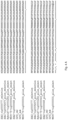
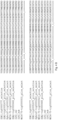
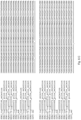
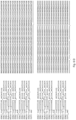
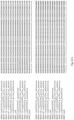
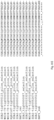
- said functional genes encode ILV2 of ZDA1, ZDA2 and/or ZDA3, wherein the sequences of ILV2 of ZDA1, ZDA2 and/or ZDA3 are provided in figure 4 .
- the yeast strain has at the most two functional genes encoding ILV2, wherein each gene encoding ILV2 encodes SclLV2 of SEQ ID NO: 32 or SelLV2 of SEQ ID NO: 38, or a functional homologue sharing at least 80% sequence identity herewith; at least four functional genes encoding ILV3, such as at least five functional genes encoding ILV3, such as at least six functional genes encoding ILV3, wherein each gene encoding ILV3 encodes ScILV3 of SEQ ID NO: 35 or SelLV3 of SEQ ID NO: 41, or a functional homologue sharing at least 80% sequence identity herewith; and at least three functional genes encoding ILV5, such as at least four functional genes encoding ILV5, such as at least five functional genes encoding ILV5, wherein each gene encoding ILV5 encodes ScILV5 of SEQ ID NO: 34 or SelLV5 of SEQ ID NO: 40, or a functional homologue sharing at least 80% sequence identity herewith.
- the yeast strain has at the most two functional genes encoding ILV2, wherein each gene encoding ILV2 encodes ScILV2 of SEQ ID NO: 32 or SelLV2 of SEQ ID NO: 38 or a functional homologue of any of the aforementioned sharing at least 80%, such as at least 85%, such as at least 90%, such as at least 95%, such as at least 98% sequence identity therewith; and in the range of 5 to 9 functional genes encoding ILV3, such as at in the range of 5 to 7, such as 6 functional genes encoding ILV3, wherein each gene encoding ILV3 encodes ScILV3 of SEQ ID NO: 35 or SelLV3 of SEQ ID NO: 41 or a functional homologue of any of the aforementioned sharing at least 80%, such as at least 85%, such as at least 90%, such as at least 95%, such as at least 98% sequence identity therewith; and in the range of 4 to 8 functional genes encoding ILV5, such as in the range of 4 to 6, such as 5 functional
- the Saccharomyces pastorianus yeast strain has at the most four genes encoding functional ILV6, for example in the range of two to four genes encoding functional ILV6, wherein each gene encoding ILV6 encode SclLV6 of SEQ ID NO: 33 or a functional homologue sharing at least 80%, such as at least 85%, such as at least 90%, such as at least 95%, such as at least 98% sequence identity therewith, or encode SelLV6 of SEQ ID NO: 39 or a functional homologue sharing at least 80%, such as at least 85%, such as at least 90%, such as at least 95%, such as at least 98% sequence identity therewith.
- the Saccharomyces pastorianus yeast strain has at least two genes encoding functional ILV5, such as at least four genes encoding functional ILV5, such as at least five genes encoding functional ILV5, wherein the each gene encoding ILV5 encodes ScILV5 of SEQ ID NO: 34 or a functional homologue sharing at least 80%, such as at least 85%, such as at least 90%, such as at least 95%, such as at least 98 up to 99% sequence identity herewith, or encodes SelLV5 of SEQ ID NO: 40 or a functional homologue sharing at least 80%, such as at least 85%, such as at least 90%, such as at least 95%, such as at least 98% up to 99% sequence identity herewith.
- the Saccharomyces pastorianus yeast strain has at the most 20 genes, such as at the most 15 genes, such as at the most 10 allelic genes encoding functional ILV5, wherein the gene encoding functional ILV5 may be any of the aforementioned. In some embodiments, the Saccharomyces pastorianus yeast strain has in the range of 5 to 20 allelic genes, such as 5 to 15 allelic genes, such as 5 to 10 genes encoding functional ILV5, wherein the gene encoding functional ILV5 may be any of the aforementioned.
- the yeast strain has in the range of 4 to 8 functional genes encoding ILV5, such as in the range of 4 to 6, such as 5 functional genes encoding ILV5, wherein each gene encoding ILV5 encodes ScILV5 of SEQ ID NO: 34 or SeILV5 of SEQ ID NO: 40 or a functional homologue of any of the aforementioned sharing at least 80%, such as at least 85%, such as at least 90%, such as at least 95%, such as at least 98% sequence identity therewith.
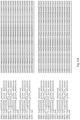
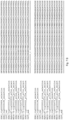
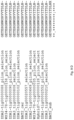
- the yeast strain has in the range of 4 to 8 functional genes encoding ILV5, such as in the range of 4 to 6, such as 5 functional genes encoding ILV5, wherein each gene encode ILV5 of ZDA1, ZDA2 and/or ZDA3, wherein the sequences of ILV5 of ZDA1, ZDA2 and/or ZDA3 are given in figure 7 .
- the Saccharomyces pastorianus yeast strain has at least three genes encoding functional ILV3, such as at least four genes encoding functional ILV3, for example as at least six genes encoding functional ILV3, wherein each gene encoding functional ILV3 encodes ScILV3 of SEQ ID NO: 35 or a functional homologue sharing at least 80%, such as at least 85%, such as at least 90%, such as at least 95%, such as at least 98% up to 99% sequence identity herewith, or encodes SelLV3 of SEQ ID NO: 41 or a homologue sharing at least 80%, such as at least 85%, such as at least 90%, such as at least 95%, such as at least 98% up to 99% sequence identity herewith.
- the Saccharomyces pastorianus yeast strain has at the most 20 allelic genes, such as at the most 15 allelic genes, such as at the most 10 allelic genes encoding ILV3, wherein each gene encoding functional ILV3 may be any of the aforementioned. In some embodiments, the Saccharomyces pastorianus yeast strain has in the range of 5 to 20 allelic genes, such as 5 to 15 allelic genes, such as 5 to 10 genes encoding functional ILV3, wherein the gene encoding functional ILV3 may be any of the aforementioned.
- the yeast of the invention has in the range of 5 to 9 functional genes encoding ILV3, such as at in the range of 5 to 7, such as 6 functional genes encoding ILV3, wherein each gene encoding ILV3 encodes ScILV3 of SEQ ID NO: 35 or SeILV3 of SEQ ID NO: 41 or a functional homologue of any of the aforementioned sharing at least 80%, such as at least 85%, such as at least 90%, such as at least 95%, such as at least 98% sequence identity therewith.
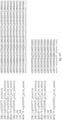
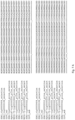
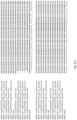
- the yeast of the invention has in the range of 5 to 9 functional genes encoding ILV3, such as at in the range of 5 to 7, such as 6 functional genes encoding ILV3, wherein each gene encode ILV3 of ZDA1, ZDA2 and/or ZDA3, wherein the sequences of ILV3 of ZDA1, ZDA2 and/or ZDA3 are given in figure 6 .
- the Saccharomyces pastorianus yeast strain has at least three genes encoding functional BAT1, such as at least four genes encoding functional BAT1, for example at least five genes encoding functional BAT1, wherein each gene encoding functional BAT1 encodes ScBAT1 of SEQ ID NO: 36 or a functional homologue sharing at least 80%, such as at least 85%, such as at least 90%, such as at least 95%, such as at least 98% up to 99% sequence identity herewith, or encodes SeBAT1 of SEQ ID NO: 42 or a functional homologue sharing at least 80%, such as at least 85%, such as at least 90%, such as at least 95%, such as at least 98% up to 99% sequence identity herewith.
- the Saccharomyces pastorianus yeast strain has at the most 20 genes, such as at the most 15 genes, such as at the most 10 genes encoding BAT1, wherein each gene encoding BAT1 may be any of the aforementioned. In some embodiments, the Saccharomyces pastorianus yeast strain has in the range of 5 to 20 allelic genes, such as 5 to 15 allelic genes, such as 5 to 10 allelic genes encoding functional BAT1, wherein each allelic gene encoding functional BAT1 may be any of the aforementioned.
- the Saccharomyces pastorianus yeast strain has at least four genes encoding functional BAT2, such as at least five genes encoding functional BAT2, for example at least six genes encoding functional BAT2, wherein each gene encoding functional BAT2 encodes ScBAT2 of SEQ ID NO: 37 or a functional homologue sharing at least 80%, such as at least 85%, such as at least 90%, such as at least 95%, such as at least 98% up to 99% sequence identity herewith, or encodes SeBAT2 of SEQ ID NO: 43 or a functional homologue sharing at least 80%, such as at least 85%, such as at least 90%, such as at least 95%, such as at least 98% up to 99% sequence identity herewith.
- the Saccharomyces pastorianus yeast strain has at the most 20 genes, such as at the most 15 genes, such as at the most 10 genes encoding functional BAT2, wherein the gene encoding functional BAT2 may be any of the aforementioned. In some embodiments, the Saccharomyces pastorianus yeast strain has in the range of 5 to 20 genes, such as 5 to 15 genes, such as 5 to 10 genes encoding functional BAT2, wherein each gene encoding functional BAT2 may be any of the aforementioned.
- the Saccharomyces pastorianus yeast strain carries a mutation in or a deletion of one or more ILV2 genes.
- the Saccharomyces pastorianus yeast strain carries a frameshift mutation in one or more ILV2 genes.
- the Saccharomyces pastorianus yeast strain carries a mutation resulting in lower or no expression of one or more ILV2 genes.
- the Saccharomyces pastorianus yeast strain carries a mutation in or a deletion of one or more ILV6 genes.
- the Saccharomyces pastorianus yeast strain carries a frameshift mutation in one or more ILV6 genes.
- the Saccharomyces pastorianus yeast strain carries a mutation resulting in lower or no expression of one or more ILV6 genes.
- the sum of the genes encoding functional ILV2 and functional ILV6 is lower than the sum of the genes encoding functional ILV5 and functional ILV3, wherein said functional ILV2, ILV6, ILV3 and ILV5 may be any of the aforementioned. In some embodiments of the present invention, the sum of the genes encoding functional ILV2 is lower than the sum of the genes encoding functional ILV5 and functional ILV3, wherein said functional ILV2, ILV5 and ILV3 may be any of the aforementioned.
- the sum of the genes encoding functional ILV2 and functional ILV6 is lower than the sum of the genes encoding functional ILV5, functional ILV3, functional BAT1 and functional BAT2, wherein said functional ILV2, ILV6, ILV3, ILV5; BAT1 and BAT2 may be any of the aforementioned.
- the sum of the genes encoding ILV5 and ILV3 is higher than the sum of the genes encoding ILV2 and ILV6.
- the sum of the genes encoding ILV5 and ILV3 is higher than the sum of the genes encoding ILV2, ILV6, BAT1 and BAT2.
- the gene ratio of ILV5 and ILV3 genes vs. ILV2 genes is at least 1, such as at least 1.5, such as at least 2, such as at least 2.5, such as at least 3, wherein said ILV2 , ILV5 and ILV3 genes encodes any of the aforementioned functional ILV2, ILV5 and ILV3, respectively.
- the gene ratio of ILV5 and ILV3 genes vs. ILV2 and ILV6 genes is at least 1, such as at least 1.2, such as at least 1.4, such as at least 1.6, such as at least 1.8 or such as at least 2, wherein said ILV2, ILV6 , ILV5 and ILV3 genes encodes any of the aforementioned functional ILV2, ILV6, ILV5 and ILV3, respectively.
- the gene ratio of ILV5, ILV3, BAT1 and BAT2 vs. ILV2 is at least 1, such as at least 1.5, such as at least 2, such as at least 2.5, such as at least 3, such as at least 4, such as at least 5, such as at least 6, wherein said ILV2, ILV5, ILV3, BAT1 and BAT2 genes encode any of the aforementioned functional ILV2, ILV5, ILV3, BAT1 and BAT2 respectively.
- the gene ratio of ILV5, ILV3, BAT1 and BAT2 vs. ILV2 and ILV6 is at least 1, such as at least 1.5, such as at least 2, such as at least 2.5, such as at least 3, such as at least 4, wherein said ILV2, ILV6, ILV5, ILV3, BAT1 and BAT2 genes encodes any of the aforementioned functional ILV2, ILV6, ILV5, ILV3, BAT1 and BAT2 respectively.
- the invention provides Saccharomyces pastorianus yeast strains described in the section with the heading "yeast strain” above, as well as methods of preparing malt and/or cereal based fermented aqueous extract, using said yeast strains.
- the aqueous extract may be any aqueous extract of malt and/or cereal kernels.
- a non-limiting example hereof is wort.
- the aqueous extract may for example be prepared by preparing an extract of malt by mashing and optionally sparging as described herein in this section below.
- Malt is cereal kernels, such as barley kernels, that have been malted.
- malting is to be understood a process involving steeping and germination of kernels in a process taking place under controlled environmental conditions, optionally followed by a drying step.
- Said drying step may preferably be kiln drying of the germinated kernels at elevated temperatures.
- Green malt, which has not been subject to kilning may also be used, in particular malt obtained by the process described in WO 2018/001882 .
- Malting is important for the synthesis of numerous enzymes that cause kernel modification, processes that principally depolymerize starch and cell walls of the dead endosperm to mobilize the kernel nutrients and activate other depolymerases.
- flavour and colour are generated at least partly due to chemical browning reactions.
- Steeping may be performed by any conventional method known to the skilled person.
- One non-limiting example involves steeping at a temperature in the range of 10°C to 25°C with alternating dry and wet conditions.
- Germination may be performed by any conventional method known to the skilled person.
- One non-limiting example involves germination at a temperature in the range of 10 to 25°C, optionally with changing temperature in the range of 1 to 4 h.
- Steeping and germination may also be performed in a combined method, e.g. as described in international patent application WO 2018/001882 .
- the kiln drying may be performed at conventional temperatures, such as at least 75°C, for example in the range of 80 to 90°C, such as in the range of 80 to 85°C.
- the malt may, for example be produced by any of the methods described by Briggs et al. (1981) and by Hough et al. (1982).
- any other suitable method for producing malt may also be used with the present invention, such as methods for production of specialty malts, including, but not limited to, methods of roasting the malt.
- Malt may be further processed, for example by milling. Milling can be performed in a dry state, i.e. the malt is milled while dry or in a wet state if green malt is used.
- the malt e.g. the milled malt may be mashed to prepare an aqueous extract of said malt.
- the starting liquid for preparing the beverage may be an aqueous extract of malt, e.g. an aqueous extract of malt prepared by mashing.
- the method for preparing a malt and/or cereal based fermented aqueous extract according to the invention may comprise a step of producing an aqueous extract, such as wort, by mashing malt and optionally additional adjuncts.
- Said mashing step may also optionally comprise sparging, and accordingly said mashing step may be a mashing step including a sparging step or a mashing step excluding a sparging step.
- the production of the aqueous extract is initiated by the milling of malt and/or kernels. If additional adjuncts are added, these may also be milled depending on their nature. If the adjunct is a cereal, it may for example be milled, whereas syrups, sugars and the like will generally not be milled. Milling will facilitate water access to kernel particles in the mashing phase. During mashing enzymatic depolymerization of substrates initiated during malting may be continued.
- the aqueous extract is prepared by combining and incubating milled malt and water, i.e. in a mashing process.
- the malt/liquid composition may be supplemented with additional carbohydrate-rich adjunct compositions, for example milled barley, maize, or rice adjuncts.
- additional carbohydrate-rich adjunct compositions for example milled barley, maize, or rice adjuncts.
- Unmalted cereal adjuncts usually contain little or no active enzymes, making it important to supplement with malt or exogenous enzymes to provide enzymes necessary for polysaccharide depolymerization etc.
- milled malt and/or milled kernels - and optionally additional adjuncts are incubated with a liquid fraction, such as water.
- the incubation temperature is in general either kept constant (isothermal mashing), or gradually increased, for example increased in a sequential manner. In either case, soluble substances in the malt/kernel/adjuncts are liberated into said liquid fraction.
- a subsequent filtration confers separation of the aqueous extract and residual solid particles, the latter also denoted "spent kernel”.
- the aqueous extract thus obtained may also be denoted "first wort”.
- Additional liquid, such as water may be added to the spent kernels during a process also denoted sparging. After sparging and filtration, a "second wort" may be obtained. Further worts may be prepared by repeating the procedure. Non-limiting examples of suitable procedures for preparation of wort is described by Briggs et al. (1981) and Hough et al. (1982).
- the aqueous extract may also be prepared by mashing only unmalted kernels.
- Unmalted kernels lack or contain only a limited amount of enzymes beneficial for wort production, such as enzymes capable of degrading cell walls or enzymes capable of depolymerising starch into sugars.
- enzymes capable of degrading cell walls or enzymes capable of depolymerising starch into sugars such as enzymes capable of degrading cell walls or enzymes capable of depolymerising starch into sugars.
- one or more suitable, external brewing enzymes are added to the mash
- Suitable enzymes may be lipases, starch degrading enzymes (e.g.
- amylases glucanases [preferably (1-4)- and/or (1-3,1-4)- ⁇ -glucanase], and/or xylanases (such as arabinoxylanase), and/or proteases, or enzyme mixtures comprising one or more of the aforementioned enzymes, e.g. Cereflo, Ultraflo, or Ondea Pro (Novozymes).
- the aqueous extract obtained after mashing may also be referred to as "sweet wort".
- sweet wort is boiled with or without hops where after it may be referred to as boiled wort.
- the aqueous extract may be heated or boiled before it is subjected to fermentation with the yeast of the invention.
- second and further worts may be combined, and thereafter subjected to heating or boiling.
- the aqueous extract may be heated or boiled for any suitable amount of time, e.g. in the range of 60 min to 120 min.
- the outcome of the malt and/or cereal based fermented aqueous extract is highly dependent on the amount and type of fermentable sugars present in the aqueous extract of malt and/or cereal kernels, as well as the characteristics of the yeast strain used during fermentation.
- said aqueous extract has an apparent extract of at least 12° Plato, such as at least 15° Plato, such as in the range of 5-15° Plato, such as in the range of 10-20° Plato, such as in the range of 15-25° Plato.
- said aqueous extract is fermented with said yeast strain for at the most 6 days, such as for the most 5 days, such as for the most 4 days, such as for the most 3 days.
- yeast strains of the present invention may be that they are useful for fermentation of wort with low levels of amino acids.
- said aqueous extract comprises at the most 3500 mg/L, such as at the most 3000 mg/L, for example at the most 2500 mg/L amino acids.
- the aqueous extract e.g. wort
- the malt and/or cereal based fermented aqueous extract may be prepared by fermentation of said aqueous extract with said yeast strain according to the invention.
- said fermented aqueous extract is a green beer.
- alcoholic fermented aqueous extracts - such as beer - may be manufactured from malted and/or unmalted kernels.
- Malt in addition to hops and yeast, contributes to flavor and color of the beverage, such as beer.
- malt functions as a source of fermentable sugar and enzymes.
- suitable methods for malting and brewing can be found, for example, in publications by Briggs et al. (1981) and Hough et al. (1982).
- the first step of producing beer from wort preferably involves heating said wort as described herein above, followed by a subsequent phase of wort cooling and optionally whirlpool rest.
- the methods of the invention comprises a step of fermenting an aqueous extract of malt and/or cereal kernels with the yeast strain according to the invention.
- Said fermentation may be a fermentation of an unfermented aqueous extract or a fermented aqueous extract still containing fermentable sugars for the yeast.
- said fermentation may be performed essentially immediately after completion of mashing or after heating of wort.
- Fermentation may be performed in fermentation tanks containing yeast according to the invention, i.e. yeast having one or more of the characteristics described herein above.
- flavour substances are developed. If the yeast strain is not capable of converting specific compounds, these will still be present after the fermentation step iii).
- the fermentation step iii) occurs at any of the temperatures specified below, wherein the aqueous extract has been incubated with any of the numbers of yeast cells as described below, wherein the fermented aqueous extract contains a maximum level of diacetyl as described below, and where fermentation is complete after a maximum of 5 days, such as a maximum of 4 days, such as a maximum of 3 days. In particular, fermentation is complete after a maximum of 4 days.
- the fermentation using a yeast strain of the invention is complete and the diacetyl is below 60 ppb, such as 50 ppb at least 12 hours, such as at least 24 hours earlier than a fermentation conducted with W-34/78 yeast strain under the same conditions.
- Aforementioned fermentation is preferably performed at a temperature of at the most 18 °C, such as at a temperature of in the range of 12°C to 18 °C.
- said fermentation may be performed at a temperature of approx. 16 °C.
- Said maximal level of diacetyl is preferably at the most 60 ppb diacetyl, such as at the most 55 ppb diacetyl, such as at the most 50 ppb diacetyl, for example at the most 45 ppb diacetyl when fermentation is complete.
- said level of diacetyl at completion of fermentation is at the most 60 ppb.
- Aforementioned fermentation is preferably performed by incubating the aqueous extract with at least 6 million viable yeast cells per millilitre, such as at least 10 million viable yeast cells per millilitre, such as at least 14 million viable yeast cells per millilitre, such as in the range of 7-8 million viable yeast cells per millilitre, for example in the range of 14-16 million viable yeast cells per millilitre.
- said fermentation may be performed by incubating the aqueous extract with approx. 15 million yeast cells per millilitre.
- said fermented aqueous extract has an alcohol content of at least 4% ABV, such as at least 5% ABV, such as at least 6% ABV, such as at least 7% ABV.
- said fermented aqueous extract contains at least 25 mg/L propanol, such as at the least 30 mg/L propanol.
- said fermented aqueous extract contains at the most 8 mg/L isobutanol, such as at the most 7 mg/L isobutanol, such as at the most 6 mg/L isobutanol.
- said fermented aqueous extract contains a beneficial propanol:isobutanol ratio.
- the propanol:isobutanol ratio may be at least 1.5, such as at least 2.0, such as at least 2.5, such as at least 3.0, such as at least 3.5, such as at least 4.0, such as at least 4.5, such as at least 5.0, such as at least 5.5, such as at least 6.0, such as at least 6.5.
- a fermented aqueous extract obtained with a yeast of the invention has a real degree of fermentation (RDF) that is at least 1.5%, such as 2% lower at the same % ABV than a fermentation conducted with the W-34/78 yeast strain or yeast strain Hybrid yeast 7 under the same conditions.
- RDF real degree of fermentation
- the malt and/or cereal based fermented aqueous extract described herein above may be further processed into a beverage.
- the malt and/or cereal based beverage is diluted with a liquid, such as water.
- water can be used to dilute the malt and/or cereal based beverage and thereby adjust e.g. the ethanol content.
- the proportions of water:malt and/or cereal based beverage may be in the range of 0.1 to 5 parts water to 1 part malt and/or cereal based beverage.
- the further process may for example also include chilling and/or filtering of the malt and/or cereal based beverage. Also additives may be added. Furthermore, CO 2 may be added. Finally, the malt and/or cereal based beverage, such as a beer, may be pasteurized and/or filtered, before it is packaged (e.g. bottled or canned).
- the beverage is a beer.
- the malt and/or cereal based beverage, produced by fermenting the aqueous extract with said yeast strain according to the present invention has a pleasant taste.
- the taste of the malt and/or cereal based beverage produced by fermentation with the yeasts according to the invention may be analyzed, for example, by a specialist beer taste panel.
- said panel is trained in tasting and describing beer flavors, with special focus on aldehydes, papery taste, old taste, esters, higher alcohols, fatty acids and sulphury components.
- the taste panel will consist of in the range of 3 to 30 members, for example in the range of 5 to 15 members, preferably in the range of 8 to 12 members.
- the taste panel may evaluate the presence of various flavours, such as papery, oxidized, aged, and bready off-flavours as well as flavours of esters, higher alcohols, sulphur components and body of beer.
- the overall taste of the beer will generally be rated by the taste panel on several different characteristics on a scale from 1 to 9, where an average rating of over 5 signifies that the beer has an acceptable taste.
- the present invention also provides malt and/or cereal based beverages, prepared by the methods described above.
- the beverage contains at least 25 mg/L propanol, such as at least 30 mg/L propanol.
- the beverage contains at the most 8 mg/L isobutanol, such as at the most 6 mg/L isobutanol.
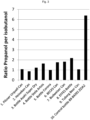
- a fermented aqueous extract or a beverage prepared using the yeast strains of the invention will have a specific ratio of propanol:isobutanol, for example a ratio similar to the ratios shown in figure 2 .
- a fermented aqueous extract or a beverage has this specific ratio of propanol:isobutanol, it is an indication that the fermented aqueous extract or a beverage has been produced by fermentation with a yeast strain of the invention.
- said propanol:isobutanol ratio may be at least 1.5, such as at least 2.0, such as at least 2.5, such as at least 3.0, such as at least 3.5, such as at least 4.0, such as at least 4.5, such as at least 5.0, such as at least 5.1, such as at least 5.2, such as at least 5.3, such as at least 5.4, such as at least 5.5, such as at least 6.0, such as at least 6.5.
- the invention may further be defined by the following items:
- the wort used in the experimental examples below was made by mashing 70% pilsner malt and 30% barley adjunct in 2.7 L of water/kg malt.
- the mashing regime was as shown in table 1 below: Table 1. Mashing regime for wort preparation. Temp (°C) at start Temp (°C) at end Time (min) Total time (min) Mashing in 52.0 52.0 5 5 Hold 52.0 15 20 Temp. increase 52.0 65.0 13 33 Hold 65.0 50 83 Temp. increase 65.0 72.0 7 90 Hold 72.0 20 100 Temp. increase 72.0 78.0 6 106 Hold 78.0 10 116
- Variations in this mashing regime can still produce a wort suitable for fermentation.
- the wort was boiled for 60 min. To ensure that the wort is suitable for fermentation it should preferably have contents within the following ranges: • Glucose 12-25 g/L • Maltose 60-80 g/L • Maltotriose 15-20 g/L • Zinc 0.16 to 0.18 mg/L • Free alpha amino nitrogen (FAN) 110-250 mg/L • Valine/FAN 0.6 to 0.8
- additional zinc may be added to the wort prior to fermentation as described in some of the examples below.
- Genomic DNA was prepared from diploid yeast strains and haploid spore clones using the MasterPure Genomic DNA purification kit from Epicentre. Concentrations of each final DNA preparation was adjusted to 50 ng/microliter DNA using Milli Q water. DNA was quantified using a NanoDrop 2000 Spectrophotometers (Thermo Scientific).
- the species-specific probes were designed to be identical apart from a single nucleotide, allowing a discrimination between the ILV2 alleles of S. eubayanus and S. cerevisiae type
- the species specific probe for S. cerevisiae has a T at nucleotide position 1515 in the S. cerevisiae ILV2 wild type sequence, whereas the species-specific probe for S. eubayanus has a C at nucleotide position 1515 in the S. eubayanus ILV2 wild type sequence.
- the following primers and probes were developed to distinguish between the S. eubayanus ILV2 allele and S. cerevisiae ILV2 allele: Target specific ILV2 primers that will amplify both S. cerevisiae and S. eubayanus ILV2 simultaneously:
- ddPCR was performed according to the instructions provided by the manufacturer.
- 5 ⁇ l of purified gDNA (5ng/ ⁇ l DNA concentration) of yeast strains was added to a 17- ⁇ l PCR mixture containing 11 ⁇ l 2x ddPCR Supermix for probes (No. dUTP; Bio-Rad), 900 nM target-specific PCR forward primer, 900 nM target-specific PCR reverse primer, 250 nM S. cerevisiae ILV2 allele specific probe and 250 nM S. eubayanus ILV2 allele specific probe.
- the reaction mixture was loaded onto the AutoDG Droplet Generator (Bio-Rad Laboratories) and droplet generation carried out according to the manufacturer's manual.
- the droplet emulsion was thermally cycled using standard PCR conditions: denaturation at 95 °C for 10 min, 40 cycles of PCR at 94 °C for 30 sec and 55 °C for 1 min, and a final extension at 98 °C for 10 min before storage of the microtiter plate at 8 °C.
- PCR amplification in droplets was confirmed using the QX200 Droplet Reader (Bio-Rad Laboratories) and the data was analysed using the software QuantaSoft (version v1.7, Bio-Rad Laboratories).
- the ratios between S. eubayanus and S . cerevisiae ILV2 were analysed directly on purified genomic DNA from each single spore clone. Some spore clones despite originating from the same parental yeast had different ILV2 genetic make-up. Some spore clones appear to have only 100% S. cerevisiae ILV2 genes the spore clone. Since most parental lager yeasts are tri- or tetraploid (Wahlter et al, 2014) it can be assumed that the 100 % S. cerevisiae ILV2 spore clones may have somewhere between 1-3 copies.
- Spiking was done such that each sample of 50 ng/microliter DNA was blended with S. eubayanus DNA of the same concentration 50 ng/microliter in a 50/50 ratio (10 microliter sample + 10 mictroliter S. eubayanus DNA).
- Droplet QPCR estimation method quantitatively reflects total ILV2 copies present but cannot reveal if there are some inactivated ILV2 alleles due to the presence of particular SNPs or frame shift mutations. Such mutations can first be detected by a subsequent genomic DNA sequencing by Sanger sequencing or Next generation sequencing.
- Beer fermentations were conducted in glass cylinders as described previously (Guiterrez et al., 2018). Fermentations were performed in 250 mL tall glass measuring cylinders (331 ⁇ 39 ⁇ 39 mm; Duran) containing 200 mL of Pilsner wort and sealed with an inverted glass beaker (Duran) on the top of the cylinder to enable escape of carbon dioxide and easy sampling access for analyses. Fermentations were performed with continuous stirring at 150 rpm using a magnetic bar on a stirring Variomag stirring platform at 16 °C inside a refrigerator (incubator cabinet of type TS 606-G/4-i).
- Yeast cell counts were estimated with a cellometer (https://www.nexcelom.com/applications/cellometer) and inoculated (pitched) at a rate of 15 million cells per ml wort and fermentation performance was monitored by measuring the weight loss resulting from metabolic CO 2 release. 10 ml samples were collected during the fermentation at day 2, 3 and 4 for diacetyl analyses. Samples were centrifuged at 1900 g for 10 min and supernatants were stored in a freezer at -20 °C until further use. Fermentations were considered completed when no further weight loss of the fermentation cylinders could be measured.
- Hybrid yeast 7 Saccharomyces pastorianus is a lager production strain and has a high flocculation allowing collection of the yeast at the end of fermentation without additional cooling.
- Hybrid yeast 7 is used as reference to the yeasts of the current invention.
- W-34/78 Saccharomyces pastorianus is a commercially available lager yeast strain from Weihenstephan Hefebank (info@hefebank-weihenstephan.de), Germany. This yeast is known to reduce diacetyl quite efficiently and it shows high flocculation, but still significantly less than the Hybrid yeast 7 strain when fermented in the wort described above. It is used as reference to the yeast of the current invention.
- W-34/78 is also referred to herein as WS34/78.
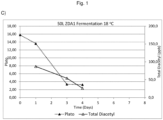
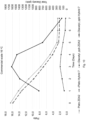
- Table 3 The results are shown in Table 3 and 4 below and plotted in Figure 1 A to C .
- Table 3. 50 L fermentation at 18 °C. Yeast Day Temp °C °Plato Diacetyl ppb pH Alcohol Vol% ZDA1 0 15.79 4.90 1 18.3 13.61 87 4.33 3 3.33 54 4 18.0 3.23 26 4.16 6.95 Hybrid yeast 7 0 15.78 4.90 1 17.9 13.6 489 4.45 3 3.06 137 4 17.7 3.01 56 4.05 7.02 Table 4. 50 L fermentation at 16 °C.
- a beer is said to be in spec. when the diacetyl level is below 50 ppb, and the Plato is stable (all fermentable sugar has been utilized). It is an advantage to get the beer in spec. at the shortest time possible, while producing at least a similar amount of alcohol as compared to the control yeast.
- yeast strain ZDA1 was able to produce a fermented wort (green beer) within three days where the diacetyl level was close to 50 ppb and at the same time all fermentable sugar present in the wort was utilized (which is evident by the drop in °Plato being less than 0.50 over 24h) when fermented at 18 °C.
- the control yeast strain Hybrid yeast 7 started with a very high diacetyl level ( Figure 1B ) and needed 4 days to reach a similar level of diacetyl as strain ZDA1 had on day 3.
- propanol and isobutanol levels were measured in final beer made from the 50 L trial beer.
- the final beer was adjusted to an alcohol content of 5.0% by volume, CO 2 to 5.1 g/L and bottled in 33 cl green bottles.
- propanol and isobutanol isobutanolis believed to be indicators of a restricted pathway flux within the branched chain amino acid pathway, in particular low ILV2 activity of the yeast, and is therefore a good way to assess whether a yeast strain has the potential to be a low diacetyl producer.
- a high propanol:isobutanol ratio is an indication of a low diacetyl producing yeast.
- Figure 3 shows the propanol per isobutanol ratio of commercial beers compared to a "control bottle 89-84393 ZDA2" beer produced using the ZDA2 yeast strain according to the invention.
- the "control bottle 89-84393 ZDA2” is produced at 50L trial and debrewed to 5%. All the commercial beers have lower propanol to isobutanol ratio.
- yeast hybrid strains with favourable diacetyl profiles were identified and compared with strain ZDA1 of example 1.
- 50 L beer was prepared from a wort as described in the materials and methods section with a °Plato of 16. Prior to fermentation the wort was adjusted to a pH of 4.9 and zinc was added to a final concentration of 0.30 mg/L. The wort was inoculated with 14 million viable yeast cells per ml of wort. The yeast for inoculation was obtained from a 50 L first fermentation, where the yeast cells were harvested at the end of fermentation and used to re-pitch a second 50 L fermentation trial. This resembles the way large scale beer production is done. Fermentation was performed at 16 °C.
- the fermented wort obtained in example 2 was further processed to final beers by adjusting the alcohol content to 5% by volume, CO 2 to 5.1 g/L and bottled in standard Danish green 33 cl bottles.
- the beers were evaluated by a specialist beer taste panel, consisting of 10 tasters. Each taste panel member was extensively trained, in particular each member was skilled in evaluating the taste properties of esters, higher alcohols, sulfur components and the body of beer. Each taste panel member evaluated different flavor notes. In particular, the overall taste was evaluated on a scale from 1 to 9 and provided as the "Main result" in Table 7 below. Table 7.
- Sample name First fermentation Main result ZDA1 6.1 Satisfactory ZDA2 5.7 Satisfactory ZDA3 5.8 Satisfactory
- the purpose of this example was to investigate whether the hybrid yeast strain ZDA1 exhibited the same advantageous diacetyl profile as observed at 50 L scale in example 1.
- 10 HL beer was prepared from a wort as described in the materials and methods section with a °Plato of approx. 16. Prior to fermentation the wort was adjusted to a pH of 4.95 and zinc was added to a final concentration of 0.8 mg/L. The wort was inoculated with at least 15 million viable yeast cells per mL wort of the hybrid yeast strains ZDA1 or the control lager yeast strain Hybrid yeast 7, followed by fermentation at approx. 16 °C. The yeast for inoculation was obtained from a first brew as described in example 2.
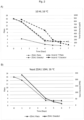
- Yeast strain ZDA1 produces a quite low initial level of diacetyl and the green beer obtained with hybrid yeast strains ZDA1 reached close to the taste threshold of diacetyl (50 ppb) on day 4 and on day 5 it was down to 28 ppb.
- Figure 2B shows that the total diacetyl level in green beer obtained with the yeast hybrid ZDA1 is close to 50 ppb approximately at the same time as the fermentable sugars are close to complete fermentation, i.e. at day 4.
- the fermented wort obtained in example 4 was further processed to final beer by adjusting the alcohol content to 4.6% by volume, CO 2 to 5.4 g/L and bottled in 33 cl amber bottles.
- the beers were evaluated by a specialist beer taste panel bot in Denmark and in France, consisting of 10 tasters. Each taste panel member was extensively trained, in particular each member was skilled in evaluating the taste properties of esters, higher alcohols, sulfur components and the body of beer. Each taste panel member evaluated different flavor notes. In particular, the overall taste was evaluated on a scale from 1 to 9 and provided as the "Main result" in Table 9 below. Table 9.
- Sample name Main result ZDA1 6.6 Satisfactory Hybrid yeast 7 6.4 Satisfactory
- Wort was fermented at approx. 16 °C. Samples were obtained at day 1 and the days indicated in the results table below. The results are shown in table 10. Table 10. 40 L fermentation at 16°C. Yeast Day Temp °C % Plato Diac etyl ppb pH Cells in liquid (million / ml) Alcoh ol Vol% Propan ol Iso-propan ol Hybrid yeast 7 1 15.7 15.54 88 4.71 2 16.5 12.78 431 4.45 3 869 4 520 5 16.4 2.49 265 4.02 6 16.5 2.45 115 4.05 0.8 7 2.37 57 4.09 8 44 7.35 11.02 9.57 W-34/78 1 14.5 15.4 176 4.64 2 16.1 12.54 470 4.33 3 485 4 286 5 16.3 2.97 150 4.1 6 16.2 2.68 62 4.15 7 15.4 2.63 41 4.19 17 8 33 7.2 11.08 9.85 ZDA1 1 15.6 15.26 89 4.69 2 16.3 12.24 166 4.38
- the examples described herein therefore provide yeast strains which are capable of reducing diacetyl to less than 50 ppb approximately at the same time where the fermentable sugars have been consumed (or even before that) and at the same time does not require any additional cooling of the green beer to harvest the yeast for the next beer production due to their high flocculation at 16°C.
- the resulting assembled genomes were used in the BLAST queries.
- the ploidy identification analysis has been carried out by deploying a modified version of the spplDer algorithm. Short reads of Illumina platform of four out of five genomes were mapped to a combination reference genome of S. cerevisiae and S. eubayanus and reads with a mapping quality (MQ) >3 were retained and sorted into the combination reference genome order; then, coverage across the combination reference genome was computed. A custom script then calculated the mean coverage for each species, and the combination reference genome broken into windows.
- MQ mapping quality
- the number in the brackets is the mode ploidy of the chromosome.
- the number without the brackets is the ploidy of the gene location on that chromosome.
- Example 8 Commercial scale brewing trial with yeast strain ZDA2 and comparative strain Hybrid yeast 7
- the purpose of this example was to investigate whether the hybrid yeast strain ZDA2 exhibited the same advantageous diacetyl profile as observed in the previous examples when applied in commercial scale brewing (approximately 1800 HL) where yeast is harvested and re-pitched.
- 1800 HL beer was prepared from a wort comprising malt and adjunct obtained by conventional infusion mashing and with a °Plato of approx. 16. Prior to fermentation the wort was adjusted to a pH of 4.9- 5.0. The wort was re-pitched with generation 8 of both the ZDA2 and control lager yeast strain Hybrid yeast 7, and fermented at approx. 16 °C. Samples were obtained at day 0 and at the days indicated in the results table 12 below and illustrated in Figure 10 . Table 12. 1800 HL fermentation at 16°C.
- Yeast strain ZDA2 produces a quite low level of diacetyl throughout the fermentation and the green beer obtained with hybrid yeast strain ZDA2 reached the taste threshold of diacetyl (50 ppb) already on day 6. At that time the plato had not decreased more than 0.5 the last 24 hours. The green beer obtained with the control yeast strain Hybrid yeast 7, had not reached the taste threshold for diacetyl at day 7, two days after the plato did not decrease more than 0.5 over 24 hours ( Figure 10 ). Consequently, the specifications for the green beer in terms of diacetyl and plato was reached at least 2 days earlier when using the ZDA2 yeast compared to the reference yeast Hybrid yeast 7.
- the ZDA2 yeast reached a real degree of fermentation (RDF) which was 2% lower than the Hybrid yeast 7, while the alcohol percentage is almost similar in the two green beers. Consequently, the ZDA yeast is capable of producing the same amount of alcohol with a lower real degree of fermentation, which will result in a beer with a better mouthfeel.
- RDF real degree of fermentation
- Raw sequencing Data were basecalled using bonito (https://github.com/nanoporetech/bonito) and demultiplexed using guppy (https://nanoporetech.com/nanopore-sequencing-data-analysis).
- Hybrid-Genome assemblies were carried out using Marsurca (https://github.com/alekseyzimin/masurca) in combination with the Nanopore and Illumina fastq files and the assembled genomes were annotated with prokka. ( https://github.com/tseemann/prokka ).
- Read mapping and SNP detection was performed in CLC Genomics work Bench (version 11). Briefly, trimmed reads were mapped to an "in silico" yeast hybrid genome which comprised a concatenation of the S . eubayanus (Accession: GCA_0012986.25.1) and S . cerevisiae (GCA_000146045.2) genomes. Using the basic variant detection tool, single-nucleotide polymorphisms (SNP's) and insertions/deletions (indels) were detected. Here, the functional copy number of ILV2 genes could be estimated based upon diagnostic SNP's which existed on single alleles within the ZDA yeast.
- Cere refers to Cerevisiae alleles and Eub refers to Euybanus alleles.
- Functional copy number - ZDA1 Functional copy number - ZDA2 Functional copy number - WS3478 ILV2_Cere 2 2 2 ILV2_Eub 0 0 2 ILV3_Cere 4 4 2 ILV3_Eub 2 2 2 ILV5_Cere 3 3 1 ILV5_Eub 2 2 2 ILV6_Cere 2 2 1 IIV6_Eub 2 2 3 BAT1_Cere 3 3 4 BAT1_Eub 2 2 2 BAT2_Cere 4 4 2 BAT2_Eub 2 2 3
- the reference WS3478 strain has 4 functional copies of the ILV2 gene, while ZDA1 and ZDA2 each only have 2 functional copies of this gene.
- WS3478 has 4 functional copies of ILV3 and 3 functional copies of ILV5, while this number is 6 and 5, respectively, for the ZDA1 and ZDA2 strains.
- the overall goal of this experiment was to adjust copy numbers of relevant genes in a model yeast strain ( Saccharomyces pastorianus ssp. carlsbergensis strain (WS34/78) to mirror the genotype of ZDA1 and ZDA2.
- WS34/78 is commercially available from Weihenstephan, Germany and is also referred to as W-34/78 herein.
- genes in strain WS34/78 had to be either inactivated or additionally expressed according to Table 15.
- Table 15 Necessary alterations in the genotype of strain WS34/78 to mirror the relevant genotype of low diacetyl strains of interest Gene Allele Alteration ILV2 S. eubayanus -2 Copies ILV3 S. cerevisiae +2 Copies ILV5 S. cerevisiae +2 Copies
- Inactivation was done with the help of resistance conferring antibiotic-cassettes that targeted the coding sequences of the genes of interest (i.e. ILV2).
- the coding DNA sequence (cds) was looped out via homologous recombination in a way that only 99 bp of the N-terminal region, and 107 bp of the C-terminal region of the gene remained.
- Overexpression of genes i.e. ILV3 and ILV5 was done in a way that left the authentic genomic context intact, i.e. a cassette that comprised roughly 1 kbp upstream of the cds, the cds, and 0,5 kbp downstream of the cds was cloned.
- the cassette comprises the native promotor and terminator sequences, and expression of the additional gene copies is presumably under native control.
- a yeast single-copy plasmid was used so that the copy number was under control.
- Cells of Saccharomyces pastorianus ssp. carlsbergensis strain WS34/78 were made competent for DNA uptake following the method described by Gietz and Schiestel (DOI: 10.1038/nprot.2007.17). Routinely, cells were transformed with 1 ⁇ g of plasmid DNA or PCR-amplicon. The duration of the heat-shock treatment was reduced to 15 min while the temperature was kept at 42°C.
- expression cassettes were generated by PCR-amplification of the native WS34/78 DNA-sequences comprising roughly 1000 bp upstream of the cds and 500 bp downstream of the cds, thus comprising the native promotor and terminator sequences.
- the exact length of the amplicons can be deduced from the respective primer sequences given in the examples.
- the cds-flanking regions of 1000 bp, or 500 bp, should allow the authentic / native control of the genes of interest.
- the cloned PCR-amplicons (in plasmid / integrated in chromosome) were controlled by Sanger-DNA sequencing with isolated plasmid DNA as template for sequencing reactions.
- the expression cassette was assembled by fusing the gene expression module with an antibiotic resistance module that allows for positive selection of the integration event.
- the cassette was fused to PCR-amplicons that encode DNA-stretches for homologous recombination with the chromosome of WS34/78.
- the sites for integration was the PAD1 loci of WS34/78, as this gene is non-functional in this yeast, and the replacement of this gene thus has no effect on the flavor profile.
- the flanking regions used for homologous recombination had a length of roughly 500 bp.
- Yeast clones that grew in presence of the antibiotic were analyzed by PCR (i.e. colony PCR), to verify the insertion of the cassette. Positive clones were further analyzed for mutations in the expression module. Amplicons that cover the expression module were controlled by Sanger-DNA sequencing.
- Plasmid pYESVIII (BRAIN;) is an E.coli - Yeast shuttle vector that is replicated at high copy number in E. coli and maintained as a single copy plasmid in yeast cells due to the CEN6 ori of replication. Expression cassettes were routinely inserted in the multiple cloning site using Gibson-assembly.
- ILV3 genes For the expression of ILV3 genes from a plasmid, a tandem construct will be assembled (bi-cistronic expression).
- a single promotor governs the expression of the two ILV3 coding sequences (one native, one synthetic cds).
- the two coding sequences will be joined by a 2A-peptide linker that enables the ribosomal skipping, so that both cds are translated under control of the native ILV3 promotor.
- the 2A-peptide technology alters the C-terminus of the first protein by adding a 3 amino acid tag (NPG), while the N-terminus of the subsequent protein starts with a proline (Liu, Z. et al., 2017; DOI: 10.1038/s41598-017-02460-2).
- E. coli was transformed with the in vitro assembled plasmids, plasmids were isolated from transformants, controlled by restriction digest and DNA-sequencing, followed by transformation of competent WS34/78 cells. Table 16. Strains and plasmids used/constructed in the project. Subscript sc denotes Saccharomyces cerevisiae genes and eu denotes Saccharomyces eubayanus genes in the interspecies hybrid brewing yeast WS34/78. Strain ILV Genotype Manipulation / Adjustment Description #1 Native None (WT Strain) Saccharomyces pastorianus ssp.
- Plasmid pYES5-Cen6-Sh.ble (sc) 2.0 (BRAIN), encoding the Sh.ble cassette gDNA S. pastorianus WS34/78, strain #1 (Table. 16)
- the sh.ble-cassette (fragment 1) was amplified from plasmid pYES5-Cen6-Sh.ble ( Saccharomyces cerevisiae (sc)) 2.0 (BRAIN Biotech AG) using primers CPA43/44. Homology arms were generated by amplification of the ILV2 ( Saccharomyces eubayanus (se)) flanking regions from gDNA strain #1 with the allele-specific primers CPA49/51 (5'-flanking region; fragment 2) and CPA50/52 (3'-flanking region; fragment 3). The HR template was generated with the aid of overlap extension PCR using primers CPA49/50 and fragments 1 + 2 + 3 as template.
- Allele-specific knockout of ILV2 (se) via homologous recombination was assisted by BRAIN's proprietary NUCLEASE technology. This resulted in a number of strains which had single or double integrations at ILV2 (se) loci and was visible on an agarose gel. A strain with a double deletion of ILV2 (se) was chosen for downstream analysis.
- ILV3 (se) expression cassette product1 was amplified from gDNA strain #1 with allele-specific primers CPA70/71. Product1 was then further amplified with primers CPA70/129, resulting in product2. Amplification of NTC-expression cassette (products) was performed with primers CPA91/96 and NTC-DNA-String as template. Product4 was generated by amplification of products with primers CPA91/128. Products and product4 were assembled via NEBuilder ® HiFi DNA Assembly kit and amplified with primers CPA70/91 to create fragment1.
- Plasmid #0 (pYESVIII, BRAIN Biotech AG) was linearized using Pmel present in the multiple cloning site. Prior to purification the hydrolyzed vector was dephosphorylated.
- the native ILV5-expression cassette (sc) was amplified from WS34/78 gDNA using allele-specific primers CPA74/75. Vector insert was then generated by amplification of the resulting PCR product with primers CPA86/87.
- the ILV5-expression vector (plasmid #1) was assembled via NEBuilder ® HiFi DNA Assembly and E. coli DH10 ⁇ were transformed with the reaction product.
- Example 10 The purpose of this experiment was similar to Example 10, i.e. to generate further genetically modified WS34/78 yeast strains to adjust copy numbers of relevant genes to mirror the genotype of ZDA1 and ZDA2.
- the S. cerevisiae genes ILV3, BAT1, BAT2, and ILV6, alongside their native promoter and terminator regions were amplified from Weihenstephan 34/78 (W34/78) lager yeast using the primers SEQ ID no 67 to SEQ ID no 74 and Phusion ® High-Fidelity DNA Polymerase (New England BioLabs). Regions to target native promoter and terminator were selected approximately 1000 base pairs upstream of the start codon (promoter) and 400 base pairs downs stream of the stop codon (terminator) according to previous literature (Mumberg et al, 1995). Genomic DNA used as template for the PCR reactions was extracted from W34/78 yeast using the MasterPure Yeast DNA Purification Kit fact No MPY80200 from Lucigen.
- the pure PCR fragments were cloned into a centromeric single copy vector containing the kanMX G418 resistance marker.
- the genes were combined to create plasmids containing more than one gene.
- Pvull-HF New England BioLabs
- the linearized plasmid was then ligated with T7 DNA ligase (New England BioLabs) at 25 oC overnight.
- the ligated plasmid was transformed into NEB 5 ⁇ Escherichia coli competent cells (New England BioLabs) and plated on Lysogeny Broth (LB) agar plates containing ampicillin (100 ⁇ g/mL). This plasmid was then used as a backbone for the insertion of the genes of interest.
- the Pvull-HF digested vector and PCR-amplified inserts were assembled using NEBuilder ® HiFi DNA Assembly (New England BioLabs). A 3:1 ratio of insert to vector was used and the reaction was incubated at 50 oC for 60 minutes. The reaction was then transformed into NEB 5 ⁇ E. coli competent cells (New England BioLabs) and plated on LB agar plates containing ampicillin (100 ⁇ g/mL). Clones were grown on LB liquid medium with ampicillin (100 ⁇ g/mL) and the plasmid was extracted using the Monarch Plasmid MiniPrep Kit (New England BioLabs).
- Weihenstephan 34/78 and Strain #2 from example 10 (Weihenstephan 34/78 with two deleted S. eubayanus ILV2 gene copies also called WS34/78 [2x ILV2eu]:: Zeo R) yeasts were transformed with the plasmids via electroporation following the protocol outlined by Benatuil et al. 2010. Some minor modifications were made: the yeast was grown at 25 oC and recovered for 2-3 hours after electroporation, and the cells were plated on YPD agar plates containing geneticin G418 (200 ⁇ g/mL).
- yeasts generated in this study are shown in Table 17, below. Table 17.
- Yeasts generated by transformation of single copy plasmids Yeast strain name Yeast background Plasmid inserted FGMG100 W34/78 pSH67- ScILV3-ScBAT2 FGMO101 W34/78 pSH67- ScILV6 FGMO102 W34/78 pSH67- ScBAT2 FGMO103 W34/78 pSH67- ScILV3 FGMO104 W34/78 pSH67-no-insert (Empty) FGMO105 W34/78 pSH67 -ScILV3-ScBAT1 FGMG0095 WS34/78 [2x ILV2eu]:: Zeo R pSH67 -ScILV6 FGMO0096 WS34/78 [2x ILV2eu]:: Zeo R pSH67- ScILV3 FGMG0097 WS34/78 [2x ILV
- Strains were fermented in cylindrical vessels as previously described. Cells were grown overnight in 10ml of liquid YPD containing 25 ⁇ g/ml of gentamicin (G418) before being transferred to 20ml of the previously described pilsner wort containing 100 ⁇ g/ml of G418. Cell pitching was performed as previously described in pilsner wort containing 100 ⁇ g/ml of G418. Plato, Diacetyl and volatile measurements were made on Days 3, 4 and 5 of the fermentations. On day 5, carbohydrate profiles and ester profile samples were taken.
- yeast strain tested are shown in Table 18, below. Table 18. Genetically modified yeast created in examples 10 and 11 tested in this example. Strain Number Resistance feature Genotype Source FGMO 0092 G418 Resistant WS34/78 Plasmid 0 (pYESVIII; no insert) control WS34/78 FGMO 0093 G418 + Zeocin Resistant 2x ILV2eu KO:Zeocin insert, 1x ILV5cer pYESVIII copy Strain #2 from Example 10 FGMO 0094 G418 + Zeocin + Nourseothricin Resistant 2x ILV2eu KO:Zeocin insert, 1x ILV5cer pYESVIII copy, 1x ILV3eu insert: KO PDC1 Strain #2 from Example 10 FGMO 0095 G418 + Zeocin Resistant ⁇ Seu ILV2 Sc ILV6-G418 Strain #2 from Example 10 FGMO 0096 G418 +
- the genetically engineered strains of this example were fermented in the presence of antibiotics, and the results above might therefore be slightly different when the strains are fermented industrially without the presence of antibiotics.
- the strains will likely have faster growth rate, and fermentation will thus proceed faster.
- reduction of initially produced diacetyl is also expected to proceed faster.
- the strain with the lowest amount of total diacetyl in the test solution on day 5 was the strain with two copies of the ILV2 gene deleted, an extra copy of ILV3 genomically integrated and an extra copy of ILV5 expressed from a single-copy plasmid (FGMO0094).
Landscapes
- Life Sciences & Earth Sciences (AREA)
- Engineering & Computer Science (AREA)
- Chemical & Material Sciences (AREA)
- Health & Medical Sciences (AREA)
- Mycology (AREA)
- Organic Chemistry (AREA)
- Microbiology (AREA)
- Bioinformatics & Cheminformatics (AREA)
- Zoology (AREA)
- Wood Science & Technology (AREA)
- Genetics & Genomics (AREA)
- Biotechnology (AREA)
- General Health & Medical Sciences (AREA)
- General Engineering & Computer Science (AREA)
- Biochemistry (AREA)
- Botany (AREA)
- Medicinal Chemistry (AREA)
- Tropical Medicine & Parasitology (AREA)
- Virology (AREA)
- Biomedical Technology (AREA)
- Food Science & Technology (AREA)
- Micro-Organisms Or Cultivation Processes Thereof (AREA)
- Distillation Of Fermentation Liquor, Processing Of Alcohols, Vinegar And Beer (AREA)
- Toxicology (AREA)
- Organic Low-Molecular-Weight Compounds And Preparation Thereof (AREA)
Priority Applications (2)
| Application Number | Priority Date | Filing Date | Title |
|---|---|---|---|
| SI202130222T SI4172301T1 (sl) | 2020-06-30 | 2021-06-29 | Kvasovke z nizko vsebnostjo diacetila |
| RS20241167A RS66083B1 (sr) | 2020-06-30 | 2021-06-29 | Kvasac sa niskom produkcijom diacetila |
Applications Claiming Priority (2)
| Application Number | Priority Date | Filing Date | Title |
|---|---|---|---|
| EP20183134 | 2020-06-30 | ||
| PCT/EP2021/067882 WO2022002960A1 (en) | 2020-06-30 | 2021-06-29 | Low diacetyl yeast |
Publications (2)
| Publication Number | Publication Date |
|---|---|
| EP4172301A1 EP4172301A1 (en) | 2023-05-03 |
| EP4172301B1 true EP4172301B1 (en) | 2024-07-24 |
Family
ID=71409176
Family Applications (1)
| Application Number | Title | Priority Date | Filing Date |
|---|---|---|---|
| EP21737438.8A Active EP4172301B1 (en) | 2020-06-30 | 2021-06-29 | Low diacetyl yeast |
Country Status (21)
| Country | Link |
|---|---|
| US (1) | US20230323282A1 (sr) |
| EP (1) | EP4172301B1 (sr) |
| JP (1) | JP2023535281A (sr) |
| KR (1) | KR20230029635A (sr) |
| CN (1) | CN115997004A (sr) |
| AU (1) | AU2021299952A1 (sr) |
| BR (1) | BR112022025351A2 (sr) |
| CA (1) | CA3183042A1 (sr) |
| CO (1) | CO2022019173A2 (sr) |
| DK (1) | DK4172301T3 (sr) |
| ES (1) | ES2991537T3 (sr) |
| FI (1) | FI4172301T3 (sr) |
| LT (1) | LT4172301T (sr) |
| MX (1) | MX2022016582A (sr) |
| PE (1) | PE20231993A1 (sr) |
| PL (1) | PL4172301T3 (sr) |
| PT (1) | PT4172301T (sr) |
| RS (1) | RS66083B1 (sr) |
| SI (1) | SI4172301T1 (sr) |
| WO (1) | WO2022002960A1 (sr) |
| ZA (1) | ZA202212298B (sr) |
Families Citing this family (4)
| Publication number | Priority date | Publication date | Assignee | Title |
|---|---|---|---|---|
| US20230212487A1 (en) * | 2019-08-30 | 2023-07-06 | Carlsberg A/S | Yeast for Preparing Beverages Without Phenolic Off-Flavors |
| PE20260007A1 (es) | 2023-03-01 | 2026-01-06 | Carlsberg As | Cepas progenie de levaduras de bajo diacetilo |
| WO2026003169A1 (en) | 2024-06-26 | 2026-01-02 | Carlsberg A/S | Yeast strains producing high levels of hydrogen sulphide |
| WO2026003180A1 (en) | 2024-06-26 | 2026-01-02 | Carlsberg A/S | Yeast strains producing high levels of isoamyl acetate |
Citations (4)
| Publication number | Priority date | Publication date | Assignee | Title |
|---|---|---|---|---|
| WO2007020992A1 (en) | 2005-08-12 | 2007-02-22 | Suntory Limited | Dihydroxy-acid dehydratase gene and use thereof |
| WO2007097089A1 (en) | 2006-02-23 | 2007-08-30 | Suntory Limited | Gene encoding acetolactate synthase and use thereof |
| CN110846238A (zh) | 2019-11-28 | 2020-02-28 | 天津科技大学 | 一种低产双乙酰和高级醇的葡萄汁酵母菌株及其应用 |
| CN110951633A (zh) | 2019-11-28 | 2020-04-03 | 天津科技大学 | 一种过表达二羟异戊酸脱水酶的葡萄汁酵母菌株及其应用 |
Family Cites Families (12)
| Publication number | Priority date | Publication date | Assignee | Title |
|---|---|---|---|---|
| CA2602357A1 (en) * | 2005-09-13 | 2007-03-22 | Suntory Limited | Branched-chain amino acid aminotransferase gene and use thereof |
| JP2009165351A (ja) * | 2006-02-23 | 2009-07-30 | Suntory Liquors Ltd | アセト乳酸シンターゼをコードする遺伝子及びその用途 |
| US20090041889A1 (en) * | 2006-02-24 | 2009-02-12 | Suntory Limited | Gene Encoding Protein With Vicinal Diketone or Diacetyl-Reducing Activity and Use Thereof |
| CA2647327C (en) * | 2006-07-13 | 2016-02-23 | Dsm Ip Assets B.V. | Improved brewing process |
| WO2009078108A1 (en) * | 2007-12-17 | 2009-06-25 | Suntory Holdings Limited | Mutant ilv5 gene and use thereof |
| US9249420B2 (en) * | 2010-05-31 | 2016-02-02 | Vib Vzw | Isobutanol production using yeasts with modified transporter expression |
| JP2012217430A (ja) * | 2011-04-13 | 2012-11-12 | Asahi Breweries Ltd | 低vdk産生セルフクローニング酵母の造成 |
| EP2615159A1 (en) * | 2012-01-16 | 2013-07-17 | Anheuser-Busch InBev S.A. | Low alcohol or alcohol free fermented malt based beverage and method for producing it. |
| WO2013158749A2 (en) * | 2012-04-17 | 2013-10-24 | Gevo, Inc. | Engineered microorganisms with improved growth properties |
| EP3020801A4 (en) * | 2013-07-12 | 2017-01-18 | Ajinomoto Co., Inc. | YEAST WITH HIGH CONTENT OF Abu, upsilon-Glu-Abu, AND/OR UPSILON-Glu-Abu-Gly |
| CN115895804A (zh) | 2016-07-01 | 2023-04-04 | 嘉士伯酿酒有限公司 | 精制的基于谷物的饮料 |
| WO2020058914A1 (en) * | 2018-09-19 | 2020-03-26 | Danstar Ferment Ag | Expression of heterologous enzymes in yeast for reducing diacetyl and dextrin |
-
2021
- 2021-06-29 US US17/999,459 patent/US20230323282A1/en active Pending
- 2021-06-29 RS RS20241167A patent/RS66083B1/sr unknown
- 2021-06-29 WO PCT/EP2021/067882 patent/WO2022002960A1/en not_active Ceased
- 2021-06-29 JP JP2022580234A patent/JP2023535281A/ja active Pending
- 2021-06-29 SI SI202130222T patent/SI4172301T1/sl unknown
- 2021-06-29 FI FIEP21737438.8T patent/FI4172301T3/fi active
- 2021-06-29 ES ES21737438T patent/ES2991537T3/es active Active
- 2021-06-29 CN CN202180046508.3A patent/CN115997004A/zh active Pending
- 2021-06-29 DK DK21737438.8T patent/DK4172301T3/da active
- 2021-06-29 LT LTEPPCT/EP2021/067882T patent/LT4172301T/lt unknown
- 2021-06-29 BR BR112022025351A patent/BR112022025351A2/pt unknown
- 2021-06-29 AU AU2021299952A patent/AU2021299952A1/en active Pending
- 2021-06-29 PT PT217374388T patent/PT4172301T/pt unknown
- 2021-06-29 KR KR1020227043873A patent/KR20230029635A/ko active Pending
- 2021-06-29 PL PL21737438.8T patent/PL4172301T3/pl unknown
- 2021-06-29 CA CA3183042A patent/CA3183042A1/en active Pending
- 2021-06-29 EP EP21737438.8A patent/EP4172301B1/en active Active
- 2021-06-29 PE PE2022003046A patent/PE20231993A1/es unknown
- 2021-06-29 MX MX2022016582A patent/MX2022016582A/es unknown
-
2022
- 2022-11-10 ZA ZA2022/12298A patent/ZA202212298B/en unknown
- 2022-12-29 CO CONC2022/0019173A patent/CO2022019173A2/es unknown
Patent Citations (4)
| Publication number | Priority date | Publication date | Assignee | Title |
|---|---|---|---|---|
| WO2007020992A1 (en) | 2005-08-12 | 2007-02-22 | Suntory Limited | Dihydroxy-acid dehydratase gene and use thereof |
| WO2007097089A1 (en) | 2006-02-23 | 2007-08-30 | Suntory Limited | Gene encoding acetolactate synthase and use thereof |
| CN110846238A (zh) | 2019-11-28 | 2020-02-28 | 天津科技大学 | 一种低产双乙酰和高级醇的葡萄汁酵母菌株及其应用 |
| CN110951633A (zh) | 2019-11-28 | 2020-04-03 | 天津科技大学 | 一种过表达二羟异戊酸脱水酶的葡萄汁酵母菌株及其应用 |
Non-Patent Citations (10)
| Title |
|---|
| D. LIBKIND, C. T. HITTINGER, E. VALERIO, C. GONCALVES, J. DOVER, M. JOHNSTON, P. GONCALVES, J. P. SAMPAIO: "Microbe domestication and the identification of the wild genetic stock of lager-brewing yeast", PROCEEDINGS OF THE NATIONAL ACADEMY OF SCIENCES (PNAS), NATIONAL ACADEMY OF SCIENCES, vol. 108, no. 35, 30 August 2011 (2011-08-30), pages 14539 - 14544, XP055450070, ISSN: 0027-8424, DOI: 10.1073/pnas.1105430108 |
| DRESEL M., TATIANA PRAET, FILIP VAN OPSTAELE, ANN VAN HOLLE (UGENT) , DIRK NAUDTS, DENIS DE KEUKELEIRE (UGENT) , LUC DE COOMAN AND: "Comparison of the analytical profiles of volatiles in single-hopped worts and beers as a function of the hop variety", BREWING SCIENCE, vol. 68, no. 1/2, 1 February 2015 (2015-02-01), pages 8 - 28, XP093273548, ISSN: 1866-5195 |
| E. GOOSSENS, M. DILLEMANS, A. DBBOURO C. A. MASSCHELEIN: "P40: Control of diacetyl formation by the intensification of the anabolic flux of acetohydroxyacid intermediates", JOURNAL OF THE INSTITUTE OF BREWING, INSTITUTE OF BREWING. LONDON., GB, vol. 93, no. 3, 6 May 1987 (1987-05-06) - 14 May 1987 (1987-05-14), GB , pages 163 - 163, XP093273621, ISSN: 0046-9750, DOI: 10.1002/j.2050-0416.1987.tb04490.x |
| FORSTER; ADRIAN; GAHR, ANDREAS: "Brewing Properties of Four New German Hop Varieties", HOPFENRUNDSCHAU INTERNATIONAL 2013/2014, vol. 2013/2014, 1 January 2013 (2013-01-01), pages 36 - 46, XP009560839 |
| HORÁCIO PRISCILA S., VEIGA BRUNO A., LUZ LUIZ F., LEVEK CAIO A., DE SOUZA ARIÁDINE R., SCHEER AGNES P.: "Simulation of vacuum distillation to produce alcohol-free beer", JOURNAL OF THE INSTITUTE OF BREWING, INSTITUTE OF BREWING. LONDON., GB, vol. 126, no. 1, 1 January 2020 (2020-01-01), GB , pages 77 - 82, XP055907851, ISSN: 0046-9750, DOI: 10.1002/jib.591 |
| LI PING; LI TONG; ZHANG CUI-YING; XIAO DONG-GUANG: "Effect ofdeletion andor/andoverexpression inon diacetyl and higher alcohols metabolism during wine fermentation", EUROPEAN FOOD RESEARCH AND TECHNOLOGY, SPRINGER BERLIN HEIDELBERG, BERLIN/HEIDELBERG, vol. 246, no. 3, 6 January 2020 (2020-01-06), Berlin/Heidelberg , pages 563 - 572, XP037019074, ISSN: 1438-2377, DOI: 10.1007/s00217-019-03422-w |
| LIU, Z. ZHANG, G. LIU, S.: "Constructing an amylolytic brewing yeast Saccharomyces pastorianus suitable for accelerated brewing", JOURNAL OF BIOSCIENCE AND BIOENGINEERING, ELSEVIER, AMSTERDAM, NL, vol. 98, no. 6, 1 January 2004 (2004-01-01), NL , pages 414 - 419, XP004727084, ISSN: 1389-1723 |
| VILLA K DLEE SGOOSSENS EDEBOURG AMASSCHELEIN C A: "Control of Vicinal Diketone Production by Brewer's Yeast. I. Effects of ILV5 and ILV3 Gene Amplification on Vicinal Diketone Production and ILV Enzyme Activity", JOURNAL OF THE AMERICAN SOCIETY OF BREWING CHEMISTS., AMERICAN SOCIETY OF BREWING CHEMISTS, ST PAUL, MN., US, vol. 53, no. 2, 1 January 1995 (1995-01-01), US , pages 49 - 53, XP008070962, ISSN: 0361-0470, DOI: 10.1094/ASBCJ-53-0049 |
| VILLANUEBA, GOOSSENS, MASSCHELEIN: "Subthreshold Vicinal Diketone Levels in Lager Brewing Yeast Fermentations by Means ofILV5Gene Amplification", JOURNAL OF THE AMERICAN SOCIETY OF BREWING CHEMISTS., AMERICAN SOCIETY OF BREWING CHEMISTS, ST PAUL, MN., US, vol. 48, no. 3, 6 June 1990 (1990-06-06), US , pages 111 - 114, XP009560841, ISSN: 0361-0470, DOI: 10.1094/ASBCJ-48-0111 |
| ZHANG, Y. WANG, Z.Y. HE, X.P. LIU, N. ZHANG, B.R.: "New industrial brewing yeast strains with ILV2 disruption and LSD1 expression", INTERNATIONAL JOURNAL OF FOOD MICROBIOLOGY, ELSEVIER BV, NL, vol. 123, no. 1-2, 4 December 2007 (2007-12-04), NL , pages 18 - 24, XP022511613, ISSN: 0168-1605, DOI: 10.1016/j.ijfoodmicro.2007.11.070 |
Also Published As
| Publication number | Publication date |
|---|---|
| CA3183042A1 (en) | 2022-01-06 |
| RS66083B1 (sr) | 2024-11-29 |
| MX2022016582A (es) | 2023-03-23 |
| FI4172301T3 (fi) | 2024-09-27 |
| JP2023535281A (ja) | 2023-08-17 |
| KR20230029635A (ko) | 2023-03-03 |
| CO2022019173A2 (es) | 2023-02-27 |
| DK4172301T3 (da) | 2024-10-21 |
| PE20231993A1 (es) | 2023-12-15 |
| BR112022025351A2 (pt) | 2023-03-07 |
| PT4172301T (pt) | 2024-10-29 |
| SI4172301T1 (sl) | 2025-02-28 |
| AU2021299952A1 (en) | 2023-01-05 |
| WO2022002960A1 (en) | 2022-01-06 |
| ZA202212298B (en) | 2025-03-26 |
| EP4172301A1 (en) | 2023-05-03 |
| ES2991537T3 (es) | 2024-12-03 |
| LT4172301T (lt) | 2024-11-11 |
| US20230323282A1 (en) | 2023-10-12 |
| CN115997004A (zh) | 2023-04-21 |
| PL4172301T3 (pl) | 2024-12-16 |
Similar Documents
| Publication | Publication Date | Title |
|---|---|---|
| EP4172301B1 (en) | Low diacetyl yeast | |
| Saerens et al. | Genetic improvement of brewer’s yeast: current state, perspectives and limits | |
| EP3237601B1 (en) | Yeast for preparing alcoholic beverages | |
| US20220127552A1 (en) | Maltotriose metabolizing mutants of saccharomyces eubayanus | |
| JP2025163119A (ja) | フェノール系オフフレーバーがない飲料を調製するための酵母 | |
| HK40091365B (en) | Low diacetyl yeast | |
| HK40091365A (en) | Low diacetyl yeast | |
| EA046780B1 (ru) | Дрожжи с низким содержанием диацетила | |
| CN1936006B (zh) | 编码细胞壁甘露糖蛋白的基因及其用途 | |
| TW202607130A (zh) | 生產高水準乙酸異戊酯的酵母菌株 | |
| EP4029935A1 (en) | S. eubayanus strain and hybrids thereof | |
| WO2026003180A1 (en) | Yeast strains producing high levels of isoamyl acetate | |
| WO2007097073A1 (ja) | アセト乳酸シンターゼ活性調節サブユニットをコードする遺伝子及びその用途 |
Legal Events
| Date | Code | Title | Description |
|---|---|---|---|
| STAA | Information on the status of an ep patent application or granted ep patent |
Free format text: STATUS: UNKNOWN |
|
| STAA | Information on the status of an ep patent application or granted ep patent |
Free format text: STATUS: THE INTERNATIONAL PUBLICATION HAS BEEN MADE |
|
| PUAI | Public reference made under article 153(3) epc to a published international application that has entered the european phase |
Free format text: ORIGINAL CODE: 0009012 |
|
| STAA | Information on the status of an ep patent application or granted ep patent |
Free format text: STATUS: REQUEST FOR EXAMINATION WAS MADE |
|
| 17P | Request for examination filed |
Effective date: 20230130 |
|
| AK | Designated contracting states |
Kind code of ref document: A1 Designated state(s): AL AT BE BG CH CY CZ DE DK EE ES FI FR GB GR HR HU IE IS IT LI LT LU LV MC MK MT NL NO PL PT RO RS SE SI SK SM TR |
|
| DAV | Request for validation of the european patent (deleted) | ||
| DAX | Request for extension of the european patent (deleted) | ||
| REG | Reference to a national code |
Ref country code: HK Ref legal event code: DE Ref document number: 40091365 Country of ref document: HK |
|
| GRAP | Despatch of communication of intention to grant a patent |
Free format text: ORIGINAL CODE: EPIDOSNIGR1 |
|
| STAA | Information on the status of an ep patent application or granted ep patent |
Free format text: STATUS: GRANT OF PATENT IS INTENDED |
|
| TPAC | Observations filed by third parties |
Free format text: ORIGINAL CODE: EPIDOSNTIPA |
|
| INTG | Intention to grant announced |
Effective date: 20240131 |
|
| TPAC | Observations filed by third parties |
Free format text: ORIGINAL CODE: EPIDOSNTIPA |
|
| GRAS | Grant fee paid |
Free format text: ORIGINAL CODE: EPIDOSNIGR3 |
|
| GRAA | (expected) grant |
Free format text: ORIGINAL CODE: 0009210 |
|
| STAA | Information on the status of an ep patent application or granted ep patent |
Free format text: STATUS: THE PATENT HAS BEEN GRANTED |
|
| P01 | Opt-out of the competence of the unified patent court (upc) registered |
Free format text: CASE NUMBER: APP_32387/2024 Effective date: 20240603 |
|
| AK | Designated contracting states |
Kind code of ref document: B1 Designated state(s): AL AT BE BG CH CY CZ DE DK EE ES FI FR GB GR HR HU IE IS IT LI LT LU LV MC MK MT NL NO PL PT RO RS SE SI SK SM TR |
|
| REG | Reference to a national code |
Ref country code: GB Ref legal event code: FG4D |
|
| REG | Reference to a national code |
Ref country code: CH Ref legal event code: EP |
|
| REG | Reference to a national code |
Ref country code: IE Ref legal event code: FG4D Ref country code: DE Ref legal event code: R096 Ref document number: 602021016180 Country of ref document: DE |
|
| REG | Reference to a national code |
Ref country code: FI Ref legal event code: FGE |
|
| REG | Reference to a national code |
Ref country code: NL Ref legal event code: FP |
|
| REG | Reference to a national code |
Ref country code: DK Ref legal event code: T3 Effective date: 20241014 |
|
| REG | Reference to a national code |
Ref country code: PT Ref legal event code: SC4A Ref document number: 4172301 Country of ref document: PT Date of ref document: 20241029 Kind code of ref document: T Free format text: AVAILABILITY OF NATIONAL TRANSLATION Effective date: 20241022 |
|
| REG | Reference to a national code |
Ref country code: SE Ref legal event code: TRGR |
|
| REG | Reference to a national code |
Ref country code: ES Ref legal event code: FG2A Ref document number: 2991537 Country of ref document: ES Kind code of ref document: T3 Effective date: 20241203 |
|
| REG | Reference to a national code |
Ref country code: AT Ref legal event code: UEP Ref document number: 1706348 Country of ref document: AT Kind code of ref document: T Effective date: 20240724 |
|
| REG | Reference to a national code |
Ref country code: EE Ref legal event code: FG4A Ref document number: E024704 Country of ref document: EE Effective date: 20241024 |
|
| REG | Reference to a national code |
Ref country code: SK Ref legal event code: T3 Ref document number: E 45292 Country of ref document: SK |
|
| PG25 | Lapsed in a contracting state [announced via postgrant information from national office to epo] |
Ref country code: NO Free format text: LAPSE BECAUSE OF FAILURE TO SUBMIT A TRANSLATION OF THE DESCRIPTION OR TO PAY THE FEE WITHIN THE PRESCRIBED TIME-LIMIT Effective date: 20241024 |
|
| PG25 | Lapsed in a contracting state [announced via postgrant information from national office to epo] |
Ref country code: GR Free format text: LAPSE BECAUSE OF FAILURE TO SUBMIT A TRANSLATION OF THE DESCRIPTION OR TO PAY THE FEE WITHIN THE PRESCRIBED TIME-LIMIT Effective date: 20241025 |
|
| PG25 | Lapsed in a contracting state [announced via postgrant information from national office to epo] |
Ref country code: IS Free format text: LAPSE BECAUSE OF FAILURE TO SUBMIT A TRANSLATION OF THE DESCRIPTION OR TO PAY THE FEE WITHIN THE PRESCRIBED TIME-LIMIT Effective date: 20241124 |
|
| PG25 | Lapsed in a contracting state [announced via postgrant information from national office to epo] |
Ref country code: HR Free format text: LAPSE BECAUSE OF FAILURE TO SUBMIT A TRANSLATION OF THE DESCRIPTION OR TO PAY THE FEE WITHIN THE PRESCRIBED TIME-LIMIT Effective date: 20240724 |
|
| PG25 | Lapsed in a contracting state [announced via postgrant information from national office to epo] |
Ref country code: NO Free format text: LAPSE BECAUSE OF FAILURE TO SUBMIT A TRANSLATION OF THE DESCRIPTION OR TO PAY THE FEE WITHIN THE PRESCRIBED TIME-LIMIT Effective date: 20241024 Ref country code: IS Free format text: LAPSE BECAUSE OF FAILURE TO SUBMIT A TRANSLATION OF THE DESCRIPTION OR TO PAY THE FEE WITHIN THE PRESCRIBED TIME-LIMIT Effective date: 20241124 Ref country code: HR Free format text: LAPSE BECAUSE OF FAILURE TO SUBMIT A TRANSLATION OF THE DESCRIPTION OR TO PAY THE FEE WITHIN THE PRESCRIBED TIME-LIMIT Effective date: 20240724 Ref country code: GR Free format text: LAPSE BECAUSE OF FAILURE TO SUBMIT A TRANSLATION OF THE DESCRIPTION OR TO PAY THE FEE WITHIN THE PRESCRIBED TIME-LIMIT Effective date: 20241025 |
|
| PG25 | Lapsed in a contracting state [announced via postgrant information from national office to epo] |
Ref country code: SM Free format text: LAPSE BECAUSE OF FAILURE TO SUBMIT A TRANSLATION OF THE DESCRIPTION OR TO PAY THE FEE WITHIN THE PRESCRIBED TIME-LIMIT Effective date: 20240724 |
|
| REG | Reference to a national code |
Ref country code: DE Ref legal event code: R026 Ref document number: 602021016180 Country of ref document: DE |
|
| PLBI | Opposition filed |
Free format text: ORIGINAL CODE: 0009260 |
|
| PLAX | Notice of opposition and request to file observation + time limit sent |
Free format text: ORIGINAL CODE: EPIDOSNOBS2 |
|
| 26 | Opposition filed |
Opponent name: HAMPTON KNOWLES LIMITED Effective date: 20250424 |
|
| PGFP | Annual fee paid to national office [announced via postgrant information from national office to epo] |
Ref country code: NL Payment date: 20250520 Year of fee payment: 5 |
|
| PLAF | Information modified related to communication of a notice of opposition and request to file observations + time limit |
Free format text: ORIGINAL CODE: EPIDOSCOBS2 |
|
| PGFP | Annual fee paid to national office [announced via postgrant information from national office to epo] |
Ref country code: FI Payment date: 20250528 Year of fee payment: 5 |
|
| PGFP | Annual fee paid to national office [announced via postgrant information from national office to epo] |
Ref country code: PL Payment date: 20250521 Year of fee payment: 5 Ref country code: DE Payment date: 20250520 Year of fee payment: 5 |
|
| PGFP | Annual fee paid to national office [announced via postgrant information from national office to epo] |
Ref country code: GB Payment date: 20250616 Year of fee payment: 5 Ref country code: DK Payment date: 20250624 Year of fee payment: 5 |
|
| PGFP | Annual fee paid to national office [announced via postgrant information from national office to epo] |
Ref country code: LT Payment date: 20250520 Year of fee payment: 5 |
|
| PGFP | Annual fee paid to national office [announced via postgrant information from national office to epo] |
Ref country code: RS Payment date: 20250521 Year of fee payment: 5 |
|
| PGFP | Annual fee paid to national office [announced via postgrant information from national office to epo] |
Ref country code: LU Payment date: 20250522 Year of fee payment: 5 Ref country code: IT Payment date: 20250521 Year of fee payment: 5 Ref country code: BE Payment date: 20250520 Year of fee payment: 5 |
|
| PGFP | Annual fee paid to national office [announced via postgrant information from national office to epo] |
Ref country code: PT Payment date: 20250521 Year of fee payment: 5 Ref country code: LV Payment date: 20250520 Year of fee payment: 5 |
|
| PGFP | Annual fee paid to national office [announced via postgrant information from national office to epo] |
Ref country code: EE Payment date: 20250526 Year of fee payment: 5 Ref country code: FR Payment date: 20250616 Year of fee payment: 5 |
|
| PGFP | Annual fee paid to national office [announced via postgrant information from national office to epo] |
Ref country code: BG Payment date: 20250520 Year of fee payment: 5 |
|
| PGFP | Annual fee paid to national office [announced via postgrant information from national office to epo] |
Ref country code: RO Payment date: 20250528 Year of fee payment: 5 Ref country code: AT Payment date: 20250721 Year of fee payment: 5 |
|
| PGFP | Annual fee paid to national office [announced via postgrant information from national office to epo] |
Ref country code: TR Payment date: 20250523 Year of fee payment: 5 Ref country code: SK Payment date: 20250529 Year of fee payment: 5 |
|
| PGFP | Annual fee paid to national office [announced via postgrant information from national office to epo] |
Ref country code: CZ Payment date: 20250522 Year of fee payment: 5 |
|
| PGFP | Annual fee paid to national office [announced via postgrant information from national office to epo] |
Ref country code: IE Payment date: 20250616 Year of fee payment: 5 |
|
| PGFP | Annual fee paid to national office [announced via postgrant information from national office to epo] |
Ref country code: SE Payment date: 20250616 Year of fee payment: 5 Ref country code: SI Payment date: 20250520 Year of fee payment: 5 |
|
| PGFP | Annual fee paid to national office [announced via postgrant information from national office to epo] |
Ref country code: ES Payment date: 20250708 Year of fee payment: 5 |
|
| PGFP | Annual fee paid to national office [announced via postgrant information from national office to epo] |
Ref country code: CH Payment date: 20250701 Year of fee payment: 5 |
|
| PLBB | Reply of patent proprietor to notice(s) of opposition received |
Free format text: ORIGINAL CODE: EPIDOSNOBS3 |
|
| PG25 | Lapsed in a contracting state [announced via postgrant information from national office to epo] |
Ref country code: MC Free format text: LAPSE BECAUSE OF FAILURE TO SUBMIT A TRANSLATION OF THE DESCRIPTION OR TO PAY THE FEE WITHIN THE PRESCRIBED TIME-LIMIT Effective date: 20240724 |