EP4166342A1 - Übertragungsvorrichtung und übertragungsverfahren dafür sowie vorbehandlungsvorrichtung und vorbehandlungsverfahren dafür - Google Patents
Übertragungsvorrichtung und übertragungsverfahren dafür sowie vorbehandlungsvorrichtung und vorbehandlungsverfahren dafür Download PDFInfo
- Publication number
- EP4166342A1 EP4166342A1 EP22193027.4A EP22193027A EP4166342A1 EP 4166342 A1 EP4166342 A1 EP 4166342A1 EP 22193027 A EP22193027 A EP 22193027A EP 4166342 A1 EP4166342 A1 EP 4166342A1
- Authority
- EP
- European Patent Office
- Prior art keywords
- pretreatment
- fabric
- section
- transfer
- pretreatment liquid
- Prior art date
- Legal status (The legal status is an assumption and is not a legal conclusion. Google has not performed a legal analysis and makes no representation as to the accuracy of the status listed.)
- Granted
Links
Images

Classifications
-
- B—PERFORMING OPERATIONS; TRANSPORTING
- B41—PRINTING; LINING MACHINES; TYPEWRITERS; STAMPS
- B41J—TYPEWRITERS; SELECTIVE PRINTING MECHANISMS, i.e. MECHANISMS PRINTING OTHERWISE THAN FROM A FORME; CORRECTION OF TYPOGRAPHICAL ERRORS
- B41J3/00—Typewriters or selective printing or marking mechanisms characterised by the purpose for which they are constructed
- B41J3/407—Typewriters or selective printing or marking mechanisms characterised by the purpose for which they are constructed for marking on special material
- B41J3/4078—Printing on textile
-
- B—PERFORMING OPERATIONS; TRANSPORTING
- B05—SPRAYING OR ATOMISING IN GENERAL; APPLYING FLUENT MATERIALS TO SURFACES, IN GENERAL
- B05B—SPRAYING APPARATUS; ATOMISING APPARATUS; NOZZLES
- B05B12/00—Arrangements for controlling delivery; Arrangements for controlling the spray area
- B05B12/16—Arrangements for controlling delivery; Arrangements for controlling the spray area for controlling the spray area
- B05B12/32—Shielding elements, i.e. elements preventing overspray from reaching areas other than the object to be sprayed
- B05B12/36—Side shields, i.e. shields extending in a direction substantially parallel to the spray jet
-
- B—PERFORMING OPERATIONS; TRANSPORTING
- B05—SPRAYING OR ATOMISING IN GENERAL; APPLYING FLUENT MATERIALS TO SURFACES, IN GENERAL
- B05B—SPRAYING APPARATUS; ATOMISING APPARATUS; NOZZLES
- B05B14/00—Arrangements for collecting, re-using or eliminating excess spraying material
- B05B14/30—Arrangements for collecting, re-using or eliminating excess spraying material comprising enclosures close to, or in contact with, the object to be sprayed and surrounding or confining the discharged spray or jet but not the object to be sprayed
-
- B—PERFORMING OPERATIONS; TRANSPORTING
- B41—PRINTING; LINING MACHINES; TYPEWRITERS; STAMPS
- B41F—PRINTING MACHINES OR PRESSES
- B41F16/00—Transfer printing apparatus
- B41F16/0006—Transfer printing apparatus for printing from an inked or preprinted foil or band
- B41F16/002—Presses of the rotary type
- B41F16/0026—Presses of the rotary type with means for applying print under heat and pressure, e.g. using heat activable adhesive
-
- B—PERFORMING OPERATIONS; TRANSPORTING
- B41—PRINTING; LINING MACHINES; TYPEWRITERS; STAMPS
- B41F—PRINTING MACHINES OR PRESSES
- B41F16/00—Transfer printing apparatus
- B41F16/0006—Transfer printing apparatus for printing from an inked or preprinted foil or band
- B41F16/006—Arrangements for moving, supporting or positioning the printing foil or band
-
- B—PERFORMING OPERATIONS; TRANSPORTING
- B41—PRINTING; LINING MACHINES; TYPEWRITERS; STAMPS
- B41F—PRINTING MACHINES OR PRESSES
- B41F16/00—Transfer printing apparatus
- B41F16/0006—Transfer printing apparatus for printing from an inked or preprinted foil or band
- B41F16/0093—Attachments or auxiliary devices
-
- B—PERFORMING OPERATIONS; TRANSPORTING
- B41—PRINTING; LINING MACHINES; TYPEWRITERS; STAMPS
- B41F—PRINTING MACHINES OR PRESSES
- B41F16/00—Transfer printing apparatus
- B41F16/02—Transfer printing apparatus for textile material
-
- B—PERFORMING OPERATIONS; TRANSPORTING
- B41—PRINTING; LINING MACHINES; TYPEWRITERS; STAMPS
- B41F—PRINTING MACHINES OR PRESSES
- B41F23/00—Devices for treating the surfaces of sheets, webs, or other articles in connection with printing
- B41F23/02—Devices for treating the surfaces of sheets, webs, or other articles in connection with printing by dampening
-
- B—PERFORMING OPERATIONS; TRANSPORTING
- B41—PRINTING; LINING MACHINES; TYPEWRITERS; STAMPS
- B41J—TYPEWRITERS; SELECTIVE PRINTING MECHANISMS, i.e. MECHANISMS PRINTING OTHERWISE THAN FROM A FORME; CORRECTION OF TYPOGRAPHICAL ERRORS
- B41J11/00—Devices or arrangements of selective printing mechanisms, e.g. ink-jet printers or thermal printers, for supporting or handling copy material in sheet or web form
- B41J11/0015—Devices or arrangements of selective printing mechanisms, e.g. ink-jet printers or thermal printers, for supporting or handling copy material in sheet or web form for treating before, during or after printing or for uniform coating or laminating the copy material before or after printing
-
- B—PERFORMING OPERATIONS; TRANSPORTING
- B41—PRINTING; LINING MACHINES; TYPEWRITERS; STAMPS
- B41J—TYPEWRITERS; SELECTIVE PRINTING MECHANISMS, i.e. MECHANISMS PRINTING OTHERWISE THAN FROM A FORME; CORRECTION OF TYPOGRAPHICAL ERRORS
- B41J2/00—Typewriters or selective printing mechanisms characterised by the printing or marking process for which they are designed
- B41J2/005—Typewriters or selective printing mechanisms characterised by the printing or marking process for which they are designed characterised by bringing liquid or particles selectively into contact with a printing material
- B41J2/0057—Typewriters or selective printing mechanisms characterised by the printing or marking process for which they are designed characterised by bringing liquid or particles selectively into contact with a printing material where an intermediate transfer member receives the ink before transferring it on the printing material
-
- D—TEXTILES; PAPER
- D06—TREATMENT OF TEXTILES OR THE LIKE; LAUNDERING; FLEXIBLE MATERIALS NOT OTHERWISE PROVIDED FOR
- D06P—DYEING OR PRINTING TEXTILES; DYEING LEATHER, FURS OR SOLID MACROMOLECULAR SUBSTANCES IN ANY FORM
- D06P1/00—General processes of dyeing or printing textiles, or general processes of dyeing leather, furs, or solid macromolecular substances in any form, classified according to the dyes, pigments, or auxiliary substances employed
- D06P1/16—General processes of dyeing or printing textiles, or general processes of dyeing leather, furs, or solid macromolecular substances in any form, classified according to the dyes, pigments, or auxiliary substances employed using dispersed, e.g. acetate, dyestuffs
-
- D—TEXTILES; PAPER
- D06—TREATMENT OF TEXTILES OR THE LIKE; LAUNDERING; FLEXIBLE MATERIALS NOT OTHERWISE PROVIDED FOR
- D06P—DYEING OR PRINTING TEXTILES; DYEING LEATHER, FURS OR SOLID MACROMOLECULAR SUBSTANCES IN ANY FORM
- D06P1/00—General processes of dyeing or printing textiles, or general processes of dyeing leather, furs, or solid macromolecular substances in any form, classified according to the dyes, pigments, or auxiliary substances employed
- D06P1/44—General processes of dyeing or printing textiles, or general processes of dyeing leather, furs, or solid macromolecular substances in any form, classified according to the dyes, pigments, or auxiliary substances employed using insoluble pigments or auxiliary substances, e.g. binders
- D06P1/62—General processes of dyeing or printing textiles, or general processes of dyeing leather, furs, or solid macromolecular substances in any form, classified according to the dyes, pigments, or auxiliary substances employed using insoluble pigments or auxiliary substances, e.g. binders using compositions containing low-molecular-weight organic compounds with sulfate, sulfonate, sulfenic or sulfinic groups
- D06P1/628—Compounds containing nitrogen
-
- D—TEXTILES; PAPER
- D06—TREATMENT OF TEXTILES OR THE LIKE; LAUNDERING; FLEXIBLE MATERIALS NOT OTHERWISE PROVIDED FOR
- D06P—DYEING OR PRINTING TEXTILES; DYEING LEATHER, FURS OR SOLID MACROMOLECULAR SUBSTANCES IN ANY FORM
- D06P5/00—Other features in dyeing or printing textiles, or dyeing leather, furs, or solid macromolecular substances in any form
- D06P5/002—Locally enhancing dye affinity of a textile material by chemical means
-
- D—TEXTILES; PAPER
- D06—TREATMENT OF TEXTILES OR THE LIKE; LAUNDERING; FLEXIBLE MATERIALS NOT OTHERWISE PROVIDED FOR
- D06P—DYEING OR PRINTING TEXTILES; DYEING LEATHER, FURS OR SOLID MACROMOLECULAR SUBSTANCES IN ANY FORM
- D06P5/00—Other features in dyeing or printing textiles, or dyeing leather, furs, or solid macromolecular substances in any form
- D06P5/003—Transfer printing
- D06P5/004—Transfer printing using subliming dyes
-
- D—TEXTILES; PAPER
- D06—TREATMENT OF TEXTILES OR THE LIKE; LAUNDERING; FLEXIBLE MATERIALS NOT OTHERWISE PROVIDED FOR
- D06P—DYEING OR PRINTING TEXTILES; DYEING LEATHER, FURS OR SOLID MACROMOLECULAR SUBSTANCES IN ANY FORM
- D06P5/00—Other features in dyeing or printing textiles, or dyeing leather, furs, or solid macromolecular substances in any form
- D06P5/20—Physical treatments affecting dyeing, e.g. ultrasonic or electric
- D06P5/2044—Textile treatments at a pression higher than 1 atm
- D06P5/2061—Textile treatments at a pression higher than 1 atm after dyeing
-
- D—TEXTILES; PAPER
- D06—TREATMENT OF TEXTILES OR THE LIKE; LAUNDERING; FLEXIBLE MATERIALS NOT OTHERWISE PROVIDED FOR
- D06P—DYEING OR PRINTING TEXTILES; DYEING LEATHER, FURS OR SOLID MACROMOLECULAR SUBSTANCES IN ANY FORM
- D06P5/00—Other features in dyeing or printing textiles, or dyeing leather, furs, or solid macromolecular substances in any form
- D06P5/20—Physical treatments affecting dyeing, e.g. ultrasonic or electric
- D06P5/2066—Thermic treatments of textile materials
- D06P5/2077—Thermic treatments of textile materials after dyeing
-
- B—PERFORMING OPERATIONS; TRANSPORTING
- B05—SPRAYING OR ATOMISING IN GENERAL; APPLYING FLUENT MATERIALS TO SURFACES, IN GENERAL
- B05B—SPRAYING APPARATUS; ATOMISING APPARATUS; NOZZLES
- B05B1/00—Nozzles, spray heads or other outlets, with or without auxiliary devices such as valves, heating means
- B05B1/28—Nozzles, spray heads or other outlets, with or without auxiliary devices such as valves, heating means with integral means for shielding the discharged liquid or other fluent material, e.g. to limit area of spray; with integral means for catching drips or collecting surplus liquid or other fluent material
-
- B—PERFORMING OPERATIONS; TRANSPORTING
- B05—SPRAYING OR ATOMISING IN GENERAL; APPLYING FLUENT MATERIALS TO SURFACES, IN GENERAL
- B05B—SPRAYING APPARATUS; ATOMISING APPARATUS; NOZZLES
- B05B13/00—Machines or plants for applying liquids or other fluent materials to surfaces of objects or other work by spraying, not covered by groups B05B1/00 - B05B11/00
- B05B13/02—Means for supporting work; Arrangement or mounting of spray heads; Adaptation or arrangement of means for feeding work
- B05B13/0207—Means for supporting work; Arrangement or mounting of spray heads; Adaptation or arrangement of means for feeding work the work being an elongated body, e.g. wire or pipe
-
- B—PERFORMING OPERATIONS; TRANSPORTING
- B05—SPRAYING OR ATOMISING IN GENERAL; APPLYING FLUENT MATERIALS TO SURFACES, IN GENERAL
- B05D—PROCESSES FOR APPLYING FLUENT MATERIALS TO SURFACES, IN GENERAL
- B05D1/00—Processes for applying liquids or other fluent materials
- B05D1/28—Processes for applying liquids or other fluent materials performed by transfer from the surfaces of elements carrying the liquid or other fluent material, e.g. brushes, pads, rollers
-
- B—PERFORMING OPERATIONS; TRANSPORTING
- B05—SPRAYING OR ATOMISING IN GENERAL; APPLYING FLUENT MATERIALS TO SURFACES, IN GENERAL
- B05D—PROCESSES FOR APPLYING FLUENT MATERIALS TO SURFACES, IN GENERAL
- B05D2203/00—Other substrates
-
- B—PERFORMING OPERATIONS; TRANSPORTING
- B05—SPRAYING OR ATOMISING IN GENERAL; APPLYING FLUENT MATERIALS TO SURFACES, IN GENERAL
- B05D—PROCESSES FOR APPLYING FLUENT MATERIALS TO SURFACES, IN GENERAL
- B05D2252/00—Sheets
- B05D2252/02—Sheets of indefinite length
-
- B—PERFORMING OPERATIONS; TRANSPORTING
- B05—SPRAYING OR ATOMISING IN GENERAL; APPLYING FLUENT MATERIALS TO SURFACES, IN GENERAL
- B05D—PROCESSES FOR APPLYING FLUENT MATERIALS TO SURFACES, IN GENERAL
- B05D5/00—Processes for applying liquids or other fluent materials to surfaces to obtain special surface effects, finishes or structures
- B05D5/06—Processes for applying liquids or other fluent materials to surfaces to obtain special surface effects, finishes or structures to obtain multicolour or other optical effects
-
- B—PERFORMING OPERATIONS; TRANSPORTING
- B41—PRINTING; LINING MACHINES; TYPEWRITERS; STAMPS
- B41J—TYPEWRITERS; SELECTIVE PRINTING MECHANISMS, i.e. MECHANISMS PRINTING OTHERWISE THAN FROM A FORME; CORRECTION OF TYPOGRAPHICAL ERRORS
- B41J15/00—Devices or arrangements of selective printing mechanisms, e.g. ink-jet printers or thermal printers, specially adapted for supporting or handling copy material in continuous form, e.g. webs
- B41J15/04—Supporting, feeding, or guiding devices; Mountings for web rolls or spindles
- B41J15/06—Supporting, feeding, or guiding devices; Mountings for web rolls or spindles characterised by being applied to printers having stationary carriages
-
- B—PERFORMING OPERATIONS; TRANSPORTING
- B41—PRINTING; LINING MACHINES; TYPEWRITERS; STAMPS
- B41M—PRINTING, DUPLICATING, MARKING, OR COPYING PROCESSES; COLOUR PRINTING
- B41M5/00—Duplicating or marking methods; Sheet materials for use therein
- B41M5/0011—Pre-treatment or treatment during printing of the recording material, e.g. heating, irradiating
- B41M5/0017—Application of ink-fixing material, e.g. mordant, precipitating agent, on the substrate prior to printing, e.g. by ink-jet printing, coating or spraying
-
- B—PERFORMING OPERATIONS; TRANSPORTING
- B41—PRINTING; LINING MACHINES; TYPEWRITERS; STAMPS
- B41M—PRINTING, DUPLICATING, MARKING, OR COPYING PROCESSES; COLOUR PRINTING
- B41M5/00—Duplicating or marking methods; Sheet materials for use therein
- B41M5/0041—Digital printing on surfaces other than ordinary paper
- B41M5/0052—Digital printing on surfaces other than ordinary paper by thermal printing
-
- B—PERFORMING OPERATIONS; TRANSPORTING
- B41—PRINTING; LINING MACHINES; TYPEWRITERS; STAMPS
- B41M—PRINTING, DUPLICATING, MARKING, OR COPYING PROCESSES; COLOUR PRINTING
- B41M5/00—Duplicating or marking methods; Sheet materials for use therein
- B41M5/0041—Digital printing on surfaces other than ordinary paper
- B41M5/0064—Digital printing on surfaces other than ordinary paper on plastics, horn, rubber, or other organic polymers
-
- B—PERFORMING OPERATIONS; TRANSPORTING
- B41—PRINTING; LINING MACHINES; TYPEWRITERS; STAMPS
- B41M—PRINTING, DUPLICATING, MARKING, OR COPYING PROCESSES; COLOUR PRINTING
- B41M5/00—Duplicating or marking methods; Sheet materials for use therein
- B41M5/025—Duplicating or marking methods; Sheet materials for use therein by transferring ink from the master sheet
- B41M5/0256—Duplicating or marking methods; Sheet materials for use therein by transferring ink from the master sheet the transferable ink pattern being obtained by means of a computer driven printer, e.g. an ink jet or laser printer, or by electrographic means
Definitions
- the present invention relates to a transfer device and a transfer method thereof, and to a pretreatment device and a pretreatment method thereof. More specifically, the present invention relates to a transfer device which is capable of shortening the drying time of the pretreatment liquid and improve the transfer rate and a transfer method thereof, and the present invention relates to a pretreatment device which is detachable from the transfer device and a pretreatment method thereof.
- a transfer textile printing method As a method of forming an image on a fabric, it is known a transfer textile printing method, in which an image is formed on a transfer medium and then the image on the transfer medium is transferred to the fabric.
- the transfer textile printing method using a sublimation dye has been widely used in recent years because of its good dyeability (dye density and dye fastness) of the resulting products and its ability to reduce environmental load.
- the sublimation transfer method for example, is a method in which a sublimation dye is used to form an image on a transfer medium with an inkjet method, and then the transfer medium and a fabric are pressed together and heated to fix the vaporized sublimation dye on the fabric.
- the gaps in the amorphous portions are small at room temperature, making it difficult for dye molecules to penetrate.
- micro-Brownian motion is activated, to open the gaps in the polymer chains and facilitating the penetration of dye molecules. Thereafter, the gaps in the polymer chains are closed at room temperature, and dye molecules are trapped inside the fiber for dyeing.
- fabrics used in the sublimation transfer method are usually limited to synthetic fibers that may be dyed with sublimation dyes, such as polyester, but the sublimation transfer method is also expected to be used for natural fibers such as cotton, and research thereof is underway.
- the present invention was made in view of the above problems and situations, and an object of the present invention is to provide a transfer device and a transfer method thereof, in which the drying time of the pretreatment liquid may be shortened and the transfer rate may be improved, and a pretreatment device and a pretreatment method thereof, which is detachable from the transfer device.
- a transfer device that reflects an aspect of the present invention is as follows.
- the above means of the present invention makes it possible to provide a transfer device and a transfer method thereof, in which the drying time of the pretreatment liquid is shortened and the transfer rate is improved, and it is possible to provide a pretreatment device which is detachable from the transfer device and a pretreatment method thereof.
- the sublimation transfer method has been widely used from the viewpoint of high quality and reduced burden on the environment.
- fabrics used in the sublimation transfer method are usually limited to synthetic fibers that may be dyed with sublimation dyes, such as polyester.
- sublimation dyes such as polyester.
- problems such as poor dyeability (dye density and dye fastness) and color fading during dry cleaning.
- a method of applying a pretreatment liquid to the fabric in advance is known.
- the fabric is immersed in the pretreatment liquid, after squeezing the fabric with a roller, it is dried. If the drying is insufficient, good dyeing will not be obtained, and there is a problem that it takes time for the drying step to sufficiently dry.
- the pretreatment section according to the present invention since it is possible to prevent the pretreatment liquid from being supplied in excess of the required amount to the surface of the fabric in contact with the transfer medium, it is not necessary to squeeze or dry the fabric. As a result, the transfer rate in the transfer device of the present invention may be improved.
- the transfer device of the present invention is a transfer device equipped with a conveying section, a pretreatment section, and a transfer section, wherein the conveying section conveys a fabric to the transfer section, the pretreatment section supplies a pretreatment liquid to one side of the fabric, and the transfer section is located downstream of the pretreatment section in the conveying direction of the conveying section, and transfers the image on the transfer medium to the fabric by pressing and heating the surface of the fabric supplied with the pretreatment liquid by the pretreatment section and the transfer medium.
- This feature is a technical feature common to or corresponding to the following embodiments.
- the pretreatment section has a plurality of nozzles that spray the pretreatment liquid, and it is more preferable that the average droplet diameter of the pretreatment liquid sprayed from the nozzles is 100 ⁇ m or less.
- the pretreatment section has a drop prevention mechanism that prevents the pretreatment liquid from falling from the nozzle when the pretreatment section is not in use.
- the pretreatment section has a shielding member that prevents the pretreatment liquid from scattering, and that the pretreatment liquid is sprayed in the space covered by the shielding member.
- the pretreatment section has a gutter to receive the pretreatment liquid falling from the shielding member.
- the supply control section controls the pretreatment section according to the type of fabric.
- the fabric is a natural fiber, and furthermore, it is more preferable that the fabric is cotton or a cotton blend.
- the pretreatment liquid contains a solvent having a value of a ratio of an inorganic value to an organic value (I/O value) of 1.5 or more and an aromatic heterocyclic compound.
- the pretreatment section is detachable from the transfer device.
- the transfer section sublimates the ink that forms the image on the transfer medium and transfers the ink to the fabric.
- the transfer method of the present invention is to transfer an image on a transfer medium to a fabric by pressing and heating the image on the transfer medium. It uses a transfer device of the present invention, wherein, the conveying section conveys the fabric to the transfer section; the pretreatment section supplies the pretreatment liquid to one side of the fabric; and the transfer section transfers the image on the transfer medium to the fabric by pressing and heating the surface of the fabric supplied with the pretreatment liquid by the pretreatment section and the transfer medium.
- the pretreatment method of the present invention is a pretreatment method of supplying a pretreatment liquid to a fabric on which an image on a transfer medium is transferred by pressing and heating.
- the conveying section conveys the fabric to the transfer section, and the pretreatment section supplies the pretreatment liquid on the surface of the fabric which is in contact with the transfer medium.
- the transfer device of the present invention is a transfer device equipped with a conveying section, a pretreatment section, and a transfer section, wherein the conveying section conveys a fabric to the transfer section, the pretreatment section supplies a pretreatment liquid to one side of the fabric, and the transfer section is located downstream of the pretreatment section in the conveying direction of the conveying section, and transfers the image on the transfer medium to the fabric by pressing and heating the surface of the fabric supplied with the pretreatment liquid by the pretreatment section and the transfer medium.
- the transfer device of the present invention transfers an image forming material onto a fabric by a sublimation transfer method.
- transferring to a fabric by a sublimation transfer method is also referred to simply as "sublimation transfer”.
- sublimation transfer method refers to a method in which, after forming an image on a transfer medium using a sublimation dye, the transfer medium and fabric are pressed together and heated to fix the vaporized sublimation dye on the fabric.
- the sublimation dyes used are disperse dyes, which are themselves insoluble in water, but are soluble in water when mixed with a dispersing agent. Disperse dyes have good dyeability and are used for dyeing hydrophobic synthetic fibers.
- the transfer device of the present invention may shorten the drying time of the pretreatment liquid and improve the transfer rate by pretreating one side of the fabric in the pretreatment section.
- pretreatment refers to a treatment applied to the fabric before sublimation transfer is performed on the fabric, specifically, it refers to a treatment supplying a pretreatment liquid to the fabric.
- the pretreatment liquid is described below, but it is not limited as long as it is a pretreatment liquid used for sublimation transfer on fabrics.
- the method of supplying the pretreatment liquid to the fabric is not restricted, but it is preferable to use a nozzle spray (spray coating method) or a roller application. By using the above methods, only the necessary amount may be uniformly supplied to the fabric.
- "supplying the pretreatment liquid to the fabric” means that the pretreatment liquid is adhered to the fabric by the operation of the pretreatment section.
- the nozzle is able to eject the pretreatment liquid in the width direction of the fabric over an area longer than the width length of the fabric.
- droplets may be atomized.
- the type of nozzle is not restricted and may be either a one-fluid nozzle or two-fluid nozzle.
- the jetting pattern of the one-fluid nozzle may be empty conical, filled conical, fan-shaped, or film-shaped.
- the arrangement of the multiple nozzles is not restricted, but it is generally preferred that they are arranged in a staggered pattern because when the liquid is pressurized and sprayed from the nozzles, the droplets are sprayed in a conical shape.
- Each nozzle is supplied with the pretreatment liquid by a pump from a pretreatment liquid tank in a known manner.
- the "average droplet diameter” means the Sauter average particle diameter when the particle size distribution of water droplets is measured at a point 30 cm from the tip of the nozzle using a phase Doppler droplet size measuring device. It is an average value of the ratio of the sum of the volume to the sum of the surface areas of the measured droplets, and is also referred to as an "average volume-surface diameter".
- nozzles when nozzles are not in use” includes the case when only some of the multiple nozzles are not in use. As will be explained in detail later, when the pretreatment liquid supply is controlled by switching the use or non-use of each nozzle, some nozzles are temporarily unused even when the pretreatment section is in operation.
- the pretreatment section of the present invention has preferably a shielding member that prevents scattering of the pretreatment liquid (hereinafter referred to as “scattering prevention cover” or simply a “cover”). It is preferred that the pretreatment liquid is injected in the space covered by the shielding member (hereinafter referred to as an “inside the scattering prevention cover” or simply an “inside the cover”).
- the pretreatment section has a scattering prevention cover, it is possible to suppress the scattering and diffusion of the pretreatment liquid and reduce the influence of the components contained in the pretreatment liquid on the human body.
- the pretreatment section has a duct that discharges gas and liquid in the space covered by the shielding member (inside the cover).
- the duct By having the duct, it is possible to prevent a relatively large droplet of the pretreatment liquid from being formed in the cover and falling onto the fabric to supply the pretreatment liquid in an amount exceeding a required amount.
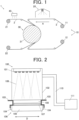
- FIG. 2 and FIG.3 show a schematic diagram of an example of a pretreatment section 100 with a shattering prevention cover 102.
- An arrow D indicates the fabric width direction and arrow A indicates the fabric conveying direction.
- FIG. 2 is a front view from the fabric conveying direction and
- FIG. 3 is a left side view from the fabric width direction.
- the cover 102 cover an area in the width direction (arrow D) of the fabric over the length of the width, and the length is not limited with respect to the conveying direction (arrow A).
- the shape of the cover is preferably a box shape having left and right walls and front and rear walls with respect to the conveying direction of the fabric and the lower end side is open. By using such a shape, the left and right walls and front and rear walls of the cover will shield the pretreatment liquid sprayed from the nozzle, preventing the pretreatment liquid from scattering around the device.
- the upper wall of the cover 102 is preferably shaped like a roof. With such a shape, the droplets adhering to the upper inner wall may easily reach from the upper inner wall to the front and rear inner walls. In addition, it is possible to prevent the droplets adhering to the inner wall from aggregating to form relatively large droplets and falling onto the fabric.
- the front, rear, left, right, and upper walls of the cover 102 are formed by shielding members. Although there are no particular restrictions on the shielding members, it is preferable that they are difficult to deteriorate due to adhesion of the pretreatment liquid. It is preferable that they are made of metal or glass.
- the cover 102 is fixed to the frame 104 of the belt conveyor 106 through a pair of frame guides 103 made of metal.
- the lower end side of each of the left and right walls of the cover 102 is fixed to the frame guides 103.
- the lower end sides of the left and right walls of the cover 102 are fixed to the frame guide 103.
- the belt conveyor 106 corresponds to the conveying section of the present invention.
- FIG. 4A and FIG. 4B show a schematic (cross-sectional) view of the area around the cover wall including the gutter 120 according to the present invention.
- the "gutter” refers to an apparatus or equipment for recovering the pretreatment liquid that has passed through the inner wall of the cover.
- the shape and material of the gutter are not restricted, the shape is preferably a semicircular shape (square shape) as if a cylinder (or a square cylinder) is vertically divided, and is attached to the inner wall of the cover, as shown in FIG. 4A and FIG. 4B .
- the material is preferably the same as the wall of the cover.
- the excess pretreatment liquid that adheres to the inner walls of the cover 102 hangs down to the lower end side along the front and rear inner walls, and is collected by the gutter 120.
- waste of the pretreatment liquid may be eliminated and the overall amount of pretreatment liquid used may be reduced.
- the cover 102 preferably has a duct 110, and further preferably connects the duct 110 and a blower 111.
- the blower is preferably be a suction blower.
- the shape and material of the duct is not restricted.
- the pretreatment section of the present invention has a roller to apply the pretreatment liquid.
- the pretreatment liquid may be applied by the roller, and the pretreatment liquid may be uniformly supplied to the fabric.
- the surface layer of the roller has elasticity. The elasticity of the surface layer of the roller allows the roller to adhere to the fabric, so that the pretreatment liquid may be supplied more evenly to the fabric.
- the roller is able to apply the pretreatment liquid to an area that is longer than the length of the width in the width direction of the fabric. From the viewpoint of uniform application, it is preferable to apply the liquid by means of a roll coater combining various types of rollers.
- the type of roll coater and application method are not restricted, and any known type of roll coater may be used.
- the roller that comes into contact with a strip of fabric or other material and applies the coating liquid is called the applicator roll.
- the surface layer of the applicator roll preferably has elasticity.
- the elastic member is not restricted and known elastic members may be used, examples include rubber and sponge.
- the pretreatment liquid according to the present invention is not restricted as long as it is a pretreatment liquid used for sublimation transfer on fabrics.
- a pretreatment liquid used for a fabric containing natural fibers in recent years will be described.
- the fabric will be described later.
- Pretreatment liquids used for fabrics containing natural fibers include swelling agents and water repellents.
- a swelling agent refers to a compound that has a swelling effect on natural fibers.
- the dye may be easily diffused into the fiber, thereby improving dyeability.
- swelling agent include polyhydric alcohols and their derivatives.
- polyhydric alcohol examples include ethanediol (ethylene glycol), propanediol (propylene glycol), butylene glycol, butenediol, pentamethylene glycol (pentanediol), tetramethylene glycol, trimethylene glycol, and ethylhydroxymethylpropanediol (hexaglycerol), hexanetriol, hexylene glycol (methylpentanediol), ethylhexanediol, octylene glycol, glycerin, polyethylene glycol, polypropylene glycol, polybutylene glycol, chloropropanediol, dioxaoctanediol, dipropylene glycol, tripropylene glycol and nitrilotripropanol.
- ethanediol ethylene glycol
- propanediol propanediol
- butylene glycol buty
- polyether polyols polyoxypropylene polyols, polyether polyols, polyoxytetramethylene glycol
- polyester polyols polyester polyols
- hydrocarbon polyols hydrocarbon polyols
- alkyleneoxyglycols represented by the following Formula (I) and mixtures thereof are preferred.
- R represents a saturated hydrocarbon group having 2 to 10 carbon atoms.
- n is an integer in the range where an average molecular weight of alkyleneoxyglycol is a predetermined value.
- R examples include an ethanediyl group, a propanediyl group, and a butanediyl group.
- the supply amount of the swelling agent is preferably in the range of 2 to 8 % by mass, more preferably in the range of 3 to 6 % by mass, based on the total mass of the natural fiber.
- the pretreatment liquid according to the present invention contains a solvent having a ratio of an inorganic value to an organic value (I/O value) of 1.5 or more, and an aromatic heterocyclic compound (hereinafter also referred to as a "pretreatment liquid containing aromatic heterocyclic compound").
- a solvent having a ratio of an inorganic value to an organic value (I/O value) of 1.5 or more and an aromatic heterocyclic compound (hereinafter also referred to as a "pretreatment liquid containing aromatic heterocyclic compound").
- the value of the ratio of the inorganic value to the organic value (I/O value) of the solvent contained in the pretreatment liquid is preferably 1.5 or more, and more preferably in the range of 1.5 to 5.0.
- the “I/O value” is the ratio of inorganic value (I) to organic value (O). It is also called as an “IOB value” (Inorganic Organic Balance: IOB). It is one of the indicators showing the magnitude of the polarity of a compound or a member.
- the "inorganic value (I)" is a numerical value of the magnitude of the influence of various substituents or bonds possessed by the organic compound on the boiling point based on the hydroxy group.
- the distance between the boiling point curve of a straight-chain alcohol and the boiling point curve of a straight-chain paraffin is taken in the vicinity of 5 carbons, it is approximately 100 °C. Therefore, the influence of one hydroxy group is defined as 100.
- the value obtained by quantifying the influence of various substituents or various bonds on the boiling point based on this numerical value is the inorganic value (I) of the substituent possessed by the organic compound.
- the inorganic value (I) of the -COOH group is 150 and the inorganic value (I) of a double bond is 2. Therefore, the inorganic value (I) of a certain organic compound means the sum of the inorganic values (I) of the various substituents and bonds possessed by the compound.
- the "organic value (O)" is determined, using the methylene group in the molecule as a unit, based on the influence of the carbon atoms represented by the methylene group on the boiling point.
- the organic material when the I/O value is closer to 0, the organic material is more nonpolar (more hydrophobic, more organic), while the higher value indicates that the organic material is more polar (more hydrophilic, more inorganic).
- Examples of the solvent having an I/O value of 1.5 or more include ethylene glycol monoethyl ether (I/O value: 1.5), dimethyl sulfoxide (I/O value: 1.75), butyric acid (I/O value: 1.875), polyethylene glycol (I/O value: 2.0), isobutyric acid (I/O value: 2.143), 2,3-butanediol (I/O value: 2.5), trimethylolethane (I/O value: 3.0), propylene glycol (I/O) value: 3.3), polypropylene glycol (I/O value: 3.3), and ethylene glycol (I/O value: 5.0).
- dimethyl sulfoxide, ethylene glycol, or propylene glycol is preferred because it may swell the fabric fibers and enable high-concentration dyeing.
- the solvent content is preferably in the range of 5 to 95 % by mass of the total mass of the pretreatment liquid containing the aromatic heterocyclic compound, and it is more preferably in the range of 15 to 50 % by mass.
- the aromatic heterocyclic compound is a compound having aromaticity composed of carbon and a heteroatom other than carbon as an element constituting the aromatic ring, but not including cases where the element constituting the aromatic ring is carbon only and the heteroatom constitutes a substituent that is substituted into the aromatic ring.
- the heteroatom comprising the aromatic ring is preferably selected from oxygen, nitrogen, and sulfur atoms, and from the viewpoint of being able to capture dyes, it is preferred to be a nitrogen atom.
- examples of the nitrogen-containing heterocyclic compounds include compounds having a pyrazole ring, a triazole ring, an imidazole ring, a triazine ring, a pyridine ring, a pyrazole ring, an aziridine ring, an indole ring, a quinoline ring, a pyrrole ring and a thiophene ring.
- at least one selected form the compounds having a pyrazole ring, a triazole ring or an imidazole ring is preferable.
- example compounds (1) to (11) represented by the following structural formulas are cited.
- the content of water is preferably in the range of 0 to 95 % by mass based on the total mass of the pretreatment liquid containing an aromatic heterocyclic compound. It is more preferable that the content of water is in the range of 0 to 50 % by mass.
- the dye By using a water repellent as a pretreatment liquid, the dye may be easily trapped inside the fiber, thereby improving the dye density.
- the water repellent adhering to the surface of the fiber prevents the fiber from swelling due to water used during washing, causing the dye inside the fiber to drop out and lowering the dye density, in other words, improving dye fastness.
- the water repellent include fluorinated and silicone water repellents.
- the transfer medium is peeled off from the fabric and wound up by the take-up roller for the transfer medium.
- the pretreatment liquid when supplied by nozzles, it is preferable to control the supply amount of the pretreatment liquid by switching between the use and non-use of each nozzle.
- the transfer method of the present invention is a transfer method of transferring an image on a transfer medium to a fabric by pressing and heating.
- the conveying section conveys the fabric to the transfer section
- the pretreatment section supplies the pretreatment liquid to one side of the fabric
- the transfer section transfers an image on the transfer medium to the fabric by pressing and heating the surface to which the pretreatment liquid is supplied by the pretreatment unit of the fabric and the transfer medium.
- the fabric which is the recording medium, is conveyed to the preprocessing section and the transfer section by the conveying section.
- the method of supplying the pretreatment liquid to the fabric is not restricted, but as mentioned above, it is preferable to use a nozzle spray (spray coating method) or a roller application. By using the above methods, only the necessary amount may be uniformly supplied to the fabric.
- the amount of pretreatment liquid supplied is not particularly limited and may be adjusted according to the content of the solvent and the aromatic heterocyclic compound in the pretreatment liquid and the amount of the ink supplied for transfer.
- sublimation transfer is preferred to sublimation transfer the image for transfer onto the fabric before the pretreatment liquid supplied to the fabric completely dries. This makes it easier for the fibers of the fabric to swell due to the solvent in the pretreatment liquid, and the solvent in the pretreatment liquid acts as a carrier for the transferred dye, thereby making it easier for the dye to penetrate into the fibers and improving the dyeability and texture.
- the image for transfer formed on the transfer medium is specifically formed using the ink described below, which contains a sublimation dye and liquid medium (solvent and water).
- the transfer temperature depends on the sublimation temperature of the sublimation dye, but it is preferably in the range of 180 to 210 °C, for example. By making the transfer temperature higher than the boiling point of the solvent contained in the pretreatment liquid, the solvent is removed and the dye is more immobilized to enhance the bleed-out inhibiting effect.
- the press pressure is preferably in the range of 200 to 500 g/cm 2 for a flat type, and 2 to 6 kg/cm 2 for a continuous type.
- the press time is preferably in the range of 30 to 180 seconds, depending on the temperature.
- the ink used in the present invention preferably contains a sublimation dye, solvent, and water.
- the dye itself is insoluble or hardly soluble in water, but a dye that performs dyeing in a state of being dispersed as fine particles in water is called a disperse dye.
- a disperse dye a dye that performs dyeing in a state of being dispersed as fine particles in water.
- disperse dyes dyes having a property of sublimation by heating are called sublimation dyes.
- insoluble or hardly soluble in water means that the solubility in water at 25 °C is 10 mg/L or less, preferably 5 mg/L or less, and still more preferably it is 1 mg/L or less.
- sublimation dye examples include azo and anthraquinone dyes. Specifically, the following dyes are listed.
- the molecular weight of the sublimation is not particularly limited, but from the viewpoint of easy sublimation, it is preferable to have a low molecular weight (e.g., 200 to 350). On the other hand, from the viewpoint of making it difficult for the sublimation dye that has penetrated into the fabric to escape, it is preferred that the molecular weight be moderately large (e.g., 350 to 500).
- the sublimation dye in the ink may or may not be crystallized.
- Examples of the method of applying an ink on the transfer medium include an inkjet method for coating.
- An inkjet method may be used to form a highly accurate image.
- the average particle size of the sublimation dye in the ink is not particularly limited, but from the viewpoint of discharge stability by the inkjet method, it is preferable that the average particle size is 300 nm or less.
- the average particle size may be determined by a commercially available particle size measuring instrument using a light scattering method, an electrophoresis method, or a laser Doppler method.
- the particle size measuring instrument for example, Zetasizer 1000 made by Malvern Corporation may be cited.
- the content of the sublimation dye in the ink is not particularly limited, it is preferable that the content of the sublimation dye is in the range of 2 to 10 % by mass with respect to the total mass of the ink.
- the content of the sublimation dye is 2 % by mass or more, it is easy to form images of high density, and when the content is 10 % by mass or less, the viscosity of the ink does not become too high and sufficient discharge stability is obtained.
- it is more preferable that the content of the sublimation dye is in the range of 5 to 10 % by mass relative to the total mass of the ink.
- Water may be ion-exchanged water, distilled water, or pure water.
- the water content in the ink is preferably in the range of 90 to 98 % by mass, and more preferably in the range of 90 to 95 % by mass.
- the ink may contain other solvents in addition to water.
- Other solvents are not restricted, but water-soluble organic solvents are preferred. It is preferable that the total content of water and water-soluble organic solvent is in the range of 90 to 98 % by mass of the total mass of the ink. It is more preferred that the total content of water and water-soluble organic solvent is in the range of 90 to 95 % by mass.
- water-soluble organic solvent examples include alcohols (e.g., methanol, ethanol, propanol, pentanol, hexanol, cyclohexanol, and benzyl alcohol), polyhydric alcohols (e.g., ethylene glycol, diethylene glycol, triethylene glycol, polyethylene glycol, propylene glycol, dipropylene glycol, tripropylene glycol, polypropylene glycol, glycerin, compounds represented by the following Formula (1)), polyhydric alcohol ethers (e.g., ethylene glycol monomethyl ether, ethylene glycol monoethyl ether, ethylene glycol monobutyl ether, ethylene glycol monophenyl ether, diethylene glycol monomethyl ether, diethylene glycol monoethyl ether, diethylene glycol monobutyl ether diethylene glycol monobutyl ether, diethylene glycol dimethyl ether, propylene glycol monomethyl ether, propylene glycol monoeth,
- R 11 represents an ethylene glycol group or a propylene glycol group
- x, y, and z each are a positive integer
- x + y + z 3 to 30.
- the water-soluble organic solvent is preferably a high boiling point solvent with a boiling point of 200 °C or higher.
- a high-boiling point solvent may promote penetration of the ink into the fabric because the ink does not easily thicken due to drying.
- sufficient ejection stability may be obtained when the ink is ejected by the inkjet method.
- Polyols and polyalkylene oxides are preferred as the high-boiling water-soluble organic solvent with a boiling point of 200 °C or higher.
- the polyol with a boiling points of 200 °C or higher include divalent alcohols such as 1,3-butanediol (boiling point of 208 °C), 1,6-hexanediol (boiling point 223 C), and polypropylene glycol; and trivalent or higher a alcohols such as glycerin (boiling point 290 °C), and trimethylolpropane (boiling point 295 °C).
- Examples of the polyalkylene oxide with a boiling point of 200 °C or higher include diethylene glycol monoethyl ether (boiling point 202 °C), triethylene glycol monomethyl ether (boiling point 245 °C), tetraethylene glycol monomethyl ether (boiling point 305 °C), tripropylene glycol monoethyl ether (boiling point 256 °C); ethers of divalent alcohols such as polypropylene glycol; ethers of trivalent or higher alcohols such as glycerin (boiling point 290 °C); and ethers of trivalent alcohols such as hexanetriol.
- the content of the water-soluble organic solvent is preferably in the range of 20 to 70 % by mass relative to the total mass of the ink.
- the content of the water-soluble organic solvent is 20 % by mass or more, dispersibility of the sublimation dye and discharge stability as an ink may be sufficiently obtained.
- the content is 70 % by mass or less, drying property of the ink is not easily impaired.
- the ink may further contain other components as needed.
- other component include dispersants, surfactants, preservatives, and pH adjusters.
- the dispersant may be selected depending on the type of sublimation dye.
- examples of the dispersant include formalin condensate of sodium creosote oil sulfonate, formalin condensate of sodium cresol sulfonate and sodium 2-naphthol-6-sulfonate, formalin condensate of sodium cresol sulfonate, formalin condensate of sodium phenol sulfonate, formalin condensate of sodium ⁇ -naphthol sulfonate, formalin condensate containing sodium ⁇ -naphthalene sulfonate and sodium ⁇ -naphthol sulfonate, alkylene oxide containing ethylene oxide and propylene oxide, fatty alcohols, fatty amines, fatty acids, phenols, alkylphenols and alkylating compounds containing amine carboxylates, lignin sulfonates, sodium paraffin sulfonates
- Examples of the comb-shaped block polymer include DISPERBYK-190, DISPERBYK-194N, DISPERBYK-2010, DISPERBYK-2015 and BYK-154, manufactured by BYK Chemie, Co., Ltd. ("DISPERBYK” and "BYK” are registered trademarks of the same company.)
- the content of the dispersant is not particularly limited, it is preferable that the content of the dispersant is in the range of 20 to 200 % by mass with respect to the total mass of the sublimation dye.
- the content of the dispersing agent is 20 % by mass or more, dispersibility of the sublimation dye may be sufficiently obtained.
- the content is 200 % by mass or less, it is easy to suppress the decrease in discharge stability due to the dispersant.
- the same ones as the pretreatment liquid may be used.
- the material of the fibers constituting the fabric that may be used for the transfer device of the present invention is not particularly restricted, but from the viewpoint of effect expression, it is preferable that the fabric is made of a material that may be used for sublimation transfer by supplying a pretreatment liquid.
- a material that may be used for sublimation transfer by supplying a pretreatment liquid.
- natural fibers hydrophilic fibers
- cellulose fibers natural cotton
- hemp hemp
- silk chemical fibers
- a pretreatment liquid may be used as appropriate when the fabric further contains other fibers other than polyester or depending on other conditions.
- the fabric preferably includes natural fibers such as cellulose fibers, hemp, wool, and silk. It is preferable that the fabric includes cellulose fibers, and it is more preferable that the fabric is cotton, because it may significantly express the effect of the present invention.
- the fabric may be composed of one type of natural fiber or two or more types of natural fibers.
- the fabric may further contain one or more kinds of chemical fibers when it contains natural fibers. Therefore, a cotton blend is preferred.
- the fabric may be made of any of these fibers in any form, such as woven, non-woven, or knitted fabric.
- the fabric may also be a blended woven or non-woven fabric of two or more types of fibers.
- the fabric contains cellulose fibers. From the viewpoint of good transfer quality, when the fabric includes cellulose fibers and other fibers other than cellulose fibers, it is preferred that the other fibers include polyester fibers.
- the pretreatment device of the present invention is a pretreatment device that may be attached to a transfer device equipped with a transfer section that transfers an image on the transfer medium to the fabric by pressing and heating the fabric and the transfer medium.
- the elements constituting the pretreatment device of the present invention include elements common to the elements constituting the pretreatment section included in the transfer device of the present invention described above.
- the pretreatment method of the present invention is a pretreatment method of supplying a pretreatment liquid to a fabric on which an image on a transfer medium is transferred by pressing and heating.
- the conveying section conveys the fabric to the transfer section, and the pretreatment section supplies the pretreatment liquid to the surface of the fabric in contact with the transfer medium.
- the process of conveying the fabric to the transfer section and the process of the pretreatment section supplying the pretreatment liquid to the surface of the fabric in contact with the transfer medium correspond to the conveying process and the pretreatment method in the transfer method of the present invention described above.
Landscapes
- Engineering & Computer Science (AREA)
- Textile Engineering (AREA)
- Mechanical Engineering (AREA)
- Chemical & Material Sciences (AREA)
- Dispersion Chemistry (AREA)
- Chemical Kinetics & Catalysis (AREA)
- General Chemical & Material Sciences (AREA)
- Treatment Of Fiber Materials (AREA)
- Coloring (AREA)
Applications Claiming Priority (1)
| Application Number | Priority Date | Filing Date | Title |
|---|---|---|---|
| JP2021170175A JP2023060529A (ja) | 2021-10-18 | 2021-10-18 | 転写装置とその転写方法、及び、前処理装置とその前処理方法 |
Publications (2)
| Publication Number | Publication Date |
|---|---|
| EP4166342A1 true EP4166342A1 (de) | 2023-04-19 |
| EP4166342B1 EP4166342B1 (de) | 2025-03-05 |
Family
ID=83151981
Family Applications (1)
| Application Number | Title | Priority Date | Filing Date |
|---|---|---|---|
| EP22193027.4A Active EP4166342B1 (de) | 2021-10-18 | 2022-08-31 | Übertragungsvorrichtung und übertragungsverfahren dafür sowie vorbehandlungsvorrichtung und vorbehandlungsverfahren dafür |
Country Status (2)
| Country | Link |
|---|---|
| EP (1) | EP4166342B1 (de) |
| JP (1) | JP2023060529A (de) |
Citations (4)
| Publication number | Priority date | Publication date | Assignee | Title |
|---|---|---|---|---|
| US20090293209A1 (en) * | 2003-03-25 | 2009-12-03 | Inktec Co., Ltd. | Textile printing method and apparatus applying inkjet printer |
| US20170320336A1 (en) * | 2016-04-20 | 2017-11-09 | Butt Nouman Idris | Under-glass digital printing method of multilayer synthetic leather |
| US20190009552A1 (en) * | 2017-07-04 | 2019-01-10 | Canon Kabushiki Kaisha | Ink jet recording method and ink jet recording apparatus |
| JP2022100506A (ja) * | 2020-12-24 | 2022-07-06 | コニカミノルタ株式会社 | 捺染用前処理装置、捺染布帛の製造方法及び捺染布帛の製造システム |
Family Cites Families (9)
| Publication number | Priority date | Publication date | Assignee | Title |
|---|---|---|---|---|
| JPH03220384A (ja) * | 1990-01-25 | 1991-09-27 | Unitika Ltd | 耐光堅牢度の優れたポリアミド繊維の染色方法 |
| WO2002017738A1 (fr) * | 2000-08-31 | 2002-03-07 | Japan Tobacco Inc. | Machine de fabrication de filtre |
| EP2802457B8 (de) * | 2012-01-13 | 2019-06-19 | Hewlett-Packard Development Company, L.P. | Digitale drucker |
| JP2018051923A (ja) * | 2016-09-29 | 2018-04-05 | 三菱ケミカル株式会社 | 画像印刷装置 |
| JP2019014236A (ja) * | 2017-07-04 | 2019-01-31 | キヤノン株式会社 | インクジェット記録方法、及びインクジェット記録装置 |
| JP7255372B2 (ja) * | 2018-09-03 | 2023-04-11 | 株式会社リコー | 液体を吐出する装置 |
| JP7358805B2 (ja) * | 2019-07-05 | 2023-10-11 | コニカミノルタ株式会社 | インクジェット記録装置及びインクジェット記録方法 |
| JP2021088796A (ja) * | 2019-12-06 | 2021-06-10 | 株式会社ミマキエンジニアリング | 転写捺染方法および転写捺染装置 |
| JP7703314B2 (ja) * | 2020-02-18 | 2025-07-07 | 株式会社ミマキエンジニアリング | 布帛の転写捺染方法および布帛の転写捺染装置 |
-
2021
- 2021-10-18 JP JP2021170175A patent/JP2023060529A/ja active Pending
-
2022
- 2022-08-31 EP EP22193027.4A patent/EP4166342B1/de active Active
Patent Citations (4)
| Publication number | Priority date | Publication date | Assignee | Title |
|---|---|---|---|---|
| US20090293209A1 (en) * | 2003-03-25 | 2009-12-03 | Inktec Co., Ltd. | Textile printing method and apparatus applying inkjet printer |
| US20170320336A1 (en) * | 2016-04-20 | 2017-11-09 | Butt Nouman Idris | Under-glass digital printing method of multilayer synthetic leather |
| US20190009552A1 (en) * | 2017-07-04 | 2019-01-10 | Canon Kabushiki Kaisha | Ink jet recording method and ink jet recording apparatus |
| JP2022100506A (ja) * | 2020-12-24 | 2022-07-06 | コニカミノルタ株式会社 | 捺染用前処理装置、捺染布帛の製造方法及び捺染布帛の製造システム |
Non-Patent Citations (6)
| Title |
|---|
| JIRO AIHARA: "Transfer Textile Printing Method for Natural Fibers and Their Blends", JOURNAL OF THE TEXTILE MACHINERY SOCIETY OF JAPAN, FIBER ENGINEERING, vol. 30, no. 3, 1977, pages 128 - 133 |
| KUMAMOTO PHARMACEUTICAL BULLETIN, no. 1, 1954, pages 1 - 16 |
| MAZHARUL ISLAM KIRON: "Wet Transfer Printing Method Steps of Wet Transfer Printing Process", TEXTILE LEARNER, 2013, Retrieved from the Internet <URL:https://textilelearner.net/steps-of-wet-transfer-printing-process> |
| TAKERU TAKEBE: "Recent trends in the development of textile printing machine", SEN-I GAKKAISHI (TEXTILE AND INDUSTRY, vol. 32, no. 8, 1976, pages 302 - 307 |
| THE FIELD OF CHEMISTRY, vol. 11, no. 10, 1957, pages 719 - 725 |
| YOSHIO KODASANKYO SHUPPAN: "Organic Concept Diagram", 1984 |
Also Published As
| Publication number | Publication date |
|---|---|
| JP2023060529A (ja) | 2023-04-28 |
| EP4166342B1 (de) | 2025-03-05 |
Similar Documents
| Publication | Publication Date | Title |
|---|---|---|
| EP0693587A2 (de) | Tintenstrahldruckgewebe, Tintenstrahldruckverfahren und Verfahren zur Herstellung von Drucken | |
| JP5506225B2 (ja) | 広告シートのリサイクル方法 | |
| EP4166342B1 (de) | Übertragungsvorrichtung und übertragungsverfahren dafür sowie vorbehandlungsvorrichtung und vorbehandlungsverfahren dafür | |
| WO2011078068A1 (ja) | インクジェット捺染用布帛前処理剤、布帛の前処理方法及びテキスタイルプリント方法 | |
| JP6578951B2 (ja) | インクジェットインクおよびインクジェット記録方法 | |
| EP1866385B1 (de) | Zusammensetzung für kontinuierliche tintenstrahlveredelung eines textilen erzeugnisses | |
| CN115613376B (zh) | 布帛用处理剂、印染用油墨组、印染方法以及印染布帛 | |
| WO2014017082A1 (ja) | インクジェット捺染インクセット | |
| JP5682317B2 (ja) | 捺染用インクセット及びインクジェット捺染方法 | |
| EP1871947B1 (de) | Zusammensetzung für drop-on-demand-ausrüstung eines textilerzeugnisses | |
| EP3141656B1 (de) | Tintenstrahldruckverfahren und tintenstrahldruckvorrichtung | |
| JP2008174865A (ja) | インクジェット捺染用布帛及びインクジェット捺染方法 | |
| JP6477064B2 (ja) | 水系インクおよびインクジェット捺染方法 | |
| EP2957607B1 (de) | Bilderzeugungsverfahren | |
| JPWO2016125869A1 (ja) | インクジェットインク、インクジェット捺染方法、インクジェット捺染方法によって捺染された布帛およびインクジェット捺染システム | |
| JP5428049B2 (ja) | テキスタイルプリント方法 | |
| JP7532961B2 (ja) | インクジェット捺染用インクセット及びインクジェット捺染方法 | |
| CN121827108A (zh) | 喷墨印染用处理方法和喷墨印染方法 | |
| JP2024042404A (ja) | 布帛用処理剤、捺染方法、布帛用捺染装置及び捺染布帛 | |
| JP7593040B2 (ja) | 捺染用インクジェットインク、捺染用インクジェットインクセット、および画像形成方法 | |
| EP3473769B1 (de) | Tintenstrahltextildruckfarbe und tintenstrahltextildruckverfahren | |
| JP7771541B2 (ja) | 布帛用前処理剤、捺染方法及び捺染布帛 | |
| US20230398801A1 (en) | Image forming method, image forming apparatus, and image forming system | |
| JP2023087696A (ja) | 布帛用処理剤、捺染用インクセット、前処理済布帛、捺染方法、及び捺染布帛 | |
| JP2023088238A (ja) | 布帛用処理剤、捺染用インクセット、前処理済布帛、捺染方法、及び捺染布帛 |
Legal Events
| Date | Code | Title | Description |
|---|---|---|---|
| PUAI | Public reference made under article 153(3) epc to a published international application that has entered the european phase |
Free format text: ORIGINAL CODE: 0009012 |
|
| STAA | Information on the status of an ep patent application or granted ep patent |
Free format text: STATUS: THE APPLICATION HAS BEEN PUBLISHED |
|
| AK | Designated contracting states |
Kind code of ref document: A1 Designated state(s): AL AT BE BG CH CY CZ DE DK EE ES FI FR GB GR HR HU IE IS IT LI LT LU LV MC MK MT NL NO PL PT RO RS SE SI SK SM TR |
|
| STAA | Information on the status of an ep patent application or granted ep patent |
Free format text: STATUS: REQUEST FOR EXAMINATION WAS MADE |
|
| 17P | Request for examination filed |
Effective date: 20231018 |
|
| RBV | Designated contracting states (corrected) |
Designated state(s): AL AT BE BG CH CY CZ DE DK EE ES FI FR GB GR HR HU IE IS IT LI LT LU LV MC MK MT NL NO PL PT RO RS SE SI SK SM TR |
|
| GRAP | Despatch of communication of intention to grant a patent |
Free format text: ORIGINAL CODE: EPIDOSNIGR1 |
|
| STAA | Information on the status of an ep patent application or granted ep patent |
Free format text: STATUS: GRANT OF PATENT IS INTENDED |
|
| RIC1 | Information provided on ipc code assigned before grant |
Ipc: B41M 5/00 20060101ALN20241009BHEP Ipc: B41M 5/025 20060101ALN20241009BHEP Ipc: B41J 15/06 20060101ALN20241009BHEP Ipc: D06P 5/20 20060101ALI20241009BHEP Ipc: D06P 5/28 20060101ALI20241009BHEP Ipc: D06P 5/00 20060101ALI20241009BHEP Ipc: D06P 1/62 20060101ALI20241009BHEP Ipc: D06P 1/16 20060101ALI20241009BHEP Ipc: B41J 11/00 20060101ALI20241009BHEP Ipc: B41J 2/005 20060101ALI20241009BHEP Ipc: B41J 3/407 20060101AFI20241009BHEP |
|
| RIC1 | Information provided on ipc code assigned before grant |
Ipc: B41M 5/00 20060101ALN20241021BHEP Ipc: B41M 5/025 20060101ALN20241021BHEP Ipc: B41J 15/06 20060101ALN20241021BHEP Ipc: B41F 23/02 20060101ALI20241021BHEP Ipc: B41F 16/02 20060101ALI20241021BHEP Ipc: B41F 16/00 20060101ALI20241021BHEP Ipc: B05D 1/00 20060101ALI20241021BHEP Ipc: B05C 1/00 20060101ALI20241021BHEP Ipc: D06P 5/20 20060101ALI20241021BHEP Ipc: D06P 5/28 20060101ALI20241021BHEP Ipc: D06P 5/00 20060101ALI20241021BHEP Ipc: D06P 1/62 20060101ALI20241021BHEP Ipc: D06P 1/16 20060101ALI20241021BHEP Ipc: B41J 11/00 20060101ALI20241021BHEP Ipc: B41J 2/005 20060101ALI20241021BHEP Ipc: B41J 3/407 20060101AFI20241021BHEP |
|
| INTG | Intention to grant announced |
Effective date: 20241104 |
|
| GRAS | Grant fee paid |
Free format text: ORIGINAL CODE: EPIDOSNIGR3 |
|
| GRAA | (expected) grant |
Free format text: ORIGINAL CODE: 0009210 |
|
| STAA | Information on the status of an ep patent application or granted ep patent |
Free format text: STATUS: THE PATENT HAS BEEN GRANTED |
|
| AK | Designated contracting states |
Kind code of ref document: B1 Designated state(s): AL AT BE BG CH CY CZ DE DK EE ES FI FR GB GR HR HU IE IS IT LI LT LU LV MC MK MT NL NO PL PT RO RS SE SI SK SM TR |
|
| P01 | Opt-out of the competence of the unified patent court (upc) registered |
Free format text: CASE NUMBER: APP_4510/2025 Effective date: 20250127 |
|
| REG | Reference to a national code |
Ref country code: GB Ref legal event code: FG4D |
|
| REG | Reference to a national code |
Ref country code: CH Ref legal event code: EP |
|
| REG | Reference to a national code |
Ref country code: IE Ref legal event code: FG4D |
|
| REG | Reference to a national code |
Ref country code: DE Ref legal event code: R096 Ref document number: 602022011359 Country of ref document: DE |
|
| PG25 | Lapsed in a contracting state [announced via postgrant information from national office to epo] |
Ref country code: RS Free format text: LAPSE BECAUSE OF FAILURE TO SUBMIT A TRANSLATION OF THE DESCRIPTION OR TO PAY THE FEE WITHIN THE PRESCRIBED TIME-LIMIT Effective date: 20250605 |
|
| PG25 | Lapsed in a contracting state [announced via postgrant information from national office to epo] |
Ref country code: FI Free format text: LAPSE BECAUSE OF FAILURE TO SUBMIT A TRANSLATION OF THE DESCRIPTION OR TO PAY THE FEE WITHIN THE PRESCRIBED TIME-LIMIT Effective date: 20250305 |
|
| REG | Reference to a national code |
Ref country code: NL Ref legal event code: MP Effective date: 20250305 |
|
| PG25 | Lapsed in a contracting state [announced via postgrant information from national office to epo] |
Ref country code: ES Free format text: LAPSE BECAUSE OF FAILURE TO SUBMIT A TRANSLATION OF THE DESCRIPTION OR TO PAY THE FEE WITHIN THE PRESCRIBED TIME-LIMIT Effective date: 20250305 |
|
| REG | Reference to a national code |
Ref country code: LT Ref legal event code: MG9D |
|
| PG25 | Lapsed in a contracting state [announced via postgrant information from national office to epo] |
Ref country code: NO Free format text: LAPSE BECAUSE OF FAILURE TO SUBMIT A TRANSLATION OF THE DESCRIPTION OR TO PAY THE FEE WITHIN THE PRESCRIBED TIME-LIMIT Effective date: 20250605 |
|
| PG25 | Lapsed in a contracting state [announced via postgrant information from national office to epo] |
Ref country code: HR Free format text: LAPSE BECAUSE OF FAILURE TO SUBMIT A TRANSLATION OF THE DESCRIPTION OR TO PAY THE FEE WITHIN THE PRESCRIBED TIME-LIMIT Effective date: 20250305 |
|
| PG25 | Lapsed in a contracting state [announced via postgrant information from national office to epo] |
Ref country code: LV Free format text: LAPSE BECAUSE OF FAILURE TO SUBMIT A TRANSLATION OF THE DESCRIPTION OR TO PAY THE FEE WITHIN THE PRESCRIBED TIME-LIMIT Effective date: 20250305 |
|
| PG25 | Lapsed in a contracting state [announced via postgrant information from national office to epo] |
Ref country code: GR Free format text: LAPSE BECAUSE OF FAILURE TO SUBMIT A TRANSLATION OF THE DESCRIPTION OR TO PAY THE FEE WITHIN THE PRESCRIBED TIME-LIMIT Effective date: 20250606 Ref country code: BG Free format text: LAPSE BECAUSE OF FAILURE TO SUBMIT A TRANSLATION OF THE DESCRIPTION OR TO PAY THE FEE WITHIN THE PRESCRIBED TIME-LIMIT Effective date: 20250305 |
|
| REG | Reference to a national code |
Ref country code: AT Ref legal event code: MK05 Ref document number: 1772596 Country of ref document: AT Kind code of ref document: T Effective date: 20250305 |
|
| PG25 | Lapsed in a contracting state [announced via postgrant information from national office to epo] |
Ref country code: NL Free format text: LAPSE BECAUSE OF FAILURE TO SUBMIT A TRANSLATION OF THE DESCRIPTION OR TO PAY THE FEE WITHIN THE PRESCRIBED TIME-LIMIT Effective date: 20250305 |
|
| PG25 | Lapsed in a contracting state [announced via postgrant information from national office to epo] |
Ref country code: SE Free format text: LAPSE BECAUSE OF FAILURE TO SUBMIT A TRANSLATION OF THE DESCRIPTION OR TO PAY THE FEE WITHIN THE PRESCRIBED TIME-LIMIT Effective date: 20250305 |
|
| PG25 | Lapsed in a contracting state [announced via postgrant information from national office to epo] |
Ref country code: SM Free format text: LAPSE BECAUSE OF FAILURE TO SUBMIT A TRANSLATION OF THE DESCRIPTION OR TO PAY THE FEE WITHIN THE PRESCRIBED TIME-LIMIT Effective date: 20250305 |
|
| PG25 | Lapsed in a contracting state [announced via postgrant information from national office to epo] |
Ref country code: PT Free format text: LAPSE BECAUSE OF FAILURE TO SUBMIT A TRANSLATION OF THE DESCRIPTION OR TO PAY THE FEE WITHIN THE PRESCRIBED TIME-LIMIT Effective date: 20250707 |
|
| PG25 | Lapsed in a contracting state [announced via postgrant information from national office to epo] |
Ref country code: PL Free format text: LAPSE BECAUSE OF FAILURE TO SUBMIT A TRANSLATION OF THE DESCRIPTION OR TO PAY THE FEE WITHIN THE PRESCRIBED TIME-LIMIT Effective date: 20250305 |
|
| PGFP | Annual fee paid to national office [announced via postgrant information from national office to epo] |
Ref country code: TR Payment date: 20250829 Year of fee payment: 4 Ref country code: IT Payment date: 20250901 Year of fee payment: 4 |
|
| PG25 | Lapsed in a contracting state [announced via postgrant information from national office to epo] |
Ref country code: AT Free format text: LAPSE BECAUSE OF FAILURE TO SUBMIT A TRANSLATION OF THE DESCRIPTION OR TO PAY THE FEE WITHIN THE PRESCRIBED TIME-LIMIT Effective date: 20250305 |
|
| PGFP | Annual fee paid to national office [announced via postgrant information from national office to epo] |
Ref country code: FR Payment date: 20250703 Year of fee payment: 4 |
|
| PG25 | Lapsed in a contracting state [announced via postgrant information from national office to epo] |
Ref country code: CZ Free format text: LAPSE BECAUSE OF FAILURE TO SUBMIT A TRANSLATION OF THE DESCRIPTION OR TO PAY THE FEE WITHIN THE PRESCRIBED TIME-LIMIT Effective date: 20250305 Ref country code: EE Free format text: LAPSE BECAUSE OF FAILURE TO SUBMIT A TRANSLATION OF THE DESCRIPTION OR TO PAY THE FEE WITHIN THE PRESCRIBED TIME-LIMIT Effective date: 20250305 |
|
| PG25 | Lapsed in a contracting state [announced via postgrant information from national office to epo] |
Ref country code: RO Free format text: LAPSE BECAUSE OF FAILURE TO SUBMIT A TRANSLATION OF THE DESCRIPTION OR TO PAY THE FEE WITHIN THE PRESCRIBED TIME-LIMIT Effective date: 20250305 |
|
| PG25 | Lapsed in a contracting state [announced via postgrant information from national office to epo] |
Ref country code: SK Free format text: LAPSE BECAUSE OF FAILURE TO SUBMIT A TRANSLATION OF THE DESCRIPTION OR TO PAY THE FEE WITHIN THE PRESCRIBED TIME-LIMIT Effective date: 20250305 |
|
| PG25 | Lapsed in a contracting state [announced via postgrant information from national office to epo] |
Ref country code: IS Free format text: LAPSE BECAUSE OF FAILURE TO SUBMIT A TRANSLATION OF THE DESCRIPTION OR TO PAY THE FEE WITHIN THE PRESCRIBED TIME-LIMIT Effective date: 20250705 |
|
| REG | Reference to a national code |
Ref country code: DE Ref legal event code: R097 Ref document number: 602022011359 Country of ref document: DE |
|
| PLBE | No opposition filed within time limit |
Free format text: ORIGINAL CODE: 0009261 |
|
| STAA | Information on the status of an ep patent application or granted ep patent |
Free format text: STATUS: NO OPPOSITION FILED WITHIN TIME LIMIT |
|
| PG25 | Lapsed in a contracting state [announced via postgrant information from national office to epo] |
Ref country code: DK Free format text: LAPSE BECAUSE OF FAILURE TO SUBMIT A TRANSLATION OF THE DESCRIPTION OR TO PAY THE FEE WITHIN THE PRESCRIBED TIME-LIMIT Effective date: 20250305 |
|
| REG | Reference to a national code |
Ref country code: CH Ref legal event code: L10 Free format text: ST27 STATUS EVENT CODE: U-0-0-L10-L00 (AS PROVIDED BY THE NATIONAL OFFICE) Effective date: 20260114 |
|
| 26N | No opposition filed |
Effective date: 20251208 |
|
| REG | Reference to a national code |
Ref country code: DE Ref legal event code: R119 Ref document number: 602022011359 Country of ref document: DE |
|
| REG | Reference to a national code |
Ref country code: CH Ref legal event code: H13 Free format text: ST27 STATUS EVENT CODE: U-0-0-H10-H13 (AS PROVIDED BY THE NATIONAL OFFICE) Effective date: 20260324 |
|
| PG25 | Lapsed in a contracting state [announced via postgrant information from national office to epo] |
Ref country code: MC Free format text: LAPSE BECAUSE OF FAILURE TO SUBMIT A TRANSLATION OF THE DESCRIPTION OR TO PAY THE FEE WITHIN THE PRESCRIBED TIME-LIMIT Effective date: 20250305 |
|
| PG25 | Lapsed in a contracting state [announced via postgrant information from national office to epo] |
Ref country code: LU Free format text: LAPSE BECAUSE OF NON-PAYMENT OF DUE FEES Effective date: 20250831 |
|
| PG25 | Lapsed in a contracting state [announced via postgrant information from national office to epo] |
Ref country code: CH Free format text: LAPSE BECAUSE OF NON-PAYMENT OF DUE FEES Effective date: 20250831 |