EP4151509B1 - Adaptiver beleuchtungsscheinwerfer - Google Patents
Adaptiver beleuchtungsscheinwerfer Download PDFInfo
- Publication number
- EP4151509B1 EP4151509B1 EP22191803.0A EP22191803A EP4151509B1 EP 4151509 B1 EP4151509 B1 EP 4151509B1 EP 22191803 A EP22191803 A EP 22191803A EP 4151509 B1 EP4151509 B1 EP 4151509B1
- Authority
- EP
- European Patent Office
- Prior art keywords
- light
- light emitting
- emitting unit
- rotor structure
- illumination
- Prior art date
- Legal status (The legal status is an assumption and is not a legal conclusion. Google has not performed a legal analysis and makes no representation as to the accuracy of the status listed.)
- Active
Links
Images








Classifications
-
- F—MECHANICAL ENGINEERING; LIGHTING; HEATING; WEAPONS; BLASTING
- F21—LIGHTING
- F21S—NON-PORTABLE LIGHTING DEVICES; SYSTEMS THEREOF; VEHICLE LIGHTING DEVICES SPECIALLY ADAPTED FOR VEHICLE EXTERIORS
- F21S41/00—Illuminating devices specially adapted for vehicle exteriors, e.g. headlamps
- F21S41/60—Illuminating devices specially adapted for vehicle exteriors, e.g. headlamps characterised by a variable light distribution
- F21S41/67—Illuminating devices specially adapted for vehicle exteriors, e.g. headlamps characterised by a variable light distribution by acting on reflectors
- F21S41/675—Illuminating devices specially adapted for vehicle exteriors, e.g. headlamps characterised by a variable light distribution by acting on reflectors by moving reflectors
-
- B—PERFORMING OPERATIONS; TRANSPORTING
- B60—VEHICLES IN GENERAL
- B60Q—ARRANGEMENT OF SIGNALLING OR LIGHTING DEVICES, THE MOUNTING OR SUPPORTING THEREOF OR CIRCUITS THEREFOR, FOR VEHICLES IN GENERAL
- B60Q1/00—Arrangement of optical signalling or lighting devices, the mounting or supporting thereof or circuits therefor
- B60Q1/02—Arrangement of optical signalling or lighting devices, the mounting or supporting thereof or circuits therefor the devices being primarily intended to illuminate the way ahead or to illuminate other areas of way or environments
- B60Q1/04—Arrangement of optical signalling or lighting devices, the mounting or supporting thereof or circuits therefor the devices being primarily intended to illuminate the way ahead or to illuminate other areas of way or environments the devices being headlights
- B60Q1/06—Arrangement of optical signalling or lighting devices, the mounting or supporting thereof or circuits therefor the devices being primarily intended to illuminate the way ahead or to illuminate other areas of way or environments the devices being headlights adjustable, e.g. remotely-controlled from inside vehicle
- B60Q1/08—Arrangement of optical signalling or lighting devices, the mounting or supporting thereof or circuits therefor the devices being primarily intended to illuminate the way ahead or to illuminate other areas of way or environments the devices being headlights adjustable, e.g. remotely-controlled from inside vehicle automatically
- B60Q1/12—Arrangement of optical signalling or lighting devices, the mounting or supporting thereof or circuits therefor the devices being primarily intended to illuminate the way ahead or to illuminate other areas of way or environments the devices being headlights adjustable, e.g. remotely-controlled from inside vehicle automatically due to steering position
- B60Q1/122—Arrangement of optical signalling or lighting devices, the mounting or supporting thereof or circuits therefor the devices being primarily intended to illuminate the way ahead or to illuminate other areas of way or environments the devices being headlights adjustable, e.g. remotely-controlled from inside vehicle automatically due to steering position with electrical actuating means
-
- B—PERFORMING OPERATIONS; TRANSPORTING
- B60—VEHICLES IN GENERAL
- B60Q—ARRANGEMENT OF SIGNALLING OR LIGHTING DEVICES, THE MOUNTING OR SUPPORTING THEREOF OR CIRCUITS THEREFOR, FOR VEHICLES IN GENERAL
- B60Q1/00—Arrangement of optical signalling or lighting devices, the mounting or supporting thereof or circuits therefor
- B60Q1/02—Arrangement of optical signalling or lighting devices, the mounting or supporting thereof or circuits therefor the devices being primarily intended to illuminate the way ahead or to illuminate other areas of way or environments
- B60Q1/04—Arrangement of optical signalling or lighting devices, the mounting or supporting thereof or circuits therefor the devices being primarily intended to illuminate the way ahead or to illuminate other areas of way or environments the devices being headlights
- B60Q1/06—Arrangement of optical signalling or lighting devices, the mounting or supporting thereof or circuits therefor the devices being primarily intended to illuminate the way ahead or to illuminate other areas of way or environments the devices being headlights adjustable, e.g. remotely-controlled from inside vehicle
- B60Q1/08—Arrangement of optical signalling or lighting devices, the mounting or supporting thereof or circuits therefor the devices being primarily intended to illuminate the way ahead or to illuminate other areas of way or environments the devices being headlights adjustable, e.g. remotely-controlled from inside vehicle automatically
- B60Q1/10—Arrangement of optical signalling or lighting devices, the mounting or supporting thereof or circuits therefor the devices being primarily intended to illuminate the way ahead or to illuminate other areas of way or environments the devices being headlights adjustable, e.g. remotely-controlled from inside vehicle automatically due to vehicle inclination, e.g. due to load distribution
- B60Q1/115—Arrangement of optical signalling or lighting devices, the mounting or supporting thereof or circuits therefor the devices being primarily intended to illuminate the way ahead or to illuminate other areas of way or environments the devices being headlights adjustable, e.g. remotely-controlled from inside vehicle automatically due to vehicle inclination, e.g. due to load distribution by electric means
-
- B—PERFORMING OPERATIONS; TRANSPORTING
- B60—VEHICLES IN GENERAL
- B60Q—ARRANGEMENT OF SIGNALLING OR LIGHTING DEVICES, THE MOUNTING OR SUPPORTING THEREOF OR CIRCUITS THEREFOR, FOR VEHICLES IN GENERAL
- B60Q1/00—Arrangement of optical signalling or lighting devices, the mounting or supporting thereof or circuits therefor
- B60Q1/02—Arrangement of optical signalling or lighting devices, the mounting or supporting thereof or circuits therefor the devices being primarily intended to illuminate the way ahead or to illuminate other areas of way or environments
- B60Q1/04—Arrangement of optical signalling or lighting devices, the mounting or supporting thereof or circuits therefor the devices being primarily intended to illuminate the way ahead or to illuminate other areas of way or environments the devices being headlights
- B60Q1/06—Arrangement of optical signalling or lighting devices, the mounting or supporting thereof or circuits therefor the devices being primarily intended to illuminate the way ahead or to illuminate other areas of way or environments the devices being headlights adjustable, e.g. remotely-controlled from inside vehicle
- B60Q1/08—Arrangement of optical signalling or lighting devices, the mounting or supporting thereof or circuits therefor the devices being primarily intended to illuminate the way ahead or to illuminate other areas of way or environments the devices being headlights adjustable, e.g. remotely-controlled from inside vehicle automatically
- B60Q1/12—Arrangement of optical signalling or lighting devices, the mounting or supporting thereof or circuits therefor the devices being primarily intended to illuminate the way ahead or to illuminate other areas of way or environments the devices being headlights adjustable, e.g. remotely-controlled from inside vehicle automatically due to steering position
-
- B—PERFORMING OPERATIONS; TRANSPORTING
- B62—LAND VEHICLES FOR TRAVELLING OTHERWISE THAN ON RAILS
- B62J—CYCLE SADDLES OR SEATS; AUXILIARY DEVICES OR ACCESSORIES SPECIALLY ADAPTED TO CYCLES AND NOT OTHERWISE PROVIDED FOR, e.g. ARTICLE CARRIERS OR CYCLE PROTECTORS
- B62J6/00—Arrangement of optical signalling or lighting devices on cycles; Mounting or supporting thereof; Circuits therefor
- B62J6/02—Headlights
- B62J6/022—Headlights specially adapted for motorcycles or the like
- B62J6/023—Headlights specially adapted for motorcycles or the like responsive to the lean angle of the cycle, e.g. changing intensity or switching sub-lights when cornering
-
- B—PERFORMING OPERATIONS; TRANSPORTING
- B62—LAND VEHICLES FOR TRAVELLING OTHERWISE THAN ON RAILS
- B62J—CYCLE SADDLES OR SEATS; AUXILIARY DEVICES OR ACCESSORIES SPECIALLY ADAPTED TO CYCLES AND NOT OTHERWISE PROVIDED FOR, e.g. ARTICLE CARRIERS OR CYCLE PROTECTORS
- B62J6/00—Arrangement of optical signalling or lighting devices on cycles; Mounting or supporting thereof; Circuits therefor
- B62J6/02—Headlights
- B62J6/022—Headlights specially adapted for motorcycles or the like
- B62J6/026—Headlights specially adapted for motorcycles or the like characterised by the structure, e.g. casings
-
- B—PERFORMING OPERATIONS; TRANSPORTING
- B62—LAND VEHICLES FOR TRAVELLING OTHERWISE THAN ON RAILS
- B62J—CYCLE SADDLES OR SEATS; AUXILIARY DEVICES OR ACCESSORIES SPECIALLY ADAPTED TO CYCLES AND NOT OTHERWISE PROVIDED FOR, e.g. ARTICLE CARRIERS OR CYCLE PROTECTORS
- B62J6/00—Arrangement of optical signalling or lighting devices on cycles; Mounting or supporting thereof; Circuits therefor
- B62J6/02—Headlights
- B62J6/022—Headlights specially adapted for motorcycles or the like
- B62J6/027—Supporting means therefor, e.g. mounting brackets
-
- F—MECHANICAL ENGINEERING; LIGHTING; HEATING; WEAPONS; BLASTING
- F21—LIGHTING
- F21S—NON-PORTABLE LIGHTING DEVICES; SYSTEMS THEREOF; VEHICLE LIGHTING DEVICES SPECIALLY ADAPTED FOR VEHICLE EXTERIORS
- F21S41/00—Illuminating devices specially adapted for vehicle exteriors, e.g. headlamps
- F21S41/10—Illuminating devices specially adapted for vehicle exteriors, e.g. headlamps characterised by the light source
- F21S41/14—Illuminating devices specially adapted for vehicle exteriors, e.g. headlamps characterised by the light source characterised by the type of light source
- F21S41/141—Light emitting diodes [LED]
- F21S41/143—Light emitting diodes [LED] the main emission direction of the LED being parallel to the optical axis of the illuminating device
-
- F—MECHANICAL ENGINEERING; LIGHTING; HEATING; WEAPONS; BLASTING
- F21—LIGHTING
- F21S—NON-PORTABLE LIGHTING DEVICES; SYSTEMS THEREOF; VEHICLE LIGHTING DEVICES SPECIALLY ADAPTED FOR VEHICLE EXTERIORS
- F21S41/00—Illuminating devices specially adapted for vehicle exteriors, e.g. headlamps
- F21S41/20—Illuminating devices specially adapted for vehicle exteriors, e.g. headlamps characterised by refractors, transparent cover plates, light guides or filters
- F21S41/25—Projection lenses
-
- F—MECHANICAL ENGINEERING; LIGHTING; HEATING; WEAPONS; BLASTING
- F21—LIGHTING
- F21S—NON-PORTABLE LIGHTING DEVICES; SYSTEMS THEREOF; VEHICLE LIGHTING DEVICES SPECIALLY ADAPTED FOR VEHICLE EXTERIORS
- F21S41/00—Illuminating devices specially adapted for vehicle exteriors, e.g. headlamps
- F21S41/60—Illuminating devices specially adapted for vehicle exteriors, e.g. headlamps characterised by a variable light distribution
- F21S41/63—Illuminating devices specially adapted for vehicle exteriors, e.g. headlamps characterised by a variable light distribution by acting on refractors, filters or transparent cover plates
- F21S41/635—Illuminating devices specially adapted for vehicle exteriors, e.g. headlamps characterised by a variable light distribution by acting on refractors, filters or transparent cover plates by moving refractors, filters or transparent cover plates
-
- B—PERFORMING OPERATIONS; TRANSPORTING
- B60—VEHICLES IN GENERAL
- B60Q—ARRANGEMENT OF SIGNALLING OR LIGHTING DEVICES, THE MOUNTING OR SUPPORTING THEREOF OR CIRCUITS THEREFOR, FOR VEHICLES IN GENERAL
- B60Q2300/00—Indexing codes for automatically adjustable headlamps or automatically dimmable headlamps
- B60Q2300/10—Indexing codes relating to particular vehicle conditions
- B60Q2300/13—Attitude of the vehicle body
- B60Q2300/134—Yaw
-
- B—PERFORMING OPERATIONS; TRANSPORTING
- B60—VEHICLES IN GENERAL
- B60Q—ARRANGEMENT OF SIGNALLING OR LIGHTING DEVICES, THE MOUNTING OR SUPPORTING THEREOF OR CIRCUITS THEREFOR, FOR VEHICLES IN GENERAL
- B60Q2300/00—Indexing codes for automatically adjustable headlamps or automatically dimmable headlamps
- B60Q2300/10—Indexing codes relating to particular vehicle conditions
- B60Q2300/13—Attitude of the vehicle body
- B60Q2300/136—Roll
-
- B—PERFORMING OPERATIONS; TRANSPORTING
- B60—VEHICLES IN GENERAL
- B60Q—ARRANGEMENT OF SIGNALLING OR LIGHTING DEVICES, THE MOUNTING OR SUPPORTING THEREOF OR CIRCUITS THEREFOR, FOR VEHICLES IN GENERAL
- B60Q2300/00—Indexing codes for automatically adjustable headlamps or automatically dimmable headlamps
- B60Q2300/30—Indexing codes relating to the vehicle environment
- B60Q2300/32—Road surface or travel path
- B60Q2300/322—Road curvature
-
- F—MECHANICAL ENGINEERING; LIGHTING; HEATING; WEAPONS; BLASTING
- F21—LIGHTING
- F21W—INDEXING SCHEME ASSOCIATED WITH SUBCLASSES F21K, F21L, F21S and F21V, RELATING TO USES OR APPLICATIONS OF LIGHTING DEVICES OR SYSTEMS
- F21W2107/00—Use or application of lighting devices on or in particular types of vehicles
- F21W2107/10—Use or application of lighting devices on or in particular types of vehicles for land vehicles
- F21W2107/13—Use or application of lighting devices on or in particular types of vehicles for land vehicles for cycles
-
- F—MECHANICAL ENGINEERING; LIGHTING; HEATING; WEAPONS; BLASTING
- F21—LIGHTING
- F21W—INDEXING SCHEME ASSOCIATED WITH SUBCLASSES F21K, F21L, F21S and F21V, RELATING TO USES OR APPLICATIONS OF LIGHTING DEVICES OR SYSTEMS
- F21W2107/00—Use or application of lighting devices on or in particular types of vehicles
- F21W2107/10—Use or application of lighting devices on or in particular types of vehicles for land vehicles
- F21W2107/13—Use or application of lighting devices on or in particular types of vehicles for land vehicles for cycles
- F21W2107/17—Use or application of lighting devices on or in particular types of vehicles for land vehicles for cycles for motorcycles
Definitions
- the present invention relates to an illumination device and more particularly to an adaptive illuminating headlight suitable for two-wheel or four-wheel vehicles.
- the headlight (headlamp), referred to by some as the "eyes" of a vehicle such as a motorcycle or a car, is very important for traffic safety.
- an illumination pattern provided by each of low and high beams in the headlight has a fixed orientation and cannot be adjusted to adapt to a tilt angle of a vehicle body. This may cause many inadequacies in actual use.
- the illumination pattern produced by the vehicle may be tilted to the right or left.
- a dark region may be present in front of the vehicle so that the driver is unable to clearly see road conditions at an inner side of the curved road, which may cause a traffic accident to occur.
- a headlight uses a plurality of fill lights to provide auxiliary lighting for corners.
- a volume of the headlight may be unable to be reduced.
- Document JP2017100500A discloses a lighting device for a two-wheeled vehicle that includes a main lamp fitting and a sub-lamp fitting.
- the main lamp fitting applies a high beam or/and a low beam.
- the sub-lamp fitting which applies predetermined distributed light, comprises a light source unit that is held to be rotatable around a direction almost parallel to a main photoirradiation direction, and a drive unit that rotatively drives the light source unit.
- the drive unit rotates the light source unit in accordance with an inclination of a vehicle body.
- Document WO2019/178365A1 discloses a lighting system for a leaning vehicle that comprises a pivot frame configured to be fixed to a light emitting and/or light reflective device, a mount configured to be fixed to a light fitting of a leaning vehicle, a motor attached to the pivot frame and the mount, wherein the motor is configured to provide rotational movement of the pivot frame relative to the mount, and a controller in electrical communication with the motor and being configured to receive sensor data of a leaning angle of the leaning vehicle, and wherein the controller is configured to control the motor to rotate the pivot frame to a desired angle relative to the mount based on the leaning angle.
- the present invention provides an adaptive illuminating headlight that can provide sufficient frontal illumination without the use of auxiliary light sources when a vehicle is making a turn or running on a curved road.
- the present invention provides an adaptive illuminating headlight installed on a vehicle for use.
- the adaptive illuminating headlight includes a stator structure, a rotor structure, a driver, a light emitting unit, an optical assembly, and a control unit.
- the rotor structure is configured to rotate relative to the stator structure and has a carrying surface.
- the driver is arranged between the stator structure and the rotor structure to drive the rotor structure.
- the light emitting unit is arranged on the carrying surface to emit an illumination light beam.
- the optical assembly is configured to allow the illumination light beam to project outwardly so as to produce an illumination pattern.
- the control unit is configured to control the driver to operate according to a posture change of a vehicle body, such that the light emitting unit is driven by the rotor structure to rotate through a predetermined angle.
- the optical assembly includes an optical lens that is integrally connected to the rotor structure via a connecting structure, and a light input surface of the optical lens is opposite to a light emitting surface of the light emitting unit.
- the light emitting unit is configured to emit the illumination light beam toward the light input surface of the optical lens.
- the rotor structure includes a base portion and a housing portion extending from the base portion, the carrying surface is located on the base portion, and the base portion and the housing portion jointly define an accommodating space.
- the stator structure is located in the accommodating space and includes an end portion and a shaft portion extending from the end portion, and the shaft portion is closer to the base portion of the rotor structure than the end portion.
- the driver includes a coil structure and a magnetic body that are disposed between the shaft portion of the stator structure and the housing portion of the rotor structure.
- the coil structure is fixed to the shaft portion of the stator structure, and the magnetic body is fixed to the housing portion of the rotor structure.
- the driver further includes at least one bearing that is surroundingly disposed on the shaft portion of the stator structure and spaced apart from the coil structure.
- the adaptive illuminating headlight further includes a back cover for closing the accommodating space
- the control unit includes a control printed circuit board (PCB) located in the accommodating space.
- PCB control printed circuit board
- the optical assembly includes a light guiding member, an optical lens, and a light distributing member.
- the light guiding member is configured to guide the illumination light beam to travel along a predetermined path.
- the optical lens and the light distributing member are arranged at positions on the predetermined path.
- the light distributing member is located between the optical lens and the light emitting unit to selectively block the illumination light beam so as to modify the illumination pattern.
- the light guiding member, the optical lens, and the light distributing member are configured to be driven by the rotor structure so as to simultaneously rotate with the light emitting unit.
- the light emitting unit has a light emitting surface
- the light guiding member has a reflecting surface that covers the light emitting surface.
- the light emitting unit is configured to emit the illumination light beam toward the reflecting surface of the light guiding member.
- the light distributing member is configured to move between a first position and a second position below the first position.
- the light distributing member at the first position blocks a portion of the illumination light beam travelling along the predetermined path, such that the illumination pattern is a low beam illumination pattern.
- the light distributing member at the second position allows all the illumination light beam travelling along the predetermined path to enter the optical lens through a light input surface of the optical lens, such that the illumination pattern is a high beam illumination pattern.
- the rotor structure includes a base portion and a housing portion extending from the base portion, the carrying surface is located on the base portion, and the base portion and the housing portion jointly define an accommodating space.
- the stator structure includes an end portion located outside the accommodating space and a shaft portion extending into the accommodating space from the end portion.
- the driver includes a coil structure and a magnetic body that are disposed between the shaft portion of the stator structure and the housing portion of the rotor structure.
- the coil structure is fixed to the shaft portion of the stator structure, and the magnetic body is fixed to the housing portion of the rotor structure.
- the driver further includes at least one bearing that is surroundingly disposed on the shaft portion of the stator structure and spaced apart from the coil structure.
- the base portion of the rotor structure further includes a limiting groove located in the accommodating space, and the at least one bearing is embedded in the limiting groove.
- control unit includes a printed circuit board (PCB) located on the end portion of the stator structure.
- PCB printed circuit board
- the optical assembly includes a light guiding member that is configured to guide the illumination light beam to travel along a predetermined path.
- the light guiding member corresponds in position to the light emitting unit and has a reflecting surface that covers a light emitting surface of the light emitting unit.
- an overall structure of the adaptive illuminating headlight is simple, reliable, and durable. More specifically, the driver and the control unit are integrated into the rotor structure, such that they are not easily affected by external environmental factors such as water and dust, thereby extending the lifespan of the adaptive illuminating headlight.
- the adaptive illuminating headlight of the present invention can be installed on a two-wheel or four-wheel vehicle for use.
- the control unit can control the driver to operate according to a posture change of a vehicle body (e.g., whether the vehicle body leans to the left or right at an angle relative to a road surface), such that the light emitting unit and the optical assembly are driven by the rotor structure to rotate through a predetermined angle, so as to reduce or even eliminate a dark region in front of the vehicle.
- All illumination patterns as described herein are illumination patterns having a cut-off line, such as illumination patterns meeting the light distribution requirements of the ECE R113 regulation which regulates headlamps for producing a symmetrical light pattern.
- FIG. 1 shows a practical application example of an adaptive illuminating headlight D1 according to a first embodiment of the present invention.
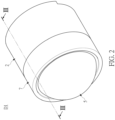
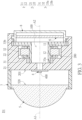
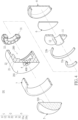
- FIG. 2 to FIG. 4 show a structure of the adaptive illuminating headlight D1 according to the first embodiment of the present invention.
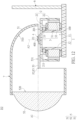
- the adaptive illuminating headlight D1 mainly includes a stator structure 1, a rotor structure 2, a driver 3, a light emitting unit 4, an optical assembly 5, and a control unit 6.
- the rotor structure 2 is configured to rotate relative to the stator structure 1 and has a carrying surface 201.
- the driver 3 is arranged between the stator structure 1 and the rotor structure 2 to drive the rotor structure 2.
- the light emitting unit 4 is arranged on the carrying surface 201 to emit an illumination light beam.
- the optical assembly 5 is configured to allow the illumination light beam to project outwardly so as to produce an illumination pattern.
- the optical assembly 5 is integrally connected to the rotor structure 2.
- the control unit 6 is configured to control an operation of the driver 3 to generate changes in magnetic field according to a posture change of a vehicle body (e.g., the vehicle body leans to the left or right at an angle relative to a road surface), such that the light emitting unit 4 and the optical assembly 5 are driven by the rotor structure 2 to rotate through a predetermined angle.
- the adaptive illuminating headlight D1 can be installed on a two-wheel motor vehicle V such as a fuel or electric motorcycle, such that the vehicle V can be provided with sufficient frontal illumination when making a turn, thereby reducing or even eliminating a dark region in front of the vehicle V. Specific details will be described below.
- the light emitting unit 4 directly emits an illumination light beam toward the optical assembly 5.
- the optical assembly 5 includes an optical lens that has a light input surface 520 and an optical axis A1.
- the light input surface 520 is opposite to a light emitting surface 400 of the light emitting unit 4, and the optical axis A1 is parallel to a rotation axis A2 of the rotor structure 2.
- the light input surface 520 is opposite and parallel to the light emitting surface 400 of the light emitting unit 4, and the optical axis A1 coincides with or is slightly offset from the rotation axis A2.
- the optical assembly 5 can include an asymmetric optical lens, in which curvatures in the horizontal direction and the vertical direction are different from each other.
- the optical assembly 5 can be integrally connected to the rotor structure 2 via a connecting structure 7. Accordingly, the optical assembly 5 can be driven by the rotor structure 2 to rotate together with the light emitting unit 4, i.e., the light emitting unit 4 and the optical assembly 5 are driven by the rotor structure 2 to simultaneously rotate through a predetermined angle.
- the connecting structure 7 can be a metal or plastic frame, but is not limited thereto.
- the connecting structure 7 and the rotor structure 2 can be formed into a unitary structure from a metal material.
- the connecting structure 7 and the optical assembly 5 can be formed into a unitary structure from a plastic material.
- the rotor structure 2 is designed to include a base portion 21 and a housing portion 22 extending from the base portion 21, and to have an accommodating space 200, in which the carrying surface 201 is located on the base portion 21.
- the base portion 21 can be a plate-like structure to provide support for the light emitting unit 4 and the optical assembly 5.
- the housing portion 22 can be a cylindrical structure to define the accommodating space 200 together with the base portion 21.
- the carrying surface 201 can have one or more convex or concave regions to conveniently carry the light emitting unit 4 or the optical assembly 5.
- the stator structure 1 serving as the basis of the entire headlight structure is designed to be incorporated into the accommodating space 200, and includes an end portion 11 and a shaft portion 12 extending from the end portion 11, in which the shaft portion 12 is closer to the base portion 21 of the rotor structure 2 than the end portion 11.
- the end portion 11 can be a plate-like structure to stably retain the driver 3 between the stator structure 1 and the rotor structure 2.
- the shaft portion 12 can be a cylindrical structure to provide support and to define the rotation axis A2.
- the driver 3 can be a brushless pan/tilt motor that mainly includes a coil structure 31 and a magnetic body 32.
- the coil structure 31 and the magnetic body 32 are disposed between the shaft portion 12 of the stator structure 1 and the housing portion 22 of the rotor structure 2.
- the coil structure 31 can include iron cores with coils wound thereon and be fixed to the shaft portion 12 of the stator structure 1.
- the magnetic body 32 can include one or more magnets and be fixed to the housing portion 22 of the rotor structure 2. Accordingly, the coil structure 31 and the magnetic body 32 can work with each other to produce an electromagnetic torque, thereby allowing the rotor structure 2 to rotate around the rotation axis A2 in a clockwise or counterclockwise direction.
- the driver 3 can further include a first bearing 33a and a second bearing 33b.
- the first bearing 33a can be surroundingly disposed on the shaft portion 12 of the stator structure 1 and spaced apart from the coil structure 31, and the second bearing 33b can be surroundingly disposed on the end portion 11 of the stator structure 1.
- the light emitting unit 4 can be fixed to the carrying surface 201 of the rotor structure 2 via a circuit board having high thermal conductivity (not numbered) such as a metal core PCB (MCPCB).
- the circuit board at least has driving functions of the light emitting unit 4, and can drive the light emitting unit 4 according to received signals, so as to allow the light emitting unit 4 to produce a target lighting effect (e.g., a color or brightness effect).
- the light emitting unit 4 is mounted on and electrically connected to the circuit board, and the circuit board is fixed to the carrying surface 201 of the rotor structure 2.
- the light emitting unit 4 can be an LED package structure that includes a first light emitting unit and a second light emitting unit.
- the first light emitting unit and the second light emitting unit can be arranged in proximity to a focus of the optical assembly 5 (e.g., optical lens), and the first light emitting unit is located above the second light emitting unit.
- Each of the first light emitting unit and the second light emitting unit includes one or more LED chips. Accordingly, when only the first light emitting unit is lit, an illumination light beam emitted therefrom can be projected outwardly through the optical assembly 5 to produce a low beam illumination pattern. When both the first light emitting unit and the second light emitting unit are lit, illumination light beams emitted therefrom can be projected outwardly through the optical assembly 5 to produce a high beam illumination pattern.
- the rotor structure 2 is made of a metal material, heat generated by the light emitting unit 4 will be quickly transmitted to a peripheral region of the rotor structure 2 through the circuit board and dissipated to the outside. If the rotor structure 2 and the connecting structure 7 are both made of a metal material, heat generated by the light emitting unit 4 will be quickly transmitted to peripheral regions of the rotor structure 2 and the connecting structure 7 through the circuit board and dissipated to the outside.
- the control unit 6 is arranged in the accommodating space 200 of the rotor structure 2, and can include a control PCB and one or more sensors (e.g., an accelerometer and a gyroscope).
- the control PCB can have a motor driver IC and its related components provided thereon.
- the adaptive illuminating headlight D1 of the present invention can further include a back cover 8 that is assembled to an open end of the housing portion 22 of the rotor structure 2 to close the accommodating space 200, so as to isolate the control unit 6 from an external environment, such that the control unit 6 is not easily affected by external environmental factors such as water and dust.
- stator structure 1 can have a wire groove 100 extending through the end portion 11 and the shaft portion 12 for allowing wire(s) from the light emitting unit 4 to pass therethrough. Therefore, the wire(s) will not interfere with mechanical parts, so that the headlight can work normally for a long period of time.
- the adaptive illuminating headlight D1 can provide sufficient frontal illumination for a running vehicle V (e.g., a fuel or electric motorcycle), so as to reduce or even eliminate a dark region BA in front of the vehicle V.
- a running vehicle V e.g., a fuel or electric motorcycle
- the detailed descriptions are as follows.
- the light emitting unit 4 and the optical assembly 5 e.g., optical lens
- a resulting illumination pattern P is in a horizontal state and no dark regions are present in front of the vehicle V, as shown in FIG. 6 .
- control unit 6 can cause an operation of the driver 3 to bring about changes in magnetic field according to a posture change of the vehicle body, such that the light emitting unit 4 and the optical assembly 5 are driven by the rotor structure 2 to rotate right through a predetermined angle in a clockwise direction viewing from the driver, as shown in FIG. 5 .
- the illumination pattern P is still maintained in the horizontal state, and an auxiliary illumination region IA can be produced to eliminate the dark region at the front-left of the vehicle V, as shown in FIG. 8 .
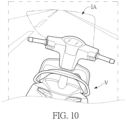
- control unit 6 can cause an operation of the driver 3 to bring about changes in magnetic field according to a posture change of the vehicle body, such that the light emitting unit 4 and the optical assembly 5 are driven by the rotor structure 2 to rotate left through a predetermined angle in a counterclockwise direction viewing from the driver, as shown in FIG. 5 .
- the illumination pattern P is still maintained in the horizontal state, and an auxiliary illumination region IA can be produced to eliminate the dark region at the front-right of the vehicle V, as shown in FIG. 10 .
- FIG. 20 shows a variant embodiment of the adaptive illuminating headlight D1 of the present invention.
- the rotor structure 2 can further include a carrying portion 23, in addition to the base portion 21 and the housing portion 22.
- the carrying portion 23 can be integrally connected to the base portion 21, and the carrying portion 23 and the housing portion 22 can be respectively located at left and right sides of the base portion 21.
- the optical assembly 5 can include a light guiding member 51 and an optical lens 52 that are configured to allow the illumination light beam to project outwardly so as to produce an illumination pattern.
- the carrying portion 23 is located between the base portion 21 and the optical lens 52.
- the carrying surface 201 is located on the carrying portion 23, and the light emitting unit 4 and the light guiding member 51 are arranged on the carrying surface 201.
- the light guiding member 51 has a reflecting surface 510 that covers the light emitting surface 400 of the light emitting unit 4, and the light emitting surface 400 preferably faces the reflecting surface 510.
- the carrying portion 23 can be an L-shaped structure and the light guiding member 51 can be a light reflecting cup, but the present invention is not limited thereto.
- an illumination light beam emitted from the light emitting unit 4 can be reflected by the reflecting surface 510 of the light guiding member 51 and projected to the light input surface 520 of the optical lens 52, and the light guiding member 51 and the light emitting unit 4 can be driven together by the rotor structure 2.
- the adaptive illuminating headlight D2 mainly includes a stator structure 1, a rotor structure 2, a driver 3, a light emitting unit 4, an optical assembly 5, and a control unit 6.
- the rotor structure 2 is configured to rotate relative to the stator structure 1 and has a carrying surface 201.
- the driver 3 is arranged between the stator structure 1 and the rotor structure 2 to drive the rotor structure 2.
- the light emitting unit 4 is arranged on the carrying surface 201 of the rotor structure 2 to emit an illumination light beam.
- the optical assembly 5 is configured to allow the illumination light beam to project outwardly so as to produce an illumination pattern.
- the optical assembly 5 is integrally connected to the rotor structure 2.
- the control unit 6 is configured to cause an operation of the driver 3 to bring about changes in magnetic field according to a posture change of a vehicle body, such that the light emitting unit 4 and the optical assembly 5 are driven by the rotor structure 2 to rotate through a predetermined angle.
- the adaptive illuminating headlight D2 can be installed on a two-wheel or four-wheel motor vehicle V for use, such as a fuel or electric motorcycle, such that the vehicle V can be provided with sufficient frontal illumination when turning, thereby reducing or even eliminating a dark region in front of the vehicle V.
- the present embodiment employs a different optical system from the first embodiment and a modified headlight structure in which a rotation axis A2 of the rotor structure 2 and an optical axis A1 of the optical assembly 5 are perpendicular or substantially perpendicular to each other, and are preferably perpendicular to each other.
- the optical assembly 5 includes a light guiding member 51, an optical lens 52, and a light distributing member 53.
- the light guiding member 51 is configured to guide the illumination light beam emitted from the light emitting unit 4 to travel along a predetermined path.
- the optical lens 52 and the light distributing member 53 are arranged at positions on the predetermined path, and the light distributing member 53 is located between the optical lens 52 and the light emitting unit 4 to selectively block the illumination light beam so as to modify the illumination pattern. Furthermore, the light guiding member 51, the optical lens 52, and the light distributing member 53 are configured to be driven by the rotor structure 2 so as to simultaneously rotate with the light emitting unit 4.
- the light guiding member 51 corresponds in position to the light emitting unit 4 and has a reflecting surface 510 that covers a light emitting surface 400 of the light emitting unit 4.
- the light guiding member 51 can be a light reflecting cup and the reflecting surface 510 can define a first focus F1 and a second focus F2.
- the first focus F1 is located in a cover region of the light guiding member 51
- the second focus F2 is located in proximity to an edge of the cover region of the light guiding member 51.
- the first focus F1 can be located on or below the optical axis A1, and is preferably located below the optical axis A1.
- the light emitting unit 4 can be located on or in proximity to the first focus F1 and located on or in proximity to the rotation axis A2, so that the rotation of the rotor structure 2 becomes more stable and smooth. Furthermore, the second focus F2 can coincide with or be in proximity to a lens focal point F3, and preferably coincides with the lens focal point F3. Accordingly, an illumination light beam emitted from the light emitting unit 4 can be reflected by the reflecting surface 510 of the light guiding member 51 to project to a light input surface 520 of the optical lens 52.
- the light guiding member 51 may be a reflecting structure other than the light reflecting cup.
- the optical lens 52 can be a circularly symmetric optical lens, and can be integrally connected to the light guiding member 51 via a connecting structure 7.
- the connecting structure 7 can be a metal or plastic frame, but is not limited thereto.
- the connecting structure 7, the light guiding member 51, and the optical lens 52 can be formed from a plastic material and into a unitary structure.
- the light distributing member 53 can be a light shielding plate and a top portion thereof has an optically effective edge 531 (also referred to as "cut-off edge") to adjust light distribution, thereby producing a low beam or high beam illumination pattern having a clear cut-off line and contour. Furthermore, the light distributing member 53 is configured to move between a first position and a second position below the first position. When the light distributing member 53 is moved to the first position, the adaptive illuminating headlight D2 will be switched to a low beam mode. When the light distributing member 53 is moved to the second position, the adaptive illuminating headlight D2 will be switched to a high beam mode. More specifically, the light distributing member 53 can be driven by a solenoid valve driver (not shown in FIG.
- the light distributing member 53 at the first position can block a portion of the illumination light beam travelling along the predetermined path, thereby producing a low beam illumination pattern.
- the light distributing member 53 at the second position can allow all the illumination light beam travelling along the predetermined path to enter the optical lens 52 through the light input surface 520, thereby producing a high beam illumination pattern.
- the rotor structure 2 is designed to include a base portion 21 and a housing portion 22 extending from the base portion 21 and to have an accommodating space 200, in which the carrying surface 201 is located on the base portion 21.
- the base portion 21 can be a plate-like structure to provide support for the light emitting unit 4 and the optical assembly 5.
- the housing portion 22 can be a cylindrical structure to define the accommodating space 200 together with the base portion 21.
- the carrying surface 201 can have one or more convex or concave regions to conveniently hold the light emitting unit 4 or the optical assembly 5.
- stator structure 1 serving as the basis of the entire headlight structure is designed to include an end portion 11 located outside the accommodating space 200 and a shaft portion 12 extending into the accommodating space 200 from the end portion 11.
- the end portion 11 can be a plate-like structure to stably retain the driver 3 between the stator structure 1 and the rotor structure 2.
- the shaft portion 12 can be a cylindrical structure to provide support and to define the rotation axis A2.
- the driver 3 can include a coil structure 31 and a magnetic body 32 that are disposed between the shaft portion 12 of the stator structure 1 and the housing portion 22 of the rotor structure 2.
- the coil structure 31 can include iron cores with coils wound thereon and be fixed to the shaft portion 12 of the stator structure 1.
- the magnetic body 32 can include one or more magnets and be fixed to the housing portion 22 of the rotor structure 2. Accordingly, the coil structure 31 and the magnetic body 32 can work with each other to produce an electromagnetic torque, thereby allowing the rotor structure 2 to rotate around the rotation axis A2 in a clockwise or counterclockwise direction.
- the driver 3 can further include at least one bearing 33 that can be surroundingly disposed on the shaft portion 12 of the stator structure 1 and spaced apart from the coil structure 31.
- the base portion 21 of the rotor structure 2 can further include a limiting groove 211 located in the accommodating space 200, and the at least one bearing 33 is embedded in the limiting groove 211.
- stator structure 1 can have a wire groove 100 extending through the end portion 11 and the shaft portion 12 for allowing wire(s) from the light emitting unit 4 to pass therethrough. Therefore, the wire(s) will not interfere with mechanical parts, so that the headlight can work normally for a long period of time.
- the light emitting unit 4 can be fixed to the carrying surface 201 of the rotor structure 2 via a circuit board having high thermal conductivity (not numbered) such as a metal core PCB (MCPCB).
- the circuit board at least has driving functions of the light emitting unit 4, and can drive the light emitting unit 4 according to received signals, so as to allow the light emitting unit 4 to produce a target lighting effect (e.g., a color or brightness effect).
- the light emitting unit 4 is mounted on and electrically connected to the circuit board, and the circuit board is fixed to the carrying surface 201 of the rotor structure 2.
- the light emitting unit 4 can be an LED package structure that includes one or more light emitting units.
- control unit 6 is located on the end portion 11 of the stator structure 1 rather than located in the accommodating space 200.
- the control unit 6 can include a control PCB and one or more sensors (e.g., an accelerometer and a gyroscope).
- the control PCB can have a motor driver IC and its related components provided thereon.
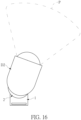
- FIG. 14 to FIG. 16 show operations of the adaptive illuminating headlight D2.
- the control unit 6 will not cause an operation of the driver 3 and no rotation is imparted to the light emitting unit 4 and the optical assembly 5 (e.g., optical lens).
- the optical assembly 5 e.g., optical lens
- the control unit 6 causes an operation of the driver 3 to bring about changes in magnetic field according to a posture change of a vehicle body, such that the light emitting unit 4 and the optical assembly 5 are driven by the rotor structure 2 to rotate left or right through a predetermined angle, as shown in FIG. 15 and FIG. 16 .
- a resulting illumination pattern P can illuminate any blind spots on the curved road in front of the vehicle.
- FIG. 17 to FIG. 19 show a structure of an adaptive illuminating headlight D3 according to the third embodiment which does not fall within the present invention.
- the adaptive illuminating headlight D3 mainly includes a stator structure 1, a rotor structure 2, a driver 3, a light emitting unit 4, an optical assembly 5, and a control unit 6.
- the rotor structure 2 is configured to rotate relative to the stator structure 1 and has a carrying surface 201.
- the driver 3 is arranged between the stator structure 1 and the rotor structure 2 to drive the rotor structure 2.
- the light emitting unit 4 is arranged on the carrying surface 201 of the rotor structure 2 to emit an illumination light beam.
- the optical assembly 5 is configured to allow the illumination light beam to project outwardly so as to produce an illumination pattern.
- the optical assembly 5 is integrally connected to the rotor structure 2.
- the control unit 6 is configured to cause an operation of the driver 3 to bring about changes in magnetic field according to a posture change of a vehicle body, such that the light emitting unit 4 and the optical assembly 5 are driven by the rotor structure 2 to rotate through a predetermined angle.
- the adaptive illuminating headlight D3 can be installed on a two-wheel or four-wheel motor vehicle V such as a fuel or electric motorcycle, such that the vehicle V can be provided with sufficient frontal illumination when turning, thereby reducing or even eliminating a dark region in front of the vehicle V.
- the headlight structure of the present embodiment is substantially the same as that of the second embodiment, but the optical system of the present embodiment does not include an optical lens and a light distributing member.
- an illumination light beam emitted from the light emitting unit 4 can be reflected by a reflecting surface 510 of a light guiding member 51 to project outwardly along a predetermined path. Therefore, an illumination pattern can be produced for road illumination without using an optical lens and a light distribution member for light distribution, but a cut-off line thereof is indistinct.
- the relevant technical details mentioned in the second embodiment still apply in the present embodiment and will not be repeated herein for the sake of brevity. Similarly, the technical details mentioned in the present embodiment can also be applied to the second embodiment.
- an overall structure is a simple, reliable, and durable. More specifically, the driver and the control unit are integrated into the rotor structure, such that they are not easily affected by external environmental factors such as water and dust, thereby extending the lifespan thereof.
- the adaptive illuminating headlight of the present invention can be installed on a two-wheel or four-wheel vehicle for use.
- the control unit can cause an operation of the driver according to a posture change of a vehicle body (e.g., the vehicle body leans to the left or right at an angle relative to a road surface), such that the light emitting unit and the optical assembly are driven by the rotor structure to rotate through a predetermined angle, so as to reduce or even eliminate a dark region in front of the vehicle.
- the light emitting unit can be fixed to the carrying surface of the rotor structure via a circuit board having high thermal conductivity, and the rotor structure and the connecting structure can be formed into a unitary structure from a metal material. Accordingly, heat generated by the light emitting unit can be quickly transmitted to peripheral regions of the rotor structure and the connecting structure through the circuit board and dissipated to the outside.
- wires can extend through the stator structure and will not be rotated with the rotor structure and interfered with the mechanical parts, such that the headlight can have better availability.
- the headlight can have a smaller volume due to an arrangement of the driver inside the rotor structure.
- the driver only affects the rotor structure and other parts driven by the rotor structure, such that the driving force thereof is smaller and the thermal effect thereof is lower.
- the adaptive illuminating headlight of the present invention has a low beam with a follow-up lighting effect and a high beam, and the low beam can meet the requirements of motor vehicle regulations during a follow-up process and does not cause glare to an oncoming vehicle.
Landscapes
- Engineering & Computer Science (AREA)
- Mechanical Engineering (AREA)
- General Engineering & Computer Science (AREA)
- Physics & Mathematics (AREA)
- Microelectronics & Electronic Packaging (AREA)
- Optics & Photonics (AREA)
- Lighting Device Outwards From Vehicle And Optical Signal (AREA)
- Non-Portable Lighting Devices Or Systems Thereof (AREA)
Claims (11)
- Adaptiver Scheinwerfer (D1, D2, D3) für die Verwendung in einem Fahrzeug (V), umfassend:einen Statoraufbau (1),einen Rotoraufbau (2), der konfiguriert ist für eine Drehung relativ zu dem Statoraufbau (1) und eine tragende Fläche (201) aufweist,eine Antriebseinheit (3), die zwischen dem Statoraufbau (1) und dem Rotoraufbau (2) angeordnet ist, um den Rotoraufbau (2) anzutreiben,eine Lichtemissionseinheit (4), die an der tragenden Fläche (201) angeordnet ist für das Emittieren eines Beleuchtungslichtstrahls,eine optische Anordnung (5), die konfiguriert ist, um zu erlauben, dass der Beleuchtungslichtstrahl nach außen projiziert wird für das Erzeugen eines Beleuchtungsmusters (P), undeine Steuereinheit (6), die konfiguriert ist zum Steuern der Antriebseinheit (3) für einen Betrieb in Entsprechung zu einer Haltungsänderung einer Fahrzeugkarosserie, sodass die Lichtemissionseinheit (4) durch den Rotoraufbau (2) für eine Drehung um einen vorbestimmten Winkel angetrieben wird,dadurch gekennzeichnet, dass der Rotoraufbau (2) einen Basisteil (21) und einen sich von dem Basisteil (21) erstreckenden Gehäuseteil (22) umfasst, wobei die tragende Fläche (201) an dem Basisteil (21) angeordnet ist, und wobei der Basisteil (21) und der Gehäuseteil (22) gemeinsam einen Aufnahmeraum (200) definieren,wobei der Statoraufbau (1) in dem Aufnahmeraum (200) angeordnet ist und einen Endteil (11) und einen sich von dem Endteil (11) erstreckenden Wellenteil (12) umfasst, wobei der Wellenteil (12) näher an dem Basisteil (21) ist als der Endteil (11),wobei die Antriebseinheit (3) einen Spulenaufbau (31), einen magnetischen Körper (32) und wenigstens ein Lager (33) umfasst, wobei der Spulenaufbau (31) und der magnetische Körper (32) zwischen dem Wellenteil (12) und dem Gehäuseteil (22) angeordnet sind und wobei das wenigstens eine Lager (33) um den Wellenteil (12) herum angeordnet ist und von dem Spulenteil (33) beabstandet ist, undwobei die Steuereinheit (6) eine Leiterplatte umfasst, die in dem durch eine hintere Abdeckung (8) geschlossenen Aufnahmeraum (200) angeordnet ist.
- Adaptiver Scheinwerfer (D1) nach Anspruch 1, wobei die optische Anordnung (5) eine optische Linse (52) umfasst, die integriert mit dem Rotoraufbau (2) über einen Verbindungsaufbau (7) verbunden ist, wobei eine Lichteintrittsfläche (520) der optischen Linse (52) einer Lichtemissionsfläche (400) der Lichtemissionseinheit (4) gegenüberliegt.
- Adaptiver Scheinwerfer (D1) nach Anspruch 2, wobei die Lichtemissionseinheit (4) konfiguriert ist zum Emittieren des Beleuchtungslichtstrahls zu der Lichteintrittsfläche (520) der optischen Linse (52).
- Adaptiver Scheinwerfer (D1) nach Anspruch 1, wobei der Spulenaufbau (31) an dem Wellenteil (12) des Statoraufbaus (1) fixiert ist und der magnetische Körper (32) an dem Gehäuseteil (22) des Rotoraufbaus (2) fixiert ist.
- Adaptiver Scheinwerfer (D2) nach Anspruch 1, wobei die optische Anordnung (5) ein Lichtführungsglied (51), eine optische Linse (52) und ein Lichtverteilungsglied (53) umfasst, wobei das Lichtführungsglied (51) konfiguriert ist zum Führen des Beleuchtungslichtstrahls für eine Bewegung entlang eines vorbestimmten Pfads, wobei die optische Linse (52) und das Lichtverteilungsglied (53) an Positionen an dem vorbestimmten Pfad angeordnet sind und wobei das Lichtverteilungsglied (53) zwischen der optischen Linse (52) und der Lichtemissionseinheit (4) angeordnet ist, um wahlweise den Beleuchtungslichtstrahl für ein Modifizieren des Beleuchtungsmusters P zu blockieren.
- Adaptiver Scheinwerfer (D2) nach Anspruch 5, wobei das Lichtführungsglied (51), die optische Linse (52) und das Lichtverteilungsglied (53) konfiguriert sind, um durch den Rotoraufbau (2) angetrieben zu werden, sodass sie sich gleichzeitig mit der Lichtemissionseinheit (4) drehen, wobei die Lichtemissionseinheit (4) eine Lichtemissionsfläche (400) aufweist und das Lichtführungsglied (51) eine Reflexionsfläche (510), die die Lichtemissionsfläche (400) bedeckt, aufweist.
- Adaptiver Scheinwerfer (D2) nach Anspruch 6, wobei die Lichtemissionseinheit (4) konfiguriert ist zum Emittieren des Beleuchtungslichtstrahls zu der Reflexionsfläche (510) des Lichtführungsglieds (51).
- Adaptiver Scheinwerfer (D2) nach Anspruch 5, wobei das Lichtverteilungsglied (53) konfiguriert ist für eine Bewegung zwischen einer ersten Position und einer zweiten Position unter der ersten Position, wobei das Lichtverteilungsglied (53) an der ersten Position einen Teil des sich entlang des vorbestimmten Pfads bewegenden Beleuchtungslichtstrahls blockiert, sodass das Beleuchtungsmuster (P) ein Abblendlicht-Beleuchtungsmuster ist, wobei das Lichtverteilungsglied (53) an der zweiten Position erlaubt, dass sich der gesamte Beleuchtungslichtstrahl entlang des vorbestimmten Pfads bewegt, um durch eine Lichteintrittsfläche (520) der optischen Linse (52) in die optische Linse (52) einzutreten, sodass das Beleuchtungsmuster (P) ein Fernlicht-Beleuchtungsmuster ist.
- Adaptiver Scheinwerfer (D2) nach Anspruch 1, wobei der Basisteil (21) des Rotoraufbaus (2) weiterhin eine in dem Aufnahmeraum (200) angeordnete Begrenzungsnut (211) umfasst, wobei das wenigstens eine Lager (33) in der Begrenzungsnut (211) eingebettet ist.
- Adaptiver Scheinwerfer (D3) nach Anspruch 1, wobei die optische Anordnung (5) ein Lichtführungsglied (51) umfasst, das konfiguriert ist zum Führen des Beleuchtungslichtstrahls für eine Bewegung entlang eines vorbestimmten Pfads.
- Adaptiver Scheinwerfer (D3) nach Anspruch 10, wobei das Lichtführungsglied (51) in seiner Position der Lichtemissionseinheit (4) entspricht und eine Reflexionsfläche (510), die eine Lichtemissionsfläche (400) der Lichtemissionseinheit (4) bedeckt, aufweist.
Applications Claiming Priority (1)
| Application Number | Priority Date | Filing Date | Title |
|---|---|---|---|
| TW110134728A TWI824297B (zh) | 2021-09-17 | 2021-09-17 | 適路性照明頭燈 |
Publications (4)
| Publication Number | Publication Date |
|---|---|
| EP4151509A1 EP4151509A1 (de) | 2023-03-22 |
| EP4151509A8 EP4151509A8 (de) | 2023-05-10 |
| EP4151509B1 true EP4151509B1 (de) | 2024-01-31 |
| EP4151509C0 EP4151509C0 (de) | 2024-01-31 |
Family
ID=83050021
Family Applications (1)
| Application Number | Title | Priority Date | Filing Date |
|---|---|---|---|
| EP22191803.0A Active EP4151509B1 (de) | 2021-09-17 | 2022-08-23 | Adaptiver beleuchtungsscheinwerfer |
Country Status (5)
| Country | Link |
|---|---|
| US (1) | US11821604B2 (de) |
| EP (1) | EP4151509B1 (de) |
| JP (1) | JP7399227B2 (de) |
| CN (1) | CN115817329A (de) |
| TW (1) | TWI824297B (de) |
Families Citing this family (1)
| Publication number | Priority date | Publication date | Assignee | Title |
|---|---|---|---|---|
| TWI863284B (zh) * | 2023-05-16 | 2024-11-21 | 得堡科技有限公司 | 交通工具轉向補光結構 |
Family Cites Families (14)
| Publication number | Priority date | Publication date | Assignee | Title |
|---|---|---|---|---|
| FR2294905A2 (fr) * | 1974-12-19 | 1976-07-16 | Alphen Jacques | Dispositif de correction automatique de l'orientation du faisceau lumineux d'un projecteur de motocycle ou vehicule analogue |
| JPH0810563B2 (ja) * | 1986-12-22 | 1996-01-31 | 株式会社小糸製作所 | 車輌用前照灯 |
| JPH01173095U (de) * | 1988-05-27 | 1989-12-07 | ||
| US5426571A (en) * | 1993-03-11 | 1995-06-20 | Jones; Jerry | Motorcycle headlight aiming device |
| JP4881255B2 (ja) * | 2007-08-13 | 2012-02-22 | 株式会社小糸製作所 | 車両用前照灯 |
| ITMI20131056A1 (it) | 2013-06-25 | 2014-12-26 | R L | Proiettore a lente orientabile per veicoli a due ruote |
| JP5642246B1 (ja) | 2013-10-23 | 2014-12-17 | 三菱電機株式会社 | 配光可変型前照灯装置 |
| WO2015115319A1 (ja) | 2014-01-30 | 2015-08-06 | 三菱電機株式会社 | 前照灯装置 |
| JP6667271B2 (ja) * | 2015-11-30 | 2020-03-18 | 株式会社小糸製作所 | 二輪車用灯具 |
| JP2018063891A (ja) | 2016-10-13 | 2018-04-19 | 株式会社小糸製作所 | 光源ユニットおよび灯具 |
| TWI651221B (zh) * | 2017-05-17 | 2019-02-21 | 誠益光電科技股份有限公司 | 車燈裝置及其遮板驅動模組 |
| US10899406B2 (en) | 2018-03-15 | 2021-01-26 | Peymon Hashimoto | Lighting system for a leaning vehicle |
| US10661703B2 (en) * | 2018-03-15 | 2020-05-26 | Allight Corp | Motorcycle light system and method of use |
| CN208874455U (zh) * | 2018-10-31 | 2019-05-17 | 深圳市恒驱电机股份有限公司 | 一种空心轴无刷直流电机 |
-
2021
- 2021-09-17 TW TW110134728A patent/TWI824297B/zh active
-
2022
- 2022-01-18 CN CN202210057178.4A patent/CN115817329A/zh active Pending
- 2022-07-28 JP JP2022120311A patent/JP7399227B2/ja active Active
- 2022-08-19 US US17/891,792 patent/US11821604B2/en active Active
- 2022-08-23 EP EP22191803.0A patent/EP4151509B1/de active Active
Also Published As
| Publication number | Publication date |
|---|---|
| US11821604B2 (en) | 2023-11-21 |
| EP4151509A1 (de) | 2023-03-22 |
| JP2023044633A (ja) | 2023-03-30 |
| JP7399227B2 (ja) | 2023-12-15 |
| EP4151509C0 (de) | 2024-01-31 |
| US20230087968A1 (en) | 2023-03-23 |
| CN115817329A (zh) | 2023-03-21 |
| TWI824297B (zh) | 2023-12-01 |
| TW202313377A (zh) | 2023-04-01 |
| EP4151509A8 (de) | 2023-05-10 |
Similar Documents
| Publication | Publication Date | Title |
|---|---|---|
| US11970235B2 (en) | Adaptive vehicle headlight | |
| US10794559B2 (en) | Vehicle lamp and vehicle having the same | |
| KR100741341B1 (ko) | 차량용 등기구 | |
| US7226193B2 (en) | Illuminating device for a vehicle for realizing an asymmetrical light distribution | |
| CN212226934U (zh) | 车辆用灯具 | |
| EP4151509B1 (de) | Adaptiver beleuchtungsscheinwerfer | |
| US12269554B2 (en) | Intelligent follow-up illumination device including support component | |
| US6578995B2 (en) | Vehicular headlamp and vehicle provided with same | |
| TWM626668U (zh) | 適應性車用頭燈 | |
| KR20180076756A (ko) | 개별조향 제어가 가능한 led모듈 및 이를 이용한 차량용 전조등 | |
| JP7847116B2 (ja) | 鞍乗り型車両に用いられる灯具 | |
| JP5891780B2 (ja) | 車両用前照灯装置 | |
| TWI874928B (zh) | 高氣密車用頭燈 | |
| TWI866111B (zh) | 車用照明裝置 | |
| CN215513430U (zh) | 一种自适应前照灯模组 | |
| CN118973864A (zh) | 照明系统 | |
| WO2020246333A1 (ja) | 二輪車用灯具 | |
| CN112334702A (zh) | 具有一致外观的可配置的车辆照明装置 |
Legal Events
| Date | Code | Title | Description |
|---|---|---|---|
| PUAI | Public reference made under article 153(3) epc to a published international application that has entered the european phase |
Free format text: ORIGINAL CODE: 0009012 |
|
| STAA | Information on the status of an ep patent application or granted ep patent |
Free format text: STATUS: THE APPLICATION HAS BEEN PUBLISHED |
|
| AK | Designated contracting states |
Kind code of ref document: A1 Designated state(s): AL AT BE BG CH CY CZ DE DK EE ES FI FR GB GR HR HU IE IS IT LI LT LU LV MC MK MT NL NO PL PT RO RS SE SI SK SM TR |
|
| STAA | Information on the status of an ep patent application or granted ep patent |
Free format text: STATUS: REQUEST FOR EXAMINATION WAS MADE |
|
| 17P | Request for examination filed |
Effective date: 20230530 |
|
| RBV | Designated contracting states (corrected) |
Designated state(s): AL AT BE BG CH CY CZ DE DK EE ES FI FR GB GR HR HU IE IS IT LI LT LU LV MC MK MT NL NO PL PT RO RS SE SI SK SM TR |
|
| GRAP | Despatch of communication of intention to grant a patent |
Free format text: ORIGINAL CODE: EPIDOSNIGR1 |
|
| STAA | Information on the status of an ep patent application or granted ep patent |
Free format text: STATUS: GRANT OF PATENT IS INTENDED |
|
| RIC1 | Information provided on ipc code assigned before grant |
Ipc: F21S 41/63 20180101ALI20230920BHEP Ipc: F21S 41/675 20180101ALI20230920BHEP Ipc: B60Q 1/115 20060101ALI20230920BHEP Ipc: B60Q 1/12 20060101ALI20230920BHEP Ipc: B62J 6/023 20200101AFI20230920BHEP |
|
| INTG | Intention to grant announced |
Effective date: 20231016 |
|
| GRAS | Grant fee paid |
Free format text: ORIGINAL CODE: EPIDOSNIGR3 |
|
| GRAA | (expected) grant |
Free format text: ORIGINAL CODE: 0009210 |
|
| STAA | Information on the status of an ep patent application or granted ep patent |
Free format text: STATUS: THE PATENT HAS BEEN GRANTED |
|
| AK | Designated contracting states |
Kind code of ref document: B1 Designated state(s): AL AT BE BG CH CY CZ DE DK EE ES FI FR GB GR HR HU IE IS IT LI LT LU LV MC MK MT NL NO PL PT RO RS SE SI SK SM TR |
|
| REG | Reference to a national code |
Ref country code: GB Ref legal event code: FG4D Ref country code: CH Ref legal event code: EP |
|
| REG | Reference to a national code |
Ref country code: DE Ref legal event code: R096 Ref document number: 602022001790 Country of ref document: DE |
|
| REG | Reference to a national code |
Ref country code: IE Ref legal event code: FG4D |
|
| U01 | Request for unitary effect filed |
Effective date: 20240207 |
|
| U07 | Unitary effect registered |
Designated state(s): AT BE BG DE DK EE FI FR IT LT LU LV MT NL PT SE SI Effective date: 20240215 |
|
| PG25 | Lapsed in a contracting state [announced via postgrant information from national office to epo] |
Ref country code: IS Free format text: LAPSE BECAUSE OF FAILURE TO SUBMIT A TRANSLATION OF THE DESCRIPTION OR TO PAY THE FEE WITHIN THE PRESCRIBED TIME-LIMIT Effective date: 20240531 |
|
| PG25 | Lapsed in a contracting state [announced via postgrant information from national office to epo] |
Ref country code: GR Free format text: LAPSE BECAUSE OF FAILURE TO SUBMIT A TRANSLATION OF THE DESCRIPTION OR TO PAY THE FEE WITHIN THE PRESCRIBED TIME-LIMIT Effective date: 20240501 |
|
| PG25 | Lapsed in a contracting state [announced via postgrant information from national office to epo] |
Ref country code: RS Free format text: LAPSE BECAUSE OF FAILURE TO SUBMIT A TRANSLATION OF THE DESCRIPTION OR TO PAY THE FEE WITHIN THE PRESCRIBED TIME-LIMIT Effective date: 20240430 Ref country code: HR Free format text: LAPSE BECAUSE OF FAILURE TO SUBMIT A TRANSLATION OF THE DESCRIPTION OR TO PAY THE FEE WITHIN THE PRESCRIBED TIME-LIMIT Effective date: 20240131 |
|
| PG25 | Lapsed in a contracting state [announced via postgrant information from national office to epo] |
Ref country code: ES Free format text: LAPSE BECAUSE OF FAILURE TO SUBMIT A TRANSLATION OF THE DESCRIPTION OR TO PAY THE FEE WITHIN THE PRESCRIBED TIME-LIMIT Effective date: 20240131 |
|
| PG25 | Lapsed in a contracting state [announced via postgrant information from national office to epo] |
Ref country code: RS Free format text: LAPSE BECAUSE OF FAILURE TO SUBMIT A TRANSLATION OF THE DESCRIPTION OR TO PAY THE FEE WITHIN THE PRESCRIBED TIME-LIMIT Effective date: 20240430 Ref country code: NO Free format text: LAPSE BECAUSE OF FAILURE TO SUBMIT A TRANSLATION OF THE DESCRIPTION OR TO PAY THE FEE WITHIN THE PRESCRIBED TIME-LIMIT Effective date: 20240430 Ref country code: IS Free format text: LAPSE BECAUSE OF FAILURE TO SUBMIT A TRANSLATION OF THE DESCRIPTION OR TO PAY THE FEE WITHIN THE PRESCRIBED TIME-LIMIT Effective date: 20240531 Ref country code: HR Free format text: LAPSE BECAUSE OF FAILURE TO SUBMIT A TRANSLATION OF THE DESCRIPTION OR TO PAY THE FEE WITHIN THE PRESCRIBED TIME-LIMIT Effective date: 20240131 Ref country code: GR Free format text: LAPSE BECAUSE OF FAILURE TO SUBMIT A TRANSLATION OF THE DESCRIPTION OR TO PAY THE FEE WITHIN THE PRESCRIBED TIME-LIMIT Effective date: 20240501 Ref country code: ES Free format text: LAPSE BECAUSE OF FAILURE TO SUBMIT A TRANSLATION OF THE DESCRIPTION OR TO PAY THE FEE WITHIN THE PRESCRIBED TIME-LIMIT Effective date: 20240131 |
|
| PG25 | Lapsed in a contracting state [announced via postgrant information from national office to epo] |
Ref country code: PL Free format text: LAPSE BECAUSE OF FAILURE TO SUBMIT A TRANSLATION OF THE DESCRIPTION OR TO PAY THE FEE WITHIN THE PRESCRIBED TIME-LIMIT Effective date: 20240131 |
|
| U20 | Renewal fee for the european patent with unitary effect paid |
Year of fee payment: 3 Effective date: 20240705 |
|
| PG25 | Lapsed in a contracting state [announced via postgrant information from national office to epo] |
Ref country code: PL Free format text: LAPSE BECAUSE OF FAILURE TO SUBMIT A TRANSLATION OF THE DESCRIPTION OR TO PAY THE FEE WITHIN THE PRESCRIBED TIME-LIMIT Effective date: 20240131 |
|
| PG25 | Lapsed in a contracting state [announced via postgrant information from national office to epo] |
Ref country code: SM Free format text: LAPSE BECAUSE OF FAILURE TO SUBMIT A TRANSLATION OF THE DESCRIPTION OR TO PAY THE FEE WITHIN THE PRESCRIBED TIME-LIMIT Effective date: 20240131 |
|
| PG25 | Lapsed in a contracting state [announced via postgrant information from national office to epo] |
Ref country code: CZ Free format text: LAPSE BECAUSE OF FAILURE TO SUBMIT A TRANSLATION OF THE DESCRIPTION OR TO PAY THE FEE WITHIN THE PRESCRIBED TIME-LIMIT Effective date: 20240131 |
|
| PG25 | Lapsed in a contracting state [announced via postgrant information from national office to epo] |
Ref country code: SK Free format text: LAPSE BECAUSE OF FAILURE TO SUBMIT A TRANSLATION OF THE DESCRIPTION OR TO PAY THE FEE WITHIN THE PRESCRIBED TIME-LIMIT Effective date: 20240131 |
|
| PG25 | Lapsed in a contracting state [announced via postgrant information from national office to epo] |
Ref country code: SM Free format text: LAPSE BECAUSE OF FAILURE TO SUBMIT A TRANSLATION OF THE DESCRIPTION OR TO PAY THE FEE WITHIN THE PRESCRIBED TIME-LIMIT Effective date: 20240131 Ref country code: SK Free format text: LAPSE BECAUSE OF FAILURE TO SUBMIT A TRANSLATION OF THE DESCRIPTION OR TO PAY THE FEE WITHIN THE PRESCRIBED TIME-LIMIT Effective date: 20240131 Ref country code: RO Free format text: LAPSE BECAUSE OF FAILURE TO SUBMIT A TRANSLATION OF THE DESCRIPTION OR TO PAY THE FEE WITHIN THE PRESCRIBED TIME-LIMIT Effective date: 20240131 Ref country code: CZ Free format text: LAPSE BECAUSE OF FAILURE TO SUBMIT A TRANSLATION OF THE DESCRIPTION OR TO PAY THE FEE WITHIN THE PRESCRIBED TIME-LIMIT Effective date: 20240131 |
|
| REG | Reference to a national code |
Ref country code: DE Ref legal event code: R097 Ref document number: 602022001790 Country of ref document: DE |
|
| PLBE | No opposition filed within time limit |
Free format text: ORIGINAL CODE: 0009261 |
|
| STAA | Information on the status of an ep patent application or granted ep patent |
Free format text: STATUS: NO OPPOSITION FILED WITHIN TIME LIMIT |
|
| 26N | No opposition filed |
Effective date: 20241101 |
|
| PG25 | Lapsed in a contracting state [announced via postgrant information from national office to epo] |
Ref country code: MC Free format text: LAPSE BECAUSE OF FAILURE TO SUBMIT A TRANSLATION OF THE DESCRIPTION OR TO PAY THE FEE WITHIN THE PRESCRIBED TIME-LIMIT Effective date: 20240131 |
|
| PG25 | Lapsed in a contracting state [announced via postgrant information from national office to epo] |
Ref country code: IE Free format text: LAPSE BECAUSE OF NON-PAYMENT OF DUE FEES Effective date: 20240823 |
|
| U20 | Renewal fee for the european patent with unitary effect paid |
Year of fee payment: 4 Effective date: 20250709 |
|
| PG25 | Lapsed in a contracting state [announced via postgrant information from national office to epo] |
Ref country code: CY Free format text: LAPSE BECAUSE OF FAILURE TO SUBMIT A TRANSLATION OF THE DESCRIPTION OR TO PAY THE FEE WITHIN THE PRESCRIBED TIME-LIMIT; INVALID AB INITIO Effective date: 20220823 |
|
| PG25 | Lapsed in a contracting state [announced via postgrant information from national office to epo] |
Ref country code: HU Free format text: LAPSE BECAUSE OF FAILURE TO SUBMIT A TRANSLATION OF THE DESCRIPTION OR TO PAY THE FEE WITHIN THE PRESCRIBED TIME-LIMIT; INVALID AB INITIO Effective date: 20220823 |
|
| REG | Reference to a national code |
Ref country code: CH Ref legal event code: H13 Free format text: ST27 STATUS EVENT CODE: U-0-0-H10-H13 (AS PROVIDED BY THE NATIONAL OFFICE) Effective date: 20260324 |
|
| PG25 | Lapsed in a contracting state [announced via postgrant information from national office to epo] |
Ref country code: CH Free format text: LAPSE BECAUSE OF NON-PAYMENT OF DUE FEES Effective date: 20250831 |