EP4143378B1 - Verfahren zum nachführen der färbung von fasern, garnen, geweben und kleidungsstücken - Google Patents
Verfahren zum nachführen der färbung von fasern, garnen, geweben und kleidungsstücken Download PDFInfo
- Publication number
- EP4143378B1 EP4143378B1 EP20735032.3A EP20735032A EP4143378B1 EP 4143378 B1 EP4143378 B1 EP 4143378B1 EP 20735032 A EP20735032 A EP 20735032A EP 4143378 B1 EP4143378 B1 EP 4143378B1
- Authority
- EP
- European Patent Office
- Prior art keywords
- pigment
- tracking
- dyeing method
- fibre
- dyeing
- Prior art date
- Legal status (The legal status is an assumption and is not a legal conclusion. Google has not performed a legal analysis and makes no representation as to the accuracy of the status listed.)
- Active
Links
Images


Classifications
-
- D—TEXTILES; PAPER
- D06—TREATMENT OF TEXTILES OR THE LIKE; LAUNDERING; FLEXIBLE MATERIALS NOT OTHERWISE PROVIDED FOR
- D06P—DYEING OR PRINTING TEXTILES; DYEING LEATHER, FURS OR SOLID MACROMOLECULAR SUBSTANCES IN ANY FORM
- D06P1/00—General processes of dyeing or printing textiles, or general processes of dyeing leather, furs, or solid macromolecular substances in any form, classified according to the dyes, pigments, or auxiliary substances employed
- D06P1/44—General processes of dyeing or printing textiles, or general processes of dyeing leather, furs, or solid macromolecular substances in any form, classified according to the dyes, pigments, or auxiliary substances employed using insoluble pigments or auxiliary substances, e.g. binders
- D06P1/52—General processes of dyeing or printing textiles, or general processes of dyeing leather, furs, or solid macromolecular substances in any form, classified according to the dyes, pigments, or auxiliary substances employed using insoluble pigments or auxiliary substances, e.g. binders using compositions containing synthetic macromolecular substances
- D06P1/5264—Macromolecular compounds obtained otherwise than by reactions involving only unsaturated carbon-to-carbon bonds
- D06P1/5292—Macromolecular compounds obtained otherwise than by reactions involving only unsaturated carbon-to-carbon bonds containing Si-atoms
-
- D—TEXTILES; PAPER
- D06—TREATMENT OF TEXTILES OR THE LIKE; LAUNDERING; FLEXIBLE MATERIALS NOT OTHERWISE PROVIDED FOR
- D06P—DYEING OR PRINTING TEXTILES; DYEING LEATHER, FURS OR SOLID MACROMOLECULAR SUBSTANCES IN ANY FORM
- D06P1/00—General processes of dyeing or printing textiles, or general processes of dyeing leather, furs, or solid macromolecular substances in any form, classified according to the dyes, pigments, or auxiliary substances employed
- D06P1/004—Dyeing with phototropic dyes; Obtaining camouflage effects
Definitions
- This invention relates to a tracking and imperceptible dyeing method for fibres, yarns, fabrics and garments.
- the invention relates to a cold dyeing method characterised by temperatures of below 70 °C with an overall treatment time of less than two hours and which does not use strong mineral acids.
- This method uses as trackers multi-responsive hybrid pigments, subsequently referred to as 'smart pigments', and uses organo-functionalised siloxanes previously hydrolysed as binding agents for dyeing said fibres, yarns, fabrics and garments, with the aim of producing textile products with special characteristics of traceability and imperceptibility.
- the legal infringement is not only related to the quality and safety of counterfeit products, but also to the circumvention of entire production systems and supply chains, where the companies that are legally designated to produce yarns, fabrics, garments and clothing accessories are suffering a substantial reduction in sales due to the introduction of counterfeit products into their distribution channels. Some of these counterfeit products have high quality standards.
- the competition between two production systems, one legal and one illegal, which operate in parallel and in a synchronized way to produce objects of the same quality and design, pushes legal companies to adopt sophisticated security systems and tracing elements.
- These safety systems must be such as to guarantee and certify the originality of the products and to be able to trace the textile elements and/or components at each production stage.
- the state of the art highlights systems for marking and tracing yarns, for example with fluorescent, phosphorescent or photochromic compounds, or labels fitted with electronic chips.
- the reactions to bind the marker are complex, or the preparation of the system containing the marker is not simple.
- the preparation of the system containing the marker is not simple.
- the technical problem raised and resolved by the invention is that of providing a method for marking and tracking textile yarns which allows the above-mentioned drawbacks of the prior art to be overcome.
- the aim of the invention is to provide an innovative tracking dyeing method, consisting of an imperceptible tracking yarn made of natural coloured and/or raw fibre, dyed with a smart pigment.
- This pigment is a 2D nano-structuring pigment, capable of piezochromic, piezo-photochromic and optionally fluorescent activity.
- the possible fluorescent activity of the pigment can be advantageously detected when the textile product is subjected to UV radiation at any stage of production, distribution and sales.
- the application of the tracking dyeing method according to the invention avoids the counterfeiting of the textile product, as the tracking element, that is, the textile fibre marked with the smart pigment, has particular properties upstream and downstream of the dyeing treatment which can only be traced by the owner of the technology.
- the response of the smart 2D nano-structuring pigment, when fluorescent is very similar to other systems with fluorescent activity already available on the market, it differs in that it can be multi-responsive, that is, it can also present piezochromic and photochromic activity and have a higher light fastness than current fluorescent-based security systems.
- the dyeing method according to the invention which uses the above mentioned pigment type, makes it possible to obtain a nano-coating or surface coating of pigment on the fibre in a single step and under bland conditions (below 60°C), through the formation of a covalent bond between the fibre and the pigment, regardless of the type of fibre or textile clothing product.
- This makes it advantageously possible to transfer the starter characteristics of the pigment, such as the fluorescence, to the natural fibre, making the pigment imperceptible when fixed to the textile structure and therefore not easy to detect and counterfeit.
- the result of the dyeing method according to the invention is a clothing textile product preferably fluorescent with high fastness to light, photo-oxidative degradation, washing and all subsequent processes to which the fabric is subjected, such as overdyeing and bleaching.
- Textile products dyed with the dyeing method according to the invention are advantageously used as tracers to uniquely mark or identify fibres and/or yarns and/or fabrics and/or garments, also hereinafter meaning textile clothing accessories and to make a marked textile clothing accessory imperceptible to the naked eye, but visible when subjected to pressure and/or when irradiated under UV light and characterised by high light fastness.
- the textile products marked at the various processing stages by the method according to the invention are compatible with any subsequent processing of the textile process.
- the fabrics obtained with the method according to the invention not only attest to the originality of the product but are also able to trace the fabric itself, which is advantageous, for example, for Huawei fashion houses which commission the production lines of certain garments.
- the tracking dyeing method according to the invention uses a smart piezochromic pigment which preferably also has a photochromic and fluorescent activity and which, when fixed to a textile product, transfers these activities to the textile substrate providing a traceable textile product.
- the method of dyeing the textile product according to the invention advantageously allows the substrate to be dyed in such a way as to fix the pigment without producing a significant change of colour in the starter product, but making it optically active under UV radiation.
- the smart pigment applied to the textile substrate is such that it remains imperceptible to mere observation and thus maintains the original colour, quality and coat of the substrate even after the finishing treatments usually carried out on the textile products into which the treated textile substrate has been woven, including dyeing or over-dyeing operations.
- the dyeing method according to the invention is able to increase the compatibility between the textile product and the smart pigment, as it allows the formation of a thermally stable covalent bond between the fabric and the smart pigment.
- the fibre, yarn, fabric and/or garment obtained with this dyeing method are in fact covalently bound to the marker, that is, to the pigment, show piezochromic activity and, preferably, are also optically active under UV radiation.
- the fibre, yarn, fabric, treated and/or marked garment is uniquely identified as genuine, that is, by simple observation under conventional UV sources if the pigment is fluorescent.
- the method according to the invention is advantageously applicable to all categories of protein fibres and does not use aggressive substances such as strong mineral acids.
- the method according to the invention produces a fabric with excellent properties from the point of view of guaranteeing security and authenticity, thanks to the unique characteristics of the smart pigment.
- the multi-responsive, and in particular fluorescent, response of the smart pigment is, in fact, a guarantee of the originality of the textile products as well as the originality of the tracking system used.
- the dyeing method according to the invention also makes it possible to preserve the noble characteristics of the natural fibres, such as softness and brilliance, as the dyeing operations are carried out at temperatures not exceeding 60 °C and in less than 2 hours.
- the temperature ramp is fast and fully compatible with the normal operations of adding the yarn to be treated, dispersing the pigment or dye and adding the siloxane bonding agent, all in a time not exceeding 15 - 25 mins.
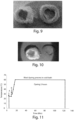
- Figure 11 which shows a diagram of the method according to the invention wherein a wool yarn is used and a siloxane bonding agent Hydrosyl 2926 of between 5 and 10% by weight with respect to the weight of the fibre and a smart pigment of between 0.25 and 2% by weight with respect to the weight of the fibre
- the maximum dyeing temperature applied in the method according to the invention represents the minimum temperature used in the traditional methods shown in Figures 1, 2 , and 3 .
- a further advantage of the dyeing method according to the invention is that it does not discriminate the type of pigment, so the same procedure can be applied for the smart pigments based on lamellar solids type LDH and Zr phosphates.
- this invention provides an imperceptible yarn, obtained with a multi-responsive pigment, covalently bound to the yarn or textile product by a bland dyeing method and in a single industrial production step, with UV activity and high light fastness.
- Textiles dyed with smart pigments are disclosed in EP-A-2628849 , a method for tracking dyeing textiles is disclosed in WO-A-2014/133384 and a method for fixing pigments on textiles with a siloxane is disclosed in GB-A-942586 .
- the pigment has a first configuration, at a first pressure value P1, wherein the inorganic matrix lamellae are spaced apart and at least one organic filling layer is positioned between two of the lamellae, and a second configuration, at a second pressure value P2, the value of the second pressure P2 being higher than the value of the first pressure P1, wherein the above-mentioned inorganic matrix lamellae are close together allowing a molecular aggregation of said organic filler.
- the molecular aggregation generates a change in pigment coloration such that, in a configuration of use of the pigment applied to the support surface, when compression is applied to a portion of the treated support surface, the pigment changes from the first to the second configuration, resulting in a change in coloration of the portion of the treated surface that has been subjected to compression with respect to the remaining treated surface not subjected to compression allowing a marking or identification of authenticity of the treated support surface.
- said molecular aggregation generates a change in pigment coloration so that, in a second configuration of use of the pigment once activated (piezochromic) and applied on the support surface, when UV irradiation is applied on a portion of the treated support surface, the pigment changes from a first coloration to a second coloration (photochromic), resulting in a change in colour and a fluorescent response of the portion of the treated surface which has undergone UV irradiation with respect to the remaining treated surface that has not undergone irradiation, allowing marking or identification of authenticity of the treated support surface.
- the above-mentioned pigments, or smart pigments consist of said organic filler comprising organic molecules, optionally fluorescent, intercalated and/or adsorbed in said inorganic matrix, or inorganic substrate, the latter consisting of a lamellar solid, preferably of the layered double hydroxide type - LDH.
- the pigments are characterised by a nano-structuring 2D structure, and can have multi-responsive activity, that is, piezochromic (colour change with pressure), piezophotochromic (colour change with pressure and further colour change after radiation with LED and/or UV light and/or solar radiation), and fluorescent.
- the tracking dyeing process comprises the immersion of the fibres, yarns, fabrics and/or garments previously wetted in a solution containing the organo-functionalised siloxane agent and, subsequently, the smart tracer pigment, preferably fluorescent, is added to the dyeing bath.
- the method according to the invention confers to the fabric the above-mentioned characteristics thanks to the mode and the stage of application of said siloxane agent, preferably made up of organo-functionalised siloxanes.
- the siloxane agent, or binder agent, based on previously hydrolysed organo-functionalized siloxanes is used to create a coating to the support, meaning yarn, fibre, fabric or garment, and then the smart pigment without organic coating is added. Therefore, the fibre is firstly made reactive with respect to the smart pigments thanks to the appropriate chemical modification, or functionalization of the support, with the organo-functionalised siloxane agent, inserted at an earlier stage with respect to the smart pigment.
- the application of the method according to the invention leads to the formation of covalent bonds between the inorganic matrix of the smart pigment and the functional groups of the fibre or natural textile substrate, such as primary and secondary amine, hydroxyl and carboxylic groups.
- the covalent bond is formed by the reaction between reactive organo-functional siloxane agents (adhesion promoters), the natural fibres, such as wool, silk, linen, cotton, hemp, cashmere and their mixtures and the pigments, in water and under mild thermal conditions.
- reactive organo-functional siloxane agents adheresion promoters
- the natural fibres such as wool, silk, linen, cotton, hemp, cashmere and their mixtures and the pigments
- the siloxane agent reactive in an aqueous medium, is in fact preferably activated at a temperature below 60°C.
- the mild heat treatment promotes the formation of a rapid condensation reaction between the hydroxyl groups (-OH) of the inorganic matrix and the residual functional groups present in the natural fibres (hydroxyl, carboxyl and primary and secondary amines), mediated by the presence of the siloxane agent, which promotes the adhesion.
- the various organic functions (amine, epoxy, alkoxide) contained in the adhesion promoter additive are able to react in the medium, producing by-products such as diols and alcohols, and covalently bind the textile fibres with the pigments used.
- the dyed product thus obtained is highly resistant to further hydrolysis, bleaching and washing reactions.
- the textile product dyed by the method according to the invention is characterised by imperceptibility of the tracking element, that is, of the pigment.
- imperceptibility means, on a visual level, the fact of not being able to perceive a substantial difference in colour that may originate in the textile product to be tracked according to the presence, within it, of the treated textile substrates, that is, a difference ⁇ E not greater than 0.5 when calculated according to the criteria of ISO 105 Part J03 "Calculation of colour differences" on the basis of the CMC formula (2:1).
- the treated textile substrates that is, the tracker yarns
- the treated textile substrates are preferably used in a very dispersed manner within the warp or weft yarns making up the textile product to be tracked. More specifically, it is preferable to use a percentage of tracker yarn not exceeding 1%, distributed randomly within an article on the basis of technical calculations, which gives rise to a "warp note” and/or “weaving note” and/or “weave”.
- the liquid colouring solution can comprise a mixture of purified water and pigment wherein said pigment has a concentration by weight of between 0.85% and 5%.
- the liquid colouring solution can comprise a percentage by weight of pigment comprised between 0.1% and 5%, optionally 2%, with respect to the weight of the natural fibre.
- the siloxane agent is added in the tank in a percentage by weight of less than or equal to 20%, optionally comprised between 5% and 10%, with respect to the weight of the natural fibre.
- the tracking dyeing method according to the invention may further comprise a step for homogenising a dye bath comprising the fibre and the siloxane agent or may comprise a step for homogenising a dye bath comprising the fibre, the siloxane agent and the colouring solution. More specifically, the homogenising step is preferably carried out for a time comprised between 10 and 20 minutes.
- the natural fibre is placed in water and the ratio between the fibre and the water can be comprised between 1 mg/ml and 20 mg/ml.
- the pH is kept equal to the isoelectric point of the natural fibre. Even more preferably, the pH is kept in a range of values comprised between 4 and 7.
- the fibre can be in a configuration wound on a spool, or reel, or skein.
- the inorganic matrix of the piezochromic pigment may include components belonging to the hydrotalcites group. More specifically, components belonging to the hydrotalcites group are preferably layered double hydroxides (LDH), optionally MgAl and ZnAI, or lamellar solids being preferably zirconium phosphates, more preferably alpha zirconium phosphate type B plus zirconium phosphate.
- LDH layered double hydroxides
- MgAl and ZnAI optionally MgAl and ZnAI
- lamellar solids being preferably zirconium phosphates, more preferably alpha zirconium phosphate type B plus zirconium phosphate.
- the organic filling of the piezochromic pigment may include aggregation-induced emission compounds (AlEs), and/or water-soluble dyes, and/or optical brighteners, and/or fluorescent dyes, and/or azo dyes, and/or liquid crystals, and/or carboxylic acids, and/or anthroquinone dyes, and/or acid dyes.
- AlEs aggregation-induced emission compounds
- the fluorescent dyes preferably comprise Fluorescent Brightener, optionally Fluorescent Brightener 351, or acid fluorescent dyes of group I.
- the siloxane agent can be selected among amine / epoxy / octyl / methoxy / ethoxy functionalised hydrolysed siloxane agents, optionally Dynasylan Hydrosil 1153, Dynasylan Hydrosil 2627, Dynasylan Hydrosil 2926, Dynasylan Hydrosil 2776, Dynasylan Hydrosil 2909.
- a spool of natural yarn such as wool, silk, cotton, linen and natural fibre blends was placed in the dyeing tank and distilled water was added at a ratio of 10/1 mg of fibre per ml of water.
- LDH_FB351 which has fluorescent piezophotochromic properties composed of an inorganic lamellar solid type component belonging to the family of layered double hydroxide (LDH) known as hydrotalcite, with the formula [M2 + 1-x M 3+ x (OH) 2 ][An-] x/n ⁇ zH 2 O (3:1 Mg/AI ratio, co-intercalated with counterion nitrate and/or water and/or carbonate molecules - MgAI-LDH CAS 148884-57-5 ) intercalated with the organic molecule belonging to the family of optical brighteners or fluorescent brighteners named Fluorescent Brightener 351 ( CAS 54351-85-8 ) was dispersed in water (10 mg/ml), considering the pigment at 2% with respect to the fibre weight.
- LDH_FB351 which has fluorescent piezophotochromic properties composed of an inorganic lamellar solid type component belonging to the family of layered double hydroxide (LDH) known as hydrotalcite, with the
- a siloxane organic binder agent Dynasylan ® Hydrosil 2926 (Evonik) was added to the tank with the yarn (5 times the weight of the pigment), left in circulation for 10 mins. and then the pigment dispersion was added.
- the mixture was heated at 60°C for 2 hours, preferably 1 hour.
- the bath water was then removed from the skein/spool by discharging the dyeing water and the resulting yarn was rinsed two to three times.
- Table 1 shows the colorimetric characteristics of the pigment used.
- the white treated yarn appears more expanded to the naked eye, with the fibres further apart, whilst the white untreated yarn appears more compact to the naked eye, with the fibres closer together.
- the colour fastness to light, washing and over-dyeing on the treated wool yarn was verified, obtaining the fluorescent response degradation results shown below, visually evaluated in light boxes, based on the grayscale for degradation ISO 105 A02, using the light source of a Blacklight-Blue BLB-T8 fluorescent tube.
- the grayscale for degradation assigns values ranging from grade 5: no colour change to grade 1: maximum colour change, also comprising intermediate grades.
- Example 2 Method of tracking dyeing, according to the invention, natural yarns made of protein fibre - wool, with fluorescent piezochromic smart pigments named LDH_AIE, consisting of the organic molecule 4,4'-(1,2-Diphenylethene-1,2-diyl)dibenzoic acid ( cas n ° 1002339-79-8 ) co-intercalated in a precursor hydrotalcite type Aluminium Magnesium Hydroxide Nitrate- LDH_NO3 ( cas 148884-57-5 ).
- LDH_AIE fluorescent piezochromic smart pigments
- a spool of natural yarn such as wool, silk, cotton, linen and natural fibre blends was placed in the dyeing tank and distilled water was added at a ratio of 10/1 mg of fibre per ml of water.
- the smart pigment named LDH_AIE consisting of the organic molecule 4.4'-(1.2-Diphenylethene-1.2-diyl) dibenzoic acid co-intercalated in an inorganic component consisting of precursor hydrotalcite type Aluminium Magnesium Hydroxide Nitrate- LDH_NO3 ( CAS 148884-57-5 ) was dispersed in water (10 mg/ml), considering the pigment at 2% with respect to the fibre weight.
- the mixture was heated at 60°C for 1 hour.
- the bath water was then removed from the skein/spool by discharging the dyeing water and the resulting yarn was rinsed two to three times.
- Figures 9 and 10 show the treated and untreated wool yarn, respectively observed with the naked eye and under UV radiation.
- Example 3 Example of the tracking dyeing method according to the invention.
- the method for dyeing yarns by means of smart pigments according to the invention described below is a spool dyeing process compatible with an industrial process (Process A) and comprises the following steps:
- Example 4 Example of the tracking dyeing method according to the invention.
- the method for dyeing yarns by means of smart pigments according to the invention described below is a skein functionalisation and dyeing process compatible with an industrial process (Process B-1) and comprises the following steps:
Landscapes
- Engineering & Computer Science (AREA)
- Textile Engineering (AREA)
- Chemical & Material Sciences (AREA)
- Chemical Kinetics & Catalysis (AREA)
- Coloring (AREA)
Claims (15)
- Tracking-Färbeverfahren zum Färben oder Färben einer zu markierenden oder zu identifizierenden Naturfaser, umfassend die folgenden Schritte:f) Vorbereiten einer Naturfaser in einem Färbetank;g) Zugabe eines Siloxanmittels in den Tank; anschließendh) Dispergieren einer flüssigen Färbelösung, die ein Pigment enthält, in dem Tank;i) Erhitzen des Färbetanks, der die Naturfaser, das Siloxan und die Färbelösung enthält, auf eine Temperatur zwischen 50°C und 70°C, vorzugsweise auf 60°C;j) Konstanthalten der Temperatur über einen Zeitraum von 1 bis 3 Stunden;wobei das Pigment ein piezochromes Pigment ist, das Folgendes umfasst:- eine anorganische Matrix mit einer lamellaren Konformation,- einen organischen Füllstoff, der so konfiguriert ist, dass er zwischen den Lamellen der anorganischen Matrix interkaliert oder absorbiert wird,wobei das Pigment bei einem ersten Druckwert (P1) eine erste Konfiguration aufweist, bei der die Lamellen der anorganischen Matrix voneinander beabstandet sind und mindestens eine organische Füllschicht zwischen zwei der Lamellen angeordnet ist, und bei einem zweiten Druckwert (P2) eine zweite Konfiguration aufweist, wobei der zweite Druck (P2) höher als der erste Druck (P1) ist, wobei die Lamellen der anorganischen Matrix nahe beieinander liegen und eine molekulare Aggregation des organischen Füllstoffs ermöglichen,wobei die molekulare Aggregation eine Änderung der Pigmentfärbung erzeugt, so dass in einer Gebrauchskonfiguration des auf die Trägeroberfläche aufgebrachten Pigments, wenn Druck auf einen Teil der behandelten Trägeroberfläche ausgeübt wird, das Pigment von der ersten in die zweite Konfiguration wechselt, was zu einer Änderung der Färbung des Teils der behandelten Oberfläche, der Druck ausgesetzt war, in Bezug auf die verbleibende behandelte Oberfläche, die keinem Druck ausgesetzt war, führt, was eine Markierung oder Identifizierung der Echtheit der behandelten Trägeroberfläche ermöglicht.
- Tracking-Färbeverfahren nach dem vorhergehenden Anspruch, wobei die flüssige Färbelösung eine Mischung aus gereinigtem Wasser und Pigment umfasst, wobei das Pigment eine Gewichtskonzentration zwischen 0,85% und 5% aufweist.
- Tracking-Färbeverfahren nach einem der vorhergehenden Ansprüche, wobei die flüssige Färbelösung einen Gewichtsprozentsatz des Pigments zwischen 0,1% und 5%, gegebenenfalls 2%, bezogen auf das Gewicht der Naturfaser, aufweist.
- Tracking-Färbeverfahren nach einem der vorhergehenden Ansprüche, wobei das Siloxan in dem Tank in einem Gewichtsprozentanteil von weniger als oder gleich 20%, gegebenenfalls zwischen 5% und 10%, bezogen auf das Gewicht der Naturfaser, zugesetzt wird.
- Tracking-Färbeverfahren nach einem der vorhergehenden Ansprüche, das ferner einen Schritt zum Homogenisieren eines Färbebades, das die Faser und das Siloxanmittel enthält, oder einen Schritt zum Homogenisieren eines Färbebades, das die Faser, das Siloxanmittel und die Färbelösung enthält, umfasst.
- Tracking-Färbeverfahren nach dem vorhergehenden Anspruch, wobei der Homogenisierungsschritt während einer Zeit zwischen 10 und 20 Minuten durchgeführt wird.
- Tracking-Färbeverfahren nach einem der vorhergehenden Ansprüche, wobei in Schritt (a) die Naturfaser in Wasser gegeben wird, wobei das Verhältnis zwischen der Faser und dem Wasser zwischen 1 mg/ml und 20 mg/ml liegt.
- Tracking-Färbeverfahren nach einem der vorangehenden Ansprüche, wobei der pH-Wert gleich dem isoelektrischen Punkt der Naturfaser gehalten wird.
- Tracking-Färbeverfahren nach einem der vorhergehenden Ansprüche, bei dem der pH-Wert in einem Wertebereich zwischen 4 und 7 gehalten wird.
- Tracking-Färbeverfahren nach einem der vorhergehenden Ansprüche, wobei die Faser in einer auf eine Spule, eine Rolle oder einen Strang gewickelten Konfiguration vorliegt.
- Tracking-Färbeverfahren nach einem der vorhergehenden Ansprüche, wobei die anorganische Matrix des piezochromen Pigments Komponenten umfasst, die zur Gruppe der Hydrotalcite gehören.
- Tracking-Färbeverfahren nach dem vorhergehenden Anspruch, wobei es sich bei den Komponenten, die zur Gruppe der Hydrotalcite gehören, um geschichtete Doppelhydroxide (LDH), gegebenenfalls MgAI und ZnAI, oder um lamellare Feststoffe handelt, bei denen es sich vorzugsweise um Zirkonphosphate, besonders bevorzugt um Zirkonphosphat, sowie um Alpha-Zirkonphosphat Typ B handelt.
- Tracking-Färbeverfahren nach einem der vorhergehenden Ansprüche, wobei die organische Füllung des piezochromen Pigments aggregationsinduzierte Emissionsverbindungen (AIE) und/oder wasserlösliche Farbstoffe und/oder optische Aufheller und/oder Fluoreszenzfarbstoffe und/oder Azofarbstoffe und/oder Flüssigkristalle und/oder Carbonsäuren und/oder Anthrochinonfarbstoffe und/oder Säurefarbstoffe umfasst.
- Tracking-Färbeverfahren nach dem vorhergehenden Anspruch, dadurch gekennzeichnet, dass die Fluoreszenzfarbstoffe Fluoreszenzaufheller, gegebenenfalls Fluoreszenzaufheller 351, oder saure Fluoreszenzfarbstoffe der Gruppe I umfassen.
- Färbeverfahren nach Anspruch 13 oder 14, wobei das Siloxanmittel ausgewählt ist aus amin / epoxy / octyl/ methoxy/ ethoxyfunktionalisierten hydrolysierten Siloxanmitteln.
Applications Claiming Priority (1)
| Application Number | Priority Date | Filing Date | Title |
|---|---|---|---|
| PCT/IT2020/000037 WO2021220311A1 (en) | 2020-04-30 | 2020-04-30 | Tracking dyeing method for fibres, yarns, fabrics and garments |
Publications (3)
| Publication Number | Publication Date |
|---|---|
| EP4143378A1 EP4143378A1 (de) | 2023-03-08 |
| EP4143378B1 true EP4143378B1 (de) | 2024-08-07 |
| EP4143378C0 EP4143378C0 (de) | 2024-08-07 |
Family
ID=71170698
Family Applications (1)
| Application Number | Title | Priority Date | Filing Date |
|---|---|---|---|
| EP20735032.3A Active EP4143378B1 (de) | 2020-04-30 | 2020-04-30 | Verfahren zum nachführen der färbung von fasern, garnen, geweben und kleidungsstücken |
Country Status (2)
| Country | Link |
|---|---|
| EP (1) | EP4143378B1 (de) |
| WO (1) | WO2021220311A1 (de) |
Families Citing this family (1)
| Publication number | Priority date | Publication date | Assignee | Title |
|---|---|---|---|---|
| CN115976859A (zh) * | 2022-11-29 | 2023-04-18 | 深圳全棉时代科技有限公司 | 感光变色棉纱及其制备方法与面料、混合染料 |
Family Cites Families (3)
| Publication number | Priority date | Publication date | Assignee | Title |
|---|---|---|---|---|
| DE1249529B (de) * | 1960-05-13 | 1968-03-21 | Dow Corning A.G., Basel (Schweiz) | Verfahren zur Herstellung von Organosiloxanmischpolymeren |
| ITPG20120006A1 (it) * | 2012-02-15 | 2013-08-16 | Ferrini S R L | Metodo per tinteggiare fibre tessili naturali e relative sostanze |
| EP2961881B1 (de) * | 2013-03-01 | 2017-10-04 | Feyecon Development & Implementation B.V. | Verfahren zur markierung eines textilsubstrats |
-
2020
- 2020-04-30 EP EP20735032.3A patent/EP4143378B1/de active Active
- 2020-04-30 WO PCT/IT2020/000037 patent/WO2021220311A1/en not_active Ceased
Also Published As
| Publication number | Publication date |
|---|---|
| WO2021220311A1 (en) | 2021-11-04 |
| EP4143378A1 (de) | 2023-03-08 |
| EP4143378C0 (de) | 2024-08-07 |
Similar Documents
| Publication | Publication Date | Title |
|---|---|---|
| Baatout et al. | Luminescent cotton fibers coated with fluorescein dye for anti-counterfeiting applications | |
| MX2008010041A (es) | Mejoramientos relacionados con la impresion. | |
| US11081255B2 (en) | High-temperature and flame-resistant colored adhesive tape, use of a substrate for its manufacture, and cable harness including such an adhesive tape | |
| Saad et al. | Polyester fabric with fluorescent properties using microwave technology for anti-counterfeiting applications | |
| CN106957618A (zh) | 耐高温的彩色特别是橙色胶粘带以及用于制备其的方法和载体及具有此类胶粘带的电缆束 | |
| KR101234552B1 (ko) | 근적외선 발광 특성을 가지는 위조방지용 시트 | |
| CN100999881A (zh) | 三重防伪材料和三重防伪纸制品 | |
| WO2021220311A1 (en) | Tracking dyeing method for fibres, yarns, fabrics and garments | |
| CN105308236A (zh) | 一种标记纺织基材的方法 | |
| Al‐Ahmed et al. | An anticounterfeiting strategy based on photochromic nonwoven polyester fabric by plasma‐assisting spray coating with ultraviolet‐responsive silica@ strontium aluminate nanoparticles | |
| Alsharief et al. | Immobilization of strontium aluminate nanoparticles onto plasma-pretreated nonwoven polypropylene fibers by screen-printing toward photochromic textiles | |
| JPH01223908A (ja) | 防汚性ポリアミドカーペット | |
| Aķ⋅ it et al. | Leaching and fastness behavior of cotton fabrics dyed with different type of dyes using sol‐gel process | |
| TWI363080B (en) | Disperse dyes for poly(lactic acid) based fibers | |
| TW200418952A (en) | Process for incorporation of UV-luminescent compounds in polymeric materials | |
| CN103726318A (zh) | 纺织品专用阻燃整理剂 | |
| HUTAKAMOL et al. | Enhancing the color shade and depth of linen fabrics dyed with caesalpinia sappan l. Wood extract using metallic salt mordants | |
| Koh et al. | Effect of acid donors on the dyeing of nylon fiber with acid milling dyes | |
| Sezgin Bozok et al. | Effect of silica based sols on the optical properties and colour fastness of synthetic indigo dyed denim fabrics | |
| US20170152627A1 (en) | Method for marking a textile thread with a fluorescent element, textile thread produced by the marking method, and use of said textile thread for weaving an item of clothing | |
| EP4143379B1 (de) | Färbeverfahren für proteinbasierte naturfasern mit fluoreszierenden eigenschaften | |
| KR102699262B1 (ko) | 형광 섬유 생산을 위한 4-보라-3a,4a-디아자-s-인다센의 용도 | |
| Pisitsak | The effect of iron mordanting and sol‐gel coating on the hydrophobicity and colour properties of cotton fabrics dyed with natural tannin | |
| KR20180007587A (ko) | 폴리에스터 섬유 전사날염용 환경친화형 고농도 분산 흑색 염료 조성물 | |
| Sadeghi‐Kiakhani et al. | Dyeing and fastness properties of polyamide fabrics using some acid‐based monoazo disperse dyes |
Legal Events
| Date | Code | Title | Description |
|---|---|---|---|
| STAA | Information on the status of an ep patent application or granted ep patent |
Free format text: STATUS: UNKNOWN |
|
| STAA | Information on the status of an ep patent application or granted ep patent |
Free format text: STATUS: THE INTERNATIONAL PUBLICATION HAS BEEN MADE |
|
| PUAI | Public reference made under article 153(3) epc to a published international application that has entered the european phase |
Free format text: ORIGINAL CODE: 0009012 |
|
| STAA | Information on the status of an ep patent application or granted ep patent |
Free format text: STATUS: REQUEST FOR EXAMINATION WAS MADE |
|
| 17P | Request for examination filed |
Effective date: 20221103 |
|
| AK | Designated contracting states |
Kind code of ref document: A1 Designated state(s): AL AT BE BG CH CY CZ DE DK EE ES FI FR GB GR HR HU IE IS IT LI LT LU LV MC MK MT NL NO PL PT RO RS SE SI SK SM TR |
|
| DAV | Request for validation of the european patent (deleted) | ||
| DAX | Request for extension of the european patent (deleted) | ||
| GRAP | Despatch of communication of intention to grant a patent |
Free format text: ORIGINAL CODE: EPIDOSNIGR1 |
|
| STAA | Information on the status of an ep patent application or granted ep patent |
Free format text: STATUS: GRANT OF PATENT IS INTENDED |
|
| INTG | Intention to grant announced |
Effective date: 20240311 |
|
| GRAS | Grant fee paid |
Free format text: ORIGINAL CODE: EPIDOSNIGR3 |
|
| GRAA | (expected) grant |
Free format text: ORIGINAL CODE: 0009210 |
|
| STAA | Information on the status of an ep patent application or granted ep patent |
Free format text: STATUS: THE PATENT HAS BEEN GRANTED |
|
| AK | Designated contracting states |
Kind code of ref document: B1 Designated state(s): AL AT BE BG CH CY CZ DE DK EE ES FI FR GB GR HR HU IE IS IT LI LT LU LV MC MK MT NL NO PL PT RO RS SE SI SK SM TR |
|
| RAP1 | Party data changed (applicant data changed or rights of an application transferred) |
Owner name: GRUPPO FLORENCE S.R.L. |
|
| REG | Reference to a national code |
Ref country code: GB Ref legal event code: FG4D |
|
| REG | Reference to a national code |
Ref country code: CH Ref legal event code: EP |
|
| REG | Reference to a national code |
Ref country code: IE Ref legal event code: FG4D |
|
| REG | Reference to a national code |
Ref country code: DE Ref legal event code: R096 Ref document number: 602020035321 Country of ref document: DE |
|
| U01 | Request for unitary effect filed |
Effective date: 20240902 |
|
| U07 | Unitary effect registered |
Designated state(s): AT BE BG DE DK EE FI FR IT LT LU LV MT NL PT RO SE SI Effective date: 20240912 |
|
| PG25 | Lapsed in a contracting state [announced via postgrant information from national office to epo] |
Ref country code: NO Free format text: LAPSE BECAUSE OF FAILURE TO SUBMIT A TRANSLATION OF THE DESCRIPTION OR TO PAY THE FEE WITHIN THE PRESCRIBED TIME-LIMIT Effective date: 20241107 |
|
| PG25 | Lapsed in a contracting state [announced via postgrant information from national office to epo] |
Ref country code: GR Free format text: LAPSE BECAUSE OF FAILURE TO SUBMIT A TRANSLATION OF THE DESCRIPTION OR TO PAY THE FEE WITHIN THE PRESCRIBED TIME-LIMIT Effective date: 20241108 Ref country code: PL Free format text: LAPSE BECAUSE OF FAILURE TO SUBMIT A TRANSLATION OF THE DESCRIPTION OR TO PAY THE FEE WITHIN THE PRESCRIBED TIME-LIMIT Effective date: 20240807 |
|
| PG25 | Lapsed in a contracting state [announced via postgrant information from national office to epo] |
Ref country code: IS Free format text: LAPSE BECAUSE OF FAILURE TO SUBMIT A TRANSLATION OF THE DESCRIPTION OR TO PAY THE FEE WITHIN THE PRESCRIBED TIME-LIMIT Effective date: 20241207 |
|
| PG25 | Lapsed in a contracting state [announced via postgrant information from national office to epo] |
Ref country code: HR Free format text: LAPSE BECAUSE OF FAILURE TO SUBMIT A TRANSLATION OF THE DESCRIPTION OR TO PAY THE FEE WITHIN THE PRESCRIBED TIME-LIMIT Effective date: 20240807 |
|
| PG25 | Lapsed in a contracting state [announced via postgrant information from national office to epo] |
Ref country code: RS Free format text: LAPSE BECAUSE OF FAILURE TO SUBMIT A TRANSLATION OF THE DESCRIPTION OR TO PAY THE FEE WITHIN THE PRESCRIBED TIME-LIMIT Effective date: 20241107 Ref country code: ES Free format text: LAPSE BECAUSE OF FAILURE TO SUBMIT A TRANSLATION OF THE DESCRIPTION OR TO PAY THE FEE WITHIN THE PRESCRIBED TIME-LIMIT Effective date: 20240807 |
|
| PG25 | Lapsed in a contracting state [announced via postgrant information from national office to epo] |
Ref country code: RS Free format text: LAPSE BECAUSE OF FAILURE TO SUBMIT A TRANSLATION OF THE DESCRIPTION OR TO PAY THE FEE WITHIN THE PRESCRIBED TIME-LIMIT Effective date: 20241107 Ref country code: PL Free format text: LAPSE BECAUSE OF FAILURE TO SUBMIT A TRANSLATION OF THE DESCRIPTION OR TO PAY THE FEE WITHIN THE PRESCRIBED TIME-LIMIT Effective date: 20240807 Ref country code: NO Free format text: LAPSE BECAUSE OF FAILURE TO SUBMIT A TRANSLATION OF THE DESCRIPTION OR TO PAY THE FEE WITHIN THE PRESCRIBED TIME-LIMIT Effective date: 20241107 Ref country code: IS Free format text: LAPSE BECAUSE OF FAILURE TO SUBMIT A TRANSLATION OF THE DESCRIPTION OR TO PAY THE FEE WITHIN THE PRESCRIBED TIME-LIMIT Effective date: 20241207 Ref country code: HR Free format text: LAPSE BECAUSE OF FAILURE TO SUBMIT A TRANSLATION OF THE DESCRIPTION OR TO PAY THE FEE WITHIN THE PRESCRIBED TIME-LIMIT Effective date: 20240807 Ref country code: GR Free format text: LAPSE BECAUSE OF FAILURE TO SUBMIT A TRANSLATION OF THE DESCRIPTION OR TO PAY THE FEE WITHIN THE PRESCRIBED TIME-LIMIT Effective date: 20241108 Ref country code: ES Free format text: LAPSE BECAUSE OF FAILURE TO SUBMIT A TRANSLATION OF THE DESCRIPTION OR TO PAY THE FEE WITHIN THE PRESCRIBED TIME-LIMIT Effective date: 20240807 |
|
| PG25 | Lapsed in a contracting state [announced via postgrant information from national office to epo] |
Ref country code: SM Free format text: LAPSE BECAUSE OF FAILURE TO SUBMIT A TRANSLATION OF THE DESCRIPTION OR TO PAY THE FEE WITHIN THE PRESCRIBED TIME-LIMIT Effective date: 20240807 |
|
| PG25 | Lapsed in a contracting state [announced via postgrant information from national office to epo] |
Ref country code: CZ Free format text: LAPSE BECAUSE OF FAILURE TO SUBMIT A TRANSLATION OF THE DESCRIPTION OR TO PAY THE FEE WITHIN THE PRESCRIBED TIME-LIMIT Effective date: 20240807 |
|
| PG25 | Lapsed in a contracting state [announced via postgrant information from national office to epo] |
Ref country code: SK Free format text: LAPSE BECAUSE OF FAILURE TO SUBMIT A TRANSLATION OF THE DESCRIPTION OR TO PAY THE FEE WITHIN THE PRESCRIBED TIME-LIMIT Effective date: 20240807 |
|
| U20 | Renewal fee for the european patent with unitary effect paid |
Year of fee payment: 6 Effective date: 20250404 |
|
| PLBE | No opposition filed within time limit |
Free format text: ORIGINAL CODE: 0009261 |
|
| STAA | Information on the status of an ep patent application or granted ep patent |
Free format text: STATUS: NO OPPOSITION FILED WITHIN TIME LIMIT |
|
| 26N | No opposition filed |
Effective date: 20250508 |
|
| REG | Reference to a national code |
Ref country code: CH Ref legal event code: H13 Free format text: ST27 STATUS EVENT CODE: U-0-0-H10-H13 (AS PROVIDED BY THE NATIONAL OFFICE) Effective date: 20251125 |
|
| PG25 | Lapsed in a contracting state [announced via postgrant information from national office to epo] |
Ref country code: MC Free format text: LAPSE BECAUSE OF FAILURE TO SUBMIT A TRANSLATION OF THE DESCRIPTION OR TO PAY THE FEE WITHIN THE PRESCRIBED TIME-LIMIT Effective date: 20240807 |
|
| GBPC | Gb: european patent ceased through non-payment of renewal fee |
Effective date: 20250430 |
|
| PG25 | Lapsed in a contracting state [announced via postgrant information from national office to epo] |
Ref country code: GB Free format text: LAPSE BECAUSE OF NON-PAYMENT OF DUE FEES Effective date: 20250430 |
|
| PG25 | Lapsed in a contracting state [announced via postgrant information from national office to epo] |
Ref country code: CH Free format text: LAPSE BECAUSE OF NON-PAYMENT OF DUE FEES Effective date: 20250430 |
|
| U1H | Name or address of the proprietor changed after the registration of the unitary effect |
Owner name: GRUPPO FLORENCE S.P.A.; IT |
|
| PG25 | Lapsed in a contracting state [announced via postgrant information from national office to epo] |
Ref country code: IE Free format text: LAPSE BECAUSE OF NON-PAYMENT OF DUE FEES Effective date: 20250430 |