EP4142995B1 - Rasiersysteme und -verfahren - Google Patents
Rasiersysteme und -verfahren Download PDFInfo
- Publication number
- EP4142995B1 EP4142995B1 EP21718079.3A EP21718079A EP4142995B1 EP 4142995 B1 EP4142995 B1 EP 4142995B1 EP 21718079 A EP21718079 A EP 21718079A EP 4142995 B1 EP4142995 B1 EP 4142995B1
- Authority
- EP
- European Patent Office
- Prior art keywords
- water
- shaver
- shaving
- rinsing
- session
- Prior art date
- Legal status (The legal status is an assumption and is not a legal conclusion. Google has not performed a legal analysis and makes no representation as to the accuracy of the status listed.)
- Active
Links
Images

Classifications
-
- B—PERFORMING OPERATIONS; TRANSPORTING
- B26—HAND CUTTING TOOLS; CUTTING; SEVERING
- B26B—HAND-HELD CUTTING TOOLS NOT OTHERWISE PROVIDED FOR
- B26B21/00—Razors of the open or knife type; Safety razors or other shaving implements of the planing type; Hair-trimming devices involving a razor-blade; Equipment therefor
- B26B21/40—Details or accessories
- B26B21/405—Electric features; Charging; Computing devices
- B26B21/4056—Sensors or controlling means
Definitions
- Various aspects of the present disclosure relate to methods and systems for measuring water usage for a shaving device. More particularly, the present disclosure describes embodiments of systems and methods for measuring and/or monitoring water flow and/or water usage for a shaving device. The present disclosure may apply to shaving using a manual shaver and may also apply to shaving using an electric shaver, for example, a wet electric shaver.
- Rinsing of a shaver is usually carried out without specific care.
- the rinsing quality and/or rinsing duration used during shaving may have an impact on the performance of the shaver and/or on the user's skin.
- rinsing duration may also have an impact on water consumption.
- sustainability is a significant global concern, and in particular, water consumption and waste is a key environmental factor influencing climate change.
- a faucet may be left running when the water is not being used to rinse the shaver. Leaving the faucet running when the shaver is not being rinsed may increase the water consumption during the shaving session.
- GB 2 529 999 A relates to a shaving system comprising a razor with at least one sensor for retrieving data on the shaving behaviour of the user.
- One such sensor in GB 2 529 999 A is a movement sensor; other sensors may include temperature and humidity sensors, and a strain gauge to measure resistance against the beard hairs to give an indication of their softness.
- a wireless transmitter of GB 2 529 999 A wirelessly transmits the sensed data to a processor.
- WO 2017/062326 A1 relates to a system for monitoring device usage that may include a handheld device for performing an action, where the handheld device includes an engagement sensor and a computer that includes a processor and a memory component.
- the memory component of WO 2017/062326 A1 stores logic that causes the computer to determine a minimum device engagement time of the handheld device.
- a shaving system as set out in independent claim 1.
- a computer-implemented method of analyzing a shaving session as set out in independent claim 11.
- Other embodiments are described in the dependent claims.
- the one or more signals from the accelerometer may be indicative of the rinsing session, e.g., by an approximately horizontal orientation of the shaver, and one or more signals from the microphone may be indicative of water flowing from a faucet or other water source.
- An approximate horizontal orientation may be +/- 15 degrees in relation to an imaginary plane that is parallel to the ground. In circumstances, the approximate horizontal orientation may reach up to +/- 30 degrees.
- the one or more signals from the stroke sensor, or a lack of signals from the stroke sensor may be indicative of a rinsing session.
- Activation of the alarm in the present invention may indicate that the faucet has been left open without a real need.
- the alarm may be a notification from a mobile device, e.g. a smartphone or any other intelligent device.
- the present disclosure relates to methods and shaving systems for monitoring and/or measuring the water consumption during a shaving session, particularly for monitoring and/or measuring the amount water used to rinse a shaver and/or shaver blades.
- Embodiments of the present disclosure relate to monitoring and/or measuring the rinsing quality, rinsing duration, and/or total water usage during a shaving session in order to improve the quality, duration, durability, etc., of the shaving session, while also helping to reduce the total amount of water used during the shaving session.
- embodiments of the disclosure may provide a value or index of water consumption.
- a total water consumption during shaving may be approximately 4 to 6 It., more specifically 5 It. and a total water consumption during rinsing may be approximately 1 to 3 It., more specifically 1,5 It.
- an indication of water rinsing requirements for different shaver head types may be provided.
- a precise value of water consumption and detailed visualization of the consumption e.g. via a mobile application/user interface may be provided.
- a shaving system includes one or more sensors e.g., audio, pressure, and/or water flow, among others that may be coupled to a shaving razor (i.e., a shaver), and may monitor various aspects of a shaving session, including, e.g., water flow rate and a volume of water consumed, e.g. in mL or other quantities.
- the sensors may be in communication with a processor that may include one or more computer logics.
- the processor may then determine when water is flowing, for example, from a faucet, etc.
- the processor may also determine when water is flowing on, over, or through one or more portions of the shaver, for example, on, over, or through the shaver head.
- Water flowing through the shaver head may be indicating rinsing of the shaver.
- the shaving system and methods discussed herein may help a user minimize water consumption while also improving a lifetime and/or cleanliness of the shaver head by helping the user ensure the shaver head is properly rinsed.
- the system may comprise an alarm that may be programmed to be activated e.g. when signals are received by the microphone and are not received by the accelerometer and/or stroke sensor during a predefined period of time. This may indicate, for example, that the water faucet has been left open while shaving i.e., when water from the faucet is not needed.
- collected and/or calculated shaving, rinsing, and water usage data may be used by the manufacturer in order to correlate the data with the use of various shavers and propose to the user an optimum shaver type for optimum rinsing performance and/or reduced water consumption.
- Systems of this disclosure may be configured to collect and to process data relating to the shaver rinsing, and to provide to the user with information in order to improve the rinsing operation. For example, adjusting one or more of water flow, water temperature, rinsing frequency, rinsing duration to more optimum values during shaving may lead to reduced water consumption and/or improved shaving performance/skin care, e.g., less irritation, nicks, cuts, better fluidity and shaving comfort, better efficiency.
- Cleaner blades may improve shaving performance/skin care. Cleaner blades may also extend lifetime/durability of the shaver head.
- Systems of this disclosure include an algorithm programmed in the processor.
- the algorithm collects data from various sensors e.g., accelerometers, stroke sensors, microphone, etc...., via the processor and provide accuracy metrics of the water flow estimation and assessment of the solutions to be offered to the user.
- the algorithm may be "trained" during the use of the system and hence gradually become accustomed to the user's individual shaving style and needs.
- the system may propose to the user more personalized advice on shaving razor and/or head choice, shaving techniques leading to improvements in water consumption, among others.
- a shaver head associated with a shaving razor is detailed herein, the disclosed techniques may be similarly applicable to other components of a shaving razor, or to other shaving products and devices.
- the exemplary embodiments herein may not be limited to application with a shaver head or cartridge with razor blades, but may also be implemented with other components, devices, machines, systems, or in any other similar context in which the contemplated embodiments may be applicable.
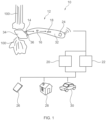
- FIG. 1 illustrates a shaving system 10 for assisting shaving.
- System 10 includes a shaver 12 and one or more sensors coupled to, in communication with, and/or incorporated within shaver 12.
- system 10 may include a sound sensor, for example, a microphone 14.
- System 10 may include an orientation sensor, for example, a gyroscope and/or an accelerometer 16.
- system 10 may also include one or more other sensors, including for example, a temperature sensor or thermocouple.
- System 10 may also include a processor 18, which may include one or more computer logics, for example, a first computer logic 20 and a second computer logic 22.
- system 10 may include one or more communication units 24, which may be in communication and/or configured to communicate e.g.
- system 10 may include one or more displays, for example, on shaver 12 or on a shaver mount or docketing station (not shown) with which shaver 12 may be docked and operatively connected to, for example, next to a sink, on a mirror, or otherwise in a bathroom or place where a user may shave.
- the microphone or a further microphone may be located in the shaver mount or docking station/base.
- Shaver 12 includes a handle 32 configured to be held by a user and a shaver head 34.
- Handle 32 may include any suitable configuration to promote comfortable gripping by a user.
- handle 32 may include coatings or coverings such as a rubber covering, or may contain geometric gripping features to prevent handle 32 from slipping within a hand of the user especially when handle 32 may be wet.
- Shaver head 34 includes one or more blades (not shown).
- Shaver head 34 may be a disposable and/or replaceable cartridge, or shaver head 34 may be an electric shaver head.
- Handle 32 may also include a handle attachment interface 36 at one end, e.g. the shaving/cartridge end of handle 32.
- Handle attachment interface 36 may be configured to selectively attach and/or release shaver head 34 to/from handle 32.
- shaver 12 may be a manual shaver or an electric shaver.
- handle attachment interface 36 may couple handle 32 and shaver head 34 through any mechanism known for attaching and releasing a disposable cartridge with a handle and/or for attaching and releasing an electric shaver head to an electric shaver handle.
- Shaver head may be pivotally attached to the handle.
- shaver 12 may be rinsed, for example, with water 100 from a faucet, other water source, etc.
- One or more sensors of system 10, for example, microphone 14 and/or accelerometer 16, may be configured to detect when water 100 is being delivered from the faucet, other water source, etc.
- one or more sensors e.g. microphone 14 may detect the sound from water 100 being delivered from the faucet, other water source, etc.
- the one or more sensors, e.g. microphone 14 may detect and be configured to distinguish when water 100 is delivered from the faucet or other water source, while not simultaneously being delivered to shaver 12, e.g. for rinsing shaver 12.
- one or more sensors of system 10 may be configured to detect when water 100 is being delivered to rinse shaver 12.
- one or more sensors e.g., microphone 14, may detect the sound from running water 100, as discussed above.
- microphone 14 may detect a louder or different sound, or other different details from water 100 that are indicative of water 100 passing on, over, or through shaver head 34, as compared to different sounds or different intensities of the sound that occur when water 100 is running while not passing on, over, or through shaver head 34.
- system 10 may include another sensor, for example, another microphone, a pressure sensor, a water flow sensor, etc., on or proximate to shaver head 34, that is configured to detect water 100 passing on, over, or through shaver head 34.
- one or more sensors e.g., accelerometer 16 may detect a position and/or orientation of shaver 12 that is indicative of rinsing shaver 12, for example, an orientation that is substantially horizontal.
- a substantially horizontal orientation may be +/- 15 degrees in relation to an imaginary plane that is parallel to the ground. In circumstances the substantially horizontal orientation may reach up to +/- 30 degrees.
- system 10 may include a stroke sensor on or otherwise coupled to shaver 12.
- the stroke sensor may be in communication with processor 18, and the stroke sensor may be configured to detect one or more shaving strokes, a temporal duration of one or more shaving strokes, a distance of the one or more shaving strokes, etc.
- processor 18 and/or the stroke sensor may include an algorithm that, on its own, is configured to detect a rinsing session by calculation of movement and absence of stroke events.
- the stroke sensor may include and/or otherwise be coupled to an accelerometer, a gyroscope, a temperature sensor, a proximity sensor, and/or one or more additional sensors.
- system 10 may include one or more additional sensors to help detect information that may be indicative of rinsing shaver 12.
- one or more of shaver 12 or the mount or docking station may include proximity, optical, RFID, or other sensors to detect when shaver 12 is uncoupled from the mount or docking station.
- system 10 is configured to detect water consumption during rinsing shaver head 34 and also overall or total water consumption during a shaving session.
- Processor 18 may be in communication with microphone 14 and accelerometer 16. Processor 18 may receive signals from microphone 14 and accelerometer 16, and may apply one or more analyses to the received signals, for example, computer logics 20, 22. For example, processor 18 may compare the received signals to stored signal thresholds and/or other parameters, for example, from a memory or storage device (not shown). In examples, processor 18 may be coupled to another memory or storage device (not shown) to communicate and store information, e.g., volumetric measurements, totals, etc. regarding water consumed during a shaving session, water consumed during a rinsing session, water consumed during a plurality of shaving sessions, water consumed during a plurality of rinsing sessions, etc.
- information e.g., volumetric measurements, totals, etc. regarding water consumed during a shaving session, water consumed during a rinsing session, water consumed during a plurality of shaving sessions, water consumed during a plurality of rinsing sessions, etc.
- First computer logic 20 may be configured to detect when water 100 is being delivered from the faucet, other water source, etc.
- computer logic 20 may receive signals from one or more sensors, e.g., microphone 14, to detect the sound from water 100 being delivered from the faucet, other water source, etc.
- Computer logic 20 may include recognizing sounds, volumes, intensities, tones, pitches, etc. via microphone 14 that are indicative of the flow of water 100 from the faucet or other water source, and in some cases that are indicative of the flow of water from the faucet or other water source, without and/or without simultaneous flow on, over, or through shaver head 34.
- computer logic 20 may recognize sounds, volumes, intensities, tones, pitches, etc. via microphone 14 that are indicative and can be correlated to a volumetric flow rate of water 100.
- First computer logic 20 may be configured to initiate a calculation mode upon detecting the flow of water, and the calculation mode may include continuously monitoring one or more sensors, e.g., microphone 14, to calculate a total volume of water 100 delivered during the shaving session.
- first computer logic 20 may detect instantaneous volumetric flow rates over the duration of the shaving session and may also record the duration of the shaving session, for example, by detecting when the flow of water 100 has ended from a faucet or other water source. An average of the instantaneous volumetric flow rate multiplied by the total duration of the shaving session may yield the total amount of water 100 delivered during the shaving session.
- Second computer logic 22 may be configured to detect when water 100 is being delivered from the faucet, other water source, etc. and on a portion of shaver 12, for example, on, over, or through shaver head 34 in a rinsing session.
- computer logic 22 may receive signals from one or more sensors, e.g., microphone 14, to detect the sound from water 100 being delivered from the faucet, etc. and over shaver 12.
- Computer logic 22 may include recognizing sounds, volumes, intensities, tones, pitches, etc. via microphone 14 that are indicative of the flow of water 100 from the faucet, etc. and on, over, or through shaver head 34.
- computer logic 22 may receive signals from one or more sensors, e.g., accelerometer 16, to detect that shaver 12 is in a rinsing position, for example, in a substantially horizontal orientation and/or not moving.
- second computer logic 22 may receive signals from additional sensors, for example, the stroke sensor.
- the stroke sensor may detect when shaver 12 is not performing a stroke or has not performed a stroke after elapse of a certain amount of time, which, alone or in combination with a substantially horizontal orientation, is indicative of a rinsing session.
- computer logic 22 may be configured to detect a rinsing session when accelerometer 16 signals a rinsing position and when the stroke sensor indicates that a stroke is not being performed.
- Computer logic 22 may recognize sounds, volumes, intensities, tones, pitches, etc. via microphone 14 that are indicative and can be correlated to a volumetric flow rate of water 100 over shaver 12. For example, a louder sound may be indicative of a greater volumetric flow of water 100 over shaver.
- Second computer logic 22 may be configured to initiate a calculation mode upon detecting the flow of water over shaver 12 and that shaver 12 is in a rinsing position, and the calculation mode may include continuously monitoring one or more sensors, e.g., microphone 14 and accelerometer 16, to calculate a total volume of water 100 delivered during the rinsing session. For example, second computer logic 22 may detect instantaneous volumetric flow rates over the duration of the rinsing session.
- Second computer logic 22 may also record the duration of the rinsing session for example, by detecting when the flow of water 100 over shaver 12 has ended and/or when shaver 12 is no longer in the rinsing position. An average of the instantaneous volumetric flow rate multiplied by the total duration of the rinsing session may yield the total amount of water 100 delivered during the rinsing session.
- Second computer logic 22 may be dependent on first computer logic 20.
- second computer logic 22 may be independent and/or not restricted by first computer logic 20.
- processor 18 may only perform second computer logic 22 once first computer logic 20 has been performed and indicates that water is flowing.
- processor 18 may only determine whether water is flowing on, over, or through shaver head 34 after processor 18 has determined that water is flowing from a faucet, other water source, etc. This may help economize and/or streamline the processing capabilities of processor 18.
- the calculated duration of the rinsing session may be a portion of the calculated duration of the shaving session, and the calculated amount of water used during the rinsing session may be a portion of the calculated amount of water used during the shaving session.
- first computer logic 20 and second computer logic 22 may operate simultaneously, and that second computer logic 22 may be dependent on values from first computer logic 20, and vice versa.
- microphone 14 may be receiving: 1) sounds attributable to the mere running of water from the faucet or other water source, and/or 2) sounds attributable for rinsing.
- first computer logic 20 and second computer logic 22 may be configured to filter or otherwise ignore sounds that do not contribute to their intended calculations, or may be calibrated to adjust for the presence of such sounds that to not contribute to their intended calculations, i.e., "noise".
- First computer logic 20 and second computer logic 22 may be dependent on one another.
- the values calculated by first computer logic 20 may be constrained by values calculated by second computer logic 22 and vice versa.
- the amount of running water should always be equal to or higher than the amount of water used in rinsing.
- second computer logic 22 may be independent of first computer logic 20.
- processor 18 may determine that water is flowing on, over, or through shaver head 34 even if processor 18 has not yet determined that water is flowing from a faucet, etc. This may help to ensure that a duration of a rinsing session is measured in an instance where there was an error, e.g., interference, insufficient sensor data, etc., in first computer logic 20.
- computer logics 20, 22 may each include one or more artificial neural networks.
- the neural networks may have been trained (or may be trained) to recognize when water is flowing and/or when shaver 12 is being rinsed, for example, based on the networks' connections to one or more sensors on shaver 12 or other components of system 10.
- a first neural network may be configured to detect water flowing and determine a duration of the water flow, e.g., via microphone 14 or one or more other sensors
- a second neural network may be configured to detect an orientation of shaver 12, e.g., via accelerometer 16 or one or more other sensors.
- accelerometer 16 and the second neural network may detect patterns of movement over time that are indicative of rinsing, e.g., tapping the shaver against a hard object, quick repeated flicking of the shaver, slight rotations of the shaver, and the like, which may be used to determine, adjust, calibrate, or modify the determined rinsing time and/or water usage during rinsing.
- the neural networks may continually train and learn as more data is collected by an individual user, and by any user worldwide sending data to a common server.
- computer logics 20, 22 may be stored in or on a mount or docking station (not shown) for shaver 12, a cloud-based server (not shown), an application on mobile device 26, smart home system 28, smart automobile 30, or otherwise in communication with system 10.
- microphone 14 is discussed as being on shaver 12, this disclosure is not so limited.
- microphone 14 (or another microphone) may be on a mount or docking station or otherwise positioned in the vicinity of shaver 12.
- Communication unit 24 may communicate with processor 18 and one or more remote devices, as mentioned above.
- communication unit 20 may include a wireless or wired internet connection to send and/or receive electronic information.
- Communication unit 24 may also include a transmitter and/or receiver to exchange electronic information with one or more remote devices, for example, a Bluetooth TM , AirDrop TM , wireless internet e.g., Wi-Fi, or any other suitable connection now known or that may be similarly developed in the future.
- communication unit 24 may communicate the total water usage for a shaving session and/or the total water usage for a rinsing session to mobile device 26.
- the respective water usages may be numerically displayed to the user, may be graphically displayed to the user, may be displayed to the user as a portion of the overall water and/or energy consumption for the user and/or the user's household, etc.
- FIG. 2 is a flowchart illustrating a method 200 of measuring water usage for a shaving device, according to aspects of the present disclosure.
- method 200 includes a step 202 that includes detecting water flow.
- step 202 may include microphone 14 detecting sound levels indicative of water 100 flowing from a faucet or other water source.
- method 200 includes a step 204 that includes measuring an amount of water flowing for a shaving session.
- step 204 may include microphone 14 detecting sound levels that are indicative of the amount of water 100 flowing from the faucet or other water source.
- Step 204 may also include detecting a duration of the water flow, for example, a time from the initiation of the water flow to an end of the water flow.
- first computer logic 20 may be used to calculate the amount of water flowing, for example, from the faucet, other water source, etc.
- Step 204 may require filtering of sounds attributable to rinsing events as further described below with respect to steps 206 and 208.
- the values calculated at step 204 may selectively filter or drop values received during rinsing.
- first computer logic 20 may use calculated values from before and after detection of rinsing events, at steps 206 and 208, to infer the amount of water that flowed from a faucet or other water source.
- First computer logic 20 may at least use the values from before and after rinsing events to inform or modify values calculated during rinsing. For example, in some cases, a user does not adjust water flow while rinsing, and thus, first computer logic 20 may assume or otherwise infer that the same water flow was used during rinsing steps as the constant water flow calculated before and after rinsing.
- a user does adjust the water flow while rinsing the shaver 12 (up or down), and first computer logic 20 may use calculated water flow values from before and after rinsing events, to modify calculated values and/or improve interpretation of various sounds recorded during rinsing thereby improving the accuracy of the calculations.
- Method 200 may also include a step 206 that includes detecting water flow on a portion of a shaver, for example, on, over, or through shaver head 34.
- Step 206 may include microphone 14 detecting sound levels indicative of water flowing on, over, or through shaver head 34.
- step 206 may include accelerometer 16 detecting that shaver 12 is in a rinsing position, for example, a substantially horizontal orientation and/or not moving.
- step 306 may include receiving signals from additional sensors, for example, the stroke sensor.
- the stroke sensor may detect when shaver 12 is not performing a stroke or has not performed a stroke after elapse of a certain amount of time, which, alone or in combination with a substantially horizontal orientation, is indicative of a rinsing session.
- step 206 may include detecting a rinsing session when accelerometer 16 signals a rinsing position and when the stroke sensor indicates that a stroke is not being performed.
- a step 208 includes measuring an amount of water flowing on the shaver for a rinsing session, for example, on, over, or through shaver head 34.
- step 208 may include microphone 14 detecting sound levels that are indicative of the amount of water flowing on, over, or through shaver head 34.
- Step 208 may also include detecting a duration of the water flow, for example, a time from the initiation of the water flow to an end of the water flow and/or or a time from shaver 12 being in the rinsing position to a time when shaver 12 is no longer in the rinsing position.
- second computer logic 22 may be used to calculate the amount of water flowing on, over, or through the portion of shaver 12.
- Method 200 may also include a step 210 that includes communicating the measured amounts of water to a remote device.
- processor 18, via communication unit 24, may transmit the measured amounts of water 100 to mobile device 26, smart home system 28, and/or smart automobile 30.
- method 200 may include an initiation step, which may include shaver 12 being separated and/or removed from a mount or docking station, one or more sensors on shaver 12 detecting movement, etc.
- This initiation step may activate microphone 14, accelerometer 16, processor 18, etc.
- step 210 may be avoided.
- shaver 12 or another component of system 10 may store the measured amounts of water.
- System 10 may display the measured water usage. For example, system 10 may displayed the measured water usage and/or rinsing performance, among other data, on mobile device 26, e.g., via an application for shaver 12, smart home 28, automobile 30, etc. Additionally or alternatively, system 10 may display the measured water usage and/or rinsing performance, among other data, on a display (not shown) on shaver 12 or a mount or docking station.
- System 10 may display the amount of water used in a shaving session. For example, system 10 may monitor and/or display the amount of water, for example, in a volumetric measurement (e.g., in milliliters) or in a time (e.g., in seconds) that the faucet is on, for an individual shaving session. System 10 may also help the user to ensure that the faucet or other water source is not left running longer than necessary, using unnecessary water, etc. In examples, system may compile the amount of water used over a number of shaving sessions. In aspects, system 10 may indicate to the user the total water used over a number of shaving sessions, an average amount of water used during a shaving session, etc.
- system 10 may display the amount of water used to rinse shaver head 34 in a rinsing session.
- system 10 may monitor and/or display the amount of water, for example, in a volumetric measurement (e.g., in milliliters) or in a time (e.g., in seconds) that the faucet is on, for an individual rinsing session.
- system 10 may help the user to ensure that shaver head 34 has been adequately rinsed during a rinsing session, which may help provide an efficient and/or comfortable shave.
- System 10 may also help the user to ensure that shaver head 34 has not been overly rinsed during the rinsing session, which may shorten the lifetime of shaver head 34, uses unnecessary water, etc.
- system may compile the amount of water used to rinse a single shaver head 34, for example, over a number of shaving sessions.
- system 10 may indicate to the user the total water used to rinse shaver head 34, which may be used to, for example, indicate to the user that it is time to replace shaver head 34, replace shaver 12, etc.
- the measured amounts of water may be accumulated with previously measured amounts of water, for example, to calculate and/or provide total amounts of water used during a number of shaving sessions and/or during rinsing sessions.
- the total amounts of water used during shaving sessions and/or during rinsing sessions may be calculated daily, weekly, monthly, yearly, etc.
- the total amounts of water may be compared to previously calculated amounts of water, e.g., one or more previous weeks, months, years, etc. or to target amounts of water, e.g., recommend total amount of water used for a shaving session, a week's worth of shaving sessions, a month's worth of shaving sessions, a year's worth of shaving sessions, etc.
- the total amounts of water may be reset, for example, via a button on shaver 12 or via a user interface, e.g., on mobile device 26.
- a user may reset the total water used during rinsing sessions when the user replaces shaver head 34. For example, if system 10 indicates to the user that it is time to replace shaver head 34, the user may do so and then reset the rinsing time calculations. Alternatively or additionally, the reset may be automatically conducted by shaver 12, when shaver 12 is equipped to automatically determine that the user has replaced shaver head 34.
- System 10 may help the user to use appropriate amounts of water. For example, if system 10 detects that water is flowing after a rinsing session has ended, i.e., the user is continuing to shave but left water running from the faucet, other water source, etc., system 10 may provide an alert to the user. The alert may suggest that the user turn off the faucet or other water source.
- the alert may be an audible alert, for example, from a speaker on shaver 12, may be a visible alert, e.g., a flashing light or notification, displayed on mobile device 26 or another component of system 10, or may otherwise alert the user.
- system 10 may alert the user that a rinsing session is complete based on, for example, a sufficient amount of water being passed through shaver 12 and/or by recognizing subtle changes in volume, pitch, tone, intensity, or the like, when shaver 12 is adequately rinsed. In these aspects, system 10 may help to reduce the total amount of water used during a shaving session.
- the total water usage may be displayed relative to the water consumption of the user, e.g., household water usage.
- the system 10 may help the user to reduce the overall water consumption during shaving and rinsing, thus reducing the overall water household water usage. Displaying these water usage amounts may help to encourage the user to reduce the overall water usage by increasing the user's awareness of the environmental impacts of the shaving and rinsing sessions, the impacts of the shaving and rinsing sessions on the user's utility bill, etc.
- the data calculated herein can be linked through APIs to other computer logic that gives advice on home energy consumption. Shaver systems according to the present disclosure thus can become integral parts of a Smart Home Network.
- a mobile application associated with shaver 12 may be used to provide various alerts and/or recommendations to the user.
- the alerts and/or recommendations may be sent at any suitable time, but may in particular be sent before, during, and/or after a specific shaving session.
- an alert and/or recommendation may be sent, based on a user's prior history of water usage/rinsing, to improve water usage efficiency of rinsing.
- an alert and/or recommendation may suggest an action to improve water usage/rinsing efficacy, e.g., a recommendation to turn off a faucet during or after shaving, a recommendation to rinse the shaver head thoroughly, for a certain amount of time, a recommendation to reduce the amount of time that a shaver is rinsed.
- Similar alerts or recommendations may be sent during shaving and/or rinsing to a user device and/or to the shaver itself.
- the alerts and/or recommendations also may be presented immediately after shaving, either to reinforce good outcomes, or help a user identify poor rinsing performance/wasteful water usage.
- the system may provide data indicating the number of strokes carried out by the user since the last rinsing and/or the wear condition of the blades and/or the clogging condition between the blades, etc.
- the system may be configured to provide real-time shaving data.
- shaving information/data may comprise at least one real time signal relating to one or more of increasing/decreasing water temperature, increasing/decreasing water flow, increasing/decreasing shaver rinsing frequency, increasing/decreasing shaver rinsing duration occurrence and replacing the shaver/shaver cartridge.
- adjusting the water flow to the flow adapted to a standard shaver or to the exact design of the shaver 12 may help reduce water consumption. For example, if the user performs too many shaving strokes before rinsing, reducing the number of strokes between two successive rinses may improve the rinsing efficiency and save water.
- This data may be provided by the shaver 12, or historical data can be provided based on previously-collected data if a standard shaver is used.
- the system may suggest different shaver types, shaver head types, or the like, that may be compatible with the user and/or that may improve performance.
- the user may select one of more available shaver/shaver head models, and the system may provide predictions as to how the selected shaver/shaver head models will perform when based on the user's historical performance and preferences.
- the shaver rinsing frequency may correspond to the elapsed time between two rinsing occurrences or may correspond to the number of shaving strokes carried out between two rinsing occurrences.
- the number of shaving strokes may be counted using any suitable mechanism, including, for example, data from accelerometer 16.
- the replacement of the shaver/shaver cartridge may correspond to a signal indicating that the shaver/shaver cartridge is worn and needs to be replaced by a new one to improve shaving (and rinsing) efficiency or may correspond to a signal indicating that another type of shaver, for example having a specific geometry design, better adapted to the user habits and thus more efficient for the user habits, for example rinsing habits, should be used.
- a method for assisting shaving comprising a first step of measuring rinse water flow and/or measuring rinse water temperature and/or detecting a shaver rinsing occurrence and a second step of providing shaving information on the basis of the data collected during the first step, is contemplated.
- the method may be carried out irrespective of the way the user rinses the shaver, i.e., using a continuous flow of water during shaving or an intermittent flow of water flowing during rising episodes only.
- a user may control the faucet, other water source, etc. to deliver water only during the rinsing episodes while shaving information may assist the user to reduce water consumption during such episodes.
- Another user may let water continuously flow during shaving, while shaving information may assist that user in order to reduce total water consumption and/or provide advice to the user to more cautiously use water during the shaving routine (e.g., using an intermittent flow of water flowing during rising episodes only).
- the steps may be performed in real time during shaving.
- processor may refer to any device or portion of a device that processes electronic data, e.g., from registers and/or memory to transform that electronic data into other electronic data that, e.g., may be stored in registers and/or memory.
- the methods described herein may be implemented by software programs executable by a computer system.
- implementations can include distributed processing, component/object distributed processing, and parallel processing.
- virtual computer system processing can be constructed to implement one or more of the methods or functionalities as described herein.
- an element described herein of an apparatus embodiment is an example of a means for carrying out the function performed by the element for the purpose of carrying out the disclosure.
Landscapes
- Life Sciences & Earth Sciences (AREA)
- Forests & Forestry (AREA)
- Engineering & Computer Science (AREA)
- Mechanical Engineering (AREA)
- Dry Shavers And Clippers (AREA)
Claims (15)
- Rasiersystem (10), umfassend:einen Rasierer (12), der einen Rasiererkopf einschließt;einen oder mehrere Sensoren, die konfiguriert sind, um einen Wasserfluss oder ein Wassergeräusch oder eine Ausrichtung des Rasierers zu erkennen; undeinen Prozessor (18), der konfiguriert ist, um eine Dauer und/oder eine Wasserverwendung während einer Rasiersitzung und/oder einer Spülsitzung zu bestimmen, wobei der Prozessor (18) einen Algorithmus einschließt, der konfiguriert ist, um Daten von dem einen oder den mehreren Sensoren zu sammeln und Genauigkeitskennzahlen der Wasserverwendung bereitzustellen, und einem Benutzer relevante Empfehlungen bereitzustellen.
- System nach Anspruch 1, ferner umfassend eine Fernvorrichtung, die konfiguriert ist, um die Dauer und/oder die Wasserverwendung für die Rasiersitzung und/oder die Spülsitzung anzuzeigen.
- System nach Anspruch 1 oder 2, wobei der eine oder die mehreren Sensoren ein Mikrofon (14) an dem oder innerhalb des Rasierers und/oder an oder innerhalb der Fernvorrichtung einschließen.
- System nach einem der Ansprüche 1 bis 3, wobei der eine oder die mehreren Sensoren einen Beschleunigungsmesser (16) an dem oder innerhalb des Rasierers einschließen.
- System nach einem der Ansprüche 1 bis 4, wobei der eine oder die mehreren Sensoren einen Hubsensor an dem oder innerhalb des Rasierers einschließen.
- System nach einem der Ansprüche 1 bis 5, wobei der eine oder die mehreren Sensoren einen Orientierungssensor an dem oder innerhalb des Rasierers einschließen.
- System nach einem der Ansprüche 3 bis 6, wobei der Prozessor (18) konfiguriert ist, um die Dauer und/oder die Wasserverwendung der Rasiersitzung durch Analysieren eines oder mehrerer Signale von dem Mikrofon (14) zu bestimmen.
- System nach einem der Ansprüche 3 bis 7, wobei der Prozessor (18) konfiguriert ist, um die Dauer und/oder die Wasserverwendung der Spülsitzung durch Analysieren eines oder mehrerer Signale von dem Mikrofon (14) und/oder eines oder mehrerer Signale von dem Beschleunigungsmesser (16) und eines oder mehrerer Signale von einem Hubsensor zu bestimmen.
- System nach einem der vorstehenden Ansprüche, wobei der Prozessor (18) konfiguriert ist, um eine Gesamtdauer und/oder eine Gesamtmenge des während einer Vielzahl von Spülsitzungen für den Rasierer verwendeten Wassers zu messen.
- System nach einem der Ansprüche 3 bis 9, ferner umfassend einen Alarm, der konfiguriert ist, um aktiviert zu werden, falls die Signale von dem Mikrofon (14) und/oder dem Beschleunigungsmesser (16) und/oder dem Hubsensor während einer vordefinierten Zeitspanne empfangen werden.
- Computerimplementiertes Verfahren zum Analysieren einer Rasiersitzung, wobei das Verfahren umfasst:Empfangen eines oder mehrerer Signale von einem Mikrofon, die auf fließendes Wasser hinweisen,wobei das Mikrofon mit einem Rasierer und/oder einer Dockingstation für den Rasierer gekoppelt ist;Analysieren des einen oder der mehreren Signale von dem Mikrofon, um eine für eine Rasiersitzung verwendete Wassermenge zu bestimmen;Empfangen eines oder mehrerer Signale von dem Mikrofon, einem Beschleunigungsmesser und/oder einem Hubsensor, die darauf hinweisen, dass Wasser über einen Teil eines Rasierers fließt, wobei der Beschleunigungsmesser mit dem Rasierer gekoppelt ist; undAnalysieren des einen oder der mehreren Signale von dem Mikrofon und dem Beschleunigungsmesser und/oder dem Hubsensor, um eine Dauer und/oder eine für eine Spülsitzung verwendete Wassermenge zu bestimmen.
- Computerimplementiertes Verfahren nach Anspruch 11, ferner umfassend ein Übertragen eines oder mehrere von der Dauer und/oder der für die Rasiersitzung verwendeten Wassermenge oder der Dauer und/oder der für die Spülsitzung verwendeten Wassermenge an eine Fernvorrichtung.
- Computerimplementiertes Verfahren nach Anspruch 11 oder 12, ferner umfassend ein Vordefinieren einer Zeitspanne, in der Signale von dem Mikrofon und/oder dem Beschleunigungsmesser und/oder dem Hubsensor empfangen werden, bevor ein Alarm aktiviert wird.
- Computerimplementiertes Verfahren nach einem der Ansprüche 11 bis 13, ferner umfassend das Bestimmen eines Werts oder eines Indexes des Wasserverbrauchs einer Rasiersitzung basierend auf den Signalen von dem Mikrofon und/oder dem Beschleunigungsmesser und/oder dem Hubsensor.
- Computerimplementiertes Verfahren nach einem der Ansprüche 11 bis 14, ferner umfassend das Bereitstellen individueller Rasierempfehlungen für einen Benutzer hinsichtlich der Wahl des Rasierers und/oder des Rasierkopfs und/oder Rasiertechniken, um den Wasserverbrauch zu verbessern.
Applications Claiming Priority (2)
| Application Number | Priority Date | Filing Date | Title |
|---|---|---|---|
| US202063017700P | 2020-04-30 | 2020-04-30 | |
| PCT/EP2021/059014 WO2021219333A1 (en) | 2020-04-30 | 2021-04-07 | Shaving systems and methods |
Publications (2)
| Publication Number | Publication Date |
|---|---|
| EP4142995A1 EP4142995A1 (de) | 2023-03-08 |
| EP4142995B1 true EP4142995B1 (de) | 2025-05-28 |
Family
ID=75478035
Family Applications (1)
| Application Number | Title | Priority Date | Filing Date |
|---|---|---|---|
| EP21718079.3A Active EP4142995B1 (de) | 2020-04-30 | 2021-04-07 | Rasiersysteme und -verfahren |
Country Status (3)
| Country | Link |
|---|---|
| US (1) | US11833700B2 (de) |
| EP (1) | EP4142995B1 (de) |
| WO (1) | WO2021219333A1 (de) |
Families Citing this family (1)
| Publication number | Priority date | Publication date | Assignee | Title |
|---|---|---|---|---|
| US11007659B2 (en) * | 2014-12-10 | 2021-05-18 | Haggai Goldfarb | Intelligent shaving system having sensors |
Family Cites Families (15)
| Publication number | Priority date | Publication date | Assignee | Title |
|---|---|---|---|---|
| US5537749A (en) * | 1994-06-30 | 1996-07-23 | Cacioppo; Tony | Razor |
| US20040098862A1 (en) * | 2002-08-21 | 2004-05-27 | Eveready Battery Company, Inc. | Razor system having razor sensors |
| GB2529999A (en) | 2014-06-12 | 2016-03-16 | King Of Shaves Company Ltd | A shaving system |
| US10298471B2 (en) | 2015-10-05 | 2019-05-21 | The Gillette Company Llc | Systems and methods for providing device usage data |
| US20170097758A1 (en) * | 2015-10-05 | 2017-04-06 | The Gillette Company | Systems and methods for device tuning |
| WO2019001891A1 (en) * | 2017-06-29 | 2019-01-03 | Bic Violex S.A. | SYSTEM AND METHOD FOR ELECTRICALLY DETECTING THE WEAR OF A RAZOR BLADE |
| KR102633237B1 (ko) * | 2017-06-29 | 2024-02-02 | 빅 비올렉스 싱글 멤버 에스.아. | 스마트 중합체를 갖는 면도 윤활제를 공급하기 위한 센서를 갖는 면도기 및 방법 |
| CN110662637B (zh) * | 2017-06-29 | 2023-02-28 | 比克维奥莱克斯公司 | 剃须刀和用于检测剃刮特性的方法 |
| US10646022B2 (en) * | 2017-12-21 | 2020-05-12 | Samsung Electronics Co. Ltd. | System and method for object modification using mixed reality |
| US10960560B2 (en) | 2018-01-19 | 2021-03-30 | The Gillette Company Llc | Method for generating user feedback information from a shave event |
| KR20210013023A (ko) * | 2018-05-21 | 2021-02-03 | 빅-비올렉스 에스아 | 교체 셰이빙 카트리지의 음성 인식 주문을 제공하기 위한 시스템 및 방법 |
| AU2019361950B2 (en) * | 2018-10-19 | 2022-09-15 | The Gillette Company Llc | Grooming device |
| EP3885084A1 (de) * | 2020-03-27 | 2021-09-29 | Bic Violex S.A. | System und verfahren für unterstütztes rasieren |
| US11273565B2 (en) * | 2020-07-02 | 2022-03-15 | The Gillette Company Llc | Grooming device with eject button displacement |
| US11633869B1 (en) * | 2021-12-10 | 2023-04-25 | Robert Frank Tammera | Biodegradable disposable safely shaving razor |
-
2021
- 2021-04-07 EP EP21718079.3A patent/EP4142995B1/de active Active
- 2021-04-07 US US17/997,385 patent/US11833700B2/en active Active
- 2021-04-07 WO PCT/EP2021/059014 patent/WO2021219333A1/en not_active Ceased
Also Published As
| Publication number | Publication date |
|---|---|
| US20230166421A1 (en) | 2023-06-01 |
| US11833700B2 (en) | 2023-12-05 |
| WO2021219333A1 (en) | 2021-11-04 |
| EP4142995A1 (de) | 2023-03-08 |
Similar Documents
| Publication | Publication Date | Title |
|---|---|---|
| EP3645223B1 (de) | Rasierer und verfahren zur erkennung von rasiereigenschaften | |
| JP6725651B2 (ja) | デバイスの使用データを提供するためのシステム及び方法 | |
| EP3513923B1 (de) | Verfahren zur erzeugung von benutzerfeedbackinformation von einem rasierereignis | |
| US10517531B2 (en) | Stress management using biofeedback | |
| CN108136605A (zh) | 用于装置调谐的系统和方法 | |
| JPWO2010146811A1 (ja) | 行動提案装置、及びその方法 | |
| US20220331079A1 (en) | Electric toothbrush system with pressure detection | |
| CN110953103A (zh) | 燃油滤清器寿命预警系统、预警方法和预警装置 | |
| CN111374556A (zh) | 饮水提示、管理、制定方法及终端、饮水器皿、饮水机 | |
| US11833700B2 (en) | Shaving systems and methods | |
| CN114469418B (zh) | 一种智能牙刷的控制方法、装置、智能牙刷及介质 | |
| JP4889365B2 (ja) | ガス器具管理システム及びガス供給システム | |
| KR101839055B1 (ko) | 웨어러블 디바이스를 이용한 운전 위험도 평가 방법, 시스템 및 컴퓨터 프로그램 | |
| KR101695500B1 (ko) | 화재 관련 상황 인지가 가능한 서버 | |
| WO2020255750A1 (ja) | 浄水カートリッジ、水供給装置、水供給装置管理システム、及び水情報収集システム | |
| US20210299897A1 (en) | System and method for assisting shaving | |
| CN108204679A (zh) | 一种电热水器及人体跌倒检测方法 | |
| KR20160067587A (ko) | 지연뇨 증상 또는 배뇨후 점적 증상 진단을 위한 이동식 시스템 및 이를 이용한 진단 방법 | |
| JP2010242319A (ja) | 水量確認装置、水量管理システム及び節水支援方法 | |
| KR20060067511A (ko) | 수면상태에 따른 알람기능을 갖는 이동통신단말기 및 그제어방법 | |
| JP2007024811A (ja) | 流速または流量計測装置および計測プログラム | |
| EP3792704A1 (de) | Verfahren und vorrichtung zur einstellung des bewegungsmodus | |
| JP2021023911A (ja) | 水供給装置及び水供給装置管理システム | |
| JP5973726B2 (ja) | パーソナル端末装置およびガス情報解析システム | |
| CN212066503U (zh) | 一种称重控制的速热饮水机 |
Legal Events
| Date | Code | Title | Description |
|---|---|---|---|
| STAA | Information on the status of an ep patent application or granted ep patent |
Free format text: STATUS: UNKNOWN |
|
| STAA | Information on the status of an ep patent application or granted ep patent |
Free format text: STATUS: THE INTERNATIONAL PUBLICATION HAS BEEN MADE |
|
| PUAI | Public reference made under article 153(3) epc to a published international application that has entered the european phase |
Free format text: ORIGINAL CODE: 0009012 |
|
| STAA | Information on the status of an ep patent application or granted ep patent |
Free format text: STATUS: REQUEST FOR EXAMINATION WAS MADE |
|
| 17P | Request for examination filed |
Effective date: 20221130 |
|
| AK | Designated contracting states |
Kind code of ref document: A1 Designated state(s): AL AT BE BG CH CY CZ DE DK EE ES FI FR GB GR HR HU IE IS IT LI LT LU LV MC MK MT NL NO PL PT RO RS SE SI SK SM TR |
|
| DAV | Request for validation of the european patent (deleted) | ||
| DAX | Request for extension of the european patent (deleted) | ||
| GRAP | Despatch of communication of intention to grant a patent |
Free format text: ORIGINAL CODE: EPIDOSNIGR1 |
|
| STAA | Information on the status of an ep patent application or granted ep patent |
Free format text: STATUS: GRANT OF PATENT IS INTENDED |
|
| INTG | Intention to grant announced |
Effective date: 20241211 |
|
| GRAS | Grant fee paid |
Free format text: ORIGINAL CODE: EPIDOSNIGR3 |
|
| GRAA | (expected) grant |
Free format text: ORIGINAL CODE: 0009210 |
|
| STAA | Information on the status of an ep patent application or granted ep patent |
Free format text: STATUS: THE PATENT HAS BEEN GRANTED |
|
| AK | Designated contracting states |
Kind code of ref document: B1 Designated state(s): AL AT BE BG CH CY CZ DE DK EE ES FI FR GB GR HR HU IE IS IT LI LT LU LV MC MK MT NL NO PL PT RO RS SE SI SK SM TR |
|
| REG | Reference to a national code |
Ref country code: GB Ref legal event code: FG4D |
|
| REG | Reference to a national code |
Ref country code: CH Ref legal event code: EP |
|
| REG | Reference to a national code |
Ref country code: IE Ref legal event code: FG4D Ref country code: DE Ref legal event code: R096 Ref document number: 602021031418 Country of ref document: DE |
|
| REG | Reference to a national code |
Ref country code: NL Ref legal event code: MP Effective date: 20250528 |
|
| PG25 | Lapsed in a contracting state [announced via postgrant information from national office to epo] |
Ref country code: ES Free format text: LAPSE BECAUSE OF FAILURE TO SUBMIT A TRANSLATION OF THE DESCRIPTION OR TO PAY THE FEE WITHIN THE PRESCRIBED TIME-LIMIT Effective date: 20250528 Ref country code: FI Free format text: LAPSE BECAUSE OF FAILURE TO SUBMIT A TRANSLATION OF THE DESCRIPTION OR TO PAY THE FEE WITHIN THE PRESCRIBED TIME-LIMIT Effective date: 20250528 |
|
| REG | Reference to a national code |
Ref country code: LT Ref legal event code: MG9D |
|
| PG25 | Lapsed in a contracting state [announced via postgrant information from national office to epo] |
Ref country code: GR Free format text: LAPSE BECAUSE OF FAILURE TO SUBMIT A TRANSLATION OF THE DESCRIPTION OR TO PAY THE FEE WITHIN THE PRESCRIBED TIME-LIMIT Effective date: 20250829 Ref country code: NO Free format text: LAPSE BECAUSE OF FAILURE TO SUBMIT A TRANSLATION OF THE DESCRIPTION OR TO PAY THE FEE WITHIN THE PRESCRIBED TIME-LIMIT Effective date: 20250828 |
|
| PG25 | Lapsed in a contracting state [announced via postgrant information from national office to epo] |
Ref country code: NL Free format text: LAPSE BECAUSE OF FAILURE TO SUBMIT A TRANSLATION OF THE DESCRIPTION OR TO PAY THE FEE WITHIN THE PRESCRIBED TIME-LIMIT Effective date: 20250528 Ref country code: PL Free format text: LAPSE BECAUSE OF FAILURE TO SUBMIT A TRANSLATION OF THE DESCRIPTION OR TO PAY THE FEE WITHIN THE PRESCRIBED TIME-LIMIT Effective date: 20250528 |
|
| PG25 | Lapsed in a contracting state [announced via postgrant information from national office to epo] |
Ref country code: BG Free format text: LAPSE BECAUSE OF FAILURE TO SUBMIT A TRANSLATION OF THE DESCRIPTION OR TO PAY THE FEE WITHIN THE PRESCRIBED TIME-LIMIT Effective date: 20250528 |
|
| PG25 | Lapsed in a contracting state [announced via postgrant information from national office to epo] |
Ref country code: HR Free format text: LAPSE BECAUSE OF FAILURE TO SUBMIT A TRANSLATION OF THE DESCRIPTION OR TO PAY THE FEE WITHIN THE PRESCRIBED TIME-LIMIT Effective date: 20250528 |
|
| PG25 | Lapsed in a contracting state [announced via postgrant information from national office to epo] |
Ref country code: RS Free format text: LAPSE BECAUSE OF FAILURE TO SUBMIT A TRANSLATION OF THE DESCRIPTION OR TO PAY THE FEE WITHIN THE PRESCRIBED TIME-LIMIT Effective date: 20250828 |
|
| PG25 | Lapsed in a contracting state [announced via postgrant information from national office to epo] |
Ref country code: IS Free format text: LAPSE BECAUSE OF FAILURE TO SUBMIT A TRANSLATION OF THE DESCRIPTION OR TO PAY THE FEE WITHIN THE PRESCRIBED TIME-LIMIT Effective date: 20250928 |
|
| PG25 | Lapsed in a contracting state [announced via postgrant information from national office to epo] |
Ref country code: LV Free format text: LAPSE BECAUSE OF FAILURE TO SUBMIT A TRANSLATION OF THE DESCRIPTION OR TO PAY THE FEE WITHIN THE PRESCRIBED TIME-LIMIT Effective date: 20250528 |
|
| REG | Reference to a national code |
Ref country code: AT Ref legal event code: MK05 Ref document number: 1798391 Country of ref document: AT Kind code of ref document: T Effective date: 20250528 |
|
| PG25 | Lapsed in a contracting state [announced via postgrant information from national office to epo] |
Ref country code: DK Free format text: LAPSE BECAUSE OF FAILURE TO SUBMIT A TRANSLATION OF THE DESCRIPTION OR TO PAY THE FEE WITHIN THE PRESCRIBED TIME-LIMIT Effective date: 20250528 Ref country code: SM Free format text: LAPSE BECAUSE OF FAILURE TO SUBMIT A TRANSLATION OF THE DESCRIPTION OR TO PAY THE FEE WITHIN THE PRESCRIBED TIME-LIMIT Effective date: 20250528 Ref country code: AT Free format text: LAPSE BECAUSE OF FAILURE TO SUBMIT A TRANSLATION OF THE DESCRIPTION OR TO PAY THE FEE WITHIN THE PRESCRIBED TIME-LIMIT Effective date: 20250528 |
|
| PG25 | Lapsed in a contracting state [announced via postgrant information from national office to epo] |
Ref country code: CZ Free format text: LAPSE BECAUSE OF FAILURE TO SUBMIT A TRANSLATION OF THE DESCRIPTION OR TO PAY THE FEE WITHIN THE PRESCRIBED TIME-LIMIT Effective date: 20250528 |
|
| PG25 | Lapsed in a contracting state [announced via postgrant information from national office to epo] |
Ref country code: EE Free format text: LAPSE BECAUSE OF FAILURE TO SUBMIT A TRANSLATION OF THE DESCRIPTION OR TO PAY THE FEE WITHIN THE PRESCRIBED TIME-LIMIT Effective date: 20250528 |
|
| PG25 | Lapsed in a contracting state [announced via postgrant information from national office to epo] |
Ref country code: SK Free format text: LAPSE BECAUSE OF FAILURE TO SUBMIT A TRANSLATION OF THE DESCRIPTION OR TO PAY THE FEE WITHIN THE PRESCRIBED TIME-LIMIT Effective date: 20250528 |
|
| PG25 | Lapsed in a contracting state [announced via postgrant information from national office to epo] |
Ref country code: IT Free format text: LAPSE BECAUSE OF FAILURE TO SUBMIT A TRANSLATION OF THE DESCRIPTION OR TO PAY THE FEE WITHIN THE PRESCRIBED TIME-LIMIT Effective date: 20250528 |
|
| REG | Reference to a national code |
Ref country code: DE Ref legal event code: R097 Ref document number: 602021031418 Country of ref document: DE |
|
| PLBE | No opposition filed within time limit |
Free format text: ORIGINAL CODE: 0009261 |
|
| STAA | Information on the status of an ep patent application or granted ep patent |
Free format text: STATUS: NO OPPOSITION FILED WITHIN TIME LIMIT |
|
| PGFP | Annual fee paid to national office [announced via postgrant information from national office to epo] |
Ref country code: GB Payment date: 20260324 Year of fee payment: 6 |
|
| REG | Reference to a national code |
Ref country code: CH Ref legal event code: L10 Free format text: ST27 STATUS EVENT CODE: U-0-0-L10-L00 (AS PROVIDED BY THE NATIONAL OFFICE) Effective date: 20260409 |
|
| 26N | No opposition filed |
Effective date: 20260303 |