EP4140982B1 - Verfahren und zwischenprodukte für die herstellungen von carboprost und carboprost-tromethamin sowie daraus hergestelltes carboprost-tromethamin - Google Patents
Verfahren und zwischenprodukte für die herstellungen von carboprost und carboprost-tromethamin sowie daraus hergestelltes carboprost-tromethamin Download PDFInfo
- Publication number
- EP4140982B1 EP4140982B1 EP22186007.5A EP22186007A EP4140982B1 EP 4140982 B1 EP4140982 B1 EP 4140982B1 EP 22186007 A EP22186007 A EP 22186007A EP 4140982 B1 EP4140982 B1 EP 4140982B1
- Authority
- EP
- European Patent Office
- Prior art keywords
- carboprost
- tromethamine
- carboprost tromethamine
- crystal
- melting point
- Prior art date
- Legal status (The legal status is an assumption and is not a legal conclusion. Google has not performed a legal analysis and makes no representation as to the accuracy of the status listed.)
- Active
Links
Images


Classifications
-
- C—CHEMISTRY; METALLURGY
- C07—ORGANIC CHEMISTRY
- C07C—ACYCLIC OR CARBOCYCLIC COMPOUNDS
- C07C405/00—Compounds containing a five-membered ring having two side-chains in ortho position to each other, and having oxygen atoms directly attached to the ring in ortho position to one of the side-chains, one side-chain containing, not directly attached to the ring, a carbon atom having three bonds to hetero atoms with at the most one bond to halogen, and the other side-chain having oxygen atoms attached in gamma-position to the ring, e.g. prostaglandins ; Analogues or derivatives thereof
-
- C—CHEMISTRY; METALLURGY
- C07—ORGANIC CHEMISTRY
- C07C—ACYCLIC OR CARBOCYCLIC COMPOUNDS
- C07C405/00—Compounds containing a five-membered ring having two side-chains in ortho position to each other, and having oxygen atoms directly attached to the ring in ortho position to one of the side-chains, one side-chain containing, not directly attached to the ring, a carbon atom having three bonds to hetero atoms with at the most one bond to halogen, and the other side-chain having oxygen atoms attached in gamma-position to the ring, e.g. prostaglandins ; Analogues or derivatives thereof
- C07C405/0008—Analogues having the carboxyl group in the side-chains replaced by other functional groups
- C07C405/0016—Analogues having the carboxyl group in the side-chains replaced by other functional groups containing only hydroxy, etherified or esterified hydroxy groups
-
- C—CHEMISTRY; METALLURGY
- C07—ORGANIC CHEMISTRY
- C07C—ACYCLIC OR CARBOCYCLIC COMPOUNDS
- C07C59/00—Compounds having carboxyl groups bound to acyclic carbon atoms and containing any of the groups OH, O—metal, —CHO, keto, ether, groups, groups, or groups
- C07C59/40—Unsaturated compounds
- C07C59/42—Unsaturated compounds containing hydroxy or O-metal groups
- C07C59/46—Unsaturated compounds containing hydroxy or O-metal groups containing rings other than six-membered aromatic rings
-
- C—CHEMISTRY; METALLURGY
- C07—ORGANIC CHEMISTRY
- C07C—ACYCLIC OR CARBOCYCLIC COMPOUNDS
- C07C213/00—Preparation of compounds containing amino and hydroxy, amino and etherified hydroxy or amino and esterified hydroxy groups bound to the same carbon skeleton
- C07C213/08—Preparation of compounds containing amino and hydroxy, amino and etherified hydroxy or amino and esterified hydroxy groups bound to the same carbon skeleton by reactions not involving the formation of amino groups, hydroxy groups or etherified or esterified hydroxy groups
-
- C—CHEMISTRY; METALLURGY
- C07—ORGANIC CHEMISTRY
- C07C—ACYCLIC OR CARBOCYCLIC COMPOUNDS
- C07C215/00—Compounds containing amino and hydroxy groups bound to the same carbon skeleton
- C07C215/02—Compounds containing amino and hydroxy groups bound to the same carbon skeleton having hydroxy groups and amino groups bound to acyclic carbon atoms of the same carbon skeleton
- C07C215/04—Compounds containing amino and hydroxy groups bound to the same carbon skeleton having hydroxy groups and amino groups bound to acyclic carbon atoms of the same carbon skeleton the carbon skeleton being saturated
- C07C215/06—Compounds containing amino and hydroxy groups bound to the same carbon skeleton having hydroxy groups and amino groups bound to acyclic carbon atoms of the same carbon skeleton the carbon skeleton being saturated and acyclic
- C07C215/10—Compounds containing amino and hydroxy groups bound to the same carbon skeleton having hydroxy groups and amino groups bound to acyclic carbon atoms of the same carbon skeleton the carbon skeleton being saturated and acyclic with one amino group and at least two hydroxy groups bound to the carbon skeleton
-
- C—CHEMISTRY; METALLURGY
- C07—ORGANIC CHEMISTRY
- C07C—ACYCLIC OR CARBOCYCLIC COMPOUNDS
- C07C51/00—Preparation of carboxylic acids or their salts, halides or anhydrides
- C07C51/347—Preparation of carboxylic acids or their salts, halides or anhydrides by reactions not involving formation of carboxyl groups
- C07C51/377—Preparation of carboxylic acids or their salts, halides or anhydrides by reactions not involving formation of carboxyl groups by splitting-off hydrogen or functional groups; by hydrogenolysis of functional groups
-
- C—CHEMISTRY; METALLURGY
- C07—ORGANIC CHEMISTRY
- C07D—HETEROCYCLIC COMPOUNDS
- C07D313/00—Heterocyclic compounds containing rings of more than six members having one oxygen atom as the only ring hetero atom
-
- C—CHEMISTRY; METALLURGY
- C07—ORGANIC CHEMISTRY
- C07B—GENERAL METHODS OF ORGANIC CHEMISTRY; APPARATUS THEREFOR
- C07B2200/00—Indexing scheme relating to specific properties of organic compounds
- C07B2200/07—Optical isomers
-
- C—CHEMISTRY; METALLURGY
- C07—ORGANIC CHEMISTRY
- C07B—GENERAL METHODS OF ORGANIC CHEMISTRY; APPARATUS THEREFOR
- C07B2200/00—Indexing scheme relating to specific properties of organic compounds
- C07B2200/13—Crystalline forms, e.g. polymorphs
-
- C—CHEMISTRY; METALLURGY
- C07—ORGANIC CHEMISTRY
- C07C—ACYCLIC OR CARBOCYCLIC COMPOUNDS
- C07C2601/00—Systems containing only non-condensed rings
- C07C2601/06—Systems containing only non-condensed rings with a five-membered ring
- C07C2601/08—Systems containing only non-condensed rings with a five-membered ring the ring being saturated
-
- Y—GENERAL TAGGING OF NEW TECHNOLOGICAL DEVELOPMENTS; GENERAL TAGGING OF CROSS-SECTIONAL TECHNOLOGIES SPANNING OVER SEVERAL SECTIONS OF THE IPC; TECHNICAL SUBJECTS COVERED BY FORMER USPC CROSS-REFERENCE ART COLLECTIONS [XRACs] AND DIGESTS
- Y02—TECHNOLOGIES OR APPLICATIONS FOR MITIGATION OR ADAPTATION AGAINST CLIMATE CHANGE
- Y02P—CLIMATE CHANGE MITIGATION TECHNOLOGIES IN THE PRODUCTION OR PROCESSING OF GOODS
- Y02P20/00—Technologies relating to chemical industry
- Y02P20/50—Improvements relating to the production of bulk chemicals
- Y02P20/55—Design of synthesis routes, e.g. reducing the use of auxiliary or protecting groups
Definitions
- the present invention relates to a novel high melting point crystal of Carboprost Tromethamine and processes for preparation thereof.
- Carboprost and Carboprost Tromethamine are both synthetic prostaglandin analogues of PGF 2 ⁇ (specifically, it is 15-methyl-PGF 2 ⁇ ) with oxytocic properties.
- Carboprost and Carboprost Tromethamine can induce contractions and trigger abortion in early pregnancy, and can also reduce postpartum bleeding.
- Carboprost Tromethamine is the original product of Upjohn.
- the first scalable synthesis of Carboprost Tromethamine was described by chemists of Upjohn ( Yankee et al., J. Am. Chem. Soc, 96(18), 5865-5876, 1974 ).
- the 15-methyl substituent was constructed from the benzoyl ⁇ -lactone-enone of Formula a with trimethylaluminum or with methylmagnesium bromide.
- the selectivity of the 15(S)-product was only 50% in both cases, which means that the process has no selectivity.
- WO 2008/081191 discloses that the alkylation of triethylsily ⁇ -lactone-enone of Formula b and methylmagnesium chloride can obtain 15(S)-product with a highest selectivity of 70%, as shown in the following Scheme C (2).
- WO 2017/093770 discloses that the alkylation of p-phenylbenzoyl ⁇ -lactone-enone of Formula c and methylmagnesium bromide can obtain 15(S)-product with a selectivity of only 55%, and it also discloses the use of various chiral additives in order to increase the selectivity of the 15(S)-product, and found that the addition of (S)-Taddol can increase the selectivity to 70%, as shown in the following Scheme C (3).
- the highest selectivity disclosed in WO 2017/093770 is at most the same as that disclosed in WO 2008/081191 .
- WO 2008/081191 discloses that carrying out the Wittig reaction at ambient temperature and in the solvent of dimethyl sulfoxide (DMSO) as disclosed by Yankee et al., will generate 6 to 8% undesired 5,6 trans-isomer, as shown in the following Scheme D (1).
- DMSO dimethyl sulfoxide
- WO 2008/0181191 further discloses that the reaction at a lower temperature, i.e., from -5°C to +5°C, can reduce the content of the 5,6 trans -isomer to about 3%, as shown in the following Scheme D (2).
- Carboprost Tromethamine is a crystalline solid at room temperature, it is still very difficult to efficiently remove the 15( R )-epimer and trans isomer simultaneously only by crystallization purification.
- the polarity of Carboprost is very large, it is more difficult to remove the 15( R )-epimer and trans isomer from Carboprost by chromatography.
- Carboprost has to be esterified to form Carboprost methyl ester, then the 15( R )-epimer and trans isomer of Carboprost methyl ester are removed by chromatography, and the Carboprost methyl ester is hydrolyzed into Carboprost with higher purity, but the yield and purity in such method are very unsatisfactory.
- CN 1136938 C discloses the use of expensive and special simulated moving bed (SMB) chromatography to separate and remove the isomers of Carboprost methyl ester, but the purity of the final product is still not good enough.
- CN 102816099 discloses the use of analyticalgrade HPLC column chromatography packing (5 ⁇ m) for separation, but the trans isomers still cannot be removed completely. In addition, since the amount that can be separated by the method of CN 102816099 is small, such method is difficult to be used for industrial-grade mass production.
- US2013/190404 discloses a crystalline form of carboprost tromethamine.
- the objective of the present invention is to provide a novel high melting point crystal of Carboprost Tromethamine.
- the present invention also provides a process for preparing the crystalline form of Carboprost Tromethamine.
- the present invention provides a high melting point (106.4 ⁇ 1°C) crystal of Carboprost Tromethamine having an X-ray powder diffraction (XRPD) pattern exhibiting characteristic peaks at the following 2 ⁇ reflection angles: 6.9 ⁇ 0.2°, 9.1 ⁇ 0.2°, 9.5 ⁇ 0.2°, 10.3 ⁇ 0.2°, 11.0 ⁇ 0.2°, 18.8 ⁇ 0.2°, 20.5 ⁇ 0.2°, and 21.9 ⁇ 0.2°.
- XRPD X-ray powder diffraction
- the present invention provides a process for preparing a high melting point crystal of Carboprost Tromethamine, comprising the use of a solvent of anhydrous acetonitrile.
- the words “comprising” (and any form of comprising, such as “comprise” and “comprises”), “having” (and any form of having, such as “have” and “has”), "including” (and any form of including, such as “includes” and “include”) or “containing” (and any form of containing, such as “contains” and “contain”) are inclusive or open-ended and do not exclude additional, unrecited elements or method steps.
- a wedged bold bond means a bond projecting above the plane of the paper
- a wedged hashed bond means a bond projecting below the plane of the paper
- a wavy bond means a bond projecting almost half above and half below the plane of the paper.
- high purity Carboprost or Carboprost Tromethamine means that Carboprost and/or Carboprost Tromethamine in question contains no more than about 1% total isomers, preferably no more than about 0.8% total isomers or no more than about 0.5% total isomers, and more preferably no more than about 0.3% total isomers.
- the isomers or impurities indicated herein include 5,6 -trans isomers, 15(R)-epimers, and any other stereoisomers.
- substantially free of 5,6 -trans isomer or the like means that a compound in question does not contain more than about 0.5%, about 0.3%, about 0.2%, about 0.1%, about 0.05%, or about 0.03% of impurities or isomers, such as 5,6- trans isomer, or contains a none-detectable level of impurities or isomers, such as 5,6-trans isomer measured by HPLC, for which the detection limit is not more than about 0.03%.
- Carboprost Tromethamine from Carboprost, the process comprises a salt formation with tromethamine, and crystallization of Carboprost Tromethamine.
- the salt formation and crystallization steps may follow the method disclosed in CN 102336693 or WO 2017/093770 .
- Carboprost can be first dissolved in a suitable solvent, such as acetone, acetonitrile, methanol, ethanol, isopropyl alcohol, and a combination thereof, then tromethamine in a suitable solvent, such as water, methanol, ethanol, isopropanol, and a combination thereof, can be added to the solution; and the mixture can be heated to about 85°C for about 1 hours to form a homogeneous solution. Thereafter, the homogenous solution can be allowed to cool down to about 60°C, and a white solid slowly starts to precipitate. The reaction mixture can be further cooled down to room temperature, and then filtered to obtain the white crystal of Carboprost Tromethamine.
- the melting point of the white crystal thus obtained is typically about 95°C to 105°C as originally disclosed by Pfizer (e.g., the prescribing information of Hemabate ® provided by Pfizer).
- Example 1 of CN 102336693 In case of Example 1 of CN 102336693 , about 1.20 g Carboprost Tromethamine was precipitated during lowering the temperature from the mixture of 100 ml acetonitrile and 0.5 ml water, and the melting point of the white crystal is measured as 103.97°C (see Figure 2 ). The present inventors repeated Example 1 of CN 102336693 and found that the melting point of the obtained Carboprost Tromethamine crystal is measured as 103.41°C.
- Example 1g of WO 2017/093770 In case of Example 1g of WO 2017/093770 , about 593 g Carboprost Tromethamine was precipitated from the mixture of isopropanol and acetone. WO 2017/093770 does not disclose the melting point of the Carboprost Tromethamine crystal obtained from Example 1g. The present inventors repeated Example 1g of WO 2017/093770 and found that the melting point of the obtained Carboprost Tromethamine crystal is measured as 97.49°C.
- the melting points of the above mentioned known Carboprost Tromethamine crystals range from about 97°C to about 104°C, which are indeed within the scope as originally provided by Pfizer (95°C to 105°C).
- the recrystallization on Carboprost Tromethamine may provide effects on decreasing the content of 15(R)-isomer.
- the recrystallization methods of Carboprost Tromethamine have been disclosed in CN 102336693 and WO 2017/093770 .
- the present inventors repeated the method CN 102336693 disclosed using water with acetone, and found that the recrystallized Carboprost Tromethamine has a melting point of 103.85°C as measured.
- the present inventors also repeated the method WO 2017/093770 disclosed using isopropanol with acetone, and found that the recrystallized Carboprost Tromethamine has a melting point of 99.46°C as measured.
- a specially high melting point Carboprost Tromethamine crystal can be obtained by a recrystallization process of Carboprost Tromethamine using a specific solvent of anhydrous acetonitrile.
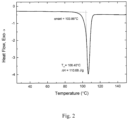
- the high melting point Carboprost Tromethamine crystal thus formed has a differential scanning calorimetry (DSC) thermogram pattern comprising an endothermic peak with a peak maximum of 106.4 ⁇ 1.0°C, which is obviously higher than the upper limit of the melting point range originally provided by Pfizer and that of the above mentioned Carboprost Tromethamine crystals disclosed in the prior art.
- DSC differential scanning calorimetry
- the present invention provides a process for preparing a high melting point crystalline form of Carbopropst Tromethamine, comprising the steps of:
- the mixture can be heated to about 80°C for completely dissolving Carboprost Tromethamine; then the homogenous solution can be slowly cooled down, and a white solid is slowly started to precipitate; and the mixture can be further cooled down to room temperature, and then filtered and dried to obtain the crystalline form of Carboprost Tromethamine.
- the amount of the anhydrous acetonitrile used in step a ranges from about 80 to 250 ml, about 100 to 220 ml, or about 150 to 200 ml, per 1 g of Carboprost Tromethamine; the anhydrous acetonitrile has a water content of less than about 0.05%, less than about 0.01%, less than about 0.005%, or less than about 0.001% (w/w); and the process is preferably carried out without adding water.
- the crystalline form of Carboprost Tromethamine prepared from the process has a differential scanning calorimetry (DSC) thermogram pattern comprising an endothermic peak with a peak maximum of 106.4 ⁇ 1.0°C, which is higher than the other known crystalline forms of Carboprost Tromethamine. Since the Carboprost Tromethamine crystal obtained by the present invention has the highest melting point compared to all other known Carboprost Tromethamine crystals, it is the most stable crystalline form of Carboprost Tromethamine.
- DSC differential scanning calorimetry
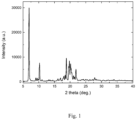
- the high melting point Carboprost Tromethamine crystal of the present invention has an X-ray powder diffraction (XRPD) pattern exhibiting characteristic peaks at the following 2 ⁇ reflection angles: 6.9 ⁇ 0.2°, 9.1 ⁇ 0.2°, 9.5 ⁇ 0.2°, 10.3 ⁇ 0.2°, 11.0 ⁇ 0.2°, 18.8 ⁇ 0.2°, 20.5 ⁇ 0.2°, and 21.9 ⁇ 0.2°, which is obviously different from the 2 ⁇ reflection angles: 6.6 ⁇ 0.2°, 9.9 ⁇ 0.2°, 18.5 ⁇ 0.2°, and 21.6 ⁇ 0.2° of the crystal disclosed in CN 102336693 . It indicates that the high melting point Carboprost Tromethamine crystal is a novel crystalline form of Carboprost Tromethamine.
- the Carboprost Tromethamine crystal has an XRPD pattern exhibiting characteristic peaks at the following 2 ⁇ reflection angles: 6.9 ⁇ 0.2°, 9.1 ⁇ 0.2°, 9.5 ⁇ 0.2°, 10.3 ⁇ 0.2°, 11.0 ⁇ 0.2°, 18.8 ⁇ 0.2°, 20.5 ⁇ 0.2°, and 21.9 ⁇ 0.2°. More preferably, the XRPD pattern of the Carboprost Tromethamine crystal is consistent with Fig. 1 . The particular data of the Carboprost Tromethamine crystal is shown in Table 1.
- the present invention provides a crystalline form of Carboprost Tromethamine having an XRPD pattern substantially as shown in Fig. 1 .
- the present invention provides the XRPD patterns of the Carboprost Tromethamine crystals for five different batches (a) to (e), as shown in Fig. 3 .
- the particular data of the four major separated characteristic peaks are clearly marked and shown in Table 2.
- the average positions of characteristic peaks are located at about 6.9°, 10.3°, 18.8°, and 21.9°, respectively.
- Table 2 Sample 2 ⁇ angle (°) (a) 6.87 10.21 18.80 21.88 (b) 6.92 10.22 18.80 21.87 (c) 7.02 10.32 18.82 21.87 (d) 7.00 10.29 18.81 21.88 (e) 6.91 10.25 18.82 21.90 Average 6.94 10.26 18.81 21.88
- the XRPD characteristic peak positions of the Carboprost Tromethamine crystal of the present invention locate at higher 2-theta (2 ⁇ ) angle (6.9 ⁇ 0.2°, 9.1 ⁇ 0.2°, 9.5 ⁇ 0.2°, 10.3 ⁇ 0.2°, 11.0 ⁇ 0.2°, 18.8 ⁇ 0.2°, 20.5 ⁇ 0.2°, and 21.9 ⁇ 0.2°), comparing with 6.6 ⁇ 0.2°, 9.9 ⁇ 0.2°, 18.5 ⁇ 0.2°, and 21.64+0.2° disclosed by CN102336693 .
- the characteristic peak at 6.621° of Carboprost Tromethamine disclosed by CN 102336693 represents a d-spacing of 13.3397 ⁇ .
- the characteristic peak at 6.92° of Carboprost Tromethamine of the present invention represents a d-spacing of 12.76 ⁇ .
- the more than 0.5 ⁇ d-spacing difference is a very clear evidence indicating that the molecule packing are different in crystal lattice structure.
- This result shows that the Carboprost Tromethamine crystal is a novel crystalline form with a more stable and denser ordering packing structure comparing to the previous arts.
- the present invention provides a Carboprost Tromethamine crystal having a DSC thermogram pattern comprising an endothermic peak with a peak onset temperature of approximately 103.9°C and a peak maximum of approximately 106.4 ⁇ 1.0°C.
- the present invention provides a crystalline form of Carboprost Tromethamine having a DSC thermogram pattern substantially as shown in Fig. 2 .
- the present invention provides the DSC thermogram patterns of the Carboprost Tromethamine crystals for five different batches (a) to (e), as shown in Fig. 4 .
- the particular data of the peak maximum for single endothermic peak is clearly marked and shown in Table 3.
- the average peak maximum of these endothermic peaks is about 106.4°C.
- Table 3 Sample Peak Maximum (°C) (a) 106.27 (b) 106.63 (c) 106.44 (d) 106.34 (e) 106.40 Average 106.42
- the DSC peak maximum temperature of about 106.4°C for the Carboprost Tromethamine crystal of the present invention is far beyond the disclosed melting point of Carboprost Tromethamine of 95 to 105°C (as originally provided by Pfizer) and the peak maximum temperature of 103.97°C disclosed in CN 102336693 , indicating that the Carboprost Tromethamine crystal of the present invention is a novel crystal with higher thermal stability comparing to the previous arts. It is well-known for person skilled in the art that a crystal comprising the highest melting point is the most stable crystalline form in thermodynamics; hence, the novel Carboprost Tromethamine crystal of the present invention is the most stable one compared to the previous arts.
- the United States Pharmacopeia recommends that Carboprost Tromethamine should be stored in a freezer (-20°C).
- the present invention proves that the high melting point crystalline form of Carboprost Tromethamine is very stable even being treated at 20°C for 6 months, 5°C for 18 months, and 80°C for 3 days. Hence, the stability of the Carboprost Tromethamine crystal of present invention has been significantly improved.
- X-ray Powder Diffraction (XRPD) Analysis The XRPD patterns were collected on a Bruker D2 PHASER diffractometer with fixed divergence slits and 1D LYNXEYE detector. The samples (ca. 100 mg) were flatly placed on a sample holder. The prepared samples were analyzed over a 2 ⁇ range from 5° to 40° with step size of 0.02 degrees and step time of 1 second using CuK ⁇ radiation at a power of 10 mA and 30 kV. The CuK ⁇ radiation was removed by a divergent beam nickel filter.
- DSC Differential Scanning Calorimetry
- the 114 g of Carboprost was dissolved in 1.2 L of acetonitrile at 60°C, and the solution was heated to 65°C.
- the 37.4 g of tromethamine in 120 ml water was slowly added into the solution.
- the reaction mixture was further heated to 85°C for reflux for 10 minutes.
- the homogenous solution was allowed to cool down to 60°C, and the white solid was slowly started to precipitate.
- the mixture was further cooled down to room temperature and stirred over 16 hours.
- the reaction mixture was filtered to obtain white crystalline form of Carboprost Tromethamine (118 g).
- the melting point of the crystal was measured by DSC as 103.41°C, as shown in Fig. 5(a) .
- the Carboprost Tromethamine crystal was prepared from an acetone/aqueous solution by following the method disclosed in Example 3 of CN 102336693 .
- the melting point of the crystal was measured by the inventor as 103.22°C, as shown in Fig. 5(b) .
- the Carboprost Tromethamine crystal was prepared from an ether/aqueous solution by following the method disclosed in Example 7 of CN 102336693 .
- the melting point of the crystal was measured by the inventor as 103.43°C, as shown in Fig. 5(c) .
- the Carboprost Tromethamine crystal was prepared from an isopropanol/acetone solution by following the method disclosed in Example 1g of WO 2017/093770 .
- the melting point of the crystal was measured by the inventor as 97.49°C, as shown in Fig. 5(d) .
- Carboprost Tromethamine 10.0 g was dissolved in 1 L acetonitrile containing water of 0.02% at 85°C to give a homogeneous solution and then cooled down the homogeneous solution to 60°C, and the white solid was slowly started to precipitate. The mixture was further cooled down to room temperature. The resulting precipitate crystal was filtered and dried. After recrystallization, yield of the obtained high purity Carboprost Tromethamine crystal was 9.0 g. The melting point of the crystal was measured by DSC as 106.40°C, as shown in Fig. 6(a) . Upon HPLC analysis, 15(R)-epimer was in an amount of 0.05%, and 5,6-trans isomer was not detected.
- the Carboprost Tromethamine crystal was prepared from an acetone/aqueous solution by following the method disclosed in Example 2, 4, 6, or 8 of CN 102336693 .
- the melting point of the crystal was measured by the inventor as 103.85°C, as shown in Fig. 6(b) .
- the Carboprost Tromethamine crystal was prepared from an isopropanol/acetone solution by following the method disclosed in Example 1h of WO2017093770 .
- the melting point of the crystal was measured by the inventor as 99.46°C, as shown in Fig. 6(c) .
- Carboprost Tromethamine which includes 2.5% of 5,6-trans isomer and 1.5% 15(R)-epimer, was dissolved in acidic water with pH of 3 and extracted with ethyl acetate to obtain 2 g of Carboprost.
- a solution of Carboprost in 8 ml of anhydrous, oxygen-free xylene was treated with 1.73 g of 2,2'-dipyridyl disulfide and 2.06 g of triphenylphosphine. After stirring for 18 hours at 25°C, the mixture was diluted with 500 ml of xylene and heated at reflux for 4 hours.
- the reaction mixture was further evaporated to remove the solvent, and the residue was partitioned between a cold sodium bicarbonate aqueous solution and ethyl acetate.
- the organic layer was collected and washed with brine, and dried with anhydrous sodium sulfate.
- the mixture was filtered and concentrated to obtain crude 1,9-lactone compound.
- the crude compound was purified by chromatography on silica gel using a mixture of dichloromethane and acetone as a gradient eluent. Yield of the obtained 15-methyl 1,9-lactone was 1.67 g.
- Carboprost which includes 2.5% of 15(R)-epimer but no detectable 5,6-trans isomer in HPLC analysis.
- Carboprost Tromethamine was formed from the Carboprost and tromethamine according to the process of Reference Example 1, and crystallized and recrystallized according to the process of Example 1 (Method A) and Example 2 to obtain high purity Carboprost Tromethamine.
- 15(R)-epimer was in an amount of 0.15%, and 5,6- trans isomer was not detected.
- the stability data shown in Tables 4 and 5 shows that the high melting point Carboprost Tromethamine crystal is stable even being treated at 20°C for 6 months, 5°C for 18 months, and 80°C for 3 days.
- the high melting point Carboprost Tromethamine crystal is very stable at room temperature, even at higher temperature, so that the formation of degradation impurities can be effectively avoided.
- the high melting point Carboprost Tromethamine crystal shows a relatively low rate of water absorption compared to the low melting point one, indicating that the high melting point Carboprost Tromethamine crystal is more stable and can be stored for a longer time under high humidity condition, so the high melting point Carboprost Tromethamine crystal is more conducive to product handling, storage and shipping.
Landscapes
- Chemical & Material Sciences (AREA)
- Organic Chemistry (AREA)
- Chemical Kinetics & Catalysis (AREA)
- Engineering & Computer Science (AREA)
- Oil, Petroleum & Natural Gas (AREA)
- Organic Low-Molecular-Weight Compounds And Preparation Thereof (AREA)
Claims (5)
- Kristalline Form von Carboprost Tromethamin, die ein Differential-Raster-Kalorimetrie (DDK-) Thermogrammmuster, umfassend einen endothermen Peak mit einem Peakmaximum von 106,4 ± 1,0 °C, und ein Röntgenpulverbeugungs- (XRPD-) Muster aufweist, das charakteristische Peaks bei den folgenden 2θ-Reflexionswinkeln umfasst: 6,9 ± 0,2°, 9,1 ± 0,2°, 9,5 ± 0,2°, 10,3 ± 0,2°, 11,0 ± 0,2°, 18,8 ± 0,2°, 20,5 ± 0,2° und 21,9 ± 0,2°.
- Kristalline Form von Carboprost Tromethamin nach Anspruch 1,
die weniger als 0,1 % 5,6-trans-Isomer enthält. - Kristalline Form von Carboprost Tromethamin nach Anspruch 2,
die weniger als 0,03 % 5,6-trans-Isomer enthält. - Verfahren zum Herstellen der kristallinen Form von Carboprost Tromethamin nach Anspruch 1, umfassend die Schritte:(a) Zugeben von Carboprost Tromethamin in wasserfreies Acetonitril, um eine Mischung auszubilden, wobei das wasserfreie Acetonitril in einer Menge von 80 bis 250 ml pro 1 g Carboprost Tromethamin vorliegt;(b) Erhitzen der Mischung auf eine Temperatur im Bereich von 70 °C bis 90 °C, um eine homogene Lösung zu erhalten; und(c) Abkühlen der homogenen Lösung, um die kristalline Form von Carboprost Tromethamin auszubilden.
- Verfahren nach Anspruch 4, wobei das wasserfreie Actonitril einen Wassergehalt von weniger als 0,05 % aufweist.
Priority Applications (1)
| Application Number | Priority Date | Filing Date | Title |
|---|---|---|---|
| EP24223868.1A EP4509492A3 (de) | 2021-08-23 | 2022-07-20 | Verfahren und zwischenprodukte zur herstellung von carboprost und carboprost tromethamin und daraus hergestelltes carboprost tromethamin |
Applications Claiming Priority (1)
| Application Number | Priority Date | Filing Date | Title |
|---|---|---|---|
| US17/408,864 US12565468B2 (en) | 2021-08-23 | 2021-08-23 | Processes and intermediates for the preparations of Carboprost and Carboprost Tromethamine, and Carboprost Tromethamine prepared therefrom |
Related Child Applications (2)
| Application Number | Title | Priority Date | Filing Date |
|---|---|---|---|
| EP24223868.1A Division EP4509492A3 (de) | 2021-08-23 | 2022-07-20 | Verfahren und zwischenprodukte zur herstellung von carboprost und carboprost tromethamin und daraus hergestelltes carboprost tromethamin |
| EP24223868.1A Division-Into EP4509492A3 (de) | 2021-08-23 | 2022-07-20 | Verfahren und zwischenprodukte zur herstellung von carboprost und carboprost tromethamin und daraus hergestelltes carboprost tromethamin |
Publications (4)
| Publication Number | Publication Date |
|---|---|
| EP4140982A2 EP4140982A2 (de) | 2023-03-01 |
| EP4140982A3 EP4140982A3 (de) | 2023-05-03 |
| EP4140982C0 EP4140982C0 (de) | 2025-02-19 |
| EP4140982B1 true EP4140982B1 (de) | 2025-02-19 |
Family
ID=83004492
Family Applications (2)
| Application Number | Title | Priority Date | Filing Date |
|---|---|---|---|
| EP22186007.5A Active EP4140982B1 (de) | 2021-08-23 | 2022-07-20 | Verfahren und zwischenprodukte für die herstellungen von carboprost und carboprost-tromethamin sowie daraus hergestelltes carboprost-tromethamin |
| EP24223868.1A Withdrawn EP4509492A3 (de) | 2021-08-23 | 2022-07-20 | Verfahren und zwischenprodukte zur herstellung von carboprost und carboprost tromethamin und daraus hergestelltes carboprost tromethamin |
Family Applications After (1)
| Application Number | Title | Priority Date | Filing Date |
|---|---|---|---|
| EP24223868.1A Withdrawn EP4509492A3 (de) | 2021-08-23 | 2022-07-20 | Verfahren und zwischenprodukte zur herstellung von carboprost und carboprost tromethamin und daraus hergestelltes carboprost tromethamin |
Country Status (5)
| Country | Link |
|---|---|
| US (2) | US12565468B2 (de) |
| EP (2) | EP4140982B1 (de) |
| JP (1) | JP7569097B2 (de) |
| KR (1) | KR102873837B1 (de) |
| CN (2) | CN115710209B (de) |
Families Citing this family (1)
| Publication number | Priority date | Publication date | Assignee | Title |
|---|---|---|---|---|
| CN117695213A (zh) * | 2023-10-31 | 2024-03-15 | 南京新百药业有限公司 | 一种卡前列素氨丁三醇注射液的制备方法 |
Family Cites Families (15)
| Publication number | Priority date | Publication date | Assignee | Title |
|---|---|---|---|---|
| US3728382A (en) * | 1970-05-04 | 1973-04-17 | Upjohn Co | 15-methyl and 15-ethyl prostaglandin analogs |
| IL43571A (en) * | 1972-11-08 | 1977-08-31 | Pfizer | Omega-pentanorprostaglandins and their preparation |
| DE2632097C2 (de) * | 1976-07-16 | 1985-08-14 | Hoechst Ag, 6230 Frankfurt | Cyclopentanderivate, Verfahren zu ihrer Herstellung und diese enthaltende Arzneimittel |
| US4683330A (en) * | 1984-03-08 | 1987-07-28 | The Upjohn Company | Interphenylene carbacyclin derivatives |
| ES2029799T3 (es) * | 1986-01-24 | 1992-10-01 | Toray Industries, Inc. | Derivados de 2,5,6,7 tetranor-4,8-inter-m-fenilen pg12. |
| CN1136938A (zh) | 1995-12-28 | 1996-12-04 | 苟文丽 | 妇科病灌肠药喜乐康及其制备方法和用途 |
| CN1136938C (zh) | 2000-04-19 | 2004-02-04 | 鞍山钢铁学院 | 卡波前列素甲酯的模拟移动床色谱分离方法 |
| JP5109134B2 (ja) | 2006-08-10 | 2012-12-26 | 国立大学法人 岡山大学 | 病態モデル実験動物、病態モデル実験動物の作出方法及び病態モデル実験動物の利用方法。 |
| US20100041912A1 (en) | 2007-01-05 | 2010-02-18 | Astra Zeneca | Method for the wittig reaction in the preparation of carboprost |
| CN102336693B (zh) | 2010-07-21 | 2014-01-22 | 上海天伟生物制药有限公司 | 卡前列素氨丁三醇的晶体及其制备方法和用途 |
| CN102816099A (zh) | 2011-06-09 | 2012-12-12 | 上海天伟生物制药有限公司 | 一种高纯度的卡前列素氨丁三醇及其制备方法和用途 |
| US9115109B2 (en) * | 2013-08-15 | 2015-08-25 | Chirogate International Inc. | Processes and intermediates for the preparations of isomer free prostaglandins |
| JP6488472B2 (ja) | 2013-09-30 | 2019-03-27 | パテオン エーピーアイ サービシーズ インコーポレイテッドPatheon Api Services Inc. | メタセシスを用いるプロスタグランジンおよびプロスタグランジン中間体の新規合成経路 |
| HU231045B1 (hu) | 2015-12-01 | 2020-01-28 | Chinoin Gyogyszer Es Vegyeszeti Termekek Gyara Zrt | Új eljárás Carboprost trometamin elõállítására |
| CN111777537A (zh) | 2020-07-30 | 2020-10-16 | 南京栖云高活医药科技有限公司 | 一种前列腺素类似物的制备方法 |
-
2021
- 2021-08-23 US US17/408,864 patent/US12565468B2/en active Active
-
2022
- 2022-07-20 EP EP22186007.5A patent/EP4140982B1/de active Active
- 2022-07-20 EP EP24223868.1A patent/EP4509492A3/de not_active Withdrawn
- 2022-08-11 KR KR1020220100577A patent/KR102873837B1/ko active Active
- 2022-08-16 JP JP2022129716A patent/JP7569097B2/ja active Active
- 2022-08-22 CN CN202211006177.3A patent/CN115710209B/zh active Active
- 2022-08-22 CN CN202511236248.2A patent/CN120965544A/zh active Pending
- 2022-12-27 US US18/089,265 patent/US20230131316A1/en active Pending
Also Published As
| Publication number | Publication date |
|---|---|
| CN115710209A (zh) | 2023-02-24 |
| EP4140982C0 (de) | 2025-02-19 |
| EP4140982A3 (de) | 2023-05-03 |
| KR102873837B1 (ko) | 2025-10-21 |
| EP4509492A3 (de) | 2025-05-14 |
| US20230097470A1 (en) | 2023-03-30 |
| CN120965544A (zh) | 2025-11-18 |
| KR20230029527A (ko) | 2023-03-03 |
| EP4509492A2 (de) | 2025-02-19 |
| JP7569097B2 (ja) | 2024-10-17 |
| JP2023031276A (ja) | 2023-03-08 |
| EP4140982A2 (de) | 2023-03-01 |
| CN115710209B (zh) | 2025-08-08 |
| US20230131316A1 (en) | 2023-04-27 |
| US12565468B2 (en) | 2026-03-03 |
Similar Documents
| Publication | Publication Date | Title |
|---|---|---|
| JP2018502140A (ja) | ベンズイミダゾール誘導体の新規結晶形及びその製造方法 | |
| EP4140982B1 (de) | Verfahren und zwischenprodukte für die herstellungen von carboprost und carboprost-tromethamin sowie daraus hergestelltes carboprost-tromethamin | |
| EP1201647B1 (de) | Verfahren zur Herstellung von 4-Cyano-4-Oxobuttersäureester und 4-Cyano-3-Hydroxybuttersäureester | |
| JP5406194B2 (ja) | R−ゴシポールl−フェニルアラニノールジエナミンを調製するための方法 | |
| US6521792B2 (en) | Process for separating the diastereomeric bases of 2-[(dimethylamino)methyl]-1-(3-methoxyphenyl)-cylohexanol | |
| EP1564209A1 (de) | Verfahren zur Herstellung von 13-cis-Retinsäure | |
| TWI861431B (zh) | 用於製備卡前列素及卡前列素緩血酸胺之方法及中間物,及由其製得之卡前列素緩血酸胺 | |
| TWI805504B (zh) | 卡前列素緩血酸胺之結晶形式及其製備方法 | |
| KR20060007027A (ko) | 토레미펜 결정화 방법 | |
| TWI868287B (zh) | carba-環狀磷脂酸化合物 | |
| US10253011B1 (en) | Lubiprostone crystals and methods for preparing the same | |
| CA2989364C (en) | Process for the preparation of enclomiphene citrate having needle shaped crystal habit. | |
| JPH08333327A (ja) | 1,4−架橋シクロヘキサン系カルボン酸誘導体の製造方法 | |
| TW202208331A (zh) | 製備拉坦前列烯布諾德(latanoprostene bunod)之方法及其中間物與包含其之組合物 | |
| JP2003300952A (ja) | スルフィド誘導体の製法 | |
| KR20050000463A (ko) | 광학활성 벤족사진 유도체의 제조방법 | |
| KR20060125218A (ko) | 광학활성 벤족사진 유도체의 제조방법 |
Legal Events
| Date | Code | Title | Description |
|---|---|---|---|
| PUAI | Public reference made under article 153(3) epc to a published international application that has entered the european phase |
Free format text: ORIGINAL CODE: 0009012 |
|
| STAA | Information on the status of an ep patent application or granted ep patent |
Free format text: STATUS: THE APPLICATION HAS BEEN PUBLISHED |
|
| AK | Designated contracting states |
Kind code of ref document: A2 Designated state(s): AL AT BE BG CH CY CZ DE DK EE ES FI FR GB GR HR HU IE IS IT LI LT LU LV MC MK MT NL NO PL PT RO RS SE SI SK SM TR |
|
| PUAL | Search report despatched |
Free format text: ORIGINAL CODE: 0009013 |
|
| AK | Designated contracting states |
Kind code of ref document: A3 Designated state(s): AL AT BE BG CH CY CZ DE DK EE ES FI FR GB GR HR HU IE IS IT LI LT LU LV MC MK MT NL NO PL PT RO RS SE SI SK SM TR |
|
| RIC1 | Information provided on ipc code assigned before grant |
Ipc: C07C 215/12 20060101ALI20230324BHEP Ipc: C07D 313/00 20060101ALI20230324BHEP Ipc: C07C 405/00 20060101AFI20230324BHEP |
|
| STAA | Information on the status of an ep patent application or granted ep patent |
Free format text: STATUS: REQUEST FOR EXAMINATION WAS MADE |
|
| 17P | Request for examination filed |
Effective date: 20231102 |
|
| RBV | Designated contracting states (corrected) |
Designated state(s): AL AT BE BG CH CY CZ DE DK EE ES FI FR GB GR HR HU IE IS IT LI LT LU LV MC MK MT NL NO PL PT RO RS SE SI SK SM TR |
|
| GRAP | Despatch of communication of intention to grant a patent |
Free format text: ORIGINAL CODE: EPIDOSNIGR1 |
|
| STAA | Information on the status of an ep patent application or granted ep patent |
Free format text: STATUS: GRANT OF PATENT IS INTENDED |
|
| INTG | Intention to grant announced |
Effective date: 20241023 |
|
| GRAS | Grant fee paid |
Free format text: ORIGINAL CODE: EPIDOSNIGR3 |
|
| GRAA | (expected) grant |
Free format text: ORIGINAL CODE: 0009210 |
|
| STAA | Information on the status of an ep patent application or granted ep patent |
Free format text: STATUS: THE PATENT HAS BEEN GRANTED |
|
| AK | Designated contracting states |
Kind code of ref document: B1 Designated state(s): AL AT BE BG CH CY CZ DE DK EE ES FI FR GB GR HR HU IE IS IT LI LT LU LV MC MK MT NL NO PL PT RO RS SE SI SK SM TR |
|
| REG | Reference to a national code |
Ref country code: GB Ref legal event code: FG4D |
|
| REG | Reference to a national code |
Ref country code: CH Ref legal event code: EP |
|
| REG | Reference to a national code |
Ref country code: DE Ref legal event code: R096 Ref document number: 602022010717 Country of ref document: DE |
|
| REG | Reference to a national code |
Ref country code: IE Ref legal event code: FG4D |
|
| U01 | Request for unitary effect filed |
Effective date: 20250219 |
|
| U07 | Unitary effect registered |
Designated state(s): AT BE BG DE DK EE FI FR IT LT LU LV MT NL PT RO SE SI Effective date: 20250226 |
|
| U20 | Renewal fee for the european patent with unitary effect paid |
Year of fee payment: 4 Effective date: 20250507 |
|
| PG25 | Lapsed in a contracting state [announced via postgrant information from national office to epo] |
Ref country code: RS Free format text: LAPSE BECAUSE OF FAILURE TO SUBMIT A TRANSLATION OF THE DESCRIPTION OR TO PAY THE FEE WITHIN THE PRESCRIBED TIME-LIMIT Effective date: 20250519 |
|
| PG25 | Lapsed in a contracting state [announced via postgrant information from national office to epo] |
Ref country code: PL Free format text: LAPSE BECAUSE OF FAILURE TO SUBMIT A TRANSLATION OF THE DESCRIPTION OR TO PAY THE FEE WITHIN THE PRESCRIBED TIME-LIMIT Effective date: 20250219 |
|
| PG25 | Lapsed in a contracting state [announced via postgrant information from national office to epo] |
Ref country code: ES Free format text: LAPSE BECAUSE OF FAILURE TO SUBMIT A TRANSLATION OF THE DESCRIPTION OR TO PAY THE FEE WITHIN THE PRESCRIBED TIME-LIMIT Effective date: 20250219 |
|
| PG25 | Lapsed in a contracting state [announced via postgrant information from national office to epo] |
Ref country code: NO Free format text: LAPSE BECAUSE OF FAILURE TO SUBMIT A TRANSLATION OF THE DESCRIPTION OR TO PAY THE FEE WITHIN THE PRESCRIBED TIME-LIMIT Effective date: 20250519 Ref country code: IS Free format text: LAPSE BECAUSE OF FAILURE TO SUBMIT A TRANSLATION OF THE DESCRIPTION OR TO PAY THE FEE WITHIN THE PRESCRIBED TIME-LIMIT Effective date: 20250619 |
|
| PG25 | Lapsed in a contracting state [announced via postgrant information from national office to epo] |
Ref country code: HR Free format text: LAPSE BECAUSE OF FAILURE TO SUBMIT A TRANSLATION OF THE DESCRIPTION OR TO PAY THE FEE WITHIN THE PRESCRIBED TIME-LIMIT Effective date: 20250219 |
|
| PG25 | Lapsed in a contracting state [announced via postgrant information from national office to epo] |
Ref country code: GR Free format text: LAPSE BECAUSE OF FAILURE TO SUBMIT A TRANSLATION OF THE DESCRIPTION OR TO PAY THE FEE WITHIN THE PRESCRIBED TIME-LIMIT Effective date: 20250520 |
|
| PG25 | Lapsed in a contracting state [announced via postgrant information from national office to epo] |
Ref country code: SM Free format text: LAPSE BECAUSE OF FAILURE TO SUBMIT A TRANSLATION OF THE DESCRIPTION OR TO PAY THE FEE WITHIN THE PRESCRIBED TIME-LIMIT Effective date: 20250219 |
|
| PG25 | Lapsed in a contracting state [announced via postgrant information from national office to epo] |
Ref country code: CZ Free format text: LAPSE BECAUSE OF FAILURE TO SUBMIT A TRANSLATION OF THE DESCRIPTION OR TO PAY THE FEE WITHIN THE PRESCRIBED TIME-LIMIT Effective date: 20250219 |
|
| PG25 | Lapsed in a contracting state [announced via postgrant information from national office to epo] |
Ref country code: SK Free format text: LAPSE BECAUSE OF FAILURE TO SUBMIT A TRANSLATION OF THE DESCRIPTION OR TO PAY THE FEE WITHIN THE PRESCRIBED TIME-LIMIT Effective date: 20250219 |
|
| PLBE | No opposition filed within time limit |
Free format text: ORIGINAL CODE: 0009261 |
|
| STAA | Information on the status of an ep patent application or granted ep patent |
Free format text: STATUS: NO OPPOSITION FILED WITHIN TIME LIMIT |
|
| REG | Reference to a national code |
Ref country code: CH Ref legal event code: L10 Free format text: ST27 STATUS EVENT CODE: U-0-0-L10-L00 (AS PROVIDED BY THE NATIONAL OFFICE) Effective date: 20251231 |
|
| 26N | No opposition filed |
Effective date: 20251120 |
|
| REG | Reference to a national code |
Ref country code: CH Ref legal event code: H13 Free format text: ST27 STATUS EVENT CODE: U-0-0-H10-H13 (AS PROVIDED BY THE NATIONAL OFFICE) Effective date: 20260224 |