EP4137370B1 - Bremspedalanordnung, bremsvorrichtung für ein fahrzeug damit und steuerverfahren dafür - Google Patents
Bremspedalanordnung, bremsvorrichtung für ein fahrzeug damit und steuerverfahren dafür Download PDFInfo
- Publication number
- EP4137370B1 EP4137370B1 EP21209834.7A EP21209834A EP4137370B1 EP 4137370 B1 EP4137370 B1 EP 4137370B1 EP 21209834 A EP21209834 A EP 21209834A EP 4137370 B1 EP4137370 B1 EP 4137370B1
- Authority
- EP
- European Patent Office
- Prior art keywords
- pedal
- stroke
- sensor
- depression stroke
- depression
- Prior art date
- Legal status (The legal status is an assumption and is not a legal conclusion. Google has not performed a legal analysis and makes no representation as to the accuracy of the status listed.)
- Active
Links
Images



Classifications
-
- B—PERFORMING OPERATIONS; TRANSPORTING
- B60—VEHICLES IN GENERAL
- B60T—VEHICLE BRAKE CONTROL SYSTEMS OR PARTS THEREOF; BRAKE CONTROL SYSTEMS OR PARTS THEREOF, IN GENERAL; ARRANGEMENT OF BRAKING ELEMENTS ON VEHICLES IN GENERAL; PORTABLE DEVICES FOR PREVENTING UNWANTED MOVEMENT OF VEHICLES; VEHICLE MODIFICATIONS TO FACILITATE COOLING OF BRAKES
- B60T8/00—Arrangements for adjusting wheel-braking force to meet varying vehicular or ground-surface conditions, e.g. limiting or varying distribution of braking force
- B60T8/32—Arrangements for adjusting wheel-braking force to meet varying vehicular or ground-surface conditions, e.g. limiting or varying distribution of braking force responsive to a speed condition, e.g. acceleration or deceleration
- B60T8/321—Arrangements for adjusting wheel-braking force to meet varying vehicular or ground-surface conditions, e.g. limiting or varying distribution of braking force responsive to a speed condition, e.g. acceleration or deceleration deceleration
- B60T8/3255—Systems in which the braking action is dependent on brake pedal data
- B60T8/326—Hydraulic systems
-
- B—PERFORMING OPERATIONS; TRANSPORTING
- B60—VEHICLES IN GENERAL
- B60T—VEHICLE BRAKE CONTROL SYSTEMS OR PARTS THEREOF; BRAKE CONTROL SYSTEMS OR PARTS THEREOF, IN GENERAL; ARRANGEMENT OF BRAKING ELEMENTS ON VEHICLES IN GENERAL; PORTABLE DEVICES FOR PREVENTING UNWANTED MOVEMENT OF VEHICLES; VEHICLE MODIFICATIONS TO FACILITATE COOLING OF BRAKES
- B60T7/00—Brake-action initiating means
- B60T7/02—Brake-action initiating means for personal initiation
- B60T7/04—Brake-action initiating means for personal initiation foot actuated
-
- B—PERFORMING OPERATIONS; TRANSPORTING
- B60—VEHICLES IN GENERAL
- B60T—VEHICLE BRAKE CONTROL SYSTEMS OR PARTS THEREOF; BRAKE CONTROL SYSTEMS OR PARTS THEREOF, IN GENERAL; ARRANGEMENT OF BRAKING ELEMENTS ON VEHICLES IN GENERAL; PORTABLE DEVICES FOR PREVENTING UNWANTED MOVEMENT OF VEHICLES; VEHICLE MODIFICATIONS TO FACILITATE COOLING OF BRAKES
- B60T11/00—Transmitting braking action from initiating means to ultimate brake actuator without power assistance or drive or where such assistance or drive is irrelevant
- B60T11/10—Transmitting braking action from initiating means to ultimate brake actuator without power assistance or drive or where such assistance or drive is irrelevant transmitting by fluid means, e.g. hydraulic
-
- B—PERFORMING OPERATIONS; TRANSPORTING
- B60—VEHICLES IN GENERAL
- B60T—VEHICLE BRAKE CONTROL SYSTEMS OR PARTS THEREOF; BRAKE CONTROL SYSTEMS OR PARTS THEREOF, IN GENERAL; ARRANGEMENT OF BRAKING ELEMENTS ON VEHICLES IN GENERAL; PORTABLE DEVICES FOR PREVENTING UNWANTED MOVEMENT OF VEHICLES; VEHICLE MODIFICATIONS TO FACILITATE COOLING OF BRAKES
- B60T11/00—Transmitting braking action from initiating means to ultimate brake actuator without power assistance or drive or where such assistance or drive is irrelevant
- B60T11/10—Transmitting braking action from initiating means to ultimate brake actuator without power assistance or drive or where such assistance or drive is irrelevant transmitting by fluid means, e.g. hydraulic
- B60T11/16—Master control, e.g. master cylinders
- B60T11/18—Connection thereof to initiating means
-
- B—PERFORMING OPERATIONS; TRANSPORTING
- B60—VEHICLES IN GENERAL
- B60T—VEHICLE BRAKE CONTROL SYSTEMS OR PARTS THEREOF; BRAKE CONTROL SYSTEMS OR PARTS THEREOF, IN GENERAL; ARRANGEMENT OF BRAKING ELEMENTS ON VEHICLES IN GENERAL; PORTABLE DEVICES FOR PREVENTING UNWANTED MOVEMENT OF VEHICLES; VEHICLE MODIFICATIONS TO FACILITATE COOLING OF BRAKES
- B60T13/00—Transmitting braking action from initiating means to ultimate brake actuator with power assistance or drive; Brake systems incorporating such transmitting means, e.g. air-pressure brake systems
- B60T13/10—Transmitting braking action from initiating means to ultimate brake actuator with power assistance or drive; Brake systems incorporating such transmitting means, e.g. air-pressure brake systems with fluid assistance, drive, or release
- B60T13/66—Electrical control in fluid-pressure brake systems
- B60T13/68—Electrical control in fluid-pressure brake systems by electrically-controlled valves
- B60T13/686—Electrical control in fluid-pressure brake systems by electrically-controlled valves in hydraulic systems or parts thereof
-
- B—PERFORMING OPERATIONS; TRANSPORTING
- B60—VEHICLES IN GENERAL
- B60T—VEHICLE BRAKE CONTROL SYSTEMS OR PARTS THEREOF; BRAKE CONTROL SYSTEMS OR PARTS THEREOF, IN GENERAL; ARRANGEMENT OF BRAKING ELEMENTS ON VEHICLES IN GENERAL; PORTABLE DEVICES FOR PREVENTING UNWANTED MOVEMENT OF VEHICLES; VEHICLE MODIFICATIONS TO FACILITATE COOLING OF BRAKES
- B60T17/00—Component parts, details, or accessories of power brake systems not covered by groups B60T8/00, B60T13/00 or B60T15/00, or presenting other characteristic features
- B60T17/18—Safety devices; Monitoring
-
- B—PERFORMING OPERATIONS; TRANSPORTING
- B60—VEHICLES IN GENERAL
- B60T—VEHICLE BRAKE CONTROL SYSTEMS OR PARTS THEREOF; BRAKE CONTROL SYSTEMS OR PARTS THEREOF, IN GENERAL; ARRANGEMENT OF BRAKING ELEMENTS ON VEHICLES IN GENERAL; PORTABLE DEVICES FOR PREVENTING UNWANTED MOVEMENT OF VEHICLES; VEHICLE MODIFICATIONS TO FACILITATE COOLING OF BRAKES
- B60T17/00—Component parts, details, or accessories of power brake systems not covered by groups B60T8/00, B60T13/00 or B60T15/00, or presenting other characteristic features
- B60T17/18—Safety devices; Monitoring
- B60T17/22—Devices for monitoring or checking brake systems; Signal devices
-
- B—PERFORMING OPERATIONS; TRANSPORTING
- B60—VEHICLES IN GENERAL
- B60T—VEHICLE BRAKE CONTROL SYSTEMS OR PARTS THEREOF; BRAKE CONTROL SYSTEMS OR PARTS THEREOF, IN GENERAL; ARRANGEMENT OF BRAKING ELEMENTS ON VEHICLES IN GENERAL; PORTABLE DEVICES FOR PREVENTING UNWANTED MOVEMENT OF VEHICLES; VEHICLE MODIFICATIONS TO FACILITATE COOLING OF BRAKES
- B60T17/00—Component parts, details, or accessories of power brake systems not covered by groups B60T8/00, B60T13/00 or B60T15/00, or presenting other characteristic features
- B60T17/18—Safety devices; Monitoring
- B60T17/22—Devices for monitoring or checking brake systems; Signal devices
- B60T17/221—Procedure or apparatus for checking or keeping in a correct functioning condition of brake systems
-
- B—PERFORMING OPERATIONS; TRANSPORTING
- B60—VEHICLES IN GENERAL
- B60T—VEHICLE BRAKE CONTROL SYSTEMS OR PARTS THEREOF; BRAKE CONTROL SYSTEMS OR PARTS THEREOF, IN GENERAL; ARRANGEMENT OF BRAKING ELEMENTS ON VEHICLES IN GENERAL; PORTABLE DEVICES FOR PREVENTING UNWANTED MOVEMENT OF VEHICLES; VEHICLE MODIFICATIONS TO FACILITATE COOLING OF BRAKES
- B60T17/00—Component parts, details, or accessories of power brake systems not covered by groups B60T8/00, B60T13/00 or B60T15/00, or presenting other characteristic features
- B60T17/18—Safety devices; Monitoring
- B60T17/22—Devices for monitoring or checking brake systems; Signal devices
- B60T17/221—Procedure or apparatus for checking or keeping in a correct functioning condition of brake systems
- B60T17/222—Procedure or apparatus for checking or keeping in a correct functioning condition of brake systems by filling or bleeding of hydraulic systems
- B60T17/223—Devices for pressurising brake systems acting on pedal
-
- B—PERFORMING OPERATIONS; TRANSPORTING
- B60—VEHICLES IN GENERAL
- B60T—VEHICLE BRAKE CONTROL SYSTEMS OR PARTS THEREOF; BRAKE CONTROL SYSTEMS OR PARTS THEREOF, IN GENERAL; ARRANGEMENT OF BRAKING ELEMENTS ON VEHICLES IN GENERAL; PORTABLE DEVICES FOR PREVENTING UNWANTED MOVEMENT OF VEHICLES; VEHICLE MODIFICATIONS TO FACILITATE COOLING OF BRAKES
- B60T7/00—Brake-action initiating means
- B60T7/02—Brake-action initiating means for personal initiation
- B60T7/04—Brake-action initiating means for personal initiation foot actuated
- B60T7/042—Brake-action initiating means for personal initiation foot actuated by electrical means, e.g. using travel or force sensors
-
- B—PERFORMING OPERATIONS; TRANSPORTING
- B60—VEHICLES IN GENERAL
- B60T—VEHICLE BRAKE CONTROL SYSTEMS OR PARTS THEREOF; BRAKE CONTROL SYSTEMS OR PARTS THEREOF, IN GENERAL; ARRANGEMENT OF BRAKING ELEMENTS ON VEHICLES IN GENERAL; PORTABLE DEVICES FOR PREVENTING UNWANTED MOVEMENT OF VEHICLES; VEHICLE MODIFICATIONS TO FACILITATE COOLING OF BRAKES
- B60T8/00—Arrangements for adjusting wheel-braking force to meet varying vehicular or ground-surface conditions, e.g. limiting or varying distribution of braking force
- B60T8/32—Arrangements for adjusting wheel-braking force to meet varying vehicular or ground-surface conditions, e.g. limiting or varying distribution of braking force responsive to a speed condition, e.g. acceleration or deceleration
- B60T8/34—Arrangements for adjusting wheel-braking force to meet varying vehicular or ground-surface conditions, e.g. limiting or varying distribution of braking force responsive to a speed condition, e.g. acceleration or deceleration having a fluid pressure regulator responsive to a speed condition
- B60T8/36—Arrangements for adjusting wheel-braking force to meet varying vehicular or ground-surface conditions, e.g. limiting or varying distribution of braking force responsive to a speed condition, e.g. acceleration or deceleration having a fluid pressure regulator responsive to a speed condition including a pilot valve responding to an electromagnetic force
-
- B—PERFORMING OPERATIONS; TRANSPORTING
- B60—VEHICLES IN GENERAL
- B60T—VEHICLE BRAKE CONTROL SYSTEMS OR PARTS THEREOF; BRAKE CONTROL SYSTEMS OR PARTS THEREOF, IN GENERAL; ARRANGEMENT OF BRAKING ELEMENTS ON VEHICLES IN GENERAL; PORTABLE DEVICES FOR PREVENTING UNWANTED MOVEMENT OF VEHICLES; VEHICLE MODIFICATIONS TO FACILITATE COOLING OF BRAKES
- B60T8/00—Arrangements for adjusting wheel-braking force to meet varying vehicular or ground-surface conditions, e.g. limiting or varying distribution of braking force
- B60T8/32—Arrangements for adjusting wheel-braking force to meet varying vehicular or ground-surface conditions, e.g. limiting or varying distribution of braking force responsive to a speed condition, e.g. acceleration or deceleration
- B60T8/88—Arrangements for adjusting wheel-braking force to meet varying vehicular or ground-surface conditions, e.g. limiting or varying distribution of braking force responsive to a speed condition, e.g. acceleration or deceleration with failure responsive means, i.e. means for detecting and indicating faulty operation of the speed responsive control means
- B60T8/92—Arrangements for adjusting wheel-braking force to meet varying vehicular or ground-surface conditions, e.g. limiting or varying distribution of braking force responsive to a speed condition, e.g. acceleration or deceleration with failure responsive means, i.e. means for detecting and indicating faulty operation of the speed responsive control means automatically taking corrective action
-
- G—PHYSICS
- G01—MEASURING; TESTING
- G01D—MEASURING NOT SPECIALLY ADAPTED FOR A SPECIFIC VARIABLE; ARRANGEMENTS FOR MEASURING TWO OR MORE VARIABLES NOT COVERED IN A SINGLE OTHER SUBCLASS; TARIFF METERING APPARATUS; MEASURING OR TESTING NOT OTHERWISE PROVIDED FOR
- G01D5/00—Mechanical means for transferring the output of a sensing member; Means for converting the output of a sensing member to another variable where the form or nature of the sensing member does not constrain the means for converting; Transducers not specially adapted for a specific variable
- G01D5/12—Mechanical means for transferring the output of a sensing member; Means for converting the output of a sensing member to another variable where the form or nature of the sensing member does not constrain the means for converting; Transducers not specially adapted for a specific variable using electric or magnetic means
- G01D5/14—Mechanical means for transferring the output of a sensing member; Means for converting the output of a sensing member to another variable where the form or nature of the sensing member does not constrain the means for converting; Transducers not specially adapted for a specific variable using electric or magnetic means influencing the magnitude of a current or voltage
- G01D5/142—Mechanical means for transferring the output of a sensing member; Means for converting the output of a sensing member to another variable where the form or nature of the sensing member does not constrain the means for converting; Transducers not specially adapted for a specific variable using electric or magnetic means influencing the magnitude of a current or voltage using Hall-effect devices
- G01D5/145—Mechanical means for transferring the output of a sensing member; Means for converting the output of a sensing member to another variable where the form or nature of the sensing member does not constrain the means for converting; Transducers not specially adapted for a specific variable using electric or magnetic means influencing the magnitude of a current or voltage using Hall-effect devices influenced by the relative movement between the Hall device and magnetic fields
-
- B—PERFORMING OPERATIONS; TRANSPORTING
- B60—VEHICLES IN GENERAL
- B60T—VEHICLE BRAKE CONTROL SYSTEMS OR PARTS THEREOF; BRAKE CONTROL SYSTEMS OR PARTS THEREOF, IN GENERAL; ARRANGEMENT OF BRAKING ELEMENTS ON VEHICLES IN GENERAL; PORTABLE DEVICES FOR PREVENTING UNWANTED MOVEMENT OF VEHICLES; VEHICLE MODIFICATIONS TO FACILITATE COOLING OF BRAKES
- B60T2220/00—Monitoring, detecting driver behaviour; Signalling thereof; Counteracting thereof
- B60T2220/04—Pedal travel sensor, stroke sensor; Sensing brake request
-
- B—PERFORMING OPERATIONS; TRANSPORTING
- B60—VEHICLES IN GENERAL
- B60T—VEHICLE BRAKE CONTROL SYSTEMS OR PARTS THEREOF; BRAKE CONTROL SYSTEMS OR PARTS THEREOF, IN GENERAL; ARRANGEMENT OF BRAKING ELEMENTS ON VEHICLES IN GENERAL; PORTABLE DEVICES FOR PREVENTING UNWANTED MOVEMENT OF VEHICLES; VEHICLE MODIFICATIONS TO FACILITATE COOLING OF BRAKES
- B60T2270/00—Further aspects of brake control systems not otherwise provided for
- B60T2270/40—Failsafe aspects of brake control systems
-
- B—PERFORMING OPERATIONS; TRANSPORTING
- B60—VEHICLES IN GENERAL
- B60T—VEHICLE BRAKE CONTROL SYSTEMS OR PARTS THEREOF; BRAKE CONTROL SYSTEMS OR PARTS THEREOF, IN GENERAL; ARRANGEMENT OF BRAKING ELEMENTS ON VEHICLES IN GENERAL; PORTABLE DEVICES FOR PREVENTING UNWANTED MOVEMENT OF VEHICLES; VEHICLE MODIFICATIONS TO FACILITATE COOLING OF BRAKES
- B60T2270/00—Further aspects of brake control systems not otherwise provided for
- B60T2270/40—Failsafe aspects of brake control systems
- B60T2270/404—Brake-by-wire or X-by-wire failsafe
-
- B—PERFORMING OPERATIONS; TRANSPORTING
- B60—VEHICLES IN GENERAL
- B60T—VEHICLE BRAKE CONTROL SYSTEMS OR PARTS THEREOF; BRAKE CONTROL SYSTEMS OR PARTS THEREOF, IN GENERAL; ARRANGEMENT OF BRAKING ELEMENTS ON VEHICLES IN GENERAL; PORTABLE DEVICES FOR PREVENTING UNWANTED MOVEMENT OF VEHICLES; VEHICLE MODIFICATIONS TO FACILITATE COOLING OF BRAKES
- B60T2270/00—Further aspects of brake control systems not otherwise provided for
- B60T2270/40—Failsafe aspects of brake control systems
- B60T2270/406—Test-mode; Self-diagnosis
-
- B—PERFORMING OPERATIONS; TRANSPORTING
- B60—VEHICLES IN GENERAL
- B60T—VEHICLE BRAKE CONTROL SYSTEMS OR PARTS THEREOF; BRAKE CONTROL SYSTEMS OR PARTS THEREOF, IN GENERAL; ARRANGEMENT OF BRAKING ELEMENTS ON VEHICLES IN GENERAL; PORTABLE DEVICES FOR PREVENTING UNWANTED MOVEMENT OF VEHICLES; VEHICLE MODIFICATIONS TO FACILITATE COOLING OF BRAKES
- B60T2270/00—Further aspects of brake control systems not otherwise provided for
- B60T2270/82—Brake-by-Wire, EHB
-
- B—PERFORMING OPERATIONS; TRANSPORTING
- B60—VEHICLES IN GENERAL
- B60Y—INDEXING SCHEME RELATING TO ASPECTS CROSS-CUTTING VEHICLE TECHNOLOGY
- B60Y2304/00—Optimising design; Manufacturing; Testing
- B60Y2304/05—Reducing production costs, e.g. by redesign
-
- B—PERFORMING OPERATIONS; TRANSPORTING
- B60—VEHICLES IN GENERAL
- B60Y—INDEXING SCHEME RELATING TO ASPECTS CROSS-CUTTING VEHICLE TECHNOLOGY
- B60Y2306/00—Other features of vehicle sub-units
- B60Y2306/15—Failure diagnostics
-
- B—PERFORMING OPERATIONS; TRANSPORTING
- B60—VEHICLES IN GENERAL
- B60Y—INDEXING SCHEME RELATING TO ASPECTS CROSS-CUTTING VEHICLE TECHNOLOGY
- B60Y2400/00—Special features of vehicle units
- B60Y2400/30—Sensors
- B60Y2400/301—Sensors for position or displacement
- B60Y2400/3012—Sensors for position or displacement using Hall effect
Definitions
- the following description relates to a brake pedal assembly, a brake apparatus for a vehicle including the same, and a control method thereof.
- An in-vehicle control unit may use a stroke sensor disposed near the brake pedal to detect information on the depression stroke and calculate a required braking force based on the detected information. Accordingly, a failure that happens in the stroke sensor will disable the control unit from controlling a vehicle brake apparatus because it can no longer calculate the required braking force corresponding to the driver's depression of the pedal even when the driver is meant to stop.
- KR 2019 0016268 A discloses a brake pedal assembly with the features of the preamble of claim 1. A further brake pedal assembly is disclosed by DE 198 55 358 A1 .
- a brake pedal assembly including a pedal, a stroke sensor configured to detect a depression stroke of the pedal, Hall sensors spaced apart from each other in a direction parallel to an operation direction of the pedal, and a controller configured to determine the depression stroke of the pedal using any combination of the stroke sensor and the Hall sensors and to determine a required braking force of a vehicle, in response to the depression stroke of the pedal.
- the Hall sensors include first to N-th Hall sensors (where N is a natural number equal to or greater than 3), and wherein spacing between the Hall sensors increases from the first Hall sensor that is closest to an initial position of the pedal to the N-th Hall sensor that is farthest from the initial position of the pedal.
- the controller may be configured to detect and to count rising edges and falling edges of the Hall sensors, in response to the pedal being depressed, and to cause a pre-storage of the depression stroke of the pedal according to counts of the rising edges and the falling edges.
- the controller may be configured to compare a first depression stroke of the pedal calculated by the stroke sensor with a second depression stroke of the pedal calculated by the Hall sensors, determine whether a difference of the first depression stroke and the second depression stroke exceeds a threshold, and determine that a failure has occurred in the stroke sensor, in response to the difference exceeding the threshold.
- the controller may be configured to use preset values, in response to a determination that the failure has occurred in the stroke sensor.
- the controller may be configured to determine whether a first detected time of a rising edge of the first Hall sensor and a second detected time of a rising edge of the second Hall sensor are shorter than preset times, and determine that the vehicle is in an emergency braking situation, in response to the first detected time and the second detected time being shorter than the preset times.
- brake apparatus for a vehicle including a brake pedal assembly according to the invention, a hydraulic circuit configured to transmit hydraulic pressure to wheels of the vehicle based on the required braking force, and a solenoid valves configured and disposed to regulate flows of the hydraulic pressure in the hydraulic circuit.
- a method of controlling a brake pedal assembly according to the invention for calculating a required braking force of a vehicle using a stroke sensor configured to detect a depression stroke of a pedal and using of Hall sensors spaced apart from each other in a direction parallel to an operation direction of the pedal the method including comparing a first depression stroke of the pedal calculated using the stroke sensor with a second depression stroke of the pedal calculated using the Hall sensors, determining whether a difference in a value of the first depression stroke and a value of the second depression stroke exceeds a threshold, determining that a failure has occurred in the stroke sensor, in response to the difference exceeding the threshold, and estimating the depression stroke of the pedal using a preset value, in response to the failure occurring in the stroke sensor.
- the method may include detecting and counting rising edges and falling edges of the Hall sensors, and pre-storing the depression stroke of the pedal according to counts of the rising edges and the falling edges.
- the estimating of the depression stroke may include determining that the vehicle is in an emergency braking situation, in response to determining that a failure has occurred in the stroke sensor and that the rising edges and the falling edges are counted up in a time that is shorter than preset times.
- the method may include calculating a braking force using an estimated depression stroke.
- first,” “second,” and “third” may be used herein to describe various members, components, regions, layers, or sections, these members, components, regions, layers, or sections are not to be limited by these terms. Rather, these terms are only used to distinguish one member, component, region, layer, or section from another member, component, region, layer, or section. Thus, a first member, component, region, layer, or section referred to in the examples described herein may also be referred to as a second member, component, region, layer, or section without departing from the teachings of the examples.
- FIG. 1 is a schematic diagram of a brake apparatus 10 for a vehicle according to at least one embodiment of the present invention.
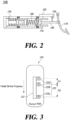
- FIG. 2 is a schematic diagram of a brake pedal assembly 100 according to at least one embodiment.
- FIG. 3 is a diagram of a plurality of sensors disposed in a sensor printed circuit board (PCB) 120 of FIG. 2 .
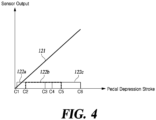
- FIG. 4 is a graph illustrating sensor outputs according to pedal positions according to at least one embodiment.
- the brake apparatus 10 for a vehicle includes all or some of the brake pedal assembly 100, a reservoir 200, a braking unit 300 (the control unit 400 may also be referred to as braking module 300), a plurality of wheel brakes W1, W2, W3, W4, and a control unit 400 (the control unit 400 may also be referred to as controller 400).
- the braking unit 300 may include a hydraulic circuit, a plurality of solenoid valves, and a hydraulic pressure supply unit.
- the control unit 400 may control a motor disposed in the hydraulic supply unit according to the required braking force to adjust the hydraulic pressure supplied to the plurality of wheel brakes W1, W2, W3, and W4.
- the hydraulic circuit is configured to transmit hydraulic pressure over to the wheels of the vehicle.
- the solenoid valves are arranged to regulate flows of hydraulic pressure in the hydraulic circuit. Those of ordinary skill in the art can provide the layout of the hydraulic circuit and the solenoid valves with different design variations.
- inlet valves may be disposed to control the amount of hydraulic pressure supplied to each of the plurality of wheel brakes W1, W2, W3, W4, and four outlet valves may be disposed to control the amount of the hydraulic pressure to withdraw from the plurality of wheel brakes W1, W2, W3, W4, although other layouts than this arrangement are envisioned in the present invention.
- the plurality of wheel brakes W1, W2, W3, W4 include a first wheel brake W1 for braking the rear left wheel of the vehicle, a second wheel brake W2 for braking the rear right wheel, a third wheel brake W3 for braking the front left wheel, and a fourth wheel brake W4 for braking the front right wheel.
- the first to fourth wheel brakes W1 to W4 are formally defined so for the convenience of explanation, and the positions of the first to fourth wheel brakes W1 to W4 are not limited to those as defined above.
- the brake pedal assembly 100 includes all or some of a pedal 110, a rod 140, a magnet 130, the sensor PCB 120, a master cylinder 150, and an elastomer or elastic body 160.
- the control unit 400 may detect the depression stroke by using the sensor PCB 120, calculate the required braking force, and supply a hydraulic braking pressure to each of the plurality of wheel brakes W1, W2, W3, W4.
- the rod 140 may have one end connected to the pedal 110 and the other end connected to the piston 170.
- the rod 140 moves the piston 170 left and right based on the depression stroke of the pedal 110, that is, the displacement of the pedal 110.
- the magnet 130 is disposed on a portion of the rod 140.
- the magnet 130 may be disposed facing toward the sensor PCB 120.
- the magnet 130 moves in unison with the movement of the rod 140 according to the depression of the pedal 110. In other words, the magnet 130 may be moved along the depression direction of the pedal 110.
- the sensor PCB 120 is disposed adjacent to the magnet 130. As shown in FIG. 3 , the sensor PCB 120 may be mounted with a stroke sensor 121 and a plurality of Hall sensors 122.
- the stroke sensor 121 may be disposed to extend along a direction parallel to the direction in which the magnet 130 moves.
- the plurality of Hall sensors 122 may be disposed to be spaced apart along a direction parallel to the direction in which the magnet 130 moves. Three or more Hall sensors 122 may be disposed on the sensor PCB 120.
- the stroke sensor 121 and the Hall sensors 122 may be mounted on the single sensor PCB 120 to form an integral structure.
- the stroke sensor 121 may output different voltages according to the depression stroke of the pedal 110.
- the stroke sensor 121 may be configured to have its output voltage increase as the pedal 110 is depressed toward the master cylinder 150.
- the control unit 400 may estimate the depression stroke of the pedal 110 or the position of the pedal 110 by using a voltage that relates to the position of the pedal 110.
- the internal structure of the master cylinder 150 shown in FIGS. 1 and 2 is exemplary and not limited to those as illustrated.
- the plurality of Hall sensors 122 may include a first Hall sensor to an N-th Hall sensor, where N is a natural number greater than or equal to 3.
- the plurality of Hall sensors 122 as illustrated in FIG. 3 includes a first Hall sensor 122a to a third Hall sensor 122c. The following description will refer to FIG. 3 .
- the first Hall sensor 122a to the third Hall sensor 122c are spaced apart from each other in a direction parallel to the operational direction of the magnet 130. In other words, the first Hall sensor 122a to the third Hall sensor 122c are spaced apart from each other in a direction parallel to the operational direction of the pedal 110.
- the first Hall sensor 122a is disposed to be closest to an initial position of the pedal 110.
- the second Hall sensor 122b is disposed to be spaced apart from the first Hall sensor 122a by a first distance D1.
- the third Hall sensor 122c is disposed to be spaced apart from the second Hall sensor 122b by a second distance D2.
- the third Hall sensor 122c is disposed at the farthest from the initial position of the pedal 110.
- the initial position refers to the position of the magnet 130 where the pedal 110 is not depressed.
- First distance D1 that is a distance between the first Hall sensor 122a and the second Hall sensor 122b is different from the second distance D2 that is a distance between the second Hall sensor 122b and the third Hall sensor 122c.
- First distance D1 may be smaller than second distance D2. In other words, when the Hall sensors 122 are sequentially spaced apart from the initial position, they are arranged with gradually increased distances.
- the control unit 400 is configured to calculate the depression stroke of the pedal 110 by using any combination of the stroke sensor 121 and the plurality of Hall sensors 122 and to calculate a required braking force of the vehicle based on the calculated depression stroke of the pedal 110.
- the control unit 400 may utilize the calculated required braking force to control the braking unit 300 to transmit the braking hydraulic pressure to each of the plurality of wheel brakes W1, W2, W3, W4.
- the control unit 400 calculates the depression stroke of the pedal 110 based on the output voltage of the stroke sensor 121 unless a failure occurs in the stroke sensor 121.
- the control unit 400 may determine whether a failure occurs in the stroke sensor 121 by using the plurality of Hall sensors 122.
- the multiple Hall sensors 122 are configured by the first Hall sensors 122a to the third Hall sensors 122c as shown in FIG. 3 .
- the magnet 130 when moving as the pedal 110 is depressed forms one rising edge and one falling edge while the magnet 130 passes one Hall sensor.
- Three Hall sensors 122 will form three rising edges and three falling edges.
- the depression strokes of the pedal 110, corresponding to the points at which the rising edges and the falling edges are detected may be stored in advance in the control unit 400.
- the control unit 400 may count rising edges or falling edges of the plurality of Hall sensors 122, and calculate the depression strokes of the pedal 110, corresponding to those counts. In particular, the control unit 400 may calculate the depression strokes of the pedal 110 at points C1 to C6 in FIG. 4 by using the plurality of Hall sensors 122.
- the control unit 400 may compare the first depression stroke calculated by using the stroke sensor 121 with the second depression stroke calculated by using the plurality of Hall sensors 122.
- the plurality of Hall sensors 122 once provided is responsive exclusively to a detected rising edge or falling edge for calculating the depression stroke of the pedal 110. Therefore, the comparison of magnitudes between the first depression stroke and the second depression stroke can be performed when a rising edge or a falling edge is detected by the plurality of Hall sensors 122.
- the stroke sensor 121 is normal, the first depression stroke and the second depression stroke are equal or have a difference within a preset margin of error. However, when a failure occurs in the stroke sensor 121, the first depression stroke may have a value outside the preset margin of error against the second depression stroke.
- the control unit 400 may determine based on this property whether a failure has occurred in the stroke sensor 121.
- FIGS. 5A-5B illustrate graphs of a required braking force over time for explaining a method of controlling a brake pedal assembly according to at least one embodiment of the present disclosure.
- FIGS. 5A-5B illustrates graph for estimating the required braking force by using the plurality of Hall sensors 122 when the control unit 400 determines that a failure has occurred in the stroke sensor 121.
- the graphs in FIG. 5A and 5B are illustrated on the premise that the depression stroke of the pedal 110 gradually increases as time increases.
- FIG. 5A is a graph regarding a control method in a general braking situation
- FIG. 5B is a graph regarding a control method in an emergency braking situation.
- L1 denotes the required braking force calculated by the control unit 400 when the stroke sensor 121 is normal
- L2 the required braking force calculated by the control unit 400 using a plurality of Hall sensors 122
- L3 an estimated required braking force by using a plurality of Hall sensors 122 when a failure occurs in the stroke sensor 121.
- T1 to T6 refer to times when detecting a rising edge or a falling edge of the plurality of Hall sensors 122. The shorter the interval between T1 to T6 is, the faster the depression speed of the pedal 110 is.
- the control unit 400 compares the magnitudes between the first depression stroke and the second depression stroke at time T1. At this time, when the first depression stroke and the second depression stroke have a differential magnitude outside the preset margin of error, the control unit 400 may increase the required braking force over time to a preset slope without using the stroke sensor 121.
- the control unit 400 also compares the magnitudes between the first depression stroke and the second depression stroke at time T2 as at time T1. Even in this case, when the differential magnitude between the first depression stroke and the second depression stroke is outside the preset margin of error, the control unit 400 determines that a failure has occurred in the stroke sensor 121. Thereafter, the control unit 400 may apply the preset slope of the required braking force to increase the required braking force until the next rising edge or falling edge is detected. The control unit 400 may determine whether a failure has occurred in the stroke sensor 121 by comparing the magnitudes between the first depression stroke and the second depression stroke at any time points of time T1 to T6.
- the estimation of the required braking force of the control unit 400 may be formed in the graph as with plot L3 but is not so limited. In other words, when the first depression stroke and the second depression stroke are compared and they have the differential magnitude that is outside a preset margin of error, various methods may be employed to estimate the required braking force.
- L1' denotes the required braking force calculated by the control unit 400 in an emergency braking situation when the stroke sensor 121 is normal
- L2' the required braking force calculated by the control unit 400 using a plurality of Hall sensors 122
- L3' an estimated required braking force by using a plurality of Hall sensors 122 when a failure occurs in the stroke sensor 121.
- T1' to T6' refer to times when detecting a rising edge or a falling edge of the plurality of Hall sensors 122.
- the driver quickly depresses the pedal 110 when an emergency braking situation occurs while driving the vehicle. Then, the intervals between T1' to T6' may be shorter than the intervals between T1 to T6.
- the control unit 400 measures the intervals between T1' and T2'. When it is determined that the intervals between T1' and T2' are shorter than preset times, the control unit 400 may determine that the vehicle is in an emergency braking situation. When an abnormality occurs in the stroke sensor 121, the control unit 400 can determine whether the vehicle is in emergency braking condition only at time T2', so the shorter the first interval D1 in the Hall sensors 122, the faster the determination can be made on the emergency braking situation. Therefore, as described above, when the first Hall sensors 122a to 122c are disposed to be spaced apart from each other by the first distance D1 and the second distance D2, the first distance D1 is better set to be smaller than the second distance D2 to enable a quicker decision of the emergency braking situation. The slope of the required braking force after time T2' may be set to become larger as the time interval between T1' and T2' is shorter.
- FIG. 6 is a flowchart of a method of controlling a brake pedal assembly according to at least one embodiment of the present disclosure. Overlapped contents with the above will not be repeated below.
- the control unit 400 determines whether depression has occurred in the pedal 110 (S61). Whether the pedal 110 is depressed may be determined by using the stroke sensor 121 or by whether a first rising edge is detected out of the plurality of Hall sensors 122. When it is determined that the pedal 110 is not depressed, the control unit 400 continues to perform Step S61.
- the control unit 400 Upon determining that the pedal 110 is depressed, the control unit 400 compares the first depression stroke calculated by using the stroke sensor 121 with the second depression stroke calculated by using the plurality of Hall sensors 122 (S62). Whenever detecting the rising edge and the falling edge of the plurality of Hall sensors 122, the control unit 400 may compare the magnitudes between the first depression stroke and the second depression stroke.
- the control unit 400 determines whether the first depression stroke has a value outside a preset margin of error against the second depression stroke (S63). An error may occur in the first depression stroke calculated by the stroke sensor 121 due to noise which is accounted for in setting an allowable margin of error in advance.
- the control unit 400 estimates the depression stroke of the pedal by using a preset slope of the required braking force (S64).
- the preset slope may be determined in advance.
- the control unit 400 calculates the required braking force by using the estimated depression stroke (S65).
- the calculated required braking force may be obtained by considering not only the estimated depression stroke but also the speed at which the driver depresses the pedal 110. For example, when it is determined that the driver depresses the pedal 110 while causing the time interval between T1' and T2' to be shorter than the preset interval as shown in FIG. 5B , the control unit 400 can take it as an emergency braking situation and offer a greater calculated required braking force.
- Step S64 is omitted and the control unit 400 directly estimates the required braking force.
- the control unit 400 determines whether the pedal depression has ended (S66).
- FIG. 6 presents the respective steps thereof as being sequentially performed, it merely instantiates the technical idea of some embodiments of the present disclosure. Therefore, a person having ordinary skill in the pertinent art could incorporate various modifications, additions, and substitutions in practicing the present invention by changing the sequence of steps illustrated by FIG. 6 or by performing one or more of the steps thereof in parallel, and hence the steps in FIG. 6 are not limited to the illustrated chronological sequences.
- a brake pedal assembly that estimates the depression stroke even with a stroke sensor failure.
- a brake pedal assembly that reduces the manufacturing cost thereof by using a plurality of Hall sensors in place of pressure sensors.
- the brake pedal assembly obviates the need for pressure sensors and mounts the Hall sensors on the same PCB that mounts the stroke sensor, to bring the manufacturing cost down.
- the apparatuses, devices, units, modules, and components described herein are implemented by hardware components.
- hardware components that may be used to perform the operations described in this application where appropriate include controllers, sensors, generators, drivers, memories, comparators, arithmetic logic units, adders, subtractors, multipliers, dividers, integrators, and any other electronic components configured to perform the operations described in this application.
- one or more of the hardware components that perform the operations described in this application are implemented by computing hardware, for example, by one or more processors or computers.
- a processor or computer may be implemented by one or more processing elements, such as an array of logic gates, a controller and an arithmetic logic unit, a digital signal processor, a microcomputer, a programmable logic controller, a field-programmable gate array, a programmable logic array, a microprocessor, or any other device or combination of devices that is configured to respond to and execute instructions in a defined manner to achieve a desired result.
- a processor or computer includes, or is connected to, one or more memories storing instructions or software that are executed by the processor or computer.
- Hardware components implemented by a processor or computer may execute instructions or software, such as an operating system (OS) and one or more software applications that run on the OS, to perform the operations described in this application.
- OS operating system
- the hardware components may also access, manipulate, process, create, and store data in response to execution of the instructions or software.
- processor or “computer” may be used in the description of the examples described in this application, but in other examples multiple processors or computers may be used, or a processor or computer may include multiple processing elements, or multiple types of processing elements, or both.
- a single hardware component or two or more hardware components may be implemented by a single processor, or two or more processors, or a processor and a controller.
- One or more hardware components may be implemented by one or more processors, or a processor and a controller, and one or more other hardware components may be implemented by one or more other processors, or another processor and another controller.
- One or more processors may implement a single hardware component, or two or more hardware components.
- a hardware component may have any one or more of different processing configurations, examples of which include a single processor, independent processors, parallel processors, single-instruction single-data (SISD) multiprocessing, single-instruction multiple-data (SIMD) multiprocessing, multiple-instruction single-data (MISD) multiprocessing, multiple-instruction multiple-data (MIMD) multiprocessing, a controller and an arithmetic logic unit (ALU), a DSP, a microcomputer, an applicationspecific integrated circuit (ASIC), a field programmable gate array (FPGA), a programmable logic unit (PLU), a central processing unit (CPU), a graphics processing unit (GPU), a neural processing unit (NPU), or any other device capable of responding to and executing instructions in a defined manner.
- SISD single-instruction single-data
- SIMD single-instruction multiple-data
- MIMD multiple-ins
- the methods that perform the operations described in this application are performed by computing hardware, for example, by one or more processors or computers, implemented as described above executing instructions or software to perform the operations described in this application that are performed by the methods.
- a single operation or two or more operations may be performed by a single processor, or two or more processors, or a processor and a controller.
- One or more operations may be performed by one or more processors, or a processor and a controller, and one or more other operations may be performed by one or more other processors, or another processor and another controller.
- One or more processors, or a processor and a controller may perform a single operation, or two or more operations.
- Instructions or software to control a processor or computer to implement the hardware components and perform the methods as described above are written as computer programs, code segments, instructions or any combination thereof, for individually or collectively instructing or configuring the processor or computer to operate as a machine or special-purpose computer to perform the operations performed by the hardware components and the methods as described above.
- the instructions or software include machine code that is directly executed by the processor or computer, such as machine code produced by a compiler.
- the instructions or software include higher-level code that is executed by the processor or computer using an interpreter. Programmers of ordinary skill in the art can readily write the instructions or software based on the block diagrams and the flow charts illustrated in the drawings and the corresponding descriptions in the specification, which disclose algorithms for performing the operations performed by the hardware components and the methods as described above.
- the computer-readable recording medium includes any type of recording device on which data that can be read by a computer system are recordable.
- Examples of the computer-readable recording medium include non-volatile or nontransitory media such as a ROM, CD-ROM, magnetic tape, floppy disk, memory card, hard disk, optical/magnetic disk, storage devices, and the like.
- the computer-readable recording medium further includes transitory media such as data transmission medium.
- the computer-readable recording medium can be distributed in computer systems connected via a network, wherein the computer-readable codes can be stored and executed in a distributed mode.
- the computer includes a programmable processor, a data storage system (including volatile memory, nonvolatile memory, or any other type of storage system or a combination thereof), and at least one communication interface.
- the programmable computer may be one of a server, a network device, a set-top box, an embedded device, a computer expansion module, a personal computer, a laptop, a personal data assistant (PDA), a cloud computing system, and a mobile device.
- PDA personal data assistant
- brake apparatus for vehicle 100 brake pedal assembly 200: reservoir 300: braking unit 400: control unit 110: pedal 120: sensor PCB 121: stroke sensor 122: multiple Hall sensors 130: magnet 140: rod 150: master cylinder 160: elastic body 170: piston
Landscapes
- Engineering & Computer Science (AREA)
- Transportation (AREA)
- Mechanical Engineering (AREA)
- Physics & Mathematics (AREA)
- Electromagnetism (AREA)
- Fluid Mechanics (AREA)
- General Physics & Mathematics (AREA)
- Braking Elements And Transmission Devices (AREA)
- Regulating Braking Force (AREA)
- Valves And Accessory Devices For Braking Systems (AREA)
Claims (10)
- Bremspedalanordnung (100) mit:einem Pedal (110);einem Hubsensor (121), der dazu ausgebildet ist, einen Niederdrückhub des Pedals (110) zu erfassen;Hall-Sensoren (122), die in einer zur Betätigungsrichtung des Pedals (110) parallelen Richtung voneinander beabstandet sind; undeiner Steuerung, die dazu ausgebildet ist, den Niederdrückhub des Pedals (110) unter Verwendung einer beliebigen Kombination des Hubsensors (121) und der Hall-Sensoren (122) zu bestimmen, und eine erforderliche Bremskraft eines Fahrzeugs in Reaktion auf den Niederdrückhub des Pedals (110) zu bestimmen,dadurch gekennzeichnet,dass die Hall-Sensoren einen ersten bis N-ten Hall-Sensor (122) aufweisen, wobei N eine natürliche Zahl gleich oder größer als 3 ist, undwobei der Abstand zwischen den Hall-Sensoren (122) von dem ersten Hall-Sensor (122a), der einer Ausgangsposition des Pedals (110) am nächsten ist, zu dem N-ten Hall-Sensor, der von der Ausgangsposition des Pedals (110) am weitesten entfernt ist, zunimmt.
- Bremspedalanordnung nach Anspruch 1, bei welcher die Steuerung ferner dazu ausgebildet ist, ansteigende Flanken und abfallende Flanken der Hall-Sensoren (122) in Reaktion auf das Niederdrücken des Pedals (110) zu erkennen und zu zählen, und ein Vorabspeichern des Niederdrückhubs des Pedals (110) gemäß den Zählungen der ansteigenden Flanken und der abfallenden Flanken zu veranlassen.
- Bremspedalanordnung nach Anspruch 2, bei welcher die Steuerung ferner dazu ausgebildet ist,einen von dem Hubsensor (121) berechneten ersten Niederdrückhub des Pedals (110) mit einem von den Hall-Sensoren (122) berechneten zweiten Betätigungshub zu vergleichen;festzustellen, ob eine Differenz zwischen dem ersten Niederdrückhub und dem zweiten Niederdrückhub einen Schwellenwert übersteigt; undin Reaktion darauf, dass die Differenz den Schwellenwert übersteigt, festzustellen, dass ein Fehler in dem Hubsensor (121) aufgetreten ist.
- Bremspedalanordnung nach Anspruch 3, bei welcher die Steuerung ferner dazu ausgebildet ist, in Reaktion auf eine Feststellung, dass der Fehler in dem Hubsensor (121) aufgetreten ist, voreingestellte Werte zu verwenden.
- Bremspedalanordnung mach Anspruch 3, bei welcher die Steuerung ferner dazu ausgebildet ist,festzustellen, ob eine erste erkannte Zeitdauer einer ansteigenden Flanke des ersten Hall-Sensors (122a) und eine zweite erkannte Zeitdauer einer ansteigenden Flanke des zweiten Hall-Sensors (122b) kürzer als voreingestellte Zeitdauern sind; undin Reaktion darauf, dass die erste erkannte Zeitdauer und die zweite erkannte Zeitdauer kürzer als die voreingestellten Zeitdauern sind, festzustellen, dass sich das Fahrzeug in einer Notbremssituation befindet.
- Bremsvorrichtung (10) für ein Fahrzeug, mit:der Bremspedalanordnung (100) nach Anspruch 1;einem Hydraulikkreis, der dazu ausgebildet ist, basierend auf der erforderlichen Bremskraft Hydraulikdruck an Räder des Fahrzeugs zu übertragen; undeinem Elektromagnetventil, das dazu ausgebildet und angeordnet ist, Ströme des Hydraulikdrucks in dem Hydraulikkreis zu regeln.
- Verfahren zum Steuern einer Bremspedalanordnung (10) nach Anspruch 1 zum Berechnen einer erforderlichen Bremskraft eines Fahrzeugs unter Verwendung des Hubsensors (121) und unter Verwendung der Hall-Sensoren (122), wobei das Verfahren die folgenden Schritte aufweist:Vergleichen eines unter Verwendung des Hubsensors (121) berechneten ersten Niederdrückhubs des Pedals (110) mit einem unter Verwendung der Hall-Sensoren (122) berechneten zweiten Betätigungshub;Feststellen, ob eine Differenz zwischen einem Wert des ersten Niederdrückhubs und einem Wert des zweiten Niederdrückhubs einen Schwellenwert übersteigt; undin Reaktion darauf, dass die Differenz den Schwellenwert übersteigt, Feststellen, dass ein Fehler in dem Hubsensor (121) aufgetreten ist; undin Reaktion auf das Auftreten des Fehlers in dem Hubsensor (121), Schätzen des Niederdrückhubs des Pedals (110) unter Verwendung eines voreingestellten Werts.
- Verfahren nach Anspruch 7, mit dem Schritt:
Erkennen und Zählen ansteigender Flanken und abfallender Flanken der Hall-Sensoren (122), und Vorabspeichern des Niederdrückhubs des Pedals (110) gemäß den Zählungen der ansteigenden Flanken und der abfallenden Flanken. - Verfahren nach Anspruch 8, bei welchem das Schätzen des Niederdrückhubs den folgenden Schritt aufweist:
in Reaktion auf die Feststellung, dass ein Fehler in dem Hubsensor (121) aufgetreten ist und die ansteigenden Flanken und die abfallenden Flanken in einem Zeitdauer gezählt sind, der kürzer als voreingestellte Zeitdauern sind, Feststellen, dass sich das Fahrzeug in einer Notbremssituation befindet. - Verfahren nach Anspruch 7, ferner mit dem Schritt:
Berechnen einer Bremskraft unter Verwendung eines geschätzten Niederdrückhubs.
Applications Claiming Priority (1)
| Application Number | Priority Date | Filing Date | Title |
|---|---|---|---|
| KR1020210108688A KR102630249B1 (ko) | 2021-08-18 | 2021-08-18 | 브레이크페달 조립체, 이를 포함하는 차량용 제동장치, 및 이의 제어방법 |
Publications (2)
| Publication Number | Publication Date |
|---|---|
| EP4137370A1 EP4137370A1 (de) | 2023-02-22 |
| EP4137370B1 true EP4137370B1 (de) | 2024-10-16 |
Family
ID=78770434
Family Applications (1)
| Application Number | Title | Priority Date | Filing Date |
|---|---|---|---|
| EP21209834.7A Active EP4137370B1 (de) | 2021-08-18 | 2021-11-23 | Bremspedalanordnung, bremsvorrichtung für ein fahrzeug damit und steuerverfahren dafür |
Country Status (4)
| Country | Link |
|---|---|
| US (1) | US12065118B2 (de) |
| EP (1) | EP4137370B1 (de) |
| KR (1) | KR102630249B1 (de) |
| CN (1) | CN115707603A (de) |
Families Citing this family (3)
| Publication number | Priority date | Publication date | Assignee | Title |
|---|---|---|---|---|
| JP7537388B2 (ja) * | 2021-07-16 | 2024-08-21 | 株式会社デンソー | ブレーキシステム |
| US20250388094A1 (en) * | 2024-06-25 | 2025-12-25 | Cummins Inc. | Systems and methods to improve drivability in a fuel cell electric vehicle |
| CN119428572A (zh) * | 2024-11-18 | 2025-02-14 | 中车时代电动汽车股份有限公司 | 车辆辅助制动系统及方法 |
Family Cites Families (16)
| Publication number | Priority date | Publication date | Assignee | Title |
|---|---|---|---|---|
| DE19855358A1 (de) * | 1998-12-01 | 2000-06-08 | Bosch Gmbh Robert | Vorrichtung und Verfahren zur Ermittlung einer Wegstrecke |
| US6464306B2 (en) * | 2001-02-27 | 2002-10-15 | Delphi Technologies, Inc. | Brake pedal feel emulator with integral force and travel sensors |
| DE102004029193B4 (de) | 2004-06-16 | 2007-09-13 | Hartmann-Exact Gmbh | Verfahren und Vorrichtung zum Erfassen eines eine bestimmte Funktion auslösenden Betriebsparameters |
| FR2875602B1 (fr) * | 2004-09-22 | 2006-11-17 | Renault Sas | Systeme de mesure d'une vitesse de pedale |
| FR2897933B1 (fr) | 2006-02-28 | 2008-07-04 | Bosch Rexroth D S I Soc Par Ac | Dispositif de detection d'un mouvement lineaire par effet hall |
| WO2013043772A1 (en) | 2011-09-22 | 2013-03-28 | Tyco Electronics Corporation | Switch assembly and system |
| JP5825035B2 (ja) * | 2011-10-18 | 2015-12-02 | 日産自動車株式会社 | 車両用制動力制御装置 |
| KR101801536B1 (ko) * | 2013-05-13 | 2017-11-27 | 주식회사 만도 | 페달 스트로크 센서의 설치구조 |
| KR102148320B1 (ko) * | 2014-05-30 | 2020-08-26 | 주식회사 만도 | 차량의 능동 유압 부스터 시스템 및 그 제어방법 |
| JP6373493B2 (ja) | 2015-05-29 | 2018-08-15 | 日立オートモティブシステムズ株式会社 | 電動倍力装置及びストローク検出装置 |
| JP2017177849A (ja) | 2016-03-28 | 2017-10-05 | 日立オートモティブシステムズ株式会社 | 倍力装置 |
| CN110234548B (zh) * | 2017-01-24 | 2022-08-23 | Cts公司 | 用于车辆制动踏板的位置和力传感器组件 |
| KR20190016268A (ko) | 2017-08-08 | 2019-02-18 | 주식회사 만도 | 페달 변위 측정 장치 및 이를 포함하는 전자식 브레이크 시스템 |
| JP7132838B2 (ja) | 2018-12-03 | 2022-09-07 | 日立Astemo株式会社 | 自動車用ペダルストローク検出装置および自動車用コントロールユニット |
| WO2020180140A1 (en) * | 2019-03-06 | 2020-09-10 | Mando Corporation | Brake pedal system for an electrically controlled vehicle brake |
| DE102021214570A1 (de) * | 2021-12-17 | 2023-06-22 | Zf Active Safety Gmbh | Elektrohydraulisches Bremsmodul |
-
2021
- 2021-08-18 KR KR1020210108688A patent/KR102630249B1/ko active Active
- 2021-11-18 US US17/529,857 patent/US12065118B2/en active Active
- 2021-11-23 EP EP21209834.7A patent/EP4137370B1/de active Active
- 2021-12-31 CN CN202111675117.6A patent/CN115707603A/zh active Pending
Also Published As
| Publication number | Publication date |
|---|---|
| US12065118B2 (en) | 2024-08-20 |
| EP4137370A1 (de) | 2023-02-22 |
| US20230054790A1 (en) | 2023-02-23 |
| KR102630249B1 (ko) | 2024-01-25 |
| KR20230026724A (ko) | 2023-02-27 |
| CN115707603A (zh) | 2023-02-21 |
Similar Documents
| Publication | Publication Date | Title |
|---|---|---|
| EP4137370B1 (de) | Bremspedalanordnung, bremsvorrichtung für ein fahrzeug damit und steuerverfahren dafür | |
| US10829149B1 (en) | Steering control for vehicles | |
| CN108136935B (zh) | 车速控制装置 | |
| US11559890B2 (en) | Method, apparatus and system for determining a trajectory of a robot's end effector | |
| US7912610B2 (en) | Control apparatus for vehicle having cooperative control unit | |
| KR102778260B1 (ko) | 자율 주행 제어 장치, 그를 포함한 시스템 및 그 방법 | |
| CN101372225B (zh) | 主动制动器脉动控制 | |
| CN108860143B (zh) | 用于控制自动驾驶的车辆的方法和车辆控制系统 | |
| JP7467903B2 (ja) | 車両用ブレーキシステム | |
| CN110816541B (zh) | 弯道识别方法、装置、计算机设备和存储介质 | |
| CN112572408A (zh) | 集成底盘控制系统 | |
| KR20190043270A (ko) | 차량 곡률 반경 추정 장치 및 방법 | |
| CN113815644A (zh) | 减少估计自主车辆动力学的不确定性的系统和方法 | |
| CN108374892A (zh) | 使用致动器线圈电感来诊断差速器卡住的系统和方法 | |
| EP4109816A1 (de) | Kontextbasierte reaktion auf angriffe gegen autonome systeme | |
| US20240241527A1 (en) | Robot and controlling method thereof | |
| US11487914B2 (en) | Component layout optimization | |
| US20220402486A1 (en) | Target vehicle detection | |
| Wang et al. | Personalized ground vehicle collision avoidance system: From a computational resource re-allocation perspective | |
| CN119037373B (zh) | 一种对称比例阀控制方法、装置、电子设备及车辆 | |
| US20250382007A1 (en) | Vehicle control device and method through estimating steering angle of front wheel | |
| CN110347166A (zh) | 用于自动驾驶系统的传感器控制方法 | |
| US12209391B2 (en) | Controlling machine operation based on validation of machine data | |
| CN116806202B (zh) | 转向控制装置 | |
| CN110843448B (zh) | 主动侧倾控制装置及方法 |
Legal Events
| Date | Code | Title | Description |
|---|---|---|---|
| PUAI | Public reference made under article 153(3) epc to a published international application that has entered the european phase |
Free format text: ORIGINAL CODE: 0009012 |
|
| STAA | Information on the status of an ep patent application or granted ep patent |
Free format text: STATUS: REQUEST FOR EXAMINATION WAS MADE |
|
| 17P | Request for examination filed |
Effective date: 20211123 |
|
| AK | Designated contracting states |
Kind code of ref document: A1 Designated state(s): AL AT BE BG CH CY CZ DE DK EE ES FI FR GB GR HR HU IE IS IT LI LT LU LV MC MK MT NL NO PL PT RO RS SE SI SK SM TR |
|
| RBV | Designated contracting states (corrected) |
Designated state(s): AL AT BE BG CH CY CZ DE DK EE ES FI FR GB GR HR HU IE IS IT LI LT LU LV MC MK MT NL NO PL PT RO RS SE SI SK SM TR |
|
| GRAP | Despatch of communication of intention to grant a patent |
Free format text: ORIGINAL CODE: EPIDOSNIGR1 |
|
| STAA | Information on the status of an ep patent application or granted ep patent |
Free format text: STATUS: GRANT OF PATENT IS INTENDED |
|
| INTG | Intention to grant announced |
Effective date: 20240606 |
|
| P01 | Opt-out of the competence of the unified patent court (upc) registered |
Free format text: CASE NUMBER: APP_36588/2024 Effective date: 20240619 |
|
| GRAS | Grant fee paid |
Free format text: ORIGINAL CODE: EPIDOSNIGR3 |
|
| GRAA | (expected) grant |
Free format text: ORIGINAL CODE: 0009210 |
|
| STAA | Information on the status of an ep patent application or granted ep patent |
Free format text: STATUS: THE PATENT HAS BEEN GRANTED |
|
| AK | Designated contracting states |
Kind code of ref document: B1 Designated state(s): AL AT BE BG CH CY CZ DE DK EE ES FI FR GB GR HR HU IE IS IT LI LT LU LV MC MK MT NL NO PL PT RO RS SE SI SK SM TR |
|
| REG | Reference to a national code |
Ref country code: GB Ref legal event code: FG4D |
|
| REG | Reference to a national code |
Ref country code: DE Ref legal event code: R096 Ref document number: 602021020294 Country of ref document: DE Ref country code: CH Ref legal event code: EP |
|
| REG | Reference to a national code |
Ref country code: IE Ref legal event code: FG4D |
|
| REG | Reference to a national code |
Ref country code: LT Ref legal event code: MG9D |
|
| REG | Reference to a national code |
Ref country code: NL Ref legal event code: MP Effective date: 20241016 |
|
| REG | Reference to a national code |
Ref country code: AT Ref legal event code: MK05 Ref document number: 1732704 Country of ref document: AT Kind code of ref document: T Effective date: 20241016 |
|
| PG25 | Lapsed in a contracting state [announced via postgrant information from national office to epo] |
Ref country code: NL Free format text: LAPSE BECAUSE OF FAILURE TO SUBMIT A TRANSLATION OF THE DESCRIPTION OR TO PAY THE FEE WITHIN THE PRESCRIBED TIME-LIMIT Effective date: 20241016 |
|
| PG25 | Lapsed in a contracting state [announced via postgrant information from national office to epo] |
Ref country code: NL Free format text: LAPSE BECAUSE OF FAILURE TO SUBMIT A TRANSLATION OF THE DESCRIPTION OR TO PAY THE FEE WITHIN THE PRESCRIBED TIME-LIMIT Effective date: 20241016 |
|
| PG25 | Lapsed in a contracting state [announced via postgrant information from national office to epo] |
Ref country code: IS Free format text: LAPSE BECAUSE OF FAILURE TO SUBMIT A TRANSLATION OF THE DESCRIPTION OR TO PAY THE FEE WITHIN THE PRESCRIBED TIME-LIMIT Effective date: 20250216 Ref country code: HR Free format text: LAPSE BECAUSE OF FAILURE TO SUBMIT A TRANSLATION OF THE DESCRIPTION OR TO PAY THE FEE WITHIN THE PRESCRIBED TIME-LIMIT Effective date: 20241016 Ref country code: PT Free format text: LAPSE BECAUSE OF FAILURE TO SUBMIT A TRANSLATION OF THE DESCRIPTION OR TO PAY THE FEE WITHIN THE PRESCRIBED TIME-LIMIT Effective date: 20250217 |
|
| PG25 | Lapsed in a contracting state [announced via postgrant information from national office to epo] |
Ref country code: FI Free format text: LAPSE BECAUSE OF FAILURE TO SUBMIT A TRANSLATION OF THE DESCRIPTION OR TO PAY THE FEE WITHIN THE PRESCRIBED TIME-LIMIT Effective date: 20241016 |
|
| PG25 | Lapsed in a contracting state [announced via postgrant information from national office to epo] |
Ref country code: BG Free format text: LAPSE BECAUSE OF FAILURE TO SUBMIT A TRANSLATION OF THE DESCRIPTION OR TO PAY THE FEE WITHIN THE PRESCRIBED TIME-LIMIT Effective date: 20241016 |
|
| PG25 | Lapsed in a contracting state [announced via postgrant information from national office to epo] |
Ref country code: ES Free format text: LAPSE BECAUSE OF FAILURE TO SUBMIT A TRANSLATION OF THE DESCRIPTION OR TO PAY THE FEE WITHIN THE PRESCRIBED TIME-LIMIT Effective date: 20241016 |
|
| PG25 | Lapsed in a contracting state [announced via postgrant information from national office to epo] |
Ref country code: NO Free format text: LAPSE BECAUSE OF FAILURE TO SUBMIT A TRANSLATION OF THE DESCRIPTION OR TO PAY THE FEE WITHIN THE PRESCRIBED TIME-LIMIT Effective date: 20250116 |
|
| PG25 | Lapsed in a contracting state [announced via postgrant information from national office to epo] |
Ref country code: AT Free format text: LAPSE BECAUSE OF FAILURE TO SUBMIT A TRANSLATION OF THE DESCRIPTION OR TO PAY THE FEE WITHIN THE PRESCRIBED TIME-LIMIT Effective date: 20241016 Ref country code: LV Free format text: LAPSE BECAUSE OF FAILURE TO SUBMIT A TRANSLATION OF THE DESCRIPTION OR TO PAY THE FEE WITHIN THE PRESCRIBED TIME-LIMIT Effective date: 20241016 Ref country code: GR Free format text: LAPSE BECAUSE OF FAILURE TO SUBMIT A TRANSLATION OF THE DESCRIPTION OR TO PAY THE FEE WITHIN THE PRESCRIBED TIME-LIMIT Effective date: 20250117 |
|
| PG25 | Lapsed in a contracting state [announced via postgrant information from national office to epo] |
Ref country code: PL Free format text: LAPSE BECAUSE OF FAILURE TO SUBMIT A TRANSLATION OF THE DESCRIPTION OR TO PAY THE FEE WITHIN THE PRESCRIBED TIME-LIMIT Effective date: 20241016 |
|
| PG25 | Lapsed in a contracting state [announced via postgrant information from national office to epo] |
Ref country code: RS Free format text: LAPSE BECAUSE OF FAILURE TO SUBMIT A TRANSLATION OF THE DESCRIPTION OR TO PAY THE FEE WITHIN THE PRESCRIBED TIME-LIMIT Effective date: 20250116 |
|
| REG | Reference to a national code |
Ref country code: CH Ref legal event code: PL |
|
| PG25 | Lapsed in a contracting state [announced via postgrant information from national office to epo] |
Ref country code: SM Free format text: LAPSE BECAUSE OF FAILURE TO SUBMIT A TRANSLATION OF THE DESCRIPTION OR TO PAY THE FEE WITHIN THE PRESCRIBED TIME-LIMIT Effective date: 20241016 |
|
| PG25 | Lapsed in a contracting state [announced via postgrant information from national office to epo] |
Ref country code: MC Free format text: LAPSE BECAUSE OF FAILURE TO SUBMIT A TRANSLATION OF THE DESCRIPTION OR TO PAY THE FEE WITHIN THE PRESCRIBED TIME-LIMIT Effective date: 20241016 |
|
| PG25 | Lapsed in a contracting state [announced via postgrant information from national office to epo] |
Ref country code: DK Free format text: LAPSE BECAUSE OF FAILURE TO SUBMIT A TRANSLATION OF THE DESCRIPTION OR TO PAY THE FEE WITHIN THE PRESCRIBED TIME-LIMIT Effective date: 20241016 |
|
| PG25 | Lapsed in a contracting state [announced via postgrant information from national office to epo] |
Ref country code: LU Free format text: LAPSE BECAUSE OF NON-PAYMENT OF DUE FEES Effective date: 20241123 |
|
| REG | Reference to a national code |
Ref country code: CH Ref legal event code: PL |
|
| REG | Reference to a national code |
Ref country code: DE Ref legal event code: R097 Ref document number: 602021020294 Country of ref document: DE |
|
| PG25 | Lapsed in a contracting state [announced via postgrant information from national office to epo] |
Ref country code: EE Free format text: LAPSE BECAUSE OF FAILURE TO SUBMIT A TRANSLATION OF THE DESCRIPTION OR TO PAY THE FEE WITHIN THE PRESCRIBED TIME-LIMIT Effective date: 20241016 |
|
| PG25 | Lapsed in a contracting state [announced via postgrant information from national office to epo] |
Ref country code: CH Free format text: LAPSE BECAUSE OF NON-PAYMENT OF DUE FEES Effective date: 20241130 |
|
| PG25 | Lapsed in a contracting state [announced via postgrant information from national office to epo] |
Ref country code: RO Free format text: LAPSE BECAUSE OF FAILURE TO SUBMIT A TRANSLATION OF THE DESCRIPTION OR TO PAY THE FEE WITHIN THE PRESCRIBED TIME-LIMIT Effective date: 20241016 |
|
| PG25 | Lapsed in a contracting state [announced via postgrant information from national office to epo] |
Ref country code: SK Free format text: LAPSE BECAUSE OF FAILURE TO SUBMIT A TRANSLATION OF THE DESCRIPTION OR TO PAY THE FEE WITHIN THE PRESCRIBED TIME-LIMIT Effective date: 20241016 |
|
| PG25 | Lapsed in a contracting state [announced via postgrant information from national office to epo] |
Ref country code: CZ Free format text: LAPSE BECAUSE OF FAILURE TO SUBMIT A TRANSLATION OF THE DESCRIPTION OR TO PAY THE FEE WITHIN THE PRESCRIBED TIME-LIMIT Effective date: 20241016 |
|
| PG25 | Lapsed in a contracting state [announced via postgrant information from national office to epo] |
Ref country code: IT Free format text: LAPSE BECAUSE OF FAILURE TO SUBMIT A TRANSLATION OF THE DESCRIPTION OR TO PAY THE FEE WITHIN THE PRESCRIBED TIME-LIMIT Effective date: 20241016 |
|
| PLBE | No opposition filed within time limit |
Free format text: ORIGINAL CODE: 0009261 |
|
| STAA | Information on the status of an ep patent application or granted ep patent |
Free format text: STATUS: NO OPPOSITION FILED WITHIN TIME LIMIT |
|
| REG | Reference to a national code |
Ref country code: BE Ref legal event code: MM Effective date: 20241130 |
|
| PG25 | Lapsed in a contracting state [announced via postgrant information from national office to epo] |
Ref country code: SE Free format text: LAPSE BECAUSE OF FAILURE TO SUBMIT A TRANSLATION OF THE DESCRIPTION OR TO PAY THE FEE WITHIN THE PRESCRIBED TIME-LIMIT Effective date: 20241016 |
|
| 26N | No opposition filed |
Effective date: 20250717 |
|
| PG25 | Lapsed in a contracting state [announced via postgrant information from national office to epo] |
Ref country code: BE Free format text: LAPSE BECAUSE OF NON-PAYMENT OF DUE FEES Effective date: 20241130 |
|
| PGFP | Annual fee paid to national office [announced via postgrant information from national office to epo] |
Ref country code: GB Payment date: 20250922 Year of fee payment: 5 |
|
| PGFP | Annual fee paid to national office [announced via postgrant information from national office to epo] |
Ref country code: FR Payment date: 20250925 Year of fee payment: 5 |
|
| PG25 | Lapsed in a contracting state [announced via postgrant information from national office to epo] |
Ref country code: IE Free format text: LAPSE BECAUSE OF NON-PAYMENT OF DUE FEES Effective date: 20241123 |
|
| PGFP | Annual fee paid to national office [announced via postgrant information from national office to epo] |
Ref country code: DE Payment date: 20250922 Year of fee payment: 5 |
|
| PG25 | Lapsed in a contracting state [announced via postgrant information from national office to epo] |
Ref country code: HU Free format text: LAPSE BECAUSE OF FAILURE TO SUBMIT A TRANSLATION OF THE DESCRIPTION OR TO PAY THE FEE WITHIN THE PRESCRIBED TIME-LIMIT; INVALID AB INITIO Effective date: 20211123 |
|
| PG25 | Lapsed in a contracting state [announced via postgrant information from national office to epo] |
Ref country code: CY Free format text: LAPSE BECAUSE OF FAILURE TO SUBMIT A TRANSLATION OF THE DESCRIPTION OR TO PAY THE FEE WITHIN THE PRESCRIBED TIME-LIMIT; INVALID AB INITIO Effective date: 20211123 |