EP4137090B1 - Slave-endvorrichtung für einen interventionellen chirurgischen roboter - Google Patents
Slave-endvorrichtung für einen interventionellen chirurgischen roboter Download PDFInfo
- Publication number
- EP4137090B1 EP4137090B1 EP22782655.9A EP22782655A EP4137090B1 EP 4137090 B1 EP4137090 B1 EP 4137090B1 EP 22782655 A EP22782655 A EP 22782655A EP 4137090 B1 EP4137090 B1 EP 4137090B1
- Authority
- EP
- European Patent Office
- Prior art keywords
- catheter
- drive mechanism
- guide wire
- assembly
- clamp
- Prior art date
- Legal status (The legal status is an assumption and is not a legal conclusion. Google has not performed a legal analysis and makes no representation as to the accuracy of the status listed.)
- Active
Links
Images


Classifications
-
- A—HUMAN NECESSITIES
- A61—MEDICAL OR VETERINARY SCIENCE; HYGIENE
- A61B—DIAGNOSIS; SURGERY; IDENTIFICATION
- A61B34/00—Computer-aided surgery; Manipulators or robots specially adapted for use in surgery
- A61B34/30—Surgical robots
- A61B34/37—Leader-follower robots
-
- B—PERFORMING OPERATIONS; TRANSPORTING
- B25—HAND TOOLS; PORTABLE POWER-DRIVEN TOOLS; MANIPULATORS
- B25J—MANIPULATORS; CHAMBERS PROVIDED WITH MANIPULATION DEVICES
- B25J3/00—Manipulators of leader-follower type, i.e. both controlling unit and controlled unit perform corresponding spatial movements
-
- A—HUMAN NECESSITIES
- A61—MEDICAL OR VETERINARY SCIENCE; HYGIENE
- A61B—DIAGNOSIS; SURGERY; IDENTIFICATION
- A61B34/00—Computer-aided surgery; Manipulators or robots specially adapted for use in surgery
- A61B34/30—Surgical robots
- A61B2034/301—Surgical robots for introducing or steering flexible instruments inserted into the body, e.g. catheters or endoscopes
-
- A—HUMAN NECESSITIES
- A61—MEDICAL OR VETERINARY SCIENCE; HYGIENE
- A61M—DEVICES FOR INTRODUCING MEDIA INTO, OR ONTO, THE BODY; DEVICES FOR TRANSDUCING BODY MEDIA OR FOR TAKING MEDIA FROM THE BODY; DEVICES FOR PRODUCING OR ENDING SLEEP OR STUPOR
- A61M25/00—Catheters; Hollow probes
-
- A—HUMAN NECESSITIES
- A61—MEDICAL OR VETERINARY SCIENCE; HYGIENE
- A61M—DEVICES FOR INTRODUCING MEDIA INTO, OR ONTO, THE BODY; DEVICES FOR TRANSDUCING BODY MEDIA OR FOR TAKING MEDIA FROM THE BODY; DEVICES FOR PRODUCING OR ENDING SLEEP OR STUPOR
- A61M25/00—Catheters; Hollow probes
- A61M25/01—Introducing, guiding, advancing, emplacing or holding catheters
- A61M25/0105—Steering means as part of the catheter or advancing means; Markers for positioning
- A61M25/0113—Mechanical advancing means, e.g. catheter dispensers
-
- A—HUMAN NECESSITIES
- A61—MEDICAL OR VETERINARY SCIENCE; HYGIENE
- A61M—DEVICES FOR INTRODUCING MEDIA INTO, OR ONTO, THE BODY; DEVICES FOR TRANSDUCING BODY MEDIA OR FOR TAKING MEDIA FROM THE BODY; DEVICES FOR PRODUCING OR ENDING SLEEP OR STUPOR
- A61M25/00—Catheters; Hollow probes
- A61M25/01—Introducing, guiding, advancing, emplacing or holding catheters
- A61M25/06—Body-piercing guide needles or the like
- A61M25/0662—Guide tubes
-
- A—HUMAN NECESSITIES
- A61—MEDICAL OR VETERINARY SCIENCE; HYGIENE
- A61M—DEVICES FOR INTRODUCING MEDIA INTO, OR ONTO, THE BODY; DEVICES FOR TRANSDUCING BODY MEDIA OR FOR TAKING MEDIA FROM THE BODY; DEVICES FOR PRODUCING OR ENDING SLEEP OR STUPOR
- A61M25/00—Catheters; Hollow probes
- A61M25/01—Introducing, guiding, advancing, emplacing or holding catheters
- A61M25/09—Guide wires
Definitions
- the present disclosure relates to the technical field of medical robots, applicable to master-slave vascular interventional robots, and in particular, relates to a slave-end apparatus for an interventional robot.
- Minimally invasive vascular intervention refers to a physician, guided by a digital subtraction angiography (DSA) system, manipulating the movement of a catheter and a guide wire in human blood vessels to treat lesions, so as to achieve the purpose of embolization of abnormal vessels, thrombolysis, dilation of narrow vessels, and the like.
- DSA digital subtraction angiography
- interventional therapy has played an important role in the diagnosis and treatment of hundreds of diseases, such as tumor, peripheral vessel disease, great vessel disease, digestive tract disease, nervous system disease, and non-vascular disease.
- the interventional therapy covers all diseases from the head to the foot of the human body, and has become the first choice for some diseases. Interventional therapy can treat many diseases that cannot be treated in the past or have a poor curative effect without incision of human tissues. In the interventional therapy, the incision (puncture point) only has the size of rice grains.
- the interventional therapy has the characteristics of no incision, small trauma, rapid recovery and good curative effect, which has been highly valued by
- WO2021011554 discloses a robotic drive system for driving one or more elongated medical devices, the robotic drive can include a linear member and at least four device modules coupled to the linear member. Each device module may be independently controllable. The plurality of device modules may be switched between a first configuration where each device module is populated with an elongated medical device and a second configuration where a subset of the at least four device modules is populated with an elongated medical device.
- the master and slave actuators contain sensors that sense translation and rotation of the controls and tools with respect to their longitudinal axes, and provide sense signals indicative of these motions to the interface circuitry.
- the master and slave actuators also contain motors respectively engaging the controls and tools to cause translational and rotational movement of these components in response to the drive signals generated by the interface circuitry.
- US20140276391 discloses a robotic instrument driver for elongate members, which includes a first carriage positionable on a bed and beside a patient access site for manipulating a first elongate member, and a second carriage positionable proximate the bed, the second carriage configured to articulate the first elongate member, wherein the second carriage is movable independent from the first carriage.
- a technical problem to be solved by the present disclosure is to provide a slave-end apparatus for an interventional robot which facilitates a physician in interventional procedures.
- the present disclosure provides a slave-end apparatus for an interventional robot according to claim 1.
- the apparatus includes: a body, a first drive mechanism, a second drive mechanism, a third drive mechanism and a front clamper proximal to the first drive mechanism that are successively mounted on the body; wherein
- the apparatus further includes: a plurality of front clampers; wherein a plurality of first catheters one-by-one pushed by the first drive mechanism to desired positions are respectively clamped by the plurality of front clampers.
- the second drive mechanism is configured to clamp and rotate, together with the first drive mechanism, the first catheter or the second catheter.
- the second drive mechanism includes: a first assembly configured to clamp and rotate the first catheter or the second catheter, and a second assembly configured to clamp and rotate the second catheter or the third catheter.
- the first assembly of the second drive mechanism is configured to clamp an Y adapter connected to the first catheter and the second catheter to clamp the first catheter and the second catheter, and rotate a Luer connector of the Y adapter to drive the first catheter and the second catheter to rotate.
- the third drive mechanism is configured to clamp and rotate, together with the second drive mechanism, the second catheter or the third catheter.
- the third drive mechanism includes: a first assembly configured to clamp and rotate the second catheter or the third catheter, and a second assembly configured to clamp and rotate the first guide wire or the second guide wire.
- the first assembly of the third drive mechanism is configured to clamp an Y adapter connected to the second catheter and the third catheter to clamp the second catheter and the third catheter, and rotate a Luer connector of the Y adapter to drive the second catheter and the third catheter to rotate.
- the second assembly is a slave-end guide wire and catheter twisting apparatus for the interventional robot.
- the apparatus further includes: a rear clamper; wherein in a case that the third drive mechanism moves to an extreme position and is to be restored to release the second guide wire, the rear clamper is configured to clamp the second guide wire to prevent movement thereof.
- the front clamper and the rear clamper are respectively positioned at a front portion and a rear portion of the body;
- the fourth drive mechanism and the fifth drive mechanism move along the same axial direction as the first drive mechanism, the second drive mechanism and the third drive mechanism.
- the terms “mounted,” “coupled,” “connected,” “fixed,” and derivative forms thereof shall be understood in a broad sense, which, for example, may be understood as fixed connection, detachable connection or integral connection or even connected in a relative movement fashion; may be understood as mechanical connection or electrical connection, or understood as direct connection, indirect connection via an intermediate medium, or communication between the interiors of two elements or interactions between two elements. Persons of ordinary skill in the art may understand the specific meanings of the above terms in the present application according to the actual circumstances and contexts.
- distal from indicates a direction facing towards a patient
- proximal to indicates a direction facing away from the patient.
- up and “upper” indicate a direction facing away from a direction of gravity
- bottom indicate a direction facing away from a direction of gravity
- forward indicates a direction along which a guide wire or a catheter moves to the body of the patient.
- backward indicates a direction along which the guide wire or the catheter moves out of the body of the patient.
- inwardly indicates an inner portion of a feature.
- outwardly indicates an outer portion of a feature.
- first and second are only used for description, but shall not be understood as indication or implication of relative importance or implicit indication of the number of the specific technical features. Therefore, the features defined by the terms “first” and “second” may explicitly or implicitly include one or more of these features.
- the term “multiple,” “more,” or “a plurality of” refers to at least two unless otherwise specified.
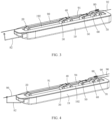
- the body 10 is elongated, and is provided with a linear guide rail 102.
- the drive mechanisms 12, 14 and 16 are successively fixed on the guide rail 102, and are slidable along the guide rail 102.
- the drive mechanism 14 includes: a first assembly configured to cooperate with the drive mechanism 12 to clamp and rotate one catheter, and a second assembly configured to cooperate with the drive mechanism 12 to clamp and rotate another catheter.
- the drive mechanism 16 includes: a first assembly configured to cooperate with the second assembly of the drive mechanism 14 to clamp and rotate the another catheter, and a second assembly configured to cooperate with the second assembly of the drive mechanism 14 to clamp and rotate the guide wire.
- the drive mechanism 16 includes a rapid exchange mechanism 162 configured to cooperate with the first assembly of the drive mechanism 16.
- the front clamper 18 is positioned at a front portion of the body 10, proximal to the drive mechanisms 12 and 14.
- the rear clamper is positioned at a rear portion of the body 10.
- the front clamper 18 and the rear clamper are fixed on the body 10, and may be movable relative to the body 10 where necessary. In other embodiments, the front clamper 18 and the rear clamper may also be mounted separately from the body 10.
- a master-end console for example, the master-end operation handle for the interventional robot as disclosed in Chinese Patent Application No. 202110654379.8 and the master-end control module as disclosed in Chinese Patent Application No. 202110649908.5
- the drive mechanisms 12, 14 and 16 cooperate to clamp the first catheter, the second catheter and the first guide wire and move along the guide rail 102 to drive the first catheter, the second catheter and the first guide wire to move forward, and the drive mechanisms 12, 14 and 16 simultaneously or non-simultaneously rotate the first catheter, the second catheter and the first guide wire, such that the first catheter, the second catheter and the first guide wire are collaboratively pushed forward.
- the first assemblies of the drive mechanisms 14 and 16 respectively clamp, via the Y adapter, the first catheter and the second catheter. That is, the first catheter and the second catheter are both connected to the Y adapter; the Y adapter is fixed on the drive mechanisms 14 and 16; the first assemblies of the drive mechanisms 14 and 16 clamp the Y adapter and rotate a Luer connector of the Y adapter; and under cooperation of the second assemblies of drive mechanisms 12 and 14, the first catheter and the second catheter are rotated.
- the first catheter moves forward to a desired position
- the first catheter is manually taken off from the first assemblies of the drive mechanisms 12 and 14; and the front clamper 18 clamps the first catheter to prevent movement thereof.
- the second catheter is manually taken off from the second assembly of the drive mechanism 14 and the first assembly of the drive mechanism 16, and the drive mechanisms 12 and 14 are caused to move backward along the guide rail 102 to clamp the second catheter.
- the drive mechanism 16 may be remotely manipulated by the master-end console to drive the first guide wire to move backward, or the first guide wire may be manually moved backward.
- the first guide wire moves backward to the introducer
- the first guide wire is taken off from the second assembly of the drive mechanism 16, and is soaked into heparin water. It should be noted that in this process, the first catheter shall not be pushed, to prevent the head of the first catheter from moving in the vessel.
- the drive mechanism 16 is caused to move backward to a suitable position.
- a third catheter for example, a micro catheter
- a second guide wire that are thinner for example, with a diameter of 0.014 in - 0.035 cm
- the second guide wire is manually led into the third catheter, which are then led into the second catheter, and the third catheter and the second guide wire are respectively clamped by the second assembly of the drive mechanism 14, the first assembly of the drive mechanism 16 and the second assembly of the drive mechanism 16. In this way, the third catheter and the second guide wire are fixed.
- the third catheter is connected to the Y adapter; the Y adapter is fixed on the drive mechanism 16, and is clamped by the first assembly of the drive mechanism 16; and a Luer connector of the Y adapter is rotated, under cooperation of the second assembly of the drive mechanism 14, to drive the third catheter to rotate.
- the front clamper 18 may also rotate the first catheter by rotating the Luer connector of the Y adapter.
- the drive mechanism 16 is remotely manipulated to cause the third catheter to move backward.
- the second guide wire is maintained as not moving.
- the rear clamper takes over to clamp the second guide wire to prevent movement thereof.
- the third catheter is manually taken off from the drive mechanisms 14 and 16, and is soaked into heparin water.
- the drive mechanism 16 may take over to clamp the second guide wire, and maintain the front clamper, the drive mechanisms 12 and 14 and the drive mechanism 16 as respectively fixing the first catheter, the second catheter and the second guide wire.
- the tail of the second guide wire is caused to run into a rapid exchange balloon dilatation catheter.
- the rapid exchange balloon dilatation catheter moves forward along with the second guide wire.
- the rapid exchange mechanism 162 clamps the rapid exchange balloon dilatation catheter.
- the rapid exchange mechanism 162 is remotely manipulated to move backward to the introducer.
- the position of the second guide wire remains unchanged.
- vasodilation needs to be performed for multiple times. Therefore, the rapid exchange balloon dilatation catheter may move forward and move backward for multiple times.
- the rapid exchange balloon dilatation catheter is manually taken off from the rapid exchange mechanism 162, and then causes a balloon-expandable stent catheter is caused to run into the second guide wire and to be clamped on the rapid exchange mechanism 162.
- a balloon-expandable stent catheter is caused to run into the second guide wire and to be clamped on the rapid exchange mechanism 162.
- the rapid exchange mechanism 162 is remotely manipulated, such that the rapid exchange balloon dilatation catheter is pushed along the second guide wire to the lesion of the patient for operation (a narrow vessel site that has been expanded).
- the position and angle of the second guide wire need to be finely adjusted by forward rotation, reverse rotation, forward movement, and backward movement according to actual needs.
- the placement of the balloon-expandable stent is correct, i.e., the contrast medium may be extracted and the rapid exchange mechanism 162 is manipulated to drive the rapid exchange balloon-expandable stent catheter to move backward to the introducer, whereas the balloon-expandable stent remains in the lesion of the patient for operation.
- the rapid exchange balloon-expandable stent catheter is manually taken off from the rapid exchange mechanism 162, and is put into the heparin water.
- the rapid exchange catheter is used, and therefore, the catheter needs to be clamped, pushed and rotated by a rapid exchange mechanism 162.
- a coaxial exchange catheter where the tail of the second guide wire is caused to run into the coaxial exchange catheter, the coaxial exchange catheter is clamped, pushed and rotated by the coaxial exchange mechanism, such that the coaxial exchange catheter moves forward to an appropriate position along the second guide wire or moves backward to the introducer.
- the clamping, pushing and rotating of the rapid exchange catheter and the coaxial exchange catheter may be practiced by means of roller driving.
- the master-end control module includes two operation levers, wherein one operation lever is configured to manipulate the drive mechanisms 12 and 14 and the rapid exchange mechanism 162, and this operation lever may manipulate the drive mechanisms 12 and 14 and the rapid exchange mechanism 162 in a time-division manner, and the other operation lever is configured to manipulate the drive mechanism 16.
- the master-end console includes more than two operation levers, for example, four operation levers, which are respectively configured to remotely manipulate the drive mechanisms 12, 14 and 16 and the rapid exchange mechanism 162.
- the movement and control process of the present disclosure has been described by taking "balloon-expandable stent angioplasty" as an example.
- the present disclosure may also be used in a variety of procedures including contrast radiography, embolization, thrombectomy, and the like.
- the drive mechanisms 12, 14 and 16 and the front clamper 18 may be freely adapted according to the actual needs of the operation, i.e., the drive mechanisms 12, 14 and 16 and the front clamper 18 may all be easily disassembled and assembled. Where more complicated operations are performed, more drive mechanisms and front clampers may be deployed.
- a rapid exchange mechanism is provided for each drive mechanism that constantly clamps the catheter, and is either removably mounted to the drive mechanism or integrally formed with the drive mechanism.
- the drive mechanisms 12 and 16 or the drive mechanisms 12 and 14, wherein a rapid exchange mechanism may be disposed on the drive mechanism 14 according to the actual needs
- the front clamper 162 are used. In the case, the other drive mechanisms are removed from the body 10.
- two catheters a thick catheter and a thin catheter
- two guide wires a thick guide wire and a thin guide wire
- appropriate diameters and lengths are selected according to the position of a vascular lesion, and the two catheters are washed with normal saline and exhausted.
- An interventional robot is started to complete initialization.
- An introducer is placed for a patient for operation.
- the thick guide wire is manually led into the thick catheter and is caused to move out of the thick catheter by a distance, and then the thick guide wire and the thick catheter are together placed into the introducer.
- the first assemblies of the drive mechanism 12 and the drive mechanism 16 are caused to cooperate to clamp the thick catheter (connected to the Y adapter), and the second assembly of the drive mechanism 16 is caused to clamp the thick guide wire. In this way, the thick catheter and the thick guide wire are fixed.
- the drive mechanisms 12 and 16 are remotely manipulated to move.
- the thick catheter and the thick guide wire are respectively caused to collaboratively move forward to the narrow vessel site.
- the heads of the thick catheter and the thick guide wire are maintained within an image field of view.
- the thick catheter is manually taken off from the first assemblies of the drive mechanisms 12 and 16; and the front clamper 18 clamps the thick catheter to prevent movement thereof. It should be noted that in this process, the thick catheter shall not be pushed, to prevent the head of the thick catheter from moving in the vessel.
- the drive mechanism 16 may be remotely manipulated by the master-end console to drive the thick guide wire to move backward, or the thick guide wire may be manually moved backward. In a case that the thick guide wire moves backward to the introducer, the thick guide wire is taken off from the second assembly of the drive mechanism 16, and is soaked into the heparin water.
- the drive mechanisms 12 and 16 are caused to move backward to a suitable position.
- the thin guide wire is manually led into the thin catheter, which are then led into the thick catheter, and the thin catheter and the thin guide wire are collaboratively clamped by the drive mechanisms 12 and 16.
- the thin catheter and the thin guide wire are fixed.
- the thin catheter is connected to the Y adapter; the Y adapter is fixed on the drive mechanism 16, and is clamped by the first assembly of the drive mechanism 16; and under cooperation of the drive mechanism 14, a Luer connector of the Y adapter is rotated to drive the thin catheter to rotate.
- the drive mechanisms 12 and 16 are remotely manipulated to move.
- the thin catheter and the thin guide wire are pushed to the lesion of the patient for operation (the target narrow vessel site) that is farther.
- the positions of the thin catheter and the thin guide wire are determined by contrast radiography.
- the drive mechanisms 12 and 16 respectively fix the thin catheter and the thin guide wire.
- the tail of the thin guide wire is caused to run into a rapid exchange balloon-expandable stent catheter.
- the rapid exchange balloon-expandable stent catheter moves forward along with the thin guide wire and runs into the thin catheter, specifically, the Y adapter connecting the thin catheter.
- the rapid 20 exchange mechanism 162 clamps the rapid exchange balloon-expandable stent catheter.
- the rapid exchange mechanism 162 is remotely manipulated, such that the rapid exchange balloon dilatation catheter moves forward to the lesion of the patient for operation (not going beyond the head of the thin guide wire).
- the position and angle of the thin catheter and the thin guide wire need to be finely adjusted by forward rotation, reverse rotation, forward movement, and backward movement according to actual needs.
- the rapid exchange balloon-expandable stent catheter reaches the lesion of the patient for operation, the position of the rapid exchange balloon-expandable stent catheter is fine-tuned, after determination, the rapid exchange balloon-expandable stent catheter is filled with the contrast medium in the catheter room, such that the stent is shaped.
- the placement of the balloon-expandable stent is correct, i.e., the contrast medium may be extracted and the rapid exchange mechanism 162 is manipulated to drive the rapid exchange balloon-expandable stent catheter to move backward to the introducer, whereas the balloon-expandable stent remains in the lesion of the patient for operation.
- the rapid exchange balloon-expandable stent catheter moves backwards, the positions of the thick catheter, the thin catheter and the thin guide wire remain unchanged.
- the rapid exchange balloon-expandable stent catheter is manually taken off from the rapid exchange mechanism 162, and is put into the heparin water.
- the drive mechanisms 12 and 16 are remotely manipulated to move, such that the thin catheter and the thin guide wire move backward to the introducer.
- the thick catheter is manually pulled out to the introducer, the thick catheter, the thin catheter and the thin guide wire are manually taken off from the front clamper 18 and the drive mechanisms 12 and 16, and are soaked into the heparin water, and then the introducer is removed and post-operation treatment is carried out to complete the operation.
- the coaxial exchange catheter in a case that a coaxial exchange catheter is used, where the tail of the thin guide wire is caused to run into the coaxial exchange catheter, the coaxial exchange catheter is clamped, pushed and rotated by the coaxial exchange mechanism, such that the coaxial exchange catheter moves forward to an appropriate position along the thin guide wire or moves backward to the introducer.
- a second embodiment of the present disclosure provides a slave-end apparatus for an interventional robot.
- the apparatus includes: a body 19, drive mechanisms 20, 30, 40, 50 and 60, a rear clamper 70, a rapid exchange mechanism 80 and a front clamper 82 that are movably mounted on the body 19.
- the body 19 is elongated, and is provided with a linear channel 192.
- the drive mechanisms 20, 30, 40, 50 and 60 are successively disposed on the channel 192, and are movable along the channel.
- the drive mechanisms 20, 30, 40, 50 and 60 may directly slide on the body 19.
- a linear guide rail is fixed on the body 19, and the drive mechanisms 20, 30, 40, 50 and 60 may all slide along the guide rail.
- Each of the drive mechanisms is configured to clamp, push (including forward movement and backward movement) and rotate (including forward rotation and reverse rotation) the catheter and the guide wire, or may be configured to simultaneously clamp, push (including forward movement and backward movement) and rotate (including forward rotation and reverse rotation) both the catheter and the guide wire, such that a plurality of catheters and one guide wire collaboratively move.
- Each of the drive mechanisms includes: a clamping assembly configured to clamp the catheter or the guide wire, and a rotating assembly configured to rotate the catheter or the guide wire.
- the rotating assembly may be an active rotating assembly or a passive rotating assembly.
- the rotating assemblies may be all active rotating assemblies, or may be partially active rotating assemblies and partially passive rotating assemblies. Clamping of the catheters by the drive mechanisms 20 and 40 does not hinder rotation of the catheters.
- the clamping assemblies and rotating assemblies of the drive mechanisms 20, 30, 40, 50 and 60 may be the slave-end guide wire and catheter twisting apparatus for the interventional robot as disclosed in Chinese Patent Application No. 202110674959 3 .
- the specific structures of the drive mechanisms 20, 30, 40, 50 and 60 are not necessarily identical, but may be different from each other, as long as the catheter and the guide wire can be clamped, pushed and/or rotated.
- the clamping assemblies may be identical, but the rotating assemblies may be different; or the clamping assemblies may be different, but the rotating assemblies may be identical; or some of the clamping assemblies and rotating assemblies may be identical, and the others of the clamping assemblies and rotating assemblies may be different.
- the drive mechanisms 20 and 30 are spaced apart from each other, and are configured to cooperate with each other to clamp, push and rotate a same guide catheter 90 (that is, a first catheter) to prevent the guide catheter 90 from being bent.
- the drive mechanisms 20 and 30 synchronously push the guide catheter 90, such that the guide catheter 90 is stretched straight, without being bent.
- the drive mechanisms 40 and 50 are spaced apart from each other, and are configured to cooperate with each other to clamp, push and rotate a same multifunctional catheter 91 (that is, a second catheter, or also referred to as a middle catheter).
- the drive mechanism 60 is configured to clamp, push and rotate a guide wire 92.
- the rear clamper 70 is configured to clamp and push the guide wire 92.
- the rapid exchange mechanism 80 and the drive mechanism 50 may be detachably fixed to each other, and may be configured to clamp and push a rapid exchange catheter.
- the rear clamper 70 is positioned at a rear portion of the body 19.
- the front clamper 82 is positioned at a front portion of the body 19, proximal to the drive mechanisms 20 and 30.
- the front clamper 82 and the rear clamper 70 are fixed on the body 19, and may be movable relative to the body 19 where necessary.
- the front clamper 82 and the rear clamper 70 may also be mounted separately from the body 19.
- a guide catheter 90, a multifunctional catheter 91 and a guide wire 92 that are suitable need to selected, and the selected guide catheter 90 and multifunctional catheter 91 are washed with normal saline and exhausted.
- the multifunctional catheter 91 is manually led into the guide catheter 90 to go beyond the guide catheter 90 by a distance
- the guide wire 92 is led into the multifunctional catheter 91 to go beyond the multifunctional catheter 91 by a distance, for example, the head of the guide wire 92 goes beyond the multifunctional catheter 91 by about 10 cm.
- the drive mechanisms 20, 30, 40, 50 and 60 are disposed at proper positions, the guide catheter 90, the multifunctional catheter 91 and the guide wire 92 are together placed and led into an introducer (for example, femoral artery, radial artery or the like) of a patient for operation, the clamping assemblies of the drive mechanisms 20 and 30 are caused to clamp the guide catheter 90, the clamping assemblies of the drive mechanisms 40 and 50 are caused to clamp the multifunctional catheter 91, and the clamping assembly of the drive mechanism 60 and a rear clamper 70 are caused to clamp the guide wire 92. In this way, the guide catheter 90, the multifunctional catheter 91 and the guide wire 92 are fixed.
- an introducer for example, femoral artery, radial artery or the like
- a master-end console for example, the master-end operation handle for the interventional robot as disclosed in Chinese Patent Application No. 202110654379.8 and the master-end control module as disclosed in Chinese Patent Application No. 202110649908 5
- the drive mechanisms 20 and 30 collaboratively clamp the guide catheter 90 and move along a channel 192 to drive the guide catheter 90 to move forward, and the rotating assemblies of the drive mechanisms 20 and 30 simultaneously or non-simultaneously rotate the guide catheter 90.
- the drive mechanism 30 clamps the guide catheter 90 to prevent movement thereof.
- the drive mechanism 20 is restored to a position proximal to the drive mechanism 30, the clamping assembly of the drive mechanism 20 clamps the guide catheter 90 again, and the drive mechanisms 20 and 30 are caused to collaboratively drive the guide catheter 90 to move forward, and the rotating assemblies of the drive mechanisms 20 and 30 simultaneously or non-simultaneously rotate the guide catheter 90. Such operations are repeated until the guide catheter 90 moves to a desired position.
- the drive mechanisms 40 and 50 simultaneously or non-simultaneously collaboratively clamp the multifunctional catheter 91 and move along the channel 192 to drive the multifunctional catheter 91 to move forward, and the rotating assemblies of the drive mechanisms 40 and 50 simultaneously or non-simultaneously rotate the multifunctional catheter 91.
- the drive mechanism 40 moves to an extreme position (for example, a distance from the drive mechanism 40 to the drive mechanism 30 approaches a threshold) and is to be restored to release the multifunctional catheter 91
- the drive mechanism 50 clamps the multifunctional catheter 91 to prevent movement thereof.
- the clamping assembly of the drive mechanism 40 clamps the multifunctional catheter 91 again, the drive mechanisms 40 and 50 are caused to collaboratively drive the multifunctional catheter 91 to move forward, and the rotating assemblies of the drive mechanisms 40 and 50 simultaneously or non-simultaneously rotate the multifunctional catheter 91. Such operations are repeated until the multifunctional catheter 91 moves to a desired position.
- the drive mechanism 60 and the rear clamper 70 simultaneously or non-simultaneously collaboratively clamp the guide wire 92 and move along the channel 192 to drive the guide wire 92 to move forward, and the rotating assembly of the drive mechanism 60 simultaneously or non-simultaneously rotates the guide wire 92.
- the drive mechanism 60 moves to an extreme position (for example, a distance from the drive mechanism 60 to the drive mechanism 50 approaches a threshold) and is to be restored to release the guide wire 92
- the rear clamper 70 clamps the guide wire 92 to prevent movement thereof.
- the drive mechanisms 30 and 50 respectively clamp the guide catheter 90 and the multifunctional catheter 91 via an Y adapter. That is, the guide catheter 90 and the multifunctional catheter 91 are respectively connected to the Y adapter; the Y adapter is fixed to the drive mechanisms 30 and 50; and the clamping assemblies of the drive mechanisms 30 and 50 clamp the Y adapter, and the rotating assemblies of the drive mechanisms 30 and 50 rotate a Luer connector of the Y adapter to drive the guide catheter 90 and the multifunctional catheter 91 to rotate.
- the guide catheter 90 moves forward to a desired position, the guide catheter 90 is fixed.
- the drive mechanism 60 and the rear clamper 70 are remotely manipulated by the master-end console, to drive the guide wire 92 to move backward.
- the process of backward movement is similar to the above process of forward movement.
- the guide wire 92 is manually taken off from the clamping assembly of the drive mechanism 60 and the rear clamper 70, and is soaked into the heparin water.
- the guide catheter 90 is manually taken off from the clamping assemblies of the drive mechanisms 20 and 30, and the front clamper 82 takes over to clamp the guide catheter 90 to prevent movement thereof. It should be noted that in this process, the guide catheter 90 shall not be pushed, to prevent the head of the guide catheter 90 from moving in the vessel.
- the multifunctional catheter 91 is manually taken off from the clamping assemblies of the drive mechanisms 40 and 50, and the clamping assemblies of the drive mechanisms 20 and 30 take over to clamp the multifunctional catheter 91.
- the drive mechanisms 40, 50 and 60 and the rear clamper 70 are adjusted to suitable positions.
- a micro catheter 94 and a micro guide wire 96 that are thinner (for example, with a diameter of 0.014 in - 0.035 cm) are selected.
- the micro guide wire 96 is manually led into the micro catheter 94 and the micro guide wire 96 and the micro catheter 94 are led into the multifunctional catheter 91, and the micro catheter 94 and the micro guide wire 96 are respectively clamped by the clamping assemblies of the drive mechanisms 40 and 50, the clamping assembly of the drive mechanism 60, and the rear clamper 70.
- the micro catheter 94 and the micro guide wire 96 are fixed.
- the micro catheter 94 is connected to an Y adapter.
- the Y adapter is fixed to the drive mechanism 50.
- the clamping assembly of the drive mechanism 50 clamps the Y adapter, and the rotating assembly of the drive mechanism 50 rotates a Luer connector of the Y adapter to drive the micro catheter 94 to rotate.
- the drive mechanisms 20, 30, 40, 50 and 60 and the rear clamper 70 are remotely manipulated to move.
- the multifunctional catheter 91 is caused to move forward to the vessel farther.
- the micro catheter 94 and the micro guide wire 96 move forward to the head of the multifunctional catheter 91, the micro catheter 94 and the micro guide wire 96 are further pushed to a lesion (that is, a target vessel stenosis site) of the patient for operation.
- the position of the micro guide wire 96 is determined by contrast radiography.
- the drive mechanisms 20 and 30, the drive mechanisms 40 and 50, the drive mechanism 60 and the rear clamper 70 respectively fix the multifunctional catheter 91, the micro catheter 94 and the micro guide wire 96.
- the drive mechanisms 20, 30, 40, 50 and 60 and the rear clamper 70 are repeatedly remotely manipulated to move, until the micro guide wire 96 reaches the designated position.
- the drive mechanisms 40, 50 and 60 and the rear clamper 70 may be remotely manipulated, by using the master-end console, to drive the multifunctional catheter 91 and the guide wire 92 to move backward together.
- the multifunctional catheter 91 and the guide wire 92 are manually taken off from the clamping assemblies of the drive mechanisms 40, 50 and 60 and the rear clamper 70, and are soaked into the heparin water.
- the guide catheter 90 is taken off from the clamping assemblies of the drive mechanisms 20 and 30, and the front clamper 82 takes over to clamp the guide catheter 90 to prevent movement thereof.
- the guide catheter 90 shall not be pushed, to prevent the head of the guide catheter 90 from moving in the vessel.
- Two catheters and one guide wire that are suitable are selected, and the catheters and the guide wire are placed into the guide catheter 90 all together.
- the drive mechanisms 20, 30, 40, 50 and 60 are caused to be at suitable positions, the clamping assemblies of the drive mechanisms 20 and 30 are caused to clamp one catheter, the clamping assemblies of the drive mechanisms 40 and 50 clamp the other catheter, and the clamping assembly of the drive mechanism 60 and the rear clamper 70 are caused to clamp the guide wire.
- the two catheters and the one guide wire are fixed.
- the drive mechanisms 40 and 50 are remotely manipulated to cause the micro catheter 94 to move backward.
- the micro guide wire 96 is maintained as not moving.
- the rear clamper 70 takes over to clamp the micro guide wire 96 to prevent movement thereof.
- the micro catheter 94 is manually taken off from the drive mechanisms 40 and 50, and is soaked into the heparin water.
- the drive mechanism 60 may take over to clamp the micro guide wire 96, and maintain the front clamper 82, the drive mechanisms 20 and 30 and the drive mechanism 60 as respectively fixing the guide catheter 90, the multifunctional catheter 91 and the micro guide wire 96.
- the tail of the micro guide wire 96 is caused to run into a rapid exchange balloon dilatation catheter 98.
- the rapid exchange balloon dilatation catheter 98 moves forward along with the micro guide wire 96.
- the rapid exchange mechanism 80 clamps the rapid exchange balloon dilatation catheter 98.
- the rapid exchange mechanism 80 is remotely manipulated, such that the rapid exchange balloon dilatation catheter 98 moves forward to the lesion of the patient for operation (not going beyond the head of the micro guide wire 96).
- the position and angle of the micro guide wire 96 need to be finely adjusted by forward rotation, reverse rotation, forward movement, and backward movement according to actual needs.
- a contrast medium is filled into the rapid exchange balloon dilatation catheter 98 in the catheter room for pre-dilatation, and a vasodilation effect is determined by contrast radiography.
- the contrast medium is extracted from the rapid exchange balloon dilatation catheter 98. Further, by using the master-end console, the rapid exchange mechanism 80 is remotely manipulated to move backward to the introducer. In the process that the rapid exchange balloon dilatation catheter 98 moves backwards, the position of the micro guide wire 96 remains unchanged. With respect to some operations, vasodilation needs to be performed for multiple times. Therefore, the rapid exchange balloon dilatation catheter may move forward and move backward for multiple times.
- the rapid exchange balloon dilatation catheter 98 is manually taken off from the rapid exchange mechanism 80, and then a balloon-expandable stent catheter is caused to run into the micro guide wire 96 and to be clamped on the rapid exchange mechanism 80.
- a balloon-expandable stent catheter is caused to run into the micro guide wire 96 and to be clamped on the rapid exchange mechanism 80.
- the rapid exchange mechanism 80 is remotely manipulated, such that the rapid exchange balloon dilatation catheter is pushed along the micro guide wire 96 to the lesion of the patient for operation (a narrow vessel site that has been expanded).
- the position and angle of the micro guide wire 96 are finely adjusted by forward rotation, reverse rotation, forward movement, and backward movement according to actual needs.
- the rapid exchange balloon-expandable stent catheter reaches the lesion of the patient for operation (the vessel side that has been expanded)
- the position of the rapid exchange balloon-expandable stent catheter is fine-tuned, after determination, the rapid exchange balloon-expandable stent catheter is filled with the contrast medium in the catheter room, such that the stent is shaped.
- the placement of the balloon expandable stent is correct, i.e., the contrast medium may be extracted and the rapid exchange mechanism 80 is manipulated to drive the rapid exchange balloon-expandable stent catheter to move backward to the introducer, whereas the balloon-expandable stent remains in the lesion of the patient for operation.
- the rapid exchange balloon-expandable stent catheter is manually taken from the rapid exchange mechanism 80, and is put into the heparin water.
- the drive mechanisms 20, 30, 40, 50 and 60 and the rear clamper 70 are remotely manipulated to move, such that the multifunctional catheter 91 and the micro guide wire 96 move backward to the introducer.
- the multifunctional catheter 91 and the micro guide wire 96 are manually taken off from the clamping assemblies of the drive mechanisms 20, 30 and 60 and the rear clamper 70, the guide catheter 90 is taken from the front clamper 82, the multifunctional catheter 91, the micro guide wire 96 and the guide catheter 90 are withdrawn from the introducer and placed into the heparin water, and then the introducer is removed and post-operation treatment is carried out to complete the operation.
- the rapid exchange catheter is used, and therefore, the catheter needs to be clamped, pushed and rotated by a rapid exchange mechanism 80.
- a coaxial exchange catheter where the tail of the micro guide wire 96 is caused to run into the coaxial exchange catheter, the coaxial exchange catheter is clamped, pushed and rotated by the coaxial exchange mechanism, such that the coaxial exchange catheter moves forward to an appropriate position along the micro guide wire 96 or moves backward to the introducer.
- the clamping, pushing and rotating of the rapid exchange catheter and the coaxial exchange catheter may be practiced by means of roller driving.
- the movement and control process of the present disclosure has been described by taking "balloon-expandable stent angioplasty" as an example.
- the present disclosure may also be used in a variety of procedures including contrast radiography, embolization, thrombectomy, and the like.
- the drive mechanisms 20, 30, 40, 50 and 60, the rear clamper 70 and the rapid exchange mechanism 80 may be freely adapted according to the actual needs of the operation, i.e., the drive mechanisms 20, 30, 40, 50 and 60, the rear clamper 70 and the rapid exchange mechanism 80 may all be easily disassembled and assembled. Where more complicated surgeries are performed, more drive mechanisms, rear clampers and rapid exchange mechanisms may be deployed.
- the master-end console and the operable table on which the master-end console is deployed are outside the catheter room.
- the master-end console and the operable table may also be deployed in a separate space in the catheter room, as long as X-ray radiation can be isolated and the physician is exempt from the X-ray radiation.
- the catheter and the guide wire are replaced in some cases.
- the replacement of the catheter and the guide wire may be completely determined according to the actual needs of the operation and the personal operating habits.
- the placement is not limited to the above methods for replacing the catheter and the guide wire.
- the first drive mechanism and the second drive mechanism may be remotely manipulated to move along the same axial direction on the body, such that a plurality of catheters and a plurality of guide wires collaboratively move to desired positions.
- the front clamper clamps the first catheter to prevent movement thereof. This blocks radiation by X rays and protects health of human bodies.
- the robot may more accurately control the catheter and the guide wire, which not only reduces working intensity, but also avoids severe mistakes.
Landscapes
- Engineering & Computer Science (AREA)
- Health & Medical Sciences (AREA)
- Robotics (AREA)
- Life Sciences & Earth Sciences (AREA)
- Surgery (AREA)
- Medical Informatics (AREA)
- Biomedical Technology (AREA)
- Heart & Thoracic Surgery (AREA)
- Nuclear Medicine, Radiotherapy & Molecular Imaging (AREA)
- Molecular Biology (AREA)
- Animal Behavior & Ethology (AREA)
- General Health & Medical Sciences (AREA)
- Public Health (AREA)
- Veterinary Medicine (AREA)
- Mechanical Engineering (AREA)
- Media Introduction/Drainage Providing Device (AREA)
Claims (8)
- Eine Slave-End-Vorrichtung für einen interventionellen Roboter, umfassend:einen Körper (10) und einen ersten Antriebsmechanismus (12), einen zweiten Antriebsmechanismus (14), einen dritten Antriebsmechanismus (16), die nacheinander am Körper (10) montiert sind, wobei der Körper (10) länglich ist und mit einer linearen Führungsschiene (102) versehen ist, der erste Antriebsmechanismus (12), der zweite Antriebsmechanismus (14) und der dritte Antriebsmechanismus (16) entlang der Führungsschiene (102) verschiebbar sind; wobeider erste Antriebsmechanismus (12) dazu eingerichtet ist, einen ersten Katheter oder einen zweiten Katheter zu klemmen und zu drehen, der zweite Antriebsmechanismus (14) umfasst eine erste Baugruppe, die dazu eingerichtet ist, zusammen mit dem ersten Antriebsmechanismus (12) den ersten Katheter oder den zweiten Katheter zu klemmen und zu drehen, und eine zweite Baugruppe, die dazu eingerichtet ist, den zweiten Katheter oder einen dritten Katheter zu klemmen und zu drehen, und der dritte Antriebsmechanismus (16) eine erste Baugruppe umfasst, die dazu eingerichtet ist, zusammen mit der zweiten Baugruppe des zweiten Antriebsmechanismus (14) den zweiten Katheter oder den dritten Katheter zu klemmen und zu drehen, und eine zweite Baugruppe, die dazu konfiguriert ist, eine erste Führungsleitung oder eine zweite Führungsleitung zu klemmen und zu drehen; unddie Slave-End-Vorrichtung dadurch gekennzeichnet ist, dassdie Slave-End-Vorrichtung weiterhin eine vordere Klammer (18, 82) umfasst, die an einer Vorderseite des Körpers (10) positioniert ist und dazu eingerichtet ist, einziehbar zu sein und sich außerhalb des Körpers (10) aus einem versteckten Raum zu erstrecken, um den ersten Katheter zu klemmen, damit der erste Katheter relativ zum Körper (10) nicht bewegt werden kann;die erste Führungsleitung dazu eingerichtet ist, in den zweiten Katheter zu laufen, der zweite Katheter dazu eingerichtet ist, in den ersten Katheter zu laufen, und die erste Führungsleitung dazu eingerichtet ist, von der zweiten Baugruppe des dritten Antriebsmechanismus (16) geklemmt zu werden, der zweite Katheter dazu eingerichtet ist, von der zweiten Baugruppe des zweiten Antriebsmechanismus (14) und der ersten Baugruppe des dritten Antriebsmechanismus (16) geklemmt zu werden, und der erste Katheter dazu eingerichtet ist, von der ersten Baugruppe des zweiten Antriebsmechanismus (14) und dem ersten Antriebsmechanismus (12) geklemmt zu werden und sich entlang einer axialen Richtung des Körpers (10) zur vorderen Klammer (18, 82) zu einer gewünschten Position zu bewegen, der erste Katheter dazu eingerichtet ist, manuell vom ersten Antriebsmechanismus (12) und der ersten Baugruppe des zweiten Antriebsmechanismus (14) abgenommen zu werden, der zweite Katheter dazu eingerichtet ist, manuell von der zweiten Baugruppe des zweiten Antriebsmechanismus (14) und der ersten Baugruppe des dritten Antriebsmechanismus (16) abgenommen zu werden, und die erste Führungsleitung dazu eingerichtet ist, von der zweiten Baugruppe des dritten Antriebsmechanismus (16) abgenommen zu werden, die vordere Klammer (18, 82) ist dazu eingerichtet, den ersten Katheter zu klemmen, und der erste Antriebsmechanismus (12) und die erste Baugruppe des zweiten Antriebsmechanismus (14) sind dazu eingerichtet, den zweiten Katheter jeweils zu klemmen, der dritte Katheter ist dazu eingerichtet, in den zweiten Katheter zu laufen, und die zweite Führungsleitung ist dazu eingerichtet, in den dritten Katheter zu laufen, der dritte Katheter ist dazu eingerichtet, von der zweiten Baugruppe des zweiten Antriebsmechanismus (14) und der ersten Baugruppe des dritten Antriebsmechanismus (16) geklemmt zu werden, und die zweite Führungsleitung ist dazu eingerichtet, von der zweiten Baugruppe des dritten Antriebsmechanismus (16) geklemmt zu werden und sich entlang der axialen Richtung des Körpers (10) zur vorderen Klammer (18, 82) zu bewegen.
- Die Slave-End-Vorrichtung für den interventionellen Roboter nach Anspruch 1, wobei die erste Baugruppe des zweiten Antriebsmechanismus (14) dazu eingerichtet ist, einen Y-Adapter zu klemmen, der mit dem ersten Katheter oder dem zweiten Katheter verbunden ist, um den ersten Katheter oder den zweiten Katheter zu klemmen, und einen Luer-Verbinder des Y-Adapters zu drehen, um den ersten Katheter oder den zweiten Katheter zu drehen.
- Die Slave-End-Vorrichtung für den interventionellen Roboter nach Anspruch 1, wobei die erste Baugruppe des dritten Antriebsmechanismus (16) dazu eingerichtet ist, einen Y-Adapter zu klemmen, der mit dem zweiten Katheter oder dem dritten Katheter verbunden ist, um den zweiten Katheter oder den dritten Katheter zu klemmen, und einen Luer-Verbinder des Y-Adapters zu drehen, um den zweiten Katheter oder den dritten Katheter zu drehen.
- Die Slave-End-Vorrichtung für den interventionellen Roboter nach Anspruch 1, wobei die zweite Baugruppe eine Slave-End-Führungsleitung- und Katheter-Drehvorrichtung für den interventionellen Roboter ist.
- Die Slave-End-Vorrichtung für den interventionellen Roboter nach Anspruch 4, weiterhin umfassend: eine hintere Klammer (70); wobei im Fall, dass der dritte Antriebsmechanismus (16) zu einer Extremposition bewegt wird und wiederhergestellt werden soll, um die zweite Führungsleitung freizugeben, die hintere Klammer (70) dazu eingerichtet ist, die zweite Führungsleitung zu klemmen, um deren Bewegung zu verhindern.
- Die Slave-End-Vorrichtung für den interventionellen Roboter nach Anspruch 5, wobei die hintere Klammer (70) jeweils an einem hinteren Abschnitt des Körpers (10) positioniert ist; wobei die hintere Klammer (70) am Körper (10) montiert ist und relativ zum Körper (10) beweglich ist; oder die hintere Klammer (70) separat vom Körper (10) montiert ist.
- Die Slave-End-Vorrichtung für den interventionellen Roboter nach Anspruch 1, weiterhin umfassend: einen Austauschmechanismus; wobei der Austauschmechanismus ein Schnellwechselmechanismus oder ein koaxialer Austauschmechanismus ist.
- Die Slave-End-Vorrichtung für den interventionellen Roboter nach Anspruch 7, wobei der Austauschmechanismus lösbar an den dritten Antriebsmechanismus (16) befestigt ist, oder der Austauschmechanismus und der dritte Antriebsmechanismus (16) integral gestaltet sind.
Applications Claiming Priority (5)
| Application Number | Priority Date | Filing Date | Title |
|---|---|---|---|
| CN202110759048 | 2021-07-05 | ||
| CN202110759062 | 2021-07-05 | ||
| CN202111009755.4A CN113729956B (zh) | 2021-07-05 | 2021-08-31 | 一种介入手术机器人从端装置 |
| CN202111009735.7A CN113693733B (zh) | 2021-07-05 | 2021-08-31 | 一种介入手术机器人从端装置 |
| PCT/CN2022/102921 WO2023280049A1 (zh) | 2021-07-05 | 2022-06-30 | 一种介入手术机器人从端装置 |
Publications (3)
| Publication Number | Publication Date |
|---|---|
| EP4137090A1 EP4137090A1 (de) | 2023-02-22 |
| EP4137090A4 EP4137090A4 (de) | 2023-11-22 |
| EP4137090B1 true EP4137090B1 (de) | 2025-06-25 |
Family
ID=84801256
Family Applications (1)
| Application Number | Title | Priority Date | Filing Date |
|---|---|---|---|
| EP22782655.9A Active EP4137090B1 (de) | 2021-07-05 | 2022-06-30 | Slave-endvorrichtung für einen interventionellen chirurgischen roboter |
Country Status (6)
| Country | Link |
|---|---|
| US (1) | US11998294B2 (de) |
| EP (1) | EP4137090B1 (de) |
| JP (1) | JP7540118B6 (de) |
| ES (1) | ES3037180T3 (de) |
| PL (1) | PL4137090T3 (de) |
| WO (1) | WO2023280049A1 (de) |
Families Citing this family (1)
| Publication number | Priority date | Publication date | Assignee | Title |
|---|---|---|---|---|
| EP4574081A1 (de) * | 2023-12-22 | 2025-06-25 | Caranx Medical | Halter für ein medizinisches instrument und medizinisches system |
Family Cites Families (38)
| Publication number | Priority date | Publication date | Assignee | Title |
|---|---|---|---|---|
| US6096004A (en) * | 1998-07-10 | 2000-08-01 | Mitsubishi Electric Information Technology Center America, Inc. (Ita) | Master/slave system for the manipulation of tubular medical tools |
| US7766856B2 (en) * | 2001-05-06 | 2010-08-03 | Stereotaxis, Inc. | System and methods for advancing a catheter |
| US20090138025A1 (en) | 2007-05-04 | 2009-05-28 | Hansen Medical, Inc. | Apparatus systems and methods for forming a working platform of a robotic instrument system by manipulation of components having controllably rigidity |
| US7998020B2 (en) * | 2007-08-21 | 2011-08-16 | Stereotaxis, Inc. | Apparatus for selectively rotating and/or advancing an elongate device |
| WO2011109283A1 (en) | 2010-03-02 | 2011-09-09 | Corindus Inc. | Robotic catheter system with variable drive mechanism |
| CN101999941A (zh) | 2010-11-29 | 2011-04-06 | 燕山大学 | 微创血管介入手术机器人送管送丝装置 |
| JP2014113181A (ja) | 2012-12-06 | 2014-06-26 | Samsung R&D Institute Japan Co Ltd | 多重構造医療用チューブの自動挿入装置 |
| US9326822B2 (en) * | 2013-03-14 | 2016-05-03 | Hansen Medical, Inc. | Active drives for robotic catheter manipulators |
| US10653863B1 (en) | 2013-03-15 | 2020-05-19 | Corindus, Inc. | Robotic percutaneous device wiper |
| US10376672B2 (en) * | 2013-03-15 | 2019-08-13 | Auris Health, Inc. | Catheter insertion system and method of fabrication |
| US9408669B2 (en) | 2013-03-15 | 2016-08-09 | Hansen Medical, Inc. | Active drive mechanism with finite range of motion |
| FR3022147B1 (fr) | 2014-06-12 | 2016-07-22 | Robocath | Module robotise d'entrainement d'organe medical souple allonge |
| KR101712733B1 (ko) | 2015-06-23 | 2017-03-06 | 한양대학교 에리카산학협력단 | 혈관중재시술로봇 및 혈관중재시술시스템 |
| FR3044541B1 (fr) | 2015-12-07 | 2017-12-29 | Robocath | Module robotise d'entrainement d'organe medical souple allonge |
| JP6837774B2 (ja) | 2016-08-05 | 2021-03-03 | 前沿産業設計研究(深セン)有限公司 | カテーテルおよびガイドワイヤ連携挿入システム |
| EP3645100B1 (de) | 2017-06-28 | 2024-09-04 | Auris Health, Inc. | Instrumenteneinsatzkompensierung |
| CN107374740B (zh) * | 2017-07-06 | 2018-09-11 | 北京理工大学 | 一种导管导丝协同操作介入机器人 |
| CN107374739B (zh) | 2017-07-06 | 2023-05-02 | 北京理工大学 | 一种介入手术机器人从端装置及其控制方法 |
| CN107374737B (zh) * | 2017-07-06 | 2018-10-30 | 北京理工大学 | 一种介入手术机器人导管导丝协同操作系统 |
| CN107744405B (zh) * | 2017-08-31 | 2024-01-30 | 首都医科大学附属北京天坛医院 | 一种机器人从端装置、操作系统及其控制方法 |
| KR102184889B1 (ko) * | 2018-04-19 | 2020-12-01 | (주)엘엔로보틱스 | 의료 로봇용 롤러 모듈, 의료 로봇용 구동 기기 및 의료 로봇 |
| CN109106449B (zh) | 2018-07-10 | 2020-04-17 | 上海交通大学 | 一种心脑血管介入手术机器人及其导丝导管推送方法 |
| JP7242841B2 (ja) | 2018-09-19 | 2023-03-20 | コリンダス、インコーポレイテッド | ロボット支援による細長い医療機器の動作 |
| CN109171904B (zh) | 2018-09-29 | 2021-04-06 | 郑州大学第一附属医院 | 一种专用于医学心血管介入治疗器装置 |
| CN109567947A (zh) | 2018-12-29 | 2019-04-05 | 易度河北机器人科技有限公司 | 一种介入手术机器人从端装置及其控制方法 |
| CN109821138B (zh) | 2019-01-29 | 2020-07-03 | 燕山大学 | 一种微创血管介入手术机器人导管和导丝推进机构 |
| CN120392308A (zh) | 2019-07-15 | 2025-08-01 | 西门子医疗血管介入机器人公司 | 使用多个细长医疗装置的机器人介入手术的系统、设备和方法 |
| CN119867942A (zh) | 2019-07-15 | 2025-04-25 | 科林达斯公司 | 细长医疗装置的操纵 |
| JP2021052933A (ja) * | 2019-09-27 | 2021-04-08 | テルモ株式会社 | 保護管、医療器具組立体、及びガイドワイヤの取り付け方法 |
| CN111529068A (zh) | 2020-05-25 | 2020-08-14 | 绍兴梅奥心磁医疗科技有限公司 | 导管机器人手术支架及导管机器人 |
| FR3118406B1 (fr) * | 2020-12-28 | 2024-05-03 | Robocath | Robot catheter comprenant au moins deux modules de translation d’instrument medical souple allonge |
| EP4023183A1 (de) | 2020-12-29 | 2022-07-06 | Robocath | Katheterroboter mit katheterübersetzungsmodulen für flexible längliche medizinische elemente |
| CN112674877A (zh) | 2021-01-19 | 2021-04-20 | 王利 | 新型介入导管及介入手术机器人 |
| EP4313239A4 (de) * | 2021-04-01 | 2024-10-30 | XCATH, Inc. | Führungsdrahtsteuerungskassette und verwendungsverfahren dafür |
| CN113057718B (zh) | 2021-05-06 | 2022-03-08 | 哈尔滨医科大学 | 一种血管内斑块切割装置 |
| CN113729956B (zh) * | 2021-07-05 | 2023-04-28 | 深圳市爱博医疗机器人有限公司 | 一种介入手术机器人从端装置 |
| CN113693733B (zh) * | 2021-07-05 | 2022-08-09 | 深圳市爱博医疗机器人有限公司 | 一种介入手术机器人从端装置 |
| US12035989B2 (en) * | 2021-08-02 | 2024-07-16 | Corindus, Inc. | Systems and methods for a control station for robotic interventional procedures using a plurality of elongated medical devices |
-
2022
- 2022-06-30 EP EP22782655.9A patent/EP4137090B1/de active Active
- 2022-06-30 PL PL22782655.9T patent/PL4137090T3/pl unknown
- 2022-06-30 ES ES22782655T patent/ES3037180T3/es active Active
- 2022-06-30 WO PCT/CN2022/102921 patent/WO2023280049A1/zh not_active Ceased
- 2022-06-30 JP JP2022555857A patent/JP7540118B6/ja active Active
- 2022-10-10 US US17/963,173 patent/US11998294B2/en active Active
Also Published As
| Publication number | Publication date |
|---|---|
| JP2023533097A (ja) | 2023-08-02 |
| PL4137090T3 (pl) | 2025-10-27 |
| WO2023280049A1 (zh) | 2023-01-12 |
| JP7540118B6 (ja) | 2024-09-12 |
| JP7540118B2 (ja) | 2024-08-27 |
| EP4137090A1 (de) | 2023-02-22 |
| EP4137090A4 (de) | 2023-11-22 |
| ES3037180T3 (en) | 2025-09-29 |
| US11998294B2 (en) | 2024-06-04 |
| US20230032469A1 (en) | 2023-02-02 |
Similar Documents
| Publication | Publication Date | Title |
|---|---|---|
| US20230022245A1 (en) | Slave-end apparatus for interventional robot | |
| CN113693733B (zh) | 一种介入手术机器人从端装置 | |
| CN113729962B (zh) | 一种介入手术机器人从端装置 | |
| CN113729958B (zh) | 一种介入手术机器人从端装置 | |
| CN114391961B (zh) | 一种简便型介入手术机器人从端操作装置 | |
| CN113729957B (zh) | 一种介入手术机器人从端装置 | |
| EP4137090B1 (de) | Slave-endvorrichtung für einen interventionellen chirurgischen roboter | |
| CN115517766B (zh) | 一种操作双导丝的介入手术机器人和介入手术机器人系统 | |
| CN114191095B (zh) | 一种同步型介入手术机器人 | |
| CN218420031U (zh) | 一种多导轨介入手术机器人从端操作装置 | |
| US12484980B2 (en) | Slave-end apparatus for interventional robot | |
| RU2803871C1 (ru) | Подчиненное устройство для интервенционного робота | |
| HK40063979A (en) | Slave end device of interventional operation robot | |
| HK40063979B (en) | Slave end device of interventional operation robot | |
| HK40063978B (en) | Slave end device of interventional operation robot | |
| HK40063981B (en) | Slave end device of interventional operation robot | |
| HK40063978A (en) | Slave end device of interventional operation robot | |
| HK40063981A (en) | Slave end device of interventional operation robot | |
| CN118526302A (zh) | 一种手术机器人模块化平台 |
Legal Events
| Date | Code | Title | Description |
|---|---|---|---|
| STAA | Information on the status of an ep patent application or granted ep patent |
Free format text: STATUS: UNKNOWN |
|
| STAA | Information on the status of an ep patent application or granted ep patent |
Free format text: STATUS: THE INTERNATIONAL PUBLICATION HAS BEEN MADE |
|
| PUAI | Public reference made under article 153(3) epc to a published international application that has entered the european phase |
Free format text: ORIGINAL CODE: 0009012 |
|
| STAA | Information on the status of an ep patent application or granted ep patent |
Free format text: STATUS: REQUEST FOR EXAMINATION WAS MADE |
|
| 17P | Request for examination filed |
Effective date: 20221011 |
|
| AK | Designated contracting states |
Kind code of ref document: A1 Designated state(s): AL AT BE BG CH CY CZ DE DK EE ES FI FR GB GR HR HU IE IS IT LI LT LU LV MC MK MT NL NO PL PT RO RS SE SI SK SM TR |
|
| RIN1 | Information on inventor provided before grant (corrected) |
Inventor name: REN, WENYONG Inventor name: OU, YONGHONG |
|
| A4 | Supplementary search report drawn up and despatched |
Effective date: 20231025 |
|
| RIC1 | Information provided on ipc code assigned before grant |
Ipc: A61B 34/35 20160101AFI20231019BHEP |
|
| STAA | Information on the status of an ep patent application or granted ep patent |
Free format text: STATUS: EXAMINATION IS IN PROGRESS |
|
| 17Q | First examination report despatched |
Effective date: 20240812 |
|
| DAV | Request for validation of the european patent (deleted) | ||
| DAX | Request for extension of the european patent (deleted) | ||
| GRAP | Despatch of communication of intention to grant a patent |
Free format text: ORIGINAL CODE: EPIDOSNIGR1 |
|
| STAA | Information on the status of an ep patent application or granted ep patent |
Free format text: STATUS: GRANT OF PATENT IS INTENDED |
|
| INTG | Intention to grant announced |
Effective date: 20250122 |
|
| GRAS | Grant fee paid |
Free format text: ORIGINAL CODE: EPIDOSNIGR3 |
|
| GRAA | (expected) grant |
Free format text: ORIGINAL CODE: 0009210 |
|
| STAA | Information on the status of an ep patent application or granted ep patent |
Free format text: STATUS: THE PATENT HAS BEEN GRANTED |
|
| AK | Designated contracting states |
Kind code of ref document: B1 Designated state(s): AL AT BE BG CH CY CZ DE DK EE ES FI FR GB GR HR HU IE IS IT LI LT LU LV MC MK MT NL NO PL PT RO RS SE SI SK SM TR |
|
| REG | Reference to a national code |
Ref country code: GB Ref legal event code: FG4D |
|
| REG | Reference to a national code |
Ref country code: CH Ref legal event code: EP |
|
| REG | Reference to a national code |
Ref country code: CH Ref legal event code: EP |
|
| REG | Reference to a national code |
Ref country code: IE Ref legal event code: FG4D |
|
| REG | Reference to a national code |
Ref country code: DE Ref legal event code: R096 Ref document number: 602022016565 Country of ref document: DE |
|
| PGFP | Annual fee paid to national office [announced via postgrant information from national office to epo] |
Ref country code: NL Payment date: 20250730 Year of fee payment: 4 |
|
| REG | Reference to a national code |
Ref country code: ES Ref legal event code: FG2A Ref document number: 3037180 Country of ref document: ES Kind code of ref document: T3 Effective date: 20250929 |
|
| REG | Reference to a national code |
Ref country code: NL Ref legal event code: FP |
|
| PG25 | Lapsed in a contracting state [announced via postgrant information from national office to epo] |
Ref country code: FI Free format text: LAPSE BECAUSE OF FAILURE TO SUBMIT A TRANSLATION OF THE DESCRIPTION OR TO PAY THE FEE WITHIN THE PRESCRIBED TIME-LIMIT Effective date: 20250625 |
|
| PGFP | Annual fee paid to national office [announced via postgrant information from national office to epo] |
Ref country code: ES Payment date: 20250803 Year of fee payment: 4 |
|
| PGFP | Annual fee paid to national office [announced via postgrant information from national office to epo] |
Ref country code: DE Payment date: 20250702 Year of fee payment: 4 |
|
| REG | Reference to a national code |
Ref country code: LT Ref legal event code: MG9D |
|
| PG25 | Lapsed in a contracting state [announced via postgrant information from national office to epo] |
Ref country code: NO Free format text: LAPSE BECAUSE OF FAILURE TO SUBMIT A TRANSLATION OF THE DESCRIPTION OR TO PAY THE FEE WITHIN THE PRESCRIBED TIME-LIMIT Effective date: 20250925 Ref country code: GR Free format text: LAPSE BECAUSE OF FAILURE TO SUBMIT A TRANSLATION OF THE DESCRIPTION OR TO PAY THE FEE WITHIN THE PRESCRIBED TIME-LIMIT Effective date: 20250926 |
|
| PGFP | Annual fee paid to national office [announced via postgrant information from national office to epo] |
Ref country code: IT Payment date: 20250630 Year of fee payment: 4 |
|
| PG25 | Lapsed in a contracting state [announced via postgrant information from national office to epo] |
Ref country code: BG Free format text: LAPSE BECAUSE OF FAILURE TO SUBMIT A TRANSLATION OF THE DESCRIPTION OR TO PAY THE FEE WITHIN THE PRESCRIBED TIME-LIMIT Effective date: 20250625 |
|
| PG25 | Lapsed in a contracting state [announced via postgrant information from national office to epo] |
Ref country code: HR Free format text: LAPSE BECAUSE OF FAILURE TO SUBMIT A TRANSLATION OF THE DESCRIPTION OR TO PAY THE FEE WITHIN THE PRESCRIBED TIME-LIMIT Effective date: 20250625 |
|
| PGFP | Annual fee paid to national office [announced via postgrant information from national office to epo] |
Ref country code: FR Payment date: 20250708 Year of fee payment: 4 |
|
| PG25 | Lapsed in a contracting state [announced via postgrant information from national office to epo] |
Ref country code: RS Free format text: LAPSE BECAUSE OF FAILURE TO SUBMIT A TRANSLATION OF THE DESCRIPTION OR TO PAY THE FEE WITHIN THE PRESCRIBED TIME-LIMIT Effective date: 20250925 |
|
| PGFP | Annual fee paid to national office [announced via postgrant information from national office to epo] |
Ref country code: CZ Payment date: 20250818 Year of fee payment: 4 |
|
| PG25 | Lapsed in a contracting state [announced via postgrant information from national office to epo] |
Ref country code: LV Free format text: LAPSE BECAUSE OF FAILURE TO SUBMIT A TRANSLATION OF THE DESCRIPTION OR TO PAY THE FEE WITHIN THE PRESCRIBED TIME-LIMIT Effective date: 20250625 |