EP4135093A1 - Laminate for lithium secondary battery - Google Patents
Laminate for lithium secondary battery Download PDFInfo
- Publication number
- EP4135093A1 EP4135093A1 EP21783700.4A EP21783700A EP4135093A1 EP 4135093 A1 EP4135093 A1 EP 4135093A1 EP 21783700 A EP21783700 A EP 21783700A EP 4135093 A1 EP4135093 A1 EP 4135093A1
- Authority
- EP
- European Patent Office
- Prior art keywords
- aluminum
- anode
- aluminum anode
- secondary battery
- lithium secondary
- Prior art date
- Legal status (The legal status is an assumption and is not a legal conclusion. Google has not performed a legal analysis and makes no representation as to the accuracy of the status listed.)
- Withdrawn
Links
Images


Classifications
-
- H—ELECTRICITY
- H01—ELECTRIC ELEMENTS
- H01M—PROCESSES OR MEANS, e.g. BATTERIES, FOR THE DIRECT CONVERSION OF CHEMICAL ENERGY INTO ELECTRICAL ENERGY
- H01M4/00—Electrodes
- H01M4/02—Electrodes composed of, or comprising, active material
- H01M4/13—Electrodes for accumulators with non-aqueous electrolyte, e.g. for lithium-accumulators; Processes of manufacture thereof
- H01M4/134—Electrodes based on metals, Si or alloys
-
- H—ELECTRICITY
- H01—ELECTRIC ELEMENTS
- H01M—PROCESSES OR MEANS, e.g. BATTERIES, FOR THE DIRECT CONVERSION OF CHEMICAL ENERGY INTO ELECTRICAL ENERGY
- H01M4/00—Electrodes
- H01M4/02—Electrodes composed of, or comprising, active material
- H01M4/36—Selection of substances as active materials, active masses, active liquids
- H01M4/38—Selection of substances as active materials, active masses, active liquids of elements or alloys
- H01M4/46—Alloys based on magnesium or aluminium
-
- H—ELECTRICITY
- H01—ELECTRIC ELEMENTS
- H01M—PROCESSES OR MEANS, e.g. BATTERIES, FOR THE DIRECT CONVERSION OF CHEMICAL ENERGY INTO ELECTRICAL ENERGY
- H01M4/00—Electrodes
- H01M4/02—Electrodes composed of, or comprising, active material
- H01M4/36—Selection of substances as active materials, active masses, active liquids
- H01M4/38—Selection of substances as active materials, active masses, active liquids of elements or alloys
- H01M4/46—Alloys based on magnesium or aluminium
- H01M4/463—Aluminium based
-
- H—ELECTRICITY
- H01—ELECTRIC ELEMENTS
- H01M—PROCESSES OR MEANS, e.g. BATTERIES, FOR THE DIRECT CONVERSION OF CHEMICAL ENERGY INTO ELECTRICAL ENERGY
- H01M10/00—Secondary cells; Manufacture thereof
- H01M10/05—Accumulators with non-aqueous electrolyte
- H01M10/052—Li-accumulators
-
- H—ELECTRICITY
- H01—ELECTRIC ELEMENTS
- H01M—PROCESSES OR MEANS, e.g. BATTERIES, FOR THE DIRECT CONVERSION OF CHEMICAL ENERGY INTO ELECTRICAL ENERGY
- H01M10/00—Secondary cells; Manufacture thereof
- H01M10/05—Accumulators with non-aqueous electrolyte
- H01M10/052—Li-accumulators
- H01M10/0525—Rocking-chair batteries, i.e. batteries with lithium insertion or intercalation in both electrodes; Lithium-ion batteries
-
- H—ELECTRICITY
- H01—ELECTRIC ELEMENTS
- H01M—PROCESSES OR MEANS, e.g. BATTERIES, FOR THE DIRECT CONVERSION OF CHEMICAL ENERGY INTO ELECTRICAL ENERGY
- H01M10/00—Secondary cells; Manufacture thereof
- H01M10/05—Accumulators with non-aqueous electrolyte
- H01M10/056—Accumulators with non-aqueous electrolyte characterised by the materials used as electrolytes, e.g. mixed inorganic/organic electrolytes
- H01M10/0561—Accumulators with non-aqueous electrolyte characterised by the materials used as electrolytes, e.g. mixed inorganic/organic electrolytes the electrolyte being constituted of inorganic materials only
- H01M10/0562—Solid materials
-
- H—ELECTRICITY
- H01—ELECTRIC ELEMENTS
- H01M—PROCESSES OR MEANS, e.g. BATTERIES, FOR THE DIRECT CONVERSION OF CHEMICAL ENERGY INTO ELECTRICAL ENERGY
- H01M10/00—Secondary cells; Manufacture thereof
- H01M10/05—Accumulators with non-aqueous electrolyte
- H01M10/058—Construction or manufacture
- H01M10/0585—Construction or manufacture of accumulators having only flat construction elements, i.e. flat positive electrodes, flat negative electrodes and flat separators
-
- H—ELECTRICITY
- H01—ELECTRIC ELEMENTS
- H01M—PROCESSES OR MEANS, e.g. BATTERIES, FOR THE DIRECT CONVERSION OF CHEMICAL ENERGY INTO ELECTRICAL ENERGY
- H01M4/00—Electrodes
- H01M4/02—Electrodes composed of, or comprising, active material
- H01M4/04—Processes of manufacture in general
- H01M4/043—Processes of manufacture in general involving compressing or compaction
- H01M4/0435—Rolling or calendering
-
- H—ELECTRICITY
- H01—ELECTRIC ELEMENTS
- H01M—PROCESSES OR MEANS, e.g. BATTERIES, FOR THE DIRECT CONVERSION OF CHEMICAL ENERGY INTO ELECTRICAL ENERGY
- H01M4/00—Electrodes
- H01M4/02—Electrodes composed of, or comprising, active material
- H01M4/13—Electrodes for accumulators with non-aqueous electrolyte, e.g. for lithium-accumulators; Processes of manufacture thereof
-
- H—ELECTRICITY
- H01—ELECTRIC ELEMENTS
- H01M—PROCESSES OR MEANS, e.g. BATTERIES, FOR THE DIRECT CONVERSION OF CHEMICAL ENERGY INTO ELECTRICAL ENERGY
- H01M4/00—Electrodes
- H01M4/02—Electrodes composed of, or comprising, active material
- H01M4/13—Electrodes for accumulators with non-aqueous electrolyte, e.g. for lithium-accumulators; Processes of manufacture thereof
- H01M4/139—Processes of manufacture
- H01M4/1395—Processes of manufacture of electrodes based on metals, Si or alloys
-
- H—ELECTRICITY
- H01—ELECTRIC ELEMENTS
- H01M—PROCESSES OR MEANS, e.g. BATTERIES, FOR THE DIRECT CONVERSION OF CHEMICAL ENERGY INTO ELECTRICAL ENERGY
- H01M4/00—Electrodes
- H01M4/02—Electrodes composed of, or comprising, active material
- H01M4/36—Selection of substances as active materials, active masses, active liquids
-
- H—ELECTRICITY
- H01—ELECTRIC ELEMENTS
- H01M—PROCESSES OR MEANS, e.g. BATTERIES, FOR THE DIRECT CONVERSION OF CHEMICAL ENERGY INTO ELECTRICAL ENERGY
- H01M4/00—Electrodes
- H01M4/02—Electrodes composed of, or comprising, active material
- H01M4/36—Selection of substances as active materials, active masses, active liquids
- H01M4/38—Selection of substances as active materials, active masses, active liquids of elements or alloys
- H01M4/381—Alkaline or alkaline earth metals elements
- H01M4/382—Lithium
-
- H—ELECTRICITY
- H01—ELECTRIC ELEMENTS
- H01M—PROCESSES OR MEANS, e.g. BATTERIES, FOR THE DIRECT CONVERSION OF CHEMICAL ENERGY INTO ELECTRICAL ENERGY
- H01M4/00—Electrodes
- H01M4/02—Electrodes composed of, or comprising, active material
- H01M4/64—Carriers or collectors
- H01M4/66—Selection of materials
-
- H—ELECTRICITY
- H01—ELECTRIC ELEMENTS
- H01M—PROCESSES OR MEANS, e.g. BATTERIES, FOR THE DIRECT CONVERSION OF CHEMICAL ENERGY INTO ELECTRICAL ENERGY
- H01M4/00—Electrodes
- H01M4/02—Electrodes composed of, or comprising, active material
- H01M4/64—Carriers or collectors
- H01M4/66—Selection of materials
- H01M4/661—Metal or alloys, e.g. alloy coatings
-
- H—ELECTRICITY
- H01—ELECTRIC ELEMENTS
- H01M—PROCESSES OR MEANS, e.g. BATTERIES, FOR THE DIRECT CONVERSION OF CHEMICAL ENERGY INTO ELECTRICAL ENERGY
- H01M50/00—Constructional details or processes of manufacture of the non-active parts of electrochemical cells other than fuel cells, e.g. hybrid cells
- H01M50/40—Separators; Membranes; Diaphragms; Spacing elements inside cells
- H01M50/409—Separators, membranes or diaphragms characterised by the material
-
- H—ELECTRICITY
- H01—ELECTRIC ELEMENTS
- H01M—PROCESSES OR MEANS, e.g. BATTERIES, FOR THE DIRECT CONVERSION OF CHEMICAL ENERGY INTO ELECTRICAL ENERGY
- H01M50/00—Constructional details or processes of manufacture of the non-active parts of electrochemical cells other than fuel cells, e.g. hybrid cells
- H01M50/40—Separators; Membranes; Diaphragms; Spacing elements inside cells
- H01M50/409—Separators, membranes or diaphragms characterised by the material
- H01M50/431—Inorganic material
- H01M50/434—Ceramics
-
- H—ELECTRICITY
- H01—ELECTRIC ELEMENTS
- H01M—PROCESSES OR MEANS, e.g. BATTERIES, FOR THE DIRECT CONVERSION OF CHEMICAL ENERGY INTO ELECTRICAL ENERGY
- H01M50/00—Constructional details or processes of manufacture of the non-active parts of electrochemical cells other than fuel cells, e.g. hybrid cells
- H01M50/40—Separators; Membranes; Diaphragms; Spacing elements inside cells
- H01M50/409—Separators, membranes or diaphragms characterised by the material
- H01M50/449—Separators, membranes or diaphragms characterised by the material having a layered structure
-
- H—ELECTRICITY
- H01—ELECTRIC ELEMENTS
- H01M—PROCESSES OR MEANS, e.g. BATTERIES, FOR THE DIRECT CONVERSION OF CHEMICAL ENERGY INTO ELECTRICAL ENERGY
- H01M50/00—Constructional details or processes of manufacture of the non-active parts of electrochemical cells other than fuel cells, e.g. hybrid cells
- H01M50/40—Separators; Membranes; Diaphragms; Spacing elements inside cells
- H01M50/46—Separators, membranes or diaphragms characterised by their combination with electrodes
-
- H—ELECTRICITY
- H01—ELECTRIC ELEMENTS
- H01M—PROCESSES OR MEANS, e.g. BATTERIES, FOR THE DIRECT CONVERSION OF CHEMICAL ENERGY INTO ELECTRICAL ENERGY
- H01M50/00—Constructional details or processes of manufacture of the non-active parts of electrochemical cells other than fuel cells, e.g. hybrid cells
- H01M50/40—Separators; Membranes; Diaphragms; Spacing elements inside cells
- H01M50/489—Separators, membranes, diaphragms or spacing elements inside the cells, characterised by their physical properties, e.g. swelling degree, hydrophilicity or shut down properties
-
- H—ELECTRICITY
- H01—ELECTRIC ELEMENTS
- H01M—PROCESSES OR MEANS, e.g. BATTERIES, FOR THE DIRECT CONVERSION OF CHEMICAL ENERGY INTO ELECTRICAL ENERGY
- H01M4/00—Electrodes
- H01M4/02—Electrodes composed of, or comprising, active material
- H01M2004/021—Physical characteristics, e.g. porosity, surface area
-
- H—ELECTRICITY
- H01—ELECTRIC ELEMENTS
- H01M—PROCESSES OR MEANS, e.g. BATTERIES, FOR THE DIRECT CONVERSION OF CHEMICAL ENERGY INTO ELECTRICAL ENERGY
- H01M4/00—Electrodes
- H01M4/02—Electrodes composed of, or comprising, active material
- H01M2004/026—Electrodes composed of, or comprising, active material characterised by the polarity
- H01M2004/027—Negative electrodes
-
- Y—GENERAL TAGGING OF NEW TECHNOLOGICAL DEVELOPMENTS; GENERAL TAGGING OF CROSS-SECTIONAL TECHNOLOGIES SPANNING OVER SEVERAL SECTIONS OF THE IPC; TECHNICAL SUBJECTS COVERED BY FORMER USPC CROSS-REFERENCE ART COLLECTIONS [XRACs] AND DIGESTS
- Y02—TECHNOLOGIES OR APPLICATIONS FOR MITIGATION OR ADAPTATION AGAINST CLIMATE CHANGE
- Y02E—REDUCTION OF GREENHOUSE GAS [GHG] EMISSIONS, RELATED TO ENERGY GENERATION, TRANSMISSION OR DISTRIBUTION
- Y02E60/00—Enabling technologies; Technologies with a potential or indirect contribution to GHG emissions mitigation
- Y02E60/10—Energy storage using batteries
-
- Y—GENERAL TAGGING OF NEW TECHNOLOGICAL DEVELOPMENTS; GENERAL TAGGING OF CROSS-SECTIONAL TECHNOLOGIES SPANNING OVER SEVERAL SECTIONS OF THE IPC; TECHNICAL SUBJECTS COVERED BY FORMER USPC CROSS-REFERENCE ART COLLECTIONS [XRACs] AND DIGESTS
- Y02—TECHNOLOGIES OR APPLICATIONS FOR MITIGATION OR ADAPTATION AGAINST CLIMATE CHANGE
- Y02P—CLIMATE CHANGE MITIGATION TECHNOLOGIES IN THE PRODUCTION OR PROCESSING OF GOODS
- Y02P70/00—Climate change mitigation technologies in the production process for final industrial or consumer products
- Y02P70/50—Manufacturing or production processes characterised by the final manufactured product
Definitions
- the present invention relates to a laminate for a lithium secondary battery.
- Rechargeable lithium secondary batteries have been already in practical use not only for small power sources in mobile phone applications, notebook personal computer applications, and the like but also for medium-sized and large-sized power sources in automotive applications, power storage applications, and the like.
- anode included in a lithium secondary battery studies are being conducted to improve battery performance by using a material having a theoretical capacity higher than that of graphite, which is an anode material in the related art.
- a material having a theoretical capacity higher than that of graphite which is an anode material in the related art.
- graphite for example, a metal material capable of occluding and releasing lithium ions has attracted attention.
- Patent Document 1 describes an anode which is a porous aluminum alloy and is formed of an anode active material for a secondary battery containing at least one kind of silicon or tin.
- a reversible reaction of insertion and desorption of lithium ions into and from the electrodes occur.
- lithium ions are desorbed from the anode and lithium ions are inserted into the cathode.
- lithium ions are desorbed from the cathode and lithium ions are inserted into the anode.
- the lithium secondary battery is known to have a laminated configuration in which cathodes, separators, and anodes are alternately laminated.
- the separator is provided to prevent a short circuit between the cathode and the anode.
- the present invention has been made in view of the above circumstances, and an object of the present invention is to provide a laminate for a lithium secondary battery in which lithium ions can smoothly move and battery characteristics of a lithium secondary battery can be improved.
- the present invention includes the following [1] to [7].
- the present invention it is possible to provide a laminate for a lithium secondary battery in which lithium ions can move smoothly and the battery characteristics of the lithium secondary battery can be improved.
- a laminate for a lithium secondary battery of the present embodiment will be described.
- the "laminate for a lithium secondary battery” is sometimes referred to as a "laminate”.
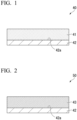
- Fig. 1 shows a laminate 40 of the present embodiment.
- the laminate 40 includes an aluminum anode 42 and a ceramic separator 41.
- the aluminum anode 42 has a plate shape and is formed of an aluminum-containing metal capable of occluding and releasing lithium ions.
- the "plate shape” means a three-dimensional shape having at least two principal surfaces facing each other.
- the distance between the two facing principal surfaces described above corresponds to the thickness of the aluminum anode 42.
- the thickness of the aluminum anode 42 various values can be adopted.
- the plate-shaped aluminum anode 42 there are a thin film-shaped electrode having flexibility that is easily curved and bent, and a thin plate-shaped electrode that is less likely to be curved and bent.
- the aluminum anode 42 is provided with the ceramic separator 41 on one surface 42a of the two principal surfaces.
- the ceramic separator 41 has both a role of electrically insulating a cathode and an anode from each other and a role of holding an electrolytic solution.
- the aluminum anode 42 and the ceramic separator 41 are integrated.
- integrated means that the aluminum anode 42 and the ceramic separator 41 move together when deformed.
- the aluminum anode 42 and the ceramic separator 41 are less likely to be shifted or peeled from each other even in a case where strain is generated by an external force. Therefore, for example, even if strain is generated in the laminate 40, there is no shift between the aluminum anode 42 and the ceramic separator 41, and a short circuit can be prevented.
- Fig. 2 shows a laminate 50 of the present embodiment.
- the laminate 50 includes the aluminum anode 42 and a solid electrolyte layer 43.
- the aluminum anode 42 and the solid electrolyte layer 43 are integrated.
- the solid electrolyte layer 43 is provided on one surface 42a of the two principal surfaces.
- the solid electrolyte layer 43 serves as a separator.
- the separator may not be required when a lithium secondary battery is manufactured.
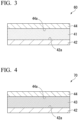
- Fig. 3 shows a laminate 60 of the present embodiment.
- the aluminum anode 42, the ceramic separator 41, and a cathode 44 are laminated in this order.
- the cathode 44 is formed of a material capable of occluding and releasing lithium ions.
- the cathode 44 has a plate shape.
- the laminate 60 is provided with the ceramic separator 41 on a surface 44a of the cathode 44 facing the aluminum anode 42.
- the aluminum anode 42 and the ceramic separator 41 are integrated. Furthermore, the cathode 44 and the ceramic separator 41 may be integrated.
- Fig. 4 shows a laminate 70 of the present embodiment.
- the aluminum anode 42, the solid electrolyte layer 43, and the cathode 44 are laminated in this order.
- the aluminum anode 42 and the solid electrolyte layer 43 are integrated.
- the laminate 70 is provided with the solid electrolyte layer 43 on the surface 44a of the cathode 44 facing the aluminum anode 42.
- the aluminum anode is preferably formed of an aluminum-containing metal.
- the aluminum anode is preferably aluminum anodes 1 to 4 described below.
- the aluminum anode 1 is formed of an aluminum-containing metal.
- the aluminum-containing metal acts as an anode active material.
- a non-aluminum metal phase is dispersed in an aluminum metal phase.
- the non-aluminum metal phase means a metal phase that does not contain aluminum.
- the non-aluminum metal phase is preferably formed of a non-aluminum metal compound containing one or more selected from the group consisting of Si, Ge, Sn, Ag, Sb, Bi, In, and Mg.
- the non-aluminum metal phase is more preferably formed of a non-aluminum metal compound containing one or more selected from the group consisting of Si, Ge, Sn, Ag, Sb, Bi, and In.
- the non-aluminum metal phase is preferably formed of non-aluminum metal compound particles.
- the non-aluminum metal compound forming the non-aluminum metal phase has a very large occlusion amount of lithium. Therefore, the non-aluminum metal compound has a large volume expansion during insertion of lithium and a large volume contraction during desorption of lithium. The strain generated by the expansion and contraction develops into cracks of the non-aluminum metal particles, and refinement occurs in which the non-aluminum metal compound particles become smaller. The refinement of the non-aluminum metal compound acting as the anode active material during charging and discharging causes a shortening of the cycle life.
- the aluminum anode 1 is a metal in which the non-aluminum metal phase is dispersed in the aluminum metal phase.
- the non-aluminum metal compound particles are coated with aluminum, which can form an alloy with lithium.
- the non-aluminum metal compound particles are less likely to crack and are therefore less likely to be refined. Therefore, even in a case where charging and discharging of the lithium secondary battery are repeated, an initial discharge capacity is easily retained. That is, the lithium secondary battery can achieve a good discharge capacity retention ratio.
- the amount of the non-aluminum metal phase in the aluminum anode 1 preferably satisfies 0.01 mass% or more and 8 mass% or less with respect to the total amount of the aluminum metal phase and the non-aluminum metal phase.
- the lower limit of the amount of the non-aluminum metal phase is preferably 0.02 mass%, more preferably 0.05 mass%, and particularly preferably 0.1 mass%.
- the upper limit of the amount of the non-aluminum metal phase is preferably 7 mass%, more preferably 6 mass%, and particularly preferably 5 mass%.
- the upper limit and the lower limit thereof can be randomly combined.
- the amount of the non-aluminum metal phase is 0.02 mass% or more and 7 mass% or less, 0.05 mass% or more and 6 mass% or less, and 0.1 mass% or more and 5 mass% or less.
- the amount of the non-aluminum metal phase is equal to or more than the lower limit, a metal or metal compound other than aluminum that can contribute to the occlusion of lithium can be sufficiently secured.
- the amount of the non-aluminum metal phase is equal to or less than the upper limit, the dispersed state of the non-aluminum metal phase in the aluminum metal phase tends to be good. Furthermore, when the amount of the non-aluminum metal phase is equal to or less than the upper limit, rolling is easily performed.
- the non-aluminum metal phase may contain an optional metal other than Si, Ge, Sn, Ag, Sb, Bi, In, and Mg.
- the optional metal include Mn, Zn, and Ni.
- the aluminum anode 1 is preferably an Al-Si binary alloy, or an Al-Si-Mn ternary alloy. In the case of a ternary alloy, it is preferable that each metal is uniformly dissolved.
- Sr may be further contained in order to promote the refinement of the non-metal aluminum phase.
- the method described in Journal of Japan Institute of Light Metals Volume 37 Issue 2 (1987) pp 146-152 can be used.
- the ratio of an area corresponding to the non-aluminum metal phase to the sum of an area corresponding to the aluminum metal phase and the area corresponding to the non-aluminum metal phase preferably satisfies 10% or less.
- the aluminum anode 1 is rolled into a foil having a thickness of 0.5 mm.
- the foil is cut perpendicular to a rolling direction, and a cut surface is etched with a 1.0 mass% sodium hydroxide aqueous solution.
- the aluminum metal phase and the non-aluminum metal phase have different solubilities in sodium hydroxide. Therefore, by etching, a height difference between irregularities of a portion corresponding to the non-aluminum metal phase and the aluminum metal phase exposed on the cut surface is formed due to the difference in solubility. Specifically, the portion corresponding to the aluminum metal phase becomes a convex portion, and the portion corresponding to the non-aluminum metal phase becomes a concave portion. When the height difference between the irregularities is formed on the cut surface, a clear contrast is shown during observation with a microscope, which will be described later.
- a cross-sectional image of the cut surface is acquired, and the cross-sectional image is subjected to image processing to obtain a binarized image in which the convex portion corresponding to the aluminum metal phase and the concave portion corresponding to the non-aluminum metal phase are each converted into black or white.
- the area of the concave portion corresponds to the area of the non-aluminum metal phase.
- the area of the convex portion corresponds to the area of the aluminum metal phase.
- the cross-sectional image can be acquired using, for example, a metallurgical microscope.
- a metallurgical micrograph having a magnification of 200 times or more and 500 times or less is acquired.
- a scanning electron microscope SEM
- an SEM image having a magnification of 100 times or more and 10,000 times or less is acquired.
- metallurgical microscope for example, Nikon EPIPHOT 300 can be used.
- the obtained SEM image or metallurgical micrograph having the above magnification is taken into a computer and subjected to binarization processing using an image analysis software.
- the binarization processing is a process of performing binarization using an intermediate value between the maximum brightness and the minimum brightness in the image.
- the binarization processing for example, a binarized image in which the portion corresponding to the aluminum metal phase is white and the portion corresponding to the non-aluminum metal phase is black can be obtained.
- image analysis software software that enables the binarization processing can be appropriately selected.
- image analysis software specifically, Image J, Photoshop, Image Pro Plus, or the like can be used.
- the area corresponding to the aluminum metal phase is referred to as S1 and the area corresponding to the non-aluminum metal phase is referred to as S2.
- the ratio (S2 / [S1 + S2]) ⁇ 100 (%) of S2 to the sum of S1 and S2 satisfies preferably 10% or less, more preferably 6% or less, and particularly preferably 3% or less.
- the non-aluminum metal compound When the ratio of S2 is equal to or less than the upper limit, the non-aluminum metal compound is sufficiently coated with aluminum, so that the non-aluminum metal compound is even less likely to crack. Therefore, even in a case where charging and discharging of the lithium secondary battery are repeated, the initial discharge capacity is easily retained.
- the non-aluminum metal phase is dispersed in the aluminum metal phase.
- the number of circles observed preferably satisfies both the following conditions (1) and (2).
- the number density of non-aluminum metal compound phases having a circle diameter of 0.1 ⁇ m or more and less than 100 ⁇ m is 1000 /mm 2 or less.
- Condition (2) The number density of non-aluminum metal compound phases having a circle diameter of 100 ⁇ m or more is 25 /mm 2 or less.
- the circle diameter of the concave portion corresponding to the non-aluminum metal compound can be obtained by the following method.
- a projected image of the circle of the concave portion corresponding to the non-aluminum metal compound is obtained from the SEM image photograph or the metallurgical micrograph.
- the distance (unidirectional particle diameter) between the parallel lines is defined as the circle diameter of the concave portion corresponding to the non-aluminum metal compound.
- the "number density” means the density of the number of circles corresponding to the non-aluminum metal compound existing per unit area in the SEM photograph and the metallurgical micrograph.
- the aluminum anode 1 is preferably manufactured by a manufacturing method including a step of casting an alloy and a rolling step.
- a predetermined amount of the metal forming the non-aluminum metal phase is added to aluminum or high-purity aluminum to obtain a mixture 1.
- High-purity aluminum can be obtained by the method described later.
- the mixture 1 is melted at 680°C or higher and 800°C or lower to obtain a molten alloy 1 of aluminum and the metal.
- aluminum forming the aluminum phase aluminum having a purity of 99.9 mass% or more, high-purity aluminum having a purity of 99.99 mass% or more, or the like can be used.
- the metal forming the non-aluminum metal phase is one or more selected from the group consisting of Si, Ge, Sn, Ag, Sb, Bi, In, and Mg.
- the metal forming the non-aluminum metal phase for example, high-purity silicon having a purity of 99.999 mass% or more is used.
- the molten alloy 1 is preferably subjected to a cleaning treatment of removing gas and non-metallic inclusions.
- cleaning treatment examples include the addition of a flux, a treatment of blowing an inert gas or chlorine gas, and a vacuum treatment of molten aluminum.
- the vacuum treatment is performed, for example, under the condition of 700°C or higher and 800°C or lower, 1 hour or longer and 10 hours or shorter, and a degree of vacuum of 0.1 Pa or more and 100 Pa or less.
- the molten alloy 1 cleaned by the vacuum treatment or the like is cast into an ingot using a mold.
- a mold an iron mold or a graphite mold heated to 50°C or higher and 200°C or lower is used.
- the aluminum anode 1 can be cast by a method of pouring the molten alloy 1 at 680°C or higher and 800°C or lower into a mold. Alternatively, an ingot may also be obtained by semi-continuous casting.
- the obtained alloy ingot can be directly cut and used as the aluminum anode 1.
- the ingot is rolled, extruded, forged, or the like to form a plate shape.
- the rolling step of the ingot is, for example, a step of processing the ingot into a plate shape by performing hot rolling and cold rolling.
- the hot rolling is repeatedly performed, for example, under the condition of a temperature of 350°C or higher and 550°C or lower and a working ratio per rolling pass of 2% or more and 30% or less until the aluminum ingot has a desired thickness.
- the "working ratio” means the rate of change in thickness when rolling is performed. For example, in a case where a plate having a thickness of 1 mm is worked to have a thickness of 0.7 mm, the working ratio is 30%.
- the intermediate annealing treatment is performed, for example, by heating a hot-rolled plate material to raise the temperature, and then allowing the heated plate material to cool.
- the temperature may be raised to, for example, 350°C or higher and 550°C or lower.
- the temperature of 350°C or higher and 550°C or lower may be held for about 1 hour or longer and 5 hours or shorter.
- cooling may be performed immediately after the temperature is raised. In the cooling step, it is preferable to allow the plate material to cool to about 20°C.
- the cooling step may be appropriately adjusted according to a desired size of the non-aluminum metal phase.
- the cooling step is performed by allowing the plate material to cool rapidly, the non-aluminum metal phase tends to become smaller.
- the cooling step is performed at a moderate cooling rate, the crystal structure of the metal forming the non-aluminum metal phase tends to grow.
- the cold rolling is performed at a temperature lower than the recrystallization temperature of aluminum.
- the aluminum ingot is repeatedly rolled to have a desired thickness under the condition in which the rolling reduction per rolling pass is 1% or more and 20% or less.
- the temperature of the cold rolling the temperature of the metal to be rolled may be adjusted to 10°C to 80°C or lower.
- a heat treatment may further be performed.
- the crystal structure of the non-aluminum metal grows, and the amount of the non-aluminum metal phase can be increased.
- the heat treatment after the cold rolling may be performed in an air atmosphere, a nitrogen atmosphere, a vacuum atmosphere, or the like.
- a plate material that has been work-hardened can be softened.
- Examples of the heat treatment conditions include conditions in which a heat treatment is performed at a temperature of 300°C or higher and 400°C or lower for 3 hours or longer and 10 hours or shorter.
- the aluminum anode 1 has a plate shape.
- the thickness of the aluminum anode 1 is preferably 5 ⁇ m or more, more preferably 6 ⁇ m or more, and even more preferably 7 ⁇ m or more. In addition, the thickness is preferably 200 ⁇ m or less, more preferably 190 ⁇ m or less, and even more preferably 180 ⁇ m or less.
- the upper limit and the lower limit of the thickness of the aluminum anode 1 can be randomly combined.
- the thickness of the aluminum anode 1 preferably satisfies 5 ⁇ m or more and 200 ⁇ m or less.
- the thickness of the aluminum anode 1 may be measured using a thickness gauge or a caliper.
- examples of a refining method for purifying aluminum include a segregation method and a three-layer electrolytic method.
- the segregation method is a purification method utilizing the segregation phenomenon during solidification of molten aluminum, and a plurality of methods have been put into practical use.
- As one form of the segregation method there is a method of pouring molten aluminum into a container, and allowing refined aluminum to solidify from the bottom portion while heating and stirring the molten aluminum at the upper portion while rotating the container.
- high-purity aluminum having a purity of 99.99 mass% or more can be obtained.
- the three-layer electrolytic method is an electrolytic method for purifying aluminum.
- aluminum or the like having a relatively low purity for example, a grade of a purity of 99.9 mass% or less in JIS-H2102
- an electrolytic bath containing, for example, aluminum fluoride and barium fluoride is disposed thereon, and high-purity aluminum is deposited on a cathode.
- High-purity aluminum having a purity of 99.999 mass% or more can be obtained by the three-layer electrolytic method.
- the method of purifying aluminum is not limited to the segregation method and the three-layer electrolytic method, and other known methods such as a zone melting refining method and an ultra-high vacuum melting method may be used.
- the aluminum anode 2 is an aluminum-containing metal.
- the aluminum anode 2 has an average corrosion rate of 0.2 mm/year or less measured by an immersion test under the following immersion conditions.
- the aluminum-containing metal is formed into a test metal piece having a size of 40 mm in length, 40 mm in width, and 0.5 mm in thickness.
- test metal piece is immersed in a 3.5% NaCl aqueous solution adjusted to a pH of 3 using acetic acid as a pH adjuster, and the test metal piece is taken out after 72 hours.
- immersion temperature the temperature of the liquid is set to 30°C.
- Corrosion rate mm / year degree of corrosion ⁇ 365 / density of test piece g / cm 3
- test metal piece may be washed with ethanol or the like before being immersed in the 3.5% NaCl aqueous solution adjusted to a pH of 3.
- the aluminum anode 2 is preferably made of an aluminum-containing metal represented by Composition Formula (1).
- Al x M 1 y M 2 z ... (1) (in Formula (1), M 1 is one or more selected from the group consisting of Mg, Ni, Mn, Zn, Cd, and Pb, M 2 is an unavoidable impurity, and 0 mass% ⁇ y ⁇ 8 mass% and [x / (x + z)] ⁇ 99.9 mass% are satisfied).
- M 1 is more preferably one or more elements selected from the group consisting of Mg, Ni, Mn, and Zn.
- y satisfies preferably 0.1 mass% ⁇ y ⁇ 8.0 mass%, preferably 0.5 mass% ⁇ y ⁇ 7.0 mass%, and particularly preferably 0.7 mass% ⁇ y ⁇ 6.0 mass%.
- the average corrosion rate can be controlled within the above range.
- rolling can be performed without cracking during a rolling step at the time of casting.
- M 2 is an unavoidable impurity such as a manufacturing residue that is unavoidably incorporated in a refining step of high-purity aluminum, and specifically, is a metal component other than aluminum and M 1 .
- the unavoidable impurity include iron and copper.
- z is 0.1 mass% or less, preferably 0.05 mass% or less, and even more preferably 0.01 mass% or less.
- [x / (x + z)] is preferably 99.95% or more, more preferably 99.99% or more, and particularly preferably 99.995% or more.
- the aluminum anode 2 contains highly pure aluminum in which [x / (x + z)] is equal to or more than the above lower limit. A refining method for purifying aluminum will be described later.
- those having y exceeding 0 may be described as a high-purity aluminum alloy.
- the high-purity aluminum or the high-purity aluminum alloy according to any one of the following (1) to (5) is preferable.
- An alloy of 99.999% pure aluminum and magnesium is 0.1 mass% or more and 4.0 mass% or less in the total amount of the aluminum-containing metal.
- the average corrosion rate is 0.04 mm/year to 0.06 mm/year.
- An alloy of 99.9% pure aluminum and magnesium is 0.1 mass% or more and 1.0 mass% or less in the total amount of the aluminum-containing metal.
- the average corrosion rate is 0.1 mm/year to 0.14 mm/year.
- An alloy of 99.999% pure aluminum and nickel is 0.1 mass% or more and 1.0 mass% or less in the total amount of the aluminum-containing metal.
- the average corrosion rate is 0.1 mm/year to 0.14 mm/year.
- An alloy of 99.99% pure aluminum, manganese, and magnesium is 1.0 mass% or more and 2.0 mass% or less in the total amount of the aluminum-containing metal.
- the average corrosion rate is 0.03 mm/year to 0.05 mm/year.
- the average corrosion rate is 0.05 mm/year.
- a manufacturing method of the aluminum anode 2 will be described separately for a manufacturing method 1 and a manufacturing method 2.
- the manufacturing method 1 is a manufacturing method in a case where the aluminum anode 2 is high-purity aluminum.
- the manufacturing method 2 is a manufacturing method in a case where the aluminum anode 2 is a high-purity aluminum alloy.
- aluminum is purified.
- Examples of a method of purifying aluminum include the aluminum purification method described in (Manufacturing Method of Aluminum Anode 1).
- the total amount of iron and copper contained in the aluminum is preferably 100 ppm or less, more preferably 80 ppm or less, and even more preferably 50 ppm or less.
- the manufacturing method 1 preferably includes a step of casting high-purity aluminum and a rolling step.
- the aluminum purified by the above-described method can be cast to obtain an aluminum ingot having a shape suitable for rolling.
- high-purity aluminum is melted at about 680°C or higher and 800°C or lower to obtain molten aluminum.
- the molten aluminum is preferably subjected to a cleaning treatment of removing gas and non-metallic inclusions.
- a cleaning treatment include the same method as the cleaning treatment described for the aluminum anode 1.
- the molten aluminum that has been cleaned is cast into an ingot using a mold.
- an iron mold or a graphite mold heated to 50°C or higher and 200°C or lower is used as the mold.
- the aluminum anode 2 can be cast by a method of pouring the molten aluminum at 680°C or higher and 800°C or lower into a mold. Alternatively, an ingot may also be obtained by semi-continuous casting.
- the obtained aluminum ingot can be directly cut and used as the aluminum anode 2. It is preferable that the aluminum ingot is rolled, extruded, forged, or the like to form a plate material. The ingot is more preferably rolled.
- the rolling step can be performed by the same method as the rolling step described in the manufacturing method of the aluminum anode 1.
- the manufacturing method 2 preferably includes a step of casting a high-purity aluminum alloy and a rolling step.
- a predetermined amount of a metal element is added to high-purity aluminum to obtain a mixture 2.
- the mixture 2 is melted at 680°C or higher and 800°C or lower to obtain a molten alloy 2 of aluminum and the metal.
- the metal element to be added is preferably one or more elements selected from the group consisting of Mg, Ni, Mn, Zn, Cd, and Pb.
- the metal containing these elements to be added preferably has a purity of 99 mass% or more.
- a high-purity aluminum alloy ingot is obtained by the same method as the casting step in the manufacturing method of the aluminum anode 1 except that the molten alloy 2 is used.
- the rolling step is performed by the same method as the above-described manufacturing method 1.
- the thickness of the aluminum anode 2 is preferably 5 ⁇ m or more, more preferably 6 ⁇ m or more, and even more preferably 7 ⁇ m or more. In addition, the thickness is preferably 200 ⁇ m or less, more preferably 190 ⁇ m or less, and even more preferably 180 ⁇ m or less.
- the upper limit and the lower limit of the thickness of the aluminum anode 2 can be randomly combined.
- the thickness of the aluminum anode 2 is preferably 5 ⁇ m or more and 200 ⁇ m or less.
- the aluminum anode 3 is an aluminum-containing metal.
- the Vickers hardness of the aluminum anode 3 is preferably 10 HV or more and 70 HV or less, more preferably 20 HV or more and 70 HV or less, even more preferably 30 HV or more and 70 HV or less, and particularly preferably 35 HV or more and 55 HV or less.
- the Vickers hardness is equal to or less than the upper limit, strain in the crystal structure during occlusion of lithium by the aluminum anode 3 can be relaxed, and the crystal structure can be maintained. Therefore, the lithium secondary battery using the aluminum anode 3 can retain the discharge capacity even in a case where charging and discharging are repeated.
- the Vickers hardness As an index of the hardness of the aluminum anode 3, the Vickers hardness (HV0.05) is measured using a micro Vickers hardness tester.
- the Vickers hardness is a value measured according to JIS Z 2244:2009 "Vickers hardness test - Test method".
- the Vickers hardness is measured by pressing a square-based pyramid diamond indenter into the surface of a test piece, which is the aluminum anode 3, releasing the test force, and then calculating the diagonal length of the indentation left on the surface.
- the hardness symbol is set to be changed by the test force.
- the aluminum anode 4 is a rolled material formed of an aluminum-containing metal.
- a cumulative frequency distribution curve of the absolute value of an angle formed by a rolled surface of the aluminum anode 4 and a normal to a ⁇ 111 ⁇ plane which is obtained by measuring the surface of the aluminum anode 4 by an EBSD method, when the total is set to 100%, the angle at which the cumulative frequency from a low angle side is 50% or more is 20° or less.
- the EBSD method stands for an electron backscatter diffraction method.
- the "angle formed by the rolled surface and the normal to the ⁇ 111 ⁇ plane of the metal crystal contained in the base metal” is an angle between the projection of the normal to the ⁇ 111 ⁇ plane on the rolled surface and the normal to the ⁇ 111 ⁇ plane, and is an angle of 90° or less.
- the angle formed as described above is not present. In this case, the angle formed is 0°.
- straight lines 1 ⁇ and 1 ⁇ that pass through any point O on the line of intersection 1 between the two planes ⁇ and ⁇ and are respectively perpendicular to the line of intersection 1 on the rolled surface ⁇ and the plane ⁇ perpendicular to the ⁇ 111 ⁇ plane are drawn.
- the angle formed by the straight lines 1 ⁇ and 1 ⁇ is defined as the angle formed by the rolled surface ⁇ and the plane ⁇ perpendicular to the ⁇ 111 ⁇ plane.
- the "absolute value of the angle” is an absolute value when the angle is expressed in ⁇ 180° notation.
- the angle at which the cumulative frequency from the low angle side is 50% or more is preferably 20° or less.
- the EBSD method is widely used as a method for analyzing the orientation distribution of a crystal texture.
- the EBSD method is used in a form in which a scanning electron microscope is equipped with an electron backscatter diffraction method.
- JSM-7900F manufactured by JEOL Ltd. can be used as the scanning electron microscope.
- etching using an acid or the like for example, chemical etching using an acid or the like or a ion etching using an argon ion or the like can be used.
- the coating on the surface may be removed by mechanical polishing such as buffing.
- a method of removing the coating on the surface by a flat surface argon ion milling method in which the surface of the aluminum anode 4 is obliquely irradiated with an argon ion beam so that the center of the argon ion beam and the center of rotation of a specimen are made eccentric to each other and thus a wide range is processed is preferable.
- the surface of the aluminum anode 4 is irradiated with an electron beam. Thereafter, the diffraction pattern of backscattered electrons is read by a device. The obtained diffraction pattern is taken into a computer, and the surface of the aluminum anode 4 is scanned while simultaneously performing crystal orientation analysis. Accordingly, indexing of crystals is performed at each measurement point such that the crystal orientation can be obtained. The crystal orientation calculated at each measurement point is recorded on the computer.
- a pixel size is preferably 3 ⁇ m or less, and more preferably 1 ⁇ m or less.
- an analysis region it is preferable to perform the analysis in a region of 10 mm 2 or more in consideration of variation depending on the location of the crystal texture.
- the cumulative frequency distribution curve of the absolute value of the angle formed by the rolled surface of the aluminum anode 4 and the normal to the ⁇ 111 ⁇ plane of the aluminum-containing metal crystal is obtained.
- the angle at which the cumulative frequency from the low angle side is 50% or more is preferably 20° or less, more preferably 15° or less, and even more preferably 12° or less.
- the cumulative frequency distribution curve of the absolute value of the angle formed by the rolling direction of the aluminum anode 4 and the normal to the ⁇ 111 ⁇ plane of the aluminum-containing metal crystal is obtained.
- the angle at which the cumulative frequency from the low angle side is 50% or more is preferably 20° or less, more preferably 15° or less, and even more preferably 12° or less.
- the angle at which the cumulative frequency from the low angle side is 50% or more is equal to or less than the upper limit, it is thought that the ⁇ 111 ⁇ plane of the crystal of the aluminum-containing metal is oriented so as to be perpendicular to the rolled surface of the aluminum anode 4. With such an orientation, a crystal plane orientation suitable for the desorption and insertion of lithium is achieved. In addition, it is presumed that a crystal texture that is easy to adapt to a volume change that occurs during the desorption and insertion of lithium is achieved. Therefore, when the aluminum anode 4 is used, the discharge capacity retention ratio of the lithium secondary battery can be improved.
- the aluminum anode 1 may have the properties of the aluminum anode 2.
- the aluminum anode 1 satisfies an average corrosion rate of 0.2 mm/year or less measured by the immersion test under the above immersion conditions.
- the aluminum anode 1 may have the properties of the aluminum anode 3.
- the aluminum anode 1 has a Vickers hardness of 10 HV or more and 70 HV or less.
- the aluminum anode 1 may have the properties of the aluminum anode 4.
- the aluminum anode 1 is a rolled material, and in the cumulative frequency distribution curve of the absolute value of the angle formed by the rolled surface of the aluminum anode and the normal to the ⁇ 111 ⁇ plane, which is obtained by measuring the surface of the aluminum anode by the electron backscatter diffraction method, when the total is set to 100%, the angle at which the cumulative frequency from the low angle side is 50% or more satisfies 20° or less.
- the aluminum anode 1 may have the properties of the aluminum anode 4.
- the aluminum anode 1 is a rolled material, and in the cumulative frequency distribution curve of the absolute value of the angle formed by the rolling direction of the aluminum anode and the normal to the ⁇ 111 ⁇ plane, which is obtained by measuring the surface of the aluminum anode by the electron backscatter diffraction method, when the total is set to 100%, the angle at which the cumulative frequency from the low angle side is 50% or more satisfies 20° or less.
- the aluminum anode 1 may have the properties of the aluminum anode 2 and the aluminum anode 3.
- the aluminum anode 1 satisfies an average corrosion rate of 0.2 mm/year or less measured by the immersion test under the above immersion conditions and a Vickers hardness of 10 HV or more and 70 HV or less.
- the aluminum anode 2 may have the properties of the aluminum anode 3.
- the aluminum anode 2 satisfies a Vickers hardness of 10 HV or more and 70 HV or less.
- the aluminum anode 1 may have the properties of the aluminum anode 2, the aluminum anode 3, and the aluminum anode 4.
- the aluminum anode 1 satisfies an average corrosion rate of 0.2 mm/year or less measured by the immersion test under the above immersion conditions and a Vickers hardness of 10 HV or more and 70 HV or less, the aluminum anode 1 is a rolled material, and in the cumulative frequency distribution curve of the absolute value of the angle formed by the rolled surface of the aluminum anode and the normal to the ⁇ 111 ⁇ plane, which is obtained by measuring the surface of the aluminum anode by the electron backscatter diffraction method, when the total is set to 100%, the angle at which the cumulative frequency from the low angle side is 50% or more satisfies 20° or less.
- the aluminum anode 1 may have the properties of the aluminum anode 2, the aluminum anode 3, and the aluminum anode 4.
- the aluminum anode 1 satisfies an average corrosion rate of 0.2 mm/year or less measured by the immersion test under the above immersion conditions and a Vickers hardness of 10 HV or more and 70 HV or less, the aluminum anode 1 is a rolled material, and in the cumulative frequency distribution curve of the absolute value of the angle formed by the rolling direction of the aluminum anode and the normal to the ⁇ 111 ⁇ plane, which is obtained by measuring the surface of the aluminum anode by the electron backscatter diffraction method, when the total is set to 100%, the angle at which the cumulative frequency from the low angle side is 50% or more satisfies 20° or less.
- the aluminum anode 2 may have the properties of the aluminum anode 3 and the aluminum anode 4.
- the aluminum anode 2 satisfies a Vickers hardness of 10 HV or more and 70 HV or less
- the aluminum anode 1 is a rolled material
- the aluminum anode 2 may have the properties of the aluminum anode 3 and the aluminum anode 4.
- the aluminum anode 2 satisfies a Vickers hardness of 10 HV or more and 70 HV or less, the aluminum anode 1 is a rolled material, and in the cumulative frequency distribution curve of the absolute value of the angle formed by the rolling direction of the aluminum anode and the normal to the ⁇ 111 ⁇ plane, which is obtained by measuring the surface of the aluminum anode by the electron backscatter diffraction method, when the total is set to 100%, the angle at which the cumulative frequency from the low angle side is 50% or more satisfies 20° or less.
- compositional analysis of the aluminum anode can be performed using an optical emission spectrometer. Accordingly, the amount of metal elements in the aluminum-containing metal can be quantified.
- the optical emission spectrometer for example, a model: ARL-4460, manufactured by Thermo Fisher Scientific can be used.
- the metal elements can be more accurately quantified by a glow discharge mass spectrometer.
- anode current collector in the aluminum anode, as the material of the anode current collector, there is a strip-shaped member formed of a metal material, such as Cu, Ni, or stainless steel, as a forming material.
- a metal material such as Cu, Ni, or stainless steel
- anode current collector As a method of causing the anode current collector to hold an anode mixture, there is a method using press-forming, or a method of forming the anode mixture into a paste using a solvent or the like, applying the paste onto the anode current collector, drying the paste, and pressing the paste to be compressed.
- the ceramic separator 41 is a microporous membrane made of ceramic.
- the ceramic contained in the ceramic separator 41 is preferably at least one selected from MgO, Al 2 O 3 , ZrO 2 , SiC, Si 3 N 4 , AlN, and cordierite, and more preferably at least one selected from MgO, Al 2 O 3 , and ZrO 2 .
- the ceramic separator 41 may contain polyethylene beads or polypropylene beads.
- a shutdown function can be imparted to the ceramic separator in a high temperature state.
- the shutdown function means a function in which the components forming the separator are melted in a high temperature state, so that the movement path of lithium ions is blocked and charging or discharging is stopped.
- polyethylene beads for example, FLO-BEADS CL, FLO-BEADS HE, and FLO-THENE UF manufactured by Sumitomo Seika Chemicals Co., Ltd.
- polypropylene beads for example, FLO-BEADS RP manufactured by Sumitomo Seika Chemicals Co., Ltd. can be used.
- the median diameter of the polyethylene beads or polypropylene beads preferably satisfies 10 ⁇ m or more and 20 ⁇ m or less.
- the ratio of the polyethylene beads or polypropylene beads to the total amount of the ceramic separator is preferably 1% or more and less than 10%, and more preferably 2% or more and 5% or less.
- the temperature at which the shutdown function is exhibited can be appropriately adjusted depending on the kind of polyethylene beads or polypropylene beads.
- the thickness of the ceramic separator is preferably 3 ⁇ m or more and 40 ⁇ m or less, more preferably 5 ⁇ m or more and 35 ⁇ m or less, and even more preferably 10 ⁇ m or more and 30 ⁇ m or less.
- the air resistance of the separator according to the Gurley method defined by JIS P 8117 is preferably 50 sec/100 cc or more and 300 sec/100 cc or less, and more preferably 50 sec/100 cc or more and 200 sec/100 cc or less in order for the electrolyte to favorably permeate through the separator during battery use (during charging and discharging).
- the porosity of the separator is preferably 30 vol% or more and 80 vol% or less, and more preferably 40 vol% or more and 70 vol% or less.
- the separator may be a laminate of separators having different porosities.
- solid electrolyte that may be included in the solid electrolyte layer 43
- a solid electrolyte that has lithium ion conductivity and is used in a known all-solid-state battery can be adopted.
- an inorganic electrolyte and an organic electrolyte there are an inorganic electrolyte and an organic electrolyte.
- the inorganic electrolyte there are an oxide-based solid electrolyte, a sulfide-based solid electrolyte, and a hydride-based solid electrolyte.
- the organic electrolyte there is a polymer-based solid electrolyte.
- oxide-based solid electrolyte examples include a perovskite-type oxide, a NASICON-type oxide, a LISICON-type oxide, and a garnet-type oxide.
- the perovskite-type oxide there are a Li-La-Ti-based oxide such as Li a La 1-a TiO 3 (0 ⁇ a ⁇ 1), a Li-La-Ta-based oxide such as Li b La 1-b TaO 3 (0 ⁇ b ⁇ 1), and a Li-La-Nb-based oxide such as Li c La 1-c NbO 3 (0 ⁇ c ⁇ 1).
- the NASICON-type oxide there are Li 1+d Al d Ti 2-d (PO 4 ) 3 (0 ⁇ d ⁇ 1).
- the NASICON-type oxide is an oxide represented by Li m M 1 n M 2 o P p O q (in the formula, M 1 is one or more elements selected from the group consisting of B, Al, Ga, In, C, Si, Ge, Sn, Sb, and Se, M 2 is one or more elements selected from the group consisting of Ti, Zr, Ge, In, Ga, Sn, and Al, m, n, o, p, and q are any positive numbers).
- the LISICON-type oxide is an oxide represented by Li 4 M 3 O 4 -Li 3 M 4 O 4 (M 3 is one or more elements selected from the group consisting of Si, Ge, and Ti, and M 4 is one or more elements selected from the group consisting of P, As, and V).
- Li-La-Zr-based oxide such as Li 7 La 3 Zr 2 O 12 (LLZ).
- the oxide-based solid electrolyte may be a crystalline material or an amorphous material.
- the amorphous solid electrolyte include a Li-B-O compound such as Li 3 BO 3 , Li 2 B 4 O 7 , and LiBO 2 .
- the oxide-based solid electrolyte preferably contains an amorphous material.
- the sulfide-based solid electrolyte there are a Li 2 S-P 2 S 5 based compound, a Li 2 S-SiS 2 -based compound, a Li 2 S-GeS 2 -based compounds, a Li 2 S-B 2 S 3 -based compound, a Li 2 S-P 2 S 3 -based compound, a LiI-Si 2 S-P 2 S 5 , a LiI-LizS-PzOs, LiI-Li 3 PO 4 -P 2 S 5 , Li 10 GeP 2 S 12 , and the like.
- the expression "-based compound” indicating the sulfide-based solid electrolyte is used as a general term for solid electrolytes primarily containing raw materials such as "Li 2 S” and "P 2 S 5 " described before the "-based compound".
- the Li 2 S-P 2 S 5 -based compound include a solid electrolyte containing Li 2 S and P 2 S 5 , and further containing other raw materials.
- the Li 2 S-P 2 S 5 -based compound also includes a solid electrolyte having a different mixing ratio of Li 2 S and P 2 S 5 .
- Li 2 S-P 2 S 5 -based compound there are Li 2 S-P 2 S 5 , Li 2 S-P 2 S 5 -LiI, Li 2 S-P 2 S 5 -LiCl, Li 2 S-P 2 S 5 -LiBr, Li 2 S-P 2 S 5 -Li 2 O, Li 2 S-P 2 S 5 -Li 2 O-LiI, Li 2 S-P 2 S 5 -Z m S n (m and n are positive numbers, and Z is Ge, Zn, or Ga), and the like.
- Li 2 S-SiS 2 -based compound there are Li 2 S-SiS 2 , Li 2 S-SiS 2 -LiI, Li 2 S-SiS 2 -LiBr, Li 2 S-SiS 2 -LiCl, Li 2 S-SiS 2 -B 2 S 3 -LiI, Li 2 S-SiS 2 -P 2 S 5 -LiI, Li 2 S-SiS 2 -Li 3 PO 4 , Li 2 S-SiS 2 -Li 2 SO 4 , Li 2 S-SiS 2 -Li x MO y (x and y are positive numbers, and M is P, Si, Ge, B, Al, Ga, or In), and the like.
- Li 2 S-GeS 2 -based compound there are Li 2 S-GeS 2 , Li 2 S-GeS 2 -P 2 S 5 , and the like.
- the sulfide-based solid electrolyte may be a crystalline material or an amorphous material.
- the sulfide-based solid electrolyte preferably contains an amorphous material.
- LiBH 4 As the hydride-based solid electrolyte material, there are LiBH 4 , LiBH 4 -3KI, LiBH 4 -PI 2 , LiBH 4 -P 2 S 5 , LiBH 4 -LiNH 2 , 3LiBH 4 -LiI, LiNH 2 , Li 2 AlH 6 , Li(NH 2 ) 2 I, Li 2 NH, LiGd(BH 4 ) 3 Cl, Li 2 (BH 4 )(NH 2 ), Li 3 (NH 2 )I, Li 4 (BH 4 )(NH 2 ) 3 , and the like.
- polymer-based solid electrolyte examples include an organic polymer electrolyte such as a polyethylene oxide-based polymer compound, or a polymer compound containing one or more selected from the group consisting of a polyorganosiloxane chain and a polyoxyalkylene chain.
- organic polymer electrolyte such as a polyethylene oxide-based polymer compound
- polymer compound containing one or more selected from the group consisting of a polyorganosiloxane chain and a polyoxyalkylene chain examples of the polymer-based solid electrolyte.
- gel type in which a non-aqueous electrolytic solution is held in a polymer compound can also be used.
- Two or more kinds of solid electrolytes can be used in combination as long as the effects of the invention are not impaired.
- solid electrolyte in a lithium secondary battery of the present embodiment, there may be cases where the solid electrolyte serves as the separator, and in such a case, the separator may not be required.
- polyethylene beads or polypropylene beads may be mixed in the solid electrolyte layer to impart a shutdown function to the solid electrolyte layer.
- polyethylene beads or polypropylene beads the same material as the polyethylene beads or polypropylene beads which may be used for the ceramic separator can be used.
- the ratio of the polyethylene beads or polypropylene beads to the total amount of the solid electrolyte layer is preferably 1% or more and less than 10%, and more preferably 2% or more and 5% or less.
- the cathode has a cathode active material.
- a lithium-containing compound or a compound containing another metal can be used as the cathode active material.
- the lithium-containing compound include a lithium cobalt composite oxide having a layered structure, a lithium nickel composite oxide having a layered structure, a lithium manganese composite oxide having a spinel structure, and a lithium iron phosphate having an olivine structure.
- Examples of the compound containing another metal include oxides such as titanium oxide, vanadium oxide, and manganese dioxide, and sulfides such as titanium sulfide and molybdenum sulfide.
- a carbon material As a conductive material, a carbon material can be used.
- the carbon material there are graphite powder, carbon black (for example, acetylene black), a fibrous carbon material, and the like. Since carbon black is fine particles and has a large surface area, the addition of a small amount of carbon black to a cathode mixture increases the conductivity inside the cathode and thus improves charge/discharge efficiencies and output characteristics.
- the ratio of the conductive material in the cathode mixture is preferably 5 parts by mass or more and 20 parts by mass or less with respect to 100 parts by mass of the cathode active material. In a case of using a fibrous carbon material such as graphitized carbon fiber or carbon nanotube as the conductive material, the ratio can be reduced.
- thermoplastic resin As a binder, a thermoplastic resin can be used.
- thermoplastic resin there are fluorine resins such as polyvinylidene fluoride, polytetrafluoroethylene, tetrafluoroethylene-hexafluoropropylene-vinylidene fluoride copolymers, hexafluoropropylene-vinylidene fluoride copolymers, and tetrafluoroethylene-perfluorovinyl ether copolymers; and polyolefin resins such as polyethylene and polypropylene.
- thermoplastic resins may be used as a mixture of two or more.
- a fluorine resin and a polyolefin resin as the binder and setting the ratio of the fluorine resin to the entire cathode mixture to 1 mass% or more and 10 mass% or less and the ratio of the polyolefin resin to 0.1 mass% or more and 2 mass% or less, a cathode mixture having both high adhesion to a cathode current collector and high bonding strength in the cathode mixture can be obtained.
- a strip-shaped member formed of a metal material such as Al, Ni, or stainless steel as the forming material can be used as the cathode current collector.
- a metal material such as Al, Ni, or stainless steel
- the cathode current collector As a method of causing the cathode current collector to hold the cathode mixture, there is a method of press-forming the cathode mixture on the cathode current collector.
- the cathode mixture may be held by the cathode current collector by forming the cathode mixture into a paste using an organic solvent, applying the obtained paste of the cathode mixture to at least one side of the cathode current collector, drying the paste, and pressing the paste to be fixed.
- an organic solvent which can be used there are amine solvents such as N,N-dimethylaminopropylamine and diethylenetriamine; ether solvents such as tetrahydrofuran; ketone solvents such as methyl ethyl ketone; ester solvents such as methyl acetate; and amide solvents such as dimethylacetamide and N-methyl-2-pyrrolidone.
- amine solvents such as N,N-dimethylaminopropylamine and diethylenetriamine
- ether solvents such as tetrahydrofuran
- ketone solvents such as methyl ethyl ketone
- ester solvents such as methyl acetate
- amide solvents such as dimethylacetamide and N-methyl-2-pyrrolidone.
- Examples of a method of applying the paste of the cathode mixture to the cathode current collector include a slit die coating method, a screen coating method, a curtain coating method, a knife coating method, a gravure coating method, and an electrostatic spraying method.
- the cathode can be manufactured by the method mentioned above.
- the laminate of the present embodiment can be manufactured by applying a separator forming composition to one surface of the aluminum anode and drying the separator forming composition to remove the solvent.
- separator forming composition for example, a composition of alumina and 1% hydroxypropyl methylcellulose can be used.
- the separator forming composition is prepared to have a solid content concentration of 40% or more and 60% or less.
- a method of applying the separator forming composition to one surface of the aluminum anode is not particularly limited, and for example, an application method using an applicator can be used.
- the coating film thickness of the separator forming composition can be appropriately adjusted in a range of, for example, 100 ⁇ m or more and 250 ⁇ m or less.
- Conditions for drying the coating film of the separator forming composition may be appropriately adjusted depending on the coating film thickness and the kind of the solvent.
- heat drying for example, drying may be performed at a temperature of 50°C or higher and 100°C or lower for 30 minutes to 5 hours.
- the laminate of the present embodiment may be manufactured by laminating a separator that has been formed in advance on an aluminum anode.
- the separator forming composition As a method of forming the separator in advance, first, the separator forming composition is applied to a base material. Next, the separator forming composition is dried to remove the solvent, such that a coating film is formed. Furthermore, the formed coating film is peeled off from the base material to obtain a separator.
- the laminate of the present embodiment can be obtained.
- a base material made of polyethylene terephthalate can be used.
- the lithium secondary battery of the present embodiment includes the laminate of the present embodiment.
- the lithium secondary battery of the present embodiment may be a liquid-based lithium secondary battery having an electrolytic solution, or may be a solid electrolyte type lithium secondary battery.
- a lithium secondary battery 1000 shown in Fig. 5 has a cathode 44 and a laminate 40.
- the laminate 40 has an aluminum anode 42 and a ceramic separator 41.
- the lithium secondary battery 1000 is accommodated in an exterior body 200 shown in Fig. 6 . It is preferable that the lithium secondary battery 1000 is accommodated in an exterior body inside 200a, the ceramic separator in the laminate 100 is then impregnated with an electrolytic solution, and the exterior body 200 is sealed.
- the lithium secondary battery 1000 may have an external terminal 113 connected to the cathode 44 and an external terminal 123 connected to the aluminum anode 42.
- the lithium secondary battery 1000 has an insulator (not shown) that insulates the laminate 100 and the exterior body 200 from each other.
- a container formed of a metal material having high corrosion resistance such as aluminum, stainless steel, and nickel-plated steel can be used.
- Examples of the shape of the lithium secondary battery 1000 include a coin type, a button type, a paper type (or a sheet type), a cylindrical type, an angular type, and an aluminum laminate type.
- the lithium secondary battery is of an aluminum laminate type, it is preferable to add an excess electrolytic solution in order to prevent the electrolytic solution from being exhausted.
- the aluminum anode expands during initial charging and becomes porous during subsequent discharging. Accordingly, pores are formed in the aluminum anode. Then, a volume of the electrolytic solution corresponding to the formed pores will be insufficient. Therefore, it is preferable to add an excess electrolytic solution to prevent a shortage of the electrolytic solution.
- the material of leads connected to the aluminum anode and the sheet-shaped cathode can be appropriately selected from nickel, copper, iron, stainless steel, or aluminum. From the viewpoint of potentials, the leads are preferably made of aluminum.
- the electrolytic solution used for the liquid-based lithium secondary battery will be described.
- lithium salts such as LiClO 4 , LiPF 6 , LiAsF 6 , LiSbF 6 , LiBF 4 , LiCF 3 SO 3 , LiN(SO 2 CF 3 ) 2 , LiN(SO 2 C 2 F 5 ) 2 , LiN(SO 2 CF 3 )(COCF 3 ), Li(C 4 F 9 SO 3 ), LiC(SO 2 CF 3 ) 3 , Li 2 B 10 Cl 10 , LiBOB (here, BOB refers to bis(oxalato)borate), LiFSI (here, FSI refers to bis(fluorosulfonyl)imide), lower aliphatic carboxylic acid lithium salts, LiAlCl 4 , and the like, and a mixture of two or more of these may be used.
- BOB refers to bis(oxalato)borate
- LiFSI here, FSI refers to bis(fluorosulfonyl)imide
- the electrolyte it is preferable to use at least one selected from the group consisting of LiPF 6 , LiAsF 6 , LiSbF 6 , LiBF 4 , LiCF 3 SO 3 , LiN(SO 2 CF 3 ) 2 , and LiC(SO 2 CF 3 ) 3 , which contain fluorine.
- organic solvent contained in the electrolytic solution for example, carbonates such as propylene carbonate, ethylene carbonate, dimethyl carbonate, diethyl carbonate, ethyl methyl carbonate, 4-trifluoromethyl-1,3-dioxolan-2-one, and 1,2-di(methoxycarbonyloxy)ethane; ethers such as 1,2-dimethoxyethane, 1,3-dimethoxypropane, pentafluoropropyl methyl ether, 2,2,3,3-tetrafluoropropyl difluoromethyl ether, tetrahydrofuran, and 2-methyltetrahydrofuran; esters such as methyl formate, methyl acetate, propyl propionate, and ⁇ -butyrolactone; nitriles such as acetonitrile and butyronitrile; amides such as N,N-dimethylformamide and N,N-dimethylacetamide; carbamates such as 3-
- the organic solvent it is preferable to use a mixture of two or more thereof.
- a mixed solvent containing a carbonate is preferable, and a mixed solvent of a cyclic carbonate and a non-cyclic carbonate and a mixed solvent of a cyclic carbonate and an ether are more preferable.
- a mixed solvent of a cyclic carbonate and a non-cyclic carbonate a mixed solvent containing ethylene carbonate, dimethyl carbonate, and ethyl methyl carbonate is preferable.
- An electrolytic solution using such a mixed solvent has many features such as a wide operating temperature range, being less likely to deteriorate even when charging or discharging is performed at a high current rate, being less likely to deteriorate even during a long-term use, and being nondegradable even in a case where a graphite material such as natural graphite or artificial graphite is used as the anode active material.
- an electrolytic solution containing a lithium salt containing fluorine such as LiPF 6 and an organic solvent having a fluorine substituent in order to enhance the safety of the obtained lithium secondary battery.
- a mixed solvent containing ethers having a fluorine substituent, such as pentafluoropropyl methyl ether and 2,2,3,3-tetrafluoropropyl difluoromethyl ether and dimethyl carbonate is even more preferable because the capacity retention ratio is high even when charging or discharging is performed at a high current rate.
- the electrolytic solution may contain additives such as tris(trimethylsilyl) phosphate and tris(trimethylsilyl) borate.
- the lithium secondary battery may be a solid electrolyte type secondary battery using a solid electrolyte.
- the solid electrolyte type secondary battery has a cathode and the laminate of the present embodiment.
- the laminate has an aluminum anode and a solid electrolyte layer.
- the solid electrolyte layer is in contact with the cathode.
- the cathode preferably has pores on the surface being in contact with the solid electrolyte layer.
- the material forming the solid electrolyte fills a part of the pores.
- the above-mentioned solid electrolyte can be used.
- the porosity of the cathode is preferably 10% or more and 50% or less, more preferably 20% or more and 50% or less, and particularly preferably 30% or more and 50% or less.
- the pores of the cathode are filled with the material forming the solid electrolyte.
- the lithium secondary battery is evaluated by assembling a lithium secondary battery and measuring the discharge capacity retention ratio thereof.
- the obtained electrode mixture is applied onto an aluminum foil having a thickness of 15 ⁇ m, which is a current collector, by a doctor blade method.
- the applied electrode mixture is dried at 60°C for 2 hours and then vacuum-dried at 150°C for 10 hours to volatilize N-methyl-2-pyrrolidone.
- the amount of the cathode active material applied after the drying is 21.5 mg/cm 2 .
- the obtained laminate of the electrode mixture layer and the current collector is rolled, and cut into a disk shape of ⁇ 14 mm, thereby manufacturing a cathode, which is a laminate of a cathode mixture layer containing lithium cobalt oxide as the forming material and the current collector.
- LiPF 6 is dissolved to 1 mol/liter, thereby producing an electrolytic solution.
- a cathode is disposed on the ceramic separator of the above laminate. This is accommodated in a battery case (standard 2032), the above electrolytic solution is injected, and the battery case is sealed, whereby a coin type (or the like) lithium secondary battery having a diameter of 20 mm and a thickness of 3.2 mm is produced.
- the separator is sufficiently impregnated with the electrolytic solution by allowing the coin type non-aqueous electrolyte secondary battery to stand at room temperature for 10 hours.
- initial charging and discharging are performed by performing constant current constant voltage charging for 5 hours in which constant current charging to 4.2 V at 1 mA is performed at room temperature and constant voltage charging at 4.2 V is then performed, and thereafter performing constant current discharging in which discharging (release of Li from Al) to 3.0 V at 1 mA is performed.
- the amounts of metal elements in an aluminum-containing metal were quantified using an optical emission spectrometer (model: ARL-4460, manufactured by Thermo Fisher Scientific).
- a plate-shaped aluminum-containing metal having a thickness of 18 mm obtained by the method described later was rolled into a foil having a thickness of 0.5 mm. Thereafter, the foil was cut perpendicular to the rolling direction. The cut surface was polished with emery paper, buffed, and electropolished for 20 seconds. Thereafter, silicon forming a non-aluminum metal phase exposed on the cut surface was removed by etching with a 1.0 mass% sodium hydroxide aqueous solution.
- the obtained image was binarized for simple binarization of the aluminum metal phase to white and the non-aluminum metal phase to black.
- the aluminum-containing metal obtained by the method described later was formed into a test metal piece having a size of 40 mm in length, 40 mm in width, and 0.5 mm in thickness.
- the surface of the test metal piece was washed with ethanol.
- the test metal piece was immersed in a 3.5% NaCl aqueous solution adjusted to a pH of 3 using acetic acid as a pH adjuster, and the test metal piece was taken out after 72 hours.
- the immersion temperature the temperature of the liquid was set to 30°C.
- Corrosion rate mm / year degree of corrosion ⁇ 365 / density of test piece g / cm 3
- the Vickers hardness As an index of the hardness of the aluminum-containing metal obtained by the method described later, the Vickers hardness (HV0.05) was measured using a micro Vickers hardness tester.
- the Vickers hardness is a value measured according to JIS Z 2244:2009 "Vickers hardness test - Test method". A micro Vickers hardness tester of Shimadzu Corporation was used for the measurement.
- the Vickers hardness was measured by pressing a square-based pyramid diamond indenter into the surface of a test piece (metal foil), releasing the force (test force) pressing the indenter, and then calculating the diagonal length of the indentation left on the surface.
- An aluminum anode was attached to a holder for a flat surface argon ion milling method, and a surface coating suitable for electron backscatter diffraction measurement was removed by an ion milling device to obtain a clean surface. Processing conditions for the ion milling were as follows.
- an electron backscatter diffraction image was acquired using a scanning electron microscope.
- Conditions for acquiring the electron backscatter diffraction image were as follows.
- the obtained diffraction pattern was taken into a computer, and the surface of the aluminum anode was scanned while simultaneously performing crystal orientation analysis.
- the pixel size at the time of scanning was 1 ⁇ m, and the measurement was performed over a region of 12 mm 2 .
- indexing of crystals was performed at each measurement point (measurement pixel) such that the crystal orientation could be obtained, and the crystal orientation calculated at each measurement point was recorded on the computer.
- a cumulative frequency distribution curve of the absolute value of an angle formed by a rolling direction of the aluminum anode and a normal to a (111) plane of the aluminum-containing metal crystal was obtained from the crystal orientation information at each measurement point recorded on the computer.
- a silicon-aluminum alloy used in Example 1 was manufactured by the following method.
- the molten alloy was cleaned by being held at a temperature of 740°C for 2 hours under the condition of a degree of vacuum of 50 Pa.
- the molten alloy was cast in a cast iron mold (22 mm ⁇ 150 mm ⁇ 200 mm) dried at 150°C to obtain an ingot.
- Rolling was performed under the following conditions. After both surfaces of the ingot were subjected to scalping by 2 mm, cold rolling was performed from a thickness of 18 mm at a working ratio of 99.4%. The thickness of the obtained rolled material was 100 ⁇ m.
- a high-purity aluminum-silicon alloy foil (thickness 100 ⁇ m) having an aluminum purity of 99.999% and a silicon content of 1.0 mass% was cut into a disk shape of ⁇ 14 mm to manufacture an aluminum anode 11.
- the ratio of the area corresponding to the non-aluminum metal phase of the aluminum anode 11 was 4%.
- the number density of the non-aluminum metal compound particles having a particle size of 100 ⁇ m or more was 9 /mm 2 .
- the particle size of the non-aluminum metal compound particle when a projected image of the cross-sectional shape of the non-aluminum metal compound particle from an SEM image photograph having a magnification of 10,000 times was sandwiched between parallel lines drawn in a certain direction, the distance (unidirectional particle diameter) between the parallel lines was measured as the particle size of the non-aluminum metal compound particle.
- the "number density” means the density of the number of non-aluminum metal compound particles present per unit area in an SEM image photograph having a magnification of 10,000 times.
- Alumina product name "AKP3000” manufactured by Sumitomo Chemical Co., Ltd.
- 1% hydroxypropyl methylcellulose were mixed at a ratio at which the solid content concentration became 50%, and were stirred using a thin-film spin system high-speed mixer (FILMIX manufactured by PRIMIX Corporation) at 3000 rpm for 3 minutes to obtain a slurry composition.
- FILMIX thin-film spin system high-speed mixer
- the slurry composition was applied to one surface of the aluminum anode 11 using an applicator to form a coating film having a thickness of 230 ⁇ m.
- the coating film was dried at 60°C for 1 hour to manufacture a laminate for a lithium secondary battery having a ceramic separator on one surface of the aluminum anode 11.
- the obtained laminate for a lithium secondary battery was cut into a disk shape of ⁇ 16 mm (ceramic separator of the laminate).
- lithium cobalt oxide product name: CELLSEED, manufactured by Nippon Chemical Industrial Co., Ltd., average particle size (D50) 10 ⁇ m
- cathode active material 5 parts by mass of polyvinylidene fluoride (manufactured by Kureha Corporation) as a binder, and 5 parts by mass of acetylene black (product name: DENKA BLACK, manufactured by Denka Company Limited) as a conductive material were mixed, and furthermore 70 parts by mass of N-methyl-2-pyrrolidone was mixed therein, thereby producing an electrode mixture for the cathode.
- polyvinylidene fluoride manufactured by Kureha Corporation
- acetylene black product name: DENKA BLACK, manufactured by Denka Company Limited
- the obtained electrode mixture was applied onto an aluminum foil having a thickness of 15 ⁇ m, which was a current collector, by a doctor blade method.
- the applied electrode mixture was dried at 60°C for 2 hours and then vacuum-dried at 150°C for 10 hours to volatilize N-methyl-2-pyrrolidone.
- the amount of the cathode active material applied after the drying was 21.5 mg/cm 2 .
- the obtained laminate of the electrode mixture layer and the current collector was rolled, and cut into a disk shape of ⁇ 14 mm, thereby manufacturing a cathode, which was a laminate of a cathode mixture layer containing lithium cobalt oxide as the forming material and the current collector.
- LiPF 6 is dissolved to 1 mol/liter, thereby producing an electrolytic solution.
- a cathode was disposed on the ceramic separator of the above laminate. This was accommodated in a battery case (standard 2032), the above electrolytic solution was injected, and the battery case was sealed, whereby a coin type (full cell) lithium secondary battery having a diameter of 20 mm and a thickness of 3.2 mm was produced.
- the separator was sufficiently impregnated with the electrolytic solution by allowing the coin type non-aqueous electrolyte secondary battery to stand at room temperature for 10 hours.
- initial charging and discharging are performed by performing constant current constant voltage charging for 5 hours in which constant current charging to 4.2 V at 1 mA is performed at room temperature and constant voltage charging at 4.2 V is then performed, and thereafter performing constant current discharging in which discharging (release of Li from Al) to 3.0 V at 1 mA is performed.
- An aluminum anode 12 was manufactured in the same manner as in Example 1 except that a molten aluminum-silicon alloy having a silicon content of 1.0 mass% was obtained, cold rolled, and then heat-treated at 350°C for 3 hours.
- An aluminum foil (thickness 100 ⁇ m) having a purity of 99.99% was used as an aluminum anode 13.
- Fig. 8 shows cumulative frequency distribution curves of the absolute values of angles formed by the rolling direction of the aluminum anodes 11 to 14 and a normal to a (111) plane, which were obtained by measuring the aluminum anodes 11 to 14 by an electron backscatter diffraction method.
- Table 1 shows the angles at which the cumulative frequency of the aluminum anodes 11 to 14 became 50% or more. [Table 1] Angle at which cumulative frequency is 50% or more Aluminum anode 11 9.5° Aluminum anode 12 22.5° Aluminum anode 13 10.5° Aluminum anode 14 28.5°
- a solid electrolyte 1 was manufactured as a sulfide-based solid electrolyte.
- Li 2 S manufactured by Furuuchi Chemical Corporation
- P 2 S 5 manufactured by Merck
- FLO-BEADS (LE-1080) manufactured by Sumitomo Seika Chemicals Co., Ltd. was added to 20 g of the solid electrolyte 1 after the ball milling, and the mixture was further mixed for 1 hour, whereby a solid electrolyte 2 was prepared.
- a thin-film spin system high-speed mixer was used as in the "production of a laminate for a lithium secondary battery having a ceramic separator".
- the slurry for a cathode active material was applied to an aluminum current collector (A1085 having a thickness of 15 ⁇ m) using an applicator, and dried at 60°C (to remove heptane of the dispersion medium), thereby obtaining a coating film.
- a 70 ⁇ m cathode sheet was produced by compacting the coating film with a roll press. The above cathode sheet was punched to ⁇ 14 mm to produce a cathode 1.
- a cathode 2 was produced in a similar manner except that the solid electrolyte of the cathode 1 was changed to the solid electrolyte 2.
- a slurry for the solid electrolyte 1 was prepared by mixing 97 parts by mass of the solid electrolyte 1, 3 parts by mass of butadiene rubber (BR) as a binder, and 60 parts by mass of heptane as a dispersion medium.
- BR butadiene rubber
- the slurry was produced using a thin-film spin system high-speed mixer as in the production of the cathode 1, applied to one surface of the aluminum anode 11 using an applicator, and dried at 60°C (to remove heptane of the dispersion medium), thereby obtaining a coating film.
- the coating film was formed into a large thickness with a roll press, whereby an anode sheet integrated with the solid electrolyte 1 having a thickness of 230 ⁇ m was produced.
- the anode integrated with the solid electrolyte 1 was punched to ⁇ 16 mm to produce an anode 1.
- An anode 2 was produced in a similar manner except that the solid electrolyte of the anode 1 was changed to the solid electrolyte 2.
- the cathode 1 and the anode 1 were accommodated in a battery case (standard 2032), and the battery case was sealed, whereby a coin type (full cell) solid electrolyte lithium secondary battery 1 having a diameter of 20 mm and a thickness of 3.2 mm was produced.
- a solid electrolyte lithium secondary battery 2 was produced in the same manner as the solid electrolyte lithium secondary battery 1 except that the anode 2 was used as the anode.
- a solid electrolyte lithium secondary battery 3 was produced in the same manner as the solid electrolyte lithium secondary battery 1 except that the cathode 2 was used as the cathode.
- a solid electrolyte lithium secondary battery 4 was produced in the same manner as the solid electrolyte lithium secondary battery 1 except that the anode 2 was used as the anode and the cathode 2 was used as the cathode.
- the solid electrolyte lithium secondary batteries 1 to 4 of the present embodiment were evaluated by assembling the lithium secondary batteries and performing a charge/discharge test.
- the cathode and the solid electrolyte of the anode were bonded to each other by allowing the coin type solid electrolyte lithium secondary batteries 1 to 4 to stand at room temperature for 10 hours.
- the solid electrolyte lithium secondary batteries 1 to 4 of the present embodiment were evaluated by assembling the lithium secondary batteries, heating the batteries, and then performing a charge/discharge test.
- the coin type solid electrolyte lithium secondary batteries 1 to 4 were allowed to stand at room temperature for 10 hours and then at 150°C for 5 hours.
- the heating treatment was performed for the purpose of evaluating the shutdown function of the solid electrolyte lithium secondary batteries.
Landscapes
- Chemical & Material Sciences (AREA)
- Chemical Kinetics & Catalysis (AREA)
- Electrochemistry (AREA)
- General Chemical & Material Sciences (AREA)
- Engineering & Computer Science (AREA)
- Manufacturing & Machinery (AREA)
- Materials Engineering (AREA)
- Inorganic Chemistry (AREA)
- Ceramic Engineering (AREA)
- Physics & Mathematics (AREA)
- Condensed Matter Physics & Semiconductors (AREA)
- General Physics & Mathematics (AREA)
- Battery Electrode And Active Subsutance (AREA)
- Cell Electrode Carriers And Collectors (AREA)
- Secondary Cells (AREA)
Applications Claiming Priority (2)
| Application Number | Priority Date | Filing Date | Title |
|---|---|---|---|
| JP2020070385 | 2020-04-09 | ||
| PCT/JP2021/014744 WO2021206118A1 (ja) | 2020-04-09 | 2021-04-07 | リチウム二次電池用積層体 |
Publications (1)
| Publication Number | Publication Date |
|---|---|
| EP4135093A1 true EP4135093A1 (en) | 2023-02-15 |
Family
ID=78024143
Family Applications (1)
| Application Number | Title | Priority Date | Filing Date |
|---|---|---|---|
| EP21783700.4A Withdrawn EP4135093A1 (en) | 2020-04-09 | 2021-04-07 | Laminate for lithium secondary battery |
Country Status (6)
| Country | Link |
|---|---|
| US (1) | US20230146067A1 (https=) |
| EP (1) | EP4135093A1 (https=) |
| JP (1) | JPWO2021206118A1 (https=) |
| KR (1) | KR20220166272A (https=) |
| CN (1) | CN115398703A (https=) |
| WO (1) | WO2021206118A1 (https=) |
Families Citing this family (2)
| Publication number | Priority date | Publication date | Assignee | Title |
|---|---|---|---|---|
| US12444729B2 (en) * | 2022-01-14 | 2025-10-14 | The Chinese University Of Hong Kong | Preparation of LI and NA foils with {110} or {100} surface texturing |
| JP2025513787A (ja) * | 2022-04-08 | 2025-04-30 | ノベリス・インコーポレイテッド | アルミニウム系アノードを備えた固体電池 |
Family Cites Families (9)
| Publication number | Priority date | Publication date | Assignee | Title |
|---|---|---|---|---|
| JP3332133B2 (ja) * | 1994-09-21 | 2002-10-07 | 松下電器産業株式会社 | 全固体リチウム二次電池 |
| CN102804457B (zh) * | 2009-06-09 | 2015-11-25 | 3M创新有限公司 | 薄膜合金电极 |
| JP5575531B2 (ja) | 2010-04-16 | 2014-08-20 | 株式会社コベルコ科研 | 負極活物質、これを用いた二次電池およびキャパシタ |
| JP2015191710A (ja) * | 2014-03-27 | 2015-11-02 | 株式会社村田製作所 | リチウムイオン二次電池の製造方法およびリチウムイオン二次電池 |
| WO2017190364A1 (zh) * | 2016-05-06 | 2017-11-09 | 深圳先进技术研究院 | 一种二次电池及其制备方法 |
| CN108365256A (zh) * | 2017-01-26 | 2018-08-03 | 本田技研工业株式会社 | 锂离子二次电池 |
| JP6442630B1 (ja) * | 2018-01-24 | 2018-12-19 | 住友化学株式会社 | 非水電解液二次電池用負極活物質、負極及び電池 |
| JP6950005B2 (ja) * | 2018-02-01 | 2021-10-13 | 本田技研工業株式会社 | 固体電池および固体電池の製造方法 |
| JP7125751B2 (ja) | 2018-11-01 | 2022-08-25 | 学校法人 関西大学 | 化合物およびその合成方法ならびに重合体およびその合成方法 |
-
2021
- 2021-04-07 CN CN202180026261.9A patent/CN115398703A/zh active Pending
- 2021-04-07 WO PCT/JP2021/014744 patent/WO2021206118A1/ja not_active Ceased
- 2021-04-07 JP JP2022514106A patent/JPWO2021206118A1/ja active Pending
- 2021-04-07 EP EP21783700.4A patent/EP4135093A1/en not_active Withdrawn
- 2021-04-07 US US17/915,931 patent/US20230146067A1/en not_active Abandoned
- 2021-04-07 KR KR1020227032930A patent/KR20220166272A/ko not_active Withdrawn
Also Published As
| Publication number | Publication date |
|---|---|
| WO2021206118A1 (ja) | 2021-10-14 |
| JPWO2021206118A1 (https=) | 2021-10-14 |
| CN115398703A (zh) | 2022-11-25 |
| KR20220166272A (ko) | 2022-12-16 |
| US20230146067A1 (en) | 2023-05-11 |
Similar Documents
| Publication | Publication Date | Title |
|---|---|---|
| EP3819962B1 (en) | Negative electrode layer for all-solid secondary battery, all-solid secondary battery including the same, and preparation method thereof | |
| EP3866231A1 (en) | Negative electrode active material for nonaqueous electrolyte secondary battery, negative electrode, battery, and aluminum clad metal laminate | |
| EP3745511A1 (en) | Negative electrode active material for non-aqueous electrolyte secondary battery, negative electrode, and battery | |
| EP4135091A1 (en) | Method for manufacturing lithium secondary battery and method for charging lithium secondary battery | |
| EP3886221A1 (en) | Negative-electrode active material for non-aqueous electrolyte secondary cell, negative electrode, cell, and laminate | |
| US8480922B2 (en) | Solid solution lithium alloy cermet anodes | |
| EP4135066A1 (en) | Lithium secondary battery and electrolytic solution for lithium secondary battery | |
| EP4135093A1 (en) | Laminate for lithium secondary battery | |
| EP4080605A1 (en) | Negative electrode for collector-integrated secondary cell, and lithium secondary cell | |
| EP4317499A1 (en) | Negative electrode active material for lithium secondary battery, metal negative electrode, and lithium secondary battery | |
| EP4257714A1 (en) | Metal negative electrode, lithium secondary cell, battery system, and production method for metal negative electrode | |
| EP4317500A1 (en) | Negative electrode for lithium secondary battery, and lithium secondary battery | |
| EP4135072A1 (en) | Lithium secondary battery | |
| EP3961761A1 (en) | Non-aqueous electrolyte secondary battery | |
| EP4080611A1 (en) | Lithium secondary battery and battery system | |
| US20250201825A1 (en) | Aluminum anode and nonaqueous electrolyte secondary battery |
Legal Events
| Date | Code | Title | Description |
|---|---|---|---|
| STAA | Information on the status of an ep patent application or granted ep patent |
Free format text: STATUS: THE INTERNATIONAL PUBLICATION HAS BEEN MADE |
|
| PUAI | Public reference made under article 153(3) epc to a published international application that has entered the european phase |
Free format text: ORIGINAL CODE: 0009012 |
|
| STAA | Information on the status of an ep patent application or granted ep patent |
Free format text: STATUS: REQUEST FOR EXAMINATION WAS MADE |
|
| 17P | Request for examination filed |
Effective date: 20221030 |
|
| AK | Designated contracting states |
Kind code of ref document: A1 Designated state(s): AL AT BE BG CH CY CZ DE DK EE ES FI FR GB GR HR HU IE IS IT LI LT LU LV MC MK MT NL NO PL PT RO RS SE SI SK SM TR |
|
| DAV | Request for validation of the european patent (deleted) | ||
| DAX | Request for extension of the european patent (deleted) | ||
| STAA | Information on the status of an ep patent application or granted ep patent |
Free format text: STATUS: THE APPLICATION HAS BEEN WITHDRAWN |
|
| 18W | Application withdrawn |
Effective date: 20240823 |