EP4132978B1 - Prozess zur herstellung von cellulosecarbamat - Google Patents
Prozess zur herstellung von cellulosecarbamat Download PDFInfo
- Publication number
- EP4132978B1 EP4132978B1 EP21718161.9A EP21718161A EP4132978B1 EP 4132978 B1 EP4132978 B1 EP 4132978B1 EP 21718161 A EP21718161 A EP 21718161A EP 4132978 B1 EP4132978 B1 EP 4132978B1
- Authority
- EP
- European Patent Office
- Prior art keywords
- mixture
- fluidized bed
- drying
- cellulose
- section
- Prior art date
- Legal status (The legal status is an assumption and is not a legal conclusion. Google has not performed a legal analysis and makes no representation as to the accuracy of the status listed.)
- Active
Links
Images
Classifications
-
- C—CHEMISTRY; METALLURGY
- C08—ORGANIC MACROMOLECULAR COMPOUNDS; THEIR PREPARATION OR CHEMICAL WORKING-UP; COMPOSITIONS BASED THEREON
- C08B—POLYSACCHARIDES; DERIVATIVES THEREOF
- C08B15/00—Preparation of other cellulose derivatives or modified cellulose, e.g. complexes
- C08B15/05—Derivatives containing elements other than carbon, hydrogen, oxygen, halogens or sulfur
- C08B15/06—Derivatives containing elements other than carbon, hydrogen, oxygen, halogens or sulfur containing nitrogen, e.g. carbamates
-
- B—PERFORMING OPERATIONS; TRANSPORTING
- B01—PHYSICAL OR CHEMICAL PROCESSES OR APPARATUS IN GENERAL
- B01J—CHEMICAL OR PHYSICAL PROCESSES, e.g. CATALYSIS OR COLLOID CHEMISTRY; THEIR RELEVANT APPARATUS
- B01J8/00—Chemical or physical processes in general, conducted in the presence of fluids and solid particles; Apparatus for such processes
- B01J8/18—Chemical or physical processes in general, conducted in the presence of fluids and solid particles; Apparatus for such processes with fluidised particles
-
- B—PERFORMING OPERATIONS; TRANSPORTING
- B01—PHYSICAL OR CHEMICAL PROCESSES OR APPARATUS IN GENERAL
- B01J—CHEMICAL OR PHYSICAL PROCESSES, e.g. CATALYSIS OR COLLOID CHEMISTRY; THEIR RELEVANT APPARATUS
- B01J8/00—Chemical or physical processes in general, conducted in the presence of fluids and solid particles; Apparatus for such processes
- B01J8/18—Chemical or physical processes in general, conducted in the presence of fluids and solid particles; Apparatus for such processes with fluidised particles
- B01J8/1818—Feeding of the fluidising gas
-
- B—PERFORMING OPERATIONS; TRANSPORTING
- B01—PHYSICAL OR CHEMICAL PROCESSES OR APPARATUS IN GENERAL
- B01J—CHEMICAL OR PHYSICAL PROCESSES, e.g. CATALYSIS OR COLLOID CHEMISTRY; THEIR RELEVANT APPARATUS
- B01J8/00—Chemical or physical processes in general, conducted in the presence of fluids and solid particles; Apparatus for such processes
- B01J8/18—Chemical or physical processes in general, conducted in the presence of fluids and solid particles; Apparatus for such processes with fluidised particles
- B01J8/1836—Heating and cooling the reactor
-
- B—PERFORMING OPERATIONS; TRANSPORTING
- B01—PHYSICAL OR CHEMICAL PROCESSES OR APPARATUS IN GENERAL
- B01J—CHEMICAL OR PHYSICAL PROCESSES, e.g. CATALYSIS OR COLLOID CHEMISTRY; THEIR RELEVANT APPARATUS
- B01J8/00—Chemical or physical processes in general, conducted in the presence of fluids and solid particles; Apparatus for such processes
- B01J8/18—Chemical or physical processes in general, conducted in the presence of fluids and solid particles; Apparatus for such processes with fluidised particles
- B01J8/1872—Details of the fluidised bed reactor
-
- B—PERFORMING OPERATIONS; TRANSPORTING
- B01—PHYSICAL OR CHEMICAL PROCESSES OR APPARATUS IN GENERAL
- B01J—CHEMICAL OR PHYSICAL PROCESSES, e.g. CATALYSIS OR COLLOID CHEMISTRY; THEIR RELEVANT APPARATUS
- B01J8/00—Chemical or physical processes in general, conducted in the presence of fluids and solid particles; Apparatus for such processes
- B01J8/18—Chemical or physical processes in general, conducted in the presence of fluids and solid particles; Apparatus for such processes with fluidised particles
- B01J8/24—Chemical or physical processes in general, conducted in the presence of fluids and solid particles; Apparatus for such processes with fluidised particles according to "fluidised-bed" technique
-
- B—PERFORMING OPERATIONS; TRANSPORTING
- B01—PHYSICAL OR CHEMICAL PROCESSES OR APPARATUS IN GENERAL
- B01J—CHEMICAL OR PHYSICAL PROCESSES, e.g. CATALYSIS OR COLLOID CHEMISTRY; THEIR RELEVANT APPARATUS
- B01J8/00—Chemical or physical processes in general, conducted in the presence of fluids and solid particles; Apparatus for such processes
- B01J8/18—Chemical or physical processes in general, conducted in the presence of fluids and solid particles; Apparatus for such processes with fluidised particles
- B01J8/24—Chemical or physical processes in general, conducted in the presence of fluids and solid particles; Apparatus for such processes with fluidised particles according to "fluidised-bed" technique
- B01J8/34—Chemical or physical processes in general, conducted in the presence of fluids and solid particles; Apparatus for such processes with fluidised particles according to "fluidised-bed" technique with stationary packing material in the fluidised bed, e.g. bricks, wire rings, baffles
-
- F—MECHANICAL ENGINEERING; LIGHTING; HEATING; WEAPONS; BLASTING
- F26—DRYING
- F26B—DRYING SOLID MATERIALS OR OBJECTS BY REMOVING LIQUID THEREFROM
- F26B21/00—Arrangements or duct systems, e.g. in combination with pallet boxes, for supplying and controlling air or gases for drying solid materials or objects
-
- F—MECHANICAL ENGINEERING; LIGHTING; HEATING; WEAPONS; BLASTING
- F26—DRYING
- F26B—DRYING SOLID MATERIALS OR OBJECTS BY REMOVING LIQUID THEREFROM
- F26B3/00—Drying solid materials or objects by processes involving the application of heat
- F26B3/02—Drying solid materials or objects by processes involving the application of heat by convection, i.e. heat being conveyed from a heat source to the materials or objects to be dried by a gas or vapour, e.g. air
- F26B3/06—Drying solid materials or objects by processes involving the application of heat by convection, i.e. heat being conveyed from a heat source to the materials or objects to be dried by a gas or vapour, e.g. air the gas or vapour flowing through the materials or objects to be dried
- F26B3/08—Drying solid materials or objects by processes involving the application of heat by convection, i.e. heat being conveyed from a heat source to the materials or objects to be dried by a gas or vapour, e.g. air the gas or vapour flowing through the materials or objects to be dried so as to loosen them, e.g. to form a fluidised bed
-
- B—PERFORMING OPERATIONS; TRANSPORTING
- B01—PHYSICAL OR CHEMICAL PROCESSES OR APPARATUS IN GENERAL
- B01J—CHEMICAL OR PHYSICAL PROCESSES, e.g. CATALYSIS OR COLLOID CHEMISTRY; THEIR RELEVANT APPARATUS
- B01J2208/00—Processes carried out in the presence of solid particles; Reactors therefor
- B01J2208/00008—Controlling the process
- B01J2208/00017—Controlling the temperature
-
- B—PERFORMING OPERATIONS; TRANSPORTING
- B01—PHYSICAL OR CHEMICAL PROCESSES OR APPARATUS IN GENERAL
- B01J—CHEMICAL OR PHYSICAL PROCESSES, e.g. CATALYSIS OR COLLOID CHEMISTRY; THEIR RELEVANT APPARATUS
- B01J2208/00—Processes carried out in the presence of solid particles; Reactors therefor
- B01J2208/00008—Controlling the process
- B01J2208/00017—Controlling the temperature
- B01J2208/00327—Controlling the temperature by direct heat exchange
-
- B—PERFORMING OPERATIONS; TRANSPORTING
- B01—PHYSICAL OR CHEMICAL PROCESSES OR APPARATUS IN GENERAL
- B01J—CHEMICAL OR PHYSICAL PROCESSES, e.g. CATALYSIS OR COLLOID CHEMISTRY; THEIR RELEVANT APPARATUS
- B01J2208/00—Processes carried out in the presence of solid particles; Reactors therefor
- B01J2208/00008—Controlling the process
- B01J2208/00017—Controlling the temperature
- B01J2208/00327—Controlling the temperature by direct heat exchange
- B01J2208/00336—Controlling the temperature by direct heat exchange adding a temperature modifying medium to the reactants
-
- B—PERFORMING OPERATIONS; TRANSPORTING
- B01—PHYSICAL OR CHEMICAL PROCESSES OR APPARATUS IN GENERAL
- B01J—CHEMICAL OR PHYSICAL PROCESSES, e.g. CATALYSIS OR COLLOID CHEMISTRY; THEIR RELEVANT APPARATUS
- B01J2208/00—Processes carried out in the presence of solid particles; Reactors therefor
- B01J2208/00008—Controlling the process
- B01J2208/00017—Controlling the temperature
- B01J2208/00327—Controlling the temperature by direct heat exchange
- B01J2208/00336—Controlling the temperature by direct heat exchange adding a temperature modifying medium to the reactants
- B01J2208/00353—Non-cryogenic fluids
- B01J2208/00371—Non-cryogenic fluids gaseous
Definitions
- the present invention relates to a process for producing cellulose carbamate (CCA) which can be further processed into regenerated cellulose products such as fibers, films, or sponges, etc. More specifically, the present invention relates to a process based on the fluidized bed principle for producing CCA from cellulosic materials.
- CCA cellulose carbamate
- CCA Cellulose carbamate
- CCA is manufactured by reacting cellulose with urea or urea radical at elevated temperatures.
- urea is used, and it reacts with cellulose according to reaction equations (1) and (2).
- reaction equations (1) and (2) In the carbamation reaction, urea starts to decompose when the temperature exceeds 133°C, and the intermediate products isocyanic acid and ammonia are formed (reaction equation 1).
- Isocyanic acid reacts further with OH-groups of cellulose by forming a carbamate group to the cellulose backbone (2).
- Ammonia gas which is formed during cellulose carbamation, needs to be removed to prevent saturation of the product side of the reaction equation and to prevent the stopping of carbamation.
- US 2,134,825 discloses a process in which cellulose and urea are reacted at an elevated temperature to form an alkali-soluble product in a hot blast oven. In known processes alkaline auxiliary agents are used in the carbamation reaction.
- US4404369 ( FI 62318 ) discloses a method where an ammonia solution having urea dissolved therein is utilized and cellulose and urea are reacted at elevated temperatures to form an alkali-soluble product in a vacuum oven.
- WO02/060956 discloses a method where cellulose carbamate is made in organic inert medium from cellulose and urea in a continuous stirring reactor.
- WO03099872 discloses a process where cellulose is first activated with a mixture of urea and alkali, after which liquid is pressed and the carbamation reaction is done at elevated temperatures by utilizing a reactive extrusion equipment to form an alkali-soluble product.
- WO2003064476 discloses a CCA production method where the carbamation reaction is done in an oven by using alkalizing agent, such as sodium hydroxide.
- WO2015/198218 presents a process where the cellulose carbamation reaction between cellulose and urea is made in an oven/reactor equipped with a mixer at elevated temperatures by using alkalizing agent.
- WO2019120529 discloses a process where cellulose is carbamated by utilizing a kneader apparatus and alkalizing agent.
- the fluidized bed dryer works on a principle of fluidization of solid materials.
- hot and dry air or another gaseous drying medium is led through a bed of solid particle material.
- This gaseous flow moves upwards through the solid particle material bed.
- upward drag forces on the solid particles increase and, at a certain point, they become equal to the gravitational forces.
- the gaseous stream coming out from the fluidized bed dryer goes through a cyclone which separates a gaseous fraction and a possible small solid fraction which is typically fed back to the dryer.
- the sectioning may be made by using a partition, typically an adjustable overflow plate. This kind of sectioning set-up is needed when residual moisture is wanted to evaporate at first and after that the carbamation reaction is done at a different temperature. This arrangement enables also to separate different kinds of gases very efficiently.
- Carbamation reaction efficiency means a ratio of the nitrogen amount bonded to cellulose carbamate (Reaction equation 2) in a cellulose chain to the nitrogen amount of isocyanate which is formed in carbamation reaction due to decomposition of urea (Reaction equation 1).
- the new process for producing cellulose carbamate (CCA) comprises the steps of:
- a mixture of cellulosic material and urea enters a chamber of the fluidized bed dryer.
- the form of the mixture has to be such that the fluidized bed dryer works normally. In practice this means that the mixture has to be in a form of particles, pellets, powder, fibers, flocs, pieces, or in such form that the mixture can start to fluidize inside the dryer. If the residual moisture content of material is too high and the material is fed to the dryer in a form of solution, paste or slurry a gaseous drying stream cannot fluidize the mixture.
- CCA can be manufactured from all types of cellulosic materials, such as from typical chemical pulps: kraft pulp, pre-hydrolysis kraft pulp, soda-AQ pulp, sulfite pulp, neutral sulfite pulp, acid sulfite pulp or organosolv pulp.
- CCA may be manufactured also from cellulosic waste materials such as cardboards, textile wastes, recycled papers, or any cellulosic waste materials having a suitable purity.
- the liquid in the mixture is inert, preferably water.
- the process that produces CCA from cellulosic material can be carried out at a stand-alone plant or at a plant integrated to a chemical pulp mill.
- the fluidized bed dryer can work at one or two temperatures:
- gaseous streams can be taken out from the drying chamber via one outlet, or separately but there may be mixing of the streams. If there is a need to separate moist air and ammonia-rich gaseous stream very efficiently, the drying chamber is divided into two sections by using an adjustable overflow plate.
- Ammonia-rich gas stream goes through the cyclone which separates a small solid fraction and returns it to the dryer.
- the ammonia-rich gaseous stream is led to further usage mentioned below.
- Due to the working principle of the fluidized bed dryer the gaseous drying stream that flows through the solid cellulosic material in the fluidized bed, removes formed ammonia away very efficiently. It is possible to attain high reaction efficiencies of over 80% by using the fluidized bed dryer as a carbamation reactor in the CCA manufacturing process. There is no need to use auxiliary agents, such as alkaline or oxidative agents, e.g. sodium hydroxide or peroxide, to enhance the reaction efficiency. It is also possible to combine the residual moisture evaporation stage and the carbamation stage to take place in the same process vessel to minimize the number of process machines.
- the residence time in the drying chamber is 5 - 240 minutes, preferably 30 - 180 minutes and more preferably 60 - 120 minutes.
- the drying chamber is divided into two sections, typically by using an adjustable overflow plate; LT section working at a temperature below 133°C and HT section working at a temperature of 133°C or over.
- the mixture enters first the LT section.
- residual moisture existing in the mixture is evaporated, and the temperature does not exceed the urea decomposition temperature.
- Moist air is led through the cyclone which separates gaseous and solid fractions.
- the solid fraction is returned to the fluidized bed dryer.
- the residence time in the LT section depends on the moisture amount of the mixture and the temperature of the drying air, but it is typically 10 - 90 minutes, preferably 20 - 70 minutes.
- the mixture enters the HT section.
- the temperature level is higher than in the LT section.
- the HT section works at a temperature of 133°C or over. In the HT section the temperature is so high, that urea starts to decompose and CCA is produced. At the same time ammonia is formed. Due to high temperature the ammonia is in gaseous form. To avoid unfavorable reactions between ammonia vs urea, or ammonia vs formed isocyanic acid (Reaction equivation1), this gaseous component needs to be removed to ensure a high reaction efficiency during cellulosic material carbamation.
- the gaseous drying stream that flows through the solid cellulosic material removes formed ammonia from the drying chamber very efficiently. It is possible to attain high reaction efficiencies of over 80% by using the fluidized bed dryer as a carbamation reactor in the CCA manufacturing process.
- the ammonia-rich gas stream is led through the cyclone which separates a small solid fraction and returns it to the drying chamber. There is no need to use auxiliary agents, such as sodium hydroxide. It is also possible to connect the residual moisture evaporation stage to the same device having two sections to minimize the number of process machines.
- the residence time in the HT section is 5 - 150 minutes, preferably 10- 120 minutes, more preferably 20 - 100 minutes.
- CCA produced in the fluidizing bed dryer goes to packing, or it can be further used immediately after the dryer to produce regenerated cellulose products.
- the washer may be of any apparatus type suitable for CCA, e.g. a drum washer, a centrifuge, a disc filter, a drum filter, a filter press, a belt press, a twin wire press, a screw press, a wash press, or a belt washer.
- the next step in the process may be drying, if the CCA needs to be dried to a high dry content before further processing, transportation or use.
- the dryer type can be: a paddle dryer, a flash dryer, a fluidized bed dryer, a belt dryer, a drum dryer, a helix dryer, a plate dryer, or a spray dryer.
- CCA is packed or further used.
- the new process can be integrated to a chemical pulp mill, where all process utility systems exist and which can produce electricity, heat and steam to processing machines.
- the integration to the chemical pulp mill makes also possible to treat waste streams produced by the carbamation process:
- the fluidized bed dryer worked in two sections. LT section worked at 110°C and the residence time was 60 minutes in all test points. HT section worked at 145°C, 160°C and at 175°C in different test points. Product samples were taken during carbamation at different times. The total nitrogen content was analysed from the samples by using Leco TruSpec Micro CHNS analyzer. Before the analysis the samples were washed well with hot 60-80 °C water (120 g Wash H2O / g CCA ) to ensure that only nitrogen covalently bonded to cellulose exists (meaning nitrogen in carbamate group). So the amount of nitrogen in the samples describes how well urea, when it is decomposed to isocyanic acid, reacts with cellulose forming carbamate groups to a cellulose chain. The theoretical maximum nitrogen amount in CCA with urea dosage of 11.5% is 2.48%.
- Table 1 shows the results of the experiments at different carbamation temperatures and at different carbamation times. Table 1. Cellulose carbamation results in the fluidized bed dryer tests. 145°C Time (min) 0 17 47 167 Nitrogen content (%) 0.0 1.4 2.0 2.1 Carbamation efficiency (%) 0.0 57.6 80.7 86.7 160°C Time (min) 10 40 100 160 Nitrogen content (%) 0.0 1.3 2.2 2.1 2.2 Carbamation efficiency (%) 0.0 54.3 90.5 84.0 90.0 175°C Time (min) 50 70 110 170 Nitrogen content (%) 0.0 2.2 1.6 1.8 1.9 Carbamation efficiency (%) 0.0 90.5 64.0 70.8 75.3
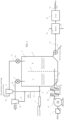
- Figure 1 is a schematic view illustrating an exemplary system for practicing a process according to the invention.
- Fig. 1 shows an embodiment, in which a fluidized bed dryer 2 is working at two temperatures and a fluidized bed drying chamber 3 is divided into two sections, typically by using an adjustable overflow plate 4.
- a low temperature (LT) section 5 is working at a temperature below 133°C
- a high temperature (HT) section 6 is working at a temperature of 133°C or over.
- a mixture of cellulose and urea is fed by a feeder 7 through line 8 to the dryer 2.
- the mixture enters first the LT section 5.
- Hot gaseous drying medium such as air
- residual moisture existing in the mixture is evaporated, and the temperature does not exceed the urea decomposition temperature.
- Moist air is led by a fan 9 through line 18 to a cyclone 10 which separates gaseous and solid fractions.
- the solid fraction is returned through lines 11, 12 and 8 to the fluidized bed drying chamber 3.
- the residence time in the LT section depends on the moisture amount of the mixture, but it is in a range of 10 - 90 minutes, preferably 20 - 70 minutes.
- Hot gaseous drying medium such as air
- the HT section is working at a temperature of 133°C or over. In the HT section the temperature is so high, that urea starts to decompose and CCA is produced. At the same time ammonia is formed and it is in gaseous form.
- the gaseous drying stream that flows through the solid cellulosic material, removes formed ammonia from the drying chamber 3 very efficiently.
- the ammonia-rich gas stream is led by a fan 20 through line 21 to a cyclone 22 which separates a small solid fraction and returns it to the drying chamber 3 through lines 12 and 8.
- the ammonia containing gaseous stream is discharged through line 26.
- the residence time in the HT section is 5 - 150 minutes, preferably 10 - 120 minutes, more preferably 20 - 100 minutes.
- Ammonia from the ammonia containing gaseous stream of line 26 may be recovered and utilized at the pulp mill, e.g. recycled to the CCA production.
- CCA produced in the fluidized bed dryer is discharged through line 22. It may go to packing, or it can be further used immediately after the dryer to produce regenerated cellulose products.
- the washer may be of any apparatus type suitable for CCA, e.g. a drum washer, a centrifuge, a disc filter, a drum filter, a filter press, a belt press, a twin wire press, a screw press, a wash press, or a belt washer.
- the next step may be a drying stage 28, if the CCA needs to be dried to a high dry content before further processing, transportation or use.
- the dryer type can be: a paddle dryer, a flash dryer, a fluidized bed dryer, a belt dryer, a drum dryer, a helix dryer, a plate dryer, or a spray dryer.
- CCA from line 29 is packed or further used.
- Washing filtrate containing nitrogen compounds from line 25 may be utilized at the pulp mill.
Landscapes
- Chemical & Material Sciences (AREA)
- Engineering & Computer Science (AREA)
- Organic Chemistry (AREA)
- Chemical Kinetics & Catalysis (AREA)
- Combustion & Propulsion (AREA)
- Life Sciences & Earth Sciences (AREA)
- Medicinal Chemistry (AREA)
- General Engineering & Computer Science (AREA)
- Biochemistry (AREA)
- Materials Engineering (AREA)
- Health & Medical Sciences (AREA)
- Mechanical Engineering (AREA)
- Polymers & Plastics (AREA)
- Microbiology (AREA)
- Polysaccharides And Polysaccharide Derivatives (AREA)
- Organic Low-Molecular-Weight Compounds And Preparation Thereof (AREA)
Claims (9)
- Prozess zur Produktion von Cellulosecarbamat (CCA), umfassend die Schritte:a) Bereitstellen einer Mischung, die Cellulose, Flüssigkeit und Harnstoff einschließt, undb) Unterziehen der Mischung Trocknung und Erwärmung, um die Carbamatisierungsreaktion zwischen Cellulose und Harnstoff, um Cellulosecarbamat und freigesetztes Ammoniak zu produzieren, in einem Wirbelbett durchzuführen, wobei die Mischung in eine Wirbelbett-Trocknungskammer eingebracht wird; ein Strom aus heißem gasförmigem Medium in die Kammer eingebracht wird, um Verwirbelung der Mischung zu bewirken, um die Mischung zu trocknen und zu erwärmen, wonach ein Strom aus gasförmigem Medium, der Ammoniak und das hergestellte Cellulosecarbamat enthält, aus der Wirbelbett-Trocknungskammer entfernt wird.
- Prozess nach Anspruch 1, wobei das Trocknen und Erwärmen der Mischung simultan in demselben Bett in der Wirbelbett-Trocknungskammer durchgeführt werden, die bei einer Temperatur von 133 °C oder darüber arbeitet, die mittels des heißen gasförmigen Mediums aufrechterhalten wird.
- Prozess nach Anspruch 1, wobei die Trocknung und Erwärmung der Mischung separat in der Wirbelbett-Trocknungskammer bewirkt werden, die in zwei Abschnitte geteilt ist, einen Trocknungsabschnitt und einen Heizabschnitt, indem eine Trennwand innerhalb der Kammer angeordnet ist, und der Trocknungsabschnitt, in den die Mischung zuerst eingespeist wird, bei einer Temperatur unter 133 °C arbeitet, und der Heizabschnitt bei einer Temperatur von 133 °C oder darüber arbeitet.
- Prozess nach Anspruch 3, wobei eine Verweilzeit in dem Trocknungsabschnitt, in dem restliches Wasser aus der Mischung verdampft wird, 10 bis 90 Minuten, vorzugsweise 20 bis 70 Minuten beträgt.
- Prozess nach Anspruch 3 oder 4, wobei eine Verweilzeit in dem Heizabschnitt, in dem die Carbamatisierungsreaktion stattfindet, 5 bis 150 Minuten, vorzugsweise 10 bis 120 Minuten, bevorzugter 20 bis 100 Minuten beträgt.
- Prozess nach einem der vorhergehenden Ansprüche, wobei das aus der Wirbelbett-Trocknungskammer entfernte Cellulosecarbamat zur weiteren Verwendung geführt wird oder gegebenenfalls gewaschen und getrocknet wird.
- Prozess nach einem der vorhergehenden Ansprüche, wobei die Mischung in den Schritten a) und b) frei von Hilfsmittel, wie einem Alkalisierungsmittel oder Oxidationsmittel, ist.
- Prozess nach Anspruch 3, 4 oder 5, wobei der Gasstrom aus dem Trocknungsabschnitt und der Gasstrom aus dem Heizabschnitt separat aus der Trocknungskammer entfernt werden.
- Verwendung eines Wirbelbetttrockners als Carbamatisierungsreaktor, in dem Cellulose und Harnstoff reagieren, um Cellulosecarbamat zu produzieren.
Applications Claiming Priority (2)
| Application Number | Priority Date | Filing Date | Title |
|---|---|---|---|
| FI20205365A FI129395B (en) | 2020-04-06 | 2020-04-06 | PROCESS FOR THE PREPARATION OF CELLULOSACARBAMATE |
| PCT/FI2021/050210 WO2021205060A1 (en) | 2020-04-06 | 2021-03-26 | Process for producing cellulose carbamate |
Publications (3)
| Publication Number | Publication Date |
|---|---|
| EP4132978A1 EP4132978A1 (de) | 2023-02-15 |
| EP4132978B1 true EP4132978B1 (de) | 2024-12-18 |
| EP4132978C0 EP4132978C0 (de) | 2024-12-18 |
Family
ID=75478074
Family Applications (1)
| Application Number | Title | Priority Date | Filing Date |
|---|---|---|---|
| EP21718161.9A Active EP4132978B1 (de) | 2020-04-06 | 2021-03-26 | Prozess zur herstellung von cellulosecarbamat |
Country Status (4)
| Country | Link |
|---|---|
| EP (1) | EP4132978B1 (de) |
| CN (1) | CN115335413B (de) |
| FI (1) | FI129395B (de) |
| WO (1) | WO2021205060A1 (de) |
Families Citing this family (3)
| Publication number | Priority date | Publication date | Assignee | Title |
|---|---|---|---|---|
| FI129982B (en) * | 2020-05-27 | 2022-12-15 | Valmet Technologies Oy | Process for removing ammonia from non-condensable gases in cellulose mill |
| FI130531B (en) * | 2022-01-07 | 2023-11-03 | Infinited Fiber Company Oy | Method for making cellulose carbamate filaments or fibers |
| FI20225011A1 (en) * | 2022-01-07 | 2023-07-08 | Infinited Fiber Company Oy | Cellulose-based textile fibers |
Family Cites Families (10)
| Publication number | Priority date | Publication date | Assignee | Title |
|---|---|---|---|---|
| US2134825A (en) | 1937-08-30 | 1938-11-01 | Du Pont | Chemical process |
| FI62318C (fi) | 1981-01-27 | 1982-12-10 | Neste Oy | Foerfarande foer framstaellning av ett alkaliloesligt cellulosaderivat |
| US5245093A (en) * | 1989-01-26 | 1993-09-14 | Abb Lummus Crest Inc. | Reaction processes in a multi-stage fluidized bed |
| DE10102172A1 (de) | 2001-01-18 | 2002-08-01 | Zimmer Ag | Verfahren und Vorrichtung zur kontinuierlichen Synthese von Cellulosecarbamat |
| EP1470162B1 (de) | 2002-01-29 | 2016-05-04 | Teknologian Tutkimuskeskus VTT OY | Verfahren zur herstellung von cellulosecarbamat |
| DE10223172B4 (de) | 2002-05-24 | 2004-05-06 | Fraunhofer-Gesellschaft zur Förderung der angewandten Forschung e.V. | Verfahren zur Herstellung von Cellulosecarbamat mittels reaktiver Extrusion und die Verwendung der Verfahrensprodukte zur Herstellung von Formkörpern |
| JP2011214805A (ja) * | 2010-04-02 | 2011-10-27 | Mitsubishi Heavy Ind Ltd | 流動層乾燥装置及び流動層乾燥設備 |
| SE540079C2 (sv) | 2014-06-27 | 2018-03-13 | Stora Enso Oyj | Förfarande för framställning av cellulosakarbamat, cellulosakarbamat samt spinnlösning innefattande cellulosakarbamat |
| WO2019120529A1 (de) | 2017-12-21 | 2019-06-27 | Fraunhofer-Gesellschaft zur Förderung der angewandten Forschung e.V. | Verfahren zur herstellung von cellulosecarbamat, cellulosecarbamat sowie hieraus hergestellte formkörper |
| FI128164B (en) | 2018-05-22 | 2019-11-29 | Andritz Oy | A process for the production of cellulose carbamate |
-
2020
- 2020-04-06 FI FI20205365A patent/FI129395B/en active IP Right Grant
-
2021
- 2021-03-26 EP EP21718161.9A patent/EP4132978B1/de active Active
- 2021-03-26 WO PCT/FI2021/050210 patent/WO2021205060A1/en not_active Ceased
- 2021-03-26 CN CN202180025572.3A patent/CN115335413B/zh active Active
Also Published As
| Publication number | Publication date |
|---|---|
| WO2021205060A1 (en) | 2021-10-14 |
| FI20205365A1 (en) | 2021-10-07 |
| EP4132978A1 (de) | 2023-02-15 |
| FI129395B (en) | 2022-01-31 |
| CN115335413B (zh) | 2023-10-27 |
| EP4132978C0 (de) | 2024-12-18 |
| CN115335413A (zh) | 2022-11-11 |
Similar Documents
| Publication | Publication Date | Title |
|---|---|---|
| EP4132978B1 (de) | Prozess zur herstellung von cellulosecarbamat | |
| US7128880B2 (en) | Organic recycling with a pipe-cross or tubular reactor | |
| CA2474465C (en) | Method for manufacturing cellulose carbamate | |
| EP0475930A1 (de) | Zentrifugales Trennen und/oder Mischen durch angesaugtes Gas | |
| US4224295A (en) | Process for the production of finely divided silicic acid by spray drying | |
| JP3537656B2 (ja) | アルカリ金属シアン化物−及びアルカリ土類金属シアン化物−顆粒の製法及びアルカリ金属シアン化物−顆粒 | |
| CS245755B2 (en) | Method of continual fluid drying of chemical products | |
| DE4203131A1 (de) | Verfahren und vorrichtung zum behandeln faserfoermiger materialien mit einem gasfoermigen reagens | |
| US4503020A (en) | Method of producing calcium sulfate semihydrate in conjunction with the desulfurization of flue gases | |
| US4427644A (en) | Process for the preparation of bivalent metal peroxides | |
| US4133714A (en) | Reaction vessel with pulsating means for producing lignocellulose product from crushed vegetable raw materials | |
| CS220766B2 (en) | Method of preparation of melamine | |
| CH620839A5 (en) | Method for fluidising solids | |
| US2901339A (en) | Continuous process for conversion of ligno-cellulose materials | |
| RU2634936C2 (ru) | Способ получения комплексных минеральных удобрений из фосфатной руды и установка для его реализации | |
| EP0600211B1 (de) | Verfahren zur Herstellung von festem Natriumcyanid | |
| US2845401A (en) | Ureaform fertilizer | |
| US4020148A (en) | Process for drying sodium carbonate peroxide | |
| US4153441A (en) | Process for making magnesium potassium ammonium phosphate | |
| US3289312A (en) | Drying of chlorinated isocyanurates and salts thereof | |
| US3514255A (en) | Production of granular diammonium phosphate | |
| EP0040318B1 (de) | Herstellung von Alkali- oder Erdalkalimetallperoxiden und so hergestellte Peroxide | |
| RU2026849C1 (ru) | Способ получения диаммонийфосфата | |
| CN112279287A (zh) | 一种半干法脱硫灰的处理工艺及处理系统 | |
| IL24090A (en) | Production of dried granular solid chemical products |
Legal Events
| Date | Code | Title | Description |
|---|---|---|---|
| STAA | Information on the status of an ep patent application or granted ep patent |
Free format text: STATUS: UNKNOWN |
|
| STAA | Information on the status of an ep patent application or granted ep patent |
Free format text: STATUS: THE INTERNATIONAL PUBLICATION HAS BEEN MADE |
|
| PUAI | Public reference made under article 153(3) epc to a published international application that has entered the european phase |
Free format text: ORIGINAL CODE: 0009012 |
|
| STAA | Information on the status of an ep patent application or granted ep patent |
Free format text: STATUS: REQUEST FOR EXAMINATION WAS MADE |
|
| 17P | Request for examination filed |
Effective date: 20221021 |
|
| AK | Designated contracting states |
Kind code of ref document: A1 Designated state(s): AL AT BE BG CH CY CZ DE DK EE ES FI FR GB GR HR HU IE IS IT LI LT LU LV MC MK MT NL NO PL PT RO RS SE SI SK SM TR |
|
| DAV | Request for validation of the european patent (deleted) | ||
| DAX | Request for extension of the european patent (deleted) | ||
| P01 | Opt-out of the competence of the unified patent court (upc) registered |
Effective date: 20240105 |
|
| GRAP | Despatch of communication of intention to grant a patent |
Free format text: ORIGINAL CODE: EPIDOSNIGR1 |
|
| STAA | Information on the status of an ep patent application or granted ep patent |
Free format text: STATUS: GRANT OF PATENT IS INTENDED |
|
| INTG | Intention to grant announced |
Effective date: 20240808 |
|
| GRAS | Grant fee paid |
Free format text: ORIGINAL CODE: EPIDOSNIGR3 |
|
| GRAA | (expected) grant |
Free format text: ORIGINAL CODE: 0009210 |
|
| STAA | Information on the status of an ep patent application or granted ep patent |
Free format text: STATUS: THE PATENT HAS BEEN GRANTED |
|
| AK | Designated contracting states |
Kind code of ref document: B1 Designated state(s): AL AT BE BG CH CY CZ DE DK EE ES FI FR GB GR HR HU IE IS IT LI LT LU LV MC MK MT NL NO PL PT RO RS SE SI SK SM TR |
|
| REG | Reference to a national code |
Ref country code: CH Ref legal event code: EP |
|
| REG | Reference to a national code |
Ref country code: DE Ref legal event code: R096 Ref document number: 602021023553 Country of ref document: DE |
|
| REG | Reference to a national code |
Ref country code: IE Ref legal event code: FG4D |
|
| P04 | Withdrawal of opt-out of the competence of the unified patent court (upc) registered |
Free format text: CASE NUMBER: APP_2461/2025 Effective date: 20250115 |
|
| U01 | Request for unitary effect filed |
Effective date: 20250110 |
|
| U07 | Unitary effect registered |
Designated state(s): AT BE BG DE DK EE FI FR IT LT LU LV MT NL PT RO SE SI Effective date: 20250117 |
|
| PG25 | Lapsed in a contracting state [announced via postgrant information from national office to epo] |
Ref country code: HR Free format text: LAPSE BECAUSE OF FAILURE TO SUBMIT A TRANSLATION OF THE DESCRIPTION OR TO PAY THE FEE WITHIN THE PRESCRIBED TIME-LIMIT Effective date: 20241218 |
|
| PG25 | Lapsed in a contracting state [announced via postgrant information from national office to epo] |
Ref country code: NO Free format text: LAPSE BECAUSE OF FAILURE TO SUBMIT A TRANSLATION OF THE DESCRIPTION OR TO PAY THE FEE WITHIN THE PRESCRIBED TIME-LIMIT Effective date: 20250318 |
|
| PG25 | Lapsed in a contracting state [announced via postgrant information from national office to epo] |
Ref country code: GR Free format text: LAPSE BECAUSE OF FAILURE TO SUBMIT A TRANSLATION OF THE DESCRIPTION OR TO PAY THE FEE WITHIN THE PRESCRIBED TIME-LIMIT Effective date: 20250319 |
|
| PG25 | Lapsed in a contracting state [announced via postgrant information from national office to epo] |
Ref country code: RS Free format text: LAPSE BECAUSE OF FAILURE TO SUBMIT A TRANSLATION OF THE DESCRIPTION OR TO PAY THE FEE WITHIN THE PRESCRIBED TIME-LIMIT Effective date: 20250318 |
|
| U20 | Renewal fee for the european patent with unitary effect paid |
Year of fee payment: 5 Effective date: 20250325 |
|
| PG25 | Lapsed in a contracting state [announced via postgrant information from national office to epo] |
Ref country code: SM Free format text: LAPSE BECAUSE OF FAILURE TO SUBMIT A TRANSLATION OF THE DESCRIPTION OR TO PAY THE FEE WITHIN THE PRESCRIBED TIME-LIMIT Effective date: 20241218 |
|
| PG25 | Lapsed in a contracting state [announced via postgrant information from national office to epo] |
Ref country code: PL Free format text: LAPSE BECAUSE OF FAILURE TO SUBMIT A TRANSLATION OF THE DESCRIPTION OR TO PAY THE FEE WITHIN THE PRESCRIBED TIME-LIMIT Effective date: 20241218 |
|
| PG25 | Lapsed in a contracting state [announced via postgrant information from national office to epo] |
Ref country code: ES Free format text: LAPSE BECAUSE OF FAILURE TO SUBMIT A TRANSLATION OF THE DESCRIPTION OR TO PAY THE FEE WITHIN THE PRESCRIBED TIME-LIMIT Effective date: 20241218 |
|
| PG25 | Lapsed in a contracting state [announced via postgrant information from national office to epo] |
Ref country code: IS Free format text: LAPSE BECAUSE OF FAILURE TO SUBMIT A TRANSLATION OF THE DESCRIPTION OR TO PAY THE FEE WITHIN THE PRESCRIBED TIME-LIMIT Effective date: 20250418 |
|
| PG25 | Lapsed in a contracting state [announced via postgrant information from national office to epo] |
Ref country code: SK Free format text: LAPSE BECAUSE OF FAILURE TO SUBMIT A TRANSLATION OF THE DESCRIPTION OR TO PAY THE FEE WITHIN THE PRESCRIBED TIME-LIMIT Effective date: 20241218 |
|
| PG25 | Lapsed in a contracting state [announced via postgrant information from national office to epo] |
Ref country code: CZ Free format text: LAPSE BECAUSE OF FAILURE TO SUBMIT A TRANSLATION OF THE DESCRIPTION OR TO PAY THE FEE WITHIN THE PRESCRIBED TIME-LIMIT Effective date: 20241218 |
|
| PG25 | Lapsed in a contracting state [announced via postgrant information from national office to epo] |
Ref country code: MC Free format text: LAPSE BECAUSE OF FAILURE TO SUBMIT A TRANSLATION OF THE DESCRIPTION OR TO PAY THE FEE WITHIN THE PRESCRIBED TIME-LIMIT Effective date: 20241218 |
|
| PLBE | No opposition filed within time limit |
Free format text: ORIGINAL CODE: 0009261 |
|
| REG | Reference to a national code |
Ref country code: CH Ref legal event code: H13 Free format text: ST27 STATUS EVENT CODE: U-0-0-H10-H13 (AS PROVIDED BY THE NATIONAL OFFICE) Effective date: 20251024 |
|
| STAA | Information on the status of an ep patent application or granted ep patent |
Free format text: STATUS: NO OPPOSITION FILED WITHIN TIME LIMIT |
|
| 26N | No opposition filed |
Effective date: 20250919 |
|
| GBPC | Gb: european patent ceased through non-payment of renewal fee |
Effective date: 20250326 |