EP4132235B1 - Verbundener körper und isolierende leiterplatte - Google Patents
Verbundener körper und isolierende leiterplatte Download PDFInfo
- Publication number
- EP4132235B1 EP4132235B1 EP21779171.4A EP21779171A EP4132235B1 EP 4132235 B1 EP4132235 B1 EP 4132235B1 EP 21779171 A EP21779171 A EP 21779171A EP 4132235 B1 EP4132235 B1 EP 4132235B1
- Authority
- EP
- European Patent Office
- Prior art keywords
- insulating resin
- circuit layer
- bonded interface
- insulating
- layer
- Prior art date
- Legal status (The legal status is an assumption and is not a legal conclusion. Google has not performed a legal analysis and makes no representation as to the accuracy of the status listed.)
- Active
Links
Images



Classifications
-
- H—ELECTRICITY
- H05—ELECTRIC TECHNIQUES NOT OTHERWISE PROVIDED FOR
- H05K—PRINTED CIRCUITS; CASINGS OR CONSTRUCTIONAL DETAILS OF ELECTRIC APPARATUS; MANUFACTURE OF ASSEMBLAGES OF ELECTRICAL COMPONENTS
- H05K3/00—Apparatus or processes for manufacturing printed circuits
- H05K3/38—Improvement of the adhesion between the insulating substrate and the metal
- H05K3/382—Improvement of the adhesion between the insulating substrate and the metal by special treatment of the metal
-
- H—ELECTRICITY
- H05—ELECTRIC TECHNIQUES NOT OTHERWISE PROVIDED FOR
- H05K—PRINTED CIRCUITS; CASINGS OR CONSTRUCTIONAL DETAILS OF ELECTRIC APPARATUS; MANUFACTURE OF ASSEMBLAGES OF ELECTRICAL COMPONENTS
- H05K3/00—Apparatus or processes for manufacturing printed circuits
- H05K3/38—Improvement of the adhesion between the insulating substrate and the metal
-
- H—ELECTRICITY
- H05—ELECTRIC TECHNIQUES NOT OTHERWISE PROVIDED FOR
- H05K—PRINTED CIRCUITS; CASINGS OR CONSTRUCTIONAL DETAILS OF ELECTRIC APPARATUS; MANUFACTURE OF ASSEMBLAGES OF ELECTRICAL COMPONENTS
- H05K1/00—Printed circuits
- H05K1/02—Details
- H05K1/0284—Details of three-dimensional rigid printed circuit boards
-
- H—ELECTRICITY
- H05—ELECTRIC TECHNIQUES NOT OTHERWISE PROVIDED FOR
- H05K—PRINTED CIRCUITS; CASINGS OR CONSTRUCTIONAL DETAILS OF ELECTRIC APPARATUS; MANUFACTURE OF ASSEMBLAGES OF ELECTRICAL COMPONENTS
- H05K3/00—Apparatus or processes for manufacturing printed circuits
- H05K3/38—Improvement of the adhesion between the insulating substrate and the metal
- H05K3/382—Improvement of the adhesion between the insulating substrate and the metal by special treatment of the metal
- H05K3/384—Improvement of the adhesion between the insulating substrate and the metal by special treatment of the metal by plating
-
- H10W70/60—
-
- H10W70/6525—
-
- H10W70/6875—
-
- H—ELECTRICITY
- H05—ELECTRIC TECHNIQUES NOT OTHERWISE PROVIDED FOR
- H05K—PRINTED CIRCUITS; CASINGS OR CONSTRUCTIONAL DETAILS OF ELECTRIC APPARATUS; MANUFACTURE OF ASSEMBLAGES OF ELECTRICAL COMPONENTS
- H05K1/00—Printed circuits
- H05K1/02—Details
- H05K1/0201—Thermal arrangements, e.g. for cooling, heating or preventing overheating
- H05K1/0203—Cooling of mounted components
-
- H—ELECTRICITY
- H05—ELECTRIC TECHNIQUES NOT OTHERWISE PROVIDED FOR
- H05K—PRINTED CIRCUITS; CASINGS OR CONSTRUCTIONAL DETAILS OF ELECTRIC APPARATUS; MANUFACTURE OF ASSEMBLAGES OF ELECTRICAL COMPONENTS
- H05K2203/00—Indexing scheme relating to apparatus or processes for manufacturing printed circuits covered by H05K3/00
- H05K2203/06—Lamination
-
- H—ELECTRICITY
- H05—ELECTRIC TECHNIQUES NOT OTHERWISE PROVIDED FOR
- H05K—PRINTED CIRCUITS; CASINGS OR CONSTRUCTIONAL DETAILS OF ELECTRIC APPARATUS; MANUFACTURE OF ASSEMBLAGES OF ELECTRICAL COMPONENTS
- H05K3/00—Apparatus or processes for manufacturing printed circuits
- H05K3/0058—Laminating printed circuit boards onto other substrates, e.g. metallic substrates
- H05K3/0061—Laminating printed circuit boards onto other substrates, e.g. metallic substrates onto a metallic substrate, e.g. a heat sink
-
- H10W40/255—
Definitions
- the present invention relates to a bonded body having a structure in which an insulating resin member made of an insulating resin and a metal part are bonded, and an insulating circuit board.
- Each of a power module, LED module, and thermoelectric module has a structure in which a power semiconductor element, an LED element, and a thermoelectric element are bonded to an insulating circuit board in which a circuit layer made of a conductive material is formed on one surface of an insulating layer.
- an insulating layer made of ceramics or an insulating resin has been proposed.
- Patent Document 1 As an insulating circuit board provided with an insulating resin layer, for example, a metal-based circuit board is proposed in Patent Document 1. In addition, a multilayer wiring board is proposed in Patent Document 2. Furthermore, an insulated circuit board comprising an insulating resin member is proposed in Patent Document 3.
- an insulating resin layer is formed on a metal substrate, and a circuit layer having a circuit pattern is formed on this insulating resin layer.
- the insulating resin layer is made of an epoxy resin that is a thermosetting resin
- the circuit layer is made of a copper foil.
- This metal-based circuit board has a structure in which a semiconductor element is bonded onto the circuit layer, a heat sink is arranged on a surface of the metal substrate opposite to the insulating resin layer, and heat generated by the semiconductor element is transferred to the heat sink side to dissipate heat.
- the multilayer wiring board described in Patent Document 2 is manufactured in such a manner that a surface roughness (Ra) of a metal foil is set to 0.2 ⁇ m or more, etching treatment is carried out on the metal foil adhered to a resin film, the etching treatment is further carried out on the metal foil to have a circuit pattern shape, thereby forming a wiring circuit layer, the wiring circuit layer formed on the surface of the resin film is embedded while applying pressure to a surface of a soft insulating sheet, an insulating circuit layer is transferred to the surface of the insulating sheet to obtain a plurality of insulating sheets, and the plurality of insulating sheets thus obtained are laminated and heat-cured all at one.
- a surface roughness (Ra) of a metal foil is set to 0.2 ⁇ m or more
- etching treatment is carried out on the metal foil adhered to a resin film
- the etching treatment is further carried out on the metal foil to have a circuit pattern shape, thereby forming a wiring circuit layer
- Patent Document 3 discloses a bonded body, as well as an insulating circuit board, having a structure in which an insulating resin member made of an insulating resin and a metal part made of a metal are bonded, wherein a bonded interface between the insulating resin member and the metal part has an uneven shape including a protrusion in which the metal part protrudes toward an insulating resin member side and a recess in which the metal part retracts from the insulating resin member side, and at least one of a kurtosis Rku of contour curve at the bonded interface of the metal part and a kurtosis Sku of contour surface at the bonded interface of the metal part is in a range of 2.75 or more and 6.00 or less.
- the object was to improve the adhesion between the insulating sheet and the wiring circuit layer by embedding the wiring circuit layer in the insulating sheet with the surface roughness (Ra) set to 0.2 ⁇ m or more.
- the present invention has been made in view of the above-mentioned circumstances, and an objective of the present invention is to provide a bonded body that has excellent adhesion between an insulating resin member and a metal part, has excellent insulation properties in the insulating resin member and can be stably used, and an insulating circuit board.
- a bonded body of the present invention has a structure in which an insulating resin member made of an insulating resin and a metal part made of a metal are bonded, and in the bonded body, a bonded interface between the insulating resin member and the metal part has an uneven shape including a protrusion in which the metal part protrudes toward an insulating resin member side and a recess in which the metal part retracts from the insulating resin member side, at least one of a kurtosis Rku of contour curve at the bonded interface of the metal part and a kurtosis Sku of contour surface at the bonded interface of the metal part is in a range of 2.75 or more and 6.00 or less, and an overhang rate that indicates a length ratio of regions overlapping in a lamination direction in a direction along the bonded interface is 7% or more.
- the bonded interface between the insulating resin member and the metal part has an uneven shape including a protrusion in which the metal part protrudes toward an insulating resin member side and a recess in which the metal part retracts from the insulating resin member side, and at least one of a kurtosis Rku of contour curve at the bonded interface of the metal part and a kurtosis Sku of contour surface at the bonded interface of the metal part is in a range of 2.75 or more and 6.00 or less, a tip of the protrusion is not sharpened more than necessary, and the insulation properties (insulating withstand voltage) of the insulating resin member can be sufficiently ensured.
- the overhang rate indicating the length ratio of regions overlapping in a lamination direction in a direction along the bonded interface is 7% or more, the metal part and the insulating resin member are sufficiently engaged, and the adhesion between the insulating resin member and the metal part can be improved.
- At least one of the root mean square deviation Rq of contour curve at the bonded interface of the metal part and the root mean square deviation Sq of contour surface at the bonded interface of the metal part is preferably in a range of 0.20 ⁇ m or more and 0.90 ⁇ m or less.
- At least one of the root mean square deviation Rq of contour curve at the bonded interface of the metal part and the root mean square deviation Sq of contour surface at the bonded interface of the metal part is in a range of 0.20 ⁇ m or more and 0.90 ⁇ m or less, it is possible to suppress the generation of electric field concentration at the tip of the protrusion, surely ensure the insulation properties, and improve the adhesion between the insulating resin member and the metal part.
- An insulating circuit board of the present invention includes an insulating resin layer, and a circuit layer in which a metal plate is bonded to one surface of the insulating resin layer, and in the insulating circuit board, a bonded interface between the insulating resin layer and the circuit layer has an uneven shape including a protrusion in which the circuit layer protrudes toward an insulating resin layer side and a recess in which the circuit layer retracts from the insulating resin layer side, at least one of a kurtosis Rku of contour curve at the bonded interface of the circuit layer and a kurtosis Sku of contour surface at the bonded interface of the circuit layer is in a range of 2.75 or more and 6.00 or less, and an overhang rate that indicates a length ratio of regions overlapping in a lamination direction in a direction along the bonded interface is 7% or more.
- the bonded interface between the insulating resin layer and the circuit layer has an uneven shape including a protrusion in which the circuit layer protrudes toward an insulating resin layer side and a recess in which the circuit layer retracts from the insulating resin layer side, and at least one of a kurtosis Rku of contour curve at the bonded interface of the circuit layer and a kurtosis Sku of contour surface at the bonded interface of the circuit layer is in a range of 2.75 or more and 6.00 or less, the tip of the protrusion is not sharpened more than necessary, and the insulation properties (insulating withstand voltage) of the insulating resin portion layer can be sufficiently ensured.
- the overhang rate indicating the length ratio of regions overlapping in a lamination direction in a direction along the bonded interface is 7% or more, the circuit layer and the insulating resin layer are sufficiently engaged, and the adhesion between the circuit layer and the insulating resin layer can be improved.
- At least one of the root mean square deviation Rq of contour curve at the bonded interface of the circuit layer and the root mean square deviation Sq of contour surface at the bonded interface of the circuit layer is preferably in a range of 0.20 ⁇ m or more and 0.90 ⁇ m or less.
- At least one of the root mean square deviation Rq of contour curve at the bonded interface of the circuit layer and the root mean square deviation Sq of contour surface at the bonded interface of the circuit layer is in a range of 0.20 ⁇ m or more and 0.90 ⁇ m or less, it is possible to suppress the generation of electric field concentration at the tip of the protrusion, surely ensure the insulation properties, and surely improve the adhesion between the insulating resin layer and the circuit layer.
- the present invention it is possible to provide the bonded body that has exceptional adhesion between the insulating resin member and the metal part, has exceptional insulation properties in the insulating resin member, and can be stably used, and the insulating circuit board.
- the bonded body according to the present embodiment includes an insulating circuit board 10 configured by bonding an insulating resin layer 12 that is an insulating resin member to a metal plate 23 (circuit layer 13) that is a metal part and a metal substrate 11.
- Fig. 1 shows the insulating circuit board 10 according to the embodiment of the present invention and a power module 1 using the insulating circuit board 10.
- the power module 1 shown in Fig. 1 is provided with the insulating circuit board 10, a semiconductor element 3 that is bonded, through a first solder layer 2, to one surface (upper surface shown in Fig. 1 ) of the insulating circuit board 10, and a heat sink 31 that is bonded, through a solder layer 32, to the other side (lower side shown in Fig. 1 ) of the insulating circuit board 10.
- the semiconductor element 3 is made of a semiconductor material such as Si.
- the first solder layer 2 for bonding the insulating circuit board 10 and the semiconductor element 3 is made of, for example, a Sn-Ag-based solder material, a Sn-Cu-based solder material, a Sn-In-based solder material, or a Sn-Ag-Cu-based solder material (so-called lead-free solder material).
- the heat sink 31 dissipates heat on the insulating circuit board 10 side.
- the heat sink 31 is made of copper or a copper alloy, aluminum or an aluminum alloy, or the like, which have good thermal conductivity.
- the heat sink is a heat radiation plate made of oxygen-free copper.
- a thickness of the heat sink 31 is set in a range of 3 mm or more and 10 mm or less.
- solder layer 32 can have the same configuration as the above-mentioned solder layer 2.
- the insulating circuit board 10 of the present embodiment includes the metal substrate 11, the insulating resin layer 12 formed on one surface (upper surface shown in Fig. 1 ) of the metal substrate 11, and the circuit layer 13 formed on one surface (upper surface shown in Fig. 1 ) of the insulating resin layer 12.
- the metal substrate 11 has an action of improving a heat dissipating feature by spreading heat generated in the semiconductor element 3 mounted on the insulating circuit board 10 in a plane direction. Therefore, the metal substrate 11 is made of a metal having excellent thermal conductivity, for example, copper or a copper alloy, or aluminum or an aluminum alloy. In the present embodiment, the metal substrate 11 is made of a rolled plate composed of oxygen-free copper. A thickness of the metal substrate 11 is set in a range of 0.05 mm or more and 3 mm or less and is set to 2.0 mm in the present embodiment.
- the insulating resin layer 12 prevents electrical connection between the circuit layer 13 and the metal substrate 11 and is made of a thermosetting resin with insulation properties.
- thermosetting resin containing a filler is used to ensure the strength of the insulating resin layer 12 and to ensure the thermal conductivity.
- the filler for example, alumina, boron nitride, aluminum nitride, or the like can be used.
- the thermosetting resin an epoxy resin, a polyimide resin, or the like can be used.
- the insulating resin layer 12 is made of an epoxy resin containing alumina as a filler. A thickness of the insulating resin layer 12 is in a range of 20 ⁇ m or more and 250 ⁇ m or less and is 150 ⁇ m in the present embodiment.
- the circuit layer 13 is formed such that the metal plate 23 made of a metal having excellent conductivity is bonded to one surface (upper surface shown in Fig. 4 ) of the insulating resin layer 12.
- a rolled plate made of a material such as copper or a copper alloy, aluminum or an aluminum alloy can be used.
- a rolled plate made of oxygen-free copper is used as the metal plate 23 constituting the circuit layer 13.
- a circuit pattern is formed, and one surface (upper surface shown in Fig. 1 ) thereof is a mounting surface on which the semiconductor element 3 is mounted.
- a thickness of the circuit layer 13 is set in a range of 0.3 mm or more and 3 mm or less and is set to 0.5 mm in the present embodiment.
- a bonded interface between the insulating resin layer 12 and the circuit layer 13 (metal substrate 11) has an uneven shape including a protrusion 18 in which the circuit layer 13 (metal substrate 11) protrudes toward the insulating resin layer 12 side and a recess 19 in which the circuit layer 13 (metal substrate 11) retracts from the insulating resin layer 12 side.
- the circuit layer 13 (metal substrate 11) intrudes into the insulating resin layer 12.
- At least one of a kurtosis Rku of contour curve at the bonded interface of the circuit layer 13 (metal substrate 11) and a kurtosis Sku of contour surface at the bonded interface of the circuit layer 13 (metal substrate 11) is in a range of 2.75 or more and 6.00 or less.
- an overhang rate that indicates a length ratio of regions overlapping in a lamination direction in a direction along the bonded interface is 7% or more.
- At least one of the root mean square deviation Rq of contour curve at the bonded interface of the circuit layer 13 (metal substrate 11) and the root mean square deviation Sq of contour surface at the bonded interface of the circuit layer 13 (metal substrate 11) is preferably in a range of 0.20 ⁇ m or more and 0.90 ⁇ m or less.
- the kurtosis of assessed profile Rku is a parameter defined in JIS B 0601:2001
- the kurtosis of scale-limited surface Sku is a parameter defined in JIS B 0681-2:2018
- each of the parameters is obtained by evaluating kurtosis that is a measure of surface sharpness.
- the Kurtosis of scale-limited surface Sku is a parameter in which the kurtosis of assessed profile Rku extends to three dimensions.
- the surface of the circuit layer 13 (the tip of the protrusion 18) is shaped in a crushed state, so that the circuit layer 13 (metal substrate 11) may not sufficiently intrude into the insulating resin layer 12 side, and the adhesion between the insulating resin layer 12 and the circuit layer 13 (metal substrate 11) may not be improved.
- At least one of the kurtosis Rku of contour curve at the bonded interface of the circuit layer 13 (metal substrate 11) and a kurtosis Sku of contour surface at the bonded interface of the circuit layer 13 (metal substrate 11) is set to be in the range of 2.75 or more and 6.00 or less.
- At least one of the kurtosis Rku of contour curve at the bonded interface of the circuit layer 13 (metal substrate 11) and the kurtosis Sku of contour surface at the bonded interface of the circuit layer 13 (metal substrate 11) is preferably 2.75 or more, and still more preferably 3.00 or more.
- at least one of the kurtosis Rku of contour curve at the bonded interface of the circuit layer 13 (metal substrate 11) and the kurtosis Sku of contour surface at the bonded interface of the circuit layer 13 (metal substrate 11) is preferably 6.00 or less, and still more preferably 3.75 or less.
- the overhang rate in the present embodiment is obtained in such a manner that the cross-sectional shape of the bonded interface is image-analyzed with image processing software, regions overlapping in a lamination direction (height direction: Y direction) in a direction along the bonded interface (horizontal direction: X direction) with respect to the obtained cross-sectional curve are defined as overhang portions, which is defined as a ratio of lengths of the overhang portions in the X direction to all of the length of the obtained cross-sectional curve in the X direction.
- the overhang rate may be 100% or more.
- the circuit layer 13 (metal substrate 11) and the insulating resin layer 12 are not sufficiently engaged, and the adhesion between the insulating resin layer 12 and the circuit layer 13 (metal substrate 11) may not be improved.
- the overhang rate that indicates the length ratio of regions overlapping in the lamination direction in the direction along the bonded interface is defined as 7% or more.
- the above-mentioned overhang rate is preferably 7% or more, and still more preferably 15% or more.
- the overhang rate is not particularly limited, but is preferably 100% or less.
- the root mean square deviation of assessed profile Rq is a parameter specified in JIS B 0601: 2001
- the root mean square deviation of scale-limited surface Sq is a parameter specified in JIS B 0681-2:2018, each of which means the standard deviation of the surface roughness.
- the circuit layer 13 (metal substrate 11) sufficiently intrudes into the insulating resin layer 12 side by setting at least one of the root mean square deviation Rq of contour curve at the bonded interface of the circuit layer 13 (metal substrate 11) and the root mean square deviation Sq of contour surface at the bonded interface of the circuit layer 13 (metal substrate 11) to 0.20 ⁇ m or more, so that the adhesion between the insulating resin layer 12 and the circuit layer 13 (metal substrate 11) can be surely improved.
- the generation of electric field concentration at the tip of the protrusion 18, which is formed by the circuit layer 13 (metal substrate 11) intruding inside the insulating resin layer 12, can be suppressed by setting at least one of the root mean square deviation Rq of contour curve at the bonded interface of the circuit layer 13 (metal substrate 11) and the root mean square deviation Sq of contour surface at the bonded interface of the circuit layer 13 (metal substrate 11) to 0.90 ⁇ m or less, so that the insulation properties of the insulating resin layer 12 can be surely ensured.
- At least one of the root mean square deviation Rq of contour curve at the bonded interface of the circuit layer 13 (metal substrate 11) and the root mean square deviation Sq of contour surface at the bonded interface of the circuit layer 13 (metal substrate 11) is preferably in the range of 0.20 ⁇ m or more and 0.90 ⁇ m or less.
- At least one of the root mean square deviation Rq of contour curve at the bonded interface of the circuit layer 13 (metal substrate 11) and the root mean square deviation Sq of contour surface at the bonded interface of the circuit layer 13 (metal substrate 11) is preferably 0.20 ⁇ m or more, and still more preferably 0.30 ⁇ m or more.
- at least one of the root mean square deviation Rq of contour curve at the bonded interface of the circuit layer 13 (metal substrate 11) and the root mean square deviation Sq of contour surface at the bonded interface of the circuit layer 13 (metal substrate 11) is preferably 0.90 ⁇ m or less, and still more preferably 0.80 ⁇ m or less.
- a roughened plating layer 23a is formed on a bonding surface between the metal plate 23 serving as the circuit layer 13 and the insulating resin layer 12, and a roughened plating layer 11a is formed on a bonding surface between the metal substrate 11 and the insulating resin layer 12.
- uneven portions are formed on the bonding surface between the metal plate 23 serving as the circuit layer 13 and the insulating resin layer 12 and the bonding surface between the metal substrate 11 and the insulating resin layer 12.
- the roughened plating layers 23a and 11a are formed as follows.
- Electrolytic plating treatment is carried out on the bonding surfaces between the metal plate 23 and the metal substrate 11.
- an electrolytic solution consisting of an aqueous solution that is obtained by adding 3,3'-dithiobis(1-propane sulfonic acid)2 sodium into a copper sulfate bath containing copper sulfate (CuSO 4 ) and sulfuric acid (H 2 SO 4 ) as main components, as an electrolytic plating solution.
- a temperature of the plating bath is preferably in a range of, for example, 25°C or higher and 35°C or lower.
- a periodic reverse (PR) pulse plating treatment is used as the electrolytic plating treatment.
- This PR pulse plating treatment is a method of performing electrolytic plating by energization while periodically reversing a direction of electric current.
- positive electrolysis anodic electrolysis in which the metal plate 23 and the metal substrate 11 serve as an anode
- negative electrolysis cathode electrolysis in which the metal plate 23 and the metal substrate 11 serve as a cathode
- 1 A/dm 2 or more and 30 A/dm 2 or less is set to 1 ms or more and 1000 ms or less, which is repeated.
- the melting of the surfaces of the metal plate 23 and the metal substrate 11 and the precipitation of copper are repeatedly carried out, thereby forming the roughened plating layers 23a and 11a.
- the kurtosis of assessed profile Rku and the kurtosis of scale-limited surface Sku each are close to 3, the overhang rate increases, and the root mean square deviation of assessed profile Rq and the root mean square deviation of scale-limited surface Sq increase.
- the ratio of precipitation amount/melting amount is increased, the kurtosis of assessed profile Rku and the kurtosis of scale-limited surface Sku each increase, the overhang rate decreases, and the root mean square deviation of assessed profile Rq and the root mean square deviation of scale-limited surface Sq decrease.
- the kurtosis of assessed profile Rku and the kurtosis of scale-limited surface Sku each are close to 3, the overhang rate decreases, and the root mean square deviation of assessed profile Rq and the root mean square deviation of scale-limited surface Sq decrease.
- Fig. 3(a) shows a cross-sectional photograph of the metal plate 23 (metal substrate 11) before the surface roughening step S01 is carried out
- Fig. 3(b) shows a cross-sectional photograph of the metal plate 23 (metal substrate 11) after the surface roughening step S01 is carried out.
- the uneven portion is formed on the bonding surface of the metal plate 23 (metal substrate 11) by carrying out the surface roughening step S01 of the present embodiment, and the overhang portion is formed.
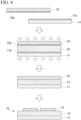
- a resin composition 22 containing alumina as a filler, an epoxy resin as a thermosetting resin, and a curing agent is arranged on one surface (upper surface shown in Fig. 4 ) of the metal substrate 11.
- the resin composition 22 is formed in a sheet shape.
- the metal plate 23 serving as the circuit layer 13 is arranged on one surface (upper surface shown in Fig. 4 ) of the resin composition 22.
- the metal substrate 11, the resin composition 22, and the metal plate 23, which have been laminated, are pressurized and heated in a lamination direction, the resin composition 22 is cured to form the insulating resin layer 12, thereby bonding the metal substrate 11 and the insulating resin layer 12 to each other and bonding the insulating resin layer 12 and the metal plate 23 to each other.
- thermocompression bonding step S03 conditions in which a heating temperature is wthin a range of 150°C or higher and 400°C or lower, a holding time at the heating temperature is wthin a range of 30 minutes or longer and 90 minutes or shorter, and a pressurizing pressure in the lamination direction is in a range of 1 MPa or more and 100 MPa or less are preferably employed.
- the metal plate 23 bonded to the insulating resin layer 12 is subjected to etching treatment to form a circuit pattern, thereby forming the circuit layer 13.
- the insulating circuit board 10 according to the present embodiment is manufactured.
- the heat sink 31 is bonded to the other surface of the metal substrate 11 of the insulating circuit board 10.
- the metal substrate 11 and the heat sink 31 are bonded through a solder material.
- the semiconductor element 3 is bonded to the circuit layer 13 of the insulating circuit board 10.
- the circuit layer 13 and the semiconductor element 3 are bonded through a solder material.
- the power module 1 shown in Fig. 1 is manufactured by the above-mentioned steps.
- the bonded interface between the insulating resin layer 12 and the circuit layer 13 (metal substrate 11) has an uneven shape including the protrusion 18 in which the circuit layer 13 (metal substrate 11) protrudes toward the insulating resin layer 12 side and the recess 19 in which the circuit layer 13 (metal substrate 11) retracts from the insulating resin layer 12 side, and at least one of the kurtosis Rku of contour curve at the bonded interface of the circuit layer 13 (metal substrate 11) and the kurtosis Sku of contour surface at the bonded interface of the circuit layer 13 (metal substrate 11) is set to 2.75 or more, the circuit layer 13 (metal substrate 11) sufficiently intrudes into the insulating resin layer 12 side, so that the adhesion between the insulating resin layer 12 and the circuit layer 13 (metal substrate 11) can be improved.
- the tip of the protrusion 18 is not sharpened more than necessary, and the insulation properties (insulating withstand voltage) of the insulating resin portion layer can be sufficiently ensured.
- the overhang rate indicating the length ratio of regions overlapping in the lamination direction in the direction along the bonded interface is 7% or more, the circuit layer 13 (metal substrate 11) and the insulating resin layer 12 are sufficiently engaged, and the adhesion between the circuit layer 13 (metal substrate 11) and the insulating resin layer 12 can be improved.
- the insulating circuit board 10 (bonded body) of the present embodiment in a case where at least one of the root mean square deviation Rq of contour curve at the bonded interface of the circuit layer 13 (metal substrate 11) and the root mean square deviation Sq of contour surface at the bonded interface of the circuit layer 13 (metal substrate 11) is in the range of 0.20 ⁇ m or more and 0.90 ⁇ m or less, it is possible to suppress the generation of electric field concentration at the tip of the protrusion 18, surely ensure the insulation properties in the insulating resin layer 12, and surely improve the adhesion between the circuit layer 13 (metal substrate 11) and the insulating resin layer 12.
- the insulating circuit board is manufactured by the method for manufacturing the insulating circuit board shown in Figs. 2 to 4 , but the present invention is not limited thereto.
- the metal plate for forming the metal substrate and the circuit layer is described as being composed of oxygen-free copper, but the metal plate is not limited thereto, and may be made of another metal composed of copper or a copper alloy or may be made of another metal such as aluminum or an aluminum alloy. Furthermore, a structure in which a plurality of metals are laminated may be adopted.
- the configuration of the power module in which the semiconductor element is mounted on the insulating circuit board is described, but the present invention is not limited thereto.
- a configuration of an LED module in which a LED element is mounted on the circuit layer of the insulating circuit board may be adopted, or a configuration of a thermoelectric module in which a thermoelectric element is mounted on the circuit layer of the insulating circuit board may be adopted.
- a metal substrate (40 mm ⁇ 40 mm ⁇ thickness of 2 mm) formed of a rolled plate made of oxygen-free copper and a metal plate serving as the circuit layer (40 mm ⁇ 40 mm ⁇ thickness of 0.5 mm) were prepared, and a roughened plating layer was formed on a bonding surface between these metal substrate and insulating resin layer of the metal plate by the PR pulse electrolysis method described in the above-mentioned embodiment.
- a sheet material (40 mm ⁇ 40 mm ⁇ thickness of 0.15 mm) composed of a resin composition containing an epoxy resin containing Al 2 O 3 as a filler was disposed on a surface on which the roughened plating layer of the metal substrate was formed.
- the metal plate serving as the circuit layer was laminated on one surface of the sheet material composed of this resin composition so that the surface on which the roughened plating layer was formed faced the sheet material side of the resin composition.
- the metal substrate laminated as described above, the sheet material composed of the resin composition, and the metal plate were heated while being pressurized in the lamination direction, the resin composition was cured to form an insulating resin layer, and the metal substrate and the insulating resin layer were bonded to each other, and the insulating resin layer and the metal plate were bonded to each other, thereby obtaining an insulating circuit board.
- a pressurizing pressure in the lamination direction was 10 MPa, a heating temperature was 180°C, and a holding time at the heating temperature was 60 minutes.
- the bonded interface between the circuit layer and the insulating resin layer was observed by using a laser microscope OLS5000 with an objective lens with a magnification of 100 times in a measurement range of 129 ⁇ m ⁇ 129 ⁇ m, the sample tilt and noise were removed, and a kurtosis of scale-limited surface Sku at the bonded interface and a root mean square deviation of scale-limited surface Sq at the bonded interface were calculated.
- a kurtosis of assessed profile Rku at the bonded interface and a root mean square deviation of scale-limited surface Rq at the bonded interface were calculated in the direction in which the roughness was considered to be the coarsest. At least three or more points were measured in the measurement range, and an average value thereof was described in Table.
- This SIM image was binarized by using image analysis software ImageJ, noise was manually removed, and an outline was then extracted.
- FIG. 5 A measurement example is shown in Fig. 5 .
- the number of overlapping regions in the Y direction for each position of the X-axis is 0, 1, 1, 0, 0, 0, 0, 0, 1, 1, 2, 2, 1, 1, 0, in order from the left, the total of these is 10, and the number of pixels in the X direction is 15.
- the overhang rate is 10/15 ⁇ 100, which is 67%.
- the above-mentioned insulating circuit board was placed in a constant temperature and humidity chamber (temperature of 85°C, humidity of 85%) and held for 3 days. Thereafter, the insulating circuit board was charged into a heating furnace and reflowed at 290°C for 10 minutes.
- the bonding rate between the circuit layer and the insulating resin layer was evaluated by using an ultrasonic flaw detector (FineSAT200 manufactured by Hitachi Power Solutions Co., Ltd.) and calculated from the following Equation.
- an initial bonding area is an area to be bonded before bonding. Since the peeling is shown by the white part in the bonding part in the image obtained by binarizing ultrasonic-detected image, the area of this white part is defined as an exfoliation area.
- (Bonding rate) ⁇ (Initial bonding area)-(Exfoliation area) ⁇ /(Initial bonding area) ⁇ 100
- the metal substrate 11 was placed on a base plate 61, a probe 62 was brought into contact with the circuit layer 13, and the partial discharge was evaluated.
- a partial discharge tester manufactured by MITSUBISHI CABLE INDUSTRIES, LTD. was used as a measuring device.
- a test atmosphere was Fluorinert (tm) FC-770 manufactured by 3M.
- a voltage was boosted by a step profile (holding time for 30 seconds) every 0.5 kV, and a voltage at which the dielectric breakdown occurred (the voltage at which the leakage current was 10 mA or higher) was defined as the dielectric breakdown voltage.
- Examples 1 to 8 of the present invention in which at least one of the kurtosis Rku of contour curve at the bonded interface of the circuit layer and the kurtosis Sku of contour surface at the bonded interface of the circuit layer was in the range of 2.75 or more and 6.00 or less, and the overhang rate is 7% or more, the bonding rate after the moisture absorption reflow was 84% or more, and the adhesion between the circuit layer and the insulating resin layer was excellent.
- the dielectric breakdown voltage after the moisture absorption reflow was 5.8 V or more, and the insulating resin layer was excellent in insulation properties.
- At least one of the root mean square deviation Rq of contour curve at the bonded interface of the circuit layer and the root mean square deviation Sq of contour surface at the bonded interface of the circuit layer was in the range of 0.20 ⁇ m or more and 0.90 ⁇ m or less.
- the adhesion between the circuit layer and the insulating resin layer was particularly excellent.
- the insulating circuit board (bonded body), in which the adhesion between the insulating resin layer (insulating resin member), the circuit layer (metal part) was excellent and the insulation properties in the insulating resin layer (insulating resin member) was excellent, and the insulating circuit board can be used stably.
Landscapes
- Engineering & Computer Science (AREA)
- Microelectronics & Electronic Packaging (AREA)
- Manufacturing & Machinery (AREA)
- Insulated Metal Substrates For Printed Circuits (AREA)
- Laminated Bodies (AREA)
- Manufacturing Of Printed Wiring (AREA)
- Physics & Mathematics (AREA)
- Condensed Matter Physics & Semiconductors (AREA)
- General Physics & Mathematics (AREA)
- Computer Hardware Design (AREA)
- Power Engineering (AREA)
Claims (4)
- Verbundener Körper, der eine Struktur aufweist, in der ein isolierendes Harzelement 12, das aus einem isolierende Harz und einem Metallteil 13 hergestellt ist, das aus einem Metall hergestellt ist, verbunden sind,wobei eine verbundene Schnittstelle zwischen dem isolierenden Harzelement 12 und dem Metallteil 13 eine unregelmäßige Form aufweist, die einen Vorsprung 18 einschließt, in den der Metallteil 13 zu einer Seite des isolierenden Harzelements hin vorsteht, und eine Aussparung 19, in der sich der Metallteil 13 von der Seite des isolierende Harzelements zurückzieht,mindestens eines eines Häufigkeitsgrads Rku von Kontourkurve an der verbundenen Schnittstelle des Metallteils 13 und Häufigkeitsgrads Sku von Kontouroberfläche an der verbundenen Schnittstelle des Metallteils 13 in einem Bereich von 2,75 oder mehr und 6,00 oder weniger liegt, undeine Überhangrate, die ein Längenverhältnis von Regionen angibt, die in eine Laminierungsrichtung überlappen, in einer Richtung entlang der verbundenen Schnittstelle 7 % oder mehr ist.
- Verbundener Körper nach Anspruch 1,
wobei mindestens eines einer mittleren quadratischen Abweichung Rq von Kontourkurve an der verbundenen Schnittstelle des Metallteils und mittleren quadratischen Abweichung Sq von Kontouroberfläche an der verbundene Schnittstelle des Metallteils in einem Bereich von 0,20 µm oder mehr und 0,90 µm oder weniger liegt. - Isolierende Leiterplatte 10, umfassend:eine isolierende Harzschicht 12 undeine Leitungsschicht 13, in der eine Metallplatte mit einer Oberfläche der isolierenden Harzschicht verbunden ist,wobei eine verbundene Schnittstelle zwischen der isolierenden Harzschicht und der Leitungsschicht eine unregelmäßige Form aufweist, die einen Vorsprung 18 aufweist, in den die Leitungsschicht zu einer Seite der isolierenden Harzschicht hin vorsteht, und eine Aussparung 19, in der sich die Leitungsschicht von der Seite der isolierenden Harzschicht zurückzieht,mindestens eines eines Häufigkeitsgrads Rku von Kontourkurve an der verbundenen Schnittstelle der Leiterschicht und Häufigkeitsgrads Sku von Kontouroberfläche an der verbundenen Schnittstelle der Leiterschicht in einem Bereich von 2,75 oder mehr und 6,00 oder weniger liegt, undeine Überhangrate, die ein Längenverhältnis von Regionen angibt, die in eine Laminierungsrichtung überlappen, in einer Richtung entlang der verbundenen Schnittstelle 7 % oder mehr ist.
- Isolierende Leiterplatte nach Anspruch 3,
wobei mindestens eines einer mittleren quadratischen Abweichung Rq von Kontourkurve an der verbundenen Schnittstelle der Leiterschicht und einer mittleren quadratischen Abweichung Sq von Kontouroberfläche an der verbundene Schnittstelle der Leiterschicht in einem Bereich von 0,20 µm oder mehr und 0,90 µm oder weniger liegt.
Priority Applications (1)
| Application Number | Priority Date | Filing Date | Title |
|---|---|---|---|
| EP24222878.1A EP4513554A3 (de) | 2020-03-30 | 2021-03-29 | Metallplatte zum verbinden mit einem isolierenden harzelement |
Applications Claiming Priority (3)
| Application Number | Priority Date | Filing Date | Title |
|---|---|---|---|
| JP2020060041 | 2020-03-30 | ||
| JP2020161017 | 2020-09-25 | ||
| PCT/JP2021/013405 WO2021200874A1 (ja) | 2020-03-30 | 2021-03-29 | 接合体、および、絶縁回路基板 |
Related Child Applications (2)
| Application Number | Title | Priority Date | Filing Date |
|---|---|---|---|
| EP24222878.1A Division-Into EP4513554A3 (de) | 2020-03-30 | 2021-03-29 | Metallplatte zum verbinden mit einem isolierenden harzelement |
| EP24222878.1A Division EP4513554A3 (de) | 2020-03-30 | 2021-03-29 | Metallplatte zum verbinden mit einem isolierenden harzelement |
Publications (3)
| Publication Number | Publication Date |
|---|---|
| EP4132235A1 EP4132235A1 (de) | 2023-02-08 |
| EP4132235A4 EP4132235A4 (de) | 2024-04-10 |
| EP4132235B1 true EP4132235B1 (de) | 2025-02-19 |
Family
ID=77930103
Family Applications (2)
| Application Number | Title | Priority Date | Filing Date |
|---|---|---|---|
| EP21779171.4A Active EP4132235B1 (de) | 2020-03-30 | 2021-03-29 | Verbundener körper und isolierende leiterplatte |
| EP24222878.1A Pending EP4513554A3 (de) | 2020-03-30 | 2021-03-29 | Metallplatte zum verbinden mit einem isolierenden harzelement |
Family Applications After (1)
| Application Number | Title | Priority Date | Filing Date |
|---|---|---|---|
| EP24222878.1A Pending EP4513554A3 (de) | 2020-03-30 | 2021-03-29 | Metallplatte zum verbinden mit einem isolierenden harzelement |
Country Status (7)
| Country | Link |
|---|---|
| US (2) | US12137526B2 (de) |
| EP (2) | EP4132235B1 (de) |
| JP (1) | JP7260059B2 (de) |
| KR (1) | KR20220160580A (de) |
| CN (2) | CN115380633B (de) |
| TW (1) | TW202205554A (de) |
| WO (1) | WO2021200874A1 (de) |
Families Citing this family (2)
| Publication number | Priority date | Publication date | Assignee | Title |
|---|---|---|---|---|
| KR20250032884A (ko) * | 2023-08-29 | 2025-03-07 | 앱솔릭스 인코포레이티드 | 기판 및 이의 제조방법 |
| WO2025079432A1 (ja) * | 2023-10-10 | 2025-04-17 | 東京エレクトロン株式会社 | 処理方法、処理システム及び検査装置 |
Family Cites Families (15)
| Publication number | Priority date | Publication date | Assignee | Title |
|---|---|---|---|---|
| JP3081026B2 (ja) | 1991-07-18 | 2000-08-28 | 古河サーキットフォイル株式会社 | プリント配線板用電解銅箔 |
| JP3037662B2 (ja) | 1998-08-31 | 2000-04-24 | 京セラ株式会社 | 多層配線基板およびその製造方法 |
| JP2001044627A (ja) * | 1999-08-02 | 2001-02-16 | Ibiden Co Ltd | 配線基板の製造方法及び配線基板 |
| JP5178064B2 (ja) * | 2007-06-27 | 2013-04-10 | 富士フイルム株式会社 | 金属表面粗化層を有する金属層積層体及びその製造方法 |
| JP5282675B2 (ja) * | 2009-06-23 | 2013-09-04 | 日立電線株式会社 | プリント配線板用銅箔およびその製造方法 |
| JP5665988B2 (ja) | 2011-07-14 | 2015-02-04 | 京セラ株式会社 | 回路基板および電子装置 |
| JP5651564B2 (ja) * | 2011-09-30 | 2015-01-14 | 富士フイルム株式会社 | 貼り付け用銅箔 |
| JP5481577B1 (ja) * | 2012-09-11 | 2014-04-23 | Jx日鉱日石金属株式会社 | キャリア付き銅箔 |
| CN104812945B (zh) | 2012-11-26 | 2018-08-28 | Jx日矿日石金属株式会社 | 表面处理电解铜箔、积层板、印刷配线板、及电子机器 |
| JP6353193B2 (ja) * | 2013-04-02 | 2018-07-04 | Jx金属株式会社 | キャリア付き銅箔、当該キャリア付き銅箔を用いて銅張積層板を製造する方法、当該キャリア付き銅箔を用いてプリント配線板を製造する方法、及びプリント配線板の製造方法 |
| JP2015207666A (ja) | 2014-04-21 | 2015-11-19 | 住友ベークライト株式会社 | 金属ベース基板、金属ベース基板の製造方法、金属ベース回路基板および電子装置 |
| CN110832120B (zh) * | 2017-03-30 | 2022-01-11 | 古河电气工业株式会社 | 表面处理铜箔、以及使用该表面处理铜箔的覆铜板及印刷电路布线板 |
| JP7356209B2 (ja) * | 2017-03-31 | 2023-10-04 | Jx金属株式会社 | 表面処理銅箔、樹脂層付き表面処理銅箔、キャリア付銅箔、積層体、プリント配線板の製造方法及び電子機器の製造方法 |
| JP7161367B2 (ja) | 2018-10-10 | 2022-10-26 | 株式会社熊谷組 | 足場寸法計測具 |
| JP2020161017A (ja) | 2019-03-28 | 2020-10-01 | 沖電気工業株式会社 | セキュリティインシデント可視化システム |
-
2021
- 2021-03-29 CN CN202180025520.6A patent/CN115380633B/zh active Active
- 2021-03-29 EP EP21779171.4A patent/EP4132235B1/de active Active
- 2021-03-29 JP JP2022512248A patent/JP7260059B2/ja active Active
- 2021-03-29 KR KR1020227033026A patent/KR20220160580A/ko not_active Withdrawn
- 2021-03-29 WO PCT/JP2021/013405 patent/WO2021200874A1/ja not_active Ceased
- 2021-03-29 EP EP24222878.1A patent/EP4513554A3/de active Pending
- 2021-03-29 US US17/915,129 patent/US12137526B2/en active Active
- 2021-03-29 CN CN202510118040.4A patent/CN119653591A/zh active Pending
- 2021-03-30 TW TW110111518A patent/TW202205554A/zh unknown
-
2024
- 2024-10-02 US US18/904,432 patent/US20250024610A1/en active Pending
Also Published As
| Publication number | Publication date |
|---|---|
| EP4132235A4 (de) | 2024-04-10 |
| TW202205554A (zh) | 2022-02-01 |
| CN115380633B (zh) | 2025-02-07 |
| KR20220160580A (ko) | 2022-12-06 |
| JPWO2021200874A1 (de) | 2021-10-07 |
| JP7260059B2 (ja) | 2023-04-18 |
| US20230164924A1 (en) | 2023-05-25 |
| CN115380633A (zh) | 2022-11-22 |
| WO2021200874A1 (ja) | 2021-10-07 |
| EP4513554A2 (de) | 2025-02-26 |
| US12137526B2 (en) | 2024-11-05 |
| EP4513554A3 (de) | 2025-05-21 |
| CN119653591A (zh) | 2025-03-18 |
| US20250024610A1 (en) | 2025-01-16 |
| EP4132235A1 (de) | 2023-02-08 |
Similar Documents
| Publication | Publication Date | Title |
|---|---|---|
| US20250024610A1 (en) | Bonded body and insulating circuit board | |
| JP7647871B2 (ja) | 金属板材、積層体、および、絶縁回路基板 | |
| EP3269491B1 (de) | Herstellungsverfahren für eine verbindung, herstellungsverfahren für ein substrat für ein leistungsmodul mit wärmesenke und herstellungsverfahren für eine wärmesenke | |
| US10861769B2 (en) | Insulated heat dissipation substrate | |
| EP4254486A1 (de) | Kühlkörperintegrierte isolierende leiterplatte und verfahren zur herstellung einer kühlkörperintegrierten isolierenden leiterplatte | |
| EP4131356B1 (de) | Verfahren zur herstellung einer isolierten leiterplatte | |
| JP6685112B2 (ja) | リードフレーム及びリードフレームパッケージ、並びにこれらの製造方法 | |
| JP7234743B2 (ja) | 接合体、及び、絶縁回路基板 | |
| JP2023029935A (ja) | 絶縁回路基板 | |
| JP2014116351A (ja) | 高熱伝導性プリント配線板及びその製造方法 | |
| EP4317529A1 (de) | Metallblechmaterial, schichtkörper, isolierte leiterplatte und verfahren zur herstellung eines metallblechmaterials | |
| US12177962B2 (en) | Insulating resin circuit substrate | |
| US20250273399A1 (en) | Multilayer ceramic capacitor | |
| EP4331766A1 (de) | Kühlkörper und kühlkörperintegrierte isolierende leiterplatte |
Legal Events
| Date | Code | Title | Description |
|---|---|---|---|
| STAA | Information on the status of an ep patent application or granted ep patent |
Free format text: STATUS: THE INTERNATIONAL PUBLICATION HAS BEEN MADE |
|
| PUAI | Public reference made under article 153(3) epc to a published international application that has entered the european phase |
Free format text: ORIGINAL CODE: 0009012 |
|
| STAA | Information on the status of an ep patent application or granted ep patent |
Free format text: STATUS: REQUEST FOR EXAMINATION WAS MADE |
|
| 17P | Request for examination filed |
Effective date: 20221014 |
|
| AK | Designated contracting states |
Kind code of ref document: A1 Designated state(s): AL AT BE BG CH CY CZ DE DK EE ES FI FR GB GR HR HU IE IS IT LI LT LU LV MC MK MT NL NO PL PT RO RS SE SI SK SM TR |
|
| DAV | Request for validation of the european patent (deleted) | ||
| DAX | Request for extension of the european patent (deleted) | ||
| REG | Reference to a national code |
Ref legal event code: R079 Ipc: H01L0023140000 Ref country code: DE Ref legal event code: R079 Ref document number: 602021026439 Country of ref document: DE Free format text: PREVIOUS MAIN CLASS: H05K0003380000 Ipc: H01L0023140000 |
|
| A4 | Supplementary search report drawn up and despatched |
Effective date: 20240312 |
|
| RIC1 | Information provided on ipc code assigned before grant |
Ipc: H05K 1/02 20060101ALN20240305BHEP Ipc: H05K 3/00 20060101ALN20240305BHEP Ipc: H01L 23/373 20060101ALN20240305BHEP Ipc: H01L 23/498 20060101ALI20240305BHEP Ipc: H05K 3/38 20060101ALI20240305BHEP Ipc: H01L 23/14 20060101AFI20240305BHEP |
|
| RIC1 | Information provided on ipc code assigned before grant |
Ipc: H05K 1/02 20060101ALN20240718BHEP Ipc: H05K 3/00 20060101ALN20240718BHEP Ipc: H01L 23/373 20060101ALN20240718BHEP Ipc: H01L 23/498 20060101ALI20240718BHEP Ipc: H05K 3/38 20060101ALI20240718BHEP Ipc: H01L 23/14 20060101AFI20240718BHEP |
|
| RIC1 | Information provided on ipc code assigned before grant |
Ipc: H05K 1/02 20060101ALN20240719BHEP Ipc: H05K 3/00 20060101ALN20240719BHEP Ipc: H01L 23/373 20060101ALN20240719BHEP Ipc: H01L 23/498 20060101ALI20240719BHEP Ipc: H05K 3/38 20060101ALI20240719BHEP Ipc: H01L 23/14 20060101AFI20240719BHEP |
|
| GRAP | Despatch of communication of intention to grant a patent |
Free format text: ORIGINAL CODE: EPIDOSNIGR1 |
|
| STAA | Information on the status of an ep patent application or granted ep patent |
Free format text: STATUS: GRANT OF PATENT IS INTENDED |
|
| INTG | Intention to grant announced |
Effective date: 20240910 |
|
| GRAS | Grant fee paid |
Free format text: ORIGINAL CODE: EPIDOSNIGR3 |
|
| GRAA | (expected) grant |
Free format text: ORIGINAL CODE: 0009210 |
|
| STAA | Information on the status of an ep patent application or granted ep patent |
Free format text: STATUS: THE PATENT HAS BEEN GRANTED |
|
| AK | Designated contracting states |
Kind code of ref document: B1 Designated state(s): AL AT BE BG CH CY CZ DE DK EE ES FI FR GB GR HR HU IE IS IT LI LT LU LV MC MK MT NL NO PL PT RO RS SE SI SK SM TR |
|
| REG | Reference to a national code |
Ref country code: GB Ref legal event code: FG4D |
|
| REG | Reference to a national code |
Ref country code: CH Ref legal event code: EP |
|
| REG | Reference to a national code |
Ref country code: IE Ref legal event code: FG4D |
|
| REG | Reference to a national code |
Ref country code: DE Ref legal event code: R096 Ref document number: 602021026439 Country of ref document: DE |
|
| PGFP | Annual fee paid to national office [announced via postgrant information from national office to epo] |
Ref country code: DE Payment date: 20250318 Year of fee payment: 5 |
|
| PGFP | Annual fee paid to national office [announced via postgrant information from national office to epo] |
Ref country code: AT Payment date: 20250417 Year of fee payment: 5 |
|
| REG | Reference to a national code |
Ref country code: NL Ref legal event code: MP Effective date: 20250219 |
|
| PG25 | Lapsed in a contracting state [announced via postgrant information from national office to epo] |
Ref country code: RS Free format text: LAPSE BECAUSE OF FAILURE TO SUBMIT A TRANSLATION OF THE DESCRIPTION OR TO PAY THE FEE WITHIN THE PRESCRIBED TIME-LIMIT Effective date: 20250519 |
|
| PG25 | Lapsed in a contracting state [announced via postgrant information from national office to epo] |
Ref country code: FI Free format text: LAPSE BECAUSE OF FAILURE TO SUBMIT A TRANSLATION OF THE DESCRIPTION OR TO PAY THE FEE WITHIN THE PRESCRIBED TIME-LIMIT Effective date: 20250219 |
|
| PG25 | Lapsed in a contracting state [announced via postgrant information from national office to epo] |
Ref country code: PL Free format text: LAPSE BECAUSE OF FAILURE TO SUBMIT A TRANSLATION OF THE DESCRIPTION OR TO PAY THE FEE WITHIN THE PRESCRIBED TIME-LIMIT Effective date: 20250219 |
|
| PG25 | Lapsed in a contracting state [announced via postgrant information from national office to epo] |
Ref country code: ES Free format text: LAPSE BECAUSE OF FAILURE TO SUBMIT A TRANSLATION OF THE DESCRIPTION OR TO PAY THE FEE WITHIN THE PRESCRIBED TIME-LIMIT Effective date: 20250219 |
|
| REG | Reference to a national code |
Ref country code: LT Ref legal event code: MG9D |
|
| PG25 | Lapsed in a contracting state [announced via postgrant information from national office to epo] |
Ref country code: NO Free format text: LAPSE BECAUSE OF FAILURE TO SUBMIT A TRANSLATION OF THE DESCRIPTION OR TO PAY THE FEE WITHIN THE PRESCRIBED TIME-LIMIT Effective date: 20250519 Ref country code: IS Free format text: LAPSE BECAUSE OF FAILURE TO SUBMIT A TRANSLATION OF THE DESCRIPTION OR TO PAY THE FEE WITHIN THE PRESCRIBED TIME-LIMIT Effective date: 20250619 |
|
| PG25 | Lapsed in a contracting state [announced via postgrant information from national office to epo] |
Ref country code: NL Free format text: LAPSE BECAUSE OF FAILURE TO SUBMIT A TRANSLATION OF THE DESCRIPTION OR TO PAY THE FEE WITHIN THE PRESCRIBED TIME-LIMIT Effective date: 20250219 |
|
| PG25 | Lapsed in a contracting state [announced via postgrant information from national office to epo] |
Ref country code: HR Free format text: LAPSE BECAUSE OF FAILURE TO SUBMIT A TRANSLATION OF THE DESCRIPTION OR TO PAY THE FEE WITHIN THE PRESCRIBED TIME-LIMIT Effective date: 20250219 |
|
| PG25 | Lapsed in a contracting state [announced via postgrant information from national office to epo] |
Ref country code: PT Free format text: LAPSE BECAUSE OF FAILURE TO SUBMIT A TRANSLATION OF THE DESCRIPTION OR TO PAY THE FEE WITHIN THE PRESCRIBED TIME-LIMIT Effective date: 20250620 Ref country code: LV Free format text: LAPSE BECAUSE OF FAILURE TO SUBMIT A TRANSLATION OF THE DESCRIPTION OR TO PAY THE FEE WITHIN THE PRESCRIBED TIME-LIMIT Effective date: 20250219 |
|
| PG25 | Lapsed in a contracting state [announced via postgrant information from national office to epo] |
Ref country code: GR Free format text: LAPSE BECAUSE OF FAILURE TO SUBMIT A TRANSLATION OF THE DESCRIPTION OR TO PAY THE FEE WITHIN THE PRESCRIBED TIME-LIMIT Effective date: 20250520 Ref country code: BG Free format text: LAPSE BECAUSE OF FAILURE TO SUBMIT A TRANSLATION OF THE DESCRIPTION OR TO PAY THE FEE WITHIN THE PRESCRIBED TIME-LIMIT Effective date: 20250219 |
|
| REG | Reference to a national code |
Ref country code: AT Ref legal event code: MK05 Ref document number: 1769185 Country of ref document: AT Kind code of ref document: T Effective date: 20250219 |
|
| PG25 | Lapsed in a contracting state [announced via postgrant information from national office to epo] |
Ref country code: SE Free format text: LAPSE BECAUSE OF FAILURE TO SUBMIT A TRANSLATION OF THE DESCRIPTION OR TO PAY THE FEE WITHIN THE PRESCRIBED TIME-LIMIT Effective date: 20250219 |
|
| PG25 | Lapsed in a contracting state [announced via postgrant information from national office to epo] |
Ref country code: SM Free format text: LAPSE BECAUSE OF FAILURE TO SUBMIT A TRANSLATION OF THE DESCRIPTION OR TO PAY THE FEE WITHIN THE PRESCRIBED TIME-LIMIT Effective date: 20250219 |
|
| PG25 | Lapsed in a contracting state [announced via postgrant information from national office to epo] |
Ref country code: DK Free format text: LAPSE BECAUSE OF FAILURE TO SUBMIT A TRANSLATION OF THE DESCRIPTION OR TO PAY THE FEE WITHIN THE PRESCRIBED TIME-LIMIT Effective date: 20250219 |
|
| PG25 | Lapsed in a contracting state [announced via postgrant information from national office to epo] |
Ref country code: IT Free format text: LAPSE BECAUSE OF FAILURE TO SUBMIT A TRANSLATION OF THE DESCRIPTION OR TO PAY THE FEE WITHIN THE PRESCRIBED TIME-LIMIT Effective date: 20250219 |
|
| PG25 | Lapsed in a contracting state [announced via postgrant information from national office to epo] |
Ref country code: AT Free format text: LAPSE BECAUSE OF FAILURE TO SUBMIT A TRANSLATION OF THE DESCRIPTION OR TO PAY THE FEE WITHIN THE PRESCRIBED TIME-LIMIT Effective date: 20250219 |
|
| PG25 | Lapsed in a contracting state [announced via postgrant information from national office to epo] |
Ref country code: CZ Free format text: LAPSE BECAUSE OF FAILURE TO SUBMIT A TRANSLATION OF THE DESCRIPTION OR TO PAY THE FEE WITHIN THE PRESCRIBED TIME-LIMIT Effective date: 20250219 Ref country code: EE Free format text: LAPSE BECAUSE OF FAILURE TO SUBMIT A TRANSLATION OF THE DESCRIPTION OR TO PAY THE FEE WITHIN THE PRESCRIBED TIME-LIMIT Effective date: 20250219 |
|
| PG25 | Lapsed in a contracting state [announced via postgrant information from national office to epo] |
Ref country code: RO Free format text: LAPSE BECAUSE OF FAILURE TO SUBMIT A TRANSLATION OF THE DESCRIPTION OR TO PAY THE FEE WITHIN THE PRESCRIBED TIME-LIMIT Effective date: 20250219 |
|
| REG | Reference to a national code |
Ref country code: CH Ref legal event code: H13 Free format text: ST27 STATUS EVENT CODE: U-0-0-H10-H13 (AS PROVIDED BY THE NATIONAL OFFICE) Effective date: 20251023 |
|
| PG25 | Lapsed in a contracting state [announced via postgrant information from national office to epo] |
Ref country code: SK Free format text: LAPSE BECAUSE OF FAILURE TO SUBMIT A TRANSLATION OF THE DESCRIPTION OR TO PAY THE FEE WITHIN THE PRESCRIBED TIME-LIMIT Effective date: 20250219 |
|
| PG25 | Lapsed in a contracting state [announced via postgrant information from national office to epo] |
Ref country code: LU Free format text: LAPSE BECAUSE OF NON-PAYMENT OF DUE FEES Effective date: 20250329 |
|
| REG | Reference to a national code |
Ref country code: DE Ref legal event code: R097 Ref document number: 602021026439 Country of ref document: DE |
|
| REG | Reference to a national code |
Ref country code: DE Ref legal event code: R079 Ref document number: 602021026439 Country of ref document: DE Free format text: PREVIOUS MAIN CLASS: H01L0023140000 Ipc: H10W0070690000 |
|
| REG | Reference to a national code |
Ref country code: BE Ref legal event code: MM Effective date: 20250331 |
|
| PG25 | Lapsed in a contracting state [announced via postgrant information from national office to epo] |
Ref country code: MC Free format text: LAPSE BECAUSE OF FAILURE TO SUBMIT A TRANSLATION OF THE DESCRIPTION OR TO PAY THE FEE WITHIN THE PRESCRIBED TIME-LIMIT Effective date: 20250219 |
|
| PLBE | No opposition filed within time limit |
Free format text: ORIGINAL CODE: 0009261 |
|
| STAA | Information on the status of an ep patent application or granted ep patent |
Free format text: STATUS: NO OPPOSITION FILED WITHIN TIME LIMIT |
|
| PG25 | Lapsed in a contracting state [announced via postgrant information from national office to epo] |
Ref country code: FR Free format text: LAPSE BECAUSE OF NON-PAYMENT OF DUE FEES Effective date: 20250419 |
|
| PG25 | Lapsed in a contracting state [announced via postgrant information from national office to epo] |
Ref country code: BE Free format text: LAPSE BECAUSE OF NON-PAYMENT OF DUE FEES Effective date: 20250331 |
|
| PG25 | Lapsed in a contracting state [announced via postgrant information from national office to epo] |
Ref country code: CH Free format text: LAPSE BECAUSE OF NON-PAYMENT OF DUE FEES Effective date: 20250331 |
|
| PG25 | Lapsed in a contracting state [announced via postgrant information from national office to epo] |
Ref country code: IE Free format text: LAPSE BECAUSE OF NON-PAYMENT OF DUE FEES Effective date: 20250329 |
|
| 26N | No opposition filed |
Effective date: 20251120 |
|
| GBPC | Gb: european patent ceased through non-payment of renewal fee |
Effective date: 20250519 |